Author Archives: Sevak
Vaisistya Astaka
Sannyasa book
Nimbarkacharya – Biography
Shri Nimbarka Acharya comes in the line of the Kumara Sampradaya and is believed to have lived around the 11th and 12th centuries. Born in the modern Murgarapattam in the southern Dravidian province, he was the son of Aruni and Jayanti, a very pious brahman a couple of the Tailanga order.
He was a great ascetic of the Tridandi order. He wrote many books according to the Dvaitadvaitavada and he lived most of his devotional life at a place called Nimbagrama near Govardhana at Vrindavana.
While at Nimbagrama, he defeated a great Jain pandit in a discussion. The Jain had refused to dine with him saying that the Sun had already set and so he would not take any food. At this, Nimbarka by his own potency made the sun appear from a Nimba tree and the astonished Jain accepted his hospitality. It is said that his name Nimbarka or Nimbaditya has been derived from this miracle of Aditya or Arka meaning sun from a nimba tree.
Once in a village near the forest of Bilva Paksha, a group of brahmanas came to engage in the worship of Lord Shiva. Just as Lord Vishnu is very much pleased when He is offered the leaves of His most beloved Tulasi, so Lord Shiva is pleased by offerings of leaves from the bilva or bael tree. Thus the brahmanas worshipped Lord Shiva by offering bilva leaves, for a period of one fortnight and satisfied Lord Shiva greatly.
Amongst those brahmanas was one whose name was Nimbarka. He had been particularly attentive in his worship of Lord Shiva. Being especially pleased with Nimbarka's devotion, Lord Shiva personally appeared to him.
"Nimbarka," said Lord Shiva, "at the edge of this village is a sacred bael forest. There, in that forest, the four Kumaras are absorbed in meditation. By their mercy you will receive transcendental knowledge, for they are your spiritual masters, and by rendering service unto them you will receive all that is of value." After saying this Lord Shiva disappeared.
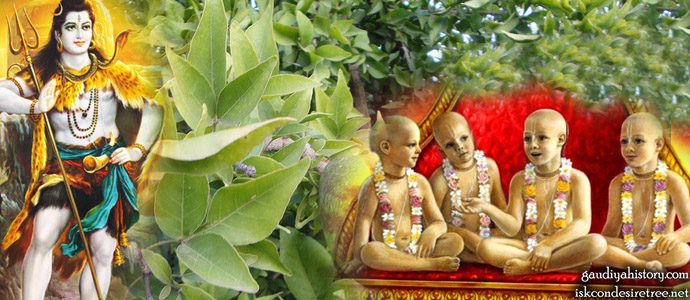
"Nimbarka," said Lord Shiva, "at the edge of this village is a sacred bael forest. There, in that forest, the four Kumaras are absorbed in meditation. By their mercy you will receive transcendental knowledge, for they are your spiritual masters, and by rendering service unto them you will receive all that is of value." After saying this Lord Shiva disappeared. (In the wallpaper: Lord Shiva, 4 Kumaras and beal tree).
Nimbarka immediately went to that place and with great determination he searched for the four Kumaras in every direction, until he finally found them, shining as brilliantly as the sun. They were seated on a very beautiful natural platform beneath a tree and they appeared like fire blazing on an altar. They were all very young, seeming to be no more than five years in age, but they appeared most noble in character as they sat there naked, rapt in meditation. Nimbarka was so excited that he cried out, "Hare Krishna!"
This sudden sound startled the four brothers, breaking their meditation. Opening their eyes, they saw before them the blissful form of an ideal Devotee, and with great pleasure they embraced Nimbarka, one after another.
"Who are you," they asked, "and why have you come here? We are certainly ready to answer all your prayers."
Nimbarka fell at the feet of the four brothers like a rod, and with great humility he introduced himself.
With a sweet smile on his face Sanat Kumara then said, "The all-merciful Supreme Personality of Godhead, knowing that Kali-yuga will be extremely troublesome for the living entities, resolved to proagate devotional service to Himself. With this goal in mind, He has empowered four personalities with devotion and sent them into this world to preach. Ramanuja, Madhva, and Vishnuswami are three and you are the fourth of these great souls. Lakshmi accepted Ramanuja as a disciple, Brahma accepted Madhva, Rudra accepted Vishnuswami and meeting you today we have the good fortune of being able to instruct you. This is our intention. Previously we were engaged in meditating on the impersonal Brahman, but by the causeless mercy of Lord Vishnu, we have been relieved of this sinful activity. Since I have realised that it is essential to preach pure devotional service, I have composed a literary work entitled Sanat Kumara Samhita. After taking initiation from me, you should follow the instructions I have set forth therein."
Nimbarka was greatly enlivened at the prospect of taking initiation and he immediately ran to take bath in the Ganges. After this he quickly returned and prostrated himself once more before the effulgent brothers.
"O deliverers of the fallen," said Nimbarka, in all humility, "please deliver this low-born rascal."
The four Kumaras gave him the Radha-Krishna mantra and instructed him in the method of worshipping Radha and Krishna with the sentiments of great love called Bhava Marga.
In that sacred bael forest Nimbarka began to worship Shri Shri Radha Krishna according to the Sanat Kumara Samhita and he chanted the mantra they had given him. Very soon Radha and Krishna revealed Themselves to Nimbarka. They stood before him, spreading an effulgence which illuminated all directions. In sweet voices They addressed him thus: "Nimbarka, you are very fortunate, for you have performed Sadhana in Shri Navadwipa. We both combine, and assume one form, as the son of Sachidevi." At that moment Radha and Krishna combined and displayed Their form of Gauranga.
Beholding this splendid vision, Nimbarka began to tremble. "Never," he said, "Never have I ever seen or heard of such a form at any time."
Lord Gauranga then said, "Keep this form, which I now show you, a secret for the time being. Just preach about devotional service and the pastimes of Radha and Krishna, for I gain great satisfaction from this. When I make My appearance and perform My education pastimes, you will also appear. Taking birth in Kashmir as a great pandit, you will tour all over India defeating all opposition. Your reputation and learning will be celebrated everywhere and you will be known as Keshava Kashmiri. Whilst wandering in Shri Navadwipa you will come to Shri Mayapur. Simply by hearing your name all the great pandits of Navadwipa will flee. Intoxicated with scholastic pride, I will take great pleasure in defeating you. However, by the mercy of Mother Saraswati, the goddess of learning, you will realize My true identity. Giving up your false pride, you will take shelter of Me and I will reward you with the supreme gift of loving devotional service and will again despatch you to preach. Thus you can satisfy Me by preaching the philosophy of dvaita-advaita. Keep My identity a secret. In the future when I begin My sankirtan movement, I will personally preach, taking the essence of your philosophy and the philosophies of Madhva, Ramanuja and Vishnuswami."
After instructing Nimbarka in this way, Lord Gauranga disappeared, and filled with intense ecstacy, Nimbarka began to shed tears of love. After worshipping the lotus feet of his gurus and taking their permission, he left Shri Navadwipa to begin his preaching mission.
(Source: Shri Navawipa-dham mahatmya)
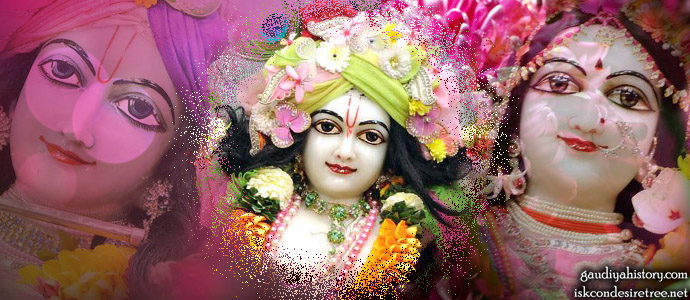
...Just preach about devotional service and the pastimes of Radha and Krishna, for I gain great satisfaction from this...(In the wallpaper: Shri Shri Radha Gopinath, Shri Gaura Chandra, ISKCON Chowpatty, Mumbai).
Nimbarkacharya – Biography
Sri Nimbarka Acarya comes in the line of the Kumara Sampradaya and is believed to have lived around the 11th and 12th centuries. Born in the modern Murgarapattam in the southern Dravidian province, he was the son of Aruni and Jayanti, a very pious brahman a couple of the Tailanga order.
He was a great ascetic of the Tridandi order. He wrote many books according to the Dvaitadvaitavada and he lived most of his devotional life at a place called Nimbagrama near Govardhana at Vrindavana.
While at Nimbagrama, he defeated a great Jain pandit in a discussion. The Jain had refused to dine with him saying that the Sun had already set and so he would not take any food. At this, Nimbarka by his own potency made the sun appear from a Nimba tree and the astonished Jain accepted his hospitality. It is said that his name Nimbarka or Nimbaditya has been derived from this miracle of Aditya or Arka meaning sun from a nimba tree.
Once in a village near the forest of Bilva Paksha, a group of brahmanas came to engage in the worship of Lord Siva. Just as Lord Visnu is very much pleased when He is offered the leaves of His most beloved Tulasi, so Lord Siva is pleased by offerings of leaves from the bilva or bael tree. Thus the brahmanas worshipped Lord Siva by offering bilva leaves, for a period of one fortnight and satisfied Lord Siva greatly.
Amongst those brahmanas was one whose name was Nimbarka. He had been particularly attentive in his worship of Lord Siva. Being especially pleased with Nimbarka's devotion, Lord Siva personally appeared to him.
"Nimbarka," said Lord Siva, "at the edge of this village is a sacred bael forest. There, in that forest, the four Kumaras are absorbed in meditation. By their mercy you will receive transcendental knowledge, for they are your spiritual masters, and by rendering service unto them you will receive all that is of value." After saying this Lord Siva disappeared.
Nimbarka immediately went to that place and with great determination he searched for the four Kumaras in every direction, until he finally found them, shining as brilliantly as the sun. They were seated on a very beautiful natural platform beneath a tree and they appeared like fire blazing on an altar. They were all very young, seeming to be no more than five years in age, but they appeared most noble in character as they sat there naked, rapt in meditation. Nimbarka was so excited that he cried out, "Hare Krsna!"
This sudden sound startled the four brothers, breaking their meditation. Opening their eyes, they saw before them the blissful form of an ideal devotee, and with great pleasure they embraced Nimbarka, one after another.
"Who are you," they asked, "and why have you come here? We are certainly ready to answer all your prayers."
Nimbarka fell at the feet of the four brothers like a rod, and with great humility he introduced himself.
With a sweet smile on his face Sanat Kumara then said, "The all-merciful Supreme Personality of Godhead, knowing that Kali-yuga will be extremely troublesome for the living entities, resolved to proagate devotional service to Himself. With this goal in m ind, He has empowered four personalities with devotion and sent them into this world to preach. Ramanuja, Madhva, and Visnuswami are three and you are the fourth of these great souls. Laksmi accepted Ramanuja as a disciple, Brahma accepted Madhva, Rudra accepted Visnuswami and meeting you today we have the good fortune of being able to instruct you. This is our intention. Previously we were engaged in meditating on the impersonal Brahman, but by the causeless mercy of Lord Visnu, we have been relieved of this sinful activity. Since I have realised that it is essential to preach pure devotional service, I have composed a literary work entitled Sanat Kumara Samhita. After taking initiation from me, you should follow the instructions I have set forth therein."
Nimbarka was greatly enlivened at the prospect of taking initiation and he immediately ran to take bath in the Ganges. After this he quickly returned and prostrated himself once more before the effulgent brothers.
"O deliverers of the fallen," said Nimbarka, in all humility, "please deliver this low-born rascal."
The four Kumaras gave him the Radha-Krsna mantra and instructed him in the method of worshipping Radha and Krsna with the sentiments of great love called Bhava Marga.
In that sacred bael forest Nimbarka began to worship Sri Sri Radha Krsna according to the Sanat Kumara Samhita and he chanted the mantra they had given him. Very soon Radha and Krsna revealed Themselves to Nimbarka. They stood before him, spreading an effulgence which illuminated all directions. In sweet voices They addressed him thus: "Nimbarka, you are very fortunate, for you have performed Sadhana in Sri Navadwipa. We both combine, and assume one form, as the son of Sacidevi." At that moment Radha and Krsna combined and displayed Their form of Gauranga.
Beholding this splendid vision, Nimbarka began to tremble. "Never," he said, "Never have I ever seen or heard of such a form at any time."
Lord Gauranga then said, "Keep this form, which I now show you, a secret for the time being. Just preach about devotional service and the pastimes of Radha and Krsna, for I gain great satisfaction from this. When I make My appearance and perform My education pastimes, you will also appear. Taking birth in Kashmir as a great pandit, you will tour all over India defeating all opposition. Your reputation and learning will be celebrated everywhere and you will be known as Kesava Kashmiri. Whilst wandering in Sri Navadwipa you will come to Sri Mayapur. Simply by hearing your name all the great pandits of Navadwipa will flee. Intoxicated with scholastic pride, I will take great pleasure in defeating you. However, by the mercy of Mother Sarasvati, the goddess o f learning, you will realize My true identity. Giving up your false pride, you will take shelter of Me and I will reward you with the supreme gift of loving devotional service and will again despatch you to preach. Thus you can satisfy Me by preaching the philosophy of dvaita-advaita. Keep My identity a secret. In the future when I begin My sankirtan movement, I will personally preach, taking the essence of your philosophy and the philosophies of Madhva, Ramanuja and Visnuswami."
After instructing Nimbarka in this way, Lord Gauranga disappeared, and filled with intense ecstacy, Nimbarka began to shed tears of love. After worshipping the lotus feet of his gurus and taking their permission, he left Sri Navadwipa to begin his preaching mission.
(Source: Sri Navawipa-dham mahatmya)
Madhavi Devi
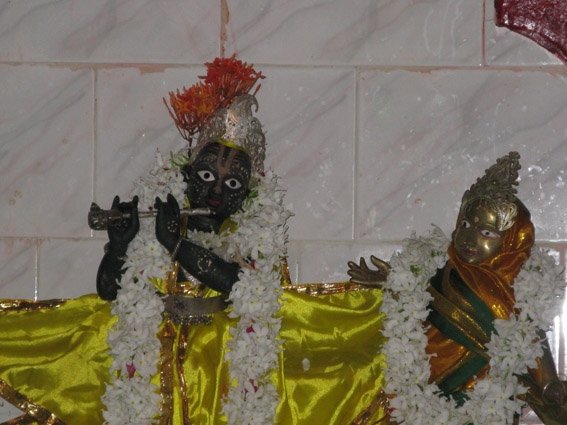
Shri Shri Radha Gopinatha-worshipped by Madhavi Devi, Bentapur-place close to Puri).
In the Antya-lila of Chaitanya-charitamrta there is a description of Madhavi Devi.
mahitira bhagini sei, nama—madhavi-devi
vrddha tapasvini ara parama vaisnavi
(C.C.3.2.104)
Sikhi Mahiti’s sister was named Madhavi Devi. She was an elderly lady who always performed austerities. She was very advanced in devotional service.
Chaitanya Mahaprabhu had three and a half very confidential Devotees. The three are mentioned below.
svarupa gosañi, ara raya ramananda
sikhi-mahiti—tina, tanra bhagini—ardha-jana
(C.C.3.2.106)
The three were Svarupa Damodara Goswami, Ramananda Raya and Sikhi Mahiti, and the half a person was Sikhi Mahiti’s sister, Madhavi Devi.
Shrila Prabhupad writes in purport: In the Gaura-ganoddesa-dipika (189) it is said that Sikhi Mahiti was formerly an assistant of Shrimati Radharani named Ragalekha. His sister Madhavi was also an assistant of Shrimati Radharani and was named Kalakeli. Sikhi Mahiti, Madhavi and their brother Murari Mahiti were all unalloyed Devotees of Shri Chaitanya Mahaprabhu. He and his brother and sister always engaged in rendering service to the Lord.
prabhu lekha kare yare—radhikara ‘gana’
jagatera madhye ‘patra’—sade tina jana
(C.C.3.2.105)
Shri Chaitanya Mahaprabhu accepted her as having formerly been an associate of Shrimati Radharani. In the entire world, three and a half people were His intimate Devotees.
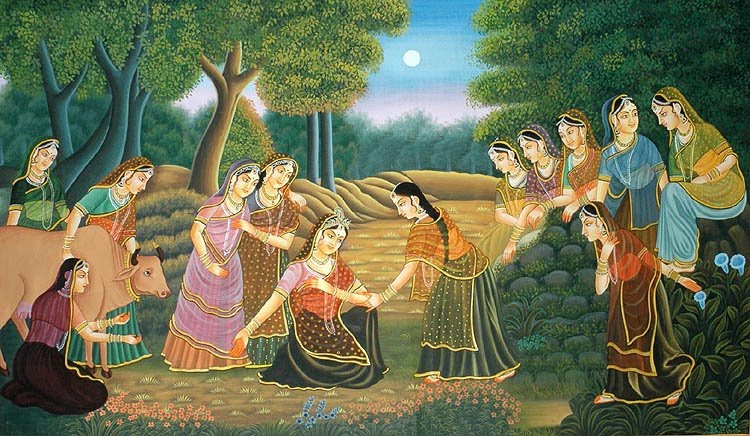
Shri Chaitanya Mahaprabhu accepted her as having formerly been an associate of Shrimati Radharani. In the entire world, three and a half people were His intimate Devotees. (In the image: Shrimati Radharani and Her Gopi friends).
Murari Mahiti
Murari Mahiti is younger brother of Sikhi Mahiti. His sister is Madhavi Devi. Murari Mahiti constantly associated with Chaitanya Mahaprabhu while He resided in Jagannatha Puri.
All three were unalloyed Devotees of Shri Chaitanya Mahaprabhu who could not forget Him for a moment of their lives.
Murari Mahiti is the younger brother of Sikhi Mahiti.
murari mahati inha-sikhi-mahatira bhai
tomara carana vinu ara gati nai
(C.C.2.10.44)
“This is Murari Mahiti, the brother of Sikhi Mahiti. He has nothing other than Your lotus feet."
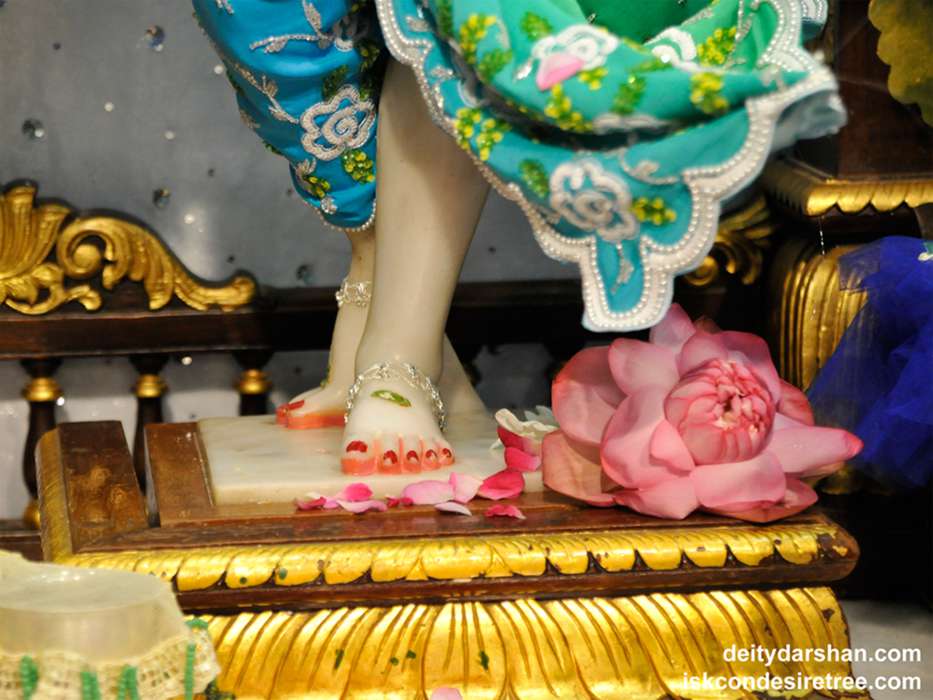
“This is Murari Mahiti, the brother of Sikhi Mahiti. He has nothing other than Your lotus feet." (In the image: The lotus feet of Shri Gaurachandra, ISKCON Chowpatty, Mumbai).
prataparudra raja, ara odhra krsnananda
paramananda mahapatra, odhra sivananda
bhagavan acarya, brahmanandakhya bharati
sri-sikhi mahiti, ara murari mahiti
(C.C. 1.10.135-136)
King Prataparudra of Orissa, the Oriya Devotees Krishnananda and Shivananda, and Paramananda Mahapatra, Bhagavan Acharya, Brahmananda Bharati, Shri Sikhi Mahiti and Murari Mahiti constantly associated with Chaitanya Mahaprabhu while He resided in Jagannatha Puri.
Chaitanya Mahaprabhu had three and a half very confidential Devotees. The three are mentioned below.
svarupa gosañi, ara raya ramananda
sikhi-mahiti—tina, tanra bhagini—ardha-jana
(C.C.3.2.106)
The three were Svarupa Damodara Goswami, Ramananda Raya and Sikhi Mahiti, and the half a person was Sikhi Mahiti’s sister.
In the Gaura-ganoddesha-dipika (189) Murari Mahiti's brother and sister are described as follows. Sikhi Mahiti was formerly an assistant of Shrimati Radharani named Ragalekha. His sister Madhavi was also an assistant of Shrimati Radharani and was named Kalakeli. 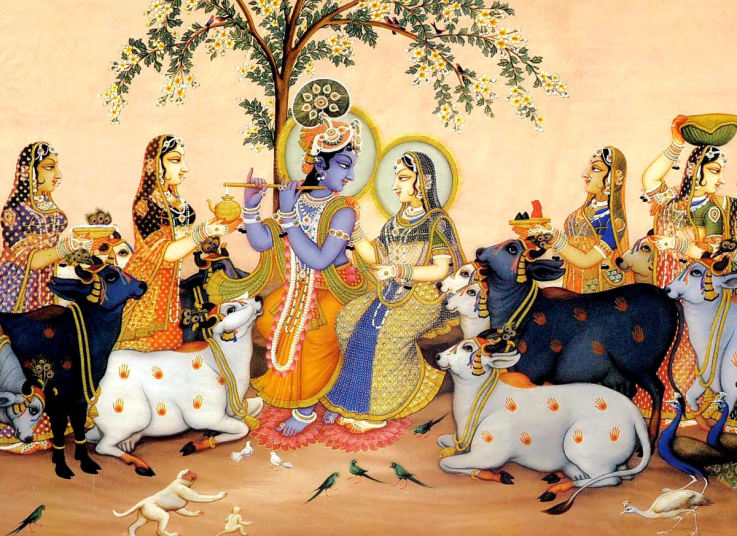
Sikhi Mahiti was formerly an assistant of Shrimati Radharani named Ragalekha. His sister Madhavi was also an assistant of Shrimati Radharani and was named Kalakeli. (In the image: Shri Shri Radha Krishna and Their Associates).
Shikhi Mahiti Biography
Shikhi Mahiti was one of the most confidential Devotee of Shri Chaitanya Mahaprabhu. He constantly associated with Chaitanya Mahaprabhu while He resided in Jagannatha Puri. His younger sister was Madhavi Devi and brother Murari Mahiti.
Chaitanya Mahaprabhu had three and a half very confidential Devotees. The three are mentioned below.
svarupa gosañi, ara raya ramananda
shikhi-mahiti—tina, tanra bhagini—ardha-jana
(C.C.3.2.106)
The three were Svarupa Damodara Goswami, Ramananda Raya and Shikhi Mahiti, and the half a person was Shikhi Mahiti’s sister, Madhavi Devi.
prataparudra raja, ara odhra krsnananda
paramananda mahapatra, odhra sivananda
bhagavan acarya, brahmanandakhya bharati
sri-shikhi mahiti, ara murari mahiti
(C.C. 1.10.135-136)
King Prataparudra of Orissa, the Oriya Devotees Krishnananda and Shivananda, and Paramananda Mahapatra, Bhagavan Acharya, Brahmananda Bharati, Shri Shikhi Mahiti and Murari Mahiti constantly associated with Chaitanya Mahaprabhu while He resided in Jagannatha Puri.
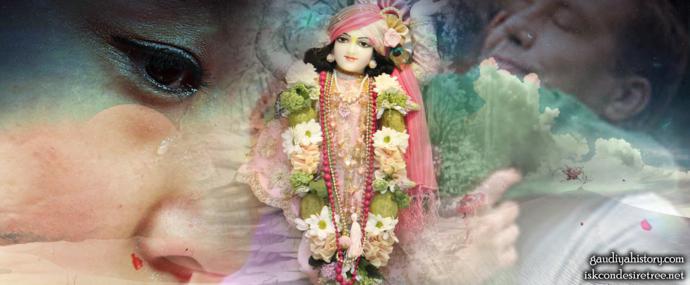
The Lord was so magnanimous that He immediately embraced Shikhi Mahiti, exclaiming, “You are the elder brother of Murari!” Being thus embraced, Shikhi Mahiti felt ecstatic transcendental bliss. Thus he and his brother and sister always engaged in rendering service to the Lord. (In the wallpaper: from left to right girl, Shri Vijaya Gauranga, ISKCON Germany, Cologne, people embracing each other).
Shrila Prabhupaad writes in purport:
In the Gaura-ganoddesha-dipika (189) it is said that Shikhi Mahiti was formerly an assistant of Shrimati Radharani named Ragalekha. His sister Madhavi was also an assistant of Shrimati Radharani and was named Kalakeli. Shikhi Mahiti, Madhavi and their brother Murari Mahiti were all unalloyed Devotees of Shri Chaitanya Mahaprabhu who could not forget Him for a moment of their lives. There is a book in the Oriya language called Chaitanya-charita-mahakavya, in which there are many narrations about Shikhi Mahiti. One narration concerns his seeing an ecstatic dream. Shikhi Mahiti always engaged in serving the Lord in his mind. One night, while he was rendering such service, he fell asleep, and while he was asleep his brother and sister came to awaken him. At that time he was in full ecstasy because he was having a wonderful dream that Lord Chaitanya, while visiting the Temple of Jagannatha, was entering and again coming out of the body of Jagannatha and looking at the Jagannatha Deity. Thus as soon as he awakened he embraced his brother and sister and informed them, “My dear brother and sister, I have had a wonderful dream that I shall now explain to you. The activities of Lord Chaitanya Mahaprabhu, the son of Mother Sachi, are certainly most wonderful. I saw that Lord Chaitanya Mahaprabhu, while visiting the Temple of Jagannatha, was entering the body of Jagannatha and again coming out of His body. I am still seeing the same dream. Do you think I have become deranged? I am still seeing the same dream! And the most wonderful thing is that as soon as I came near Chaitanya Mahaprabhu, He embraced me with His long arms.” As Shikhi Mahiti spoke to his brother and sister in this way, his voice faltered and there were tears in his eyes. Thus the brothers and sister went to the Temple of Jagannatha, and there they saw Lord Chaitanya in the Jagamohana kirtana hall, looking at the beauty of the Shri Jagannatha Deity just as in Shikhi Mahiti’s dream. The Lord was so magnanimous that He immediately embraced Shikhi Mahiti, exclaiming, “You are the elder brother of Murari!” Being thus embraced, Shikhi Mahiti felt ecstatic transcendental bliss. Thus he and his brother and sister always engaged in rendering service to the Lord.
It is said that Shikhi Mahiti out of humility never visited Vrindavana-dhama.
tabu vrndavana yaha’ loka sikhaite
seita karibe, tomara yei laya citte
(C.C.2.16.281)
Shrila Prabhupaad writes in purport:
Shri Pundarika Vidyanidhi, Shri Haridasa Thakura, Shrivasa Pandita, Shivananda Sena, Shri Ramananda Raya, Shri Shikhi Mahiti, Shri Madhavi Devi and Shri Gadadhara Pandita Goswami never visited Vrindavana-dhama.
Murari Mahiti is the younger brother of Shikhi Mahiti.
murari mahati inha-shikhi-mahatira bhai
tomara carana vinu ara gati nai
(C.C.2.10.44)
“This is Murari Mahiti, the brother of Shikhi Mahiti. He has nothing other than Your lotus feet.
Madhavidevi is the younger sister of Shikhi Mahiti.
madhavi-devi—shikhi-mahitira bhagini
sri-radhara dasi-madhye yanra nama gani
(C.C. 1.10.137)
Madhavi Devi, the seventeenth of the prominent Devotees, was the younger sister of Shikhi Mahiti. She is considered to have formerly been a maidservant of Shrimati Radharani.
In the Antya-lila of Chaitanya-charitamrta there is a description of Madhavi Devi.
mahitira bhagini sei, nama—madhavi-devi
vrddha tapasvini ara parama vaisnavi
(C.C.3.2.104)
Shikhi Mahiti’s sister was named Madhavi-devi. She was an elderly lady who always performed austerities. She was very advanced in devotional service.
prabhu lekha kare yare—radhikara ‘gana’
jagatera madhye ‘patra’—sade tina jana
(C.C.3.2.105)
Shri Chaitanya Mahaprabhu accepted her as having formerly been an associate of Shrimati Radharani. In the entire world, three and a half people were His intimate Devotees.
Ser Khan
He was a Pathan. Later his Vaishnava name was Chaitanya dasa. He was a disciple of Shyamananda prabhu. A political representative of the Muslim Emperor, Ser Khan was possibly the ruler of Ambua Dharenda Pargana in Orissa.
Prema vilasa 19 writes as follows: One day Shyamananda prabhu was passing with his followers singing kirtana. At that time Ser Khan arrived there and ordered Shyamananda to stop singing. When Shyamananda refused to comply, Ser Khan crushed their mrdanga and began harassing them. Shyamananda could not tolerate seeing his Devotees harassed and burst into a loud roar, which made Ser Khan severely ill and he vomited blood. Out of fear, Ser Khan and his followers humbly surrendered at the feet of Shyamananda. All of them took spiritual initiation from Shyamananda and became ardent Vaishnavas. 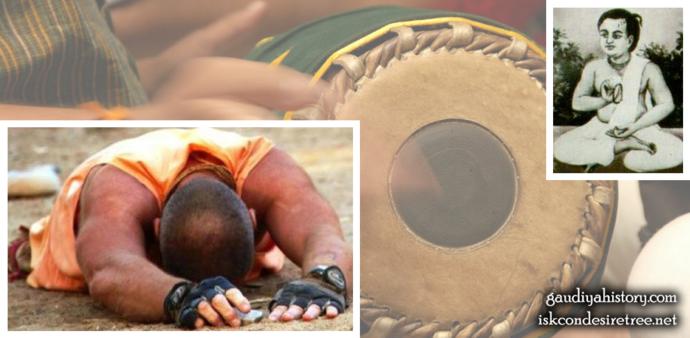
One day Shyamananda prabhu was passing with his followers singing kirtana. At that time Ser Khan arrived there and ordered Shyamananda to stop singing. When Shyamananda refused to comply, Ser Khan crushed their mrdanga and began harassing them. Shyamananda could not tolerate seeing his Devotees harassed and burst into a loud roar, which made Ser Khan severely ill and he vomited blood. Out of fear, Ser Khan and his followers humbly surrendered at the feet of Shyamananda. All of them took spiritual initiation from Shyamananda and became ardent Vaishnavas. (In the wallpaper: A Devotee, mridanga, Shyamananda Prabhu).
Satyaraja Khan
kulinagrama-vasi satyaraja, ramananda
yadunatha, purusottama, sankara, vidyananda
(CC. 1.10.80)
Satyaraja, Ramananda, Yadunatha, Purushottama, Shankara and Vidyananda all belonged to the twentieth branch.
He was an inhabitants of the village known as Kulina-grama and a descendent of Shri Gunaraja Khan.
In his past incarnation he was Sukanthi of Vraja.
Kalakantha-devi and Sukantha-devi, the two Gandharva-dancers who appeared in Vrajabhumi, also appeared as Ramananda Vasu and Satyaraja. (GGD 173).
CC Madhya 15.98: The Lord then with great respect extended an invitation to all the inhabitants of Kulina-grama, asking them to come every year and bring silken rope to carry Lord Jagannatha during the Ratha-yatra festival.
Lord Chaitanya explained to the residents of Kulina-grama the various stages of a Devotees advancement (CC. 2.15.104-111, 2.16.69-75)
CC Madhya 15.99: Shri Chaitanya Mahaprabhu then said, "Gunaraja Khan of Kulina-grama compiled a book named Shri Krishna-vijaya, in which there is a sentence revealing the author's ecstatic love of Krishna."
CC Madhya 15.100: Shri Chaitanya Mahaprabhu said, "'Krishna, the son of Nanda Maharaja, is my life and soul.' By this statement I am sold into the hands of the descendants of Gunaraja Khan. 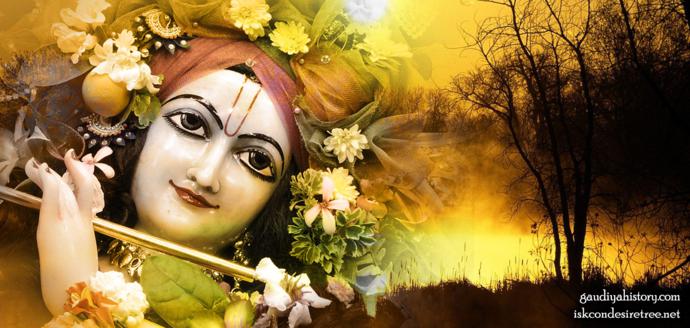
'Krishna, the son of Nanda Maharaja, is my life and soul.' By this statement I am sold into the hands of the descendants of Gunaraja Khan. (In the wallpaper: Shri Gopinath, ISKCON Chowpatty, Mumbai).
CC Madhya 15.101: "To say nothing of you, even a dog living in your village is very dear to Me. What, then, to speak of others?"
CC Madhya 15.102: After this, Ramananda Vasu and Satyaraja Khan both submitted questions at the lotus feet of Shri Chaitanya Mahaprabhu.
CC Madhya 15.103: Satyaraja Khan said, "My dear Lord, being a householder and a materialistic man, I do not know the process of advancing in spiritual life. I therefore submit myself unto Your lotus feet and request You to give me orders."
CC Madhya 15.104: Shri Chaitanya Mahaprabhu replied, "Without cessation continue chanting the Holy Name of Lord Krishna. Whenever possible, serve Him and His Devotees, the Vaishnavas."
CC Madhya 15.105: Upon hearing this, Satyaraja said, "How can I recognize a Vaishnava? Please let me know what a Vaishnava is. What are his common symptoms?"
CC Madhya 15.106: Shri Chaitanya Mahaprabhu replied, "Whoever chants the Holy Name of Krishna just once is worshipable and is the topmost human being.
CC Madhya 15.107: "Simply by chanting the Holy Name of Krishna once, a person is relieved from all the reactions of a sinful life. One can complete the nine processes of devotional service simply by chanting the Holy Name.
CC Madhya 15.108: "One does not have to undergo initiation or execute the activities required before initiation. One simply has to vibrate the Holy Name with his lips. Thus even a man in the lowest class [chanḍala] can be delivered.
CC Madhya 15.109: "By chanting the Holy Name of the Lord, one dissolves his entanglement in material activities. After this, one becomes very much attracted to Krishna, and thus dormant love for Krishna is awakened.
CC Madhya 15.110: "'The Holy Name of Lord Krishna is an attractive feature for many saintly, liberal people. It is the annihilator of all sinful reactions and is so powerful that, save for the dumb who cannot chant it, it is readily available to everyone, including the lowest type of man, the chanḍala. The Holy Name of Krishna is the controller of the opulence of liberation, and it is identical with Krishna. When a person simply chants the Holy Name with his tongue, immediate effects are produced. Chanting the Holy Name does not depend on initiation, pious activities or the puraścarya regulative principles generally observed before initiation. The Holy Name does not wait for any of these activities. It is self-sufficient.'"
CC Madhya 15.111: Shri Chaitanya Mahaprabhu then finally advised, "One who is chanting the Hare Krishna mantra is understood to be a Vaishnava; therefore you should offer all respects to him."
CC Madhya 16.69: As in the previous year, one of the inhabitants of Kulina-grama submitted a petition to the Lord, saying, "My Lord, kindly tell me what my duty is and how I should execute it."
CC Madhya 16.70: The Lord replied, "You should engage yourself in the service of the servants of Krishna and always chant the Holy Name of Krishna. If you do these two things, you will very soon attain shelter at Krishna's lotus feet."
CC Madhya 16.71: The inhabitant of Kulina-grama said, "Please let me know who is actually a Vaishnava and what his symptoms are." Understanding his mind, Shri Chaitanya Mahaprabhu smiled and gave the following reply. 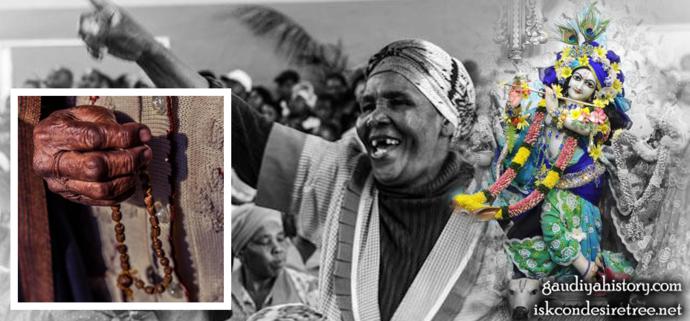
CC Madhya 15.110: "'The Holy Name of Lord Krishna is an attractive feature for many saintly, liberal people. It is the annihilator of all sinful reactions and is so powerful that, save for the dumb who cannot chant it, it is readily available to everyone, including the lowest type of man, the chanḍala. The Holy Name of Krishna is the controller of the opulence of liberation, and it is identical with Krishna. When a person simply chants the Holy Name with his tongue, immediate effects are produced. Chanting the Holy Name does not depend on initiation, pious activities or the puraścarya regulative principles generally observed before initiation. The Holy Name does not wait for any of these activities. It is self-sufficient.'" (In the wallpaper: Sankirtana Yagya in Durban, Africa, Shri Gopinath, ISKCON Chowpatty, Mumbai, a japa mala).
CC Madhya 16.72: "A person who is always chanting the Holy Name of the Lord is to be considered a first-class Vaishnava, and your duty is to serve his lotus feet."
CC Madhya 16.73: The following year, the inhabitants of Kulina-grama again asked the Lord the same question. Hearing this question, Shri Chaitanya Mahaprabhu again taught them about the different types of Vaishnavas.
CC Madhya 16.74: Shri Chaitanya Mahaprabhu said, "A first-class Vaishnava is he whose very presence makes others chant the Holy Name of Krishna."
CC Madhya 16.75: In this way, Shri Chaitanya Mahaprabhu taught the distinctions between different types of Vaishnavas — the Vaishnava, Vaishnavatara and Vaishnavatama. He thus successively explained all the symptoms of a Vaishnava to the inhabitants of Kulina-grama.
Shrila Prabhupada writes in purport of CC Madhya 15.99 about Shri Gunaraja Khan:
Shri Krishna-vijaya is a book of poems considered to be the first poetry book written in Bengal. Shrila Bhaktisiddhanta Saraswati Thakura states that this book was begun in the year 1395 Sakabda (A.D. 1473). After seven years, it was completed (in 1402 Sakabda). This book was written in plain language, and even half-educated Bengalis and women could read it very clearly. Even ordinary men with little knowledge of the alphabet could read this book and understand it. Its language is not very ornamental, and sometimes the poetry is not very sweet to hear. Although according to the sonnet style each line should contain fourteen syllables, there are sometimes sixteen, twelve or thirteen syllables in his verse. Many words used in those days could be understood only by local inhabitants, yet this book is still so popular that no bookstore is complete without it. It is very valuable for those who are interested in advancing in Krishna consciousness.
Shri Gunaraja Khan was one of the topmost Vaishnavas, and he translated the Tenth and Eleventh Cantos of Shrimad-Bhagavatam for the understanding of the common man. The book Shri Krishna-vijaya was highly praised by Shri Chaitanya Mahaprabhu, and it is very valuable for all Vaishnavas. Shrila Bhaktisiddhanta Saraswati Thakura gives a genealogical table and family history of Gunaraja Khan. When a Bengali emperor named Adisura first came from Kanyakubja, or Kanauj, he brought with him five brahmanas and five kayasthas. Since the king is supposed to be accompanied by his associates, the brahmanas accompanied the King to help him in higher spiritual matters. The kayasthas were to render other services. In the northern Indian high country, the kayasthas are accepted as shudras, but in Bengal the kayasthas are considered among the higher castes. It is a fact that the kayasthas came to Bengal from northern India, specifically from Kanyakubja, or Kanauj. Shrila Bhaktisiddhanta Saraswati Thakura says that the kayasthas who came from Kanyakubja were high-class men. Of them, Dasharatha Vasu was a great personality, and the thirteenth generation of his family included Gunaraja Khan.
His real name was Maladhara Vasu, but the title Khan was given to him by the Emperor of Bengal. Thus he became known as Gunaraja Khan. Bhaktisiddhanta Saraswati Thakura gives the following genealogical table of Gunaraja Khan: (1) Dasharatha Vasu; (2) Kushala; (3) Subhashankara; (4) Hamsa; (5) Saktirama (Baganda), Muktirama (Mainagara) and Alankara (Bangaja); (6) Damodara; (7) Anantarama; (8) Guninayaka and Vinanayaka. The twelfth generation included Bhagiratha, and the thirteenth Maladhara Vasu, or Gunaraja Khan. Shri Gunaraja Khan had fourteen sons, of whom the second son, Lakshminatha Vasu, received the title Satyaraja Khan. His son was Shri Ramananda Vasu; therefore Ramananda Vasu belonged to the fifteenth generation. Gunaraja Khan was a very well known and wealthy man. His palace, fort and temples are still existing, and from these we can deduce that the opulence of Gunaraja Khan was certainly very great. Shri Gunaraja Khan never cared for the artificial aristocracy introduced by Ballal Sena. 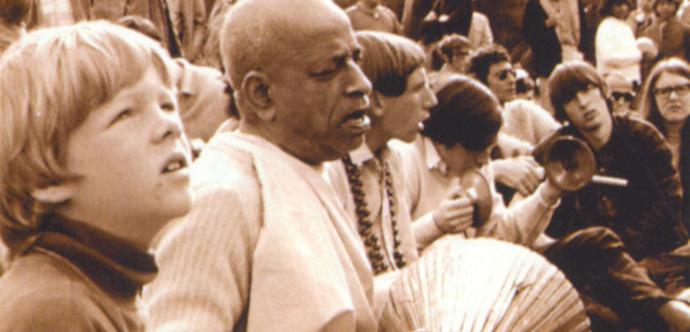
A first-class Vaishnava is he whose very presence makes others chant the Holy Name of Krishna. (In the image: Shrila Prabhupada leading kirtan, Tompkins Park, USA).