Author Archives: Sevak

Yamunacharya

Biography of Yamunacharya by Shri Madhavakkannan
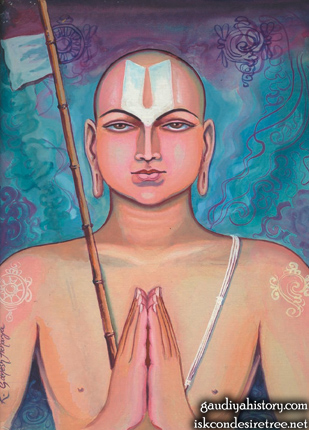
Yamunacharya

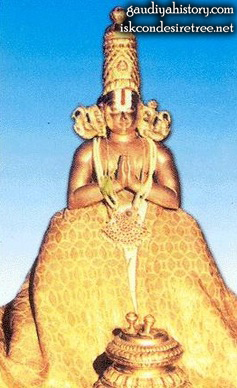
Yamunacharya.

   Yamunacharya is the grand -Acharya (Pracharya ) of Ramanujacharya (1017 AD to 1137 AD). He  established the principles of Visisht Adhvaita as an expansion of the doctrines housed in his grandfather's treatises and elaborated on those doctrines with authoritative scriptures such as Sruthis, Bhagavadh Gita , Azhwar's pasurams and Selected Satvika Puranas.

   Once an arrogant vidwan by name Akkiyalvan was challenging and humiliating learned men. Yamuna (as a 16 year old boy) accepted the challenge and went to the court to argue with him. The queen was so impressed with the boy that she told the king and pursuaded him to give away half the kingdom if he won in the debate and offered herself to be thrown to wild dogs, if the boy failed. Akkiyalvan asked the boy to state three propositions positive or negative which he offered to counter. And, if he could not, the boy would be declared the winner.

Yamuna asked (or stated) three statements. He asked Akkialwan to counter.

   ( i ) Your mother is not a barren woman-Naturally he could not counter saying that his mother is a barren woman (he is very much standing in front of Yamunacharya).

   ( ii ) The king is a righteous and powerful ruler – Obviusoly he can not afford to conuter this. and

   ( iii ) The queen is a model of chastity. – oh no! Never can he counter this.

   Akkialvan accepted defeat and the King now asked Yamuna to disprove his own statements.

Yamuna clarified by observing the following:-

   ( i ) The sacred laws say that an only son is no son at all. So, Akkiyalvan's mother was as good as barren in the eyes of the law.
 
   ( ii ) The king cannot be called righteous when he entertained such an arrogant person to be his chaplain and his not dismissing the chaplain showed that the king was indeed powerless.

   ( iii ) According to the Shruti texts, every woman is wedded first to Soma, then Gandharva and then Agni before marrying her earthly partner. The queen was no exception and therefore cannot be deemed a model of chastity.

   (This is only to drive home a point that logic can not be the solution fully. One needs to fall back on Saasthras and Shruthi/Smrthis for pramanams.)
 
   The King sent Akkiyalvan out of his kingdom and gave Yamuna half his kingdom. The queen hailed the boy as "Alavandhaar"- One who came to save me.

   Thus, Alavandar has become the king and could not attend to spiritual pursuits further.

   Meanwhile, Rama Mishra (manakkaal nambhi) was trying to catch Yamunacharya's attention to fulfil his promise to his Guru to install Alavandar as the spiritual successor to Nathamuni.. But, he could not meet Alavandar, being a king now to discuss the matter. He came out with an idea. He came to know that the king relishes thoodhu vaLai keerai (kind of spinach). He supplied that spinach to the royal kitchen daily. After few months, he stopped. The king asked the cook as to why the spinach is not being served. They replied saying "one brahmin used to supply. He does not come nowdays." Alavandhar told them that he would like to meet him, if he comes next. Next day, they met each other.

   Rama Mishrar told Alavandhar that his grandfather Shri Nathamuni had passed on the family wealth (kula dhanam) that needs to be handed over to Shri Alavandhar. Alavandhar said, "in that case, give me that."
 
   "No. It is not here. Come with me.". He took him all the way to Shrirangam Koil. (Aradha arulamudham podhintha koil). He showed Alavandhar, the Divya mangala vigraham of Shri Ranganathan. Looking at the Lord, in such divine splendour, the divine beauty- and looking (with tears rolling down his cheeks) at those "kariyavaagi, pudai parandhu, miLirndha, sevvariyOdiya, neeNda, ap periya vaaya kaNgaL.." (those dark, well spread, shining, ruddy lined, long, large eyes)-

   He bursts out:

   I have nothing to give you. None at all. I have no quailifications. I am not religious. What a Great person my Grand Father was! What am I! I have no one but You(the embodiment of mercy! Compassion!) as my refuge. He performed Sharanagathy at the Lotus Feet of Lord Ranganathan.

na dharma nishtOsmi na chaatma vedi
na bhaktimaan tvaccharan Aravinde
akinchanoananyagatih saranya!
tvat paadamoolam saranam prapadye
.  

(Sthothra Rathnam- 22nd sloka)

   Oh you worthy of being sought as refuge! I am not one established in Dharma, nor am I a knower of the self. I have no fervent devotion to Your lotus-feet. Utterly destitute as I am, and having none else for resort, I take refuge under Your feet. (Translation by Swamy Adidevananda)

   Rama Mishra explained the purpose of his mission and requested Alavandar to take over the reins of spiritual leadership bequeathed to him by his illustrious grandfather, Nathamuni. Alavandar took to Sannyas and was then known as Yamuna Muni.

    He has composed for us only.

Aparaaadha-sahasra-bhaajanam
patitam bhiima-bhavaarnav'odare;
agatim saran'aagatam hare!
krpayaa kevalam aatmasaat kuru.

   Oh Shri Hari! pray, make me Your own out of sheer grace – me, who has fallen into the depths of the terrible ocean of worldly existence, and who, being resortless, have sought refuge at your feet.

amaryadha: kshudra: chalamadhi: asuyAprasavabhu
kruthagno dhurmAni smara paravaso vanchanapara
nrusamsa: papishta: kathamahamitho dukkajaladhe
aparath uttheerna: tava parichareyam charanayo

   What a soul stirring slhoka! One can not but cry reciting this, (imagining himself as the hero:-( of the slhoka)

   AlavandhAr describes himself as:

   amaryadha: one who has crossed the bounds of established rules
   kshudra: engaging in trivial /worldly /material/sensual pursuits
   chalamadhi: never steady; (chanchalam), fickle  mind
   asuya prasava bhu : Place where jealousy is born
   kruthagana: Ungrateful one
   dhurmanee: ill feelings towards fellow human beings;
   smara paravasa: Fallen into the gamut of desires and sensual impluses
   vanchanapara: skillfully deceiving others (at cheating others )
   nrusamsa: engaging in violent acts
   paapishta: ( Incorrigible sinner – maha paapi)

   Swamy Desikan says– ahamasmi aparadha chakravartthi. (also meant for us). Swamy desikan also writes in Subashithanivi:

   Source : http://www.saranagathi.org/acharyas/yamuna/index.htm
Yamunacharya

Oh Shri Hari! pray, make me Your own out of sheer grace - me, who has fallen into the depths of the terrible ocean of worldly existence, and who, being resortless, have sought refuge at your feet. (In the wallpaper: Lord Shri Krishna, ISKCON Chennai).
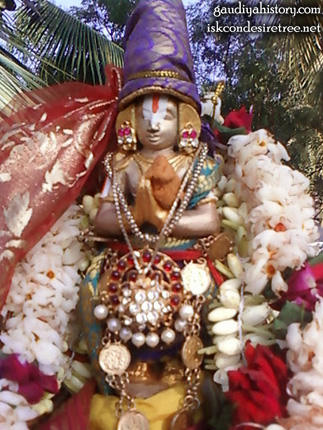
Thiruppaan Alvar


Thiruppaan Alvar

Thiruppaan Alvar.

 Thiruppaan Alvar was born in Purthurmadhi year, Kaarthigai month, on a Wednesday in the Rohini Star (Natshatram) in the small village of "Alagapuri" near Shrirangam in the 8th or 9th century C.E. He was born in "Paanar Cheri". Paanars are a community of musicians and traditional songmakers who are capable of moving their audiences to states of ecstacy and bliss. Tradition goes that because of these skills they had an influence over the Devas (demigods) and Sages. Despite this, the Paanar community were considered as outcastes and were victims of the social dynamics of their times.

   It is said that Alvar is the amsam (significant) of the small mole (tradition has it that all alvars are avatars of some part of the Lord), called as "Shrivatsam" on the chest of Shriman Narayanan. Having a veena in his hand, he was always to be seen singing the glories of Shri Vishnu. He was soon famous in and around these tamil lands of Southern India. His skills as a bhakti musician and his abilities to express and invoke bhakti amongst his listeners, drew audiences from afar. He was soon to be known as "Paanar perumal".

   One of the strictures on outcastes was that they were not to come anywhere near the Cauvery river , considered scared and pure by the people of the region. Following this stricture Paan Perumal did not come anywhere near the Kaveri river, but mostly stood alongside its banks facing the Shrirangam Temple and sung his praises to the Lord.

   The following incident in the life of the Alvar , is considered a "divine play" lila of the Lord. The supreme bhakti and devotion that Paanar held within him had to be brought out and explicated as an example of devotion to the Supreme. As is the wont of the Lord, the other bhaktas of the world had to be made aware of such a soul in their midst.

   One day, a devout Brahmin in the service of the Temple, by name Loka Shaaranga came to the river for taking water for use in the Temple. He motioned to Paanar to move away. But, Paanar was so engrossed in the rhapsody of his music that he did not hear this. Loka Sharanga threw a small stone in his direction to shake him up. But, the stone accidentally fell on the forehead of Paanar and it started to bleed. Paanar quietly retired.

   Unaware of the injury caused, Loka Shaaranga returned to the Temple. He was taken aback on seeing blood oozing out from the forehead of the image of Lord Ranganatha. But, none could connect the two incidents. That very night, the Lord appeared in the dream of Loka Shaaranga and commanded him to fetch Paanar to the Temple the next morning. Accordingly, Loka Sharanga requested Paanar to come to the Temple. But, Paanar referring to his low birth declined even to set foot on the holy earth of Shrirangam lest he pollute the holy place. When he was told of the Lord's commandment, Paanar was beside himself and was lost in a deep trance. Loka Shaaranga said that if that were his objection Paanar could get on his shoulders and he offered to carry Paanar to the Temple. Loka Shaaranga carried Paanar who was in a state of trance. This also earned the Alvar, the sobriquet, Munivaahanar (the one astride a priest).

   When they reached the Sanctum Sanctorum, Paanar experienced the bliss of Ranganatha and composed the 'Amalan Adhipiraan' a poem describing the beauty from head to foot of the Lord in 10 verses and laid his life at the feet of the Lord. The poem is considered to be sweeter than even the 'sound of music' of the Veena.

   Source :   http://en.wikipedia.org/wiki/Thiruppaan_Alvar

Thiruppaan Alvar

When they reached the Sanctum Sanctorum, Paanar experienced the bliss of Ranganatha and composed the 'Amalan Adhipiraan' a poem describing the beauty from head to foot of the Lord in 10 verses and laid his life at the feet of the Lord. The poem is considered to be sweeter than even the 'sound of music' of the Veena. (In the wallpaper: Lord Shri Rangannath Swami, Shri Rangam).

Thirumulisai Alvar

Thirumulisai Alvar

Thirumulisai Alvar.

   Thirumalisai Alvar is a tamil mendicant-saint revered in the Shri Vaishnavism school of south India between the 4th to 9th century CE in Tondai Nadu [now called Kanchipuram and Tiruvallur districts]. There are only little historical records of this alvars. The legend of this saint Devotees of Shri Vaishnavism say that he was the incarnation of Vishnu's disc, Sudarshana. He belonged to Paraiyar caste, he proclaimed that he was "not of the 4 castes" (Brahmin, Kshatriya, Vaishya & Shudra) in one of his couplets as he was considered (Avarna) untouchable and casteless person.

   He had the access and resources to learn about various religions because in one of his couplets he says "After my futile efforts to know the supreme principle through Jainism, and Buddhism I am blessed by Shriman Narayana to take refuge at the Lotus feet of Shri Devi and have escaped all problems and misfortunes since then".

   There is also evidence in his couplets that show that he asked God to help reveal their ignorance to them. Legend also says that when he displeased the pallava king and was banished, he asked the God from the Temple, Yathotkari, to leave with him. Vishnu is said to have rolled up the snake Sesha like a matress and left with him

   Source : http://en.wikipedia.org/wiki/Thirumalisai_Alvar

Peyalvar

   Peyalvar was one of the twelve Alvars and was a Hindu saint. He belonged to the Vaishnavite (worshiper of Vishnu) faith.

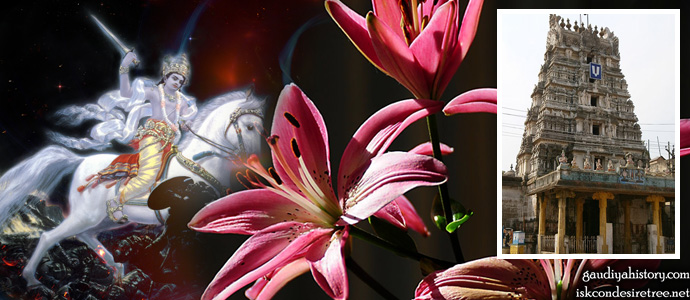
   Peyalvar was born in Tirumayilai (Mylapore, now part of the city of Chennai in the seventh century CE. Vaishnavite traditions state that Peyalvar was found on a lily flower in the pond of the Adi Keshava Perumal Temple in Mylapore. They also believe that he was an incarnation of the sacred sword of Vishnu, Nandakam. Payalvar's 100 hymns in the Naalayira Divyap Prabhandham are the third 100 and start with the words Tiruk Kanden, Pon Meni Kanden ('I found the glorious, golden form of the Lord').

Tiruk Kanden Pon Meni Kanden- Thigazhum
Arukkan Ani Niramum Kanden-Seruk Kilarum
Pon Aazhi Kanden Puri Sangam Kai Kanden
En Aazhi Vannan Paal Inru.

   "On witnessing the glorious vision in which the entire universe was the very body of Lord Narayana, the Alvar proceeds to describe all that he had seen."

   Peyalvar's hymns are of the Anthathi style, in which the last word of the previous hymn is used as the first work in the next hymn.

   Source : http://en.wikipedia.org/wiki/Peyalvar

Peyalvar

Peyalvar was found on a lily flower in the pond of the Adi Keshava Perumal Temple in Mylapore. They also believe that he was an incarnation of the sacred sword of Vishnu, Nandakam. (In the wallpaper: Lord Kalki and His sword, Adi Keshava Temple, Lily flowers).

Nammalvar Alvar

Nammalvar Alvar

Nammalvar Alvar.

   He was born in a small town called Kuruhur, in the southernmost region of the Tamil country Tirunelveli. His father, Kari, was a petty prince who paid tribute to the Pandyan King of Madura.

   He must have been born fully enlightened because as a baby he never cried or suckled and never opened his eyes. According to tradition, as a child he responded to no external stimuli and his parents left him at the feet of the Deity of Lord Vishnu. The child then got up and climbed into a hole in a tamarind, sat in the lotus position, and began to meditate. It appears he was in this state for as long as sixteen years when a Tamil poet and scholar in North India named Madhurakavi Alvar saw a bright light shining to the south, and followed it until he reached Nammalvar's tree. Unable to elicit any reaction from the child, he asked him a riddle: "If the small is born in a dead's body(or stomach), what will it eat and where will it stay?" meaning, if the subtle soul is embodied in the gross body, what are its actions and thoughts? Nammalvar broke his lifelong silence and responded, "That it will eat, and there it will rest!" meaning that if the soul identifies with the body, it will be the body but if it serves the divine, it will stay in vaikunta and eat(think) of God. Madhura-kavi realized the divinity of this child.

Source : http://en.wikipedia.org/wiki/Nammalvar

Shri Koorath Azhvan (Kooresha)

   Shri Kuresha was born in a village called Kooram near Kanchi in A.D 1008. His parents, who were extremely rich, named him Shri Vatsangar. Because of his background he was called Kooranaatha or Kooresha.

   When he heard that Shri Ramanuja had joined the monastic order, Kooresha and Dasarathi rejoiced and proceeded to Kanchi, where Ramanuja initiated them into Shri Vaishnavam, by performing Pancha-samskaram. Kooresha and Dasarathi were the first disciples of Ramanuja. It is believed that both Dasarathi and Kooresha are the incarnation of the divine symbols of Lord Vishnu, namely, the Conch and the Discus respectively.

   After studying under Ramanuja for a while, Kooresha returned to Kooram. There he was very generous with his wealth and used to feed and cloth anyone who came at his door. It is said that the doors at his mansion would close only after the doors at Kanchi Varadaraja Perumal Temple closed.

   One day the doors at his mansion closed earlier than usual. The next day, Kanchi Poorna visited him inquiring about the reason for closing his mansion's doors before Shri Varadaraja's doors closed and added that it was the Lord's wish to get an answer from him. On hearing that the noise from his mansion's doors disturbed the Lord, he resolved to forego all his possession and join Ramanuja at Shri Rangam.

   Soon Kooresha and Andaal (his wife) were on their way to Shri Rangam. They were walking through a thick forest, which Kooresha's wife was not used to. Soon she stopped Kooresha and asked him if the path they had taken was safe. To this, Kooresha replied, there was no reason to be afraid as long as they do not have anything of value with them. Saint Andaal replied that she had brought a small cup made in gold to fetch water for Kooresha. He immediately took the cup and threw it away, saying her fears has been defeated. When they arrived at Shri Rangam, Ramanuja invited them with a warn reception. Kooresha and Andaal then made Shri Rangam as their home.

   Kooresha assisted Ramanuja in writing the Shri Bhasya. It is said that, he accompanied Ramanuja to Kashmir and studied Bodhayana-vriti; a gloss on the Brahma-sutras, which was available only there. He committed the entire text to memory when the authorities in charge of the manuscript did not permit Ramanuja to take it with him. He helped Ramanuja in writing the Shri Bhasya by reciting the relevant passages of the Vritti.

   When Ramanuja was ordered by Kulottunka to appear before him and admit Shiva's supremacy, Kooresha feared for Ramanuja's life. He convinced Ramanuja to switch robes and appeared before the king in Ramanuja's ascetic robes. He lost his eyes when he was not able to create conviction in favor of Vishnu in the mind of the King. His devotion to the Lord was such that he was able to visualize the divine vision of Lord Varadaraja at Kanchi and describe Him to Ramanuja.

   Kooresha and Andaal had two sons, Parashara Bhattar and Vedavyasa Bhattar, who became great scholars during their times. Kooresha composed five poems, collectively known as Panchasthavam, in addition to some Granthas. The five poems are:

    Shri Vaikuntha Stava
    Shri Atimaanusa Stava
    Shri Sundarabaahu Stava
    Shri Varadaraaja Stava
    Shri Stava

Source : http://www.Shrivaishnava.org/sva/koor.htm

Shri Koorath Azhvan (Kooresha)

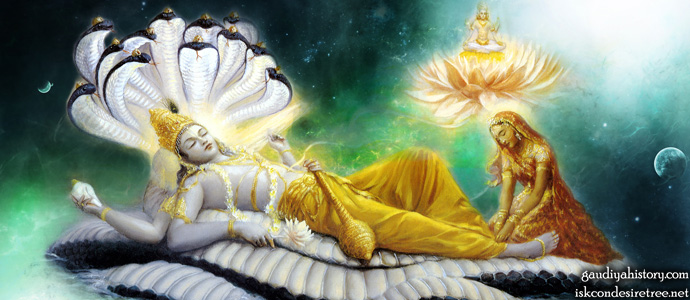
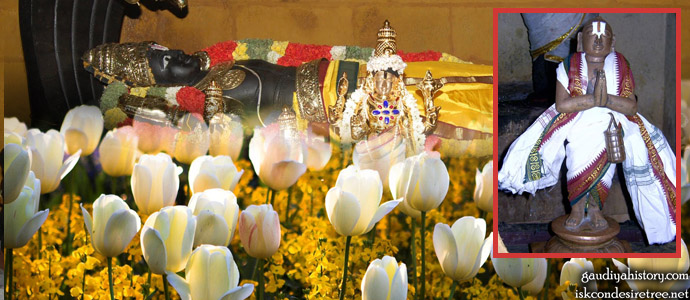
It is believed that both Dasarathi and Kooresha are the incarnation of the divine symbols of Lord Vishnu, namely, the Conch and the Discus respectively. (In the image: Lord Shri Vishnu and Shrimati Lakshmi Devi, Shri Ananta Dev, Lord Brahma).

Dhanurdhar Dasa

Dhanurdhar Dasa

His wife Ponnacchiyar was so beautiful like a damsel, so that Dhanurdasa never left her and used to gaze at her moonlight beauty always. Once Ponnacchiyar wished to see the Chithra Festival of Namperumal, so Dhanurdasa took her, walking by her side, held his coverlet over her head in great solicitude to screen her handsome face from the sun's rays.

   In Nisuiapuri (Uraiyur) lived a couple named Dhanurdasa (Pillaiurangavilli dasar) and Ponnacchiyar. They belonged to malla cult and he was an excellent athlete and archer. His wife Ponnacchiyar was so beautiful like a damsel, so that Dhanurdasa never left her and used to gaze at her moonlight beauty always. Once Ponnacchiyar wished to see the Chithra Festival of Namperumal, so Dhanurdasa took her, walking by her side, held his coverlet over her head in great solicitude to screen her handsome face from the sun's rays. Shri Ramanuja was returning from his ablutions in Kaveri river surrounded by his disciples to join the procession of Namperumal. As he was coming, he noticed this couple, wondering how love and affection towards a girl can make a man blind, shamelessly transforming this love and affection into a public proclamation. Shri Ramanuja approached Dhanurdasa and asked straightaway why he was doing like this. To this Dhanurdasa  replied, " look at her beautiful eyes Swami, I fell in love with those eyes, I have never seen such a beautiful ones ever". Swami answered "If i show you the beautiful eyes,what you will do?" to this Dhanurdasar replied," I will be forever in your service "Emperumanar caught hold of Dhanurdasa's hands took him to Periyaperumal and requested Periyaperumal to show the full beauty of the eyes. To which Dhanurdasa fell captivated life long. He became one of the prime disciples of Emperumanar. 

   Emperumanar's affection towards Dhanurdasa was so great that we can find, Emperumanar used to lean on Dhanurdasaathi, before going for his bath. While after bathing he used to lean only on Dhanurdasa.

   This love of Emperumanar towards Dhanurdasa made many disciples envious. Hence they complained to Emperumanar. One day Dhanurdasa was summoned to Emperumanar and while he was talking to Emperumanar, Swami instructed those complainers to go in the shadow of the night to Dhanurdasa's home and steal the jewels – ponnachiyar was wearing and come back. The disciples agreed and they left for Dhanurdasa's home,while Dhanurdasa without knowing all these drama stayed back. When the disciples went to Dhanurdasa's home they found Ponnachiyar asleep and they happily started their job. They stole all the ornaments which she was wearing on her one side. While doing this Ponnachiar became awake, but she understood that they were Shrivaishnavas, and she well understood a Shrivaishnava will not do this unless otherwise they were in such a financial distress

   She thought whatever she owned was a Shrivaishnava's property. So in order to make the snatching of the jewels,which she wore on the other side of her body easy, she just turned around as if she was in sleep. Seeing this, the disciples thought she was awake, and they took whatever they stole and ran away to Emperumanar's mutt. Emperumanar seeing his disciples coming back, gave permission for Dhanurdasa to leave, and asked the disciples to follow Dhanurdasa silently. Once when Dhanurdasa reached home he found his wife missing some jewels and to this ponn Achiyar explained the incident. She told they ran away when she turned around. To this Dhanurdasa remonstrated her in the face telling that, you understood Seshathva, but you did not understood the meaning of parathanthrya. If you have laid as if you were a stone, they might have stolen rest of the jewels without any problem. Who told you to turn around and show that you are awake? The Shrivaishnavas were wonderstruck to this and they immediately fell at the feet of Dhanurdasa, and returned the jewels and explained the drama in detail. It is recorded that Dhanurdasa's life was full of such incidents.

Source : http://uk.answers.yahoo.com/question/index?qid=20110722090149AAfkfkx

Dhanurdhar Dasa

"Emperumanar caught hold of Dhanurdasa's hands took him to Periyaperumal and requested Periyaperumal to show the full beauty of the eyes. To which Dhanurdasa fell captivated life long. He became one of the prime disciples of Emperumanar...(In the wallpaper: Shri Gopinath, ISKCON Chowpatty, Mumbai).

Bhoothath Alvar

   Bhoothath Alvar was one of the twelve Alvars and was a Hindu saint. He belonged to the Vaishnavite (worshiper of Vishnu) faith.

   Bhoothath Alvar was born in the Pallava country near Mamallapuram in the seventh century CE. Bhoothath Alvar's 100 hymns form the second part of the Naalayira Divyap Prabhandham. Bhoothath Alvar's hymns start with the words Anbe Tagaliya, Aarvame Neyyaaga ( with love as the lamp and devotion as the oil). He is considered an incarnation of Vishnu's mace, Kaumodaki.

Anbe Thagliyaa Aarvame Neyyaaga
Inburugu Chintai Idu Thiriyaa
Nanpurugi Gnaana Chudar Vilakku Etrinen
Naaranarku Gnaana Thamizh Purindha Naan

   "I who wrote this song that bestows wisdom, with love as the lamp, endearing involvement as the lubricant ghee, and knowledge as the wick of the burning torch, dedicated myself to the service of the Lord"

Source :  http://en.wikipedia.org/wiki/Bhoothathalvar

Bhoothath Alvar

"I who wrote this song that bestows wisdom, with love as the lamp, endearing involvement as the lubricant ghee, and knowledge as the wick of the burning torch, dedicated myself to the service of the Lord" (In the wallpaper: Shri Gopinath, ISKCON Chowpatty, Mumbai, a boy).

Thondaradippodi Alvar

   Thondaradippodi Alvar was a Tamil Vaishnava Saint who is also named as "Vipra Narayanar" led his life in devotion to Lord Narayana and worked for the Perumal (Lord) by dedicating him with Garlands. He is one of the 12 Alvars.

Birth and Early life

   Thondaradippodi Alvar was born in a small village by name 'Thiru mandaggudi' in Prabhava year, Margazhi month, Krishna chaturthi, Tuesday in Kettai (Jyestha) Nakshatram (star). His father ‘Veda Visaradhar’ belonged to "Kudumi Sozhiyap Brahmanar" community also called as "Vipra" people, whose routine work is to praise about Shri Vishnu.

   On the 12th day after his birth, he was named as "Vipra Narayanar". From an early age, bhakti towards Shri Vishnu was taught to him. He grew up with a well rounded personality. It is said that in spite of being good and beautiful and dedicated to Shri Vishnu bhakti, he had no conceit and treated all the aged persons and persons who are younger to him in the same way and gave proper respect to them.

Reaching Shrirangam

   As per lore, Viswakshenan, who was the commander-in-chief of Shri Vishnu's troop, once descended to earth and revealed to Vipranarayanar, why he was born in this mighty world and what are the things that he should follow to attain Moksham. 

Thondaradippodi Alvar

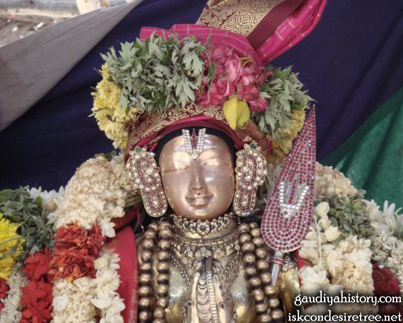
Thondaradippodi Alvar was a Tamil Vaishnava Saint who is also named as "Vipra Narayanar" led his life in devotion to Lord Narayana and worked for the Perumal (Lord) by dedicating him with Garlands. (In the wallpaper: Lord Shri Ranganath, Shri Rangam, Perumal, Thondaradippodi Alvar).

   On hearing the truth of his birth, he showed much love, affection and bhakti towards Shriman Narayanan. As an extension to it, he started thinking what should be the next step to be taken to explore his bhakti. He thought of traveling to all of the Temples where the Emperumaan is giving His seva. But, he had a question that from which sthalam he should start with. After a long thinking, he finally decided that he should start from the greatest of all of the Vishnu sthalams, the Shrirangam, which is located on the banks of Cauvery river should be the starting sthalam he should worship and started traveling towards it.

   After reaching the Temple, he went inside the Moolavar sannadhi and was very happy to see the Perumal on the Aadhisheshan (the snake) who is found in sleeping posture. After seeing the beauty of Shri Ranganathar, he did not want to see any of the things around and thought his bhakti and the remaining life should be spent completely for Aranganathan. He thought in what way he can express his bhakti towards the Emperumaan and finally he thought he can offer him with the Garland daily to the Perumal. 

   Soon after this thought, he constructed a big Nandhavanam (flower park) in Shrirangam, where various beautiful and fragrance flower plants are grown. He built a small hut in the midst of the park. Daily, in the morning, as a daily work, he dedicated the Garland to Shri Ranganathar and only then did his routine jobs. Since, he thought, only Shri Aranganathar is the beautiest thing in this world, he didn't turn up towards any of the women around him. Because of this, all the people thought he doesn't have any feelings towards the people around him. On seeing these kinds of scenes from Shri Vaikundam, thirumagal, Shri Lakshmi questioned Shriman Narayanan that because of having the affection towards him (Shri Ranganathar) and in spite of being a male, he doesn’t know how the love should be expressed towards a women and continued that which women can show her love towards a person like Vipra Narayanan? Knowing the future and what is going to happen, Shri Vishnu casually answered Shri Lakshmi that she is going to see what is going to happen for him.

Devi and Devadevi

   In Thirukkarambanoor, there lived two Daasis (Women who dances in front of the king to earn money) by named Devi, who is the elder sister and Devadevi, who is the younger sister. They wanted to dance to the Urayoor king and to get prize from him. Then both of them went to Shri Rangam Temple to worship Aranganathar.

   When they were going to the Temple, they had the chance to see the Nandhavanam, which belonged to Vipra Narayanar. Devadevi wanted to see him and they both went to the small hut. Devadevi, on seeing him, was very much attracted towards him and started loving at the first sight. She expressed her love in words and continued with his work. She did service to convert him towards her side. Soon she completely turned Vipra Narayanar towards her and they both started to live together.

   One day, Devadevi said to Vipra Narayanar that she wanted to see her parents and her sister. Vipra Narayanar said that he would too come along with her, since he could not live without leaving her for a second. But her mother did not want him to be in the house and asked Vipra Narayanar to get out of the house for he did not have any wealth. Since, Vipra Narayanar is helpless, he came out of the house and entered a Nandavanam and being so tired, he slept for a while. On seeing this, the Emperumaan wanted him to get of the Maya and wanted him to get along with the right path, which leads to the Thiruvadi of Him (Shri Vishnu).

   He changed himself as a Student of Vipra Narayanar and went straight to Devadevi's house and gave him a big silver vessel as given by his Guru to Devadevi.

   On getting that her mother thanked him and asked his Guru, Vipra Narayanar to return back to her house. On hearing this, Vipra Naryanar walked fast to the house and hugged Devadevi.

   The Next morning, the archakar entered into the Shri Ranganathar sannadhi and found one Vattal (Vessel which is used to do the daily pooja) was missing and complained to the king about this. The king ordered his servants to go in search of the Vattal and they found that in Devadevi's house.

   Vipra Narayanar was jailed for one night. On that night, Vipra Narayanar cried and asked the Emperumaan why like this has happened to him and prayed towards Him. On the same night, the Emperumaan arise in the dream of the king and explained him what had happened and asked him to free Vipra Narayanar. The king explained that this is a small thiru Vilayaadal (game) of Shri Emperumaan.

   Knowing the real truth why he came to the world, he went to Shri Ranganathar Temple and praised the Lord. Then, he worshipped all the bhaktas of Shri Vishnu and put the podi (Small tiny dust particles), which is found under the feet of them in his head and sang songs in praise of Shri Ranganathar.

   From then, he was called as "Thondaradipodi Alwar". Finally he realised for what he came for to the earth and went to all the Vishnu Temples to praise him.

   Source : http://en.wikipedia.org/wiki/Thondaradippodi_Alvar

Thirumangai Alvar

Thirumangai Alvar

Thirumangai Alvar.

   Thirumangai Alvar or Tirumangai Alvar or Tirumankai Alvar or Thirumangai Mannan (8th century AD) is the last of the 12 Alvar saints of south India, who are known for their affiliation to Vaishnava tradition. He is considered one of the most learned Alvars and the most superior Alvar in the context of composition of verses. He holds the title Narkavi Perumal, the mark of an excellent poet, and Parakala (Beyond Time). Though, he is respected as a Vaishnava saint-poet, he, initially, worked as a military commander, a chieftain and then a robber. After his conversion to Vaishnavism, he confronted practitioners of rival Hindu sect of Shaivism as well as Buddhism and Jainism.


   Source : http://en.wikipedia.org/wiki/Thirumangai_Alvar