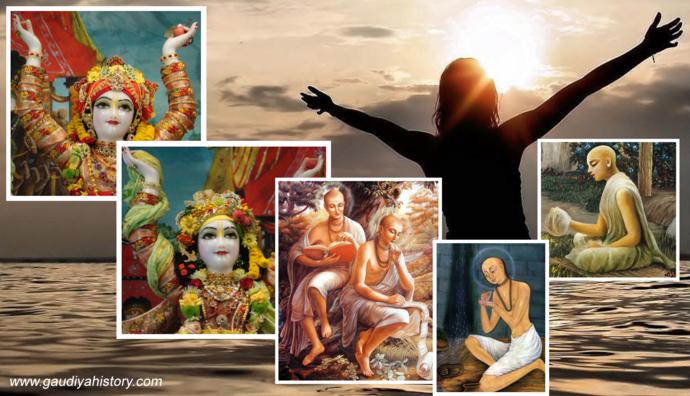
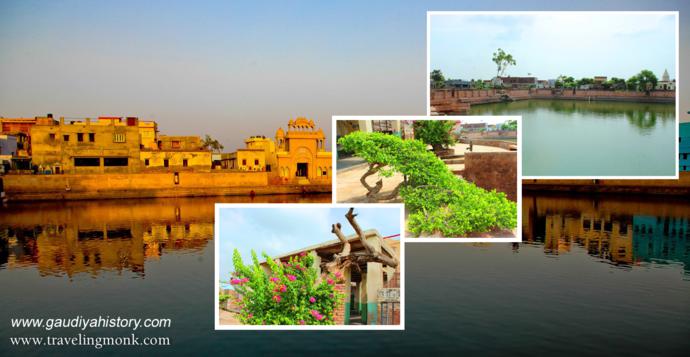
Gopala Bhatta Goswami – Biography

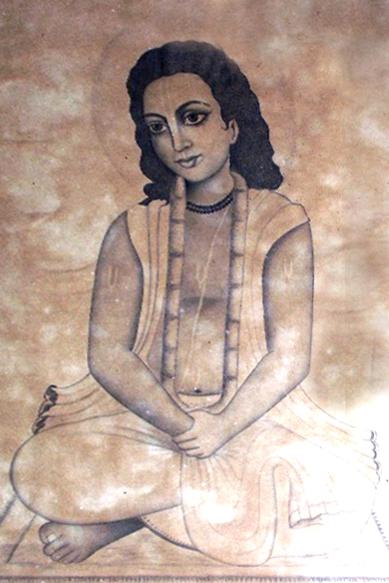
Gopala Bhatta Goswami

Gopala Bhatta Goswami.

   The all merciful Lord Shri Gaura Hari, as He travelled from village to village throughout the south of India, continued to distribute love of Godhead wherever He went. Hearing the nectarean names of Hari from His lotus mouth, thousands and thousands men and women felt relief from the blazing fire of material existence. Various wretched, miserable and fallen souls lives were completely rejuvenated and thus they became virtuous and happy. While causing rains of love of God to fall anywhere and everywhere, without consideration of time or place, Shri Gaurasundara came to the ancient holy place of Shri Rangakshetra on an island in the middle of the Kaveri river.

   The Temple of Shri Ranga Kshetra was extremely large, the crest of the Temple tower pierced the sky. Throughout the day and night hundreds and thousands of pilgrims were going and coming to take darsan of Lord Ranganath. The Temple hall resounded with the sounds of hundreds and thousand of brahmanas chanting Vedic hymns. In the midst of this scene from Vaikuntha, entered Shri Gaurasundara chanting the names of Krishna in his sweet voice that defeated the voices of 10 million gandharvas. Everyone in the Temple became dumbstruck, amazed and thrilled with wonder. What unprecedented beauty; His bodily effulgence makes molten gold appear lack-lustre. From His eyes which are like the full blown petals of a lotusflower trickled down tears of ecstatic love. Every limb, every part of His body was filled with such exquisite grace that even the mind of cupid gets stolen away. The brahmanas began to consider, "Is this a demigod? Can such symptoms and emotions be found in human beings?" Again resounding the halls with the transcendental vibrations of Shri Hari's name, when He came before the Deity and fell down as a tree is blown down by the wind, some people thought that a mountain of gold was rolling on the ground. Shri Vyenkata Bhatta seeing this divine personage became restless with ecstasy. His heart being flooded with devotion he got up and began to move the crowds away so that the Lord could engage in chanting and dancing. When the Lord had regained His external consciousness after engaging in sankirtan, Vyenkata Bhatta approached Him and took the dust of His lotus feet. Mahaprabhu gazed towards him and saying, "Krishna! Krishna!" embraced him firmly. Shri Vyenkata Bhatta invited Mahaprabhu to come to his house and having brought Him there, very reverantly washed His lotus feet and along with the other family members, he drank the water. Shri Bhattaji's house became filled with joy. 

Gopala Bhatta Goswami

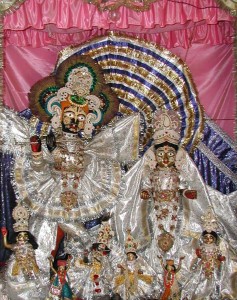
His bodily effulgence makes molten gold appear lack-lustre. From His eyes which are like the full blown petals of a lotusflower trickled down tears of ecstatic love. Every limb, every part of His body was filled with such exquisite grace that even the mind of cupid gets stolen away. The brahmanas began to consider, "Is this a demigod? Can such symptoms and emotions be found in human beings?" Again resounding the halls with the transcendental vibrations of Shri Hari's name, when He came before the Deity and fell down as a tree is blown down by the wind, some people thought that a mountain of gold was rolling on the ground... (In the image: Lord Shri Chaitanya visits Shri Rangannatha Swami Temple, Shrirangam).

   Mahaprabhu came to Ranga Kshetra in the Christian year 1511. Vyenkata Bhatta had two brothers, Tirumalla Bhatta and Prabodhananda Saraswati. They all belonged to the Ramanuja sampradaya and Prabodhananda Saraswati was a tridandi sannyasi of that order. Vyenkata Bhatta had a son named Gopal, who was then just a child. When the boy came to offer his obeisances at the lotus feet of Mahaprabhu picked him up and very affectionately seated him in His lap. Mahaprabhu would call Gopal after He had finished His meal and offer His remnants to the boy. In this way He prepared him for the positon of Acharya.

   After remaining at Vyenkata Bhatta's house during the four months of the rainy season (Chaturmasya) Mahaprabhu prepared to continue His journey of the South. Vyenkata Bhatta's house began to ebb in a tide of tears in anticipation of His departure. Gopal fell at His lotusfeet in a dead faint. Therefore Mahaprabhu remained for a couple of more days in order to con-sole the boy. Being pleased with Gopala Bhatta Goswami's sincere service and devotion, Shri Chaitanya Mahaprabhu initiated him, and ordered him to move to Vrindavana after the disappearance of his parents and perform bhajan and write. He instructed him to serve his mother and father and always engage in chanting Krishna's glories and thereafter to come to Vrindavan. 

Gopala Bhatta Goswami

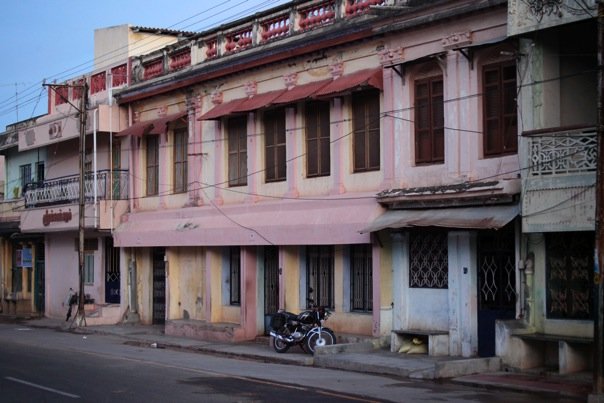
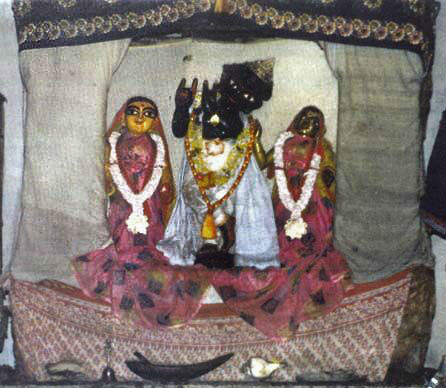
Vyenkata Bhatta approached Him and took the dust of His lotus feet. Mahaprabhu gazed towards him and saying, "Krishna! Krishna!" embraced him firmly. Shri Vyenkata Bhatta invited Mahaprabhu to come to his house and having brought Him there, very reverantly washed His lotus feet and along with the other family members, he drank the water. Shri Bhattaji's house became filled with joy. (In the image: Vyenkatta Bhatta's house).

   Very quickly Gopal became expert in grammar, poetry and rhetoric and then began his study of Vedanta. His uncle Prabodhananda, specifically began to instruct him from the devotional scriptures (Bhakti – shastra). Gopal Bhatta always remained thinking of the lotus feet of Mahaprabhu and when he might again be able to meet Him. At the same time however he couldn't leave his aged mother and father. Finally having reached their final days they called their son Gopal and instructed him to go to the lotus feet of Mahaprabhu in Vrindavan. Then while meditating on His lotus feet themselves they went to join Him in His eternal lila.

   At the age of thirty Gopala Bhatta Goswami came to Vrindavana, and having missed Shri Chaitanya Mahaprabhu this saddened him.Thus Gopal set out for Vrindavan and when he arrived there Rupa Goswami immediately sent word to Mahaprabhu to inform Him of Gopal's arrival there. Mahaprabhu had previously indicated to Rupa and Sanatan that Gopal Bhatta would one day come there to Vrindavan, so upon his arrival they treated him with the same care and affection they would their own brother. They immediately became life long companions.

   However, the all knowing Supreme Personality of Godhead, Shri Chaitanya Mahaprabhu received word that Gopal Bhatta had come to Vrindavan, He was very pleased and sent with that messenger with the Lord's personal wooden sitting plank (hoki) which He had used along with a pair of His undergarments and one of His upper cloths – uttara or chaddar. Having received these gifts Gopal Bhatta was in ecstasy and he worshipped them as the prasad (tadiya) of Mahaprabhu. 

   When he would worship his Deities he would sit on that wooden plank. This piri (wooden seat) and Mahaprabhus clothes are still being worshipped at Radha-Ramana Mandir. Gopala Bhatta, like Rupa and Sanatana, had no fixed residence and would spend the night in various kunjas (forest groves). He spent his time studying the scriptures and composing various literatures. After Shri Chaitanya Mahaprabhu's disappearance Gopala Bhatta Goswami felt intence separation from the Lord. To relieve his Devotee, the Lord instructed Gopala Bhatta in a dream : "If you want my darsan then make a trip to Nepal".

   In Nepal, Gopala Bhatta bathed in the famous Kali-Gandaki River. Upon dipping his waterpot in the river, he was surprised to see several Shaligrama Shilas enter his pot. He dropped the shilas back into the river, but the shilas re-entered his pot when he refilled it. After emptying and refilling his waterpot for the third time, Gopala Bhatta Goswami found twelve Shaligrama shilas sitting there. Thinking this must be the Lords mercy, he kept all the shilas and returned to Vrindavana. 

   Shri Gopala Bhatta Goswami used to worship twelve Shaligram silas. Wherever he would go he would bring them with him in a piece of cloth tied at the corner. One day a wealthy man (Seth) came to Vrindavana and offered Gopala Bhatta a variety of clothing and ornaments for his Shaligrams. Being very impressed with the Goswami he wanted his darshan and to render some service which he presented in the form of some valuable cloths and ornaments. However, Gopala Bhatta couldn't use these for his round-shaped Shaligrams, so he advised the donor to give the Deity decorations to someone else, but the Seth insisted. Gopala Bhatta kept the cloths and ornaments with his shilas. While Gopala Bhatta Goswami was absorbed in remembering how the half-man, half-lion form of the Supreme Lord had manifested from the pillar in Hiranyakashipu's palace, he prayed in transcendental lamentation to the Lord: "Oh my Lord, you are very merciful and always fulfill the desires of your Devotees. I wish to serve you in your form, having arms and legs and blissful smiling face, with lotus eyes. If I had a Deity then I would be able to decorate Him so nicely with these clothes and ornaments." 

Gopala Bhatta Goswami

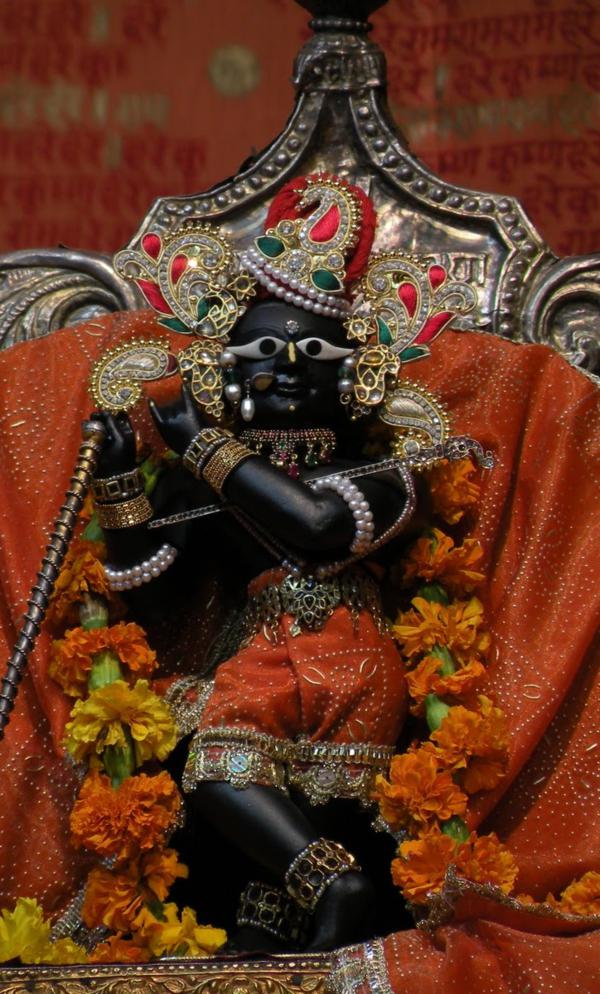
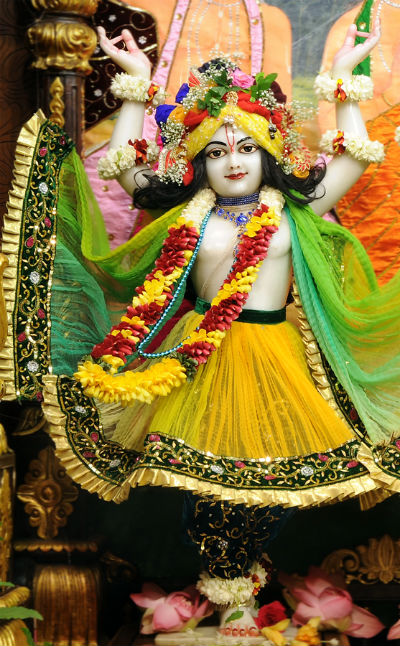
"Oh my Lord, you are very merciful and always fulfill the desires of your Devotees. I wish to serve you in your form, having arms and legs and blissful smiling face, with lotus eyes. If I had a Deity then I would be able to decorate Him so nicely with these clothes and ornaments." (In the image: Shri RadhaRaman, Shri Vrindavan Dham).

   In the evening after offering some bhoga and arotika to his Shalagram shilas, Gopala Bhatta put them to rest, covering them with a wicker basket. Late in the night, Gopala Bhatta took a little rest and then, in the early morning went to take bath in the Yamuna river. Returning from his bath, he uncovered the Shalagramas in order to render the puja for Them, and saw amongst Them a Deity of Krishna playing the flute. There were now eleven shilas and this Deity. The "Damodara shila", had manifested as the beautiful three-fold bending form of tri-bhangananda-krishna. Floating in the ocean of ecstasy, he fell to the ground in order to offer his dandavats and then recited various prayers and hymns. This wonderful event of the appearance day of RadhaRaman happened on the day after Shri Nrisimha Chaturdasi, and is celebrated on that day accordingly. That day they offer 500 liters of milk for the Lord's pleasure and many other sweets and different things. The RadhaRaman Temple has the highest standard of Deity worship in all of Vraj.

   When Rupa and Sanatana Goswamis as well as many other Devotees received news of this miraculous event they came running to see the Lord. Gazing on the Lord's transcendental form, which bewildered all the living entities of the many various planets, they all bathed Him with their tears. This Deity whom the Goswamis named, "Shri Radha-raman Deva" made His appearance on the full moon day of Vaisakha in the year 1542. Except for Vrindadevi, Shri Radha-Ramanaji is the only one of the original Deities of Vrindavana who never left to go to Jaipur. Shri Shri Radha-raman-ji is still being worshipped in Vrindavana near Nidhuban kunj in the compound of the Temple.

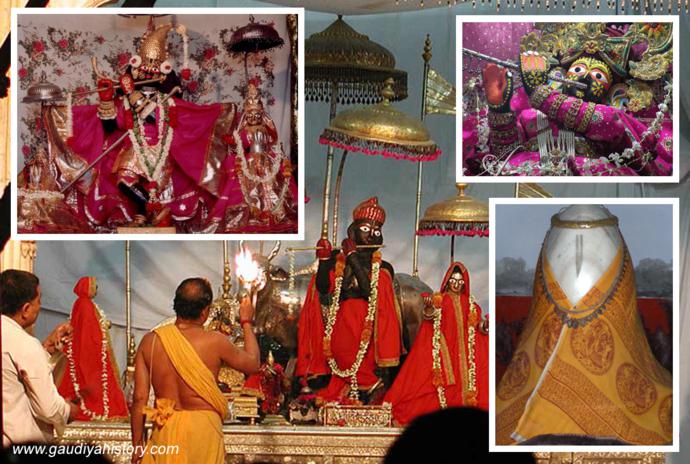
   The Deity is called Radha-raman although physically there is no apparent Deity of Radha there. As one can see from the picture, that to the right of the picture (to Ramanji's left) is a place setting for Shrimati Radhika. In this way the pujaris worship Shri Radha and Ramanji together.

   Shri Radha-ramana Deva, unlike other Deities, has very intricate features, including fingernails and even teeth. On the back side of His body parts of the original Shalagram shila from which He manifested Himself can be seen. There is a story that the small son of one of the sevaits was playing with the Deity once and put a small stick in one ear of the Deity and pushed it through out the other ear. The stick however, had blood on it, and that boy died vomiting blood that very day.

   If you ever have the great good fortune to attend the Snan-yatra festival in Shri Vrindavan Dham, then it is a must that you visit the Radha-Raman Temple on this day. The temperatures are hot and dry in the 40+ centigrade and much anticipation of seeking out cooling water pervades the thoughts in Vrindavan's hot summer. At the Temple, the merciful Ramanji has made a provision so that first He takes His transcendental bath right at the front of the altar for all to see – But Then, after He has taken in His expanded kindness the pujaris turn on the sprinkler system that surrounds the open court-yard – the fan in the middle is even equipped with pipes to pour out cooling water as it rotates at a high speed, inundating all the Devotees taking the darshan of the Lord, with great pleasure. 

   In some discussion with the present day guardians of the Temple and Deity, they told that some scientists had come to examine the Deity and propound their doubts that He was self manifested, as the Devotees state. They examined the Deity under the supervision of the Devotees, but could find no evidence of carving.

About todays descendents:

   Once Shri Gopala Bhatta went to Haridwar. As he was returning, suddenly a downpour started and thus he took shelter in the house of one brahmana. This brahmana was very devoted and he very carefully began to serve Shri Gopala Bhatta, who thus became very pleased. As this brahmana had no children Shripad Gopal Bhatta Goswami blessed him that he might have a son who would be a devoted follower of Lord Hari. The brahman replied out of gratitude that, "My first son I will send to you in order to serve you."

   Approximately ten years later when Gopala Bhatta returned from bathing in the Yamuna one day, he saw a young boy sitting at the door of his kutir. When the boy saw the Goswamiji approaching, he got up and then fell down to offer his dandavats (obeisances like a stick on the floor before him). Shripada Gopala Bhatta Goswami enquired who the boy was, to which he replied, "My home was in Devandyagram within Saharanpur near Haridwar. My father has sent me here to serve you. My name is Gopinatha."

   Then Gopal Bhatta could remember the time when he went to Haridwar many years ago. So this boy remained with him and very carefully began to serve him. Eventually he became known as Shri Gopinatha Pujari Goswami as he served Shri Radha-Ramana Deva through his life as an unmarried brahmachari. His younger brother Shri Damodara dasa, along with his family, accepted iniation from Shri Gopinathaji and also became engaged in the service of the Deity. Shri Damodara dasa's three sons were named Harinatha, Mathuranatha and Harirama. It is from these family members of Gopinath's brother that todays guardians the Radha-Raman Gosais so nicely maintain and serve Shri Shri Radha-Ramanji.

   Shri Gopala Bhatta's devotion was so special, his devotion so profound that the Lord appeared for him in this special form – but not only that as if in confirmation of the pastimes of the Lord, and Mahaprabhu's being directly Radha Krishna (sri krishna chaitanya radha krishna nahi anya), in his worship of Shri Radha-Ramana would sometimes see that He had taken the form of Shri Gaurasundara – Shri Chaitanya Mahaprabhu, "Becoming subservient to the love of Shri Gopala Bhatta, Shri Radha-Ramana would sometimes accept the form of Shri Gausundara."

   Shri Gopala Bhatta was the initiating guru of Shrinivasa Acharya Prabhu. Shripad Gopal Bhatta Goswami was very learned, trained in pancharatra, coming in the learned family of Vyenkata Bhattar in the Shri Vaishnava line – he wrote many books including: Sat-sandarbha karika, Shri Krishna-vallabha (Krishna karnamrtatika), Sat kriya sara dipika (a brilliant work on Vaishnava samkara viddhi), and Laghu Hari-bhakti vilasa with Dig darshini tika. From this work, Shri Sanatana Goswami compiled the Hari-bhakti-vilasa now followed by all Gaudiya Vaishnavas. It is said, "Out of affection for Shrila Gopala Bhatta Goswami, Shrila Sanatana Goswami compiled the famous Vaishnava smriti titled Hari Bhakti Vilas, and published it under Gopala Bhatta Goswami's name.

   Gopala Bhatta Goswami resided for forty-five years in Shri Dham Vrindavana, but out of great humility he requested Shrila Krishna das Kaviraja not to mention his name in the classic work Shri Chaitanya Charitamrita.

   Gopala Bhatta Goswami serves as Guna Manjari. In the Gaura-ganoddesa-dipika too, it is mentioned that in the eternal pastimes of Radha and Krishna, Gopala Bhatta Goswami's name in Vraja-lila has been given as Guna manjari.

   His birth was on the day of the dark fortnight of the month Pausa in the year 1503 (Christian), 1425 (Saka).

   His disappearance was on the sixth day of the dark fortnight of the month of Sravon in the year 1578 (Christian – A.D.), 1500 (Sakabda era) Age: 75 years. 

Gopala Bhatta Goswami

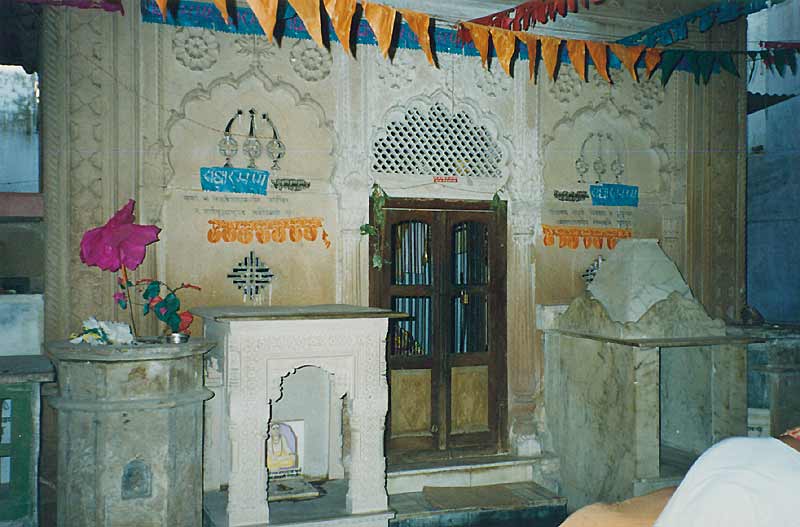
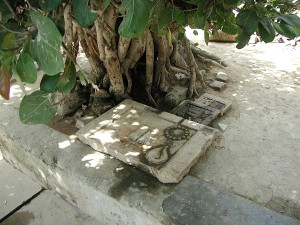
Samadhi Mandir of Sripad Gopala Bhatta Goswami, Shri Vrindavan Dham.

Ramachandra Kaviraja – Biography 2

Ramachandra Kaviraja

Shrila Narottama dasa Thakura Mahasaya has sung: "O Acharya Prabhu (Shrinivasa), please bestow your mercy upon me. I pray that I might also have the association of Ramachandra." (In the image: Shrila Ramachandra Kaviraja).

   Shrila Narottama dasa Thakura Mahasaya has sung: "O Acharya Prabhu (Shrinivasa), please bestow your mercy upon me. I pray that I might also have the association of Ramachandra."

   Shri Ramachandra Kaviraja was the disciple of Shrinivasa Acharya Prabhu and the very intimate friend of Narottama dasa Thakura. His father was Chiranjiva Sena and mother Shri Sunanda. Chiranjiva was originally an inhabitant of Kumara nagar but after marrying the daughter of Shri Damodara Kavi he moved to Shri Khanda.

   "Chiranjiva Sena was a pure Devotee very much loved by Narahari Sarkar and the other residents of Shri Khanda. He was extremely learned in all matters and his wife was very chaste and gentle. Her activities were completely transcendental." [C.C Mad. 11/92]

   Shri Mukunda, Narahari, Raghunandana and Chiranjiva, who were all residents of Shri Khanda, were of one mind and one purpose. Every year they would come to Nilachala to have darshan of Mahaprabhu and to chant and dance in front of Lord Jagannatha during Ratha Yatra. Chiranjiva was from a family of physicians. His two jewel-like sons were Ramachandra and Govinda. Later they both became disciples of Acharya Prabhu and came to reside at Teliya Bhudari-gram in Murshidabad.

   Ramacandra was very handsome, intelligent and perseverent. His maternal grandfather, Shri Damodara Kaviraja, was a well-known poet who was a worshiper of Krishna's energy (shakti) and was initiated in this cult. After their father passed away, the two brothers Ramachandra and Govinda came to live with their grandfather, who practiced the Shakta religion. Being influenced by him, both became inclined to worship the various personified forms of maya, Krishna's external deluding potency.

   At this time Ramachandra practiced medicine and was also quite well known as an accomplished poet.

   After his marriage, Ramchandra was carried in a palanquin with his new bride to his home at Kumaranagara. As the procession passed Shrinivasa Acharya Prabhu's house at Jajigram, he saw the Acharya seated on the verandah of his house, discussing Krishna-katha with some of his disciples. Simply upon seeing the Acharya he felt a strange new emotion dawn in his heart. It was as though he was seeing a very dear friend after long time of separation. Similarly, Acharya Prabhu, upon seeing Ramachandra seated in the palanquin, immediately inquired from those who were present with him, "Who is that? What is his name? Which varna (caste) he belong to? And where does he reside?" [B.R. 8/530] His associates replied, "He is great scholar of the name Ramachandra. He is very excellent poet as well as a physician and resides at Kumaranagara." Hearing this, Acharya Prabhu simply smiled. 

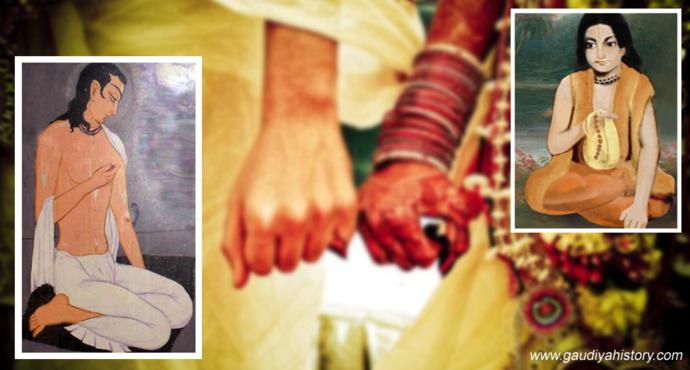
His associates replied, "He is great scholar of the name Ramachandra. He is very excellent poet as well as a physician and resides at Kumaranagara." Hearing this, Acharya Prabhu simply smiled. (In the wallpaper: in top right Shrinivas Acharya, in the left Ramachandra Kaviraja, background photo of a marriage).”]Ramachandra Kaviraja

   Ramachandra Sena, still seated within the palanquin, after seeing Shrinivasa Acharya and hearing his sweet voice, became extremely anxious to meet him. After a short time the procession reached the house where much pomp and celebration took place. Everyone was overjoyed to see the new bride, Ratna Mala, and a great din and bustle ensued in welcoming her and her bridegroom into their new home. Ramachandra's mind however was still back at Jagigram where he had seen that divine personage. With great difficulty he somehow or other passed the day there, but with the fall of night he returned to Gajigram, where he passed the night in the house of one brahman.

   With the approach of morning he came to Shrinivasa Acharya's house and fell down at the Acharya's feet to offer his prostrated obeisances. Shrinivasa Acharya Prabhu had similarly been continuously thinking of Ramachandra ever since he'd seen him the day before. Upon seeing Ramachandra again, prostrated before him, he picked him up and embraced him in deep ecstasy. Then he told him, "Birth after birth, you are my most dear friend. In the same way that the Lord caused my meeting with Shri Narottama dasa Thakura at Vrindavana, He has also re-united me with another dear friend."

   Ramachandra stayed with Acharya Prabhu and studied the literature’s of the six Goswamis under his tutorship. Acharya Prabhu was extremely pleased to see his gentle and polite behavior and his deeply spiritual nature. On the next auspicious day he initiated Ramachandra with Radha-Krishna mantra.

   After some time, Ramachandra returned to his house. When the Shaktas saw he had been initiated into Vaishnava religion they became very upset. Ramachandra, however, was undaunted. With tilaka on his body in twelve places and a japa mala in his hand, he sat down in front of them and began to chant the Holy Names. One day, as Ramachandra was proceeding to his house after having taken his bath, his Shakta neighbours called him.

   "Kaviraja, without worshipping Lord Shiva, how is it that you are going home? Your grandfather was a great Devotee of Lord Shiva. Have you given up Lord Shiva's worship?"

   Ramachandra replied, "Lord Shiva and Brahma are incarnations of two of the material modes created by Shri Krishna. Shri Krishna Himself is the source of all incarnations. Therefore, by worshipping Lord Krishna everyone's worship is performed, just as by watering the roots of a tree all the leaves and branches become nourished. Prahlad, Dhruva, Vibhishana and others were dear Devotees of Shri Krishna. Therefore Lord Shiva and Brahma were naturally favorably disposed to them, whereas Ravana, Kumbakarna, Banasura and other demons were only devotees of Lord Shiva and not Devotees of Lord Krishna. Thus their ultimate end was to simply be destroyed. 

Ramachandra Kaviraja

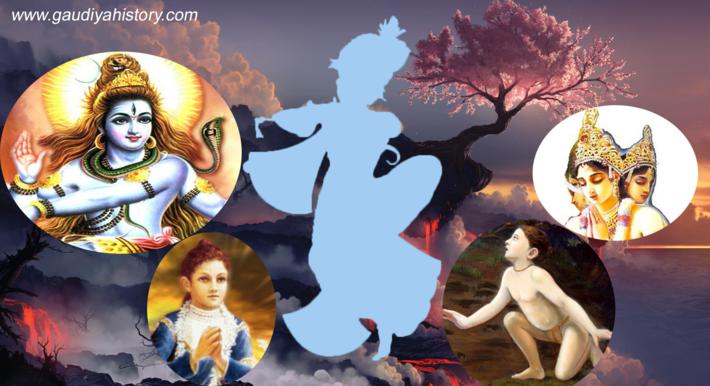
Lord Shiva and Brahma are incarnations of two of the material modes created by Shri Krishna. Shri Krishna Himself is the source of all incarnations. Therefore, by worshipping Lord Krishna everyone's worship is performed, just as by watering the roots of a tree all the leaves and branches become nourished. Prahlad, Dhruva, Vibhishana and others were dear Devotees of Shri Krishna. Therefore Lord Shiva and Brahma were naturally favorably disposed to them... (In the wallpaper: Shri Krishna in the middle, from left to right Lord Shiva, Prahlada Maharaja, Dhruva Maharaja, Lord Brahma).

   "The shastras say that Lord Brahma was able to create this world due to having successfully worshipped Shri Vishnu. Similarly, Lord Shiva has become qualified to invoke auspiciousness in this world due to having received the foot wash water of Lord Vishnu (Ganges) on his head." Having heard these various statements from the shastras, those scholars remained speechless.

   Ramachandra became very anxious to have darshana of Shri Vrindavana and the Goswamis there. He petitioned Shri Raghunandana and various other Vaishnavas for their permission which they readily gave. Thus on the next day he set out for Shri Vrindavana Dhama. After passing through Gaya, Kashi and Prayaga, he finally arrived at Mathura. There he took bath and some rest at Vishrama ghat. After taking darshana of the Adi Keshava Temple, he started for Vrindavana.

   At this time his guru, Shrinivasa Acharya, was present at Vrindavana. Ramachandra offered his prostrated obeisances at the lotus feet of his guru and Shri Jiva Goswami and conveyed the good news of the Devotees from Gaudadesha.

   As ordered by Shri Jiva Goswami, Ramachandra took darshana of Shri Govinda, Shri Gopinatha, Shri Madanamohana and Shri Sanatana Goswami's samadhi. Then he offered his respects to Shri Gopala Bhatta, Shri Lokanatha and Shri Bhugarbha Goswami, who were very pleased with him and who offered him their benediction. Hearing some samples of his great poetic ability, everyone decided to present him with the title 'Kaviraja.' (B.R.9/214)

   After remaining in the Goswami's association for some days, they finally instructed him to return to Gaudadesha. And so he returned, visiting Shri Khanda, Jajigram, Khandaha and Kalna on the way. Finally he came to Shri Mayapura, where he received the blessings of Shri Ishana Thakur.

   One time, some smarta brahmanas made a conspiracy to defame the name of Shrila Narottama dasa Thakura Mahasaya. They were very upset that though he was only a kayastha by caste, he accepted those born in brahmana families as his disciples. They enlisted Raja Narasimha and the conquering pandita Shri Rupanarayana in a crusade to somehow expose Narottama dasa as a fraud. In a large party they made their way to Kheturi, where Shrila Narottama had his headquarters.

   Coming to know of this conspiracy, Shri Ramachandra and Shri Ganga Narayana Chakravarti came forward to meet their challenge. They journeyed to Kumarapura where they each set up two small shops in the market; one a pan and betel nut shop and the other a store selling clay pots.

   When the party of smarta brahmanas arrived at Kumarapura and sent their disciples out to purchase wares for cooking their meals, the students came to those shops. The 'shopkeepers' (actually Ramachandra and Ganga Narayana in disguise) spoke to them in Sanskrit and began to raise a philosophical dispute with them. Seeing the profound learning of those two shopkeepers, the students were dumbfounded, but nevertheless took up the challenge. After a short time, however, it became obvious that they were no match for these 'shopkeepers.' They called for their gurus, who arrived on the scene with Raja Narasimha and Rupanarayana. Rupanarayana himself was drawn into the debate and was defeated by the Bhagavata-based arguments of Ramachandra and Ganga Narayana.

   When the king requested their introduction, those two shop keepers informed him that they were two extremely insignificant disciples of Shrila Narottama dasa Thakura Mahasaya. Having met defeat in this village marketplace, Rupanarayana and the smarta brahmanas were no longer interested in proceeding onward to Kheturi. Their crusade evaporated as they all decided to return immediately to their respective homes.

   That night, after Raja Narasimha had returned to his house, he had a dream in which Durgadevi told him, "Narasimha! You have committed a great offense at the feet of Narottama dasa Thakura. As a result of this Vaishnav aparadha, I will have to cut you all to pieces with this chopper. If you want to save yourself, then you had better immediately go and take shelter at Narottama dasa Thakura's lotus feet."

   When his sleep broke the king quickly took his bath and set out for Kheturi. Rupanarayana had a similar dream and was also proceeding towards Kheturi at the same time. They met upon their arrival there and approached the Temple of Shri Gauranga in order to meet Narottama Thakura. Thakur Mahasaya was absorbed in his bhajana, but when a disciple informed him of the arrival of the two guests, he came out to meet them. Simply by seeing his transcendental form, imbued with Krishna-prema, the two offenders became purified and fell down to offer their obeisances at Thakura Mahasaya's feet. Thakura Mahasaya very humbly presented himself as being a fallen soul. Finally he initiated them with Radha-Krishna mantra.

   Many sinful atheists were delivered by Shri Ramachandra Kaviraja. He was present at the Kheturi festival. He came to Vrindavana a second time on the order of Shrinivasa and Narottama, but this time he couldn't have darshana of the Goswamis as they had all departed this world for Goloka Vrindavana. Feeling separation from them, he was very distressed at heart. Unable to tolerate that pain, he joined them in their eternal pastimes there in Vrindavana. In Vraja-lila his name is Karuna-manjari. His disappearance is on the third day of the dark fortnight in the month of Pausha. His principal disciple was Harirama Acharya.

   The Deities worshipped by Ramchandra and Govinda Kaviraja have been brought from Jeliya-Bhudargram to Bhagavan Gola where they are at present being worshipped by the followers of Rama dasa Babaji. There is a station at Bhagavan Gola on the Sealdah-Lal Gola rail line. 

Ramachandra Kaviraja

As ordered by Shri Jiva Goswami, Ramachandra took darshana of Shri Govinda, Shri Gopinatha, Shri Madanamohana and Shri Sanatana Goswami's samadhi. Then he offered his respects to Shri Gopala Bhatta, Shri Lokanatha and Shri Bhugarbha Goswami, who were very pleased with him and who offered him their benediction. Hearing some samples of his great poetic ability, everyone decided to present him with the title 'Kaviraja.' (B.R.9/214) (In the wallpaper: from left to right Shri Shri Radha Gopinath, Shri Shri Radha Govinda, Shri Madan Mohan, Jipur and samadhi of Sanatana Goswami).

Jagadish Pandit – Biography

   "Shri Jagadisha Pandita is the saviour of the world. He distributes the nectar of love of Krishna just like a dense mass of dark clouds in the sky distributes rainfall." [C.C. Adi 11.30]

   Shri Jagadisha Bhatta took his birth in the region of Gaihati. His father's name was Shri Kamalaksha Bhatta, who was the son of Bhatta Narayana, who hailed from Goyghar Bandyaghata. Both the mother and father of Jagadisha were very devoted Vishnu-bhaktas. After his parents passed away he came with his wife to live on the banks of the Ganges. His wife's name was Dukhini devi. (His younger brother Mahesha also came with him to reside on the banks of the Ganga.)They built their house near the home of Jagannatha Mishra.

   Shri Gaurasundara instructed Jagadisha to preach Hari Naam at Nilachala. Thus he took shelter of the lotus feet of Lord Jagannatha. At that time he prayed at the feet of Lord Jagannatha and was rewarded by obtaining a Deity of the lotus-eyed Lord. This he brought to Yasora, on the banks of the Ganga near Chakdaha. This Deity was brought suspended from a staff which is still being worshiped in the Temple of Lord Jagannatha at Jasora. This Temple is presently under the charge of Shri Gaudiya Math, and is a rickshaw ride away from Chakdaha railway station, on the Sealdah-Krishnanagar line.

Jagadish Pandit

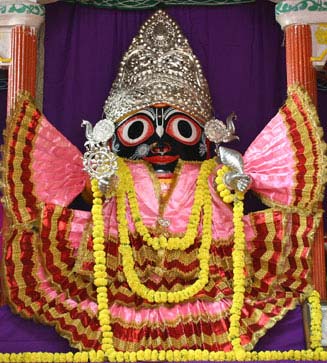
Thus he took shelter of the lotus feet of Lord Jagannatha. At that time he prayed at the feet of Lord Jagannatha and was rewarded by obtaining a Deity of the lotus-eyed Lord. This he brought to Yasora, on the banks of the Ganga near Chakdaha. (In the image: Lord Jagannath - the Deity of Jagadish Pandit).

   Lord Chaitanya and Lord Nityananda sometimes used to go to Jasora to have festivals of sankirtana. Jagadisha Pandita's son was Shri Rambhadra Goswami. In the Temple are Deities of Shri Jagannatha Deva, Shri Radha-Vallabhaji and Shri Goura-Gopala. It is said that the Goura Gopala Deity was established by Shri Duhkhini Devi. The Deity is a golden color.

   After Lord Chaitanya conducted a sankirtan festival at the home of Jagadisha Pandita, He planned to go to Nilachala. Duhkhini, however, knowing the Lord's mind, was very distressed by feelings of impending separation. At that time Mahaprabhu gave her this Deity and said, "I will eternally remain in your house in the form of this Deity." From that day this Deity of Gaura-Gopala is being worshiped there. In Gaur-ganoddesa-dipika it is revealed that Jagadisha and Hiranya were wives of the Vedic brahmanas in Krishna lila. According to another opinion, "He who was previously known as Chandrahasa, a famous dancer in Krishna-lila, is now famous as Jagadisha Pandita, who also takes great pleasure in ecstatic dancing."

   On one Ekadashi day, the young Shri Gaura Hari wanted to eat rice from the house of Jagadisha and Hiranya. The Lord said to His parents, "If you don't want Me to die, then immediately go to the house of two brahmanas by the names of Jagadisha and Hiranya, with whom I am very pleased. They are both fasting for Ekadashi, but they have prepared some offerings for Lord Vishnu. If you can obtain some of that Vishnu-Prasada then I'll recover My health and be able to move about." [C.B. Adi 6.20-23] One day, child Gaura Hari was crying incessantly. His parents told Him, "First tell us what You want. We'll bring it, but please don't cry."

   He replied, "On this Ekadashi day in Jagadisha and Hiranya's house are many preparations of Vishnu-Prasada. If I can eat that then I'll be alright."

   Hearing this impossible request of Her son, Sachi Mata put her hand on her head and began to lament. Upon hearing the words of the child, the neighbours laughed in amazement. "How is it that such a young child as this is aware that today is Ekadashi?"

   Then the ladies told Him, "Bap Nimai, don't cry anymore, we'll bring what You have requested." When the two brahmanas heard of the child's request they were very pleased. Both of them were very intimate friends of Jagannath Mishra and they were well aware that the Supreme Personality of Godhead Shri Hari had appeared in his house. Therefore, whatever they had prepared for Lord Hari they brought before Shri Gaura Hari and told Him, "Bap, Vishvambhara! We have brought everything which You requested. Now please eat it in great happiness and don't cry anymore." 

Jagadish Pandit

"If you don't want Me to die, then immediately go to the house of two brahmanas by the names of Jagadisha and Hiranya, with whom I am very pleased. They are both fasting for Ekadashi, but they have prepared some offerings for Lord Vishnu. If you can obtain some of that Vishnu-Prasada then I'll recover My health and be able to move about." (In the wallpaper: Lord Shri Vishnu).

Lochana Dasa Thakura – Biography

   Shrila Lochana Dasa Thakura appeared in this world in 1520 A.D., thirty-four years after the appearance of Shri Chaitanya Mahaprabhu. Lochana Dasa wrote a biography on Lord Chaitanya, entitled Shri Chaitanya Mangala, and he wrote many devotional songs.

   Shri Lochana dasa Thakura took birth in a family of Rarhiya physicians who resided in the village of Kogram, within the Mahakumar (Katna) district of Barddhaman. His guru was Shri Narahari Sarkar Thakura.

   "I am the servant of Thakura Shri Narahari, who is the master of my life. The desire of all my desires, I place at his lotus feet; which is that this vile creature (myself) might describe some-thing about the wonderful qualities of Shri Gaurasundara. In this expectation, he is my only refuge. [Chaitanya-mangala,Satvakhan­da].

   His father's name was Shri Kamalakara dasa and his mother's name, Shri Sadananda. He was the only son of his parents. He was raised in his maternal grandfather's home and his education was completed there. When he was only a little boy, he enjoyed the good fortune of meeting the Devotees of Shri Gauranga.

   He was married at a very young age. From his youth he was very attached to Shri Gaursundara and consequently very disinterested in material life, though he was surrounded by family, friends and society. In his youth he spent the major part of his time at his guru's Shripat, Shrikhanda, where he learned how to do kirtana. 
Lochana Dasa Thakura

"Murari Gupta, who resides at Nadia, composed many beautiful verses about the life of Shri Gauranga. These include the youthful pastimes of Nimai, which Murari Gupta personally took part in, and His later pastime in Nilachala, after He accepted sannyasa, which were narrated by Shri Damodara Pandita. Having heard these verses of Murari Gupta, composed in sanskrit, I have become very attracted and so I have composed them in the village folk poetry meter of Bengali." (In the image: Childhood pastimes of Nimai).

   The book that he composed Chaitanya-mangala was from the diary of Shri Murari Gupta. "Murari Gupta, who resides at Nadia, composed many beautiful verses about the life of Shri Gauranga. These include the youthful pastimes of Nimai, which Murari Gupta personally took part in, and His later pastime in Nilachala, after He accepted sannyasa, which were narrated by Shri Damodara Pandita. Having heard these verses of Murari Gupta, composed in sanskrit, I have become very attracted and so I have composed them in the village folk poetry meter of Bengali."

   In his Chaitanya Mangala, Shrila Lochana Dasa Thakura has written: "My hope of hopes is to be near the lotus feet of Shri Narahari Thakura, to serve and worship him with my very life. The cherished desire of the fallen Lochana Dasa is to be allowed by the grace of Narahari to sing the glories of Shri Gauranga. My Lord is Shri Narahari Thakura and I am his servant. Bowing and praying before him I beg him to allow me his service. This is my only aspiration."

   Previously in Bengal (especially East Bengal, now Bangladesha) the poets used to compose sacred songs and verses in different forms of classic rhymes and rythmic meters called Panchali (such as Laxmir Panchali, Sanir Panchali and Manasa Bhasan). The Panchali style of composition was especially used for glorifying the Lord. Shrila Lochana Dasa Thakura used the Panchali form of verse-meter in composing his famous work, Shri Chaitanya Mangala. The Panchali form employs five different kinds of song-styles or meters.

   The principle source material that was drawn upon by Shri Lochana Dasa Thakura in composing his Chaitanya Mangala was a Sanskrit book by Murari Gupta called Shri Chaitanya Caritamritam.

   Lochana Dasa Thakura explains this in his Chaitanya Mangala as follows: "That very Murari Gupta who lived in Nadiya composed many Sanskrit verses about the life of Shri Gauranga, which he later arranged in the form of a book. Having heard these verses from Murari Gupta, Damodara Pandit taught them to me, and I memorized them with great delight. As these Sanskrit verses, and the conception of Chaitanya Mahaprabhu imparted to me through Damodara Pandita, developed within my mind, it flowed forth from me in the form of these Panchali verses in Bengali, which I write in glorification of the life and pastimes of Shri Chaitanya." (C.M.Sutra-Khanda)

   In his preface to the Chaitanya Mangala, Shrila Lochana Dasa Thakura offers his prayers to Vrindavan dasa Thakura before proceeding with the narrative. He says, "I offer my prayers of submission to Vrindavana Dasa Thakura with all my heart. The sweet song of his Chaitanya Bhagavata has enchanted the whole world." (C.M.Sutra-Khanda)

   Vrindavan Dasa Thakura's Chaitanya Bhagavata was originally called Chaitanya Mangala. It is said that Shrila Lochana Dasa Thakura and Shrila Krishna Dasa Kaviraja Goswami gave it the name Chaitanya Bhagavata. Krishnadasa Kavriaja Goswami writes:

krishna lila bhagavate kahe vedadvyasa,
chaitanya lilara vyasa-vrindavana dasa.

   "Vedavyasa has described the pastimes of Krishna in his Bhagavata.The Vyasa of Chaitanya Lila is Vrindavan Dasa."

   From this comparison between Vedavyasa and Vrindavana Dasa, it has been concluded that Kaviraja Goswami is probably responsible for Vrindavan Dasa Thakur's work becoming known as the Bhagavata of Chaitanya Lila or Chaitanya-Bhagavata.

   There are many pastimes of Shri Chaitanya that have only been touched on briefly by Vrindvana Dasa Thakura. These are described in detail in the Chaitanya Mangala of Lochana Dasa Thakura.

   The Chaitanya Mangala is divided into four parts: Sutra Khanda, Adi Khanda, Madhyama Khanda and Shesha Khanda. The Sutra Khanda has two chapters, Adi Khanda has seven chapters, the Madhyama Khanda twelve, and the Shesha Khanda three. The contents of the Adi Khanda are as follows.

Lochana Dasa Thakura

The first chapter in the Sutra Khanda is called Mangalaracharanam, or auspicious invocation. It begins with a song of the glories of Shri Chaitanya and then praises the Vaishnavas who were personal associates of Shri Chaitanya. After this, Lochana Dasa Thakura offers respects to his gurudeva, Narahari Sarakara Thakura, and prays for his guru's mercy. He offers his obeisances at the lotus feet of the countless Devotees and personal associates of Shri Chaitanya Mahaprabhu, known and unknown...(In the image: Lord Chaitanya and other Devotees).

   The first chapter in the Sutra Khanda is called Mangalaracharanam, or auspicious invocation. It begins with a song of the glories of Shri Chaitanya and then praises the Vaishnavas who were personal associates of Shri Chaitanya. After this, Lochana Dasa Thakura offers respects to his gurudeva, Narahari Sarakara Thakura, and prays for his guru's mercy. He offers his obeisances at the lotus feet of the countless Devotees and personal associates of Shri Chaitanya Mahaprabhu, known and unknown. Having prayed for the blessings of guru and vaishnavas, Lochana Dasa explains that Murari Gupta had written a book in Sanskrit called the Chaitanya Charitamritam, and that since that book is no longer available, he is giving its essence in the form of Bengali verse called Panchali. He then briefly describes the subjects found in the Adi, Madhya, and Shesha Khandas.

   The second chapter of the Sutra Khanda is called Grantharambha, for here the book actually begins. In this chapter Lochana Dasa relates how he heard from Damodara Pandita the story of Jaimini's Mahabharata recital, wherein he describes a conversation between Narada and Uddhava. In that conversation Narada explained the cause of Krishna's appearance in the golden form of Shri Gauranga. One time Narada saw that with the coming of the age of Kali the living beings had fallen into great suffering. He began to worry about how they could be delivered and the principles of dharma restored. Thinking in this way, he decided that only Krishna's descent into this world would deliver the fallen souls and restore the principles of religion. Wanting to appeal to Krishna to descend as an avatara, he set out for Dwaraka dham. At that time, Krishna was staying in the palace of Shri Rukmini devi.
Lochana Dasa Thakura

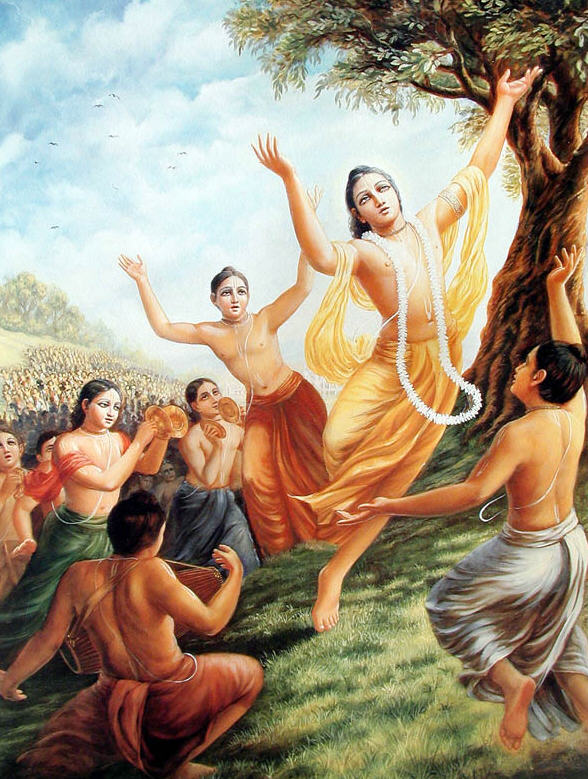
There, in answer to Uddhava's inquiries about the welfare of the living beings, he explained how in Kali-yuga - the best of all ages because of Shri Gauranga's advent - Krishna would appear in a golden form as Shri Gauranga and perform the kirtan of the Holy Name of Hari. Narada told Uddhava how the Lord would come to establish the Sankirtana of the Holy Name of Krishna as the yuga-dharma, the religious principle for the age of Kali. Narada explained the glories of kirtana. (In the image: Sankirtana movement of Lord Chaitanya).

   Just then, upon learning that Shri Krishna would soon appear on earth in a golden form, with the golden luster and devotional mood of Radharani, Rukminidevi became deeply troubled. Feeling separation from the Lord, she fell at the lotus feet of Krishna and began praising the qualities of Shri Radha – whose devotion was so glorious that Krishna wanted to honor her by assuming her luster and mood. At that time Narada entered the room. He explained to Krishna the reason for his trip – that he wanted Krishna to descend to the earth planet in order to deliver the fallen souls. At that time, Krishna revealed to him how in the future he would appear as the son of Sachidevi and Jagannatha Mishra in Navadwipa dham: in a golden form with all his transcendental associates. 

   Having seen that golden form revealed, Narada was overwhelmed with ecstasy. Constantly thinking of this golden form and the Lord's plans to appear in Navadwipa dhama as Shri Gauranga, Narada the best of munis went to visit Naimisharanya, all the while singing the glories of the Lord. There, in answer to Uddhava's inquiries about the welfare of the living beings, he explained how in Kali-yuga – the best of all ages because of Shri Gauranga's advent – Krishna would appear in a golden form as Shri Gauranga and perform the kirtan of the Holy Name of Hari. Narada told Uddhava how the Lord would come to establish the Sankirtana of the Holy Name of Krishna as the yuga-dharma, the religious principle for the age of Kali. Narada explained the glories of kirtana.

   Thereafter, Narada Muni related to Uddhava the discussion that had previously taken place when he had gone to Kailasha and visited Lord Shiva,the best of Vaishnavas. There, Narada and Parvati discussed the glories of Maha Prasada, having heard of the glories of Maha Prasada from Narada, Parvati had performed 12 years of Lakshmi-seva. By her mercy, Parvati got some of Lakshmi Devi's own Maha Prasada and also gave Shiva a small bit of that Prasada. Not able to tolerate the dancing of Lord Shiva upon obtaining this Maha Prasada, the earth came before Parvati, begging her to give the Maha Prasada of the Vaishanvas to all the jivas. With this proposal, Parvati explained how the Gaura-avatara would come in kaliyuga and distribute Maha Prasada to all the fallen souls.

   After this, Narada went to Brahma and discussed the Gaura-avatara with him. Brahma, the creator, at that time explained to him the essential subject of the Shrimad Bhagavatam, and showed him how the version of the Bhagavatam supported the gaura-avatara. After this,Narada began wandering here and there. As he went from place to place he became concerned about he sufferings of the jivas. As he was worrying about the living entities in this way, he came near Jagannatha Puri. There he heard a divine voice discussing the avatara of Jagannatha. On the order of the divine voice he went to Puri. From there, the Lord ordered him to go to Goloka. First he came to Vaikuntha. After this, he arrived in Goloka, where he saw many pastimes of the Lord. There he saw the Lord in his golden form as Shri Gaura, and fainted in ecstasy. After this, he went all over the universe, informing all the gods of the news.

   In Shvetadwipa he saw the supernatural pastimes of Balarama, the very figure of service. After this, all the demigods began taking birth on earth. As previously mentioned by Krishna in His conversation with Rukmini, the Lord, along with Satyabhama, Rukmini, and all His eternal associates from the spiritual world came with the luster and mood of Radharani in a golden form as Shri Gauranga. He came to spread the sankirtan of the Holy Name of Krishna. 
Lochana Dasa Thakura

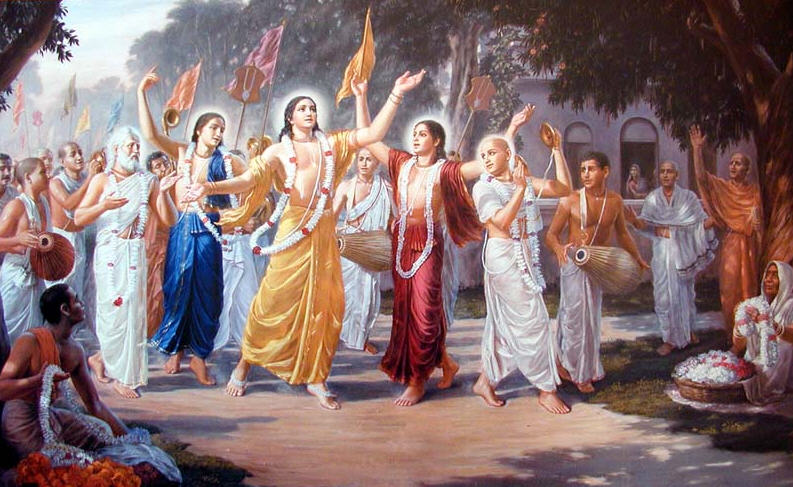
Balarama came as Nityananda, Shiva came as Advaita Prabhu, and other great souls descended as His other eternal associates like Murari, Mukunda, Shrivasa, Raya Ramananda, Ishvara Puri, and Madhavendra Puri. Lochana Dasa Thakur concludes the chapter by praising the glories of his guru, Shri Narahari Sarakara Thakura,and his nephew Raghunandana Thakura. (In the image: Congregational chanting of the Holy Names).

   Balarama came as Nityananda, Shiva came as Advaita Prabhu, and other great souls descended as His other eternal associates like Murari, Mukunda, Shrivasa, Raya Ramananda, Ishvara Puri, and Madhavendra Puri. Lochana Dasa Thakur concludes the chapter by praising the glories of his guru, Shri Narahari Sarakara Thakura,and his nephew Raghunandana Thakura.

   The first chapter of the Adi lila of Chaitanya Mangala describes the Janma-lila, or birth pastimes, of Shri Chaitanya Mahaprabhu. The chapter first describes the advent of the Lord's eternal associates, who appeared in this world before Mahaprabhu Himself. Lochana Thakura describes the Lord as the remote and immediate cause of creation, the Parabrahman, Shri Narayana Himself. That Supreme Personality of Godhead descended within the womb of Sachi Devi and advented Himself upon this earth. In this way, gradually Sachi's womb grew day by day, and her body assumed a supernatural effulgence. Seeing her wonderful bodily effulgence, everyone was astonished, and thought, "Surely a great personality is about to take birth from the womb of Shri Sachi Devi." 
Lochana Dasa Thakura 9

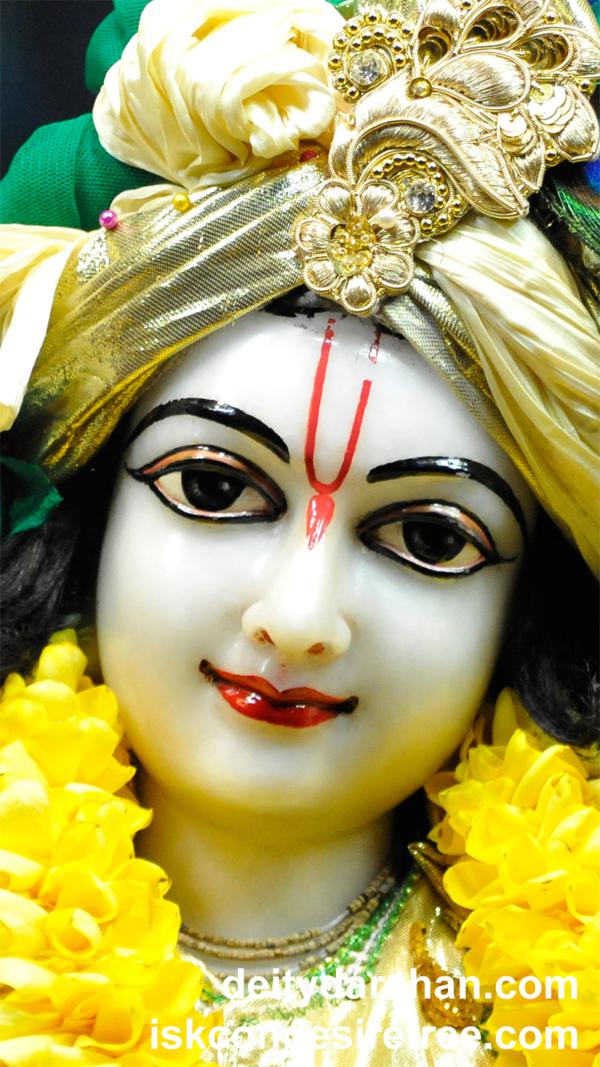
When the heart of Sachi Devi was full of mercy for the whole world, that is to say, when the most merciful Shri Chaitanya Mahaprabhu had completely filled her heart, gradually the tenth month came. After this, taking advantage of an auspicious moment on the full moon day in the month of Phalguna, in the midst of Hari-sankirtana, Shri Guarachandra appeared like a golden moon from the ocean of the womb of Mother Sachi. In this way, the Lord appeared on earth, and the ten directions were jubilant. The gods and godesses, men and women, eager to see the moonlike face of the son of Sachi, hurried to the house of Jagannatha Mishra and Sachi Devi. In this way, their home was transformed into Vaikuntha. (In the image: Moon like face of Shri Gaurachandra, ISKCON Chowpatty, Mumbai).

   When her "pregnancy" was in its sixth month, one day Advaita Acharya Prabhu went to the house of Sachi Devi and Jagannatha Mishra. Arriving there, he offered his obeisances to the child in the womb of Mother Sachi and then circumambulated her. Sachi Devi and Jagannatha Mishra could not understand the cause of Advaita's unusal behavior. In this way, Brahma, Shiva, and the other gods came to offer their respects to that Supreme Personality of Godhead who had hidden Himself within the womb of Sachi Devi, knowing well that He would soon advent Himself in this world to deliver the lowest of men with the highest nectar of Krishna prema. Detecting their presence, Sachi Devi felt great joy. When the heart of Sachi Devi was full of mercy for the whole world, that is to say, when the most merciful Shri Chaitanya Mahaprabhu had completely filled her heart, gradually the tenth month came. After this, taking advantage of an auspicious moment on the full moon day in the month of Phalguna, in the midst of Hari-sankirtana, Shri Guarachandra appeared like a golden moon from the ocean of the womb of Mother Sachi. In this way, the Lord appeared on earth, and the ten directions were jubilant. The gods and godesses, men and women, eager to see the moonlike face of the son of Sachi, hurried to the house of Jagannatha Mishra and Sachi Devi. In this way, their home was transformed into Vaikuntha.

   Jagannatha Mishra and all the residents of Nadiya who had turned out to see that divine child were all struck with wonder to see his beauty. He had a neck like a lion, arms like the trunks of elephants, and a broad chest. His lotus feet were marked with the auspicious symbols of Lord Vishnu: a flag, a thunderbolt, a rod for driving elephants.

   Seeing all these wonderful and superhuman manifestations of divinity in the child, the people there were all astonished. Everyone speculated about His supernatural origin, saying, "He is definitely not an ordinary human." For eight days, the newborn child and its mother were quarantined, as is traditional for childbirth in Bengal, and on the ninth day a great festival was held. At that time, all the neighbors were filled with great joy to see the boy, and their attraction for Him increased.

   The second chapter of the Adi Khanda describes the Lord's bala-lila childhood pastimes. Here, Lochana dasa Thakura describes how after six months, the grain-eating ceremony of Shri Gaurasundara was held, and after this the name-giving ceremony was performed. At the appearance of the Lord, the whole world was delighted. Since the Lord gave pleasure to the whole world, the brahmanas said His name should be Vishvambhara. Soon, Vishvambara began to walk, by holding onto Jagannatha Mishra's finger with His tiny hand. The different women in the village used to decorate Him with different ornaments, and they would wonder at the beautiful effulgence that emanated from the child, which was as bright as millions of moons.The moon outside can brighten the darkness of night only slightly, but the moon of Shri Gaurachandra can eliminate all darkness, both within and without.

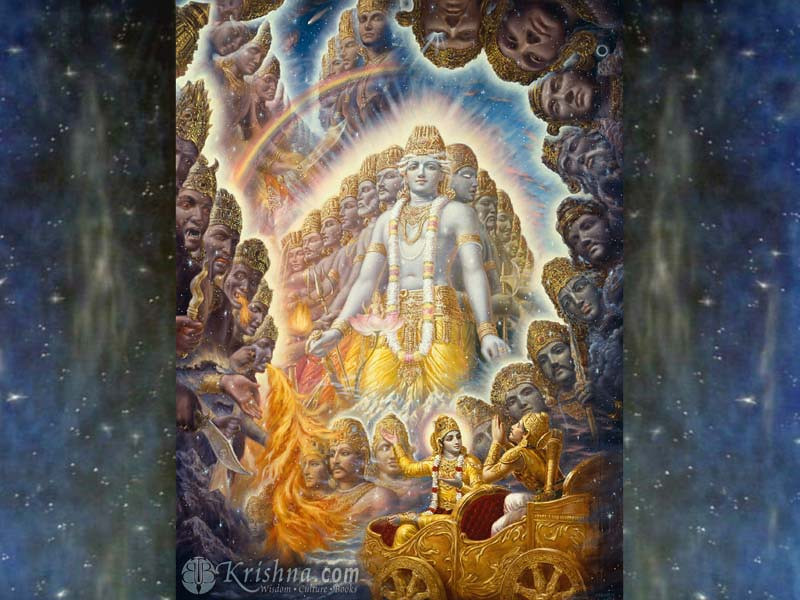
   Sachi Devi would sing to her son while threshing wheat, and at that time, all the demigods are offer prayers to her son. Seeing this,Sachi Devi was quite amazed. Sometimes she would see Gaurahari chanting the glories of Radha-Krishna with the gods and would become astonished and faint. When she heard ankle-bells ringing on the bare feet of her child, again she was bewildered. Sometimes she was afraid that ghosts were causing a disturbance, and sometimes she would look in the mouth of her child, and, beholding the universal form, become completely astonished. 
Lochana Dasa Thakura

Sachi Devi would sing to her son while threshing wheat, and at that time, all the demigods are offer prayers to her son. Seeing this,Sachi Devi was quite amazed. Sometimes she would see Gaurahari chanting the glories of Radha-Krishna with the gods and would become astonished and faint. When she heard ankle-bells ringing on the bare feet of her child, again she was bewildered. Sometimes she was afraid that ghosts were causing a disturbance, and sometimes she would look in the mouth of her child, and, beholding the universal form, become completely astonished. (In the image: Universal form of Krishna).

   In this way, gradually Gaurahari grew old enough to play outside,where He astounded His newfound childhood friends with His divine antics. His playmates were quite attached to Him. Sachi Devi would carry the baby Gaurahari in her arms and watch after Him carefully as He ran about, to keep Him from smashing everything as He played. Once, He explained to Mother Sachi the nature of things pure and impure, instructing her on the aprakrita nature of Krishna, who is master of everything.

   While sitting on a heap of broken clay pots soiled with leftovers, He instructed His mother on jnana. Seeing His mother bewildered, He brought her some coconut fruit. In this way, He performed many childhood pranks. He used to play with puppydogs. When Sachi Devi chastised Him for playing with a dog, and Gaurahari had to give up His pet, He cried tears of anger before Sachi Devi. At that time, He bestowed a divine spiritual body upon that dog while performing Harikirtana. The dog went to Vaikuntha, and as Brahma, Shiva, and the other demigods saw the good fortune of the dog they were all amazed. Sachi Devi was astonished at the activities of her son, who made her understand His Supreme Position as the Absolute Lord.

   The fourth chapter of the Adi Lila of Chaitanya Mangala describes the Lord's pauganda, or boyhood lila. Having heard Murari Gupta reciting the yogashastras, the Lord mimicked His gestures and speech, making fun of him and then began to laugh uproariously.Thus Murari Gupta was enraged and chastised the Lord with words of anger. In return, the boy, intending to express His contempt for the conclusions of yogis went to Murari's afternoon lunch and urinated on Murari Gupta's plate. After this, He instructed Murari Gupta on the superiority of Krishna-bhakti. 

   Finally, the author discusses Mahaprabhu's boyhood performance of sankirtana, and relates what he heard from Damodara Pandit of Murari Gupta's notes on the sannyasa of Vishvarupa, the Lord's older brother. He also relates the lamentation of Sachi Devi and Jagannatha upon their son's taking sannyasa. He also recounts many other pastimes performed by the Lord as a boy.

   At that time the Lord's hair-cutting ceremony took place. And soon thereafter, the day of Hate-khare, or the first holding of chalk, came. On that day, to signify the beginning of a child's formal education begins, He is given a piece of chalk and a chalkboard, upon which He is to draw the letters of the alphabet. Upon beginning His studies, the Lord was overjoyed to meet many new classmates. On the day that his son's education began, Jagannatha Mishra was very pleased. That night, however, he had a dream in which a brahmana appeared to him and told him that his son Vishvambhara was Bhagavan Himself. Who can educate the Supreme Lord, or discipline Him as a small boy? From this, Jagannatha Mishra could understand the supreme position of his child. When his dream broke, he was again overwhelmed with the sentiments of parental love and soon forgot the dream.

   At a particular time, the sacred thread ceremony of the boy was performed. After this, there is a discussion of the four ages and the yuga-avatara. In Dvapara-yuga, the Supreme Lord Himself, Shri Krishna the son of Nanda in Vrindavana, makes His appearance on earth. In Kaliyuga, Shri Krishna, appearing with the luster and mood of Shri Radha, advents Himself as Shri Gauranga. By performing Sankirtana, He establishes the religious principle for the age of Kali: hari-nama-sankirtana. In order to establish the yuga-dharma, He comes as a preacher. Maddened with Krishna-prema, He delivers all souls with the ecstasy of love of God, by moving here and there and distributing divine love. While in His grihastha-lila, He ordered His mother to refrain from eating grains on Ekadashi, in this way instructed everyone to follow this injunction. 

Lochana Dasa Thakura 11

At a particular time, the sacred thread ceremony of the boy was performed. After this, there is a discussion of the four ages and the yuga-avatara. In Dvapara-yuga, the Supreme Lord Himself, Shri Krishna the son of Nanda in Vrindavana, makes His appearance on earth. In Kaliyuga, Shri Krishna, appearing with the luster and mood of Shri Radha, advents Himself as Shri Gauranga. By performing Sankirtana, He establishes the religious principle for the age of Kali: hari-nama-sankirtana. In order to establish the yuga-dharma, He comes as a preacher. Maddened with Krishna-prema, He delivers all souls with the ecstasy of love of God, by moving here and there and distributing divine love...(In the wallpapers: In the left side Mother Yashoda with Gopal in her hands and Lord Chaitanya performing sankirtana Yagya along with other Devotees).

   Gradually, Jagannatha Mishra fell ill, and passed away, entering into the Lord's unmanifest pastimes. At that time, the Lord instructed Sachi Devi on the fleeting nature of a man's short life within the material world. He also explained many other important principles of divine reality to her. With the passing of her husband, Sachi Devi greatly lamented. Gaurahari Himself also lamented the passing of His father. After this time, He began paying close attention to His studies.

   Chapter four describes the Lord's pastimes of youth and marriage. One day, after school, the Lord was walking home from His teacher's house and at that time He met Vanamali Acharya. As they talked, the Acharya made the Lord understand that he had just been to see His mother Sachi Devi, where he had been making arrangements for the Lord's wedding. Sachi Devi had rebuffed him, and unable to secure her permission for the match, Vanamali was a little unhappy. In this way, he was returning to his home, downcast. Shri Gaurahari returned home. Without intimating anything of his conversation with the matchmaker, the Lord informed her of His intentions to wed, saying that she should seek out Vanamali and make the necessary arrangements for the wedding of her son.

   She did so, and on the orders of Sachi mata, Vanamali Acharya went to Vallabhacharya's house. There he informed Vallabhacharya of the Lord's intent to wed Vallabhacharya's daughter Lakshmi Devi.

   Having made all the arrangements for the wedding, Sachi Devi informed all her friends and relatives of the auspicious event and invited them to the occasion. Everyone floated in the waves of the joyful ocean. In this way, Sachi Devi made preparations for her son's wedding.
Lochana Dasa Thakura

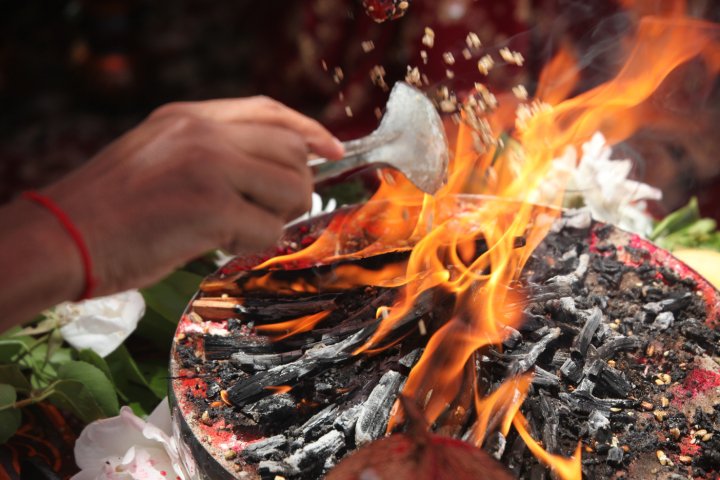
All the residents of Nadia turned out to see the wedding. The relatives saw to it that all the old traditional Bengali wedding customs were followed. The Hindu ceremony of besmearing the bridegroom and bride with a paste of turmeric and then bathing them on the eve of the wedding was performed, as were many other rituals. The place where the wedding was to be performed was cleansed with sanctified water, and all the Vedic purificatory rites were observed...(In the image: Wedding of Devotees, Carpinteria).

   All the residents of Nadia turned out to see the wedding. The relatives saw to it that all the old traditional Bengali wedding customs were followed. The Hindu ceremony of besmearing the bridegroom and bride with a paste of turmeric and then bathing them on the eve of the wedding was performed, as were many other rituals. The place where the wedding was to be performed was cleansed with sanctified water, and all the Vedic purificatory rites were observed. All this took place at the house of Vallabhacharya. At last, with great pomp and grandeur, in the midst of a great assembly of Devotees, relatives and friends, the wedding of Shri Gaurahari and Lakshmidevi was performed in the house of Vallabhacharya.

   The Acharya himself performed the Vedic wedding ceremony. He offered his new son-in-law sanctified water and arghya to sweeten His lotus mouth. After this, he brought Lakshmi Devi up on the wedding stage and presented her to Gaurahari. Finally, the scriptural sacrifice that is performed at weddings took place. After this, the brahmanas were fed sumptuous Prasadam at the conclusion of the wedding, and Shri Lakshmi Devi was escorted to her new home as the bride of Shri Gaurahari. 

   The Fifth Chapter of the Adi Khanda of Chaitanya Mangala describes more of the Lord's pastimes of youth, including his tour of Bengal. After some time the Lord journeyed down the banks of the Ganges, sanctifying that holy river even further by the touch of His lotus footsteps. In order to provide for His new family, the Lord set out for East Bengal, where He took up the occupation of teaching. In this way He gave His mercy to the residents of East Bengal who lived on the banks of the Padmavati river. When He returned to Bengal, He found that Lakshmi Devi had been unable to tolerate the pain of His absence. She was bitten by the snake of separation and passed away into the unmanifest pastimes of the Lord. Sachi Devi was heartbroken and was consoled in her lamentation by Gaurahari who glorified the sublime qualities of Lakshmi Devi.

   The Sixth Chapter of the Adi Khanda of Chaitanya Mangala describes the arrangements made by Sachi Devi for the Lord's second wedding. Through Dvija-Kashishvara it was arranged that He was to be wed to the daughter of Sanatana Pandita, Vishnupriya Devi. Here, the wedding of Vishnupriya and Gaurahari is elaborately described. 
Lochana Dasa Thakura

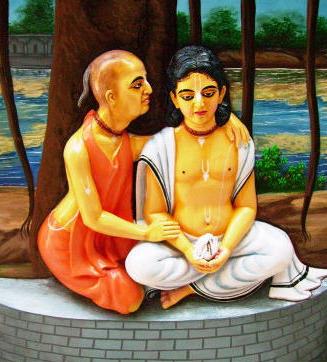
...At that time, the Lord met that best of Vaishnavas, Shri Ishvara Puri. He prayed for the mercy of Ishvara Puri Prabhu, who, soon thereafter, initiated Him in the Krishna mantra. (In the image: Lord Chaitanya in white is initiated by Ishvara Puri in saffron)quot;Surely a great personality is about to take birth from the womb of Shri Sachi D/p/p/pev/pi..

   The seventh chapter of the Adi Khanda describes the Lord's journey to Gaya. Some time after the wedding of Gaurahari and Vishnupriya Devi, the Lord, having completed His education busied Himself in His teaching work. One day, He left for Gaya to offer respects to His departed father. As He walked down the road, everywhere, the birds and animals who saw Him were stunned with ecstasy upon beholding His lotus feet. After instructing a brahmana in Krishna-bhakti, the Lord allowed a brahmana to drink the water of His lotus feet. That brahmana immediately became free from all his bodily distress. 

   At that time, the Lord also instructed how the mysteries of Krishna-bhajana cannot be understood simply on the basis of one's birth in a brahmana family. At last arriving in Gaya, the Lord performed worship of the devas and pitris, in order to do His duty regarding His departed father. While so engaged, He went to see the lotus feet of the Vishnu Deity. At that time, the Lord met that best of Vaishnavas, Shri Ishvara Puri. He prayed for the mercy of Ishvara Puri Prabhu, who, soon thereafter, initiated Him in the Krishna mantra.

   With this, the Lord's transcendental ecstasy became manifest. After this, He went to take darshan of the lotus feet of Vishnu. Upon seeing the Lord's holy feet, Shri Gaurahari was overwhelmed with prema and exhibited His ecstasy by laughing, singing and dancing. Only a few days later, He returned home.

From this point the first chapter of the Madhya Khanda begins.

   In the first chapter of the Madhya Khanda:
 
   The author describes the Lord's pastimes as a teacher, and explains how He showed mercy to His students. Praising her good fortune, the Lord showed His grace to Sachi mata. Soon after this He revealed symptoms of mahaprema at the home of Shuklambara Brahmachari. This was the first time that He publicly revealed His absorption in Krishna-prema, by showing the symptoms of great ecstasy, such as swooning, tears shooting from the eyes, hairs of the body standing on end, choking up of the voice, laughing madly, and so on. Performing sublime kirtan, Shri Gaurahari drowned everyone in the waves of bliss. In this way the Supreme Lord appeared as His own Devotee in order to glorify the position of Bhakti. After this, the Lord began His pastimes of preaching the glories of Shri Krishna prema, engaging many Devotees in preaching. He began organizing all the Devotees, beginning with Gadadhara, as well as many Devotees from within and wihtout Bengal. One day the Lord went to the house of Shrivasa and his brothers. At that time, the Devotees could hear the flute of Krishna. At that time the Lord became overwhelmed by the mood of Shrimati Radhika. In the madness of separation, He began laughing and crying. Sometimes He would fall completely silent and His mood became grave. In this way He manifest differing divine moods. At that time, a divine voice siad, "O Vishvambhara! You are the Lord Himself. For the purpose of preaching Krishna-prema, You have descended within this world."
Lochana Dasa Thakura

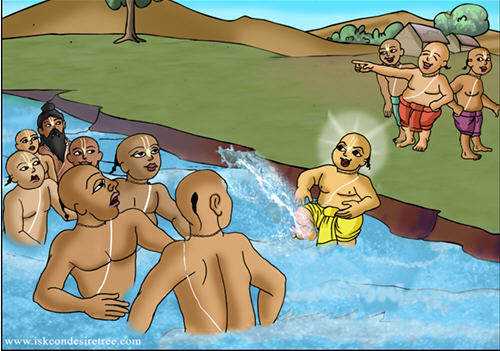
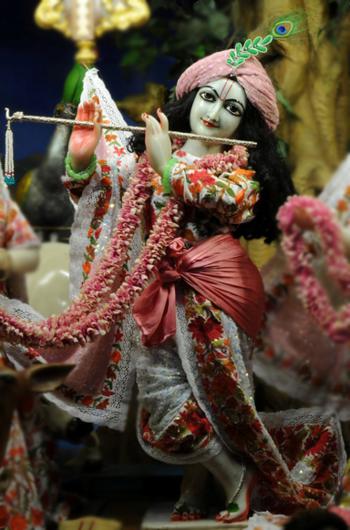
When a foolish brahman remarked that the murti of Shri Krishna is a product of Maya, the Lord jumped in the Ganges with His clothes on, to purify Himself from the offender. (In the image: Shri Gopinath, ISKCON Chowpatty, Mumbai).

   Later, at the house of Murari Gupta, the Lord would reveal His form as the Varaha avatara. At that time, Murari offered prayers before the Lord in great ecstasy, and the Lord told him to serve Krishna the son of Nanda, following in the footsteps of the residents of Vrindvana. Murari Gupta wanted to see the form of Shri Ramachandra.

   At that time the Lord instructed him on the glories of the Holy Name of Krishna. At last, the devatas headed by Lord Brahma appeared before the Lord, praying for Krishna-prema and attained Krishna-prema by the mercy of Shri Gauranga. After this, kirtan-performer Shuklambhara Brahmachari began chanting "Jai Radhe! Jai Govinda!" and attained the mercy of Shri Chaitanya. After this, Lochana dasa Thakura describes the glories of Shri Srhi Gaura-Gadadhara.

   In the second chapter of the Madhya Khanda:
 
   The author describes the beauty of Shri Gauranga's divine form. The Lord performed a miracle by planting a mango seed that immediately became a mango tree with fully ripened fruit for the satisfaction of the Devotees. Whoever ate the fruit of that tree was delivered from the tree of material existence. The Lord instructed Mukunda Datta on the supremacy of Krishna bhakti, and how one should give up thinking of the body and mind and think only of the worshipable service of Krishna. The Lord gave His blessings to Murari Gupta. The Lord's pastimes of kirtana at the house of Shrivasa Thakura are described. When a foolish brahman remarked that the murti of Shri Krishna is a product of Maya, the Lord jumped in the Ganges with His clothes on, to purify Himself from the offender.

   The third chapter of the Madhya-Khanda:
 
   Describes the glories of Shri Advaita. Here, the author describes the Lord's pastimes with Advaita, how He performed kirtan in the house of Advaita, and how they embraced in ecstasy. A brahman who tried to stop the kirtan of Mahaprabhu by attempting to frighten Shrivasa Pandita was bewildered by the Lord's mayic potency. Also described is how the Lord, in the house of Shrivasa, performed the worship known as Gada-puja, wherein the club of Vishnu is worshiped in order to invoke the Lord's power in smashing the atheists.

   This chapter also explains the visit paid by Advaita to Navadwipa, how Advaita bowed before Shri Gauranga, and danced in ecstasy before Him, realizing that his prayers for Krishna's descent had been fulfilled. When Shrivasa Thakura inquired into the glories of Advaita, Mahaprabhu described Advaita-tattva, and advised everyone to worship Shri Hari.

   In the fourth chapter of the Madhyama Khanda:
 

Lochana Dasa Thakura

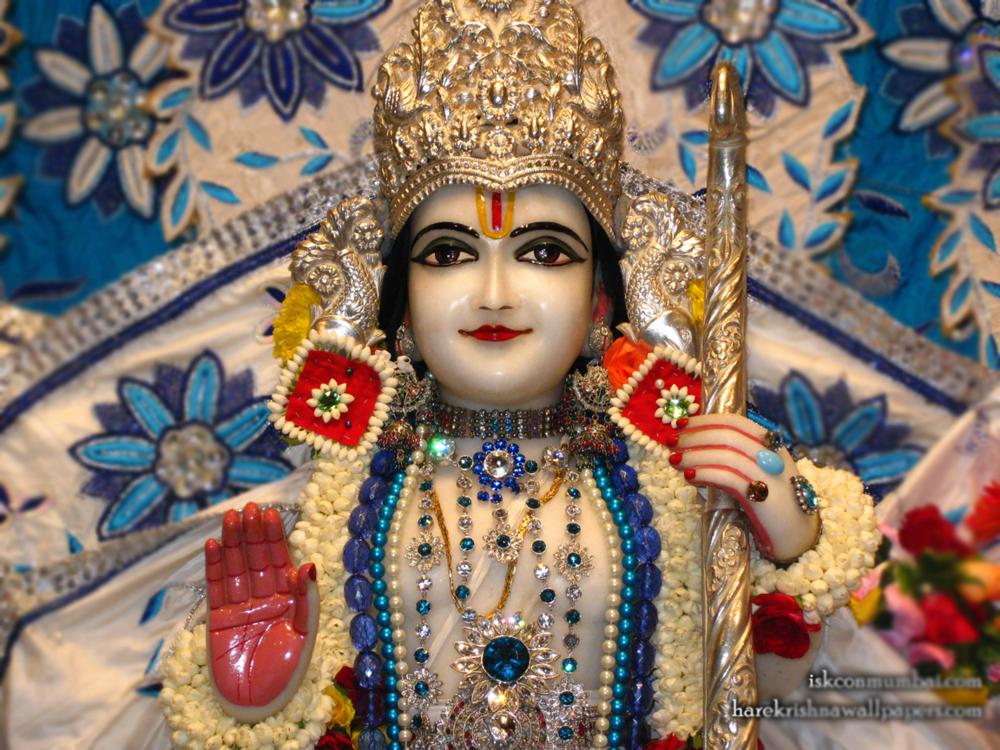
Shri Gaurahari explains the esoteric meaning of "Shrivasa." Murari Gupta's book, "Raghubhirashtaka" is discussed. The Lord writes "Ramdasa" on Murari's forehead. He reveals Himself as Rama and orders Rama Pandita, the brother of Shrivasa Pandita to serve Shrivasa...(In the image: Lord Shri Rama, ISKCON Juhu, Mumbai).

   Shri Gaurahari explains the esoteric meaning of "Shrivasa." Murari Gupta's book, "Raghubhirashtaka" is discussed. The Lord writes "Ramdasa" on Murari's forehead. He reveals Himself as Rama and orders Rama Pandita, the brother of Shrivasa Pandita to serve Shrivasa. The Devotees are sent to search for Nityananda. The Lord meets Nityananda at the house of Nandana Acharya. The Lord explains the glories of Shri Nityananda and how it is that by Nityananda's mercy one may attain Krishna-prema. At that time, the Lord reveals his six-armed, four-armed, and two-armed forms to Nityananda.

   The fifth chapter of the Madhya-Khanda:
 
   Reveals how, late at night, the Lord was weeping tears of ecstatic love for Krishna. He discussed His dream with Sachi Devi. The story of how Nityananda Prabhu spent two days at the house of Advaita Acharya is recounted. Nityananda Prabhu's prema is described. The worship by Advaita of Mahaprabhu in the house of Shrivasa Pandita is described. The meeting of the Lord and Haridasa Thakura. The author also tells how Nityananda's kaupin was saved by Mahaprabhu, who later had the Devotees wear it as a kavacha. Mahaprabhu's trance and the Devotees' separation from the Lord is also described. The ecstasy of the Devotees upon the Lord's reawakening is also described.

   The sixth chapter of the Madhya-Khanda discusses the following subjects:
 
   How Gaurahari enjoyed pastimes of prema in the midst of the Devotees; His meeting with Haridasa Thakura; His visit at the house of Advaita; His order to Advaita to preach Krishna-prema without any consideration of fitness and unfitness; His order to all the Devotees to preach nama-prema and thus deliver everyone; the effects of nama-bhasa; How the Lord would wander through the streets of Nadiya performing Nama-kirtana; the story of the deliverance of Jagai and Madhai.

After this, the author glorifies the mercy of Shri Nityananda and Shri Gauranga.

   The seventh chapter of the Madhyama-Khanda describes the following subjects:
Lochana Dasa Thakura

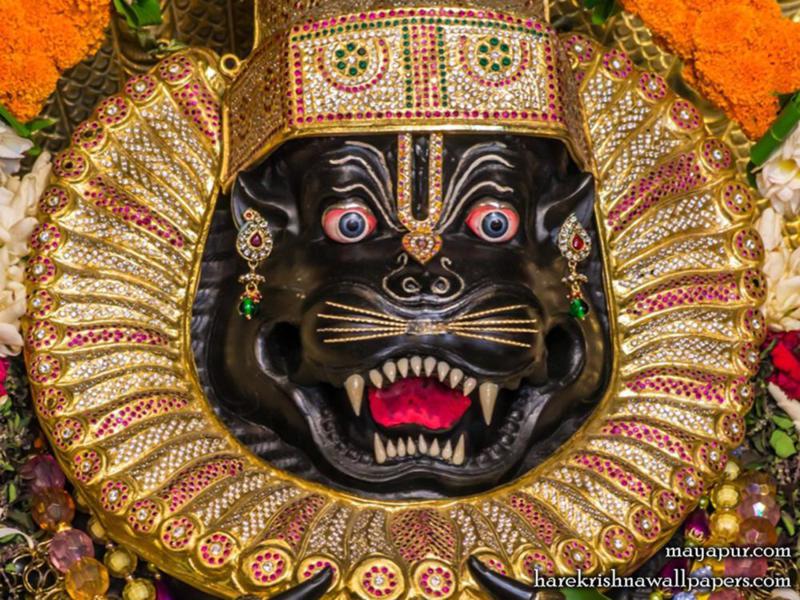
After this, the Lord revealed His Nrishimha manifestation at the house of Shrivasa... (In the image: Lord Shri Narasimha Dev, ISKCON Mayapur).

   How the Lord cast His merciful glance upon the son of an East Bengal brahmana named Vanamali; the brahmana seeing the Shyamansundara form of the Lord offered many prayers to Shri Gauranga. After this, the Lord revealed His Nrishimha manifestation at the house of Shrivasa. He bestowed mercy upon a follower of Shiva. After a brahman lady touched His feet, He jumped into the Ganges. The Lord gave instructions regarding the worship of Shri Hari. His mercy towards Shrivasa is described as are Mukunda's prayers, the Lord's manifestation of His Godhead, and Shrivas Pandit's abhishek of Mahaprabhu. The author's glorification of the qualities of Shri Gauranga and his instructions on the worship of Shri Gauranga conclude the chapter.

   The eighth chapter of the Madhyama Khanda describes the following subjects:

   How the envious brahmana who was stricken with leprosy prayed for forgiveness in order to become freed from the sin of Vaishnava aparadha and was delivered by the mercy of Shrivasa Thakura; how a brahmana was forbidden to enter the Lord's nocturnal kirtan and how the Lord danced in ecstasy when that brahmana then cursed the Lord never to enjoy the pleasures of samsara. How the Lord in the mood of Balarama demanded honey is described. The assembly of Devotees at the house of Advaita is described. The visit of the Devotees headed by Acharyaratna is recorded. How all of them saw the Lord's manifestation of Balarama and bathed in the Ganges is also described.

   The ninth chapter of the Madhyama Khanda of Shri Chaitanya Mangala records the following subjects:
 
   The Lord's manifestation of Varaha; How the Devotees headed by Advaita were ordered to preach and perform sankirtana; How the mood and qualities of the gopis was glorified in kirtan; How Shrivasa in the dress of Narada glorified Gadadhara Pandita; A discussion of the divine correlation between Shri Gadadhara and Shri Radhika; Thakur Harida's  visit; the ecstasy of Sankirtana; The Lord's mad manifestation of the mood of Vaikuntha opulence; How the Lord, in the dress of Lakshmidevi rendered service to the Lord in great ecstasy; How the Lord expressed the inner moods of the personality of Godhead.

   The tenth chapter of the Madhyama-Khanda of Chaitanya Mangala describes the following:

   The Lord tells Shrivasa of the different religious principles for the different ages and how Sankirtan is the best religious principle in the age of Kali. In the mood of Shri Radha the Lord began asking "Where is Vrindavan? Where is Lalita?" in great anxiety. Murari Gupta consoled Him, and they all performed kirtana. In a dream Sachi Devi sees Gaurahari receive the sannyasa mantra from Keshava Bharati. The Lord's powerful separation from Krishna is described. Worried that the Lord will take sannyasa, the Devotees are heartbroken. Mahaprabhu consoles the Devotees. The eleventh chapter of Madhyama Khanda describes the following: Upon hearing of the Lord's sannyasa, Sachi Devi's lamentation; Her entreaty to Gaurahari to remain a grihastha; The Lord's advice to everyone to worship Krishna; His different attempts to console His mother and His revelation of the divine form of Krishna to her.

   The twelfth chapter of the Madhyama Khanda discusses the following subjects:
 
   The lamentation of Vishnupriya Devi; the Lord's sweet words of pacification to her and His instructions regarding divine reality, as well as His revelation of of His four-handed Narayana form; the visit by Shrivasa and Murari, the Lord's attempt to pacify them.

   The thirteenth chapter describes the following:
 

Lochana Dasa Thakura

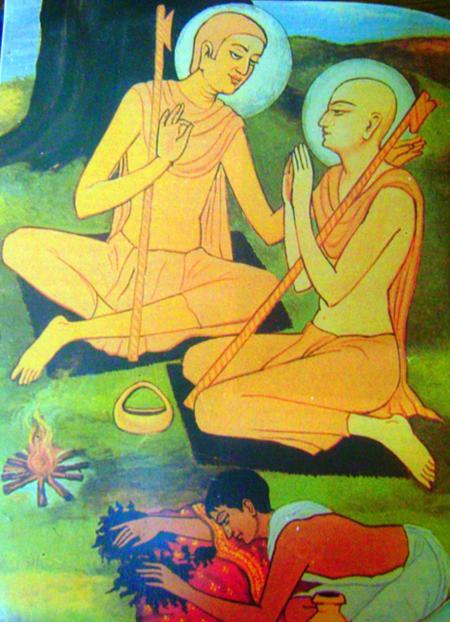
The Lord asks for the sannyasa mantra from Keshava Bharati; The Lord first gives the sannyasa mantra to Bharati and then hears it from him; the lamentation of all the Devotees at the sannyasa of Shri Chaitanya Mahaprabhu; The Lord's attempt to pacify them; the Lord's eagerness for Krishna-bhakti; the giving of the name Shri Krishna Chaitanya; (In the image: Lord Chaitanya takes sannyasa initiation from Keshava Bharati).

   The Lord's attemtp to console the Devotees, and His instructions on different truths; with the aim to take sannyasa, He swims across the Ganges and meets Keshava Bharati at Katwa; Sachi mata and Vishnupriya faint; Nityananda Prabhu tries to pacify them; Headed by Chandrashekhara Acharya and Damodara Pandit, all the Devotees follow Nityananda Prabhu to Katwa where the sannyasa is taking place. The Lord asks for the sannyasa mantra from Keshava Bharati; The Lord first gives the sannyasa mantra to Bharati and then hears it from him; the lamentation of all the Devotees at the sannyasa of Shri Chaitanya Mahaprabhu; The Lord's attempt to pacify them; the Lord's eagerness for Krishna-bhakti; the giving of the name Shri Krishna Chaitanya; At the conclusion of sannyasa the Lord's wandering half-mad in the Radadesha.

   The fourteenth chapter:
 
   Describes how Chandrashekara returns from Katwa to Nadia bearing news to Sachi mata and Vishnupriya; their lamentation; Nityananda Prabhu causes Mahaprabhu to detour to Shantipura; the Lord's vist there; Nityananda's conversation with Sachi Devi; the Devotees of Nadiya go to the house of Advaita in Shantipur to see the Lord; the Lord's reciprocation of affection with the residents of Nadiya, and their separation.

   The fifteenth chapter:

   Describes the Lord's deliverance of all souls through the performance of nam-sankirtan, and how He bestowed upon all the jivas the supreme goal of life. After this His journey to Jagannatha Puri is described as well as the humility of Haridasa Thakura, the exodus of Devotees who went to Puri to be with the Lord, His sweet words of consolation, how the Lord used to chant the shloka, "rama-raghava raksha mam," on His way to Puri, how Nityananda Prabhu broke His sannyasa danda, and how the Lord manifest His pastimes of anger with Nityananda after the breaking of His danda.

   The sixteenth chapter of the Madhyama Khanda:
 

Lochana Dasa Thakura

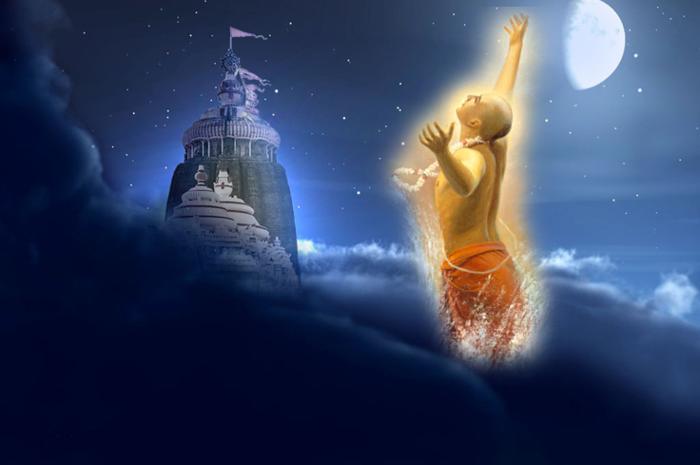
After this His journey to Jagannatha Puri is described as well as the humility of Haridasa Thakura, the exodus of Devotees who went to Puri to be with the Lord, His sweet words of consolation, how the Lord used to chant the shloka, "rama-raghava raksha mam..." (In the wallpaper: Jagannath Temple and Lord Shri Krishna Chaitanya).

   Describes how on the way to Jagannatha Puri, the Devotees bathed in a place called Brahma-kunda; how they went to Remuna and had darshan of the Lord there; how the Lord danced before the Gopal Deity; how after bathing in the Vaitarani river they had darshan of Varaha-deva; how the Lord went to Yajapura; How the Lord took darshan of a Shiva-linga there; Then, from Brahma-kunda, He visited Nabhigaya and Shivanagara; how He received the darshan of Kshirodakshayi Vishnu; how in a grove of mangos He took up the question of Shiva Prasada and prayers to Shiva; after this, how He went from Kapoteshwara and bathed in the Bhargavi river; How the Lord fainted before the Jagannatha Deities while having darshan there; His visit to the house of Sarvabhauma; How the Lord would go from the house of Sarvabhauma, take a position west of the Garuda Stambha, and see the Deity of Lord Jagannatha; how Sarvabhauma Bhattacharya and the Lord discussed Vedanta; How Sarvabhauma was converted; How the Lord revealed His six-armed form to Sarvabhauma Bhattacharya.

From here, the Shesha Khanda begins.

   The first chapter of the Shesha Khanda describes:
 
   The Lord's kirtan pastimes in which Sarvabhauma took part; the Lord's tour of South India and His journey to Setubandha; His mercy on Vasudeva Vipra, the brahmana who had leprosy; the Lord's visit to Jiyada-Nrishimha and its ancient history; the Lord's meeting with Ramananda Raya on the banks of the Godavari; Ramananda's vision of Mahaprabhu's dual feature as Rasaraja and Mahabhava; the Lord's visit to Panchavati and Shri Rangam; How He bestowed mercy on Trimalla Bhatta; His four month stay in Shri Rangam during the period of Chatur Masya; His meeting with Paramananda Puri; the prayers by Paramananda Puri to Gaura Bhagavan. 
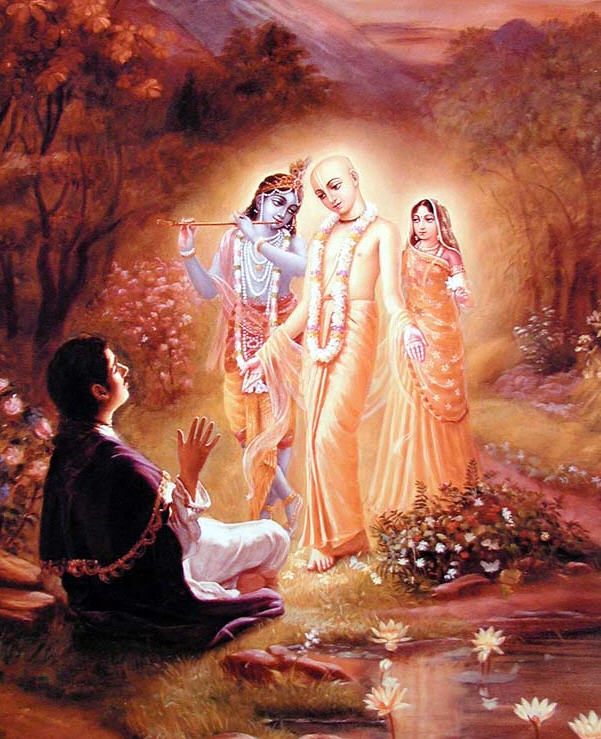
Lochana Dasa Thakura

Ramananda's vision of Mahaprabhu's dual feature as Rasaraja and Mahabhava...(In the image: Lord Chaitanya is united form of Shri Shri Radha and Krishna, in the left Ramananda Raya).

   The second chapter of the Shesha Khanda describes the following:

   How the Lord continued on His South Indian tour and delivered the seven trees that had been standing since the time of Lord Ram; How at Setubandha in great ecstasy, the Lord chanted the names of Rama, Lakshman, Sita, and Hanuman; how the Lord returned to Alalanatha by way of the Godavari; His return to Jagannatha Puri; His visit to Mathura; His meeting with Rupa and Sanatana; How with Balabhadra Bhattacharya, He wandered down the banks of the Yamuna and through the twelve forests of Vrindavana.

   The third and final chapter of the Shesha Khanda of Chaitanya Mangala records:
 
   How the Lord returned to Jagannatha Puri; the Lord's trip to Gauda-desha; how He passed through in the Rada-desha; how He stopped in Kuliya; How everyone in Navadwip turned out to see the Lord; How they prayed for His mercy and He bestowed amnesty on all; How, to satisfy His mother's desire, He went to Navadwipa and instructed her on of Krishna-bhajan; How the Lord went to Shantipura where He visited Shri Advaita; His kirtan there; How the Lord left Shantipura; His return to Jagannatha Puri; How He visited the Deity of Jagannatha; How He performed kirtana day and night; How King Prataparudra attained the Lord's mercy; His revelation of the six-armed form to Prataparudra Raja; The Dravidian brahmana who came to visit the Lord, how he was fasting for seven days, and how he was delivered by the Lord's mercy.

   In the Chaitanya Mangala, Lochana Dasa Thakura mentions the details of certain pastimes not revealed by Vrindavana Dasa Thakura. For example, Vrindavana Dasa Thakura does not record the conversation that took place between Shri Chaitanya Mahaprabhu and Vishnupriya Devi just before the Lord left to take sannyasa. But Lochana Dasa Thakura describes this as follows: Seeing Mahaprabhu's eagerness to take sannyasa, the moon-faced Vishnupirya Devi said, with her voice choked in emotion, "Tell me,O Prananatha, Lord of my life, and I shall take Your order upon my head. Will You take sannyasa? I have heard this rumor being circulated among the people in general. Hearing this, my heart is broken. If it is true, I shall enter into fire. You are the treasure of my life. Your beautiful form is always everfresh and newly youthful. Will You give up everything and go away? If am deprived of Your association, I might as well give up my life by drinking poison."

   Hearing the pitiful words of lamentation spoken by Vishnupriya Devi, Shri Chaitanya Mahaprabhu smiled a little, and spoke as follows: "Listen, O you who are dear as life itself: Please don't be in any anxiety. There is no need to worry at all. What I am about to say is for your own benefit. Please hear Me attentively, with your whole mind. Whatever you see in this world is all false; the only truth is Bhagavan and the Vaishnavas, without that whatever you see is all illusion. Know this for a fact. Sons, wives, husbands, ladies, fathers, mothers, and everything else? All these relationships are illusory. They are temporary and transitional. In one lifetime we have one set of sons, wives, husbands, mothers and fathers, and in our next life this changes. Other than the lotus feet of Krishna, we have no real family. Everything else that we see as our family is an illusion of maya. What we see as man and woman is unreal.

   Beneath the surface all souls are spiritual energy; the relationship between men and women is an illusory connection of maya. Shri Krishna is the real Husband of everyone; He is the master. Everything else is material, but unfortunately this is not understood by the people in general. The souls is embedded in a mixture of semen and blood from which it is born into a body composed of stool and urine. In this way the soul moves upon this earth in ignorance. From boyhood to youth to old age, we suffer different miseries, all the while mistaking the housing of this body as our real self. Absorbed in false ego, we make friends, maintain attachments, suffering abuse, and are gradually cheated by old age. Even hearing the truth, however, still our eyes are blind, and while our suffering in the material world brings us to tears, we never worship Govinda. 
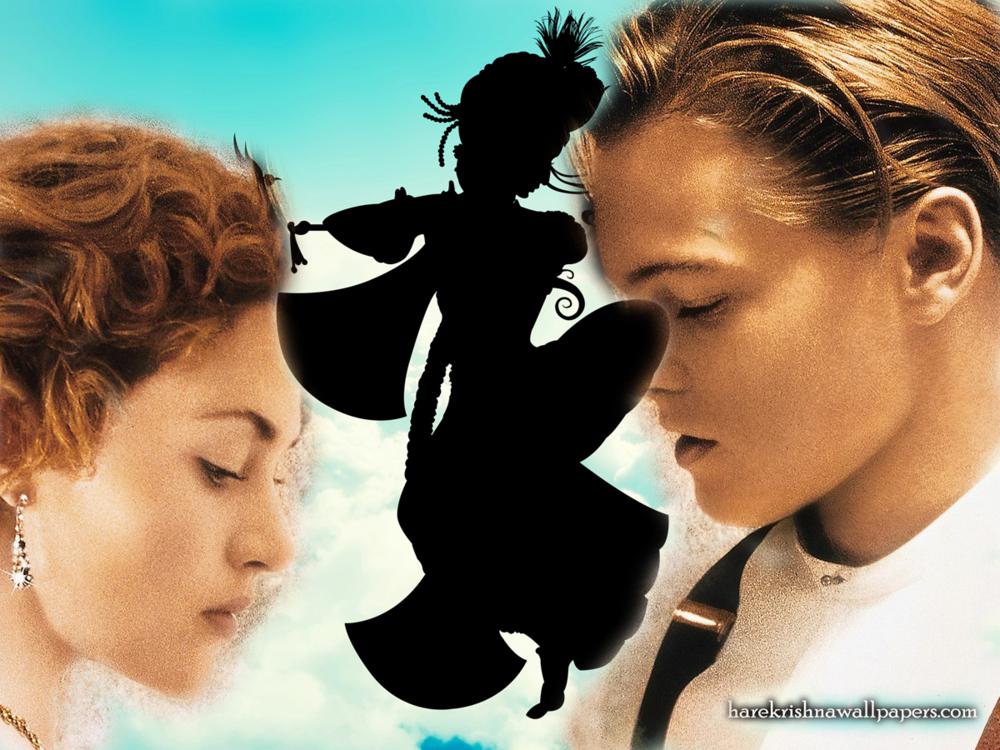
Lochana Dasa Thakura

Beneath the surface all souls are spiritual energy; the relationship between men and women is an illusory connection of maya. Shri Krishna is the real Husband of everyone; He is the master. Everything else is material, but unfortunately this is not understood by the people in general. The souls is embedded in a mixture of semen and blood from which it is born into a body composed of stool and urine. In this way the soul moves upon this earth in ignorance. From boyhood to youth to old age, we suffer different miseries, all the while mistaking the housing of this body as our real self. Absorbed in false ego, we make friends, maintain attachments, suffering abuse, and are gradually cheated by old age. Even hearing the truth, however, still our eyes are blind, and while our suffering in the material world brings us to tears, we never worship Govinda. (In the wallpaper: Krishna in between and besides actors of the film Titanic).

   Forsaking Krishna's service, we maintain these bodies in the material world of birth and death, trapped in the bondage of maya. Mad with false ego we have forgotten our Lord, and so we insure our passage to hell. Your name is Vishnupriya, however. Fulfill the real purport of Vishnupriya, and do not lament for what is false. Remembering what I have said here, cast your worries at a distance, and always think of Krishna within your heart, day and night."

   Having conveyed all these divine instructions to Vishnupriya Devi, the Supreme Lord, Shri Gaurasundara revealed to her His four-armed form, thus making her understand His absolute position. At that time, He told Vishnupriya Devi, "You see before you the Supreme Lord, cast your mayik lamentaion away." At this, Vishnupriya Devi became joyful within. Her grief and pain vanished, and her heart became blissful upon suddenly seeing the Lord's four-armed form.

   After hearing the instructions of the Lord and seeing His absolute form, Vishnupriya cast off her bewilderment, but her mentality of taking the Lord as her husband was intact. At that point, she fell at the feet of the Lord and said: "O Lord, please listen to my entreaty. Falling at Your feet again and again, I implore You to accept my humble submission. I am certainly the lowest, having taken birth in this world of samsara; but You are my most dear Lord of life. This is my only wealth; without You I have nothing. Without Your service, I will certainly go down."

   Saying this, Vishnupriya Devi began loudly weeping, sobbing and sobbing again and again in ever-increasing frenzy of sorrow. Seeing the affliction of someone so dear, the Lord bestowed His merciful glance upon Vishnupriya Devi, embracing her with His eyes and so giving her His mercy.

   At that time, the Lord said, "Listen O Vishnupriya Devi, and give close attention to My answer to your words. I shall go there and there, but wherever I go, I shall still remain at your place: This truth I have spoken with great determination."

   Upon hearing the order of the Lord, Vishnupriya Devi could understand that the Lord is supremely independent. At that time she said, "You must do what makes You happy. Let no one be an obstacle to Your divine mission."

   Addressing the Lord in this way, Vishnupriya tearfully averted her eyes from the Lord's glance and fell silent. Thus went the conversation between the Lord and Vishnupriya, which is painful to hear.

   This is reported by Lochana Dasa.

   Lochana Dasa Thakura also sings the glories of Shri Gauranga and Nityananda in the following beautiful song:

parama karuna pahun dui jana
nitai gaurachandra

saba avatara, sara shiromani
kevala ananda kanda

bhaja bhaja bhai, chaitanya nitai
sudhrida visvasa kori

vishaya chariya se rase majiya
mukha bolo hari hari

dekho ore bhai, tribhuvane nai
emona doyala data

pashu-pakhi jhure, pashana vidore
shuni yar guna gantha

samsare majiya, rahile pariya
se pade nahilo asha

apana koroma, bhunjaye shamana,
kohoye locana dasa

   This song was especially dear to His Divine Grace A.C. Bhaktivedanta Swami Prabhupada who translates it as follows:"This is a song by Lochana dasa Thakura. Lochana dasa declares that the two Lords, Nitai-Gaurachandra! Lord Nitai and Lord Chaitanya are very merciful. They are the essence of all incarnations. The specific significance of these incarnations is that prosecuting their way of self-realization is simply joyful, for they introduced chanting and dancing. There are many incarnations, like Lord Rama and even Krishna, who taught Bhagavad-gita, which requires knowledge and understanding. But Lord Chaitanya introduced a process which is simply joyful! Simply chant and dance.

   Therefore Lochana Das requests everyone: "My dear brother, I request that you just worship Lord Chaitanya and Nityananda with firm conviction and faith." Don't think that this chanting and dancing will not lead to the desired goal. It will. It is the assurance of Lord Chaitanya Mahaprabhu that one will get all perfection by this process. Therefore one must chant with firm faith and conviction. But what is the process? If one wants to be Krishna conscious by this process, one has to give up his engagement in sense gratification. That is the only restriction. If one gives up sense gratification, it is sure that he will reach the desired goal. One simply has to chant "Hari Hari!" without any motive of sense gratification.

   Lochana das says, "My dear brother, you just try and examine this. Within the three worlds there is no one like Lord Chaitanya or Lord Nityananda, because Their merciful qualities are so great that They make even birds and beasts cry, what to speak of human beings." Actually, when Lord Chaitanya passed through the forest known as Jharikhanda, the tigers, elephants, snakes, deer, and all other animals joined Him in chanting Hare Krishna. It is so nice that anyone can join. Even the animals can join, what to speak of human beings. Of course, it is not possible for ordinary men to induce animals to chant, but if Chaitanya Mahaprabhu could inspire animals to chant, at least we can encourage human beings to adopt this path of Hare Krishna mantra chanting. It is so nice that even the most stone hearted man will be melted. It is so nice that even stone will melt.

   But Lochana dasa Thakura regrets that he is entrapped by sense gratifi
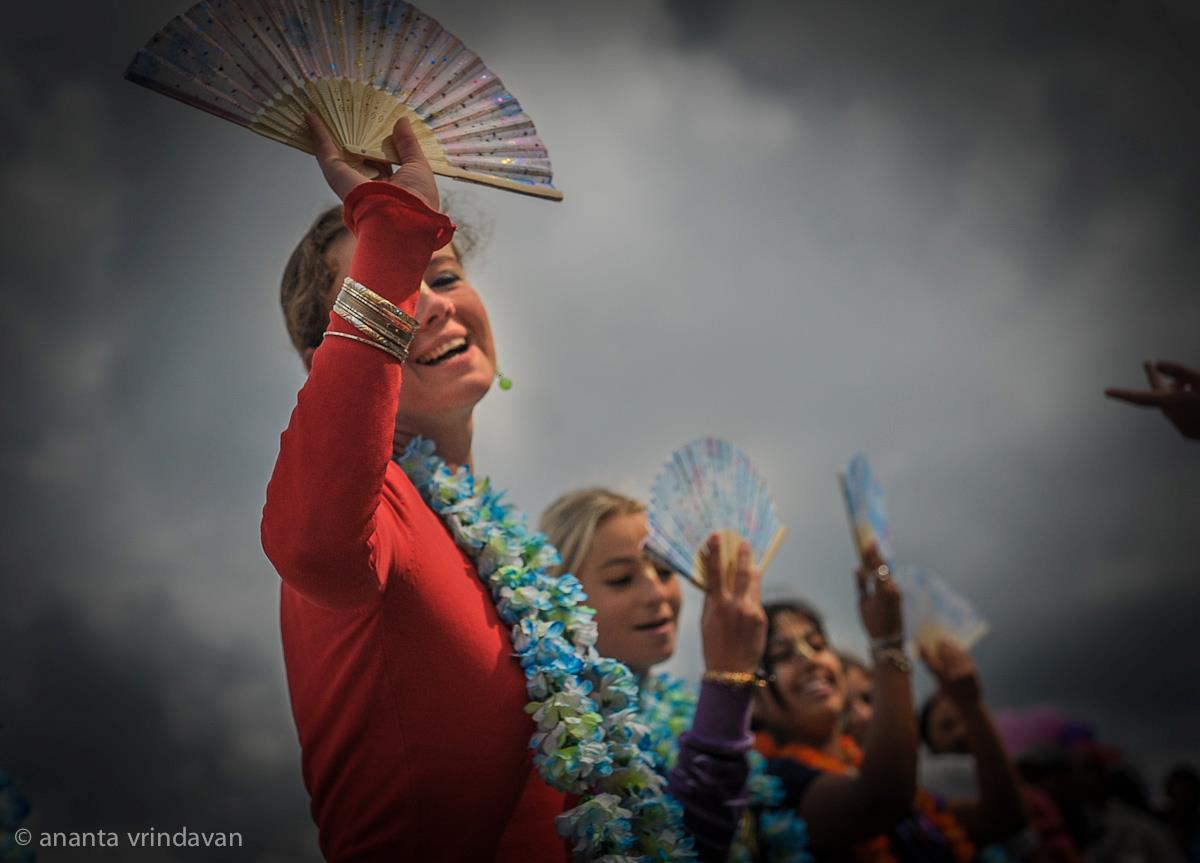
Lochana Dasa Thakura

Therefore Lochana Das requests everyone: "My dear brother, I request that you just worship Lord Chaitanya and Nityananda with firm conviction and faith." Don't think that this chanting and dancing will not lead to the desired goal. It will. It is the assurance of Lord Chaitanya Mahaprabhu that one will get all perfection by this process. Therefore one must chant with firm faith and conviction. But what is the process? If one wants to be Krishna conscious by this process, one has to give up his engagement in sense gratification. That is the only restriction. If one gives up sense gratification, it is sure that he will reach the desired goal. One simply has to chant "Hari Hari!" without any motive of sense gratification. (In the image: Festival in Woodstock, Poland).
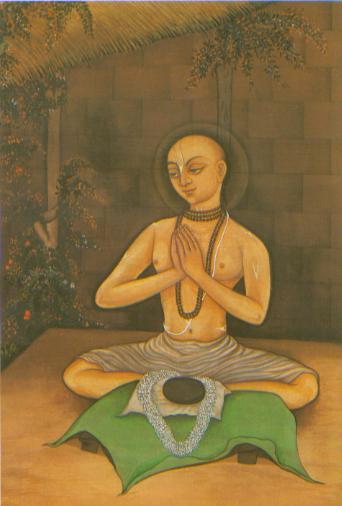
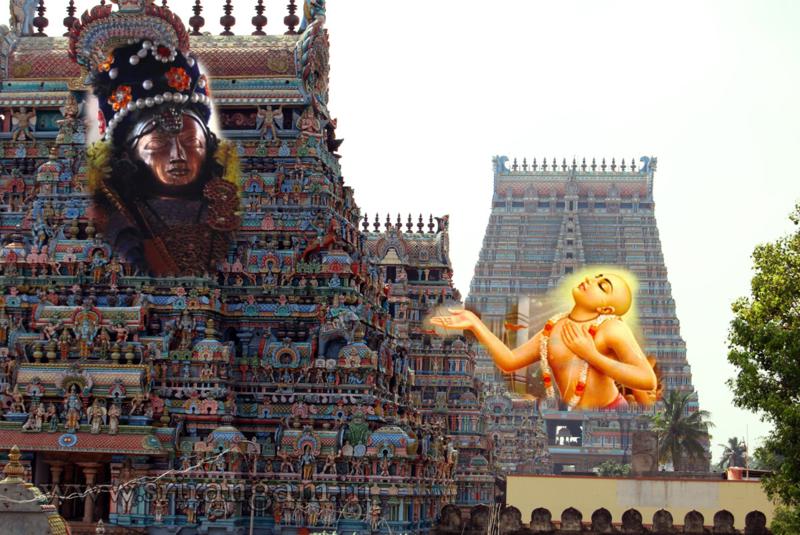
Uddharana Datta Thakura – Biography

Sri krishnadasa Kaviraja Goswami has written: "Uddharana Datta Thakura, the eleventh among the twelve cowherd boys, was an exalted devotee of Lord Nityananda Prabhu. He worshiped the lotus feet of Lord Nityananda in all respects." According to Gaura-ganodesa-dipika, "The devotee who was formerly known as Subahu in Vraja, and who was one of the cowherd boys in Vrindavana later appeared in Gaura-lila as Sri Uddharana Datta.

In his translation and commentary on Caitanya Caritamrta (CC Adi 11.41) Sri A.C. Bhaktivedanta Swami writes: "Uddharana Datta Thakura, previously known as Sri Uddharana Dattta, was a resident of Saptagrama, which is situated on the bank of the Saraswati River near the Trisbhigha railway station in the district of Hugali. At the time of Uddharana Datta Thakura, Saptagrama was a very big town, encompasing many other placesf such as Vasudeva-pura, Bansabediya, krishnapura, Nityananda-pura, Sivapura, Sanhanagara and Saptagrama.

"Calcutta was developed under British rule by the influential mercantile community and especially by the suvarna-vanik community who came from Saptagrama to establish their businesses and homes all over Calcutta. They were known as the Saptagrami mercantile community of Calcutta, and most of them belonged to the Mullik and Sil families. More than half of Calcutta belonged to this community, as did Srila Uddharana Datta Thaura. Our paternal family also came from this district and belonged to the same community. The Mulliks of Calcutta are divided into two families, namely, the Sil family and De family whose members, intimately connected with the Mohammedan rules, received the title Mullik.

"In the Caitanya-Bhagavata, Antya Khanda chapter six, it is said that Uddharana Datta was an extremely elevated and liberal Vaisnva. He was born with the right to worship Nityananda Prabhu. It is also stated that Nityananda Prabhu, after staying for some time in Khadadaha, came to Saptagrama and stayed in the house of Uddharana Datta. The suvarna-vanik community to which Uddhaana Datta belonged was actually a Vaisnava community. Its members were bankers and gold merchants (suvarna means "gold" and vanik means "merchant"). Long ago there was a misunderstanding between Balla Sena and the suvarna-vanik community because of the great banker Gauri Sena. Balla Sena was taking loans from Gari Sena and spending money extravagantly, and therefore Gauri Sena stopped supplying money. Balla Sena took revenge by instigating a social conspiracy to make the suvarna-vanik community was again elevated. It is said in the Caitanya Bhagavata, yateka vanika-kula uddharan haite pavitra ha-ila dvidha nahika ihate: there is no doubt that all the community members of the suvarna-vanik society were again purified by Nityananda Prabhu.

In Saptagrama there is still a temple with a six-armed Deity of Sri Caitanya Maharabhu that was personally worshipped by Srila Uddharan Datta Thakura. On the right side of Sri Caitanya Maharabhu is a Deity of Sri Nityananda Prabhu and on the left side, Gadadhara Pandita. There are also a Radha-Govinda murti and salagrama-sila, and below the throne is a picture of Uddharana Datta Thakura. In front of the temple there is now a big hall, and in front of the hall is a Madhavi-lata plant. The temple is in a very shady, cool, and nicely situated location. When we returned from America in 1967, the executive committee members of this temple invited us to visit it, and thus we had the opportunity to visit this temple with some American students. Formerly, in our childhood, we visited this temple with our parents because all the members in the suvarna-vanika community enthusiastically take interest in this temple of Uddharana Datta Thakura. In the Bengali year 1283 one babaji of the name Nitai dasa arranged for a donation of twelve bighas of land for this temple. The management of the temple later deteriorated, but then in 1306, thorugh the cooperation of the famous Balarama Mullik of Hugali, who was a subjudge, and many rich suvarna-vanik community members, the management of the temple improved greatly. Not more than fifty years ago, one of the family members of Uddharan Datta Thakura named Jagamohana Datta established a wooden Deity of Uddharan Datta Thakura in the temple, but that deity is no longer there; at present, a picture of Uddharana Datta is worshiped. It is understood, however, that the wooden Deity of Uddharana Datta was taken away by Sri Madana-mohana Datta and is now being worshiped with a salagrama-sila by Srinatha Datta.

Uddharana Datta Thakura was the manager of the estate of a big Zamindar in Naihati, about one and a half miles north of Katwa. The relics of this royal family are still visble near the Dainhata station. Since Uddharana Datta Thaura was the manager of the estate, it was also known as Uddharana-pura. Uddharana Datta Thakura installed Gaura-Nitai deities that were later brought to the house of the Zamindar, which was known as Vanaoyarirbada. Srila Uddhaana Datta Thaura remained a householder throughout his life. His father's name was Srikara Datta, his mother's name was Bhadravati, and his son's name was Srinivasa Datta.

Vrindavana dasa Thakura writes as follows about Uddharana Thakura in his Caitanya Bhagavata: "After Nityananda Prabhu stayed for many days in Khadadaha, he went to Saptagrama.There is a famous ghata in Saptagrama at the confluence of the three rivers which is celebrated as being the place of the seven rsis. At that ghata on the Ganges the seven rsis had once performed penances in order to attain the lotus feet of Govinda. Three divine goddesses come together at that place: Yamuna, Saraswati, and Jahnavi. These three goddesses of rivers join at the confluence of those three rivers. It is a most holy place within this world. One may be delivered from all his sins just by seeing that place. Nityananda Prabhu was extremely happy to see that place and bathed at that holy place with all the devotees. Uddharana Datta was staying in a temple of the Lord on the banks of that river when Nityananda Prabhu came to the triveni. When he saw Nityananda, he offered his mind, body, and words to the holy feet of Nityananda and worshiped him without any duplicity in his heart. As a result of the mercy of Nityananda Prabhu, Uddharana Datta was qualified by constitution to worship and serve Nityananda. Who can estimate his good fortune. Although he may appear to take birth within this material world, Nityananda is by nature the Supreme Controller, and he remains so every time he descends here. Nityananda is the master, and Uddharana Datta was his servant birth after birth. Uddharana Datta was from the vanik community, and he purified the two divisions of that community by his devotion. Nityananda Prabhu delivered the vanik community by his descent, and gave them the qualifications for prema-bhakti. Practically everyone in Saptagrama was a vanik. The moonlike Nitai-canda frolicked in kirtana within their midst. All the vaniks took shelter at the lotus feet of Nityananda and worshiped him with great ecstasy. Seeing all the vaniks absorbed in krishna-bhajana under the direction of Nityananda Prabhu the whole world was amazed. Indeed the universe itself was astonished to witness the exalted greatness of Nityananda Prabhu who delivered the lowest of men, the foolish and illiterate, and the entire vanika community. In this way, Nityananda Prabhu performed various pastimes of sankirtana in Saptagrama, delivering the inhabitants of Saptagrama as well as hundreds of their descendants within the vanik community. In the same way that the towns and villages of Nadia were filled with happiness when Caitanya and Nitai had performed sankirtana there, Saptagrama was filled with happiness at the pastimes of Nityananda."

After the disappearance of Caitanya Mahaprabhu, Sri Nityananda Prabhu's sakti, Sri Jahnava Mata came to Saptagrama and visited the house of Uddharana Datta Thakura. At that time, Uddharana Datta Thakura had already passed away. Uddharana Datta Thakura passed away on the 13th day of the dark moon in the month of Pausa.

Mahesh Pandit – Biography

   "He who was previously a very munificent cowherd boy has now appeared as Mahesh Pandita. In ecstatic love, he dances like a madman as though intoxicated to the beat of a kettle drum. [C.C. Adi 11.32]

   According to Gaura-ganoddesa-dipika, Mahesh Pandita was formerly Maha-Bahusakha in Krishna-lila. He was a companion of Nityananda Prabhu, and was present at the Danda Mahotsava held at Paninati.

   In Bhakti-Ratnakara, Taranga Nine, it is stated that when Narottama dasa Thakura came to visit Khardaha, he had darshana of the lotus feet of Mahesh Pandita.

   Vrindavana dasa Thakura has described him as a 'param mahanta' due to the fact that he was very dear to Nityananda Prabhu. [C.B. Antya 5.744]

   Mahesh Pandita's original Shripat at Sukh Sagor merged into the bed of the Ganges, but his worshipful Deities of Shri Shri Nitai-Gauranga as well as his samadhi were moved to Palpara. There is a railway station there, between Shimrali and Chakdaha stations, on the Sealdah-Krishnanagar line.

   His disappearance day is on the thirteenth day of the bright fortnight in the month of Pausa. 

Mahesh Pandit

"He who was previously a very munificent cowherd boy has now appeared as Mahesh Pandita. In ecstatic love, he dances like a madman as though intoxicated to the beat of a kettle drum. (C.C. Adi 11.32) (In the image: Krishna Balaram and Their Friends).

Raghunatha Dasa Goswami – Biography 3

   Shri Raghunatha dasa took his birth in the village of Shri Krishnapura in the district of Hooghly. His father's name was Shri Govardhana, whose elder brother was Shri Hiranya dasa. Both of them were respectable wealthy land-holders belonging to the Kayastha caste. Their title, which was given by the King, was "Majumdar".

   In his childhood Shri Raghunatha dasa studied at the house of the priest, Acharya Shri Balarama dasa. Haridasa Thakura was very merciful to Balarama dasa and occasionally visited his house. At these times Raghunatha dasa had the good fortune of relishing Thakura Haridasa's association and listened to philosophical discourses from him.

   Shri Raghunatha dasa was the only son in the family of Hiranya and Govardhana and there was no limit to the care and affection which was showered upon him. Though he was brought up just like the son of a king, by the powerful influence of saintly Devotees, he realized at a very young age that material existence is temporary and a mood of detachment towards wealth, parents and relatives began to grow within him. 

Raghunatha Dasa Goswami

Shri Raghunatha dasa was the only son in the family of Hiranya and Govardhana and there was no limit to the care and affection which was showered upon him. Though he was brought up just like the son of a king, by the powerful influence of saintly Devotees, he realized at a very young age that material existence is temporary and a mood of detachment towards wealth, parents and relatives began to grow within him. (In the wallpaper: from left to right Shri Vijaya Gauranga, Shri Nityananda Prabhu, ISKCON Hungary, Shri Rupa and Shri Sanatana Goswamis, Shri Raghunatha Das Goswami, Shrila Haridas Thakur).

   Upon hearing the glories of Shri Gauranga and Nityananda, he became extremely eager to have darshana of Their lotus feet. When he heard that Shri Gaurasundara had taken sannyasa and was leaving Nadia forever, he rushed madly to the home of Advaita Acharya in Shantipura to meet the Lord. Seeing Raghunatha fall at His feet, Shri Chaitanya Mahaprabhu could understand that this was His dearmost eternal associate, and He embraced Raghunatha firmly. Crying, Shri Raghunatha appealed to the Lord, "I will also go with you." But the Lord replied that He would not take him along at that time, yet upon His return from Vrindavana, Raghunatha should, under any pretext, come to Nilachala to see Him.

   In CC Antya lila, Sixth Chapter, there is a narration of how Shri Raghunatha dasa was arrested by the Nawab's men and his subsequent release from the bondage of family life. In that chapter there is also a description of the Panihati festival, as well as Raghunatha's pastimes in Jagannatha Puri with Shri Gaurasundara.

   Shri Raghunatha dasa Goswami passed his days in the highest happiness, continually bathing in the shower of Mahaprabhu's mercy. But upon the disappearance of Shri Chaitanya Mahaprabhu, Raghunatha's world grew dark. In separation from their Lord, the Devotees' hearts burned with anguish. Raghunatha dasa also burned in that fire of separation, but taking the order of Mahaprabhu on his head, he went to Shri Vrindavana. Previously Shri Sanatana, Shri Rupa, Shri Gopala Bhatta, Shri Raghunatha Bhatta, Shri Lokanatha, Shri Kashishvara, and Shri Bhugarbha Goswami had already gone to Vrindavana and were living there by the order of the Lord. Though they all burned in the fire of separation, they pacified themselves by gathering together and discussing and writing the conclusions of the teaching of Mahaprabhu. It was the dawn of a golden age in Vraja. Shri Vallabha Acharya also visited Vrindavana at that time.

   Shri Raghunatha used to reside at Shri Radha kunda. At that time Radha kunda had not yet been excavated, though Raghunatha often meditated upon how to beautify the kunda. Once a wealthy merchant walked the long, difficult road to Shri Badarik ashrama. With great devotion he worshiped Shri Badarinarayana and offered a large portion of his wealth in charity. That night Shri Badarinarayana appeared to him in a dream and said, "You should go to the village near Vraja named Arit-grama where you will find my Devotee, Shri Raghunatha dasa Goswami. To him you should deliver all your wealth. If he refuses to accept it, tell him I sent you and remind him about restoring Radha kunda." The merchant happily returned to his home and then went on to Vraja where he met Shri Raghunatha and explained everything to him. Astonished, Raghunatha gave him permission to restore both Radha kunda and Shyama kunda.

   On the banks of the kunda grew five trees, which were actually the five Pandavas. Once there was some talk of cutting the trees down, but that night the Pandavas appeared to Raghunatha and forbade the trees to be cut. To this day the trees still grow there. The Devotees were overwhelmed with happiness to see the restoration of Shri Radha kunda and Shri Shyama kunda. On the outskirts of these two ponds, groves of the Asta-sakhis were planted. 

Raghunatha Dasa Goswami

On the banks of the kunda grew five trees, which were actually the five Pandavas. Once there was some talk of cutting the trees down, but that night the Pandavas appeared to Raghunatha and forbade the trees to be cut. To this day the trees still grow there. The Devotees were overwhelmed with happiness to see the restoration of Shri Radha kunda and Shri Shyama kunda. (In the wallpaper: from right to left Shyama Kund, Arjuna tree, Bhima tree, background image is Radha Kund, Vrindavan).

   Raghunatha did not have a fixed residence, but stayed either on the banks of Shri Radha kunda or on the banks of the Manasa Ganga. At that time both places were surrounded by a fearful jungle inhabited by ferocious tigers and other wild beasts. One day Shri Sanatana Goswami arrived at the bhajan kutir of Shri Gopala Bhatta Goswami on the banks of the Manasa Ganga where he would take his midday meal. When going for a bath at Pavan Ghat he saw a tiger very nearby who had just drunk water in the ghat. Just a little further on, Raghunatha dasa sat at the base of a tree deeply absorbed in his bhajan. Sanatana Goswami was alarmed and requested Raghunatha to practice bhajan in a cottage or hut. From that day on Raghunatha performed his bhajan in his hut.

   Raghunatha dasa Goswami was always engaged in worshiping Shri Radha-Govinda within his mind. One day, in his meditation he prepared and offered sweet-rice to Shri Radha and Krishna. In great happiness They and the gopis ate the sweet rice, and he accepted Their remnants. While he was honoring their Lordship's Prasada, he was filled with intense love and ate slightly more than what he was accustomed to. The next day, from morning until late afternoon his door remained closed, causing the Devotees some concern. After they knocked repeatedly on his door, it finally opened and they saw him lying down. "My health is not good," he explained to Shridasa. The Devotees were unhappy and immediately sent word to Sanatana Goswami in Mathura. At that time Shri Sanatana was staying at the house of Vallabha Acharya. Upon hearing the news, Vallabhacharya's son, Shri Viththal, sent two doctors to see Raghunatha dasa at Radha-kunda.

   Seeing his condition the physicians insisted that Raghunatha's illness was the result of eating too much sweet rice. The Devotee were dumbfounded by such a suggestion, but eventually understood the mystery. The worship of Raghunatha dasa Goswami was very wonderful.

   Kavi Karnapura has written in Gaura-ganoddesha-dipika (186) that Shri Raghunatha was Rasamanjari in Krishna lila. According to some other persons he was Ratimanjari or Bhanumati.

   Raghunatha dasa wrote many books such as: Stavavali, Danacharita, Muktacharita, etc. He also composed many padas. He was born in the Saka era of 1428 and left the world in the Saka era of 1504, on the twelfth day of the bright fortnight in the month of Ashvina. (CC 1.10.91-102, 3.6.35-154, Gaura-ganoddesha-dipika 186, Premavilasa 16.127)

  His name has been mentioned in the following texts: Vaishnava Vandana of Jiva Goswami (149-150), of Devakinandana (55), and of Vrindavana dasa (49); Krishna Chaitanya charitam of Murari Gupta 4.17.21; Karnapura's Chaitanya Chandrodaya Nataka 10.3.; CC (R.G. Nath ed.) 2.1.269. 

Caitanya Mahaprabhu – Biography

Caitanya Mahaprabhu

The origin of Lord Chaitanya's name is mentioned in CBh. 2.28.179,181: "You aroused everyone's spiritual consciousness (Chaitanya) and inspired the entire world to chant the Holy Name of Krishna, thus Your are called Sri Krishna Chaitanya."

   The origin of Lord Chaitanya's name is mentioned in CBh. 2.28.179,181: "You aroused everyone's spiritual consciousness (Chaitanya) and inspired the entire world to chant the Holy Name of Krishna, thus Your are called Sri Krishna Chaitanya."

   According to the Tantra tradition, the term 'krishnavarna' mentioned in Srimad Bhagavatam refers to Krishna Chaitanya. Ramabhadra Vaishnavacharya Goswami has said, "yasya namadyavayave sah krishnacaitanyah"; just as Satya refers to Satyabhama, and Bhima refers to Bhimasena, similarly the term Krishnavarna indicates Krishna Chaitanya (In this connection refer to the tika of the sloka 'sriya savarnena…'Bhagavatam 3.3.3).

   Some argue that the name "Gauranga" was uttered by Keshava Bharati at the time of Lord Gauranga's sannyasa initiation, thus the name 'Gaura' (referring to Him as a resident of Navadwipa) should be considered His foremost name. However this is not rationally tenable when considered from a theological viewpoint. Simply by looking at the titles of the major biographies of the Lord's life (i.e. Chaitanya Bhagavata, CC, Chaitanyamangala, etc.) it is evident that Sri Krishna Chaitanya was His foremost name.

   Although Lochana Thakura, the preacher of Gauraparatamyavada, dealt with the nama-guna-lila etc. of Gaura in his composition Dhamali, nevertheless the biography he wrote was entitled Sri Chaitanyamangala.

   Prabodhananda Sarasvati writes about the dhyana of Gauranagaravana in his Sri Chaitanya chandramrta (132). In one continuous lila numerous names of the Lord have been mentioned, yet the most frequently used name is Chaitanya. Thus we can conclude without any doubt that Chaitanya was the foremost name.

   For details see the following biographies of Lord Chaitanya:

    1. Chaitanya Bhagavata
    2. Chaitanya Charitamrta
    3. Chaitanyamangala
    4. Chaitanyacharitamahakavya
    5. Chaitanyachandrodaya
    6. Murari Gupta's Kadacha
    7. Gaurakrishnodaya

   The Gauramantra is mentioned in the following works:

    1. Urdhvamnayatantra 3.14-16 (manuscript from the collection of the Madras Oriental Mss. Library)
    2. Isanasamhita
    3. Paddhati written by Dhyanacandra Goswami 54-55
    4. Sri Chaitanyachandrodaya 9
    5. Advaitaprakasa 10 and 12
    6. CC. 3.2.31
    7. Gaurakrsnodaya-mahakavya of 1680 Saka; sloka 18.22-34.
    8. Gaudiya Vaisnava Abhidhana Vol. 1, p.250
    9. Caitanya Bhagavata 1.1.3, 12.10.59-60.
    10.Tika of Chaitanyachandramrta (31) by Anandi

   The following are the astakas (eight lined hymns) composed in praise of Lord Chaitanya:
Astaka by Sarvabhauma Bhattacarya;
Sacisutastaka by Narahari Sarkara; Caitanyastaka by Rupa Goswami;
Gaurasudhakaracitrastaka by Prabodhananda; Sacisunvastaka by Dasa Goswami.
Caitanyastakam (1), by Rupa Goswami;
Caitanyastakam (2), by Rupa Goswami;
Caitanyastakam (3), by Rupa Goswami;
Gaurangastakam, by Sarvabhauma Bhattacarya;
Gaura-Gadadhara-yugalastakam, by Acyutananda Goswami (son of Advaitacarya);
Maha-prabhor-astakam, by Visvanatha Cakravarti Thakura;
Sacinandanastakam, by Narahari-sarakara Thakura;
Sacinandana-vijayastakam, by Visvanatha Cakravarti Thakura;
Sacisunvastakam, by Raghunatha-dasa Goswami; (probably same as "Dasa Goswami")
Sacisutastakam, anonymous;
Sacitanayastakam, anonymous;
Astottarasatanama by Sarvabhauma; Namadvadasaka; Namavimsatistotra by Sarvabhauma.

   Sahasraka: one each by Narahari Sarkara, Kavikarnapura, and Rupa Goswami. Sri-gauranga-sahasra-nama-stotra, from Moksarnava-tantra, Siva to Gauri; Sri-krishna-caitanya-candrasya sahasra-nama-stotra, by Sri-Caitanya-dasa Ciranjivi-sarvadhikari

   Stava: Navadvipacandrastavaraja by Raghunandana Thakura; Praty-anaga-varnanakhya-stavaraja by Advaita Prabhu; Gaurangastavakalpataru by Raghunatha Dasa Goswami.

   Sataka: Caitanyasataka by Sarvabhauma; Gaurasataka by Ratikanta Thakura.

   Astakaliya sutra: Bhavadhyalila by Rupa Goswami; Paddhati 72-77 by Dhyanacandra Goswami; Smaranamangala by Visvanatha Cakravarti; and the Bengali work Gauracaritcintamani by Narahari Cakravarti.

   Rupa Goswami: sriman-maha-prabhor asta-kaliya-lila-smarana-mangala-stotram;
   Visvanatha C: sriman-maha-prabhor asta-kaliya-lila-smarana-mangala-stotram;

   Sri-Gaura-premollasa-stotram, by Nanda-kisora Goswami;
   Sri-Gauranga-lila-smarana-mangala-stotram, by Bhaktivinoda Thakura;
   Gauranga-stotram, by Sri Bhakti-desika Maharaja;
   Gauranga-virudavali, by Raghunandana Goswami;
   Gaura-prema-stava-raja, by Ramaraya Goswami;
   Godruma-candra-bhajanopadesa, by Bhaktivinoda Thakura;

   Gauranga-maha-prabhu-dhyanam;
   Gauranga-maha-prabhu-pranamah;
   Gauranga-maha-prabhu-vijnaptih;
   Gaura-Nityananda-pranamah;

   Books on Lord Chaitanya:

   In Bengali:

    1. Sri Gaurasundara by Shyamalal Goswami
    2. Amiya-Nimai-Carita by Sisir Kumar Ghosh
    3. Caitanyadeva by Sundarananda Vidyavinoda

   In Oriya:

    1. Caitanyabhagavata of Isvara dasa
    2. Caitanyavilasa of Madhava

   In Vrajbasa:

    1. Caitanyacaritamrta of Suvalasyama

   In Hindi:

    1. Amiya-Nimai-Carita
    2. Caitanya Premasagara of Pandita Ramananda
    3. Caitanya caritavali of Prabhudatta Brahmacari

   In Gurmukhi:

    1. Caitanyacarita

   In Urdu:

    1. Sri Nimaicand of krishnaprasada Duggul

   In Telugu:

    1. Sri Caitanyalilamrtasaram
    2. Sri Caitanyasiksamrtam
    3. Lord Gauranga

   In Tamil:

    1. Life and Teaching of Gauranga by P.V. Pillai, Madras

   In English:

    1. Lord Gauranga by Sisirkumar Ghosh
    2. Sri krishna Caitanya by N.K. Sanyal
    3. Lord Caitanya by B.P. Tirtha
    4. Sri Caitanya Mahaprabhu B.P. Tirtha
    5. Caitanya by G. Tucci
    6. Life of Sri Caitanya by C.S. Trilokekar
    7. Caitanya and His Companions by D.C. Sen
    8. Gauranga and His Gospel by M. Dhar
    9. The Universal Religion of Sri Caitanya by N.N. Chaterjee
    10.Caitanya's Pilgrimage and Teachings by J. Sarkar

   The famous Siksastaka was composed by Lord Chaitanya. The commentator Vitthaleshvara states that Sri Krishna premamrta stotra was orally propounded by Lord Chaitanya. Although a number of other small astakas are considered to have been composed by Lord Chaitanya, the Lord Himself did not write any theological treatises. This task was taken up by Jiva Goswami, who compiled a number of philosophical works such as Satsandarbha, Kramasandarbha, Sarvasamvadini, etc. 

Caitanya Mahaprabhu

The famous Siksastaka was composed by Lord Chaitanya. (In the image: Lord Sri Krishna Chaitanya, 3rd verse of Shikshashtakam).

Advaita Acarya – Biography

Advaita Acharya

Sri Advaita Acharya, Mayapur Chandradoya Mandir.

    He is a disciple of Madhavendra Puri, and constitutes one of the figures amongst the Pancatattva. In an earlier incarnation he was Lord Siva. He was born in a varendra brahmana family on the seventh day of the bright fortnight in the month of Magha, 1355 Saka (1433 AD), in the village named Lauda in Srihatta.

   According to Bangabhasa O Sahitya, Advaita Prabhu was born in 1434 AD and met Vidyapati in 1458 AD. Advaita's former name was Kamalaksa (Kamalakanta) Vedapancanana. His two wives were Sita Devi and Sri Devi. His son Acyutananda was born of Sita Devi (1425 Saka 1503 AD), followed by krishnadasa, Gopala, Balarama, Svarupa, and Jagadisa Misra. While Sri Devi gave birth to one son named Syamadasa (Premavilasa 24).

   From Lauda, Advaita Prabhu moved to the village of Navahatta and later to Santipura. He also had a house at Navadvipa. In 1480 Saka (1558 AD), at the age of 125 years (i.e. 25 years after the disappearance of Lord Caitanya) Advaita Prabhu passed away. (Advaita Vilasa) 

Advaita Acharya

Srila Madhavendra Puri-Spiritual Master of Advaita Acharya.

   However, according to Premavilasa 24, Advaita Prabhu was born in Santipura. He studied the Vedas and other scriptures under a scholar named Santacarya in Phullavati village near Santipura, where he was awarded the title Acarya. The genealogy of Advaita Prabhu can be found in Premavilasa 24. Also books such as Valyalilasutra (in Sanskrit), and Advaitavilasa, Advaitamangala, Advaita Prakasa, Sitacarita (in Bengali) present detailed information on Advaita Prabhu.

   To verify the meeting of Advaita with Vidyapati, it is known that in 1330 Saka (1408 AD) Vidyapati received the endowment of Bisaphi village from Sivasimha. Vidyapati was born around 1307 Saka (1385 AD), and was a contemporary of Candidasa. Vidyapati mentions their meeting one another in songs he composed in 1325 Saka (1403 AD).

   One manuscript of the Bhagavata which was copied by Vidyapati is still available and carries the date of copying as 1379 Saka (1457 AD). Evidence shows that Vidyapati was alive until 1401 Saka (1479 AD). In 1485 AD Advaita Prabhu, at the age of fifty two, arrived at the room where Lord Gauranga was born. Much earlier he undertook a pilgrimage. Hence his meeting with Vidyapati should be taken as a fact.

   The foremost of all the Vaisnavas who reside at Navadvipa is Sri Advaita Acarya, whose virtuous presence has made all the worlds blessed. He is the most prominent preceptor in all fields including knowledge, renunciation and devotion. In explaining krishna-bhakti he is like unto Lord Sankara himself, and whatever scriptures that exist within the three worlds he explains in the light of Krishna-bhakti. 

Advaita Acharya

When Lord Chaitanya and Nityananda were eating in the home of Advaita Acharya, Lord Nityananda jokingly told Advaita to take away the foodstuff. He threw a handful of rice on the floor in front of Him, as if He was angry. A couple pieces of rice touched Advaita's body. When the rice touched him, Advaita thought himself purified by the touch of Lord Nityananda's remnants and he immediately began dancing in various ways. Chaitanya-charitamrita, Madhya-lila 3.93-96

   With the intense eagerness he continually worships Sri Krishna with Tulasi manjaris and Ganges water. By the momentum of his spiritual force, his loud shouts pierce the coverings of this universe and, resounding throughout Vaikuntha, reach the ears of Sri krishna. Hearing this loving summons saturated with devotion, Sri krishna advents Himself.

jaya jaya advaita isvara avatara
krishna avatari kaila jagat-nistara

   "All glories to Advaita Prabhu, the incarnation of the Supreme Personality of Godhead. He induced krishna to descend and thus delivered the entire world." [CC Antya 8.4]

   "On the seventh day of the bright fortnight of the month of Magh, the great ocean of ecstasy swelled to its limits, being forcibly attracted by the moon of Advaita, Who appeared from the womb of Sri Nabhadevi as the moon appears in the autumn sky. His father, Sri Kuvera Pandit floated in that ocean of joy. In great happiness he gave many gifts in charity to the brahmanas (who voluntarily accept vows of poverty). Very quietly he approached the maternity room to get a glimpse of his newborn son. Then his own face began to shine by the reflected light of that moon-like personage. The residents of Navagram came running to see the child. Everyone remarked that they had never seen such a beautiful baby. What a pious activities his father must have been performed to get such a jewel of a son, and that in his old age? Thus Ghanasyama sings about this occasion." [Bhaktiratnakara 12.1759] The child was named Mongal and his other name was Kamalaksa. 

   Advaita Acarya is the combined incarnation of Mahavisnu and Sadasiva (who resides in Goloka). His two consorts, Sita and Sri are manifestations of Yoga Maya. Once when Advaita performed worship, whatever gods and demigods He used to meditate upon He saw all gathered at Lord Caitanya's lotus feet, offering prayers. Raising up his two hands, Advaita exclaimed in great ecstasy, "Today all the days of my life have produced a successful result, as all my desires have been fulfilled. My birth and activities have finally born fruit. I have directly perceived Your two lotus feet, which are proclaimed throughout the four Vedas but are unattainable thereby. Now, by Your causeless mercy, You have revealed Yourself to Me." 

Advaita Acharya

Place in Vrindavan where Advaita Acharya discovered Deity of Madan Mohan.

   Mahaprabhu replied, "Acarya, now you should perform My worship." First Advaita Acarya washed the Lord's two lotus feet with water scented by flower petals and then with water scented with sandalwood. Then He placed on His lotus feet Tulasi manjari dipped in sandalwood paste along with arghya – an auspicious offering of rice, durva grass, yogurt etc. His eyes brimming with tears, he offered incense, ghee lamps, flowers, sandalwood paste, and some foodstuffs. After offering various prayers he loudly proclaimed the Lord's glories with auspicious shouts. "All glories to the Lord and maintainer of the universe, the Lord of all that lives. All glories to Gaurachandra, the ocean of mercy. All glories to the most munificent incarnation of Sri Krishna Chaitanya Mahaprabhu, whose form is all-enchanting. All glories to He who is decorated with the ornaments of Shrivatsa and Kaustubha. All glories to He who has revealed the Hare Krishna Maha-mantra. All glories to He who enjoys the pastimes of accepting devotion unto Himself. All glories to Mahaprabhu who reclines on the bed of Ananta Sesa. All glories to the refuge of all living entities. [CBh. Madhya 6.116]  

Advaita Acharya

Sri Sri Radha Madan Mohan, Deities worshipped by Advaita Acharya.

   Hearing Advaita's prayer's Mahaprabhu replied, "My dear Acarya, I am very pleased by your prayers. Now you can ask from me any benediction you like."

   Then Advaita requested that, "My only request is that you distribute love of Krishna even to women, laborers and the ignorant fools as well. [CBh. Madhya 6.167] 

   A Nrsimha-sila and Deities, fashioned after a picture of Sri Sri Madan-Gopal that were worshiped by Advaita Acarya are still residing at Santipur in Madan-Gopal Para. Santipur is a short distance from Krishnanagara. 

   The place on the banks of the Ganga where Advaita Acarya worshiped salagram and called out to the Lord to please descend to the world is known today as Babla. A temple has been built in memory of Advaita Acarya's pastimes there. 


Nityananda Prabhu – Biography


Nityananda Prabhu

Shri Nityananda Prabhu, ISKCON Chowpatty, Mumbai).

   He was Halayudha in Krishna lila. According to Premavilasa 24, Nityananda was a disciple of Ishvara Puri. Shri Jiva states that Nityananda was a disciple of Shankarshana Puri who was a disciple of Madhavendra Puri. But Bhaktiratnakara states that Nityananda took diksha from Laksmipati who was the guru of Madhavendra Puri. If this were the case then Nityananda would have been the great-guru of Lord Chaitanya and a friendly relationship could not have existed between the two. According to CBh. Madhavendra Puri dealt with Nityananda as a friend, while the latter showed guru-like reverence to the former.

   Nityananda Prabhu was born on the thirteenth day of the bright fortnight of Magha (February-March) in the village of Ekachakra in the district of Birbhum in 1395 Saka (1473 AD). His father was Hadai Pandita (Hado Ojha) and his mother was Padmavati. His paternal grandfather, Sundaramalla Nakadi Baduri was a brahmana of the Radha clan.

   Nityanda's past name was Kuvera and He was an avadhuta. Steven Rosen (Satyaraja das) says in his book Pancha-tattva, 3.13:
   "Nityananda was considered an avadhuta sannyasi, although it is said that He never formally adopted sannyasa order. Avadhutas (the pure ones, in SB 4.29.11 p. called "most free") are usually associated with the Saivite tradition but there is a little known branch of Vaishnava sannyasis known as turiyatit-avadhuta. They are described in the Narada-parivrajaka-upanishad, Turiyatit- avadhuta-upanisad and the Brhad-avadhuta-upanishad."

   In the same book (3.40) he lists twelve gopalas, associates of Shri Nityananda, with their identity in Chaitanya-lila:
   Shridama (Ramadasa Abhirama of Khanakul-Krishnanagar in Hooghly)
   Sudama (Sundarananda Thakura, brahmana ascetic)
   Vasudama (Dhananjaya)
   Subala (Gauridasa Pandita)
   Mahabala (Kamalakara Pipalai)
   Subahu (Uddharana Datta)
   Mahabahu (Mahesha Pandita)
   Stokakrishna (Purushottama)
   Arjuna (Parameshvara Dasa)
   Dama (Purushottama Nagara)
   Labanga (Kala Krishnadasa)
   Madhumangala, or Kusumasava (Shridhara)

   Shri Nitai is Isha prakasha (CC 1.1.7-11), the cherished goal of Gaudiyas (CC 1.1.18-19), and is depicted as the trunk of the tree of bhakti (CC 1.9.21, 1.10.115)

   His childhood sports up to twelve years of age are described in CBh. 1.9.12-99; His pilgrimage tours up to twenty years of ages in CBh. 1.9.100-136; His arrival in Navadwipa at the house of Nandana Acharya and his meeting Lord Chaitanya is described in CBh. 2.3.120-2.4.76.

   Premavilasa narrates the following information relating to Nityananda Prabhu: marriage of Nityananda; settled life at Khardaha with Vasudha-Jahnava; death of seven sons soon after birth when Abhirama conveyed his humble obeisances to each; birth of Virachandra and Ganga later; both stayed alive and healthy despite Abhirama's offering of obeisances; hymns sung by Abhirama in praise of Ganga Devi.

   Nityananda tattva: Mahasankarshana, Sesa, etc. (Gaura-ganoddesa-dipika 63-64). Sandhini-sakti; inward descent of Ananga manjari (Ananga manjari Samputika), in the form of Prakrti indirectly and in the form of Purusa directly. See Dharanishesha Sanvad in Brahmanda Purana of Vrindavana dasa Thakura, (2) Aishvaryamrtakavya and (3) Rasakalpasara tattva. Nityananda mantra: see Brahmanda Purana and Dhyanachandra Goswami's Paddhati (56-57).

   Dhyana and Gayatri dealing with Nityananda: see Paddhati (as above) 50, 72. Nityananda Astaka composed by (1) Sarvabhaumma and (2) Vrindavana dasa Thakura; Nama dvadasaka on Nityananda composed by Sarvabhauma Bhattacharya; Astottarasatanama (108 names) of Nityananda (1) in Brahmanda Purana and (2) by Sarvabhauma. 

Nityananda Prabhu

In the middle the Deity of Bankim Raya, Ekachakra Dhama).

   The following are some primary works on Nityananda Prabhu:

   Nityananda prabhu raisvaryamrtakavyam, Baranagar Pathavadi (Calcutta manuscript no. BA. copying date is 1260 BS (1853 AD). This Sanskrit text consisting of 128 shlokas is said to have been written by Vrindavana dasa Thakura. The ms. deals with descriptions of various aishvarya and madhurya-lilas of Nityananda Prabhu, as well as a note on His true nature (prakrti-svarupa). Another manuscript with similar contents titled Rasakalpasaratattva is also attributed to Vrindavana dasa and is available at Pathavadi collection ms. no. B 46.

   Nityananda Vamsavistar, by Vrindavana dasa Thakura. The contents are as follows: Avatarahood of Virachandra; revelation of Virachandra; genealogy of Virachandra; Jahnava's pilgrimage to Vrindavana, in two parts – a total of six sections.

   Nityananda Bhasya written by Ramrayaji, a disciple of Nityananda. It forms a commentary to Shikshashtaka.

   He disappeared by merging with the body of Banka (Bankima) Raya Deity in Ekachakra grama – His appearance place.