Category Archives: Vaishnav Biographies

Vidyanidhi Tirtha

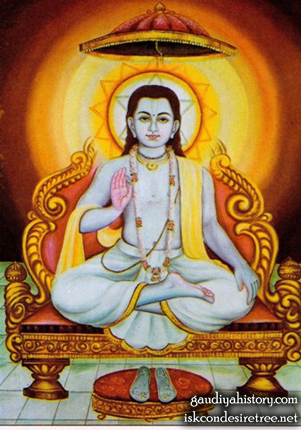
   Shripad Vidyadhiraja Tirtha was born in 1269 AD (1190 Sakabja Era) (A.C.Bhaktivedanta Swami Prabhupad. Shri Chaitanya Charitamrta. Madhya-lila 9:245. purport – Bombay Gazzette.) and some say that he lived to 1412 AD (143 years). BNK Sharma alots him the time of residence on the Pitha as being 1388-1412., (page 451.) according to the Madhva lineage he too was the immediate disciple of Jaya Tirtha and successor to the 'Pitha'. Previously his name was Krishnabhatta, (though the "Guru-acharya" gives him the name Nrsimha Shastri hailing from Badaganaadu Karnataka group of South India, and was admitted into the order of sannyas "the fourth order" directly from the brahmachari ashram and that he was very learned in the 'shastras'.) (BNK Sharma. 1961. History of the school of Dvaita Vedanta and its literature. page 451.) It is understood that he was a lifelong 'brahmachari', but for his time spent on the Vedanta Pitha is not clearly established. The times of office in the Mutt records range from three years, nine months and thirteen days; to four years; and lastly sixty four years, but for reasons best known to itself the Mutt is silent on clearing up this matter.

   The 'Guru-acharya' listings assign Vidyanidhi Tirtha a period of seven years, nine months and thirteen days as the next pontiff on the Vedanta Pitha.

   It seems that he would have been about forty years of age when he was ordanined by Jaya Tirtha, which was about one year before Jaya Tirtha's demise. Some say he was born in 1388, but this then makes it imposible for him to take initiation from Jaya Tirtha, given that the dates we have for Jaya Tirtha are accurate.

   The only written works accredited to him was a commentary on the Bhagavad Gita, and a commentary on Vishnusahasranama, which incidently was the first recorded Dvaita commentary upon it. (B.N.K. Sharma. 1961. History of the Dvaita School of Vedanta. page 453.).

   The devotional writer Shrila Kavikarnapur's "Shri Gaura-Ganoddesa Dipika", (Text 22.) mentions, "Akshobhya's disciple was Jaya Tirtha. Jaya Tirtha's disciple was Jnanasindhu. Jnanasindhu's disciple was Mahanidhi. Mahanidhi's disciple was Vidyanidhi. Vidyanidhi's disciple was Rajendra" However, in Shrila Bhaktisiddhanta Saraswati's song "Guru Parampara" he says, "Madhava Tirtha accepted the great paramahamsa Aksobhya Tirtha as his disciple. The principle disciple of Aksobhya Tirtha was known as Jaya Tirtha. Jaya Tirtha's service was for his disciple Jnanasindhu. Dayanidhi received the science of devotional service from Jnanasindhu and the servant of Dayanidhi was Vidyanidhi (Vidyadhiraja Tirtha). Rajendra became the disciple of Vidyadhiraja Tirtha."

   The Mutt listings are it seems reliable only as regards the cyclic years of the demise of a particular pontiff. Although there is even room for doubt in regards to a few there too! The cyclic year of Shripad Vidyadhiraja's demise is given as Angirasa which would correspond to 1392 A.D.

   Source : http://www.hknet.org.nz/gp-Vidyadhiraj%20Tirtha.htm 

Padmanabha Tirtha

   Shripad Padmanabha Tirtha was a native of Uttara-Karnataka which in those days stretched to the area known as Andhra Pradesh. The exact time of Padmanabha Tirtha's appearance is not , but in Shri Chaitanya Charitamrta purport (Madhya-lil 9:245.) Shrila A.C. Bhaktivedanta Swami Prabhupad includes a section from the Bombay Gazzette that gives a date as being 1120. There is no mention of the dating system that is being used specifically for that date but, many of the other references are of Sakabja Era to which we need to add 79 years to get Chritian Era (A.D.) making the date 1199 A.D.

   Both of the afore-mentioned state however, that Padmanabha Tirtha came from Uttara-Karnataka of the Telegu speaking people around the area where the Godavari River flows. His previous name in his 'purva-ashram' was Sobhana Bhatta, his initiation and subsequent change of name came upon meeting Madhwa when Madhwa returned to Udupi from his second northern tour. He (Sobhana Bhatta) was already a renowned and distinguished scholar of the day, but his proficiency in fourteen branches of learning were silenced in fourteen seconds by Acharya Madhwa in 1265 AD. In a very short time he became one of the most trusted disciples of Madhwa. Madhwa always praised him, being the senior-most disciple among those outside the Tulu area, and his learning, preaching capacity and seniority enabled Madhwa to make him the first to sit on the 'Pitha' after Madhwa's disappearance pastime.

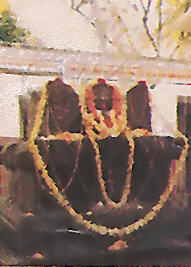
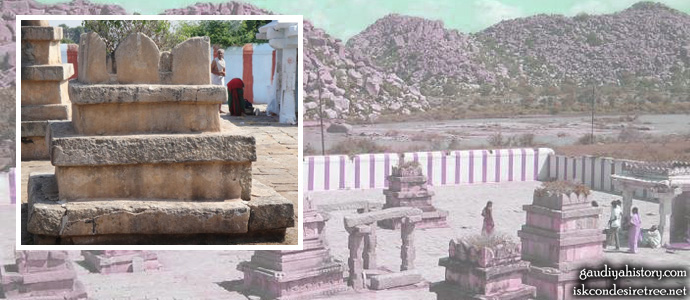
   Shripad Padmanabha Tirtha left this world at Navavrindavanas, near Hampi, on the sacred Tungabhadra River in 1324 AD. His 'samadhi' tomb remains there to this day.

   Source : http://www.hknet.org.nz/gp-Padmanabha%20Tirtha.htm

Padmanabha Tirtha

Shripad Padmanabha Tirtha left this world at Navavrindavanas, near Hampi, on the sacred Tungabhadra River in 1324 AD. His 'samadhi' tomb remains there to this day. (In the wallpaper: Navavrindavan in the back side, and samadhi tomb).

Laxmipati Tirtha

   The following is a story in connection with the disciple of Shripad Vyasa Tirtha who was given the name Laxmipati Tirtha, and who became the next to be recognised as the 'acharya' in the line in which we follow.

   Once Lord Balarama (Krishna's elder brother) appeared to Laxmipati Tirtha to break the ground for a change in the regular line of the Madhwa Sampradaya. Big changes were to take place that would eventuate in a revolution in thought and deed. Lord Shri Krishna and His brother Lord Balarama were about to appear in the dress of Devotees within the Madhwa 'sampradaya'.

brajendra nandana jei-Sachi-suta hoilo sei
balarama hoilo nitai

   Shrila Narottama dasa Thakura sings in his "Ishta Deve Vijnapti", in simple Bengali language that "Lord Krishna, the son of Nanda Maharaja, the King of Vraja, became the son of Sachi (Lord Chaitanya) and Balarama became Nitai (Nityananda).

   One story of this nature, which is quite heart rendering is the following story of Laxmipati Tirtha, the best of the 'sannyasis', who, on one occasion, was sitting in a solitary place performing his 'bhajan' throughout the night singing the glories of Lord Balarama. His unalloyed devotion was so intense he would sometimes cry or call out, "O Baladeva, kindly show me Your favour. I am so fallen and wicked." Tears would come from his eyes and he lost all patience and composure due to his old age and intense desire to see the Lord. He would sometimes collapse on the floor, stunned. This day, due to the devotional traumas he had undergone, he slept.

   It is described that Lord Nityananda, in His usual prankish mood, appeared to Laxmipati in His original form as Lord Balarama, Krishna's brother. How he appeared to Laxmipati was in a dream, telling him that a wandering Brahmin, in the form of an 'avadhuta', madman had arrived in town. "He will come to you. Initiate him into the Vaishnava 'diksha mantras' and accept him as your disciple." Then Lord Balarama spoke the 'mantra' into Laxmipati's right ear and Laxmipati awoke. After a short time Laxmipati saw the 'avadhuta Brahmin' and his mind became full with anxious anticipation. When they met, Laxmipati couldn't take his eyes off the beautiful form of the Lord, His aura and His Moonlike face and unblinking eyes. Hearing the sweet words of Lord Nityananda, Laxmipati's eyes brimmed over with swelling tears. That very day Laxmipati fulfilled the order of Lord Balarama, and Nityananda became the favourite of Laxmipati.

nityananda prabhu vande
Shrimad laxmipati priyam
Shri madhwa-sampradaya
vardhanam bhakta vatsalam

   "Respectful obeisances unto You, Nityananda Prabhu, the dear favourite of Laxmipati Tirtha. He (Nityananda) increases the bliss of the entire Madhwa 'sampradaya' and He has the innermost needs of the Devotees foremost at hand." 

Laxmipati Tirtha

"Respectful obeisances unto You, Nityananda Prabhu, the dear favourite of Laxmipati Tirtha. He (Nityananda) increases the bliss of the entire Madhwa 'sampradaya' and He has the innermost needs of the Devotees foremost at hand." (In the wallpaper: Shri Nityananda Prabhu, ISKCON Chennai).

   Shripad Laxmipati Tirtha couldn't understand his intense attraction for Nityananda or the bliss he felt just being near Him. On Lord Nityananda's absence from his sight for a moment, intense separation came over him. Laxmipati stayed awake that night pondering over things. He had dozed off slightly, when again in a dream the Lord appeared. He was whitish in complexion, dressed in a blue dhoti. It was Nityananda in his dream, but then Nityananda transformed into Lord Balarama. Laxmipati was amazed and he bathed the Lord's feet with ecstatic tears from his eyes. He prayed to the Lord, "Surely You have made a fool of me and put this fallen wretch into much distress. Please show me Your mercy. You are my Lord. I take shelter at Your lotus feet." That same Shri Nityananda Rama (Balarama) fulfilled all of Laxmipati's cherished longings, though He forbade him from telling a soul of His identity, and then disappeared from sight.

   When Laxmipati awoke in lamentation upon the Lord's disappearance, he saw that night had become the morning. Shripad Laxmipati Tirtha had noticably changed from this day on. He didn't speak ever again, as his mind was always absorbed elsewhere. From an external perspective he looked terrible, and his disciples became full of anxiety. Within a short while, without any warning, Shripad Laxmipati left this world. Who can understand properly the character and pastimes of the Lord and His pure Devotee Laxmipati Tirtha? Just see the purity of Shripad Laxmipati Tirtha, that the Lord appears directly to play with him.

   Usually it is accredited to Shripad Madhavendra Puri Goswami, the disciple of Shripad Laxmipati Tirtha, as being the spiritual master of Lord Nityananda Prabhu, but here it is mentioned otherwise.

   We are not trying to create any controversy so let us substantiate some of this story a little. In the Chaitanya Charitamrta Shrila A.C. Bhaktivedanta Swami writes: "In Khadadaha, sometimes people misunderstood Nityananda Prabhu to belong to the 'shakta-sampradayam' whose philosophy is 'antah saktah bahih saivah sabhayam vaisnavo matah'.  According to the 'shakta sampradaya', a person called 'kaulavadhuta' thinks materially while externally appearing to be a great Devotee of  Lord Shiva. When such a person is in an assembly of Vaishnavas, he appears like a Vaishnava. Nityananda Prabhu did not belong to such a community. Nityananda Prabhu was always a 'brahmachari' of a 'sannyasi' of the 'Vaidika' ('Vedic') order. Actually He was a 'paramahamsa'. Sometimes He is accepted to be a disciple of Laxmipati Tirtha. If  He is so accepted, Nityananda Prabhu belonged to the Madhwa-sampradaya. He did not belong to the Tantrika-sampradaya of Bengal."(Shri Chaitanya Charitamrta, Madhya lila 1:3:85. purport.). However in Chaitanya Charitamrta, Madhya lila (3:8:128) purport, Shrila Prabhupada says: "Shri Nityananda Prabhu was initiated by Madhavendra Puri, a 'sannyasi'. According to others, however, He was initiated by Laxmipati Tirtha."

   H.H.Bhakti Hridoy Mangal Maharaja, Secretary General of the Shri Chaitanya Gaudiya Math, when he visited Australia 1989-90, mentioned that he remembered hearing personally an instance that was related by Shrila Bhaktisiddhanta Saraswati Goswami Maharaja Prabhupada (sometime in the late 1920's during a class), wherein Shrila Bhaktisiddhanta Saraswati Thakura told how Lord Nityananda walked off with a 'sannyasi' who came to beg alms at His parent's house (as mentioned in Chaitanya Bhagavata.) The 'sannyasi' asked Hadai Pandit, the father of Lord Nityananda, as is traditional, for some alms and so Hadai Pandit as a dutiful householder agreed. But when the 'sannyasi' asked him to give him the boy (Nityananda) as alms, Hadai Pandit, nearly died. Considering his life useless without the boy and a bad example to the boy if he didn't fulfill the desires of his saintly guest. So to fulfill 'dharma' he gave the boy to the 'sannyasi' as his assistant – this 'sannyasi' was Shripad Laxmipati Tirtha. It is interesting to note that the boy Nityananda simply walked off with the 'sannyasi' without even so much as looking back, just as Lord Rama left His father, Dasaratha, to go to the forest. Though different circumstances, both Maharaja Dasaratha and Hadai Pandit died within a very short time due to intense separation. Hadai Pandit and his wife's faces turned black, and never ate again.

   Source : http://www.hknet.org.nz/gp-LaxmiPati%20Tirtha.htm

Brahmanya Tirtha

Brahmanya Tirtha

Shri Brahmanya Tirtha's Samadhi is in Shri Vrindavna Dhama.

   He was the third descendant from Shripad Rajendra Tirtha in the line senior of disciples coming from Shripad Vidyadhiraja Tirtha. Very little on his life is known. It is said that it was due to the blessings of Brahmanya Tirtha that the parents of Vyasa Tirtha, (Brahmanya Tirtha's disciples), owed the birth of their children notably Shripad Vyasa Tirtha (B.N.K. Sharma. 1961. History of the Dvaita School of Vedanta. page 460.).

   As his permanent residence, Brahmanya Tirtha lived mostly at Channapatna or Abbur in Karnataka State (B. Venkobarao. Vy-charita, Page 26.) There he had a Mutt of his own which later he was to entrust to his disciple Shridhar Tirtha. This Mutt which still survives today is called the Kundapur Mutt. His other disciple was the famous Shripad Vyasa Tirtha.

   The Mutt lists give his demise as 1467 AD
 
   Shri Brahmanya Tirtha's Samadhi is in Shri Vrindavna Dhama.

   Source : http://www.hknet.org.nz/gp-Brahmanya%20Tirtha.htm

Vyasadeva

Some Brief Information About Shrila Vyasadeva.
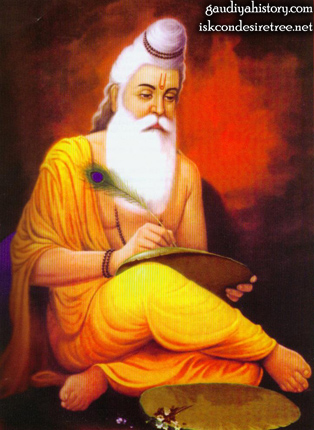
Vyasadeva

Vyasadeva.

   "When the second millenium ('Dwarpa Yuga') overlapped the third ('Treta Yuga'), the great sage Shrila Vyasadeva was born to Parashara Muni in the womb of Satyati, the daughter of Vasu (the fisherman)." (Shrimad Bhagavatam 1:4:14.).

   In Shrila Vyasa's childhood he was called Krishna, because of his dark complexion, and because he was born on an island at the confluence of the Sati and Mati Rivers he was called Dwaipayana. After dividing the Vedas he got the name Veda Vyasa. There are some who say that Krishnadwaipayana Veda Vyasa took his birth at a place now known as Vyasa Goofer, the cave of Shrila Vyasa in present day Nepal, on the road from Pokara to Kathmandu which was, in days of yore, part of the kingdom of King Janaka. There are local records that support this statement, which say this was the 'ashrama' of Parashara Muni and at this place Shrila Vyasa was conceived. They also lay claim that later Shrila Vyasa came back to that 'ashrama' and stayed there for some time, and this being why there is a small Deity of Him at the entrance of the cave. The Padma Purana however says that he was conceived on an island created by Parashara in the Yamuna river, (Padmalochana Prabhu's book entitled "Yamuna Devi, The Personification Of Prema Bhakti", Page 24.), in connection with the place known as Soma Tirtha ghat. Some also say that the birth place was at Damauli.

   The date of Shrila Vyasa's appearance was on the twelfth day of the light fortnight in the month of Vaisaka (April-May), called Vasant Dwadashi.

   Once the hermit Parashara became attracted to a fisher girl of the name Matsya-Gandha who was found inside a fish. (The fish was actually a celestial maiden named Adrika who conceived two children by collecting the semen of the King of Chedi when his semen had fallen into the water of a river after seeing two animals engaged in coitus.)  Parashara Muni asked the beautiful Matsya-Gandha, so named because of her fishy aroma, to take him in her boat from one side of the river to the other, but the beauty of this damsel, her bodily movements from the rowing, aroused lusty desires in Parashara. When he sat close to her she moved away, and asked him not to violate her chastity, but Parashara Muni being already too far carried away, created an artificial fog on the river and seduced her right there in the boat. He then created an island in the river and on that island the girl conceived a child in her womb. Parashara explained to her that even after the child was born she would remain a virgin and the son born to her would be a portion of Lord Vishnu and would be famous throughout the three worlds. He would be a man of purity, the spiritual master of the entire world, and He would divide the Vedas.

   Shrila Vyasa soon grew into everything that Parashara had described, and had many disciples.

   Later in life it is recorded that Shrila Vyasa returned to this island in the river and there compiled the Shrimad Bhagavatam. Recorded is another instance when Shrila Vyasa called for Ganesha (the elephant-headed 'deva') to write the Mahabharata as he related it to him. He did so on the condition that Shrila Vyasa continually recited, and Ganesha, having perfectly understood the meaning, wrote down the Mahabharata. The word "Vyasa" means one who describes elaborately.

   "The great sage, Shrila Vyasa who was fully equipped with knowledge, could see through his transcendental vision the deterioration of everything material, due to the influence of the age. He could also see that the faithless people in general would be reduced in duration of life and would be impatient due to lack of goodness. Then he contemplated for the welfare of men in all statuses and orders of life. He saw that the sacrifices mentioned in the Vedas were means by which people's occupations could be purified, and to simplify the process, he divided the one Veda into four, in order to expand them among men. The four divisions of the original sources of knowledge (the Vedas) were made separately, but historical facts and authentic stories mentioned in the Puranas are called the fifth Veda." (Shrimad Bhagavatam 1:4:17-20.).

   "Thus the great sage Shrila Vyasadeva, who is very kind to the ignorant mass, edited the Vedas so they might be assimilated by less intellectual men. Still he was not satisfied, even though he was engaged in working for the total welfare of all people. Thus Shrila Vyasa, being dissatisfied in heart, began to reflect within himself. 'I have, under strict disciplinary vows, unpretentiously worshipped the Vedas, the spiritual master and the altar of sacrifice. I also abided by the rulings and have shown the import of disciplic succession through the explanation of the Mahabharata, by which even women, shudras and others (friends of the twice born) can see the path of religion. I am feeling incomplete, though myself I am fully equipped with everything required by the Vedas. This may be because I did not specifically point out the devotional service of the Lord, which is dear both to perfect beings and to the infallible Lord'."

   "Shrila Narada Muni (who was another son of Prajapati Brahma) reached the cottage of Shrila Krissna-dwaipayana Vyasa on the banks of the Saraswati, where Shrila Vyasa was staying at that time, just when Shrila Vyasa was regretting his defects. At the auspicious arrival of Shrila Narada, Shrila Vyasadeva got up respectfully and worshipped him, giving him veneration equal to that given to Shri Brahmaji, the creator. Shrila Narada then said: 'O Shrila Vyasadeva, your vision is completely perfect. Your good fame is spotless. You are firm in vow and situated in truthfulness, and thus you can think of the pastimes of the Lord in trance for the liberation of the people in general from all material bondage. The people in general are naturally inclined to enjoy, and you have encouraged them in that way in the name of religion. This is verily condemned and is quite unreasonable. Because they are guided under your instructions, they will accept such activities in the name of religion and will hardly care for prohibitions.' And so Narada Muni, Shrila Vyasadeva's spiritual master, instructed Shrila Vyasa to compile the Maha-Bhagavat Purana (Shrimad Bhagavatam) now in his maturity for the benefit of all mankind, to which Shrila Vyasadeva agreed. He presented the glories of Krishna and His many incarnations just after the departure of Lord Krishna from this world. (Excerpts from Shrimad Bhagavatam 1:4:24-33.).

   "In this yuga the son of Parashara, who is glorified as a part of Vishnu and who is known as Dvaipayana, the vanquisher of all enemies, became Shrila Vyasa. Urged by Brahma, he undertook the task of classifying the Vedas. Shrila Vyasa accepted four disciples to preserve and continue the Vedas. They were Jaimini who took care of the Sama Veda, Sumantu – the Atharva Veda, Vaishampayana – the Yajur Veda and Paila – the Rg Veda, and for the Itihasa and Puranas – Lomaharsana." (Shri Vayu Purana 60:10-16.).

   According to Vayu Purana it says, "Previously there have been twenty-eight Vyasas, but when the twenty-eighth appears, Lord Vishnu, the most Glorious, Great Father of the three worlds, becomes Dvaipayana Vyasa. Then Lord Shri Krishna, the best amongst the Yadus will be born of Vasudeva and will be known as Vasudeva. Then in due course I (Vayu) will come in the form of an ascetic and assuming the body of a religious student, will surprise the world by means of the Lord's 'yoga maya'." (Vayu Purana 23:206-208.) Actually, this is Vayudeva announcing his appearance as Shripad Madhwacharya.

   Source : http://www.hknet.org.nz/gp-Vyaasadev.htm
Narada Muni

Narada Muni   The next recipient of the Shri Gopala mantra is Shri Narada Muni as indicated in the above sanskrit verse. In the creation of this universe according to Pauranika literature, Shri Narada Muni is the younger brother of the Four Kumaras and son of Brahma. He also rejected his father’s orders of increasing the population, and chose devotion to the Lord. He was thus present before all of the demigods, along with his elder brothers. He was blessed with the ability to travel to any part of creation according to tradition and he took initiation from his older brothers and their discussions as guru and disciple are recorded in the Upanishads with a famous conversation in the Chandogya Upanishad; also with their discourses in the Shri Narada Purana and the Pashcaratra literature. He is found in most of the religious scriptures always passing on knowledge of an event or teaching the path of Bhakti to all. He was the inspiration for the writing of the greatest Purana – the Bhagavata Purana

   Source : http://en.wikipedia.org/wiki/Nimbarka_Sampradaya


Nimbarkacharya

Nimbarkacharya

Nimbarkacharya.

   Accurate biographies are difficult to find, yet authorities agree that Shri Nimbarkacharya preached Krishna consciousness about three-hundred years before the adventure of Shri Chaitanya Mahaprabhu. 

   In Navadwipa Dhama Mahatyam, Shrila Bhaktivinoda Thakura says that Nimbarka had previously worshiped Lord Shiva in Bilva Paksha, Rudradwipa (Navadwipa). Lord Shiva appeared before Nimbarka instructing him to take initiation from the four Kumaras, who were meditating nearby. Nimbarka received Radha-Krishna mantra and continued living in Navadwipa. Following the teachings of the Sanat-Kumara Samhita, he worshiped Radha and Krishna with great love. Soon Radha and Krishna appeared before Nimbarka. Then the Divine Couple displayed Their unified form as Shri Gauranga Mahaprabhu. 
 
   Lord Gauranga said, "Nimbarka, in the future when I begin My sankirtana movement I will personally preach the perfect transcendental philosophy of achintya-bheda-abheda-tattva. I will take the essence of the philosophies of Madhva, Ramanuja, Vishnuswami. From you, Nimbarka, I will take two important principles: (1) The necessity of taking shelter of Shrimati Radharani. (2) The high esteem of the Vraja gopis love for Shri Krishna." Lord Gauranga disappeared after instructing Nimbarka. Shedding tears of ecstasy, Nimbarka left Navadwipa to begin his preaching mission. In Chaitanya lila, Nimbarka appeared as Keshava Kashmiri and received love of Godhead directly from Nimai Pandit.

   There are striking similarities between the Gaudiyas and Nimbarkas. The followers of Nimbarka accept the six forms of surrender, practice the nine limbs of bhakti, and believe in the dasa mula (ten cardinal points of Gaudiya philosophy). They also worship Radha and Krishna in Vrindavana. They worship Shrimati Radharani as the topmost Devotee, and they accept the gopis love for Krishna is supreme. With beads, bhajans, and kirtans the Nimbarkas chant their version of the maha-mantra: Radhe Krishna Radhe Krishna Krishna Krishna Radhe.Radhe, Radhe Syama Radhe Syama Syama Syama Radhe Radhe.

   In Vrindavana, about one mile from Govardhana, there is the village of Nimgaon, named after Nimbarkacharya, who lived there from childhood and later performed bhajana there. Many of Radha-Krishna's pastime places in Vrindavana are now maintained by the Nimbarka sect. In Mathura-Vrindavana, innumerable Devotees follow Nimbarka's path of bhakti. The Shriji Mandir, just off Loi Bazaar in Vrindavana, serves as the center of Nimbarka sampradaya. 

Nimbarkacharya

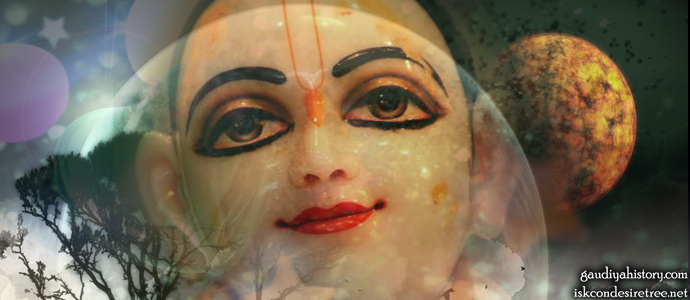
From you, Nimbarka, I will take two important principles: (1) The necessity of taking shelter of Shrimati Radharani. (2) The high esteem of the Vraja gopis love for Shri Krishna." Lord Gauranga disappeared after instructing Nimbarka. Shedding tears of ecstasy, Nimbarka left Navadwipa to begin his preaching mission. In Chaitanya lila, Nimbarka appeared as Keshava Kashmiri and received love of Godhead directly from Nimai Pandit. (In the wallpaper: Shrimati Radharani, ISKCON Chowpatty, Mumbai).