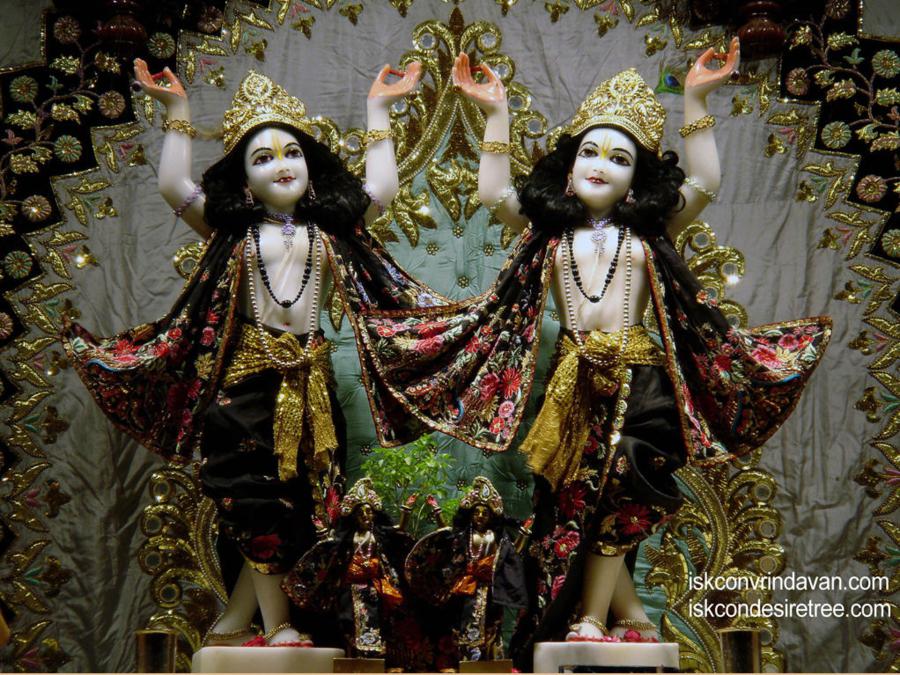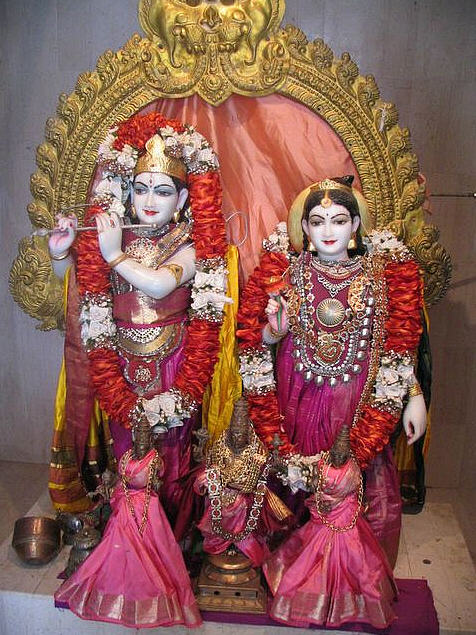
Author Archives: Sevak

Minaketana Rama Das

amum pravishatam karyat sahajau nishatholmukau
minaketana-ramadir vyuhah sankarshano’parah
 
   The two brothers Nishatha and Ulmuka entered into the expansions of Nityananda as Minaketan and Rama, etc. (Gaura-ganoddesha-dipika 68)
 
Rama Das, a Devotee of Nityananda
 
   Though the Gaura-ganoddesha-dipika here indicates that Minaketan and Rama Das are two different people, it is clear from the Chaitanya Charitamrita and the Bhakti-ratnakara that Minaketan Rama Das is one single individual. Perhaps both Nishatha and Ulmuka, participants in Baladeva-lila, entered into the body of Minaketan Rama Das during Gaura-lila.
 
Minaketana Rama Das

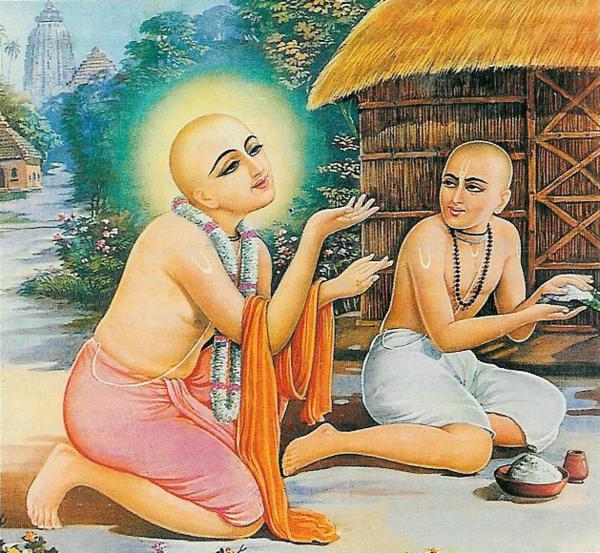
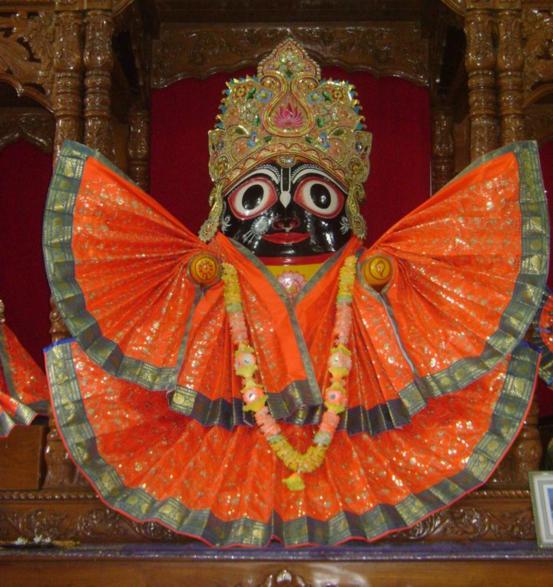
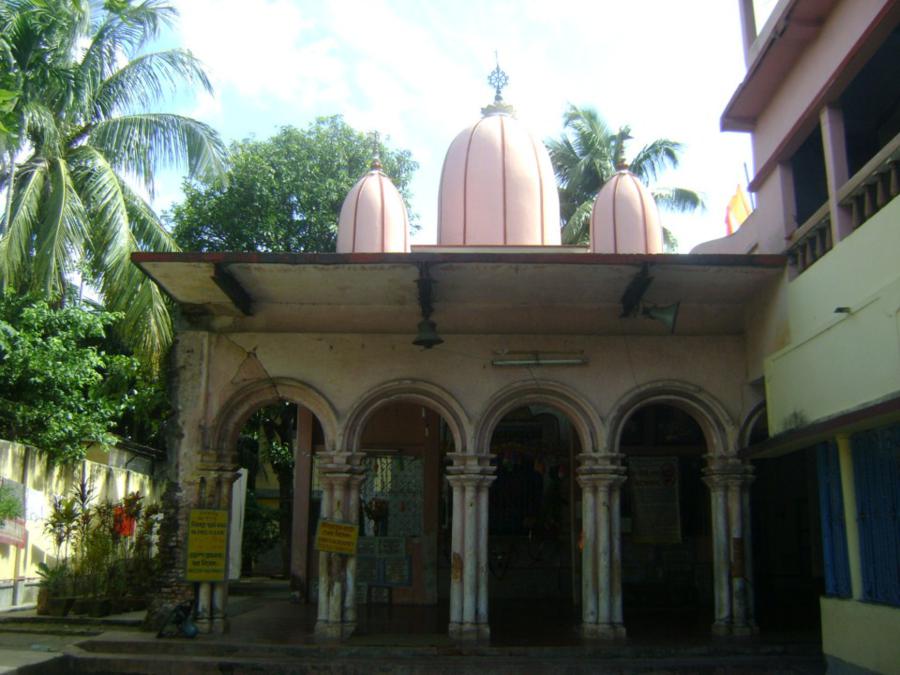
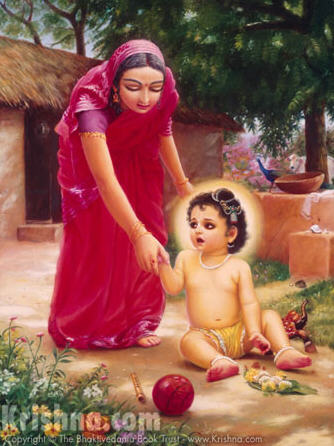
"The word avadhuta is defined by Shridhara Swami in his commentary to SB 3.1.19 by the words asamskrita-deha, or (one who does not take care of his body) Nityananda Prabhu was an avadhuta, and his disciple was also an eternally perfect, maha-bhagavata paramahamsa like him--beyond the varnashrama system. As a result, none of the characteristics of any of the castes or states of life were manifest in his body. He was completely absorbed in the mood of Vraja and had no consideration whatsoever for the duties of the body." (Anubhashya, 1.5.161) (In the image: Shri Nityananda Prabhu).

   Nothing is known about the details of Minaketan Rama Das's birthplace or his parents. From the account of Krishnadas Kaviraj Goswami, it would appear that his home was somewhere in the vicinity of Krishnadas’s residence in Jhamatapura.
 
   He was one of the associates of Nityananda who went to Kheturi with Jahnava Devi. Narahari Chakravarti writes that the three worlds are purified by the sight of Vaishnavas like Minaketan Rama Das:
 
   "The great Devotees all joined together to go to Kheturi. Seeing them, the entire universe is sanctified. Minaketan Rama Das, Abhiram Thakur, Murari Chaitanya, Jnana Das, Mahidhara, Shankara, Kamalakara Pippalai, Nrisingha Chaitanya, Jiva and Kanai Pandit." (Bhakti-ratnakara 10.372-5)
 
   Krishnadas Kaviraj Goswami recounts some details about Minaketan Rama Das in his Chaitanya Charitamrita in the course of glorifying Nityananda Prabhu. Just as Nityananda Prabhu was an avadhuta, his follower Minaketan also behaved in the manner of an avadhuta. Shrila Bhaktisiddhanta Saraswati Goswami Thakur discusses the word avadhuta in his commentary: "The word avadhuta is defined by Shridhara Swami in his commentary to SB 3.1.19 by the words asamskrita-deha, or (one who does not take care of his body) Nityananda Prabhu was an avadhuta, and his disciple was also an eternally perfect, maha-bhagavata paramahamsa like him–beyond the varnashrama system. As a result, none of the characteristics of any of the castes or states of life were manifest in his body. He was completely absorbed in the mood of Vraja and had no consideration whatsoever for the duties of the body." (Anubhashya, 1.5.161)
 
Rama Das at Jhamatapura
 
   On one occasion, Minaketan Rama Das was invited to attend an all-night kirtan at Krishnadas Kaviraj’s home in Jhamatapura. The other guests were impressed by his appearance and his display of transcendental emotions and came to pay their obeisances to his feet. In his ecstatic mood, he would sometimes hit the person prostrated before him with his flute, sometimes slap him. Occasionally, he would even climb onto some other Devotees’ shoulders. Tears poured from his eyes like the uninterrupted flow of a river. Seeing this, other Devotees’ also felt their eyes fill with tears. All the eight amazing manifestations of ecstatic love appeared in his body. When he shouted the name of Nityananda in this state, all the Devotees felt their hearts fill with a divine ecstasy.
 
   Gunarnava Mishra was engaged as a pujari in Krishnadas’s house. This Brahmin was a kanishtha adhikari and had faith in the Deity but was unable to recognize the Devotee and did not have much enthusiasm to pay him proper respect. Minaketan Rama Das was able to understand that this Gunarnava Mishra had no faith in Nityananda Prabhu and that for this reason he was deliberately ignoring him because he was Nityananda’s disciple. In order to teach the world, Rama Das said, "Just look! A second Romaharshana Suta who did not come forward to show respect when he saw Balaram!" (Chaitanya Charitamrita 1.5.170)
 
   Romaharshana was seated on the Vyasasana and engaged in reciting the Bhagavat at the request of the assembled sages in Naimisharanya when Baladeva himself appeared there. All the other sages stood up to show Lord Balaram the appropriate respect, with the exception of Romaharshana. For this, he was punished. Someone who is proud has no authority to speak on the Bhagavat, nor, for that matter, is he authorized to worship the Deity. The Bhagavat is identical to Krishna himself. However, in this case, the pujari Gunarnava Mishra did not object to Rama Das’s chastisement and simply continued in the performance of his service to the Deity.
 
   At the end of the kirtan festival, however, Minaketan Rama Das got into an argument with Krishnadas Kaviraj’s brother. Krishnadas’s brother had strong faith in Chaitanya Mahaprabhu, but lacked such faith in Nityananda Prabhu. When Rama Das discovered this, he broke his flute in anger and left the place. The result of this curse was that Krishnadas’s brother was doomed to destruction. Krishnadas Kaviraj himself rebuked his brother, an act which pleased Lord Nityananda who came to him in a dream and told him to go to live in Vrindavan.
 
   The above account reveals how dear Minaketan Rama Das was to Nityananda Prabhu. Nityananda’s followers are like him: they are deliverers of the most fallen and capable of fulfilling all desires.
 
   [Excerpted from “Shri Chaitanya: His Life & Associates” by Shrila Bhakti Ballabh Tirtha Maharaj] 
Minaketana Rama Das 2

At the end of the kirtan festival, however, Minaketan Rama Das got into an argument with Krishnadas Kaviraj’s brother. Krishnadas’s brother had strong faith in Chaitanya Mahaprabhu, but lacked such faith in Nityananda Prabhu. When Rama Das discovered this, he broke his flute in anger and left the place. The result of this curse was that Krishnadas’s brother was doomed to destruction. Krishnadas Kaviraj himself rebuked his brother, an act which pleased Lord Nityananda who came to him in a dream and told him to go to live in Vrindavan. (In the image: Shri Nityananda Prabhu).

Kurma Vipra

Kurma Vipra

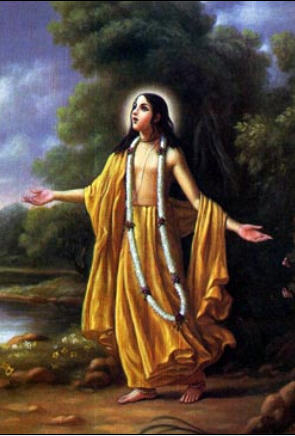
When Mahaprabhu decided to deliver the people of the South, He left Puri on the pretext of going on pilgrimage in the month of Vaishakh. At Nityananda Prabhu’s request, He accepted Krishnadas Vipra as a servant. Distributing prema to all as He passed, He arrived in the place known as Kurmasthana where He bestowed His blessings on the Vedic Brahmin also named Kurma. (In the image: Lord Shri Krishna Chaitanya).

    When Mahaprabhu decided to deliver the people of the South, He left Puri on the pretext of going on pilgrimage in the month of Vaishakh. At Nityananda Prabhu’s request, He accepted Krishnadas Vipra as a servant. Distributing prema to all as He passed, He arrived in the place known as Kurmasthana where He bestowed His blessings on the Vedic Brahmin also named Kurma.
 
   Krishnadas Kaviraj Goswami has not given anything more than this Brahmin’s name in his account of this event in his Chaitanya Charitamrita. Though many Devotees descended to this world to participate in the Lord’s pastimes, the worldly identity of many of them remains unfortunately unknown. There is not much possibility that historians will ever be able to unearth any more informtion about this Kurma Vipra’s background. Detailed knowledge about the Lord’s associates’ worldly identities is far less important, however, than the lessons which we are taught through their saintly lives.
 
   Mahaprabhu was influenced by the intense devotion of Kurma Vipra to accept his service. He was fortunate enough to be able to take the Lord to his house, where he washed His feet and gave the holy water to all his family members to drink. He gave the Lord to eat and ate His remnants as Maha Prasad.
 
   In that village there was a Vedic Brahmin named Kurma. He respectfully invited Lord Chaitanya Mahaprabhu to his home. He washed the Lord’s lotus feet and drank the water with his family members. With great affection and respect, he gave Mahaprabhu all kinds of food to eat. After that, all the members of the family shared His remnants. (Chaitanya Charitamrita 2.7.121-3)
 
   The Brahmin glorified Mahaprabhu, pleasing Him, but as the Lord left he was unable to bear the thought of being separated from Him. He asked the Lord for permission to accompany Him, but the Lord denied it, telling him to stay at home and chant the names of Krishna and then to take the role of an acharya and preach the Holy Names to others.
 
   The Lord said, "Never make such a suggestion again. You should rather remain at home and constantly chant the Holy Name of Krishna. Instruct whomever you see in the religion of Krishna. Become a spiritual master on my order and deliver everyone in this land. Do this and you will never again be entangled in the waves of materialistic life. Indeed, you will have My company again, here in this very place." (Chaitanya Charitamrita 2.7.127-9)
 
   Shrila Bhaktisiddhanta Saraswati Goswami Thakur has elaborated on this instruction to Kurma Vipra in his Anubhashya as follows: "For those who are determined to abandon everything to take shelter of the Supreme Lord Shri Chaitanya Mahaprabhu and serve Him exclusively, the Lord here gives the instruction to remain in the home, i.e., to give up the pride of being a heroic performer of bhajana and to adopt a regular practice of chanting the Holy Name of Krishna in the home and, with the humility which is characterized by remaining in the householder life, instruct others in chanting the Holy Names. If one takes up the duties of a spiritual master in this way, he will never become entangled in the "waves of materialistic life" in the form of the desire for self-aggrandizement. Many foolish people think that it is an impediment to spiritual practice to teach through writing books as Rupa Goswami, Sanatan Goswami, Jiva Goswami or Raghunath Das Goswami have done, or by taking on large numbers of disciples like Madhvacharya, Ramanujacharya or Narottama Das Thakur. Indeed, these less intelligent persons even claim that such activities are material entanglements. By adhering to these erroneous ideas, they become offenders to many unalloyed Devotees who have nothing to do with the material world. This teaching of the Lord is intended for these people, who, if they analyze it carefully, will come to give up their false pride in a show of humility and, rather than demonstrating a vengeful attitude towards those who are devoid of a devotional attitude to the Lord, advance the cause of genuine bhajana."
 
[Excerpted from “Shri Chaitanya: His Life & Associates” by Shrila Bhakti Ballabh Tirtha Maharaj] 
Kurma Vipra

"Never make such a suggestion again. You should rather remain at home and constantly chant the Holy Name of Krishna. Instruct whomever you see in the religion of Krishna. Become a spiritual master on my order and deliver everyone in this land. Do this and you will never again be entangled in the waves of materialistic life. Indeed, you will have My company again, here in this very place." (Chaitanya Charitamrita 2.7.127-9) (In the image: Kartik Parikrama, Shri Vrindavan Dham).

Prataparudra

indradyumno maharajo jagannatharcakah pura
jatah prataparudrah san sama indrena so’dhuna
 
   Indradyumna, who previously worshiped Lord Jagannath, was born as Prataparudra, with the same opulences as Indra himself. (Gaura-ganoddesha-dipika118) 
Prataparudra

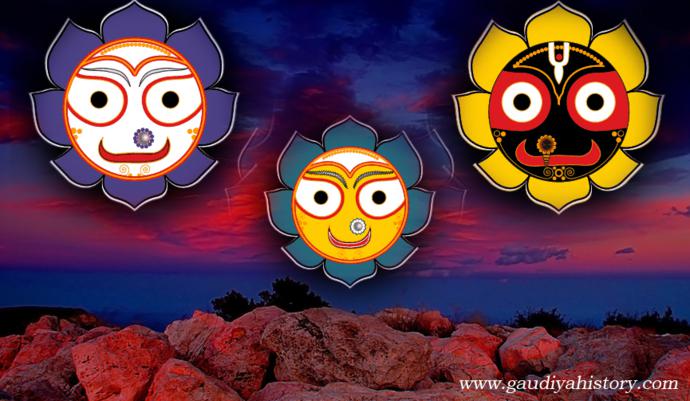
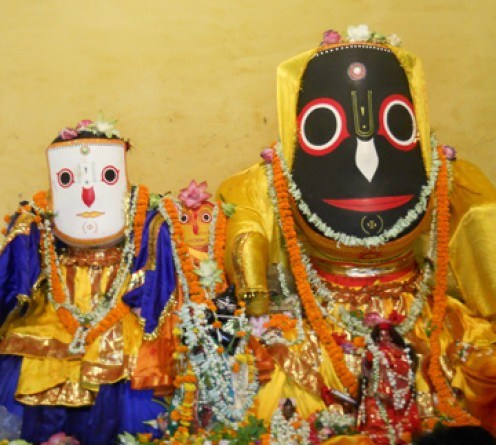
Jagannath had appeared in Nilachala as Nila Madhava with the purpose of delivering the conditioned souls of this world. He was served by a tribal king named Vishvavasu. Nila Madhava manifested the Deity form of Jagannath through these three persons: Indradyumna, Vidyapati and Vishvavasu. The Lord appeared in three forms at the place known as Banki Mohana in order to show His mercy for King Indradyumna. These three Deities are, of course, Balaram, Subhadra and Jagannath. (In the wallpaper: from right to left Lord Jagannath, Subhadra Devi, Lord Baladeva).

 
    [Note: In a Satyayuga during the second half of Brahma’s lifetime, a certain king named Indradyumna was born into the Dynasty of the Sun. He ruled over the kingdom of Malava and had his capital at Avantipura. He was a great Devotee of Vishnu, as was his priest Vidyapati. In the first half of Brahma’s life, Jagannath had appeared in Nilachala as Nila Madhava with the purpose of delivering the conditioned souls of this world. He was served by a tribal king named Vishvavasu. Nila Madhava manifested the Deity form of Jagannath through these three persons: Indradyumna, Vidyapati and Vishvavasu. The Lord appeared in three forms at the place known as Banki Mohana in order to show His mercy for King Indradyumna. These three Deities are, of course, Balaram, Subhadra and Jagannath.]
 
Prataparudra’s Ancestors
 
   The ancestors of King Prataparudra are listed in the Orissan history, Madala Punji. It is said there that when King Kajjalabhanu, the last ruler of the Ganga dynasty, was absent from the kingdom during wartime, his minister Kapilendra Deva led a coup and took over the throne. Also known as Kapileshvara, this king founded the Gajapati dynasty of Orissa. Kapilendra’s queen was Parvati, to whom was born their son and successor, Purushottam Deva, Prataparudra’s father. Prataparudra’s mother was Padmavati or Rupambika.
 
   Prataparudra was an associate of Lord Chaitanya Mahaprabhu and is considered a branch of Gadadhara Pandit Goswami. During the Lord’s lifetime, he was an independent king of considerable power. His capital city was Chuttack (Kataka). He, his wives and sons, were all Devotees of Mahaprabhu. His chief wife (or patta-mahishi) was named Gauri. She had five sons, the eldest of whom was named Purushottam Jana. This is mentioned in Bhakti-ratnakara (6.65).
 
Prataparudra, Disciple of Kashi Mishra
 
   King Prataparudra accepted Kashi Mishra as his spiritual master and served him with great dedication. While staying at Puri, he would daily go to Kashi Mishra’s house and massage his guru’s feet after his midday meal. At this time he would inquire about the state of Jagannath’s service, etc.
Prataparudra had a regular duty which he performed whenever he was at Nilachala. He would daily massage Kashi Mishra’s feet and would hear a report on Jagannath’s service. (Chaitanya Charitamrita)
 
   Mahaprabhu stayed at Kashi Mishra’s house in a one-roomed cottage on the veranda. In Orissan, such a small cottage is called a gambhira.
 
   We also learn from Ramananda Raya’s Jagannath-vallabha Nataka that Prataparudra was a mighty and heroic military leader, despite which he maintained a humble demeanor. He was a generous and open-hearted Vaishnava. It is also said there that he was devoted to the promotion of learning. Every one of Mahaprabhu’s biographies states that he received the Lord’s mercy. Kavi Karnapura also writes about Prataparudra’s military qualities in his Chaitanya-chandrodaya Nataka. He protected brahmanical culture and was especially benevolent towards the Vaishnava religion. Many works of Vaishnava history dating to that period have given testimony that he was the object of affection for Mahaprabhu, Ramananda Raya, Kashi Mishra and Sarvabhauma Bhattacharya.
 
   Many books have been attributed to Prataparudra, such as Saraswati-vilasa, Pratapa-martanda, Kautuka-chintamani, Nirnaya-sangraha, etc. In fact, the first two of these books were written by two of his court scholars, Lolla Lakshmidhara and Ramakrishna, respectively. There is a legend that when Mahaprabhu left Puri for Vrindavan, Prataparudra felt such separation that he had a murti of the Lord made. He assigned 54 Brahmins to the service of the Deity, as well as giving a large tract of land for its maintenance. In the royal palace at Puri, Deities of Gaura-Nityananda and Gaura-Gadadhara are worshiped alongside numerous other images.
 
Purushottam Fights for Jagannath’s Honor
 
   During Prataparudra’s reign, his kingdom stretched as far as Rajamahendri in modern Andhra Pradesh. It is not necessary to go into detail here, but the following is a brief summary of some of the historical background. Prataparudra’s father, Purushottam Deva, retrieved lands which had been lost to his kingdom as well as expanding it further through his own might. Being entirely surrendered to Jagannath, he was successful in extending Orissan lands as far as Rajamahendri, or Rajahmundry. It was said that Jagannath Himself would appear on the battlefield to assist the king in his fight. 
Prataparudra

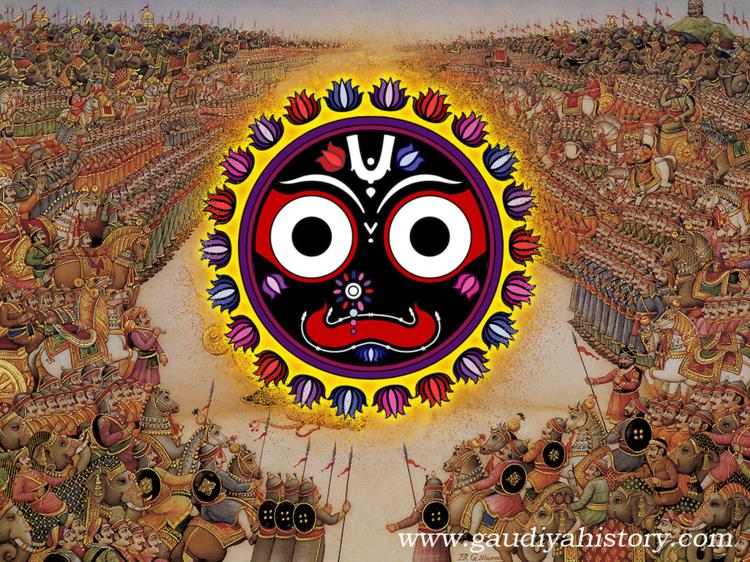
Prataparudra’s father, Purushottam Deva, retrieved lands which had been lost to his kingdom as well as expanding it further through his own might. Being entirely surrendered to Jagannath, he was successful in extending Orissan lands as far as Rajamahendri, or Rajahmundry. It was said that Jagannath Himself would appear on the battlefield to assist the king in his fight. (In the wallpaper: Lord Jagannath in the battle field).

 
   On one occasion, marriage was contracted between Purushottam and the king of Kanchi’s daughter Padmavati. The king of Kanchi came to Puri to have a look at the groom. He arrived there during the time of the Rathayatra and saw his prospective son-in-law sweeping the parade ground before the chariot of the Lord, as was the custom. Though Purushottam was sweeping the ground with a golden broom, the king of Kanchi thought that it was an insult to his daughter to marry her to someone who took the tasks of a sweeper, the lowest outcaste of Hindu society. He thus cancelled the marriage between them. The king of Kanchi was a Devotee of Ganesha, and had no great faith in Jagannath.
 
   When Purushottam heard of the sovereign of Kanchi’s faithlessness, he became angry and attacked his territories with a large force. At first he was unable to secure a victory, so he prostrated himself before Jagannath and surrendered to Him. This time Jagannath assured him that He would aid his war effort and so Purushottam took up arms again.
 
   As Purushottam passed through the village of Anandapura, about 12 miles from Puri, a milk maid said to him, "Two horsemen passed through here. They bought milk, yogurt and buttermilk from me and paid for it with a ring. They told me to give you the ring and ask for money in exchange." When Purushottam looked at the ring, he was able to recognize that the two horsemen had been none other than Jagannath and Balaram. He rewarded the milkmaid and set off to certain victory against Kanchi. He returned with the jewelled throne of that kingdom and offered it to the service of Jagannath. He also took the Ganesha Deity which was worshipped in Kanchi back to Puri. In this way, Jagannath Deva crushed the arrogant pride of the king of Kanchi. It is said that Ganesha tried to cast obstacles in Purushottam’s way during the battle. Since he went against his customary role of eliminating obstacles, he was given the name Bhanda ("deceitful") Ganesha.
 
   Kanchi’s king personally returned to Puri with his daughter Padmavati and offered her as Purushottam’s bride while he was sweeping the Rathayatra route for Jagannath. Purushottam kept his promise and remained king of Puri until 1497 AD. He was followed by Prataparudra who remained on the throne until his death in 1540. Other than the abovementioned queen Gauri, he also had four other wives, named Padma, Padmalaya, Ila and Mahila.
 
Prataparudra Wishes to Meet Mahaprabhu
 
   Prataparudra was the most fortunate member of the Gajapati dynasty of Orissan kings, as he received the mercy of Shri Chaitanya Mahaprabhu, the combined form of Radha and Krishna. Even though Mahaprabhu felt that it was not beneficial for a sannyasi to come into contact with a worldly man like a king, His disdain for him was pure show. Inwardly, He was won over by the king’s pure devotional attitude and He showered him generously with His causeless mercy. Krishnadas Kaviraj Goswami has described how the Lord taught the people of this world through King Prataparudra in his Chaitanya Charitamrita. The story is told in the eleventh chapter of the Madhya-lila.
 
   At first Prataparudra approached Sarvabhauma Bhattacharya to tell him of his desire to meet Chaitanya Mahaprabhu. He asked him so many times that finally Saravabhauma asked Mahaprabhu to allow the king to see him. As soon as he heard the request, however, the Lord covered His ears and said, "For a sannyasi like Myself, to see a king is the same as looking at a woman– it is pure poison." (2.11.7) Even though the king was a great Devotee, the fact that he was a king made him an object of fear, like a black snake.
 
Prataparudra’s Dream
 
   In the fifth chapter of the Antya-khanda of the Chaitanya Bhagavat, Vrindavan Das Thakur has described the King’s deep desire to meet with the Lord as well as a dream in which the King saw that Lord Jagannath and Lord Chaitanya Mahaprabhu are non-different. The first time the King saw Mahaprabhu dance, He observed body covered in dust and His mouth filled with frothing saliva from his ecstatic dancing and so felt some doubts. 
Prataparudra

That very night, he saw Jagannath in a dream. Jagannath too was covered in dust and saliva; then he saw the same dust-covered form of Lord Chaitanya Mahaprabhu sitting on Lord Jagannath’s simhasana along with the Deity. From this amazing dream he understood the divine nature of Lord Chaitanya Mahaprabhu. (In the wallpaper: from left to right Lord Jaganath, Lord Shri Gauranga Mahaprabhu, ISKCON Vrindavan).

 
   That very night, he saw Jagannath in a dream. Jagannath too was covered in dust and saliva; then he saw the same dust-covered form of Lord Chaitanya Mahaprabhu sitting on Lord Jagannath’s simhasana along with the Deity. From this amazing dream he understood the divine nature of Lord Chaitanya Mahaprabhu.
 
   [Jagannath said,] "Just look! My body is covered with dust and saliva. You are a king and the son of a king. Surely it is not proper for you to touch someone like Myself." Having said this, Lord Jagannath looked at His servant and laughed. In that very moment, the King saw Chaitanya Mahaprabhu sitting on the altar alongside the Lord. (Chaitanya Bhagavat 3.5.175-7)
 
Ramananda and Sarvabhauma Try to Intervene
 
   One day, Prataparudra came to Puri with Ramananda Raya and other members of his retinue. Ramananda knew of the king’s eagerness to meet Mahaprabhu, so when he went to visit the Lord, he tried to persuade Him to allow such a meeting to take place, telling Him of the king’s deep affection for Him. He added that the king had given him leave from his job with full pay to allow him to stay with the Lord. When He heard how the king was filled with love for him and how he had served His Devotee, Mahaprabhu replied: "The king has shown so much love for you that the Lord is sure to accept him on the basis of this virtue alone."
 
ye me bhakta-janah partha na me bhaktash ca te janah
mad-bhaktanam tu ye bhaktas te me bhaktatama matah
 
   Those who claim to be My Devotees are in fact not so. The best of My Devotees are those who are devoted to My servants.
 
   However, Sarvabhauma Bhattacharya again entreated the Lord on the king’s behalf to allow such a meeting to take place, the Lord said that under no circumstances would He come face to face with a king, and that if people continued to ask Him to do so, He would leave Puri and go to live elsewhere. When the king heard this, he was desolated. He said,
 
   "The Lord has descended just to deliver all kinds of sinful, lowborn persons. He has even delivered sinners like Jagai and Madhai. But it seems that He has made a promise to deliver the entire universe with the exception of someone named Prataparudra. He may have sworn not to see me, but I have sworn to give up my life if I cannot see Him. Without Shri Chaitanya Mahaprabhu's mercy, my life and kingdom are worthless." (Chaitanya Charitamrita 2.11.45-6, 48-9) 
 
   Vasudeva Sarvabhauma thought up a way to arrange a meeting between Prataparudra and the Lord. During the Rathayatra festival, after having danced in the sankirtan with His Devotees, the Lord customarily went into a flower garde to rest. Sarvabhauma Bhattacharya suggested to the king that he take this opportunity to approach the Lord dressed as a common person and to recite the verses of the Rasa-panchadhyaya from the Bhagavat. The Lord would be in a trance-like state and would be transported by the recital of the loves of Krishna and the gopis. In this condition, He would surely embrace the king. The king was relieved to hear these words of advice. 
Prataparudra

The Lord has descended just to deliver all kinds of sinful, lowborn persons. He has even delivered sinners like Jagai and Madhai. But it seems that He has made a promise to deliver the entire universe with the exception of someone named Prataparudra. He may have sworn not to see me, but I have sworn to give up my life if I cannot see Him. Without Shri Chaitanya Mahaprabhu's mercy, my life and kingdom are worthless. (Chaitanya Charitamrita 2.11.45-6, 48-9) (Chaitanya Charitamrita 2.12.19-21) (In the wallpaper: Shri Jaya Gauranga, ISKCON Hungary, New Vrindavan).

 
   When the Lord returned from His pilgrimage to the South of India, Prataparudra sent a letter to Sarvabhauma in which he once again expressed his desire to meet with the Lord. Sarvabhauma showed the letter to the other Devotees and all were duly impressed by the degree of devotion exhibited by the King. Nityananda Prabhu decided that he would speak to the Lord, not about meeting the King but simply about his personal qualities and actions. He said the following to the Lord:
 
   We want to submit everything to You, whether or not it is fitting. The King has decided that he will become a yogi if he cannot meet You. He says, "I will pierce my ears and place earrings there and become a mendicant. I have no desire to enjoy this kingdom without the mercy of Gaurahari. When will I be able to see the Lord’s moonlike face to my full satisfaction and when will I be able to hold His lotus feet to my heart?" (Chaitanya Charitamrita 2.12.19-21)
 
   Though the Lord listened to Nityananda’s account of the King’s mood, He took a hard-line position in order to teach the world. He said that for the sake of His spiritual advancement, a sannyasi is forbidden to even see a King. If He were to engage in such forbidden acts, Damodar Pandit would criticize Him. Damodar Pandit answered, saying:
 
   "I am merely an insignificant jiva, so what power do I have to tell you what to do? I shall see you meet the King of your own volition. The King loves You very much, and you are influenced by a Devotee’s feelings of love. It is the power of this love for You that will reward him with the opportunity to touch You. Although You are the Supreme Lord and are completely independent, still it is Your nature to be influenced by the love and affection of Your Devotees." (Chaitanya Charitamrita 2.12.27-9)
 
   Nityananda added that people who experience unrequited love tend to commit suicide. Thus, in order to save the King’s life, he asked Mahaprabhu to give him a used loincloth (bahirvasa). The Lord could not refuse, so Nityananda asked Govinda for the loincloth and sent it to the King via Sarvabhauma Bhattacharya. Prataparudra was overjoyed to receive the cloth and he began to worship it as though it were the Lord Himself.
 
Mahaprabhu Sees the King’s Son
 
   When Ramananda Raya received the King’s permission to come to live near the Lord in Puri, he also described Maharaj Prataparudra’s intense desire to see the Lord and tried to persuade the Lord to fulfill that desire. Mahaprabhu spoke out of a desire to establish the rules of conduct for the renounced orders: He said that just as even a slight mark on a piece of white cloth immediately becomes noticeable, the smallest character flaws of a sannyasi are noticed by the general public. A jug full of milk is contaminated by even a drop of liquor; similarly, though King Prataparudra may possess all virtues, the very fact that he is a king makes his association contaminated.
 
   However, the Lord was unable to completely ignore Ramananda Raya’s request, because of their close friendship. He Himself suggested that He could see the King’s son, for according to the maxim atma vai jayate putrah ("one is reborn as one’s own son"), there is no difference between the father and the son. When he learned of the Lord’s will, Prataparudra immediately sent his son to Him. When Mahaprabhu saw the teenaged prince with his almond eyes and dark skin wearing a yellow cloth, He immediately thought of Krishna. He embraced the lad which caused Him to experience the ecstatic transformations of prema. The King embraced Him and felt the same ecstasies through the medium of his son. From that day onward, the King’s son was considered one of Mahaprabhu’s associates.
 
The King’s Humble Service to Lord Jagannath
 
   A Devotee who is free from pride, is surrendered and without any ulterior motive, is eligible to receive the Lord’s mercy.
 
dinere adhika daya karen Bhagavan
kulin pandit dhanir baria abhiman
 
   The Lord bestows greater blessings on the meek and humble. Those who are well-born, who are learned, and who are rich are filled with pride. (Chaitanya Charitamrita 3.4.68)
 
   Maharaj Prataparudra was without any pride, even though he had so much material power as well as possessing all good qualities. Mahaprabhu had noticed his willingness to engage in even menial service and was pleased with him and ready to give him His mercy, even though externally He made a show of being hard-hearted. 
Prataparudra

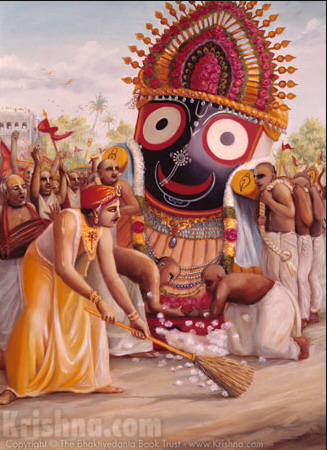
(While Lord Jagannath was being carried from the throne to the car) King Prataparudra personally engaged in the Lord's service by sweeping the road with a gold-handled broom. He sprinkled the road with sandalwood-scented water. Although he was the owner of the royal throne, he engaged in such menial service. Although the King was the most exalted respectable person, still he accepted menial service for Lord Jagannath and was therefore a suitable candidate for Jagannatha’s mercy. Mahaprabhu was happy to see the King’s service to the Lord and it was through this service, that he finally received the mercy of the Lord. (Chaitanya Charitamrita 2.13.15-18) (In the image: King Prataparudra sweeping the path before the Lord).

 
   (While Lord Jagannath was being carried from the throne to the car) King Prataparudra personally engaged in the Lord's service by sweeping the road with a gold-handled broom. He sprinkled the road with sandalwood-scented water. Although he was the owner of the royal throne, he engaged in such menial service. Although the King was the most exalted respectable person, still he accepted menial service for Lord Jagannath and was therefore a suitable candidate for Jagannatha’s mercy. Mahaprabhu was happy to see the King’s service to the Lord and it was through this service, that he finally received the mercy of the Lord. (Chaitanya Charitamrita 2.13.15-18)
 
   The Lord’s mercy has no cause. Only He knows who will receive His blessings and when. Often, He does so in an indirect manner rather than doing it openly. The Lord was pleased by the King’s engagement of a menial service and even though He did not make a public show of mercy to him, He did reveal His personal form to the King and thus fulfill his deepest desire.
 
Harichandana is Slapped by Shrivasa Pandit
 
   In the thirteenth chapter of the Madhya-lila, these events are described. During the Rathayatra festival, the Bengali Devotees were divided into seven groups for chanting the Holy Names. Each one of these groups thought that Mahaprabhu was with them alone. Prataparudra was able to witness this pastime and felt wonder and ecstatic love. All this was Mahaprabhu’s indirect mercy.
 
   When Mahaprabhu Himself wanted to dance in front of Jagannath’s chariot, He would gather the seven sampradayas together into one kirtan group. Meanwhile, the Devotees formed three rings of protection around the Lord. The innermost line of defense was headed by Nityananda Prabhu, the second by Kashishvara Pandit, Mukunda and other Devotees. Prataparudra and his soldiers formed the outermost circle to defend the Lord from the crowds.
 
   Maharaj Prataparudra watched mesmerized while the Lord danced, resting his hand on the shoulder of his minister (mahapatra) Harichandana. At that time, Shrivasa Pandit, who was also absorbed in watching the Lord’s ecstatic dancing, came and stood in front of the King, blocking his vision. Harichandana repeatedly tried to push Shrivasa to one side, telling him to let the King see until finally Shrivasa lost his temper and slapped Harichandana. When Harichandana became angry and was about to respond to Shrivasa’s aggression, the King said:
 
   "You are very fortunate, for you have been graced by the touch of Shrivasa Thakur. I have not been so fortunate. You should feel obliged to him."
 
Prataparudra Catches the Lord
 
   In Mahaprabhu's lila we find a delightful mixture of the highest manifestations of love, mercy and teachings for the general public. As He pulled the chariot of Lord Jagannath, Mahaprabhu was absorbed in the mood of Radha and the other gopis at their meeting with Lord Krishna who had come to Kurukshetra from Dvaraka on the occasion of the solar eclipse. Thus Mahaprabhu wished to drag Krishna (in His Jagannath form) from the site of His majestic pastimes in Kurukshetra, represented by Nilachala (the Jagannath Temple) to the site of His sweet, loving pastimes in Vrindavan, represented by Suryachala or the Gundicha Temple. Sometimes, Mahaprabhu would lag behind as He tried to understand the depth of the gopis’ loving power; Jagannath Himself would seem to understand the Lord’s emotions and slow down the movement of the chariot. Thus, the Lord danced more frenziedly as He and Lord Jagannath went deeper and deeper into ecstatic communication. As He danced in this divyonmada state, the Lord seemed about to fall down just in the very spot where King Prataparudra was standing. The King immediately held the Lord to keep Him from falling. This was how the Lord blessed the King and allowed him to touch Him, but He immediately began to rebuke Himself for having allowed a materialistic person to touch Him. The inconceivable activities of the Lord contain both delightful manifestation of emotion and teachings for the world, neither of which are easy to understand. 
Prataparudra

As He pulled the chariot of Lord Jagannath, Mahaprabhu was absorbed in the mood of Radha and the other gopis at their meeting with Lord Krishna who had come to Kurukshetra from Dvaraka on the occasion of the solar eclipse. Thus Mahaprabhu wished to drag Krishna (in His Jagannath form) from the site of His majestic pastimes in Kurukshetra, represented by Nilachala (the Jagannath Temple) to the site of His sweet, loving pastimes in Vrindavan, represented by Suryachala or the Gundicha Temple. Sometimes, Mahaprabhu would lag behind as He tried to understand the depth of the gopis’ loving power; Jagannath Himself would seem to understand the Lord’s emotions and slow down the movement of the chariot. Thus, the Lord danced more frenziedly as He and Lord Jagannath went deeper and deeper into ecstatic communication. (In the wallpaper: Lord Chaitanya dancing before Lord Jagannath).

 
   When He saw that it was the King, Mahaprabhu condemned Himself, saying, "O, how pitiful it is that I have touched a person interested in mundane affairs." … Even though the Lord had had made up His mind to see the King upon seeing him act as a sweeper in the service of Lord Jagannath, He still externally expressed feelings of anger in order to warn His personal associates.
 
The Lord Embraces the King
 
   There is a spot about halfway between the Jagannath Temple and Gundicha, or halfway between Shraddhabalu and Ardhasani Devi, which is called Balagandi. During the Rathayatra, Lord Jagannath’s chariot stops here at midday so that the He can rest. The custom is that all Devotees, whether important or less so, can make food offerings to Him on this occasion. Because of the large crowds which normally accumulate, Mahaprabhu went to rest in a flower garden near a coconut grove. Raja Prataparudra remembered Sarvabhauma’s counsel and approached the Lord in the dress of a commoner and began to massage His feet. He began to recite gopi-gita verses from the Rasa-lila of the Shrimad Bhagavatam, starting with the following verse:
 
jayati te’dhikam janmana vrajah
shrayate indira shashvad atra hi
dayita drishyatam dikshu tavakas
tvayi dhritasavas tvam vicinvate
 
   The glories of Vraja-bhumi have increased ever since You took birth here; since then, the goddess of fortune has taken up residence here. O beloved! We whose lives depend completely on You are searching for You, please show Yourself to us. (SB 10.31.1)
 
   Mahaprabhu was ecstatic and told the King to go on reciting. The King reached the ninth verse of the chapter:
 
tava kathamritam tapta-jivanam
kavibhir iditam kalmashapaham
shravana-mangalam shrimad-atatam
bhuvi grinanti te bhurida janah
 
   Nectarean discussions about You give life to those who are suffering; the philosophers have glorified them for they destroy all of one’s sins. They are auspiciousness f or the ears, they bring the fortune of love /divfor Krishna. Those most munificent of beings distribute these wonderful words throughout the world.
 
   As soon as Mahaprabhu heard this verse, He became ecstatic with love and embraced the King, while repeating the word bhurida ("most munificent beings") from the verse. Though the Lord is all-knowing, He asked the King his identity. Prataparudra answered that he was the servant of the servant of the Lord. Satisfied with the King’s answer, the Lord revealed to him a glorious divine form. All the Devotees were overjoyed to see that the King had finally received the Lord’s mercy.
 
Prataparudra

Because of the large crowds which normally accumulate, Mahaprabhu went to rest in a flower garden near a coconut grove. Raja Prataparudra remembered Sarvabhauma’s counsel and approached the Lord in the dress of a commoner and began to massage His feet.

   When the ratha was being pulled from Balagandi to Gundicha, it suddenly came to a stop and even the strongest men and intoxicated elephants were unable to move it. Maharaj Prataparudra became anxious. When the Lord saw that everyone was worried, He removed the strong men and the elephants and told His own Devotees to take the  ropes. Mahaprabhu Himself went to behind the chariot and began to push it with His head. The chariot started to move with a great rumbling noise. This feat amazed King Prataparudra and the rest of his entourage.
 
Prataparudra Sees Other Wonderful Pastimes
 
   While spending the four months in Puri, the Bengali Vaishnavas witnessed numerous pastimes of Lord Jagannath. On the Nandotsava, the day after the Krishna’s birth ceremony, Mahaprabhu would dress up as a cowherd and put on a play about the Vraja pastimes with His Devotees. Prataparudra also participated in this lila.
 
   The Lord made His first attempt to go to Vrindavan, He left Puri on Vijaya-dashami and went to Cuttack where He met Prataparudra in a garden under a bakula tree. Here too, the Lord saw the great prema of the King and embraced him, drenching him in His own tears of love. From that day on, the Lord was given the epithet Prataparudra-santrata, "the savior of King Prataparudra".
 
   Bhavananda Raya’s son Gopinath Pattanayaka was placed on the scaffold by the King’s son for having misappropriated state funds. Some Devotees came to Mahaprabhu to ask Him to intervene in order to save Gopinath’s life. The Lord was unhappy at being asked to get involved in such mundane affairs and made up His mind to go to Alalanath. The King himself was disturbed at hearing this news and prepared himself to give up everything in order to keep the Lord in Puri. These are all further proofs of the extent of the King’s love for the Lord’s lotus feet.
 
   When King Prataparudra heard all these details, he felt great pain in his mind. "I shall give up all that is owed me," he said, "if Mahaprabhu only stays here at Jagannath Puri. Even a moment’s contact with the Lord is worth more than millions of chintamani stones. I care nothing for this small sum of 200,000 kahanas (Note: a kahana equals 1280 cowries.); I would indeed offer everything not only this, but my life and kingdom at the lotus feet of the Lord."
 
A Song Written by King Prataparudra
 
   In the description of Bengali manuscripts in the Banga Sahitya Parishad library in Calcutta, a notice is given of a song with the signature of Prataparudra. There is some doubt as to whether the song is indeed his or not. A portion of that song is as follows:
   A Prayer to Radha
 
I will become an ornament on your body,
the ankle bells upon your feet.
I will become the chakora who gazes
at the moons of your fingernails,

the bee who buzzes around your lotus feet.

I will become the mirror you look into,
the whisk that fans you.
And I have yet another desire
Let me become a layer of fine dust on your feet.
If I cannot become the dust of your feet,
then be merciful and do with me as you please,
this is Prataparudra’s prayer.
 
   When Mahaprabhu disappeared, Prataparudra felt great separation from Him. This is described in the Bhakti-ratnakara as follows:
 
   When the King heard that the Lord had departed, he fell to the ground and began lamenting. Hitting his head again and again, he fell unconscious and only the association of Ramananda Raya kept him alive. The King was unable to bear the absence of the Lord and so he left Puri, remaining elsewhere for the rest of his days. (Bhakti-ratnakara 3.217-19)
 
   Maharaj Prataparudra’s descendants are: (1) Kaluwa Pratapa, (2) Kakharuwa Pratapa, (3) Govinda Vidyadhara, (4) Chakra Pratapa, (5) Narasimha Deva, (6) Raghurama Deva, (7) Mukunda Deva Harichandana, (8) Ramachandra Deva, (9) Purushottam Deva, (10) Nrisingha Deva, (11) Gangadhara Deva, (12) Balabhadra Deva, (13) Mukunda Deva II, (14) Divyasimhadiv Deva, (15) Hare Krishna Deva, (16) Gopinath Deva, (17) Ramachandra Deva II, (18) Virakeshari Deva, (19) Divyasimha Deva II, (20) Mukunda Deva III, (21) Ramachandra Deva III, (22) V_rakeshari Deva II, (23) Divyasimha Deva III, (24) Mukunda Deva IV, (25) Ramachandra Deva IV, (26) Virakeshari Deva III, (27) Divyasimha Deva IV.
 
[Excerpted from “Shri Chaitanya: His Life & Associates” by Shrila Bhakti Ballabh Tirtha Maharaj] 
Prataparudra

When Mahaprabhu saw the teenaged prince with his almond eyes and dark skin wearing a yellow cloth, He immediately thought of Krishna. He embraced the lad which caused Him to experience the ecstatic transformations of prema. The King embraced Him and felt the same ecstasies through the medium of his son. From that day onward, the King’s son was considered one of Mahaprabhu’s associates. (In the wallpaper: Shri Shyamasundar, ISKCON Hungary, New Vraja Dham).

Kavi Karnapura Goswami – Biography

Kavi Karnapura Goswami

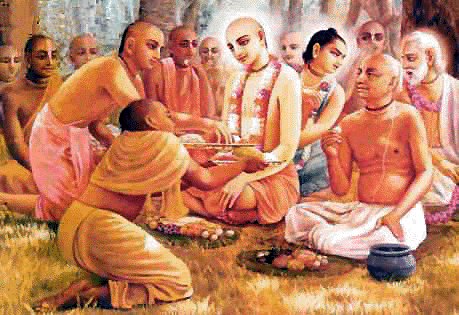
Kavi Karnapura is considered a branch of Chaitanya Himself. His father was Mahaprabhu’s dear associate, Shivananda Sena. (In the image: Lord Chaitanya, Shivananda Sena and others).

   Kavi Karnapura is considered a branch of Chaitanya Himself. His father was Mahaprabhu’s dear associate, Shivananda Sena. Karnapura himself identifies his parents in his own Gaura-ganoddesha-dipika:
 
pura vrindavane vira dati sarvash ca gopikah
ninaya krishna-nikariam sedanim janako mama
vraje bindumati yasid adya sa janani mama
 
   The go-between Vira, who previously brought all the gopis to Krishna, is my father. My mother was known as Bindumati. (Gaura-ganoddesha-dipika 176)
 
Paramananda Das or Puri Das
 
   Karnapura did not give his own identity in Gaura-ganoddesha-dipika, but from his knowledge of his own parents’ identity, we can surmise that he was an associate of Krishna in Vraja as well. In the Vaishnavacara-darpana, it is written:
   "Kavi Karnapura was Gunachuda Sakhi in Vraja. He is a branch of Chaitanya who lived in Kachariaparia. He accumulated spiritual power from Mahaprabhu when he placed the Lord’s big toe in his mouth and was given the name Puri Das."
 
   He was born in 1527 in the town of Kaichana-palli. His father named him Paramananda Das, Paramananda Sena or Puri Das. He was the youngest of Shivananda Sena’s three sons. His older brothers were named Chaitanya Das and Rama Das. All three brothers were Devotees of Lord Shri Chaitanya. (Chaitanya Charitamrita 1.10.62)
Kavi Karnapura Goswami

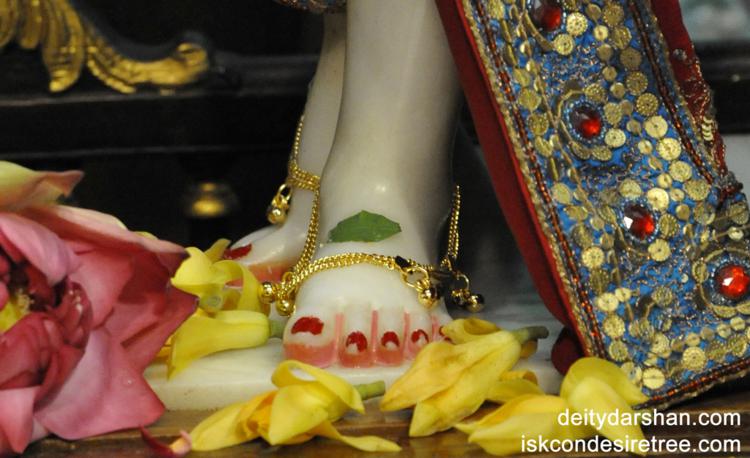
"Kavi Karnapura was Gunachuda Sakhi in Vraja. He is a branch of Chaitanya who lived in Kachariaparia. He accumulated spiritual power from Mahaprabhu when he placed the Lord’s big toe in his mouth and was given the name Puri Das." (In the image: Lotus Feet of Shri Goura Chandra, ISKCON Chowpatty, Mumbai).

   Shivananda Sena’s entire family was blessed with the Lord’s unlimited mercy. The Lord Himself told His other associates just how dear this family was to Him when He ordered that as long as Shivananda and his family stayed in Puri, they should receive His remnants. (Chaitanya Charitamrita 3.12.53)
 
   Kavi Karnapura received the name Paramananda Das from Mahaprabhu Himself. The Lord also jokingly called him Puri Das. This child was born as a result of Mahaprabhu’s blessing.
 
   The Lord asked Shivananda Sena the youngest son's name; Sena answered, “Paramananda Das.” Previously, when Shivananda Sena had visited the Lord, the Lord had said to him, “The next time you have a son, name him Puri Das.” The baby was already in his wife’s womb and was born after Shivananda returned home. He named the child Paramananda Das in accordance with the Lord’s wishes, and the Lord jokingly called him Puri Das. (Chaitanya Charitamrita 3.12.45-49)
 
Mahaprabhu Gives the Epithet Kavi Karnapura
 
   The next year, when Shivananda Sena brought the baby to Mahaprabhu, the Lord showed the child much mercy by placing His big toe in his mouth. When Puri Das was only seven years old, the Lord Himself gave him the title Kavi Karnapura upon hearing the wonderful poetry that the child was capable of composing. This has been described by Krishnadas Kaviraj Goswami in the sixteenth chapter of the Antya-lila.
 
   One year, when Shivananda and his wife were in Puri for the Rathayatra, they came with Puri Das to see the Lord. The child paid obeisances to Mahaprabhu, and the Lord said to him, “Say Krishna, say Krishna!” Though the Lord asked him to chant repeatedly, the boy refused to utter the Holy Name. His embarrassed father also tried to get him to chant, but the child was steadfast in his refusal. Mahaprabhu Himself was amazed and said, “I have made everyone in the universe, even the non-moving beings, chant the names of Krishna, but have been unable to make this little child do so. What on earth could be the reason?”
 
   Svarupa Damodar suggested: “You have instructed him in Krishna’s name. Because it is forbidden to repeat one’s guru-given mantra aloud, he will not reveal it publicly and will only chant it mentally. I would guess that this is what he is thinking.”
 
Kavi Karnapura Goswami

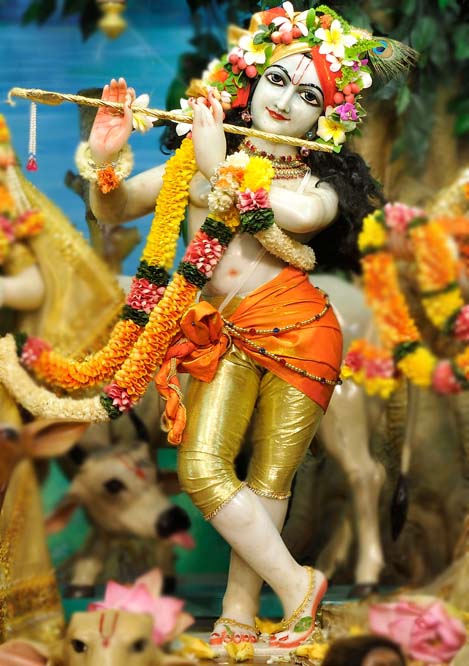
All glories to Hari, the ornament for all the beauties of Vrindavan -- a blue lotus for their ears, black collyrium for their eyes, and a necklace of blue sapphires to decorate their breast. (Chaitanya Charitamrita 3.16.74) (In the image: Shri Gopinath, ISKCON Chowpatty, Mumbai).

   The Lord was happy to see that such a young boy was aware of this scriptural injunction. In his Anubhashya, Shrila Bhaktisiddhanta Saraswati Goswami Thakur has explained: “The mantra which one has received from the guru is not to be revealed to anyone else, otherwise it will lose its potency. We have seen this previously from the story about Gadadhara Pandit.” This is why Puri Das would not repeat the mantra which had been given to him by Mahaprabhu himself.
 
   Mahaprabhu asked Puri Das to recite a verse in order to make him break his silence. The child recited the following verse of his own composition:
 
shravasoh kuvalayam akshnor
anjanam uraso mahendra-mani-dama
vrindavana-ramaninam
mandanam akhilam harir jayati
 
All glories to Hari,
the ornament for all the beauties of Vrindavan —
a blue lotus for their ears,
black collyrium for their eyes,
and a necklace of blue sapphires
to decorate their breast.
(Chaitanya Charitamrita 3.16.74)
 
   All those who were present were charmed by the lovely verse. A small boy of seven who had barely commenced his education was yet able to recite a verse of such quality! The gods like Brahma and Shiva are unable to understand Mahaprabhu’s mercy, what to speak of the ordinary jiva!
 
   Though Kavi Karnapura received the mantra of Krishna’s name from Chaitanya Mahaprabhu, he nevertheless followed the social custom of taking initiation from Shrinatha Chakravarti, who is a branch of Advaita Acharya on the Chaitanya tree. In the introduction to his Ananda-vrindavana-campu, Karnapura has paid his obeisances to Shrinatha Chakravarti. In another introductory verse to that work, he has glorified Chaitanya Mahaprabhu as his family Deity, saying that Mahaprabhu adopted Shivananda Sena’s entire family as His own. Some people say that Shrinatha Chakravarti’s Deities are still being worshiped in Kumarahatta or Kanchariaparia.
 
   The following is a list of Kavi Karnapura’s compositions:
 Chaitanya-chartamrita-mahakavya, Ananda-vrindavana-campu, Alankara-kaustubha, Chaitanya-candrodaya-nataka, Gaura-ganoddesha-dipika, Brihad-ganoddesha-dipika, Arya-shataka, Ahnika-kaumudi, a commentary on the tenth canto of the Shrimad Bhagavatam, Chaitanya-sahasra-nama and Keshavashtaka. He was still writing books in 1576 AD, the date of the Chaitanya-candrodaya-nataka.
 
   Kavi Karnapura, was dear to the Lord and became a writer of books in which he revealed the Lord’s blessings on Sanatan Goswami. (Bhakti-ratnakara 1.657)
 
   [Excerpted from “Shri Chaitanya: His Life & Associates” by Shrila Bhakti Ballabh Tirtha Maharaj] 

Kamalakara Pippalai – Biography

kamalakarah pippalai-namnasid you mahabalah
 
   Nityananda’s associate Kamalakara Pippalai was one of the twelve Gopals, formerly known as Mahabala.
   (Gaura-ganoddesha-dipika 128)
 
   Kamalakara’s behavior was extraordinary. It is well-known throughout the world that his love for Krishna is extraordinary.
   (Chaitanya Charitamrita 1.11.24)
 
Kamalakara Pippalai

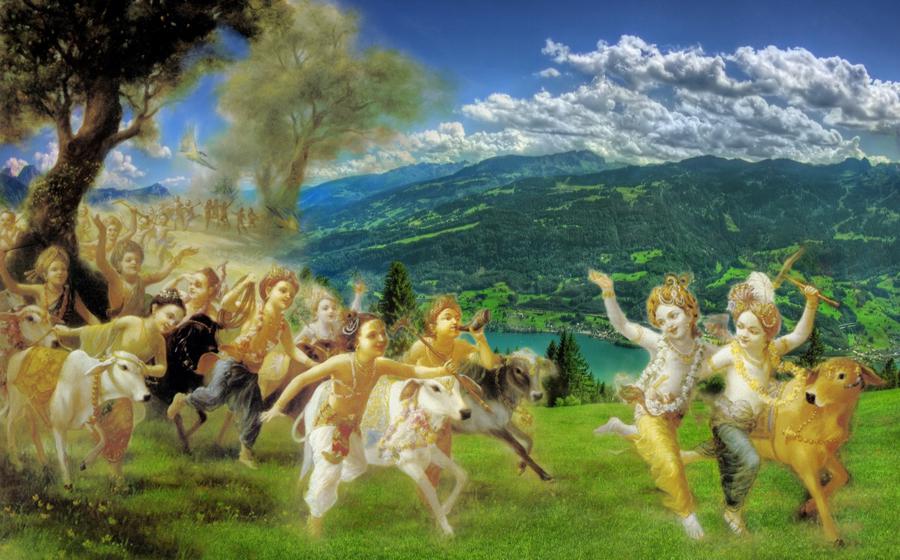
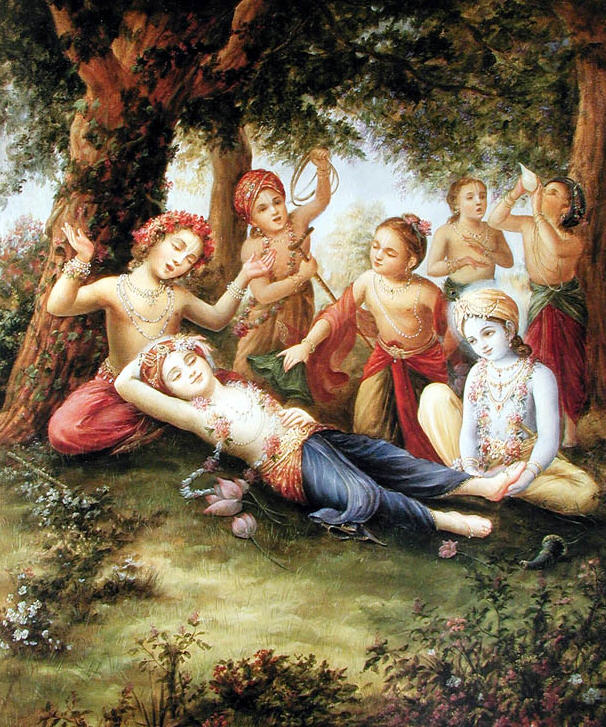
The cowherd boy who was known as Mahabala in Vrindavan is now known as Kamalakara Pippalai. Day and night he sang the glories of Radha and Krishna and is counted as one of Nityananda’s branches. He lived in Mahesha on the west bank of the Ganges where he served a Deity of Jagannath. (Vaishnavachara-darpana) (In the image: Krishna and Balarama with Their Friends).

   The cowherd boy who was known as Mahabala in Vrindavan is now known as Kamalakara Pippalai. Day and night he sang the glories of Radha and Krishna and is counted as one of Nityananda’s branches. He lived in Mahesha on the west bank of the Ganges where he served a Deity of Jagannath. (Vaishnavachara-darpana)
 
   Kamalakara Pippalai was born in Akna Mahesha and lived in Jageshvara. (Shripata-paryatana)
 
   In the Gaudiya Vaishnava Abhidhana, Kamalakara’s birth year is given as 1492 AD. His father was a rich landlord. He was born in the village known as Khalijhuli in the Sundarbon area. He had a younger brother named Shrinidhipati Pippalai. They belonged to a Brahmin family of the Rarha branch.
 
   Though born in Khalijhuli, he moved to the village of Mahesha, which is about 2 1|2 miles from the Serampore railway station in Hooghly. The famous Jagannath Deity in Mahesha was consecrated by him. Prior to Kamalakara’s arrival, the area around Mahesha was nothing but jungle, but he had the land cleared and made into a model village whose fame spread everywhere.
 
   Shrila Bhaktisiddhanta Saraswati Goswami Thakur has told two stories about Kamalakara Pippalai in his Anubhashya to the Chaitanya-charitamrita:
 
   (1) When Kamalakara Pippalai left home his younger brother Nidhipati Pippalai searched for him and in due course of time found him in the village of Mahesha. When his brother refused to return despite his remonstrances, Nidhipati Pippalai came to live in Mahesha with all his family members. His descendants still reside in the Mahesha area, where they consist of some twenty households.
 
   (2) There was once a vairagi named Dhruvananda who went on pilgrimage to Puri. It was his strong desire to offer Lord Jagannath food that he had cooked with his own hands. Jagannath appeared to him in a dream one night and told him to go to Mahesha on the the Ganges and when Jagannath was installed there, his wish to cook and make an offering to him would be fulfilled. When Dhruvananda came to Mahesha, he saw Jagannath, Balaram and Subhadra floating in the Ganges. He picked them out of the water and had a small hut built where he could shelter and worship them. As he neared his death and was searching about for a suitable replacement for himself to take care of the Deities, Jagannath once again appeared to him in a dream and said, "My Devotee, a great Vaishnava named Kamalakara Pippalai, lives in the village of Khalijuli in the Sundarban. I have ordered him in a dream to come here and take over My service. When he comes, you should turn the responsability for caring for Me over to him.
 
   The next morning, Kamalakara Pippalai, who had indeed had such a dream, arrived there and Dhruvananda immediately gave him charge of the worship of Jagannath, Baladeva and Subhadra. Having been empowered in this way to serve the Lord, Kamalakara Pippalai took the title Adhikari, and this title has been used as the family name ever since. The Pippalai name belongs to one of the fifty-five branches of the Rarha Brahmins."
 
Kamalakara Pippalai

There was once a vairagi named Dhruvananda who went on pilgrimage to Puri. It was his strong desire to offer Lord Jagannath food that he had cooked with his own hands. Jagannath appeared to him in a dream one night and told him to go to Mahesha on the the Ganges and when Jagannath was installed there, his wish to cook and make an offering to him would be fulfilled. When Dhruvananda came to Mahesha, he saw Jagannath, Balaram and Subhadra floating in the Ganges. He picked them out of the water and had a small hut built where he could shelter and worship them. As he neared his death and was searching about for a suitable replacement for himself to take care of the Deities, Jagannath once again appeared to him in a dream and said, "My Devotee, a great Vaishnava named Kamalakara Pippalai, lives in the village of Khalijuli in the Sundarban. I have ordered him in a dream to come here and take over My service. When he comes, you should turn the responsability for caring for Me over to him. (In the image: Jagannath, Baladeva and Subhadra Mayi, Mahesha).

   The Devotee is always anxious to serve the Lord, so the Lord gives him directions for service, and never to a non-devotee. Kamalakara was gratified to have received Lord Jagannath’s order, and immediately abandoned his home and family to go to Mahesha. The conditioned souls are normally so attached to the pleasures of their gross and subtle senses that the mere mention of service to Krishna and the Vaishnavas fills their hearts with fear. They consider it to be a burden and look for any excuse to avoid such service. Because it does not contribute to the gratification of the senses, they do not consider service to Vishnu and the Vaishnavas to be a wealth or a source of profit in the way that a Vaishnava does. To the eyes of the world, a Vaishnava may be playing the role of a family man, but he is not of the same order as a worldly householder. Sometimes it is the Lord’s wish that someone take a wife and have a family, but even though he is externally subject to the same conditions that an ordinary materialists because his mind is absorbed in separation from the Lord. Thus, as soon as he receives direction from the Lord, he enthusiastically abandons his material connections and becomes fully engaged in the Lord’s service. This renunciation of family life is not painful as it is for one on the jnana-yoga path, but is natural and spontaneous.
 
   The Vijaya-khanda says that Nityananda gave Panihati over to Kamalakara.
 
   Shrila Bhaktisiddhanta Saraswati Goswami Thakur has noted a few of the generations which descended from Kamalakara. He had a son named Chaturbhuja, who in turn had two sons, Narayan and Jagannath. Narayan’s son was named Jagadananda whose son was Rajivalochana. During Rajivalochana’s lifetime, service to the Jagannath Deity was at first hampered by a shortage of finances. The Nawab of Òhaka, Wali Shah Suja, donated 1185 bighas of land in the Bengali year 1060 (1653 AD). This land is found in the area of Jagannathpura, about 2 1/2 kroshas from the Mahesha Temple. The village was named Jagannathpura after the Deity.
 
   The Gaudiya Vaishnava Abhidhana cites the following verses from Nityananda-vamsha-vistara:
 
   A pure-hearted Brahmin who regularly worshiped Vishnu and the Vaishnavas lived in the town of Mahesha. He was Pippalai’s son-in-law named Sudhamaya. His wife was Vidyunmala.
 
   Thus, Vidyunmala, Kamalakara Pippalai’s daughter, married Sudhamaya Chattopadhyaya. They had a daughter named Narayani Devi. Virabhadra Prabhu later married this Narayani Devi. The descendants of the Pippalai family in Mahesha say that this girl’s name was Radharani. On the other hand, Shrila Bhaktisiddhanta Saraswati Goswami Thakur has said that Virabhadra Prabhu married Shrimati, who was the daughter of Yadunatha Acharya and his wife Vidyunmala, as well as their adopted daughter, Narayani.
 
   The Vaishnavacara-darpana also states that a highly qualified Brahmin named Yadunandana was married to Kamalakara Pippalai’s daughter Vidyunmala. Yadunandana thus had a great Devotee of Jagannath, who knew nothing but the desire to serve Jagannath, as his father-in-law.
 
   Kamalakara was present in Panihati at the Danda-mahotsava of Raghunath Das. He also came to the renowned festivals at Kheturi and Katwa. He joined Jahnava Devi to got here, as his name is mentioned in this connexion in Bhakti-ratnakara (10.375).
 
   According to the Vaishnavacara-darpana, he left for Vrindavan after giving his daughter away in marriage where he lived until the end of his days. According to the tradition maintained by his descendants, the disappearance day of the founder of their line was Chaitri Shukla-trayodashi of the year 1563 AD.
 
   [Excerpted from “Shri Chaitanya: His Life & Associates” by Shrila Bhakti Ballabh Tirtha Maharaj] 
Kamalakara Pippalai

To the eyes of the world, a Vaishnava may be playing the role of a family man, but he is not of the same order as a worldly householder. Sometimes it is the Lord’s wish that someone take a wife and have a family, but even though he is externally subject to the same conditions that an ordinary materialists because his mind is absorbed in separation from the Lord. Thus, as soon as he receives direction from the Lord, he enthusiastically abandons his material connections and becomes fully engaged in the Lord’s service. This renunciation of family life is not painful as it is for one on the jnana-yoga path, but is natural and spontaneous. (In the image: Shri Vrindavan Dham).

Kaliya Krishna Dasa – Biography

Kaliya Krishna Dasa

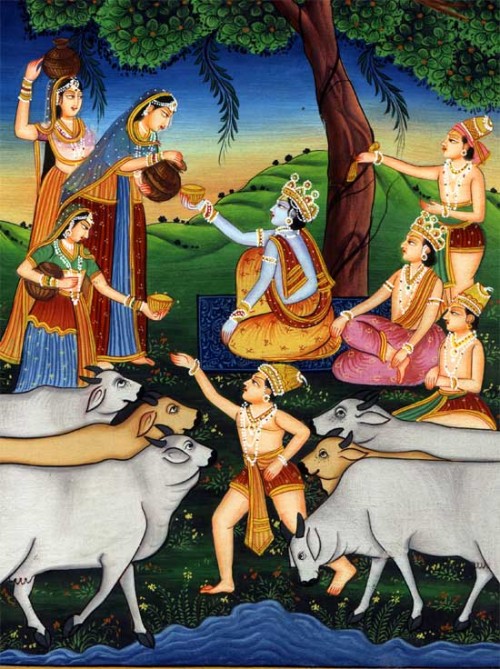
In Vraja, Kala Krishna Das was Krishna’s cowherd friend named Lavanga. (Gaura-ganoddesha-dipika 132) (In the image: Krishna and His Friends).

   kalah shri-krishnadasa sa yo lavangah sakha vraje
 
   In Vraja, Kala Krishna Das was Krishna’s cowherd friend named Lavanga. (Gaura-ganoddesha-dipika 132)
 
   Kaliya Krishna Das was known throughout the three worlds. One can attain Gaurachandra through remembrance of him. (Chaitanya Bhagavat 3.5.740)
 
   Lavanga Sakha is one of the twelve Gopals. His Shripata is in the town of Akai Hata, within the jurisdiction of Katwa just off the road which leads from Navadwip to Katwa. It is about two miles south of the Katwa train station and one mile north of Dain Hata station. Near the Shripata is a tank called Nupur Kund. It is said that the ankle bell of Raghunandan Thakur, the son of the Khandavasi Mukunda, fell here. Others say that it was Nityananda Prabhu’s ankle bell.
 
   In his Anubhashya commentary to the Chaitanya Charitamrita, Shrila Bhaktisiddhanta Saraswati Goswami Thakur has written:
 
   He had two sons named Shri Mohana Das and Shri Gauranga Das, or Vrindavan Das. Their descendants still live in the Sonatala village. There they celebrate Kala Krishna Das’s disappearance day on the twelfth day of the waning moon in the month of Agrahayan. The Deity which he worshiped was named Kala Chand.
 
   Kala Krishna Das was the best of the Vaishnavas. He knew nothing other than Nityananda Prabhu’s lotus feet. (Chaitanya Charitamrita 1.11.37)
 
    When Jahnava Devi came to Katwa, Kala Krishna Das was in her entourage.
 
   They all arrived in Kantaka Nagara (Katwa) with company of many Devotees, including Kala Krishna Das from Akai Hata. (Bhakti-ratnakara 10.409)
 
   The Kala Krishna Das who accompanied Shri Chaitanya Mahaprabhu to Southern India was not the same personality. (Anubhashya, 2.7.39)
 
   [Excerpted from “Shri Chaitanya: His Life & Associates” by Shrila Bhakti Ballabh Tirtha Maharaj]

Jagadisha Pandit

Jagadish Pandit

The wives of the sacrificing Brahmins in Vraja took birth as Jagadisha and Hiranya. The Lord (Mahaprabhu) asked for and ate their Prasad on the Ekadashi day. (Gaura-ganoddesha-dipika 192) (In the image: Wives of Brahmins are giving food to Krishna and His Friends).).

   apare yajna-patnyau shri-jagadisha-hiranyakau
ekadashyaà yayor annaà prarthayitva’ghasat prabhuh
 
   The wives of the sacrificing Brahmins in Vraja took birth as Jagadisha and Hiranya. The Lord (Mahaprabhu) asked for and ate their Prasad on the Ekadashi day.
   (Gaura-ganoddesha-dipika 192)
 
asid vraje chandrahaso nartako rasa-kovidah
so’yaà nritya-vinodi shri-jagadishakhyah panditah
 
   In Vraja there was a dancer named Chandrahasa who was very expert in the tasting of rasa. In Chaitanya-lila, he became Jagadisha Pandit who also took great pleasure in dancing for the Lord.
   (Gaura-ganoddesha-dipika 143)
 
   Jagadisha Pandit is considered to be simultaneously both Nityananda-shakha and Chaitanya-shakha, a branch both of Chaitanya as well as Nityananda in the desire tree of devotion. He was born in the town of Gauhati (Pragjyotishpur) in modern Assam. His father’s name was Kamalaksha Bhatta. Both of his parents were Devotees of Vishnu. When they died, he came with his wife Duhkhini and his brother Hiranya to Mayapur on the shores of the Ganga where they built a home near that of Jagannath Mishra. Jagadisha Pandit became Jagannath Mishra’s very close friend.
 
   Jagadisha and his wife Duhkhini had the same kind of parental affection for the little Nimai as Jagannath and Sachi themselves. Duhkhini was like a mother to Nimai and even sometimes acted as his wet-nurse. Nimai, the son of Sachi, is none other than the son of Yashoda, the Supreme Lord Krishna incarnate. It is not possible for anyone but an eternal associate of the Lord to have the good fortune to treat Him like a son in this way.
 
Nimai begs for Jagadisha’s offering
 
   Mahaprabhu showed through His pastimes just how dear He considered Jagadisha Pandit to be. Shriman Mahaprabhu is the father of sankirtan and even as a child He tricked everyone into chanting the Holy Names. Sachi and all the other neighbors would clap their hands and sing the names of the Lord in order to make Him stop crying. One Ekadashi day, however, Nimai kept on crying despite Sachi Mata and Jagannath Mishra’s chanting the Names in the usual way. His parents became confused and anxious, and in desperation asked Him, “What do You want, child? What must we give You to make You to stop crying?” Nimai answered, “Today, they have made a rice offering to Vishnu at Jagadisa’s house. I want to eat some of that Prasad. Give Me some of that Prasad and I will stop crying.” 
Jagadish Pandit

The Lord grabs the things of the Devotee even if he doesn’t offer them, but he shows no interest whatsoever in the gifts of the non-devotee. (In the image: Lord Chaitanya asking for chipped rice from Raghunnatha Das Goswami).

 
   Jagannath Mishra was amazed to hear Nimai say such things. How could he know that Jagadisha Pandit made a rice offering on Ekadashi? Jagannath Mishra immediately went to his neighbor’s house and was surprised to see that a large offering had indeed been made to their Vishnu Deity. Jagannath told Jagadisha of Nimai’s request, adding that he was worried that it would not be correct for Him to eat rice on Ekadashi day. But Gauranga’s eternal associate Jagadisha Pandit knew that it was little Gopal in the form of Nimai who was hungry. Without any hesitation, he gave the entire offering to Jagannath Mishra. As soon as Nimai received the plate, He immediately stopped crying and joyfully started to eat.
 
   Jagadisha Pandit and Hiranya [are Chaitanya’s branches of the desire tree of devotion]. The merciful Lord gave them His grace when He was a little boy. He ate the offerings to Vishnu at their house on the Ekadashi day
   (Chaitanya Charitamrita 1.10.70-71)
 
   Jagadisha Pandit purifies the entire universe because the nectar of love for Krishna pours from him like torrents of rain.
   (Chaitanya Charitamrita 1.11.30)
 
   The above mentioned pastime is described in the Chaitanya Bhagavat, Adi-khanda, chapter 4:
 
   The Lord grabs the things of the Devotee even if he doesn’t offer them, but he shows no interest whatsoever in the gifts of the non-devotee.
 
   Just as Mahaprabhu was conquered by the devotion of Jagadisha Pandit, so too was His dearest companion Nityananda Prabhu who considered him to be one of his own intimate associates. Nityananda Prabhu was Jagadisha’s life and soul. Jagadisha was present in Panihati for the Chira-dadhi Mahotsava.
 
Jagadisha and Jagannath
 
   Before taking sannyas, Mahaprabhu ordered Jagadisha to go to Nilachala to preach Krishna-bhakti and the religious practice of the age, Harinama-sankirtan. The son of Nanda, Shri Krishna and the son of Jagannath Mishra, Shri Gaurasundara, are the same truth as Jagannath Himself. When He arrived in Puri, Jagadisha went for Jagannath’s darshan and melted with love when he saw Him. When on his way back to Bengal, however, he felt extreme separation from Jagannath. Thousands and thousands of people go on pilgrimage to Puri every single day. All of them take darshan of Jagannath, but how many of them are overcome by feelings of separation when returning home? Perhaps once in a while some fortunate individual is able to feel such emotions. If one truly feels such pangs of separation, then this is a sign of Jagannath’s mercy; if not, then one has not truly received the grace of the Lord.
 
   Jagannath Deva saw Jagadisha crying and so mercifully appeared to him in a dream and told him to take His vigraha and serve it. Simultaneously, He appeared to the king of Orissa and ordered him that at the time of the nava-kalevara, when the wooden Deity of Jagannath is changed, the outgoing form should be given to Jagadisha Pandit. Thus, when He met Jagadisha, the Maharaj considered it to be a great honor to give him Jagannath’s outgoing form, which is known as the samadhi-stha-vigraha.
 
Jagadish Pandit

The son of Nanda, Shri Krishna and the son of Jagannath Mishra, Shri Gaurasundara, are the same truth as Jagannath Himself. When He arrived in Puri, Jagadisha went for Jagannath’s darshan and melted with love when he saw Him. When on his way back to Bengal, however, he felt extreme separation from Jagannath. Thousands and thousands of people go on pilgrimage to Puri every single day. All of them take darshan of Jagannath, but how many of them are overcome by feelings of separation when returning home? Perhaps once in a while some fortunate individual is able to feel such emotions. If one truly feels such pangs of separation, then this is a sign of Jagannath’s mercy; if not, then one has not truly received the grace of the Lord. (In the image: Lord Jagannath, Deity of Jagadish Pandit).

   Jagadisha prayed to Jagannath, asking Him just how he could possibly carry the heavy figure of the Deity all the way back to Bengal. Jagannath answered him that He would become as light as a cork; Jagadisha should simple cover him with a new cloth and then carry him with the help of a staff. Jagadisha would have to make permanent arrangements to stay wherever Jagannath was set down on the ground. Jagadisha enlisted the aid of two Brahmins, and they took turns carrying Jagannath as far as the village of Jashora on the banks of the Ganges, near the town of Chakdaha. Jagadisha left Jagannath with one of the Brahmins and went to take his bath in the Ganges. Suddenly, the Brahmin found that Jagannath was becoming very heavy and that He was no longer able to hold Him up. Thus when Jagadisha came back from his bath, he saw Jagannath sitting on the ground and realized that the Lord wanted to stay in that very spot.
 
   Chakdaha is a historical site and ancient holy place. During the Puranic age, it was known as Rathavarma. Pradyumna killed the demon Sambara there during Krishna’s incarnation at the end of the Dvapara age and thus it was known as Pradyumna-nagara. Prior to that, when Bhagiratha was bringing down the Ganga in order to save the Sagara dynasty, he buried the wheel of his chariot here. Thus the town was also given the name Chakradaha, which in time has been transformed into Chakdaha. When the local people heard that the Jagannath Deity from Puri had come to stay in Jashora, they flocked there in their thousands to seek His darshan. This is how Jagadisha decided to remain in Jashora rather than return to to his home in Mayapur.
 
   Both Nityananda Prabhu and Chaitanya Mahaprabhu visited the Jagannath Temple in Jashora on two occasions, being attracted by Jagadisha Pandit and his wife’s parental devotion. They held sankirtan and a feast both times. As the Lord was about to leave Jashora to go to Puri, Duhkhini began to cry from the imminent separation so intensely that the Lord agreed to remain behind in the form of the Gaura-Gopal Deity. In the course of the couple’s householder life, they had a son named Ramabhadra Goswami.
 
The Jashora Temple after Jagadisha Pandit
 
   At first, the Deity was kept under a bata tree near the Ganges, and later the king of Krishnanagara, Krishnachandra, had a Temple built there for Him. Jagadisha Pandit’s Temple is currently being managed by the Shri Chaitanya Gaudiya Math.
 
   “The very same Jagannath Deity and Gaura Gopal who were worshiped by Nityananda Prabhu’s dear associate, Jagadisha Pandit, have displayed the wonderful pastime of voluntarily offering themselves to the great Devotee, Tridandi Swami Shrimad Bhakti Dayita Madhava Maharaj, in order to accept his service.”
 
   In the first year after taking over Jagannath’s service, my Guru Maharaj came to the annual festival and personally sat several thousand men and women in the neighboring field and fed them with maha prasad. I still feel goose bumps when I remember the ecstasy that flooded over Jashora on that day.
 
[Excerpted from Shri Chaitanya: His Life & Associates] 
Jagadish Pandit

At first, the Deity was kept under a bata tree near the Ganges, and later the king of Krishnanagara, Krishnachandra, had a Temple built there for Him. Jagadisha Pandit’s Temple is currently being managed by the Shri Chaitanya Gaudiya Math. (In the image: Jashora Temple, Mayapur).

Jagadananda Pandit

Jagadananda Pandit

Devotees make no inner distinction between Satyabhama and Jagadananda Pandit. (Gaura-ganoddesha-dipika 51) (In the image: Shri Shri Krishna Satyabhama).

   kenavantara-bhedena bhedam kurvanti satvatah
satyabhama-prakasho’pi jagadananda-panditah
 
   Devotees make no inner distinction between Satyabhama and Jagadananda Pandit.
   (Gaura-ganoddesha-dipika 51)
 
   Jagadananda Pandit is the very life of the Lord. He is known everywhere as being a manifestation of Satyabhama.  (Chaitanya Charitamrita 1.10.29)
 
   All glories to Gauranga, the life of Jagadananda and Shrigarbha! All glories to the wealth of Vakreshvara Pandit!  (Chaitanya Bhagavat 2.7.3)
 
   The date and place of Jagadananda Pandit’s birth are unknown. Devotees who are seeking devotion as the goal of their lives do not consider detailed information about a spiritual master’s material identity to be essential. From Chaitanya Bhagavat we learn that Jagadananda Pandit was present at Shrivasa Angan and at Chandrasekhara’s house after Mahaprabhu returned from Gaya and participated in the beginnings of the sankirtan movement.
 
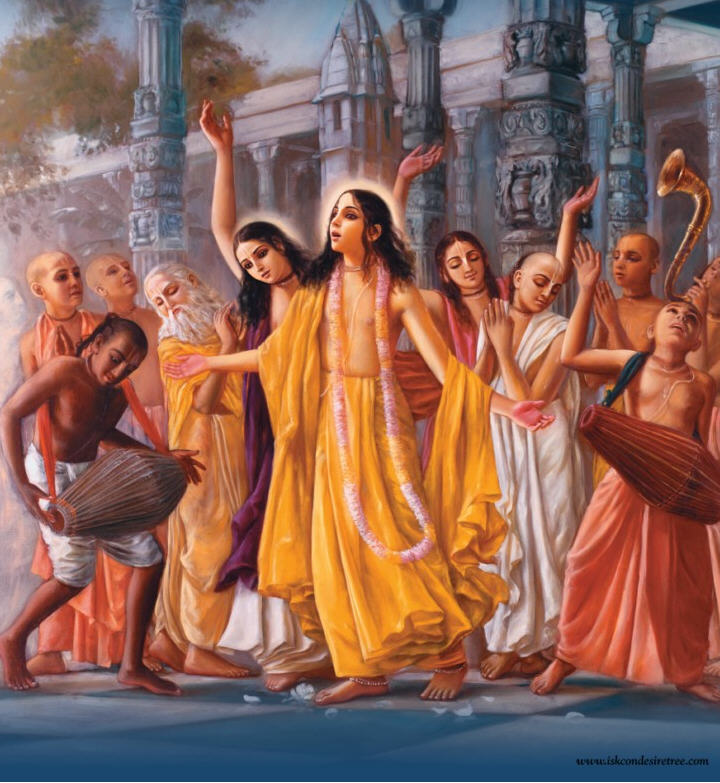
   All the Vaishnavas felt great enthusiasm when they heard that Mahaprabhu had begun His sankirtan movement. Every night, these kirtans took place in the house of Shrivasa Pandit, and on certain occasions, in the house of Chandrashekhara Acharya. Nityananda, Gadadhara, Advaita, Shrivasa, Vidyanidhi, Murari, Hiranya, Hari Das, Ganga Das, Vanamali, Vijaya, Nandana, Jagadananda, Buddhimanta Khan, Narayan. These were some of the personalities who stayed with the Lord as He danced. Other than such intimate associates, no one was allowed entrance into the sankirtan.
   (Chaitanya Bhagavat 2.8.110-113, 117) 
Jagadananda Pandit

Every night, these kirtans took place in the house of Shrivasa Pandit, and on certain occasions, in the house of Chandrashekhara Acharya. Nityananda, Gadadhara, Advaita, Shrivasa, Vidyanidhi, Murari, Hiranya, Hari Das, Ganga Das, Vanamali, Vijaya, Nandana, Jagadananda, Buddhimanta Khan, Narayan. These were some of the personalities who stayed with the Lord as He danced. Other than such intimate associates, no one was allowed entrance into the sankirtan. (Chaitanya Bhagavat 2.8.110-113, 117) (In the image: Sankirtana in the house of Shrivas Thakur).

 
   Thus from Vrindavan Das’s account, we know that Jagadananda Pandit is an eternal associate of the Lord and participated with Him in His Navadwip sankirtan pastimes. From this we can surmise that he was born somewhere in Bengal.
 
Jagadananda Accompanies the Lord to Puri
 
   According to the Chaitanya Bhagavat, Jagadananda Pandit was in the group of Devotees who accompanied Mahaprabhu from Shantipur to Puri after He took sannyas, the others being Nityananda Prabhu, Gadadhara Pandit, Mukunda Datta, Govinda and Brahmananda. The Chaitanya Charitamrita version has the Lord being accompanied by Nityananda, Jagadananda, Damodar and Mukunda.
On their way to Puri, as they travelled through Atisara, Chatrabhog, Northern Orissa, Suvarnarekha, Jaleshvara, Remuna, Yajpur, Vaitarani, Katak (Cuttack), Sakshigopala, Bhuvaneshvara, Kamalapura, Atharanala, etc., Mahaprabhu gave his companions many lessons in how to depend on the Lord and other matters. In one place named Gangaghata, just across the frontier into Orissa, Mahaprabhu himself told His companions to wait in a Temple while He went to the village to beg. He came back with rice and vegetables in His cloth which He gave to Jagadananda to cook. When He had finished preparing the meal, Mahaprabhu and His other companions ate His cooking with great relish.
 
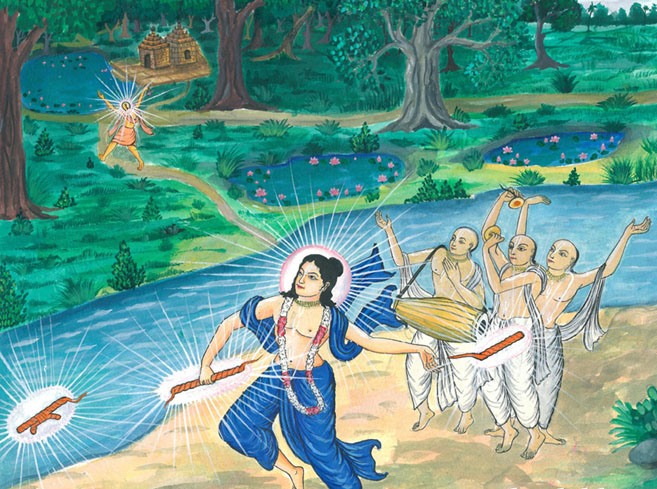
   According to the Chaitanya Bhagavat, Mahaprabhu gave His danda (staff) to Jagadananda to carry as they walked. One day, Jagadananda gave the danda to Nityananda Prabhu to hold as he went to collect foodstuffs. Nityananda Prabhu is non-different from Balaram and he took this opportunity to break Mahaprabhu’s staff into three pieces, so teaching his followers to take the tridanda, a staff of three branches. According to the Chaitanya Bhagavat, Jagadananda took the broken staff to Mahaprabhu, and He became extremely unhappy to have lost His only possession. Mahaprabhu then told His companions that He wished to travel alone, giving them the choice of whether He would walk in front or behind them. The Devotees answered that they would walk behind Him, not in front. 
 
Jagadananda Pandit

According to the Chaitanya Bhagavat, Mahaprabhu gave His danda (staff) to Jagadananda to carry as they walked. One day, Jagadananda gave the danda to Nityananda Prabhu to hold as he went to collect foodstuffs. Nityananda Prabhu is non-different from Balaram and he took this opportunity to break Mahaprabhu’s staff into three pieces, so teaching his followers to take the tridanda, a staff of three branches. (In the image: Lord Nityananda is braking Lord Chaitanya's eka danda).

   Leaving Nityananda Svarupa in one place, Jagadananda went to look for food. Jagadananda carried the Lord’s danda, and he left it with Nityananda when he went. He said, "Take care of the Lord’s danda. I will be right back after begging foodstuffs."
(Chaitanya Bhagavat 3.2.202-4)
 
   While walking in front of the other Devotees, from Atharanala Mahaprabhu saw a vision of Krishna playing His flute on the pinnacle of the Jagannath Puri Temple. He ran toward the Temple and entered to behold the form of Jagannath, whereupon He fell into a swoon. Sarvabhauma Bhattacharya noticed Him and took Him to his own house where he saw to His care. Nityananda, Jagadananda, Mukunda and Damodar arrived at the Jagannath Temple not long afterwards. There they heard that the Lord was at Sarvabhauma’s residence and they immediately went there. This was Jagadananda’s first meeting with Sarvabhauma Bhattacharya.
 
A Permanent Associate of the Lord at Puri
 
   The first time that Mahaprabhu wished to go to Vrindavan, He came to Gauda-mandala from Puri. He stayed in Vidyanagara for five days; from there He went on to Kuliya, and then through Maldah district to the village of Ramakeli where He met with Rupa and Sanatan. Jagadananda was amongst the associates of Mahaprabhu present on that occasion along with Nityananda, Hari Das, Shrivasa, Gadadhara, Mukunda, Murari and Vakreshvara.
   (Chaitanya Charitamrita 2.1.219)
 
   Jagadananda Pandit was a permanent associate of the Lord at Puri: Gadadhara Pandit, Vakreshvara, Damodar, Shankara, Hari Das, Jagadananda, Bhavananda, Govinda, Kashishvara, Paramananda Puri and Svarupa Damodar, all came and made their residence in Puri. They, along with Ramananda Raya and other long-time residents of Shri Kshetra, were Mahaprabhu’s permanent companions.
   (Chaitanya Charitamrita 2.1.252-4)
 
   Jagadananda Pandit’s mood was primarily that of madhura-rasa, which was very pleasing to Mahaprabhu and won His heart. In the Chaitanya Charitamrita, this is described as follows:
 
   Paramananda Puri had parental affection for Mahaprabhu; Ramananda Raya had love for Him in pure friendship; Govinda Das’s love for Him was as a servant. Gadadhara, Jagadananda and Svarupa Damodar worshiped in the ecstasy of the chief rasa. Mahaprabhu's heart was won by these four different loving attitudes.
   (Chaitanya Charitamrita 2.2.78) 
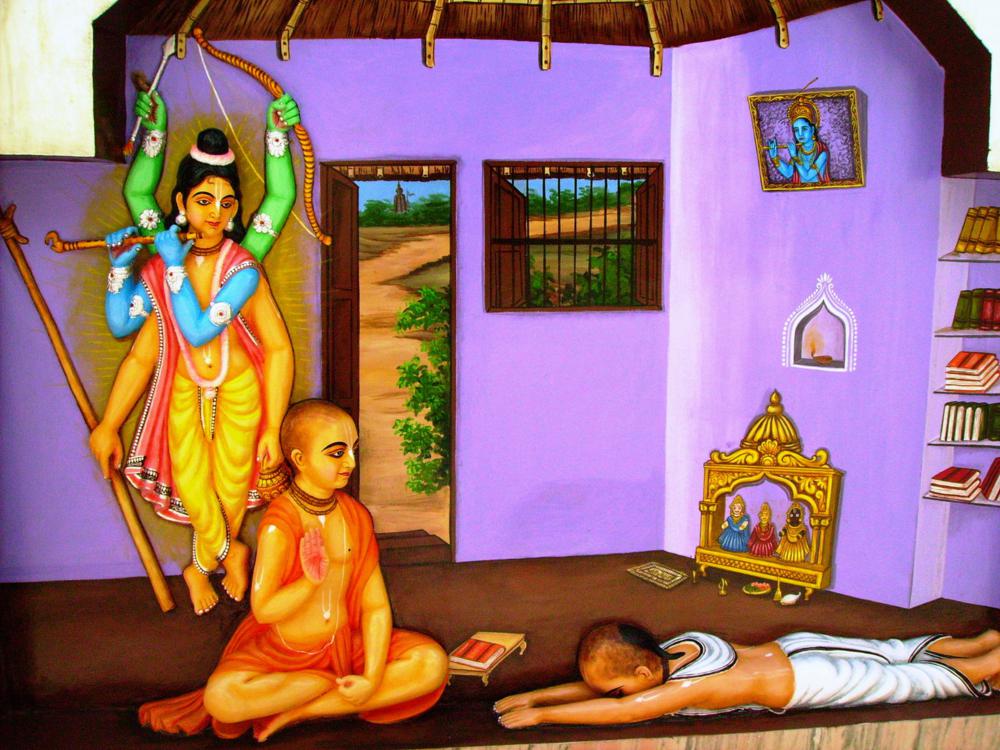
Jagadananda Pandit

By Mahaprabhu’s mercy, Saravabhauma Bhattacharya gave up his predilection for the impersonal philosophy of Mayavada and took up the path of devotion. He then had a vision of Mahaprabhu in a six-armed form which inspired him to compose a Sanskrit hymn to the Lord in a hundred verses. (In the image: Lord Chaitayna showing to Sarvabhauma His six armed Form).

 
   By Mahaprabhu’s mercy, Saravabhauma Bhattacharya gave up his predilection for the impersonal philosophy of Mayavada and took up the path of devotion. He then had a vision of Mahaprabhu in a six-armed form which inspired him to compose a Sanskrit hymn to the Lord in a hundred verses. He wrote the first two verses glorifying Mahaprabhu on a palm leaf and gave it to Jagadananda to bring to the Lord. Mukunda Datta was there when Jagadananda came from Sarvabhauma’s house, carrying Jagannath Prasad and the palm leaf. He took the precaution of copying the two verses down on the wall in front of the Lord’s residence before Jagadananda carried it in to show Him. As soon as Mahaprabhu saw the verses, which glorified Him as an incarnation of the Supreme Lord, he tore up the palm leaf. Because Mukunda had preserved the verses on the wall, however, the Devotees were able to obtain great joy from reading them. The verses are as follows:
 
vairagya-vidya-nija-bhakti-yoga-
shikshartham ekah purushah puranah
shri-krishna-caitanya-sharira-dhari
kripambudhir yas tam aham prapadye
 
kalan nashtam bhakti-yogam nijam yah
pradushkartum krishna-caitanya-nama
avirbhutas tasya padaravinde
gadham gadham liyate citta-bhringah
 
   Let me take shelter of the Supreme Personality of Godhead, the ocean of transcendental mercy, Shri Krishna, who has descended in the form of Lord Chaitanya Mahaprabhu to teach us detachment, real knowledge and His own devotional service.
 
   The Supreme Personality of Godhead, who has taken the name of Shri Krishna Chaitanya, has appeared to reveal the ancient system of devotional service to Himself which had almost been lost due to the influence of time. I pray that the honey bee of my mind will drink deeply of the honey of His lotus feet.
   (Chaitanya Charitamrita 2.6.253-4; Chaitanya-candrodaya-nataka 6.74)
 
   Mahaprabhu took sannyas during the fortnight of the waxing moon of the month of Magh (January-February). He arrived in Nilachala in the month of Phalguna (February-March). In the month of Chaitra (March-April), he converted Sarvabhauma Bhattacharya to Vaishnavism. In the month of Vaishakh (April-May), He left for His pilgrimage to the south of India. When Mahaprabhu said that He wanted to go on this pilgrimage alone, Nityananda Prabhu told Him that He should not travel by Himself and suggested that he would accompany Him. At this time, Mahaprabhu showed His great affection for His companions (Nityananda Prabhu, Damodar Brahmachari, Jagadananda Pandit, etc.) by remonstrating with them and refusing their company on this pilgrimage. Of Jagadananda, he said:
 
   "Jagadananda wants me to enjoy sense gratification. I try to do whatever he tells Me because I am afraid of him. Whenever I act contrary to his wishes, he gets angry and stops talking to Me for three days at a time."
   (Chaitanya Charitamrita 2.7.21-2)
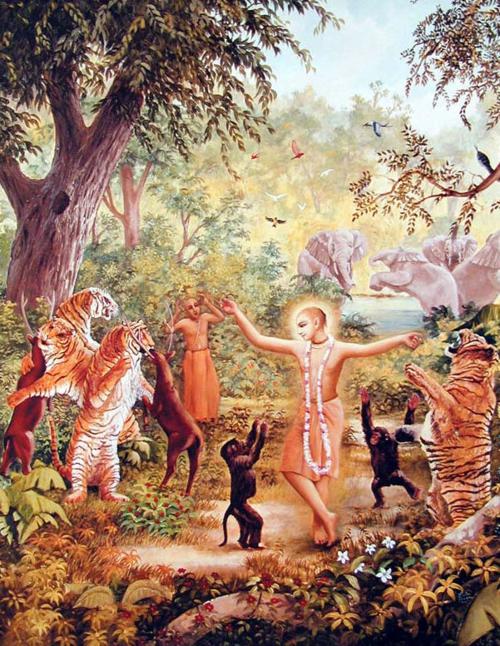
 
Jagadananda Pandit

The Lord vowed that the next time He would travel to Vrindavan alone. When He did go again, He took the path through the Jharikhanda jungles, accompanied only by a servant named Balabhadra Bhattacharya. (In the image: while traveling through the Jarikanda forest Lord made animals to chant the Holy Names and dance).

   While Mahaprabhu was travelling in the South, the Devotees waited for Him in great distress caused by His absence. The deeper one’s love, the more one feels the pain of separation. The sign of real love is in the intensity of the joy one feels at being united with someone from whom one has been separated. After travelling for several months, the lord arrived in Alalanath, near Puri, and sent His servant Krishna Das to tell Nityananda and the other Devotees that He had returned. The enthusiasm that they all felt for seeing Him again knew no bounds and they all rushed to Alalanath. Krishnadas Kaviraj Goswami describes their reaction to the news of His arrival in his Chaitanya Charitamrita as follows:
 
   "As soon as Nityananda heard of Mahaprabhu’s arrival, he immediately got up to go to see Him. Indeed, his love for the Lord made him very impatient. Jagadananda, Damodar Pandit and Mukunda, danced as they went to greet the Lord, their bodies unable to hold back their ecstasy."
   (Chaitanya Charitamrita 2.9.339-40)
 
   Nityananda Prabhu, Jagadananda and the others advised Mahaprabhu to send Krishna Das to Gauda to tell Sachi that the Lord had returned from His pilgrimage to South India. Mahaprabhu approved of the idea out of a desire to give pleasure to His Devotees. Gradually, in the company of Jagadananda, Mahaprabhu met with all the Devotees who had come to live in Puri, including Svarupa Damodar, Raya Ramananda, Hari Das Thakur, etc. One of Jagadananda’s most enjoyable services to the Lord and His Devotees was to satisfy them with the foodstuffs that He had Himself cooked. 
 
   The Bengal Devotees came annually during the Chaturmasya period to be with the Lord in Nilachala. They did this three years in a row before Mahaprabhu announced His determination to go to Vrindavan. On this occasion, Jagadananda was amongst His companions when He travelled through Orissa and Gauda. They went to Panihati, Kumarahatta, Kuliya village, Ramakeli, etc., before finally turning back from the village of Kanair Natshala to return to Puri, abandoning the pilgrimage to Vrindavan because of the large crowd of companions which had gathered around Him. The Lord vowed that the next time He would travel to Vrindavan alone. When He did go again, He took the path through the Jharikhanda jungles, accompanied only by a servant named Balabhadra Bhattacharya. When He returned by the same path, He was once again reunited with His loving Devotees including Jagadananda, who had once again been suffering greatly in His absence. This reunion was so joyful that it is beyond description.
 
Sanatan Comes to Puri
 
   Once Sanatan Goswami took the Jhariikhanda route to Nilachala from Vraja. On the way, he developed blistering sores all over his body due to drinking bad water and fasting. Sanatan became extremely troubled by the disease because his physical impurity would make him an obstacle to the servants of Jagannath. In view of this potential offense, he decided that he would throw himself under the wheels of Jagannath’s chariot during the Rathayatra festival. Mahaprabhu, the indweller of all beings, knew that he had made this decision and said to him, "You cannot attain Krishna through suicide. You can only attain Him through bhajana. You have no right to destroy the body which has been given to you so that you can render service." 
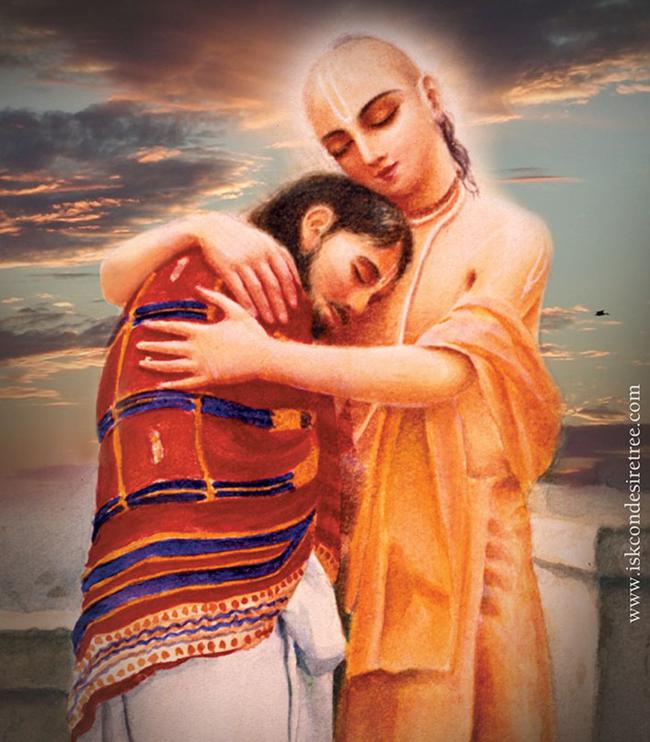
 
Jagadananda Pandit

"You cannot attain Krishna through suicide. You can only attain Him through bhajana. You have no right to destroy the body which has been given to you so that you can render service." (In the image: Lord Chaitanya embraced Sanatana Goswami).

   These instructions had an effect on Sanatan and he changed his mind. The Lord Himself does not concern Himself with the purity or impurity of a Devotee’s external body; He is attracted by the inner purity of His desire for service. Therefore Mahaprabhu did not hesitate to embrace Sanatan, again and again. When He did so, the pus leaking from Sanatan’s sores touched the Lord’s body which embarrassed and shamed him. Sanatan turned to Jagadananda Pandit for advice and Jagadananda told him that he should leave for Vrindavan immediately after the Rathayatra. Sanatan thought that this was the best solution and went to Mahaprabhu to ask Him permission to depart. When Mahaprabhu heard this, He became angry and chastised Jagadananda, saying:
 
   "Jagadananda is just a newcomer, a boy. Yet, he has become so proud that he thinks that he can give even you advice. You are his guru in every respect, both in material and spiritual terms. Yet he gives you advice? Doesn’t he know his own worth? You are My teacher; you are an authority. And yet, like an impudent child, he is giving instruction to even someone as qualified as you." (Chaitanya Charitamrita 3.4.158-60)
 
   The Devotee and the Lord occasionally chastise their intimates. If the Devotee is chastised by the Lord, he should consider it a great good fortune. Sanatan reacted to Mahaprabhu’s criticism of Jagadananda as a sign of His great fortune and his own misfortune.
 
   You accept Jagadananda into Your inner circle, while You venerate me. It is as though You were giving him ambrosia to drink and me the bitter juice of neem and tobacco leaves.
   (Chaitanya Charitamrita 3.4.163)
 
   Even though Mahaprabhu had long been won over by Jagadananda’s devotion to Him, He made a point of teaching all of His followers Vaishnava etiquette and the importance of offering the proper respect to senior Vaishnavas such as Sanatan Goswami Prabhu through Him. He said to him:
 
   "Jagadananda is not more dear to Me than you, but I cannot tolerate transgressions of etiquette."
   (Chaitanya Charitamrita 3.4.166)
 
   When Mahaprabhu was telling Vallabha Bhatta about the greatness of Devotees, He said that through the association of preachers of the Holy Name like Jagadananda Pandit, one could attain devotion to Krishna.
 
   Acharyaratna, Acharyanidhi, Gadadhara Pandit, Jagadananda, Damodar, Shankara, Vakreshvara, Kashishvara, Mukunda, Vasudeva, Murari and so many other great Devotees have appeared in Gaudadesha. They have preached the glories of the Holy Name throughout the world. It is through their association that I have a little devotion to Krishna.
   (Chaitanya Charitamrita 3.7.48-50)
 
Jagadananda as Satyabhama
 
 
Jagadananda Pandit

Jagadananda Pandit had a deep and pure love for the Lord, like that of Satyabhama for Krishna. He was moody, being possessed of the vamya nature. He would repeatedly provoke loving arguments with the Lord and there always seemed to be some misunderstanding between them. (Chaitanya Charitamrita 3.7.142-3) (In the image: Lord Shri Krishna with His 3rd wife Satyabhama).

 Jagadananda is the incarnation of Satyabhama, thus because of his refractory nature, he and Mahaprabhu would often quarrel.
 
   Jagadananda Pandit had a deep and pure love for the Lord, like that of Satyabhama for Krishna. He was moody, being possessed of the vamya nature. He would repeatedly provoke loving arguments with the Lord and there always seemed to be some misunderstanding between them.
   (Chaitanya Charitamrita 3.7.142-3)
 
   In the Chaitanya Charitamrita, at the beginning of the eighth chapter of the Antya-lila, Krishnadas Kaviraj Goswami contrasts the sincere loving attitude of Jagadananda Pandit with the hypocrisy of Ramachandra Puri. Even though Ramachandra Puri was officially a disciple of Madhavendra Puri, he had no proclivity for service. Because of his lack of sincerity and his false piety, he was ultimately deprived of his guru’s mercy.
 
   Jagadananda was present at Hari Das Thakur’s funeral celebration, serving Prasad to the senior associates of the Lord. By his behavior, he showed that giving Prasad to the Devotees was an important element of devotional service. 
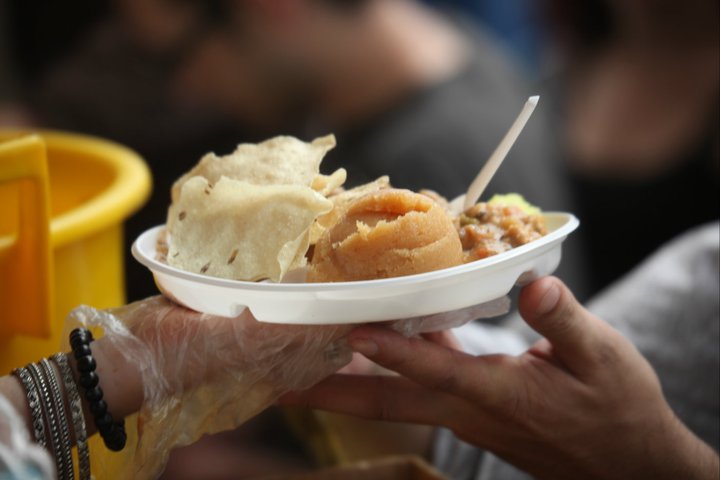
Jagadananda Pandit

Jagadananda was present at Hari Das Thakur’s funeral celebration, serving Prasad to the senior associates of the Lord. By his behavior, he showed that giving Prasad to the Devotees was an important element of devotional service. (In the image: Prasadam distribution, Woodstock).

 
   During the Chaturmasya all the Devotees would come to meet the Lord in Nilachala and would return at the end of the four month period. In the same year that Mahaprabhu told Nityananda not to come to Puri, He also sent Jagadananda to Navadwip with a message for His mother. Jagadananda recounted that which Mahaprabhu had told him about the exact times when Sachi Mata thought that she had dreamt or hallucinated His coming and eating her food offerings. When she heard this from Jagadananda, she believed that these secret visits were not hallucinations, but had in fact been real–He really had come. When the other Devotees met Mahaprabhu’s intimate associate, Jagadananda, they all were submerged in an ocean of happiness.
 
   Jagadananda then went to Shivananda Sena’s house where he collected a fragrant sandalwood oil for rubbing on Mahaprabhu’s head. He filled an earthen jug with the oil and brought it back with him to Puri where he gave it to Govinda, the Lord’s servant. Govinda then told Mahaprabhu, "Jagadananda Pandit has brought aromatic sandalwood oil back from Gaudadesha with him. If you rub it on Your head, it will relieve the symptoms of disturbed bile and wind." In order to set a proper example, Mahaprabhu answered, "Sannyasis are forbidden the use of body oils. It is even more reprehensible to use aromatic oils. Since he has gone to the trouble of bringing the oil all the way here, you can give it to the Jagannath temple. They can use the oil to light lamps for the Deity. That will make all his troubles worthwhile."
 
   Govinda told Jagadananda of Mahaprabhu’s decision. Jagadananda began to sulk and stopped talking. After ten days, Govinda again told Mahaprabhu that Jagadananda still wished him to use the oil. Mahaprabhu became angry and in order to teach the world, said:
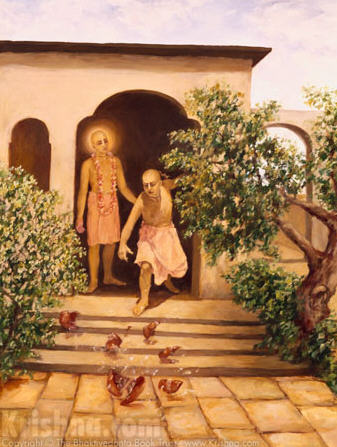
 
Jagadananda Pandit

"Why don’t we hire a masseur to give me massage. Are these the pleasures for which I have taken the renounced order? You will all be very amused at seeing my downfall. As I walk along the road, people will get a whiff of my perfumes and say, there goes a womanizing monk." (Chaitanya Charitamrita 3.12.112-4) (In the image: Jagadananda broke the pot with oil).

   "Why don’t we hire a masseur to give me massage. Are these the pleasures for which I have taken the renounced order? You will all be very amused at seeing my downfall. As I walk along the road, people will get a whiff of my perfumes and say, there goes a womanizing monk."
   (Chaitanya Charitamrita 3.12.112-4)
 
   Govinda was speechless at Mahaprabhu’s tirade. The next morning, Jagadananda Pandit came to Mahaprabhu who again said to him, "A sannyasi shouldn’t use fragrant oils. The best thing to do is to offer it to Jagannath for His service." Jagadananda became angry and proudly said, "Who told You I brought this oil all the way from Gauda? It’s a lie." He then threw down the earthen jug in the courtyard and broke it. Then he went to his own room, locked the door and lay down.
 
   After he had fasted for three days, Mahaprabhu finally went Himself to assuage him, knocking on his door and saying gently, "Jagadananda! Open the door. I am going now to bathe and then to the Temple for darshan of Jagannath. When I come back I will take whatever food you have prepared for Me. So start cooking." Out of his love for the Lord, Jagadananda immediately got up, bathed and started preparing the Lord’s lunch. After performing His noonday rituals, the Lord returned, let Jagadananda wash His feet and then sat down to eat. Jagadananda set a banana leaf before Him and then covered it with fine rice soaked in clarified butter, numerous vegetable preparations and then cakes and sweet rice. Mahaprabhu told Jagadananda to set another banana leaf and fill it with food as he had done so that he could eat beside Him. He lifted His hands in the air and refused to eat a bite until Jagadananda sat down and ate with Him. Finally, Jagadananda’s pride melted and he agreed to take the Lord’s Prasad once he had finished. As he ate, Mahaprabhu repeatedly praised the food that Jagadananda had cooked in his loving anger.
 
   "This is the kind of nectar that you offer to Krishna. Who can estimate the extent of your good fortune?"
   (Chaitanya Charitamrita 3.12.133)
 
   Jagadananda kept serving more and more vegetables to the Lord, who out of fear refused nothing, eating everything that he was given. He was afraid that if He refused even a single preparation Jagadananda would again start fasting, so on that day, He ate ten times as much as He did normally. After the meal, Jagadananda gave Him some aromatic spices, sandalwood and a garland. Mahaprabhu then insisted that he sit down and take his meal in front of Him. Jagadananda pleaded with Mahaprabhu to go and rest, as he was well aware of the demands of etiquette. Ramai and Raghunath Bhatta had also helped with the cooking, so he wanted them to eat also before sitting down himself, but he assured the Lord that he would. Mahaprabhu was still not convinced and so he told Govinda to remain there and report to Him whether or not Jagadananda had eaten. But Jagadananda immediately told Govinda to go and massage the Lord’s feet. After he had given Ramai, Nandai, Govinda and Raghunath Bhatta to eat, Jagadananda took the remnants of Mahaprabhu’s plate. When Mahaprabhu heard that Jagadananda had finally eaten, He was able to rest peacefully.
 
   Jagadananda’s love for the Lord was just like the descriptions of Satyabhama’s love for Krishna in the Bhagavat. Who can describe the extent of Jagadananda’s good fortune? His love is the standard by which that of others is to be compared. Anyone who hears about the loving exchanges (prema-vivarta) between Jagadananda Pandit and Shri Chaitanya Mahaprabhu will know the characteristics of prema and will attain the wealth of pure love.
   (Chaitanya Charitamrita 3.12.152-4)
 
   Shrila Bhaktisiddhanta Saraswati Goswami Thakur writes that the words prema-vivarta in this verse can mean both the kind of confused transformations of love that Jagadananda underwent with the Lord, or the book of that name which he wrote.
 
   The Lord Sleeps on Plantain Bark
 
   Due to His intense feelings of separation from Krishna, Mahaprabhu started to increase His vows of renunciation. He decided to sleep on a bed of dried plantain bark, which caused Him pain by rubbing against His bones. The Devotees were greatly distressed to see the Lord’s suffering. Jagadananda decided to take steps to alleviate the Lord’s pain by getting some cloth and dying it saffron, and then filling it with cotton from the silk cotton tree. In this way he made both a mattress and a pillow for the Lord’s comfort. Jagadananda then asked Govinda Das to give the mattress and pillow to the Lord and Svarupa Damodar to convince Him to use them. When it was time for the Lord to go to bed, He saw the cotton pillow and became angry. However, when He heard that Jagadananda Pandit had givrsquo;s house, carrying Jagannath Prasad and the palm leaf. He took the precaution of copying the two verses down on the wall in front of the nbsp; Lord en it, He hesitated. So He made a pretense of anger, "A mattress and pillow? Why don’t you just go and get Me a bed? A sannyasi is nbsp;su/divpp osed to sleep on the ground. Jagadananda wants Me to become a sense enjoyer. This is shameful." Jagadananda was saddened when he heard from Svarupa Damodar that Mahaprabhu had refused the bedding. However, Svarupa Damodar cleverly made some bedding out of dried banana leaves which the Lord accepted. This satisfied all the Devotees with the exception of Jagadananda.
 
   Though he said nothing about it, Jagadananda was angry and asked Mahaprabhu for permission to go to Vrindavan. The Lord was able to understand the real reason for his dissatisfaction and said to him in a consoling voice, "You are angry and blame Me for it. And so you want to go to Mathura and become a beggar?" The petulant Jagadananda hid his true feelings and simply said, "I have wanted to go to Vrindavan for a long time. Previously You wouldn’t give me permission, so I could not go."
 
   Mahaprabhu out of His affection for Jagadananda would not give him permission even though he asked Him repeatedly. Finally, Jagadananda asked Svarupa Damodar to intercede on his behalf and get the Lord’s permission to go. Svarupa Damodar went to Mahaprabhu and said, "Jagadananda’s desire to see Vrindavan is very strong. I think it would be a good idea if Tou send him to Vrindavan just as You previously sent him to Navadwip with a message for Sachi Mata." Thus, Mahaprabhu finally allowed Himself to be persuaded and accorded permission to Jagadananda to go to Vraja. Out of His affection for him, however, He gave him elaborate instructions for his voyage. "The road up to Varanasi is free from any problems. After Varanasi, however, the road is full of robbers, so be careful. You should take some soldiers with you for your protection. If the highwaymen see a single Bengali on the road, they will be sure to attack and loot him. When you get to Mathura, first go and see Sanatan. Offer your respects to the Caube Brahmins of Mathura, but don’t associate with them. You will not be able to understand their behavior, so respect them at a distance. Do the Vraja-parikrama with Sanatan, do not leave his side for even a moment. Don’t climb Govardhana to see Gopal. Don’t stay in Vraja for a long time. Hurry back."
 
   Come back quickly! Do not stay there for a long time. Don’t climb Govardhana to take darshan of Gopal."
   (Chaitanya Charitamrita 3.13.39)
 
Jagadananda Chastises Sanatan
 
   Jagadananda paid his obeisance to the Lord and left on foot for Varanasi where he met with Tapana Mishra and Chandrashekhara. From there he went on to Mathura where he met Sanatan Goswami. Sanatan took him around the twelve forests of Vraja and then they stayed together for some time in Gokula Mahavana. Sanatan Goswami used to live on madhukari, begging for pieces of bread from the local people, but since Jagadananda was not habituated to a wheat-based diet, he went to a local Temple and cooked rice. One day, Jagadananda invited Sanatan Goswami to eat. A certain sannyasi named Mukunda Saraswati had given a saffron cloth to Sanatan which he would wear wrapped around his head. When Jagadananda saw this, he thought that the cloth must have been given to Sanatan by the Lord and was overwhelmed with love. When he learned, however, that the cloth had been given by someone else, he became so angry that he was ready to hit Sanatan with the rice pot. He criticized Sanatan:
 
   "You are Mahaprabhu’s most important associate. No one is dearer to Him than you. How could anyone tolerate you wearing another sannyasi’s cloth around your head?" Sanatan answered, "Well said! It is clear, Pandit Mahashaya, that you are unequalled in your love for the Lord. Only from you could I have learned this lesson, for you alone have such solid faith in the Lord. My purpose in binding the cloth around my head has been realized, for as soon as you saw it, I was able to witness the manifestations of your love for the Lord. A Vaishnava should not wear a saffron-colored cloth. I will give it to someone else, for I have no further need for it."
   (Chaitanya Charitamrita 3.13.56-61)
 
   Jagadananda offered the food he had cooked to Mahaprabhu and then took Prasad with Sanatan. After staying with him for two months, he started to feel his absence from Mahaprabhu too intensely and asked Sanatan for permission to return to Puri. Sanatan bid him goodbye, giving him sand from the place where Krishna held the rasa dance, a stone from Govardhana, a garland of gunja berries and some dried ripe pilu fruits for Mahaprabhu. Jagadananda was delighted to return to Puri and see Mahaprabhu and the other Devotees again. Mahaprabhu embraced him tightly and was extremely pleased with the gifts sent by Sanatan. Most of the Devotees did not know how to eat pilu fruits, but because they were from Vrindavan, they enjoyed them anyway.
 
Advaita’s Message
 
   Because of His love for His mother, Mahaprabhu would send Jagadananda every year to Navadwip with a prasadi cloth for her. Jagadananda would come and talk to her about Mahaprabhu and thus somewhat alleviate her suffering in separation from her son. The last time that he went, he went to Advaita Acharya's house to ask permission to return to Puri. On that occasion, Advaita gave a cryptic message to Jagadananda to deliver to Mahaprabhu. The riddle went as follows:
 
   Tell the Lord that I pay Him a million obeisances and that I humbly submit to Him the following: Tell the Madman that everyone has gone mad. Tell the Madman that they are no longer selling rice in the market. Tell the Madman that the crazies are no longer good for anything. Tell the Madman that this is what the madman said.
   (Chaitanya Charitamrita 3.19.19-21)
 
   Bhaktivinoda Thakur explains this riddle in this way: "Tell Mahaprabhu that everyone has become intoxicated with love for Krishna and so in the marketplace of love, no one is buying the rice of Krishna prema any longer. Tell Mahaprabhu that the saintly madmen (aul) are so intoxicated with love that they are no longer involved in their material duties. Tell Mahaprabhu that Advaita said this in a state of complete intoxication of prema. In short, the message was that the purpose for which Mahaprabhu had been called to earth by Advaita had been completed. Now the Lord may do as He wills."
 
   The date and place of Jagadananda Pandit’s departure from this world are unknown.
 
   [Excerpted from “Shri Chaitanya: His Life & Associates” by Shrila Bhakti Ballabh Tirtha Maharaj] 
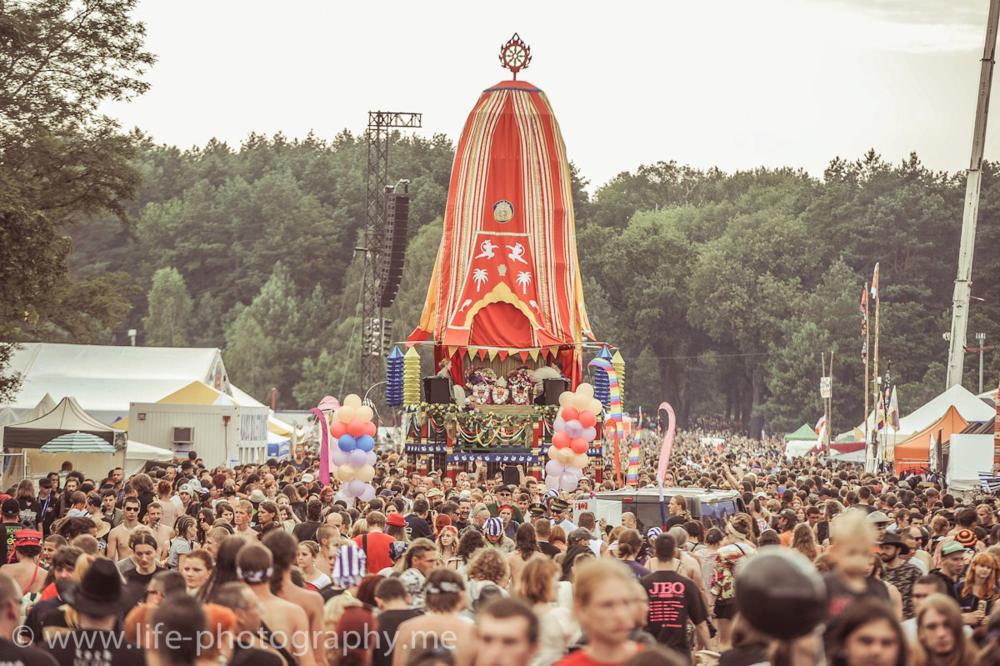
Jagadananda Pandit

Tell the Lord that I pay Him a million obeisances and that I humbly submit to Him the following: Tell the Madman that everyone has gone mad. Tell the Madman that they are no longer selling rice in the market. Tell the Madman that the crazies are no longer good for anything. Tell the Madman that this is what the madman said. (Chaitanya Charitamrita 3.19.19-21) (In the image: Ratha Yatra, Europe).
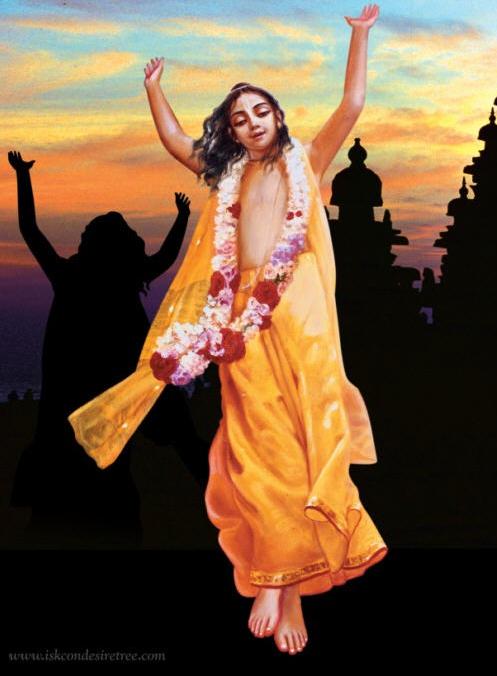
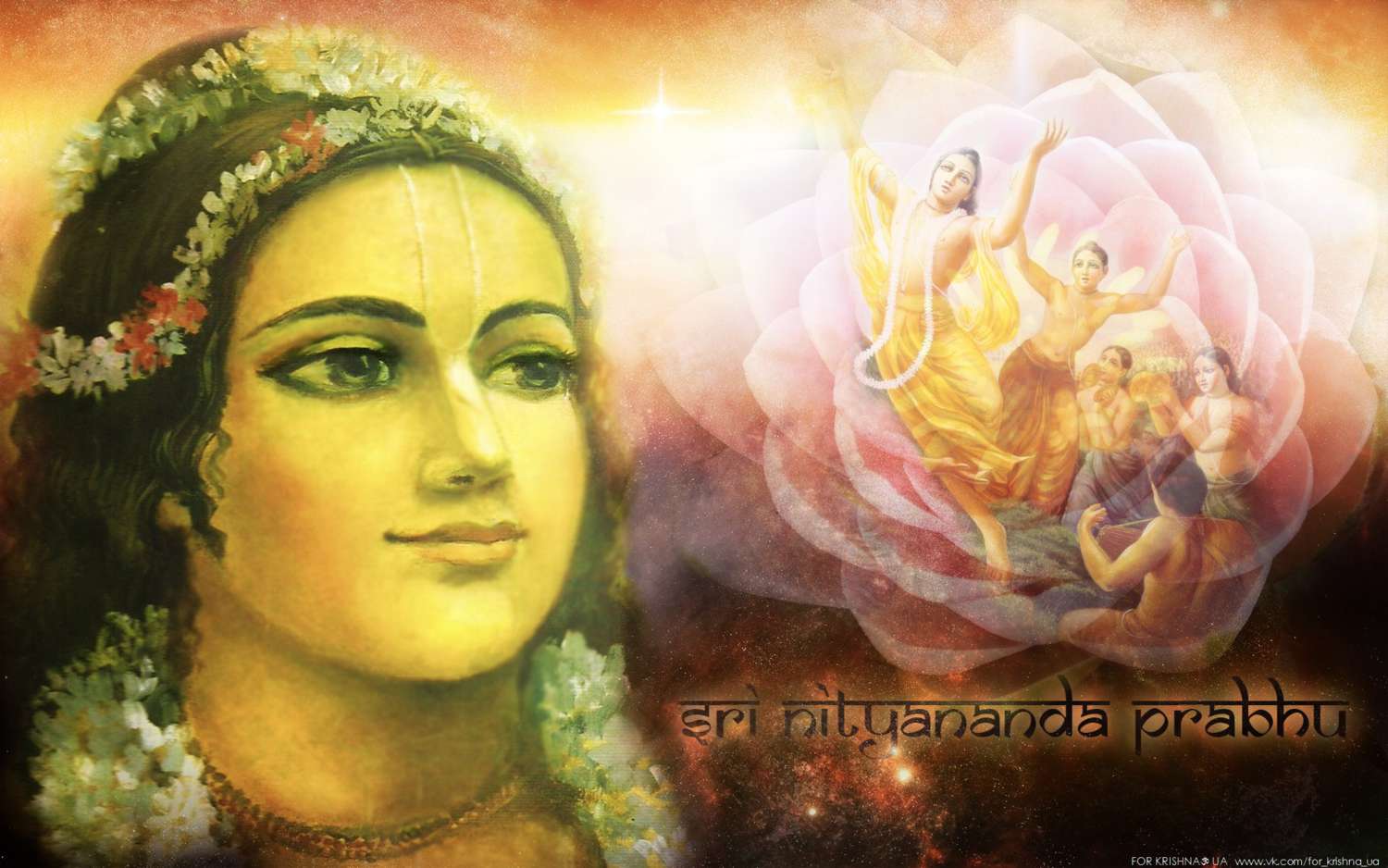
Ishan Thakur

Ishan Thakur

He tolerated all of little Nimai’s childhood pranks and answered His every whim. Nimai was unable to go without Ishan for even a moment. (In the image: Little Nimai and Sachi Mata).

   Ishan Thakur was Jagannath Mishra’s household servant. Only an eternal associate of the Supreme Lord could have the good fortune to render him personal service in his own home. The Lord accepts the service of his own confidential associates. When Mahaprabhu was born, Ishan had the chance to take the Lord on his lap and to hold Him affectionately. He tolerated all of little Nimai’s childhood pranks and answered His every whim. Nimai was unable to go without Ishan for even a moment. 
 
   Ishan Thakur is counted as one of Chaitanya Mahaprabhu’s branches:
 
   Shrinath Mishra, Subhananda, Shri Rama, Ishan, Shrinidhi, Shri Gopikanta, Bhagavan Mishra [were branches of Chaitanya’s tree].
   (Chaitanya Charitamrita 1.10.110)
 
   How can I understand the activities of Ishan Thakur, whom Nimai used to lovingly call “father”? The son of Sachi, Nimai Chand, was his very life and Nimai would not go anywhere without him. In his childhood, Nimai was very naughty and He would make all kinds of capricious demands that Ishan would do his best to fulfill. (Bhakti-ratnakara 12.95-7)
 
   Ishan Thakur also had the chance to serve Nityananda Prabhu, Shri Chaitanya Mahaprabhu’s other self. Before the two sat down to eat in Sachi’s house, Ishan Thakur would bring water to wash their feet. The Lord would plea with His mother to be able to invite Nitai and when she finally agreed would go Himself to invite him.
 
   Ishan gave water for Gaura and Nitai to wash their feet and then they sat down to eat.
   (Chaitanya Bhagavat 2.8.59) 
Ishan Thakur

The Lord too blesses His Devotees through His Devotee’s merciful attitude. The Lord’s mercy follows upon the mercy of the Devotee. (In the image: Bhakti Sangam Festival, Russia).

 
   As one of the Lord’s eternal associates, Ishan Thakur was fully aware of His divine nature. He knew that the worship of the Devotee is more important than even the worship of the Lord Himself. Thus he performed all kinds of service to Sachi Devi, who is none other than Yashoda Devi and was blessed by her affection. The Lord too blesses His Devotees through His Devotee’s merciful attitude. The Lord’s mercy follows upon the mercy of the Devotee. Ishan Thakur glories are described in the work known as the Vaishnava-vandana:
 
vandiba ishana-dasa kara-joria kari
shaci-thakurani yare sneha kaila vari
 
   I pay obeisances to Ishan Das with folded hands, for Sachi Thakurani was very affectionate towards him.
   (Bhakti-ratnakara 12.94)
 
   The Brahmin said, “Look, here comes Ishan. What can I say, no one really understands his great qualifications. He has the reputation of knowing all the truths about the Lord, and he served Sachi by doing whatever she needed having done. Because he rendered such service to the Lord’s mother, Ishan is uniquely fortunate in the fourteen worlds. Even though I saw with my own eyes how much affection she had for him, I am unable to find the words to describe it."
   (Bhakti-ratnakara 12.90-3)
 
   Ishan, most fortunate in the fourteen worlds, served the Lord’s mother constantly.
   (Chaitanya Bhagavat 2.8.74)
 
   When Mahaprabhu took sannyasa and left for Puri, Ishan was left with the responsibility of taking care of his mother Sachi and his wife Vishnupriya Devi and supervising their household. In his commentary to the Chaitanya Bhagavat (2.8.73), where it is said that Ishan Thakur did all the cleaning of the house, etc., Shrila Bhaktisiddhanta Saraswati Goswami Thakur writes: “Ishan was the servant in Mahaprabhu’s house. He gathered up the rice that had been thrown all over [by Nityananda] and made the house proper. There was no limit to Ishan’s good fortune. He was able to render service to the Lord’s mother throughout his entire life. Even after the Lord took sannyasa, he was engaged in the service of the Lord’s mother and His wife, showing the extent of the blessings he had received. He is therefore described as ‘most blessed’ or ‘the most fortunate amongst the blessed.’”
 
   Ishan Thakur lived a very long life. He was still living even after the disappearance of Vishnupriya Devi and all the other Devotees of Mahaprabhu in Navadwip. Thus when Shrinivas Acharya, Narottama Thakur and Ramachandra Kaviraj came to Navadwip on pilgrimage, only Ishan was able to show them where all the places of the Lord’s pastimes were. In the Bhakti-ratnakara, it is said that when Ishan showed these Devotees the holy places, they were already old and in a state of disrepair. This gives some idea of how old he must have been.
 
   Nearly everyone has disappeared from Navadwip. No one but the Lord’s servant Ishan remains here.
   (Bhakti-ratnakara 11.721)
 
Ishan Thakur

Shrinivas Acharya, Narottama Thakur and Ramachandra Kaviraj received Ishan Thakur’s blessings in Navadwip Dham and were embraced by him before leaving to visit Shrikhanda where they met with Raghunandan Thakur. When they arrived there, they received the news that Ishan had died. (In the image: Shrinivas Acharya, Narottam das Thakur, Ramachandra Kaviraj).

   Shrinivas Acharya, Narottama Thakur and Ramachandra Kaviraj received Ishan Thakur’s blessings in Navadwip Dham and were embraced by him before leaving to visit Shrikhanda where they met with Raghunandan Thakur. When they arrived there, they received the news that Ishan had died. 
 
   I heard from some people while on my way here that Ishan has disappeared.
   (Bhakti-ratnakara 13.21)
 
   After Mahaprabhu and Sachi Mata had disappeared, Vamshivadanananda Thakur served Vishnupriya Devi and Ishan Thakur.
 
   Other than this Ishan, there were several other associates of the Lord who had the same name. (1) Sanatan Goswami’s servant was named Ishan. (2) There was a Devotee in Vrindavan of that name. He is mentioned in the Bhakti-ratnakara as a member of the party of Devotees who accompanied Rupa Goswami to the house of Vitthaleshvara to have darshan of Govardhanadhari Gopal. He also is said to have blessed Shrinivas Acharya, Narottama Das Thakur and Shyamananda Prabhu when they started their voyage to Bengal with the Goswamis’ books. (3) In the Gaudiya Vaishnava Abhidhana, there is mention of a certain Ishan Acharya who is identified as Vraja’s Yauna Manjari. (4) The author of the Advaita-Prakasha was named Ishan Nagara.
 
[Excerpted from “Shri Chaitanya: His Life & Associates” by Shrila Bhakti Ballabh Tirtha Maharaj]

Gopinath Pattanayaka

Gopinath Pattanayaka

Gopinath Pattanayaka was Bhavananda Raya’s second son. According to the tenth chapter of the Adi-lila of Chaitanya Charitamrita, Mahaprabhu says that Bhavananda Raya was formerly the king Pandu and that his sons were the five Pandavas. All of these five sons were very dear to the Lord. (In the image: Five Pandavas and Draupadi).

   Gopinath Pattanayaka was Bhavananda Raya’s second son. According to the tenth chapter of the Adi-lila of Chaitanya Charitamrita, Mahaprabhu says that Bhavananda Raya was formerly the king Pandu and that his sons were the five Pandavas. All of these five sons were very dear to the Lord.
 
   Your sons, Ramananda Raya, Gopinath Pattanayaka, Kalanidhi, Sudhanidhi and Vaninatha Nayaka, are all objects of my affection. Ramananda and I are different in body only, in spirit we are one.
(Chaitanya Charitamrita 1.10.133-4)
 
   Brahmagiri or Alalanath is about 12 miles west of Jagannath Puri. Bentapura is a small village not far from there. Bhavananda Raya was a landowner living in this village. His descendants, who nowadays use the surname Chaudhuri-Pattanayaka continue to reside in this village.
 
Gopinath Falls in Arrears
 
   Gopinath Pattanayaka was King Prataparudra’s tahsildar in Malajathya Dandapata, which is now the district of Midnapur in West Bengal. The tahsildar’s duty is to collect taxes. On one occasion, there was a shortfall of 200,000 kahans of cowries. [FN: a kahan = 16 panas, 1 pana = 20 gandas, 1 ganda = 4 cowries.] In the Orissan language, the crown prince is known as Baria Jana. At that time, capital punishment was given by throwing the prisoner down from a scaffold to be impaled on swords. This system was known in Orissan as the canga. When Gopinath Pattanayaka could not come up with the tax moneys, King Prataparudra’s son, the Baria Jana, decided to punish him by having him thrown from the canga.
 
   When they saw Gopinath in this dangerous situation, some of Bhavananda Raya’s well-wishers came to Mahaprabhu to appeal to him to intervene. When Mahaprabhu asked what the reason for Gopinath’s punishment was, one of the supplicants answered, "Gopinath owes the government treasury 200,000 kahanas in back taxes and is unable to make a cash payment." He offered to pay back the money by selling some of his possessions and for that reason he brought a dozen fine horses to the palace. The King sent one of his princes who is an expert in evaluating horses, but he offered a price far below what the horses were actually worth. This prince had a physical quirk in that he repeatedly stretched his neck, looking upward and then from side to side. Gopinath was angry at the attempt to cheat him and so he responded by mocking the prince, saying, "My horses lift their necks, but at least they don’t keep looking up in the air! I don’t see how they can be worth so little." In other words, he suggested that his horses were more valuable than the prince himself.
 
   "The prince was insulted by this comment and decided to take revenge. He went to the King and got permission to put Gopinath on the canga in order to extract the money which he owed. He has now put him on the scaffold and is prepared to throw him down on the swords."
 
   Upon hearing this account, Shri Chaitanya Mahaprabhu took an attitude of impartiality and replied with affectionate anger, asking how the King could be at fault if Gopinath Pattanayaka did not pay his dues. How could the King be at fault for punishing someone who has committed an offense? What could he do about that?
 
The Lord Saves Gopinath
 
Gopinath Pattanayaka

Gopinath Pattanayaka was Ramananda Raya’s brother. By the Lord’s grace, he was delivered from a sentence of death given by the King. (Chaitanya Charitamrita 2.1.265) (In the image: Lord Shri Chaitanya embracing Ramananda Raya).

   However, subsequently, the news came that Bhavananda Raya and his entire family had been imprisoned and Svarupa Damodar Goswami and other close companions of the Lord appealed to Him to do something. Mahaprabhu, who as the Supreme Lord is capable of doing anything, or changing anything that has been done, or of remaining inactive if He so wishes, instructed everyone to take shelter of Jagannath Deva’s lotus feet and that He would take care of the problem.
 
   As the Supersoul within the heart, the Lord inspired Harichandana Patra, one of King Prataparudra’s ministers, to recount Gopinath’s entire story to the King, asking him to repeal the death sentence which had been condemned. The King was surprised that he had not been informed of events and immediately had the death sentence repealed and Gopinath was released.
 
   Gopinath Pattanayaka was Ramananda Raya’s brother. By the Lord’s grace, he was delivered from a sentence of death given by the King.
   (Chaitanya Charitamrita 2.1.265)
 
   Mahaprabhu inquired about how Vaninatha and the other members of Gopinath’s family reacted when they were imprisoned. The messenger replied,
 
   "Vaninatha was without fear; he was constantly chanting the maha-mantra-Hare Krishna, Hare Krishna, Krishna Krishna, Hare Hare. Hare Rama, Hare Rama, Rama Rama, Hare Hare. He counted each mantra on the fingers of his hands, and after he had finished chanting a thousand times, he would make a mark on his body." Mahaprabhu was pleased to hear that Vaninatha was acting in this way. Who can understand the mysterious workings of the Lord’s mercy? (Chaitanya Charitamrita 3.9.56-9)
 
   Mahaprabhu complained to the King’s priest, Kashi Mishra, however, that people were repeatedly coming to disturb Him, trying to get Him to intercede on behalf of Bhavananda Raya’s family which was misappropriating state funds. He told him that He was thinking of moving to Alalanath where He could get some peace. Kashi Mishra talked Him out of going, but told Maharaj Prataparudra of how the Lord had been affected by these events. As a result, in order to please the Lord, the King not only pardoned Gopinath Pattanayaka but he forgave him his debt and doubled his salary. Appreciative of the Lord’s mercy, Gopinath came and placed his head, which had been honored with a silken turban personally wrapped around his head by the King, at the Lord’s lotus feet and said:
 
   "The King has pardoned my tax arrears. He has reappointed me to my post and doubled my salary, while honoring me with this silken turban. All of this is due to your mercy. What a difference! One moment I am on the canga, preparing myself to die, the next I am being given honors like the silk turban. When on the canga, I began meditating on your lotus feet, and this is the result of that meditation. People are amazed at this turn of events and they sing the glories of your mercy. I know, however, my Lord, that these are not the principal results of meditating upon your lotus feet, but are simply a secondary effect. Material gains are only temporary. Your real mercy has been granted to Ramananda Raya and Vaninatha Raya, for you have granted them freedom from material sensual entanglements, a blessing that you have not given to me. I pray, O Lord, that you bestow your pure mercy upon me so that I may also become renounced. I no longer wish for material enjoyment."
(Chaitanya Charitamrita 3.9.133-9)
 
The Lord heard Gopinath’s heartfelt prayer and answered:
 
   "Whether you are involved in material activities or become completely renounced, you and your brothers are my eternal servants, birth after birth. But I ask you to obey one order of Mine. Do not spend money which belongs to the King. Pay the King his dues and then spend the balance for religious and fruitive activities. Don't spend a farthing for sinful activities, otherwise you will be the loser both in this life and the next."
(Chaitanya Charitamrita 3.9.141-4)
 
[Excerpted from “Shri Chaitanya: His Life & Associates” by Srila Bhakti Ballabh Tirtha Maharaj] 
Gopinath Pattanayaka

I pray, O Lord, that you bestow your pure mercy upon me so that I may also become renounced. I no longer wish for material enjoyment." (Chaitanya Charitamrita 3.9.133-9) (In the image: Shri Shri Gaura Nitay, ISKCON Vrindavan).