Author Archives: Sevak

Ranga Puri

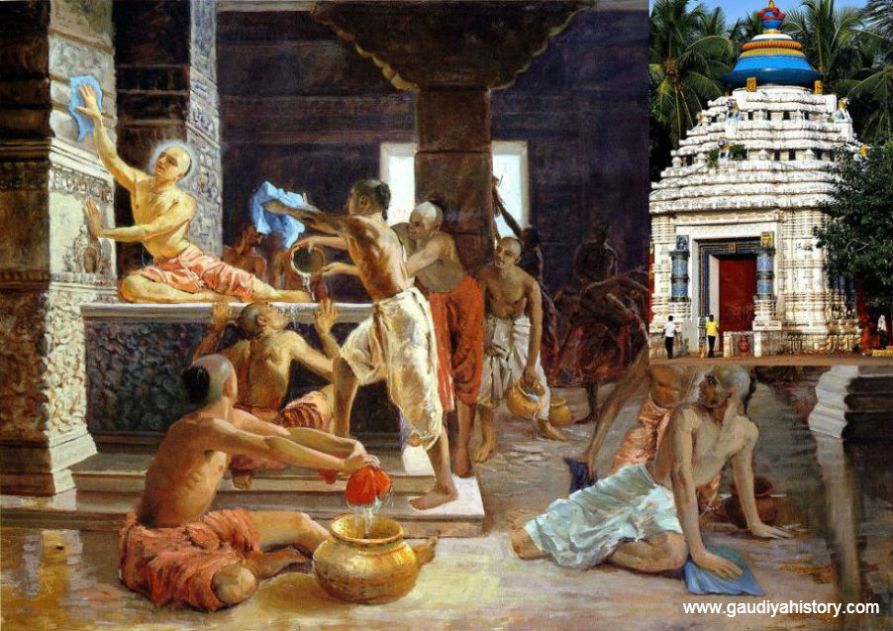
   There Mahaprabhu met Shri Ranga Puri and ended the sufferings of Rama Das. (Chaitanya Charitamrita 2.1.113)
 
   During His travels through South India, Mahaprabhu came to the town Pandharpur on the banks of the Bhima River. Pandharpur is the home of the Vitthaladeva Deity in the Sholapur district of Maharashtra. It is also well-known as the home of the famous Maharashtrian Vaishnava saint Tukarama who lived there in the 15th century of the Shaka era. 
Ranga Puri

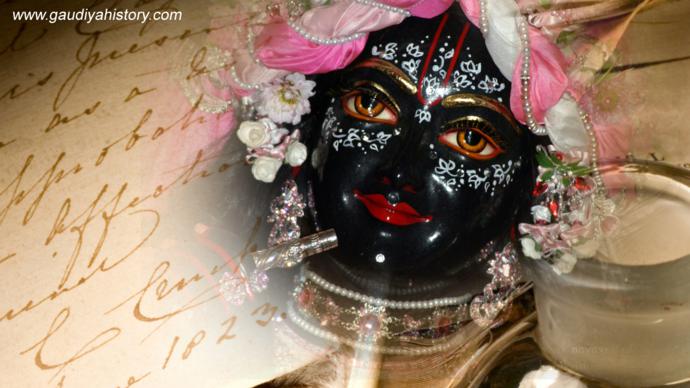
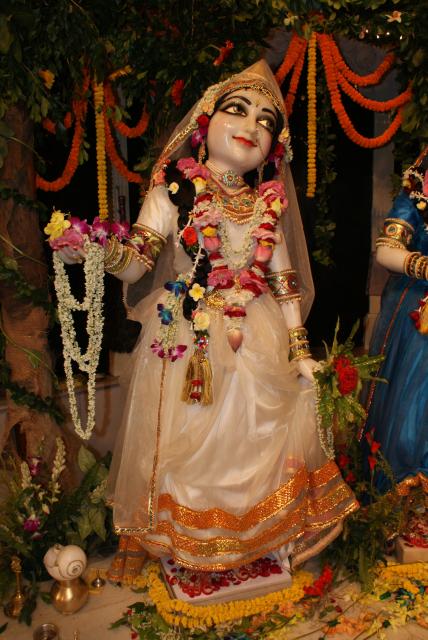
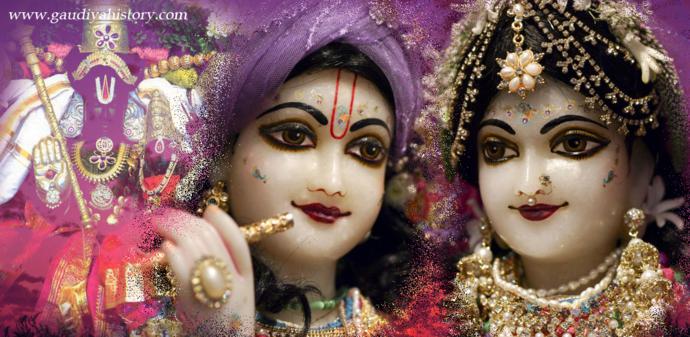
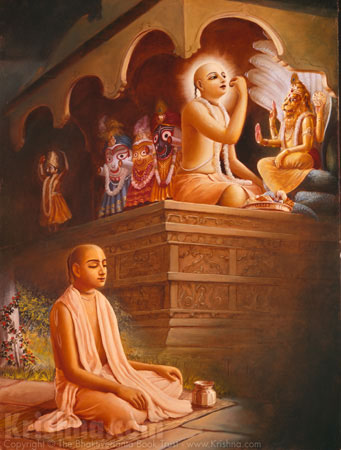
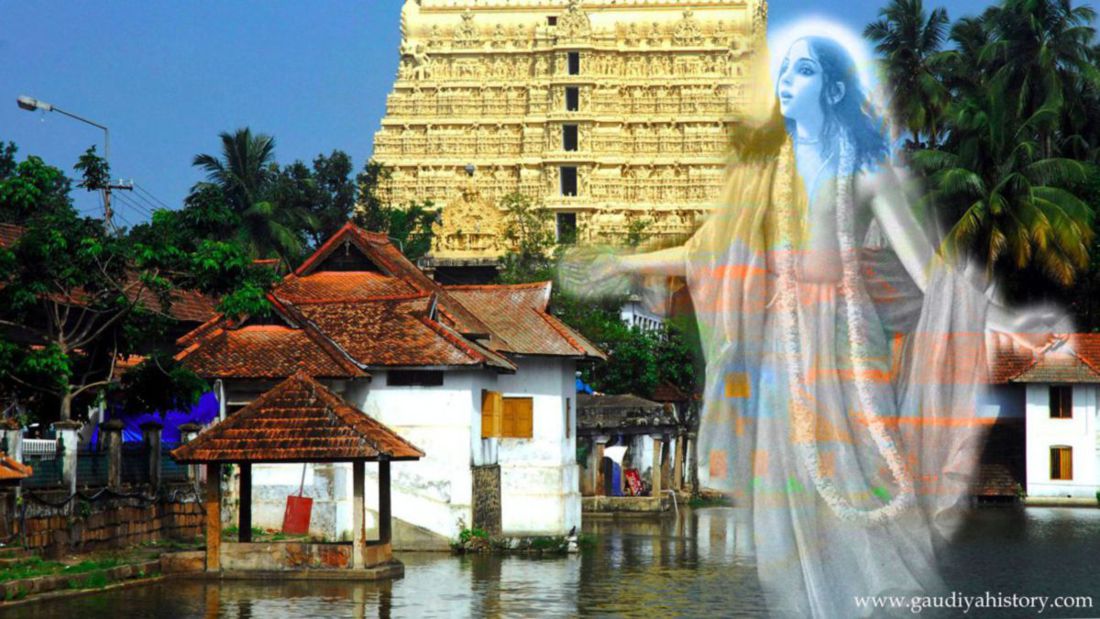
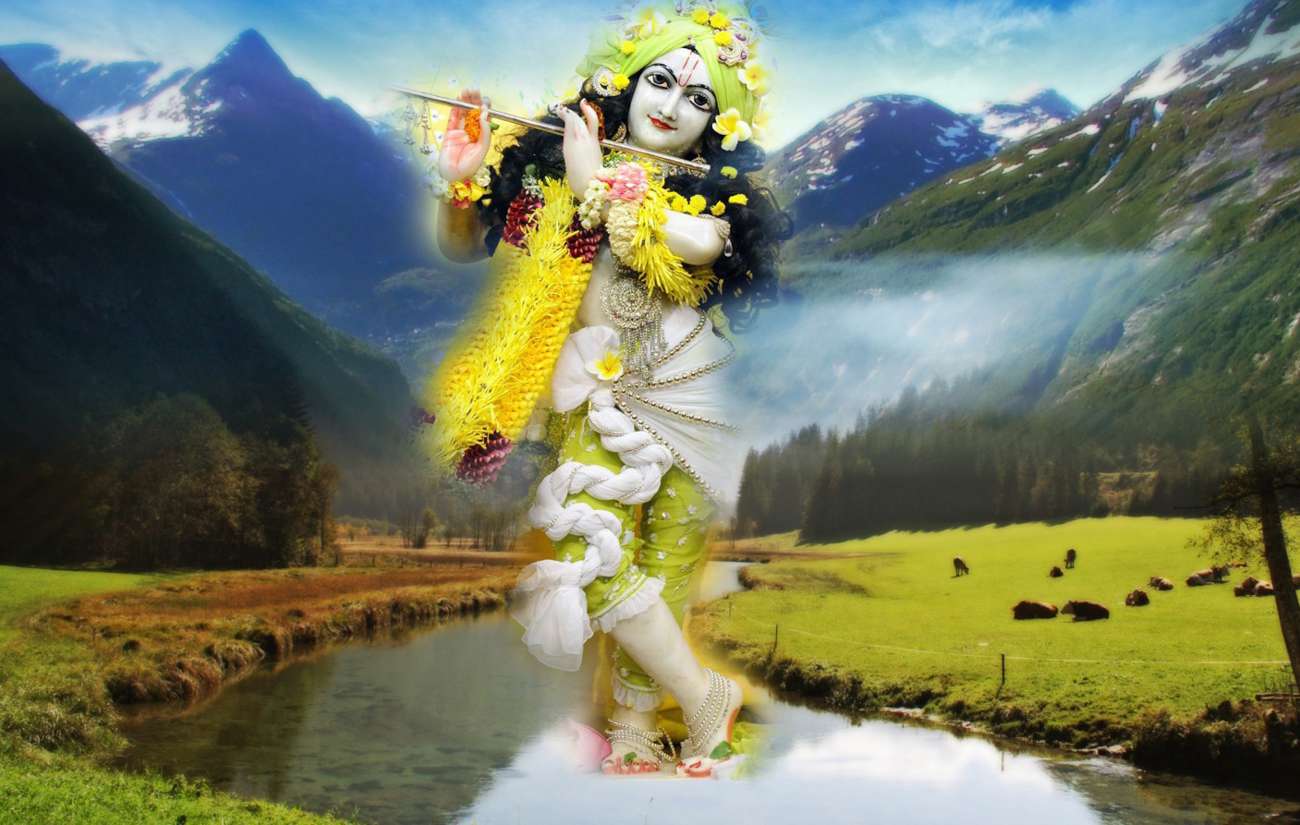
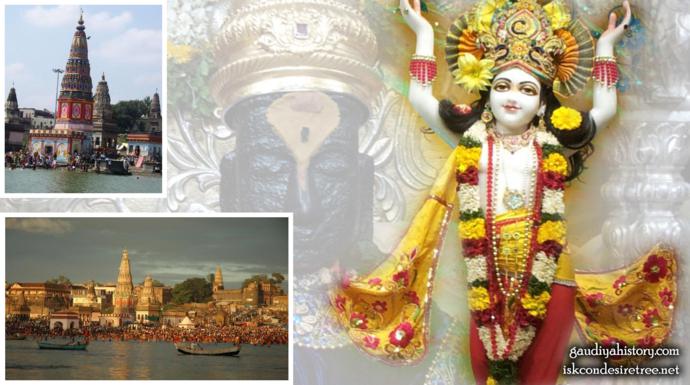
During His travels through South India, Mahaprabhu came to the town Pandharpur on the banks of the Bhima River. Pandharpur is the home of the Vitthaladeva Deity in the Sholapur district of Maharashtra. (In the wallpaper: Shri Krishna Chaitanya, ISKCON Chennai, images of Pandarpur Temples and in the background image there is Lord Panduranga).

 
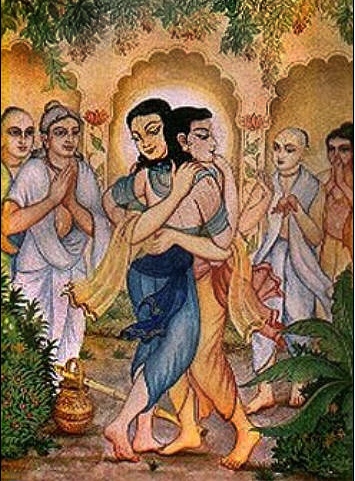
   In Pandharpur, Mahaprabhu was invited by a certain Brahmin to his home where was lavishly fed. While there, He heard that Madhavendra Puri’s disciple, Shri Ranga Puri, was staying nearby in another Brahmin’s house. Mahaprabhu immediately went there to meet him. He prostrated Himself before His guru’s godbrother and was immediately inspired by a mood of ecstatic love. Shri Ranga Puri was also impressed by the sight of Mahaprabhu’s ecstatic symptoms and guessed that the Lord must have some relation to the spirit of devotion promulgated by his own spiritual master, without which they would be impossible. He lifted the Lord up and embraced Him and the two of them began to cry in devotional ecstasy.
 
   From there Shri Chaitanya Mahaprabhu went to Pandharpur, where He joyfully saw the Temple of Vitthala Thakur. A Brahmin saw the Lord chanting and dancing in ecstatic love, was very much pleased and invited Him to his home for lunch. The Brahmin offered Mahaprabhu food with great respect and love. After finishing His lunch, the Lord received auspicious news: Shri Ranga Puri, one of the disciples of Shri Madhavendra Puri, was residing at the home of another Brahmin in Pandharpur. The Lord immediately went to that Brahmin’s home and, upon entering, saw Shri Ranga Puri. As soon as Mahaprabhu saw him, He was immediately overwhelmed with ecstatic love and prostrated Himself in obeisance. All the symptoms of ecstatic transformation were visible: tears, jubilation, trembling and perspiration. (Chaitanya Charitamrita 2.9.282-7)
 
   Upon learning that Mahaprabhu was Ishvara Puripada’s disciple, Shri Ranga Puri was filled with great affection for Him. Just by touching each other, they were both flooded with ecstatic feelings. They passed seven days together in discussions of Krishna conscious topics. Shri Ranga Puri was overjoyed to hear that the Lord’s birthplace was in Navadwip. He told the Lord that he had previously been to Navadwip with his spiritual master and that they had eaten at Jagannath Mishra’s house. He recalled that Jagannath’s wife Sachi had fed them a delicious banana flower curry. She had served the sannyasis as though they were her own sons and as if the Mother of the Universe had become incarnate in her. Shri Ranga Puri continued to tell Mahaprabhu that Sachi and Jagannath had a worthy son who took sannyas, taking on the name Shankararanya, but who had died there in Pandharpur. 
Ranga Puri

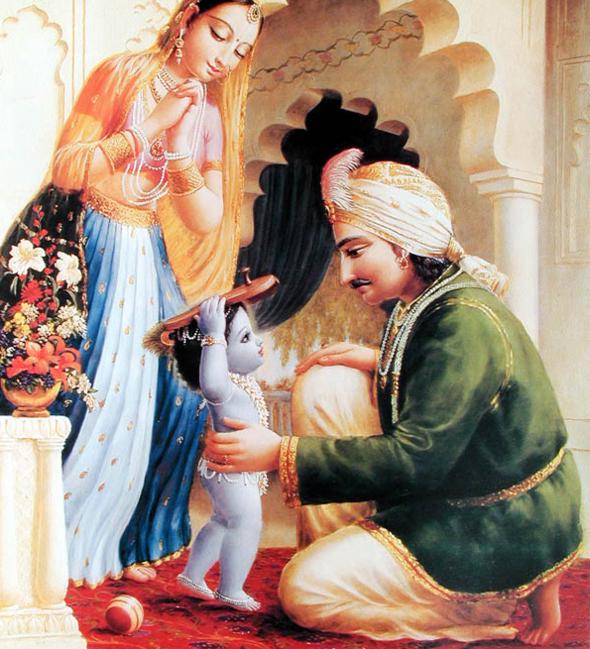
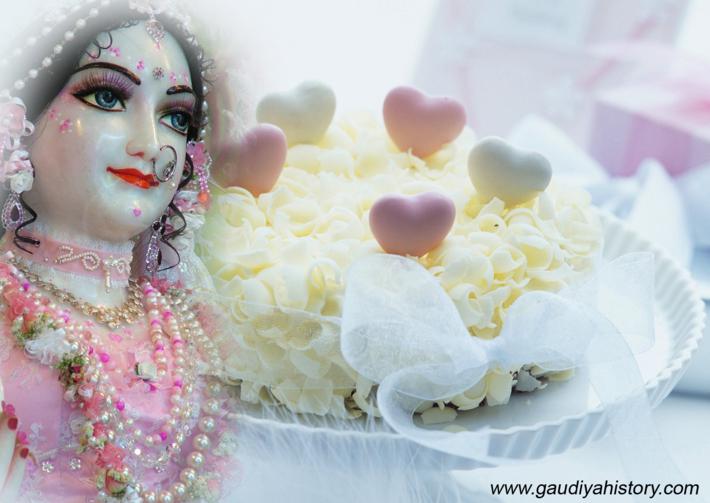
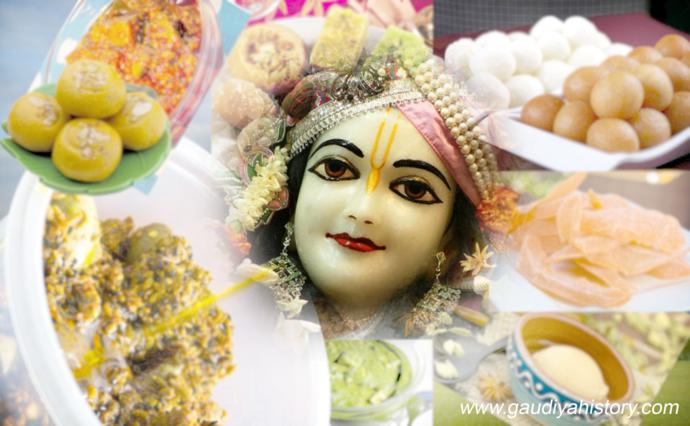
...He told the Lord that he had previously been to Navadwip with his spiritual master and that they had eaten at Jagannath Mishra’s house. He recalled that Jagannath’s wife Sachi had fed them a delicious banana flower curry. She had served the sannyasis as though they were her own sons and as if the Mother of the Universe had become incarnate in her. Shri Ranga Puri continued to tell Mahaprabhu that Sachi and Jagannath had a worthy son who took sannyas, taking on the name Shankararanya, but who had died there in Pandharpur. (In the wallpaper: Jagannath Mishra and Sachi Mata along with baby Nimai in her hands, Yoga Pith, Shri Mayapur Dham, Prasadam in the background image).

 
   Upon hearing all this, Mahaprabhu was overcome with feelings of separation and He let Shri Ranga Puri know that Shankararanya had been His very own brother and that Jagannath and Sachi were His father and mother. After they finished their conversation, Shri Ranga Puri went on to Dwaraka while the Lord continued on Krishnavenva River.
 
   Madhavendra Puri is pure devotional sentiment personified. Simply by remembering his name, one can achieve all perfections. All of his disciples such as Ishvara Puri and Shri Ranga Puri were similarly intoxicated with the moods of sacred rapture. (Bhakti-ratnakara 5.2272-3)
 
   Some people say that Shri Ranga Puri later came to Jagannath Puri to join the Lord and spend the remainder of his life in His association.
 
   [Excerpted from “Shri Chaitanya: His Life & Associates” by Shrila Bhakti Ballabh Tirtha Maharaj]

Ramachandra Puri

Ramachandra Puri

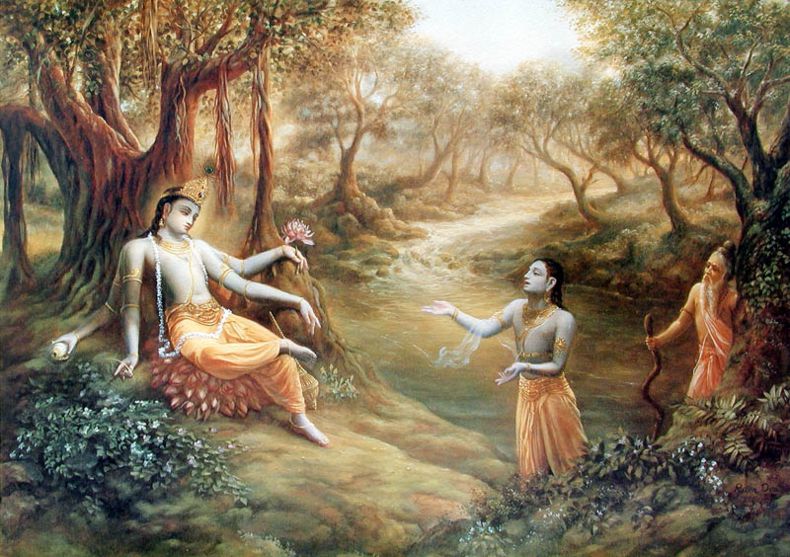
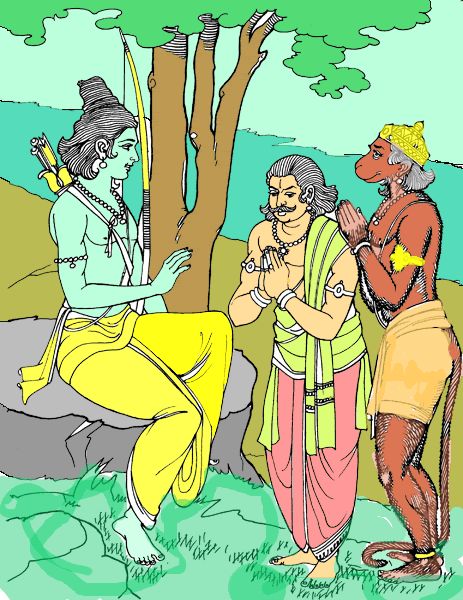
Ramachandra’s dear Devotee, Vibhishana, took birth as Ramachandra Puri. Radharani’s mother-in-law, Jatila, also entered into him for certain special purposes. On account of him, Mahaprabhu reduced his food consumption. (Gaura-ganoddesha-dipika 92-3) (In the image: from left to right Lord Shri Rama, Vibhishana, Monkey Soldier).

   vibhishano yah prag asid ramacandra-puri smritah
uvacato gaura harir naitad ramasya karanam
jatila radhika-shvashruh karyato ‘vishad eva tam
ato mahaprabhur bhiksha-sankocaditato ‘karot
 
   Ramachandra’s dear Devotee, Vibhishana, took birth as Ramachandra Puri. Radharani’s mother-in-law, Jatila, also entered into him for certain special purposes. On account of him, Mahaprabhu reduced his food consumption. (Gaura-ganoddesha-dipika 92-3)
 
tam vande krishna-caitanyam ramacandra-puri-bhayat
laukikaharatah svam yo bhikshannam samakocayat
 
   I offer my prayers to Shri Krishna Chaitanya who out of fear of Ramachandra Puri reduced his eating in the eyes of the world. (Chaitanya-charitamrita 3.8.1)
 
Ramachandra Puri as Counter-Example
 
   Before discussing the character of Ramachandra Puri, we must remember that the lessons of his life are taught as counter-examples. Anyone who seeks the perfection of his own life should bear in mind that the following lessons are to be learned from his actions:
 
   (1) Faultfinding, especially finding fault in Vishnu and the Vaishnavas, is extremely detrimental to one’s spiritual advancement. A devotional practitioner should look at his own faults rather than at others’. By correcting his own faults, he will be able to make some advancement. Anyone who sincerely seeks to achieve pure devotional service should always remember the following verse from Mahaprabhu’s teachings to Rupa Goswami:
 
yadi vaishnava aparadha uthe hati mata
uparie va chinde tara shukhi jaya pata
 
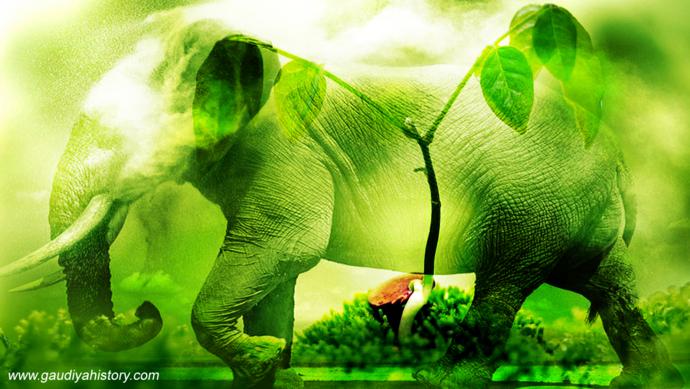
   If the maddened elephant of Vaishnava-aparadha enters the devotional garden, the creeper of bhakti will be uprooted and all its leaves will dry up. (Chaitanya-charitamrita 2.19.156) 
Ramachandra Puri

If the maddened elephant of Vaishnava-aparadha enters the devotional garden, the creeper of bhakti will be uprooted and all its leaves will dry up. (Chaitanya-charitamrita 2.19.156) (In the wallpaper: Mad elephant, a small tree).

 
   (2) All the disciples who take initiation from the same guru are not to be considered equal. Though superficially all may have taken shelter of the spiritual master and received the mantra from him, they cannot all be considered true or sincere disciples. The spiritual master rewards the disciple who dedicates himself to affectionate service of the master; such a disciple is furthermore able to recognize the mercy of his spiritual master. A disciple seeking his own perfection will bear in mind that of the sixty-four limbs of devotional service, one of the most important is vishrambhena guroh seva, the service of the spiritual master in reverence and respect. The sincere disciple recognizes that the spiritual master’s instructions are beneficial both for himself and for others.
 
   (3) To show disrespect to one’s spiritual master and to other Vaishnavas has a pernicious effect on one’s spiritual life. One should remember that the Lord cannot tolerate the transgression of the rules of etiquette. (Chaitanya-charitamrita 3.4.166). Due to whatever misfortune, some conditioned souls come under the influence of the illusory energy and are so bewildered by a pride in their own knowledge or self-worth that they arrogantly try to correct or to instruct the Vaishnava or the guru.
 
   (4) Those who want to increase in devotion should associate with and serve other Devotees who are affectionate and who have similar spiritual goals. The tendency to serve Vishnu and the Vaishnavas is increased by associating with those who possess this tendency in greater quantities.
 
   (5) Because of his relation to the guru, the guru’s godbrother is as worshipable as the guru himself. One must always show him the proper respect. Even if one thinks that his instructions are not correct, one should still maintain the outer decorum and not use direct critical speech with him. Mahaprabhu taught this kind of behavior by His own actions.
 
gorara ami, gorara ami mukhe balile nahi cale
gorara acara gorara vicara la+ile phala phale
 
   Just to repeat 'I belong to Gaura, I belong to Gaura' is not in itself sufficient. One has to follow the practice and the teachings given by Gaura if one wishes to achieve the promised results. (Bhaktivinoda Thakur).
 
Ramachandra Criticizes Jagadananda Pandit
 
   Ramachandra Puri’s family background and birthplace are unknown. It is well known that he took initiation from Madhavendra Puri. Krishnadas Kaviraj Goswami has related the story of his relationship to his guru and to Mahaprabhu in the Antya-lila of Chaitanya-charitamrita. Because he was Madhavendra Puri’s initiated disciple, both the Lord and Paramananda Puri showed him respect. Nevertheless, despite his relationship to the distinguished master, Ramachandra Puri associated closely with those who followed the path of dry knowledge and was attracted to doctrines opposed to those of pure devotional service.
 
   One day, Jagadananda Pandit saw the Lord, Paramananda and Ramachandra paying obeisances to each other, embracing each other and engaging in conversation. He decided to invite the three of them to eat a meal together. He arranged for copious amounts of Jagannath Prasad to be brought for them and fed them very well. When they had finished, Ramachandra Puri himself told Jagadananda to sit down and take Prasad. He took special care of him, personally serving him with the Lord’s remnants. After Jagadananda had finished eating, however, he criticized Mahaprabhu’s followers saying:
 
   I had heard that Chaitanya’s followers were big eaters. Now I have seen with my own eyes that this is true. To feed a sannyasi excessively leads to the destruction of religious principles. A renunciate who eats this much will find that his vows will dissipate. (*Chaitanya-charitamrita 3.8.15-16)
 
How Ramachandra Became a Fault Finder
 
   This propensity to find fault with others, to criticize and to give instructions in dry philosophy was the result of offenses Ramachandra Puri had committed at the feet of his spiritual master. When Madhavendra Puri was on his death bed in Remuna, he was in the depth of separation from Krishna and was crying in the mood of Radha after Krishna’s departure for Mathura. He kept repeating the verse,
 
ayi dinadayardra natha he, mathuranatha kadavalokyase
hridayam tvad-aloka-kataram dayita bhramyati kim karomy aham
 
   "O Lord, whose heart softens at seeing the condition of the unfortunate! Oh lord of Mathura, when will I see You? My heart is filled with pain from not seeing You, oh my love, and is confused. What can I do?" 
Ramachandra Puri

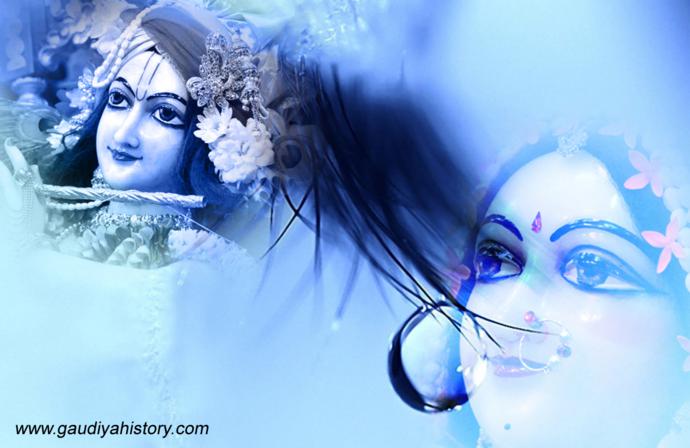
"O Lord, whose heart softens at seeing the condition of the unfortunate! Oh lord of Mathura, when will I see You? My heart is filled with pain from not seeing You, oh my love, and is confused. What can I do?" (In the wallpaper: Shri Shri Radha Gopinath, ISKCON Chowpatty, Mumbai).

 
   Both Ishvara Puri and Ramachandra Puri were present at this time. Ramachandra had no understanding of his spiritual master’s mood and treating him like an ordinary human being, arrogantly began to give him instruction. He said, “Remember that you are completely full of the bliss of Brahman. Why are you crying like this despite being knowledgeable of your own Brahma-nature?”
 
   When Madhavendra Puri heard these words so full of ignorance and effrontery, he became angry and began to rebuke Ramachandra, saying,
 
   "Get away from me, you most sinful rascal! I am dying from the distress of not having received Krishna’s mercy, of not having attained Mathura, and you come to add to my misery! Don’t show your face to me again, go wherever you like! If I see you while I am dying I will take a lower birth. I am dying from the distress of not having attained Krishna and this lowly fool is teaching me about Brahman." (Chaitanya-charitamrita 3.8.22-5)
 
   As a result of his offenses, Madhavendra Puri withdrew his blessings from Ramachandra Puri who thenceforth started to develop material desires. He became a dry philosopher without any interest in Krishna. Not only that but he became critical of everyone, exclusively devoting himself to faultfinding.
 
   In this connection, Shrila Bhaktisiddhanta Saraswati Goswami Thakur has written, "Even though Ramachandra Puri saw his own guru suffering of separation from Krishna, he was incapable of recognizing the transcendental nature of this transport of emotions. He judged his guru to be an ordinary man and took his mood to be material, the result of some material insufficiency. As a result he tried to explain to him the value of experiencing the oneness of Brahman. Madhavendra Puri reacted to his disciple’s stupidity and disregard for his instructions and thus stopped wishing for his well-being. He abandoned him and drove him away."
 
   On the other hand, Ishvara Puri not only adhered to his guru’s teaching but served him physically and thus received his mercy, so becoming immersed in love of Krishna.
 
   "Ishvara Puri received his spiritual master’s mercy, while Ramachandra Puri received his enmity. For the edification of the world, these two served as examples of the guru’s blessings and his punishment." (Chaitanya-chritamrita 2.8.32)
 
Ramachandra Puri Finds Fault with the Lord Himself
 
   Deprived of his spiritual master’s blessings, Ramachandra Puri sought out sannyasis to find out what their activities were, how much they ate, etc., all for the sake of discovering their faults. Mahaprabhu had the habit of taking lunch on the invitation of His various Devotees. If anyone was unable for whatever reason to invite the Lord to his house for a meal, he would give a donation of money to buy Jagannath Prasad. The customary amount at that time was four panas or strings (320) of cowries.
 
   Unable to appreciate the Lord’s glories and thinking of Him as an ordinary man, Ramachandra Puri concerned himself with gathering all sorts of information about His lodgings, His habits, how much He ate and slept and His comings and goings. He was interested only in finding faults and finally he found one. He criticized those in the renounced order for eating sweetmeats, saying that it made it difficult to control the senses. Though his only goal was to find fault with the Lord, Ramachandra Puri nevertheless he came regularly to see Him. When they met, the Lord would offer him respectful obeisances, considering him a godbrother of Hs spiritual master.
 
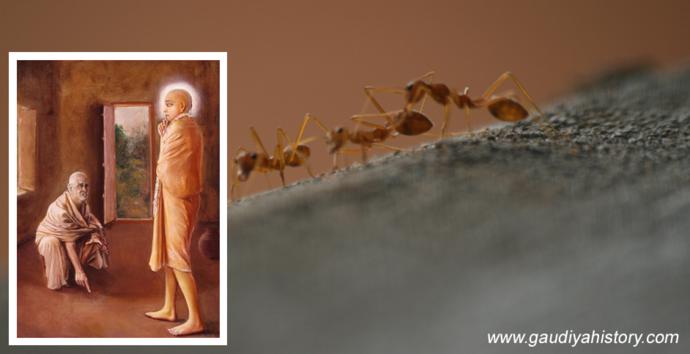
   One day Ramachandra Puri came in the morning to Mahaprabhu’s residence. Seeing many ants in the Lord’s room, he began to criticize Him, saying, "Last night there was molasses made from sugar cane in here. This is why there are so many ants. Alas, how sad to see such an attachment to sense gratification amongst those in the renounced order of life!" After saying this, he got up and left.
 
   Though ants quite naturally roam about everywhere, Mahaprabhu became apprehensive as a result of his accusations. He called Govinda and instructed him to reduce His daily consumption of Prasad to one-fourth of a pot and five gandas worth of vegetables. He warned him that if Govinda brought Him more than this amount, He would leave Puri. 
Ramachandra Puri

One day Ramachandra Puri came in the morning to Mahaprabhu’s residence. Seeing many ants in the Lord’s room, he began to criticize Him, saying, "Last night there was molasses made from sugar cane in here. This is why there are so many ants. Alas, how sad to see such an attachment to sense gratification amongst those in the renounced order of life!" After saying this, he got up and left. Though ants quite naturally roam about everywhere, Mahaprabhu became apprehensive as a result of his accusations. He called Govinda and instructed him to reduce His daily consumption of Prasad to one-fourth of a pot and five gandas worth of vegetables. He warned him that if Govinda brought Him more than this amount, He would leave Puri. (In the wallpaper: Lord Shri Chaitanya in the right, Ramachandra Puri in the left, ants).

 
   When the Devotees heard about Mahaprabhu’s reduction in Prasad consumption, they were thunderstruck. They condemned Ramachandra Puri and themselves stopped eating. When Ramachandra Puri heard that Mahaprabhu and His Devotees had all reduced the amount of food they were taking, he went to see Him and impudently said:
 
   "A sannyasi is not supposed to gratify his senses. He should fill his belly with the bare minimum. I see that You have become thin. Indeed, I have heard that You have cut your eating in half. But this kind of dry renunciation is not the religion of a sannyasi, either. A sannyasi eats as much as is necessary to maintain his body, but without engaging in sense gratification. By so doing, he becomes perfect in the discipline of knowledge."
 
natyashnato 'pi yogo 'sti na caikantam anashnatah
na cati-svapna-shilasya jagrato naiva carjuna
 
yuktahara-viharasya yukta-ceshtasya karmasu
yukta-svapnavabodhasya yogo bhavati duhkha-ha
 
   "O Arjuna, yoga practice is impossible for anyone who overeats, under-eats, oversleeps, or under-sleeps. For a person who eats, relaxes and exerts himself in all duties in a regulated way, and who keeps regular hours in proper measure, the practice of yoga brings about the end of all worldly suffering." (Bhagavad-gita 6.16-17)
 
   Mahaprabhu continued to show Ramachandra Puri the same respect as before, however, and humbly submitted, "I am just like an ignorant boy and it is My great fortune that you treat Me like your disciple and instruct Me. I will do My best to follow your instructions." Hearing this, Ramachandra Puri got up and left.
 
Paramananda Puri Tries to Intercede
 
   In the meantime, Paramananda Puri heard that all the Devotees of Shri Chaitanya Mahaprabhu were eating only half as much as usual. He and some other Devotees approached the Lord with great humility and submission and said, "Ramachandra Puri is by nature a slanderer. It is not wise to give up eating on his say-so. It is his wont to make someone eat far more than he wants. Then he reproaches that person for overeating. Two kinds of activity, though rejected in the revealed scriptures, constitute the substance of his daily affairs:
 
para-svabhava-karmani na prashamsen na garhayet
vishvam ekatmakam pashyan prakritya purushena ca
 
   "One should neither praise nor criticize the activities of others which result from their nature, because everything in the universe is a combination of the material nature and the living souls, and is thus one sole entity. (SB 11.28.1)
 
"Of the two rules, Ramachandra Puri obeys the first by abandoning praise, but although he knows that the second is more prominent, he neglects it by criticizing others."
 
   Shrila Bhaktisiddhanta Saraswati Goswami Thakur comments on this verse by saying, "The above-mentioned verse from Shrimad Bhagavatam gives two injunctions. The first, called purva-vidhi, is that one should not praise, and the second, para-vidhi, is that one should not criticize. It is generally said that the rule which is given later takes precedence over previously given injunctions. From this we can understand that to praise someone is not so dangerous, while one should avoid calumny. Here, however, Ramachandra Puri observed the injunction to avoid praising others, but did not observe the prohibition against criticism. Thus he neglected the para-vidhi but strictly observed the purva-vidhi. This verse thus has an ironical meaning."
 
   Paramananda Puri continued: "Ramachandra Puri does not praise even a person who has hundreds of good qualities; he rather finds some way of calling these qualities a fault. You should not give up eating properly because of his criticism; You should rather accept invitations as before."
 
   Mahaprabhu replied, "There is no reason to get angry at Ramachandra Puri. A sannyasi should not be lusty after the pleasures of the tongue, but only eat in order to keep body and soul together."
 
   When the Devotees continued to press the Lord to abandon His new principle, He would not do so. Finally, He responded to their request by accepting half of the original amount of Prasad (rather than a quarter as He was then doing). Thus the cost for the food needed to invite Him was fixed at two panas of cowries (160 conch shells), and that food would be taken by two men and sometimes three.
 
   Krishnadas Kaviraj Goswami writes:
 
   "When a Brahmin at whose home an invitation could not be accepted invited the Lord, he would pay two panas of conch shells to purchase the Prasad. When a Brahmin at whose home an invitation could be accepted invited him, the Brahmin would purchase part of the Prasad and cook the rest at home. (Chaitanya-charitamrita 3.8.89-90)
 
Ramachandra Leaves Puri
 
   If Gadadhara Pandit, Bhagavan Acharya or Sarvabhauma Bhattacharya invited the Lord on a day when He had already been invited to dine by someone else, He would break His previous engagement. Then He would eat as much as they served Him.
 
   Mahaprabhu sometimes treated Ramachandra Puri according to worldly etiquette, and sometimes He would ignorer him as though he were of no more significance than straw. All the Lord’s activities are auspicious and beautiful, in all times and circumstances.
 
   "Sometimes the Lord acted almost like a servant to Ramachandra Puri. At other times, He treated him like straw. The Lord’s activities are beyond human comprehension. Whatever He does, to whomever, is always enchanting." (Chaitanya-charitamrita 3.8.94-5)
 
   Ramachandra Puri stayed in Jagannath Puri for a short while longer before leaving to visit various holy places of pilgrimage. When he left, the Devotees felt extremely happy, as if a great load of stones had suddenly fallen from their heads to the ground. Mahaprabhu once again began to accept invitations as before and the Devotees were able to serve Him without hindrance.
 
   Thus, if one commits an offense to one’s spiritual master, that offense eventually arrives at the feet of the Supreme Personality of Godhead Himself.
 
   "This is the result of being rejected by one’s spiritual master. Eventually, the offense reaches as far as the Supreme Personality of Godhead. Even though the Lord did not consider the offenses of Ramachandra Puri, considering him to be a senior, he instructed through His behavior about the result of offending the spiritual master." (Chaitanya-charitamrita 3.8.99-100)
 
Mahaprabhu Stays with Ramachandra Puri in Benares
 
   Vrindavan Das Thakur has also written that Mahaprabhu hid in the house of Ramachandra Puri while in Benares.
 
   Mahaprabhu remained hidden for two months in Ramachandra Puri’s matha. (Chaitanya Bhagavat 2.19.105)
 
   Shrila Bhaktisiddhanta Saraswati Goswami Thakur writes in his Gaudiya-bhashya, "Gaurasundara stayed in the house of Chandrashekhara while in Benares. Chandrashekhara was a shudra of the vaidya caste. Vrindavan Das Thakur says that He stayed with Ramachandra Puri, who is known as a pretentious disciple of Madhavendra Puri who had a strong preference for the Mayavada philosophy. He told people in Benares that He was staying with Ramachandra Puri while in fact He preferred to spend His time with Devotees. Ramachandra Puri was a sannyasi in one of the ten Shankarite orders, therefore Mahaprabhu stayed with him to avoid criticism from the non-devotees."
 
   [Excerpted from “Shri Chaitanya: His Life & Associates” by Shrila Bhakti Ballabh Tirtha Maharaj] 
Ramachandra Puri

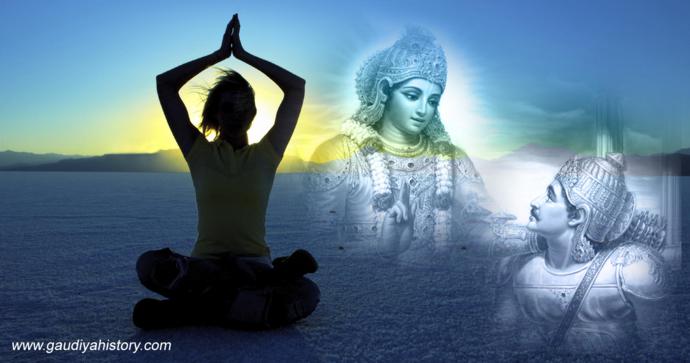
"O Arjuna, yoga practice is impossible for anyone who overeats, under-eats, oversleeps, or under-sleeps. For a person who eats, relaxes and exerts himself in all duties in a regulated way, and who keeps regular hours in proper measure, the practice of yoga brings about the end of all worldly suffering." (Bhagavad-gita 6.16-17) (In the wallpaper: from right to left Arjuna, Shri Krishna, a yogi).
Raghupati Upadhyaya

   Shri Raghupati Upadhyaya was a Brahmin who originated from the region of Mithila. He was born in Tirhut, in the Sitamari subdivision of Darbhanga district in Bihar state. Tirhut or Tiruhita, was also the name for a kingdom which included the four modern districts of Darbhanga, Sitamarhi, Muzaffarpur and Champaran in northwestern Bihar. Paramananda Puri also came from Tirhut.
 
   When Mahaprabhu heard Raghupati Upadhyaya’s verses, he became overwhelmed with feelings of ecstatic love. Shrila Rupa Goswami later included several of these verses in his Padyavali. Krishnadas Kaviraj Goswami has recounted the meeting of Raghupati with the Lord in his Chaitanya Charitamrita. Madhya-lila, 19. This meeting took place when Mahaprabhu was in Prayag and had gone to visit Vallabhacharya in Ariail. [See vol. II, Chapter 3, on Rupa Goswami.] 
Raghupati Upadhyaya

Let those afraid of material existence worship the Vedas and Upanishads, the smritis and puranas, or the Mahabharata, as they wish. I, on the other hand, shall simply worship Maharaj Nanda, in whose courtyard plays the Supreme Truth. (Padyavali, 126) (In the image: Shri Gopal, His parents Nanda Maharaja and Yashoda Maharani).

 
   At that time Raghupati Upadhyaya arrived there. He was from Tiruhita district, a learned scholar, a Vaishnava and a gentleman. He offered his respects to Shri Chaitanya Mahaprabhu and the Lord blessed him, saying, "May you always remember Krishna." (Chaitanya Charitamrita 2.19.92-3)
 
   When Mahaprabhu asked Raghupati to speak to Him about Krishna, Raghupati recited a verse of his own composition:
 
shrutim apare smritim itare
bharatam anye bhajantu bhava-bhitah
aham iha nandam vande
yasyalinde param brahma
 
   Let those afraid of material existence worship the Vedas and Upanishads, the smritis and puranas, or the Mahabharata, as they wish. I, on the other hand, shall simply worship Maharaj Nanda, in whose courtyard plays the Supreme Truth. (Padyavali, 126)
 
   Mahaprabhu was ecstatic upon hearing this beautiful verse and asked to hear more. Raghupati acquiesced by reciting another verse he had written:
 
kam prati kathayitum ishe
samprati ko va pratitim ayatu
go-pati-tanaya-kuïje
gopa-vadhuti-vitam brahma
 
   Whom dare I tell that the Supreme Truth, is lusting after the cowherds’ brides in the bushes by the banks of the River Yamuna? And who will believe me when I say it? (Padyavali, 98)
 
   As the Lord heard more and more of Raghupati’s compositions, he went deeper and deeper into a trance of prema, demonstrating powerful ecstatic symptoms which made a great impression on the scholar, leading him to believe that Mahaprabhu was Krishna Himself.
 
   Mahaprabhu then asked Raghupati which of Krishna’s many forms was the best. The scholar replied: "The Lord’s blackish form is supreme." Mahaprabhu then asked, "Which abode of the Lord is the best?" Raghupati answered, "Mathura is the best city." In response to Mahaprabhu’s question about Krishna’s best age, he answered that it was His adolescence. And then to the question about the best amongst the rasas, Raghupati stated that the primary rasa, or the erotic mood, was supreme. The complete verse is found in the Padyavali (82):
 
shyamam eva param rupam
puri madhu-puri vara
vayah kaishorakam dhyeyam
adya eva paro rasah
 
   Mahaprabhu embraced Raghupati in His ecstasy and then began to dance. Vallabha Bhatta and all the members of his householders were astounded by Raghupati Upadhyaya’s great fortune.
 
   [Excerpted from “Shri Chaitanya: His Life & Associates” by Shrila Bhakti Ballabh Tirtha Maharaj] 
Raghupati Upadhyaya

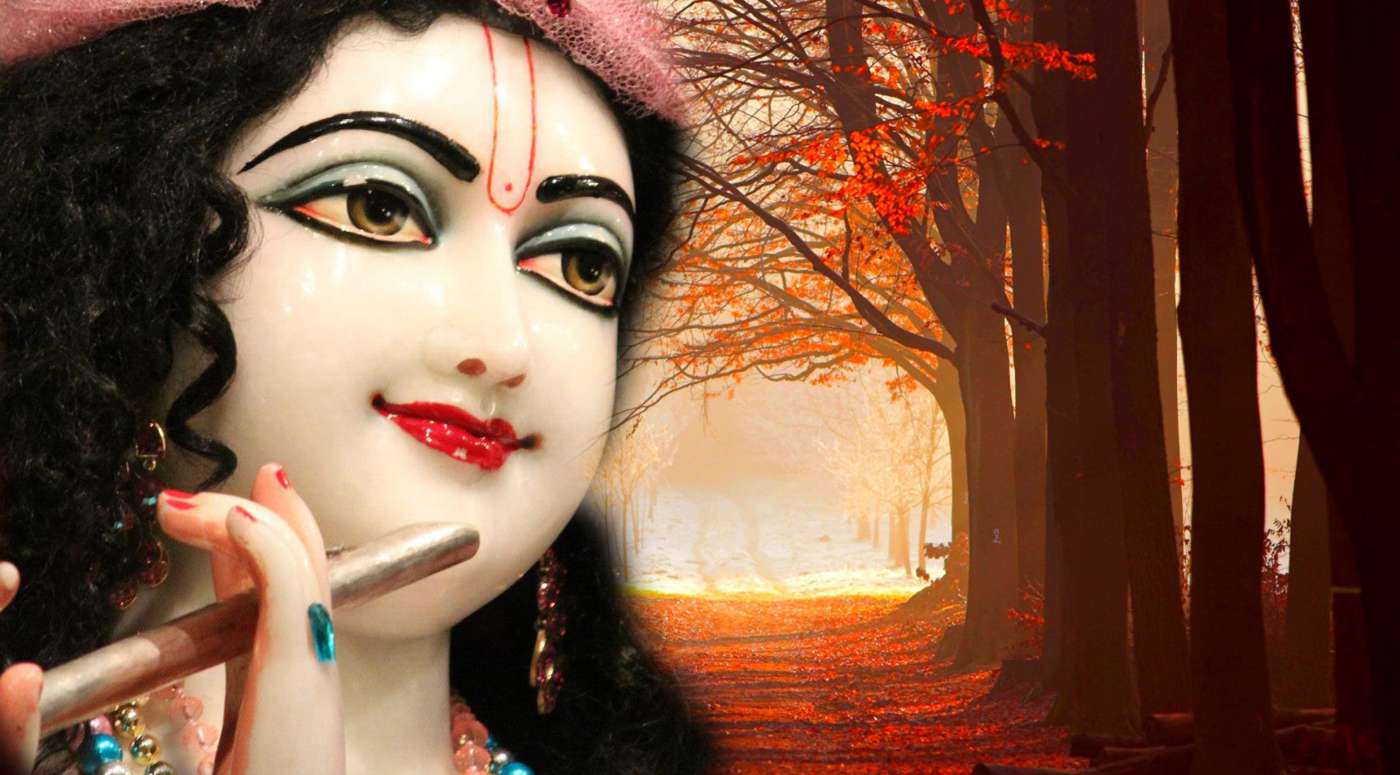
Mahaprabhu then asked Raghupati which of Krishna’s many forms was the best. The scholar replied: "The Lord’s blackish form is supreme." Mahaprabhu then asked, "Which abode of the Lord is the best?" Raghupati answered, "Mathura is the best city." In response to Mahaprabhu’s question about Krishna’s best age, he answered that it was His adolescence. And then to the question about the best amongst the rasas, Raghupati stated that the primary rasa, or the erotic mood, was supreme. (In the wallpaper: Shri Shyamasundara, ISKCON Hungary, New Vraja Dham).

Raghava Pandit- Biography

dhanishtha bhakshya-samagrim krishnayadad vraje’mitam
saiva sampratam gauranga-priyo raghava-panditah
gunamala vraje yasid damayanti tu tat-svasa
 
   The gopi Dhanishtha who brought unlimited amounts of food to Krishna in Vraja has now become Gauranga’s dear servant, Raghava Pandit. His sister Damayanti was Gunamala in Krishna-lila. (Gaura-ganoddesha-dipika 166-7) 
Raghava Pandit

In Krishna-lila, Dhanishtha Devi would take Krishna’s Prasad to Radharani on Yashoda Mata’s order. Radharani would then lovingly take the Prasad. (In the wallpaper: Shrimati Radharani, ISKCON Hungary, Krishna Valley).

 
   In Krishna-lila, Dhanishtha Devi would take Krishna’s Prasad to Radharani on Yashoda Mata’s order. Radharani would then lovingly take the Prasad. Bhaktivinoda sings in his bhoga arati:
 
yashomati ajïa peye dhanishtha anita
shri-krishna-prasad radha bhuïje haye prita
 
   Mahaprabhu, who was none other than Krishna in the mood of Radharani, similarly accepted the food offerings made by Dhanishtha’s incarnation, Raghava Pandit.
 
Mahaprabhu Resides Permanently in Raghava’s House
 
   Raghava Pandit’s home was in the town of Panihati. Panihati is on the eastern bank of the Ganges, one mile from the Sodhpur station on the Eastern Railway line out of Sealdah. Krishnadas Kaviraj Goswami has written that Mahaprabhu remained permanently in the house of Raghava Pandit.
 
   The Lord’s manifestations took place in the home of Sachi, during Nityananda’s dancing, in Shrivasa’s kirtan, and in the house of Raghava Pandit. It is the Lord’s nature to be attracted by His Devotee’s love. (Chaitanya Charitamrita 3.2.34-5)
 
   Vrindavan Das Thakur’s biography of the Lord indicates clearly how dear Raghava Pandit was to Mahaprabhu. When he saw the Lord of his life coming toward his home in Panihati from Shrivasa’s house in Kumarahatta, Raghava Pandit fell down at His feet, overcome by love.
 
   When the Lord of Vaikuntha saw Raghava Pandit’s devotion, He blessed him with a look of favor. The Lord said, “I have come to Raghava’s house and forgotten all My distress simply by seeing him. I feel the same pleasure by coming here as I do when I take a refreshing bath in the Ganges.” (Chaitanya Bhagavat 3.5.81-3) 
Raghava Pandit

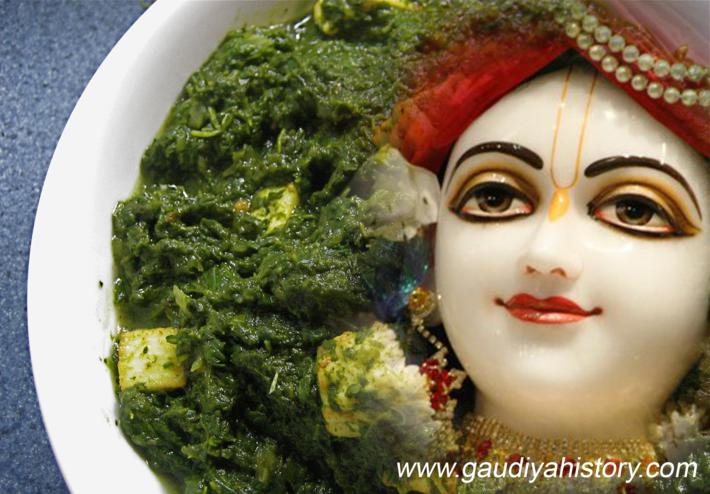
The Lord often told Raghava Pandit to cook for Him because He enjoyed accepting his devotion-soaked preparations. Raghava Pandit cooked and fed the Lord with great enthusiasm. Balaram’s other form, Nityananda Prabhu, would also come to eat at Raghava’s house with his companions and all would praise his cooking. Mahaprabhu especially enjoyed his spinach platters. (In the wallpaper: Shri Gauranga Mahaprabhu, ISKCON Chennai, spinach Prasadam).

 
   The Lord often told Raghava Pandit to cook for Him because He enjoyed accepting his devotion-soaked preparations. Raghava Pandit cooked and fed the Lord with great enthusiasm. Balaram’s other form, Nityananda Prabhu, would also come to eat at Raghava’s house with his companions and all would praise his cooking. Mahaprabhu especially enjoyed his spinach platters.
 
   While He was there, Gadadhara Das, Purandara Pandit, Parameshvari Das, Raghunatha Vaidya and other great Vaishnavas came to Raghava’s house in Panihati by Mahaprabhu’s desire. The Lord took Raghava aside in order to explain to him His identity with Nityananda Prabhu. He also told Makaradhvaja Kara that service to Raghava Pandit was the same as service to Himself.
 
Raghavera Jhali
 
   Makaradhvaja Kara, a kayastha who also lived in Panihati, was Raghava Pandit’s initiated disciple. It was he who annually carried the bags of food that his spiritual master prepared for the Lord in Puri. He was named the munsib or superintendent of these bags (Chaitanya Charitamrita 3.10.40). Raghavera jhali or “Raghava’s bags” were a filled with various preparations that his sister Damayanti made throughout the year for Mahaprabhu. They have been mentioned in Abhirama Das Thakur’s Pata-paryatana and in the Chaitanya Charitamrita.
 
   Raghava and Damayanti lived in Panihati. They were famous for the bags of food known as Raghavera jhali. (Pata-paryatana)
 
   Raghava Pandit, Mahaprabhu’s primary follower, is the Lord’s seventh branch. An important sub-branch, Makaradhvaja Kara, proceeded from him. His sister Damayanti was the Lord’s dear maidservant, who throughout the year gathered various ingredients for the Lord’s bhoga. Raghava filled bags with the foods Damayanti prepared and secretly carried them to Puri for the Lord. The Lord then ate these gifts of food for an entire year. Those bags are still celebrated as Raghavera jhali [“the bags of Raghava Pandit”]. (Chaitanya Charitamrita 1.10.24-27)
 
   The generous Raghava Pandit also went with them. Mahaprabhu secretly stayed in his house. (Chaitanya Bhagavat 3.8.32)
 
   Krishnadas Kaviraj Goswami writes a complete description of these bags in his Chaitanya Charitamrita (3.10). Krishna’s Devotees in Vraja have no sense of majesty in their attitude to the Lord. Damayanti would prepare shukta for the Lord because she worried that He might have problems with his digestion. Mahaprabhu was overjoyed to receive these preparations that were offered with such affection.
 
   Raghava Pandit came with bags full of condiments prepared very nicely by his sister, Damayanti. Damayanti made varieties of unparalleled food suitable for the Lord. The Lord would then enjoy them for the entire year that followed. These are the names of some of the pickles and condiments in the bags of Raghava Pandit: mango mustard pickle, ginger mustard pickle, hot spicy mustard, lime and mango pickle, amra-koli, dried ground mango, sliced dried mango, mangoes preserved in oil and dried mango. With great attention, Damayanti also made a powdered dried bitter vegetable preparation (shukta). Do not disregard shukta because it is a bitter preparation; the Lord derived more happiness from eating this shukta than from drinking panchamrita [a combination of milk, sugar, ghee, honey and curd]. Since Chaitanya Mahaprabhu is the Supreme Lord, He takes the spirit in which things are done; accepting the love in which a gift is given. He therefore derived great pleasure even from the dried bitter leaves of shukta and from kashandi (mustard sauce). Because of her natural love for Mahaprabhu, Damayanti considered Him to be an ordinary human being and therefore worried that He might become sick from overeating and get dysentery. She prepared shukta for Him, since it diminishes the mucous that accumulates in the digestive system, causing dysentery. Damayanti’s affectionate attitude brought great pleasure to the Lord. (Chaitanya Charitamrita 3.10.13-20) 
Raghava Pandit

Because of her natural love for Mahaprabhu, Damayanti considered Him to be an ordinary human being and therefore worried that He might become sick from overeating and get dysentery. She prepared shukta for Him, since it diminishes the mucous that accumulates in the digestive system, causing dysentery. Damayanti’s affectionate attitude brought great pleasure to the Lord. (Chaitanya Charitamrita 3.10.13-20) (In the wallpaper: Shri Gauranga Mahaprabhu, ISKCON Vrindavan).

 
Raghava Pandit’s Strict Cleanliness
 
   Mahaprabhu joyfully praised the extent of Raghava Pandit’s devotion to His entourage in Puri, especially talking about his coconut offerings. Though Raghava Pandit possessed hundreds of coconut trees in his own garden, he would have more expensive nuts brought from a far in order to offer coconut water and pulp as offerings that Lord Chaitanya Mahaprabhu happily accepted.
 
   Raghava Pandit never offered anything to the Lord that was not pure and of the highest quality. Paying high prices for the best possible produce, he had mangoes, jackfruit, bananas and other fruit brought from distant villages to be offered to his Mahaprabhu Deity. One day a servant touched the coconut offering after his hand had brushed against the doorframe. Raghava worried that dust from people’s feet had surely touched the foodstuffs. Thus, he rejected them as unsuitable for the Deity and threw them away.
 
   Should anyone criticize Raghava Pandit for throwing fruit away, Shrila Bhaktisiddhanta Saraswati Goswami Thakur has warned, “Raghava Pandit was an eternally perfected servant of Krishna and not some person with an obsessive-compulsive neurosis about cleaning. Nor was he a low-level Devotee who artificially projected transcendental qualities on matter. He served the object of his worship without the slightest hint of any materialistic attitude, completely absorbed in a transcendental mood of service.” (Anubhashya, 2.14.83) 
Raghava Pandit

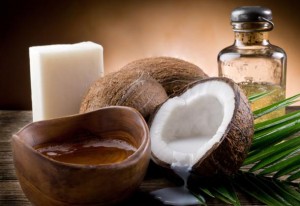
Mahaprabhu joyfully praised the extent of Raghava Pandit’s devotion to His entourage in Puri, especially talking about his coconut offerings. Though Raghava Pandit possessed hundreds of coconut trees in his own garden, he would have more expensive nuts brought from a far in order to offer coconut water and pulp as offerings that Lord Chaitanya Mahaprabhu happily accepted. (In the image: Coconut products).

 
Nityananda Visits Panihati
 
   Mahaprabhu ordered Nityananda Prabhu to take his associates and leave Puri to preach pure devotion in Bengal. While wandering through the Ganges valley, Nitai was attracted by Raghava Pandit’s pure devotional attitude and came to his house in Panihati. Along with him came the three Ghosh brothers, Govinda, Madhava and Vasudeva, who were known for their abilities as kirtaniyas. When they began singing, Nityananda became absorbed in a trance-like state and started to dance. When he had finished dancing, he sat on the Deities’ altar and Raghava Pandit and Nityananda Prabhu’s entourage performed an elaborate abhishek ceremony to honor him. After the bathing ceremony, they dressed and garlanded him, whereupon Nityananda sat down again on the Deities’ throne while Raghava Pandit held the parasol.
 
   At this moment, a miraculous event occurred. Nityananda Prabhu, still in a trance-like state, ordered Raghava Pandit to quickly bring him a garland of kadamba flowers. Raghava answered that kadamba trees were not yet in flower. Nityananda Prabhu told him to look around the grounds of his house and he would find the flowers. As Raghava searched, he was amazed to find kadamba flowers blossoming on a lime tree. He quickly picked the flowers and made a garland, which he placed around Nityananda’s neck.
 
Raghava Pandit

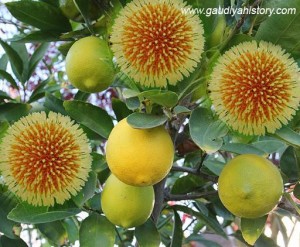
At this moment, a miraculous event occurred. Nityananda Prabhu, still in a trance-like state, ordered Raghava Pandit to quickly bring him a garland of kadamba flowers. Raghava answered that kadamba trees were not yet in flower. Nityananda Prabhu told him to look around the grounds of his house and he would find the flowers. As Raghava searched, he was amazed to find kadamba flowers blossoming on a lime tree. He quickly picked the flowers and made a garland, which he placed around Nityananda’s neck. (In the wallpaper: Kadamba flowers in the lime tree).

   A few moments later, the house was filled with the fragrance of damanaka flowers. Nityananda Prabhu said that Mahaprabhu Himself had come from Puri wearing a damanaka garland to hear the kirtan. Narahari Chakravarti Thakur mentions this dance and kirtan in his Bhakti-ratnakara:
 
   First Nityananda Prabhu came to Panihati with his associates. Raghava Pandit, Makaradhvaja Kara and the other Devotees of the village were overjoyed to see them. Who can describe the wonderful dancing and kirtan that took place in Raghava Pandit’s house? (Bhakti-ratnakara 12.3645-7)
 
   Nityananda Prabhu came to Panihati along with Rama Das and Gadadhara Das, where he first visited Raghava Pandit’s house. The kirtan that they began there filled the entire universe with transcendental joy. Panihati is the birthplace of the great Devotee, Raghava Pandit. There is no limit to the glories of a great Devotee’s birthplace. (Bhakti-ratnakara 8.156-8)
 
Chidha-dadhi Mahotsava
 
   Later, Nityananda ordered Raghunatha Das Goswami to put on a feast of chipped rice and yogurt for his entourage. Raghava Pandit came there also with various foods that had not been contaminated by the touch of cooked rice. He thus witnessed Nityananda’s lila of picnicking by the riverbank in great astonishment. After resting the afternoon by the Ganges, Nityananda went and spent the evening at Raghava Pandit’s house in kirtan and dance. Mahaprabhu Himself manifested there, being attracted by Nityananda’s dancing. In order to reveal the extent of Raghava Pandit’s good fortune, Mahaprabhu and Nityananda sat down together and accepted his offerings of fine rice and various vegetable preparations, as well as cakes and sweet rice, all of which was like the nectar of the gods. Overcome with affection for Raghunatha Das, Raghava Pandit gave Mahaprabhu’s remnants to him. 
Raghava Pandit

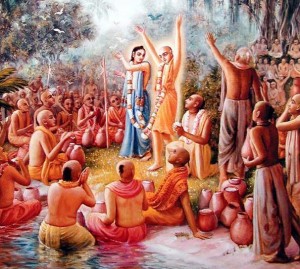
Mahaprabhu Himself manifested there, being attracted by Nityananda’s dancing. In order to reveal the extent of Raghava Pandit’s good fortune, Mahaprabhu and Nityananda sat down together and accepted his offerings of fine rice and various vegetable preparations, as well as cakes and sweet rice, all of which was like the nectar of the gods. Overcome with affection for Raghunatha Das, Raghava Pandit gave Mahaprabhu’s remnants to him. (In the image: Chipped rice festival, Panihati).

 
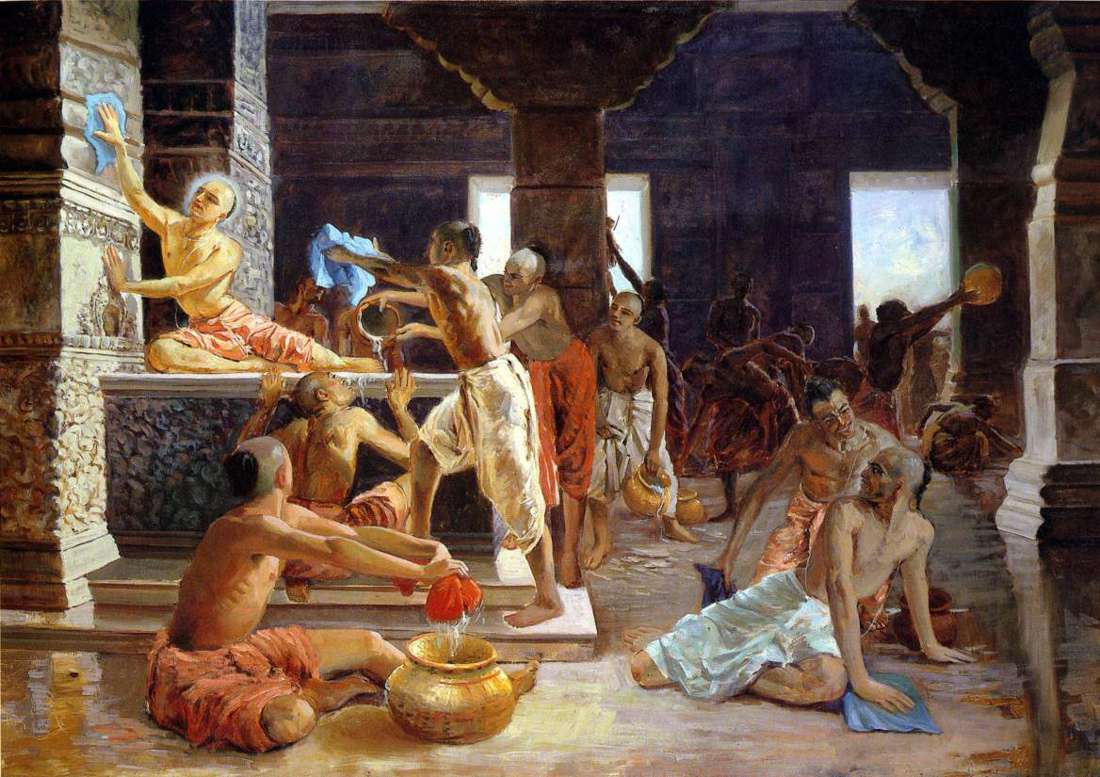
   Raghava Pandit visited Puri on occasion where he participated with Mahaprabhu in the cleaning of the Gundicha Temple, the Rathayatra festival, water sports in the Indradyumna Sarovara, etc. He sang in the chorus with the first group of singers who were led by Svarupa Damodar and in which Advaita Acharya was the principal dancer.
 
   Shrila Bhaktisiddhanta Saraswati Goswami Thakur has written a few words about Raghava Pandit’s samadhi tomb: “A high platform was built over Raghava Pandit’s tomb and it is now overgrown with vines. To the north of the samadhi is a broken down building in which his Madana Mohana Deities are present, but much neglected. The service is managed by the principal landlord of Panihati, named Shivachandra Raya Chaudhuri.” (Anubhashya, 1.10.24). Shrila Prabhupada wrote these lines in 1932. Sixty years later, it appears that the situation has changed. A new Temple and residential building have now been constructed on the site of Raghava Pandit’s home.
 
   [Excerpted from “Shri Chaitanya: His Life & Associates” by Shrila Bhakti Ballabh Tirtha Maharaj] 

Prabodhananda Saraswati – Biography

Prabodhananda Saraswati

The gopi Tungavidya, who was most learned in all the scriptures, has today become the sannyasi Prabodhananda, whose words are all used in the glorification of Lord Gauranga. (In the image: Tungavidya Gopi, ISKCON Mayapur).

   tungavidya vraje yasit sarva-shastra-visharada
sa prabodhananda-yatir gaurodgana-sarasvati
 
   The gopi Tungavidya, who was most learned in all the scriptures, has today become the sannyasi Prabodhananda, whose words are all used in the glorification of Lord Gauranga.
 
   Venkata Bhatta lived in South India. He held a special position amongst the Brahmins as he was very learned in all the scriptures.
 
   There was a Vaishnava of the Shri-sampradaya named Venkata Bhatta who respectfully invited the Lord to his house. (Chaitanya Charitamrita 2.9.82)
 
    In his commentary to this verse of the Chaitanya-charitamrita, Shrila Bhaktivinoda Thakur has written: “Venkata Bhatta, Trimalla Bhatta and Prabodhananda Saraswati were previously acharyas of the Shri-sampradaya. Gopal Bhatta Goswami was the son of Venkata Bhatta.”
 
   Shrila Bhaktisiddhanta Saraswati Goswami Thakur has also commented on the same verse: “Shri Venkata Bhatta was a Brahmin of the Shri-sampradaya who lived in Shrirangam. [FN: Shrirangam is situated on the Kaveri River near Trichinopoly. It is about ten miles from Kumbhakonam in the Tanjor district of Tamil Nadu. The Temple of Shri Ranganatha is the largest Temple in India.] Because Shrirangam is situated in Tamil Nadu, people no longer use the names Venkata and Tirumalai (Trimalla). This family had possibly moved to Shrirangam not long before Mahaprabhu’s visit there. Venkata Bhatta belonged to the Variagalai branch of the Ramanuja sampradaya. One of his brothers was the tridandi sannyasi, Prabodhananda, who acted as an acharya of the school. Venkata Bhatta’s son was Gopal Bhatta Goswami.”
 
   Previously, these three brothers were worshipers of Lakshmi Narayan, but they were converted to the worship of Radha and Krishna by the grace of Shri Chaitanya Mahaprabhu. Krishnadas Kaviraj Goswami has described this conversion in his Chaitanya Charitamrita.
 
   Shrila Prabodhananda Saraswati’s disciple was his own nephew, Gopal Bhatta, one of the six Goswamis.
 
bhakter vilasamsh cinute prabodha-
nandasya shishyo bhagavat-priyasya
gopala-bhatto raghunatha-dasam
santoshayan rupa-sanatanau ca
 
   Gopal Bhatta, the disciple of Prabodhananda who is dear to the Lord, has compiled these devotional activities to satisfy Raghunath Das, Rupa and Sanatan Goswamis. (Hbv 1.2)
 
   Shrila Prabodhananda Saraswati wrote a number of books, including Vrindavan-shataka, Navadwip-shataka, Radha-rasa-sudhanidhi, Chaitanya-chandramrita, which are especially loved by rasika Devotees. Some of his other titles are Sangita-Madhava, Ashcharya-rasa-prabandha, Shruti-stuti-vyakhya, Gitagovinda-vyakhyana and Kama-bija-kama-gayatri-vyakhyana.
 
Is Prabodhananda Prakashananda?
 
   In the third chapter of the Madhya-khanda of the Chaitanya Bhagavat, Shrila Bhaktisiddhanta Saraswati Goswami Thakur comments as follows: “Prakashananda was a teacher of the mayavada doctrine and a sannyasi. While discoursing on the Veda, he cuts up my divine and transcendental body into pieces. Some inexperienced people say that this Prakashananda is the same person as the Prabodhananda, the younger brother of Venkata Bhatta who lived on the banks of the Kaveri. This error has entered into the sahajiya book named Bhaktamal, and the same erroneous belief has entered into the writings of many modern scholars also.” (Gaudiya-bhashya, Madhya-khanda, 3.37.)
 
   That which Shrila Bhaktisiddhanta Saraswati Goswami Thakur has indicated in this commentary is quite true. Ashutosh Deb has written in his dictionary under the rubric, Prabodhananda Saraswati, “A Vaishnava philosopher whose real name was Prakashananda Saraswati. Chaitanya Deva gave him the name Prabodhananda.”
 
   Hari Das Das has also written in his Gaudiya Vaishnava Abhidhana: “Some people hold that Prabodhananda is the Vaishnava name given to Prakashananda… It is clear from the last verse of the Radha-rasa-sudha-nidhi that Prabodhananda had at one time been a mayavadi sannyasi.”
 
   We would argue that the words mayavadarka-tapa-santapta which Hari Das Das quotes as proof of Prabodhananda’s former adherence to the impersonalist philosophy are not acceptable as proof. Mahaprabhu and all of His followers argued against the impersonalist doctrines as much as they could because of its extreme opposition to devotion. The Lord’s deliverance of Sarvabhauma Bhattacharya and Prakashananda Saraswati are greater feats of mercy than even the salvation of Jagai and Madhai. This statement in the Rasa-sudha-nidhi is simply an effort to show the extent of Mahaprabhu’s mercy and His quality as the deliverer of the most fallen.
 
Saraswati Thakur’s Introduction to Chaitanya-chandramrita
 
Prabodhananda Saraswati

In 1510 AD, Shri Krishna Chaitanya went to Southern India in order to show His mercy to His Devotees, though His ostensible purpose was to perform a pilgrimage. Starting from Puri in Orissa, He traveled southward to the Godavari and then continued through various other holy places. On the Ekadashi of the waxing fortnight of the month of Asharih, Mahaprabhu found Himself in Shrirangam. The monks of the Dashanami order to which Mahaprabhu belonged normally follow the Chaturmasya vows, and so the Lord decided to spend the four-month period in Shrirangam. This town is the residence of many Vaishnavas of the Shri-sampradaya. (In the image: Shrirangam basi-resident, Tamil Nadu).

   In his introduction to the edition of Chaitanya-chandramrita, Shrila Bhaktisiddhanta Saraswati Goswami Thakur, the founder of the worldwide Chaitanya Maths has written an account of Prabodhananda Saraswati’s life. The rest of this chapter is a quotation in full of this account:
 
   In 1510 AD, Shri Krishna Chaitanya went to Southern India in order to show His mercy to His Devotees, though His ostensible purpose was to perform a pilgrimage. Starting from Puri in Orissa, He traveled southward to the Godavari and then continued through various other holy places. On the Ekadashi of the waxing fortnight of the month of Asharih, Mahaprabhu found Himself in Shrirangam. The monks of the Dashanami order to which Mahaprabhu belonged normally follow the Chaturmasya vows, and so the Lord decided to spend the four-month period in Shrirangam. This town is the residence of many Vaishnavas of the Shri-sampradaya.
 
   The Vaishnavas of this school are strongly fixed in their practice. Throughout southern India, Smarta Brahmins find it difficult to live in villages where the Shri Vaishnavas are strong. In that period, Shrirangam was a holy place exclusively inhabited by the Shri Vaishnavas. Mahaprabhu considered this a favorable environment for the execution of His four-month vow and so He spent the period in visiting the Temple of Ranganatha and preaching about Krishna. 
 
   Three brothers, Tirumalaya, Venkata and Gopalguru had recently come from Mysore to live in Shrirangam. They were not Tamils but Andhras or from Uttarapradesha. The Lord was particularly merciful to this Brahmin family and spent the four months of the rainy season in their house. The middle brother, Venkata, had a son of five years who later became Gopal Bhatta Goswami, one of the six Goswamis.
 
   The Vaishnavas of the Shri-sampradaya are devoted to the worship of Lakshmi Narayan. By Mahaprabhu’s blessings, this Bhatta family developed a taste for Krishna rasa. Although we know nothing more about Tirumalaya, we can surmise that he was totally devoted to Shri Chaitanya Mahaprabhu. The Lord’s conversation with Venkata Bhatta is described in the ninth chapter of the Chaitanya Charitamrita’s Madhya-lila.
 
   Prabodhananda was unequalled in his attachment to Shri Chaitanya. Through his pure teachings, Venkata’s son Gopal Bhatta became a great acharya of the Gaudiya Vaishnava school. Prabodhananda himself has a particularly elevated position amongst the followers of Shri Chaitanya. Kavi Karnapura has identified him as Tungavidya in his Gaura-ganoddesha-dipika. In the Hari-bhakti-vilasa, he is identified as Gopal Bhatta Goswami’s guru and as extremely dear to Lord Chaitanya. In the Bhakti-ratnakara, the following passages about him are found: Some people glorified Prabodhananda’s virtues and thus he was given the title Saraswati by which he was known everywhere. Shri Krishna Chaitanya is the Supreme Lord and Supreme Absolute Truth. He was so dear to Prabodhananda that even in his dreams he knew nothing else. Prabodhananda was greatly renounced; he was affection incarnate and handsome, as well as being a great poet and expert in singing, playing musical instruments and dance. Everyone’s joy increased on hearing him speak. These are some of the unlimited glories of Prabodhananda Saraswati. (Bhakti-ratnakara 1.149-153)
 
Prabodhananda Comes to Live in Vraja
 
   A few years after Mahaprabhu had returned to Puri, Prabodhananda entered into a deep understanding of the most intimate teachings given by Chaitanya Mahaprabhu. He left Shrirangam and went to live in Kamyavana in the Mathura region. Gopal Bhatta also gradually developed an intense desire to come and live in Vraja and so he followed the path taken by his uncle and guru. 
Prabodhananda Saraswati

A few years after Mahaprabhu had returned to Puri, Prabodhananda entered into a deep understanding of the most intimate teachings given by Chaitanya Mahaprabhu. He left Shrirangam and went to live in Kamyavana in the Mathura region. Gopal Bhatta also gradually developed an intense desire to come and live in Vraja and so he followed the path taken by his uncle and guru. (In the image: ManMandir, Varshana, Uttar Pradesh).

 
   Many people ask the question, “If Prabodhananda was so dear to Chaitanya, why is his name not mentioned anywhere in the Krishnadas Kaviraj Goswami’s Chaitanya Charitamrita? Would he not have included the pastimes of such a great personality for the pleasure of the Vaishnavas?” We can find an adequate response to this question in the Bhakti-ratnakara. Narahari Chakravarti writes:
 
   Some people have described these activities of Gopal Bhatta, others have not. Those who cannot understand the reason for this engage in useless argument, with the result that an offensive attitude takes root in them. Previously, great rasika Devotee poets who were quite capable of describing these events did not do so in order that others would be able to do so in the future. Gopal Bhatta enthusiastically gave his approval to the writing of [Chaitanya-caritamrita] but would not allow [Krishnadas] to write anything about him. Who knows why he did this; likely it was his great humility. Krishnadas Kaviraj Goswami was not able to ignore his command. (Bhakti-ratnakara 1.209…223)
 
Prabodhananda and svakiya-rasa
 
   Some people say that Prabodhananda’s writing show a tendency to the svakiya doctrine. For this reason, Gaudiya Vaishnavas who consider the parakiya-vada superior do not show a great enthusiasm for studying his books. Anyone who is devoted to Chaitanya Mahaprabhu is blessed. We simply follow Narahari Chakravarti, a neutral commentator, and avoid useless argument. We relish the writings of Prabodhananda which are filled with the sweetness of servitude to Krishna in the parakiya mood.
 
   Prabodhananda’s mood is very clear. In his language, both gravity and sweetness are found equally. Mahaprabhu’s Devotees take great pleasure in reading his Vrindavan-shataka. His Navadwip-shataka resembles the Vrindavan-shataka. His Radha-rasa-sudha-nidhi is truly unequalled in the entire world. This book, Chaitanya-charitamrita, does not bring quite the same degree of pleasure from the poetic point of view, but is nevertheless extremely dear to the Devotees who have an attachment to the sacred rapture of devotion. According to one’s taste, one experiences a work as being superior or inferior. Thus for the transcendental moods of Vraja-bhakti to take effect on a reader, there is a certain dependence on his pious activities from previous lives. Another book, Viveka-shataka, attested by Aufrecht in his notices of manuscripts, is attributed to Prabodhananda Saraswati. The late Rama Das Sena of Berhampore saw this manuscript.
 
   The Chaitanya-charitamrita was widely distributed in Bengal. Even those inimical to Chaitanya became purified upon reading it and experienced a change of heart. It thus goes without saying that Devotees of Lord Chaitanya Mahaprabhu will be immersed in an ocean of indescribable ecstasy. When the Lord of Goloka comes and stays for four months in someone’s house and accepts service from that household, it is not surprising that He bestows upon that household the most rare forms of love of God. The insignificant living entities can hope to gain some crumbs from the storehouse of priceless love which these blessed persons possess.
 
Prakashananda Saraswati
 
   Some people attempt to identify Prabodhananda with the Mayavadi sannyasi Prakashananda Saraswati who lived in Varanasi. We are not able to accept their arguments in any way whatsoever for the following reasons: The following account of Prakashananda Saraswati is given in the third chapter of the Madhya-khanda in the Chaitanya Bhagavat: 
 
   "Thus the Lord constantly floated in the joys of devotion along with His followers in Navadwip. One day, He heard a verse glorifying the Varaha avatar. He began to roar and went to Murari Gupta’s house. Being satisfied by the praises of Murari, He began to speak in anger against the Vedas: “The Vedas say that I have no hands, feet, face or eyes. This is the way that they make a mockery of Me. In Kashi there is a rascal named Prakashananda who teaches people, cutting My body up into little pieces. He states that the Veda does not accept that I have a body. His entire body has become infected with leprosy and yet he still does not accept My transcendental form. My body is pure and the condensed form of all the sacrifices. Brahma, Shiva and the other gods all glorify My form and activities. What audacity this rascal has to say that My body is false when one accumulates merit and becomes purified by coming into contact with it." (Chaitanya Bhagavat 2.3.35-40) 
Prabodhananda Saraswati

“The Vedas say that I have no hands, feet, face or eyes. This is the way that they make a mockery of Me. In Kashi there is a rascal named Prakashananda who teaches people, cutting My body up into little pieces. He states that the Veda does not accept that I have a body. His entire body has become infected with leprosy and yet he still does not accept My transcendental form. My body is pure and the condensed form of all the sacrifices. Brahma, Shiva and the other gods all glorify My form and activities. What audacity this rascal has to say that My body is false when one accumulates merit and becomes purified by coming into contact with it." (Chaitanya Bhagavat 2.3.35-40) (In the image: Shri Vrindavana Natabara, ISKCON Columbus, Ohio).

 
   This event took place sometime between 1425 and 1430 of the Shaka era (1504 and 1509 AD). Mahaprabhu came to Shrirangam in 1433 (1512 AD) which is the first time that He met Prabodhananda and his brothers. The three brothers were Vaishnavas in the Shri sampradaya following Ramanuja and thus believers in the eternal form of Narayan. Prakashananda was a Mayavadi sannyasi during this time, a prominent follower of Shankara’s doctrine. It is sheer madness to say that that these two persons are one and the same. Again, in the Chaitanya Bhagavat, Madhya-khanda, the following mention is made of Prakashananda Saraswati:
 
   As he spoke, the Lord was suddenly possessed by the spirit of the Divinity. Grinding His teeth, He angrily spoke the following words: The sannyasi Prakashananda is preaching in Kashi in a way that cuts My body into pieces. The rascal teaches Vedanta but does not accept My transcendental form. I have infected his body with leprosy, but still he does not understand. How can this rascal say that My body, which is filled with unlimited universes, is false? I tell you truthfully, Murari, for you are My servant, that anyone who denies My transcendental form is destined for destruction. My lila and My works are all true; My abode is true. Anyone who denies them will be struck down. The glories of the Lord will destroy one’s ignorance if one hears them, but this sinful professor calls it all false. Anyone who has so little affection for My holy fame will never be able to understand My incarnation. (Chaitanya Bhagavat 2.10.31…44)
 
   At that time, Prakashananda Saraswati was the leader of the ekadandi sannyasi followers of Shankara, whereas Prabodhananda was a tridandi sannyasi in the line of Ramanuja, who had moved to Shrirangam from Mysore. Prakashananda was a Mayavadi living in Kashi, whereas Prabodhananda was a Vaishnava living in Kamyavana. One was a northerner, the other a southerner. One was an impersonalist and monist, the other a Devotee who first followed Ramanuja’s vishishtadvaita-vada and then converted to Mahaprabhu’s achintya-bhedabheda-vada. One was an enemy of Vishnu and the Vaishnavas and only after conversion became a Devotee, the other was the guru of Gopal Bhatta Goswami, an eternal associate of Lord Chaitanya Mahaprabhu and acharya of the Gaudiya Vaishnava sampradaya. Anyone who calls Gopal Bhatta Goswami’s worshipable guru and uncle a mayavadi and enemy of Vishnu and the Vaishnavas, a conditioned soul, rather than an eternally perfect Devotee of the highest order, is engaging in insults which are offensive and sure to lead him who makes them to a hellish destination.
 
   In two places in the Chaitanya Charitamrita, an extensive description of the conversion of Prakashananda Saraswati is given. It is impossible to understand how someone who had been a mayavadi from 1504 to 1509, then a qualified dualist Vaishnava in South India in 1512, should again become the leader of the Mayavadis in Kashi in 1514. Therefore, any attempt to identify Prakashananda with Prabodhananda is evidence of extreme ignorance. It is no small cause of distress to see the tradition being uprooted in this way. As proof of his humility, Prabodhananda asked through Gopal Bhatta that his own activities not be described in the Chaitanya-charitamrita. Krishnadas Kaviraj Goswami was not able to disobey this order and so today we have this problem. If Prabodhananda had known that as a result of this silence people would later fall into confusion and identify him with someone who preached against Vishnu and the Vaishnavas he would surely not have commanded Gopal Bhatta and Krishnadas Kaviraj in this way. Anyone who reads the Bhakti-ratnakara will understand. The author of that book writes: 
Prabodhananda Saraswati

Gaurachandra was the wealth of Tirumalaya, Venkata and Prabodhananda’s lives. The three of them were worshipers of Lakshmi Narayan whose preferences changed to Radha and Krishna as a result of the Lord’s mercy...(In the wallpaper: from left to right Shri Shri Lakshmi Narayana Pirumala, Shri Shri Radha Gopinatha, Radhadesh, ISKCON Belgium).

 
   Gaurachandra was the wealth of Tirumalaya, Venkata and Prabodhananda’s lives. The three of them were worshipers of Lakshmi Narayan whose preferences changed to Radha and Krishna as a result of the Lord’s mercy… The three of them wondered how they could continue living in the Lord’s absence; they wondered who would joke with them and who would accompany them to the Kaveri to bathe in the morning… After four months, when the Lord left, the three brothers began to cry. Mahaprabhu embraced the three brothers and tried to console them. Some people glorified Prabodhananda’s virtues and thus he was given the title Saraswati by which he was known everywhere. Shri Krishna Chaitanya is the Supreme Lord and Supreme Absolute Truth. He was so dear to Prabodhananda that even in his dreams he knew nothing else. (Bhakti-ratnakara 1.83-4, 128-9, 133, 135, 149, 150)
 
   Professor Aufrecht has listed Sangita-Madhava as Prabodhananda’s work. We managed to trace this work and published it in the 18th volume of Sajjana-toshani, in issues 5-12.
 
   Shri Vaishnavas who renounce family life never take the single staff (ekadanda), which is the mark of the Shankarites. Their custom is to take the triple staff (tridanda) and the title Ramanujaryaswami. Some people claim upon reading the Chaitanya-charitamrita that Prabodhananda had been a worshiper of Brahman, but if we accept this without any supplementary evidence we fall into difficulty.
 
   [Excerpted from “Shri Chaitanya: His Life & Associates” by Shrila Bhakti Ballabh Tirtha Maharaj] 
Prabodhananda Saraswati

The sannyasi Prakashananda is preaching in Kashi in a way that cuts My body into pieces. The rascal teaches Vedanta but does not accept My transcendental form. I have infected his body with leprosy, but still he does not understand. How can this rascal say that My body, which is filled with unlimited universes, is false? I tell you truthfully, Murari, for you are My servant, that anyone who denies My transcendental form is destined for destruction. My lila and My works are all true; My abode is true. Anyone who denies them will be struck down. The glories of the Lord will destroy one’s ignorance if one hears them, but this sinful professor calls it all false. Anyone who has so little affection for My holy fame will never be able to understand My incarnation. (Chaitanya Bhagavat 2.10.31...44) (In the wallpaper: Supreme Personality of Godhead Krishna).

Pradyumna Mishra

avirbhavo gauraharer nakula-brahmacarini
aveshash ca tatha jïeyo mishre pradyumna-sangake
 
   The Lord’s avirbhava ("manifestation") took place in Nakula Brahmachari, and His avesha ("possession") in Pradyumna Mishra. (Gaura-ganoddesha-dipika 73-74). 
Pradyumna Mishra

The Lord’s avirbhava ("manifestation") took place in Nakula Brahmachari, and His avesha ("possession") in Pradyumna Mishra. (Gaura-ganoddesha-dipika 73-74). (In the wallpaper: Shri Krishna Chaitanya, ISKCON Chennai).

 
   Shrila Bhaktisiddhanta Saraswati Goswami Thakur has written that Pradyumna Mishra was an Orissan (Chaitanya Charitamrita 1.10.131, Anubhashya). Vrindavan Das Thakur has stated the same in Chaitanya Bhagavat.
 
   Many of Mahaprabhu’s associates took birth in Orissa. It was not long before they came and met with the Lord. Amongst them were Pradyumna Mishra, whose body was solidified prema. The great self-controlled Devotees Paramananda Mahapatra and Ramananda Raya were others. (Chaitanya Bhagavat 3.3.183-4)
 
   According to Gaudiya Vaishnava Abhidhana, Pradyumna Mishra was originally a resident of Sylhet and only later moved to Orissa. He is counted amongst the branches of Chaitanya Mahaprabhu Himself. The extent to which he was dear to Mahaprabhu is described in both the Chaitanya Charitamrita and Chaitanya Bhagavat:
 
   Pradyumna Mishra was an ocean of love for Krishna and Lord Gaurasundara put him on the same level as Himself. (Chaitanya Bhagavat 3.5.211)
 
   Chief amongst the loving Devotees of the Lord were Kashishvara Pandit, Bhagavan Acharya and Pradyumna Mishra. (Chaitanya Bhagavat 3.8.57)
 
   The Lord felt joy on meeting Kashi Mishra, Pradyumna Mishra and Bhavanand Raya. (Chaitanya Charitamrita 1.10.131)
 
   All glories to the Lord, the life of Pradyumna Mishra, the wealth of Paramananda Puri. (Chaitanya Bhagavat 1.14.2)
 
   When Mahaprabhu returned from South India, Sarvabhauma Bhattacharya introduced Pradyumna Mishra to the Lord as a great Vaishnava.
 
   Pradyumna Mishra is the best of the Vaishnavas. He was Jagannath’s chief cook and had the family title of Das. (Chaitanya Charitamrita 2.10.42) [FN: Das is sometimes used by Brahmana families in Orissa, though it is a lower caste name in Bengal.]
 
   Later, Pradyumna Mishra was instructed by Mahaprabhu to go to Ramananda Raya to hear Krishna-katha. This has been extensively described in the Chaitanya Charitamrita, Antya-lila, chapter 5. Shrila Bhaktisiddhanta Saraswati Goswami Thakur writes in his Gaudiya Bhashya to the Chaitanya Bhagavat (Adi, 14.2): "Pradyumna Mishra took birth in a Brahmin family in central Orissa. He led an exemplary pious householder life, showing nobility of character in his adherence to social etiquette. Mahaprabhu gave meaning to this behavioral standard by sending him to the great Devotee, Ramananda Raya, who though not born in a material Brahmin family was the most competent instructor in the matter of bhakti-rasa. When Pradyumna Mishra went to this Vaishnava acharya to hear him glorify Krishna’s pastimes in the attitude of a disciple and thereby received Mahaprabhu’s causeless mercy."
 
Pradyumna Wants to Hear Harikatha
 
   Pradyumna Mishra came one day to Mahaprabhu eagerly asking to hear some Hari-katha. Mahaprabhu replied with great humility that he was not qualified to speak on elevated matters of sacred rapture and sent him to meet Ramananda Raya. At the time, Ramananda Raya was living in the Jagannath-vallabha gardens. The service he was engaged in for the pleasure of Lord Jagannath was beyond the capacity of even great self-controlled sages, what to speak of ordinary human beings. He would prepare two young deva-dasis for the performance of a play which was to be given before Lord Jagannath, not only by training them in the songs that they would sing and in the dance they would perform, but also by bathing, dressing and decorating them. While Ramananda Raya was engaged in such service, no one was allowed to interrupt him. 
Pradyumna Mishra

"I am a sannyasi and I consider Myself to be renounced. But if I even hear the name of a woman, what to speak of seeing one, I feel an effect on My mind and body. So who is not moved by the sight of a woman? Everyone listen to Me. Let Me tell you about Ramananda Raya, although they are so wonderful and uncommon that they really cannot be properly described. He personally serves Jagannath’s young and beautiful devadasis in every possible way. He personally bathes and dresses them and decorates them with ornaments. While doing so, he naturally sees and touches the private parts of their bodies, but even so, his mind is never affected. He teaches the girls how to physically express all the moods of love, to be acted out before Jagannath Deva, but his mind and body are as steady as wood or stone. Indeed, it is amazing that even when he touches such young girls, his mind is not disturbed. Only Ramananda has the right to do such things, and seeing him do them, I can understand that his body is not material but has been completely transformed into a spiritual entity." (Chaitanya Charitamrita 2.5.35-42) (In the wallpaper: Lord Shri Jagannath, and a dancer).

 
   The first time that Pradyumna Mishra came to see Ramananda, one of Ramananda’s servants told him that he was busy doing this work and asked Mishra to sit outside and wait. After Pradyumna Mishra had been waiting a long time, Ramananda Raya finished his service and came outside and learned that Pradyumna Mishra had been waiting there to hear about Krishna from him. He showed the Brahmin the appropriate respect and begged forgiveness for his offense in making him wait. Mishra realized that it was too late that day for his wish to be fulfilled and he returned home.
 
   Some days later, when Mahaprabhu saw Mishra, he asked him how the meeting with Ramananda had gone and what topics they had discussed. At first, Pradyumna Mishra remained silence because of the doubts which he had about Ramananda Raya’s behavior. Mahaprabhu, as the antaryami was able to understand what was going through his mind and began to glorify Ramananda’s extraordinary character with great force. His words are found in the Chaitanya Charitamrita:
 
   "I am a sannyasi and I consider Myself to be renounced. But if I even hear the name of a woman, what to speak of seeing one, I feel an effect on My mind and body. So who is not moved by the sight of a woman? Everyone listen to Me. Let Me tell you about Ramananda Raya, although they are so wonderful and uncommon that they really cannot be properly described. He personally serves Jagannath’s young and beautiful devadasis in every possible way. He personally bathes and dresses them and decorates them with ornaments. While doing so, he naturally sees and touches the private parts of their bodies, but even so, his mind is never affected. He teaches the girls how to physically express all the moods of love, to be acted out before Jagannath Deva, but his mind and body are as steady as wood or stone. Indeed, it is amazing that even when he touches such young girls, his mind is not disturbed. Only Ramananda has the right to do such things, and seeing him do them, I can understand that his body is not material but has been completely transformed into a spiritual entity." (Chaitanya Charitamrita 2.5.35-42)
 
   Thus saying that Ramananda Raya was highly qualified to speak on matters connected to Krishna, the Lord sent Pradyumna Mishra back again. When he arrived in the Jagannath-vallabha gardens, Ramananda greeted him by paying obeisances. Pradyumna then heard Ramananda explained all the different topics on sambandha, abhidheya and prayojana which he had recounted to the Lord at Vidyanagara during His trip to South India. Both the speaker and the hearer completely forgot themselves in the ecstasies of Krishna-katha. The whole day passed in this way. Pradyumna Mishra felt himself to be completely fulfilled by the hearing of all these subjects of Krishna and he went to tell Mahaprabhu about it.
 
   Shrila Bhaktisiddhanta Saraswati Goswami Thakur has made the following commentary on this anecdote in his Anubhashya: "Ordinarily, the Brahmin acts as preceptor to the three other varnas and the sannyasi is the guru of all Brahmins in the three other ashramas. The Lord wished to curb the false pride arising from these notions by sending Pradyumna Mishra, even though he was a pure blood Brahmin, to take instruction from Ramananda Raya, who belonged to the lowest varna, that of the shudras, and to the lowest ashrama, that of the householder. The Lord Himself, though a sannyasi, also showed the same example by taking instruction personally from him, accepting the conclusions which he preached."
 
[Excerpted from “Shri Chaitanya: His Life & Associates” by Shrila Bhakti Ballabh Tirtha Maharaj] 
Pradyumna Mishra

Ordinarily, the Brahmin acts as preceptor to the three other varnas and the sannyasi is the guru of all Brahmins in the three other ashramas. The Lord wished to curb the false pride arising from these notions by sending Pradyumna Mishra, even though he was a pure blood Brahmin, to take instruction from Ramananda Raya, who belonged to the lowest varna, that of the shudras, and to the lowest ashrama, that of the householder. The Lord Himself, though a sannyasi, also showed the same example by taking instruction personally from him, accepting the conclusions which he preached. (In the image: Shrila Prabhupada).

Pradyumna Brahmachari

Pradyumna Brahmachari

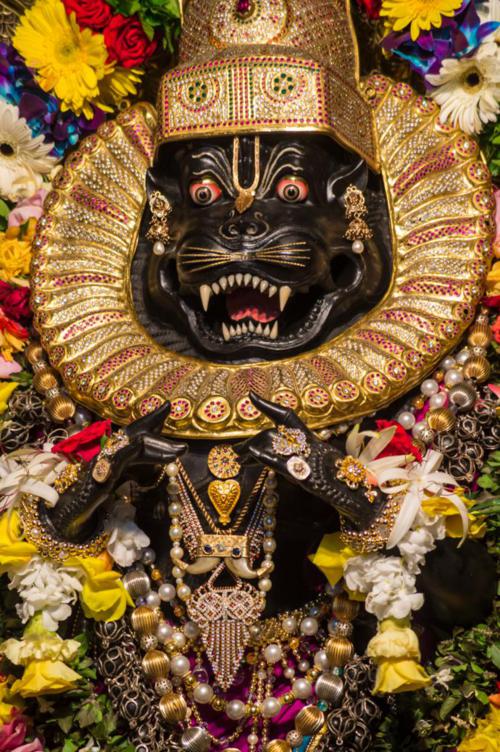
Mahaprabhu gave Pradyumna Brahmachari the epithet Nrisinghananda because of his absorption in the service of Nrisingha. He is considered to be one of Chaitanya’s own branches. (Chaitanya Charitamrita 1.10.35, 3.2.53) (In the image: Shri Narasimhadev, ISKCON Mayapur).

   Shri Pradyumna Brahmachari or Shri Nrisinghananda.
 
aveshash ca tatha jïeyo mishre pradyumna-sanjnake
 
   The Lord’s avesha manifestation took place in Pradyumna Mishra.
 
   Shrila Bhaktisiddhanta Saraswati Goswami Thakur has quoted the above verse in connection with Pradyumna Brahmachari and not for the Orissan Pradyumna Mishra who will be described later in chapter 63 of this volume. The Gaudiya Vaishnava Abhidhana has also taken the same position. Hari Das Das there calls Pradyumna Brahmachari the Lord’s avesha.
 
The Lord’s Avirbhava
 
sakshat-darshana, ara yogya-bhakta-jive
avesha karaye kahan, kahan avirbhave
 
   Lord delivered the fallen souls in three different ways: some places by appearing to them directly in His self-same body, in other places by entering into a worthy Devotee, and in still other places by divine epiphany. His principal method of giving salvation was to appear to the conditioned souls in His Self-same body, but He also took possession of Nakula Brahmachari’s body and made an apparition before Nrisinghananda Brahmachari. It is the Supreme Lord’s nature to declare, “I shall deliver the people of the world.” (Chaitanya Charitamrita 3.2.4-6)
 
The Name Nrisinghananda
 
   Mahaprabhu gave Pradyumna Brahmachari the epithet Nrisinghananda because of his absorption in the service of Nrisingha. He is considered to be one of Chaitanya’s own branches. (Chaitanya Charitamrita 1.10.35, 3.2.53)
 
   Pradyumna Brahmachari considered himself to be the servant of Nrisingha for Nrisinghadeva manifested Himself in his body. He remained by Mahaprabhu’s side in the consciousness that Nrisingha Himself had appeared in the form of a sannyasi. (Chaitanya Charitamrita 3.3.286-7)
 
   Vrindavan Das Thakur writes in the Chaitanya Bhagavat that Pradyumna conversed directly with Nrisinghadeva. This is mentioned particularly when Pradyumna joined the company of Devotees on the annual pilgrimage to Jagannath Puri.
 
   Pradyumna Brahmachari, who talked directly to Lord Nrisingha walked along as a part of the company of Devotees. (Chaitanya Bhagavat 3.8.92)
 
   All those people who think that the body of the Lord is a product of the material nature are atheists who have been bewildered by the Lord’s illusory energy. They think that these accounts are tall stories they can criticize out of their false sense of being learned. Anyone who lacks faith in the Supreme Lord is an unfortunate beggar who is cheated of any worthwhile achievement in life, and who gains nothing but the birth and death that are the lot of the conditioned soul.
 
The Power of Pradyumna’s Meditation
 
   When Mahaprabhu took sannyas in Katwa, He made off for Vrindavan, but Nityananda Prabhu tricked Him into coming back to Shantipur to the house of Advaita Acharya. Afterwards, the Lord continued to Puri in the company of Nityananda Prabhu, Jagadananda Pandit, Mukunda Datta and Damodar Pandit. Shortly thereafter, He left Puri on a pilgrimage through southern India. On His return from South India, He planned a trip to Vrindavan that would take Him on the route along the Ganges through Bengal. On this trip, He stopped at the house of Sarvabhauma Bhattacharya’s brother, Vidya Vachaspati in Vidyanagara, delivered Devananda Pandit and Chapal Gopal from their offenses in Kuliya village, and then met Rupa and Sanatan Goswamis for the first time in Ramakeli. 
 
   As Mahaprabhu made this trip, Pradyumna Brahmachari meditated on Him, visualizing himself placing jeweled bricks on the road on which the Lord was walking to make His journey more agreeable. When the Lord reached Kanair Natshala, about 200 miles north of Calcutta in the Santal Paragana district of Bihar state, five miles from the town of Rajmahal, Pradyumna’s meditation suddenly broke. He was immediately able to understand that the Lord would only go as far as Kanair Natshala on this occasion and no further. 
Pradyumna Brahmachari

As Mahaprabhu made this trip, Pradyumna Brahmachari meditated on Him, visualizing himself placing jeweled bricks on the road on which the Lord was walking to make His journey more agreeable. When the Lord reached Kanair Natshala, about 200 miles north of Calcutta in the Santal Paragana district of Bihar state, five miles from the town of Rajmahal, Pradyumna’s meditation suddenly broke. He was immediately able to understand that the Lord would only go as far as Kanair Natshala on this occasion and no further. (In the wallpaper: Land of Vrindavan).

 
   It is said that mental service like that performed by Nrisingha Brahmachari in this meditation is superior to service performed with actual ingredients. Rupa Goswami makes this point in his Bhakti-rasamrita-sindhu (1.2.182), where he gives the example of the Brahmin from Pratishthanpura who attained the association of Narayan in Vaikuntha as a result of mental service or manasi seva.
 
Pradyumna Brings the Lord to Kumarahatta
 
   On one occasion, Mahaprabhu was attracted by Nrisinghananda’s love to come to Kumarahatta and to appear in the house of Shivananda Sena. This story has been told beautifully by Krishnadas Kaviraj Goswami in the second chapter of the Antya-lila of his Chaitanya Charitamrita.
 
   One year, as Shivananda Sena’s nephew Shrikanta Sena left Puri, Mahaprabhu told him to convey the message to the Bengali Devotees that there was no need for them to come to Puri that year, for He Himself would be visiting Bengal in the month of Paush. When Shrikanta came with this news, all the Devotees were jubilant in expectation of the Lord’s visit. But when the month of Paush had almost come to an end and there was no sign of Mahaprabhu, Shivananda Sena, Jagadananda Pandit and the others who had been waiting anxiously were disheartened by His non-arrival.
 
   At that time, Nrisinghananda happened by and asked everyone the reason for their unhappiness. When he heard that they were disappointed that the Lord had not come, he assured them that he would be able to make Mahaprabhu appear there within three days. Since Shivananda and Jagadananda knew Nrisinghananda’s spiritual powers, they believed him.
 
Pradyumna-Brahmachari

As soon as he sat down in meditation for the offerings, Mahaprabhu personally appeared and ate all three plates, leaving no remnants. (In the image: Lord Chaitanya eating the food which Brahmachari offered to Him).

   Nrisinghananda sat down and stayed absorbed in meditation for two days, after which he told Shivananda that Mahaprabhu had arrived in Panihati and that by noon of the next day He would be in Kumarahatta. He ordered Shivananda Sena to supply him with the ingredients for a feast in honor of the Lord. He personally started cooking early in the morning and made a large variety of preparations that he distributed onto three plates to make offerings to Jagannath, Nrisinghadeva and Mahaprabhu. As soon as he sat down in meditation for the offerings, Mahaprabhu personally appeared and ate all three plates, leaving no remnants.
 
   Although Nrisinghananda was overjoyed to see the Lord accept his offerings, he made a pretense of disappointment. He said, since Mahaprabhu and Jagannath are ontologically non-different, there was no fault in His eating the plate set out for Jagannath. But why had He taken the offering intended for Nrisingha? “Nrisinghadeva has fasted today,” he said. Indeed, the Lord performed this pastime in order to show that He is not different from Jagannath or Nrisinghadeva.
 
   After eating, Mahaprabhu left for Panihati. Nrisinghananda cried out in distress, causing Shivananda to inquire what was the cause of his troubles. Nrisinghananda answered that the Lord had alone eaten all three plates, leaving Jagannath and Nrisinghadeva to fast. Shivananda Sena had some doubts, but on his request provided him with foodstuffs to prepare a second offering. The brahmachari cooked once again and made an offering to Nrisinghadeva.
 
   The next year, when Shivananda Sena went with the Bengali Devotees to Puri, everyone was duly astonished to hear the Lord Himself volunteer the information that He had been to Shivananda’s house in the month of Paush and had eaten the delicious offerings made by Nrisinghananda.
 
   One day, the Lord was engaged in conversation in the presence of all the Devotees and suddenly began to praise Nrisinghananda’s qualities. He said, “Last year in the month of Paush, Nrisinghananda gave me delicious sweetmeats and vegetables such as I had never eaten.” Hearing this, all the Devotees were struck with wonder and Shivananda was finally convinced that the incident was true. (Chaitanya Charitamrita 3.2.76-78)
 
   [Excerpted from “Shri Chaitanya: His Life & Associates” by Shrila Bhakti Ballabh Tirtha Maharaj] 
Pradyumna Brahmachari

It is said that mental service like that performed by Nrisingha Brahmachari in this meditation is superior to service performed with actual ingredients. Rupa Goswami makes this point in his Bhakti-rasamrita-sindhu (1.2.182), where he gives the example of the Brahmin from Pratishthanpura who attained the association of Narayan in Vaikuntha as a result of mental service or manasi seva. (In the wallpaper: Chanting of the Hare Krishna Maha Mantra on Tulasi beads).

Parameshvara Dasa Thakura

namnarjunah sakha prag yo dasa sa parameshvarah
 
   Parameshvara das Thakur was previously Arjuna, one of Krishna’s twelve cowherd boyfriends. (Gaura-Ganoddesha-Dipika 132)
 
   Shrila Parameshvara Thakur appeared in a Vaidya family. He made his home in Antpur, a village which was previously known by the name of Bishakhali. The Antpur station is on the Champadanga branch of the Howrah-Amta rail line. Parameshvara Thakur’s Shripat is not far from the train station and near the old Radha Govinda Temple established of the diwan or chief minister of Burdwan’s king, Tej Bahadur.
 
   After the Lord took sannyas in Katwa, he headed for Vrindavan in a state of divine intoxication before being diverted to Advaita Acharya’s house in Shantipur by Nityananda Prabhu. Sachi Mata and the other Devotees from Navadwip all came to see the Lord there. At His mother’s request, Mahaprabhu agreed to stay in Puri and took the path through Chatrabhoga to Nilachala in the company of Nityananda, Mukunda, Jagadananda and Damodar. 

Parameshvara Dasa Thakura

The first time that the Lord wished to go to Vrindavan from Nilachala, He came through Bengal, though He was eventually unsuccessful, He passed through Panihati, Kumarahatta, Kuliya, Ramakeli, Kanair Natshala, Shantipur, etc., before returning to Puri. When Nrisinghananda Brahmachari heard that Mahaprabhu was going to Vrindavan, he meditated on the Lord’s route, imagining a road of jewels as far as Kanair Natshala, when he realized that this was as far as the Lord would go, that he would not make it to Vrindavan this time. (In the wallpaper: Lotus Feet of Shri Gaura Chandra, ISKCON Chowpatty, Mumbai).

   The first time that the Lord wished to go to Vrindavan from Nilachala, He came through Bengal, though He was eventually unsuccessful, He passed through Panihati, Kumarahatta, Kuliya, Ramakeli, Kanair Natshala, Shantipur, etc., before returning to Puri. When Nrisinghananda Brahmachari heard that Mahaprabhu was going to Vrindavan, he meditated on the Lord’s route, imagining a road of jewels as far as Kanair Natshala, when he realized that this was as far as the Lord would go, that he would not make it to Vrindavan this time. Thousands of people were accompanying the Lord at this time. When He arrived at Kanair Natshala, He remembered Sanatan Goswami’s advice,

 
   “To go on pilgrimage with such a large company of Devotees is not recommended. You are going to Vrindavan with an entourage of hundreds and thousands of people, and this is not a fitting way to go on a pilgrimage.” (Chaitanya Charitamrita 2.1.222-4) 
 
   On His way back to Nilachala, Mahaprabhu stopped at Advaita’s house in Shantipur. This time He was accompanied by Balabhadra Bhattacharya and Damodar Pandit. When the Lord returned from Gaya, he also went as far as Kanair Natshala where he had a vision of Muralidhara Shri Krishna, who embraced him before he disappeared (Chaitanya Bhagavat 2.2.179-85). Once he returned to Nilachala, Mahaprabhu told Nityananda Prabhu to go with his own associates to Bengal to deliver the lowborn, foolish and fallen people. Amongst his associates at that time were Shri Rama Das, Gadadhara Das, Raghunatha Vaidya, Krishna Das Pandit, Parameshvara Das and Purandara Pandit. While travelling with Nityananda, these Devotees displayed various ecstatic moods. These are described in the Chaitanya Bhagavat:
 
   Krishna Das Pandit, Parameshvara Das and Purandara Pandit were all enthusiastic to join Nityananda. So all of his personal associates accompanied him on this journey back to Bengal. Before starting off, Nityananda first empowered them by saturating them with Krishna prema. They all completely forgot their external identities. There was no end to the variety of ecstatic moods that manifested in each one of their bodies. (Chaitanya Bhagavat 3.5.232-235)
 
   Parameshvara Das and Krishna Das both shouted “Hoi! Hoi!” in the spirit of cowherd boys. (Chaitanya Bhagavat 3.5.240) Parameshvara Das was one of the most important of Nityananda Prabhu’s companions, who appeared specifically to enrich his pastimes. Nityananda Prabhu considered him to be his very own life. This too is stated in the Chaitanya Bhagavat:
 
   Parameshvari Das is Nityananda’s life. Nityananda used his body as an extension of his own. (Chaitanya Bhagavat 3.5.732)
 
   It is also stated in the Chaitanya Bhagavat that Mahaprabhu manifested Himself in the Gauranga Deity Parameshvari Das worshiped in Antpur. 
Parameshvara Dasa Thakura

On His way back to Nilachala, Mahaprabhu stopped at Advaita’s house in Shantipur. This time He was accompanied by Balabhadra Bhattacharya and Damodar Pandit. When the Lord returned from Gaya, he also went as far as Kanair Natshala where he had a vision of Muralidhara Shri Krishna, who embraced him before he disappeared (Chaitanya Bhagavat 2.2.179-85). (In the wallpaper: Shri Muralidhara, ISKCON Manhattan, NYC, USA).

 
   Purandara Pandit and Parameshvari Das both saw the manifestation of Gaurachandra in the Deity. As soon as they saw Him, they ran towards Him and fell down, crying in the ecstasy of love. (chaitanya Bhagavat 5.95-6)
 
   It is said in the Bhakti-ratnakara that Parameshvari Das was in the entourage of Nityananda’s shakti, Jahnava Mata, when she went to the Kheturi festival.
 
   Jahnava Ishvari happily walked in the company of Gauranga, Nakarii Krishna Das, Damodar, Parameshvari, the learned Balaram, Mukunda, Vrindavan Das, etc. (Bhakti-ratnakara 10.376-7)
 
   Shri Parameshvari Das Thakur also accompanied Jahnava Mata on her last trip to Vraja Dhama and witnessed her merging into the body of Radhika in the Gopinath Temple. He established the worship of Radha-Gopinath Deities in Antpur on Jahnava’s order.
 
   Once back from Vraja, Parameshvari Das stayed for some time in Khardaha and Garalagacha village in Puri district. When Narottama Das came to Khardaha, he gave him directions to Puri. In Chaitanya Charitamrita, it is written that just by remembering Parameshvari Das one can attain love for Krishna.
 
   Parameshvari Das took exclusive shelter of Nityananda Prabhu. Whoever remembers him attains devotion to Krishna. (Chaitanya Charitamrita 1.11.29)
 
   Shri Parameshvari Das had miraculous powers. On one occasion, Harinama-sankirtan was being at the house of Kamalakara Pippalai in the town of Akna Mahesh situated near Serampore. Parameshvari was dancing in ecstasy during the kirtan. Hearing the sounds of the kirtan and seeing the ecstatic dancing caused some of the local atheists to become very envious. They decided to pollute the kirtan area and to teach the Devotees a lesson, so they threw a dead jackal in the midst of the kirtan group. But Parameshvari did not stop dancing for a moment. By the force of his kirtan, the jackal came back to life and started to howl along with the kirtan. The other Devotees were astonished by this display of power and overcome by transcendental joy. This has been mentioned in the Vaishnava-vandana:
 
   I very attentively worship Parameshvari Das, who made a jackal come back to life during sankirtan.
 
   In front of the Temple in Antpur are two huge Bakula trees and a Kadamba tree. Between them is the samadhi tomb of Parameshvari Das, over which is a Tulasi Altar. It is said that Bakula trees grew from the branch of a tree that grew there during the time of Parameshvari Thakur. Every year, the Kadamba tree produces a flower that is used for the worship of the Deities. Parameshvari Thakur’s tirobhava festival is held every year on the vaishakhi purnima.
 
   [Excerpted from “Shri Chaitanya: His Life & Associates” by Shrila Bhakti Ballabh Tirtha Maharaj]

Paramananda Puri – Biography

puri paramanando ya asid uddhavah pura
 
   He who was Uddhava in Krishna-lila came to enrich the pastimes of Gaura as Paramananda Puri.
(Gaura-ganoddesha-dipika 118) 
Paramananda-Puri

He who was Uddhava in Krishna-lila came to enrich the pastimes of Gaura as Paramananda Puri. (Gaura-ganoddesha-dipika 118) (In the image: from left to right Lord Krishna, Uddhava, Maitreya Rshi).

 
   Nothing is known about Paramananda Puri’s antecedents nor about his appearance and disappearance dates. It is known that he was born in Tirhut, the area which surrounds Muzaffarpur and Darbhanga in Bihar. Shrila Bhaktisiddhanta Saraswati Goswami Thakur has described him as a Brahmin from Tirhut.
 
   His diksha guru was Madhavendra Puri, as a result of which he was treated as a very dear superior by Mahaprabhu. Krishnadas Kaviraj Goswami has described Paramananda Puri as one of the nine sannyasi roots which came out of the trunk of the desire tree of devotion (Chaitanya Charitamrita 1.9.14). The first sprout of this desire tree was Madhavendra Puri; its well-nourished second sprout was Ishvara Puri; its trunk was Chaitanya Mahaprabhu Himself. The entire tree remained stable sitting on nine sannyasi roots: Paramananda Puri, Keshava Bharati, Brahmananda Puri, Brahmananda Bharati, Vishnu Puri, Keshava Puri, Krishnananda Puri, Nrisingha Tirtha and Sukhananda Puri. Of these nine, Paramananda Puri is the central root. The great mystery here is that Chaitanya Mahaprabhu could both be the trunk of the tree and the gardener who takes care of it.
 
   The central root of the tree was the grave and sober Paramananda Puri. The tree stood solidly on these nine roots.
(Chaitanya Charitamrita 1.9.16)
 
Mahaprabhu’s Meeting with Paramananda Puri
 
   When Mahaprabhu left Nilachala to do a tirtha-yatra of Southern India in the company of Krishna Das Vipra, He traveled through Kurmasthana, Jiyada-Nrisingha, Vidyanagara where He met with Raya Ramananda, Gautami Ganga, Mallikarjuna, Ahobala Nrisingha, Siddhabata, Skandhakshetra, Trimatha, Vriddhakashi, Bauddhasthana, Tirupati, Trimalla, Pana Nrisingha, Shiva Kanci, Vishnu Kanci, Trikalahasti, Vriddhakola, Shiyali Bhairavi, the banks of the Kaveri River, Kumbhakarna’s forehead, Shrirangam (where he bestowed bhakti on Vyenkata Bhatta and his entire family).
 
   When he arrived at Ashabha Mountain He met Paramananda Puri for the first time. Ashabha Parvata is in the state of Tamil Nadu in Madurai district. Twelve miles north of the town of Madurai are the Anagadamalaya mountains where Rshabhadeva was burned in a forest fire in the forest surrounding Kutakachalam. The place is known today as Palni Hill, or Varaha Parvata, according to the local people. Paramananda Puri was observing the Chaturmasya-vrata at this Ashabha Parvata when Mahaprabhu arrived there. The Lord paid his obeisances to Paramananda, who stood up and embraced him. The two of them spent three days discussing topics of Krishna. When Puri told the Lord of his intention to travel north to Puri and then continue on to bathe in the Ganges, Mahaprabhu invited him to return to Puri afterwards and join Him. He said that He Himself would quickly return from Setubandha to Puri where they would meet again. 
Paramananda Puri

When Mahaprabhu left Nilachala to do a tirtha-yatra of Southern India in the company of Krishna Das Vipra, He traveled through Kurmasthana, Jiyada-Nrisingha, Vidyanagara where He met with Raya Ramananda, Gautami Ganga, Mallikarjuna, Ahobala Nrisingha, Siddhabata, Skandhakshetra, Trimatha, Vriddhakashi, Bauddhasthana, Tirupati, Trimalla, Pana Nrisingha, Shiva Kanci, Vishnu Kanci, Trikalahasti, Vriddhakola, Shiyali Bhairavi, the banks of the Kaveri River, Kumbhakarna’s forehead, Shrirangam (where he bestowed bhakti on Vyenkata Bhatta and his entire family). (In the wallpaper: Lord Chaitanya's travel to South India, Shri Padmanabha Swami Temple, Kerala).

 
   Puri Goswami said, "I intend to go to Puri. After visiting Puri, I will go on from there to Bengal where I will bathe in the Ganges." The Lord said, "Come back again to Puri afterward. I will be there before long after I have visited Setubandha. It is my wish to stay with you, so please be kind to me and come and take up permanent residence in Puri."
(Chaitanya Charitamrita 2.9.171-3)
 
Paramananda Goes to Puri
 
   When Mahaprabhu returned from His southern tour to Nilachala, He sent Kala Krishna Das to Navadwip to announce to Sachi and the other Devotees that He had returned. They were all overjoyed by the news, and then Advaita Acharya and the others took Sachi’s permission to visit the Lord in Puri. Paramananda Puri happened to be in Navadwip at the time, as he had been walking along the Ganges. He had been staying in Mayapur at Sachi Mata’s house where she had been taking care of him with great affectionately. He thus also learned from Kala Krishna Das that Mahaprabhu had returned to Nilachala. Feeling an intense eagerness to see the Lord again, he and another Devotee, Kamala Kanta Dvija, immediately left for Puri.
 
   Once again, Mahaprabhu respectfully paid obeisances to Paramananda Puri, while he was overwhelmed with feelings of ecstasy and took the Lord in his arms. They each told the other how much they desired their association.
 
   The Lord said, "I desire very much to remain in your company. I request you to be merciful to Me and take up residence in Nilachala." Puri answered, "And I too am very eager to remain in your company. It is for that reason that I left Bengal to come here to Nilachala."
(Chaitanya Charitamrita 2.10.17-8)
 
   Mahaprabhu gave a secluded room in Kashi Mishra’s house to Paramananda Puri as living quarters. Paramananda Puri was therefore always present during the Chaturmasya period, participating in all of the Lord’s pastimes during that time along with His others associates.
 
   We can see from Vrindavan Das’s Chaitanya Bhagavat just how dear Paramananda Puri was to Mahaprabhu:
 
   Mahaprabhu saw Paramananda Puri from a distance and He immediately got up respectfully. Joyful to see His Devotee, the Lord glorified him and danced in ecstatic love. Lifting His arms, He cried out "Hari! Hari! I have finally seen Paramananda Puri with My own eyes! My eyes have been fulfilled, My life has finally been perfected! All My religious works have finally borne fruit. My sannyasa has been fulfilled. It is as though I am seeing Madhavendra Puri himself." Having said this, the Lord took His dear Devotee to His chest and bathed His body with the tears from His lotus eyes. Puri also forgot himself in ecstasy as soon as he saw the Lord’s moonlike face. For some time the two paid obeisances to each other. Paramananda Puri is the abode of love for Chaitanya Mahaprabhu. (Chaitanya Bhagavat 3.3.168-175)
 
   Only Svarupa Damodar was as dear to the Lord as Puri Goswami. Amongst all the sannyasis, there was no one as dear to the Lord as Puri Goswami. Svarupa Damodar and Paramananda Puri are the most qualified of the sannyasi associates of the Lord. The two of them remained constantly in the Lord’s company, taking the staff (danda) in renunciation for the Lord. Puri engaged primarily in meditation, while Svarupa Damodar engaged in kirtan. They were like two arms of the Lord’s form as a sannyasi. (Chaitanya Bhagavat 3.10.42, 46-49)
 
Paramananda’s Activities with the Lord in Puri
 
   Mahaprabhu ostracized Chota Hari Das for having talked to a woman, refusing him entrance to his house. Chota Hari Das was greatly distressed by this punishment and fasted for three days. Svarupa Damodar and the rest of Mahaprabhu’s entourage repeatedly asked the Lord to soften his stance toward Hari Das, but he would not be shaken. Indeed, he rebuked the devotees for suggesting that he repeal his order. When the devotees learned that Chota Hari Das intended to commit suicide because he was no longer allowed to see the Lord, they came to Paramananda Puri as a last resort to ask the Lord to forgive him. The Lord considered Paramananda Puri to be as worshipable as his own guru, as he was Ishvara Puri’s godbrother. The devotees hoped that if he were to approach the Lord on behalf of Chota Hari Das, that the Lord would accept his demand. 

Paramananda Puri

During the Gundicha Temple cleaning, He did not engage His guru-varga in any of the difficult tasks like carrying buckets of water. Rather, they were engaged in cleaning alongside the Lord with the water the other Devotees had carried in. (In the wallpaper: Cleaning of the Gundicha Temple, in the above right is the Gundicha Temple, Puri).

 
   When Paramananda came to Mahaprabhu, the Lord said that he was willing to allow Chota Hari Das to return to His house, but that He Himself would go to Alalanath. Paramananda Puri was taken off guard by Mahaprabhu’s intention to leave Puri. He said that He was the independent Lord and that it had been incorrect of him to try to interfere with His decision. He then tried to dissuade Mahaprabhu from going to Alalanath.
 
    Mahaprabhu taught by His own behavior that the guru’s godbrother is worshipable, like the guru. It is extremely detrimental to one’s devotional life to disrespect those who are one’s guru-varga. The Lord says, "I cannot tolerate breaches of Vaishnava etiquette." (Chaitanya Charitamrita 1.4.166)
 
   Paramananda Puri participated in nearly all of the Lord’s pastimes in Purushottam: the cleaning of the Gundicha Temple, the Rathayatra festival, the water sports in the Narendra Sarovara. He was present at the festival in honor of Hari Das Thakur after his disappearance. Once the Bengali Devotees returned home after the rainy season, Saravabhauma Bhattacharya invited either Mahaprabhu or one of his ten sannyasi associates (Paramananda Puri, Damodar Svarupa, Brahmananda Puri, Brahmananda Bharati, Vishnu Puri, Keshava Puri, Krishnananda Puri, Nrisingha Tirtha, Sukhananda Puri, and Satyananda Bharati) to take lunch at his house every day for a month. Five of these days were consecrated to nicely feeding Paramananda Puri with delicious Maha Prasada.
 
   All the Gaudiya Vaishnavas and the residents of Puri treated Paramananda Puri as a senior spiritual leader and gave him all respect. Mahaprabhu Himself followed the etiquette of placing sandalwood paste and giving garlands to Paramananda Puri and Brahmananda Bharati before anyone else during the Rathayatra festival. During the Gundicha Temple cleaning, He did not engage His guru-varga in any of the difficult tasks like carrying buckets of water. Rather, they were engaged in cleaning alongside the Lord with the water the other Devotees had carried in.
 
   Paramananda Puri and Brahmananda Bharati were overjoyed to receive the sandalwood paste from Mahaprabhu’s own hand. Advaita Acharya and Nityananda Prabhu were also ecstatic to receive the touch of the Lord’s hand. (Chaitanya Charitamrita 2.13.30-1)
 
   Except for Nityananda, Advaita, Svarupa, Brahmananda and Paramananda Puri, all the other Devotees carried water. (Chaitanya Charitamrita 2.12.109)
 
Paramananda Puri’s Well
 
   The Vyasadeva of Lord Chaitanya’s pastimes, Vrindavan Das Thakur describes Paramananda Puri’s glories in the Chaitanya Bhagavat (Antyakhanda, chapter 3), especially mentioning his well. Shrila Bhaktisiddhanta Saraswati Goswami Thakur makes the following remarks about Paramananda Puri’s well in his Bhashya on the Chaitanya Bhagavat: "This well is not far along the road leading west from the Jagannath Temple. Shrila Bhaktivinoda Thakur pointed this well out as being that of Paramananda Puri. It is just next to the police station."
 
   Just as Krishna engaged in intimate conversation and discussions with His friend Arjuna, so too did Mahaprabhu spend entire days conversing with Paramananda Puri about Krishna. Mahaprabhu knew that the water from this well was not good through His omniscience; later He heard the same thing directly from Paramananda himself. Jagannath knew that any living being who touched or drank the water from Paramananda’s well would be freed from all his sins and thus liberated, thus He Himself had made the water of this well muddy in order to discourage anyone from taking it. This was a sign of Jagannath’s miserliness, as He did not seem to want anyone to have this opportunity to attain liberation. Mahaprabhu thus stood up and prayed with arms upraised, asking Lord Jagannath to be merciful to the jivas.
 
   Lord Jagannath, grant Me this boon: Let the Ganges river enter into this well. Please order the Bhogavati Ganga, which travels underground, to flow into the well. (Chaitanya Bhagavat 3.3.235-6)
 
   When the Devotees heard the Lord’s sweet prayer, they all shouted the names of Hari in approval. Taking the order of the Lord seriously, Ganga Devi entered into the well. The next morning, the Devotees were amazed and overjoyed to see that the water in the well was pure and clear. Paramananda Puri glorified the well, saying that anyone who takes a bath with this water will obtain the same benefits as from bathing in the Ganges and would attain devotion to Krishna. Mahaprabhu Himself bathed in the well’s water and drank from it. Just as the Devotee glorifies the Lord, so too does the Lord sing His Devotee’s glories and seeks to increase them. Those who are uninterested in the Supreme Lord are incapable of understanding the glories of a Devotee. The compassionate Lord glorifies the Devotees so that everyone could learn that without the association of Devotees and without their mercy, there is no such thing as auspiciousness for the jiva.
 
   The Lord said, "I am present on this earth only out of affection for Paramananda Puri. I belong to him alone. If he sells Me, I allow Myself to be sold. Anyone who sees Paramananda Puri, even once, will receive love for Krishna." (Chaitanya Bhagavat 3.3.255-7)
 
   In the Gaudiya Vaishnava Abhidhana, it is said that Paramananda Puri wrote a book named Govinda-vijaya.
 
   [Excerpted from “Shri Chaitanya: His Life & Associates” by Shrila Bhakti Ballabh Tirtha Maharaj]. 

Paramananda Puri

Mahaprabhu Himself followed the etiquette of placing sandalwood paste and giving garlands to Paramananda Puri and Brahmananda Bharati before anyone else during the Rathayatra festival. (In the wallpaper: Sandal wood, Lord Chaitanya's Lotus hand, Simantadwipa, Shri Navadwipa Dham).

Nandana Acharya

Nandana Acharya

Nandana Acharya is a branch of the Chaitanya tree that is celebrated throughout the world because two of the Prabhus hid in his house. (Chaitanya Charitamrita 1.10.39) (In the image: Nandana Acharya's house).

   According to both the Chaitanya Bhagavat and the Chaitanya Charitamrita, Nandana Acharya’s father was named Chaturbhuja and he had two brothers, Vishnu Das and Ganga Das. (Chaitanya Bhagavat 3.5.74; Chaitanya Charitamrita 1.11.43) They were a family of Bhattacharya Brahmins residing in Navadwip. Both Vishnu Das and Ganga Das stayed in Nilachala with Mahaprabhu for a while. Mahaprabhu, Nityananda Prabhu and Advaita Acharya all hid in Nandana Acharya’s house at one time or another. Nityananda Prabhu stayed at his house while at Navadwip. 
 
   Nandana Acharya is a branch of the Chaitanya tree that is celebrated throughout the world because two of the Prabhus hid in his house. (Chaitanya Charitamrita 1.10.39)
 
   In the Gaudiya Vaishnava Abhidhana, a different family tree is given for Nandana Acharya. The author of that dictionary writes: “Nandana Acharya came from a family of astrologer Brahmins. His father’s name was Lakshmi Narayan. Lakshmi Narayan had two sons: Nandana Acharya and Bhagavan Adhikari Sarvabhauma. Lakshmi Narayan had a reputation as a seer and astrologer. He was present when Mahaprabhu was born. Nandana Acharya is included as a branch of the Chaitanya tree. He was lame. When Mahaprabhu returned from South India, all the Devotees were overjoyed to see Him. Even though Nandana Acharya was lame, he went ahead of everyone else to perform puja to the Lord.
 
   Nandana Acharya came forward with a deep attachment. Though lame, he went to the front of the group of Devotees.
 
   Shri Nandana Acharya came from a family of Shakadvipi Brahmins descended from Shanti Muni, the son of Parashara. He belonged to the Bharata branch of the Vatsya gotra from Rarha. He lived for some time in Bahirkhanda village near Tarakeshvara in present-day Birbhum before moving to Navadwip where he made his home in Shrihatiya or Dakshin Para.”
 
   It is also written in the Gaudiya Vaishnava Abhidhana: “The Nandana mentioned in the Chaitanya Charitamrita as the brother of Ganga Das and Vishnu Das is a different person. He is counted as a branch of Nityananda Prabhu. He is a writer of poetry and songs, but little else is known about him. He is not Nandana Acharya.”
 
Nityananda Prabhu in the House of Nandana Acharya
 
   When Shriman Nityananda Prabhu was in a mood of separation from Krishna, so he wandered all over India looking for him until finally he came to Vrindavan. There he heard that Krishna had already appeared in Navadwip Mayapur. The son of Nanda, Shri Krishna, had appeared as Gaurahari, the son of Sachi. Nityananda Prabhu, who is none other than Balaram himself, quickly came to Navadwip and started to live incognito in the house of Nandana Acharya. Nandana Acharya felt that his life had been fulfilled once he had laid eyes on Nityananda and gained the opportunity to serve him. Mahaprabhu knew of Nityananda’s coming through a dream. He told the other Devotees that Nityananda Prabhu had arrived in town and sent Shrivasa Pandit and Hari Das Thakur out to look for him. These two searched through the entire town but could not find him anywhere. When Mahaprabhu heard from Shrivasa Pandit and Hari Das Thakur that Nityananda was not in Navadwip, He slightly smiled in His omniscience and took the Devotees with Him to Nandana Acharya’s house.
 
Nandana Acharya

Mahaprabhu became anxious to be reunited with His brother and He clutched Nitai to His bosom while glorifying him to the assembled Devotees. (In the image: Lord Nityananda Prabhu meeting with Chaitanya Mahaprabhu).

   The Devotees were astonished to behold a personality as effulgent as a million suns. In order to reveal Nityananda’s true identity to all His Devotees, Mahaprabhu signaled Shrivasa Pandit to sing a verse from the Bhagavatam:
 
barhapidam nata-vara-vapuh karnayoh karnikaram
vibhrad-vasah kanaka-kapisham vaijayantim ca malam
randhran venor adhara-sudhaya purayan gopa-vrindai-
rvrinaranyam sva-pada-ramanam pravishad gita-kirtih
 
   Krishna, whose glories are sung to the world by the cowherd boys, dressed as a dancing performer, a peacock feather decorating His topknot, karnikara flowers behind His ears, a golden cloth covering His body and a victory garland around His neck, entered Vrinda’s forest, the pleasure garden of His auspiciously marked feet, while filling the holes of His flute with the nectar of His lips. (Shrimad Bhagavatam 10.21.5)
 
   As soon as he heard this verse, Nityananda Prabhu uttered the words “Ha Krishna!” and fainted, the eight ecstatic symptoms manifesting in his body. Mahaprabhu became anxious to be reunited with His brother and He clutched Nitai to His bosom while glorifying him to the assembled Devotees.
 
   Shri Nandana Acharya was fortunate, indeed. Just look, Shrinivas, this is his house. The Lord came to this house with all the Devotees and found Nityananda sitting here in meditation. The Devotees stood here gazing upon his incomparable beauty. (Bhakti-ratnakara 12.2422-4)
 
Advaita Acharya Hiding in Shri Nandana Acharya’s House
 
   When the Vyasa Puja at Shrivasa Angana had been completed, Mahaprabhu, Nityananda Prabhu and their other associates became fully absorbed in the ecstasies of sankirtan.One day, Mahaprabhu was absorbed in the mood of the Divinity, and ordered Ramai Pandit to go to Advaita’s house and tell him of His manifestation. He also said to Ramai, “In order to bring the Lord of Goloka down to this earth, Shri Advaita Acharya called to Him while performing puja with Ganges water and Tulasi leaves. This Lord has now appeared in Navadwip along with Nityananda Prabhu. Therefore, Advaita should immediately come to Shrivasa Angana with his wife and all the paraphernalia for worship.” 
Nandana Acharya

I pay my obeisances to Krishna Govinda, the Lord of the brahminical society, to Him who is the source of the cows’ and the Brahmins’ welfare, and who is the source of the welfare of the entire universe. (In the wallpaper: Shri Gopinath, ISKCON Chowpatty, Mumbai).

 
   Ramai acted according to Mahaprabhu’s instruction and went to Advaita Acharya’s house. Advaita asked him why he had come. When he heard from Ramai that Mahaprabhu had manifested in Navadwip, he and his wife Sita Devi, his son Achyutananda, and a number of his other followers all became excited and shed tears of joy. Advaita did as he had been instructed, gathering up the paraphernalia for worship and made for Navadwip with his entourage. Nevertheless, he wished to test Mahaprabhu first, and so he stopped at Nandana Acharya’s house and remained there. He sent Ramai ahead but told him to keep his presence there secret and to tell Mahaprabhu instead that he had refused to come.
 
   As the Supersoul, Mahaprabhu could understand exactly what Advaita was trying to do. He revealed a majestic divine form on the altar of Shrivasa’s house. He indicated to Nityananda Prabhu to hold the parasol over His head and the other Devotees to engage in various services. Mahaprabhu then announced to all the Devotees, “Advaita Acharya has decided to test me. He is hiding at Nandana Acharya’s house with all the paraphernalia for My puja.” He again sent Ramai to tell him that He was aware of his plan and to tell him to quickly come. When Advaita got the direct order from Mahaprabhu a second time, he joyfully went to Shrivasa’s house. As soon as he saw the Lord, he fell to the ground at some distance to pay obeisance to His lotus feet and began to recite hymns of glorification. Seeing the Lord’s opulent form, Advaita became motionless and then began to glorify the unequalled mercy of the Lord Gaurahari everywhere. He then washed the Lord’s lotus feet and then worshiped Him with the five ingredients (panchopachara), using the following mantra to do so:
 
namo brahmanya-devaya go-brahmana-hitaya ca
jagad-dhitaya krishnaya govindaya namo namah
 
   I pay my obeisances to Krishna Govinda, the Lord of the brahminical society, to Him who is the source of the cows’ and the Brahmins’ welfare, and who is the source of the welfare of the entire universe.
 
   Mahaprabhu then commanded Advaita Prabhu to get up and dance. Advaita started to dance madly until he became completely intoxicated, immersing all the watching Devotees in a flood of ecstasy.
 
Mahaprabhu Hiding in the House of Nandana Acharya
 
   The local atheists started to plot against Mahaprabhu after having been beaten in debates by His talent and learning. They fabricated complaints and went to the local administrator. That day, when he returned home, Mahaprabhu started sankirtan in order to put an end to the atheists’ blasphemous ways. However, on that day, Mahaprabhu noticed that He was not feeling the usual emotion in the divine names and made public His distress. Advaita Acharya gave the following reasons for His lack of ecstasy on that day: “You have made Nityananda the keeper of the storehouse of love. You have deprived Shrivasa and myself of this love. On the other hand, You have given it to everyone else, even to those in the lower castes. So, I have dried up the ocean of Your prema. That is why You are not feeling anything today.” 
Nandana Acharya

Nandana Acharya was also amongst the participants in the nightly kirtan at Shrivasa Angan and in the procession to the Kazi’s house. In Puri, he participated in the cleaning of the Gundicha Temple and the Nrisingha Temple and the Lord’s bathing pastimes in Indradyumna Sarovara. He also took part in the feast in the Ai Tota gardens and, of course, the Rathayatra festival. (In the image: Cleaning of the Gundicha Temple, Puri).

 
   When Mahaprabhu heard this, He decided that He could not bear to live another minute in a useless body devoid of prema, and so He went and jumped into the Ganges, intending to drown Himself. Nityananda and Hari Das immediately jumped in after Him and pulled Him out. Mahaprabhu then revealed to these two His intention to go and stay out of the sight of the other Devotees for a while at the house of Nandana Acharya. They were thus the only ones to know that He was there.
 
   The other Devotees found no sign of Mahaprabhu anywhere and began to feel intense separation from Him. Advaita Prabhu even undertook a fast. Meanwhile, Mahaprabhu sat down on the Deity’s throne in Nandana Acharya’s house and engaged its owner in various kinds of service. Mahaprabhu also instructed him not to tell anyone that He was at his place, but Nandana answered, “You are the wealth of the Devotees’ hearts. The Devotees are the ones who reveal You. How will You possibly be able to remain hidden from them?”
 
   Indeed, the Lord was aware that the Devotees were unable to tolerate the pain of His absence, and so He asked Nandana Acharya to bring Shrivasa Pandit there. Shrivasa recounted to Him that Advaita was extremely upset and that he was fasting. Mahaprabhu immediately accompanied Shrivasa to Advaita’s residence and when He saw him lying faint and weak on the floor, He felt Himself to be a great offender. Advaita himself rose up from his faint and prayed the Lord again and again for forgiveness for his rash statements and asked that he be allowed a place at the Lord’s lotus feet so that he could serve Him birth after birth. (Chaitanya Bhagavat 2.17)
 
Nandana Acharya’s Participation in Other Lilas
 
   After taking sannyas in Katwa, when Mahaprabhu was brought to the house of Advaita in Shantipur by Nityananda’s trickery, then Sachi and other residents of Navadwip came to see Him there. Amongst these residents of Navadwip was Nandana Acharya. The year that Raghava Pandit first brought his famous bags of food (Raghavera jhali) to Mahaprabhu in Puri, Nandana Acharya also gave Him some food preparations which pleased the Lord greatly. Nandana Acharya was also among those Devotees whose invitations to lunch were accepted by the Lord at Puri. His name is also mentioned by Sarvabhauma Bhattacharya when he described the Lord’s Devotees to King Prataparudra. (Chaitanya Charitamrita 2.11.89)
 
   Nandana Acharya was also amongst the participants in the nightly kirtan at Shrivasa Angan and in the procession to the Kazi’s house. In Puri, he participated in the cleaning of the Gundicha Temple and the Nrisingha Temple and the Lord’s bathing pastimes in Indradyumna Sarovara. He also took part in the feast in the Ai Tota gardens and, of course, the Rathayatra festival.
 
   Shrila Bhakti Saranga Goswami Maharaj, the founder of the Gaudiya Sangha and who has now entered the eternal activities of the Lord, constructed a Temple at the site of Nandana Acharya’s house in Ishodyan, Mayapur. The Temple houses Deities of Shri Chaitanya Mahaprabhu and Nityananda Prabhu.
 
   The date and place of Nandana Acharya’s appearance and disappearance are unknown.
 
   [Excerpted from “Sri Chaitanya: His Life &∓ Associates” by Srila Bhakti Ballabh Tirtha Maharaj] 
Nandana Acharya

Krishna, whose glories are sung to the world by the cowherd boys, dressed as a dancing performer, a peacock feather decorating His topknot, karnikara flowers behind His ears, a golden cloth covering His body and a victory garland around His neck, entered Vrinda’s forest, the pleasure garden of His auspiciously marked feet, while filling the holes of His flute with the nectar of His lips. (Shrimad Bhagavatam 10.21.5) (In the image: Shri Krishna, ISKCON Chennai, Tamil Nadu).