Author Archives: Sevak

Sri Gopala Bhatta Goswami – Biography

Sri Gopala Bhatta Goswami was the son of Vyenkatta Bhatta, a brahmana resident of Sri Rangam, who was initiated in the Sri Sampradaya. The city of Sri Rangam is located on the Kaveri river in the district of Tanjor about ten miles west of Kumbhakonam. 


Regarding this temple Sri Bhaktivedanta Swami remarks as follows. "The Sri Rangam temple is the largest in India, and there are seven walls surrounding it. There are also seven roads leading to Sri Rangam. The ancient names of these roads are Dharma, Rajamahendra, Kulashekhara, Alinadana, Tiruvikrama, Tirubidi and Ada-iyavala-indana. The temple was founded before the reign of Dharmavarma, who reigned before Rajamahendra. Many celebrated kings like Kulashekhara and others such as Alabandaru, resided in the temple of Sri Rangam. Yamunacharya, Sri Ramanuja, Sudarshanacharya, and others also supervised this temple."

According to Bhaktivedanta Swami, "Sri Vyenkatta Bhatta was a Vaishanva brahmana and an inhabitant of Sri Rangakshetra. He belonged in the disciplic succession of Sri Ramanujacharya. Sri Rangam is one of the places of pilgrimage in the province of Tamila-desha. The inhabitants of that province do not retain the name Vyenkatta. It is therefore supposed that Vyenkatta Bhatta did not belong to that province, although he may have been residing there for a very long time. Vyenkatta Bhatta was a member of a branch of the Ramanuja Sampradaya known as Badagala-i. He had a brother in the Ramanuja Sampradaya known as Sripada Prabodhananda Saraswati. The son of Vyenkatta Bhatta was later known in the Gaudiya Sampradaya as Gopala Bhatta Goswami and he established the Radha-ramana temple in Vrindavana. More information about him may be found in a book known as Bhakti-Ratnakara (1.100) by Sri Narahari Cakravarti."

The Gaura-parshada-charitavali describes the life of Gopala Bhatta Goswami as follows. The merciful Sri Caitanya Mahaprabhu, in order to deliver the souls of this world, as well as to distribute krishna-prema everywhere, walked throughout the length and breadth of South India and moved from place to place inundating every town and village with the nectar of the divine name. Drinking the nectar of the holy name from the lotus mouth of Sri Caitanya Mahaprabhu Himself, thousands and thousands of men and women who were burning in the desert of material existence, quenched their thirst. Thus their lives were freed from the burning of material life, and their souls were cooled. Day after day, the fallen people in general drank the nectar of Krishna's holy name and thus attained life's supreme treasure.

In order to shower nama-prema far and wide like a great thundercloud, Sriman Mahaprabhu came to stay for some time at the great holy place of Sri Rangakshetra. Sri Ranganath's huge and expansive temple is so tall that it appears to reach the heavens. That great temple has seven huge walls. Millions of devotees come to see that deity every year. Within the temple, the brahmanas are constantly chanting the glories of Sri Ranganatha. 
When Sri Gauranga Mahaprabhu entered that temple and began chanting Hare Krishna in kirtan, his song was far sweeter than that of millions of Gandharvas. Everyone was stunned and astonished, and the hairs of their body stood on end. His divine figure was wonderful to behold, and his bodily radiance was dazzling. From his lotus eyes showered torrents of tears of Krishna-prema. The brahmanas wondered, "Is he a god? Is such a manifestation of ecstasy possible in a man?"

Again and again exhorting everyone to chant the holy name, saying, "Haribolo! Haribolo!" he was drowning in the tears that poured from his lotus eyes, as he fell before the deities like a tree that has been cut down. Everyone thought that Sri Caitanya Mahaprabhu appeared like a golden mountain that had fallen to the earth. 
Sri Vyenkatta Bhatta, detecting in Sri Caitanya Mahaprabhu the symptoms of a Mahapurush, a great personage, could not contain himself as he saw the Lord performing sankirtan. His heart leaped with joy as it became filled with bhakti. Pushing his way through the crowd, he joined the kirtan party and lost himself in dancing and singing the holy name of Hari with the Lord. When the Lord had regained his external consciousness somewhat and had steadied himself, Vyenkatta fell in the dust of his lotus feet and asked the Lord for his mercy. The Lord, saying, "Krishna! Krishna!" heartily embraced him. At that time, Sri Vyenkatta invited the Lord to stay with him in his home during the four months of the rainy season. 
At his home Vyenkatta Bhatta washed the Lord's lotus feet and drank the holy water. In this way there was great joy within the home of Vyenkatta Bhatta.

The above has been briefly described in the Caitanya Caritamrita as follows (ML 9.79Ñ86):


papa-nasane vishnu kailo darasane,
shri-ranga-ksetre tabe karila gamana
kaverite snana kari dekhi ranganatha
stuti pranati kari manila krtartha
premaveshe kaila bhauta gana nartena
dekhi camatkara haila saba lokera mana
shri vaishnava ekaÑvyenkatta bhatta nam
prabhure nimantrana kaila kariya sammana
nija-ghare laya kaila pada praksalana
sei jala kaila sa-vamse bhakshana
bhiksha karaya kichu kaila nivedana
caturmasya asi prabhu haila upasanna
caturmasya kripa kari raha mora ghare
krishna-katha kahi kripaya uddhara amare
tanra ghare rahila prabhu krishna-katha rasa
bhatta-sange gonaila sukhe cari mase.

"After visiting the holy place named Siva-ketra, Caitanya Mahaprabhu arrived at Papanashana and there saw the temple of Lord Vishnu. Then He finally reached Sri Ranga-kshetra. After bathing in the river Kaveri, Sri Caitanya Mahaprabhu saw the temple of Ranganatha and offered his ardent prayers and obeisances. Thus He felt Himself successful. In the temple of Ranganatha, Sri Caitanya Mahaprabhu chanted and danced in ecstatic love of Godhead. Seeing His performance, everyone was struck with wonder. 
One Vaishnava known as Vyenkatta Bhatta then invited Sri Caitanya Mahaprabhu to his home with great respect. Sri Vyenkatta Bhatta took Sri Caitanya Mahaprabhu to his home. After he washed the Lord's feet, all the members of his family drank the water. After offering lunch to the Lord, Vyenkatta Bhatta submitted that the period of Chaturmasya had already arrived. Vyenkatta Bhatta said, ³Please be merciful to me and stay at my house during Chaturmasya. Speak about Lord Krishna's pastimes and kindly deliver me by your mercy.² Sri Caitanya Mahaprabhu remained at the house of Vyenkatta Bhatta for four continuous months. In this way, the Lord passed His days in great happiness, enjoying the transcendental mellow of discussing Lord Krishna's pastimes."

In the year 1511, Sri Caitanya Mahaprabhu stayed at the house of Vyenkatta Bhatta. At that time Vyenkatta Bhatta lived with his two brothers, Prabodananda Saraswati and Trimalla Bhatta. At that time, Sri Prabodhananda Saraswati was a tridandi sannyasi of the Ramanuja Sampradaya and Vyenkatta Bhatta and Trimalla Bhatta were also Vaishnavas in the Ramanuja Sampradaya. Vyenkatta's son was Gopala Bhatta. At the time of Mahaprabhu's visit, he was only a child. When the little boy offered his respects at the feet of Sri Caitanya, the Lord picked him up and held him on his lap, affectionately embracing the boy. Sri Caitanya Mahaprabhu used to call the boy and give him the remnants of his prasadam. By giving him his prasada in this manner, he was blessing Gopal Bhatta Acharya to become a great acharya in the future.

The Lord arrived in Sri Rangam during the time of Chaturmasya. At that time he stayed in the house of Vyenkatta Bhatta. In Sri Rangam live many Sri Vaishanvas. Seeing the manifestation of divine sentiments in Sri Caitanya, however, many of them were converted, for they experienced the nectar of Krishna-prema. Every day, one brahmana Vaishnava after another invited the Lord to take lunch. In this way, during the four months of Chaturmasya, the Lord accepted many invitations, and still could not honor all the invitations of the many Vaishnava grihasthas who wanted to show their hospitality to the Lord. 
The Lord stayed at the house of Vyenkatta Bhatta. Every day, Sri Gopala Bhatta would serve him personally. At that time, Sri Caitanya instructed Vyenkatta Bhatta on the position of Lakshmidevi and the worship of Lakshmi-Narayana versus the position of the gopis and the worship of Radha-Govinda. The Lord preached these points to him in a humourous style, laughing and joking in a clever way. The Lord said, "Bhatta! Your Lakshmidevi is the crest jewel of chaste ladies. My Krishna is a gopa-boy who herds cows. Why does she want to be with Krishna?"
Vyenkatta Bhatta said, "Krishna and Narayana are one and the same. Krishna is one of the forms our Lord takes in order to enjoy pastimes of a clever and sporting nature. There is no violation of Lakshmidevi's chastity if she takes an interest in Krishna – he is one and the same with Narayana. This is not in contradiction with any religious principles. Therefore why do you joke with me in this way?"
The Lord said, "What you say is true. But tell me, why is it that Lakshmidevi performs great penances to attain Krishna, but cannot do so? On the other hand, the Upanishads also performed penances to attain Krishna and did so. How is it that the Upanishads succeeded in entering Vrindavana and getting Krishna's association where Lakshmidevi failed?"
Vyenkatta said, "I cannot understand this at all." At this point he said, "You are Krishna Himself. You know the meaning of your own pastimes. Only those who you choose to enlighten can understand all these things. If you enlighten me, then I can also understand them."
At that time, Sri Caitanya explained that Lakshmidevi wanted to remain in her position as the opulent goddess of fortune in Vaikuntha and at the same time enter into the pastimes of Krishna, where sweetness and beauty are superior to power and opulence. This is not possible. Only those who follow in the footsteps of the gopis and the residents of Vrindavana can attain such a position. The Upanishads succeeded where Lakshmidevi failed because they followed in the footsteps of the Gopis. 
Before this explanation was given Vyenkatta Bhatta thought that Sri Narayana was the Supreme Personality of Godhead. Thinking in this way, he believed that the worship of Narayana was the supreme form of worship. Mahaprabhu understood his misconception and corrected it through joking about it. After this, Vyenkatta was convinced of the Supreme position of Krishna and Vrindavana, and converted to the cause of Gaudiya Vaishnavism, although he was raised in the Ramanuja Sampradaya. He offered his respects at the lotus feet of the Lord and the Lord embraced him.

In this way, the Lord spent the four months of the rainy season at the home of Vyenkatta, discussing many things about Krishna and His pastimes. After this, he bid farewell. The happy home of the Bhattas was plunged into tears. Gopala Bhatta fainted at the Lord's lotus feet. The Lord gave some consolation to Gopala Bhatta saying, "Now you must serve at the home of your mother and father. Later, you must come to Vrindavana. There you will constantly hear and glorify the holy name of Sri Krishna." In this way, after instructing the whole family, Sri Caitanya Mahaprabhu went on his way.

Within a short time, Sri Gopala Bhatta Goswami learned Sanskrit grammar, poetry, rhetoric and became expert in all the scriptures, beginning with the Vedanta sutra. His uncle, Sripad Prabodhananda Saraswati instructed him extensively in the different bhakti-shastras. His scholarship was unparalleled.

After he had been blessed by having darshan of the lotus feet of Sri Gauranga, Gopal Bhatta Goswami's mind was always absorbed in thoughts of the Lord's lotus feet. He began thinking, "When will I again obtain a vision of the Lord?" 
Day and night he posed this question in his mind and could think of nothing else. And yet, he thought, "I cannot just give up my aging father and mother and go away." In this way, some time went by. At length his mother and father arrived at their final days. They called Gopala Bhatta to their side and said, "Boy, after we pass away, you must go to Vrindavana and take shelter of the lotus feet of Sri Caitanya Mahaprabhu." Taking the order of his mother and father on his head, Gopala Bhatta went to Vrindvana, always remembering the lotus feet of Mahaprabhu.

When Gopala Bhatta arrived in Vrindavana, he found that Rupa Goswami was preparing to send messages with some devotees from Vrindavana to Sri Caitanya Mahaprabhu in Puri. Sri Rupa and Sri Sanatana Prabhu already knew that Gopala Bhatta would be coming to Vrindavana. Sri Rupa and Sanatana greeted him and treated him like a brother. From that time on, their lifelong friendship began.

When the messengers arrived in Puri, Mahaprabhu was happy to receive them. He heard from them of how Gopala Bhatta had come to Vrindavana. He sent the messenger from Vrindavana back to Rupa Goswami with the kaupin and outer garments of the babaji order, to be given to Sri Gopala Bhatta Goswami as symbols of his renunciation. Sri Rupa received these things with great joy. Sri Gopala Bhatta Goswami accepted the loincloth and dress of a babaji with great happiness, considering it to the Lord's mercy and prasada. In this way he went on. He was very close to Rupa and Sanatana. He would pass his nights at different kundas, and spent all his time studying the shastra and writing.

Sri Gopala Bhatta Goswami had twelve shalagram shilas. He used to keep them in a cloth bag hung round his neck. Still, he had a mind to worship the Sri Vigraha of the Lord in his deity form. At this time a rich man went to see Sri Gopala Bhatta Goswami. Having seen him, he was very happy. Eager to serve, the rich man offered some fine cloth and ornaments for the service of the Lord. Sri Gopala Bhatta placed these things before his shalagrams. The wealthy man bid Gopala Bhatta goodbye.

That night, Sri Bhatta Goswami offered aroti and bhoga and put his shalagrams to rest, covering them carefully in a basket. At last, late that night Gopala Bhatta after performing different kinds of bhajan, took some prasada and went to rest. The next morning he bathed in the Yamuna. When he went to wake his shalagrams and opened the basket, he saw, in the midst of the shalagrams, something divine. One of the shalagram shilas had become a full-fledged deity of Krishna with a three-fold bending form, who stood there looking very beautiful.
Seeing the unprecedented beauty of this deity, Gopala Bhatta's happiness took the shape of a great ocean in which he was diving and surfacing. Offering his full dandavats to the deity, he began offering different hymns and prayers to the Lord. Hearing this beautiful language, Sri Rupa Goswami and Sri Sanatana Goswami, as well as the other Vaishnavas and Goswamis, quickly went there and saw the world-enchanting beauty of the deity as tears of divine love flowed from their eyes and wet the earth. In the year 1599 of the Christian era, on the full moon day of Vaishakha, this deity form of Krishna became manifest. The Goswamis named this deity, "Sri Radha-ramana-deva."

After a time, Sri Gopala Bhatta Goswami went to a town called Devavandya Gram in Saharan Pura near Haridwara. There he was received with great delight by the residents. One day, he was on his way to the house of a devotee near the edge of the town. In the afternoon, there was a great storm. On the road was the house of a brahmana in which Gopala Bhatta took shelter. This brahmana was very devoted to Krishna. He saw to the needs of Sri Bhatta Goswami with great care. Sripad Gopala Bhatta Goswami was very happy. The brahmana had no son. Gopala Bhatta blessed him, saying, "May you have a son who is a great devotee of Krishna." The brahmana then said, "I shall give you my first son to engage in the service of Krishna as you see fit."

Sri Bhatta Goswami stayed in Saharanapur and preached the holy name of Hari for a few days before returning to Vrindavana. At that time he went to the Gandaki river and retrieved twelve shalagram shilas from the river. One of these shalagramas was the one from which the deity of Radha-ramana-deva later manifest himself.

Almost ten years past since this time. One day, Sri Gopala Bhatta Goswami went to take his noon bath in the Yamuna and afterwards returned to his kutir to perform his bhajan. From a distance he culd see a young boy sitting in the door of his hut. When the boy saw Sri Bhatta Goswami he arose and offered his obeisances at the Goswami's feet. 
Sri Gopala Bhatta asked him, "Who are you?" The boy said, "I am from Devavandya Gram in Saharan Pura. I have come from there."
Bhatta Goswami said, "Who is your father? Why have you come to me?" The boy said, "My father has sent me here to engage in your service. My name is Gopinatha." With this, Gopala Bhatta remembered his previous conversation with the boy's father, in which the brahmana said he would give the Goswami his son to engage in the service of the Lord. After this time, Sri Gopinatha served Sri Bhatta Goswami with great attention and regard.

Subsequently that boy became known as Sri Gopinatha Pujari Goswami. He remained a brahmachari and served the Radha-ramana deity up until his death. Eventually his younger brother Sri Damodara Dasa took mantra initiation from Sri Gopinathaji and also engaged in the service of Sri Radharamana. Sri Damoadara Dasa had three sons, Harinatha, Mathuranatha and Harinama.

Sri Gopala Bhatta Goswami served his beloved Radha-ramana deity constantly, remembering the words and teachings of Sri Caitanya Mahaprabhu. While serving in this way, the eyes of Gopala Bhatta were often filled with tears of divine love that flowed like torrential rain. 
Whereupon Sri Radha-ramana deva bestowed upon Sri Bhatta Goswami a divine vision of Sri Gauranga Himself. "When Sri Bhatta Goswami was overwhelmed by Krishna-prema, Sri Radha-ramana revealed himself as Sri Gauranga deva." Bhakti Ratnakara 4th Taranga.

Sri Gopala Bhatta Goswami gave mantra-diksha to Srinivasa Acharya. Srimad Sanatana Goswami composed Hari Bhakti Vilasa in collaboration with Gopala Bhatta Goswami, who edited the work. Sanatana Goswami had such great affection for Gopala Bhatta Goswami that he even published the book under his name. Sri Gopala Bhatta Goswami was responsible for originating the six thesis of Sat Sandarbha later elaborately developed by Sri Jiva Goswami. 
Jiva Goswami writes in the beginning of his Tattva-Sandarbha: "A devotee from South India who was born of a brahmana family and was a very intimate friend of Rupa Goswami and Sanatana Goswami has written a book that he has not compiled systematically. Therefore I, a tiny living entity called Jiva, am trying to assort the events of the book systematically, consulting the direction of great personalities like Madhva, Sridhara Swami and Ramanujacharya."
Gopala Bhatta Goswami has written a foreward to Jiva Goswami's Sat Sandarbha. He wrote a commentary on Krishna-Karnamrita. He also wrote Sat-Kriya-Sara Dipika, a guide to Vaishnava samskaras and rituals for birth ceremonies, sacred thread initiations, marriage ceremonies, sannyasa, and funerals etc. In addition to this he composed many other scriptures.

In the Gaura-Gandodesha-Dipika, Sri Kavi Karnapura Goswami writes:


ananga-manjari sadya gopala bhattakah
bhatta goswaminam kocidahuh shri guna manjari

"In my opinion, that person who in Vrindavana was Ananga Manjari is now Gopal Bhatta Goswami. Some authorities, however, have given their opinion that he was Guna Manjari."

Sri Gopala Bhatta Goswami was born in the year 1503 of the Christian era on the 13th day of the dark moon in the month of Pausha. Srimad Gopala Bhatta Goswami lived within this world for 75 years. In the Christian year of 1578 on the sixth day of the dark moon, Sri Gopala Bhatta Goswami left this world behind and entered into the eternal pastimes of the Lord.
Gangamata Goswamini – Biography

   Within the present state of Bengal, lies what was once the kingdom of Shri Naresh Narayana. King Naresh Narayana had a daughter named Sachi. From early childhood, Sachi was a topmost Devotee of the Lord. Within a short time, Sachi began her education. At first she absorbed herself in grammar and poetry, but having become expert in these, she gradually became completely immersed in endlessly studying the scriptures. Even as a young girl, she was always fascinated with Krishna consciousness. As Sachi came of age, all the young boys were charmed by her beauty. But within Sachi's mind there was not the least attraction for any of the young men, no matter how handsome or rich they were. Her mind was always filled with thoughts of Madana Gopala. 
Gangamata Goswamini

As Sachi came of age, all the young boys were charmed by her beauty. But within Sachi's mind there was not the least attraction for any of the young men, no matter how handsome or rich they were. Her mind was always filled with thoughts of Madana Gopala. (In the image: Shri Madana Gopal).

 
   Shri Naresh Narayana began to think of arranging for his daughter's marriage. Upon understanding her father's intentions, Sachi told him, "I will not marry a mortal man, born of this world of death." The king and queen wanted to make arrangements to give her hand in marriage. But Sach i did not want to be wed. Always regretting their failure to arrange for their daughter's wedding, in due course of time, the king and queen grew old and passed away.
 
   After the passing of the king and queen, the royal succession fell to Sachi. Sachi accepted the responsibilities of governing the kingdom. One day, on the plea of seeing more of the kingdom Sachi left to visit the holy places of pilgrimage, after appointing some relatives to govern in her place. Although she wandered here and there, nowhere could her heart find satisfaction. She decided to seek out a bonafide spiritual master. After much travel, she arrived in Jagannatha Puri. One day, after taking darshan of the Jagannatha Deities, she received an inner message and was inspired to go to Vrindavana. 
Gangamata Goswamini

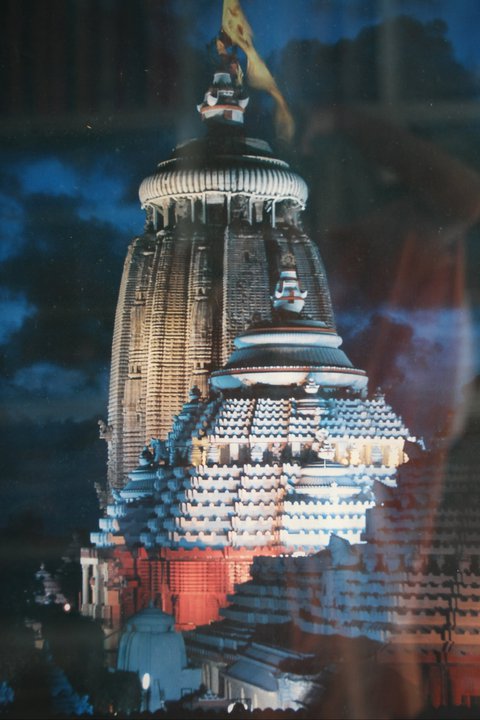
Although she wandered here and there, nowhere could her heart find satisfaction. She decided to seek out a bonafide spiritual master. After much travel, she arrived in Jagannatha Puri. One day, after taking darshan of the Jagannatha Deities, she received an inner message and was inspired to go to Vrindavana. (In the image: Lord Jagannath's Temple, Puri).

 
   With this Sachi felt that the moon of her good fortune had arisen. In Vrindavana, she chanced to meet Haridas Pandit, whose single-minded devotion to Gauranga and Nityananda was unsurpassed. Upon seeing the spiritual power and austerity of his divine form, Sachi became filled with ecstasy. After meditating deeply for several days, Haridas Pandit gave Sachi shelter. Shri Sachi fell at the lotus feet of Haridas Pandit with her eyes pouring tears and prayed for his mercy.
 
   The Chaitanya Charitamrita gives Haridas Pandit's preceptorial ancestry as follows, "Ananta Acharya was a disciple of Gadadhara Pandit. His body was always overwhelmed by the ecstasy of Krishna-prema. He was magnanimous and advanced in all respects. Ananta Acharya was a reservoir of all good qualities. No one can estimate how great he was. Pandit Haridas was his beloved disciple."
 
   In order to examine Sachi's qualifications as a disciple, Haridas Pandit said: "It is not possible for the daughter of a king to go to Vrindavana and live as a poor Devotee, constantly absorbed in bhajan with little to eat and no comforts. It will be better for you to stay at home and worship than to go to Vrindavana."
 
   Shri Sachidevi could understand what all this talk was for. She paid no attention to all these words of discouragement. With fierce determination, renunciation, and austerity, she went on with her bhajan, and her service to her guru. As she absorbed herself in her austere service, step by step she renounced her opulent dresses and fine ornaments.
 
   One day, Haridas Pandit Goswami said to Sachi devi, "If you like, giving up all pride and fear, you may wander throughout Vraja and practice begging from place to place as a renounced Devotee. You have my blessings." Upon hearing the words of her gurudeva, Sachi's joy knew no bounds. Thereafter, freed from all false ego, her body covered only with rags, she went house to house in Vrindavana, begging alms in the fashion of a bumblebee who takes only a little pollen from each flower. In this way she showed the intense renunciation and austerity of a highly advanced Devotee. All the Devotees in Vrindavana were astonished by her severe renunciation.
 
Gangamata Goswamini

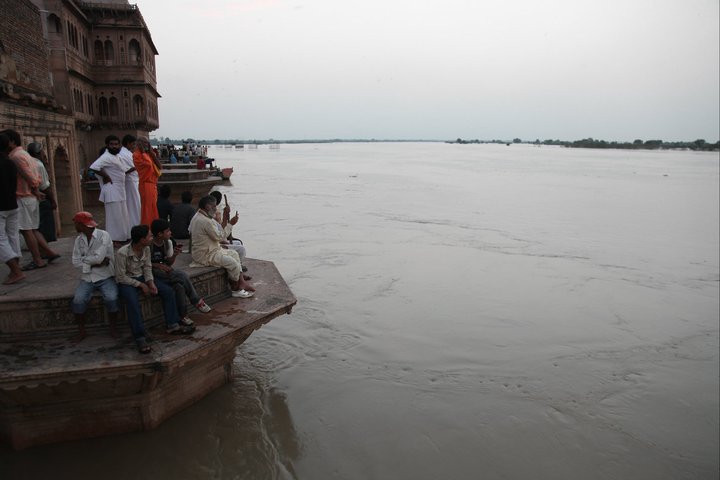
Physically exhausted from her diligent service she would sleep on the banks of the Yamuna, and then rise again the next day to cleanse the Lord's Temple. She would regularly circumambulate some holy places, see the aroti of the Deity, and listen to the lectures on Shrimad-Bhagavatam. (In the image: Yamuna, Shri Vrindavan Dham).

   Gradually, Sachi's body became frail and weak. She grew thin, and was covered with soot. Still, she took no notice of her condition, and continued following her austere regimen. Physically exhausted from her diligent service she would sleep on the banks of the Yamuna, and then rise again the next day to cleanse the Lord's Temple. She would regularly circumambulate some holy places, see the aroti of the Deity, and listen to the lectures on Shrimad-Bhagavatam.
 
   Seeing the intense renunciation of Sachi devi, Haridas Pandit Goswami's heart was filled with pity. His mercy towards her increased. Smiling, he called Sachi devi and said to her, "You are a princess, and yet you have made such an intense effort to worship Krishna that seeing your renunciation and austerity in the cause of devotion I have become supremely happy. Soon I shall give you initiation into the mantra."
 
   Haridas Pandit had one disciple named Shri Lakshmipriya, toward whom he was very affectionate. Just at that time she arrived in Vrindavana. Shri Lakshmipriya used to chant three hundred thousand names of Krishna daily. When she arrived, Haridas Pandit sent her to live near where Sachi devi performed her daily bhajan on the banks of the Radha-Kunda. Taking the order of her guru on her head, Lakshmipriya went to the Radha-Kunda to be with Sachi devi and help her with her bhajan. Every day Sachi devi and Lakshmipriya would circumambulate Govardhan hill. In this way, in the company of Lakshmipriya devi, Sachi continued her worship of Krishna with great determination, living on the banks of the Radha-Kunda, until one day Haridas Pandit called for her to return. He instructed her to quickly return to Jagannatha Puri, to continue with her bhajan and to preach what she had learned of Shri Chaitanya's teachings. At that time almost all of Chaitanya Mahaprabhu's personal associates had gone back to Godhead, and had entered into their eternal, unmanifest pastimes. 
Gangamata Goswamini

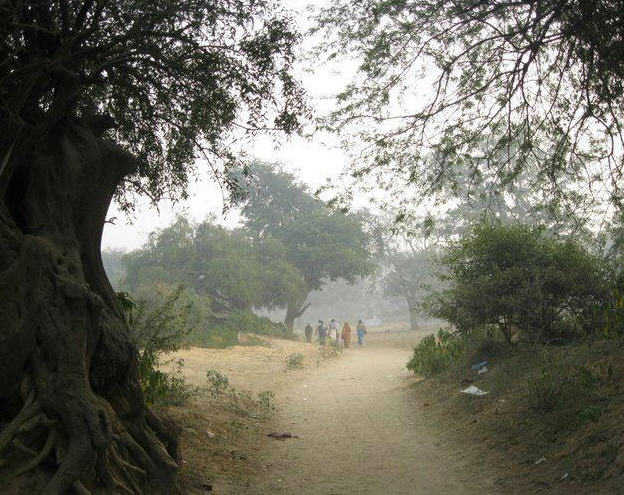
Taking the order of her guru on her head, Lakshmipriya went to the Radha-Kunda to be with Sachi devi and help her with her bhajan. Every day Sachi devi and Lakshmipriya would circumambulate Govardhan hill. In this way, in the company of Lakshmipriya devi, Sachi continued her worship of Krishna with great determination, living on the banks of the Radha-Kunda... (In the image: path around Govardhan Hill).

 
   Shri Sachi devi left Vrindavana and returned to Jagannatha Puri. On the order of her gurudeva, she went to the house where Sarvabhauma Pandit had once stayed. There she engaged in bhajan and began giving classes on the Shrimad-Bhagavatam. The old house of Sarvabhauma was dilapidated and crumbling. For a long time no one had lived there. No one remained there to worship the Damodara Salagram that had once been worshiped by Sarvabhauma Bhattacharya himself. Sachi devi established first-class worship of the Shalagrama according to the traditional rules and regulations of the Shastra. In order to hear her wonderful siddhantic interpretations of the Shrimad-Bhagavatam, faithful Devotees would come to Sarvabhauma's house day after day. In a short time her Bhagavatam classes became very famous, and people would come from miles around just to hear her. 
Gangamata Goswamini

House of Sarvabhauma Bhattacharya.

 
   One day, the king of Jagannatha Puri, Mukunda Deva, came to hear the Bhagavatam from Sachi devi. Hearing her original explanations of siddhanta, the king was completely astounded. He thought to himself that he would like to make a nice offering to Sachi devi, out of appreciation for her devotion to Krishna. That night he had a wonderful dream. Lord Jagannatha came to him in his dream and ordered him, "Offer Sachi devi a place on the banks of the Ganges."
 
   The following day king Mukunda Deva went to Sachi devi. With great humility, Sachi devi offered the king a sitting place and asked him the reason for his visit. King Mukunda Deva explained about the vision he received from Jagannatha and how the Lord had instructed him to construct a place by the Ganges for Sachi devi. Shri Sachi devi was not disposed to accept any sort of wealth or comfortable situation and wanted to refuse. But the king kept pressing his wishes again and again. At that time, not wanting to violate Lord Jagannatha's order, King Mukunda Deva issued a decree naming a holy ghat by the side of the White Ganges after Shri Sachi devi.
 
   The decree let it be known that Shri Sachi devi was a princess who had left everything to come to Jagannatha Puri and preach the holy gospel of Shri Chaitanya.
 
   One day the day of Mahavaruni-snana approached and Shri Sachidevi wanted to go to the Ganges to bathe. But Sachi devi's gurudeva had forbidden her ever to leave Jagannatha Puri. Remembering the order of her gurudeva, Sachi devi gave up her desire to bathe in the Ganges. That night, Jagannatha came to her in a dream and said, "Sachi, don't think like that – the day when Varuni will take bath that day you must go and bathe in the White Ganges. Ganga devi has been praying for your association. So you must go to the White Ganges."
 
   Having had such a divine vision from Jagannatha, Sachi devi was very joyful. The day of Varuni-snana came. In the middle of the night, Sachi devi went to the White Ganges to bathe. As she bathed at Sweta Ganga, the current of Ganga devi picked her up and began moving along. The waters of the Ganges overflooded the pond, and the current ran before her in a flood until she arrived at the Jagannatha Mandira. Seeing this, thousands and thousands of the dhambhasis in Jagannatha Puri became ecstatic and took their bath in the ganges. The four directions were filled with prayers that were shouted in great ecstasy, and there was a huge commotion. In the midst of great jubilation everyone bathed in the Ganges.
 
Gangamata Goswamini

Samadhi of Sarvabhauma and Ganga Mata Goswamini, Puri.

   In the midst of the comotion the guards at the gate of the Jagannatha Temple awoke. They were speechless at seeing the commotion going on in all directions. Hearing a great noise they went inside the Temple. They began talking loudly amongst themselves. Hearing all the noise, the king had also awakened. Anxious to see that everything was all right, the king ordered the gates to the Temple opened. At this, the gates were opened. By some miracle, Sachi devi was standing there, alone, inside the Temple of Jagannatha. The servants and pujaris of Jagannatha concluded that she must be a thief who has come to steal the valuable ornaments of Jagannatha. 
 
   Many people said, "This cannot be! There must be some mystery here." Immediately Sachi devi was imprisoned in the dungeons to stand trial for theft. Sachi devi's mind, however, did not become weak or confused. While imprisoned, she absorbed herself in constantly chanting the Holy Name of Krishna.
 
   Late that night, King Mukunda Deva saw Lord Jagannatha in a dream. Jagannatha angrily told him: "Immediately release Sachi devi from your dungeons. It was because I wanted to personally arrange for washing her holy feet that I had the Ganges bring her to my Temple. If you want your life to be auspicious, then you had better make the pandas and pujaris bow at her feet and pray for forgiveness. You yourself must take initiation from her."
 
   Seeing this in his dream, the king was repentant, and right after taking his bath, he had the pandas and pujaris go to the place where Sachi devi was being held and immediately release her, falling at her feet and begging for forgiveness. They went there and payed full obeisances, falling down like rods before her feet. The king himself went before Sachi devi, and with great entreaties begged her to forgive him for his offenses at the holy feet of a Devotee. At that time, he told Sachi devi of how Lord Jagannatha had ordered him to accept her as his guru and take mantra initiation from her.
 
   Understanding all these things to be the pastimes of Lord Jagannatha, Sachi devi became extremely joyful. Her heart filled with divine love for Krishna. Placing her hand on the king's head, she gave him her blessings. 
 
   Soon after this, on the order of Jagannatha, on an auspicious day, Shri Sachi devi initiated King Mukunda Deva into the eighteen syllable Radha-Krishna mantra. Along with the king, many pujaris also took shelter of her on that day. From that day forward, Shri Sachi devi was known as Gangamata Goswamini.
 
   One day a smarta-brahmana named Mahidhara Sharma had come to the banks of the Sweta-Ganga to worship his ancestors. Having heard of the glories of Gangamata Goswamini, he was eager to have darshan of her holy feet. After showing great respect to the pandit, Shri Gangamata Goswamini offered him a place to sit. She asked him what his purpose in coming was. The brahmana pandit explained the righteous reason for his coming. Seeing his genuine earnestness and piety, Shri Gangamata Goswamini explained the siddhanta of Shrimad-Bhagavatam to the brahmana. The brahmana pandit was astonished by her explanations of Shrimad-Bhagavatam, and dived and surfaced in the nectar of her ambrosial words. 
 
   After this, the pandit brahmana asked to take shelter at the lotus feet of Gangamata Goswamini. On an auspicious day she initiated him into the Radha-Krishna mantra of ten syllables. Mahidhara Sharma's birthplace is in Dhananjaya-pura. On the order of Gangamata Goswamini, he preached the message of nam-prema, and the teachings of Gaura-Nityananda throughout Bengal. 
Gangamata Goswamini

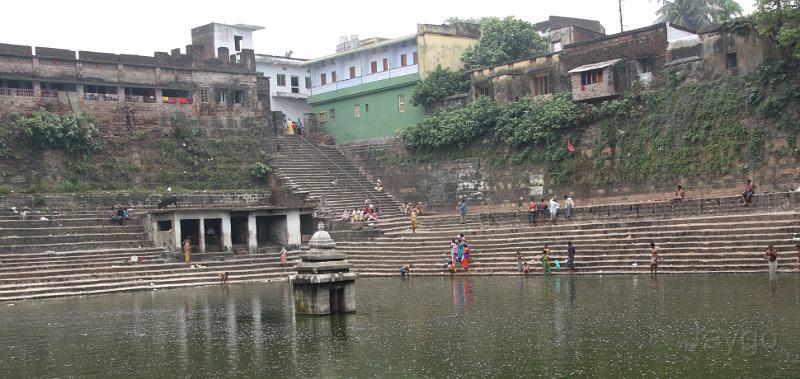
One day the day of Mahavaruni-snana approached and Shri Sachidevi wanted to go to the Ganges to bathe. But Sachi devi's gurudeva had forbidden her ever to leave Jagannatha Puri. Remembering the order of her gurudeva, Sachi devi gave up her desire to bathe in the Ganges. That night, Jagannatha came to her in a dream and said, "Sachi, don't think like that - the day when Varuni will take bath that day you must go and bathe in the White Ganges. Ganga devi has been praying for your association. So you must go to the White Ganges." (In the image: Sweta Ganga, Puri).

Gadadhara Dasa Thakura – Biography

   Sri Gadadhara dasa Thakura used to live in Navadwipa dhama, but after the disappearance of Sri Chaitanya Mahaprabhu, he moved to Katwa. Finally he moved to a village called Endiyadaha-grama, where he made his ultimate residence.
 
   Gadadhara dasa Thakura had a disciple in Katwa named Yadunandana Chakravarti. Gadadhara dasa was one of the eternal associates of Sri Chaitanya Mahaprabhu and Nityananda Prabhu. The Gaura-ganodesa-dipika mentions Gadadhara dasa as the extension of Shrimati Radharani's beauty and luster. There it is written: 
 
   "The gopi named Chandrakanti, who was a vibhuti (expansion) of Sri Radha, appeared in Gaura-lila as Gadadhara dasa, a close associate of Sri Chaitanya Mahaprabhu." 
Gadadhara Dasa Goswami

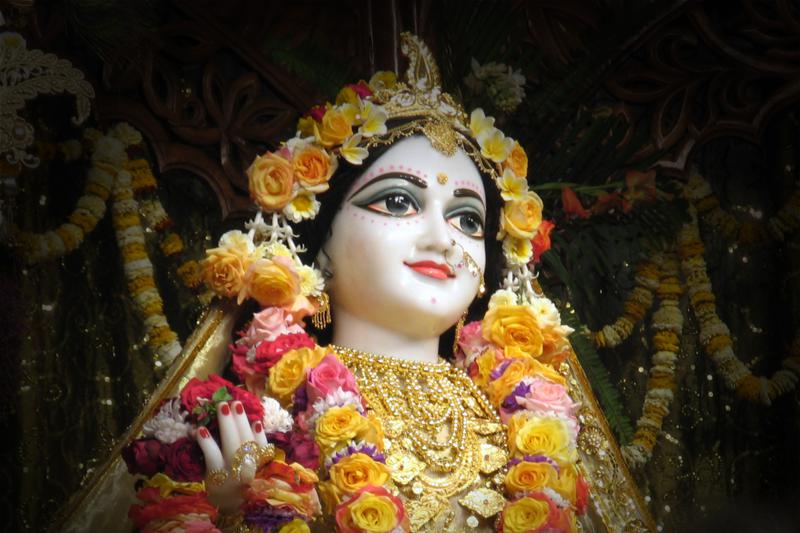
The Gaura-ganodesa-dipika mentions Gadadhara dasa as the extension of Shrimati Radharani's beauty and luster. (In the image: Shrimati Radharani, Chandra doya Mandir, Shri Mayapur Dham).

 
   Sri Gadadhara dasa was not one of the Gopalas who served Nityananda Prabhu in the mood of sakhya-rasa, friendship. Rather he was always merged in the mellow of madhurya-rasa. Shripad Bhaktivedanta Swami Maharaja writes as follows of Gadadhara dasa in his Chaitanya-Charitamrta commentary: "About eight or ten miles from Calcutta on the banks of the Ganges is a village known as Endiyadaha-grama. Shrila Gadadhara dasa was known as an inhabitant of this village…After the disappearance of Lord Chaitanya Mahaprabhu Gadadhara dasa came from Navadwipa to Katwa. Thereafter he came to Endiyadaha-grama and resided there. He is stated to be the luster of the body of Srimati Radharani, just as Shrila Gadadhara Pandita is an incarnation of Shrimati Radharani Herself. Chaitanya Mahaprabhu is sometimes explained to be radha-bhava-dyuti-suvalita, or characterized by the emotions and bodily luster of Shrimati Radharani. Gadadhara dasa is this dyuti or luster. He counts among the associates of both Shrila Gaurahari and Nityananda Prabhu….Even though he was an associate of Lord Nityananda Prabhu, he was not among the cowherd boys but was situated in the transcendental mellow of conjugal love. He established a Temple of Shri Gaurasundara in Katwa."
 
   In 1434 sakabda (1534 A.D.) when Lord Nityananda Prabhu was empowered by Lord Chaitanya to preach the sankirtana movement in Bengal, Shri Gadadhara dasa was one of Lord Nityananda's chief assistans. He preached the sankirtana movement by requesting everyone to chant the Hare Krishna maha-mantra. When Srila Gadadhara dasa was preaching the cult of hari-kirtana, there was a magistrate who was very much against his sankirtana movement. Following in the footsteps of Lord Chaitanya Mahaprabhu, Shrila Gadhadhara dasa one night went to the house of the Kazi and requested him to chant the "Hare Krishna" mantra. The Kazi replied, "All right, I shall chant "Hare Krishna" tomorrow." On hearing this, Shrila Gadadhara dasa Prabhu began to dance, and he said, "Why tomorrow? You have already chanted the "Hare Krishna" mantra, so simply continue."
 
   "…Srila Gadadhara dasa is considered to be a united form of Chandrakanti, who is the effulgence of Shrimati Radharani, and Purnananda, who is an expansion of Lord Balarama's dear girlfriend. Thus Srila Gadadhara dasa was one of the associates of both Chaitanya Mahaprabhu and Nityananda Prabhu. Once while Srila Gadadhara dasa Prabhu was returning to Bengal from Jagannatha Puri with Nityananda Prabhu, he forgot himself and began talking very loudly as if he were a girl of Vrajabhumi selling yogurt, and Srila Nityananda Prabhu noted this. 
 
   Another time, while absorbed in the ecstasy of the gopis, he carried a jug filled with Ganges water on his head as if he were selling milk. When Lord Chaitanya Mahaprabhu appeared in the house of Raghava Pandita while going to Vrindavana, Gadadhara dasa went to see Him, and Sri Chaitanya Mahaprabhu was so glad that He put His foot on his head. When Gadadhara dasa Prabhu was present in Endiyadaha he established a Balagopala murti for worship there. Shri Madhava Ghosh performed a drama known as Dana-khanda with the help of Shri Nityananda Prabhu and Shri Gadadhara dasa."
 
   "The tomb of Gadadhara dasa Prabhu, which is in the village of Endiyadaha, was under the control of the Satyogi Vaishnavas and later under the direction of Siddha Bhagavan dasa Babaji of Kalna. By his order, Shri Madhusudana Mullik, one of the members of the aristocratice Mullik family of the Narikeladanga in Calcutta, established a padavadi (monastery) there in the Bengali year 1256. He also arranged for the worship of a Deity named Sri Radhakanta. His son, Balaichanda Mullik, established Gaura-Nitai Deities there in the Bengali year 1312. Thus on the throne of the Temple are both Gaura-Nityananda Deities and Radha-Krishna Deities."
 
   When Chaitanya Mahaprabhu sent Nityananda Prabhu to Bengal to preach the nectar of the Holy Name, he sent Shri Rama dasa and Shri Gadadhara dasa with him. Once when he was carrying a waterpot on his head, Gadadhara dasa, in the mood of a gopi called out "Who will buy milk? Who will buy yogurt?" Saying this, he laughed at the joke.
 
   The details of how Gadadhara dasa delivered the Kazi are as follows: One day, Gadadhara dasa went to the house of the Kazi, overwhelmed with Krishna-prema, madly dancing and performing hari-sankirtana. When he arrived at the Kazi's door, he began loudly calling for the Kazi. The Kazi, enraged, went outside his house ready to chastise Gadadhara dasa for disturbing the peace. But when he beheld the beautiful form of Gadadhara dasa, who was the personification of Shri Radhika's divine luster, he was stunned. When Gadadhara dasa embraced the Kazi with great affection the Kazi said, "Thakura! Why have you come?" Gadadhara dasa said, "I want to have a talk with you."
   "What do you wish to talk about?" 
   "Gaura-Nityananda have appeared upon this earth to deliver humankind with divine love by distributing the sweet nectar of the Holy Name of Hari. Why don't you chant this sweet name of Hari?"
   "Tomorrow I shall chant the name Hari."
   "Why chant the Holy Name tomorrow? I have come to deliver you with the Holy Name of Krishna. Now you have begun your life of auspiciousness by vibrating the Holy Name of Hari. From today on all your sins and miseries will disappear by the grace of the Holy Name if you simply continue this chanting – this is why I have come: to deliver you."
 
   Hearing the words of Gadadhara dasa, the Kazi was bewildered. At length, he smiled and again said, "Tomorrow I will chant the Holy Name of Hari." 
   Upon hearing the Holy Name of Hari issuing from the mouth of the Muslim Kazi, Gadadhara dasa at once became mad in the ecstasy of Krishna prema. 
   At last he said, "Why tomorrow! Just now you have said the name "Hari".  All your sins will now melt away and you will become supremely purified by the power of the Holy Name."
 
    Purified by the grace of Gadadhara dasa and the Holy Name of Krishna, the Kazi took shelter of the holy feet of Gadadhara dasa. In this way, Gadadhara dasa delivered countless sinners, nonbelievers, and yavanas with the Holy Name of Krishna. He disappeared on the eight day of the full moon in the month of Kartika. 
Gadadhara Dasa Goswami

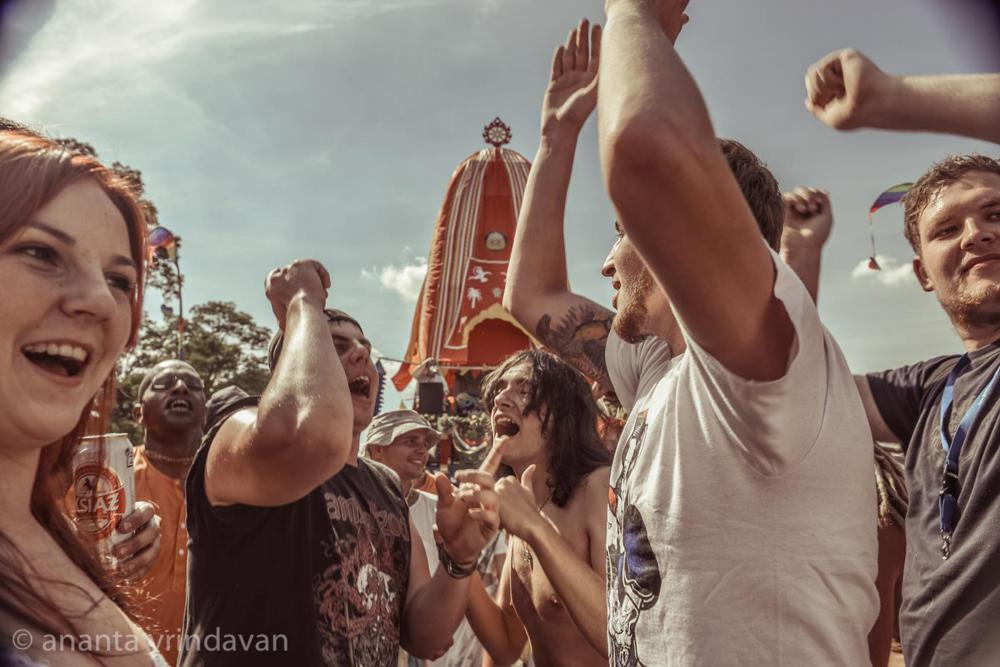
"Why chant the Holy Name tomorrow? I have come to deliver you with the Holy Name of Krishna. Now you have begun your life of auspiciousness by vibrating the Holy Name of Hari. From today on all your sins and miseries will disappear by the grace of the Holy Name if you simply continue this chanting - this is why I have come: to deliver you." (In the image: Highlights of Krishna's Village of Peace at Polish Woodstock 2012).

Devananda Pandit – Biography

   Devananda Pandita lived in Navadwipa-dhama, in the section known as Kuliya, or Koladwipa (near where the present-day Sri Chaitanya Saraswata Math of Srila Shridhara Maharaja is now located). Sri Chaitanya Mahaprabhu used him to manifest the glories of Srimad-Bhagavatam to the world. Devananda Pandita was highly renowned for his expertise in considering the sayings of Srimad-Bhagavatam. Many people used to go and study the Srimad-Bhagavatam under him.
 
   One day Shrivasa Pandita went to hear the Srimad-Bhagavatam class given by Devananda Pandita. After some time, Devananda began giving his lecture. He was surrouned on all four sides by his students, who listened carefully to his reading. Shrivasa Pandita was a highly exalted rasika bhakta, a Devotee experienced in tasting the mellows of devotion. Hearing the sweetness of the verses of the Srimad-Bhagavatam, Shrivasa Thakura fell to the ground with tears of ecstasy in his eyes. Weeping and wailing with tears of ecstasy in his eyes, he began rolling on the ground with his voice choked up with emotion. 
Devananda Pandit

One day Shrivasa Pandita went to hear the Srimad-Bhagavatam class given by Devananda Pandita. After some time, Devananda began giving his lecture. He was surrouned on all four sides by his students, who listened carefully to his reading. Shrivasa Pandita was a highly exalted rasika bhakta, a Devotee experienced in tasting the mellows of devotion. Hearing the sweetness of the verses of the Srimad-Bhagavatam, Shrivasa Thakura fell to the ground with tears of ecstasy in his eyes. Weeping and wailing with tears of ecstasy in his eyes, he began rolling on the ground with his voice choked up with emotion. (In the image: Shrivas Thakur, Pancha Tattva member, ISKCON Leicester, UK).

 
   Seeing all this, the students of Devananda said, "This man is mad. He is not properly giving his attention to the Srimad-Bhagavatam. Throw him out! Eject him!" 
 
   Devananda Pandita saw all this, but did nothing to prevent his disciples from ejecting Shrivasa Pandita from the class. If a disciple commits a sin as a result of the guru's ignorance, the guru partakes of the sinful reaction. Therefore Devananda Pandita also partook of the sinful reaction of offending Shrivasa Pandita. Without saying a word of this to anyone, and without telling anyone of his suffering at the hands of Devananda Pandita, Shrivasa Thakura returned home. All these events took place before the advent of Sri Gauranga Mahaprabhu.
 
   At length, the advent of Sri Chaitanya Mahaprabhu took place, as the Supreme Lord made His appearance within this material world. Gradually He manifest His childhood pastimes, His studies, His pastimes of learning, and His pastimes as a young professor, as well as the revelation of His divinity in the house of Shrivasa Thakura. 
 
   At the time of that divine manifestation, when the Lord revealed His Mahaprakasa in the Temple of Shrivasa Thakura amidst all the Devotees, He told Shrivasa, "Shrivasa! Don't you remember the time when you went to hear Srimad-Bhagavatam at the house of Devananda Pandita? When you fell to the ground in ecstasy upon hearing the nectarine verses of the Bhagavatam, then the disciples of Devananda – as a result of his ignorance of your exalted devotion – threw you out of the class. At that time you went home, feeling distressed, but you told no one of the incident. Do you remember this?"  Hearing the words of the Lord, Shrivasa was astonished and fell at his lotus feet, catching hold of them.
 
   One day, as Mahaprabhu was wandering through the towns of Navadwipa, He came upon the road near where Sarvabhauma's father, Maheshvara Visarada Pandit used to live. There was the house of Devananda Pandita. And at that time, within the house of Devananda Pandita a class on Srimad-Bhagavatam was being held. From a long way off, Chaitanya Mahaprabhu could hear this. Upon hearing Devananda's Bhagavatam class, Mahaprabhu became enraged. 
 
   Chaitanya Bhagavata records: With sharp words, the Lord said, "What does this fellow know about the meaning described by the Bhagavatam? He will never know the Bhagavatam even in many lifetimes. The Srimad-Bhagavatam is the literary avatara of Krishna Himself. The Bhagavatam promotes bhakti as the ultimate goal of life. The Srimad-Bhagavatam is the essence of the four Vedas; it is the literary form of divine love. The four Vedas are like milk; the Srimad-Bhagavatam is like butter. Shukadeva Goswami is the churner of the butter, which was eaten by Parikshita Maharaja. That Shukadeva Goswami, who is dear to me, knows the meaning of Srimad-Bhagavatam. In the Srimad-Bhagavatam, Shukadeva expressed the truths about Myself; he expressed My own opinions. Me and My servants are glorified in the Srimad-Bhagavatam; one who finds a difference between Myself and My servants will find all his good intelligence destroyed. An irreligious person who rejects bhakti and finds some other meaning in the Srimad-Bhagavatam will never understand the Bhagavatam." 
Devananda Pandit

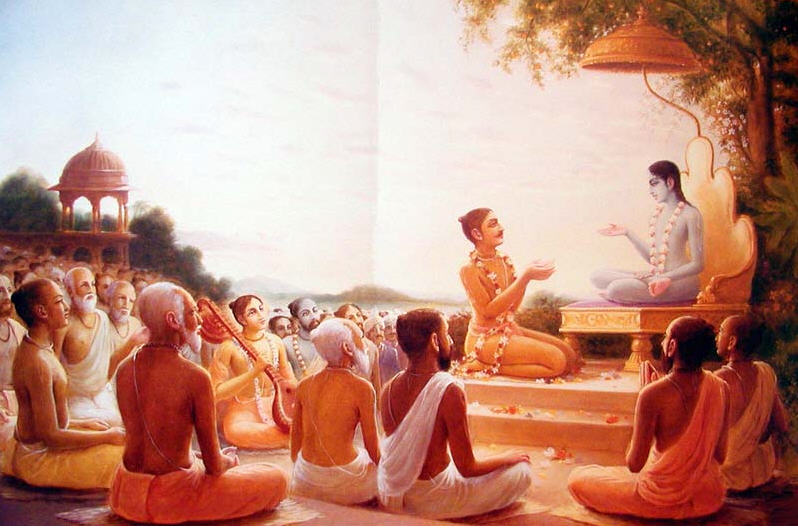
...The Bhagavatam promotes bhakti as the ultimate goal of life. The Srimad-Bhagavatam is the essence of the four Vedas; it is the literary form of divine love. The four Vedas are like milk; the Srimad-Bhagavatam is like butter. Shukadeva Goswami is the churner of the butter, which was eaten by Parikshita Maharaja. That Shukadeva Goswami, who is dear to me, knows the meaning of Srimad-Bhagavatam. In the Srimad-Bhagavatam, Shukadeva expressed the truths about Myself; he expressed My own opinions...(In the image: Shukadeva Goswami reciting Srimad Bhagavatam to the sages and to the king Parikshit).

 
   After saying all these things in an angry mood, Chaitanya Mahaprabhu, began to flee away from the house of Devananda Pandita, which He considered condemned. The Devotees caught hold of Him and begged Him not to go. 
 
   The Lord again said, "All the scriptures sing of the Srimad-Bhagavatam as being highly mysterious, inconceivable. It cannot be understood by vast learning or powerful austerity. One who attempts to know the Srimad-Bhagavatam through scholarship will never understand it. One who recognizes that the Bhagavatam is nondifferent from the inconceivable Supreme Controller knows that the essence of the Bhagavatam can be known only through devotion and not through scholarship."
 
   "One who understands that Srimad-Bhagavatam is Krishna Himself can understand Srimad-Bhagavatam. One can only understand the Bhagavatam's meaning through divine love. If one wants to understand this he must served both the book Bhagavata and the Devotee Bhagavata."
 
   In this way, Mahaprabhu spoke many different truths to His followers and then returned to His own home, accompanied by the Devotees. From far away, Devananda Pandita could hear all these different instructions. But at the time, he did not pay any mind to all this.
 
   After some time, Chaitanya Mahaprabhu took sannyasa and went to Jagannatha Puri. At that time, Devananda remembered the instructions the Lord had given. He began to think, "Such a great person as this came near my residence, and I did not get to meet him? I could not understand the glories of such a great and exalted Personality as Chaitanya Mahaprabhu who was filled with Krishna-prema?"
 
   One day in Kuliya, or Koladwipa as it is now known, Sri Vakreshvara Pandita went to visit the house of a Devotee. That evening Vakreshvara Pandita was absorbed in kirtana and dancing. Hearing the news of this, people gathered from all around to take part in the kirtana. As the night went on, more and more Devotees began arriving there. Hearing this news, Devananda Pandita could not maintain his steadiness. He also hurried to the place where the kirtana was going on. 
 
   Seeing the empowered figure of Vakreshvara Pandita and hearing his sweet kirtana Devananda Pandita was astonished. He stood transfixed for what seemed like hours. As the night wore on, the crowd grew and, in attempts to push forward and see the dancing of Vakreshvara Pandita, it became boisterous and rowdy. At that time, Devananda Pandita, with a cane in his hand, held the crowd back and quieted the mob. 

Srila Vakreshvara Pandita.

 
   When Vakreshvara Pandita, after dancing and dancing, fell to the ground overwhelmed by ecstasy, Devananda Pandita carefully picked him up and held him on his lap. With his own scarf, Devananda wiped the dust from the holy body of Vakreshvara Pandita. In this way, it was on that day that Devananda Pandita began his bhakta-seva, his service to Devotees.
 
   One day, five years after He took sannyasa, Sri Chaitanya Mahaprabhu returned to Navadwipa-dhama from Jagannatha Puri. Upon His return the Devotees felt that their lives had returned. Their joy knew no bounds. In order to see the lotus feet of Sri Chaitanya Mahaprabhu thousands of people gathered there. Whoever had previously committed offenses to the lotus feet of the Lord when He had manifested His lila in Navadwipa was eager to be forgiven. They all came there to beseech the Lord's forgiveness for whatever offenses they might have committed. 
 
   At that time, in the place known today as the aparadha-bhanjanam, or the place of amnesty (where Srila Shridhara Maharaja now has his Temple), Sri Chaitanya Mahaprabhu granted forgiveness to all who gathered there and instructed them in the science of devotion.
 
   At that time, Devananda Pandita took darsana of the lotus feet of Sri Chaitanya Mahaprabhu. Offering his obeisances unto the lotus feet of Sri Chaitanya at a distance, Devananda cowered and shrank away from the Lord, standing off to one side. At that time the Lord saw him and said, "You are the servant of my dear Devotee Vakreshvara Pandita. By your service to him you have greatly pleased Me. As a result of your service to him you have come close to Me. Vakreshvara is empowered by Krishna-sakti. By serving my dear Devotee Vakreshvara Pandita you have attained the mercy of Krishna."
 
   Hearing these words of Sri Chaitanya Mahaprabhu, Devananda was overwhelmed with the sentiments of bhakti. His voice was choked with divine emotion, and he said, "O My Lord; O Supreme Master – You have appeared in Navadwipa just to deliver all the fallen souls. I am a sinner. I have commited great sins against divinity. I have failed to worship your lotus feet. As a result of this, I have cheated myself out of your causeless mercy. O Lord of all creation; Supersoul of all that lives! You are supremely merciful. By your causeless mercy I have been able to take darshan of your holy feet on this day. O Supremely Merciful one – please be kind upon me and instruct me in the goal of life. Please explain the meaning of Srimad-Bhagavatam to me as well." 
Devananda Pandit

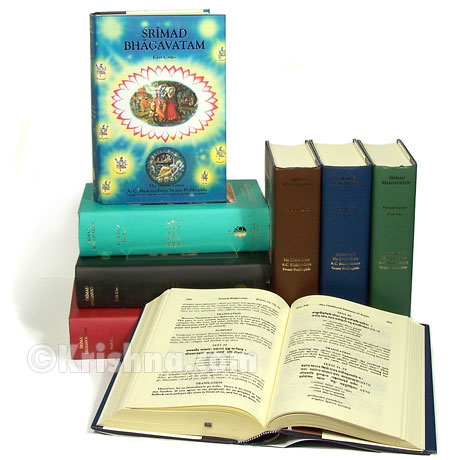
... In a trance of bhakti-yoga Vyasa compiled the Srimad-Bhagavatam. It passed through him and appeared on his tongue as a result of the mercy of Krishna. If one doesn't understand that the Srimad-Bhagavatam is divine truth on the level of God Himself he will never realize its meaning...(In the image: Shrimad Bhagavatam Books with the purports of Srila Prabhupada).

 
   Hearing this humble request of Devananda Pandita, Sri Chaitanya Mahaprabhu spoke as follows: "Listen carefully, o brahmana. Always praise Srimad-Bhagavatam. Never let any explanation of Srimad-Bhagavatam other than bhakti issue forth from your lips. From beginning, middle to end, this is its meaning: constant devotion to Krishna is eternally perfect flawless, and infallible. It is the highest goal of life. The Supreme Lord appears in innumerable avataras beginning with Kurma. His appearance and disappearance is transcendental. In the same way, Srimad-Bhagavatam is not a material creation: its appearance and disappearance is completely divine. 
 
   In a trance of bhakti-yoga Vyasa compiled the Srimad-Bhagavatam. It passed through him and appeared on his tongue as a result of the mercy of Krishna. If one doesn't understand that the Srimad-Bhagavatam is divine truth on the level of God Himself he will never realize its meaning. This is the verdict of all authorized scriptures. One who understands the Srimad-Bhagavatam in that way has real knowledge. If one approaches the Srimad-Bhagavatam with material knowledge he will never understand it. If, however, one is unlearned but takes shelter of the Srimad-Bhagavatam he will be enlightened with its meaning. The Srimad-Bhagavatam is filled with divine love, prema. It is an extension of Krishna Himself and it reveals his confidential pastimes of divine love.
 
   O brahmana! Previously you committed an offense to the lotus feet of Shrivasa Pandita. You must go to him and beg forgiveness at his lotus feet. There is no difference between the book Bhagavata and the Bhakta Bhagavata. If you get the mercy of the Bhakta Bhagavata then you will easily attain the mercy of the book Bhagavata."
 
   Having thus heard the words of Sri Chaitanya Mahaprabhu, Devananda Pandita immediately went to Shrivasa Thakura and begged forgiveness for his offenses. At that time, Shrivasa Thakura embraced Devananda and forgave his offenses. The four directions were filled with the sound of the Holy Name of Hari as the Devotees were all jubilant upon Mahaprabhu's return to Navadwipa-dhama. From that day on, Devananda Pandita was accepted in the midst of the followers of Mahaprabhu as a great Devotee. Devananda Pandita's disappearance day falls on the dark moon Ekadashi of the month of Pausha, which corresponds to the month of December. 
Devananda Pandit

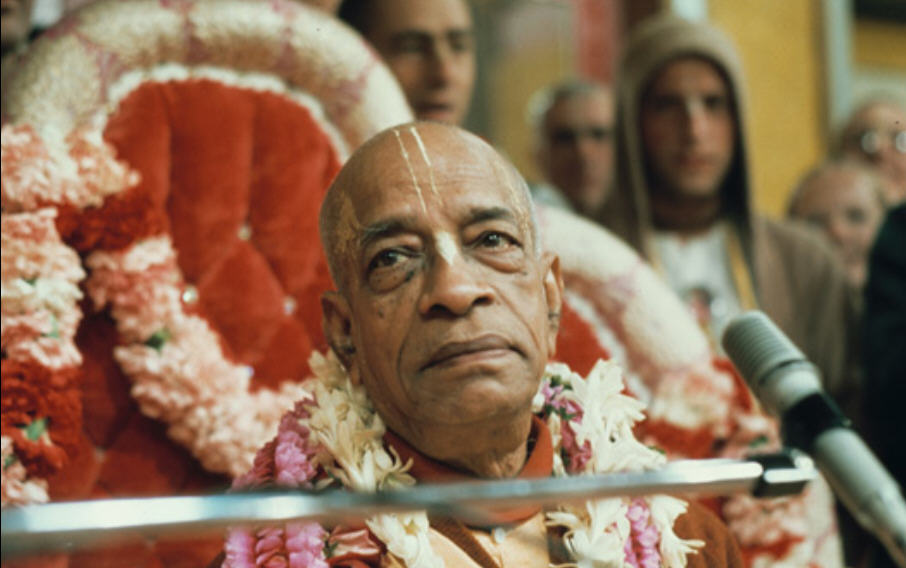
"...There is no difference between the book Bhagavata and the Bhakta Bhagavata. If you get the mercy of the Bhakta Bhagavata then you will easily attain the mercy of the book Bhagavata." (In the image: Srila Prabhupada).

Sri Birchandra Prabhu – Biography

Srimad Birchandra or Birabhadra Prabhu took birth within this world on the ninth day of the dark moon in the month of Kartik, which corresponds to the divine appearance day of Sri Srimad Bhakti Raksaka Sridhar Maharaja.
 
Sri Krishna Dasa Kaviraja Goswami writes (CC Adi 11.8-12):
"Sri Nityananda Prabhu is the topmost branch of the indestructible tree of eternal love of Godhead, Sri Caitanya Mahaprabhu…From that branch grow many branches and sub-branches…After Nityananda Prabhu, the greatest branch is Birabhadra Goswami (Birchandra Prabhu)…although Birabhadra Prabhu was the Supreme Personality of Godhead, He presented Himself as a great devotee. And although the Supreme Godhead is transcendental to all Vedic injunctions, He strictly followed the Vedic rituals. He is the main pillar in the hall of devotional service erected by Sri Caitanya Mahaprabhu. He knew within Himself that He acted as the Supreme Lord Vishnu, but externally He was prideless. It is by the glorious mercy of Sri Birchandra Prabhu that people all over the world now have the chance to chant the names of Caitanya and Nityananda. I therefore take shelter of the lotus feet of Sri Birchandra Prabhu so that by His mercy my great desire to write Sri Caitanya Caritamrita will be properly guided."
 
In his Anubhashya commentary on Caitanya Caritamrita, Sri Bhaktisiddhanta Saraswati Thakura describes the life of Birchandra Prabhu. He writes that Birchandra Prabhu, also known as Virabhadra Goswami was the son of Nityananda Prabhu and the disciple of Jahnava Mata. He was born from the womb of Sri Vasudha, Nityananda Prabhu's other wife. In the Gaura-Ganodesha-Dipika, he is mentioned as an incarnation of Kshirodakshayi Vishnu as follows:
 
 
sankarshanashya yo vyuha, payobdhishayi-namakah, 
sa eva virachandro'bhu-caitanya-abhinna vigraha
 
"Sri Sankarshan Deva expands Himself as Kshirodakshayi Vishnu. His avatara is Birchandra Prabhu. He is nondifferent from Sri Caitanya Mahaprabhu, in that he is Vishnu-tattva, God Himself."
 
In a village of the name Jhamatapura in the district of Hugali, Birchandra Prabhu had a disciple named Yadundanacharya, who had two daughters – his own daughter by birth, Srimati, and a foster daughter named Narayani. Both these daughters married Birchandra. The marriage of Birchandra Prabhu has been mentioned in the Bhakti Ratnakara of Sri Narahari Chakravarti Thakura as follows: 
 
"Near Rajabol Hatta is Jhamatpura. Sri Jahnava Mata went there to the temple of one of her disciples. There, lived the brahmana Yadunandana Acharya. By the mercy of Sri Jahanava Mata he was endowed with great devotion. Yadunandana had a wife named Lakshmi. It was said that she was a pure and highly religous wife. They had two daughters – Srimati and Narayani. Their bodily beauty was wonderful beyond compare. Upon the wish of Jahnava Mata that fortunate brahmana gave his two daughters to be wed to Birchandra Prabhu."
 
Sri Yadunandana Acharya was a disciple of Birchandra Prabhu. Srimati and Narayani were given mantra initiation by Jahnava Mata. Sri Vasudha's daughter was Gangadevi. She was an avatar of Gangadevi herself. She was wed to Sri Madhava Acharya, who was an avatara of Shantanu Maharaja. The Mahabharata celebrates Shantanu Maharaja, the father of Bhishmadeva in Dwapara-yuga, as the husband of Gangadevi herself. Madhava Acharya was a great devotee who was deep in Krishna-prema.
 
On the order of his mother, Sri Birchandra Prabhu made a pilgrimage to Sri Vrindavana Dhama. First he visited the home of Uddharana Datta Thakura in Saptagrama. Uddharana Datta Thakura's son, Srinivasa Datta Thakura greeted Birchandra Prabhu with a respectful reception, and Birchandra Prabhu stayed there for two days. 
From there, he went to Shantipura where he visited the house of Sri Advaita Acharya. Advaita Acharya's son Sri Krishna Mishra cordially welcomed Birchandra Prabhu with a full reception, and there was sankirtan, in which everyone was drowned by the sweet waves of the holy name. 
 
From there, Birchandra Prabhu went to Ambika Kalna, where he visited the home of Sri Gauridasa Pandit. Sri Hridaya Caitanya Prabhu met him there with great warmth and affection.
 
From Ambika Kalna Birchandra Prabhu went to Nabadwipa dhama to the house of Sri Jagannatha Mishra. Seeing the son of Nityananda Prabhu, all the followers of Sri Caitanya who were present there were overjoyed, and welcomed him with great happiness. 
There he stayed for two days, after which he traveled on to Sri Khanda. There he was met by Sri Raghunandana and Sri Kanai Thakura who received him affectionately and embraced him. 
 
After staying there for some time, he continued on to Yajigrama to visit the house of Srinivasa Acharya. With great devotion, Srinivasa Acharya offered puja to Sri Birchandra Prabhu, knowing him to be the Supreme Personality of Godhead. There he stayed for some days, and there was a great sankirtan festival there. 
After this, Birchandra Prabhu went on to Kanthak Nagara, near Katwa, where Mahaprabhu took sannyasa. 
 
After staying there for a day, he continued on to Badhuri Gram, where he arrived at the house of Govinda Kaviraja. With great devotion, the advanced Vaishnava, Govinda Kaviraja gave him a respectful reception and worshiped him with puja. Being very please with his great devotion, Birchandra Prabhu stayed at his house for two days. 
 
After this, he visited Kheturi Gram, the hometown of Narottama Thakura. This is all recorded in the Bhaktiratnakara: "To increase Sri Narottama Thakura's bliss beyond measure, That important branch of the Sri Caitanya tree, Sri Birchandra Prabhu came to Kheturi Gram and danced in sankirtan. At that time, countless people came to see Sri Birchandra Prabhu, who is Vishnu Himself."
 
After staying in Kheturi Gram for some days in a great festival of sankirtan, Birchandra Prabhu continued on his way to Vrindavana. By his influence, many sinners and atheists were delivered on the path. When he reached Vrindavana, being informed of his auspicious arrival, and wishing to welcome him as soon as he arrived, the important devotees in Vrindavana waited for him on the road. These devotees were all great souls, and included Sri Jiva Goswami, Srimad Krishna dasa Kaviraja Goswami, as well as Sri Ananta Acharya and Sri Hari Dasa Pandita, who were Sri Gadadhara Pandit's disciples and the pujaris of the deity of Sri Madana-Mohan. Sri Krishna Dasa Brahmachari, Sri Gopinatha Adhikari, and Sri Madhu Pandita were also there, as was the pujari of Sri Gopinatha, Bhavananda. Kashishvara and his disciples Sri Govinda Goswami (the pujari of Sri Govinda in Vrindavana) and Sri Yadava Acharya were also there as well as many others.
 
Bhakti Ratnakara says, "Everyone came out to see Birchandra Prabhu, and all the residents of Vrindavana were delighted to take His darshan. There was no one who was not overwhelmed by the seeing the manner of ecstatic bhakti exhibited by Birchandra Prabhu. He sang of the superlative qualities of Vrindavana and all the Vaishnavas there. After this he visited the deities of Sri Govinda, Sri Gopinatha, and Sri Madana Mohana and took darshan of their holy forms."
 
After this, on the order of Sri Jiva Goswami and Sri Bhugarbha Goswami, Birchandra Prabhu wandered throughout the forests of Vrindavana on an extensive pilgrimage. He saw the twelve forests of Vrindavana, Radha Kunda, Shyama Kunda, and Govardhana Hill. And as he saw these things, he exhibited amazing and wonderful manifestations of divine love. All the residents of Vrindavana were enchanted by seeing these demonstrations of ecstasy in Krishna-bhakti. 
 
In this way, after gradually visiting all the important holy places in Vrindavana, Sri Birchandra Prabhu returned to Gaudadesha. After these wonderful expressions of divine love by Birchandra Prabhu, his fame was preached far and wide. His divine opulences were nondifferent from those of Nityananda Prabhu.
 
Srila Bhaktisiddhanta Saratswati Thakura, in his Anubhasya commentary, writes that Birchandra Prabhu had three disciples who are regarded as his sons – Gopijana-vallabha, Ramakrishna, and Ramachandra. The youngest, Ramachandra, belonged to the Sandilya dynasty and had the surname Varavyala. He established his family at Khoradoha, and its members are known as the goswamis of Khoradoha. His eldest disciple, Gopijana-vallabha, was a resident of a village known as Lata near the Manakara railway station in the district of Burdwan. The second, Ramakrishna, lived near Malda in a village named Gayeshpura. 
 
Srila Bhaktisiddhanta Saraswati Thakura notes that since these three disciples belonged to different dynasties and also had different surnames and lived in different places, it is not possible to accept them as real sons of Virachandra Prabhu.
 
Birchandra Prabhu's youngest disciple, Ramachandra had four sons, of whom the eldest was Radha-Madhava, whose third son was named Yadavendra. Yadavendra's son was Nandakirshora, his son was Nidhikrishna, his son was Caitanyacand, his son was Krishna Mohan, his son was Jaganmohana, his son was Vrajanatha, and his son was Shyamalal Goswami.

Baladeva Vidyabhushana – Biography

Baladeva Vidyabhusana

Baladeva Vidyabhusana.

   Shrimad Baladeva Vidyabhusana Prabhu was a pure Devotee of the highest order, who cared for nothing but the service of the Lord. He didn't have a spot of desire for name and fame. He was the composer of many scriptures which are as priceless as precious gems, for the ultimate benefit of all those who have taken human birth. The exact location of his birth, the names of his mother and father, and their family tree is not known. The exact circumstances of his birth and childhood are, therefore, unknown. Still, some are of the opinion that he took birth in a place called Baleshvara, a village neighboring Remuna, in the early part of the 18th century A.D, as the son of a vaishya, an agriculturist.
 
   At an early age he became learned in Sanskirt grammar, poetry, rhetoric, and logic. After becoming expert in all these subjects, he began wandering to different places of pilgrimage. After wandering about in this way for some time, and after visiting many holy places, he happened to stay at a Temple of the Tattvavadi followers of Sri Madhvacharya. There, he became fluent in his understanding of the tattvavada-siddhanta, that is, the philosophical and theological conclusions of the followers of Madhva. After this, he took sannyasa, and preached the tattvavada-siddhanta very vigourously throughout the length and breadth of India.
 
   As he wandered from one place to the next, he gradually came to Jagannatha Puri. There he remained and preached for a few days. At that time, he chanced to meet one of the foremost disciples of Sri Rasikananda Deva, Pandit Sri Radha-Damodara, with whom he discussed devotional principles. At that time, Srimad Radha-Damodara deva Goswami instructed Baladeva on the subject of Sri Gourasundara's pastimes of mercy and His teachings on Gaudiya Vaishanva siddhanta to Sarvabhauma Bhattacharya. After hearing the divine wisdom spoken by Sri Radha-Damodara Goswami, Baladeva's heart was deeply moved. After a few days of hearing from him, he accepted initiation into the Radha-Krishna mantra, and began studying the Sat-Sandarbhas of Jiva Goswami at the holy feet of his gurudeva, Radha-Damodara Goswami.
 
   After a short time, Baladeva became expert in the Gaudiya Vaishanva siddhanta. After staying with Radha-Damodara Goswami for some time, he was ordered to further his studies in Gaudiya Vaishnavism by going to Vrindavan and taking shelter at the holy feet of Vishvanatha Cakravarti Thakura. After first visiting Navadwipa, he soon arrived in Vrindavan. Sri Visvanatha Chakravarti Thakur (Sri Harivallabha dasa), was very happy to see Baladeva's submission, modesty, learning, and renunciation. From that day forward, for some time, he kept Baladeva by his side and taught him the acintya-bheda-abheda philosophy of Sri Chaitanya and many other important siddhantas related to the Gaudiya Vaishnava conception of Krishna-bhakti. From this point on, Sri Baladeva's life and soul was fully dedicated to the theistic conception of the Gaudiya Sampradaya. His mind was fixed on this, and with one-pointed determination, he now began preaching this line to the exclusion of all others.
 
   One day, in Jaipur, in the royal court, the Ramanuja sampradaya began arguing a case in connection with the Gaudiya sampradaya. They informed the king that the Gaudiya sampradaya had no commentary on the most important revealed scripture of Vedic religion Vedanta; therefore they had no siddhanta and no real sampradaya, or school. As a consequence they should give up their service of the Deities of Govinda and Gopinatha, and entrust with those who were bona fide members of a genuine sampradaya. At that time, the king of Jaipura was a follower of the Gaudiya sampradaya. He immediately sent word of the controversy by messenger to Vishvanatha Cakravarti Thakur in Vrindavan, wanting to know if the Gaudiya sampradaya actually did have any commentary on the Vedanta. If there was, the king wanted that the commentary be sent immediately to Jaipur to satisfy the scrutiny of the pandits from the Ramanuja Sampradaya.
 
   At this time, Sri Vishvanatha Chakravarti was very old and infirm. It was impossible for him to make the arduous journey to Jaipur. He sent his student and disciple, Sri Baladeva, in his place. Baladeva Vidyabhusana was an expert scholar in all the important scriptures. In the midst of a huge assembly of pandits from the Ramanuja sampradaya, Baladeva challenged them all to argue with him in scholarly debate. A long, and hard-fought debate took place, with tumultuous arguing from the Ramanuja school. Still, none of them could stand before his conclusive statements, keen scholarship, and penetrating intellect. Baladeva argued that the founder of the Gaudiya Sampradaya, Sri Chaitanya Mahaprabhu established the Srimad-Bhagavatam as the topmost commentary on Vedanta. The Bhagavatam itself claims that it is bhashyanam brahma-sutranam, the natural commentary on Vedanta. This is confirmed on the basis of evidence given by Jiva Goswami in his Sat Sandarbha. Therefore, the Gaudiya sampradaya has chosen to accept Srimad-Bhagavatam as the original commentary on Vedanta, and sees no need for a separate commentary. 
Baladeva Vidyabhusana

Sri Baladeva Vidyabhusana went to the Temple of Sri Govinda, the deity of Rupa Goswami. After offering his eightfold obeisances before the Deity, he related everything that had taken place. That night in a dream, Sri Govinda told him, "You must compose the commentary. That commentary will be personally sanctioned by Me. No one will be able to find any fault in it."

 
   At that point, the pandits from the Ramanuja sampradaya shouted: "He admits that there is no commentary! They have no commentary!" Having no other recourse, Sri Baladeva Vidyabhusana promised to show them the Gaudiya commentary on Vedanta within a few days. The pandits were astonished to think that such a thing existed. They were suspicious that this might be some kind of trick, but were silenced for the time being.
 
   Very troubled within his mind, Sri Baladeva Vidyabhusana went to the Temple of Sri Govinda, the deity of Rupa Goswami. After offering his eightfold obeisances before the Deity, he related everything that had taken place. That night in a dream, Sri Govinda told him, "You must compose the commentary. That commentary will be personally sanctioned by Me. No one will be able to find any fault in it."
 
   Seeing this in his dream, Baladeva became very happy, and his heart was full of strength, ready for the task at hand. After this, he meditated on the lotus feet of Govinda and began writing his commentary. Within a few days it was completed. This commentary became known as the Govinda Bhashya commentary on Vedanta.
 
   In an addendum appended to the Govinda Bhashya, after it was published, Sri Baladeva has written, vidyarupam bhushanam ye pradaya, khatim nitye teno yo mamudarah, Sri govinda-svapna-nirdishtha bhashye, radhabandhurangah sa jiyat. "May Sri Govinda be all glorious. By his mercy, he revealed this commentary to me in a dream. The commentary revealed by Him is especially appreciated by the highly learned, and as a result of this I have been given the name Vidyabhushana, but it is Sri Govinda who deserves all credit. May that Sri Govinda who is the most dear life and soul of Sri Radhika, be all-victorious." 
Baladeva Vidyabhusana

"May Sri Govinda be all glorious. By his mercy, he revealed this commentary to me in a dream. The commentary revealed by Him is especially appreciated by the highly learned, and as a result of this I have been given the name Vidyabhushana, but it is Sri Govinda who deserves all credit. May that Sri Govinda who is the most dear life and soul of Sri Radhika, be all-victorious."

 
   With the Govinda Bhashya commentary in hand, Baladeva Vidyabhushana arrived at the assembly hall of the king, where the pandits were waiting for him. When he showed them his commentary, they were speechless. The Gaudiya sampradaya was proclaimed victorious. The king and all the Gaudiya Vaishnavas were supremely happy. At that time the pandits gave Sri Baladeva the name 'Vidyabhushana' or one whose ornament is knowledge, in honor of his great scholarship. The year was 1628, Shaka era. From the day forward, the king of Jaipur decreed, everyone would attend the aroti of Sri Govinda, the Deity beloved by the Gaudiya Vaishnavas, who was ultimately responsible for such a wonderful commentary on Vedanta.
 
   The Ramanuja pandits, falling under the influence of Sri Baladeva Vidyabhusana, accepted him as their acharya and wanted to become his disciples. With great humility, Baladeva Vidyabhushana refused, explaining that there are four sampradayas, among which the Sri Sampradaya is a genuine school that preaches servitude to God as the best religious process. By advancing the views of the Gaudiya sampradaya, he meant no disrespect to the Sri sampradaya. To insult the Sri sampradaya would be a great offense, he said.
 
   Sripad Baladeva Vidyabhushana returned from Jaipur to Vrindavana carrying the message of his victory. Upon returning, he submitted to the lotus feet of Sri Vishvanatha Chakravarti Thakura and told him the news. All the visiting Vaishnavas and the residents of Vrindavan were delighted and Vishvanatha Chakravarti Thakura bestowed his blessings upon Baladeva Vidyabhusana.
 
   After this, Baladeva Vidyabhusana began writing a commentary on the Sat Sandarbha. Soon Vishvanatha Chakravarti Thakura passed away, and the Vaishnava community felt as if a great beacon of divine light had been extinguished. At that time, Sri Baladeva Vidyabhusana became regarded among the Vaishnava community as the keeper of the flame, the leader among those who understood the teachings of Sri Chaitanya.
 
   In his teachings, Baladeva establishes the transcendental position of the Vedas, and then argues that they are the best evidence for knowing the supreme truth. In his Siddhanta-darpana, Baladeva has explained the position of transcendental sound in relationship to Krishna and his Holy Name as follows:
 
 
ekameva pram tattvam vachyavachaka bhavabhak
vachyah sarveshvaro devo vachakah pranavobhavet
matsya-kurma-adibhir-rupair-yatha vachyo bahur-bhavet
vachako'pi tatharthadi-bhavadbahur-udiryate
adyantarahitatvena svayam nityam prakirtite
avirbhava tirobhavau syatamasya yugeyuge
 
"The one absolute truth has two categories: the named (Krishna) and the name (Om). Parameshvara, Sri Krishna, the absolute person is the named; pranava, or omkara (Om) is the name. The named, or Parameshvara Sri Krishna, reveals himself in different forms as Matsya, Kurma, and many other forms. In the same way the name of the Supreme Lord expands into many different forms; such as the transcendental syllable Om, the gayatri mantram, and the Vedas themselves. There is no limit to the Supreme Personality of Godhead; he has no beginning and no end. As a consequence, his glorification is also eternal. He appears within this material world, stays for some time, and again disappears according to his own sweet will."
 
   Baladev explains the potency of Godhead in his Siddhanta-darpana: "The Lord has three potencies thinking (jnana) feeling (kriya) and willing (bala). Through these three potencies he causes the material creation to come into being. The rays of consciousness emanating from him the jiva souls are his separated parts and parcels. By his thinking, feeling, and willing, they too come into being. The Vedas are spoken by the Lord, who is all-perfect. The Vedas are therefore free from the four defects of material existence: error, cheating, illusion, and imperfect perception. And so, the Vedas are the perfect form of evidence for understanding the Supreme Truth. The Vedas glorify Krishna as the absolute truth. The Puranas and Itihasas are as good as the Vedas. They too glorify Krishna as the absolute truth."
 
   In his Vedanta-samantaka, Baladeva has expanded on this thesis of the Vedas being the best evidence for understanding the Supreme Godhead. There he says:
 
tadevam sarvatah shreishtha shabdasya sthite tattvanirnayakastu shrotilakshana eva na tvarshalakshanopi.
 
"There are different ways of knowing what is truth: pratyaskha (direct perception), anuman (inference, hypothesis, and deduction), shabda (the words of the authorities), arthapati (interpretation), anupalabdhi (negative inference), sambhava (the laws of probability) and aitihya (history). Of all these methods of arriving at truth, shabda, hearing from authorities, is best. The best source of knowledge about the absolute is the shruti: revealed truth received from Vedic authority. Different scholars always entertain different opinions about reality, but the Vedic shastras are eternal and transcendental, moreover they are free from the four defects of material existence, having sprung directly from the Supreme Lord Himself. Therefore they are the best evidence for knowing the absolute truth." (Vedanta Samantaka 1/51)
 
   What has been proved on the basis of solid evidence, pramana, is called prameya. Baladeva has written a book called Prameya Ratnavali, in which he states nine principles that he has established are facts, proven by the incontrovertible evidence of the Vedas. The teachings of Madhva-Gaudiya Vaishnavism as it has descended from Madhvacharya to Sri Chaitanya Mahaprabhu have been summarised in the Prameya Ratnavali. His nine principles are stated in the following verse (PR 8):
 
 
Sri madvhah praha vishnum paratamam akhilamnaya vedyam ca cisvam
satyam bhedam ca jivam hari carana jusas tartamyam ca tesham 
moksham vishnv-anghri-labham tad-amala-bhajanam tasya hetum pramanam
pratyaksadi trayam cety upadisati hari krsna-caitanya chandra
 
"Sri Madhvacaharya taught that:
1) Krishna, who is known as Hari is the Supreme Lord, the Absolute.
2) That Supreme Lord may be known through the Vedas.
3) The material world is real.
4) The jivas, or souls, are different from the Supreme Lord.
5) The jivas are by nature servants of the Supreme Lord.
6) There are two categories of jivas: liberated and illusioned.
7) Liberation means attaining the lotus feet of Krishna, that is, entering into an eternal relationship of service to the Supreme Lord.
8) Pure devotional service is the cause of this relationship.
9) The truth may be known through direct perception, inference and Vedic authority. These very principles were taught by Sri Chaitanya Mahaprabhu."
 
According to Baladeva there are five categories of tattvas or truths which constitute reality: ishvara, God; jiva, soul; prakriti, matter; kala, time; and karma, action. Ishvara or God, is the greatest. He is all-knowing, he is the utmost realization of transcendental bliss, and his very nature is ecstasy. He is full in all qualities and is the absolute person. He is the master of everything and is eternally free from birth and death. He is the master of all the gods headed by Brahma and Shiva. He is the supreme husband, the Lord of lords, and the Supreme Person, the worthiest of receiving prayers. He alone remains as the absolute truth even after this material world (which is his separated material energy) is destroyed along with all the demigods such as Brahma, Shiva, and Indra.
 
   Baladeva further explains that Krishna has three energies, parashakti, kshetrajna-shakti, and maya-shakti. Parashakti means svarupa-shakti or the Lord's internal potency. Kshetrajna-shakti means jiva-shakti or the living beings, and maya-shakti means the Lord's external potency, his potency for keeping the souls in illusion. This explanation is on the basis of the Vishnu Purana. He goes on to explain that there is no difference between the body and soul of God. They are one and the same. As Krishna, the Supreme Lord has two hands, he plays a flute, he has a transcendental form of eternity, knowledge and bliss, and he is known by the names Govinda and Gopal. 
 
Baladeva Vidyabhusana

"Sri Radhika is the Supreme Goddess. Her very nature is Krishna, for her very existence is permeated by Krishna. Therefore she is known as Krishnamayi or one who is full of Krishna. She is known as Paradevata, for she is the Supreme Goddess. All other goddesses are subordinate to her. She is the Supreme Lakshmi and her transcendental effulgence surpasses all conceptions of brilliance. She is the supreme enchantress, for she enchants Krishna Himself, who is capable of charming millions of cupids." (In the image: Srimati Radharani, ISKCON Chowpatty, Mumbai.)

   Lakshmidevi is nondifferent from Him, in that he is the Supreme Energetic and She is His Supreme Energy. (sei jaganmata lakshmi vishnur anapayini shakti) This confirmed throughout the shastra. Whatever form the lord appears in, there is a corresponding Lakshmi form who acts as his eternal consort. When the Lord appears as a god, Lakshmi appears as a goddess. When the Lord advents as an ordinary human being, Lakshmi also descends upon this earth as an ordinary human being.
 
   Baladeva Vidyabhushan says:
 
teshu sarveshu lakshmi-rupeshu radhayah svayam laksmitvam
mantavyam sarveshu bhagavad-rupeshu krishnasya svayam bhagavatvavat 
(Vedanta-samantaka 2.37)
 
"Of all the manifestations of Lakshmidevi, Srimati Radharani is the Supreme Goddess, just as amongst so many avatars of Godhead, Krishna is the supreme Personality of Godhead."
 
   This is confirmed in the Brihad-Gautamiya Tantra,which states, "Sri Radhika is the Supreme Goddess. Her very nature is Krishna, for her very existence is permeated by Krishna. Therefore she is known as Krishnamayi or one who is full of Krishna. She is known as Paradevata, for she is the Supreme Goddess. All other goddesses are subordinate to her. She is the Supreme Lakshmi and her transcendental effulgence surpasses all conceptions of brilliance. She is the supreme enchantress, for she enchants Krishna Himself, who is capable of charming millions of cupids."
 
   Baladeva cites Shaunaka Muni who says in Srimad-Bhagavatam that of all the avatars, expansions of Godhead and Personalities of Godhead, Krishna is the Supreme Personality of Godhead. The worship of Krishna, must therefore be regarded as the highest form of worship. 
 
   According to Baladeva, the jiva souls are the atomic spiritual energy of the Lord. The souls are eternal and can never be destroyed by any means. The soul's true eternal nature is to be filled with transcendental knowledge:
 
sa ca jivo bhagavadaso mantavyah dasabhuto 
harereva nanyasyaive kadacaneti padmat 
(Vedanta-samantaka 3.11)
 
   "It is the constitutional nature of the soul to be a servant of Bhagavan Sri Krishna. It is the version of the Padma-Purana that the soul is an eternal servant of Hari, and has no other genuine position."
 
   By surrender to the lotus feet of a spiritual master who is a Devotee of Krishna, one attain Krishna-bhakti by the guru's mercy. Upon attaining Krishna-bhakti one gets Krishna Himself.
 
   In His Vedanta-samantaka, Sri Baladeva Vidyabhusana offers the following prayer to the lotus feet of his gurudeva, Sri Radha-Damodara Goswami:
 
   radhadidamodara nama vibhrata,
viprena vedantamayah syamantaka
Sri radhikayairviniveditomaya
tasyah pramodam sa tanotu sarvada
 
   "Having been deputed to do so by my gurudeva, the brahmana named Sri Radha-Damodara Goswami, I have compiled this commentary on the Vedanta known as Vedanta-syamantaka for the sake of Srimati Radharani's pleasure. This commentary is a summary of the important points of Vedanta. May it be pleasing to Sri Radhika."
 
   Sri Baladeva Vidyabhusana had two superexcellent disciples who were perfected souls. Their names were Sri Uddhava Dasa and Sri Nandana Mishra. Among the books compiled by Sri Baladeva Vidyabhusana were as follows: 
 
  • His commentary on Vedanta called the Govinda-bhashya; 
  • The jewel of conclusions or Siddhanta Ratna; 
  • Sahitya Kaumudi; 
  • A summary of Vedanta philosophy known as Vedanta Syamantaka; 
  • The jewel of factual principles (outline the nine principles held in common by both the Madhva and Chaitanya schools) known as Prameya Ratnavali; 
  • A summary of Gaudiya Vaishnava principles called the Siddhanta Darpana; 
  • The Kavya Kaustubha (a book of selected Sanskrit verses for Vaishnavas); 
  • The Aishvarya Kadambini; 
  • Vyakarana Kaumudi (a book on grammar); 
  • Padakaustubha (selected prayers); 
  • Commentaries on important Upanishads beginning with the Isha Upanishad and including the Gopala Tapani Upanishad; 
  • A commentary on Bhagavad-gita known as Gitabhushana Bhashya; 
  • As well as commentaries on: Vishnu-Sahasra-nama, Srimad-Bhagavatam (Vaishnava-nandini-tika), Jiva Goswami's Tattva-Sandarbha, Rupa Goswami's Stavamala, Nata-chandrika, Jayadeva Goswami's Chandraloka, his own Sahitya Kaumudi, Laghu-bhagavatamrita, Nataka-Chandrika, and Shyamananda Shataka.
 
Sri Baladeva Vidyabhusana disappeared in the Christian year 1768. 
Baladeva Vidyabhusana

Baladeva cites Shaunaka Muni who says in Srimad-Bhagavatam that of all the avatars, expansions of Godhead and Personalities of Godhead, Krishna is the Supreme Personality of Godhead. The worship of Krishna, must therefore be regarded as the highest form of worship. (In the image: Sri Gopinath, ISKCON Chowpatty, Mumbai.)


Abhirama Gopala Thakura – Biography

Abhiram Gopala Thakur

Krishna with Sridama and Madhumangal.

   Previously, Abhirama Gopala Thakura (Sri Rama Dasa) was one of the dvadasa gopalas (12 cowherd boys) who descended with Lord Balarama. (See appendix for listing of the dvadasa gopalas) In Gaura-lila he was an intimate Devotee of Sri Nityananda Prabhu.
 
   One day while overwhelmed in the ecstasy of sakhya rasa (loving friendship), Abhirama wanted to play a flute like a cowherd boy. After searching the forest he found a log which sixteen men couldn't move. Astounding everyone, Abhirama grabbed the log, made it into a flute, and played it. In the mood of a cowherd boy Abhirama Gopala carried a bull whip named Jaya Mangala. Anyone who touched it became infused with Krishna prema. It's said Srinivasa Acarya received pure love of Krishna in this way.
 
   Abhirama Gopala was a powerful acarya of Gaudiya Vaisnavism. Atheists and blasphemers would flee in terror upon seeing him. He was Lord Nityananda's most vigorous preacher. Learned in all the scriptures, he also excelled in music, song, dance. Abhirama used his home for preaching and serving Vaishnava pilgrims, not for sleeping. His house resounded with kirtana and Krishna katha, and was often visited by pure Devotees. His samadhi is in 64 Samadhis Area.

Srila Krishna Das Babaji Maharaj – Biography

Akincana Krishna Dasa Babaji Maharaja

Akincana Krishna Dasa Babaji Maharaja.

   He was the delight of all the associates of the great PRABHUPADA Sarasvati Thakura. He was the favorite of his Godbrothers and he gave them all his laughing Hare Krsna!
 
   In 1968 paramahamsa Akinchana Krishnadas Babaji Maharaj was staying at Srila Vana Maharaj's Vrindavan Gaudiya Matha, bhajan kutir, which he did every year for 4-5 months at a time before and during the hot season. In the winter he was in Navadvipa. We slept on the roof together many summer nights, and he never went to sleep. Prayers, quiet bhajan and chanting all night long, every night. He was constantly laughing, and he would always say "Hare Krishna!" with the greatest exuberance I have ever witnessed.
 
   He was the most 'Goswami' alike character. He looked just like you would imagine Sanatana or Rupa Goswami in Vraja to look like. He was the only devotee I ever witnessed who would weep flowing tears while leading kirtan without losing his voice. And he was the greatest kirtana leader in the universe! All the Devotees within the various Gaudiya Math's everywhere agreed that Lord Chaitanya would personally join Babaji Maharaj's kirtana. As long as he stayed at Srila Vana Maharaj's Vrindavan ashram he always led the kirtana starting at 4:30 am. He always played the mrdanga either in kirtan or alone while singing prayers before the Deities.
 
   The Deities at bhajan-kutir were Lord Chaitanya, Sri Govinda in the center, with Srimati Radharani on the other side. There were also Govardhana and Shalagram shila's worshipped daily with the central Deities. The puja standard was first-class. There were about 10-15 ashramites ranging in age from 18 – 80 years old. Everyone was either a brahmacari or sannyasi. Akinchana Krishnadas was the only "Babaji" who stayed regularly at the Vrindavana bhajan-kutir except for Srila Vana Maharaj's Babaji disciple Sri Lalit Babaji who returned to Vraja nitya-lila in 1972.
 
   In the daytime, after noon kirtana, Krishnadas Babaji Maharaj would go down into a cave room which Swami Vana had constructed years before. Srila Vana Maharaj was known to have performed solitary Vraja-bhajan in this basement room for a number of years before he accepted disciples. It was very cool in that room. So everyday Babaji Maharaj would spend the entire afternoon in the cave room chanting his mala.
 
   Babaji Maharaj didn't seem to have any teeth. He was an old Bengali disciple of Saraswati Thakura's who (it is rumored) went to live in seclusion at Haridwar after the disappearance of Prabhupada and the following trouble within the Gaudiya Math. In any case, that was many, many years before. He was about 70 years old when I first received his merciful glance. Making disciples, building temples or collecting money were the farthest thing from his mind; and he never, ever criticized anyone. His only concern was chanting constantly; either kirtan or rounds. He would answer with a laughing "Hare Krishna!" any time anyone would speak to him. He often had a gleefully pained look on his face like he had just heard the world's funniest joke and was going to burst out laughing. And when any one said "Hare Krishna" to Babaji he would laugh out loud in a most infectious manner. When ever he would say "Hare Krishna" he would laugh his way through the mantra. I have never seen Prema-bhakti as exhibited by Krsnadas Babaji Maharaj. All the Gaudiya Math Devotees were so glad when Babaji Maharaj would come to stay. "Time for the uttama kirtana!"
 
   In 1968, for protection from my Vietnam draft legal problems, I proceeded to Govardhana Hill on the order of Srila Vana Maharaj to perform parikrama. By some good fortune I was accompanied by Babaji Maharaj who also wanted to visit Govardhana. On the way we stopped at Nandagram where we stayed for a week at Sanatana Goswami's bhajan kutir (no electric, water, nor latrine). Begging "madhu-kari" from the local Vraja-vasis by proclaiming, "Radhe Syama!", we passed our time in chanting and exploring the home of Nanda Maharaj. Babaji Maharaj didn't speak anything (he only said "Hare Krsihna!"), nor did I speak much Bengali yet, so our relationship was initially based on only saying "Hare Krishna!" to each other.
 
   Next we proceeded to Varshana where he introduced me to Sriji Herself. But due to my blunt material eyes I could only see charming Deities. We also stayed a few days at Man-mandira with a siddha-purush known as Radha-charan Das Babaji. He is one of the most exalted souls I have ever met, and as of 1996 he has resided there for 46 years.
 
   After many days we finally arrived at Mount Govardhana, but we got off the bus (at Babaji's insistence) before the bus drove over the hill and on to the bus station. Early the next morning, after bathing in Shyama kunda & Radha kunda, we walked around Govardhana hill barefoot, carrying our bedding, chanting all the way. Sometimes Babaji Maharaj, while always chanting, would laugh out loud and other times he seemed morose like he was missing Krishna. Just like Srila Prabhupada, Babaji Maharaj never wasted a single moment without Krishna Consciousness. By evening we had completed the task and returned safely to Radha-kunda for the night. The next day we went back to Mathura by bus and onwards to Vrindavana by Tonga.
 
Samadhi of Akinchan Krsnadas Babaji Maharaj in Nandagram 
 
   Sanatana Goswami's sacred bhajan-kutir is on the banks of the eternal Pavan-sarovar lake. This kunda is so special because Sri Krsna takes His daily bath here eternally. It is said that a morning bath in Pavan-sarovar gives liberation from material bondage forever (at least a shira-snan). All the devotees would bath daily in this sarovar. It is very charming. 
Akincana Krishna Dasa Babaji Maharaja

Bhajan Kutir of Srila Sanatana Gosvami.

 
   Attached to this austere ashram is a very sacred tirtha, the samadhi of Akinchan Krishnadas Babaji Maharaj, who is a real bhajan-anandi.
 
   Nandagram is the lila-stali chosen over all others by Babaji Maharaj to leave his old body. Some Devotees believe that Babaji Maharaj is eternally in shakya-rasa with Lord Krishna. Although he would never say, still, I remember him at Madhuvana singing a Hindi song about Krishna's friends with tears streaming down his face.
 
   In the samadhi is a large picture of Babaji Maharaj looking kind of pained. I have never exactly seen Babaji with that look before. I always remember him laughing and very happy. He was so humble that we were all afraid to offer him obeisance's because he would always do the same in return. He would never accept obeisance's. Can you imagine a Vaisnava of Babaji's character bowing to a prakrta-bhakta and former beef-eater like me? I wasn't fit to wash his feet.
 
   Please allow me to speak more about Akinchan Krishnadas Babaji Maharaj. One time he was leading a large sankirtana party through the streets of Vrindavana. It was the middle of summer (In Vrindavana!!). When we reached Srila Bhakti Saranga Goswami's Gaudiya Math, Babaji Maharaj fainted. We all thought he might die, so we continued chanting and took him into Bhakti-Saranga Maharaja's Amalitala ashram. Finally we got Babaji Maharaja to wake up and then he got sick to his stomach. When he felt a little better he asked us to continue on and he would catch up later. Sure enough, on the last stretch, there was Babaji Maharaj with mrdanga in hand and a beaming grin on his face.
 
   On another occasion I was following Babaji Maharaj walking around Giriraj Maharaj. In all the years together I never heard Babaji Maharaj speak much. Example: "Babaji Maharaj, is it true that you're in shakya rasa?" To which he replies, "HARE KRISHNA!!!" Even when he was meeting with his Godbrothers he would always sit at their feet, and he would simply laugh and proclaim, "Hare Krishna!!!" whenever he was told anything. So we were walking past a Devotee who was performing 108 dandavat parikrama around Govardhana when suddenly Babaji Maharaj turned to me and said, "Ucharan Koro!" ("Pronounce it"—the Holy Name). My chanting was so poor that Babaji Maharaj had to break his silence.
 
   As I mentioned before, Babaji Maharaj never slept. He was always up all night performing bhajan; at least during the summers when he would always stay in Vrindavana with Srila Vana Maharaj. First thing in the morning Babaji Maharaj would lead all the kirtana with all the many traditional Gaudiya Matha melodies. Then, after Chaitanya Charitamrta reading (in Bengali), Babaji Maharaj would sit alone before the Deities and sing endless sweet bhajan's for a few hours. He would also sing (recite) so many verses, and he would always begin with all the Guru vandanas, Siddhanta-Sarasvati, Gaura Kishore, etc. During the afternoon he would stay in Swami Vana's underground room to chant. I often went down to serve him and I never saw him sleeping. At night he would again lead the kirtana, and after Prasadam he would sit on the roof to pray, all night! The best way to describe Babaji Maharaja is a laughing "Hare Krishna!!"
 
– by Richard Shaw Brown

Sri Advaitastaka by Srila Sarvabhauma Bhattacarya

ganga-tire tat-payobhis tulasyah
patraih puspaih prema-hunkara-ghosaih
prakatyartham gauram aradhayad yah
sriladvaitacaryam etam prapadye 

Let me offer my loving obeisances to Srila Advaita Acarya, who worshiped Sri Gaura with tulasi leaves, flowers, water, and loud calls of love at the shore of the Ganges and begged Him to appear.

yad-dhunkaraih prema-sindhor vikarair
akrstah san gaura-goloka-nathah
avirbhutah sri-navadvipa-madhye
sriladvaitacaryam etam prapadye 

 
Let me take shelter of Srila Advaita Acarya. Attracted by his loud calls, the golden Lord of Goloka Vrindavana, who is an ocean of ecstatic love, appeared in Sri Navadvipa.

brahmadimam durlabha-prema-purair
adinam yah plavayam asa lokam
avirbhavya srila-caitanyacandram
sriladvaitacaryam etam prapadye 

 Let me surrender to Srila Advaita Acarya. He inspired the rising of the moon of Sri Caitanya, who inundated the world with pure love of Godhead, prema, which is even for Lord Brahma and the great demigods difficult to attain.

sri-caitanyah sarva-sakti-prapurno
yasyaivaja-matrato ’ntardarde ’pi
durvijeyam yasya karunya-krtyam
sriladvaitacaryam etam prapadye 

Let me offer my loving obeisances to Srila Advaita Acarya, whose mercy is beyond understanding and by whose request alone all-powerful Sri Caitanya disappeared from this world.

srsti-sthity-antam vidhatum pravrtta
yasyamsamsah brahma-visnv-isvarakhyah
yenabhinnam tam maha-visnu-rupam
sriladvaitacaryam etam prapadye 

Let me surrender to Srila Advaita Acarya, who is not different from the form of Maha-Vishnu and of whom Brahma, Vishnu, and Siva are a part, engaged in the creation, maintenance, and destruction of the worlds.

kasmimscid yah sruyate casrayatvat
sambhor ittham sambhavan-nama dhama
sarvaradhyam bhakti-matraika-sadhyam
sriladvaitacaryam etam prapadye

  
Let me offer my loving obeisances to Srila Advaita Acarya, who is worshiped by all and who is attained only by devotional service. It is heard in certain Vedic literature, that because he is Lord Siva’s shelter, he has a name and glory like Lord Siva.

sita-namni preyasi prema-purna    
putro yasyapy acyutananda-nama
sri-caitanya-prema-pura-prapurnah
sriladvaitacaryam etam prapadye 

Let me take shelter of Srila Advaita Acarya, who is filled with love for Sri Caitanya and whose beloved wife, Sitadevi, and son, Acyutananda, are also inundated with love.

nityanandadvaitato ’dvaita-nama
bhaktyakhyanad yah sad-acarya-nama
sasvac-cetah-sacarad-gaura-dhama
sriladvaitacaryam etam prapadye 

Let me offer my loving obeisances to Srila Advaita Acarya, whose heart is Sri Gaura’s eternal playground, who is named Advaita because he is not different (dvaita) from Sri Nityananda and who is named Acarya because he teaches devotional service.

pratah pritah pratyaham sampathed yah
sitanathasyastakam suddha-buddhih
so ’yam samyak tasya padaravinde
vindan bhaktim tat-priyatvam prayati 

Any person who happily and attentively recites every morning these eight prayers, glorifying Sri Advaita, the husband of Sitadevi, attains pure loving devotion for his lotus feet and becomes very dear to him.