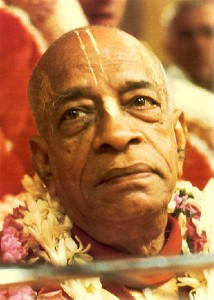
Author Archives: Sevak

Jagannatha Dasa Babaji – Biography

Jagannatha Dasa Babaji

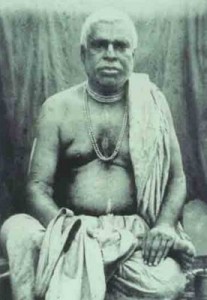
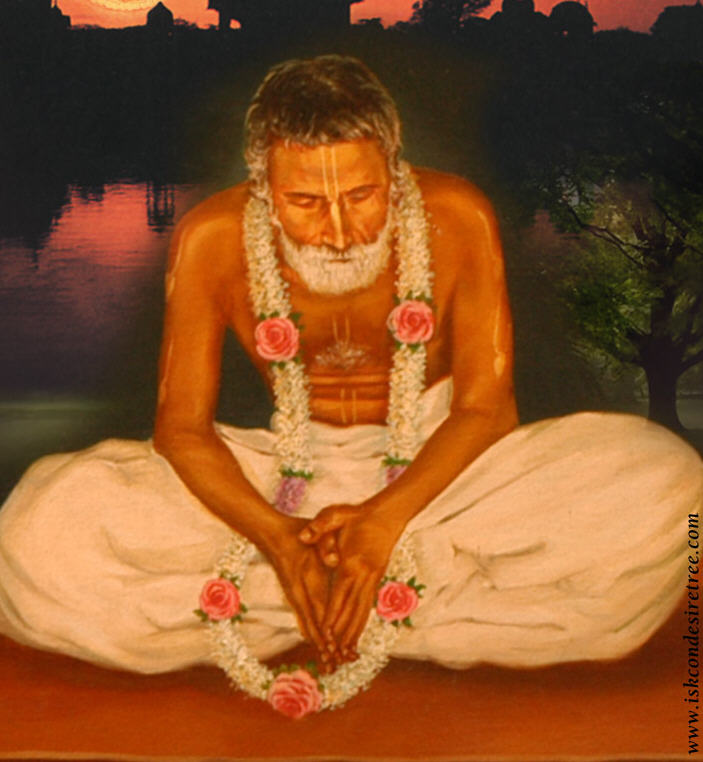
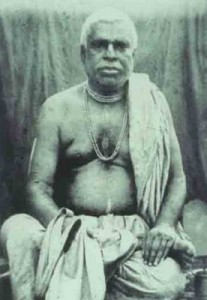
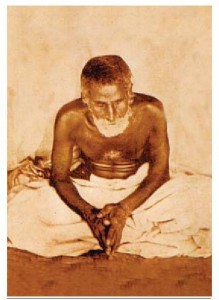
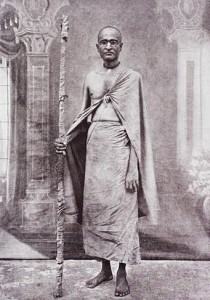
Babaji Maharaja always had great enthusiasm for kirtan and Vaishnava seva. Even when he was nearly 135 years old, he went on preaching the message of Shri Chaitanya throughout the world for the benefit of the fallen masses. In his old age, although he was almost paralyzed by infirmity, whenever it was time for kirtana he would still raise his arms in ecstasy. (In the image: Jagannath Dasa Babaji Maharaj, original photo).

   Jagannatha dasa Babaji was born in the Mayamanasimha district of West Bengal. Gaudiya Vedanta-acharya Shri Baladeva Vidyabhushana had a disciple named Uddhava dasa. His disciple was Shri Madhusudana dasa Babaji who lived in Suryakunda. Madhusudana dasa Babaji's disciple was Jagnnatha dasa Babaji.

   Jagnnatha dasa Babaji was very austere; he never hesitated to fast without taking any water for three days at a stretch. He used to sit up the entire night chanting the Holy Name and at early dawn finish his ablutions. In the morning he took Prasada of curd and flat rice.

   The following is a list of disciples of Siddha Jagnnatha dasa Babaji:

    1. Biharidasa Babaji
    2. Bhagavata dasa Babaji
    3. Gaurahari dasa Babaji
    4. Ramahari dasa Babaji
    5. Ramadasa Babaji
    6. Nityananda dasa Babaji, a resident of Varshana
    7. Harekrishna dasa Babaji, a resident of Kadamakhandi

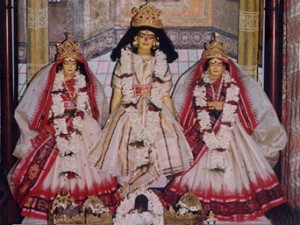
   Jagannatha dasa Babaji lived in Vrindavana and performed his bhajan there for quite some time. Once he asked his servant Bihari dasa to locate a Deity to install there. Bihari dasa personally approached a weaver-caste Zamindar to help him in this regard. The Zamindar thus arranged to bring Deities of Gaura-Nitai from Dainhata and gave them to Bihari dasa. Nitai-Gaura looked so beautiful when They were installed that it appeared as if They were made of gold. On the occasion of the installation ceremony a sum of Rs. 3,000 was spent to feed the Vaishnavas of Suryakunda and Radhakunda.

   One day a band of dacoits approached him with the motive of stealing the Deities which they thought were made of gold. He told them that he possessed nothing and they might look into the Temple for booty. The dacoits broke open the Temple door and quickly gathered up everything they could find, including the Deities. However, in rushing to make their escape they stumbled on the door step and dropped the Deities. Seeing that the sun had risen outside the dacoits left the Deities and rushed off with the rest of the booty. After this incident he asked Bihari dasa to arrange for the Deities to be cared for by someone else. Bihari dasa carried the Deities to Vrindavana where he handed Them over, along with Rs. 2,000, to Mother-Goswamini, a resident of Gayespur in the district of Maldaha. At present these Deities are residing at Dhopapada in Gopalbag and are known as "Sonara Gaura".

   Sometime later he again asked Bihari dasa to locate another Deity for him. Bihari dasa found a Deity of the six-armed Lord Chaitanya which had been kept hidden in a bag of cattle-feed. This Deity belonged to Dinu Babaji, a Manipuri Vaishnava residing in Mathura near Radhakunda. Bihari dasa brought the Deity to Vrindavana where he cleansed and decorated Him, then carried the Deity, along with all items for worship, to Suryakunda.

   For ten years thereafter Babaji Maharaja worshiped this Deity until one day he said, "Bihari, please put this Deity in the care of someone else in Vrindavana. I would like to go to Navadwipa. Let my body be offered at the lotus feet of Lord Gauranga." Bihari dasa brought the Deity to Vrindavana and after receiving a donation of Rs. 25 from Mother-Goswamini of Gayespur handed over the Deity as well as the money to Narottama dasaji, the head of the Gopalaguru Matha. At present this Deity is being served at the lane of Nidhuvana.

   In 1880 Bhaktivinoda Thakura went to Vrindavana and saw him for the first time. While there, he received many instructions on Hari-bhakti from Jagannatha dasa. Some time later, Babaji Maharaja visited the Barddhaman district during the month of Phalguna. He stayed at a town called Amalajora. At that time, Bhaktivinoda Thakura again had the good fortune to take his darshana.

   Seeing Bhaktivinoda Thakura's enthusiasm for preaching the Holy Name of Krishna, Babaji Maharaja was very happy. He stayed in Amalajora during Ekadashi, and that night there was kirtan and Hari-katha. Later, at Amalajora, Bhaktivinoda Thakura established his Prappana-ashrama. 

Jagannatha Dasa Babaji

Samadhi of Jagannatha Dasa Babaji Maharaja.

   In 1893 Babaji Maharaja went from Koladwipa to Surabhi-kunja in Godrumadwipa. There he took his seat. His arrival in Surabhi-kunja was a wonderful event. Jagannatha dasa Babaji revealed many lost holy places in Mayapura, including the Yogapitha, Shrivasa Angana, and others. It is said that when he came upon the holy place of Mahaprabhu's birth he danced, although he was very old and walked with difficulty. For some time he remained in Nadia and performed his bhajan on the banks of the Ganges. His bhajan kutir and samadhi mandir are still there at present. He ordered Bhaktivinoda Thakura to build a hut so Devotees could stay near his bhajan kutir, and Bhaktivinoda did so.

   When Bhaktisiddhanta Saraswati Thakura was twelve years old, he was an expert in the Jyoti-shastras explaining Vedic astrology. Hearing this, Babaji Maharaja one day called upon him to prepare the Vaishnava calendar in accordance with the proper siddhanta. He did so and Babaji Maharaja was very pleased. With this, the Navadwipa Panjika, the Vaishnava calendar recording the dates of the appearance and disappearance of important Vaishnava saints and the celebration of important festivals, began.

   Babaji Maharaja always had great enthusiasm for kirtan and Vaishnava seva. Even when he was nearly 135 years old, he went on preaching the message of Shri Chaitanya throughout the world for the benefit of the fallen masses. In his old age, although he was almost paralyzed by infirmity, whenever it was time for kirtana he would still raise his arms in ecstasy.

   Jagnnatha dasa Babaji was the vesa, or Babaji, guru of Bhagavata dasa Babaji Maharaja. Bhagavata dasa in turn gave the dress of a babaji to Gaura Kishora dasa Babaji. Jagnnatha dasa Babaji's servant's name was Bihari dasa. He was extremely strong and powerful. In his old age, Babaji Maharaja could not walk and Bihari dasa used to carry him in a basket on his shoulders. When he went to Calcutta, Babaji Maharaja would stay at the house of Bhaktivinoda Thakura on Manikatala Street. Bhaktivinoda was always very eager to invite him to his house for Prasada, but Babaji Maharaja was very renounced and would come only occasionally.

   When he was in his old age, Babaji Maharaja was nearly blind. Many people would come to see him and to offer him donations for the service of Shri Krishna. His servant Bihari dasa would keep all these donations in a bag. One day, Babaji Maharaja said, "Bihari! How many rupees have I got?" Bihari dasa had put some rupees aside for some service he had planned to render Babaji Maharaja. When asked about how many rupees were on hand, Bihari placed some rupees in his hand and kept twelve rupees aside. Even though his eyesight was failing, however, Babaji Maharaja detected the discrepancy. "Bihari!," he said, "Why have you kept twelve rupees aside? Give me all the rupees!" Smiling at this fun, Bihari surrendered the remaining coins to his guru. At that time, Babaji Maharaja made his wishes known as to how the money should be spent. The total came to two hundred rupees. Babaji Maharaja ordered Bihari dasa to take the money at once and buy sweetballs, rasagulas, and feed all the cows in Navadwipa dhama. 

Jagannatha Dasa Babaji

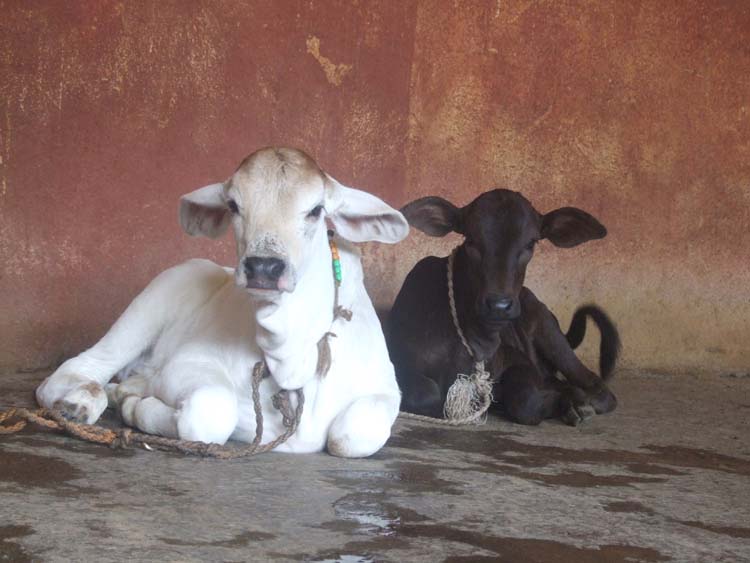
"Bihari!," he said, "Why have you kept twelve rupees aside? Give me all the rupees!" Smiling at this fun, Bihari surrendered the remaining coins to his guru. At that time, Babaji Maharaja made his wishes known as to how the money should be spent. The total came to two hundred rupees. Babaji Maharaja ordered Bihari dasa to take the money at once and buy sweetballs, rasagulas, and feed all the cows in Navadwipa dhama. (In the image: Calves in Govardhan Eco Village, Wada, Maharashtra).

   Once Babaji Maharaja was on the banks of the Ganges, living under a makeshift canvas tent. Nearby that place there lived a dog with five puppies. Whenever Babaji Maharaja would take Prasada, the dogs would come around and lick the food from his plate. When Bihari dasa caught hold of one of the dogs to drive it off, Babaji Maharaja told him: "Bihari! If you wish to drive these dogs off, you may take my plate away as well. I shall not eat today." When Bihari complained, "But guru Maharaja, these dogs are unclean!" Babaji Maharaja remarked, "No. These dogs are residents of the holy dhama. You may not abuse them."

   Many people used to come and beg alms from Jagnnatha dasa Babaji. He did not want to give them alms, but told them to do service. One day a man named Shri Gaura Hari dasa came and asked Jagannatha dasa Babaji for alms, but Babaji Maharaja would give him nothing. When the man persisted for three days, fasting outside Babaji Maharaja's tent, Babaji Maharaja finally relented. He tore off a piece of his kaupina (undergarment) and gave it to Bihari dasa, his servant, with the instruction to present it to the beggar as alms, thereby informing the beggar that he must first learn to control his senses before taking up the profession of a saint.

   One day Babaji Maharaja remarked about the professional readers of Shrimad-Bhagavatam, "This kind of professional Bhagavata kirtana is simply prostitution. Those who make their living by reading Shrimad-Bhagavatam are offenders to the Holy Name of Krishna. No one should listen to the kirtana and Bhagavatam readings that they produce. And one who listens to such offensive readings and thus commits offenses against the Holy Name of Krishna certainly goes to hell. Those who are involved in this professional reading should immediately give it up. Such a person should worship the residents of Vrindavana with great care and attention, considering himself most fallen, and thus pray for forgiveness."

   In Navadwipa Jagannatha dasa Babaji preferred to live beneath a tree where now the bhajan kutir of Bihari dasa stands. Later Bihari dasa bought ten cottahs of land from Madhava Datta for Rs. 40. That plot had a huge ditch in it which Bihari filled up by carrying earth from the Ganges at night after Jagannatha dasa went to bed. Sometime later Kedaranatha Datta Bhaktivinoda arrived there and both he and Bihari dasa sought bhiksa from Nafar Pal Chowdhury of Mahesaganj and raised two shades. A while later, with the approval of Jagannatha dasa, Rajarshi Banamali Raya Bahadur built three small rooms and fenced them in with a surrounding wall. The aged Manamohini dasi, a resident of Kaigrama, arranged to dig a well. He lived here for 32 years until his disappearance at the age of 147 years.

   Shrimad Bhaktivinoda Thakura remarked of Jagannatha dasa Babaji Maharaja that he was the topmost general among Gaudiya Vaishnavas. 

Jagannatha Dasa Babaji

"This kind of professional Bhagavata kirtana is simply prostitution. Those who make their living by reading Shrimad-Bhagavatam are offenders to the Holy Name of Krishna. No one should listen to the kirtana and Bhagavatam readings that they produce. And one who listens to such offensive readings and thus commits offenses against the Holy Name of Krishna certainly goes to hell. Those who are involved in this professional reading should immediately give it up. Such a person should worship the residents of Vrindavana with great care and attention, considering himself most fallen, and thus pray for forgiveness."

Visvanatha Cakravarti Thakura – Biography

The biography of Visvanatha has been translated from the following Bengali publications: Mihir Caudhuri Kamilya, Narahari Cakravarti: Jivani O Racanavali (Life and works of Narahari Cakravarti) Vol. 1: Biography and collected works. Burdwan, University of Burdwan, 1981, pp. 1-15

Narahari Cakravarti writes as follows in Bhaktiratnakara (Pathavadi ms. no. 2341-24, p. 154 ka, "My father, Vipra Jagnnatha, was a disciple of the famous Visvanatha Cakravarti." Visvanatha stands as a remarkable example of Bengali intellect. His place in the Vaisnava world remains unsurpassed as far as erudition, theological knowledge, poetic talent and appreciation of rasa. He was worshiped by his contemporaries as an example of unblemished ascetic life and an ideal follower of Ragamarga.

Scholars differ in their views regarding Visvanatha's period. According to Syamalala Goswami it was 1626-1708 A.D. (quoted in the book Caitanyottara Yugera Gaudiya Vaisnava p. 98). Murarilal Adhikari writes in Vaisnava Digdarsani that the period was 1646-1754. Madhusudana Tattvavacaspati guesses that Visvanatha was born around 1633-1638 A.D. (1555-60 Saka) and disappeared around Saka 1625-30 (Sri krishna Bhavanamrta, introduction p. 4, published in Bhaktiprabha 1335). Both Nikhilnath Roy and Bimanbihari Majumdar hold that Visvanatha was born toward the early part of the 17th century Saka (see Mursidavadera Itihasa p. 308). In Gaurapadatarangini 1st ed. 1310, p. 183, Jagadbandhu Bhadra argues that in 1664 A.D. (Saka 1586) Visvanatha was born. However proper evidence in support of the above arguments is lacking.

Visvanatha completed Sararthadarsini in 1704 A.D. (1626 Saka), which he himself states at the conclusion of the book. Thus he must have been alive around 1704 A.D. According to Sukumar Sen, Visvanatha disappeared shortly after 1704 A.D. (see Vangala Sahityera Itihasa Vol. 1, Part 2, 2nd ed., 1965, p. 393)

Visvanatha was born at Devagrama (see ms. of Narottamavilasa at Pathavadi no. 2336 (21), p. 31 kha). Some believe that this village belongs to Kasiganj police station of the Nadia district (Gaurapadatarangini, introduction p. 183; Vaisnava Digdarsani p. 120; Jivanikosa by Sasibhusana Vidyalankar, Vol. 5, p. 1773; Nadia: Svadhinata Rajatajayanti Smarakagrantha, krishnagore 1973, p. 25). Others argue that Devagrama falls under Sagaradihi police station of the Mursidabad district (see 'Padakarta Harivallabha' by Harekrishna Mukhopadhyay in Ananda Bajara Patrika special Puja no. 1369, p. 276).

None of the old mss. record the names of Visvanatha's parents. Pathavadi mss. of 'Narottamavilasa" state that Visvanatha's father's name was Ramanarayana Cakravarti. Visvanatha was the youngest child in the family. His eldest brother was Ramabhadra and the next oldest was Raghunatha. Ramabhadra was an accomplished theologian and a disciple of Gopikanta. This Gopikanta was the son of Hariramacarya, the disciple of Ramacandra Kaviraja who belonged to the spiritual lineage of Srinivasa. The second brother, Raghunatha, was also a great scholar (mss. of 'Narottamavilasa' of Pathavadi no. 2336.21, p. 31 kha).

Visvanatha's family was brahmana by caste from the Radha clan, Sandilya gotra, and lineage drawn from Bhattanarayana (see Vaisnavacarya Visvanatha by Nanigopala Goswami in Bharatavarsa 1351).

In the said mss. of 'Narottamavilasa' p. 31 kha, an account is given relating to Visvanatha's birth. It is said that as soon as Visvanatha was delivered a strange halo of light appeared around his body. That light illuminated the entire delivery-room and then disappeared. This account seems to be an interpolation at a later date. Once a highly renowned scholar visited Devagrama and the local pandita's became unnerved upon meeting him. But Visvanatha, a mere adolescent, defeated this scholar in argument.

As a child Visvanatha completed his studies at Devagrama and thereafter went to Saidavad. Some say that Visvanatha was educated under Ganganarayana Cakravarti of Saidavad (Premavilasa J.N. Talukdar ed. pp. 206-7), while others argue that Ganganarayana's adopted son krishnacarana actually taught Visvanatha (H.K. Mukhopadhyaya 'Padakarta Harivallabha'). No evidence in support of these views has yet been found.

Radharamana was the name of Visvanatha's diksa guru. Visvanatha himself writes about his spiritual lineage in one sloka of Sararthadarini. In chapters 2-7 of Stavamrtalahari Narahari also gives details on the spiritual lineage or guru-pranali of Visvanatha as follows:

Lord Gauranga
|
Lokanatha
|
Narottama
|
Ganganarayana
|
krishnacarana
|
Radharamana (alias Sri Rama)
(son & disciple)
|
Visvanatha

Visvanatha's guru and parama-guru belonged to the spiritual lineage of Narottama Thakura.

From his childhood Visvanatha was of a detached temperament. At the command of his father, Visvanatha's brother Ramabhadra arranged for Visvanatha's marriage at an early age. However, through studying Srimad Bhagavatam Visvanatha developed a deep spirit of renunciation. After completing his studies he took spiritual initiation and gradually developed an intense love for krishna. Finally, one day, he renounced home, took the vow of a renunciate and went to vrindavana. After visiting several holy places Visvanatha finally sought the shelter of Mukundadasa, a disciple of krishnadasa Kaviraja on the bank of the Radhakunda. The devotees present there urged this young renunciate to return home, which Visvanatha had to abide by (mss. Narottamavilasa pp. 31-32 ka).

Possibly this was the time when Visvanatha went to Patadanja where he is said to have realized his spiritual goal. Visvanatha installed the deity of Gopala (Harekrishna Mukhopadhyaya p. 276)

At the command of his guru, Visvanatha went home for one night to meet his wife. His wife, however, heard nothing other than krishna katha from her husband throughout the night (see mss. Narottamavilasa p. 32 ka). Early the next morning Visvanatha left home and took shelter of his guru. As directed by his guru, Visvanatha began copying Srimad Bhagavatam.

Visvanatha settled on the bank of the Radhakunda in vrindavana. Regarding his spiritual practices Narahari writes as follows, "Being deeply immersed in singing kirtana of the Lord, Visvanatha narrated the pastimes of the Lord in a most fascinating manner. No one is competent enough to speak of his spiritual practices. Anyone who had the good fortune to set his eyes upon Visvanatha felt immediately soothed from the pangs of material existence. Visvanatha served the deity of Sri Gokulananda with great pleasure and devotion."

When Visvanatha arrived in vrindavana he noticed that with the disappearance of the six Goswamis the beauty of that holy place was no longer visible. A large number of Mathas had been destroyed by the Muslims. Priests migrated from vrindavana taking away the deities which were in their charge. A number of deities were left standing alone and received no service. And the devotees were in a state of constant fear. People in general were in no mood to devote attention to the study of the scriptures (see Madhurya Kadambini introduction, p. 4, by Satyendranatha Vasu).

During his stay in vrindavana many loyal workers and scholars such as Baladeva Vidyabhusana were deeply impressed upon seeing Visvanatha's devotion, strength of mind and hard working nature. Visvanatha became determined to bring back the lost glory of vrindavana. The following are some of his achievements.

1. Visvanatha himself installed the Deity of Gokulananda and took charge of serving Govardhana sila. He reinstated different priests to begin the service of the Deities in various places.

2. It was through his initiative that the Sri Vardhana Matha of Kongala and some new Mathas at several other places were set up (Visvakosa V. 19, p. 42). Visvanatha also arranged to renovate a large number of temples.

3. At that time there was little access by the common people to the works of the Goswamis. This was due to the fact that there were no proper analysis and interpretation of these theological treatises. What Visvanatha did was to prepare simple and lucid commentaries for these works, as well as presenting abridged forms of the original works. This enabled devotees of all types to understand and appreciate the essence of the Goswamis' works. Visvanatha also arranged for the wide distribution of books which Vaisnavas needed for daily study and spiritual practices. He also organized classes to be held on them to impart instructions.

Visvanatha was one of the most accomplished preachers of madhurya-bhava in ragamarga. Regarding sadhana (spiritual achievements), Visvanatha's name is placed after Raghunatha dasa Goswami, krishnadasa Kaviraja and Narottama Thakura (CC Sukumar Sen ed. 1.4. p.13).

Visvanatha was an out and out parakiya-vadi. Both in prakata and aprakata lila Visvanatha considered Sri Radha and the gopis as the parakiya heroines of Lord krishna. Visvanatha had deep faith in the astakaliya nitya-lila described by Kavi Karnapura and krishnadasa Kaviraja (Padavaliparicaya 2nd ed. pp. 86-87). Apart from practicing smarana (remembrance), manana (contemplation) and sankirtana, Visvanatha remained deeply absorbed in the service of Radha krishna with loyalty to the Vrajavasis. Due to his own success in practice and realization, Visvanatha was able to write beautifully describing the proper method for astakaliya nitya-lila, a unique analysis of ragamarga sadhana, detailed descriptions of Radha krishna lila, details on the sadhana practiced by sakhi-manjari or kinkari, the mystic significance of bhajan and the method of bhajan.

Another remarkable achievement of Visvanatha's was to establish Gaudiya Vaisnavism and its theology through Baladeva Vidyabhusana, Visvanatha's close follower, at the meeting of Vaisnavas held at Galta, Jaipur in 1718 A.D. (Saka 1640) (see CC introduction 4th ed. p. 396, also Baladeva Siddhantaratna, Gopinatha Kaviraja ed., introduction).

As a youth in Saidavad Visvanatha set up a Sanskrit school and accepted a teaching career. In order to help the students to learn easily Visvanatha wrote a simplified commentary titled 'Suvodhini' on Kavi Karnapura's Alamkara Kaustubha. This is said to be Visvanatha's first literary work. Upon his arrival in vrindavana, Visvanatha sought the refuge of Mukundadasa. This Mukunda dasa was a poet and disciple of krishnadasa Kaviraja. Mukunda dasa had some books to be completed. Noting Visvanatha's devotion and erudition, he thus requested Visvanatha to complete those books. Pathavadi mss. Narottamavilasa p. 32 ka, refers to this but does not give the names of the works.

In vrindavana Visvanatha's literary talent blossomed and beautiful compositions began to flow like many streams of nectar. His complete works can be classified under four groups:

1. Commentary works (Tika Grantha):

At that time most of the manuals and other books which Vaisnavas needed to consult daily were full of difficult theological concepts mostly written in Sanskrit. This made it difficult for the lay-devotee to study and understand the proper conclusions. To remove these obstacles Visvanatha wrote simple Sanskrit commentaries on many of the Goswamis' works. Titles of such commentaries are as follows:

    1. Sararthadarsini (1704 A.D.) – tika on Srimad Bhagavatam
    2. Sararthavarsini – tika on Bhagavad-gita
    3. Sri Caitanya-caritamrtera tika (the first commentary in Sanskrit on a Bengali book)
    4. Brahmasamhitara tika
    5. Anandacandrika – tika on Ujjvala-nilamani of Rupa Goswami
    6. Bhakti-sara-pradarsani – tika on Bhakti-rasamrta-sindhu of Rupa Goswami
    7. Prema-bhakti-candrika-kirana – a Sanskrit tika on Narottama's Prema-bhakti-candrika
    8. Sukhavartini – a tika on Kavi Karnapura's Ananda-vrindavana-campu
    9. Mahati – tika on Danakeli Kaumudi of Rupa Goswami
    10. Bhakta-harsini – tika on Gopalatapani
    11. Hamsaduta tika – tika on Rupa Goswami's Hamsadutam
    12. Tika on Rupa Goswami's Vidagdha-madhava
    13. Lalita-madhavera tika

Some scholars argue that the tika on Lalita-madhava and Vidagdha-madhava were not works of Visvanatha. They say that krishnadeva Sarvabhauma, a disciple of Visvanatha, was the writer of the Vidagdha-madhava tika, while Radhakrishna dasa, a disciple of Jiva Goswami wrote the tika of Lalita-madhava (see Haridasa dasa Gaudiya Vaisnava Abhidhana, p. 1751-52, 1745)

2. Abridged Works:

Visvanatha felt that many of the Vaisnava works were difficult for the lay-devotee to grasp. He therefore extracted the most relevant information and presented an abridged form of various selected books. Three of these are works of Rupa Goswami as shown below:

    1. Kirana i.e Ujjvala-nilamani-kirana on Ujjvala-nilamani
    2. Vindu i.e Bhakti-rasamrta-sindhu-vindu on Bhakti-rasamrta-sindhu
    3. Kana i.e. Bhagavatamrta-kana on Laghu-bhagavatamrta

3. Original Works:

Visvanatha's thoughts had originality and depth. He was gifted with the talent of communicating deep philosophical concepts in a simple way, while keeping the unique characteristics of Radha krishna lila in tact. Most of his original works relate to sadhana-bhajan as follows:

    1. Sri krishna-bhavanamrta (1679 A.D.): describes astakaliya nitya-lila of Radha krishna
    2. Ragavartmacandrika: a guide to and an account of raganuga bhakti and its methods
    3. Madhurya-kadambini: reveals the subtle concepts on rupa and madhurya of Lord krishna
    4. Aisvarya Kadambini: a scriptural account of Lord krishna's aisvarya (opulence)
    5. Camatkara-candraka: mystic sports of Radha krishna
    6. Gopipremamrta: reveals the love of the gopis and concepts regarding svakiya and parakiya
    7. Mantrartha-dipika: explanation of kamabija and kamagayatri mantras
    8. Vraja-riti-cintamani: describes the sites of Lord krishna's Vraja-lila
    9. Prema-samputa (1684 A.D.): describes madhurya of Radha
    10. Sankalpa-kalpadruma (1678 A.D.): describes prayers to Sri Radha to grant sevavrtti
    11. Nikunja-keli-virudavali (1678 A.D.): describes the sports of Radha krishna in the kunja
    12. Surata-kathamrta (1678 A.D.): description of the pastimes of Radha krishna in the quiet of midnight.

Some other works by Visvanatha are written like hymns. These reveal Visvanatha's genuine devotion and reverence for his superiors, cherished Deities, and the holy places of Lord krishna's pastimes. The following is a list of these works:

    1. Sriman Mahaprabhorastakaliya Smaranamangalastotram: A guide book describing Lord Gauranga's astakaliya lila.
    2. Sri Gauranganoddesa-candrika: A brief account on the close associates of Lord Gauranga (a similar manuscript of Visvanatha's dealing with the associates of Lord Gauranga is available in the collection of Barahanagar Sri Gauranga Granthamandir the title of the said mss. is Gauraganasvarupa-tattvacandrika, no.230 B 17)
    3. Stavamrta-lahari: This is one of the best works of hymns. It consists of a total of 28 hymns which deal with the guru, the poet's own guru, paramaguru, paratparaguru, Narottama, Lokanatha, Sri Caitanya, Vaisnava acaryas, etc. Then invocation of the mercy of the famous Deities Gopaladeva, Madanagopala, Govindadeva, Gopinatha, Gokulananda and Lord krishna; invocation of the grace of Radha and Vrnda devi; hymns in praise of various lila sites such as vrindavana, Nandisvara, krishnakunda, etc.
    4. Padavali Samkalam (compilation of Vaisnava poems)
    5. Ksanada-gita-cintamani (known briefly as 'Ksanada' or 'Gitacintamani').
    [Ksanada-gita-cintamani mss. Pathavadi no. 2615 (24 ga), 2613 (24 ka), oldest edition 1282 (1875 A.D.). See Vangala Sahityera Itihasa V. 1, Pt. 1, p. 393]

    2nd edition 1315 vrindavana Kesighat (krishnapada dasa Babaji)
    3rd edition (?) Nitaipada Dasa
    4th edition (1332) Nityasvarupa Brahmacari, Calcutta
    5th edition (1369) Bimanabihari Majumdar, General Library

While compiling this Ksanada-gita-cintamani containing selected Vaisnava poems Visvanatha had in mind that devotees of raganuga marga may every night perform or listen to nama-guna etc. of their cherished Deities.

Earlier some attempts were made to prepare compilations of Vaisnava poems to some extent by Ramagopala dasa of Srikhanda in his 'Sri Sri Radhakrishnarasa-kalpavalli', by his son Pitamvaradasa in 'Rasamanjari' and Mukundadasa, a disciple of krishnadasa Kaviraja in 'Siddhantacandrodaya'. However it was Visvanatha who first prepared this first compilation. In fact Ksanada is considered "the first perfect Padavali compilation" (Vangala Sahityera Itihasa V. 1, Pt. 2, 2nd ed., p. 102 b 393). The first part of Ksanada is available, but it is thought that Visvanatha disappeared before the later part was completed. Dr. Sukumar Sen argues that this compilation was done before 1704 A.D. (see Gaudiya Vaisnava Sadhana by Harekrishna Mukhopadhyay, 1st ed. p. 136). In this book Visvanatha used the bhanita of 'Harivallabha' or 'Vallabha' on those poems composed by him.

Recently the second part of Ksanada, compiled by Manohara dasa, was found and published (Ksanada-gita-cintamani: Manoharadasa, published by Radhakrishna dasa, Kusumsarovar, P.O. Radhakunda, Mathura). This mss. contains the first to the seventeenth section of Ksanada. It was available from Advaitacarana Goswami, the priest of Radharamana of vrindavana. Haridasa dasa gives information in Gaudiya Vaisnava Abhidhana Vol. 3, p. 1484 that a similar manuscript is available in the collection of Nimbarka sampradaya.

Bimanbihari Majumdar argues as follows: "Since Visvanatha compiled Vaisnava poems for the Bengalis to enjoy he titled them 'Purva Vibhaga' (eastern section) and his contemporary, Manohara dasa, the writer of Anuragavalli, compiled for the readers of western India and hence titled it 'Pascima Vibhaga' (western section)."

In the second compilation there are twenty one poems of Manohara dasa, along with those of Haridasa swami etc. Several of Manoharadasa's poems deal with Lord Gauranga. This compilation consists of Hindi poems. In the 'Pascima Vibhaga' there are six Hindi poems written by Visvanatha, who gave the bhanitas of Harivallabha or Vallabha.

The Purva Vibhaga of Visvanatha consists of a total of thirty Ksanada or themes. These themes are fitted each for thirty nights from the first night of the dark fortnight of one lunar month till the day of the new moon and from the first day of the bright fortnight till the night of the full moon. Varying in size, eight have small and sixteen have big padas. A total of 308 pada are found in Purva Vibhaga containing the bhanita of 48 known and unknown poets (of these the compiler has 53 padas – 40 with the bhanita of Harivallabha and 13 with the bhanita of Vallabha). Some hold that Harivallabha was the name of Visvanatha's guru. Some argue that Harivallabha was the sannyasa name of Visvanatha. However neither of these ideas is supported by evidence. In 'Gitavali' part of the book Stavamrta-lahari of Visvanatha, out of eleven Sanskrit padas two have bhanita of Harivallabha and four have the bhanita of Vallabha.

In 'Mantrartha-dipika' Sri Radha addresses Visvanatha in a state of dream as Harivallabha. Narahari, the son of Visvanatha's disciple, clearly writes that Harivallabha was the name of Visvanatha.

Each Ksanada or section is arranged in such a manner as it could be sung for one night. First there is Gaura Vandana, then follows Nityananda Vandana and concludes with poems of milana (comedy) or sambhaga. In between there are poems/lyrics dealing with abhisara, or aksepanuraga and rasa. All these compositions relate to madhurya rasa. None of these deal with sakhya, vatsalya or even themes relating to Mathura.

This compilation was made with a view to serving aspirants with manjari-bhava eager to enjoy Vrajarasa. Though Visvanatha was a highly imaginative poet he was a perfect erudite too. He never liked to compose poems in a simple, unadorned manner. Sanskrit expression, rhetorically rich language, chiming words and waves of rhythm enriched his poems which were equally rich with fascinating themes and deep rasa.

Visvanatha had an extraordinary command of Vrajvuli, Hindi and Sanskrit. In all three languages Visvanatha composed a total of seventy padas of which the ones in Sanskrit are the best.

It seems that Visvanatha's poems were not appreciated by his contemporaries. Hence in later compilation not many of Visvanatha's poems are found. In Padamrtasamudra of Radhamohana Thakura, almost a contemporary of Visvanatha, there was not any pada of Visvanatha's. The reason for this was that Radhamohana compiled the poems in Bengal while Visvanatha was in vrindavana. Neither can any pada of Visvanatha's be found in Sankirtanamrta, a compilation by Dinabandhu dasa belonging to a bit later period.

Among other compilations of padas there are five padas of Visvanatha's in the total 1169 pada in Gitacandrodaya compiled by Narahari Cakravarti, one pada of Visvanatha's out of a total of 1119 pada compiled in Kirtanananda of Gaurasundara dasa, and three pada of Visvanatha's out of 3101 total pada compiled in Vaisnava dasa's Padakalpataru.

When critically evaluated as poetry Visvanatha's works do not rank in the first category although critics have praised most of his padas (see introduction by Bimanbihari Majumdar ed. Ksanadagitacintamani).

Judged from the standpoint of the preceding Vaisnava acaryas and the quality of rasa, Visvanatha undoubtedly contributed immensely in leading Gaudiya Vaisnavism and sadhana bhakti forward. Most of the difficult treatises of Rupa Goswami were presented by Visvanatha to devotees sometimes by adding simple commentaries and sometimes by preparing abridged editions. Devotees hailed Visvanatha as 'the second svarupa of Rupa' or as 'avatara of Rupa'.

Among the devotees of Visvanatha nothing much is known about others except krishnadasa (see mss. N. Vilasa p. 33 kha), Kanudasa, Nandakisora (see Rasakalika ed. Haridasa dasa, p. 82, p. 154). Some think that krishnadeva Sarvabhauma was a disciple of Visvanatha. Baladeva Vidyabhusana, a disciple of Radhadamodara, revered Visvanatha deeply as his guru.

Visvanatha stands as a remarkable outcome of Bengali intellect in 17th-18th century as poet, musician, thinker, theologian, scholar and above all a devotee and preacher.

Bhaktivinoda Thakura – Biography


Bhaktivinod Thakur

Srila Bhaktivinoda Thakura.

  Bhaktivinoda Thakura was born on Sunday, Sept. 2, 1838 in Biranagara (Ulagrama) in the Nadia district of Bengal. He was the seventh son of Raja Krishnananda Datta, a great Devotee of Lord Nityananda. He was also known as the great grandson of Madana Mohana and the third son of his Godfather Anandacandra. He would be known as daitya-kulera prahlada (Prahlada in the family of demons). This was because Vaisnavism was not very much respected in his family; on his mother's side, there was no respect for Vaisnavism at all. He was named Kedaranatha Datta by his Godfather. His childhood was spent at the mansion of his maternal grandfather Mustauphi Mahasaya, in Biranagara. His environment at this time was very opulent. He got his elementary education at the primary school started by his grandmother. Later he attended an English school in Krishnanagara, started by the King of Nadia; he left that school when his older brother died unexpectedly of cholera. When he was 11 years old, his father passed away. Subsequently, the grant of land that had been conferred upon his grandmother changed owners; at this time the family fell into a condition of poverty – their great wealth proved to be illusory. Still, Kedaranatha Datta passed over these difficulties with great endurance. His mother arranged a marriage for him when he was 12 (in the year 1850) to the 5 year old daughter of Madhusudana Mitra Mahasaya, a resident of Rana Ghata. Around this time Kedaranatha's uncle Kasiprasada Ghosh Mahasaya Thakura, who had mastered British education, came to Ulagrama after the death of his maternal grandfather. He schooled young Kedaranatha at his home in Calcutta; this was at first resisted by the boy's mother, but by the time he was 13 he was allowed to go to the big city.

   His uncle's house was situated in the Heduya district of central Calcutta. Kasiprasada was the central figure of the literary circle of his time, being the editor of the Hindu Intelligencer newspaper; many writers came to him to learn the art of writing in correct English. Kedaranatha assisted Kasiprasada by judging manuscripts submitted to the newspaper. Kedaranatha studied Kasiprasada's books and also frequented the public library. He attended Calcutta's Hindu Charitable Institution high school and became an expert English reader, speaker, and writer. Kedaranatha became ill from the salty water of Calcutta. He returned to Ulagrama and was treated by a Muslim soothsayer who predicted that the village of Biranagara would soon become pestilence-ridden and deserted. The Muslim also predicted Kedaranatha would become recognized as a great Devotee of Lord Krishna. In the year 1856, when he was 18, Kedaranatha entered college in Calcutta. He started writing extensively in both English and Bengali; these essays were published in local journals. He also lectured in both languages. He studied English literature at this time extensively, and taught speechmaking to a person who later became a well-known orator in the British Parliament. Between the years 1857-1858 he composed a two part English epic entitled "The Poriade", which he planned to complete in 12 books. These two books described the life of Porus, who met Alexander the Great. Dvijendranatha Thakur, the eldest son of Maharsi Devendranatha Tagore and brother of the Nobel Prize winning poet Rabindranatha Tagore, was Kedaranatha's best friend during these years. He assisted Kedaranatha in his studies of Western religious books. Kedaranatha used to call Dvijendranatha "baro dada", or big brother. He was very taken by Christian theology, and found it more interesting than Hindu monism. He would spend many hours comparing the writings of Channing, Theodore Parker, Emerson and Newman.

   At the end of 1858 Kedaranatha returned to Biranagara and found that the Muslim soothsayer's prediction about that place had come true: it was ruined and deserted. Kedaranatha brought his mother and paternal grandmother with him to Calcutta. Soon after he went to Orissa to visit his paternal grandfather, Rajavallabha Datta, formerly an important Calcutta gentleman who was now living as an ascetic in the Orissan countryside. His days were coming to a close, and he wanted Kedaranatha to be with him when he departed this world. After receiving his grandfather's last instructions, he traveled to all the monasteries and temples in the state of Orissa.

   Kedaranatha began to consider the question of the means of his livelihood. He was not interested in business, as he'd seen how the "necessary dishonesty" of the trade world had morally weakened the merchant class. He decided to become a school teacher. He established a school for English education in the village of Kendrapara near Chutigrama, in Orissa, thus becoming a pioneer in English teaching in that state. He also could see the oppressive power wielded by the landowners of Chutigrama. After some time he went to Puri and passed a teacher's examination; he got a teacher's post in a Cuttack school and later became headmaster of a school in Bhadraka and then in Madinipura. His work was noted by the schoolboard authorities. In Bhadraka, his first son Annada Prasada (Acyutananda) was born, in 1860. He published a book that year in English that described all the asramas and temples in the state; this book received favorable mention in the work called "Orissa" by British historian Sir William Hunter. Hunter praised Kedaranatha's moral and religious character. As the headmaster of the Medinipura high school, Kedaranatha studied many popular Bengali religious sects, particularly their philosophies and practices. He concluded they were all cheap.
 
   He came to understand that the only real religion that had ever been established in Bengal was that of Sri Caitanya Mahaprabhu; unfortunately, His movement was not well-represented. Kedaranatha could not even get a copy of the 16th century Bengali biography of Lord Caitanya's activities on earth called Sri Caitanya-caritamrta, despite searching in bookshops, libraries and monasteries all over Bengal. Kedaranatha's first wife passed away, so in the town of Jakapura he married Bhagyavati Devi. In 1861 Kedaranatha accepted the post of Deputy Magistrate in the Government of Bengal. Then he became Collectorate Officer after seeing the corruption of the government workers. He established an organization called the "Bhratr Samaja". He wrote an English book in 1863 called "Our Wants." At this time he also constructed a home in Rana Ghata. Later in 1863 he stayed at Burdwan, where he composed two novel poems in Bengali: "Vijinagrama" (deserted village) and "Sannyasi." Volume 39 of the 1863 Calcutta Review praised these poems, saying, "We hope the author will continue to give his countrymen the benefit of his elegant and unassuming pen, which is quite free from those objectionable licenses of thought and expression which abound in many dramas recently published. The want of the day is the creation of a literature for Hindu ladies, and we trust that many more educated natives will have the good sense to devote their time and abilities to the attainment of this most desirable aim." The rhyme and style of these two poems were original; they gave birth to a new way of writing poetry in the Bengali language. In the year 1866 Kedaranatha took the position of Deputy Registrar with the power of a Deputy Collector and Deputy Magistrate in the district of Chapara. He also became quite fluent in Persian and Urdu. In a place called Saran in Chapara, a clique of tea planters made unjust demands of him; he successfully opposed them. And while at Saran he visited the Gautama Asrama at Godana. Desiring to establish a school for teaching nyaya-sastra, he delivered a speech there (in 1866) which was well-received. The school was successfully established, the foundation-stone being laid in 1883 by Sir Rivers Thomson, after whom the school was named. Though Kedaranatha had no further part in the project after his speech, the talk he gave was instrumental in securing public aid for the school. Also in 1866 he translated the Balide Registry Manual into Urdu, which was circulated by the government throughout the United Provinces of Agra and Oudh; this manual was used by the registration departments of those areas.
 
   Kedaranatha was transferred to Purniya from Chapara where he took charge of the government and judicial departments; he was then transferred to Dinajapura (West Bengal) in 1868, becoming the Deputy Magistrate. At this time he received copies of the Srimad Bhagavatam and Sri Caitanya-caritamrta from Calcutta. He read Caitanya-caritamrta repeatedly; his faith in Krishna developed until he was absorbed in Krishna consciousness day and night. He incessantly submitted heartfelt prayers for the Lord's mercy. He came to understand the supreme majesty and power of the one and only Absolute Personality of Godhead Sri Krishna. He published a song about Lord Chaitanya entitled Saccidananda-premalankara. In 1869, while serving as deputy magistrate under the government of Bengal in Dinajapura, he delivered a speech in the form of a treatise he had written on the Srimad-Bhagavatam to a big congregation of many prominent men of letters from many parts of India and England. He was transferred to Camparana, during which time his second son, Radhika Prasada, was born. In Camparana people used to worship a ghost in a banyan tree which had the power to influence the mind of the local judge to decide in the favor of the worshiper. Kedaranatha engaged the father of Pandita Ramabhai, a famous girl scholar, to read Srimad-Bhagavatam under the tree; after one month, the tree crashed to the ground, and many people found faith in the Srimad-Bhagavatam. From Camparana he went to Puri which engladdened his heart because the holy city of Puri, the site of the famous Krishna Temple of Jagannatha, was where Chaitanya Mahaprabhu had resided for 18 years as a sannyasi. 

Bhaktivinod Thakur

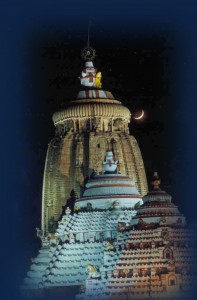
Sri Jagannath Mandir, Puri.

   Near Puri, in the town of Kamanala, there lived a yogi named Bisakisena, who became popular by exercising mystic powers. He had two companions going by the names Brahma and Siva; Bisakisena himself claimed to be Mahavisnu. Some wealthy landowners of Orissa came under his sway and were providing funds for the construction of a temple. They also sent him women with whom he engaged in "rasa-lila" enjoyments. Bisakisena declared he'd drive the British rulers out of Orissa and make himself king. Such inflammatory statements were circulated all around Orissa. The British thought him a revolutionary, so the District Governor of the National Government of Bengal drew up arrest orders; but nobody in Orissa dared to act upon these orders, as they all feared the yogi's power.

   Mr. Ravenshaw, district commissioner for Orissa, requested Kedaranatha to bring Bisakisena to justice. Kedaranatha went personally to Bisakisena, who showed some powers and informed Kedaranatha that he knew well who he was and his mission. He warned Kedaranatha that since he (Bisakisena) was the Lord, he'd better not interfere with him. Kedaranatha replied by acknowledging Bisakisena's accomplishments in yoga and invited him to come to Puri where he could see the Jagannatha temple. Bisakisena haughtily said, "Why should I come to see Jagannatha? He's only a hunk of wood; I am the Supreme in person." Instantly furious, Kedaranatha arrested the rogue, brought him to Puri and threw him in jail, where he was guarded by 3 dozen Muslim constables and 72 policemen from Cuttack day and night. "Brahma" and "Siva" avoided arrest by claiming they'd been forced by Bisakisena to do as they'd done; but Mr. Taylor, subdivision officer at Kodar, later prosecuted them. Kedaranatha tried Bisakisena in Puri. The trial lasted 18 days, during which time thousands of people gathered outside the courtroom demanding Bisakisena's release.
 
   On 6th day of the trial Kedaranatha's second daughter Kadambini (age 7) became seriously ill and nearly died; but within a day she had recovered. Kedaranatha knew it was the power of the yogi at work. He remarked, "Yes, let us all die, but this rascal must be punished." The very next day in court the yogi announced he'd shown his power and would show much more; he suggested that Kedaranatha should release him at once or face worse miseries. On the last day of the trial Kedaranatha himself became ill from high fever and suffered exactly as his daughter had done for one whole day. But Kedaranatha pronounced the man guilty and sentenced him to 18 months for political conspiracy. When Bisakisena was being readied for jailing, one Dr. Walter, the District Medical Officer, cut off all the yogi's long hair. The yogi kept his mystic power in his hair and hadn't eaten or drunk during the whole trial, so when his hair was shorn he fell to the floor like a dead man and had to be taken by stretcher to jail. After 3 months he was moved to the central jail at Midnapura where he took poison and died in the year 1873. In Puri, Kedaranatha studied the Srimad-Bhagavatam with the commentary of Sridhara swami, copied out the Sat-sandarbhas of Jiva Goswami and made a special study of Rupa Goswami's Bhakti-rasamrta-sindhu. Between the years 1874 and 1893, Kedaranatha spent much time in seclusion chanting the holy name (though he still executed his worldly duties perseveringly). He wrote several books in Sanskrit such as Tattva-sutra, Datta-kaustubha and Tattva-viveka and many other books in Bengali such as the Kalyana-kalpataru. While in Puri he established a Vaisnava discussion society known as the Bhagavat-samsad in the Jagannatha-vallabha gardens, where the famous saint Sri Ramananda Raya stayed in meditation hundreds of years before. All the prominent Vaisnavas joined this group except for Raghunatha dasa Babaji, known as Siddha Purusa.
 
   He thought that Kedaranatha was unauthorized, as he did not wear kanthi-mala (neckbeads) or tilaka (clay markings on 12 places of the body). Moreover, he advised other Vaishnavas to avoid Kedaranatha's association. But soon thereafter Raghunatha dasa Babaji contracted a deathly illness. Lord Jagannatha appeared to him in a dream and told him to pray for the mercy of Kedaranatha if he at all wanted release from the illness and death. He did so; Kedaranatha gave him special medicines and cured him. Raghunatha dasa Babaji was blessed with a true awareness of Kedaranatha's spiritual position. A well-known saint named Svarupa dasa Babaji did his worship at Satasana near the ocean in Puri. Svarupa showed much affection for Kedaranatha and gave him many profound instructions on the chanting of the Holy Name of Krishna. A popular upstart holy man named Charan dasa Babaji preached and printed books advising a perverted style of kirtana (congregational chanting of the holy names of God), advising that one should chant the Hare Krishna Mantra in japa and Nitai Gaura Radhe Syama Hare Krishna Hare Rama in kirtana. Kedaranatha preached long and hard to him; after a long time Charan dasa Babaji came to his senses and begged forgiveness from Kedaranatha, admitting his fault in spreading this nonsense fashion of chanting all over Bengal. Six months later Caran dasa went mad and died in great distress. Kedaranatha became manager of the Jagannatha temple. He used his government powers to establish strict regularity in the worship of the Deity. In the Jagannatha temple courtyard he set up a Bhakti Mandapa, where daily discourses of Srimad Bhagavatam were held. Kedaranatha would spend long hours discussing Krishna and chanting the Holy Name, especially at the important sites of Sri Chaitanya's pastimes like the Tota Gopinatha Temple, the tomb of Haridasa Thakura, the Siddha Bakula tree and the Gambhira room. He made notes on the Vedanta-sutra which were used by Sri Syamalala Goswami in the edition of the Govinda Bhasya by Baladeva Vidyabhusana that he published.

   Near the Jagannatha-vallabha gardens, in a large house adjacent to the Narayana Chata Matha, on the 5th day of the dark fortnight of Magha in the year 1874, the fourth son of Kedaranatha took birth. He was named Bimala Prasada (and would later be known as Bhaktisiddhanta Sarasvati Prabhupada, the spiritual master of A.C. Bhaktivedanta Swami Prabhupada, founder-acarya of the International Society for Krishna Consciousness). Two years earlier, Kamala Prasada, his third son, had taken birth. 

Bhaktivinod Thakur

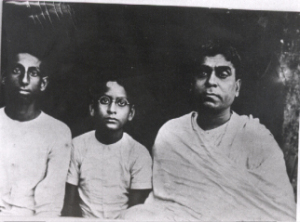
Starting from right: Bhaktivinoda Thakur, his son Bimala Prasad.

   In 1874 Kedaranatha discovered the Raja (king) of Puri had misappropriated 80 thousand rupees for his own sense pleasures. This money belonged to the temple, so Kedaranatha forced the Raja to pay for the offerings of food to Lord Jagannatha. The raja was angry at Kedaranatha and therefore, with the help of 50 brahmin priests, began a yajna (fire sacrifice) meant for killing Kedaranatha which went on for 30 days; when the last oblations were offered into the fire, the king's own son and not Kedaranatha died. Kedaranatha left Puri on special business, returning to Bengal where he visited the holy towns of Navadvipa, Santipura and Kalana. He was put in charge of the subdivision Mahisarekha in Haora. After that he was transferred to Bhadraka. In August 1878 he was made head of the subdivision Naraila in the Yashohan district. While in Naraila he published two books on Krishna that became famous around the world: Sri Krishna-samhita and Kalyana-kalpataru. In a letter dated April 16, 1880, Dr. Reinhold Rost wrote to Kedaranatha: "By representing Krishna's character and his worship in a more sublime and transcendental light than has hitherto been the custom to regard him, you have rendered an essential service to your co-religionists, and no one would have taken more delight in your work than my departed friend Goldstuecker, the sincerest and most zealous advocate the Hindus ever had in Europe." In 1877 Varada Prasada was born, his fifth son, and in 1878, Viraja Prasada, the sixth son, both at Rana Ghata.

   Kedaranatha took formal Vaishnava initiation from Bipin Bihari Goswami, who was descended from the Jahnava family of Baghnapara. At the same time, his seventh son, Lalita Prasada, appeared at Rana Ghata.

   Within a few years after his initiation, Kedaranatha was awarded by the Vaishnavas the title "Srila Bhaktivinoda Thakura" in appreciation for his tireless propagation of the philosophy of devotion (bhakti) to Sri Krishna. In Naraila, many people had formally adopted Vaisnavism, but they were not trained in scriptural conclusions and thus were easily misled by upstarts who exploited their devotional sentiments. Bhaktivinoda Thakura gave these simple Devotees of Krishna shelter and instructed them in Vaishnava-siddhanta (the essential truths of Vaishnavism) most exactingly. In 1881 Bhaktivinoda began publishing the Sajjanatosani, his Vaisnava journal. Bhaktivinoda Thakura had previously pilgrimaged to the holy cities of Benares, Prayaga, Mathura and Vrindavana in 1866. At the close of his stay in Naraila he desired to again see Vrindavana, the land of Krishna. He took three months for this purpose. He met Jagannatha dasa Babaji there, who moved every 6 months between Navadvipa (in Bengal) and Vrindavana. Bhaktivinoda Thakura accepted Jagannatha dasa Babaji as his eternally worshipable siksa guru (instructing spiritual master). During his pilgrimage at this time he dealt with a gang of dacoits (highway robbers) known as the Kanjharas who robbed and killed many pilgrims; he gave evidence to the government and a commission was formed to wipe out this scourge.

   From Vrindavana he came to Calcutta and bought a house at 181 Manikatala Street, now called Ramasha Datta Street, near Bidana Park. He called the house Bhakti-bhavan (place of devotion) and started daily worship of Sri Giridhara.

   He was appointed head of the subdivision of Barasat where the well-known novelist Bankim Candra met him. Bankim Candra showed him a book he'd written about Krishna to Bhaktivinoda, who preached to Bankim Candra for four days, taking little food and hardly any sleep; the result was Bankim Candra changed his ideas (which were mundane speculations about Krishna) and his book to conform with the teachings of Sri Chaitanya. Bhaktivinoda Thakura used to say that knowledge is power. During the last year of his stay at Barasat (1886), Bhaktivinoda Thakura published an edition of the Bhagavad-gita with the Sanskrit commentary of Visvanatha Cakravarti Thakura, which he translated into Bengali (the "Rasika-ranjana" translation). He had undertaken this task at the request of Babu Sarada Carana Mitra, ex-judge of the Calcutta High Commission. Bankim Candra wrote the preface, acknowledging his own indebtedness to Bhaktivinoda Thakura; he noted that all Bengali readers would be indebted to Bhaktivinoda for his saintly work. From Barasat, Bhaktivinoda Thakura was transferred to Sriramapur. At nearby Saptagram he visited the residence of the great Vaishnava saint Uddharana Datta Thakura, a great associate of Lord Nityananda, and the places of another great Vaishnavas of that time, Abhirama Thakura, at Khanakula, and Vasu Ramananda, at Kulinagrama. At Sriramapura he composed and published his masterly writing, Sri Caitanya Siksamrta, Vaishnava-siddhanta-mala, Prema-pradipa and Manah-siksa. He was also publishing Sajjanatosani magazine on a regular basis. In Calcutta he set up the Sri Caitanya Yantra, a printing press at the Bhakti Bhavana, upon which he printed Maladhara's Sri Krishna-vijaya, his own Amnaya-sutra and the Caitanyopanisad of the Atharva Veda.

   Finding the Chaitanyopanisad was a difficult task. Hardly anyone in Bengal had heard of it. Bhaktivinoda Thakura traveled to many places in Bengal looking for it; finally, one devoted Vaishnava pandita named Madhusudana dasa sent him an old copy he'd been keeping with him at Sambalapura. Bhaktivinoda Thakura wrote a Sanskrit commentary on the book and called it Sri Caitanya-caranamrta. Madhusudana dasa Mahasaya translated the verses into Bengali; this translation was called Amrta-bindu. It was a sellout when published. In Calcutta Bhaktivinoda Thakura started the Sri Visva-Vaisnava Sabha, dedicated to the preaching of pure bhakti as taught by Lord Chaitanya. To publicize the work of the society, Bhaktivinoda Thakura published a small booklet entitled Visva-Vaisnava-kalpavi. Also he published his own edition of the Sri Caitanya-caritamrta, with his Amrta-prabhava Bhasya commentary. And he introduced the Caitanyabda or Caitanya-era calendar, and gave assistance to the propagation of the Caitanya Panjika, which established the feast day of Gaura Purnima, the day of Lord Caitanya's appearance in the material world. He lectured and gave readings on Vaishnava books in various religious societies. In the Hindu Herald, an English periodical, he published a detailed account of Sri Caitanya's life.

   In the year 1887 Bhaktivinoda Thakura resolved to quit government service and go to Vrindavana with Bhaktibhringa Mahasaya for the rest of his life. One night in Tarakesvara, he had a dream in which Sri Chaitanya appeared to him and spoke, "You will certainly go to Vrindavana, but first there is some service you must perform in Navadvipa. When will you do that?" When the Lord disappeared, Bhaktivinoda awoke. On the advice of Bhaktibhringa Mahasaya he thereupon applied for a transfer to Krishnanagara, where the government headquarters for the Navadvip district is situated. He turned down offers of big posts in Assam and Tripura. He even tried to retire at this time, but his application was not accepted. Finally, in December of 1887 he managed to trade posts with Babu Radha Madhava Vasu, Deputy Magistrate of Krishnanagara. During his stay at Krishnanagara, Bhaktivinoda Thakura used to go to Navadvipa and search for the birthsite of Sri Caitanya Mahaprabhu, the exact location of which had been lost in time. One night he was sitting on the roof of the Rani Dharmasala in Navadvipa chanting on his beads, when he spotted in the distance a very tall tala tree; near the tree was a small building that gave off a remarkable effulgence. Soon afterwards, he went to the Krishnanagara Collectory where he began to study some very old manuscripts of Caitanya Bhagavata, Navadvipa Dhama Parikrama by Narahari Sarkara, and some old maps of the Navadvipa area. He went to the village of Ballaladibhi and spoke with many elderly people there, and uncovered facts about the modern-day Navadvipa. In the year 1887 he discovered that the place he'd seen from the dharmasala rooftop was in fact the birthplace of Mahaprabhu. This was confirmed by Jagannatha dasa Babaji, the head of the Gaudiya Vaisnava community in Navadvipa. A great festival was held there. Bhaktivinoda published the Navadvipa Dhama Mahatmya, which elaborated the glories of the birthsite of Sri Caitanya. Also in 1887, Bhaktivinoda renovated the house of Jagannatha dasa Babaji at Ravasghata. He took leave from office for two years and acquired a plot of land at Sri Godadrumadvipa, or Svarupa Ganga. He built a retirement house there called Surabhi Kunj.

   In 1890 he established the "Nama Hatta" there. Sometimes Jagannatha dasa Babaji would come there and have kirtana. Lord Nityananda had established His Nama Hatta at the same place and Bhaktivinoda considered himself the street sweeper of the Nama Hatta of Nitai.

   When the birthplace was uncovered, Bhaktivinoda and Jagannatha dasa Babaji would worship Lord Chaitanya there. Once one of Bhaktivinoda's sons contracted a skin disease and Jagannatha dasa Babaji told the boy to lie down at the birthsite of Lord Chaitanya for the night. He did so, and the next morning he was cured. 

Bhaktivinod Thakur

Yoga Pitha-Birth place of Lord Chaitania.

   In 1888 Bhaktivinoda took charge of the village of Netrakona in the district of Mayamanasimha, because he could not keep good health in Krishnanagara and had requested transfer to a more healthful region. From Netrakona he came to Tangaila and from there he was transferred to the district of Vardhamana. There he would hold kirtana with the Devotees from a place called Amalajora, headed by Ksetra Babu and Vipina Babu; they would sing poems like Soka-satana written by him.

   He was put in charge of the Kalara subdivision in 1890, and from there would often visit such holy places as Godadrumadvipa, Navadvipa, Campahati, Samudragana, Cupi, Kasthasali, Idrakapura, Baghnapara, Pyariganga (the place of Nakula Brahmacari) and the place of vrindavana dasa Thakura at Denura. Soon Bhaktivinoda Thakura was transferred for a few days to Ranighata, from where he came to Dinajapura again. Sailaja Prasada was born there, his youngest son. In Dinajapura Bhaktivinoda wrote his Vidva-ranjana commentary and translation of the Bhagavad-gita; it was published in 1891 with the commentary of Baladeva. 1891 was the year Bhaktivinoda Thakura took leave from the government service for two years. He desired to preach the chanting of the Hare Krishna mahamantra. From his base at Svarupa Ganga he used to visit such places as Ghatala and Ramajivana to lecture in clubs, societies and organizations. This he'd also often do in Krishnanagara. In March of 1892 he traveled and preached with a party of Vaisnavas in the Basirahata District. All the while he was writing also. He opened many centers of Krishna worship (Nama Hatta) in different districts of Bengal. The Nama Hatta became a self-sustaining success which continued to spread even after his return to government service. From Basirahata he set out on his third trip to Vrindavana; he stopped off at Amalajora to celebrate the Ekadasi day with Jagannatha dasa Babaji. In Vrindavana, he visited all the forests and places of pastimes and he continued to give lectures and readings on Hari Nama in various places in Bengal when he returned to Calcutta. In February 1891 he gave a lecture on his investigation into the whereabouts of the exact birthsite of Sri Chaitanya; his audience included highly learned men from all over Bengal, who became very enthusiastic at the news. Out of this gathering the Sri Navadvipa Dhama Pracarini Sabha was formed for spreading the glories of the Yogapitha (the birthsite). That year, on Gaura Purnima, a big festival was held that witness the installation of Gaura-Visnupriya Deities at the Yogapitha. All the learned pandits, having deliberated fully on Bhaktivinoda Thakura's evidence, agreed that the Yogapitha was the true birthsite of Mahaprabhu. 

Bhaktivinod Thakur

Gaura-Lakshmi-Vishnupriya Deities installed by Bhaktivinoda Thakura, Yoga Pitha, Mayapur.

   In 1892, Bhaktivinoda Thakura published the book Vaisnava-siddhanta-mala from his headquarters in Bengal. Later he printed its individual chapters as separate booklets for public distribution. In 1900 he published Hari-nama-cintamani in Bengali poetic form.

   In October 1894, at age 56, he retired from his post as Deputy Magistrate, though this move was opposed by his family and the government authorities. He stayed at Svarupa Ganga to worship, lecture and revise his old writings. Sometimes he went to Calcutta; there he begged door to door for funds to construct a Yogapitha temple. In July 1896 Bhaktivinoda Thakura went to Tripura at the request of the the king, who was a Vaishnava. He stayed in the capital for 4 days and preached the chanting of the Holy Name of Krishna. His lecture on the first day amazed all the local panditas; on the next two days the royal family and general public thrilled to his talks on the pastimes of Mahaprabhu. Back in Svarupa Ganga, Bhaktivinoda Thakura printed a small booklet written in Sanskrit under the title Sri Gauranga-lila-smarana-mangala-stotram, with a commentary by Sitikantha Vacaspati of Nadia. The introduction in English was called "Chaitanya Mahaprabhu, His life and Precepts". This book found its way into the library of the Royal Asiatic Society in London, the library of McGill University in Canada and other respectable institutions. It was reviewed in the Journal of the Royal Asiatic Society by Mr. F.W. Fraser, an erudite British scholar.

   In the rainy season of 1896, requested by the Maharaja of Tripura, he went to Darjilim and Karsiyam. In 1897 he went to many villages such as Medinipura and Sauri to preach.

   Sisir Kumar Ghosh was the founder of the Amrta Bazar Patrika and the author of the Sri Amiya Nimai-carita. He had great respect for Bhaktivinoda Thakura; he also took up the preaching of the Holy Name throughout Calcutta and in many villages in Bengal. He published the Sri Visnu Priya O Ananda Bazar Patrika under the editorship of Bhaktivinoda. In one of his letters to Bhaktivinoda he wrote, "I have not seen the six Goswamis of Vrindavana but I consider you to be the seventh Goswami."

   Bhaktisiddhanta Sarasvati had been residing at Puri as a strict renunciate and was engaged in worship at the Gandharvika Giridhari Matha, one of seven Mathas near the samadhi tomb of Haridasa Thakura. Bhaktivinoda Thakura, desiring to help his son, had the monastery cleaned and repaired when he came to Puri himself at the beginning of the 20th century. After Bhaktisiddhanta Sarasvati left Puri for Sri Navadvipa Mayapura, Bhaktivinoda Thakura constructed his own place of bhajana on the beach, calling it Bhakti Kutir; Krishnadasa Babaji, Bhaktivinoda Thakura's devoted assistant and disciple, joined him there at this time. He was his constant attendant up to the end of Bhaktivinoda Thakura's life. He began solitary worship (bhajan) at this time; he had many visitors at Sivathis place. Some of them simply wanted to disturb him, whereas others were sincere and benefited greatly from his spiritual inspiration. In 1908, 3 months before Bhaktivinoda Thakura renounced the world, one of his sons who was working in a Calcutta government office came home to inform his father that Sir William Duke, chief secretary to the government, was in Calcutta. Bhaktivinoda Thakura had served under him as a magistrate. Bhaktivinoda Thakura made an appointment to meet him the next day at the government building. Sir William Duke greeted Bhaktivinoda Thakura on the street outside the building and personally escorted him into his office. With folded hands, he asked forgiveness for having once planned to remove Bhaktivinoda Thakura from his post of district magistrate; this was because he thought that if such qualified Indians held such important posts, the British would not last much longer in India. Formerly Sir William Duke used to visit to Bhaktivinoda's house and would even take his meals there. Such familiarity between British nobility and the native people of India was uncommon. Now that Sir William was getting old, he wished to clear his conscience of guilty feelings from the past, and so confessed to Bhaktivinoda Thakura that he'd thought ill of him despite their close relationship. Bhaktivinoda Thakura answered, "I considered you to be a good friend and a well-wisher all along." Pleased with Sir William, he gave him his blessings. Later Bhaktivinod Thakura admitted he was astonished that Duke wanted to harm him in some way.

   In 1908 Bhaktivinoda Thakura took vesa (the dress of babaji) at Satasana in Puri. Until 1910 he would move between Calcutta and Puri, and continued to write; but after that he stopped all activity and remained in Puri, absorbed in the Holy Name of Krishna. He shut himself up and entered samadhi, claiming paralysis. On June 23, 1914, just before noon at Puri, Bhaktivinoda Thakura left his body. This day was also the disappearance day of Sri Gadadhara Pandita. Amidst sankirtana his remains were interred in Godruma after the next solstice; the summer solstice had just begun when he had left his body. About Bhaktivinoda Thakura, Sarada Carana Mitra, Calcutta High Court Judge, wrote: "I knew Thakura Bhaktivinoda intimately as a friend and a relation. Even under the pressure of official work as a magistrate in charge of a heavy district he could always find time for devotional contemplation and service, and whenever I met him, our talk would turn in a few moments to the subject of devotion, dvaitadvaita-vada philosophy and the saintly work that lay before him. Service of God is the only thing he longed for and service under the government, however honorable, was to him a clog." In executing his government service, Bhaktivinoda Thakura would wear coat and pants to court, with double-size tulasi neckbeads and tilaka. He would shave his head monthly. Very strong in his decisions, he would decide immediately. He did not allow any humbug in his court; no upstart could stand before him.

   He was always charitable to brahmanas, and equally befriended other castes. He never showed pride, and his amiable disposition was a characteristic feature of his life. He never accepted gifts from anyone; he even declined all honors and titles offered by the government to him on the grounds that they might stand against his holy mission of life. He was very strict in moral principles, and avoided the luxurious life; he would not even chew betel. He never allowed harmonium and he never had any debts. He disliked theaters because they were frequented by public women. He spoke Bengali, Sanskrit, English, Latin, Urdu, Persian and Oriya. He started writing books at age 12, and continued turning out a profuse number of volumes up until his departure from this world.

Gaura Kishora Dasa Babaji Maharaja – Biography

Gaura Kishora Dasa Babaji Maharaja

Gaura Kishora Dasa Babaji Maharaja.

   He was the guru of Bhaktisiddhanta Saraswati Goswami, the founder of the Chaitanya Mathas and Gaudiya Mathas. This Vaishnava saint's life was an example of utter humility and poverty, the true attributes of a Vaishnava. Gaurakishora never accepted any material object from anyone. For his clothing he used the discarded loin cloths from corpses left on the bank of the Ganges. For food, he would collect rice by begging, soak it in river water, and garnish it with salt and chilly. He never asked favors from anyone and lived a fully detached life, devoid of all possessions.

   Very little information is available about the past life of Gaura Kishora except that he was born in a Vaishya family in the village of Bagjana near Tepakhola on the bank of the Padma. As a householder, Gaura Kishora was known by the name Vansidasa. At that time he was engaged in some agricultural trade and from the income took care of his wife and family honestly. After the passing away of his wife, Gaura Kishora renounced his home and went to Vrindavana, where he was initiated into Vairagi Vesha by Bhagavata dasa Babaji, one of the foremost disciples of Jagannatha dasa Babaji.

   Gaura Kishora lived on madhukari and slept beneath a tree. He would lie prostrate, offering his humble obeisances to the residents of Vraja, considering them as embodiments of Lord Krishna. He even offered his obeisances to the flowers, trees, and land around him. He spent about thirty years at Vrajamandala serving the Deities there. Afterwards he left for Navadwipa.

   During his stay at Navadwipa, Gaura Kishora underwent various transformations of spiritual moods. Sometimes he danced on the bank of the Ganges chanting, "Gaura, Gaura", while at other times he would lie on the ground in an unconscious state. He joyfully moved throughout the groves located on the bank of the Ganges, considering them sites of the divine sports of Radha-Govinda. His only clothing was a strip of cloth around his waist and often went totally naked. He chanted japa on beads or sometimes knotted a cloth and used that as a substitute for japa beads. Occasionally, he went to Godruma to listen to Bhaktivinoda Thakura recite Shrimad Bhagavatam. 

Gaura Kishora Dasa Babaji Maharaja

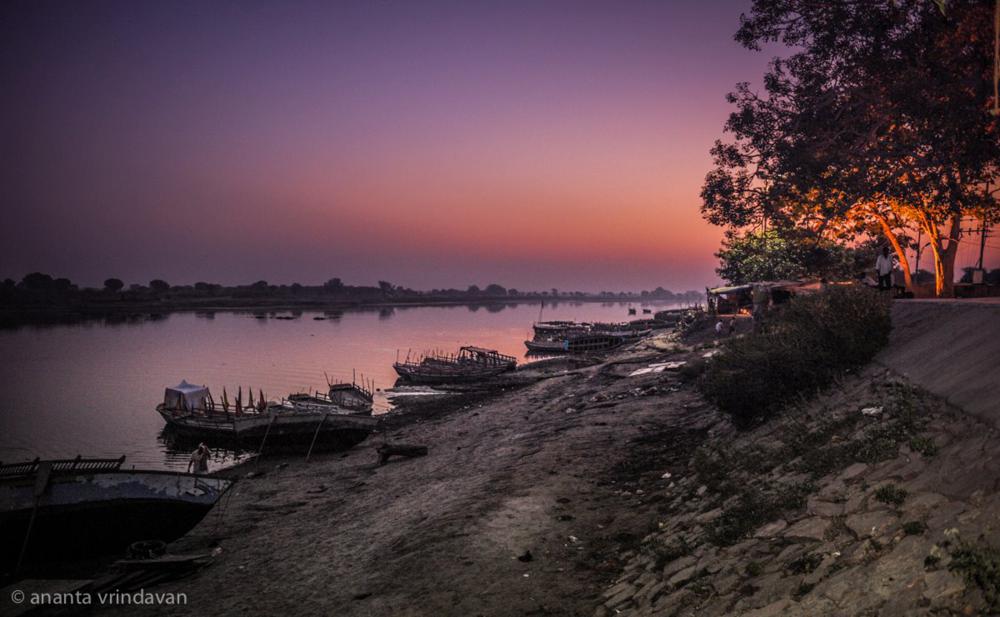
Sometimes he danced on the bank of the Ganges chanting, "Gaura, Gaura", while at other times he would lie on the ground in an unconscious state. He joyfully moved throughout the groves located on the bank of the Ganges, considering them sites of the divine sports of Radha-Govinda. (In the image: Yamuna, Vrindavan).

   Every virtuous person looked forward to rendering service to Gaura Kishora. However, he rarely allowed anyone the chance to serve him. Once Manindrachandra Nandi, the Maharaja of Kasimbazar, sent a distinguished messenger to escort Gaura Kishora to the former's palace. Gaura Kishora, however, did not accept the Maharaja's invitation saying that if he visited the palace he may feel tempted by the wealth of the Maharaja which may result in a strained relation between the two. Hence, Gaura Kishora suggested that instead of him visiting the palace, let the Maharaja free himself completely from the shackles of wealth by donating everything he owned to his relatives and then come to live with Gaura Kishora in a specially prepared shed where both of them could practice Hari Bhajan in peace.

   Gaura Kishora was very selective about accepting invitations for food knowing it could adversely affect the spiritual life. Once a Devotee name Harenbabu partook of Prasada offered at the festival held at bhajan kutir at Navadwipa. For this Gaura Kishora stopped communicating with Haren for three days. On the fourth day Gaura Kishora explained that the Prasada of the above festival had been financed by a woman of questionable profession.

   Once, on the eve of Sanatana Goswami's disappearance day, Gaura Kishora decided to celebrate the occasion. The Devotee attending him asked who would provide them with the materials for the celebration. Gaura Kishora replied: "Remember not to speak to anyone about it. We shall miss a meal and continue around the clock chanting the Holy Name. This could be the typical festival for those of us who have taken the vow of poverty." 

Gaura Kishora Dasa Babaji Maharaja

"Remember not to speak to anyone about it. We shall miss a meal and continue around the clock chanting the Holy Name. This could be the typical festival for those of us who have taken the vow of poverty."

   Narendra Kumar Sen, a resident of Agartala (Tripura), once approached Gaura Kishora to learn about guru-pranali or siddha pranali. Gaura Kishora told him, "The Supreme Lord cannot be realized through worldly knowledge. Only through the chanting of the Holy Name can the true nature of the Lord be revealed. As the Lord is revealed from the letters comprising the Nama, the Devotee gradually begins to understand his own nature and becomes acquainted with seva."

   Once a physician told Gaura Kishora that he intended to move to Navadwipa and take up charitable practices. Gaura Kishora advised the physician that if he truly desired to live in Navadwipa then he should give up the plan for a charitable practice because it would only encourage materially minded people to save money. Those who sincerely practiced Hari bhajan should never get distracted by the chains of welfare activities.

   A young seeker wearing a kaupina once stayed with Gaura Kishora for some days. Later he arranged, through the agency of an employee of a female estate owner, to obtain five kathas of land as a donation from the woman. When Gaura Kishora heard about this he was extremely annoyed: "Navadwipa dhama is beyond this material world. How can a worldly land-owner dare to hold land here and even think he can donate five kathas out of it? A mere grain of sand of the transcendental Navadwipa is more valuable than all the precious gems in this world put together. Moreover, how advanced could this young kaupina-clad Devotee be if he dares to collect so much land in lieu of his bhajan merit?"

   Once a Devotee offered some sweets to Lord Gauranga and then took the offering to Gaura Kishora, urging him to partake of it. Gaura Kishora told the Devotee, "Those who are non-vegetarian, those who commit adultery, or offer food to Lord Gauranga with a particular motive, their offerings never reach Lord Gauranga and are never sanctified as Prasada."

   Gaura Kishora regularly begged for rice, after which he would cook the rice, offer it, and partake of the Prasada. He never touched any foodstuff offered by someone else. Once during monsoon, Gaura Kishora stayed in the rest-house at Phulia Navadwipa. Some Prasada was left in a vessel for him to respect later. Meanwhile a snake passed by the vessel and a woman there happened to notice it. When Gaura Kishora sat down to take Prasada the woman appeared there and informed him about the snake. Gaura Kishora, however, firmly stated that he would not touch the Prasada until the woman left. After the woman left, Gaura Kishora said, "Look how maya works! Taking the form of compassion, maya attempts to hit deep into her target slowly. Maya can assume countless forms. She always prevents a mortal being from practicing Hari bhajan."

   Giribabu and his wife once ardently requested Gaura Kishora to stay in their house at Navadwipa. Gaura Kishora was moved by their sincere devotion and finally agreed to oblige them on the condition that he would live only in their toilet room where he would perform Hari bhajan. Giribabu tried to persuade him to change his mind but Gaura Kishora remained firm. Giribabu reluctantly arranged to have the toilet thoroughly cleaned and Gaura Kishora used it for Hari Bhajan. A realized soul can practice Hari bhajan anywhere in an unconcerned manner, and wherever he resides, that place becomes Vaikuntha.

   Gaura Kishora was a highly spiritually advanced soul. He never allowed deceitful practices or any discussion which was not within the purview of the holy books. One day when a Devotee questioned Gaura Kishora about a well-known reciter of Shrimad Bhagavatam who was in the habit of chanting "Gaura, Gaura", Gaura Kishora remarked, "He doesn't say "Gaura, Gaura". Rather what he means to say is, 'Money, Money.' Those who recite Shrimad Bhagavatam for payment are not entitled to chant the name of the Supreme Lord."

   Gaura Kishora never delivered discourses openly, yet his spotless character drew everyone to him. Upon meeting Gaura Kishora, even a staunch materialist would become inclined take up Hari bhajan.

   In November 1915 AD on Ekadasi day, Gaura Kishora dasa Babaji breathed his last. Bhaktisiddhanta Saraswati himself arranged to bury the mortal remains of his revered guru. 

Gaura Kishora Dasa Babaji Maharaja

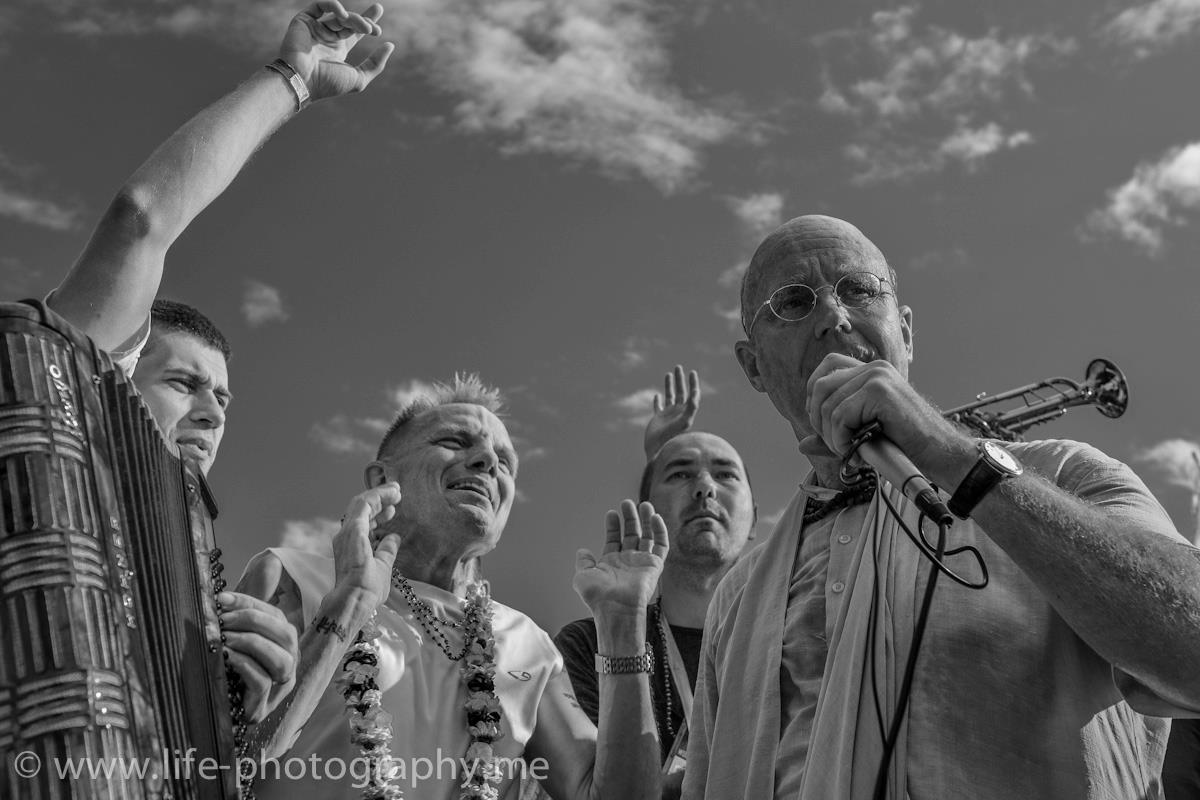
"The Supreme Lord cannot be realized through worldly knowledge. Only through the chanting of the Holy Name can the true nature of the Lord be revealed. As the Lord is revealed from the letters comprising the Nama, the Devotee gradually begins to understand his own nature and becomes acquainted with seva." (In the image: Ratha Yatra, Poland).

Bhaktisiddhanta Sarasvati Thakura – Biography

Bhaktisiddhanta Saraswati Thakur

Srila Bhaktisiddhanta Saraswati Thakur.

    Srila Bhaktisiddhanta Sarasvati was one of ten children born to Bhaktivinoda Thakura, a great Vaisnava teacher in the disciple-line from Lord Caitanya Himself. While living in a house named Narayana Chata, just near the temple of Lord Jagannatha in Puri, Bhaktivinoda Thakura was engaged as a prominent Deputy Magistrate and also served as the superintendent of the temple of Lord Jagannatha. Yet in spite of these responsibilities, he served the cause of Krishna with prodigious energy. While working to reform Gaudiya Vaisnavism in India, he prayed to Lord Caitanya, "Your teachings have been greatly depreciated and it is not in my power to restore them." Thus he prayed for a son to help him in his preaching mission. When, on February 6, 1874, Bhaktisiddhanta Sarasvati was born to Bhaktivinoda and Bhagavati Devi in Jagannatha Puri, the Vaisnavas considered him the answer to his father's prayers. He was born with the umbilical cord wrapped around his neck and draped across his chest like the sacred thread worn by brahmanas.

   Six months after the child was born, Bhaktivinoda arranged for his son to undergo the annaprasana ceremony with the prasada of Vimala Devi, and thereafter named the boy Bimala prasada. Around the same time the carts of the Jagannatha festival stopped at the gate of Bhaktivinoda's residence and for three days could not be moved. Bhaktivinoda Thakura's wife brought the infant onto the cart and approached the Deity of Lord Jagannatha. Spontaneously, the infant extended his arms and touched the feet of Lord Jagannatha and was immediately blessed with a garland that fell from the body of the Lord. Seeing this the priests chanted the name of Hari and told the child's mother that the boy would certainly become a great devotee one day. When Bhaktivinoda Thakura learned that the Lord's garland had fallen on his son, he realized that this was the son for whom he had prayed. 

Bhaktisiddhanta Saraswati Thakur

Srila Bhaktivinod Thakur-Father of Bhaktisiddhanta Saraswati Thakur.

   Bimala Prasada stayed in Puri for ten months after his birth and then went to Bengal by palanquin on his mother's lap. His infancy was spent at Nadia District's Ranaghat hearing topics of Sri Hari from his mother.

   Bhaktivinoda and his wife were orthodox and virtuous; they never allowed their children to eat anything other than prasada, nor to associate with bad company. One day, when Bimala Prasada was still a child of no more than four years, his father mildly rebuked him for eating a mango not yet duly offered to Lord krishna. Bimala Prasada, although only a child, considered himself an offender to the Lord and vowed never to eat mangoes again. (This was a vow that he would follow throughout this life.) By the time Bimala Prasada was seven years old, he had memorized the entire Bhagavad-gita and could even explain its verses. His father then began training him in proofreading and printing, in conjunction with the publishing of the Vaisnava magazine Sajjana-tosani.

Bhaktisiddhanta Saraswati Thakur

Bimala Prasad.

    In 1881, in the course of excavating for the construction of the Bhakti bhavana at Rambagan in Calcutta, a Deity of Kurmadeva was unearthed. After initiating his seven year old son, Bhaktivinoda entrusted Bimala with the service of the deity of Kurmadeva.

   On April 1, 1884, Bhaktivinoda was appointed the senior Deputy Magistrate of Serampore, where he admitted Bimala in the Serampore High School. When Bimala was a mere student in class five, he invented a new method of writing named Bicanto. During this period he took lessons in mathematics and astrology from Pandita Mahesacandra Cudamoni. However, he preferred to read devotional books rather than the school texts.

   In 1892, after passing his entrance examination, Bimala was admitted into the Sanskrit College of Calcutta. There he spent considerable time in the library studying various books on philosophy. He also studied the Vedas under the guidance of Prthvidhara Sarma. As a student he contributed many thoughtful articles to various religious journals. However he did not continue with his college studies for long. 

Bhaktisiddhanta Saraswati Thakur

Bhagavati Devi-Mother of Bhaktisiddhanta Saraswati Thakur.

   In 1897 he started an autonomous Catuspathi (Sanskrit school) wherefrom monthly journals entitled "Jyotirvid", "Brihaspati", and many old treatises on astrology were published. In 1898, while teaching at Sarasvata Catuspathi, he studied Siddhanta Kaumudi under Prthvidhara Sarma, at Bhakti bhavana. By the time he was twenty-five he had become well versed in Sanskrit, mathematics, and astronomy, and he had established himself as the author and publisher of many magazine articles and one ancient book, Surya-siddhanta, for which he received the epithet Siddhanta Sarasvati in recognition of his erudition.

   In 1895 Sarasvati Goswami accepted service under the Tripura Royal Government as an editor for the biography entitled Rajaratnakara, the life histories of the royal line of the independent Tripura Kingdom. Later he was entrusted with the responsibility of educating the Yuvaraja Bahadur and Rajkumar Vrajendra Kisore, in Bengali and Sanskrit.

   After a short period of time, Siddhanta Sarasvati took up the responsibilities for inspecting various ongoing activities in the royal palace for the state of Tripura. However, after finding envy, malice and corruption surfacing in every corner of his inspection, Siddhanta Sarasvati very quickly developed an aversion to state affairs and gave notice of his intention to retire to Maharaja Radhakisore Manikya Bahadur. The Maharaja approved of Siddhanta Sarasvati's plans for renunciation and awarded him full-pay pension. However, after three years Siddhanta Sarasvati also renounced his pension. With his father, he visited many tirthas and heard discourses from the learned panditas. In October 1898 Siddhanta Sarasvati accompanied Bhaktivinoda on a pilgrimage of Kasi, Prayaga, Gaya and other holy places. At Kasi a discussion was held with Ramamisra Sastri regarding the Ramanuja sampradaya. After this talk Siddhanta Sarasvati's life seemed to take a turn, his inclination towards renunciation increased, and he quietly continued to search for a guru.

   When Siddhanta Sarasvati was twenty-six his father, understanding the mind of his son, guided him to take initiation from a renounced Vaisnava saint, Gaurakishora dasa Babaji. Gaurakishora dasa Babaji was the embodiment of vairagya and was very selective about giving diksa. He lived beneath a tree near the bank of the Ganga and wore the abandoned clothes of dead bodies as a waist band (kaupina). Generally he ate plain rice soaked in Ganga water garnished with chili and salt. Sometimes he utilized discarded earthen pots, after properly washing them he would cook rice in them, offer it to Krishna, and then take Prasada.

   Following the advice of his father, Siddhanta Sarasvati went to Gaurakishora dasa and begged to be accepted as his disciple. Gaurakishora replied that he would not be able to give diksa unless he received the approval of Lord Chaitanya. However, when Siddhanta Sarasvati returned again, Gaurakishora said that he had forgotten to ask Lord Chaitanya. On the third visit, Gaurakishora stated that Lord Chaitanya had said that erudition is extremely insignificant in comparison to devotion to the Supreme Lord.

   Hearing this Siddhanta replied that since Gaurakishora was the servant of Kapatacudamani (the Supreme deceiver) hence he must be testing Sarasvati by withholding his consent. However Siddhanta Sarasvati remained firmly determined and remarked that Ramanuja Acarya had been sent back eighteen times before he finally received the grace of Gosthipurna, thus he too would wait patiently until the day that Gaurakishora would bestow his benedictions upon him. Seeing the commitment of Sarasvati, Gaurakishora was impressed and gave him diksa in the blissful grove of Godruma and told him, "to preach the Absolute Truth and keep aside all other works." 

Bhaktisiddhanta Saraswati Thakur

Srila Gourakishora Das Babaji Maharaja-Spiritual Master of Bhaktisiddhanta Saraswati Thakur.

   In March 1900 Sarasvati accompanied Bhaktivinoda on a pilgrimage of Balasore, Remuna, Bhuvanesvara, and Puri. As instructed by Bhaktivinoda, Sarasvati gave lectures from CC with profound purports. Through the initiative of Bhaktivinoda Thakura the flow of pure bhakti again began to inundate the world. After Lord Caitanya's disappearance a period of darkness ensued in which the river of bhakti had been choked and practically dried up. The end of the period was brought about by the undaunted preaching of Bhaktivinoda Thakura. He wrote a number of books on suddha-bhakti siddhanta and published numerous religious periodicals. He inspired many to take up the service of Lord Gauranga and instituted various Nama Hatta and Prapanna-asrama (Gaudiya matha centers).

   In 1905 Siddhanta Sarasvati took a vow to chant the Hare Krishna mantra a billion times. Residing in Mayapur in a grass hut near the birthplace of Lord Caitanya, he chanted the mantra day and night. He cooked rice once a day in an earthen pot and ate nothing more; he slept on the ground, and when the rainwater leaked trough the grass ceiling, he sat beneath an umbrella, chanting.

   In 1912 Manindra Nandi, the Maharaja of Kasimbazar, arranged to hold a large Vaisnava Sammilani at his palace. At the specific request of the Maharaja, Sarasvati Goswami attended the Sammilani and delivered four very brief speeches on suddha-bhakti on four consecutive days. However, he did not take any food during the Sammilani because of the presence of various groups of sahajiyas. After fasting for four days Sarasvati Goswami came to Mayapura and took the Prasada of Lord Chaitanya. Later when Maharaja Manindra Nandi realized what had happened he was deeply aggrieved and came to Mayapura to apologize to Siddhanta Sarasvati.

   During that time Bengal was full of sahajiya sects, such as Aul, Baul, Kartabhaja, Neda-nedi, Daravesa, Sain etc., who followed worldly practices in the name of spiritualism. Siddhanta Sarasvati launched a severe attack against those irreligious sects and did not spare anyone who deviated from the teachings of Lord Chaitanya. Even some well-known persons bearing the surname of Goswamis patronized these sahajiya sects during that period.

   Siddhanta Sarasvati was deeply grieved to see these groups of prakrita sahajiyas, in the garb of paramahamsa Goswami gurus, misleading the people. Thus he completely dissociated himself and resorted to performing bhajana in solitude. During this period of solitude, one day Lord Chaitanya, along with the six Goswamis, suddenly manifested before Siddhanta Sarasvati's vision and said: "Do not be disheartened, take up the task of re-establishing Varnashrama with new vigour and preach the message of love for Sri Krishna everywhere." After receiving this message, Sarasvati Goswami was filled with inspiration to preach the glories of Lord Chaitanya enthusiastically.

   In 1911, while his aging father was lying ill, Siddhanta Sarasvati took up a challenge against pseudo Vaishnavas who claimed that birth in their caste was the prerequisite for preaching Krishna consciousness. The caste-conscious brahmana community had become incensed by Bhaktivinoda Thakura's presentation of many scriptural proofs that anyone, regardless of birth, could become a brahmana-Vaishnava. These smarta brahmanas, out to prove the inferiority of the Vaishnavas, arranged a discussion. On behalf of his indisposed father, young Siddhanta Sarasvati wrote an essay, "The Conclusive Difference Between the Brahmana and the Vaishnava," and submitted it before his father. Despite his poor health, Bhaktivinoda Thakura was elated to hear the arguments that would soundly defeat the challenge of the smartas.

   On the request of Madhusudana dasa Goswami of Vrindavana and Visvambharananda deva Goswami of Gopiballabhapur, Siddhanta Sarasvati traveled to Midnapur, where panditas from all over India had gathered for a three-day discussion. Some of the smarta panditas who spoke first claimed that anyone born in a sudra family, even though initiated by a spiritual master, could never become purified and perform the brahminical duties of worshiping the deity or initiating disciples. Finally, Siddhanta Sarasvati delivered his speech. He began quoting Vedic references glorifying the brahmanas, and at this the smarta scholars became very much pleased. But when he began discussing the actual qualifications for becoming a brahmana, the qualities of the Vaisnavas, the relationship between the two, and who, according to the Vedic literature, is qualified to become a spiritual master and initiate disciples, the joy of the Vaisnava-haters disappeared. Siddhanta Sarasvati conclusively proved from the scriptures that if one is born as a sudra but exhibits the qualities of a brahmana then he should be honored as a brahmana, despite his birth. And if one is born in a brahmana family but acts like a sudra, then he is not a brahmana. After his speech, Siddhanta Sarasvati was congratulated by the president of the conference, and thousands thronged around him. It was a victory for Vaishnavism.

   Bhaktivinoda Thakura passed away in 1914 on the day of Gadadhara Pandita's disappearance. On the eve of his disappearance Bhaktivinoda instructed his son to preach the teachings of the six Goswamis and Lord Chaitanya far and wide. He also requested that Siddhanta Sarasvati develop the birthsite of Lord Gauranga. Mother Bhagavati Devi disappeared a few years later. Before her passing away, she held the hands of Sarasvati Goswami imploring him to preach the glories of Lord Gauranga and His dhama. Accepting the instructions of his parents as his foremost duty, Sarasvati Goswami took up this task of preaching with intense enthusiasm and vigour.

   With the passing away of his father, and his spiritual master a year later, Siddhanta Sarasvati continued the mission of Lord Chaitanya. He assumed editorship of Sajjana-tosani and established the Bhagwat Press in Krishnanagar. Then in 1918, in Mayapur, he sat down before a picture of Gaurakishora dasa Babaji and initiated himself into the sannyasa order. At this time he assumed the sannyasa title Bhaktisiddhanta Sarasvati Goswami Maharaja. 

Bhaktisiddhanta Saraswati Thakur

Sannyasa acceptance day, 1918.

   Bhaktisiddhanta Sarasvati was dedicated to using the printing press as the best medium for large-scale distribution of Krishna consciousness. He thought of the printing press as a brhat mrdanga, a big mrdanga. The mrdanga drum played during kirtana could be heard for a block or two, whereas with the brhat mrdanga, the printing press, the message of Lord Chaitanya could be spread all over the world.

   Rohinikumar Ghosh, a nephew of Justice Candramadhava Ghosh of Calcutta High Court and originally a resident of Bhola in Barisal (now in Bangladesh), decided to renounce the world and engage himself in Hari bhajana. With this purpose in mind he came to Kulia in Navadvipa where he led the life of a Baul. However, he despised the practices of the sevadasis prevalent amongst the Baul sect. One day Rohini Ghosh happen to come to the Yogapitha when Sarasvati Goswami was lecturing there. Rohini was delighted to see the luminous appearance of Sarasvati Goswami and fascinated by his words. Late that night, after spending the whole day listening to Sarasvati Goswami's teachings, Rohini returned to his Baul guru's asrama at Kulia. Without taking any prasada, Rohini took rest contemplating the lessons on suddha-bhakti which he had heard that day. In his dream Rohini saw a Baul and his consort appear before him in the form of a tiger and tigress which were about to devour him. Trembling in fear Rohini desperately called out to Lord Chaitanya. Suddenly Rohini found himself being rescued from the clutches of the tigers by Bhaktisiddhanta Sarasvati. From that day Rohini left the Baul guru forever and took shelter at the feet of Sarasvati Goswami.

   Annadaprasad Datta, the elder brother of Sarasvati Goswami, suffered with severe headaches shortly before his disappearance. On the day of Annada's disappearance Sarasvati Goswami remained by his side all through the night, chanting Harinama. Before Annada passed a way he briefly regained consciousness and began apologizing to Sarasvati Goswami, who simply encouraged him to remember the Holy Name of the Lord. Suddenly the tilak mark of the Ramanuja sampradaya became clearly visible on Annada's forehead. Annada explained that in his past birth he had been a Vaisnava belonging to the Ramanuja sect. But due to committing an offense at the feet of Sarasvati Thakura, Annada had to be reborn. However, as a result of his past merit he was fortunate enough to be born into Bhaktivinoda's family. After finishing his account Annada breathed his last.

   Once on the day preceding Janmastami in the Bengali month of Bhadra, Sarasvati Goswami was engaged in bhajana at Mayapura but was feeling disturbed as he was unable to arrange for milk to be offered to the Deity. As soon as he began to think in this way he chastised himself: "Have I thought like this for my own sake? That is wrong." Because it was the monsoon season, Lord Chaitanya's birth site was covered with water and was totally inaccessible except by boat. However, that afternoon, one milkman turned up there wading through water and slush carrying a large quantity of milk, ksira, butter, cottage-cheese etc. Apparently a zamindar named Harinarayana Cakravarti, guided by Lord Caitanya, had sent the milkman with all the items.

   After offering everything to the Deity the Devotees partook of the Prasada joyfully. Sarasvati Thakura was surprised to see so much Prasada and the Devotees explained what had happened. After taking prasada Siddhanta Sarasvati humbly appealed to the Lord: "I am very sorry to have caused You so much trouble. Why did I have such an uncalled for thought? To fulfill my desire You have inspired another person and arranged to send these things."

   The world was amazed to see the supernatural power of Sarasvati Goswami. Many educated persons from highly respectable families were attracted to him and thus dedicated themselves to the service of Lord Gauranga. Between 1918 and 1937 Bhaktisiddhanta Sarasvati founded sixty-four suddha bhakti Mathas at the following places: Navadvipa, Mayapura, Calcutta, Chaka, Mymensingh, Naryanaganj, Chittagong, Midnapore, Remuna, Balasore, Puri, Alalanatha, Madras, Covoor, Delhi, Patna, Gaya, Lucknow, Varanasi, Hardwar, Allahabad, Mathura, Vrindavana, Assam, Kuruksetra, and outside India in London, and Rangoon. Sarasvati Goswami instituted Gaurapadapitha at Nrsimhacala on the top of the Mandara hill, and at several places in South India. He initiated twenty five highly educated persons into Bhagavata Tridandi sannyasa.

He published the following periodicals on Suddha Bhakti in different languages:

    1. Sajjanatosani (a fortnightly Bengali
    2. The Harmonist (an English fortnightly)
    3. Gaudiya (a Bengali weekly)
    4. Bhagavata (a Hindi fortnightly)
    5. Nadiya Prakasa (a Bengali daily)
    6. Kirtana (an Assamese monthly)
    7. Paramarthi (in Oriya)

   In addition he published a large number of Vaishnava books. In fact, he heralded a new era in the spiritual world. He deputed well-disciplined tridandi sannyasi's to preach the message of Lord Gauranga all over the world. For six years he continued to supervise this preaching work and when he found that his mission had attained its goal, to a reasonable extent, he decided to pass into the eternal service of Lord Gauranga.

   He recommended to all Vaishnavas to read these books: Caitanya Bhagavata (by Vrindavana dasa Thakura), Dasamula Siksa (by Bhaktivinoda Thakura), Sri Krishna Bhajanamrta (by Narahari Sarkara) and Prema Bhakti Candrika (by Narottama dasa Thakura). According to others, they were Prema Bhakti Candrika, Prarthana (by Narottama dasa Thakura) and Upadesamrta (by Rupa Goswami)

   A few days before his disappearance Bhaktisiddhanta Sarasvati called his foremost disciples and showered his blessings upon all his Devotees. He gave them the following instructions: "With the utmost enthusiasm preach the message of Rupa Raghunatha. Our ultimate goal is to become a speck of dust touching the lotus feet of the followers of Rupa Goswami. All of you remain united in allegiance to the spiritual master (asraya-vigraha) in order to satisfy the senses of the Transcendental Entity of Non-Dual Knowledge. Do not give up the worship of Hari even amidst hundreds of dangers, hundreds of insults or hundreds of persecutions. Do not become unenthusiastic upon seeing that the majority of people in this world are not accepting the message of Krishna's sincere worship. Never give up the glorification of the topics of Krishna, they are your own personal bhajana and your very all and all. Being humble like a blade of grass and tolerant like a tree, constantly glorify Hari."

In the early hours of the day on January 1, 1937 Bhaktisiddhanta Sarasvati Goswami passed away.

A.C. Bhaktivedanta Swami Prabhupada

Srila Prabhupada

A.C. Bhaktivedanta Swami Prabhupada.

    His Divine Grace A.C. Bhaktivedanta Swami Prabhupada appeared in this world in 1896 in Calcutta, India. He first met his spiritual master, Srila Bhaktisiddhanta Sarasvati Goswami, in Calcutta in 1922. Bhaktisiddhanta Sarasvati, a prominent religious scholar and the founder of sixty-four Gaudiya Mathas (Vedic institutes), liked this educated young man and convinced him to dedicate his life to teaching Vedic knowledge. Srila Prabhupada became his student and, in 1933, his formally initiated disciple.

   At their first meeting, in 1922, Srila Bhaktisiddhanta Sarasvati requested Srila Prabhupada to broadcast Vedic knowledge in English. In the years that followed, Srila Prabhupada wrote a commentary on the Bhagavad-gita, assisted the Gaudiya Matha in its work, and, in 1944, started Back to Godhead, an English fortnightly magazine. Single-handedly, Srila Prabhupada edited it, typed the manuscripts, checked the galley proofs, and even distributed the individual copies. The magazine is now being continued by his disciples in the West. 

Srila Prabhupada

Srila Bhaktisiddhanta Saraswati Thakur-Spiritual Master of Srila Prabhupada.

   In 1950 Srila Prabhupada retired from married life, adopting the vanaprastha (retired) order to devote more time to his studies and writing. He traveled to the holy city of Vrindavana, where he lived in humble circumstances in the historic temple of Radha-Damodara. There he engaged for several years in deep study and writing. He accepted the renounced order of life (sannyasa) in 1959. At Radha-Damodara, Srila Prabhupada began work on his life's masterpiece: a multivolume commentated translation of the eighteen-thousand-verse Srimad-Bhagavatam (Bhagavata Purana). He also wrote Easy Journey to Other Planets.

   After publishing three volumes of the Bhagavatam, Srila Prabhupada came to the United States, in September 1965, to fulfill the mission of his spiritual master. Subsequently, His Divine Grace wrote more than fifty volumes of authoritative commentated translations and summary studies of the philosophical and religious classics of India.

   When he first arrived by freighter in New York City, Srila Prabhupada was practically penniless. Only after almost a year of great difficulty did he establish the International Society for Krishna Consciousness, in July of 1966. Before he passed away on November 14, 1977, he had guided the Society and seen it grow to a worldwide confederation of more than one hundred asramas, schools, temples, institutes, and farm communities.

   He initiated about five thousands disciples, the first one – Acarya Prabhakarara das (Mishra, Dr.) when still in India. His first eleven western disciples were / are (as per Umapati Swami):
Mukunda das: now Goswami, GBC
Umapati das: now Swami
Hayagriva das: first BBT editor, left his body in 1989
Rayarama das: first BTG main editor, left the movement in 1969
Jagannath das: left the movement in the first few years
Karalapati das: left the movement in the first few years
Ravindra Svarupa das (not the GBC): left in the first few years
Satyavrata das: left in 1967 or 1968
Stryadhisa das: left in 1967
Janardana das: left in 1970
Janaki devi dasi: left the movement in the 70's

   In 1972 His Divine Grace introduced the Vedic system of primary and secondary education in the West by founding the gurukula school in Dallas, Texas. Since then his disciples have established similar schools throughout the United States and the rest of the world.

   Srila Prabhupada also inspired the construction of several large international cultural centers in India. The center at Sridhama Mayapur, in West Bengal, is the site for a planned spiritual city, an ambitions project for which construction will extend over many years to come. In Vrindavana are the magnificent Krishna-Balarama Temple and International Guesthouse, gurukula school, and Srila Prabhupada Memorial and Museum. There is also a major cultural and educational center in Mumbai. Other centers are planned in a dozen important locations on the Indian subcontinent. 

Srila Prabhupada

Bhaktivedanta Gurukula International School, Vrindavan.

   Srila Prabhupada's most significant contribution, however, is his books. Highly respected by scholars for their authority, depth, and clarity, they are used as textbooks in numerous college courses. His writings have been translated into over fifty languages. The Bhaktivedanta Book Trust, established in 1972 to publish the works of His Divine Grace, has thus become the world's largest publisher of books in the field of Indian religion and philosophy.

   In just twelve years, despite his advanced age, Srila Prabhupada circled the globe fourteen times on lecture tours that took him to six continents. In spite of such a vigorous schedule, Srila Prabhupada continued to write prolifically. His writings constitute a veritable library of Vedic philosophy, religion, literature, and culture.

Books on Srila Prabhupada

By Satsvarupa Dasa Goswami:

1. Srila Prabhupada Lilamrita (7 volumes)
2. Beginning at 26 Second Avenue
3. Calling Out To Srila Prabhupada
4. Here is Srila Prabhupada
5. ISKCON in the 1970's
6. Life with the Perfect Master
7. Memories
8. One Hundred Prabhupada Poems
9. Prabhupada Appreciation
10. Prabhupada Meditations (4 volumes)
11. Prabhupada Nectar
12. Prabhupada: Your Ever Well-Wisher
13. Remembering Srila Prabhupada
14. Srila Prabhupada Samadhi Diary
15. Under the Banyan Tree
16. Vaisnava Behaviour/26 Qualities of a Devotee
17. With Srila Prabhupada in the Early Days
18. You Cannot Leave Boston

By other disciples:
19. Acarya (Sesa Dasa)
20. By His Example: The Wit and Wisdom of A.C. Bhaktivedanta Swami (Gurudas)
21. Destination South Africa (Riddha Dasa)
22. Festivals: Srila Prabhupada at the Mayapur-Vrindavana Festivals (Lokanath Swami)
23. Final Pastimes of Srila Prabhupada (Tamala Krsna Goswami)
24. He Lives Forever
25. His Divine Grace (Danavir Goswami)
26. Jaya Srila Prabhupada! (Bhakti Vikasa Swami)
27. Journey to the Pacific Rim (Bali Mardana Dasa)
28. Master at Whose Feet All Masters Sit
29. Memories (2 volumes) (Siddhanta Dasa)
30. Mission: In the service of Srila Prabhupada (Riddha Dasa)
31. My Glorious Master (Bhurijana Dasa)
32. My Memories of Srila Prabhupada (Bhakti Vikasa Swami)
33. Our Srila Prabhupada – A Friend to All (Mulaprakrti Devi Dasi)
34. Prabhupada A Roma ("Prabhupada in Rome" – Italian)
35. Prabhupada in Malaysia (Janananda Dasa)
36. Prabhupada at Radha-Damodara (Mahanidhi Swami)
37. Servant of the Servant (Tamala Krsna Goswami)
38. Srila Prabhupada & His Disciples in Germany (Vedavyasa Dasa)
39. Srila Prabhupada is Coming (Mahamaya Devi Dasi)
40. Srila Prabhupada Uvaca (Srutakirti Dasa)
41. TKG's Diary-Prabhupada's Final Days (Tamala Krsna Goswami)
42. The Great Transcendental Adventure (Kurma Dasa)
43. A Transcendental Diary (5 volumes) (Hari Sauri Dasa)
44. Vrindaban Days (Hayagriva Dasa)
45. Watering the Seed (Giriraj Swami)

An Overview of the Life of A.C. Bhaktivedanta Swami Prabhupada

Srila Prabhupada

A.C. Bhaktivedanta Swami Prabhupada.

   I humbly offer my respectful obeisances unto Om Visnupada Paramahamsa Parivrajakacarya Nitya Lila Pravista 108 Sri Srimad A.C. Bhaktivedanta Swami Srila Prabhupada, the life and soul of the International Society for Krishna Consciousness. Known affectionately as Srila Prabhupada.

   His full life story can be found in the seven volume set entitled "Prabhupada Lilamrta" by His Holiness Satswarupa dasa Goswami. This in itself tells more than I could ever say.

   His motto was, "Preaching is the essence, purity is the force, books are the basis, and utility is the principal." This graphically depicts the mood of Srila Prabhupada, and those who walk with him.

   "The people of India could not recognise Srila Prabhupada very well when he was there, to their great misfortune. But, day by day we hear people say, 'how unfortunate I was, I didn't get Srila Prabhupada's 'darshan'. How great he is, he has spread this culture all over the whole world. No one has ever done that.'Day by day I'm hearing more and more people comment how much they are unfortunate that they failed to take the opportunity of Srila Prabhupada's presence. Actually Srila Prabhupada predicted that something like that would happen. That eventually everyone, from India, once all of India, then the whole world, they would realise how great this movement is, and how great Srila Prabhupada is to spread it all over the world. And the movement is still spreading by all of his powerful representatives, all of his Devotees! Just see!

   "The people of India were so foolish, that even though Srila Prabhupada was present, he didn't put on such a big show, he didn't manufacture 'rasagulas'. He simply manufactured pure Devotees wherever he went. Which nobody can do! But the people they are more interested in the 'ashes', if somebody can create some ashes, that is very wonderful. I was in Jagannatha Puri and some 'sadhu' came up, and said, 'I am a 'sadhu' give me a flower'. So one Devotee gave him a flower, he went like this (closed his hand on it), opened his hand, there was ashes. 'Can I have some Rupees?' "What is the use??? So one is asking Rs. 2., and one is getting so many followers. The point is they are simply producing ashes, they are not producing a Devotee. They are not changing persons' heart! 
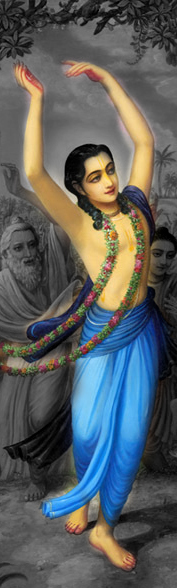
Srila Prabhupada

Of course Srila Prabhupada is carrying out the same thing that Lord Nityananda started in Bengal 500 years ago. Lord Nityananda started the 'Nama-hatta', the market place of the Holy Name. Where everyone can come and get the Holy Name.

   "So, Srila Prabhupada has changed, and his representatives, are changing the hearts of people all over the world. You see that is the real miracle. That is the real miracle!!! But people are so foolish that even today they are not able to understand what is miraculous, and what is cheap. But gradually they will understand. It took them ten years in Navadwip to understand (after Lord Chaitanya's leaving that place to take 'sannyasa'). So more the preaching goes, so more the people will come to understand."Of course Srila Prabhupada is carrying out the same thing that Lord Nityananda started in Bengal 500 years ago. Lord Nityananda started the 'Nama-hatta', the market place of the Holy Name. Where everyone can come and get the Holy Name. But the price of purchasing it isn't an ordinary 'pounds-shillings-and pence'. What is the price? The price is faith. The price is desire. If one has the faith to chant, the desire to take the mercy, that is the only price. So in this way Lord Nityananda sent out His representatives everywhere, to open up branches of the market. And this was in turn done by Bhaktivinoda Thakura, he wrote 'Anyone all over the world, they can be part of this transcendental market place of the Holy Name'; and of course Srila A.C. Bhaktivedanta Swami Prabhupada, he actually established the market places, all over the world. Any where there is a big Temple with so many Devotees, that is described as a bazaar. A Bazaar means where there are so many shops, so many opportunities to purchase the goods. So all these Temples, big Temples, they are like market places. A Devotee can come and get wholesale mercy. And where there are individuals, one or two, few Devotees, there is a shop where one can go. And then there's the travelling salesman. Travelling salesmen, they go from village to village, they carry the goods on their heads, and crying out: 'Anyone who is interested!' They give him the merchandise. It is described, there are two kinds of salesman. One kind takes the goods on credit and one buys, cash. The person who takes on credit, he takes the goods, goes and sells it, realises the profit, the money, returns the price of the goods and keeps the profit. The other person he's already got the capitol, he buys the goods cash, he goes out sells the goods, realises the profit. So like that some devotees, even they have not realised, even they may not have taken initiation, they may not of realised themselves what is the full nectar of devotional service. Still by taking the message from the bona-fide source, going out distributing it, then going back and getting some more mercy to give out, they realise their profit. They make their spiritual advancement. And some, even he is realised, even he's got a taste for chanting and hearing still the same thing, he takes the goods and distributes what is that merchandise, that's the pure Holy Name. Of course the pure Holy Name is existing in Srila Prabhupada's books, on every page, word by word, glorification of the Holy Name, form, pastimes of the Lord. 

   "So in this way everyone is taking part, some people are the employees of the this market-place, just like there's a treasurer; there's the man who weights the goods up; there's the 'coolie', who carries out the goods, throws them up, in the van; then there's the tailor, the barber and the washerman.

   "In India these three types of people are considered very low. Especially the washerman, and the barber. The dirty jobs, cutting all the hair! But in the market place of the holy name these are the most important people, Yes. The tailor, they take so many pieces of cloth, stitch them together and make a garment. So the tailor, his job is to take so many different diverse ideas 'karma-yoga', 'jnana-yoga' 'bhakti!' He takes all different kinds of materialistic things he combines them together, [the] stitches [are] ‘time, place and circumstances’, [he] cuts the suit to engage the person in devotional service. And the barber is very essential, in the barbershop he's got the long hairs, and the beards. He cuts, and gets them all cleaned up. This is just like the 'new bhakta director' man comes in he's completely materialistic, and he's shaved up and preached to, he's cleaned up in his conceptions. In this way the barber takes the gross materialist, cleans them up, and brings them into devotional service, very important.

   "But the most difficult task, I must admit, is actually the laundry man, the 'dhoba'. His job is very difficult. He takes all the dirty clothes with all the spilled chutney, 'dahl' and everything and has to make it spotless and clean. This is just like when a devotee is negligent in his devotional life and he 'bloops', he falls down or he becomes confused, and lacks enthusiasm. It means he's become coloured with materialistic desires, materialistic contamination. So the washerman, he takes such people, 'the fringies', 'the bloops' and he cleans them up and brings them back to the perfect line of devotional service, a most difficult task. It doesn't matter the devotional market place in the 'nama-hatta' everyone is engaged in the transcendental there's no consideration 'Oh this man's a washerman' Every engagement is very essential and important. So the thing is to immediately join Lord Nityananda's enterprise, His International, intercosmic, transcendental spiritual market, either as salesman or employee in the market or sweeper, cleaner or whatever it may be. Sweeper is the post that was taken by Bhaktivinoda Thakur, it's especially reserved for the Acarya. The sweeper has to always keep the market place clean, no nonsense, no dirt allowed to settle. Everything has to always be kept clean, no 'maya' allowed to enter. In the market place of the holy name the highest position which appears in the material view point to be most menial. Actually what is the duty of the 'guru', he's simply to see that there's no 'maya' enters into the disciple's mind. And that all the dirt is swept away. So he's a sweeper, he's a servant of everyone, but in the market place he's given respect by all the other devotees. So in this way this transcendental preaching is going on without cessation. It's going on eternally, constantly. 
Srila Prabhupada

"I will inundate the entire universe with My love. Not a pinch of misery or lamentation will remain. I will freely give My ecstatic love to the demigods ('devas'), and all moving and non-moving living entities."(Sri Chaitanya Mangala, Lochan dasa Thakura; Mahanidhi Swami. 1994. page 48.)

   "Srila Prabhupada, when he was walking through Vrindavana a 'rickshaw walla' got down off his 'rickshaw' and bowed down to Srila Prabhupada. Prabhupada said just see, this simple man, this 'rickshaw walla', how he's respecting a Vaishnava. This is the greatness of Indian culture. Unfortunately, most people see a dirty 'rickshaw walla' got off his 'rickshaw' and bowed down, what's the big deal? But Srila Prabhupada was overwhelmed that this simple person knows how to respect a Vaishnava. Where else in the world can you get any taxi driver get out and bow down to the 'acarya'. So this is the remnants of the glory of the Vedic culture which is still in India."(Jayapataka dasa Goswami. 29th August 1979. Srimad Bhagavatam class excerpt S.B. 3:29:45., Bhaktivedanta Manor, London.).

   In regards to the different functions within the market-place of the Holy Name, Sri Chaitanya Mangala of Locan dasa Thakura Lord Chaitanya is recorded speaking the following words, which the members of ISKCON believe, although in some cases are general, specifically refer to Srila Prabhupada.

   "In the Kali Yuga, However, I'll use the weapons of My transcendental Holy Names, qualities, and the potency of My 'prema-bhaktas' (pure devotees). With these I'll conquer the people's demoniac mentalities and award them pure devotional service to Radha and Krishna.

"Now without considering anything else, everyone just come with Me, and we'll destroy the sinful activities of the age of Kali. With the powerful chopper of 'nama-sankirtan' I'll cut the hard knots of demoniac desires from the hearts of everyone.

"Even the sinners reject or flee to foreign countries, still they will get the mercy. I will send 'mor senapati bhakta' to go there and deliver them.

[‘mor’ means My; ‘senapati’ means a military field commander, and ‘bhakta’ means devotee. So Lord Chaitanya will empower His own devotee to spread Krishna consciousness around the world.]

"I will inundate the entire universe with My love. Not a pinch of misery or lamentation will remain. I will freely give My ecstatic love to the demigods ('devas'), and all moving and non-moving living entities."(Sri Chaitanya Mangala, Lochan dasa Thakura; Mahanidhi Swami. 1994. page 48.)

Brahmananda: Oh, Bhavananda Maharaja, he knows. The astrologer in Mayapur?
Bhavananda: Oh, Mr… In Svarup Ganj there's one big astrologer. So he saw your photograph, and he said, 'This is the face of the most powerful spiritual personality on the planet.'
Prabhupada: (laughs) Hare Krishna.
Brahmananda: Then what else?
Bhavananda: Then he said that, 'I can tell from his face that he can make a house in which the whole world can live peacefully.'
Devotees: Jaya Prabhupada!
Prabhupada: At least I desire so. (break) Where your preaching was going on?
Tamala Krsna: We were preaching in Berkeley, California. Our other parties are spread out all over the country. One party is in"(Morning Walk Conversation, A.C.Bhaktivedanta Swami Prabhupada. 1st. July 1975. Denver.) 
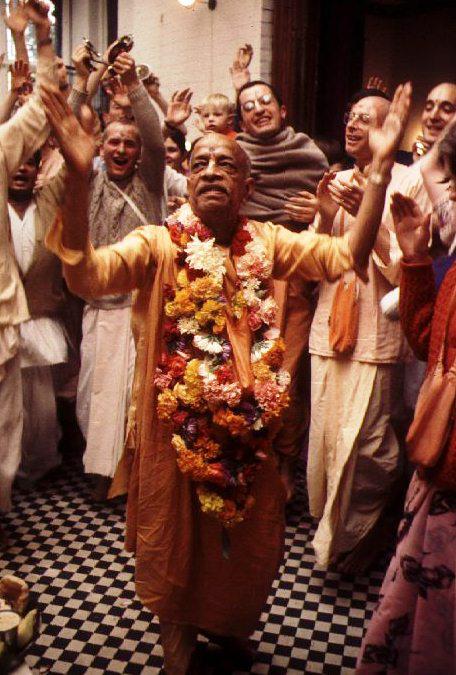
Srila Prabhupada

'I can tell from his face that he can make a house in which the whole world can live peacefully.'

   Srila Prabhupada was born Abhay Charan De on September 1st 1896 in Calcutta, India. His father was Gour Mohan De, a cloth merchant, and his mother was Rajani. His parents in accordance with Bengali tradition, employed an astrologer to calculate the child's horoscope, and they were made jubilant by the auspicious reading. The astrologer made a specific prediction: When this child reaches the age of seventy, he would cross the ocean, become a great exponent of religion, and open 108 temples.(Satswarupa das Goswami. 1987. "Your Ever Well-wisher". page x.) It is noteworthy that in that very same year, 1896, Srila Bhaktivinoda Thakura's book was accepted into McGill University in Canada, a pilot light for preaching in the West.

   When young Abhay had been unwilling to go to school, his father saw the humour in it, and always treated him kindly, and was lenient. His mother however, hired a man to escort young Abhay daily to school.

   Gour Mohan De was also a pure hearted Vaishnava. He often used to take young Abhay to the local Sri Radha-Govinda Temple. Where young Abhay was seen to be stood for many long hours offering prayers before the Deity. "The Deity was so beautiful, with His slanted eyes". (A.C.Bhaktivedanta Swami Prabhupada; Satswarupa das Goswami. 1987. "Your Ever Well-wisher". page xiii.)

   As Abhay grew up he became more and more devoted to the Deity form of the Lord. He was especially enamoured with the Jagannatha Rathyatra festival that was held in Calcutta each year. Hearing and understanding the significance of the festival Abhay would sometimes check railway timetables to go to Jagannath Puri where Lord Chaitanya personally attended some 500 years before. Every year a conservative estimated 5 million people attended the festival, this absorbed Abhay more in the mood of Rathyatra.

   1901 (circa) Young Abhay conducts his very own first Rathayatra. His father making a small cart, three feet high with a canopy resembling closely the huge carts in Puri. All the local children and many adults would come. Abhay stood out as a leader even then, as he organised and engaged everyone, even many of the mothers were engaged by him in cooking, (especially his sister Bhavatarini), who all cooked special preparations to be offered and distributed as 'Prasadam' at this Rathyatra festival.

   At age 6, his father purchased upon his request, his own Radha-Govinda Deities. Seeing the family engaged from his birth, watching his father performing the 'puja' at home, and going regularly to see Radha-Govindaji, it was only natural. From this day on whatever foodstuffs were brought before him by his parents, he would first offer to Sri Radha-Govindaji, and then eat Their 'prasadam'. He also used to daily offer them a ghee lamp, and properly put Them to rest at night. Little is know of his adolescence.

   During his college years his father arranged a marriage, selecting Radharani Datta as Abhay's bride. In 1918 they were married, but for several years Abhay lived with his family and Radharani with hers as she was only 11 years old, and Abhay was 22 years of age. So as well as for obvious reasons, this was to facilitate his finishing his college education. As it was recognised that the added responsibility of supporting a family is a challenge.

   In his fourth year of college Abhay felt reluctant to accept his degree, a degree that was given by the British. He had become a sympathiser to the Nationalist case, which advocated 'National schools', Freedom from British Rule, and Self Government (Self Rule).

   At the same school (Scottish Colleges) in the class one year ahead of Abhay was the highly spirited Nationalist Subhas Chandra Bose, who later became the leader of the Indian National Army formed to overthrow British Rule of India.

   Abhay was attracted to the pure and simple teaching of Mohandas K. Gandhi (Mahatma Gandhi). Who stood by the ancient pure principles of moral India, and regarded Bhagavad Gita above all other books. His personal habits too, and life-style were pure, as he lived a life as a saint, 'sadhu'. Abhay had seen many 'sadhus' and was not overly impressed. However, Gandhi had more integrity than most.

   Gandhi called on all Indian students to rebel and give up British mundane, manipulative educations, that would ultimately bind one in slavery to the British Raj and would deny the Indian people of their freedom, religion, culture, and inevitably their country. The schools shaped the students, 'brainwashing' them to British Imperialism, teaching them the corrupted philosophies taught by the Christian Church funded Western Indologists  shaping them for the control of generations to come.

   Abhay weighed up the 'pros' and 'cons'. Abhay then rejected his diploma even after completing his fourth year and passing his examination. So doing he made his principled stand of protest in response to Gandhi's call.

   When Gandhi called for a boycott of everything British and 'non-co-operation' after the British soldiers had gunned down hundreds of innocent, unarmed Indians who gathered at a peaceful rally at Jallainwalla Bagh, Abhay moved closer towards Gandhi's independence movement.

   Abhay's father was somewhat disturbed for Abhay's future, but didn't resent his decision. More concerned for Abhay's future than Indian politics Gour Mohan De arranged employment for Abhay through a prominent friend, distinguished surgeon, and chemical industrialist, a Dr Kartick Chandra Bose. Dr Bose gladly accepted Abhay as his department manager in his firm.

   1921 His wife gave birth to the first son and child, while she was just 14 years old (A.C.Bhaktivedanta Swami Prabhupada. June 8th 1974. Morning walk conversation. Geneva, Switzerland.).

   1922 marked the first meeting of Abhay with his spiritual master. Some of Abhay Charan's friends were going to see a 'sadhu' who was preaching in Calcutta, a descendant in the Brahma Madhwa Gaudiya line coming through Bhaktivinoda Thakur, his father none less. The 'Scottish School' educated, and prestigious leader of his group of friends, was asked to come along too. At his family home Abhay Charan De had seen so many 'sadhus' come, his father a pure Devotee of the Lord, would daily invite 'sadhus' to his house for 'Prasadam', and as a general feeling Abhay was not overly impressed with what he saw. His friends knowing his devotion, learning and expectations, valued his opinion, and so insisted that he come and see Bhakti Siddhanta Saraswati Goswami. Abhay was reluctant, but his friends wanted his approval. So Abhay conceded to go.

   "No sooner did Abhay and his friends respectfully bow before the saintly person and prepare to sit than he said to them, 'You are educated young men. Why don't you preach Lord Chaitanya's message throughout the whole world?' " (Satswarupa das Goswami. 1987. Your Ever Well Wisher. page xvi.)

   Abhay was surprised that the 'sadhu' had asked immediately for them to become preachers on his behalf. Impressed by Srila Bhakti Siddhanta Saraswati Thakura he wanted to test him with intelligent inquiries" (Satswarupa das Goswami. 1987. You Ever Well-wisher. page xvi.)

   Khadi clad, Abhay asked, "Who will hear your Chaitanya's message? We are a dependent country. First India must become independent. How can we spread India's culture if we are under British rule?"

   Note that he never objected to the concept of spreading Lord Chaitanya's mission, his concern was with the apparent obstacles that stood in the way.

   Srila Bhakti Siddhanta Saraswati dispelled any thought of potential obstacles saying that Krishna consciousness didn't have to wait for a change in Indian Politics, nor was it dependent on who ruled. Krishna consciousness could not be impaired by anyone or anything, it is so important that it could not wait. Therefore you must do it. Abhay was struck by his boldness. He brushed all temporal material miseries and condions aside, leaving the only worthwhile and factual conclusion and solution to all material difficulties, Krishna consciousness. 
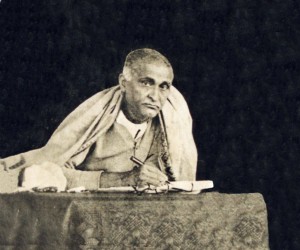
Srila Prabhupada

Srila Bhaktisiddhanta Saraswati Thakur Prabhupada.

   In a very short time Abhay was convinced, "He's wonderful!" Abhay said to his friend, "The message of Lord Chaitanya is in the hands of a very expert person" (Satswarupa das Goswami. 1987. "Your Ever Well-wisher", page xvii.) It was that very night that in his heart young Abhay accepted Srila Bhaktisiddhanta Saraswati Thakur Prabhupada as his spiritual master (Satswarupa das Goswami. 1987. "Your Ever Well-wisher", page xvii-xviii).

In 1925 Abhay Charan De first visits Sri Vrindavan, the Holy place of Lord Sri Krishna's Pastimes.

   For business purposes, Abhay and his wife and family moved to Allahabad. As a pharmaceutical salesman, Abhay did a lot of travelling by rail, especially in North India. By now Abhay Charan had developed a strong relationship with Srila Bhaktisiddhanta Saraswati Thakur Prabhupad, to the point where he requested formal spiritual initiation. On November 21st 1932., in the Gaudiya Math in Allahabad Abhay Charan De receives 'diksha' initiation.

   Abhay tried to organise to visit his spiritual master but whenever he visited Calcutta Srila Bhaktisiddhanta Saraswati was not there. Unlike many of his other disciples Abhay was thus unable to travel and spend time with his spiritual master. Consequently over the next four years they only met about a dozen times.

   When finally they did meet Abhay Charanaravinda das took every opportunity to hear from Srila Bhaktisiddhanta. "Although Srila Bhaktisiddhanta Saraswati was so strong in argument against other philosophies that even his own disciples were cautious about approaching him if he were sitting alone, and although Abhay's contact with him was quite limited, still Srila Bhaktisiddhanta Saraswati would always treat him very kindly. Srila Prabhupada would later recall, "sometimes my Godbrothers would criticise because I would talk a little freely with him, and they would quote this English saying, 'Fools rush in, where angels fear to tread'. But I would think, 'Fool? Well, maybe. But that is the way I am'. My Guru Maharaj was always very, very affectionate to me" (Satswarupa das Goswami. 1987. "Your Ever Well-wisher", page xx.)

   1935 on the occasion of Srila Bhaktisiddhanta Saraswati's 62nd birthday Abhay submitted a poem and an essay at as meeting of his Godbrothers in Bombay. The articles were well received and duly published in the 'Harmonist' for which Abhay was informally daubed 'kavi' (learned poet) by his Godbrothers. Abhay's real pleasure in his offering was when it reached Srila Bhaktisiddhanta Saraswati, who in particular liked one stanza and showed it to all his guests:

Absolute is sentient
Thou hast proved,
Impersonal calamity
though has removed.

   Later Srila Bhaktisiddhanta Saraswati said to the editor of the 'Harmonist', "Whatever he writes, publish it!"
   That year (1935) held one of the most significant meetings with his spiritual master in Vrindavan. Once when Abhay Charanaravinda das was walking with Srila Bhaktisiddhanta Saraswati and several other disciples, Srila Bhaktisiddhanta Saraswati began talking confidentially to Abhay Charan das. The conversation was in regard to some senior disciples quarrelling over who would use various rooms and facilities at the Gaudiya Math headquarters in Calcutta (Bagh Bazaar). Srila Bhaktisiddhanta Saraswati said to Abhay Charan' if they are quarrelling now what will they do after their spiritual master passes away? Srila Bhaktisiddhanta Saraswati was distressed. He said to Abhay Charan' "There will be fire!" One day there would be fire in the Calcutta Gaudiya Math, and that fire of party interest would spread and destroy. Abhay Charan' heard, but didn't know what to make of it. "It would be better, to take the marble from the walls of the temple to secure money. If I could do this and print books, that would be better," said Srila Bhaktisiddhanta Saraswati. 

Srila Prabhupada

"It would be better, to take the marble from the walls of the temple to secure money. If I could do this and print books, that would be better," said Srila Bhaktisiddhanta Saraswati.
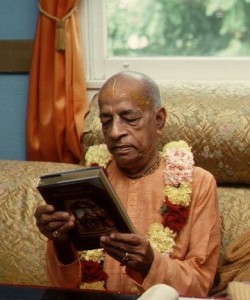
   Then Srila Bhaktisiddhanta Saraswati said directly to Abhay Charan, "I have a desire to print some books. If you ever get money print books".(Satswarupa das Goswami. 1987. "Your Ever Well-wisher", page xxi.)

"Srila Bhaktisiddhanta Saraswati Thakur Prabhupad departed from this mortal world in December 1936. One month before his departure Abhay Charan wrote him a letter. He was thinking that as householder, 'grhastha' he couldn't fully serve his spiritual master, and he wanted to know what to do. Thus he inquired, "Is there any particular service I can do?"

   Two weeks later Abhay Charan received a reply: "I am fully confident that you can explain in English our thoughts and arguments to the people who are not conversant with the languages Bengali & Hindi. This will do much good to yourself as well as your audience. I have every hope that you can turn yourself into a very good English preacher." (Satswarupa das Goswami. 1987. "Your Ever Well-wisher" page xxi.) Accepting this as his confirmation of his mission Abhay Charan began to further mould his life. "The fire in the math", mentioned by Srila Bhaktisiddhanta Saraswati broke out almost immediately after his disappearance. Legal disputes followed and the mission as propounded by Srila Bhaktisiddhanta Saraswati, was spoiled.

   Srila A.C.Bhaktivedanta Swami Prabhupad lets his feelings be felt in the following Purports:

   "In the beginning, during the presence of Om Visnupada Paramahamsa Parivrajakacarya Astottara-sata Sri Srimad Bhaktisiddhanta Sarasvati Thakura Prabhupada, all the disciples worked in agreement; but just after his disappearance, they disagreed. One party strictly followed the instructions of Bhaktisiddhanta Sarasvati Thakura, but another group created their own concoction about executing his desires. Bhaktisiddhanta Sarasvati Thakura, at the time of his departure, requested all his disciples to form a governing body and conduct missionary activities cooperatively. He did not instruct a particular man to become the next 'acarya'. But just after his passing away, his leading secretaries made plans, without authority, to occupy the post of 'acarya', and they split in two factions over who the next acarya would be. Consequently, both factions were 'asara', or useless, because they had no authority, having disobeyed the order of the spiritual master. Despite the spiritual master's order to form a governing body and execute the missionary activities of the Gaudiya Matha, the two unauthorised factions began litigation that is still going on after forty years with no decision. 

   "Therefore, we do not belong to any faction. But because the two parties, busy dividing the material assets of the Gaudiya Matha institution, stopped the preaching work, we took up the mission of Bhaktisiddhanta Sarasvati Thakura and Bhaktivinoda Thakura to preach the cult of Caitanya Mahaprabhu all over the world, under the protection of all the predecessor 'acaryas', and we find that our humble attempt has been successful. We followed the principles especially explained by Srila Visvanatha Cakravarti Thakura in his commentary on the Bhagavad Gita verse 'vyavasayatmika buddhir ekeha kuru-nandana'. According to this instruction of Visvanatha Cakravarti Thakura, it is the duty of a disciple to follow strictly the orders of his spiritual master. The secret of success in advancement in spiritual life is the firm faith of the disciple in the orders of his spiritual master. The Vedas confirm this:

yasya deve para bhaktir
yatha deve tatha gurau
tasyaite kathita hy arthah
prakasante mahatmanah

   'To one who has staunch faith in the words of the spiritual master and the words of the Supreme Personality of Godhead the secret of success in Vedic knowledge is revealed'. The Krishna consciousness movement is being propagated according to this principle, and therefore our preaching work is going on successfully, in spite of the many impediments offered by antagonistic demons, because we are getting positive help from our previous 'acaryas'. One must judge every action by its result. The members of the self-appointed 'acaryas' party who occupied the property of the Gaudiya Matha are satisfied, but they could make no progress in preaching. Therefore by the result of their actions one should know that they are 'asara', or  useless, whereas the success of the ISKCON party, the International Society for Krishna Consciousness, which strictly follows 'guru' and Gauranga, is increasing daily all over the world. Srila Bhaktisiddhanta Sarasvati Thakura wanted to print as many books as possible and distribute them all over the world. We have tried our best in this connection, and we are getting results beyond our expectations." (A.C.Bhaktivedanta Swami Prabhupada; Sri Chaitanya Charitamrta Adi lila 12:8. purport.)

asarera name ihan nahi prayoiana
    are janibare kari ekatra ganana

   "There is no need to name those who are useless. It matters the devotional market place I mentioned them only to distinguish them from the useful Devotees." (Sri Chaitanya Charitamrta Adi lila 12:11. text.)

dhanya-rasi mape yaiche patna sahite
pascate patna udana samskara karite

   "Paddy is mixed with straw at first, and one must fan it to separate the paddy from the straw." (Sri Chaitanya Charitamrta Adi Lila 12:12. text.)

   "This example given by Krishnadasa Kaviraja Goswami is very appropriate. In the case of the Gaudiya Matha you preach about Lord Chaitanya, one can apply a similar process. There are many disciples of Bhaktisiddhanta Sarasvati Thakura, but to judge who is actually his disciple, to divide the useful from the useless, one must measure the activities of such disciples in executing the will of the spiritual master. Bhaktisiddhanta Sarasvati Thakura tried his best to spread the cult of Sri Chaitanya Mahaprabhu to countries outside India. When he was present he patronised the disciples to go outside India to preach the cult of Sri Chaitanya Mahaprabhu, but they were unsuccessful because within their minds they were not actually serious about preaching His cult in foreign countries; they simply wanted to take credit for having gone to foreign lands and utilise this recognition in India by advertising themselves as repatriated preachers. Many 'swamis' have adopted this hypocritical means of preaching for the last eighty years or more, but no one could preach the real cult of Krishna consciousness all over the world. They merely came back to India falsely advertising that they had converted all the foreigners to the ideas of Vedanta or Krishna consciousness, and then they collected funds in India and lived satisfied lives of material comfort. As one fans paddy to separate the real paddy from useless straw, by accepting the criterion recommended by Krishnadasa Kaviraja Goswami one can very easily understand who is a genuine world-preacher and who is useless." (A.C.Bhaktivedanta Swami Prabhupada; Sri Chaitanya Charitamrta Adi Lila 12:12. purport).

   1939 Abhay Charan prabhu in recognition for his devotional scholarship receives the honorary title 'Bhaktivedanta' from the Gaudiya Matha.
Srila Prabhupada

February 1944 A.C. Bhaktivedanta begins the 'Back to Godhead magazine', an English fortnightly magazine, single handedly.

   February 1944 A.C. Bhaktivedanta begins the 'Back to Godhead magazine', an English fortnightly magazine, single handedly. Srila Prabhupada edited it, typed the manuscripts, checked the galley proofs, and even distributed the individual copies. Indian independence in 1947 was followed by the horrors of 'Indo-Pak'  fighting. Hundreds of thousands died in the fighting that followed 'partition' of the land into India and Pakistan. Abhay Charan always remained in spiritual prospectus, reflecting Srila Prabhupada recalls, "We have seen in 1947, Hindu-Muslim fighting. One party was Hindu, the other party was Muslim. They fought, and so many died. And after death there was no distinction who was Hindu or who was Muslim – the municipal men gathered the bodies together in piles to throw them somewhere". (Satswarupa das Goswami. 1987. "Your Ever Well-Wisher", page xxiii.)

   In regard to the problem Abhay Charan das presented a solution in BTG (Back to Godhead Magazine), in his article "Gandhi-Jinnah Talks", he wrote, "Fighting will go on between Hindu and Mohammedan, between Christian and Christian, between Buddhist and Buddhist 'till the day of annihilation".(Satswarupa das Goswami. 1987. "Your Ever Well-Wisher", page xxii.) As long as people forget their purpose in life and relationship with God and each other out of selfish material interests and desires for sense gratification, they will continue fighting. "Real unity was possible only on the platform of spiritual understanding and service to the Supreme".(Satswarupa das Goswami. 1987. "Your Ever Well-Wisher", page xxii.)

   On December 7th 1947 Abhay Charan' wrote a  long letter to Gandhi in New Delhi. Having doubts that Gandhi would ever receive it Abhay Charan addressing himself as Gandhi's "Unknown Friend", he wrote, "I tell you as a sincere friend that you must immediately retire from active politics if you do not desire to die an inglorious death". Abhay Charan never received a reply, and on 30th January 1948 Gandhi was shot to death, his letter appearing as a prophecy.

   For the next few years Abhay Charan put less and less energy into business and more and more into writing and preaching.

   Abhay Charan was invited to speak at the Gita Mandir in Jhansi by a colleague he had met as a customer at the Jhansi hospital. The audience was mostly students and professionals, who were mostly interested in social and cultural mental titillation. Many speakers came and went. But Abhay Charan was visionary and ambitious, and leaving his Allahabad business affairs in the hands of his son, he tried to start a spiritual movement there in Jhansi. This was "The League of Devotees".
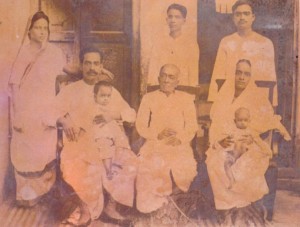
Srila Prabhupada

Family of Srila Prabhupada.

   1950 he retired from family life, adopting the 'ashrama' of 'vanaprastha' (retired). He was far from retirement in actuality. Now he dedicated his energy into study and writing.

   In 1953 initiates his first disciple in that centre in Jhansi, Acarya dasa.

   Starts his own centre in Jhansi, to which the Grand Opening for 'The League of Devotees' was on May 16th.

   The 1950's were a difficult time for Abhay Charan. He had to leave his "League if Devotees" building because the governor's wife insisted it be used for a "Ladies Club". With no place to stay and no real support, he left Jhansi – but not his plan for a world wide association of Devotees. He moved around from an 'ashram' in Delhi, stayed with different Godbrothers, now he knew he was on his own. He lived like a mendicant, staying here and there for a week at a time in various temples or in the homes of the wealthy pious people who would receive him. These difficult times of no money, simple clothing, little proper food, etc., made him more resourceful. He took these difficulties as assets. (Satswarupa das Goswami. 1987. "Your Ever Well-Wisher", page xxix.) Not so much in material terms, but in term of what it did for his faith. He had no-one, he was alone. Rejected by family and friends as a material failure his only solace was the mission of his spiritual master. 

Srila Prabhupada

He had no-one, he was alone. Rejected by family and friends as a material failure his only solace was the mission of his spiritual master.
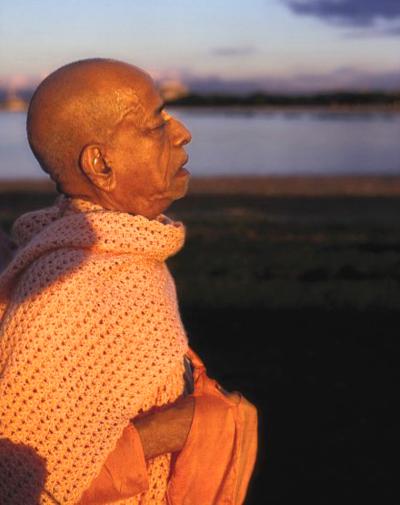
   To fulfil this mission he approached many prominent personalities including Dr Rajendra Prasad, the President of India at that time, but received no reply.

   In September of 1956, Abhay Charan moves to Sri Vrindavan Dham eighty miles south of Delhi to begin an intensive preparation and study to embark on his life's mission. His plan was to draw enough energy from the well of spiritual purity and energy of Sri Vrindavan Dham, write in the tranquil atmosphere and then commute to Delhi to distribute his literature and seek donations from respected persons.

   Having full faith in guru and Krishna, always expecting their mercy, daily Abhay Charan pushed on even in the 60 degree Centigrade heat of the Vrindavana and Delhi summers. Living simply, in an inexpensive room in the Vamsi-Gopalji Temple, located on the bank of the sacred Yamuna River, he entered into a special mood, and quality of Vrindavan life.

   It was very difficult, commuting to Delhi on the early morning train, but having nowhere to stay, returning to Vrindavan the same night. It didn't leave but a few hours in Delhi, and everything was so expensive, for one on a budget of next to nothing. Yet he continued, travelling, printing and mailing. After producing 12 consecutive fortnightly editions of "Back To Godhead" Abhay Charan ran out of money. The printer told him that he couldn't print simply out of friendship, and so there was no more publication. Abhay Charan continued writing, building up a stock-pile of preaching materials, but the plan for publication was distant.

   After many years of struggle to support and maintain his family, finally in 1954, A.C. Bhaktivedanta prabhu leaves his family to dedicate his life to the mission of fulfilling the order of his spiritual master.

   He ventured again to preach in Delhi. Resolute in his definite major purpose A.C.Bhaktivedanta prabhu sat in his Chippiwada Temple (Delhi) typing by day and night in order to present Shrimad Bhagavatam faithful to the Vedanta Sutra of Vyasa, and with purports to affect the stone like hearts of the misdirected civilisation presently inhabiting the Earth. Srila A.C.Bhaktivedanta prabhu carefully and thoughtfully with exacting care and concentration worked quickly to this end. 
Srila Prabhupada

Resolute in his definite major purpose A.C.Bhaktivedanta prabhu sat in his Chippiwada temple (Delhi) typing by day and night in order to present Srimad Bhagavatam faithful to the Vedanta Sutra of Vyasa, and with purports to affect the stone like hearts of the misdirected civilisation presently inhabiting the Earth.

   After some time moved to the Radha-Damodar Temple in town. There he would eat, sleep and write in his humble rooms overlooking the courtyard at the Sri Sri Radha-Damodara Temple, where the six Goswamis, four hundred years previously, would sit and take 'Prasadam' and discuss Vaishnava philosophy and the loving pastimes of Sri Radha Krishna in the presence of Lord Chaitanya. At this sacred place, the home of Gaudiya Vaishnavism, Srila Prabhupada, by the mercy of the 'parampara', became surcharged. His conviction, and mission to write and preach becomes more apparent, with much deep reflection upon his role, and the method by which he would fulfil that role.

   Living at the historic Sri Radha-Damodar Temple in Vrindavana he began his monumental 'life's masterpiece' the multi volume commentated translation of the eighteen thousand verse Srimad Bhagavatam (Maha-Bhagavat Purana).

Reflective, and in a renounced and solitary mood, Abhay Charan Bhaktivedanta prabhu composed a Bengali poem, entitled, "Vrindavan Bhajan". Its opening stanzas were especially self-reflective and personal:

Verse 1.
"I am sitting alone in Vrindavana Dham. In this mood I am getting many realisations. I have wife, sons, daughters, grandsons, everything. But I have no money, so they are a fruitless glory. Krishna has sown me the naked form of material nature; By His strength it has all become tasteless to me today, 'yasyaham anugrhnami harishye tad-dhanam shanaih'  "I gradually take away all the wealth of those upon whom I am merciful".
How was I able to understand this mercy of the All Merciful?

Verse 2.
"Everyone has abandoned me, seeing me penniless wife, relatives, friends, brothers, everyone. This is misery, but it gives me a good laugh. I sit alone and laugh!

In this 'Maya samsara', whom do I really love?
Where have my loving father and mother gone now?
And where are all my elders, who were my own folk?
Who will give me news of them, tell me who?
All that is left of this family life is a list of names.

   (Satswarupa das Goswami. 1987. "Your Ever Well-Wisher", page xxxi).

   Soon after this realisation Abhay Charan Bhaktivedanta prabhu had a striking repetitive dream, one that he had as a householder. In the dream his spiritual master appeared, just as he knew him, a tall, scholarly 'sannyasi', 'Vaikuntha man', the pure representative of the Lord. Srila Bhaktisiddhanta Saraswati Thakur indicated to Abhay Charan that it is time now to take 'sannyasa'. Repeatedly he called and motioned to the cloth. He was definitely asking Abhay Charan to take to the 'sannyasa' order.

   When Abhay Charan awoke he pondered carefully the dream. "Abhay Charan dasa reasoned that his spiritual master was saying 'now take sannyasa and you will actually be able to accomplish this mission. Formerly the time was not right'." (Satswarupa dasa Goswami. 1987. "Your Ever Well-Wisher", page xxxiv.)

   Humbly Abhay Charan (Bhaktivedanta prabhu) although apprehensive, approached his senior godbrother, Srila Bhakti Prajna Keshava Maharaj in Mathura, who stressed that Abhay Charan take 'sannyasam' immediately.

   September 17th 1959, he receives formal 'sannyasa' initiation in Mathura from Srila Bhakti Prajna Keshava Maharaj, a dear godbrother and senior disciple of Srila Bhaktisiddhanta Saraswati Thakur Prabhupada. He was given the suffix Goswami to his name, and so carried the full name A.C. Bhaktivedanta Swami.That day he was horned by a bull in the market place, and took it as purification after the initiation.

   In the Autumn of 1959, "Srila Prabhupada was living in Sri Vrindavan Dham and would sometimes practice 'madhukari'. 'Madhukari' means to collect a little food door-to-door for one's maintenance just as a bee collects a little pollen flower-to-flower. Srila Prabhupada, however, often requested the householders whom he called upon to give pen and paper for his writing rather than the rice, dahl, and chapattis traditionally sought by holy men practicing 'madhukari'.

   On those papers that he received as alms, Srila Prabhupada wrote page after page, preparing his messages of Godhead for the world. Some of his manuscripts he published in his 'Back to Godhead Magazine', and others, like 'Easy Journey to Other Planets', he printed as small booklets. Although unable to publish everything he wrote, Srila Prabhupada nevertheless continued to write and stockpile his manuscripts. Unfortunately, some of the early writings of His Divine Grace were lost after Srila Prabhupada left Sri Vrindavan Dham to conduct his worldwide campaign of spreading Krishna consciousness." (J.G. Bhaktigaurava Narasingha Swami. 1993. Introduction to 'In Search of the Ultimate Goal of Life'. page xv.)
Srila Prabhupada

A.C. Bhaktivedanta Swami publishes his first book 'Easy journey to other planets' in Delhi in the autumn of 1960.

   Following the mood of the day, acknowledging the world struggle and control between the 'post war super powers'  for the 'uncharted, unknown realm of space', and understanding the mentality of the people of the day A.C. Bhaktivedanta Swami publishes his first book 'Easy journey to other planets' in Delhi in the autumn of 1960.

   As a culmination of many years of study, reflection, meditation, discussion, and thought A.C. Bhaktivedanta Swami publishes Canto One, Volume One of Srimad Bhagavatam a commentary with super condensed, compacted purports which were the crystallised product of a life times study and realisation.

   From his small room at the Radha-Damodar temple, where he would prepare his meals, and rest he could see the 'samadhi' of Srila Rupa Goswami and the Deities that he installed there. Bhaktivedanta Swami prayed there, at the feet of Rupa Goswami, his predecessor for guidance. what he received in return, the inspiration, intimate direction, was like the scribe Ganesh who wrote on Srila Vyasadeva's behalf as Vyasa dictated to him.

   In 1962, with his Srimad Bhagavatam now published he personally travelled, preached its glories, and sold copies. Using favourable reviews from prominent persons like: Hanuman Prasad Poddar (Gita Press – Gorakpur), Hindu philosopher Dr Radhakrishnan, the prestigious 'Adyar Library Bulletin', Scholarly Godrothers, Prime Minister Lal Bahadur Shastri, Dr Zakir Hussain – the Vice President of India, Sri Biswanatha Das – governor of Uttar Pradesh, as his advertisements. Bhaktivedanta Swami visited prospective donors as he tried to raise funds for further volumes. To publish the first canto in three volumes it had thus taken a little more than two years.

   Now he turned his attention to preaching in the West.

   Srila A.C. Bhaktivedanta Swami was 69 years of age. He had treasured, nurtured and developed the instruction from his spiritual master some forty years. It seemed a long cultivation and preparation. As Satswarupa das Goswami so nicely calls his biography on Srila Prabhupada's first volume "A life-time in preparation", preparing to plant the seeds.

   "In Vrindavan Bhaktivedanta Swami met Mr Agarwal, a Mathura businessman, and mentioned to him on passing, as he did to almost everyone he met, that he wanted to go to the West. Although Mr Agarwal had known Bhaktivedanta Swami for only a few minutes, he volunteered to try to get him a sponsor in America by asking his son Gopal, an engineer in Pennsylvania, to send back a sponsorship form. When Mr Agarwal volunteered to help in this way, Bhaktivedanta Swami urged him to please do so" (Satswarupa das Goswami. 1987. "Your Ever Well-Wisher", page xxxviii.)

   Meanwhile A.C. Bhaktivedanta Swami went about his daily affairs following his usual avenues of book selling, looking for whatever opportunity might arise. Then one day to his pleasure and surprise, he was contacted by the Ministry of External Affairs and informed that a certificate of 'No Objection' for travelling to the U.S was ready. Mr Gopal Agarwal of Butler Pennsylvania had solemnly declared that he would bear any and all expenses of Bhaktivedanta Swami during his stay in the United States.
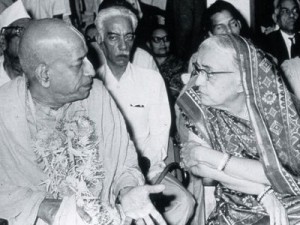
Srila Prabhupada

Meeting Sumati Morarji - owner of the steamship company.

   With newly acquired passport, visa, 'P-form', sponsor, and travel fare A.C. Bhaktivedanta Swami travelled to Bombay to seek assistance in getting to America. He approached Srimati Sumati Morarji, head of the Scindia Steamship Line, who had previously helped him with a large donation for printing volume two of Srimad Bhagavatam. Concerned to his health and welfare Sumati Morarji said, "no" to his request for assistance.

   Bhaktivedanta Swami coaxed her secretary Mr Choksi, advising him in exactly what to say: "I find this gentleman very inspired to go to the States and preach Lord Krishna's message to the people there " again she said, "no". He demanded a personal interview, which he got, and then presented his single minded emphatic request: "Please give me one ticket!"

   Finally she conceded and gave him a scheduled place on the ship Jaladuta, which was sailing from Calcutta on 13th August 1965. She made all the arrangements, making sure that he would travel on a ship whose captain understood the needs of a vegetarian and a 'brahmana'. She organised that the captain, Arun Pandia carry extra vegetables and fruits for Bhaktivedanta Swami.

   A couple of days before the ship was to sail Bhaktivedanta Swami arrived in Calcutta. Although he had spent so much of his early life growing up there and had known so many persons as in his poem, now he knew no-one. Staying with a slight acquaintance, and on the day before his departure, travelling north to Mayapur to visit the 'samadhi' tomb of his spiritual master Srila Bhaktisiddhanta Saraswati Thakura Prabhupada to ask for his blessings. Now he was ready.

   His main baggage was several trunks, two hundred three volume sets of first canto Srimad Bhagavatam, his personal baggage a small suit-case, an umbrella, and a supply of dry cereal in case he couldn't find food in the land of the meat eaters. If that be the case, he was prepared to live on boiled potatoes and the cereal he brought with him.

   On Friday August 13th 1965., at 9:00 am, he sets sail for America aboard the steamship 'Jaladuta'. By Saturday 14th, Bhaktivedanta Swami experienced seasickness, dizziness, vomiting as they moved slowly in heavy rains through the Bay of Bengal.

   Reaching Colombo, Sri Lanka on 19th, Bhaktivedanta Swami was able to go ashore and get some relief from his seasickness. A diary is recorded of the exact route in Satswarupa das Goswami's books in the chapter "Struggling Alone" (Satswarupa das Goswami. 1987. "Your Ever Well-Wisher", pages 1-3.)

   After experiencing sea-sickness from the Atlantic crossing, in rough seas, and in mid-Atlantic, and at the advanced age of 63 years of age A.C. Bhaktivedanta Swami suffers two heart attacks. "If a third comes I will not survive!"

   That night in a dream the Lord appeared to him in a boat full of many incarnations, and assured the dedicated mendicant that He will protect him.
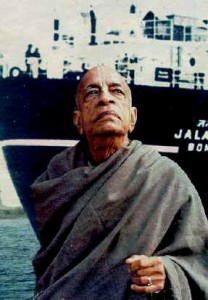
Srila Prabhupada

"If the Atlantic would have shown its usual face, perhaps I would have died. But Lord Krishna has taken charge of the ship".

   Sri Krishna was very kind to Srila A.C. Bhaktivedanta Swami, and he appreciated that. In his diary he wrote, "If the Atlantic would have shown its usual face, perhaps I would have died. But Lord Krishna has taken charge of the ship".

   After a 35 day journey from Calcutta the Jaladuta docked at Commonwealth pier at 5:30 am, September 17th 1965, the ship docks in Boston, United States of America, stopping briefly before pushing on to New York City Harbour, for A.C. Bhaktivedanta Swami a new journey had begun.

   The Captain made comments to the effect that, this had been the calmest of all the Atlantic crossings that he had ever been on, and light heartedly, yet with regard for his health, asked Bhaktivedanta Swami if he would return with him to ensure another safe trip.

   With only forty Rupees, and an Indian steel trunk full of Srimad Bhagavatams, A.C. Bhaktivedanta Swami set his sights for creating a movement that would have the effect of changing the world that we live in so many ways.

   Unlike many Indians who had gone before him and come to the West, he had not come to receive from the West, but had come to give to the West!

   He was staunch. In an uncompromised manner, with shaven head, 'Vaishnava tilak', Tulasi neck beads, saffron 'dhoti', 'kurta', 'uttara' and an old 'chaddar' – shawl; and rubber pointed slippers, all not uncommon for 'sadhus' in India. But who in America had ever dreamed of seeing anyone dressed in the traditional Vaisnava way? "He was possibly the first 'Vaishnava sannyasi' to arrive in New York with uncompromising appearance" (Satswarupa dasa Goswami. 1987. "Your Ever Well-Wisher", page 5.)

   Srila Prabhupada recalls, "I did not know whether to turn left or right" (Satswarupa das Goswami. 1987. "Your Ever Well-Wisher", page 5.) After passing through the dockyard formalities he was met by a representative from travellers aid, sent by the Agarwals' in Butler Pennsylvania.

   He stayed there for a while, always meditating on how best to preach. With a burning desire to start his preaching movement he got Gopal Agarwal to take him to Pittsburg where he got a bus for New York City.

   A.C. Bhaktivedanta Swami knew no-one in New York, he only had a contact: Dr Ramamurthi Mishra. Dr Mishra was a flamboyant, dramatic personality. Bhaktivedanta Swami was given a room at his apartment, but when it became inconvenient he shifted Bhaktivedanta Swami down to his Hatha Yoga studio near Central Park. Bhaktivedanta Swami stayed there for a short time, but found himself constantly at odds with Mishra who turned out to be a 'mayavadi'.

   In Butler he had been confined by the Agarwals' middle class sensibilities; now due to having to be temporarily dependent on the good will of a 'mayavadi' treated with kindness, yet viewed as a threat. Dr Mishra tried desperately hard to keep his 'yoga' students away from the personalistic philosophy emanating from Bhaktivedanta Swami's mouth.

   November 8th, 1965, Bhaktivedanta Swami wrote to his godbrother Tirtha Maharaj, who had become president of the Gaudiya Math. He tried to urge his godbrothers to come and help him, or at least send a couple of men he could work with, preach with and open a centre with.

   Three weeks later a reply came from Tirtha Maharaj, unfortunately today, I think for him, Tirtha Maharaj's letter was a very polite yet to the point, "that the Gaudiya Math's funds could not be used to open a centre in New York".

   That didn't deter him in the least, his faith in the mission of his guru maharaj was firm, he knew what he wanted and knew that all he had to do was be willing to follow the design of the Lord. the practical example of Arjuna was there in the forefront of his mind, trusting that the battle was in fact already won, the humble follower of this ageless tradition now stood up proudly amidst numerous potential foes and declared the battle won. Proof of the foresight of  his faith, like one who puts faith in the darkness of the early morning, knowing that light of day will appear, he revealed his mind to those he met, who he found worthy.

   "In his solitary wanderings in Manhattan, Bhaktivedanta Swami made acquaintances with a number of local people. there was Mr Ruben, a Turkish Jew, who worked as a subway conductor. Mr Ruben met Bhaktivedanta Swami on a park bench and, being a sociable fellow and a world traveller, sat and talked with the Indian holy Man. 

 Mr Ruben: He seemed to know that he would have temples filled with devotees. He would look out and say, 'I am not a poor man, I am rich. There are temples and books, they are existing, they are there, but time is separating us from them'. He always mentioned 'we' and spoke about the one who sent him, his spiritual master. He didn't know people at that time, but he said, 'I am never alone'. He always looked like a lonely man to me. That's what made me think of him like a holy man, Elijah, who always went out alone. I don't believe he had any followers."(Satswarupa dasa Goswami. 1987. "Your Ever Well-Wisher", page 14.)

   Even in the severest conditions of blizzards and snow Bhaktivedanta Swami worked on his "Krishna Book", Srimad Bhagavatam, preached from Bhagavad Gita and offered his food to the Lord.

   15th February 1965, Bhaktivedanta Swami moved from Dr Mishra's 'yoga' studio to an place of his own, a small narrow office without furniture or telephone. Sleeping on the floor on blankets, and a makeshift desk for writing made by covering a trunk with a cloth. There were no bathing or cooking facility so he travelled up to flights to use Dr Mishra's 'Yoga Ashram'. Now Bhaktivedanta Swami maintained himself simply by selling his books to who ever he met that was interested.

   Even in this bare room Bhaktivedanta Swami began to preach. On a donated reel to reel tape recorder he recorded some of his solitary 'bhajans', accompanying himself on 'karatals' (hand cymbals). He even recorded a long philosophical essay, "Introduction to Gitopanishad (Bhagavad Gita)". Srila Bhaktisiddhanta Saraswati had told him, "…and even if no one attends, you can go on chanting to the four walls". Now uninhibited by those around him, and free to speak, Bhaktivedanta Swami began lectures Mondays, Wednesday, and Fridays to whoever would come. His first audience were Dr Mishra's students that he had preached to at their 'ashram'. But news soon spread like fire in the Lower East Side of New York, the time was right and so were the people.

   After having his typewriter and tape recorder stolen, disappointed, Bhaktivedanta Swami moved to the Bowery to be where the people were, and where he was offered accommodation in a loft.

   The classes continued, and the musicians of the area came to chant along with Bhaktivedanta Swami, as long as they chanted 'Hare Krishna' he didn't mind.

   But alas the nature of the Bowery's drug using population convinced Bhaktivedanta Swami that as he was warned, the Bowery was unsafe for a gentleman such as he.

   Gaining assistance from some of his students Bhaktivedanta Swami stayed with Carl Yeargens and his wife Eva, until Michael Grant Carl helped him to find a store front, a former gift shop on 26 – 2nd Avenue, called "Matchless Gifts". The rent was $71 a month and including bond, electricity etc., it came to $196 to move in. Carl, Mike and some of the others pitched in and Bhaktivedanta Swami was able to move in. The apartment was painted, electricity connected, water turned on, and a phone installed everything paid for by his friends. 
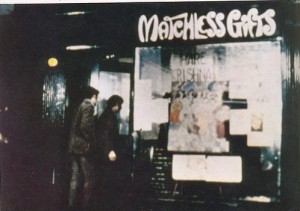
Srila Prabhupada

Gaining assistance from some of his students Bhaktivedanta Swami stayed with Carl Yeargens and his wife Eva, until Michael Grant Carl helped him to find a store front, a former gift shop on 26 - 2nd Avenue, called "Matchless Gifts".

   The musicians and people of the Bowery considered Bhaktivedanta Swami "Highly Evolved", and felt inspired when it was time to move him into his new place. (Satswarupa das Goswami. 1987.) He was pleased to be there too, and seeing things slowly but surely coming together encouraged the mission of his spiritual master to keep going on.

   The time was right, things were radically changing in the west. The youth were looking for the positive alternative, something to give lasting peace after decades of war.

   Now finding himself strategically placed by the Lord ready to receive the influx of potential spiritual seekers, who had come from all over the U.S. to descend on the Lower East Side, "Which in the parlance of the renting agents became known as the 'East Village'." (Satswarupa dasa Goswami. 1987. "Your Ever Well-Wisher", page 34.) Their search was unlike other immigrants to the area, their's was a search not for work or acceptance by material society. Their's was a search to find real love, real peace, real existence, integrity, and ultimately real spiritual consciousness. They had rebelled against the war in Vietnam, political manipulation, T.V. propaganda, the trivia, and mundane advertising, and influence of the media – in fact they rebelled against everything that the ephemeral goals of 'middle class America' whence they came stood for. "They were disillusioned by parents, teachers, clergy, public leaders, and the media they were just right for spiritual life." (Satswarup das Goswami. 1987. "Your Ever Well-Wisher", page 34.) Sometimes, with his usual visionary and humble outlook, he would declare that they had been placed there by his 'guru maharaj' to assist with his preaching.

   With complete disregard for his own safety he went to a place that Vaisnavas normally find distasteful, the most materially successful place, but a land of passion and ignorance, beset with crazy misguided youth and demoniac scientists, and where intoxication, illicit sex, and cow killing were a way of life. Sri Meanwhile A.C. Bhaktivedanta Swami went about his daily affairs following his usual avenues of book selling, looking for whatever opportunity might arise. Then one day to his pleasure and surprise, he was contacted by the Ministry of External Affairs and informed that a certificate of A.C. Bhaktivedanta Swami, at an age when most elderly gentlemen would be thinking of rest and retirement, started a revolution that has, without any doubt, changed the face of the earth.

aitam sa asthaya paratmanistha madhyasitam purvatamairmaharsibhih aham tarisyami durantaparam tamo mukundanghri nisevayaiva

   "Following in the lotus footsteps of the great 'rshis' [we shall cross], he has crossed over the impassable ocean of the material existence by means of devotion to the Supreme Lord and by the transcendental service of Lord Mukunda, the Lord of liberation."

   The pure unalloyed Vaishnavas like Srila Prabhupada always act in a way that is pleasing to the Lord and in no other way, as in the case of Lord Chaitanya's servant, who, after Lord Chaitanya fell asleep across the doorway of the room, stepped over His body to perform devotional service for the Lord. Upon Lord Caitanya's waking he saw that His dear servant was still in the room and had not taken his meal. Lord Caitanya enquired why he had not gone for his meal, and the devotee replied that he couldn't as You, the Lord were sleeping, blocking the door. The Lord further enquired saying, "How then did you enter the room?"  The devotee replied that, "I had stepped over You so I could do some service for You, but for my service, service of my tongue and belly, I could not cross over You as this would be an offence." There are many stories like this in the Srimad Bhagavatam. One story relates how, at one time, Lord Sri Krsna played the part of having a headache. He stated that the only medicine was to take the dust from the lotus feet of the 'brahmanas', and so approached the 'brahmanas' in that way. Thinking for their own welfare and not for Krsna's, they all said that if they were to allow the Supreme Lord to take their feet on His head, they would all go to hell, never to return. However, when Krsna approached the 'gopis', the simple cowherd girls of Vrndavana with the same request, without hesitation gave Krsna their feet and He placed them on His head. Their thoughts are recorded as, "We don't care if we go to hell. Let us satisfy our Krsna. If Krsna is suffering we will do anything we can to relieve Him." 

   Another time in Jagannatha Puri Temple, which gets very full, an old lady climbed onto the body of Sri Chaitanya Mahaprabhu to see the forms of Lord Jagannatha, Baladeva and Lady Subhadra. Many Devotees were perplexed, but Sri Chaitanya Mahaprabhu could see her deep love for the Lord, and thus allowed her to do so. Another is in the case of Lord Krishna Himself, who broke His promise to save His Devotee Arjuna. When grandfather Bhisma attacked Arjuna, Krishna ran at Bhishma to crush him with a chariot wheel, even though He had said He would not intervene in the battle. Yet for His Devotee He gave up His reputation. So in the same way, as a spotless 'paramahamsa Vaishnava sannyasi' of the Lord "our Srila Prabhupada", for the service of the Lord and for the service of mankind and all living entities, took up the preaching mission as laid down by the Personality of Godhead, Lord Chaitanya Mahaprabhu, at the risk of his own personal safety and comfort. 
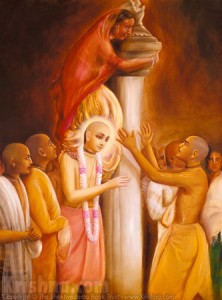
Srila Prabhupada

A lady who climed up on Lord Chaitania in order to see Lord Jagannath.

   Srila A.C. Bhaktivedanta Swami was never concerned for the petty criticisms of the caste conscious 'smartas' and 'gosais', or others who never preached to try to lessen the suffering of the living entities in this world, for his turning those born outside of the 'Hindu' caste of 'brahmin' into sincere 'Vaisnava brahmins'. Rather he strictly followed the higher principal of compassion to all the conditioned souls, as spoken by Sri Caitanya Mahaprabhu;

bharata-bhumite haila manusya janma yara
janma sarthaka kari kara para upakara

   "One who has taken his birth as a human being in Bharata Bhumi (India) should make his life successful and work for the benefit of all peoples outside India as well as in India."

ateva saba phala deha 'yare tare
khaiya ha-uk loka ajara amare

   "Distribute this Krishna consciousness movement all over the world. Let people eat these fruits of love of Godhead and ultimately become free from old age and death." (Chaitanya Charitamrta Adi Lila 9:39.).

atheva ami ajnadilvn sabakare
 yahan tahan prema-phala deha 'yare tare

   "Therefore I (the Supreme Personality of Godhead Lord Sri Krishna Chaitanya Mahaprabhu) order every man within this universe to accept this Krishna consciousness movement and distribute it everywhere." (Chaitanya Charitamrta Adi 9:35-36.)

   Even at the cost of his own reputation, expense, safety and health.

   The 'shastric' injunctions that the many rigid 'smartas' quote are it's true there for our guidance and safeguard. The context however needs to be examined, and then applied to practical application as in the way of it's intent. In reality the sum and substance of these injunctions restricts the movements of purified or pure Devotees outside of 'karmabhumi' (India) to safeguard them from the undesirable lifestyles of the non-devotees, and barbarian carnivores who pervade such places, least not only their Vaishnava principles be threatened but also their lives. Specifically the west is referred to as 'bhogabhumi' meaning a place of unrestricted sensual exploitation and enjoyment.

   We can see though, that such a strong willed, pure hearted and dedicated person as Srila Prabhupad never ever became affected by the lesser influences of the material energy. Rather 'Mayadevi' stands hands folded as the assistant of her Lord and master (Sri Krishna) to help and guide such a pure Devotee.

   "We shall call our society I.S.K.C.O.N. Bhaktivedanta Swami had laughed playfully when he had first coined the acronym". He had initiated the legal work of incorporation that spring, while still living on the Bowery, but even before its legal beginning, he had been talking about his "International Society for Krishna Consciousness", and so it had appeared in letters to India and in "The Village Voice" (newspaper). A friend had suggested a title that would sound more familiar to Westerners "International society for God Consciousness". But 'God' was a vague term, whereas 'Krishna' was exact and scientific; 'God Consciousness' was spiritually weaker, less personal. And if Westerners didn't know or understand that Krishna was God, then the 'International Society for Krishna Consciousness' would tell them, by spreading His glories 'in every town and village'.

   'Krishna Consciousness' was Bhaktivedanta Swami's own rendering of a phrase from Srila Rupa Goswami's Padyavali, written in the 16th century. 'krsna-bhakti-rasa-bhavita': "To be absorbed in the mellow taste of executing devotional service to Krishna'.

   The purposes stated within ISKCON's articles of incorporation reveal Bhaktivedanta Swami's thinking. There were seven points, similar to those given in the prospectus for The League of Devotees, he formed in Jhansi, India 1954. That attempt had been unsuccessful, yet his purposes remained unchanged.

   Seven Purposes of the International Society for Krishna Consciousness.

   (a) To systematically propagate spiritual knowledge to society at large and to educate all peoples in the techniques of spiritual life in order to check the imbalance of the values in life and to achieve real unity and peace in the world.

   (b) To propagate a consciousness of Krishna, as it is revealed in the Bhagavad Gita and Shrimad Bhagavatam.

   (c) To bring the members of the society together with each other and nearer to Krishna, the prime entity, thus to develop the idea within the members, and humanity at large, that each soul is part and parcel of the Quality of Godhead (Sri Krishna).

   (d) To teach and encourage the 'sankirtan' movement, congregational chanting of the Holy Names of God as revealed in the teachings of Lord Sri Chaitanya Mahaprabhu.

   (e) To erect for the members and for society at large, a Holy place of transcendental pastimes, dedicated to the personality of Krishna.

   (f) To bring the members closer together for the purpose of teaching a simpler and more natural way of life.

   (g) With a view towards achieving the aforementioned purposes, to publish and distribute periodicals, magazines, books and other writings.

   Regardless of what ISKCON's charted members thought of the society's purposes, Bhaktivedanta Swami saw them as immanent realities. (Satswarup dasa Goswami. 1987. "Your Ever Well-wisher", page 45-47.) In 1966 (July 20th), he incorporates ISKCON. Autumn of 1966, he establishes the ISKCON Press.

   In January 1967 A.C. Bhaktivedanta Swami experiences his first airplane flight to San Francisco to be greeted by his newly established temple inmates there.

   September 1967, he finds himself suffering from a third heart attack since leaving his beloved Vrindavan.

   July 9th 1967, he inspires his disciple to perform the first Rathayatra outside of India, it was to be performed in San Francisco.

   In July (24th) 1967, Srila A.C. Bhaktivedanta Swami leaves for India because of ill-health. But found a warm welcome to meet him.

   In May of 1968, Srila A.C. Bhaktivedanta Swami visits the new fledgling community of 'New Vrindavan', West Virginia.

   This opens a new chapter by installing the first Radha-Krishna Deities outside of India, in the Los Angeles ISKCON Temple (June 23rd 1969). Being sensitive to the predictions that Los Angles may become like Dwaraka and return to the sea, (Los Angles, due to its being in an earthquake zone, being on a fault line etc.) the Deities are called Sri Sri Rukmini-Dwarakadisha. 
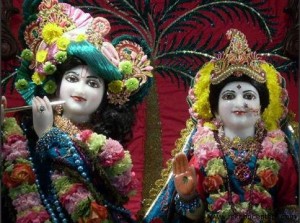
Srila Prabhupada

Sri Sri Rukmini-Dwarakadisha, Los Angles, USA.

   Srila A.C. Bhaktivedanta Swami pays his first visit to London (September 1st 1969) to see his disciples there, and resides at 'Beatle' John Lennon's country estate at Tittenhurst, near Reading.

   In December (14th) 1969, he conduct the Grand Opening and 'Avahan' Installation of Sri Sri Radha-Londoniswara at the Radha-Krishna Temple, 7, Bury Place, Holborne, London, just around the corner from the British Museum. 

   On 28th July 1970., Srila Prabhupada forms the Governing Body Commission (G.B.C.) as originally requested by Srila Bhaktisiddhanta Saraswati Thakur for his disciples to do.

   The very next day (29th July) he establishes the Bhaktivedanta Book Trust (BBT). A book trust specifically for publishing the works of His divine Grace. Highly respected by scholars for their authority, depth, and clarity, the books are now used as standard text books in numerous college, and University courses.

   As a publishing enterprise it has to date published, and distributed world-wide more books in number, unequalled by anyone book publishing house. (In some ISKCON literature 1972 is the date given as the foundation of the BBT.)

   August 29th 1970, marks the instituting of the 'Life Membership Program' in Calcutta. Later that fall, he performs a series of preaching tours with his American and European disciples.

   May 1971, Srila Prabhupada signs a contract with MacMillan Book Publishing Company to print the unabridged edition of 'Bhagavad Gita As It Is'.

   1971 (May) marks the acquiring of five acres of land in Sridham Mayapura, near the birthplace of Lord Chaitanya, Nadia, West Bengal. This will further one of the purposes of the society.
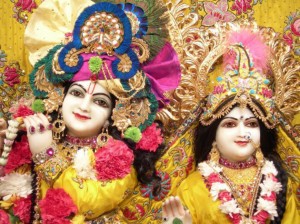
Srila Prabhupada

Sri Sri Radha-Londoniswara, London, UK.

   Sometimes some of Srila Prabhupada's godbrothers would try to criticise him saying that they had noticed that when he came to Mayapura that he didn't stop his vehicle at the Gaudiya Math get down and pay obeisances as the others did at the 'samadhi' tomb of Srila Bhaktisiddhanta Saraswati Thakura. Srila Prabhupada stated that it was not that he saw his spiritual master only in that place, he said that never was there a second of any day that he felt the absence of his spiritual master. He always felt the presence of Srila Bhaktisiddhanta because actually he was always in his association.

   We can truly see that Srila Prabhupada followed in the mood of the great predecessor acaryas like Sripad Madhwacarya, Sripad Vyasa Tirtha and the Goswamis of Vrindavana, for he was never simply attached to the worldly system of 'varna' and 'ashrama', or materialistic etiquette and its' dogma. But rather knew how to please Lord Krishna, and subsequently all others, by adapting whatever situation occurred into a favourable one for serving Him.

   Anyone could see, he was a great 'Vaishnava brahmin' of the highest character, but when necessity called for it he did not hesitate to involve himself in day to day management to ensure that his preaching mission, his life's mission to fulfil the order of his 'Guru Maharaja', went on, which ordinarily someone who was thinking himself to be a 'sannyasi' or a big big 'guru' doesn't seem to do. In fact on numerous occasions he said that he would do anything to assist in the preaching mission of his 'guru maharaj'. One such instant that come to mind was with a 'sankirtan' book distributor who required something on a shelf, and asked Srila Prabhupad if he could stand on his bed to reach it. The Devotee was immediately told that for preaching you can stand on my head.

   On an arrival address Srila Prabhupada spoke about the caste system in India. He defined the four social castes, and then especially glorified the 'brahmins'. Thinking they had found a loop-hole in his spotless character, a reporter poised a subtle challenging question. "So what caste are you?" The humble reply, "I'm a fifth class, servant of the other four!", startled everyone there.

   From time to time fundamental, fanatical and other poorly informed groups; deprogrammers etc., published books in which they found fault with Srila Prabhupada's fledgling and 'newly converted' disciples, yet none to my knowledge were so brave, or so foolish as to find fault with him, the pure surrendered Devotee of the Lord.

   Now we are seeing the fruits of Srila Prabhupada's selfless surrender, but according to some, one in the renounced order of life should not cross a small ocean. And if one is thinking himself as a material designation such as a 'sannyasi', then as Sripad Rajendra Tirtha inferred to Jayadharma Tirtha (Vijayadhvaj Tirtha), surely it is better that one doesn't go anywhere least he become contaminated, but for pure Vaishnavas there is a higher principle. H.H. Sri Bannajee Govindacharya gives his support to such selfless preaching to further the 'dharma'.

   However, June 1971, saw Srila Prabhupad visiting Moscow the seat of communistic atheism, and plants the seed of Krishna consciousness there, by which we see today, the fruits of many Temples, and tens of thousands of Devotees have emerged.

   In 1972 Srila Prabhupada began the Vedic system of primary and secondary education in the West by founding the ' Bhaktivedanta Swami gurukula' school in Dallas, Texas. Since then many more have been developed around the world.

   In March 1972 he performs the consecration, and cornerstone laying ceremony ('Deva Grharambha') at Hare Krishna Land his newly established and threatened project in Juhu, Bombay.

   Just after this still in March 1972, he aquires land in Raman Reti, Sri Vrindavan Dham, and conducts the cornerstone laying ceremony there also.

   Following a vigorous 12 year preaching tour which took him fourteen times around the world, and to six continents. Yet his 'sadhana' of taking rest early, and rising at midnight to write through the night afforded his prolific quality literary output.

   At the Rathyatra in London July 1973, even at a very advanced age of 77-78 he dances ecstatically the full length of the procession course from Hyde Park Corner to Trafalgar Square, for at least an hour and a distance of about 3-4 kilometres (around 2 miles).

   Srila Prabhupada was so ecstatic that even the Devotees who were seated on Lord Jagannath's cart, Revatinandan Maharaj leading wonderful kirtans, they were told to come down off the cart and join the fun. They did, and by the time the Rathyatra reached Picadilly Circus Srila Prabhupada was dancing and jumping, clean off the ground.

   On November 10th 1974, Srila Prabhupada completes his mammoth commentary on Sri Chaitanya Charitamrta with elaborate translations and purports.

   April 20th 1975, he organises to bring local 'brahmin' priests to accompany his ecstatically jubilant disciples as functionary priests under his instruction to perform the 'Avahan' and Grand Opening of the newly completed Sri Sri Krishna-Balaram Mandir, in Vrindavan.

   On April 20th 1975 Srila Prabhupad meets with Prime Minister of India, Indira Gandhi.

   1975, also marks a great scientific achievement for Srila Prabhupad. He founds the 'Bhaktivedanta Institute', the scientific branch of ISKCON headed by a group of his disciples from the scientific community, now dedicated to Srila Prabhupada's mission of proving that 'Life Comes From Life'. Thus smashing former atheistic, rationalistic, Darwinistic theories of 'Material Evolution'.

   "One time in Mayapura, we had just completed that four-storey building, and Srila Prabhupada was very happy to be there. Of course he had a place to sit, so now we could lay down.

   He was taking 'prasad'. There was a big feast that day for the opening of the Temple, and  [after] he was taking, and he heard all this noise in the back. He got up and looked out of the [window in the] back. He called all the G.B.C.'s immediately come, call Bhavananda, Jayapataka everyone (everyone laughs). Also, he used to call, all of a sudden. 'Call everyone!' so everyone was called, they all run! and there he was looking, and there in the back, there was a ditch about 50 feet from the wall of the Temple where all the leaf plates from the feast had been thrown. And there, there was about 15 local children, who were fighting off the dogs and taking the plates. You know, how Devotees, they get a little piece of uncooked 'puri', and throw it back on the plate, or there's a little bit of chutney juice! Anyway the children were taking the plates and licking them, and taking the little half 'puris', and whatever they could get and eating that. And Srila Prabhupada was looking, 'Just  look at how they are eating this, they must be so hungry. They must be so hungry! We must feed them!'

   "Then Srila Prabhupada started crying and said, 'This is Krishna's house, Krishna is the father of everyone, if you want to make 'real Temple' then you must make arrangement anyone within a 10 kilometre circumference, that they near go hungry. Then this is Krishna's house – in the presence of the father the child will never go hungry. Immediately make arrangements to distribute 'prasadam'. ' And that's the beginning of ISKCON Food Relief (the fore-runner of 'Food For Life'). "(Jayapataka dasa Goswami. 29th August 1979. Bhaktivedanta Manor, London.) 
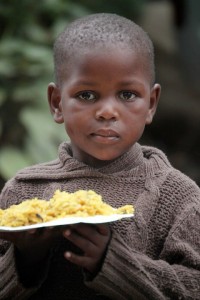
Srila Prabhupada

'This is Krishna's house, Krishna is the father of everyone, if you want to make 'real Temple' then you must make arrangement anyone within a 10 kilometre circumference, that they near go hungry. Then this is Krishna's house - in the presence of the father the child will never go hungry. Immediately make arrangements to distribute 'prasadam'.

   Srila Prabhupada's mission was so necessary. I, for one, would not be here writing this if it were not for his compassion for the fallen conditioned souls, such as myself, who somehow, or another had fallen into this material pool, and were suffering like anything there. This is not some esoteric poetry or exaggerated 'arthavadic' statement on my part, I mean suffering LIKE ANYTHING.

   Srila Prabhupada, by his mercy and on the order of his spiritual master Srila Bhaktisiddhanta Saraswati Thakura, came to smash the philosophies of impersonalism and voidism. Not only are pure Vaishnavas crossing a small watery ocean like a calf's hoof-print, but are successfully crossing the ocean of birth and death, and enabling many thousands of souls in this world to do the same. On the order of 'guru' and Krishna, "..therefore, the Madhwa Sampradaya is successfully spreading all over the universe" (A.C. Bhaktivedanta Swami Prabhupada in his purport to the verse Srimad Bhagavatam 1:9:7.  page 75.)

   Like all of the predecessor 'Acaryas' we need to remember, relish and give thanks to such a devoted and pure soul as Srila Prabhupada.

   To enable this mission to be established Prabhupada nearly sacrificed his very life on the journey across the treacherous Atlantic Ocean that remitted two heart attacks, but this humble pure devotee's love for the Lord changed everything. The Lord even appeared in a dream to Srila Prabhupada, in a boat full with many incarnations, saying they would protect their lonely ambassador. The captain of the Jaladuta (the ship on which Prabhupada left India) said that it was the smoothest voyage he had ever had, and asked Prabhupada to come with him on the return to guarantee another smooth Atlantic voyage.

   To capture the mood of Srila Prabhupada we have included the English translation of the Bengali prayer that he wrote on his arrival at Commonwealth Pier on September 17th 1965, Boston, U.S.A.

   One should try to picture the scene, looking at the seat of western materialism where he had come to fulfil the order of his spiritual master. The intensity of standing on the battle field overlooking the armies assembled, or ready to embark upon one's allotted "sankirtan spot" ('prabhu datta desha') prepared with intent, meditative, observant, dependant, and where to start? Srila Prabhupada, on board the ship Jaladuta, carrying within his heart the order of his spiritual master to spread the teachings of Sri Caitanya, the wisdom of the 'Acaryas', beyond the borders of India throughout the entire world, oversaw his purpose. As he looked out upon Bostons' bleak and dirty skyline he could understand the difficulty of this sacred mission for these Godless people. Thus, with perfect humility, he composed this historic prayer, praying for the deliverance of all the fallen souls.

   1. " My dear Lord Krishna, You are so kind upon this useless soul, but I do not know why You have brought me here. Now you can do whatever you like with me.

   2.  But I guess You have some business here, otherwise why would You bring me to this terrible place?

   3. Most of the population here is covered by the material modes of ignorance and passion. Absorbed in material life, they think themselves very happy and satisfied and therefore they have no taste for the transcendental message of Vasudeva. I do not know how they will be able to understand it.

   4.  But I know Your causeless mercy can make everything possible because You are the most expert mystic.

   5.  How will they understand the mellows of devotional service? O Lord, I am simply praying for Your mercy so that I will be able to convince them about Your message.

   6.  All living entities have come under the control of the illusory energy by Your will, and therefore, if you like, by Your will they can also be released from the clutches of illusion. 

   7.  I wish that You may deliver them. Therefore, if You so desire their deliverance, then only will they be able to understand Your message.

   8. The words of the Srimad Bhagavatam are Your incarnation, and if a sober person repeatedly receives it with submissive aural reception, then he will be able to understand Your message.

   9.  It is said in the Srimad Bhagavatam (1:2:17-21.): "Sri Krsna, the Personality of Godhead, who is the Paramatma (Supersoul) in everyone's heart and the benefactor of the truthful devotee, cleanses desire for material enjoyment from the heart of the devotee who relishes His messages, which are in themselves virtuous when properly heard and chanted. By regularly hearing the Bhagavatam and rendering service unto the pure devotee, all that is troublesome to the heart is practically destroyed to nil and loving service unto the glorious Lord, Who is praised with transcendental songs, is established in the heart, the modes of passion ('raja') and ignorance ('tamas') and lust and desire ('kama') disappear from the heart. Then the devotee is established in goodness and he becomes happy. Thus established in the mode of goodness, the man rejuvenated by loving service to the Lord gains liberation from material association ('mukti') and comes to know scientifically of the Personality of Godhead. Thus the knots of the heart and all misgivings are cut to pieces. The chain of fruitive actions ('karma') is terminated when one sees the Self as master."
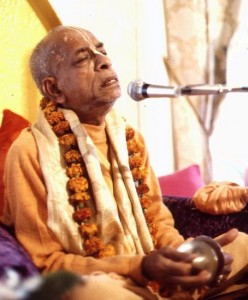
Srila Prabhupada

How will they understand the mellows of devotional service? O Lord, I am simply praying for Your mercy so that I will be able to convince them about Your message.

   10.  He will become liberated from the influence of the modes of ignorance and passion and thus all inauspicious things accumulated in the core of the heart will disappear.

   11.  How will I make them understand this message of Krishna consciousness? I am very unfortunate, unqualified, and the most fallen. Therefore I am seeking Your benediction so that I can convince them, for I am powerless to do so on my own.

   12.  Somehow of other, O Lord, You have brought me here to speak about You. Now, My Lord, it is up to You to make me a success or failure as You like.

   13.  O spiritual master of all the world! I can simply repeat Your message, so if you like You can make my power of speaking suitable for their understanding.

   14.  Only by Your causeless mercy will my words become pure. I am sure that when this transcendental message penetrates their hearts they will certainly feel gladdened and thus become liberated from all unhappy conditions of life.

   15.  O Lord, I am just like a puppet in Your hands. So if You have brought me here to dance, then make me dance, make me dance, O Lord make me dance as You like.

   16.  I have no devotion, nor do I have any knowledge, but I have strong faith in the Holy Name of Krsna. I have been designated as Bhaktivedanta, and now if You like You can fulfil the real purport of Bhaktivedanta.
(Signed – the most unfortunate, insignificant beggar A.C. Bhaktivedanta Swami, on board the ship Jaladuta, Commonwealth Pier, Boston, Massachusetts, U.S.A., 18 September 1965.) 
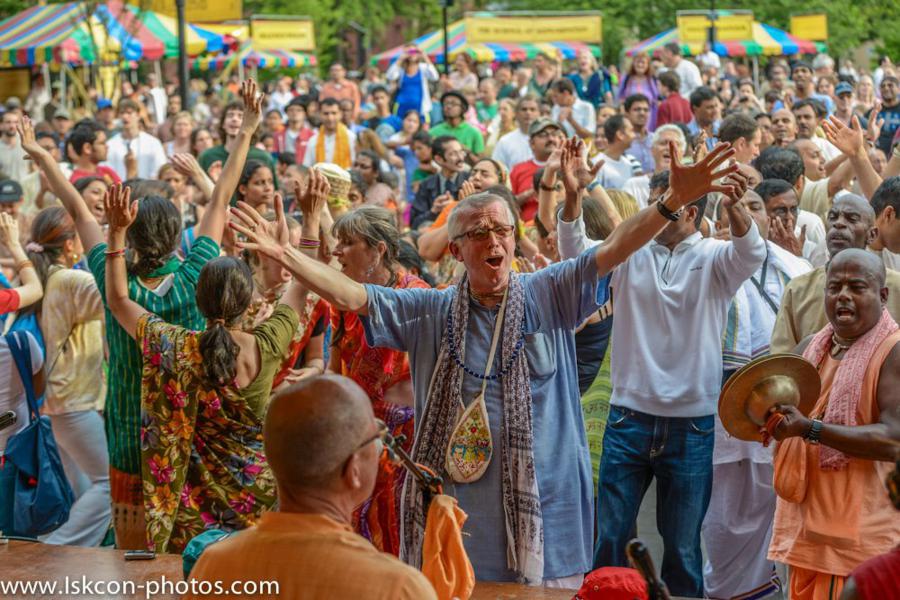
Srila Prabhupada

Only by Your causeless mercy will my words become pure. I am sure that when this transcendental message penetrates their hearts they will certainly feel gladdened and thus become liberated from all unhappy conditions of life.

   Arriving with only forty rupees in his pocket and a trunk full of Canto One of the Srimad Bhagavatam in three parts, Srila Prabhupada, the ambassador for the priceless truth of ancient India, the panacea, that makes lame men walk and blind men see, was about to embark on his mission that we have seen, has changed the face of the whole earth. Srila Prabhupada relied completely on Krishna, sitting down beneath a tree in Tomkins Square Park. The 'Yuga Dharma' was put to the test – "Just chant 'Hare Krishna' and your life will be sublime." Srila Prabhupada's faith in 'guru' and Krishna gave everyone who came in contact with his message the living purport to devotional life.

   On the Jaladuta ship in mid-Atlantic, suffering heart attacks, Srila Prabhupada composed the following prayers knowing how, by the order and desire of Lord Sri Chaitanya and Srila Bhaktisiddhanta Saraswati, everything would go on.

sri  siddhanta saraswati saci-suta priya ati
krsna-sevaya jara tula nai
sei se mohanta-guru jagater madhe uru
krsna bhakti dey thai thai
tara iccha balavan pascatyete than than
yoy jate gauranger nam
prthivite nagaradi asamudra nada nadi
sakalei loy krsna nam

   "Sri Srimad Bhaktisiddhanta Saraswati Thakura, who is very dear to Lord Gauranga, the son of mother Saci, is unparalleled in his service to the Supreme Lord Sri Krishna. He is that great saintly spiritual master who bestows intense devotion to Krishna at different places throughout the world. By his intense desire, the Holy Name of Gauranga will spread throughout all the countries of the western world. In all the cities, towns and villages on the earth, from all the oceans, seas, rivers and streams, everyone will chant the Holy Name of Krishna."

   Sitting on a park bench in New York City, Prabhupada, in conversation with an acquaintance said, "We have so many Temples, so many Devotees, so many books. There is just some time separating us." And it became a fact. By Srila Prabhupada's humility, fathomless faith and determination to satisfy guru, the parampara and Krishna, to save all the fallen souls suffering due to ignorance in this materialistic age of Kali, his years of intense study and writing had given Krishna a perfect instrument to work with.

   When success came, as was his visualisation, with so many Devotees, so many books and so many Temples, Srila Prabhupada remained all the time meek and humble.

   In a letter of 1968 Srila Prabhupada wrote: "Personally, I am a nonentity; I have come here on the order of my Spiritual Master, and He has kindly sent all you boys (and girls) to assist me. So whatever is being done, there is no credit for me, but all the credit goes to my spiritual master, because He has arranged everything, and I am simply to abide by His order." (A.C.Bhaktivedanta Swami Prabhupad. Letter, 68:10:34 Book Ref No.)

   Srila 'Prabhupada: 'The master at who's feet other masters sit, never ever utilised any facility for sense gratification. His purity and true renunciation was, and is, admired by all. Even sometimes persons would criticise Srila Prabhupada's followers due to our deep conditioning, not coming to the standard Srila Prabhupada had set, but still no honest man could criticise Srila Prabhupada. He is still cherished in the memories of millions for his perfect Vaishnava qualities, more tolerant than a tree, humbler than a blade of grass, and always offering respect to others. Even he would glorify his disciples for their helping him, though the disciples knew it was by Srila Prabhupada's mercy that they were even there. Kindling the smallest flames of devotion, the perfect 'hotri' set the entire world ablaze with Krishna Consciousness. 

   If any think they can do as, or better than he, I challenge you to do it. Talk is cheap, achievements take surrender, and if by the Lord's mercy you too are successful, then wonderful, we all benefit the more! Please only speak to glorify who is worthy.

   In just twelve short years he initiated many thousands of disciples, established Temples in every major city in the world, and travelled extensively twelve times around the world in as many years. He established the Bhaktivedanta Book Trust, which is now one of the biggest book publishing houses in the world which distributes transcendental literatures at a rate unparalleled. In every university, library, school, and many millions of houses there are now to be found the transcendental time bombs of Vedic wisdom – Bhagavad Gita As It Is, Sri Ishopanishad, Bhaktirasamrta Sindhu (Nectar of Devotion), Srimad Bhagavatam, Sri Caitanya Caritamrta, and hundreds of small books and booklets on spiritual life.

   All the great 'acaryas' made commentaries on the Vedanta Sutra, and our Srila Prabhupada also mentioned that he had this planned. Actually if one studies Srila Prabhupada's life and instructions on how to take up spiritual life, one will realise how the person "Bhagavata" and the scripture "Bhagavata" are non-different 'saksad dharitvena samasta sastraih'!

   Every word that Srila Prabhupada spoke came as a translation of a verse with crystallised realisations in the form of the Bhaktivedanta purports. If one reads the purports of the previous 'acaryas' which the faithful surrendered soul Srila A.C. Bhaktivedanta Swami echoed, one can see that he embellished the words of all the pure 'Vaishnava acaryas' in our line. What he actually did was virtually gave up his own ideas, and even speech patterns, to assimilate and simply deliver the word of the previous authorities, in a pure and presentable manner. He used his intelligence properly to present it. That to my understanding is real self surrender. This is why Krishna empowers such Devotees, for Srila Prabhupada had no other interest but to spread the pure teachings of the Brahma Madhwa Gaudiya Sampradaya to all who could take it. Every action that he made, every 'mudra', gesture told of the ageless culture coming down from the Lord. If you doubt this, study his life. Srila Prabhupada may not have formally written Vedanta Sutra, but his life was the living Bhakti-Vedanta-Sutra, and therefore must be accepted along with all the great 'Vaishnava acaryas' like Narada, Srila Vyasadeva, Acarya Madhwa, Sri Chaitanya, the Goswamis, Baladeva Vidyabhusana, Srila Bhaktivinoda and Srila Bhaktisiddhanta Saraswati Thakura. Earnestly studying the commentaries of the great 'acaryas', Srila Prabhupada preached their glories constantly.

   Srila Prabhupada states in his purport to Caitanya Caritamrta, Adi Lila (7:21.) that "All the codes of the Vedanta Sutra need not be examined here however, since we intend to present the Vedanta Sutra in a separate volume." I suggest, that He was that volume personified. Actually if one takes the time to read the purports of these verses of the 7th chapter of Adi Lila of Sri Caitanya Caritamrta, one will easily understand the purport to the stanza the person "Bhagavata" and the book "Bhagavata" are one and the same. Srila Prabhupada is a living example of the Vedanta Sutras. Sacrificing everything for the mission of the Lord, barely sleeping at night, he would stay up translating and writing his purports, then daily giving lectures, going on walks and having room discussions with his disciples and guests. Whatever way one looks at this, the conclusion must be that Srila Prabhupada is definitely the bona-fide representative of the Brahma-Madhwa-Gaudiya Sampradaya. As all the acaryas have left their commentary on Vedanta Sutra, all complimenting the original author, and the supporting commentaries by great acaryas like Madhwa, so Srila Prabhupada left his for us in the modern age, in the form of his life, the Bhakti-Vedanta Sutra.

   On his last journey around the world stopping at London's Bhaktivedanta Manor, I, for a very short time, had the great good fortune of being able to see His Divine Grace and have but a few "exchanges". At this time I accepted His Divine Grace as the Lord of my life, my spiritual master, not officially, but within my heart. This, no one can deny me. Thus Srila Prabhupada has changed my life, and feeling so indebted, I humbly dedicate this book to His Divine Grace, in his centennial year (1896-1996), and who is an epitaph of the "Legacy of Sripad Ananda Tirtha, Madhwacarya, Bhagavatpad", – Srila A.C. Bhaktivedanta Swami Prabhupada, for if it had not been for him, I have no idea of where I would be now, or my future. Nor would you be reading this book!

   At this time his physical health had been poor for a while now, and virtually his body had ceased to work. In London when he came in August, we were all so excited to see him. And after delays at the airport, which gave way to prolonged ecstatic 'kirtan' by Devotees from all over Europe (England, Ireland, Scotland, Germany, Holland, etc.) up to the point when his car came through the "Manor Gates" and up to the reception room door. But we were shocked at his emaciated appearance, it was heart rending. Yet, his eyes, sparkling behind tinted glasses told of a different situation. They were penetrating, warm and smiling, reaching out and touching the very core of each of us.

   Watching his devotion to Sri Sri Radha Gokulananda was touchingly memorable, and his 'traditional' visit to Radha Londonishwara via Radha-Bankabihari's (an old friend from Vrindavan's Deity, who lives in London) even in such a condition and Janmastami and Vyasa-puja there at the Manor.

   A few months after his visit to London, after giving up eating, sleeping etc., only subsisting on the Deity's 'caranamrta', he now returned to his beloved home, Vrindavana.

   The concerned Devotees consulted astrologers on Srila Prabhupada's request with a view to gaining insight as to when this condition would pass. Everything indicated that this could be the time of Srila Prabhupada's disappearance. Although some said that if he were to survive this difficult time for his body, he would carry it on for a few more years. One astrologer suggested, 'maha-mrtyum jaya-japa' and 'havan', to which Srila Prabhupada responded, "So this 'japa', 'maha-mantra japa' and 'bhagavat-path', that I am doing". 'Srimad Bhagavatam-patha'. So either read 'bhagavat' or chant 'Hare Krishna', and let me lie down like this, that's all, as it is going on. Huh? (A.C.Bhaktivedanta Swami Prabhupada. October 14th 1977. Room Conversation.)

   In his humility Srila Prabhupada requested many of his godbrothers to come, and those who could not come, he sent telegrams asking for their forgiveness of any offences that he may have committed while trying to push on, and fulfil the preaching mission of Srila Bhaktisiddhanta Saraswati Thakur Prabhupada. Humbly Srila Prabhupada requested like this, and the loving Devotees surrounding his bedside, carried out his every wish. Many godbrothers came, sharing treasured moments together, knowing Srila Prabhupada's nature, and heart's desire, and intent – there was no question of any offence being taken. 

   As a complete philosophy, a full and rich culture, a way of life, and a way to death, and beyond, the 'acaryas' like Srila Prabhupad have left a wealth of practical guidance, up to the last that we can take advantage of to help us advance.

   Some things as eternal truths, some to be applied according to 'time, place and circumstance'. Nothing was left untouched, no mysteries, or controversies. The chaste 'Prabhupadanuga' followers recognise this, look for what he has left, and resolve, and push on his movement, as he did himself.

   One dear friend of Srila Prabhupada’s came to see him, Niskinchina Krishna dasa babaji maharaj:
   Krishna dasa Babaji: It is wonderful that he is speaking so nicely, with full sense.
   Bhakti-caru: He's saying that it's wonderful that you are in full consciousness.
   Prabhupada: He doesn't expect this consciousness in this condition. Therefore he is astonished. Actually, physically–finished, everything. So wherefrom the voice coming and wherefrom intelligence coming? That he is astonished…
(Venue: Srila Prabhupada's house, Sri Krishna Balarama Mandir, Vrindavana. Date: 3rd November 1977 [11 days before Srila Prabhupada departed] SRILA PRABHUPADA KI JAYA! )

   Srila Prabhupad residing in the holy Dham of Sri Vrindavan, on Monday November 14th, 1977, at 7:30 pm, which fell upon the Caturthi of the Gaura (Sukla) Paksa, Mula nakshatra, gave up this mortal frame surrounded by loving disciples engaged in 'Harinam-sankirtan', the congregational chanting of the Holy Name.
   Translating Srimad Bhagavatam up until the very last breath, in a peaceful condition, and with the Holy Name on his tongue, Srila Prabhupada passed from this world in Sri Vrindavana Dhama to rejoin his worshipful Lords Sri Sri Nitai Gaura, Sri Sri Krishna Balarama, and Sri Sri Radhe Shyamasundara in Their eternal abode.

"He reason ill who tells that Vaisnavas die
When thou art living still in sound!
The Vaisnavas die to live, and living try
To spread the Holy Name around !"

   (Poem by Srila Bhaktivinoda Thakura)

   In many ISKCON centres where Srila Prabhupada visited, and had his office, 'darshan' rooms and quarters, there are now museums holding many of his personally used artefacts, dedicated to his loving memory. In Mayapura, West Bengal a fine structure has been built in memorial to him, his 'Pushpa samadhi'. In the ISKCON Sri Sri Krishna Balaram Mandir on Bhaktivedanta Swami Marg, in Raman Reti, an area of Vrindavana no longer on the out-skirts, one will find his 'Samadhi Mandir' (his ' Brindavan') where one can come and pay homage to His Divine Grace. There too one can visit his personal quarters. 
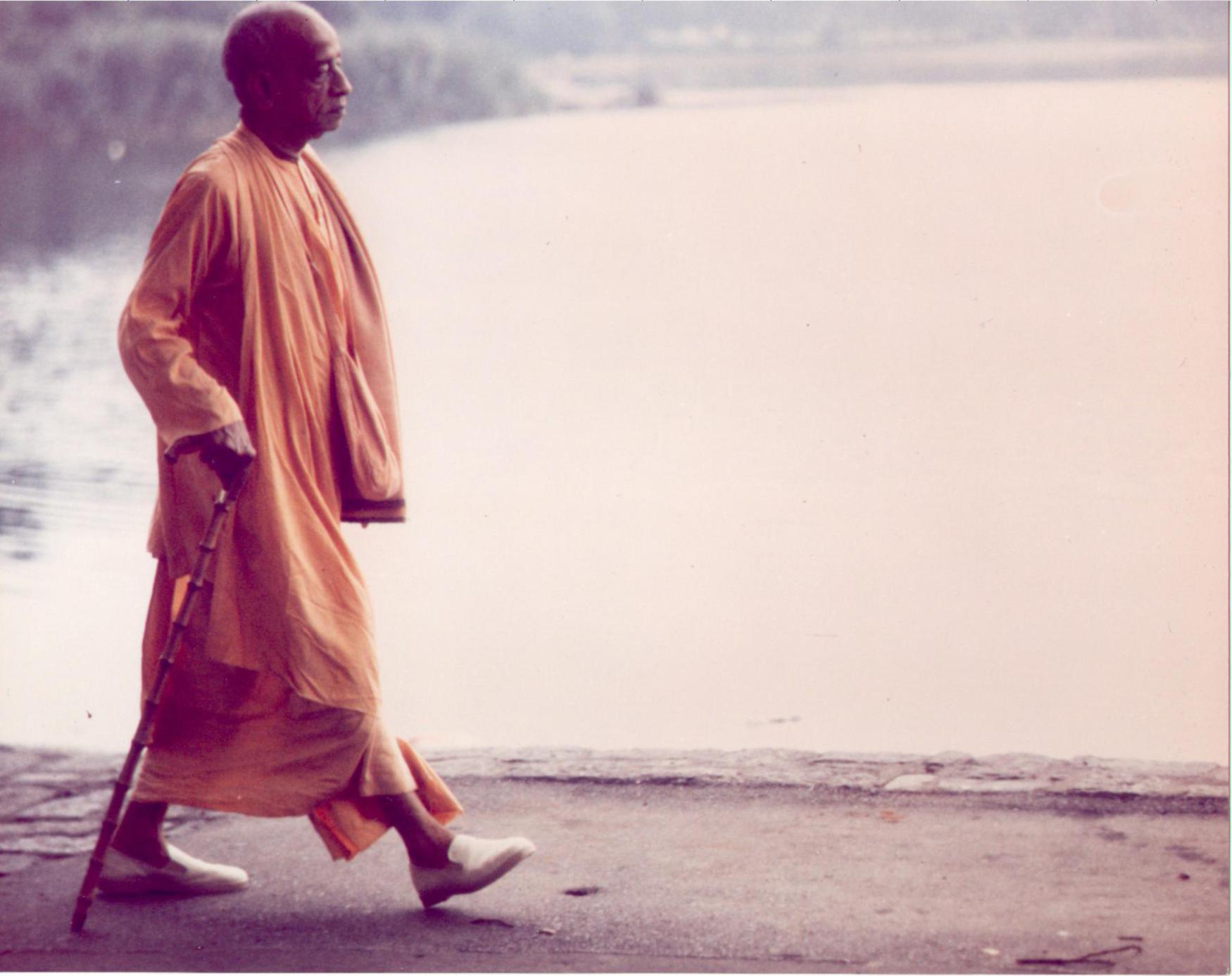
Srila Prabhupada

"He reason ill who tells that Vaisnavas die When thou art living still in sound! The Vaisnavas die to live, and living try To spread the Holy Name around!"
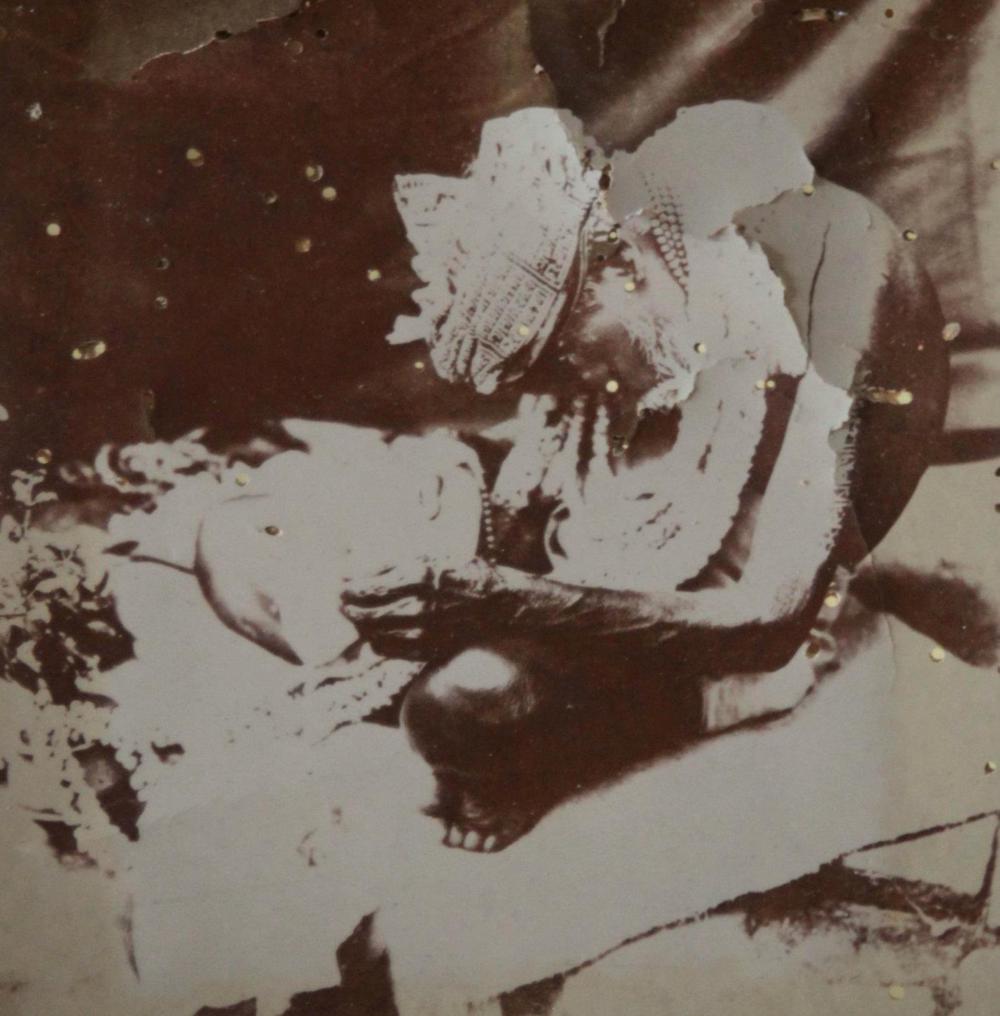
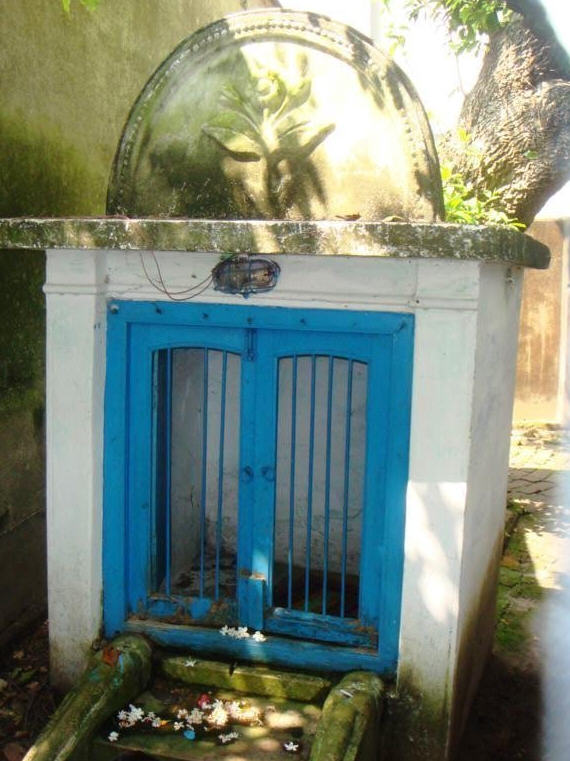
Bhaktisiddhanta Saraswati Dissappearance Day Lecture By Srila Prabhupada

Srila Bhaktisiddhanta Saraswati Prabhupada was known as 'simha' (lion) 'guru' due to his fearless and ferocious preaching. If an impersonalist saw him on the street, the impersonalist would cross the road in fear, or turn off onto another street. Those who didn't, Srila Bhaktisiddhanta would go up to and shake them violently, his huge body towering over them, and say, "Why do you say the Lord has no form? Nonsense offender!"

We have already mentioned his birth and some of his early pastimes in conection with his father Srila Bhaktivindoda Thakura, and his 'Guru' Srila Gaura Kishora dasa Babaji Maharaja.

He appeared on February 6th 1874.  Father was deputy magistrate of Puri, had been for three years. Srila Bhaktivinode Thakur had been concerned that the pure teachings of Sri Chaitanya Mahaprabhu would be usurped by unauthorized persons, who were members of 13 apasampradayas and so he prayed for a Ray of Vishnu. Srila Bhaktivinode Thakura had started his mission for Lord Caitanya late in life. He was also very busy with his profession.  But he wrote profusely, and wanted someone to preach boldly to establish these pure teachings.

The Padma Purana predicted Srila Bhaktisiddhanta Saraswati: a very elevated, pure and learned personality would appear in Purushottama-ksetra to spread the glories of Lord Jagannatha all over the world.  His activities would be very unique.

When he was 6 months old, the Rathayatra was held. The cart stopped in front of Srila Bhaktivinoda's house (which was on the main road between the temple and the Gundica mandira.  The cart stayed there for 3 days.  On the 3rd day, Bhagavati devi (mother of Srila Bhaktisiddhanta Saraswati) brought out the child and the 'pujaris' picked him up and put him on the cart. He crawled to the base of Lord Jagannatha, and touched His lotus feet.  Simultaneously a garland fell from the neck of the Lord and landed around the child. The pujaris exclaimed that this boy is particularly blessed by Lord Jagganatha.

The 'Annaprasha' festival (first grains ceremony), first grain taken by children which is usually given when the first sign of teeth are there something like six-months old, so for Srila Bhaktisiddhanta Saraswati the first grain was Jagannatha Prasada. Vimala devi is offered the 'prasada' after Jagannatha takes; hence his name Bimala Prasada. When during the 'Anna-prasna' ceremony the child is shown the 'shastra' and coins to give some indication as to his nature by what he goes for baby Bimal chose the Srimad Bhagavatam as opposed to the gold coins.

When he was five family had become senior deputy magistrate: only three of these in all of India under British Raja. Mango incident happened at this time. Never again took ripe mangos. But he took green mango chutney offered by his disciples; this was a favourite of his.

When Srila Bhaktisiddhanta Saraswati was 7 years old, his father Srila Bhaktivinoda Thakura moved to Calcutta, to the "Bhakti-Bhavan" house was building. While digging foundation they found Deity of Lord Kurma. Srila Bhaktivinoda Thakura gave him his first initiation and the name Siddhanta Saraswati; and initiated his son into the worship of Lord Kurma. He was doing this every single day without missing. Even when he was admitted into school.

He was a very expert student. However his preference was to study the Vaishnava books of his father. He did just that and studied books of Srila Bhaktivinoda Thakura, but never fell behind in school – he remembered everything after hearing it once. His teachers were astonished, and his father was very pleased.

As a boy, Bimala Prasada delivered his oldest brother Acyutananda from an offense he'd made in his last life. Acyutananda had a nervous disease, and once became very sick.  Bimala Prasada took 'karatals' and chanted the 'Hare Krishna mantra' constantly for 6 days without eating. Then Ramanuja-sampradaya 'tilaka' appeared on Acyutananda's forehead.  He said, "I am a Ramanuja Vaishnava. I committed an offense to a Gaudiya Vaishnava in my last life and therefore had to take this birth. Now I am relieved." Then he left his body for dead.

In 1892, after passing his entrance examination, Bimala was admitted into the Sanskrit College of Calcutta. There he spent considerable time in the library studying various books on philosophy. He also studied the Vedas under the guidance of Prithvidhara Sharma. As a student he contributed many thoughtful articles to various religious journals.  However he did not continue with his college studies for long.

We told this story before, but from another angle; Srila Bhaktivinoda Thakura had taken initiation from Bipin Bihari Goswami, who came in the line of Gadadhara Pandit, through Janavi Devi. However once when Bipin Bihari Goswami was visiting Srila Bhaktivinoda Thakura, the Thakura paid obeisances and Bipin Bihari Goswami placed his foot on Srila Bhaktivinoda Thakura's head. Srila Bhaktisiddhanta Saraswati saw this and was surprised. He thought this was a dangerous thing for Bipin Bihari Goswami to do. When Srila Bhaktivinoda Thakura left the room, Srila Bhaktisiddhanta Saraswati Thakura asked him a question: "You are my father's 'guru'. But do you know who he is?" Bipin Bihari Goswami was taken aback at this 7-year-old's question. Srila Bhaktisiddhanta Saraswati continued, "My father is a 'nityasiddha', an eternal associate of the Supreme Lord.  Do you have sufficient spiritual potency to place your foot on his head?" Srila Bhaktivinoda Thakura returned at this time, so the conversation was interrupted. Bipin Bihari Goswami said, "Your son is bold to the point of being rude." Later on, Srila Bhaktivinoda Thakura found this out and used to tell this story to his disciples.

Srila Bhaktivinoda Thakura in krishna-lila is Kamalaman-manjari, and Srila Bhaktisiddhanta Saraswati is his eternal assistant, Nayana-manjari. At age 13 he started higher education.  Once Srila Bhaktivinoda Thakura returned from Puri with Tulasi and initiated his son into chanting Hare krishna Mahamantra and he also took 'Nrsingha mantra' initiation, 'ugram bhiram maha-vishnum'etc.

During this time he invented, and developed a shorthand script called 'Vikanta', so much was his genius.

Srila Bhaktivinoda Thakura, after seeing the wonderful vision of a golden 'mandira', began  begging door to door for funds to establish the Yoga Pitha. At 18, Srila (Bhakti) Siddhanta Saraswati entered Capital Sanskrit College affiliated with Calcutta University. Within a short time mastered the 6 limbs of Sanskrit studies: 'shiksha', 'jyotish', 'chanda', 'alankara', etc.

When Srila Bhaktisiddhanta Saraswati was 22 he left college to avoid taking householder life. He took up work under the king of Tripura. Tripura had been turned to a Vaishnava state by the king of Manipur, who was a disciple of Narottama dasa Thakur.

So Srila Bhaktisiddhant Saraswati became Raja Pandit there for 3 years. He retired with full pension, which Srila Bhaktisiddhanta Saraswati accepted for a few years and then voluntarily stopped.

Around this time he took initiation from Gaura Kishora dasa Babaji. Srila Gaura Kishora dasa Babaji had been a grain merchant before taking 'babaji'. He'd gone to Vrindavana and did 'bhajana' for a long time. Then he came to Navadwipa. By this time Srila Bhaktivinoda Thakura had retired and had built a 'bhajana kutir' in Navadwipa (Godruma). He gave Srimad Bhagavatam class there every day. Srila Gaura Kishora dasa Babaji used to come to these classes. Srila Bhaktivinoda told Srila Bhaktisiddhanta Saraswati to accept Srila Gaura Kishora as initiating 'guru'. Srila Bhaktisiddhanta Saraswati approached Gaura Kishora, asking "Please give me your mercy." Gaura Kishora answered, "Mercy is not mine to give.  It is the property of Lord Chaitanya Himself.  I'll ask Him, and if He agrees, I can give you."

Second time they met, Srila Bhaktisiddhanta Saraswati inquired, "Did you ask Him?" "No, I forgot." Third time same thing happened. Srila Bhaktisiddhanta Saraswati said, "You worship that great cheat, Krishna, Who is cheating everyone. And so you are also cheating me. But if you continue in this way, I will simply give up my life, because my life is useless without receiving you mercy." Then Gaura Kishora das Babaji gave initiation to Srila Bhaktisiddhanta Saraswati as Varshabhanavi-devi dasa. Then Srila Bhaktisiddhanta Saraswati gave up all other activities to chant 194 rounds daily for 7 years. He had a 'kutir' but did not spend the time to repair the roof; he just used an umbrella if it rained.

In 1897 he started an autonomous Catuspathi ('Sanskrit' school) wherefrom monthly journals entitled "Jyotirvid", "Vrihaspati", and many old treatises on astrology were published. In 1898, while teaching at Sarasvata Catuspathi, he studied Siddhanta Kaumudi under Prthvidhara Sarma, at Bhaktibhavana.  By the time he was twenty five he had become well versed in Sanskrit, mathematics, and astronomy, and he had established himself as the author and publisher of many magazine articles and one book, Suryasiddhanta, for which he received the epithet Siddhanta Sarasvati in recognition of his erudition.

In 1895 Sarasvati Goswami accepted service under the Tripura Royal Government as an editor for the biography entitled Rajaratnakara, the life histories of the royal line of the independent Tripura Kingdom. Later he was entrusted with the responsibility of educating the Yuvaraja Bahadur and Rajkumar Vrajendra Kisore, in Bengali and Sanskrit. After a short period of time, Siddhanta Saraswati took up the responsibilities for inspecting various ongoing activities in the royal palace for the state of Tripura. However, after finding enviousness, malice and corruption surfacing in every corner of his inspection, Siddhanta Saraswati very quickly developed an aversion to state affairs and gave notice of his intention to retire to Maharaja Radhakisore Manikya Bahadur. The Maharaja approved of Siddhanta Sarasvati's plans for renunciation and awarded him full pay pension. However, after three years Siddhanta Sarasvati also renounced his pension. With his father, he visited many Tirthas and heard discourses from the learned pandits.  In October 1898 Siddhanta Sarasvati accompanied Bhaktivinoda on a pilgrimage of Kasi, Prayag, Gaya and other holy places. At Kasi a discussion was held with Ramamisra Shastri regarding the Ramanuja Sampradaya. After this talk Siddhanta Sarasvati's life seemed to take a turn, his inclination towards renunciation increased, and he quietly continued to search for a 'sadguru'.

When Siddhanta Sarasvati was twenty six his father, understanding the mind of his son, guided him to take initiation from a renounced Vaisnava saint, Gaura Kishora dasa Babaji, who we will now bring into the picture. actually it is inpossible to separate these three especially, anyway we will do our best to shed some light on their all effulent forms. Although it is like shining a candle to illumine the Sun globe.

One discipline of Srila Bhaktivinoda Thakura who wanted to continue the mission came looking for Srila Bhaktisiddhanta Saraswati in Navadwipa at this time, knowing him to be as powerful a personality as his father.  He went around asking the locals if they knew of a sadhu matching Srila Bhaktisiddhanta Saraswati's desciption, but they all answered, "We don't know of a sadhu, we only know of one madman. We see him moving here and there, crying aloud and sometimes rolling on the ground." So he went searching for him in the jungle next to the Ganga, where they said he sometimes could be seen. Suddenly he heard Srila Bhaktisiddhanta Saraswati crying "Krishna Krishna Haribol! Nitai Gaura Hari Bol!"  He saw him burst out from the forest and plunge, fully dressed, into the Ganga. He kept on shouting in the water, splashing about. Then he came out. The disciple of Srila Bhaktivinoda Thakura then approached him, requesting him to come to Calcutta to head up the sankirtana mission there. Srila Bhaktisiddhanta Saraswati answered, "Sankirtana? Can you not see the wonderful 'sankirtana' mission of Sri Caitanya right here in the holy 'dham' of Navadwipa? Is it not wonderful? Sri Pancha-tattwa are chanting and dancing in ecstacy, surrounded by all their associates. Can you not see this?" Then Srila Bhaktisiddhanta Saraswati ran off, again shouting "Haribol" in great ecstacy. As it was sunset by this time, that man took his bath in the Ganga, and mentally renounced the idea of organizing the 'sankirtana' mission.

But later on, in 1918, Srila Bhaktisiddhanta Saraswati appeared at his door in Calcutta, in 'sannyasi' robes with 'danda', freshly shaven, and ordered, "Now we are founding a Society, the Sri Gaudiya Matha. Draw up the papers immediately and have it registered. Though he'd arrived at 4 p.m., the work was done before that same afternoon was ended.

Even before 1918 he decried the 'Jatigosai'/'brahmana' monopoly of giving initiation only to born 'brahmins'. He preached very boldly against them. The 'brahmins' challenged him, "where does the 'Gaura mantra' appear in any authorized scripture as a Gayatri?" (Because the Gaudiya Vaishnavas would take this 'mantra' as a 'pancharatriki mantra' for 'brahminical' initiation.) They said, "Sri Chaitanya claimed only to be a devotee. Why do you say he is the Supreme Personality Of Godhead and use His name in place of authorized scriptural names and 'mantras'?"

Srila Bhaktisiddhanta Saraswati cited Chaitanyopanishad from the Atharva-veda, discoverd by Srila Bhaktivinode, 19 verses glorifying Lord Chaitanya. In another assembly he directly attacked the 'brahmins' and 'Jati Gosais'. He initiated the movement to take back the teachings of Lord Caitanya from the hands of such unauthorized persons. Srila Vishvanatha, Srila Baladeva Vidyabhusana, his disciple Uddhava dasa Babaji, his disciple Madhusudana dasa Babaji, were all saintly renounced souls: after Baladeva there was no-one to strongly represent the pure teaching of Lord Caitanya and preach them boldly. During Srila Bhaktivinoda Thakura's time, Gaudiya Vaishnava meant Baul, Aula, Sakhi-Beki, Jati Gosai, etc. who were all degraded. The Vaishnavas got no respect. At this time the shaktas became strong from Rama-Krishna-Vivekananda, and this put further obstructions for the establishment of pure Vaishnava dharma. Srila Bhaktisiddhanta Saraswati preached against all of this nonsense.

When Srila Gaura Kishora dasa Babaji Maharaj left the planet, the 'babajis' wanted to do the 'samadhi' rites. He'd said he wanted to have his body dragged through the streets by his "disciples".  The 'babajis' had gathered to do that, they'd tied a rope around the neck.

Srila Bhaktisiddhanta Saraswati crossed over to Navadwipa from Mayapura and stopped them, saying "None of you are his disciples." Babaji Maharaja had one disciple, that one was Srila Bhaktisiddhanta Saraswati, (in other records it says he only had two disciples, the other was Vamsivata dasa Babaji Maharaja, who was an 'avadhuta'). "I am the right claimant to perform these last rites." They said, "But he was a 'babaji', and you are not." Srila Bhaktisiddhanta Saraswati answered, "Gaura Kishora dasa Babaji does not come in 'babaji' line. He was initiated by Nimai Chand Goswami, who was a Nityananda Parivat, coming in the line of Lord Nityananda. He received his 'Vesha' ('babaji' dress) from Bhagavata dasa Babaji Maharaja, who is an initiated disciple of Jagannatha dasa Babaji."

Before Srila Bhaktisiddhanta Saraswati, from time of Lord Caitanya Mahaprabhu, param-bhakta Vaishnavas would get 'Vesha' (white knee length cloth, 'koupin', waterpot and bead-bag) initiation, not 'tridandi sannyasa'. "Bhaktivinode Thakur also took 'Vesha' from Jagannatha dasa Babaji. Srila Bhaktivinoda Thakura, though 'diksha' initiated of Bipin Bihari Goswami, received 'siksha' and 'vesha' from Jagannatha dasa Babaji. And Gaura Kishora dasa Babaji received 'siksha' from Srila Bhaktivinoda Thakura. Sri Caitanya Mahaprabhu's line is Bhagavata Parampara, not seminal line." So he challenged them to show that any such line came from Rupa or Sanatana Goswami. As to be a Rupanuga means coming in Bhagavata Sampradaya. Rupa told of Advaita's rejecting His own son Madhusudana because he accepted Lord Caitanya only, but not Lord Nityanananda.

"If you are Babajis, then you are fully sense controlled. So the one of you who has not engaged in any illicit activities in the past 1 year, come and do the last rites." No one stood up. "One month? One week? 24 hours?" No one stood up. Srila Bhaktisiddhanta Saraswati then placed Gaura Kishora dasa Babaji Magharaj's body in 'samadhi'. So after finishing with the 'smartas', 'jati gosais', he took on 'Babas'. He would take on and defeat anyone solely to establish pure unalloyed, undeviated krishna consciousness.

Then in 1918 he opened his first center in Ultadanga Road in Calcutta. He was then 44.  Kunjabihari Vidyabhusana (Bhakti Vilasa Tirtha Maharaja) was his main manager and a prominent devotee in the Matha. Srila Bhaktisiddhanta Saraswati had made a vow after taking 'sannyasa' that he would never touch money. Everything was arranged by his disciples. Many of them wishing to assist his mission took up responsible jobs, e.g. Kunja Babu became a post-master.

Srila Bhaktisiddhanta Saraswati did 'nagara kirtana' with disciples and was invited to programs by the King of Burdwan or the King of Kooch Bihar; everywhere he established Lord Caitanya's teachings as the most excellent spiritual philosophy.

He knew all Vaishnava philosophies most expertly. He brought out books on their 'darshans', e.g. Madhvacharya's arguments against Mayavadis.

As well as other Vaishnavacaryas like Ramanuja. In the temple he established in Mayapur he built 4 small temples in honor of the 4 Vaishnava sampradayas. He put the deities of the 4 founder acaryas there; Madhwacarya; Ramanujacarya; Nimbarkacarya; and Visnu Swami.

He started the Gaudiya Mission in the midst of war and national liberation agitation. He was uncompromising in his disregard of such mundane concerns. "The most important thing is to invoke the spirit of devotion to the Supreme Lord; this concern lies far above any material consideration." Many leaders objected, but he continued. In this period the aristocratic young Abhay Charan De (latter known as Srila A.C.Bhaktivedanta Swami Prabhupada) visited Srila Bhaktisiddhanta Saraswati on the rooftop at Ultadanga Road; At this time Abhay charan De was adherent of the national liberation movement, but Srila Bhaktisiddhanta Saraswati convinced him in one sitting of the vital necessity of Lord Caitanya's mission over everything else.

Srila Bhaktisiddhanta Saraswati's 'sannyasa': happened in 1918. He could have taken 'babaji' but didn't. Many 'babajis' wanted to initiate him, as he'd shown himself to be such a powerful exponent of Vaishnavism (e.g. his 3-day debate with caste 'brahmins' attended by Vaishnava scholars, in which he resoundingly defeated caste pretensions and established the Vaishnava view of 'brahminical' status by quality of work, not birth).

When he gave himself 'tridandi sannyasa' (or more correctly, had taken 'sannyasa' from a picture of Gaura Kishora dasa Babaji Maharaj), this was a shock to even his supporters, including disciples of Srila Bhaktivinoda Thakura. The controversy was not over the method of initiation in this instant as some criticise him for. But over 'varnashrama'; they thought he was returning to the 'Varnashram-dharma' that Lord Caitanya had rejected in his talks with Srila Ramananda Raya. But the concern was for nothing, as he was not continuing the bodily 'varna'-and-'ashram' system, but was establishing 'Daivi-varnashrama'.

Srila Prabhodananda, Lokanatha Goswami were great Gaudiya 'sannyassis' of the past. Prabhodananda Saraswati converted a great 'smriti acharya', Gopal Bhatta Ghosh, and gave him 'tridandi sannyasa'. Srila Gadadhara Pandita was also 'tridandi sannyasi'. Without establishment of 'Daivi-Varnashram-Dharma', 'babaji' (supposedly, or with the concept of  'paramhamsa' initiation) will, as it had become a farce.

In this way Srila Bhaktisiddhanta Saraswati travelled and preached initially from Mayapura to vrindavana and challenged the authority of the 'babajis', and others.Some ritualistic and narrow minded persons found fault, as one can even do with the moon in the sky. "They protested that this was unauthorized." He said, "Everything I am doing can be supported by scriptural reference, but nothing you do can be. You take young boys who don't even know how to clean themselves after passing stool and giving them 'sakhi rupa.' I am giving 'samskara' to reform the fallen souls, and this 'samskar' is the 'Hari Nama', which Lord Chaitanya gave as the 'siddha pranali'.  No rules of caste or creed bind this 'Harer Nama diksha."

Then they tried to say that Srila Bhaktisiddhanta Saraswati was not properly initiated in an established line. He disproved this. Srila Gaura Kishora dasa Babaji Maharaja was initiated in line of Nityananda, but he (Srila Bhaktisiddhanta Saraswati) did not accept that line. In fact Srila Bhaktisiddhanta Saraswati rejected that line from Nimai Jatgoswami (line of Nityananda, Jahnavi, Bir Chandra Prabhu. Rather Srila Bhaktisiddhanta Saraswati Thakura stressed Bhagavata Sampradaya, and didn't care for material or seminal lines.

Therefore in his pranams the term, 'Rupanuga virrudhapa siddhanta', 'any conclusion against the precepts of Rupa Goswami is to be rejected immediately' is to be found.

In his life he founded 64 Gaudiya Math temples throughout India. For his further preaching and attempts to spread krishna consciousness beyond the bounds of India, as his father had desired too, he sent three disciples to west, and he gave ten westerners initiation, mostly from young intelligent men from Germany and a couple of elderly women in St John's Wood in London, by sending sannyasis to Germany and England(Rupa Vilasa dasa. 1988. "Raya of Visnu".).

During this time Abhay Caran De (Srila A.C. Bhaktivedanta Swami Prabhupada) met Srila Bhaktisiddhanta Saraswati Prabhupada. He was a young man – a 'khadi' clad follower of Gandhi's national movement. Srila Bhaktisiddhanta Saraswati Prabhupada, seeing this bright faced young man before him, convinced him of a necessity to preach krishna consciousness. "In this world there is no shortage of anything, only krishna consciousness." Srila Bhaktisiddhanta also requested young Abhay Caran De, "You are an intelligent young man. If you ever get money, print books in the English language." Our Srila Prabhupada was so impressed that he took this as his life's mission. Some eleven years later he took diksa initiation from Srila Bhaktisiddhanta Saraswati Thakura, who told his other disciples who printed the Sajjana Tosani newspaper on his order, "Whatever Abhay Caran writes, print it."  He obviously knew his worth.

Srila Bhaktisiddhanta Saraswati Prabhupada was always eager to reveal transcendental knowledge. Whenever he found an eager listener he would go on speaking, not knowing bounds of time and space. Disregarding requests of his medical advisers, up to the last moment, he continued to deliver the message of the Supreme Lord to all people. This was his only purpose for his appearance in this world. All his tours were highly successful, though not without events because many of his disciples were not from orthodox 'Brahmin' families. Though they wore the sacred 'yajnopavitra', 'brahmin' thread of the twice-born, many so-called 'Brahmins' objected. Shops would refuse to sell their goods to Bhaktisiddhanta's 'brahmana' and 'sannyasi' disciples, even though according to the 'Pancaratrika' system of 'Vaisnava agamas', they were all properly initiated as 'brahmanas' and 'sannyasis'.

His whole life was spent in a mood of loving devotion to the Lord. He was fully devoted to spreading the teachings of Sri Caitanya Mahaprabhu. The numerous publications and commentaries on the works of the previous 'acaryas' establishing the Lord to be 'saccidananda vigraha' is quite evident of this fact.

In 1936, whilst residing in the holy dhama of Jagannatha Puri at the age of 62, he left this mortal world to again return to the loving pastimes of Sri Sri Radha krishna in Brajaloka the topmost planet in the spiritual sky.

Srila Bhaktisiddhanta Saraswati used to "install" the printing presses that were acquired by the Gaudiya Matha for literature publication.

He gave many a heavy class on detachment from material life. Later, while writing, he observed a monkey stealing bananas from the godown, which was just next to his study.  He ran out with a stick to chase the monkey away, overturning his writing table and spilling ink on the pages of his manuscript.  When the cook saw this, he inquired, "Today you told that one must be detached. How to understand your behaviour just now – for two bananas you jumped from your writing to chase a monkey, and even ruined your work in the process?"  Srila Bhaktisiddhanta Saraswati answered, "These bananas belong to Srimati Radharani, because they are to be used in Krishna's service."

He went to take a bath in a 'pukkur', and when he was seven steps above the surface of the water, the water rose seven steps and touched his lotus feet. Then all the 'brahmacaries' jumped in, to bath in the 'caranamrta'.

At the Yoga Pith temple was a cook who was very passionate. He fought with every devotee there except for Srila Bhaktisiddhanta himself. Then he died. After the funeral ceremony was completed, the Gaudiya Matha 'brahmacharies' were sitting together and talking about how much trouble they'd had with the cook – each was telling stories about the fights he'd had with him. Suddenly Srila Bhaktisiddhanta Saraswati appeared at the doorway and said, "He always washed his 'dhoti' nicely and was very clean." From then on nobody dared say anything negative about that cook. Although Srila Bhaktisiddhanta was renoun for his aggressive, and even 'chopping' attacks on the 'mayavadins' and other such offenders, he always showed true Vaishnava respect and appreciation for all of the devotees.

When one 'mayavadi sadhu' was preaching his oneness philosophy in the presence of Srila Bhaktisiddhanta Saraswati and his disciples while they were riding on a train from Calcutta to Puri, Srila Bhaktisiddhanta ordered his 'brahmacaries' to feed the 'sadhu' some rotten mangos which had been donated to his party earlier (they were ripe when donated, but got rotten because Srila Bhaktisiddhanta would not take them due to his vow, and therefore no disciple would take either). After being obliged to eat four mangos, that sadhu fell at Srila Bhaktisiddhanta's feet and swore he'd never preach the philosophy of exclusive undifferentiated oneness again.

His 'kirtana' procession (with him personally at the head) would stop all traffic wherever it went in Calcutta; in Puri even the brahmins accepted his 'nam-sankirtana' as fully authorized.

He stayed in Puri in his last days. He lectured for some days at the place known as "Goverdhana" in Puri, and before and after his talk he would recite prayers praising Goverdhana Hill and requesting shelter in some corner there. He would sometimes comment to his disciples, there's not much time left. They could see something was going to happen soon, but weren't sure what.

He got very sick ten days before he left his body. Two days later he wrote his last instruction: "Somehow we must become qualified to attain the shelter of Rupa and Raghunatha. Always chant Hare Krishna, always preach Krishna consciousness, and stay away from Vaishnava-aparadha.  In this way become qualified to get the shelter of the lotus feet of Sri Rupa and Raghunatha." Two days after that he wrote his letter to Srila Prabhupada (Abhaya Charan De).

All the big intellectuals of Calcutta had a memorial gathering upon hearning word of his death.  One (an atheist), in eulogy, said: "Who will we argue with now?"

The full life story of His Divine Grace Srila Bhaktisiddhanta Saraswati Goswami Maharaja Prabhupada can be found in one very nice book which is a compilation and summary study of many books of the time on the life of Srila Bhaktisiddhanta, and is entitled "A Ray of Visnu," as was prayed for by his father before his taking birth. This book is available through ISKCON, and was published by Rupa Vilasa prabhu, a disciple of Srila A.C. Bhaktivedanta Swami Prabhupada.

Srila Bhaktisiddhanta Saraswati's father, Srila Bhaktivinoda Thakura, had a vision one night on the other side of the River Jalanghi, opposite his house. In the open fields he saw a huge city made up of all Vaisnavas from all over the world. There would be Americans, Australians, Canadians, Africans, Chinese, Russian, English, every nation's devotees dancing together in transcendental kirtan and chanting "Jaya saci-nandana gaura hari." Astrologers predicted that a person of great saintly character, full in all Vaisnava qualities, who could build a house in which the whole world could live peacefully, would appear to set back the flow of Kali Yuga.

We have seen after the passing of Srila Bhaktisiddhanta Saraswati Thakura Prabhupada, the Gaudiya Math underwent some difficulties. Although Srila Bhaktisiddhanta Saraswati Thakura had requested his disciples to come together as a 'Governing Body' to push on the mission after his demise, a couple of prominant disciple instead took the helm against his wishes which changed some of the intrinsic foundation of the Gaudiya Matha at that time. In relation to 'siksha' (instuctions) having precedence over 'diksha' (initiation) as a means of proper succession there came a splintering of the Gaudiya Matha because of neglecting the 'gurus' instructions. Since this time major valuation set-backs have been observed (A.C.Bhaktivedanta Swami Prabhupada. Sri Caitanya Caritamrta Adi Lila Chapter 12 text 8., The Asara son's of Advaita Acarya!)

Following the instructions therefore provides a strength in continuity of the overall success and chastity of the followers in the line's mission or purpose. On examination we find some intrinsic differences in the rhythm, movement and systems tha eventuated after this point in time despite 'all being disciples'. In many instances the disputes have to date remained unresolved. 'The Gaudiya Matha and Its Missions', today has many lines and sub-lbranches coming from the disciples of Srila Bhaktisiddhanta Saraswati Thakura Prabhupada.

At this time (the end of the 1930's) the saintly figure emerged, who was to become notably one of the great 'acaryas' in Vaisnava history, although he remained in humble circumstances, preparing himself for the mission that would not only fulfil his spiritual master, Srila Bhaktisiddhanta Saraswati Thakura Prabhupada's order, but would fulfil the desire of all the great Vaisnavas in the Brahma-Madhwa-Gaudiya Sampradaya and gain the praise and amazement of other 'sampradayas', religionists and scholars alike. That person is Srila A.C. Bhaktivedanta Swami, known by his loving followers as Srila Prabhupada.

We are presently awaiting a wonderful book by H.H. Bhaktivikash Maharaj which he has researched for the last ten years by speaking to the last of Srila Bhaktisiddhanta Saraswatis' disciples who are remaining in their old age on the planet, on the life of Srila Bhaktisiddhanta Sarasvati Thakur Prabhupada.

Bhaktisiddhanta Saraswati Appearance Day Lecture By Srila Prabhupada On February 8, 1977

Pradyumna: The lecture is now, then we’ll have arati.
Prabhupada: So this is the one-hundred-third birth anniversary. You may remember? One-hundred-third this is? One-hundred-third anniversary?
Pradyumna: 1972, 1977 it is. One-hundred-fourth. One-hundred-fifth.
Hari-sauri: One-hundred-fifth.
Prabhupada: Anyway, this is the auspicious day of Srila Bhaktisiddhanta Sarasvati, one-hundred-fourth?
Pradyumna: (indistinct)
Prabhupada: One-hundred-third birth anniversary. So this is formal, one-hundred-third or, or, or second. It is eternal. It is eternal. Just like Sri Caitanya Mahaprabhu has described, nitya-lila. Nitya-lila means it is going on. Just like just now it is eleven o’clock. This eleven o’clock, and when it becomes twelve o’clock noon, it does not mean that eleven o’clock is passed. Eleven o’clock is existing somewhere. In India it is eleven o’clock, somewhere else it is ten o’clock, and when in India it will be twelve o’clock that eleven o’clock will be somewhere else. Therefore one, two, three, four, five, six, seven, eight, you take, that is going on. It is not that one is finished. That is material calculation. Material calculation, this body we have got. When this body will be finished it is finished forever. It will never come. Tatha dehantara-praptir. In the spiritual world there is no such thing as finished. Nitya-lila. Nitya-mukta. We have to understand that. In the material world, one minute’s lost, it is lost forever. Canakya Pandita has given us instruction from the material point of view,

ayushah kshana eko ’pi
na labhyah svarna-kotibhih
sacen nirarthakam nitah
ka ca hanis tato ’dhikah

Ayushah kshana eko ’pi. Suppose I shall live fifty years or hundred years maximum. So out of them, one moment lost, it will be never returned. From our birth, when a child is born we ask the parents when the child is born. The parents say, “This child was born in the morning, ten o’clock.” So if the child is born at ten o’clock and I am asking at eleven o’clock, the one hour life of the child lost. Eleven o’clock means child has already died one hour out of his one hundred years.

So for Vaishnava it is not like that. It is not like that. Na hanyate hanyamane sarire. This is material calculation: one hour lost, two hours lost, body’s life is transient , it is losing one moment, one hour. But spiritual life is different. Nityah sasvato yam, na hanyate hanyamane sarire. So, as Krishna comes, yada yada hi dharmasya glanir bhavati bharata tadatmanam srijamy aham. Krishna is eternal, but still, He appears. The same example. Just like the sun is in the sky but we see in the morning it appears; in the evening it retires. That is defectness of our eyes. Actually the sun is always there. So similarly Vaishnava, as Krishna comes, yada yada hi dharmasya glanir. Similarly, a Vaishnava means the confidential servant of Krishna, he also comes for some purpose by the order of the master. So their life and Krishna’s life, it is same. There is no question of past, present, future. Nityah. Nityah sasvato ’yam, na hanyate hanyamane sarire. So they are the same thing as the appearance and disappearance of sun. And Bhaktisiddhanta Sarasvati Thakura, our master, spiritual master, he also came in this world to execute some mission of life or mission of Caitanya Mahaprabhu. So he executed it, and when it was required, he left this place and went to another place to do the same business. Just like the sun rises at six o’clock and seven o’clock there is six o’clock in another place, and it is eight o’clock another place. It is going on. Nitya-lila.

So we have nothing to lament for disappearance. We should simply remember his activities. That is Vaishnava you cannot understand the activities of the Vaishnava, but they come, any Vaishnava comes, for some particular mission. Prahlada Maharaja,

naivodvije para duratyaya-vaitaranyas
tvad-virya-gayana-mahamrita-magna-cittah
soce tato vimukha-cetasa (indriyartha)
maya-sukhaya bharam udvahato vimudhan

Prahlada Maharaja said to Nrisimhadeva, “My Lord, I have nothing to grieve, because wherever I shall sit down, glorifying Your activities, I immediately become merged into the ocean of nectarine. So I have nothing to grieve. But one thing I am sorry, I am in grief for these vimudhas.” Vimudhan. Mudha means rascal, and vimudhai, particularly rascals. Every living being within this material world, they are mudhas because they are forgetting their relationship with Krishna. Mudho nabhijanati mam param avyayam. This is mudha. All living entities more or less, we are all mudhas, particularly vimudhan, because there are different types of living entities. Jalaja nava-lakshani sthavara laksha vimsati krimayo, species of life.

So the evolution is going on. When we come to this stage of human form of life, here is a chance to get out of this evolutionary process. This is the chance. Asatim, caturam caiva brahma jiva-jatesu. In the Padma Purana the evolutionary theory Not theory. It is fact. Darwin’s evolutionary theory it may be, but in the Vedic literature the evolutionary theory it is existing since very, very, millions of  It is not crazy fellow’s evolutionary theory. It is fact. So in this evolutionary theory, fact, we see that the, bahunam janmanam ante, bahunam sambhavan. After many, many evolution, millions of years, we get this chance of human being, to become human being. In this human form of life, if we still remain a mudha, then we are vimudhan. Vimudhan means, vi means visesha. Here is chance. And Krishna personally is giving his instruction to the human being. Sarva-dharman parityajya mam ekam saranam vraja. This is the chance. But still, we are not accepting. Therefore vimudhan. Mudha, the cats and dogs, they cannot understand. If we give instruction to the dog, “My dear dog, chant Hare Krishna ” But a human being, either he may be known to Krishna or not known to Krishna, he can be trained up. Just like in your country, in Europe and America, they did not know even what Krishna. But since we have started this movement, Krishna consciousness movement, you have become so many devotees of Krishna. That is possible because human being. They can be trained up. So in spite of all these facilities for the human being, if he’s not trained up to Krishna consciousness, then he is vimudha. He does not take the advantage. Na mam  This human form of life, he is classified as dushkritina, mudha, naradhama, mayayapahrita-jnanah. He’s described. He must be either of these categories. So things have degraded so low that India they’re asking what is God. This is Kali-yuga. In India, where Krishna comes personally, where Lord Ramacandra comes, where Lord Buddha comes, where Caitanya Mahaprabhu comes, in that country now young men are asking, “What is God?” This is Kali-yuga.
        
So we should not remain vimudha. We should become intelligent. And to make us intelligent, Krishna comes, Krishna’s devotees come, some messenger comes. And Srila Bhaktisiddhanta Sarasvati Thakura is one of the messengers of Krishna Caitanya Mahaprabhu to preach Krishna consciousness. And not only he preached, but he trained up many disciples to preach this Krishna consciousness all over the world. So by his grace we are also endeavoring to do something. This is called parampara system. So we should take advantage of this Vaishnava mission. As Caitanya  Prahlada Maharaja said, they are very anxious. Vaishnava means para-duhkha-duhkhi. Kripambudhir yas tam, aham prapadye. Para-duhkha-duhkhi. Vaishnava  Our Guru Maharaja Bhaktisiddhanta Sarasvati Thakura, he is Vaishnava, cent percent Vaishnava. And he was para-duhkha-duhkhi. This is Vaishnava. He criticized nirjana bhajana. He has personally written one song, mana tumi kisera vaishnava. Nirjanera ghare pratishthara tare, tava hari-nama kevala kaitava. Mana tumi kisera vaishnava. He has in long song  Pratishtha  Vaishnava means he doesn’t want any material profit or material opulence or material reputation. He doesn’t want. This is  But in the material world everyone is busy for three things material profit, material reputation, and material adoration. This is not Vaishnava’s business. Vaishnava never cares for all these things. Vaishnava is always thinking how to do good to the suffering humanity. Lokanam-hita-karinau. About Six Goswamis it is said, nana-sastra-vicaranaika-nipunau sad-dharma-samsthapakau lokanam hita-karinau tri-bhuvane manyau saranyakarau. This is Vaishnava. Nana-sastra-vicaranaika-nipunau. In the sastra everything is there. Just like Srila Rupa Goswami has given us Bhakti-rasamrita- sindhu to understand what is bhakti. We have tried to translate it into English, the Nectar of Devotion. So, why? Rupa Goswami was the minister in the government of Hussain Shah. Very opulent position. Tyaktva turnam asesha-mandala-pati-srenim sada tucchavat bhutva dina-ganesakau karunaya kaupina- kanthasritau. They resigned the high post of ministership and joined Sri Caitanya Mahaprabhu for pushing on and on this Krishna consciousness movement. Tyaktva turnam asesha- mandala-pati-srenim sada tucchavat bhutva dina-ganesakau karunaya kaupina-kanthasritau.

So Vaishnava means para-duhkha-duhkhi. They are simple thinking There are so many politicians and humanitarians and so many. But nobody knows how to do good to others. Nobody knows. They do not know. The real fact is, as Krishna explains Himself, that

asraddadhanah purusha
dharmasyasya parantapa
mam aprapya nivartante
mrityu-samsara-vartmani (sic:)

This is the real suffering of the humanity. I especially speak humanity because in the human form of life one can actually understand what is the position, what is the value of life. The value of life one should understand that we are in the cycle of birth and death. Bhutva bhutva praliyate. Once we take birth and again we die. Janma-mrityu-jara-vyadhi duhkha-doshanu-darsanam. So one should be intelligent to understand that I am eternal. I learn from Bhagavad-gita and Vedic literature that aham brahmasmi: “I am eternal.” Why I am dying? This is intelligence. This is intelligence. Otherwise cats and dogs. A dog, a cat, does not know why he is dying. Neither he knows that he is eternal. But a human being can take information from the sastra that he is eternal and he does not die on the destruction of the body. Na hanyate hanyamane sarire. Krishna is giving this information. Tatha dehantara. This is our real unhappiness. Janma-mrityu-jara-vyadhi. But if we are kept in darkness about this and simply we become busy with some superficial things, bahir-artha-maninah. Na te viduh svartha- gatim hi vishnu, durasaya. It is durasaya. So all these leaders, the political leaders, they do not know what is the value of life. The durasaya, with some hope which will never be fulfilled, they are busy with that. Therefore a Vaishnava is para-duhkha-duhkhi. He knows what is the real suffering of humanity and he tries to estab Sad-dharma-samsthapakau.
            
Nana-sastra-vicaranaika-nipunau. Real dharma means occupation. Dharma does not mean that you believe in something. That is the description in the , “a faith.” Faith is different thing. But real dharma means the occupational duty. Just like government law. Government law. If you go on the street, you’ll find “Keep to the left.” There is no question of faith. You must keep on the left; otherwise you are criminal, you’ll be punished. That is dharma. The real meaning is this, that dharmam tu sakshad bhagavat- pranitam, The laws given by God. That is the simple definition of dharma.
        
So if we don’t accept the dharma, then we’ll be punished. That is stated in the Bhagavata. Dharmasya asya. Asraddadhanah. “If I have no faith in the words of God ” Man-mana bhava mad- bhakto mad-yaji mam namaskuru. Krishna is saying, “If you do not become devotee, if you do not think of Krishna, then you will not get Krishna.” Remain continuously, birth after birth, forgetful of Krishna, that is very dangerous. What is that danger? Nivartante mrityu-samsara-vartmani: again you’ll be in the cycle of birth and death, birth and death, birth and death. Not that today you are Indian; you shall get the birth again as Indian. No. Today you may be Indian, prime minister; tomorrow you may be a dog in some other country. They do not know these laws.

prakriteh kriyamanani
gunaih karmani sarvasah
ahankara vimudhatma
kartaham iti manyate

You are not independent. Nobody is independent. Today you maybe something; tomorrow you may be something. But you must search out your real life. That is intelligence. That is intelligence. That intelligence is given by the Vaishnava. Therefore Vaishnava has got a very great responsibility. My Guru Maharaja pointed out, Bhaktisiddhanta Sarasvati Thakura,

mana tumi kisera vaishnava?
pratishthara tare, nirjanera ghare,
tava hari-nama kevala (kaitava)

Formerly people used to know that “If I take a mala and sit down in a secluded place ” Of course, that is good; that is not bad. But the real business of Vaishnava is not for himself, but for others. Just like the example given by Rupa Goswami: nana-sastra-vicaranaika-nipunau sad-dharma samsthapakau lokanam hita-karinau.
 
Lokanam-hita-karinau, not personal hita-karinau. Personal hita-karinau is not high-class Vaishnava. “I shall become liberated. Let me give up everything and sit down.” Sometimes that is also good, but sometimes we take it to get cheap adoration from innocent public that “Here is a Vaishnava. He sits down.” No. My Guru Maharaja, Bhaktisiddhanta Sarasvati Thakura, he was not that type of Vaishnava. That is his special gift. He wanted every one of his disciples to go and preach the cult of Krishna consciousness. Caitanya Mahaprabhu wanted. Here we are in the Caitanya Mahaprabhu’s country, birthplace. We should remember. Caitanya Mahaprabhu of course asked every Indian to take His mission. At least Bengalis should take Caitanya Mahaprabhu’s mission.

So Caitanya Mahaprabhu What is Caitanya Mahaprabhu’s mission?

amara ajnaya guru hana, tara ei desa
yare dekha, tare kaha ‘krishna’-upadesa

Even if you cannot go outside, it doesn’t matter. Wherever you are, either you are here in Nabadwip or in Calcutta, anywhere, so you become a guru. Don’t remain a rascal. You become a guru. “Now, how can I become a guru? I am not very educated.” No! You don’t require to be very highly educated rascal. Simply repeat Krishna consciousness as Krishna said. You become guru. Unfortunately we don’t care for Krishna’s instruction. We are busy with this ism, that ism, that ism. So we should remember I don’t wish to take much time Bhaktisiddhanta Sarasvati Thakura, he took Caitanya Mahaprabhu’s instruction very seriously, and he wanted his disciple to do. Bhaktivinoda Thakura also wanted that, and Bhaktisiddhanta  This Mayapur is meant for this purpose, to spread Krishna consciousness movement all over the world as it was desired by Caitanya Mahaprabhu. Prithivite ache yata nagaradi grama sarvatra pracara. So the beginning is there. We are preaching all over the world and you, my dear friends from Europe and America, you have taken this Krishna consciousness movement. Again I shall repeat the same logic. Andha-pangu-nyaya. Andha means blind and pangu means lame. Both of them are useless. Andha cannot see, he cannot walk, and the lame man cannot walk. Andha can walk but cannot see. And the lame man can see but cannot walk. Now let them both combine together. So the whole world is suffering for want of Krishna consciousness or spiritual life. If American money and Indian culture mix together, the whole world will be benefited. That is my ambition. Take Indian culture and help with American money. The whole world will be happy. Andha-pangu-nyaya. If the andha is taken on the shoulder  If the pangu is taken on the shoulder of the andha, then the lame man can give direction.
        
So actually this logic is coming to be true, there is now agitation. People are feeling the pressure of this movement, and in Europe and America there is opposing party. But don’t be afraid. Take this Krishna consciousness movement very seriously. It is not a national movement or some social movement. It is the movement to uplift the position of the whole human society. So that was the mission of Bhaktisiddhanta Sarasvati Thakura. Somehow or other we are taking it little seriously. Let all the Americans, Indians, especially young men  Don’t misunderstand these Europeans and Americans C.I.A. Don’t be mad, crazy fellow. They have taken Krishna consciousness. They have nothing to do with politics. And you also, young men, you also join on the basis of Krishna consciousness and do something philanthropic for the whole human society.

Bhaktisiddhanta Saraswati Appearance Day Lecture By Srila Prabhupada On February 21, 1976

Prabhupada: Today, the auspicious day of our predecessor spiritual master, Om Vishnupada Paramahamsa Parivrajakacarya Ashtottara-sata Srimad Bhaktisiddhanta Sarasvati Thakura Prabhupada. Srila Bhaktisiddhanta Sarasvati Thakura’s mission  Apart from his life, we are especially stressing on the mission of Bhaktisiddhanta Sarasvati Thakura. This place, Mayapur, was formerly known as Miyapura. Mostly it is inhabited by the Muhammadans. Some way or other it converted into the name of Miyapura instead of Mayapur. Still, people are very much doubtful where is the birth site of Sri Caitanya Mahaprabhu. And Bhaktivinoda Thakura was researching to find out the actual place. So under the direction of Jagannatha dasa Babaji Maharaja, this present Yogapitha was ascertained to be the birth site of Sri Caitanya Mahaprabhu. So Bhaktivinoda Thakura in the beginning wanted to develop this place very gloriously, befitting the holy name of Sri Caitanya Mahaprabhu. So he started this movement of developing Mayapur. He could not finish it, so it was handed down to Bhaktisiddhanta Sarasvati Thakura. So under his effort, assisted by his disciples, this place has gradually developed, and our attempt is also to develop this place. Therefore we have named this temple Mayapur Chandrodaya. We have got great ambition to develop this place nicely and gloriously, and fortunately we are now connected with foreign countries, especially with the Americans. Bhaktivinoda Thakura’s great desire was that the Americans would come here and develop this place and they would chant and dance along with the Indians.

So his dream as well as Caitanya Mahaprabhu’s foretelling,

prithivite ache yata nagaradi grama
sarvatra pracara haibe mora nama

So Caitanya Mahaprabhu desired that all Indians to take part.

bharata bhumite manushya-janma haila yara
janma sarthaka kari’ kara para-upakara.

This is Caitanya Mahaprabhu’s mission, para-upakara. Para-upakara means to do good to others. Of course, in the human society there are many different branches of doing good to others welfare societies but more or less  Why more or less? Almost completely they think that this body is our self and to do some good to the body is welfare activities. But actually that is not welfare activities because in the Bhagavad-gita we understand very clearly, antavanta ime dehah nityasyoktah saririnah. This body is antavat. Anta means it will be finished. Everyone knows his body is not permanent; it will be finished. Anything material bhutva bhutva praliyate it has a date of birth, it stays for some time, and then it annihilates. So the spiritual education begins from the understanding that “I am not this body.” This is spiritual education. In the Bhagavad-gita the first instruction given by Krishna to Arjuna is this, that we are not this body. Because Arjuna was speaking from the bodily platform, so Krishna chastised him that asocyan anvasocas tvam prajna-vadams ca bhashase: “Arjuna, you are talking like a very learned man, but you are lamenting on the subject matter on which no learned man laments.” Asocyan anvasocas tvam.

So such kind of welfare activity concerning the body, like hospital and so many other things, they are good undoubtedly, but the ultimate goal is to see the interest of the soul. That is ultimate goal. That is the whole Vedic instruction. And Krishna begins from this point. Dehino ’smin yatha dehe kaumaram yauvanam jara. So when Caitanya Mahaprabhu wanted to do some para-upakara

bharata bhumite manushya-janma haila yara
(manushya) janma sarthaka kari’ kara para-upakara

These welfare activities did not mean that welfare to this body. It was meant for the soul, the same thing as Krishna wanted to impress upon Arjuna, that “You are not this body. You are soul.” Antavanta ime dehah nityasyoktah saririnah, na hanyate hanyamane sarire. So real welfare activity means to see to the interest of the soul. So what is the interest of the soul? The interest of the soul is that the soul is part and parcel of Krishna, God. Just like small spark of fire is part and parcel of the big fire, similarly, we living entities, we are very minute, small spark of the Supreme Brahman, Parabrahman, or Krishna. So as the spark within the fire looks very beautiful, the fire also looks beautiful, and the spark also looks beautiful, but as soon as the sparks fall down from the fire, it becomes extinguished.

So our condition is that the  Our present position is that we are fallen down from the whole fire, Krishna. This is explained in a simple Bengali language:

krishna bhuliya jiva bhoga vancha kare
pasate maya tare japatiya dhare

Maya means darkness, ignorance. So this example is very nice. The sparks of the fire dancing very nicely with fire, it is also illuminating. But as soon as it fall down on the ground, it becomes cinder, black cinder, no more fiery quality. Similarly, we are meant for dancing and playing and walking and living with Krishna. That is our real position. That is the Vrindavana. Everyone  Everyone is connected with Krishna. There the trees, there the flowers, water, the cows, the calves, the cowherd boys, or elderly cowherd men, Nanda Maharaja, other persons of his age, then Yasodamayi, mother, then gopis in this way Vrindavana life, Vrindavana picture. Krishna comes with full Vrindavana picture, and He demonstrates His Vrindavana life, cintamani-prakara-sadmasu, just to attract us, that “You are trying to enjoy in this material world, but here you cannot enjoy because you are eternal. You cannot get eternal life here. So you come to Me. You come to Me.” Tyaktva deham punar janma naiti mam eti kaunteya. This is Krishna consciousness movement. (aside:) Please ask them to wait for prasadam. Tyaktva deham punar janma naiti mam eti. This is the invitation. Mam eti: “He comes back to home, back to Godhead.” This is the whole instruction of Bhagavad-gita. And at the end He said, sarva-dharman parityajya mam ekam saranam vraja. Why you are bothering yourself, manufacturing so many plans to adjust material life? That is not possible. Here it is not possible. Here so long you are in material association, then you have to change the body. Prakriteh kriyamanani  Prakriti-stho. What is that verse? Purushah prakriti-stho ’pi Hridayananda: Bhunjate prakriti-jan gunan.

Prabhupada: Ha. Bhunjate prakriti-jan gunan. So long the living entity is in this material world, he has to associate with the different modes of material nature. The same example. Just like the fire spark falls down on the ground. So ground, they have got different situation. One situation is dry grass, one situation is wet grass, and one situation is simply ground. So similarly, there are three position: sattva-guna, rajo-guna, tamo-guna. So sattva-guna means if the spark falls down on the dry grass, then it ignites the grasses. So in the sattva-guna, prakasa, this fiery quality is demonstrated. But if it falls down on the water, wet ground, then it is completely extinguished. Three stages. Similarly, when we come down to this material world, if we associate with the sattva-guna, then there is some hope of spiritual life. And if we are rajo-guna there is no hope, and tamo-guna, there is no hope. Rajas-tamah. Rajas-tamo-bhava kama- lobhadayas ca ye. Rajas-tamah. If we associate with rajo-guna and tamo-guna, then our desires will be lusty and greediness. Kama- lobhadayas ca. Tato rajas-tamo-bhava kama-lobhadayas ca. And if we increase our sattva-guna quality, then this kama-lobhadaya, these two things, will not touch us. We may be little aloof from kama-lobha. So if in the sattva-guna  This is stated in the Srimad- Bhagavatam:

srinvatam sva-kathah krishnah
punya-sravana-kirtanah
hridy antah-stho hy abhadrani
vidhunoti suhritsatam

So we have to transcend all these three qualities, sattva-guna, rajo-guna, tamo-guna, especially rajo-guna, tamo-guna. If we do not try to do that, then there is no hope of spiritual salvation or liberation from the material entanglement. But in the Kali- yuga there is no practically sattva-guna, simply rajas, rajo-guna, tamo-guna, especially tamo-guna. Jaghanya-guna-vritti-sthah. Kalau sudra-sambhavah. Therefore Sri Caitanya Mahaprabhu spread this Krishna consciousness movement, chanting Hare Krishna mantra.

So from this place Sri Caitanya Mahaprabhu started this movement, Krishna consciousness movement, throughout whole India, and He desired that prithivite ache yata nagaradi grama: “So as many towns and villages are there, this Krishna consciousness movement should be spread.” So this Krishna consciousness movement is now in your hand. Of course, in (sic:) 1965 Bhaktisiddhanta Sarasvati Thakura, he wanted me to do something in this connection. He wanted from his, all his disciples. Especially he stressed many times that “You do this. Whatever you have learned, you try to expand in English language.” And in 1933, when he was in Radha-kunda, I was at that time Bombay in connection with my business life. So I came to see him, and one friend wanted to give some land in Bombay for starting Bombay Gaudiya Matha. He’s my friend. So that’s a long story, but I wish to narrate this, the Bhaktisiddhanta Sarasvati Goswami’s mission. So at that time one of my Godbrother was also present. He reminded me about my friend’s donation, and Bhaktisiddhanta Sarasvati Thakura Prabhupada immediately took up the land. He continued that “There is no need of establishing many temples. Better we publish some books.” He said like that. He said that “We started our, this Gaudiya Matha in Ultadanga. The rent was very small, and if we could gather 2 to 250 rupees, it was very nice, going on. But since this J.V. Datta(?) has given us this stone, marble stone Thakurabari, our competition between the disciples have increased, so I don’t like anymore. Rather, I would prefer to take out the marble stone and sell it and publish some books.” So I took that point, and he also especially advised me that “If you get money, you try to publish books.” So by his blessing it has become very successful by your cooperation. Now our books are being sold all over the world, and it is very satisfactory sale. So on this particular day of Bhaktisiddhanta Sarasvati Thakura’s advent, try to remember his words, that he wanted that many books should be published about our philosophy and it should be given to the English-knowing public especially, because English language is now world language. We are touring all over the world. So anywhere we speak English, it is understood, except in some places. So on this day, particular on the advent of Bhaktisiddhanta Sarasvati Thakura, I’d especially request my disciples who are cooperating with me that try to publish books as many as possible and distribute throughout the whole world. That will satisfy Sri Caitanya Mahaprabhu as well as Bhaktisiddhanta Sarasvati Thakura.
 
Devotees: Jaya Srila Prabhupada.