Author Archives: Sevak

Jahnava Mata – Biography

Jahnava Mata

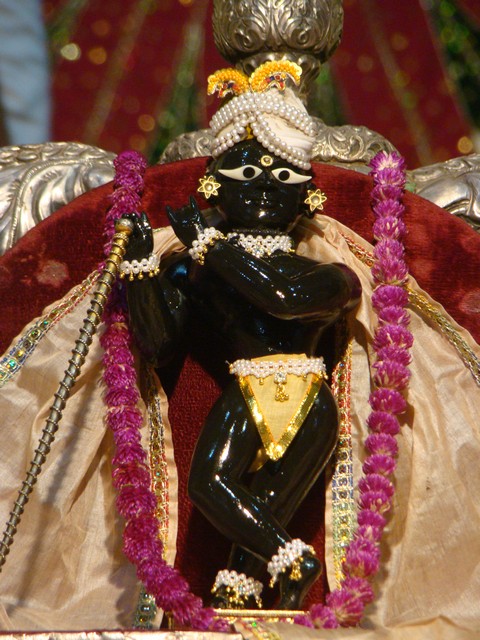
Balaram’s wives Varuni and Revati became Vasudha and Jahnavi, the two wives of Nityananda Prabhu, in Chaitanya-lila. Both of them were the daughters of Surya Das, who was as effulgent as the sun. He was Kakudman, the father of Revati, in his previous birth. According to another opinion, Jahnava was the incarnation of Ananga Manjari. Both these opinions are possible, as we have shown that more than one identity can be joined in associates of Chaitanya Mahaprabhu. (Gaura-ganoddesha-dipika 65-6) (In the image: Lord Balaram with His wives).

   shri-varuni-revata-vamsha-sambhave
tasya priye dve vasudha ca jahnavi
shri-surya-dasasya mahatmanah sute
kakudma-rupasya ca surya-tejasah
 
ananga-manjarim kecij jahnavam ca pracakshate ubhayam tu samicinam purva-nyayat satam matam
 
   Balaram’s wives Varuni and Revati became Vasudha and Jahnavi, the two wives of Nityananda Prabhu, in Chaitanya-lila. Both of them were the daughters of Surya Das, who was as effulgent as the sun. He was Kakudman, the father of Revati, in his previous birth. According to another opinion, Jahnava was the incarnation of Ananga Manjari. Both these opinions are possible, as we have shown that more than one identity can be joined in associates of Chaitanya Mahaprabhu.
   (Gaura-ganoddesha-dipika 65-6)
 
   Jahnava’s father was Surya Das Sarakhela. According to the Gaudiya Vaishnava Abhidhana, her mother’s name was Bhadravati. Surya Das’s Shripata is in the village of Shaligrama, which is not far from Navadwip, situated close to the Muragacha station on the Eastern Railway. Surya Das was the third son of Kamsari Mishra. His older brothers were Damodar and Jagannath, his younger brothers, Gauri Das, Krishna Das Sarakhela and Nrisingha Chaitanya.
 
   Shaligrama is not far from Navadwip. Surya Das Pandit made his home there. He held an important post in the service of the king of Gauda, as a result of which he was given the title Sarakhela (‘commander’) and earned a large amount of money. Surya Das and his brothers were all very pure in their character and they had a spotless reputation. His virtues are innumerable. His daughters were Vasudha and Jahnava.
   (Bhakti-ratnakara 12.3875-8)
 
   Surya Das Sarakhela and Krishna Das were brothers who both had great faith in Nityananda and were filled with love for Krishna. (Chaitanya Charitamrita 1.11.25)
 
   Surya Das Sarakhela was a magnanimous Devotee whose brother was Gauri Das Pandit. Gauri Das took his permission to come and live in Ambika on the banks of the Ganges.
   (Bhakti-ratnakara 7.330-1)
 
   Nityananda Prabhu’s Wedding
 
   Narahari Chakravarti Thakur has written about Jahnava Devi’s holy life at length in his Bhakti-ratnakara. Every manifestation of Vishnu-tattva has three energies which are known as Shri, Bhu, and Nila or Lila. Nityananda Prabhu is also Vishnu-tattva and possesses these three energies. In the 12th Taranga of the Bhakti-ratnakara, Lord Nityananda’s wedding is described as taking place according to human custom. The essence of that description is as follows. 
 
   A certain kayastha named Krishna Das, the son of Harihoria of Bariagachi, a village near Shaligrama, took the responsibility of seeking a wife for Nityananda Prabhu. A certain elderly Brahmin from Shaligrama saw that Surya Das was worried about finding a suitable husband for his two daughters and made the following suggestion: “In the village of Ekachakra in Radhadesha are a couple named Hariai Pandit and Padmavati Devi. They were Vasudeva and Rohini in their previous lives in Krishna-lila. Balaram has become incarnate as their son, Nityananda. Nitai traveled to all the places of pilgrimage and performed many austerities and became a great scholar before coming to Navadwip and becoming Chaitanya Mahaprabhu’s dearest associate. He is the eternal husband of your two daughters.” 
Jahnava Mata

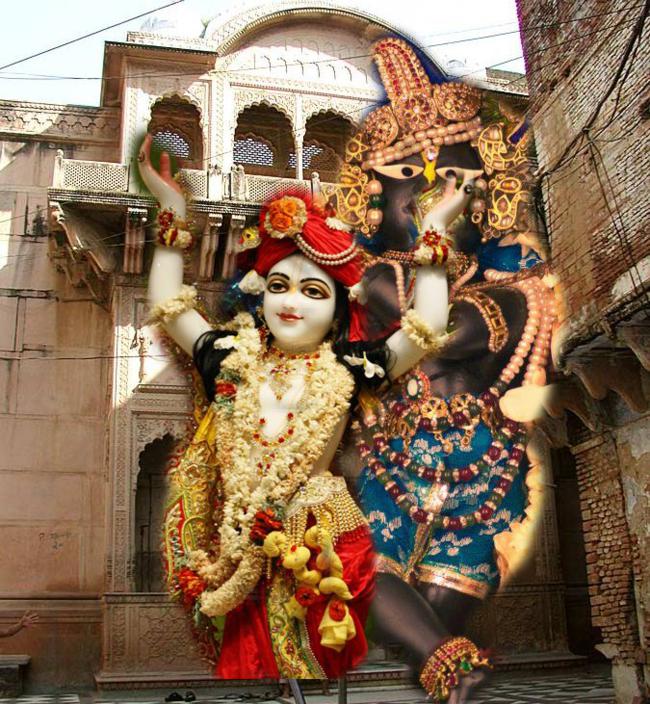
“In the village of Ekachakra in Radhadesha are a couple named Hariai Pandit and Padmavati Devi. They were Vasudeva and Rohini in their previous lives in Krishna-lila. Balaram has become incarnate as their son, Nityananda. Nitai traveled to all the places of pilgrimage and performed many austerities and became a great scholar before coming to Navadwip and becoming Chaitanya Mahaprabhu’s dearest associate. He is the eternal husband of your two daughters.” (In the wallpaper: from left to right Shri Balaram, ISKCON Punjabi Bagh,Delhi; Shri Nityananda Prabhu, ISKCON Chowpatty, Mumbai).

 
   In a dream, Surya Das also had a vision of Nityananda as Balaram with Vasudha and Jahnava standing to his left and right in their forms as Revati and Varuni. When Surya Das took the Brahmin’s advice seriously and offered the two girls to Nityananda’s lotus feet, Nityananda Prabhu mercifully gave him the same vision directly. Surya Das fainted in ecstasy.
 
   He saw Vasudha and Jahnava as Varuni and Revati, whose forms were more effulgent than mountains of gold and kunkum. Standing to the left and right of Balaram, they were decorated in magnificent jewelry and bedecked in fine, colorful clothes. Nityananda revealed this magnificence to his Devotee in order to give him joy, and Surya Das completely forgot himself in his ecstasy.
   (Bhakti-ratnakara 12.3908-10)
 
   The adhivasa rituals on the eve of the wedding were conducted in the house of Krishna Das Sarakhela in Shaligrama. All the Brahmins of Bariagachi and Shaligrama were present there.
 
   The fortunate Surya Das Sarakhela gave his two daughters away to Nityananda Prabhu according to the religious rites and popular custom.
   (Bhakti-ratnakara 12.3983) 
Jahnava Mata

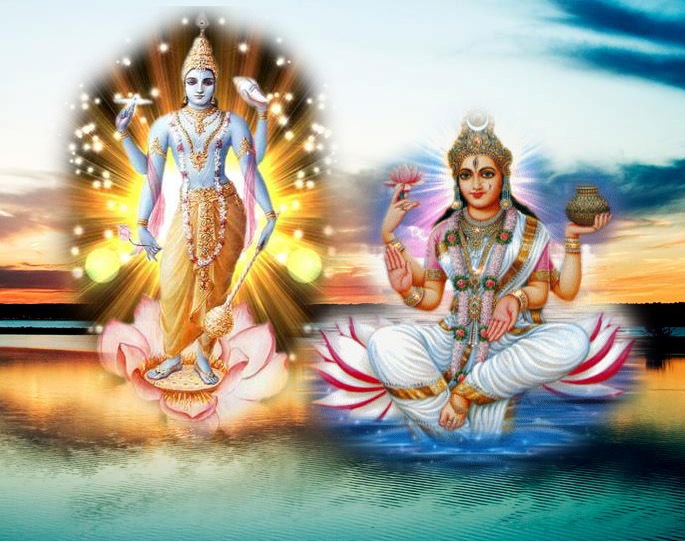
Jahnava Devi herself had no sons, but Nityananda’s Shakti Vasudha Devi gave birth to Virabhadra (or Virachandra) Goswami and Ganga Devi, who are the incarnations of Kshirodakashayi Vishnu and the river Ganges, respectively. (In the wallpaper: Kshirodakashayi Vishnu, Ganga Mata).

 
   At Sachi Mata’s request, Nityananda Prabhu stayed for some time after his wedding in Shantipur before moving to Saptagram, where he stayed with Uddharan Datta, and then establishing a permanent residence at Khardaha on the banks of the Ganges. 
 
   Jahnava Devi herself had no sons, but Nityananda’s Shakti Vasudha Devi gave birth to Virabhadra (or Virachandra) Goswami and Ganga Devi, who are the incarnations of Kshirodakashayi Vishnu and the river Ganges, respectively. According to the Gaura-ganoddesha-dipika (69), Ganga Devi’s husband Madhavacharya is an incarnation of King Shantanu.
 
Jahnava Devi’s Glories
 
   Virabhadra Goswami was inundated with Jahnava Mata’s mercy, becoming her direct initiated disciple. Nityananda Das writes in his Prema-vilasa that when Virabhadra saw Jahnava in a four-armed form that his mind was changed and he decided to accept her as his diksha guru.
 
   Without the mercy of Nityananda Prabhu’s energy Jahnava Devi, no one is able to cross over the ocean of material life, nor can one obtain the service of Nityananda Prabhu and enter into the loving service of his worshipable Gaurahari and Radha Krishna. Bhaktivinoda Thakur has written in his Kalyana-kalpa-taru:
 
   O Jahnava Devi! Be merciful to this servant today. Deliver me from my pain and give me a place in the boat of your lotus feet so that I can be sure to cross over the ocean of birth and death. You are Nityananda’s energy, you are devotion to Krishna and my guru. Please give this servant the desire tree of your lotus feet. How numerous are the fallen souls that you have saved, so this fallen beggar seeks a place at your feet.
 
   The mahajana Krishna Das, in his song which begins jaya Radhe jaya Krishna jaya Vrindavan, has prayed for Jahnava Devi’s mercy after glorifying Krishna’s name, abode and associates. “Remembering Jahnava Devi’s lotus feet, the lowly Krishna Das sings the names of the Lord.”
 
Jahnava Devi’s Travels
 
   Jahnava was present when Narottama Das Thakur put on a great festival at Kheturi village to install the Deities on Chaitanya Mahaprabhu’s appearance day. Indeed, the installation of the Deities took place under her direction. She also supervised and personally participated in the cooking of the first offering and made the first offering to the Deities. She served the Prasad to the assembled mahantas.
 
   Jahnava Ishvari rose early that morning in great delight and took her bath and did her mantra meditation. Then she began to cook innumerable vegetable preparations with great enthusiasm.
   (Bhakti-ratnakara 10.686-7)
 
Jahnava Mata

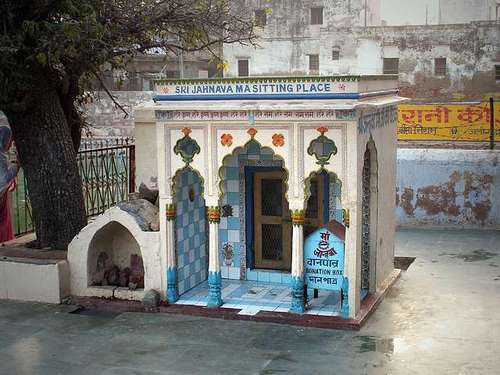
The ghat where Jahnava bathed and had this vision is today known as Shri Jahnava Ghat. (In the image: Place where Jahnava Mata sat, Radha Kund, Vrindavan).

   All of Chaitanya Mahaprabhu’s personal associates from Bengal were very happy to see Narottama Das. Jahnava Devi, the daughter of Surya Pandit and wife of Nityananda Prabhu, worshiped by the entire universe, expert in the distribution of the pearl of prema, was delighted to hear his name. Her joy increased when she observed his uncommon love for Krishna and his renunciation. Out of her mercy, she came to Kheturi, satisfying everyone by being present there and giving her darshan to all. How can a fallen person like myself fully describe the compassionate nature of Shrimati Jahnava Devi.
   (Bhakti-ratnakara 1.429-34)
 
   Jahnava Devi’s travels are described in the eleventh Taranga of Bhakti-ratnakara. On the road from Kheturi to Braj she stopped in a prosperous village where she delivered some atheistic unbelievers and criminals and bestowed Krishna-prema upon them. When she arrived in Vrindavan, she saw the samadhi of Gauri Das Pandit which moved her to tears. When in Vrindavan, the leaders of the Vaishnava community such as Jiva Goswami, Gopal Bhatta Goswami, Lokanatha Gosvami, Bhugarbha Goswami, Madhu Pandit, etc., all came to offer her their respectful greetings. Taking these leaders with her, she visited the principle Temples of Vrindavan — Madana Mohana, Govinda and Gopinath — before going to Radha Kund. There she met Raghunath Das Goswami, who was engaged in constant chanting of the Holy Names, and whose body was emaciated by his austerities. 
Jahnava Mata

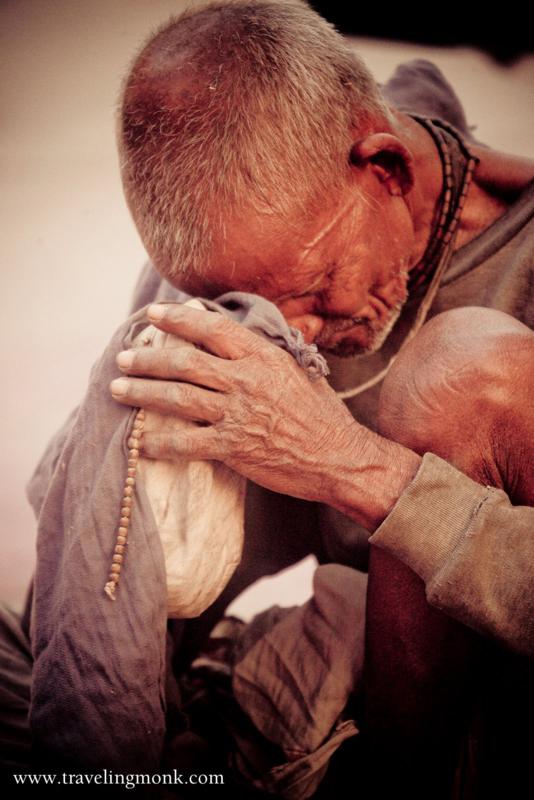
O Jahnava Devi! Be merciful to this servant today. Deliver me from my pain and give me a place in the boat of your lotus feet so that I can be sure to cross over the ocean of birth and death. You are Nityananda’s energy, you are devotion to Krishna and my guru. Please give this servant the desire tree of your lotus feet. How numerous are the fallen souls that you have saved, so this fallen beggar seeks a place at your feet. (In the image: Vrajabasi, Radha Kund, Vrindavan).

 
   Jahnava remained in Radha Kund for three days engaged in bhajana. She heard the sound of Krishna’s flute while sitting on the banks of the tank and had a vision of Shri Krishna which overwhelmed her with waves of divine love. The ghat where Jahnava bathed and had this vision is today known as Shri Jahnava Ghat. She then took the company of Vaishnavas on a parikrama of Vraja-mandala. During this parikrama she heard Jiva Goswami discourse on Brihad-Bhagavatamrita.
 
   After her visit to Braj, Jahnava returned to Gauda-desha where she visited numerous villages. She spent three or four days in Kheturi (Narottama Das’s home), some time in Budhuri (the home of Ramachandra Kaviraj in Murshidabad district), the place of Nityananda’s birth in Ekachakra (Birbhum), Katwa (where Mahaprabhu took sannyasa and where she met Yadunandana Acharya), Jajigrama (Shrinivas Acharya’s home village), Shrikhanda (the home of Raghunandan Thakur, son of Narahari Sarkara Thakur), Navadwip, Ambika, Saptagram (where she visited Uddharan Datta’s house) before finally returning to Khardaha. There she recounted the story of her entire voyage to Vasudha and Virabhadra Goswami.
 
   By Jahnava Devi’s mercy, Nityananda’s dear associate Parameshvari Das Thakur was fortunate enough to see Gopinath united with Radharani in Vrindavan. When he returned to Khardaha and told what he had seen to Jahnava and Vasudha, Jahnava was overwhelmed with loving ecstasies. She instructed him to immediately go to the village of Satpur and to install Deities of Radha and Gopinath there.
 
   Jahnava Devi arranged for Virabhadra’s marriage to Yadunandana Acharya’s two daughters, Shrimati and Narayani, both of whom became disciples of Jahnava.
 
   Nityananda’s shakti, Shrimati Jahnava Devi disappeared on the shukla navami tithi of Vaishakh.
 
   [Excerpted from “Shri Chaitanya: His Life & Associates” by Shrila Bhakti Ballabh Tirtha Maharaj] 

Gadadhara Pandit – Biography

Gadadhara Pandit

Sri Gadadhara Pandit, Mayapur Chandradoya Mandir.

    Gadadara Pandit was a childhood friend of Nimai and both were students in the same ‘Tol’ or school. Gadadhar’s parents Madhav Mishra and Ratnawati were natives of Chattagram district but later on moved to Navadwip. Gadadhar Pandit was born in Navadwip.

   In the Gaura-ganodesa-dipika, verses 147 through 153, it is stated: "The pleasure potency of Sri Krishna formely known as Vrindavaneshvari Srimati Radharani is now personified in the form of Sri Gadadhara Pandit in the pastimes of Lord Chaitanya Mahaprabhu.

   Sri Swarupa Damodara Goswami has pointed out that in the shape of Lakshmi, the pleasure potency of Krishna, she was formely very dear to the Lord as Shyamasundara-vallabha. The same Shyamasundara-vallabha is now present as Gadadhara Pandit".

   From his early childhood, Gadadhara was very serene, patient, calm, quiet, fond of solitude and very renounced. Nimai Pandit during the time of His precocious youth would ask his fellow students meaningless, fallacious questions in logic. Gadadhara however, was not especially fond of this pastime, and therefore he sometimes used to remain at some distance from Nimai.

   On the way to their school, Nimai would catch hold of Gadadhara and chide him, “What do you think of yourself – you think you are a really great pandit? Tell me, what are the symptoms of a liberated soul?”

   Gadadhara would give his explanation based on the scriptures. Nimai would then tell him that it was the absolutely wrong answer. “The display of acute misery and suffering is actually the symptom of a truly liberated soul” said Nimai. Gadadhara tried to argue further on the point. With a wave of his hand, Nimai dismissed all his logic and told him that he (Gadadhara) would understand the answer later on when he got home. 

Gadadhara Pandit

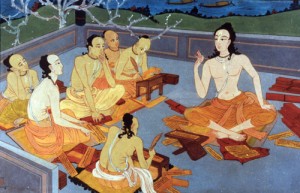
Nimai Pandit teaching His students.

   Gadadhara wondered why Advaita Acharya looked up to Nimai with such intense faith and devotion. Even Ishwara Puri seemed respectful of him. While there was no doubt that Nimai Pandit was exceedingly clever and intelligent, it seemed that Advaita Acharya glimpsed something beyond the mere intellectual prowess of the young man and beheld something at another level, which he could not understand or reach to.

   Once while Gadadhara was plucking flowers at the home of Srivas Pandit, Srivas came up to Gadadhara with a basket for the flowers, beaming with joy. Gadadhara asked “What makes you so happy?” Srivas replied, “Nimai has returned from Gaya just yesterday. It is unbelievable that the cheeky and arrogant boy has changed so completely. He has turned into a compassionate, humble and meek person. Continuously shedding tears, he writhes in agony and cries pitieously, ‘Krishna, Krishna…’ He does not even look like a normal human being anymore – rather like someone from another realm.”

   Srivas Pandit continued, “Our desire seems to be on the verge of fulfilment. He has called up to congregate at the house of Shuklambar Brahmachari. Perhaps he will share the reasons of his pain and suffering with us.” 

Gadadhara Pandit

Lord Chaitania after returning from Gaya.

   Gadadhara instinctively exclaimed, “Even though I am not invited, I will also go. I also want to know the reason behind the incredible change in Nimai.” So he went but hid himself from the rest, as he was not invited to the secret congregation scheduled to take place in Shuklambar’s courtyard.

   The beautiful, golden and effulgent Nimai stood in the middle of the courtyard, and passed his large lotus eyes over the gathering before Him. Losing control of Himself, he burst into tears and sobbed loudly, crying “Where is my Lord Sri Krishna? He was here just now, where has he disappeared, where has he hidden himself from me?

   The heart wrenching sincerity and desperation of His cry stunned everyone present. Nimai then fell down unconscious with a great crash. When he regained consciousness, He could hear someone sobbing very loudly. The sound seemed to be coming from inside the house. He went into the house and asked who was it that was crying so pathetically. Shuklambar told him, “It is your Gadadhar.”

   From his very childhood, Gadadhara had followed behind Nimai as if he were his shadow. Gadadhara was quite detached from the world, his only object of attachment was Nimai. Nimai called Gadadhara and told him, “My dear Gadadhara, since your early childhood, you have always been devoted to Lord Krishna. But I have simply wasted my time in false pursuits and achieved nothing.

   At one time I too was close to Sri Krishna, but due to my own fault I have now lost this invaluable treasure. Please tell me, how can I find him again?” He wept inconsolably and lost consciousness again.

   After some time, seeing Gadadhara alone, Nimai asked him again, “Where is my Lord Krishna? Please tell me.” Gadadhara answered, “Your Krishna is hidden within your heart.” At this, Nimai started digging into his chest with his nails. Gadadhara leapt forward and held Nimai’s hands tightly.

   Mother Sachi happened to witness this incident and ran up to them and told Gadadhara, “You have just saved my Nimai.” She blessed him and said, “Stay with Nimai for your entire life so that my son may be protected.”

   Sri Gadadhara Pandita was very affectionate towards Mukunda datta. Whenever any Vaisnava saint came to Navadwip, Mukunda would inform Gadadhara and they would both go to have darsana. One time Pundarika Vidyanidhi came from Chattagram to Navadwipa and Mukunda invited Gadadhara to come along and meet him. Gadadhara was very excited to meet a exalted Vaisnava and the two of them happily set out together to have darshan of the famous Pundarika Vidyanidhi.

   However, Gadadhara was not prepared for the sight that met his eyes. He saw that Pundarika Vidyanidhi was dressed in fine silk, his lips red with the juice of betel-leaf and was reclining on a fine couch resting against velvet cushions. His servants were fanning him and spraying scented oil all around the room. Gadadhara Pandit was not impressed. How could this apparently sensual person be called a ‘great Vaishnava’ he wondered. He was disappointed and wanted to leave immediately. 

Tota Gopinath Temple.

Tota Gopinath Temple.

   However, Mukunda knew the real character of Pundarika Vidyanidhi, and he could also sense the doubts in the mind of Gadadhara Pandita. Thus he recited some slokas from the Srimad Bhagavatam in a very sweet voice. When Pundarika Vidyanidhi heard his beautiful recitation of these slokas, in a fit of ecstasy he began to cry while calling, "Krishna, Krishna", and rolled about on the bed, his clothes falling into disarray. Soon he fainted dead away on the floor. [Chaitanya Bhagavat. Madhylila 7.78-79].

   Gadadhara now felt very remorseful in his mind. He thought to himself, "Because I have ignorantly considered this highly advanced soul to be an ordinary materialist, what an offense I have committed! In order that I might be saved from the reaction of this offense, I think the only solution is to accept initiation from him."

   Gadadhara Pandita submitted his proposal to Mukunda, who presented it to Pundarika Vidyanidhi with a full account of the pandita's high qualifications. "Hearing this proposal, Pundarik became very happy. 'Providence has bestowed upon me a great jewel; certainly I will accept him. You shouldn't have any doubt about that. It is the result of many lifetimes of good fortune that one gets a disciple like this.'" On an auspicious day, Sri Gadadhara Pandita received the divine mantra from Pundarika Vidyanidhi.

   Prior to taking initiation, Gadadhara Pandit discussed the matter with Nimai, asking if his offence would be forgiven by taking diksha from Pundarik Vidyanidhi. Nimai told him not to delay a single moment and take initiation as soon as possible. 

Gadadhara Pandit

Tota Gopinath. Deity of Gadadhara Pandit.

 
   When Nimai was to leave for Puri after his sannyas, Gadadhara put up a lot of arguments against his leaving home. Gadadhara told Nimai that one could practice any sort of spiritual sadhana even while staying at home. But Nimai told him that what He (Mahaprabhu) had come to say would be better accepted by the masses if He became a sannyasi rather than a grihasta. Gadadhara finally gave in.

   Gadadhara then tried to persuade Mahaprabhu to take him also to Puri. But Nimai did not agree, despite all his cries and pleas. Gadadhara was left behind burning in the fire of separation. He wondered how he would survive without seeing the dear face of his beloved Gauranga.

   After some time, Gadadhara accompanied some devotees from Navadwip to visit Mahaprabhu in Puri. He stayed on in Puri, not returning to Navadwip. Gadadhara started living in Jameshwar’s Tota (garden). Everyday, Gadadhara would read out aloud from the Srimad Bhagavatam for the pleasure of Mahaprabhu. 

   Once while sitting on the beach, discussing some topics on Krishna, Nimai decided to bestow his special grace on Gadadhara. He told Gadadhara to dig in a particular spot. After digging for sometime, Gadadhara discovered the beautiful deity of Sri Gopinath. The deity was established in a temple in the garden and came to be known as Tota Gopinath. 

Gadadhara Pandit

Gadadhara Pandit copied all the verses of the Bhagavad-gita in Bengali.

   Mahaprabhu asked Sri Gadadhara Pandit to do three activities on His behalf:

1. Be the authoritative teacher of Srimad-Bhagavatam;

2. Give diksha (formal initiation) on behalf of Mahaprabhu to the true seekers on the path of pure Vraja-bhakti;

3. Worship the Deity of Sri Gopinath along with His eternal consort, Sri Radha; 

   Soon after, Gadadhara took a vow of “Kshetra Sanyas” (limiting oneself to one particular place only), so as to do uninterrupted seva of Lord Sri Gopinath.

   When Mahaprabhu started on his pilgrimage to Sri Vrindavan, Gadadhara said he would accompany him. Mahaprabhu reminded him about his vow. Gadadhara replied that Mahaprabhu was his “Sri Kshetra” and his Gopinath as well. Mahaprabhu was not happy. “This is not proper” he said. 

   Gadadhara nearly fainted due to the sorrow of separation. Mahaprabhu told Sarvabhauma Bhattacharya to take him back to Sri Kshetra. He would not let him break his vow. On that particular occasion, Mahaprabhu’s Vrindavan trip was cancelled. Mahaprabhu told everyone that he felt his Vrindavan visit was cancelled because he had made Gadadhara unhappy. 

   Once Gadadhara asked Mahaprabhu for a mantra. He wanted to be re-initiated. He said that he had disclosed his mantra to some one and it seemed to have lost is efficacy. Mahaprabhu told him to ask Pundarik Vidhyanithi for a mantra once again. He also said that Pundarik would be arriving in Nilachal very soon. Sure enough, Pundarik came and Gadadhara was re-initiated. 

Gadadhara Pandit

Original hand writing of Gadadhara Pandit.

http://www.srigaurangashram.in

Vamsi Das Babaji Maharaj – Biography

Vamsidas Babaji was a Gaudiya Vaishnav sadhu who lived at Swarupa Gunj, Navadwip during the time of Srila Bhaktisiddhanta Saraswati Thakur. He was respected by Srila Bhaktisiddhanta, and he used to see to it that Vamsidas Babaji was provided with grains and so on by Gaudiya Matha brahmacharis.
 
Srila Vamsidas Babaji appeared in the village of Majidpur in the Jamalpur district of Bangladesh. Before the partition of India, this city was formerly in the district of Mymensing. His father’s name was Sanatana Malobrahma and he was previously known as Bhairava. Babaji Maharaj came to Nabadwip from East Bengal. 
 
He lived as a total recluse, far away from the hubbub of the town in a solitary place on the bank of Ganga near Baral Ghata in Navadvipa, as if he was a mad or crazy person. His only possessions were an old kaupina, karanga and kantha. 
 
Vamsidasa Babaji lived in a world of his own. His world centered round his deities-Gaura-Gadadhara, Nitai, Radha-Krishna and Gopala. For the service of his deities he had two brass pots, some earthen pots, one plate, one glass, some small cups, pancapatra, bell and conch-shell and nothing else.
 
Baba passed day and night in the service of the deities and in sweet talks with Them. Early in the morning he went out from his kuti to collect flowers. Then he went for bhiksa. He returned to his kutiya about noon and made garlands from the flowers for each of the six deities.
 
After that he would cut the vegetables. He washed each vegetable a number of times. Then he cleaned rice. He examined each grain of rice. If he found any grain from which the husk was not removed, he removed it with his own hand.
 
He did everything slowly, contemplating all the time the lila of Radha-Krishna or Gaura-Nitai, and singing or talking to Them. It was only late in the evening that he could cook and offer bhoga to the deities. He had no consciousness of time. Morning and evening, day and night had no meaning for him. Almost the whole night he kept awake, talking and singing.
 
One day, a lady selling fish approached V.B., offering him some choice type of catch.  Somehow or other, the Babaji's mind became attracted to tasting the fish.  But he immediately rebuked himself and became very angry. 
 
He first of all shouted at the woman to go away. Then he shouted at his deities, "How could this happen?  How could this happen?  I've surrendered my life to Radha Krishna, I'm under They're protection, and still this happens!  Why are You not protecting me?"
 
He went storming into his bhajan kutir.  People gathered while he fussed and fumed at his Deities inside.  Then he came out, bringing the Deities tied by rope, and threw Them into the Ganga.  He kept the end of the rope under his foot.  When one man inquired why he was doing this, the Baba threw a stone at him.
When this news reached the Gaudiya Matha, Srila Bhaktisiddhanta Thakur called his brahmacharis together and forbade them from visiting the baba again, save for one who would just deliver supplies. 
 
After a few days, he again called them together and said, "Some of you think I've stopped you from visiting babaji maharaja because he is in maya.  That is not so.  I’ve prevented you because  you will not be able to understand this bhava and will only commit offences.  So better you stay away."
 
Later, when that one brahmachari visited, Vamsidas babaji maharaj threw a stone at him and told, "If you want to please me, then never return here again!"
 
Babaji never locked the door of his kutir when he went out for bhiksa or to bathe in the Gariga. When asked why he did not lock the kutir, he said, "If the owner of the house Himself does not keep a watch then what is the use of locking the house? I do not even keep the keys of the lock with me. The lock has three keys. All the three are with the three boys. One is with Gaura, one with Nitai and one with Gadadhara."
 
After entrusting the lock and the keys to the three “boys”, Baba used to be free from anxiety. If while he was out a cow entered the kutir and ransacked everything, he would be angry with the boys. If someone stole something from the kutir he would say, "Gaura has a soft corner for Nadiyavasis, the residents of His own Dhama. Therefore He gives things away to them. I am after all an outsider." Once a gold necklace, given by someone to Sri Gaura, was stolen, when he had gone out for bhiksa.
 
On returning to the kutir he kept on scolding Gaura and asking Him whom He had given away the necklace to, for about two hours. Towards the evening he got a hint. He then went to the house of the thief and asked him for the necklace. The thief pushed him down the verandah of his house. He was hurt. But he did not say anything. But how could Gaura tolerate this? The thief soon died as well as all the other members of his family.
 
Once Baba had to punish Gaura-Nitai for Their connivance in a theft. The two brass-pots, in which Baba' used to cook for Gaura-Nitai were stolen. How could this happen without the connivance of Gaura-Nitai? So They were punished.
 
Baba scolded Them and did not give Them anything to eat that day. The punishment had its effect. The next day someone came quietly and delivered one of those pots.
 
Baba said, "This small pot is Nitai's. He will be fed today. If Gaura wants to eat, He must also bring His pot." Baba always did what he said. He cooked and offered bhoga to Nitai. Gaura drew a long face as He kept looking at Nitai eating.
 
In the meantime another man came and delivered the other pot. Baba then cooked in that pot and offered bhoga to Gaura. When Gaura also had eaten, he said with tears in his eyes, "Do I ever want to punish You? But both of You are so naughty that You always harass me. Don’t you know that I have now become old and cannot bear it all. What can I do?"
 
Babaji Maharaj did not stay exclusively in the Navadwip area, but also travelled to many holy places where he practiced the spiritual disciplines of bhakti-yoga.
 
Whenever he saw a peepal tree, he would sit under it, taking it to be the Vamsi-vata under which Krishna played his flute to attract the gopis. Once he had installed himself there, it would be difficult to get him to move.
 
In February 1941, Vamsi Dasji left Navadwip and headed for Vrindavan. He sometimes walked, sometimes travelled by ox-cart and sometimes by rail.
 
He first went to Katwa where he stayed for two days under a vata tree near the railway station. Then he took the train to Bhagalpur where he stayed for a day under again under a vata tree near the station and for four days by the Ganges. Then he travelled on to Gaya where he remained on the banks of the Phalgu River for three days.
 
He also stayed on a boat in the Ganges near Dashashvamedha Ghat in Benares for three days, spent another three days in Ayodhya by the Sarayu including three hours under a vata tree, at the Triveni confluence at Prayag for ten days, two days at the Vishram Ghat in Mathura, eight days at the Vamshivata in Vrindavan, at the Madhya-curia on the banks of the Yamuna, the Govindevji temple, Kaliya-daha, near a tamala tree on the east bank of Surya Kund at Nandagrama, two days at Pavana-sarovara and then nine days at Vamshivata Ghat in Vrindavan.
 
Everywhere that he went, he remained absorbed in chanting the Holy Names and meditating on Krishna’s form and pastimes. After three months, he returned to Navadwip Dhama, in the month of Jyestha. 
Those who travelled with him recounted that when wandering through Vraja Mandala, he would sometimes sing songs about Krishna’s lila, sometimes glorify Navadwip Dhama, sometimes laugh madly. Sometimes, he would babble incoherently, and oftentimes he would remain completely silent.
 
When visiting a temple, he was often seen muttering confidentially to the deities, disclosing some personal sentiment to them. All in all, his companions were charmed by his devotional absorption.
In an old Gaudiya Math weekly magazine, further accounts of Babaji Maharaj’s travels are given. It is stated there in the four years from March 1943, he travelled to Ambika Kalna, Kharagpur, Baleshvara (Balasore), Soro, Bhadrak, Khurda Road and Purushottam.
 
During these travels the sadhus of the Gaudiya Matha rendered great service to him.
Nothing is known about Baba's life as a householder, except that he was married at an early age and his son Haricandra was nine or ten years old when he renounced the world. He went to Navadvipa around 1906.
 
There was a person from Navadvipa-dhama who used to come to Babaji Maharaja. One day, he thought, "I have the desire to obtain the Supreme Lord. How can I get Bhagavan?"  This person came back repeatedly to see Babaji Maharaja. Finally, one day, he approached Maharaja directly.
 
"What do you want?" Babaji Maharaja asked him.
"I want to see Bhagavan," the man said.
Babaji Maharaja replied with only one word: " Then weep for Him!"
 
Babaji Maharaj’s disappearance day is on the Shukla Caturthi of Shravan.
 
 
http://www.srigaurangashram.in

Gopala Bhatta Goswami – Biography

Gopala Bhatta Goswami

Shrila Gopala Bhatta Goswami.

   Shri Gopal Bhatt Goswami, one of the six Goswamis of Vrindavan, was born in 1503 on the 13th day of the dark moon in the month of Pausha. Shrila Gopal Bhatt Goswami lived for 75 years and left this world to enter into the eternal pastimes of the Lord in 1578.
 
   Shri Gopal Bhatt Goswami was the son of Vyenkatta Bhatt, a brahmana resident of Shri Rangam in South India, who was initiated in the Shri Sampradaya tradition, in the disciplic succession of Shri Ramanujacharya.
 
   Shri Vyenkatta Bhatt’s had a famous brother named Shri Prabodhananda Saraswati. The son of Vyenkatta Bhatt was later known in the Gaudiya Sampradaya as Gopal Bhatt Goswami and he established the Radha-Ramana Temple in Vrindavan.
 
   During his travels in southern India, Chaitanya Mahaprabhu came to the famed Shri Rangakshetra which has the famous Temple dedicated to Lord Vishnu as Shri Ranganath. When Shri Gauranga Mahaprabhu entered the Temple and began chanting Hare Krishna kirtan, He mesmerized the Devotees in the Temple.
 
   Everyone was stunned in ecstasy and the hairs of their body stood on end. Mahaprabhu’s divine form was wonderful to behold, and his bodily radiance was dazzling. From His lotus eyes showered torrents of tears of Krishna-prema. The brahmanas wondered, "Is he a god? Is such a manifestation of ecstasy possible in a man?"
 
   Again and again exhorting everyone to chant the Holy Name, saying, "Haribol! Haribol!" Mahaprabhu fell before the Deities like a tree that has been cut down.
 
   Shri Vyenkatta Bhatt, detecting in Shri Chaitanya Mahaprabhu the signs of a Mahapurush could not contain himself as he saw the Lord performing sankirtan. Pushing his way through the crowd, he joined the kirtan party and lost himself in dancing and singing the Holy Name of Hari with the Lord. 
Gopala Bhatta Goswami

Shri Rangannatha Swami Temple, Shrirangam.

 
   When the Lord regained His external consciousness somewhat and had steadied Himself, Vyenkatta fell in the dust of His lotus feet and asked the Lord for His mercy. The Lord lifted him into His embrace saying, "Krishna! Krishna!" At that time, Shri Vyenkatta invited the Lord to stay with him in his home during the four months of the rainy season.
 
   In this way, the Lord passed His days in great happiness, enjoying the transcendental mellow of discussing Lord Krishna's pastimes with Shri Vyenkatta Bhatt.
 
   In 1511, Shri Chaitanya Mahaprabhu stayed at the house of Vyenkatta Bhatt. Vyenkatta had a son named Gopal. At the time of Mahaprabhu's visit, he was only a child. When the little boy offered his respects at the feet of Shri Chaitanya, the Lord picked him up and held him on His lap and affectionately embraced the boy. Shri Chaitanya Mahaprabhu used to call the child and give him the remnants of His Prasad. By giving him His Prasad in this manner, He blessed Gopal Bhatt Acharya to become a great Devotee in the future.
 
   Every day, Shri Gopal Bhatt would serve Him personally. At that time, Shri Chaitanya instructed Vyenkatta Bhatt on the esoteric truths regarding the position of Shri Lakshmidevi and the worship of Lakshmi-Narayana versus the position of the gopis and the worship of Shri Radha-Govinda.
 
   The Lord preached these points to him in a humourous style, laughing and joking in a clever way. The Lord said, "Bhatt! Your Lakshmidevi is the crest jewel of chaste ladies. My Krishna is a gopa-boy who herds cows. Why does she want to be with Krishna?"
 
   Vyenkatta Bhatt said, "Krishna and Narayana are one and the same. Krishna is one of the forms our Lord takes in order to enjoy pastimes of a sweet and sporting nature. There is no violation of Lakshmidevi's chastity if she takes an interest in Krishna – he is one and the same with Shriman Narayana. There is no contradiction with any religious principles.”
Gopala Bhatta Goswami

"Krishna and Narayana are one and the same. Krishna is one of the forms our Lord takes in order to enjoy pastimes of a sweet and sporting nature. There is no violation of Lakshmidevi's chastity if she takes an interest in Krishna - he is one and the same with Shriman Narayana. There is no contradiction with any religious principles.” (In the image: Shri Madan Gopal, ISKCON Nashik, Maharashtra).

 
   The Lord said, "What you say is true. But tell me, why is it that Lakshmidevi performs great penance to attain Krishna, but cannot do so? On the other hand, the Upanishads also performed penances to attain Krishna and did so. How is it that the Upanishads succeeded in entering Vrindavan and getting Krishna's association where Lakshmidevi failed?"
 
   Vyenkatta had no answer. Then Lord Chaitanya explained that Lakshmidevi wanted to retain her opulent position as Goddess of Fortune in Vaikuntha while at the same time enter into the pastimes of Krishna, where sweetness and beauty are superior to power and opulence.
 
   This is not possible. Only those who follow in the footsteps of the gopis and the residents of Vrindavan can attain such a position. The Upanishads succeeded where Lakshmidevi failed because they followed in the footsteps of the gopis.
 
   Before this explanation was given Vyenkatta Bhatt believed that Shri Narayana was the Supreme Personality of Godhead. Thinking in this way, he believed that the worship of Narayana was the supreme form of worship. Mahaprabhu understood his misconception and gently corrected it by making good-natured jokes about it.
 
   After this, Vyenkatta was convinced of the supreme position of Shri Krishna and Vrindavan, and converted to the cause of Gaudiya Vaishnavism, although he was raised in the Ramanuja Sampradaya. He offered his respects at the lotus feet of the Lord and the Lord embraced him.
 
   In this way, the Lord spent the four months of the rainy season at the home of Vyenkatta, discussing many things about Krishna and His pastimes. After this, he bid farewell. Gopal Bhatta fainted at the Lord's lotus feet. The Lord comforted little Gopal saying, "Now you must serve at the home of your mother and father. Later, you will come to Vrindavan. There you will constantly hear and glorify the Holy Name of Shri Krishna." In this way, after instructing the whole family, Shri Chaitanya Mahaprabhu went on his way.
 
   Within a short time, Shri Gopal Bhatta Goswami learned Sanskrit grammar, poetry, rhetoric and became expert in all the scriptures, beginning with the Vedanta sutra. His uncle, Shripad Prabodhananda Saraswati instructed him extensively in the different bhakti-shastras.
 
   After he had been blessed by having darshan of the lotus feet of Shri Gauranga, Gopal Bhatta Goswami's mind was always absorbed in thoughts of the Lord's lotus feet. He began thinking, "When will I again obtain a vision of the Lord?"
 
   In this way, the years passed. Eventually his aged mother and father called Gopal Bhatta to their side and said, "Boy, after we pass away, you must go to Vrindavan and take shelter of the lotus feet of Shri Chaitanya Mahaprabhu." After his parents’ demise, Gopal Bhatta went to Vrindvan, always remembering the lotus feet of Mahaprabhu.
 
   When Gopal Bhatta arrived in Vrindavan, he found that Shrila Rupa Goswami was preparing to send messages with some Devotees from Vrindavan to Shri Chaitanya Mahaprabhu in Puri. Shri Rupa and Shri Sanatana Goswamis already knew that Gopal Bhatt would be coming to Vrindavan. Shri Rupa and Sanatana greeted him and treated him like a brother. From that time on, their lifelong friendship began.
 
   When the messengers arrived in Puri, Mahaprabhu was happy to hear that Gopal Bhatt had gone to Vrindavan. He sent the messenger back to Rupa Goswami with his kaupin and outer garments of the babaji order, to be given to Shri Gopal Bhatta Goswami as symbols of his renunciation.
 
   Shri Rupa received these things with great joy. Shri Gopal Bhatta Goswami accepted the loincloth and dress of a sanyasi with great happiness, considering it to the Lord's mercy and Prasad. In this way he would pass his nights at different kundas, and spent all his time studying the shastra and writing.
 
   After some time, Shri Gopal Bhatta Goswami went on a pilgrimage to various holy places. He halted in a town called Devavandya Gram in Saharanpur near Hardwar. There he was received with great delight by the residents. One day, he was on his way to the house of a Devotee near the edge of the town.
 
   In the afternoon, there was a great storm. Gopal Bhatta took shelter in the house of a brahmana who was a great Devotee of Lord Krishna. He saw to the needs of Shri Bhatta Goswami with great care. Shripad Gopal Bhatta Goswami was very happy. The brahmana had no son. Gopal Bhatta blessed him, saying, "May you have a son who is a great Devotee of Krishna." The brahmana then said, "I shall give you my first son to engage in the service of Krishna as you see fit."
 
   After spending some time in Hardwar, he went further north into Nepal and to the Gandaki river where he retrieved twelve Shalagram Shilas from the river.
 
   Shri Gopal Bhatta Goswami had twelve Shalagram Shilas. He used to keep them in a cloth bag hung round his neck. Still, he had a desire to worship the Shri Vigraha of the Lord in his Deity form. Around this time a rich merchant visited Shri Gopal Bhatt Goswami. Eager to serve, the rich man offered some fine clothes and ornaments for the service of the Lord. Shri Gopal Bhatta placed these things before his Shalagrams saying tearfully that he wished he could adorn the Lord with all the nice ornaments and clothes. 
Gopala Bhatta Goswami

The place where Damodar Shaligram Shila took the form of Radha Raman, Shri Vrindavan Dham.

 
   That night, Shri Bhatta Goswami offered arati and bhoga and put his Shalagrams to rest, covering them carefully in a basket and hanging the basket on the branch of the tree under which he lived. Then after performing his bhajan, he took some Prasad and went to sleep. The next morning he bathed in the Yamuna as usual and went to wake his Shalagrams. When he opened the basket, he saw, in the midst of the Shalagrams, one of the Shalagram shilas had turned a full-fledged Deity of Krishna in a charming three-fold bending posture, who stood there looking exquisitely beautiful.
 
   Seeing the unprecedented beauty of this Deity, Gopal Bhatt dived in an ocean of joy. Shedding tears and offering his full dandavats to the Deity, he began spontaneously offering hymns and prayers to the Lord.
 
   Hearing of the miracle, Shri Rupa and Sanatana Goswamis, as well as the other Vaishnavas and Goswamis quickly went and saw the world-enchanting beauty of the Deity as tears of divine love flowed from their eyes. In the year 1599 on the full moon day of Vaishakha, this sweet Deity of Krishna became manifest. The Goswamis named this Deity, "Shri Radharamana deva."
 
   Almost ten years later one day, Shri Gopal Bhatta Goswami went to take his noon bath in the Yamuna and returned to his kutir to perform his bhajan. From a distance he saw a young boy sitting at the door of his hut.
 
   When the boy saw Shri Bhatta Goswami he arose and offered his obeisances at the Goswami's feet. Shri Gopal Bhatta asked him, "Who are you?" The boy said, "I am from Devavandya Gram in Saharanpur. I have come from there."
 
   Bhatta Goswami said, "Who is your father? Why have you come to me?" The boy said, "My father has sent me here to engage in your service. My name is Gopinatha." Gopal Bhatta then remembered the boy's father in Saharanpur, in which the brahmana said he would give the Goswami his son to engage in the service of the Lord. After this time, Shri Gopinatha served Shri Bhatta Goswami with great attention. 
Gopala Bhatta Goswami

Hearing of the miracle, Shri Rupa and Sanatana Goswamis, as well as the other Vaishnavas and Goswamis quickly went and saw the world-enchanting beauty of the Deity as tears of divine love flowed from their eyes. In the year 1599 on the full moon day of Vaishakha, this sweet Deity of Krishna became manifest. The Goswamis named this Deity, "Shri Radharamana deva." (In the image: Shri Radharaman, Shri Vrindavan Dham).

 
   Subsequently that boy became known as Shri Gopinatha Pujari Goswami. He remained a brahmachari and served the Radharamana Deity up until his death.
 
   Shri Gopal Bhatta Goswami served his beloved Radharamana Deity lovingly, remembering the words and teachings of Shri Chaitanya Mahaprabhu. While serving in this way, the eyes of Gopal Bhatta would often filled with tears of divine love that flowed like gushing streams.
 
   Where upon Shri Radharamana bestowed upon Shri Bhatta Goswami a divine vision of Shri Gauranga Himself. The Bhakti Ratnakara 4th Taranga says, "When Shri Bhatta Goswami was overwhelmed by Krishna-prema, Shri Radharamana revealed Himself as Shri Gauranga deva."
 
   Shri Gopal Bhatta Goswami accepted Shrinivasa Acharya as his disciple. Shrila Sanatana Goswami composed Hari Bhakti Vilasa in collaboration with Gopal Bhatta Goswami, who edited the work. Sanatana Goswami had such great affection for Gopal Bhatta Goswami that he even published the book under his name.
 
   Shri Gopal Bhatta Goswami was responsible for originating the six thesis of Sat Sandarbha later elaborately developed by Shri Jiva Goswami.
 
   Jiva Goswami writes in the beginning of his Tattva-Sandarbha: "A Devotee from South India who was born of a brahmana family and was a very intimate friend of Rupa Goswami and Sanatana Goswami has written a book that he has not compiled systematically. Therefore I, a tiny living entity called Jiva, am trying to assort the events of the book systematically, consulting the direction of great personalities like Madhva, Shridhara Swami and Ramanujacharya."
 
   Gopal Bhatta Goswami has written a foreword to Jiva Goswami's Sat Sandarbha. He wrote a commentary on Krishna-Karnamrita. He also wrote Sat-Kriya-Sara Dipika, a guide to Vaishnava samskaras and rituals for birth ceremonies, sacred thread initiations, marriage ceremonies, sannyasa, and funerals etc. In addition to this he composed many other scriptures.
 
   In the Gaura-Gandodesha-Dipika, Shri Kavi Karnapura Goswami writes:
 
ananga-manjari sadya Gopal Bhattkah
Bhatt goswaminam kocidahuh shri guna manjari
 
   "In my opinion, that person who in Vrindavan Leela was Ananga Manjari is now Gopal Bhatt Goswami. Some authorities, however, have given their opinion that he was Guna Manjari."
 
   http://www.srigaurangashram.in 
Gopala Bhatta Goswami

Where upon Shri Radharamana bestowed upon Shri Bhatta Goswami a divine vision of Shri Gauranga Himself. The Bhakti Ratnakara 4th Taranga says, "When Shri Bhatta Goswami was overwhelmed by Krishna-prema, Shri Radharamana revealed Himself as Shri Gauranga deva." (In the image: Shri Radha Raman, Lord Chaitanya in ISKCON Chennai Temple, and behind there is Shri Radha Raman Temple, Shri Vrindavan Dham).

Advaita Acharya – Biography

Advaita Acharya

Sri Advaita Acharya.

    All over the world the glories of Sri Chaitanya Mahaprabhu and Nityananda Prabhu are sung. However, without Sri Advaita Acharya Prabhu, also known as Gaur Ana Thakur, He who brought Gaura to this world, there would be no Mahaprabhu.
 
   Sri Advaita Acharya was the first among the associates of Lord Chaitanya and He appeared on our earth some 50 &‐ 60 years before Sri Chaitanya's own advent. Sri Advaita Acharya is recognized as a combined incarnation or expansion of Sri Maha Vishnu and Sri Sadashiva, Lord Shiva in Golok dham.
 
   In Chaitanya Charitamrita, Srila Krishnadas Kaviraj Goswami quotes the following evidence from the diary of Swarupa Damodar to describe the ontological principle of Advaita Acharya:
 
maha-vishnur jagat-karta mayaya yah srijaty adah
tasyavatara evayam advaitacarya ishvarah
advaitam harinadvaitad acaryam bhakti-shasanat
bhaktavataram isham tam advaitacaryam ashraye
 
   Maha Vishnu is the master of the universe, which He creates through his power of Maya. Advaita Acharya is the incarnation of this form of the Supreme Lord. He is known as Advaita because he is none other than Hari, as Acharya because he is the preceptor of devotion. I take shelter of the Supreme Lord Advaita Acharya who is the Incarnation of a Devotee.
 
   When Sri Advaita Acharya manifested in this world, Srila Madhavendra Puri, Sri Ishwar Puri, Sri Sachi Mata and Sri Jagannath Mishra also made their appearances.
 
   Sri Advaita Acharya was a disciple of Srila Madhavendra Puri and forms one of the main figures amongst the Pancatattva – Sri Krishna Chaitanya, Prabhu Nityananda, Sri Advaita, Gadadhar pandit and Srivasa. 
Advaita Acharya

Srila Madhavendra Puri-Spiritual Master of Advaita Acharya.

 
   Sri Advaita Acharya Prabhu was born in 1434 in Nabagram, Bengal to Sri Kubera Pandit and Srimati Nabha devi. They were originally inhabitants of Nabagram village near Sri Hatta, but later moved to Santipur on the banks of the Ganga. He disappeared in the year 1559, at the age of 125 years.
 
   Sri Advaita Acharya studied the Vedas and other scriptures under a scholar named Santacharya in Phullavati village near Santipura, where He was awarded the title Acharya.
 
   Before the appearance of Sri Gauranga Mahaprabhu, all the Vaishnava Devotees in the Navadwip area used to gather at the house of Advaita Acharya. In these meetings, Advaita Acharya preached on the basis of the Bhagavad Gita and Srimad Bhagavatam.
 
   In the house of Advaita Acharya, the devotees took pleasure in Krishna Katha, worshipping Krishna and chanting the Lord’s names. Sri Advaita Acharya was a spiritual guru and had many followers. Sri Chaitanya’s older brother Vishwarup used to visit Advaita Acharya’s house every day to engage in the chanting and dancing of naam sankirtan.
 
   He spent most of his adult life in the town of Shantipur, with his wife and family, where he became the well-respected leader of the small vaishnava community encouraging everyone to follow the path of bhakti – loving service to Sri Krishna.
 
   Seeing all around Him the growing tendency for people to abandon their spiritual practices for the pursuit of wealth and short-lived materialistic gains, Advaita Acharya felt greatly pained. He wondered how the masses would ever be liberated.
 
   It is said Advaita Acharya prayed fervently to the Lord for several months–He worshipped His shaligram shilas lovingly with sacred Tulasi leaves and Ganges water calling out aloud to the Lord to manifest and show a way to the worldly people to reach the eternal spiritual abode.
 
   In the age of Kali, the Lord will not appear at the call of mere mortals. Knowing this His plenary expansion Sri Maha Vishnu appeared and compelled Sri Krishna Himself to manifest in His most munificent avatar.
 
 
Advaita Acharya

Sri Krishna Chaitania-Yuga Avatara. United form of Radha and Krishna.

 By the momentum of his spiritual fervour, his loud cries pierced the coverings of the material universe and echoing through the transcendental Vaikunta lokas, reached the ears of Sri Krishna in Goloka. Hearing this urgent cry saturated with devotion, Sri Krishna advented Himself as Sri Krishna Chaitanya in Mayapur, Bengal as the son of Sri Jagannath Mishra and Saci Devi.
 
jaya jaya advaita isvara avatara 
krsna avatari kaila jagat-nistara
 
   "All glories to Advaita Prabhu, the incarnation of the Supreme Personality of Godhead. He induced Krsna to descend and thus delivered the entire world."
 
   When Kubera Pandit and Nabha Devi disappeared, Advaita Acharya went to Gaya to perform their pinda daan ceremonies and thence continued on a pilgrimage tour of the holy places in India.
 
   He came to Vrindavan and became absorbed in the worship of Krishna. He discovered the deity of Sri Madan Mohan or Madan Gopal which He later entrusted to the care of a Choube brahmin in Mathura before continuing on his pilgrimage tour. It was this deity that was later served by Srila Sanatan Goswami.
 
   Sri Advaita Acharya had two wives; one was named Sri, the other Sita. In the Gaura-ganoddesha-dipika, it is written that the divine Yogamaya took the form of Advaita’s wife Srimati Sita devi, and that Sri is her prakasha expansion.
 
   The Caitanya-caritamrita gives a history of Sri Advaita's sons. One of these, Achyutananda, is described in the Gaura-ganoddesha-dipika (87-8) as the incarnation of Karttikeya, the son of Lord Shiva. 
Advaita Acharya

Sri Advaita Acarya worshiped the shaligram shila and called out to the Lord to descend to this world.

 
   Sri Advaita Acharya Prabhu’s leelas are too multifarious and mystical to be understood by mundane intellects. Chaitanya Mahaprabhu Himself glorified Advaita Acharya and described the underlying truth of his nature in the following way:
 
   Advaita Acharya is God himself. As a result of his association, I have become purified. Because there is noone equal to him in devotion to Krishna, nor in knowledge of the scriptures, he is called Advaita Acharya. By his mercy, even the mlecchas become devotees of Krishna, who can describe the extent of his powers or his devotion?
 
   The Narasimha shaligram shila and Deities made in the image of Sri Sri Madan-Gopal that were worshiped by Sri Advaita Acarya are still to be found at Santipur in Madan-Gopal Para.
 
   The place on the banks of the Ganga where Sri Advaita Acarya worshiped the shaligram shila and called out to the Lord to descend to the world is known today as Babla. A temple has been built in memory of Advaita Acarya's pastimes there.
 
 
http://www.srigaurangashram.in

Lord Nityananda Prabhu’s – Avirbhava Appearance Day

Nityananda Prabhu

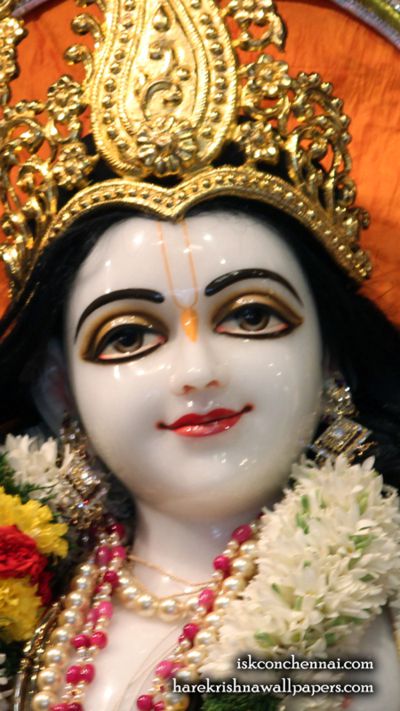
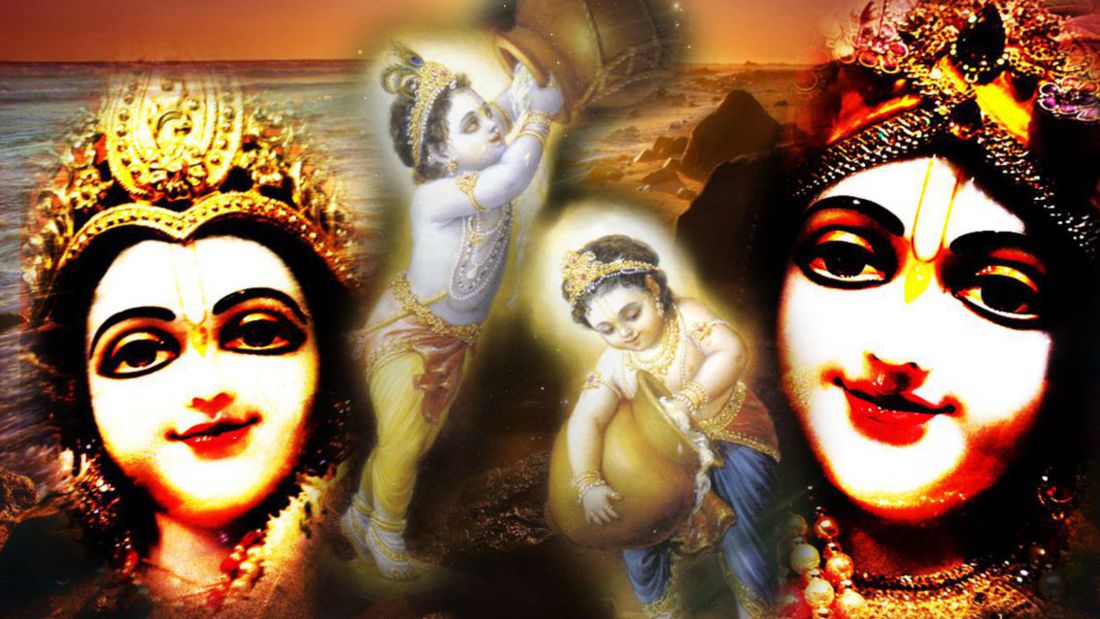
Who was formerly the son of Nanda Maharaja, He has appeared as the son of Sachi Devi.” Chaitanya Mahaprabhu’s mother’s name was Sachi Devi. So Krishna. Krishna is Shri Chaitanya Mahaprabhu, and Balarama is Nityananda Prabhu. (In the wallpaper: Shri Shri Gaura Nitay in right and left sides, ISKCON Chennai, Shri Shri Krishna Balarama in the middle).

   Prabhupada: So today, the appearance day of Nityananda Prabhu… Nityananda Prabhu is Baladeva, Baladeva-tattva.

vrajendra-nandana yei, saci-suta haila sei,
balarama haila nitai

   “Who was formerly the son of Nanda Maharaja, He has appeared as the son of Sachi Devi.” Chaitanya Mahaprabhu’s mother’s name was Sachi Devi. So Krishna. Krishna is Shri Chaitanya Mahaprabhu, and Balarama is Nityananda Prabhu. Now.

vrajendra-nandana yei, saci-suta haila sei,
balarama haila nitai

   So Balarama… In the Vedic literature it is said, nayam atma bala-hinena labhyah; na bahuna srutena. So bala means strength. Sometimes some rascal philosophers, they take it that bala means bodily strength. They propagate this philosophy that “Unless you are bodily stout and strong, you cannot achieve spiritual salvation. You must be very strong and stout and eat meat and fight, and then you’ll get next spiritual birth” No. This bala, this strength, is different. This is spiritual strength.

   The difficulty of the present situation is that actually we are moving on account of spiritual strength, but they have no information of the spiritual strength. They are thinking of material strength. That is expressed here, that

ahankare matta hoiya, nitai-pada pasariya,
asatyere satya kori mani

  This is due to ahankara. Ahankara-vimudhatma kartaham iti manyate. Those who are vimudha, especially rascal… Mudha, rascals, and vi means visesha, viseshanam, particularly. Ahankara- vimudhatma. The same thing which is spoken in the Bhagavad- gita, Narottama dasa Thakura says the same thing in a plain Bengali language. Ahankare matta haiya, nitai-pada. By the spell of maya ahankara-vimudhatma kartaham iti manyate  they are thinking that “We are independent. We can do whatever we like.” This is called ahankara-vimudhatma. Under false pretext, false prestige, everyone is thinking that “We are independent. We can find out the solution of the problems of life by material adjustment,” so on, so on. So that is our material disease. Ahankara-vimudhatma. Bewildered, they do not understand that the real strength is spiritual strength. We see daily, see daily that a very strong man, very powerful man, very good brain, very good scientist… So where is the strength? The strength is atma. As soon as the atma, or the soul, goes out of this body, so intelligent, so strong, and so many things, that is nothing. That is the difference between dead man and the living man. A living man is very powerful, very good position, everything. As soon as he lies down, he is lying down on the floor, and if you kick him on his face, he’ll not protest. So where is that strength? The strength is gone. That is spiritual strength. On the spiritual strength, the body moves. Suppose you have got a very good car, Mercedes car or Rolls Royce car. But when there is no petrol, how the car will move? It is not possible. There is spirit, petrol spirit. Similarly, real strength is spiritual strength. That spiritual strength is Balarama. Bala means strength. Therefore we have to take shelter of the lotus feet of Balarama, guru-tattva.
Nityananda Prabhu

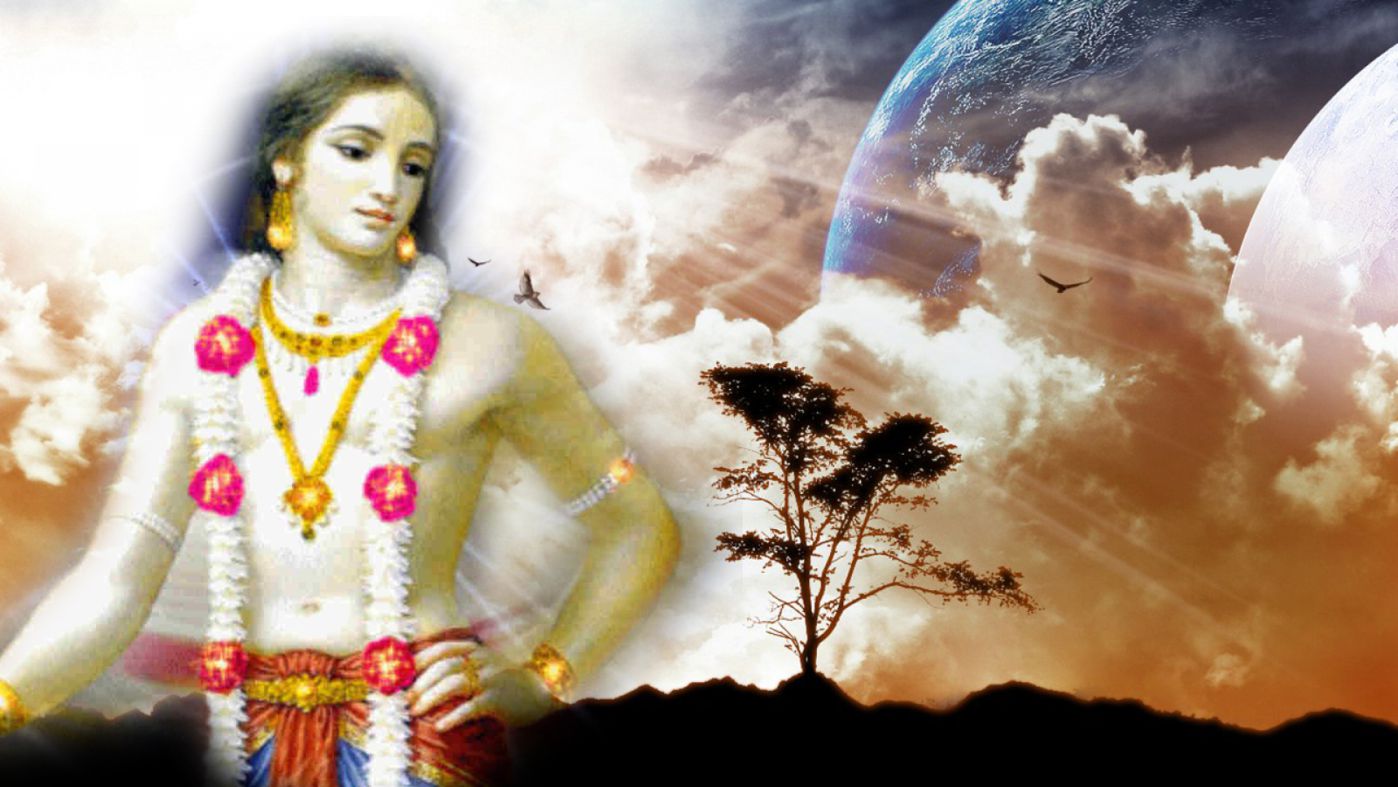
So where is the strength? The strength is atma. As soon as the atma, or the soul, goes out of this body, so intelligent, so strong, and so many things, that is nothing. That is the difference between dead man and the living man. A living man is very powerful, very good position, everything. As soon as he lies down, he is lying down on the floor, and if you kick him on his face, he’ll not protest. So where is that strength? The strength is gone. That is spiritual strength. On the spiritual strength, the body moves. Suppose you have got a very good car, Mercedes car or Rolls Royce car. But when there is no petrol, how the car will move? It is not possible. There is spirit, petrol spirit. Similarly, real strength is spiritual strength. That spiritual strength is Balarama. Bala means strength. Therefore we have to take shelter of the lotus feet of Balarama, guru-tattva. (In the wallpaper: Shri Balarama).

   Balarama means guru-tattva. Balarama represents guru. Yasya prasadad bhagavat-prasadah. If we want to understand Caitanya Mahaprabhu, if we want to understand Krishna, then we must take shelter of Balarama. Nayam atma bala-hinena labhyah. This bala- hinena labhyah, this Vedic injunction, means “Without the mercy of Balarama you cannot understand, you cannot realize your spiritual identification. So that Balarama comes as Nityananda Prabhu. Balarama haila nitai. Therefore we must take shelter of Balarama. That is.This song has been sung by Narottama dasa Thakura. Nitai-pada-kamala, koti-candra-susitala. If we take shelter of Nityananda Prabhu, then we get peace. Koti-candra-susitala. Just like in daytime, especially in the summer season, we become very much exasperated. But at night, in the evening, as soon as there is moonshine, we become very much satisfied. All day’s labor and fatigue is immediately moved. So nitai-pada-kamala, the shade of Nityananda Prabhu’s lotus feet, is koti-candra-susitala, as pleasing as one crore of moonshine. One moonshine gives us so much pleasure. So if we want actually peace of mind, if we actually want to be free from this material fatiguement, then we must take the shelter of Nityananda Prabhu. Nityananda Prabhu is the strength, spiritual strength. And without spiritual strength you cannot approach Krishna. Nayam atma pravaca… Simply by talking nonsense… Nayam atma pravacanena labhyah. If you are a good speaker, that does not mean you’ll understand, yourself. Na medhaya: “Neither by good brain.” Because you have got very good brain you’ll understand Krishna no. Nayam atma pravacanena labhyo na medhaya na bahuna srutena. If you think that you are a very good scholar, university degree-holder, then you’ll understand no. This is not possible.

   So we must have spiritual strength. That source of spiritual strength is Balarama, Krishna’s next manifestation, prakasa-vigraha. Krishna is manifesting Himself through Balarama. So we have to take shelter of Nityananda Prabhu.

nitai-pada-kamala, koti-candra-susitala,
je chayay jagata juray

   The whole world is suffering, but if you want peace, then you take the shelter of Nityananda Prabhu.

heno nitai bine bhai, radha-krishna paite nai
dhridha kori’ dharo nitair pay

   Our real aim of life how to go back home back to Godhead and associate with Radha Krishna. In another song the same author says,

manushya-janama paiya, radha-krishna na bhajiya,
janiya suniya bisha khainu

   Unless you come to Radha-Krishna, you cannot get real pleasure. If you want to dance and get pleasure, don’t dance independently. Dance with Krishna. Then you’ll be happy. The dancing is there, but dancing without association of Krishna. Just like here, in our Temple, we are also eating, but we are eating the remnants of foodstuff left by Krishna. That is real pleasure. It is not that we are stopping eating. We are not stopping eating. We are not dry philosophers. Krishna baro doyamoy, koribare jihwa jay, swa-prasad-anna dilo bhai. All over the world we are eating Krishna Prasadam, and we have got good experience. At least ten thousand men and women, they are taking Krishna Prasadam, but we have no anxiety. We have no anxiety. A family consists of a few members. They are full of anxiety how to maintain the family. And we are maintaining a family of ten thousand men. We have no anxiety. Just see practically. We have no anxiety. We require thousands and thousands of rupees for maintaining Europe, America, a costly affair. But because we are under the shelter of Nityananda Prabhu, Balarama, we have no anxiety. That means material life means anxiety. You cannot avoid anxiety if you lead a material life. Then you will be anxious. 
Nityananda Prabhu

Just like here, in our Temple, we are also eating, but we are eating the remnants of foodstuff left by Krishna. That is real pleasure. It is not that we are stopping eating. We are not stopping eating. We are not dry philosophers. Krishna baro doyamoy, koribare jihwa jay, swa-prasad-anna dilo bhai. All over the world we are eating Krishna Prasadam, and we have got good experience. At least ten thousand men and women, they are taking Krishna Prasadam, but we have no anxiety. We have no anxiety. A family consists of a few members. They are full of anxiety how to maintain the family. And we are maintaining a family of ten thousand men. We have no anxiety. (In the wallpaper: Shri Krishna, ISKCON Chennai).

   That is Prahlada Maharaja’s instruction. He was asked by his father, “My dear son, what you have learned, the best thing from your teachers?” So he replied, “My dear father” He never said, “My dear father”; He said, “My dear best of the asuras.” Asura- varya. Tat sadhu manye ’sura-varya dehinam. Tat sadhu manye ’sura-varya dehinam sada samudvigna-dhiyam asad-grahat. The whole human society is suffering, at least suffering from one disease anxiety. Ask anybody. Take one small ant and take the big elephant; take the President of United States or take one street beggar. Ask him, “Whether you are free from anxiety?” Nobody will say, “No.” “I am full of anxiety.” That’s a fact. So why they are anxiety, in, full of anxiety? That Prahlada Maharaja had replied, sada samudvigna-dhiyam asad-grahat. Because we have taken asad-vastu, that will not exist…

   Everything, whatever you have got our, this body will not exist. And this is the main platform of our existence. In the material world, so long the body is there, you exist. So Prahlada Maharaja said that “Real solution of problems of life is to get out of this material condition. That is best thing in my opinion.” Sada samadvigna-dhiyam asad. That is Vedic injunction also. Asato ma sad gamaya: “Don’t live in this asat, in this material condition.” Sad gamaya: “Go to real existence.” That real existence means spiritual life. Na hanyate hanyamane sarire. So if we actually want life, blissful life, then we must get out of this material existence. That is Prahlada Maharaja’s instruction. Samudvigna-dhiyam. And if you remain in the material existence, you must suffer some anxiety. There is no excuse.

   So Prahlada Maharaja advises that hitvatma-ghatam griham andha-kupam vanam gato yad dharim asrayeta. If you… Real problem is anxiety. And this anxiety will continue so long you are material existent. Therefore the real life is to get out of this material… Hitvatma-ghatam. Atma-ghatam. Atma-ghatam means killing the soul. This material civilization is killing the soul. That They have no information of the soul. They do not know how to become peaceful, how to become blissful. They are trying to be peaceful, bahir-artha-maninah, by external material energy. They are thinking by constructing big, big buildings, just like in Bhubaneshwar they are doing, and having good, very big, big roads and motorcars, that is advancement of civilization. No. That is not advancement of civilization. That is increasing their anxiety. There is no solution of the anxiety. There is… Formerly that… I was speaking. There was no university. The university was in the cottage Vyasadeva. Vyasadeva was writing Shrimad-Bhagavatam and all the Puranas in a cottage. The university was there. Who can produce such literature as Vyasadeva has given? From any angle of vision, from literary point of view, from philosophical point of view everything, so perfect, every literature, Mahabharata, Puranas, and Vedanta. Veda-vyasa, he has given. So there was no need of university. It required clear brain. That was to be done by the brahminical qualifications, samo damo titiksha arjava, jnanam-vijnanam astikyam brahma-karma svabhava. Where is that education? This education, technical education, how you can very nicely hammer, this will not solve the problem. So if we want real solution of the problems, then our duty is first of all to take the shelter of nitai-pada-kamala. Then we’ll be happy, and we’ll get moonshine, and our all fatigueness will be subsided.
Nityananda Prabhu

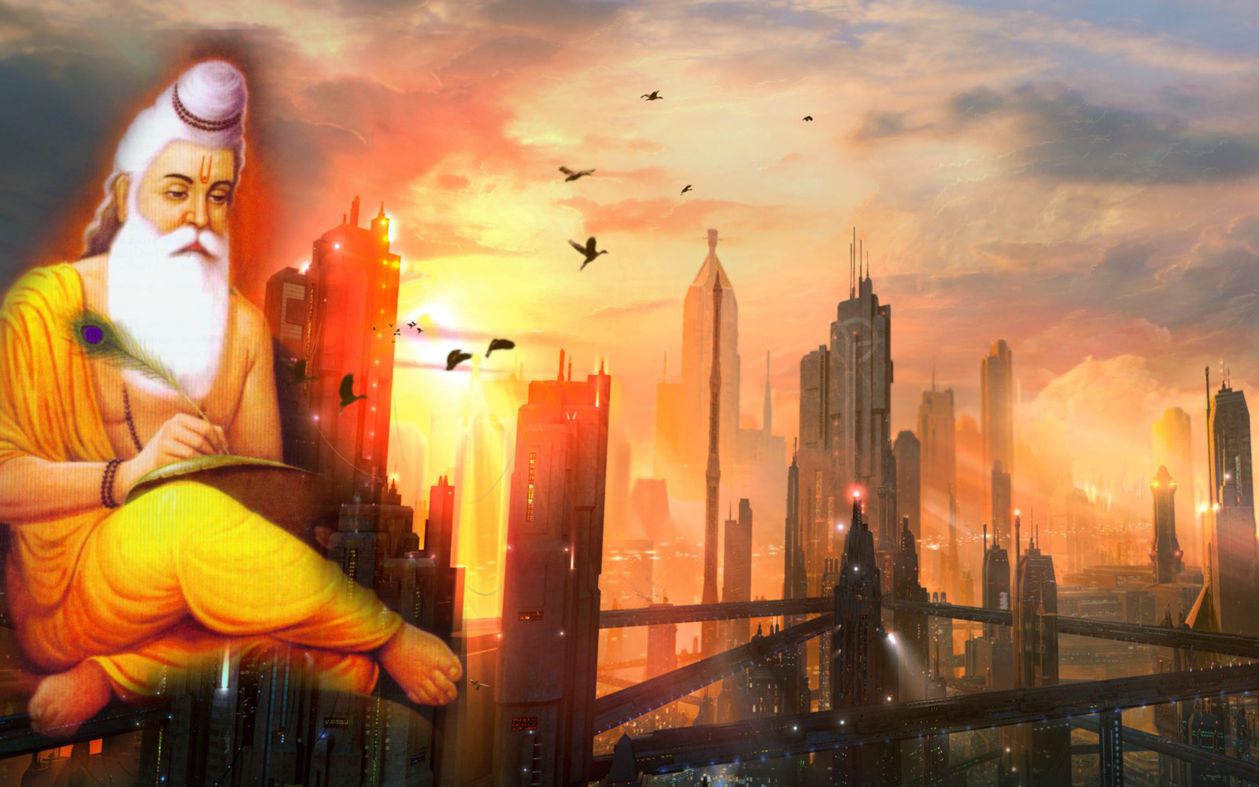
They are thinking by constructing big, big buildings, just like in Bhubaneshwar they are doing, and having good, very big, big roads and motorcars, that is advancement of civilization. No. That is not advancement of civilization. That is increasing their anxiety. There is no solution of the anxiety. There is... Formerly that... I was speaking. There was no university. The university was in the cottage Vyasadeva. Vyasadeva was writing Shrimad-Bhagavatam and all the Puranas in a cottage. The university was there. Who can produce such literature as Vyasadeva has given? From any angle of vision, from literary point of view, from philosophical point of view everything, so perfect, every literature, Mahabharata, Puranas, and Vedanta. Veda-vyasa, he has given. So there was no need of university. (In the wallpaper: Shrila Veda Vyas).

   Sambandha nahi jar, britha janma gelo tar. So if you have no connection with Nityananda Prabhu. Nityananda means always. Nitya means always, ananda means pleasure. This is another meaning you can draw. So therefore, if you have no connection with Nityananda Prabhu. Se tar: “He’s simply wasting time.” Britha means useless. Uselessly, he’s wasting time. Se pasu boro duracar. And Narottama dasa Thakura has used very strong word. “Anyone who has no connection with Nityananda Prabhu, he’s a pasu.” Sei pasu. He’s a pasu, means animal. So animal, how one animal can get happiness? That is not possible. The dog, from the childhood he’s searching after food, searching after food. And cannot get food. Unless a dog has got a master, he’s street dog and he’s always unhappy. So better to become a dog of Nityananda Prabhu. Then we shall be happy. Instead of becoming dog of so many other people.. Everyone is dog. Everyone is searching after to serve a master. But none of them are satisfied because that is false master. You take real master, Nityananda Prabhu. You’ll be happy. Se pasu boro duracar. He does not know where is happiness. Where I shall become a dog? That…Our Bhaktivinoda Thakura, he has sung therefore,

vaisnava thakur, tomara kukkur,
boliya janaha more
Nityananda Prabhu

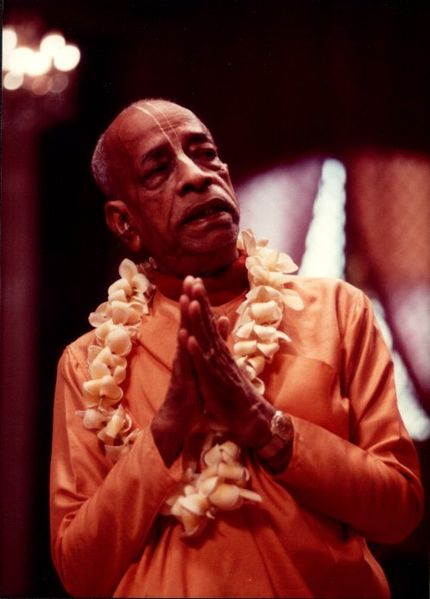
Narottama boro duhkhi. Narottama dasa Thakura, he’s acharya. He is presenting himself... That is acharya. Means he is not duhkhi, but he’s presenting himself as duhkhi. That is acharya. Acharyas, they are never duhkhi. But taking the common man’s position, he says, narottama boro duhkhi. Or, in other words, Narottama... Narottama means the best of the human being...(In the image: Shrila Prabhupada).

   “My dear Vaishnava Thakura, kindly accept me as your dog, as your dog. I am dog already, but I am maya’s dog. I’m not Vaishnava’s dog. So kindly accept me.” If you become a Vaishnava’s dog. Chadiya vaishnava seva, nistar paiche keba. If you do not become a dog of Vaishnava and Nityananda Prabhu.. Nityananda is guru. So if you do not become a dog of Nityananda Prabhu, Vaishnava, or guru, there is no question of happiness. Se sambandha nahi yar, britha janma gelo se pasu boro duracar. Nitai na bolilo mukhe, majila samsara-sukhe. He who has no connection with Nityananda Prabhu, and he does not say, “Jaya Nitai! Jaya Gaura!” And majilo samsara-sukhe, he thinks that this society, family, and “Society, friendship and love, divinely bestowed upon man.” These materialist persons, they say like that. That is called majilo samsara sukhe. In samsara there cannot be any sukha, but he’s attracted by that. Majilo samsara sukhe. Vidya-kule ki koribe tar. What we’ll do with university education or born in big family or This will not help. This is not possible. Vidya-kule ki karibe tar. Why they’re accepting this false? Ahankare matta hoiya, nitai-pada pasariya, asatyere satya kori mani. On account of being misled by false prestige and false egotism, asatyere satya kori mani, we are accepting this body which is asat, which will not exist. That we have taken as reality. Ahankare matta hoiya, nitai pada pasariya. But if we take shelter of Nityananda Prabhu, then you get the enlightenment. Asatyere satya kori mani. Nitaiyer koruna habe, braje radha-krishna pabe, dharo nitai-carana du’khani.

   Therefore Narottama dasa Thakura advises that Today is Nityananda Prabhu’s avirbhava appearance day. Let us at least remember today nitai-pada-kamala. That is wanted. Nitai carana satya, tahara sevaka nitya. The reality is nitai-carana, and anyone who is servant of Nitai…So nitaiyer carana satya, tahara sevaka nitya. One who has become the dog of Nityananda Prabhu, he gets his eternal life. We are eternal, but under misconception of material identification, we are under the subjugation of maya. Bhutva bhutva praliyate. Tatha dehantara. It is very botheration, but they do not know. I am going from one body to another transmigration. And that is not guaranteed, what body. They have no science, no knowledge about understanding tatha dehantara, the very first instruction of Bhagavad-gita. They are so rascals, and they are proud of their education, their universities. This is going on.

   Nitai carana satya, tahara sevaka., nitai-pada sada koro asa. Therefore we should always expect to be under the shelter of nitai-pada-kamala. Narottama boro duhkhi. Narottama dasa Thakura, he’s acharya. He is presenting himself… That is acharya. Means he is not duhkhi, but he’s presenting himself as duhkhi. That is acharya. Acharyas, they are never duhkhi. But taking the common man’s position, he says, narottama boro duhkhi. Or, in other words, Narottama… Narottama means the best of the human being. So here in this material world one may be the best of the human being, very exalted position, but everyone is duhki, unhappy. Narottama boro duhki, nitai more koro sukhi: “Only Nityananda can make me happy. Otherwise not possible.” Rakho ranga-caranera pasa. So today is Nityananda Prabhu’s appearance day. We shall always pray Nityananda Prabhu, “Kindly keep me under your shelter so that. I am very duhki; I am very unhappy. Under the shelter of Your lotus feet I shall be happy.” And that is real happiness. Thank you very much.

   Devotees : Jaya Shrila Prabhupada! 
Nityananda Prabhu

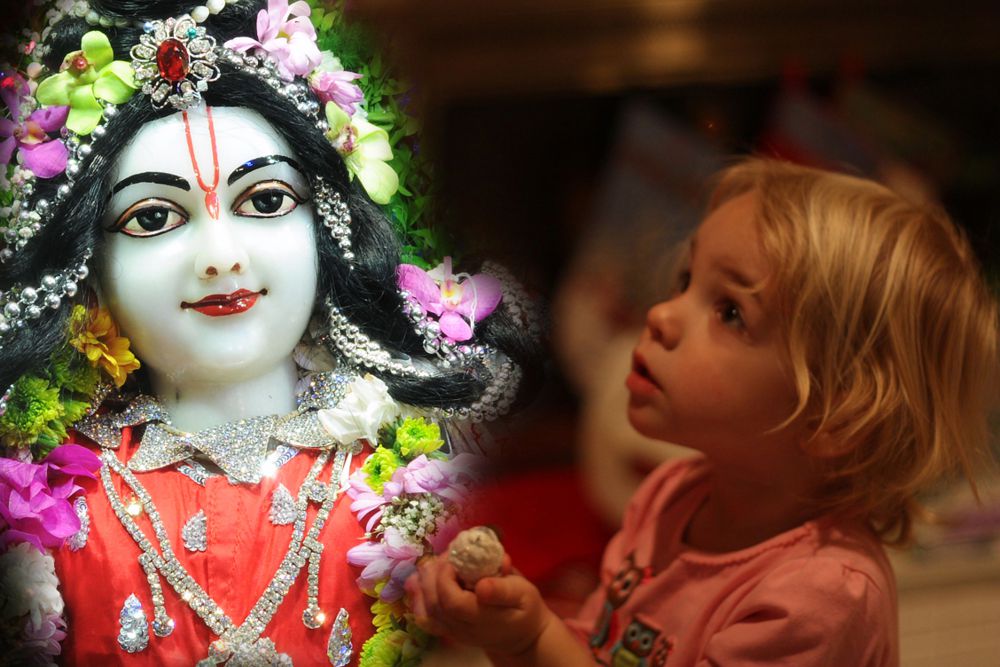
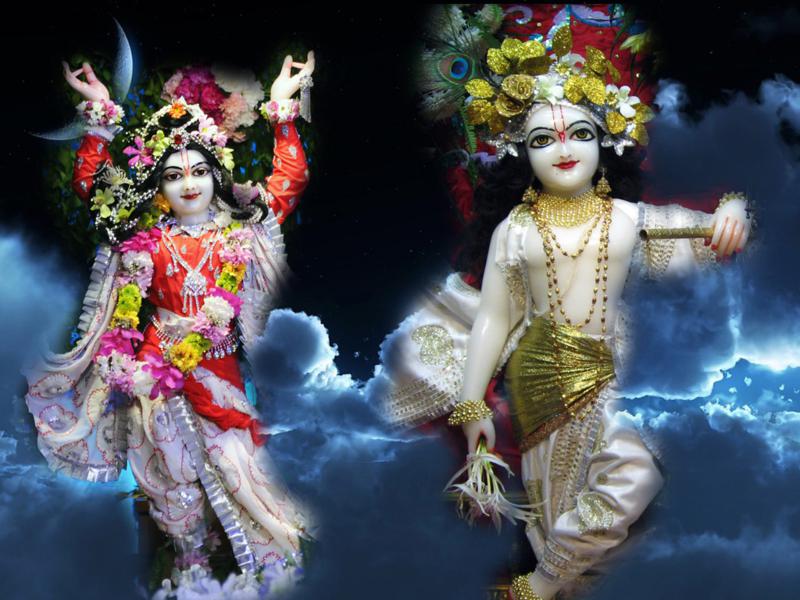
“My dear Vaishnava Thakura, kindly accept me as your dog, as your dog. I am dog already, but I am maya’s dog. I’m not Vaishnava’s dog. So kindly accept me.” If you become a Vaishnava’s dog. Chadiya vaishnava seva, nistar paiche keba. If you do not become a dog of Vaishnava and Nityananda Prabhu.. Nityananda is guru. So if you do not become a dog of Nityananda Prabhu, Vaishnava, or guru, there is no question of happiness. Se sambandha nahi yar, britha janma gelo se pasu boro duracar. Nitai na bolilo mukhe, majila samsara-sukhe. He who has no connection with Nityananda Prabhu, and he does not say, “Jaya Nitai! Jaya Gaura!” (In the wallpaper: from left to right Shri Nityananda Prabhu, ISKCON Chowpatty, Mumbai, a small kid).
Lord Nityananda’s Childhood

Nityananda Prabhu

Although no authorized account of His birth is extant, it is said that He was born in or near the year 1474 and that His father's name was Hadai Ojha. Hadai was a well known pandita, having descended from a good brahmana family whose origins were in Mithila; and his wife's name was Padmavati. Their only son, Nityananda, was born on the auspicious thirteenth day of the bright fortnight of the month of Magh. This auspicious day was made even more auspicious by Nityananda Prabhu's birth. (In the image: Shri Nityananda Prabhu, ISKCON Chennai).
   Curiously there is no authoritative biography of Nityananda Prabhu; and while Rupa, Jiva, and Raghunatha do not even mention him once in their collective writings, Sanatana Goswami refers to him only briefly in the invocation of his Vaishnava-toshani. Nonetheless, the world is fortunate that Shri Chaitanya Mahaprabhu's biographers have devoted large sections of their work to Nityananda's life, which can be pieced together from this massive literature, and also from later medieval Vaishnava texts, such as Bhakti-ratna-kara and Prema-vilasa. Nityananda Prabhu was born in the village of Ekchakra, also called Ekacakra, in the country of Rahr (Radhadesha), some eight miles east of where today stands the Mallarpura station of the E.I. Railway (within the modern Birbhum District of West Bengal). His birth site is commemorated by a small Temple named Garbhavasa and is visited by throngs of pilgrims to this day.
   Although no authorized account of His birth is extant, it is said that He was born in or near the year 1474 and that His father's name was Hadai Ojha. Hadai was a well known pandita, having descended from a good brahmana family whose origins were in Mithila; and his wife's name was Padmavati. Their only son, Nityananda, was born on the auspicious thirteenth day of the bright fortnight of the month of Magh. This auspicious day was made even more auspicious by Nityananda Prabhu's birth.

   As a child, Nitai, as He was called, had a close circle of friends, and together they used to imitate the pastimes of Vishnu and His associates. Once, they dressed themselves as demigods and petitioned the Lord to alleviate the burdened Earth of Kali-yuga. Nityananda Prabhu and a playmate who was dressed as the ailing Earth, along with the other children, took their game to the Ganges, where they addressed Lord Vishnu. At that time, one of the children hid behind a rock and spoke in a grave voice, "I will soon be born in Mathura to lighten the oppression of the Earth." The boys enjoyed themselves, as children do, while becoming completely absorbed in Krishna lila.

   On another occasion, Nitai and His friends gathered in an imitation "village" to celebrate the marriage of Vasudeva and Devaki, the parents of Krishna. The following day, they made their playhouse into the prison of Kamsa and enacted the entire story of Krishna's birth. Once, while acting out this episode, Nitai transformed the area into a cowherd settlement and took "Krishna" there, deceiving Kamsa by substituting Yogamaya for Krishna within the prison. 

Nityananda Prabhu

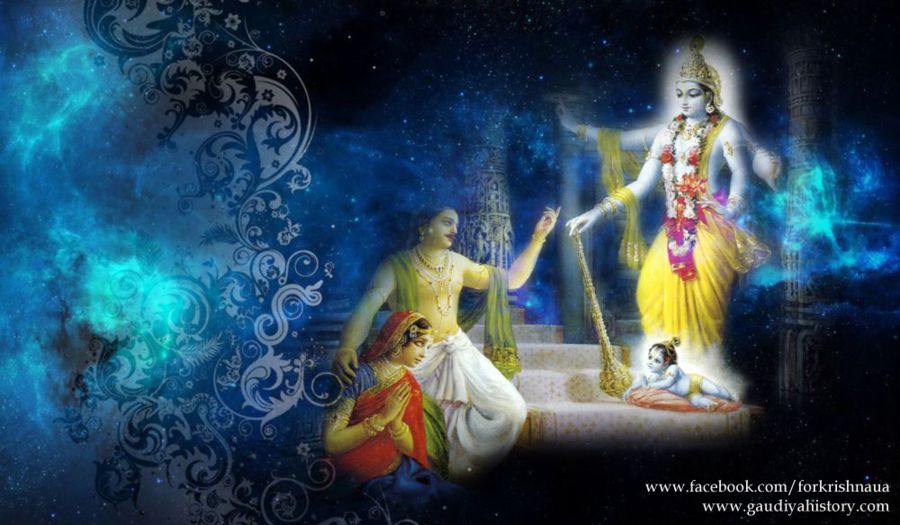
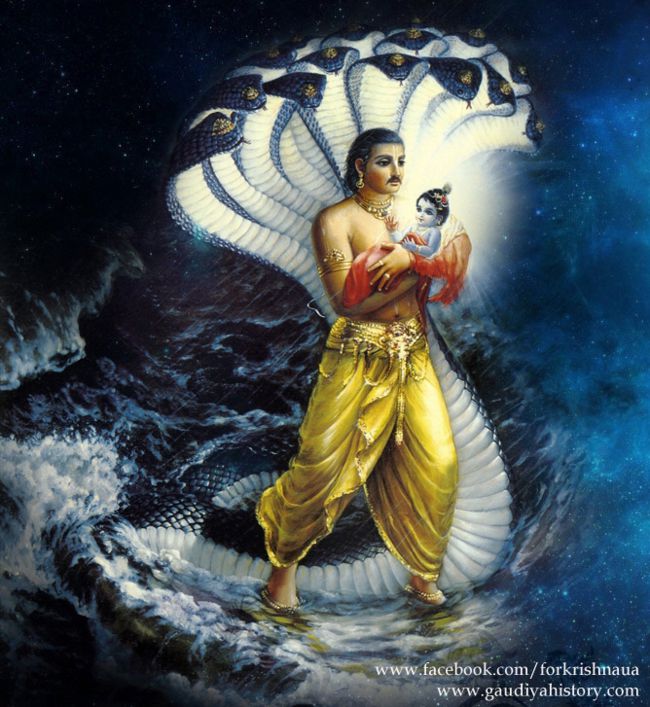
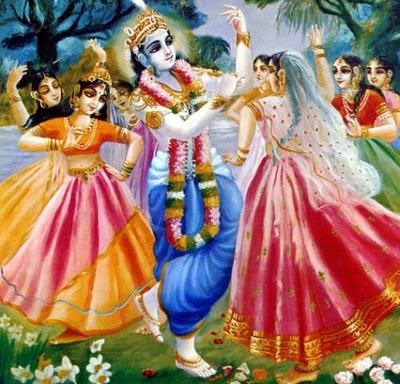
On another occasion, Nitai and His friends gathered in an imitation "village" to celebrate the marriage of Vasudeva and Devaki, the parents of Krishna. The following day, they made their playhouse into the prison of Kamsa and enacted the entire story of Krishna's birth. Once, while acting out this episode, Nitai transformed the area into a cowherd settlement and took "Krishna" there, deceiving Kamsa by substituting Yogamaya for Krishna within the prison. (In the wallpaper: Krishna appeared to Devaki and Vasudev in the prison, Mathura).

   Performing these intricately-woven stories on a daily basis, the children became quite close and came to love Nitai as their natural leader and friend. He was the most imaginative among them, and they all laughed and shared joyful exchanges when He would dress them like demons.

   When they staged the Putana story, for example, they would engage in uproarious laughter when one of their friends pretended to suck the demoness's breasts like baby Krishna. Sometimes Nitai would construct demons out of toys, naming them Bakasura, Aghasura, Vatsasura, and so on and would go through the motions of battling with them and finally killing them.

   His friends were so entertained by His play-acting that they would come back day after day just to see Him do it again and again.

   Once in a while, His friends would take the roles of the elephant Kuvalayapida or the wrestlers Chanura and Mustika. Nitai would fight with them, knock them down, and drag them off by the hair. By the end of the day, their stomachs would ache from laughter, and they would tell their parents about the great fun enjoyed with Nitai in play-acting.

   Sometimes Nitai would bring His friends to the local milkman and have them watch Him steal butter and yogurt, as Krishna did in His Vraja lila. The milkman, of course, did not complain. In fact, he was an accomplice, setting aside excess dairy for Nitai and His friends, expecting them to show up.

   All the adults of Ekachakra adored Nitai. They were fascinated by this unique little boy, and they loved Him as their own. Seeing His total absorption in Krishna and the avataras of Vishnu, they suspected that He might be some sort of Incarnation Himself.

   He was relentless, day after day enacting a different pastime, and did it so skillfully that His neighbors wondered, "How is it that He is so talented? How does He know the stories so well? No one has explained all these details to Him."

   One day He imitated Krishna's pastime of lifting Govardhana Hill, with all aspects of the story acted out perfectly. On another, He constructed a replica of Vrindavana, performing many parts of Krishna's Vraja-lila with marked realism, and on still another, He pretended to steal the clothes of the gopis and visit the wives of the brahmanas engaged in sacrifice.

   On one occasion, one of the boys dressed as Akrura and took Krishna and Balarama away from Vrindavana on the order of Kamsa. Nitai cried in grief, feeling the separation of the gopis. Tears of love flowed from His eyes.

   His acting was so authentic that it made all who watched question whether He was merely acting or in some way experiencing the part He played. This was true whether He was playing Krishna, Balarama, or even Vamana, or other Incarnations of the Lord."Nitai, where have you learned all this?" one of the neighborhood ladies asked. Nityananda enjoyed her question. "They are My own divine pastimes," He said, "and I am allowing you to see them." The townspeople laughed, shaking their heads. They did not know what to make of Him. 

Nityananda Prabhu

On one occasion, one of the boys dressed as Akrura and took Krishna and Balarama away from Vrindavana on the order of Kamsa. Nitai cried in grief, feeling the separation of the gopis. Tears of love flowed from His eyes. (In the image: Akrura taking Krishna and Balarama to Mathura, Gopis are crying, Shri Vrindavan Dham).

Lord Nityananda’s Early Childhood Pastimes

Chapter Summary

   This chapter describes the childhood pastimes of Nityananda up to his twelfth year, during which time he re-enacted the divine pastimes of Krishna, Rama, Vamana, and the other avataras of Vishnu. This chapter also describes his tour of different holy places which continued until his twentieth year.

   On the order of Gaura Krishna, Ananta Deva had already made his appearance in the village of Ekachakra in Radhadesh. In this way, Nityananda Prabhu appeared like the moon from the sea of the womb of Padmavati, the wife of Hadai Oja. And just like the rising moon, he dispelled all the darkness covering the land of Radha by his auspicious appearance. As a child, Nityananda constantly played with his boyhood friends imitating the pastimes of Krishna. 

Nityananda Prabhu

On the order of Gaura Krishna, Ananta Deva had already made his appearance in the village of Ekachakra in Radhadesh. In this way, Nityananda Prabhu appeared like the moon from the sea of the womb of Padmavati, the wife of Hadai Oja. And just like the rising moon, he dispelled all the darkness covering the land of Radha by his auspicious appearance. (In the wallpaper: Shri Nityananda Prabhu, ISKCON Chennai).

   Once, his friends took the role of the assembly of gods, who were desirous of petitioning the Lord to relieve the burden of evil oppressing the Earth. Nityananda Prabhu took with him a child who was dressed as the earth, and together with the children who acted the roles of the different assembled gods, he went to the banks of the river Ganges. There he addressed the Lord who rests in the ocean of milk, Kshirodakshayi Vishnu. At that time, one of the children took the part of Lord Vishnu, and hiding unseen by the other children spoke in a grave voice that all could hear: "I shall surely be born in Goloka Mathura to lighten the burden of the Earth."

   And so Nityananda Prabhu enacted the different pastimes of Krishna that the Lord performed during the Dvapara age. He enacted the pastimes of the marriage of Vasudeva and Devaki, the birth of Shri Krishna in the prison of Kamsa, the journey of Vasudeva to Nandagram and how he carried Krishna over the Yamuna river, as well as his return from Nandagram and how he brought Mahamaya who had just appeared as the daughter of Yashoda with him. 

   He enacted the slaying of Putana, the breaking of the cart, Krishna's butter stealing pastimes, the slaying of the demons, Dhenuka, Agha, and Baka. He also displayed the pastimes of the pasturing of the cows, the lifting of Govardhan hill, the stealing of the gopis clothes and the Lord's bestowal of mercy upon the wives of the sacrificial brahmanas. He performed the pastimes of sending secret advice to Kamsa in the guise of Narada, the killing of the Kuvalaya elephant and the wrestlers Chanura and Mustika, and the killing of Kamsa. 

Nityananda Prabhu

And so Nityananda Prabhu enacted the different pastimes of Krishna that the Lord performed during the Dvapara age. He enacted the pastimes of the marriage of Vasudeva and Devaki, the birth of Shri Krishna in the prison of Kamsa, the journey of Vasudeva to Nandagram and how he carried Krishna over the Yamuna river, as well as his return from Nandagram and how he brought Mahamaya who had just appeared as the daughter of Yashoda with him. (In the image: Vasudev is taking Gopal to Vrindavan Dham).

   Nityananda Prabhu also enacted the pastime of Vamana Deva's cheating Bali of the three worlds, and took the role of Ramachandra. His friends acting the part of monkey soldiers pretended to build a bridge of floating stones across the ocean, in imitation of the pastimes of Rama. Once, Nityananda took the part of Lakshman, and, bow in hand, would storm the palace of Sugriva. Once he took the part of Rama Himself, enacting the pastime of breaking Parashurama's pride. Once, taking the role of Lakshman he pretended to kill Indrajit and then swoon, hit by the powerful arrows of Ravana, the demon-king. He would enact the pastime of having the medicine from Gandamadana Hill brought by Hanuman and would recover from his wounds after receiving the medicine.

   Nityananda spent twelve years enacting these kinds of pastimes. At that time, he went to visit the different holy places in order to purify them from the sins left behind by the pilgrims who visit them.

   He toured the holy places in both Northern and Southern India, on the pretext of pilgrimage and in this way was occupied until his twentieth year when he arrived in Navadwipa and met Chaitanya Mahaprabhu. In the course of his wandering through the different holy places, Nityananda Prabhu met Madhavendra Puri, Ishvara Puri, and Brahmananda Puri. Nityananda passed many days enjoying the ecstasy of Krishna-katha in the company of Madhavendra Puri and his disciples. He then visited Setubandha, Danatirtha, Mayapuri, Avanti, Godavari Jiyura Nrismha, Devapari, Trimala, Kurmakshetra and many other holy places. At last he arrived at Jagannatha Puri, where he took darshan of Jagannatha Deva and was profoundly moved to ecstasy upon seeing the Deity. From Jagannatha Puri, he returned again to Mathura. The chapter closes with an explanation of Lord Nityananda's renunciation.

   Lord Nityananda who is identical with the powerful Balarama himself, manifest during this period his pastimes of preaching the Holy Name in love of God. The chapter concludes with a description of greatness of Nityananda Balarama.

Text of Chapter

   All glories to Shri Krishna Chaitanya, the ocean of mercy. All glories to Nityananda Prabhu, the friend of the helpless. All glories to the life and soul of Shri Advaita Chandra. All glories to He who is the only shelter of Shrivasa and Gadadhara. All glories to Vishvambhara, the son of Jagannatha Mishra and Sachi Devi who is always beloved by His Devotees and followers.

   Before the advent of Shri Chaitanya Mahaprabhu, Ananta Deva himself had appeared on the order of the Lord. He took birth in the Radhadesh to help enact the divine lila of the Lord. His father's name was Hadai Oja and his mother's name was Padmavati. He appeared in the village of Ekachakra within the land of Gauda. From infancy he was sober, highly intelligent and supremely qualified. The baby boy was millions of times more beautiful than cupid.

   From the moment of his birth there appeared within the Radhadesh, all-auspicious symptoms. All varieties of famine, poverty, and unhappiness immediately disappeared. On the day that Shri Gaurachandra made His advent in Shridhama Navadwipa, Nityananda Prabhu shouted with joy. The vast universe was pervaded with the sound of his cries and the whole world became astonished. Some said, "The thunderbolt has descended to Earth." Many could understand that the mighty disturbance was the result of some divine power. Some said, "We know the cause. The master of Gauda has spoken in a voice of thunder." And in this way, everyone gave their different opinions. But by the power of the illusory energy of Krishna, no one could recognize the transcendental position of Nityananda Prabhu. 

Nityananda Prabhu

On the day that Shri Gaurachandra made His advent in Shridhama Navadwipa, Nityananda Prabhu shouted with joy. The vast universe was pervaded with the sound of his cries and the whole world became astonished. Some said, "The thunderbolt has descended to Earth." Many could understand that the mighty disturbance was the result of some divine power. Some said, "We know the cause. The master of Gauda has spoken in a voice of thunder." And in this way, everyone gave their different opinions. But by the power of the illusory energy of Krishna, no one could recognize the transcendental position of Nityananda Prabhu. (In the image: Shri Gauranga Mahaprabhu, ISKCON Chennai).

   In this way, keeping his divine nature unmanifest, the supreme Lord, Nityananda Prabhu delighted in the company of children. In all the games that the Lord played with the children, Krishna was the center. Indeed, their play was nothing but the lila of the Lord. Nityananda Prabhu would hold an assembly of the gods with one of the children acting the part of the Earth presenting the petition of the demigods to the supreme Lord Vishnu. All of them would go along with the Earth to the banks of the river where together they would pray to the hidden Lord of the universe, Kshirodakshayi Vishnu. Unseen by all, one of the boys would loudly proclaim from his hiding place, "I will shortly be born in the cowherd village of Mathura."

   Another day, Nityananda Prabhu and his childhood friends would gather in the village to celebrate the marriage of Vasudeva and Devaki. Once, having made their playhouse into the prison of Kamsa, he re-enacted the pastime of Krishna's divine appearance in the dead of night. Nityananda Prabhu built a cowherd settlement and took Krishna there, deceiving Kamsa by substituting Yogamaya for Krishna within the prison.

   Another time he dressed up one of his childhood friends as Putana, while another boy, climbing his body pretended to such his breast like the baby Krishna. Once, having built a cart made of reeds with the help of the children, Nityananda Prabhu broke it. Nityananda Prabhu would bring his childhood friends to the house of the local milkman and steal milk and yogurt, following in the footsteps of Krishna. His friends never left his company, nor would they return to their homes, but day and night they would play in the company of Nityananda Prabhu.

   Nor did their mothers and fathers complain, but all loved Nityananda with their hearts and souls. He would hold his relatives and friends in affectionate embrace. Upon beholding his amazing childhood pastimes, everyone would say, "We have never seen such wonderful playing. How is it possible that this child has learned all these activities of Krishna."