Category Archives: Gaudiya Vaishnav Biographies

Ganga Dasa Pandit

Ganga Das’s Previous Identity
 
Ganga Dasa Pandit

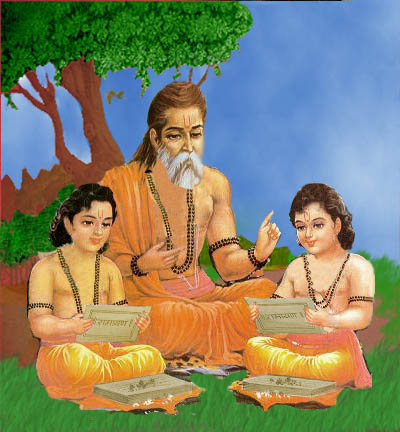
Ramachandra’s guru, Vasishtha Muni, appeared in two expansions in Gaura-lila as Ganga Das Pandit and Sudarshana. (Gaura-ganoddesha-dipika 53) (In the image: Rishi Vasishtha with Rama and Lakshman).

purasid raghunathasya yo vashishtha-munir guruh
sa prakasha-visheshena gangadasa-sudarshanau
 
   Ramachandra’s guru, Vasishtha Muni, appeared in two expansions in Gaura-lila as Ganga Das Pandit and Sudarshana. (Gaura-ganoddesha-dipika 53)
 
acaryah shri-jagannatho gangadasa prabhu-priyah
asin madhuvane prag yo durvasa gopika-priyah
 
   Jagannath Acharya and Ganga Das Pandit were previously Durvasa, who was so dear to the gopis in Madhuvana.
   (Gaura-ganoddesha-dipika 199)
 
   Ganga Das was very dear to Lord Chaitanya Mahaprabhu. Anyone who remembers him will be freed from all material bondage.
   (Chaitanya Charitamrita 1.10.29)
 
   In his Chaitanya Bhagavat, Vrindavan Das Thakur equates Ganga Das Pandit with Krishna’s guru Sandipani Muni:
 
   There was in Navadwip a wonderful professor named Ganga Das Pandit, who resembled Krishna’s guru, Sandipani Muni.
   (Chaitanya Bhagavat, 1.8.26)
 
   In the Gaudiya Vaishnava Abhidhana, Hari Das Das suggests that Ramachandra’s guru Vasishtha entered into Sandipani Muni during Krishna-lila. Thus, these apparently conflicting statements can be true. In verse 52 of Gaura-ganoddesha-dipika, Kavi Karnapura identifies Keshava Bharati with Sandipani Muni. 
Ganga Dasa Pandit

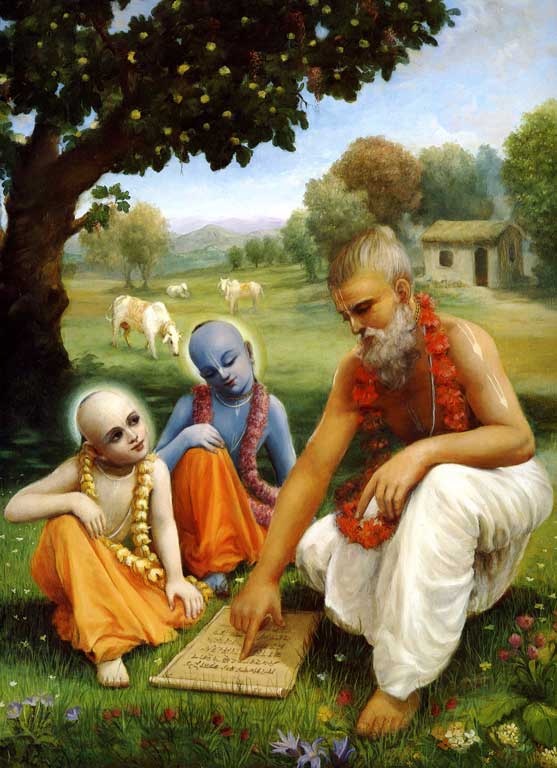
In the Gaudiya Vaishnava Abhidhana, Hari Das Das suggests that Ramachandra’s guru Vasishtha entered into Sandipani Muni during Krishna-lila. Thus, these apparently conflicting statements can be true. In verse 52 of Gaura-ganoddesha-dipika, Kavi Karnapura identifies Keshava Bharati with Sandipani Muni. (Sandipani Muni with Krishna and Balarama).

 
   Advaita Acharya is Mahavishnu’s incarnation. Out of a desire to see the salvation of all creatures in this world, he prayed and called to Krishna to descend to this earth. Indeed, it was through the heartfelt cries of Advaita that Chaitanya Mahaprabhu became incarnate. It was the Lord’s desire that all his eternally perfected associates from his previous incarnations who played the role of His seniors descend prior to His own appearance. Ganga Das Pandit was one of these elders who preceded the Lord.
 
   Nityananda Prabhu appeared in the land of Rarha while Ganga Das Pandit, Murari Gupta and Mukunda also appeared elsewhere. 
   (Chaitanya Charitamrita 1.13.61)
 
   Many other associates of the Lord remained hidden in Navadwip, taken birth there prior to Him on His order. They included Chandrashekhara, Jagadisha, Gopinath, Shriman, Murari, Shri Garuda and Ganga Das.
   (Chaitanya Bhagavat 1.9.98-9)
 
Nimai’s Vidya-Vilasa Lila
 
   Jagannath took little Nimai to Ganga Das when the child expressed His desire to study with him. Ganga Das lived in the neighborhood known as Ganganagara. It is said that when Bhagiratha brought down the Ganges, the goddess waited on this spot for the arrival of Gauranga Mahaprabhu. During the parikrama of Navadwip Dham, the Devotees sit down at a spot near the Yoga Pith Temple to hear the glories of Ganga Das’s home, even though it is in fact situated in Simantadvipa.
 
   In his commentary to Chaitanya Bhagavat, Shrila Bhaktisiddhanta Saraswati Goswami Thakur writes: "Gaura-Narayan is the Lord of Vaikuntha, the Supreme Personality of Godhead. He is therefore the only reservoir of all scriptural knowledge, as well as the embodiment of the opulence of wisdom. Even so, it is his wont to accept human limitations during His incarnation and thus He desired to learn grammar and other arts and sciences just as Krishna did when He studied with Sandipani Muni. He did this to show that those who make a living as teachers should have genuine learning and not make a pretense of possessing knowledge." 
   (Gaudiya-bhashya, 1.8.24)
 
   When Jagannath Mishra brought Nimai to Ganga Das, the scholar was overjoyed to accept Him as his student. He began to teach Him with as much care as if He were his own son. He was astounded by Nimai’s powerful memory and His intelligence. Though he had taught thousands of students, he had never had a pupil of such caliber. A student of quality brings glory to his teacher.
 
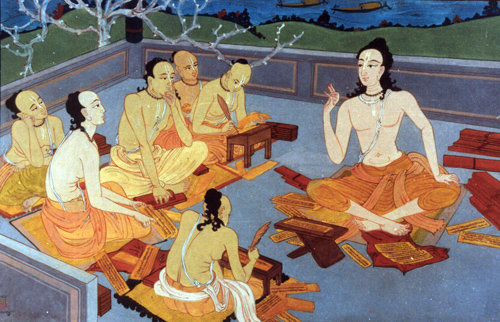
   Nimai would ask trick questions of his fellow students Murari Gupta, Krishnananda, Kamala Kanta and others. He was able to explain a sutra in one way and then in a completely different way, thus baffling His classmates who were nevertheless impressed by His scholarship. Thus, the Lord’s education pastimes took place in the home of Ganga Das Pandit. 
Ganga Dasa Pandit

Nimai would ask trick questions of his fellow students Murari Gupta, Krishnananda, Kamala Kanta and others. He was able to explain a sutra in one way and then in a completely different way, thus baffling His classmates who were nevertheless impressed by His scholarship. Thus, the Lord’s education pastimes took place in the home of Ganga Das Pandit. (In the image: Nimay Pandit teaching His students).

 
   This is the house of Ganga Das Pandit, where the son of Sakhi studied grammar. Ever day he took delight in this study, even making his own explanatory comments on the codes. With a twinkle in his eye, he would ask tricky questions of Murari Gupta, Krishnananda, Kamala Kanta, and his classmates. Gaurasundara immersed Himself completely in the joys of learning — such pastimes are beyond the ken of the great gods themselves. 
(Bhakti-ratnakara 12.2185-8)
 
   The Lord studied grammar from Ganga Das Pandit. After hearing a lesson just once he would memorize both the sutra and its explanation.
   (Chaitanya Charitamrita 1.15.5)
 
Mahaprabhu After His Return from Gaya
 
   After Nimai’s return from Gaya in 1509, all the Navadwip Devotees, Shrivasa Pandit, Shriman Pandit, Gadadhara Pandit, Sadashiva, and Shuklambara Brahmachari were amazed to see the transformation in His character. They also felt great joy to see how He had abandoned His attachment to His studies to turn to devotion to Krishna and preaching.
 
   Even so, Mahaprabhu continued to set an example of how to serve the spiritual master, going to Ganga Das’s house and paying obeisances to his feet. Ganga Das also displayed the suitable behavior of a guru for His dear disciple by embracing Him with respect and affection. If one’s education does not lead to devotion to Krishna, then it is certainly a waste of time. Through devotion to Krishna, one’s ancestors, both on the father and mother’s side, are delivered. Ganga Das Pandit was also happy to see Nimai’s transformation, but he told Him to continue teaching.
 
   Nimai’s guru said, "Your life is blessed, my child. Your mother and father’s forefathers have all been delivered. Neither You nor your students should open a book today, even if Brahma himself tells You to do so. You have now revealed Yourself, so go home today. Come back tomorrow, however, and continue teaching."
   (Chaitanya Bhagavat 2.1.122-4)
 
   Nimai paid His obeisances to Ganga Das Pandit’s feet, even though He Himself was the Lord of the Vedas and the husband of the Goddess of Learning as His disciples. What goals could be left for Ganga Das to achieve? His disciple is worshipable to the fourteen worlds. (Chaitanya Bhagavat 2.1.283-4)
 
Ganga Das at Shrivasa Angan
 
   Nityananda Prabhu, the savior of the most fallen, also visited Ganga Das Pandit’s house one day after having been worshiped in Shrivasa Pandit’s house, when He was wandering through Navadwip in the mood of a child, playing with the boys of the town.
 
   On the day that Mahaprabhu sat on Vishnu’s throne in the house of Shrivasa Pandit, displaying His effulgent form for 21 hours in the Mahaprakasha, He called all His Devotees one by one to give them His blessings. On this occasion He called Ganga Das as well, reminding him of the following event from the past.
 
   One day, Ganga Das had left his home with his wife and children due to fear of the Muslim rulers. He was standing by the banks of the Ganges with his family, waiting for a ferry to come to take them across the river, but none came. This was causing him no small amount of anxiety, but even after waiting almost the whole night, no ferry docked at the quay. He began to cry in the fear that the Muslims would touch his family members and contaminate them. He thought that he would have to drown himself in the Ganges if this should happen.
 
   At that very moment, Mahaprabhu Himself took the form of a ferry man and arrived at the riverbank. Ganga Das was so glad to see Him that he said:
 
   Oh Brother! Please save me this time. My caste, my life, my wealth and my body are all dependent on You. Help me by taking my family and me across the river. I will give You a silver coin and a pair of new garments.
   (Chaitanya Bhagavat 2.9.116)
 
The Lord then took them on board and across the river after which He returned to His abode in Vaikuntha. When Ganga Das heard the Lord recount this event, which only he had known, he fainted in ecstasy.
 
Ganga Das Pandit in Puri
 
   After the Lord took sannyas at Katwa, Nityananda Prabhu tricked Him into going to Shantipur to Advaita’s house. Ganga Das came there with the rest of the Navadwip Devotees to see Him. He was also one of the first Bengali Devotees to go to Puri to see the Lord there. The first time that the Devotees went there, the Lord was in Alalanatha due to His feelings of separation from Jagannath, who cannot be seen for a period following the Snana-yatra. The Lord returned to Puri to meet the Bengali Devotees. Sarvabhauma Bhattacharya pointed out these Devotees to King Prataparudra, naming them one by one, including Ganga Das. 
   (Chaitanya Charitamrita 2.11.85)
 
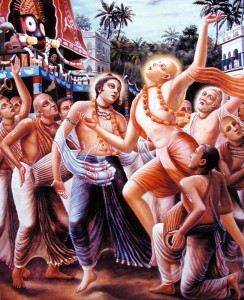
   When the Lord met Ganga Das on that occasion, He praised him to the Orissan Devotees and embraced him respectfully (Chaitanya Charitamrita 2.11.159-60). Ganga Das also participated in the kirtan before the Jagannath cart as a member of the chorus in the second kirtan group. Shrivasa Pandit was the lead singer in this group and Nityananda the chief dancer. Hari Das Thakur, Shriman Pandit, Shubhananda, Shrirama Pandit were some of the others in the same group. 
(Chaitanya Charitamrita 2.13.38-9)
 
[Excerpted from “Sri Chaitanya: His Life & Associates” by Srila Bhakti Ballabh Tirtha Maharaj] 
Ganga Dasa Pandit

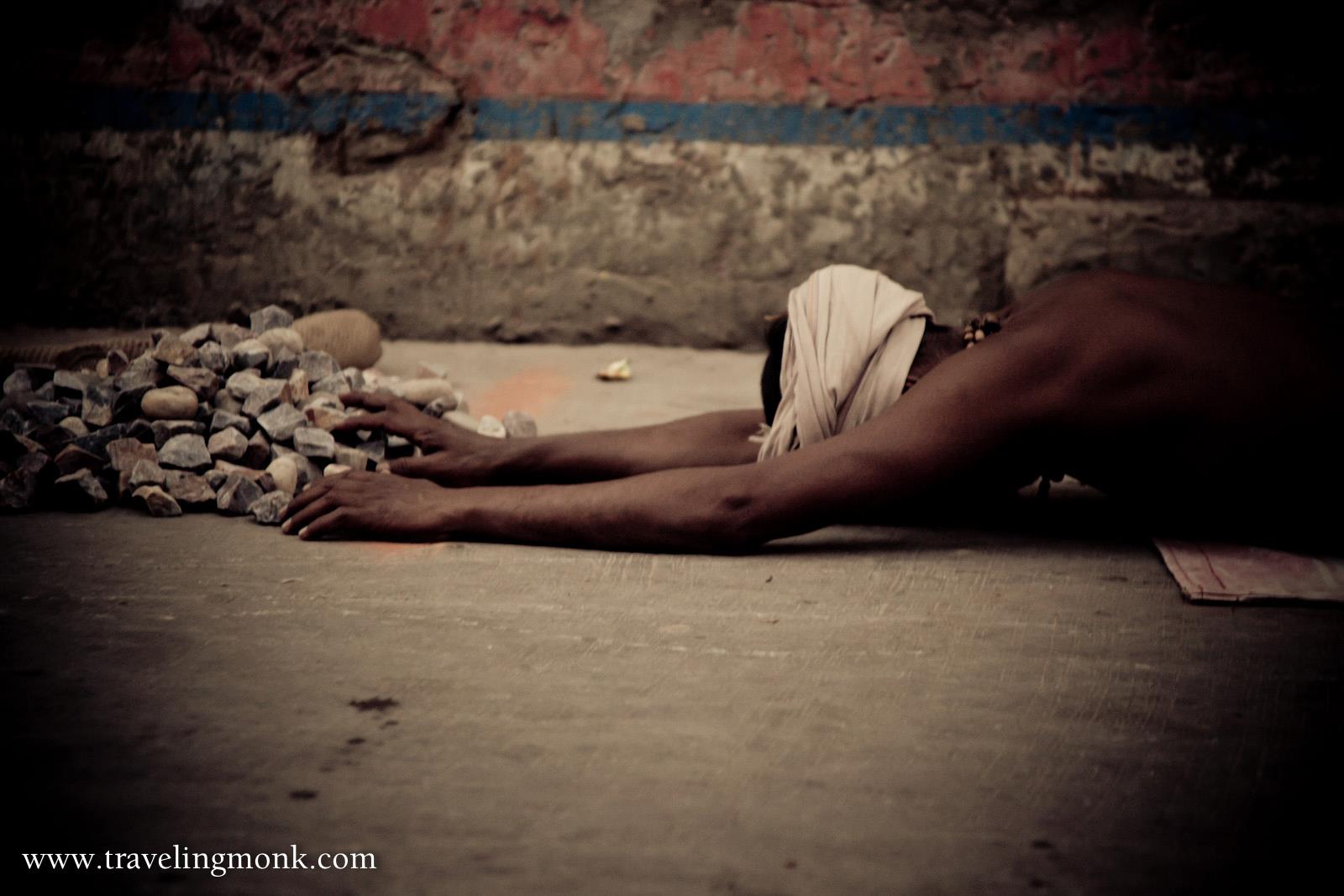
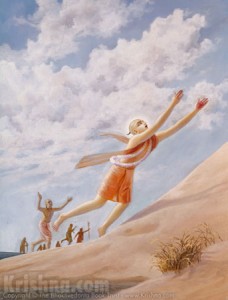
Oh Brother! Please save me this time. My caste, my life, my wealth and my body are all dependent on You. Help me by taking my family and me across the river. I will give You a silver coin and a pair of new garments. (Chaitanya Bhagavat 2.9.116) (In the image: Brajabasi is circulating Govardhana Hill with obeisances).

Damodar Pandit

shaivyo yasid vraje candi sa Damodar-panditah
kutashcit karyato devi pravishat tam sarasvati
 
   The terrible-tempered gopi named Shaivya became Damodar Pandit in Gaura lila, though occasionally the goddess Saraswati also entered into him for some special purpose.
   (Gaura-ganoddesha-dipika 159) 
   Damodar Pandit is considered to be one of Chaitanya Mahaprabhu’s branches.
   Damodar Pandit is another branch of the Chaitanya trunk. His love for the Lord was so intense that he even chastised Him. This verbal punishment so satisfied the Lord that he sent him to Nadiya. I will tell this story later.
   (Chaitanya Charitamrita 1.10.31-2)
 
Damodar Accompanies the Lord to Puri
 
   After the Lord took sannyasa in Katwa, Nityananda Prabhu tricked Him into coming to Advaita Prabhu’s house in Shantipur. Many people came from Navadwip to see Him there, one of whom was Damodar Pandit. Mahaprabhu stayed ten days in Shantipur, after which He was asked by His mother to stay in Puri where she could always have news of Him. Damodar Pandit was one of the Devotees who accompanied the Lord on His trip to Jagannath Puri. The others were Nityananda Prabhu, Mukunda Datta and Jagadananda Pandit.
 
Damodar Pandit

...He then had a vision of Mahaprabhu in a six-armed form which inspired him to compose a Sanskrit hymn to the Lord in a hundred verses. (In the image: Lord Chaitanya's shad bhuja - 6 armed form).

   When Mahaprabhu arrived in Puri, He immediately went to the Jagannath Temple where He fainted in ecstasy upon seeing Lord Jagannath. Vasudeva Sarvabhauma then took Him to his own house to take care of Him. At that time, Sarvabhauma was convinced of the mayavada philosophy, but by Chaitanya Mahaprabhu’s mercy, he gave up his predilection for these doctrines and took up the path of devotion. He then had a vision of Mahaprabhu in a six-armed form which inspired him to compose a Sanskrit hymn to the Lord in a hundred verses. He wrote the first two verses glorifying Mahaprabhu on a palm leaf and gave it to Jagadananda Pandit and Damodar Pandit to show to the Lord. Mukunda Datta was there when they came from Sarvabhauma’s house, and he took the precaution of copying the two verses down on the wall in front of the Lord’s residence before Jagadananda carried it in to show Him. As soon as Mahaprabhu saw the verses, which glorified Him as an incarnation of the Supreme Lord, He tore up the palm leaf, but because Mukunda had preserved the verses, the Devotees were able to memorize them. [Note: The verses are as found in the chapters on Jagadananda Pandit and Sarvabhauma Bhattacharya.]
 
   Mahaprabhu took sannyasa during the fortnight of the waxing moon of Magh. He arrived in Puri in the month of Phalgun and delivered Sarvabhauma Bhattacharya in the following month of Chaitra. He departed alone on his pilgrimage to Southern India in the month of Vaishakh. Nityananda Prabhu and the other Devotees He left behind in Puri they suffered greatly in His separation. Nitai had tried to persuade the Lord to take one of them as a companion, but He refused. He then apparently criticized them, while in fact praising them. Of Damodar Pandit He said:
 
   Even though I am a sannyasi and Damodar just a brahmachari, he is always telling me what to do, holding the rod of chastisement over me. He does not like me to act independently and so I do not know how to behave in front of him. By Krishna’s mercy, he does not care for public opinion whereas I cannot be indifferent to what people think.
   (Chaitanya Charitamrita 2.7.25-7)
 
   When Mahaprabhu returned from South India, getting as far as Alalanath, He sent His servant companion Krishna Das to inform Nityananda and the other Devotees that He had arrived. Damodar Pandit joined Jagadananda, Nityananda and Mukunda joyfully rushed onto the main road where they met Him.
 
   As soon as he heard that the Lord had arrived, Nityananda got up and started off to meet Him, as nothing could hold back his love. Jagadananda, Damodar Pandit and Mukunda all danced down the road, bursting with joy.
   (Chaitanya Charitamrita 2.9.339-40) 
Damodar Pandit

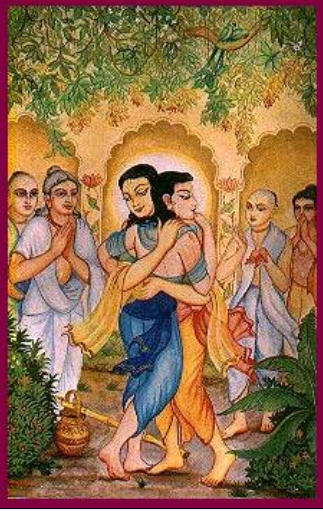
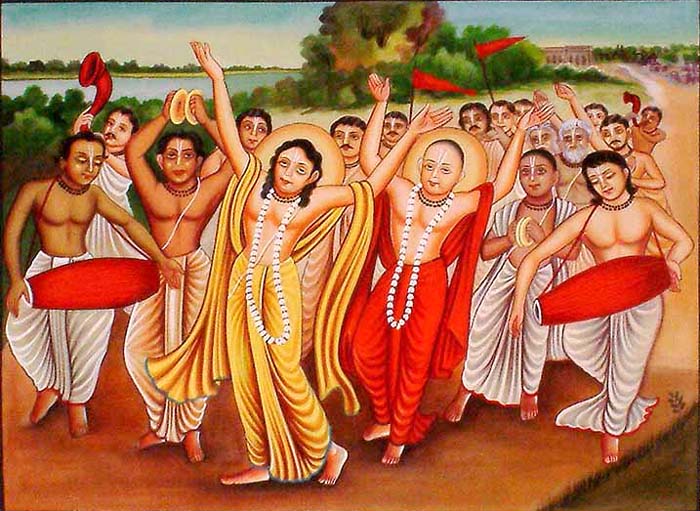
As soon as he heard that the Lord had arrived, Nityananda got up and started off to meet Him, as nothing could hold back his love. Jagadananda, Damodar Pandit and Mukunda all danced down the road, bursting with joy. (Chaitanya Charitamrita 2.9.339-40) (In the image: Lord Sri Chaitanya and Lord Sri Nityananda are embracing each other).

 
   Once he had settled back in Puri, Mahaprabhu told Sarvabhauma Bhattacharya about the behavior of Krishna Das Vipra. While in the South, Krishna Das had been seduced away from his service to the Lord by a group of Bhattathari women. Mahaprabhu somehow managed to free him from their clutches and brought him back to Puri. He then told him that he was free to go wherever he liked as he was no longer welcome to stay in his company. Krishna Das started to cry at this rejection, and out of sympathy for him, Nityananda, Damodar Pandit, Jagadananda and Mukunda discussed what to do with him. Finally, they recommended to the Lord that he be sent to Navadwip with news of the Lord’s return from His pilgrimage. The Lord approved the proposal and Kala Krishna Das set off, delighting everyone in Bengal with the good news. Later, when Damodar Pandit went back to Bengal himself, he met Kala Krishna Das.
 
Damodar’s Brother Shankara Pandit
 
   Mahaprabhu had a mixture of respect and affection for Damodar Pandit. Towards Damodar’s younger brother Shankara Pandit, however, he had pure affection unseparated by any distance. However, for his own good, he put Shankara in the care of his older brother because he knew that Damodar would keep him under strict discipline.
 
   Seeing Shankara, the Lord turned to Damodar Pandit and said, "My love for you is mixed with reverence, whereas I love Shankara with all my heart. For this reason I am putting him under your care."
   (Chaitanya Charitamrita 2.11.146-7)
 
   Damodar answered, "Shankara is younger than me, but from this day on, by your grace, I will treat him as my elder." During Mahaprabhu’s later pastimes, Shankara stayed in His direct association, sleeping in the same room. The Lord would even sleep sometimes with His feet resting on Shankara’s body, as a result of which he received the nickname prabhu-padopadhana – "Mahaprabhu’s foot pillow".
 
Damodar’s Tendency to Criticize the Lord’s Behavior
 
   One day, the Lord Himself began serving Prasad to His Devotees. Since He was engaged in serving, He was not eating. The other Devotees raised their hands and sat silently, refusing to eat until the Lord did so. Finally, Svarupa Damodar asked the Lord to sit down with Nityananda and to take Prasad. Svarupa Damodar, Jagadananda, Damodar Pandit and others then served. Only then did the Devotees feel capable of eating.
 
   When the Lord returned from the South, Maharaj Prataparudra asked several times for permission to meet with Him. When Mahaprabhu refused, he became so distraught that he threatened to give up his kingdom and become a beggar. The Lord’s Devotees were all impressed by the King’s show of devotion and wished to intervene on his behalf. Sarvabhauma Bhattacharya suggested that instead of directly asking the Lord to meet with the King, they should simply praise his faith and devotion in the hope that this would change the Lord’s attitude. Following this policy, Nityananda told the Lord of the King’s intention to become a yogi beggar if he could not have a personal audience with him. Mahaprabhu was somewhat mollified upon hearing this, but nevertheless maintained a hardline attitude. He named Damodar Pandit as a reason for such strict behavior:
 
   "It is your wish to take Me to Cuttack to meet with the King. Not only will my spiritual practice be affected by such an action, but people will criticize Me. If they do, that does not bother Me so much, but I am afraid that Damodar Pandit will chastise Me. I will not go to meet the King on your order alone. I will only go if Damodar tells Me to."
   (Chaitanya Charitamrita 2.12.23-5)
 
   Srila Bhaktivinoda Thakur comments on these verses in the following way: "Mahaprabhu said, 'I will not grant an audience to the King on your order alone. Only if Damodar Pandit commands Me shall I consider it.' These words had a particular significance: though the Lord appreciated Damodar’s devotion, his criticisms of the Lord’s behavior were often unnecessary. The Lord was thus hinting that Damodar should stop this tendency to unnecessary criticism."
   (Amrita-pravaha-bhashya, 2.12.25)
 
Damodar Pandit

"Mahaprabhu is the supremely independent Lord. He knows what should or should not be done. No insignificant jiva is going to dictate to Him what to do. The Lord is subject to devotion and the King is devoted to him, so He will surely meet with him some day. He may be supremely independent, but He is controlled by His Devotee’s love." (In the image: Lord Sri Krishna Chaitanya in Puri).

   When Damodar Pandit heard the Lord’s words, he muttered in response, "Mahaprabhu is the supremely independent Lord. He knows what should or should not be done. No insignificant jiva is going to dictate to Him what to do. The Lord is subject to devotion and the King is devoted to him, so He will surely meet with him some day. He may be supremely independent, but He is controlled by His Devotee’s love." 
 
Other Pastimes in Puri
 
   Damodar Pandit was also the Lord’s companion during the Rathayatra festival. He was one of the chorus singers in one of the seven kirtan groups in which Svarupa Damodar was the lead singer. Advaita Acharya danced in the same group.
 
   When Mahaprabhu set off for Vrindavan through Gaudadesha with many of His associates, including Damodar Pandit. On this occasion, the Lord did not make it all the way to Vraja, as He changed His mind on Sanatana Goswami’s advice.
 
   The following year, Mahaprabhu traveled through northern India, going as far as Vrindavan. He then returned to Puri with Balabhadra on the path through Jhariikhanda. When they received the news of the Lord’s arrival in Atharo Nala, all the Lord’s Devotees rushed there to welcome Him back. The Lord’s affectionately embraced each one of them.
 
Mahaprabhu and the Widow’s Son
 
   There was an Orissan widow living in Puri while Mahaprabhu was there. She had a handsome young son who would come to visit the Lord daily. He would pay his obeisances to the Lord and then engage Him in a lengthy, affectionate conversation. The boy came to love the Lord as he loved himself and was not able to go through a day without seeing Him. The Lord also treated the boy with great warmth. Damodar Pandit, however, could not tolerate seeing the affectionate relationship between the Lord and this boy. Though he repeatedly forbade him, the boy continued to come to see the Lord. A child will naturally go where he receives affection and the Lord was indeed very affectionate to him.
One day, Damodar Pandit finally exploded and said sarcastically to the Lord,
 
   "Everyone says You are very learned because of the instructions You so generously give to others. I shall see what kind of master You really are. Now people will glorify You for being a great master and You will truly be famous as a master throughout Puri."
   (Chaitanya Charitamrita 3.3.11-12)
 
   The Lord did not understand at first what Damodar was getting at and made him explain himself. The Pandit made himself more explicit, "Lord, You do as You like. No one has the authority to dictate to You. Even so, this is a world full of gossips whose speech no one can stifle. You are learned, so why don’t You Yourself see the implications of Your acts? Why do You behave so affectionately towards a widow’s child? She may be an austere and chaste Brahmin woman, but she has the fault of being young and beautiful. You too are a young and handsome man. Such a close relationship with her son gives the world occasion to whisper. Do You think that this is intelligent behavior?" With that, Damodar fell silent. Mahaprabhu was satisfied with his sentiments and said:
 
   "This is what I call a wave of pure love! No one is as intimate an associate as Damodar."
   (Chaitanya Charitamrita 3.3.17)
 
Mahaprabhu Sends Damodar to Nadiya
 
   One day Mahaprabhu called Damodar Pandit and asked him to go to Sachi Mata in Navadwip and to help supervise her material affairs.
   "No one is more suited than you to act in her protection, for you have warned even Me. Amongst My associates, there is no one more impartial than you. Religious principles can only be defended by someone who is free from bias or prejudice."
   (Chaitanya Charitamrita 3.3.22-3)
 
   After telling Damodar to return to Navadwip, He then consoled him by telling him to return to Puri from time to time. He also told him to pay repeated obeisances to His mother and gave him a confidential message to deliver to her:
 
Damodar Pandit

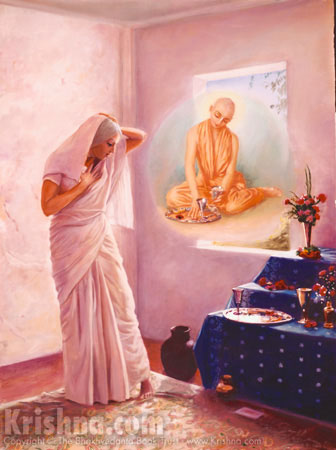
"... During the last Magh-sankranti festival, she cooked a variety of vegetables, condensed milk, cakes and sweet rice for Me. She then offered the food to Lord Krishna, and while in meditation, I suddenly appeared and her eyes filled with tears. When she saw Me come there in great haste and eat everything, she felt great happiness. But a moment later, after she had wiped her eyes, she saw that the plate she had offered Me was empty and thought, 'I dreamt that Nimai was eating everything.'" (In the image: Lord Chaitanya is eating the offerings of Sachi Mata).

   "Tell her that I am happy, as this will give her happiness. Tell her that I have sent you to tell you of My personal activities. After you have warmed her heart in this way, remind her of one most secret event: I come to her home repeatedly to eat all the sweetmeats and vegetables she offers. She experiences My coming and eating of the offerings to be real, but because of external separation, she thinks that it is nothing but a dream. During the last Magh-sankranti festival, she cooked a variety of vegetables, condensed milk, cakes and sweet rice for Me. She then offered the food to Lord Krishna, and while in meditation, I suddenly appeared and her eyes filled with tears. When she saw Me come there in great haste and eat everything, she felt great happiness. But a moment later, after she had wiped her eyes, she saw that the plate she had offered Me was empty and thought, 'I dreamt that Nimai was eating everything.'"
 
   "In the condition of external separation, she again became bewildered, thinking that she had not offered any food to Lord Vishnu. She went back to the kitchen to look at the cooking pots and found that every one of them was still filled with food. So she cleansed the altar and made the offering once again. This is how I come again and again to eat everything she offers me, for I am attracted by her pure love. I reside in Nilachala only because she told Me to. Even still, she repeatedly pulls Me back to her out of her great love for Me."
(Chaitanya Charitamrita 3.3.19-39)
 
   Mahaprabhu then gave some Jagannath Prasad to Damodar Pandit and told him to give it to Sachi Mata and the other Navadwip Devotees. Damodar set off and carried out the Lord’s instructions to the letter. With the Pandit there in Navadwip, the Devotees became very careful about their behavior. No one dared to act in an independent manner. If anyone of Mahaprabhu’s followers made even the slightest transgression in etiquette, Damodar Pandit would establish the standards of behavior by verbally punishing the offender.
 
   The ignorance of atheism will flee from anyone who hears this history of Damodar Pandit’s chastisement of the Lord which has just been described.
   (Chaitanya Charitamrita 3.3.46)
 
   Damodar Pandit is thus one of the great Devotees through whose preaching, the glories of the Holy Name have spread throughout the universe. Mahaprabhu glorified these great souls when He said,
 
   "I have come to possess devotion to Krishna through the grace of all these great Devotees who have preached love for the Holy Name throughout the world."
   (Chaitanya Charitamrita 3.7.50)
 
   In the Bhakti-ratnakara, Narahari Chakravarti says that Narottama Das Thakur met Damodar Pandit in Navadwip. Narottama paid his obeisances to his feet in excitement at meeting a direct associate of the Lord.
(Bhakti-ratnakara 8.93)
 
[Excerpted from “Sri Chaitanya: His Life & Associates” by Srila Bhakti Ballabh Tirtha Maharaj] 
Damodar Pandit

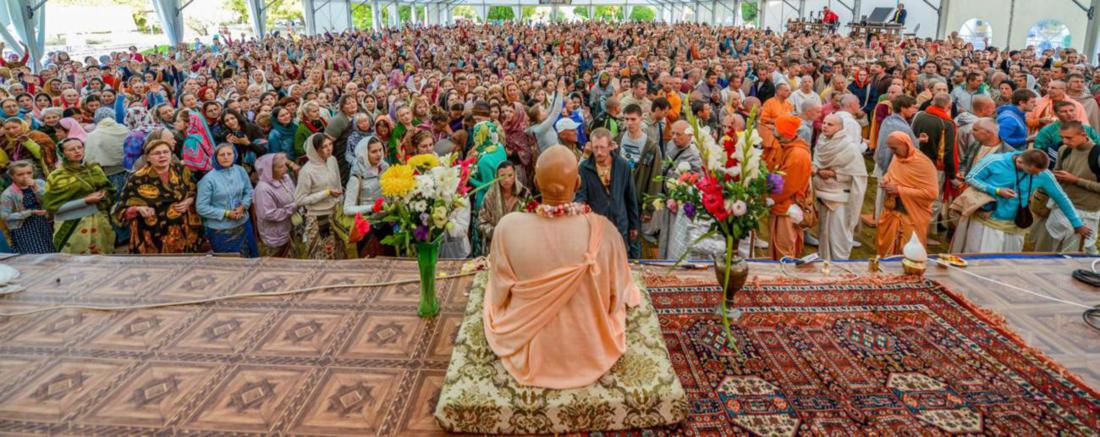
"I have come to possess devotion to Krishna through the grace of all these great Devotees who have preached love for the Holy Name throughout the world." (Chaitanya Charitamrita 3.7.50) (In the image: The Bhakti Sangam festival in Ukraine).

Bijali Khan

   Sri Bijali Khan was a Pathan Muslim. Even so, after receiving Mahaprabhu’s mercy, he became well-known as a Vaishnava. His father was a rich man. Krishnadas Kaviraj Goswami has described how he met the Lord and received His mercy in the eighteenth chapter of the Madhya-lila.
 
Mahaprabhu Leaves Vraja
 
Bijali Khan

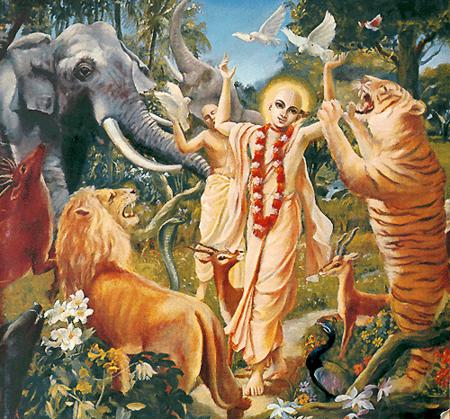
Lord Chaitanya made all animals to chant and dance in the Jarikhanda forest.

   That year, Mahaprabhu took the Jharikhanda route to Vrindavan after the Rathayatra festival. Ramananda Raya and Svarupa Damodar Goswami arranged for two people to accompany him, Balabhadra Bhattacharya and another Brahmin servant. As he travelled, his absorption in ecstatic love increased a hundredfold over that which he experienced in Puri. Upon arriving in Mathura, it increased a thousandfold, and when he went through the twelve forests of Vraja, it increased a hundred-thousandfold. 
 
   As he was wandering through the twelve forests, the Lord came to the place known as Akrura Ghat on the Yamuna. The Lord jumped into the water and remained immersed for a long time. Krishna Das, a Rajaputa who had been attracted by the Lord and was accompanying Him, became afraid that the Lord had drowned and started to cry out for help. Balabhadra Bhattacharya heard his shouts and quickly dove into the water to pull the him out.
 
   Balabhadra was anxious about the Lord’s great distraction due to his divine ecstasies and so he discussed with Madhavendra Puri’s disciple, the Sanoriya Brahmin, about what could be done to protect him. After some discussion, they decided that the best thing to do was to propose to Mahaprabhu that he go to Soro-kshetra on the banks of the Ganges for the full-moon bath at the end of the month of Magh, known also as Makara-sankranti. From there, they could take him on to Prayag. The Rajaputa Krishna Das and the Mathura Brahmin were well acquainted with the route along the Ganges and so they remained with the Lord and the two Brahmins as guides.
 
   As they tired from walking, the Lord sat down underneath a tree. Nearby, a herd of cows was grazing which reminded the Lord of Krishna’s Vrindavan lila. Suddenly, the cowherd began to play his flute causing Mahaprabhu to faint in ecstasy. He fell to the ground, his breathing stopped and foam accumulated around his mouth.
 
Bijali Khan Ties up the Lord’s Companions
 
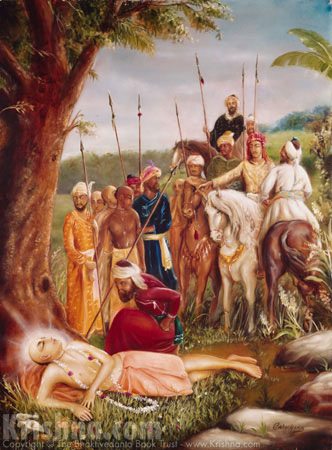
   At this very moment, the Muslim soldier, Bijali Khan was passing by with a troop of ten cavalrymen. His immediate suspicion on seeing the Lord’s condition was that the four men accompanying him had poisoned him with datura in order to steal his money. 
Bijali Khan

The Pathan immediately bound the Lord’s four companions, intending to kill them, causing the two Bengali Brahmins to tremble in fear. The two others, however, were fearless and quickly thought of a way out of the situation. The Sanoriya Brahmin explained to the Pathan as follows: "I am a Brahmin from Mathura and I know hundreds of people in the Emperor’s court. This sannyasi is my Guru and he happens to be ill, which makes him faint from time to time. Tie us up and wait for a few minutes. He will regain consciousness and you will hear the truth from Him."

 
   The Pathan immediately bound the Lord’s four companions, intending to kill them, causing the two Bengali Brahmins to tremble in fear. The two others, however, were fearless and quickly thought of a way out of the situation. The Sanoriya Brahmin explained to the Pathan as follows: "I am a Brahmin from Mathura and I know hundreds of people in the Emperor’s court. This sannyasi is my Guru and he happens to be ill, which makes him faint from time to time. Tie us up and wait for a few minutes. He will regain consciousness and you will hear the truth from Him."
 
   The Pathan listened and said, "I can understand what you two are saying. You are from Mathura, but these two Bengalis are trembling with guilt. They must have done something wrong."
 
   The Rajaputa Krishna Das was acutely aware of the danger of the situation and said, "I live in the neighboring village. I have two hundred Turkish mercenaries with a hundred cannons at my command. I only have to shout and they will come here and take your horses and equipment. I think that you must be highwaymen, not these two Bengalis. You are only interested in robbing pilgrims like us."
 
   The Muslim cavalrymen were cast into doubt by these fearless words. Meanwhile, the Lord came back to consciousness and in a transport of ecstasy, shouted out the names "Hari! Hari!" and began to dance. The Pathan soldiers were overcome by fear when they heard the Lord bellow and saw his ecstatic dancing. They immediately liberated their four prisoners and the Lord never saw his Devotees tied up. They were attracted by the Lord’s physical beauty and by his spiritual mood and they asked him the question which had been troubling them: were these four people robbers who had drugged Him in order to steal His possessions?
 
   The Lord answered, "I am a sannyasi and I live by begging. I have no wealth. These four men are my followers. I sometimes suffer from epilepsy and fall unconscious as a result. These four companions mercifully stay with me when this happens to protect me and take care of me."
 
The Lord Discusses Religion with a Sufi
 
   In the group of cavalrymen, one Muslim dressed all in black introduced himself as a Sufi practitioner. He was pleased by the Lord’s appearance and wished to discuss scriptures with him. He established that the Supreme Truth was impersonal on the basis of the Islamic scriptures. The Lord, however, displayed his own knowledge of the Qur’an and demonstrated the invalidity of the Sufi’s arguments, establishing the personal nature of the Supreme Truth and the Supreme Lord’s transcendental qualities. Then the Lord went on to show that the philosophies of karma, jïana and yoga did not hold the answers to the supreme goal of life, which is nothing other than pure love of God.
 
   All the Pathans were enchanted by the Lord’s physical appearance and were even more attracted when they heard him speak on spiritual life and its goal. The Sufi Pathan began spontaneously to chant the names of Krishna. When Mahaprabhu hear the saintly Muslim chant the Lord’s names, he was pleased, thinking that all the sins that he had accumulated over millions of births had all been destroyed and that he had been purified. The Lord told them all to chant, which they did. He initiated the Sufi Pathan in the Holy Name and gave him the name Rama Das. When the prince Bijali Khan saw the good fortune of his own servant, he fell down at the Lord’s feet and repeated the name, "Krishna, Krishna." The Lord also blessed him.
 
   "After bestowing his mercy upon them in this way, Mahaprabhu continued on his way. All the Muslim soldiers then became mendicants and were celebrated as the Pathan Vaishnavas. They toured all over the country, glorifying Mahaprabhu’s activities. Bijali Khan became a greatly advanced Devotee, and his fame was sung at every holy place of pilgrimage."
(Chaitanya Charitamrita 2.18.210-2)
 
[Excerpted from “Sri Chaitanya: His Life & Associates” by Srila Bhakti Ballabh Tirtha Maharaj] 
Bijali Khan

In the group of cavalrymen, one Muslim dressed all in black introduced himself as a Sufi practitioner. He was pleased by the Lord’s appearance and wished to discuss scriptures with him. He established that the Supreme Truth was impersonal on the basis of the Islamic scriptures. The Lord, however, displayed his own knowledge of the Qur’an and demonstrated the invalidity of the Sufi’s arguments, establishing the personal nature of the Supreme Truth and the Supreme Lord’s transcendental qualities.

Buddhimanta Khan

Buddhimanta Khan

...One night, Suvarna Sena saw Gaura and Gadadhara with all their associates in a dream. When he awoke, the King cried out in distress from the loss of the vision. Suddenly, he heard a voice from the sky which told him that when Mahaprabhu appeared again in the Age of Kali, then the King would also take birth as Buddhimanta Khan in order to expand the Lord’s pastimes. (In the image: Lord Gouranga and Gadadhara Pandit and Their associates perfroming Sankirtana yagya).

   Buddhimanta Khan was very dear to Lord Chaitanya Mahaprabhu. He was one of the Lord’s greatest servants who obeyed him from the time of his birth.
(Chaitanya Charitamrita 1.10.74)
 
Buddhimanta’s Previous Life
 
   Buddhimanta Khan is considered to be one of Chaitanya’s branches. In his Nabadvipa-dhama-mahatmya, Srila Bhaktivinoda Thakur has written the following in connection with the village of Suvarna Bihar in Godrumadvipa: “In the Satya Yuga, a pious king named Suvarna Sena lived in this village of Suvarna Bihar. Through the blessings of Narada Muni, this king obtained love for Radha and Krishna as well as for their joined form, Sri Gauranga Mahaprabhu. One night, Suvarna Sena saw Gaura and Gadadhara with all their associates in a dream. When he awoke, the King cried out in distress from the loss of the vision. Suddenly, he heard a voice from the sky which told him that when Mahaprabhu appeared again in the Age of Kali, then the King would also take birth as Buddhimanta Khan in order to expand the Lord’s pastimes.”
 
Buddhimanta's Charitable Works
 
   Buddhimanta lived in Navadwip. He and Mukunda Sanjaya were amongst the richest people in the town. They performed charitable works such as providing medicines and treatment for the poor who fell ill. Once, when the Lord was undergoing ecstatic transformations as a householder, the other Devotees called Buddhimanta Khan in order to see to his treatment.
 
Buddhimanta Khan

Buddhimanta paid for all the costs of Mahaprabhu’s wedding when he married for the second time, to Vishnupriya, the daughter of a local zamindar’s priest, Sanatan Mishra.

   Buddhimanta paid for all the costs of Mahaprabhu’s wedding when he married for the second time, to Vishnupriya, the daughter of a local zamindar’s priest, Sanatan Mishra. He participated in all of Mahaprabhu’s Navadwip pastimes–in the kirtans at Shrivasa Angana, at Chandrasekhara’s house, in the public kirtans, the liberation of Jagai and Madhai, and the water sports in the Ganges.
 
Buddhimanta at Chandrasekhara’s House
 
   One day Mahaprabhu revealed his desire to put on a play about Vraja lila and dance in the mood of Maha Lakshmi. He told Buddhimanta Khan that he wanted him to take responsibility for the costumes and decorations. He himself dressed Mahaprabhu.
 
Mahaprabhu said: "Buddhimanta Khan! Go quickly and arrange for costumes for today I shall dance.” Upon receipt of the order, Sadashiva [and] Buddhimanta Khan immediately returned home, feeling unlimited joy. The Devotees immediately put up an awning of bamboo and cloth and there started dressing the actors in the play. Buddhimanta brought the costumes and placed them before the Lord.
(Chaitanya Bhagavat 2.18.13-16)
 
   Look here. This is the house of Chandrasekhara Acharya. The Lord came here with his dearest associates. Sadashiva and Buddhimanta Khan took charge of the costumes and dressing the actors.
(Bhakti-ratnakara 12.2902-3)
 
   When Mahaprabhu took sannyasa in Katwa, he went to Shantipur where he met with all the Navadwip Devotees, including Buddhimanta Khan. He also accompanied the Bengali Devotees to Puri to see the Lord. The Lord also lovingly accepted Buddhimanta Khan and the Bengali Devotees’ gifts of foodstuffs, etc., which they brought to Puri for him.
 
   Buddhimanta Khan, for whom the Lord’s order had been the only interest from his very birth, also went.
(Chaitanya Bhagavat 3.8.30)
 
[Excerpted from “Sri Chaitanya: His Life & Associates” by Srila Bhakti Ballabh Tirtha Maharaj]

Bhagavan Acarya

   Bhagavan Acharya was said to be Gauranga Mahaprabhu’s expansion.
 
acaryam bhagavantam tu tejomaya-kalevaram
yasya smarana-matrena gaura-prema prajayate
 
[I offer obeisances to] Bhagavan Acharya, whose powerful body is filled with effulgence. Just by remembering him, one will develop love for Gauranga Mahaprabhu.
(Shakha-nirnayamrita)
 
   Bhagavan Acharya was originally from the town of Halisahar, which is in the 24 Pargana district. Krishnadas Kaviraj Goswami writes that he is considered to be Chaitanya’s branch along with Brahmananda Bharati, Shikhi Mahiti and Murari Mahiti.
(Chaitanya Charitamrita 1.10.136)
 
   It is written in the Gaudiya Vaishnava Abhidhana that Bhagavan Acharya appeared in Sri Dham Nabadwip, but left to live in Halisahar. His father Shatananda Khan was a wealthy materialist, while he himself was a scholar and a great Vaishnava who worshiped in the mood of friendship. Bhagavan Acharya was a householder. His son was named Raghunath Acharya. Both he and his son accompanied Jahnava Mata to Kheturi.
(Bhakti-ratnakara 10.382)
 
   The following further information is found in the Gaudiya Vaishnava Abhidhana: "Bhagavan Acharya was particularly advanced in the study of logic, so much so that he received the title of Nyayacharya. When his father saw that he was developing the renounced spirit at a young age, he arranged for his marriage with the daughter of Nabadwip’s Madhusudana Ghataka. Despite this, Bhagavan Acharya overcame the entanglements of his householder life to go to live in Puri with the Lord. Mahaprabhu enjoined him to return to his wife, however, and so he came back to Bengal. He had two sons Raghunath and Ramanatha. Nevertheless, Bhagavan Acharya was unable to remain for long in householder life and he ultimately gave the responsibility for his wife and children to his brother-in-law and disciples. He then took the renounced order and returned to Puri to live with the Lord."
 
Bhagavan Acharya in Puri
 
   When the Devotees heard that Mahaprabhu had returned from South India, they rushed to see Him. Bhagavan Acharya renounced everything and came to live there near the Lord.
Ramabhadra Acharya and Bhagavan Acharya came to live near the Lord, giving up all other duties.
(Chaitanya Charitamrita 2.10.184)
 
   Bhagavan Acharya was a great Devotee, a scholar and a man of refined habits. He came to Purushottam to be with the Lord. He was an incarnation of a cowherd who served Krishna in the mood of friendship. His dealings with Svarupa Damodar were also those of a close friend. He was completely surrendered to the Lord’s lotus feet, and he occasionally invited him to eat at his residence. He made various vegetable preparations which he personally served to the Lord.
(Chaitanya Charitamrita 3.2.84-7) 
Bhagavan Acarya

Bhagavan Acarya was present when Mahaprabhu went to greet Advaita Acharya, along with Kashishvara Pandit, Pradyumna Mishra and others. He was also present when Mahaprabhu went into an ecstatic trance and fell into the ocean, after taking the dunes on the beach to be Govardhana.

 
   Bhagavan Acharya would not brook any materialistic conversation, only listening to Krishna’s name, form, qualities and pastimes (Chaitanya Bhagavat 3.3.188). He was one of the many Devotees who came to meet Mahaprabhu in Puri after the Lord delivered Sarvabhauma Bhattacharya.
 
   The great personality Bhagavan Acharya arrived. Mundane topics never entered his ears.
(Chaitanya Bhagavat 3.3.188)
 
   He was present when Mahaprabhu went to greet Advaita Acharya, along with Kashishvara Pandit, Pradyumna Mishra and others. He was also present when Mahaprabhu went into an ecstatic trance and fell into the ocean, after taking the dunes on the beach to be Govardhana.
 
   Paramananda Puri, Brahmananda Bharati and others ran to the beach while Bhagavana Acharya, being lame, followed them as quickly as he could.
(Chaitanya Charitamrita 3.14.90)
 
   One day Bhagavan Acharya wanted to feed Mahaprabhu nicely and sent Chota Hari Das to beg for fine rice from Madhavi Devi. While eating, Mahaprabhu learned of this and became angry and ostracized Chota Hari Das. He said that for a renunciate to talk to a woman is worse than drinking poison.
 
prabhu kahe – vairagi kare prakriti sambhashana
dekhite na paron ami tahara vadana
 
   The Lord said, "I cannot look upon the face of a someone who after taking the vows of renunciation continues to converse with women."
(Chaitanya Charitamrita 3.2.117)
 
Bhagavan Acharya’s Brother, Gopal
 
   Bhagavan Acharya was a generous and unpretentious Vaishnava. Because of these qualities he was particularly dear to Mahaprabhu. The following account of his simplicity is given in the Chaitanya Charitamrita:
 
   Bhagavan Acharya’s younger brother, Gopal Bhattacharya, had been to Kashi where he had studied Vedanta. After finishing his studies, he came to Puri to see his older brother who was quite pleased to hear that he had become learned in the field. With great enthusiasm, Bhagavan Acharya to introduce him to Mahaprabhu. The Lord, being the indweller of all beings, knew that Gopal was a mayavadi, so he was not delighted to meet Him. Even so, he formally showed a polite affection.
 
   The simple, straightforward Bhagavan Acharya went to Svarupa Damodar and asked him to hear his brother speak on Shankara’s Vedanta-bhashya: "Gopal, my younger brother, has come here after finishing his study of Vedanta philosophy. Please come and hear the Vedanta commentary from him."
 
   Svarupa Damodar Goswami, however, somewhat angry due to his love for Bhagavan Acharya, chastised him as follows:
 
   "You have lost your intelligence in the association of Gopal, and now you are eager to hear the Mayavada philosophy. When a Vaishnava listens to the Shariraka-bhashya, the Mayavada commentary upon Vedanta-sutra, he gives up the attitude that the Lord is the master and the living entity is his servant. Instead, he considers himself to be the Supreme Lord. The Mayavada philosophy is so dangerous that even a highly elevated Devotee who has accepted Krishna as his life and soul changes his attitude if he studies it."
(Chaitanya Charitamrita 3.2.94-6)
 
   Bhagavan Acharya continued, even though he had been chastised by Svarupa Damodar: "The Devotees are all fixed at the lotus feet of Krishna in heart and soul. Listening to the Shariraka-bhashya could not possibly have a negative effect on them."
 
   Svarupa Damodar answered with a furhter warning about the dangerous effects of the Mayavada philosophy. He said, "When we hear the Mayavada philosophy, not only do we hear that Brahman is the only spiritual reality and that the universe of maya is false, but we gain no spiritual understanding. When a Devotee hears the Mayavadi say that the living entity is only imaginary and that the Supreme Lord is a manifestation of ignorance, it breaks his heart and soul."
(Chaitanya Charitamrita 3.2.98-99)
 
   Svarupa Damodar’s remarks made Bhagavan Acharya ashamed and a little afraid, so sent his brother Gopal back to Bengal.
 
The poet from East Bengal
 
   One day a poet came to Puri from eastern Bengal who wrote poetry according to his own whim. He had also written a play about Mahaprabhu. Since he knew Bhagavan Acharya personally, he read the play to him and afterwards to the other Devotees, all of whom praised his work. They felt that Mahaprabhu should hear his play, being under the impression that he would enjoy it. Svarupa Damodar would normally censor literary works before allowing them to be read to the Lord, however; he would examine them for improper presentation of devotional sentiment and doctrine. Only if he approved could any work of poetry be presented to Mahaprabhu for his enjoyment. Since his friend Bhagavan Acharya had praised the literary qualities of the play, Svarupa Damodar finally agreed to read it after repeated requests. As soon as the poet read the invocation verse and explained it, however, and even though all the Devotees were pleased, Svarupa Damodar pointed out two faults which had an offensive character. 
Bhagavan Acarya

"You are a fool and have brought ill fortune upon yourself, for you have no faith in either of the two Lords, Jagannathdeva or Sri Chaitanya Mahaprabhu. Lord Jagannath is completely spiritual and full of transcendental bliss, but you have said that he is nothing but a dull, destructible body composed of the inert, external energy. At the same time, you have said that Sri Chaitanya Mahaprabhu, who is the Supreme Personality of Godhead, full in six opulences, is an ordinary living being, a spark of spiritual energy rather than the supreme fire. You have committed offenses to both Lords. This is what happens when someone who knows no theology tries to glorify the Lord.

 
   The poet’s explanation was as follows:
 
   "Lord Jagannath is a most beautiful body, and Sri Chaitanya Mahaprabhu, who is exceptionally grave, is the owner of that body. Sri Chaitanya Mahaprabhu has appeared here in Puri to spiritualize the entire dull material world."
(Chaitanya Charitamrita 3.5.114-5)
 
   Hearing this glorification of the Lord, everyone present was delighted. Svarupa Damodar alone was not and he began to speak in great anger.
 
   "You are a fool and have brought ill fortune upon yourself, for you have no faith in either of the two Lords, Jagannathdeva or Sri Chaitanya Mahaprabhu. Lord Jagannath is completely spiritual and full of transcendental bliss, but you have said that he is nothing but a dull, destructible body composed of the inert, external energy. At the same time, you have said that Sri Chaitanya Mahaprabhu, who is the Supreme Personality of Godhead, full in six opulences, is an ordinary living being, a spark of spiritual energy rather than the supreme fire. You have committed offenses to both Lords. This is what happens when someone who knows no theology tries to glorify the Lord.
 
   "Furthermore, you have made another great error. You have made a distinction between the Lord and His body. Such a distinction does not exist, for the Lord’s body and his identity are one. This is a great offense. At no time is there a distinction between the body and soul of the Supreme Personality of Godhead. His personal identity and His body are made of blissful spiritual energy. There is no distinction between them."
(Chaitanya Charitamrita 3.5.117-122)
 
   When he saw the poet’s distress at being criticized, Svarupa Damodar became compassionate and told him to take shelter of a pure Devotee,
 
jaho bhagavata pario vaishnavera sthane
ekanta ashraya karo caitanya-carane
caitanyera bhakta-ganera nitya karo sanga
tabe to janiba siddhanta-samudra-taranga
(Chaitanya Charitamrita 3.5.131-2)
 
   Go and study the Bhagavat from a Vaishnava. Take exclusive shelter of Chaitanya Mahaprabhu’s lotus feet. Associate constantly with the devotees of Chaitanya Mahaprabhu. Only then will you be able to understand all the waves of the ocean of Vaishnava philosophy.
 
   The Brahmin poet was amazed, ashamed and afraid, all at once. Svarupa Damodar was kind to him and showed him how his own verse could be reinterpreted to glorify Krishna. When he gave an elaborate explanation to the poet, he had a change of heart and surrendered to the Lord’s Devotees.
 
[Excerpted from “Sri Chaitanya: His Life & Associates” by Srila Bhakti Ballabh Tirtha Maharaj] 
Bhagavan Acarya

"Furthermore, you have made another great error. You have made a distinction between the Lord and His body. Such a distinction does not exist, for the Lord’s body and his identity are one. This is a great offense. At no time is there a distinction between the body and soul of the Supreme Personality of Godhead. His personal identity and His body are made of blissful spiritual energy. There is no distinction between them." (Chaitanya Charitamrita 3.5.117-122) (In the image: Sri Sri Gour-Nitay Deities, Chennai ISKCON Temple, Tamil Nadu.)


Achyutananda


Achyutananda

Some say that he was Karttikeya in his previous incarnation.

   yogamaya bhagavati grihini tasya sampratam
sitarupenavatirna shrinamna tat-prakashatah
tasya putro’cyutanandah krishna-caitanya-vallabhah
shrimat-pandita-gosvami-shishyah priya iti shrutah
yah karttikeyah prag asid iti jalpanti kecana
kecid ahu rasavido “cyuta-namni tu gopika
ubhayam tu samicinam dvayor ekatra sangatat
karttikeyah krishna-mishras tat-samyad iti kecana
 
   The goddess Yogamaya was Advaita Acharya’s wife, having appeared as Sita; his other wife Sri was her expansion. Advaita’s son Achyutananda was very dear to Sri Krishna Chaitanya. He became a dear disciple of Srila Gadadhara Pandit Goswami. Some say that he was Karttikeya in his previous incarnation, while others who are knowledgeable about sacred rapture say that he was the gopi named Achyuta. Both opinions are reasonable because both identities are joined in him. Some people hold that his brother Krishna Mishra was also Karttikeya, due to his similarity to him.
   Achyutananda was born as the son of Advaita Acharya and Sitadevi in the town of Shantipur in the year 1428 Shaka (1506 AD). He was Advaita’s oldest son and is counted as a Chaitanya branch of the tree of devotion.
 
shri-caitanyamarataror dvitiya-skandha-rupinah
shrimad-advaita-chandrasya shakha-rupan numah
 
   I offer my obeisances to all the branches of Sri Advaita Candra, who is the second trunk of the eternal Chaitanya tree.
(Chaitanya Charitamrita 1.12.3)
   Achyutananda was one of Advaita Prabhu’s major branches; from his very birth, he served Chaitanya’s lotus feet.
(Chaitanya Charitamrita 1.12.13)
 
Advaita’s Six Sons
 
   Advaita Acharya had six sons, of whom three, Achyutananda, Krishna Mishra and Gopal Mishra are considered to have understood the essence of spiritual life, while the other three, Balaram, Svarupa and Jagadisa, did not. The book Advaita-carita describes this as follows:
acyutah krishna-mishrash ca gopala-dasa eva ca
ratna-trayam idam proktam sitagarbhadi-sambhavam
acarya-tanayeshvete trayo gaura-ganah smritah
caturtho balaramash ca Svarupah païcamah smritah
shashthas tu jagadishakhya acarya-tanayo hi shat
 
   The three sons Achyuta, Krishna Mishra and Gopal Das were born in the womb of Sitadevi and are called the three jewels. Amongst Advaita’s sons, these three were members of Gaura’s inner circle. His fourth son was Balaram, his fifth son Svarupa and the sixth, Jagadisa.
   Srila Bhaktivinoda Thakur paraphrases Krishnadas Kaviraj’s explanation in his Amrita-pravaha-bhashya: “At first, all of Advaita Prabhu’s followers were of a common opinion, but in the course of time, some unfortunately adopted differing doctrines. Those who followed the opinions of Advaita himself are considered to be pure Vaishnavas; those who under some fateful influence rejected his teachings and invented a new doctrine are considered useless. We have no need of knowing the names of the useless sons of Advaita Prabhu, but have listed them together in order to be able to distinguish them. Just as the useful rice grain is separated from the chaff by winnowing, so have the useful sons of Advaita been separated from the useless.”
 
   The doctrines of Advaita Acharya are the essential teachings of spiritual life; those who ignored his orders became useless.
(Chaitanya Charitamrita 1.12.10)
 
   All those who took Achyutananda’s opinion belong to the group of Advaita Acharya’s associates. They are great Devotees who received his mercy and easily attained the lotus feet of Chaitanya Mahaprabhu.
(Chaitanya Charitamrita 1.12.73-4)
 
Mahaprabhu’s Mercy on the Child Achyutananda
 
   After taking sannyas in Katwa, Mahaprabhu descended on Shantipur. Achyutananda was either three or five years old (as Vrindavan Das Thakur gives both ages in different places).
Advaita’s son Achyutananda, a gloriously effulgent naked child, was omniscient by the Lord’s inconceivable power. Greatly fortunate, he was Advaita’s worthy heir. His entire body was covered with dust, but knowing the Lord had arrived he came to see him, his face covered with laughter. He fell at the Lord’s feet and the Lord picked him up, dust and all, and held him on his lap.
(Chaitanya Bhagavat 3.1.213-6)
 
   While holding him, Mahaprabhu said to Achyutananda: “Since Advaita is my father, you are my brother.” When he heard this, Achyuta responded by displaying a profound understanding of Mahaprabhu’s spiritual identity by saying that the Lord was the friend of every single living being, and that all scriptures say that he is the father of all the creation. The Devotees were astonished when they heard Achyuta say this.
 
The Wisdom of Achyutananda at Five
 
   In the fourth chapter of the Antya-khanda, Vrindavan Das Thakur writes about Achyutananda’s single-minded devotion to Chaitanya Mahaprabhu in the following way: One day, a sannyasi came to visit Advaita Prabhu’s house and asked him what the relationship between Chaitanya Mahaprabhu and Keshava Bharati was. Advaita answered in a conventional way, saying that Keshava Bharati was the Lord’s sannyas guru. The five year old child interjected angrily, “The Lord is the spiritual master of all the gurus of the world; he is the Supreme Lord Himself. How could anyone be His guru?” When Advaita heard this wisdom from the mouth of his five-year old son, he said, “This boy is my father and I am his son!” And he asked his son forgiveness for his offense–causing the lad to hang his head with embarrassment. Krishnadas Kaviraj Goswami has also summarized this story beautifully:
   When Achyutananda heard from his father that Keshava Bharati was Lord Chaitanya Mahaprabhu’s spiritual master, he was very unhappy. He told his father, “Your teaching about the supreme teacher, Chaitanya Mahaprabhu, will wreak havoc in the country. Lord Chaitanya Mahaprabhu is the spiritual master of the fourteen worlds, but you say that someone else is his spiritual master. This is not supported by any revealed scripture.” When Advaita Acharya felt great satisfaction to hear his five-year-old son Achyutananda display such an understanding of doctrine.
(Chaitanya Charitamrita 1.12.14-7)
 
   Mahaprabhu appeared at Advaita’s house just when the entire household was and gave his blessings to Achyutananda. Prior to this occasion, Achyutananda accompanied his father to Navadwip when he was summoned by the Lord through Srirama Pandit just before his great epiphany (Maha-prakasha). He also witnessed the Lord’s punishment of his father for teaching impersonalism. In his Anubhashya, Srila Bhaktisiddhanta Saraswati Goswami Thakur writes the following: “Sri Achyuta was the Lord’s Devotee from childhood. There is no information that Achyutananda ever married, but he is described as the foremost of the disciples of Advaita Acharya. On the other hand, in Yadunandana Das’s book describing the disciples of Gadadhara Pandit Goswami, Shakha-nirnayamrita, it is said that Achyutananda was a disciple and branch of Gadadhara. The passage there is as follows:
 
maharasamritanandam
acyutananda-namakam
gadadhara-priyatamam
shrimad-advaita-nandanam
 
   [I offer obeisances to] Advaita Acharya’s son named Achyutananda, who takes great joy in the ocean of nectarean sacred rapture. He is Gadadhara’s dearest disciple.
 
Achyutananda in Puri
 
Achyutananda

The kirtan around the Temple started and the seven groups began to sing. In each of the seven groups, one Devotee was the designated dancer: Advaita Acharya, Nityananda Prabhu, Vakresvara, Achyutananda, Srivasa Pandit, Satyaraj Khan, and Narahari Das. The Lord wandered from group to group, but all the Devotees thought that he was with them alone. (Chaitanya Charitamrita 3.10.58-61)

   Near the end of Mahaprabhu’s life, Gadadhara remained permanently in Jagannath Puri. Achyutananda and Advaita’s other sons also came to stay in Puri to be near him. Achyutananda, the son of Advaita Acharya, lived in Jagannath Puri, taking shelter of Lord Chaitanya Mahaprabhu.
(Chaitanya Charitamrita 1.10.150) 
 
   Achyutananda came to Puri every year to celebrate the Rathayatra festival during which he danced in the sixth kirtan group that came from Shantipur. (Chaitanya Charitamrita 2.13.45) He was also participated as a dancer in the beria-sankirtan, when the Lord danced around the Temple.
 
   The kirtan around the Temple started and the seven groups began to sing. In each of the seven groups, one Devotee was the designated dancer: Advaita Acharya, Nityananda Prabhu, Vakresvara, Achyutananda, Srivasa Pandit, Satyaraj Khan, and Narahari Das. The Lord wandered from group to group, but all the Devotees thought that he was with them alone.
(Chaitanya Charitamrita 3.10.58-61) 
 
   Achyutananda also participated in the cleaning of the Gundicha Temple. When Lord Jagannath was in the Gundicha Temple, Mahaprabhu would go there with the devotees to see him after his morning bath. They would go three times a day and perform sankirtan in the Gundicha temple courtyard. At the Lord’s behest, either Advaita Acharya, Nityananda Prabhu, Vakresvara Pandit, Achyutananda, or Hari Das Thakur would dance.
 
   After bathing in the morning, the Lord would go to see Jagannath, taking the Devotees and dancing in sankirtan. He would sometimes make Advaita dance, sometimes Nityananda, sometimes Hari Das and sometimes Achyutananda, sometimes Vakresvara and sometimes other Devotees. The Lord performed sankirtan three times a day in the courtyard of the Gundicha temple.
(Chaitanya Charitamrita 2.14.70-72)
 
   According to Narahari Chakravarti’s Narottama-vilasa, Achyutananda remained in Puri until Mahaprabhu’s disappearance. In Narahari’s opinion, he spent the rest of his life living at the family home in Shantipur. He also participated in the Kheturi festival.
 
[Excerpted from “Sri Chaitanya: His Life & Associates” by Srila Bhakti Ballabh Tirtha Maharaj]

Bhugarbha Goswami

   Just as there is very little mentioned in the scriptures about the life of Srila Lokanatha Goswami, in the same way, there is little written about his dear friend Srila Bhugarbha Goswami. Srila Lokanatha and Sri Bhugarbha Goswami were of one heart and mind. On the order of Chaitanya Mahaprabhu they went to live in Vrindavana. Bhugarbha Goswami was a disciple of Gadadhara Pandita. Among his disciples were Sri Govindadeva's pujari Chaitanya Dasa, as well as Mukundananda Chakravarti, Premi Krishnadasa and others.
 
Sri Krishnadasa Kaviraja Goswami writes: "The eleventh branch of Gadadhara Goswami was Bhugarbha Goswami and the twelfth was Bhagavata Dasa. Both of them went to Vrindavana and resided there for life." 
 
   Sri Kavikarnapura writes in his Gaura-ganodesa-dipika that Bhugarbha Goswami was formerly the gopi named Prema Manjari in Vrindavana. While in Vrindavana, Bhugarbha Goswami passed away and entered into the unmanifest pastimes of the Lord on the fourteenth day of the full moon in the month of Kartika. 
 
   Lokanatha Goswami and Bhugarbha Goswami lived together in Vrindavana as one. Srila Narahari Cakravarti Thakura writes about them in his Bhakti-ratnakara: "Bhugarbha Goswami and Lokanatha Goswami were world-preachers; they were so close and affectionate to one another that they were like one body." 
Bhugarbha Goswami

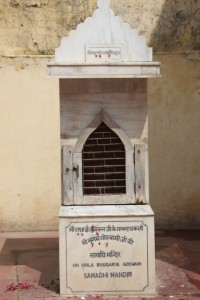
Samadhi of Srila Bhugarbha Goswami, Vrindavan.

 
   In Vrindavana, Bhugarbha Goswami and Lokanatha Goswami were regarded as among the principle Goswamis, as they were senior by age and experience to many. The foremost among the subsequent followers of Rupa Goswami, Narottama Dasa Thakura, writes about Bhugarbha Goswami, with whom he had much affectionate association: "O Hari! Why am I addicted to this abominable path of karma? I didn't worship Radha-Krishna in Vraja even one iota, nor could I understand the position of spontaneous devotion – raga-marga. Svarupa Damodara, Sanatana Goswami, Raghunatha Bhatta, Raghunatha dasa, Gopala Bhatta Goswami, Bhugarbha Goswami, Jiva Goswami, and Lokanatha Goswami – I never offered a drop of service to their lotus feet. How then shall I attain the goal of life? 
 
   Krishnadasa Kaviraja is among the most exalted rasika-bhaktas, Devotees whose sole interest is in relishing the mellows of devotion to Radha-Govinda and Mahaprabhu. He compiled the Chaitanya-Charitamrita which describes the pastimes of Sri Chaitanya and the Govinda-lilamrita, describing the pastimes of Radha-Krishna. Hearing the pastimes of Gaura-Govinda would melt even stone, but it had no effect on my consciousness. Not only have I failed to take advantage of the association of all these great souls, but I have also neglected their associates and followers. What a sad story my life has become. My life and birth are all useless. Shame on me. Alas, alas. Thus laments Narottama Dasa."

Raghava Pandit

   Shri Raghava Pandit  was exclusively devoted to Shri Gauransundara and was very dear to Him.  Shriman Kavi Karnapura notes in his Gaura Ganodesha Dipika:  “That person who was once the dear gopi friend of Radharani and whose name was Dhanishta later appeared as Shri Raghava Pandit and later lived at Govardhan where he worshiped a Deity of Giridhari in great ecstasy. The gopi Dhanishta,  is always engaged in preparing foods for Shri Krishna.
 
   The gopi named Gunamala appeared as Raghava Pandit’s sister Damayanti. On the East Bengal railway line beginning from the Sealdah station in Calcutta, there is a station named Sodapura, which is not very far from Calcutta. Within one mile of this station, toward the western side of the Ganges, is a village known as Panihati, in which the residential quarters of Raghava Pandit still exist. On Raghava Pandit’s tomb is a creeper on a concrete platform. There is also a Madana-Mohana Deity in a broken-down Temple nearby. This Temple is managed by a local zamindar of the name Shri Shivachandra Roya Chaudhuri. – Ref CC Adi lila 10.25
 
   The foods Damayanti cooked for Lord Chaitanya when He was at Puri were carried in bags by her brother Raghava without the knowledge of others.
 
   The Lord accepted these foods throughout the entire year. Those bags are still celebrated as raghavera jhali (“the bags of Raghava Pandit”).
 
   Krishna Das Kaviraj describes the contents of the bags of Raghava Pandit in his book Chaitanya Charitamrta. Hearing this narration, Devotees generally cry, and tears glide down from their eyes. 
Raghava Pandit

The foods Damayanti cooked for Lord Chaitanya when He was at Puri were carried in bags by her brother Raghava without the knowledge of others. The Lord accepted these foods throughout the entire year. Those bags are still celebrated as raghavera jhali (“the bags of Raghava Pandit”). (In the wallpaper: Shri Vijaya Gauranga, ISKCON Hungary, New Vraja Dham).

Basudev Bipra

Basudev Bipra

Fast as lightning, He reached that place where Basudev was lying on the ground, sobbing in disappointment. Lifting him up with both His arms, Mahaprabhu locked Basudev in a tight embrance.

   Mahaprabhu had just started on his pilgrimage to the South from Nilachal. On the way He came to a holy place called Kurmasthan. He spent a whole day there, singing and dancing in ecstasy, the entire populace joining Him in singing the Lord’s name.

   Next morning, He left the place and proceeded onward on his pada-yatra. Immediately after His departure, a Brahmin named Basudev Bipra came there to see the Lord.

   Basudev was a very devout man, but was afflicted with leprosy. But he was totally oblivious of his condition, as he used to be absorbed in his devotion to God and his faith was very strong. His body was of no concern to him although it was full of sores that were seeping and infested with maggots.

   The worms were his only companions, as the foul odour from his body kept people far away from him.

   If one of the maggots would fall off his body, he would carefully pick it up and place it back on his body.

   One night he heard that the Lord Himself had come in the guise of a sannyasi, singing the Lord’s name and roaming from place to place. Desperate to have a glimpse of the Lord, Basudev Bipra started moving towards Kurmasthan.

   Feeble and ill, his progress was slow, as he sometimes walked, sometimes sat and sometimes crawled towards his destination.

   By the time he arrived Mahaprabhu had already left that place. On finding Him gone, Basudev wept “O Lord, I could not get your darshan!” In the agony of his despair, he fainted. 

Basudev Bipra

One night he heard that the Lord Himself had come in the guise of a sannyasi, singing the Lord’s name and roaming from place to place. Desperate to have a glimpse of the Lord, Basudev Bipra started moving towards Kurmasthan. (In the image: Lord Chaitanya).

   At that very moment, somewhere on the road, Mahaprabhu stopped in his tracks, as if He was carefully hearing something. “I am coming” He said and turned around and started back towards Kurmasthan.

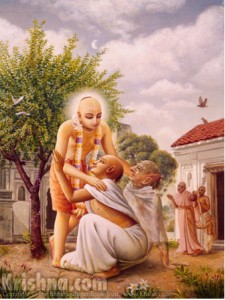
   Fast as lightning, He reached that place where Basudev was lying on the ground, sobbing in disappointment. Lifting him up with both His arms, Mahaprabhu locked Basudev in a tight embrance.

   On the Lord’s divine touch, Basudev’s leprosy was immediately cured and he was released from all bondage. Basudev found that his body had been transformed into a lustrous golden colour, with no trace of his disease!

   Falling at the feet of Mahaprabhu, he wept, “Lord of Mercy, what have you done. No one dares to come close to me and you have held me close to your heart, which is the residence of Sri Lakshmi!! Only the Supreme God is capable of such action, as both the deserving and undeserving are both dear to You. But now, I am in anxiety. As long as I was an untouchable my mind was free of pride, which is why I could attain You. But now that I have got a beautiful body, I am afraid that I will not remain humble anymore. Once pride enters my mind, then I will lose You.”

   Hearing these words of Basudev, Mahaprabhu’s heart melted and tears streamed down his eyes. He thought, “Today Basudev has defeated me.”

   He addressed Basudev, “A Devotee like you will never be overtaken by arrogance. Your duty now is to serve the people of Utkal with devotion, bringing them close to God. Your life should be a seva yagya.” Saying this, He departed.

Basudev Bipra was a physician by profession. Thus directed by Mahaprabhu, he spent the rest of his life bringing succour to the sick and needy in Orissa.

http://www.srigaurangashram.in

p

Chaitanya Mahaprabhu

   "This account originally appeared in a short work by Srila Bhaktivinoda Thakura entitled, 'Sri Chaitanya Mahaprabhu: His Life and Precepts.' (dated 20th August 1896.)" This was taken from "Prologue" to "Teachings of Lord Chaitanya" (A.C.Bhaktivedanta Swami Prabhupada. 1974. pages xiii-xxii.) Who better could we find to include here than the pure unalloyed Devotee, and foremost scholar in Vaishnava circles Srila Bhaktivinoda Thakura to perform this task. He starts his essay;
Caitanya Mahaprabhu

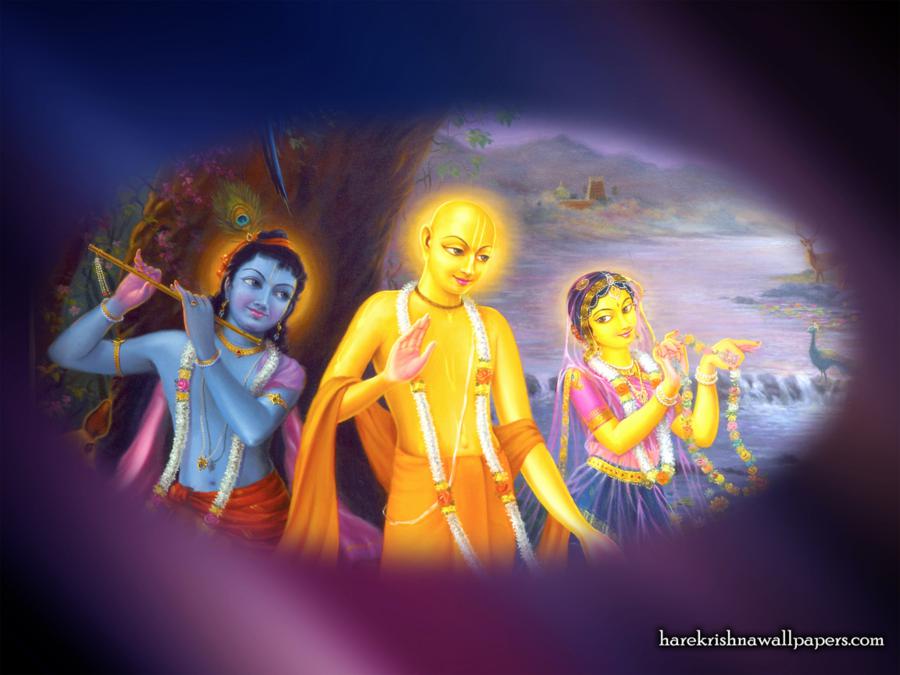
Lord Sri Krishna Chaitanya in combined Form of Sri Sri Radha Krishna.

   "Chaitanya Mahaprabhu was born in Mayapur in the town of Nadia just after sunset on the evening of the 23rd Phalguna (1407 Sakadba), answering to the 18th of February 1486 of the Christian Era. The moon was eclipsed at the time of His birth, and the people of Nadia were then engaged, as was usual on such occasions, in bathing in the Bhagirathi with loud cheers of Haribol. His father, Jagannatha Misra, a poor 'brahmana' of the Vedic order, and His mother, Saci-devi, a model good woman, both descended from 'brahmana' stock originally residing in Sylhet. Mahaprabhu was a beautiful child, and the ladies of the town came to see Him with presents. His mother's father, Pandita Nilambara Chakravarti, a renowned astrologer, foretold that the child would be a great personage in time; and he, therefore, gave him the name Vishvambhara. The ladies of the neighbourhood styled him Gaurahari on account of His golden complexion, and His mother called Him Nimai on account of the 'nimba' tree near which He was born. Beautiful as the lad was, everyone heartily loved to see Him every day. As He grew up He became a whimsical and frolicsome lad. After His fifth year, He was admitted into a pathasala where He picked up Bengali in a very short time. 
Caitanya Mahaprabhu

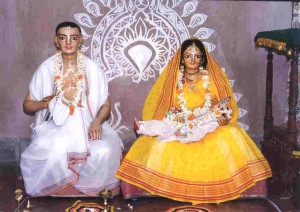
His father, Jagannatha Misra, a poor 'brahmana' of the Vedic order, and His mother, Saci-devi, a model good woman, both descended from 'brahmana' stock originally residing in Sylhet. Mahaprabhu was a beautiful child, and the ladies of the town came to see Him with presents. His mother's father, Pandita Nilambara Chakravarti, a renowned astrologer, foretold that the child would be a great personage in time; and he, therefore, gave him the name Vishvambhara... (In the image: Murtis of Jagannath Mishra, Sachi Mata and new born Vishvambhar, Yoga Pitha, Mayapur).

   "Most of His contemporary biographers have mentioned certain anecdotes regarding Chaitanya which are simple records of His early miracles. It is said that when He was an infant in His mother's arms He wept continually, and when the neighbouring ladies cried 'Haribol' He used to stop. Thus there was a continuation of utterance of 'Haribol' in the house, foreshewing the future mission of the hero. It has also been stated that when His mother gave Him sweetmeats to eat, He ate clay instead of the food. His mother, asking for the reason, He stated that as every sweetmeat was nothing but clay transformed, He could eat clay as well. His mother, who was also the consort of a 'pandita', explained that every article in a special state was adapted  to a special use. Earth, while in the state of a jug, could be used as a water pot, but in the state of a brick such a use was not possible. Clay, therefore in the form of sweetmeats was usable as food, but clay in its other states was not. The lad was convinced and admitted His stupidity in eating clay and agreed to avoid the mistake in the future. Another miraculous act has been related. It is said that a brahmana on pilgrimage became a guest in His house, cooked food and read grace with meditation upon Krishna. In the meantime the lad came and ate up the cooked rice. The 'brahmana', astonished at the lad's act, cooked again at the request of Jagannatha Misra. The lad again ate up the cooked rice while the 'brahmana' was offering the rice to Krishna with meditation. The 'brahmana' was persuaded to cook for the third time. This time all the inmates of the house had fallen asleep, and so the lad showed Himself as Krishna to the traveller and blessed him. The 'brahmana' was then lost in ecstasy at the appearance of the object of his worship. It has also been stated that two thieves stole away the lad from His father's door with a view to purloin His jewels and gave Him sweetmeats on the way. The lad exercised His illusory energy and deceived the thieves back towards His own house. The thieves, for fear of detection, left the boy there and fled. Another miraculous act that has been described is the lad's demanding and getting from Hiranya and Jagadisa all the offerings they had collected for worshiping Krishna on the day of Ekadashi. When only four years of age He sat on rejected cooking pots which were considered unholy by His mother. He explained to His mother that there was no question of holiness and unholiness as regards to earthen pots thrown away after the cooking was over. These anecdotes relate to His tender age up to the fifth year.

   "In His eighth year, He was admitted into the tola of Gangadasa Pandita in Ganganagara close by the village of Mayapur. In two years He became well read in Sanskrit grammar and rhetoric. His readings after that were of the nature of self-study in His own house, where He had found all-important books belonging to His father, who was a 'pandita' himself. It appears that He read the 'smrti' in His own study, and the 'nyaya' also, in competition with His friends, who were then studying under the celebrated 'pandita' Raghunatha Siromani.

   "Now, after the tenth year of His age, Chaitanya became a passable scholar in grammar, rhetoric, the 'smrti' and the 'nyaya'. It was after this that his elder brother Vishvarupa left his house and accepted the 'ashrama' (status) of a 'sannyasi' (ascetic). Chaitanya, though a very young boy, consoled His parents, saying that He would serve them with a view to please God. Just after that, His father left this world. His mother was exceedingly sorry, and Mahaprabhu, with His usual contented appearance, consoled His widowed mother.
Caitanya Mahaprabhu

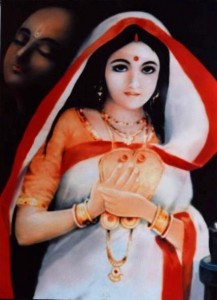
It was at His mother's request that He married Visnupriya, the daughter of Raja Pandita Sanatana Misra. (In the image: Vishnupriya holding foot wear of Her Husband Lord Chaitanya).

   It was at the age of 14 or 15 that Mahaprabhu was married to Lakshmidevi, the daughter of Vallabhacharya, also of Nadia. He was at this age considered one of the best scholars of Nadia, then renowned seat of 'nyaya' philosophy and Sanskrit learning. Not to speak of the 'smarta panditas', the 'Naiyayikas' were all afraid of confronting Him in literary discussions. Being a married man, He went to Eastern Bengal on the banks of the Padma for acquirement of wealth. There He displayed His learning and obtained a good sum of money. It was at this time that He preached Vaishnavism at intervals. After teaching him the principles of Vaishnavism, He ordered Tapanamishra to go to and live in Benares. During His residence in East Bengal, His wife Lakshmidevi left this world from the effects of snake bite. On returning home, He found His mother in a mourning state. He consoled her with a lecture on the uncertainty of human affairs. It was at His mother's request that He married Visnupriya, the daughter of Raja Pandita Sanatana Misra. His comrades joined Him on His return from pravasa or sojourn. He was now so renowned that He was considered to be the best pandita in Nadia. Keshava Misra of Kashmir, who had called himself the Great Digvijayi, came to Nadia with a view to discuss with the 'pandita' of that place. Afraid of the so-called conquering pandita, the tola professors of Nadia left their town on pretence of invitation. Keshava met Mahaprabhu at the Barokona-ghata in Mayapur, and after a very short discussion with Him he was defeated by the boy, and mortification obliged him to decamp. Nimai Pandita was now the most important 'pandita' of His times.

   "It was at the age of 16 or 17 that He travelled to Gaya with a host of His students and there took His spiritual initiation from Ishvara Puri, a Vaishnava 'sannyasi' and a disciple of the renowned Madhavendra Puri. Upon His return to Nadia, Nimai Pandita turned religious preacher, and His religious nature became so strongly represented that Advaita Prabhu, Srivasa and others who had before the birth of Chaitanya already accepted the Vaishnava faith were astonished at the change of the young man. He was then no more a contending 'naiyayika', a wrangling 'smarta' and a criticizing rhetorician. He swooned at the name of Krishna and behaved as an inspired man under the influence of His religious sentiment. It has been described by Murari Gupta, an eye-witness, that He showed His heavenly powers in the house of Shrivasa Pandita in the presence of hundreds of His followers, who were mostly well-read scholars. It was at this time that He opened a nocturnal school of 'kirtana' in the compound of Shrivasa Pandita with His sincere followers. There He preached, there He sang, there He danced, and there He expressed all sorts of religious feelings. Nityananda Prabhu, who was then a preacher of Vaishnavism and who had then completed His travels all over India, joined Him at that time. In fact, a host of 'pandita' preachers of Vaishnavism, all sincere at heart, came and joined Him from different parts of Bengal. Nadia now became the regular seat of a host of Vaishnava 'acaryas' whose mission it was to spiritualize mankind with the highest influence of the Vaishnava creed. 
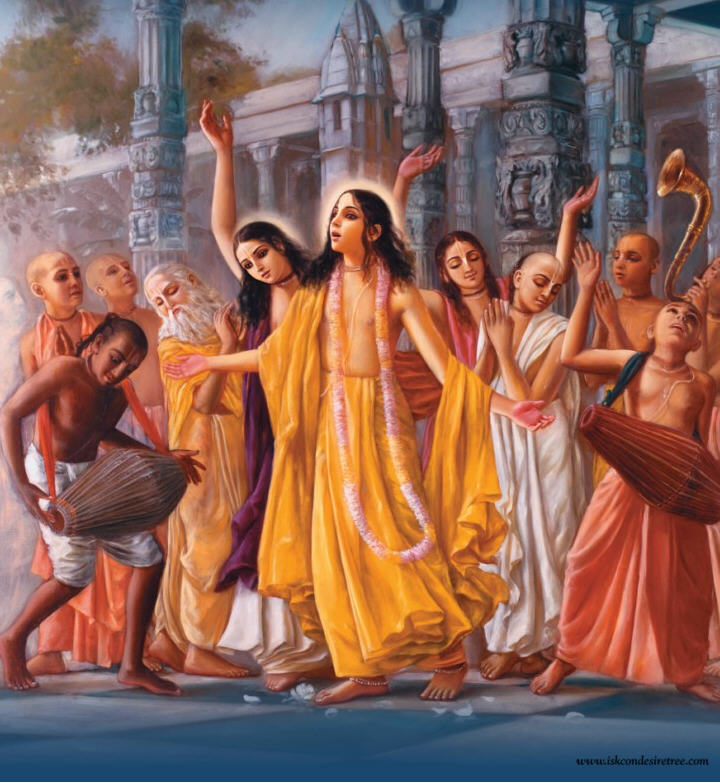
Caitanya Mahaprabhu

...He showed His heavenly powers in the house of Shrivasa Pandita in the presence of hundreds of His followers, who were mostly well-read scholars. It was at this time that He opened a nocturnal school of 'kirtana' in the compound of Shrivasa Pandita with His sincere followers. There He preached, there He sang, there He danced, and there He expressed all sorts of religious feelings. Nityananda Prabhu, who was then a preacher of Vaishnavism and who had then completed His travels all over India, joined Him at that time. In fact, a host of 'pandita' preachers of Vaishnavism, all sincere at heart, came and joined Him from different parts of Bengal. Nadia now became the regular seat of a host of Vaishnava 'acaryas' whose mission it was to spiritualize mankind with the highest influence of the Vaishnava creed. (In the image: Lord Chaitanya along with other Devotees performing Kirtan at Shrivas Thakur's house).

   "The first mandate that He issued to Prabhu Nityananda and Haridasa was this: 'Go, friends, go through the streets of the town, meet every man at his door and ask him to sing the name of Hari with a holy life, and you then come and report to Me every evening the result of your preaching.' Thus ordered, the two preachers went on and met Jagai and Madhai, two most abominable characters. They insulted the preachers on hearing Mahaprabhu's mandate, but were soon converted by the influence of 'bhakti' (devotion) inculcated by their Lord. The people of Nadia were now surprised. They said, 'Nimai Pandita is not only a gigantic genius, but He is certainly a missionary from God Almighty.' From this time to His twenty-third year, Mahaprabhu preached His principles not only in Nadia but in all important towns and villages around His city. In the houses of His followers He showed miracles, taught the esoteric principles of 'bhakti' and sang His 'sankirtan' with other bhaktas. His followers of the town of Nadia commenced to sing the Holy Name of Hari in the streets and bazaars. This created a sensation and roused different feelings in different quarters. The 'bhaktas' were highly pleased. The 'smarta brahmanas' became jealous of Nimai Pandita's success and complained to Chand Kazi against the character of Chaitanya as un-Hindu. The Kazi came to Shrivasa Pandita's house and broke a 'mrdanga' ('khola' drum) there and declared that unless Nimai Pandit ceased to make noise about His queer religion he would be obliged to enforce Mohammedanism on Him and His followers. This was brought to Mahaprabhu's notice. He ordered the townspeople to appear in the evening each with a torch in his hand. This they did, and Nimai marched out with His 'sankirtan' divided in 14 groups, and on His arrival in the Kazi's house, He held a long conversation with the Kazi and in the end communicated into his heart His Vaishnava influence by touching his body. The Kazi then wept and admitted that he had felt a keen spiritual influence which had cleared up his doubts and produced in him a religious sentiment which gave him the highest ecstasy. The Kazi then joined the sankirtan party. The world was astonished at the spiritual power of the Great Lord, and hundreds and hundreds of heretics converted and joined the banner of Vishvambhara after this affair.
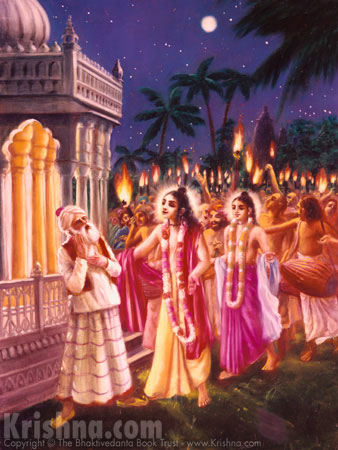
Caitanya Mahaprabhu

...Nimai marched out with His 'sankirtan' divided in 14 groups, and on His arrival in the Kazi's house, He held a long conversation with the Kazi and in the end communicated into his heart His Vaishnava influence by touching his body. The Kazi then wept and admitted that he had felt a keen spiritual influence which had cleared up his doubts and produced in him a religious sentiment which gave him the highest ecstasy. The Kazi then joined the sankirtan party. (In the image: Lord Chaitanya talking to Chand Kazi).

   "It was after this that some of the jealous and low-minded 'brahmanas' of Kulia picked a quarrel with Mahaprabhu and collected a party to oppose Him. Nimai Pandita was naturally a soft-hearted person, though strong in His principles. He declared that party feelings and sectarianism were the two great enemies of progress and that as long as He should continue to be an inhabitant of Nadia belonging to a certain family, His mission would not meet with complete success. He then resolved to be a citizen of the world by cutting His connection with His particular family, caste and creed, and with this resolution He embraced the position of a 'sannyasi' at Katwa, under the guidance of Keshava Bharati of that town, on the 24th year of His age. His mother and wife wept bitterly for His separation, but our hero, though soft in heart, was a strong person in principle. He left His little world in His house for the unlimited spiritual world of Krsna with man in general.

   "After His 'sannyasa', He was induced to visit the house of Advaita Prabhu in Shantipura. Advaita managed to invite all His friends and admirers from Nadia and brought Sachidevi to see her son. Both pleasure and pain invaded her heart when she saw her son in the attire of a 'sannyasi'. As a 'sannyasi', Krishna Chaitanya put on nothing but a 'kaupina' (two pieces of cloth, a loin cloth) and a 'bahirvasa' (outer covering). His head was without hair, and His hands bore a 'danda' (stick) and a 'kamandalu' (hermit's water pot). The Holy Son fell at the feet of His beloved mother and said, "Mother! This body is yours, and I must obey your orders. Permit me to go to Vrindavana for My spiritual attainments." The mother, in consultation with Advaita and others, asked her son to reside in Puri (the town of Jagannatha) so that she might obtain His information now and then. Mahaprabhu agreed to that proposition and in a few days left Shantipura for Orissa. His biographers have described the journey of Krishna Chaitanya (that was the name He got after His 'sannyasa') from Shantipura to Puri in great detail. He travelled along the side of the Bhagirathi as far as Chatrabhoga, situated now in Thana Mathurapura, Diamond Harbour, 24 Parganas. There He took a boat and went as far as Prayaga-ghata in the Midnapura District. Thence He walked through Balasore and Cuttack to Puri, seeing the Temple of Bhuvaneshvara on His way. Upon His arrival at Puri He saw Jagannatha in the Temple and resided with Sarvabhauma at the request of the latter. Sarvabhauma was a gigantic 'pandita' of the day. His readings knew no bounds. He was the best 'naiyayika' of the times and was known as the most erudite scholar in the Vedanta philosophy of the school of Shankaracharya. He was born in Nadia (Vidyanagara) and taught innumerable pupils in the 'nyaya' philosophy in his tola there. He had left for Puri some time before the birth of Nimai Pandita. His brother-in-law Gopinatha Mishra introduced our new sannyasi to Sarvabhauma, who was astonished at His personal beauty and feared that it would be difficult for the young man to maintain 'sannyasa-dharma' during the long run of His life. Gopinatha, who had known Mahaprabhu from Nadia, had a great reverence for Him and declared that the 'sannyasi' was not a common human being. On this point Gopinatha and Sarvabhauma had a hot discussion. Sarvabhauma then requested Mahaprabhu to hear his recitation of the Vedanta-sutras, and the latter tacitly submitted. Chaitanya heard with silence what the great Sarvabhauma uttered with gravity for seven days, at the end of which the latter said, 'Krishna-Chaitanya! I think You do not understand the Vedanta, for You do not say anything after hearing my recitation and explanations.' The reply of Chaitanya was that He understood the sutras very well, but He could not make out what Shankaracarya meant by his commentaries. Astonished as this, Sarvabhauma said, 'How is it that you understand the meanings of the 'sutras' and do not understand the commentaries which explain the 'sutras'? All well! If You understand the 'sutras', please let me have Your interpretations.' Mahaprabhu thereon explained all the 'sutras' in His own way without touching the pantheistic commentary of Shankara. The keen understanding of Sarvabhauma saw the truth, beauty and harmony of arguments in the explanations given by Chaitanya and obliged Him to utter that it was the first time that he had found one who could explain the Brahma-sutras in such a simple manner. He admitted also that the commentaries of Shankara never gave such natural explanations of the Vedanta-sutras as he had obtained from Mahaprabhu. He then submitted himself as an advocate and follower. In a few days Sarvabhauma turned out to be one of the best Vaishnavas of the time. When reports of this came out, the whole of Orissa sang the praise of Krishna Chaitanya, and hundred and hundreds came to Him and became His followers. In the meantime Mahaprabhu thought of visiting Southern India, and He started with one Krishnadasa Brahmana for the journey. 
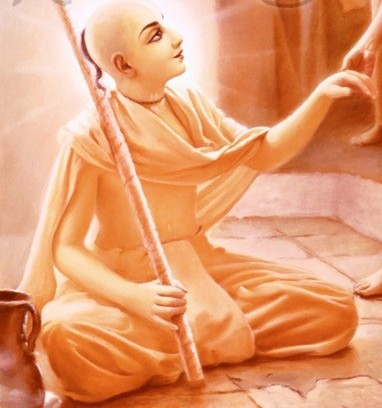
Caitanya Mahaprabhu

...brought Sachidevi to see her son. Both pleasure and pain invaded her heart when she saw her son in the attire of a 'sannyasi'. As a 'sannyasi', Krishna Chaitanya put on nothing but a 'kaupina' (two pieces of cloth, a loin cloth) and a 'bahirvasa' (outer covering). His head was without hair, and His hands bore a 'danda' (stick) and a 'kamandalu' (hermit's water pot).

   "His biographers have given us a detail of the journey. He went first to Kurmaksetra, where He performed a miracle by curing a leper named Vasudeva. He met Ramananda Raya, the Governor of Vidyanagara, on the banks of the Godavari and had a philosophical conversation with him on the subject of 'prema-bhakti'. He worked another miracle by touching (making them immediately disappear) the seven 'tala-trees' through which Ramachandra, the son of Dasharatha, had shot His arrow and killed the great Bali Raja. He preached Vaishnavism and 'nama-sankirtana' throughout the journey. At Rangakshetra He stayed for four months in the house of one Venkata Bhatta in order to spend the rainy season. There He converted the whole family of Venkata from Ramanuja Vaishnavism to Krishna-bhakti, along with the son of Venkata, a boy of ten years named Gopala, who afterwards came to Vrindavana and became one of the six Goswamis or prophets serving under their leader Sri Krishna Chaitanya. Trained up in Sanskrit by his uncle Prabodhananda Sarasvati, Gopala wrote several books on Vaishnavism. 

   "Sri Chaitanya visited numerous places in Southern India as far as Cape Comorin and returned to Puri in two years by Pandepura on the Bhima. In this latter place He spiritualized one Tukarama, who became from that time a religious preacher himself. This fact has been admitted in his 'adhangas', which have been collected in a volume by Mr. Satyendra Nath Tagore of the Bombay Civil Service. During His journey He had several discussions with the Buddhists, the Jains and the 'mayavadis' in several places and converted His opponents to Vaishnavism. 
Caitanya Mahaprabhu

Gopal-Bhatta Goswami's house where Lord Chaitanya stayed during Chaturmasya (4 months), Srirangam, Tamil Nadu.

   "Upon His return to Puri, Raja Prataparudra-deva and several 'pandita brahmanas' joined the banner of Chaitanya Mahaprabhu. He was now twenty-seven years of age. In His twenty-eighth year He went to Bengal as far as Gauda in Mald. There He picked up two great personages named Rupa and Sanatana. Though descended from the lines of Karnatic brahmanas, these two brothers turned demi-Moslems by their continual contact with Hussain Shah, then Emperor of Gauda. Their names had been changed by the Emperor into Dabir Khas and Sakara Mallik, and their master loved them heartily since they were both learned in Persian, Arabic and Sanskrit and were loyal servants of the state. The two gentlemen had found no way to come back as regular Hindus and had written to Mahaprabhu for spiritual help while He was at Puri. Mahaprabhu had written in reply that He would come to them and extricate them from their spiritual difficulties. Now that He had come to Gauda, both the brothers appeared before Him with their long-standing prayer. Mahaprabhu ordered them to go to Vrindavana and meet Him there.

   "Chaitanya returned to Puri through Shantipura, where He again met His dear mother. After a short stay at Puri He left for Vrindavana. This time He was accompanied by one Balabhadra Bhattacharya. He visited Vrindavana and came down to Prayag (Allahabad), converting a large number of Mohammedans to Vaishnavism by argument from the Koran. The descendant of those converts are still known as Pathana Vaishnavas. Rupa Goswami met Him in Allahabad. Chaitanya trained him up in spirituality in ten days and directed him to go to Vrindavana on missions. His first mission was to write theological works explaining scientifically pure 'bhakti' and 'prema'. The second mission was to revive the places where Krishnachandra had in the end of 'Dvapara-yuga' exhibited His spiritual 'lila' (pastimes) for the benefit of the religious world. Rupa Goswami left Allahabad for Vrindavana, and Mahaprabhu came down to Benares. There He resided in the house of Chandrasekhara and accepted His daily 'bhiksa' (meal) in the house of Tapana Misra. Here it was that Sanatana Goswami joined him and took instruction for two months in spiritual matters. The biographers, especially Krishnadasa Kaviraja, have given us details of Chaitanya's teachings to Rupa and Sanatana. Krishnadasa was not a contemporary writer, but he gathered his information from the Goswamis themselves, the direct disciples of Mahaprabhu. Jiva Goswami, who was the nephew of Sanatana and Rupa and who has left us his invaluable work of Sat-sandarbha, has philosophized on the precept of his great leader. We have gathered and summarised the precepts of Chaitanya from the books of those great writers. 
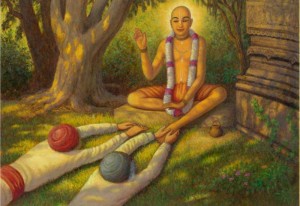
Caitanya Mahaprabhu

...In His twenty-eighth year Lord Chaitanya went to Bengal as far as Gauda in Mald. There He picked up two great personages named Rupa and Sanatana. (In the image: Rupa and Sanatana Goswamis are offering dandavat to Lord Chaitanya).

   "While at Benares, Chaitanya had an interview with the learned 'sannyasis' of that town in the house of a Maratha 'brahmana' who had invited all the 'sannyasis' for entertainment. At this interview, Chaitanya showed a miracle which attracted all the 'sannyasis' to Him. Then ensued reciprocal conversation. The 'sannyasis' were headed by their most learned leader Prakashananda Sarasvati. After a short controversy, they submitted to Mahaprabhu and admitted that they had been misled by the commentaries of Shankaracarya. It was impossible even for learned scholars to oppose Chaitanya for a long time, for there was some spell in Him which touched their hearts and made them weep for their spiritual improvement. The 'sannyasis' of Benares soon fell at the feet of Chaitanya and asked for His grace ('krpa'). Chaitanya then preached pure 'bhakti' and instulled into their hearts spiritual love for Krishna which obliged them to give up sectarian feelings. The whole population of Benares, on this wonderful conversion of the 'sannyasis', turned Vaishnavas, and they made a master 'sankirtana' with their new Lord. After sending Sanatana to Vrindavana, Mahaprabhu went to Puri again through the jungles with His comrade Balabhadra. Balabhadra reported that Mahaprabhu had shown a good many miracles on His way to Puri, such as making tigers and elephants dance on hearing the name of Krishna.

   "From this time, that is, from His 31st year, Mahaprabhu continually lived in Puri the house of Kashi Misra until His disappearance in His forty-eighth year at the time of sankirtana in the Temple of Tota-gopinatha. During these 18 years, His life was one of settled love and piety. He was surrounded by numerous followers, all of whom were of the highest order of Vaishnavas and who were distinguished from the common people by their purest character and learning, firm religious principles and spiritual love of Radha-Krishna. Svarupa Damodara, who had been known by the name of Purushottamacharya while Mahaprabhu was in Nadia, joined Him from Benares and accepted service as His secretary. No production of any poet or philosopher could be laid before Mahaprabhu unless Svarupa had passed it as pure and useful. Raya Ramananda was His second mate. Both he and Svarupa would sing while Mahaprabhu expressed His sentiments on a certain point of worship. Paramananda Puri was His minister in matters of religion. There are hundreds of anecdotes described by His biographers which we do not think it meet here to reproduce. Mahaprabhu slept short. His sentiments carried Him further and further into the firmament of spirituality every day and night, and all His admirers and followers observed Him throughout. He worshipped, communicated with His missionaries at Vrindavana, and conversed with those religious men who newly came to visit Him. He sang and danced, took no care of Himself and of-times lost Himself in religious beatitude. All who came to Him believed in Him as the all-beautiful God appearing in the nether world for the benefit of mankind. He loved His mother all along and sent her 'Mahaprasada' now and then with those who went to Nadia. He was most amiable in nature. Humility was personified in Him.  His sweet appearance gave cheer to all who came in contact with Him. He appointed Prabhu Nityananda as the missionary in charge of Bengal. He dispatched six disciples (Goswamis) to Vrindavana to preach love in the upcountry. This he markedly did in the case of Junior Haridasa. He never lacked in giving proper instructions in life to those who solicited them. This will be seen in His teachings to Raghunatha dasa Goswami. His treatment to Haridasa (senior) will show how He loved spiritual men and how He defied caste distinction in spiritual brotherhood." (Thakura Bhaktivinoda. 20th August 1896.) 
Caitanya Mahaprabhu

'Go, friends, go through the streets of the town, meet every man at his door and ask him to sing the name of Hari with a holy life, and you then come and report to Me every evening the result of your preaching.'