Category Archives: More About Gaudiya Saints

Parameshvara Dasa Thakura – Biography

Parameshvara Dasa Thakura

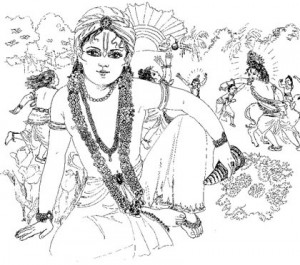
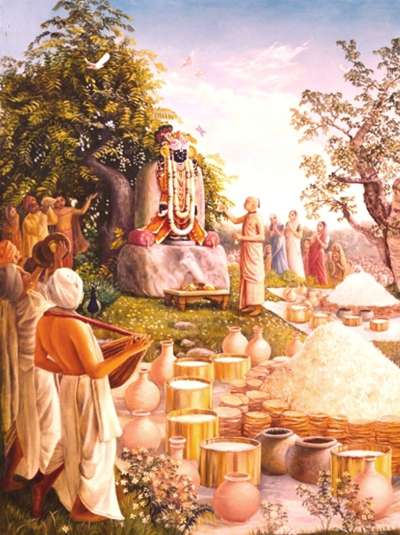
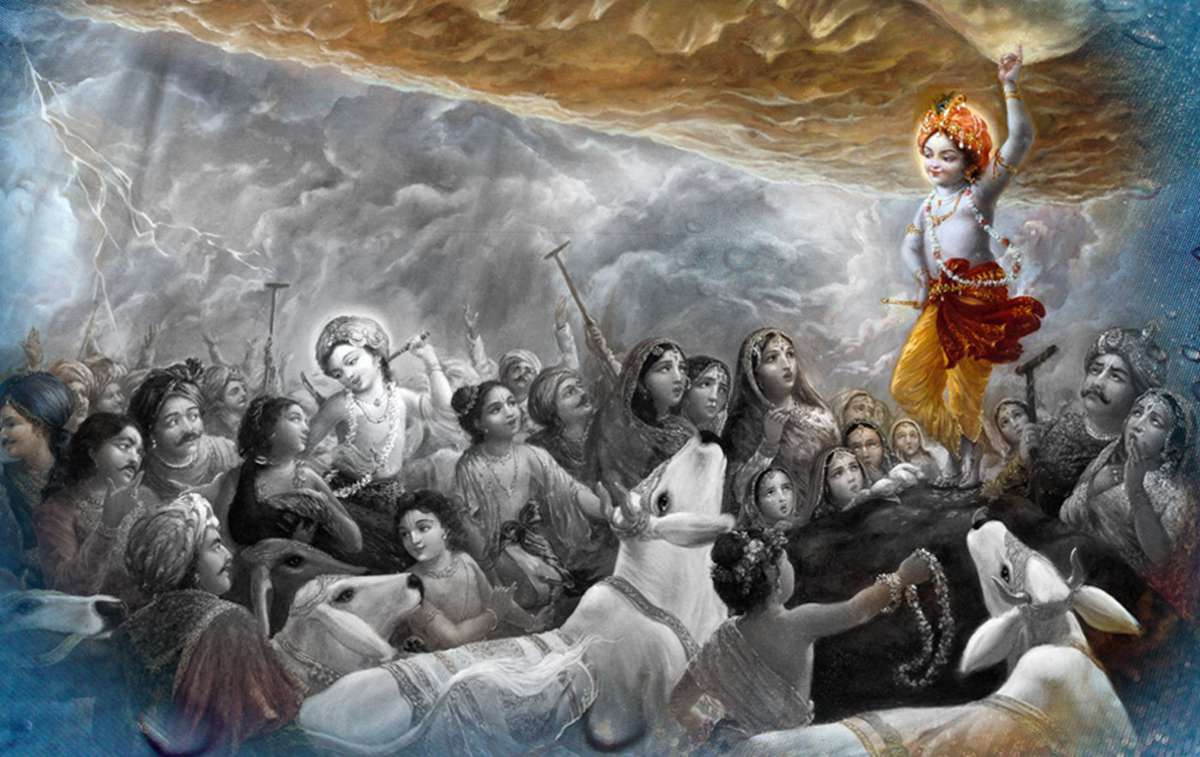
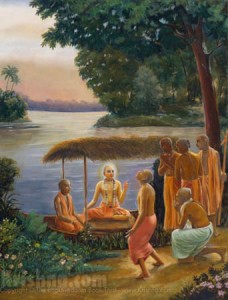
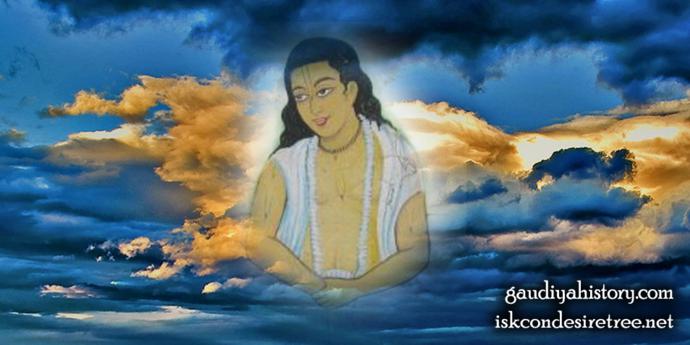
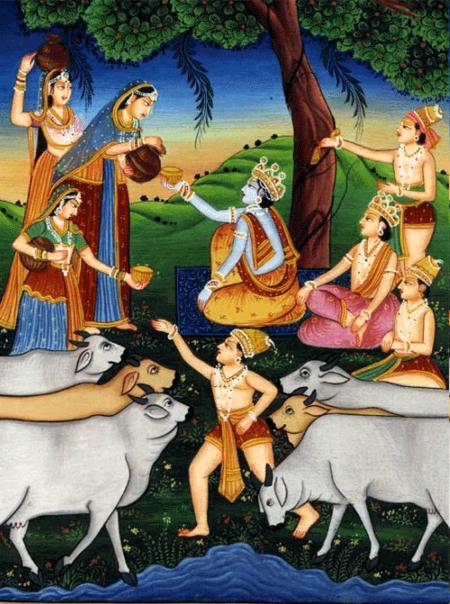
Parameshvara das, said to be the fifth gopala of Krishna lila, completely surrendered to the lotus feet of Nityananda. Anyone who remembers his name, Parameshvara dasa, will get love of Krishna very easily. (In the image: Wives of brahmanas are giving food to Krishna and His friends).

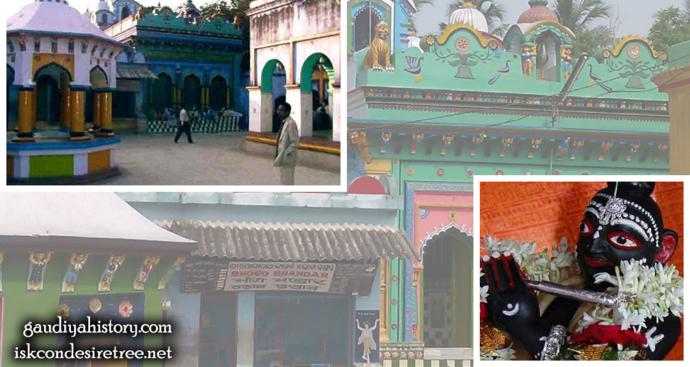
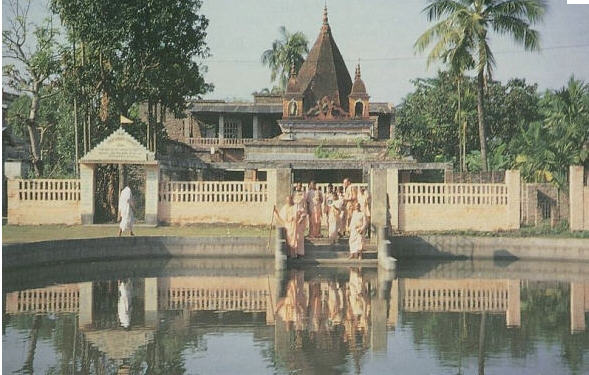
   Shri Parameshvara dasa Thakura appeared in a family of physicians. His Shripat is at Atapur, which was on the Chanpandanga branch of the Howrah-Amrah rail line. Rail service on this line has been discontinued. Direct bus service is available from Howrah station; it is about a 2 hour journey from there. Atapur was previously known as Vishakhala. Shri Shri Radha-Govinda are still residing at his Shripat. In front of the Temple are two Bakul trees and in between them is Parameshvara Thakura's Samadhi mandira.

   Shri Krishna das Kaviraj Goswami has written: "Parameshvara das, said to be the fifth gopala of Krishna lila, completely surrendered to the lotus feet of Nityananda. Anyone who remembers his name, Parameshvara dasa, will get love of Krishna very easily." [C.C. Adi 11.29]

   Shri Kavi Karnapura Goswami has written: namnarjunah sakha prag yo dasah paramesvarah, "Parameshvara dasa Thakura was previously the cowherd friend of Shri Krishna named Arjuna."

   Shri Vrindavana dasa Thakura has written:

nityananda jivan paramesvar das
jahar vigrahe nityananda vilasa
Krishna das paramesvar das dvi jon
gopabhave hoi hoi kore sarvakkon

   "Parameshvara is the life of Lord Nityananda and his form (body) is the place of his pastimes. Krishna dasa and Paramesvara, being in the mood of cowherd boys, are always raising a commotion."

   When Jahnava Mata attended the festival at Kheturi, Parameshvara accompanied her and went to Vrindavana with her as well. He installed Shri Shri Radha-Gopinatha at Atapur in accordance with the desire of Shri Jahnava Devi, who was personally present during the installation celebration.

paramesvari dasa thakura bandibo sabdhane
srigale loyar nam sankirtan sthane

   One day, near Shri Rampur, at Akna Mahesh (the Shripat of Kamalakara Pippalai), there was a festival of nama-sankirtan going on within the Temple of Lord Jagannatha there. Parameshvara was present and was dancing in a completely God-intoxicated state. At that time some miscreants passed by there, and seeing a dead fox lying on the road, they picked it up and threw it into the midst of the sankirtan party. The highly exalted Vaishnavas present didn't feel any anger towards those ignorant fools, but Parameshvara felt sad to see the unfortunate dead fox, and so by his merciful glance he brought it back to life. Then that fox trotted out of the nat-mandir (kirtan hall) to the utter bewilderment of those miscreants, who then immediately fled from the spot.

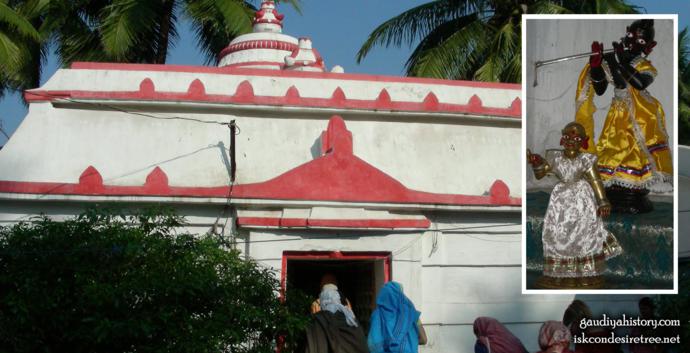
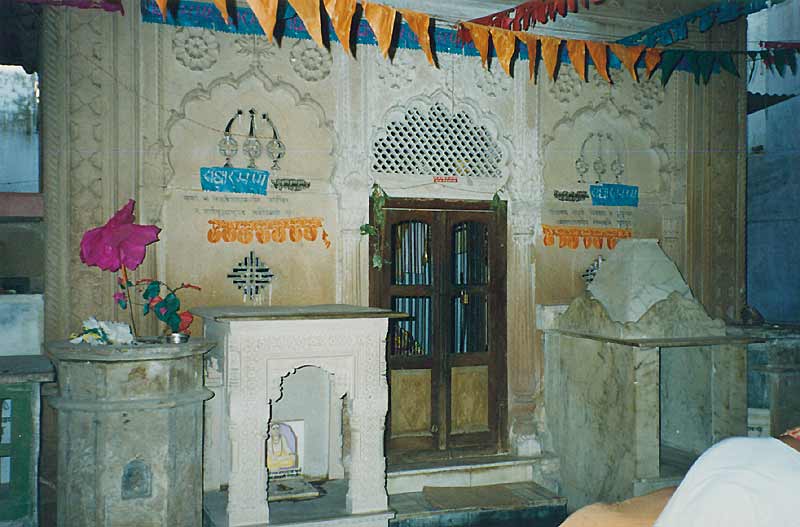
   Parameshvara dasa Thakura accompanied the Deity of Radharani that Shri Jahnava Devi sent to Vrindavana for Shri Govinda. He was the very dear servant of Shri Jahnava Mata. His disappearance is on the full moon day of the month of Vaishakha. On that day the khunti that he used in sankirtan is placed next to his samadhi mandir. Khunti – this is a symbol carried on a staff preceeding the kirtana party. Supposedly its history dates from the time when the Kazi gave his promise that no one would ever disturb the sankirtan parties again. This was an emblem of the Kazi, and its presence infront of the sankirtan party indicated that the party was sanctioned by the Kazi and thus no one should disturb them. Today it is decorated with eyes, tilak, flower garlands and cloths, and worshipped as a manifestation of Mahaprabhu Himself. 

Parameshvara Dasa Thakura

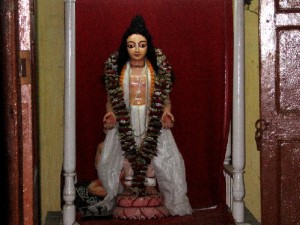
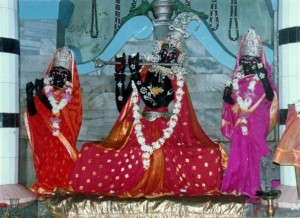
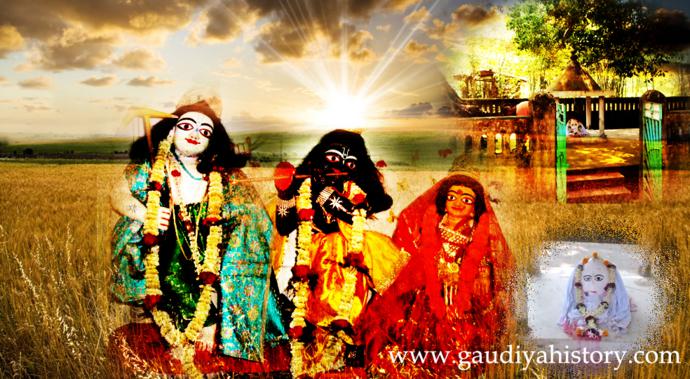
On that day the khunti that he used in sankirtan is placed next to his samadhi mandir. Khunti - this is a symbol carried on a staff preceeding the kirtana party. Supposedly its history dates from the time when the Kazi gave his promise that no one would ever disturb the sankirtan parties again. This was an emblem of the Kazi, and its presence infront of the sankirtan party indicated that the party was sanctioned by the Kazi and thus no one should disturb them. Today it is decorated with eyes, tilak, flower garlands and cloths, and worshipped as a manifestation of Mahaprabhu Himself. (In the wallpaper: Deities of Parameshvara Dasa Thakura and his samadhi).

Gadadhara Pandit – Biography

Gadadhara Pandit

Sri Gadadhara Pandit.

    Sri Gadadhar was the consant companion of Mahaprabhu from the time of their childhood. His father's name was Sri Madhva Misra and his mother's name Sri Ratnavati-devi. They lived very near the house of Sri Jagannatha Misra in Mayapura. Ratnavati-devi thought of Saci-devi as her own sister, and always used to visit her.

   During their childhood, Sri Gaura Hari and Gadadhara would play together, sometimes at Mahaprabhu's house and sometimes at Gadadhara's house. They both studied together at the sameschool. Gadadhara was a few years younger then Nimai. Nimai couldn't remain without Gadadhara even for a moment and Gadadhara likewise couldn't stand to be separated from Nimai.

   In the Gaur-ganoddesa-dipika, it is described that that person who in Vraja was the daughter of Sri Vrsabhanu Raja, namely Srimati Radharani, is now celebrated as Sri Gadadhara Pandita.

   Srila Svarupa Damodara has written in his diary: avani sura bavah Sri Panditakhyo jatindrah / sa khalo bhavati Radha Srila Gauravataro.

   Sri Vasudeva Ghosa Thakura has also written:

   Agam agocar gora akhil brahma-par, veda upar, najane pasandi mati bhora Nitya-nityananda Caitanya Govinda Pandit Gadadhar Radhe Caitanya yugala-rupa kebol raser kup avatar sadsiva sadhe Antare nave-ghana bahire gaura tanu yugalrupa parkase Kahe Vasudeva Ghose yugal bhajan base janame janame rahu asa

   "Lord Gaurasundara, who is beyond the perview of the scriptures, beyond the entire Brahman, and above even the Vedas, can never be known by the atheists whose intelligence is dull. Lord Nityananda is His eternal self. Lord Caitanya is Lord Govinda Himself and Pandita Gadadhara is none other than Sri Radha. The divine couple, who are present in Sri Caitanya, are a well of rasa. Advaita Acarya (Sadasiva) has prayed for His descent.

   Within He is blackish but of a golden hue without, the manifestation of the divine couple. Thus Vasudeva Ghosa sings of the beauty of this divine couple – Sri Gaura-Gadadhara – in whose worship he has been completely subjugated. He prays that he will desire to serve them birth after birth."

   In Sri Caitanya-caritamrta we likewise find:

   Panditer bhav mudre kahan na jay gadadhar pran nath nam hoila jay panditer krpa prasad lehan na jay gadai gauranga kari sarvaloke gay

   "The emotions and expressions of Pandita Gadadhara are not possible to describe. Another name of Lord Gauranga is the 'Lord of the life of Gadadhara.' Who can understand what mercy has been bestowed upon him? Their glories are sung by everyone as Gadai- Gauranga." During the time when Sri Isvara Puri was present for a few months in Navadwipa at the house of Sri Gopinath Acarya, he taught Gadadhara from the book he had composed, Sri krishna Lilamrta.

   Gadadhara was from his very childhood very serene, patient, calm, quiet, fond of solitude and very renounced. Nimai Pandit during the time of His precocious youth would ask his fellow students meaningless, fallacious questions in logic. Gadadhara however, was not especially fond of this pastime, and therefore he sometimes used to remain at some distance from Nimai. But Nimai wouldn't allow him to get away. He would tell him – "Gadadhara! In a very short time I'll become such a Vaisnava that Lord Brahma and Lord Siva themselves will come to My door."

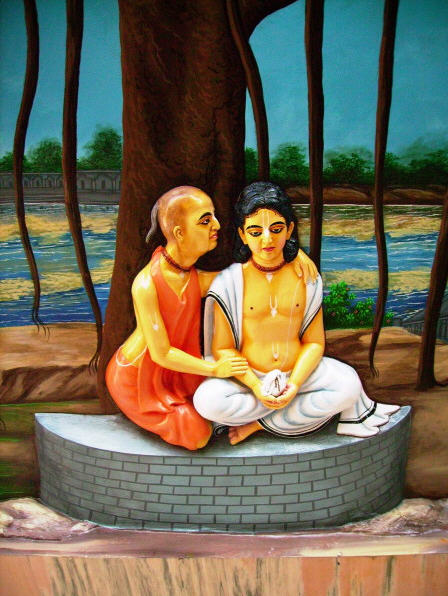
   Sri Gadadhara Pandita was very affectionate towards Mukunda datta. Whenever any Vaisnava came to Navadwipa, Mukunda would inform Gadadhara and they would both go to have darsana.one time Pundarika Vidyanidhi came from Cattagram to Navadwipa and Mukunda invited Gadadhara to come along and meet him. Gadadhara was very excited to meet such a Vaisnava and thus the two of them happily set out together to take advantage of sadhu-sanga with the famous Pundarika Vidyanidhi. 
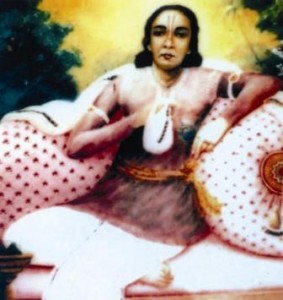
Gadadhara Pandit

Pundariki Vidyanidhi - Spiritual Master of Gadadhara Pandit.

   However, when Gadadhara saw that Pundarika Vidyanidhi dressed and acted like a wealthy materialist, he lost whatever reverence he had previously felt even before speaking with him. Gadahara thought to himself, "How can a Vaisnava look and act as if he was so addicted to sense enjoyment?"

   However, Mukunda knew the real character of Pundarika Vidyanidhi, and he could also sense the doubts in the mind of Gadadhara Pandita. Thus he recited some slokas from the Srimad Bhagavatam in a very sweet voice. When Pundarika Vidyanidhi heard his beautiful recitation of these slokas, in a fit of ecstasy he began to cry while calling, "Krishna, Krishna", and finally fainted dead away on the floor. [Chaitanya Bhagavat. Madhylila 7.78-79].

   Gadadhara now felt very remorseful in his mind. He thought to himself, "Because I have ignorantly considered this highly advanced soul to be an ordinary materialist, what an offense I have committed! In order that I might be saved from the reaction of this offense, I think the only solution is to accept initiation from him."

   Gadadhara Pandita submitted his proposal to Mukunda, who presented it to Pundarika Vidyanidhi with a full account of the pandita's high qualifications. "Hearing this proposal, Pundarik became very happy. 'Providence has bestowed upon me a great jewel; certainly I will accept him. You shouldn't have any doubt about that. It is the result of many lifetimes of good fortune that one gets a disciple like this.'" [Chaitanya Bhagavat. Madhylila 7.117-118]. On an auspicious day, Sri Gadadhara Pandita received the divine mantra from Pundarika Vidyanidhi.

   Sri Caitanya Mahaprabhu, upon going to Gaya Dham, first began to manifest krishna-prema. There he enacted the pastime of accepting the shelter of Sri Isvara Puri. After returning to His house He began to exhibit a new life.

   Day and night He floated in the ocean of love of krishna. Gadadhara, upon seeing the Lord showeringof tears in love for krishna, also began to cry in ecstatic love. From this time, Gadadhara Pandita was always at Mahaprabhu's side.

   One day Sri Gadadhara brought some pan to Sri Gauranga, Who, in an exuberance of emotion asked him, "Gadadhara! Where is that beautiful blackish boy Who is dressed in yellow garments?" After asking this, He began to shed tears.Gadadhara couldn't immediately think of what to say. He finally respectfully suggested, "He is in your heart." Hearing this, Mahaprabhu began to tear at his chest with his nails, but Gadadhara quickly grabbed his hands. Prabhu said to him, "Gadadhara! Let go of My hands. I cannot remain a moment more not seeing Krishna." 
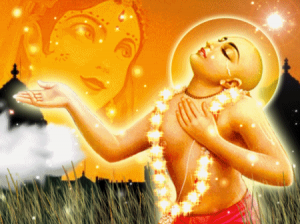
Gadadhara Pandit

Lord Chaitania is crying feeling love for Krishna.

   Gadadhara replied, "Just try to be a little patient and calm Yourself. Krishna will come any minute now." Hearing this, Mahaprabhu became somewhat composed.

   Sacimata heard all this from a distance and then came running there. Being very pleased with Gadadhara, she declared, "Though He is just a boy, He is very intelligent. I am frightened to go before my son when He is in these moods. But Gadadhara has very cleverly pacified him."

   "Sacimata told Gadadhar, 'Gadadhara! You must please remain with Nimai always. If you stay with Him then I won't have to worry."

   One day, Sri Gadadhara, having heard that Mahaprabhu will speak krishna-katha at Suklambara Brahmacari's house, went there and sat down inside. Meanwhile, Mahaprabhu arrived outside on the verandah and began to speak about Krishna to an audience of devotees there; Gadahara Prabhu listened from within the house. Soon Mahaprabhu became totally absorbed in the ecstacy Krishna-prema, which quickly spread to the assembly of devotees. For some time they continued to taste the mellows of love of Krishna together and then becalmed themselves.

   Gadadhara, however, couldn't restrain his ecstacy. With his head bowed down, he continued to cry very loudly. Hearing his pitiful sobbing, Mahaprabhu inquired, "Who is crying within the room?" Suklambara Brahmacari replied, "Your Gadadhara."

   Mahaprabhu exclaimed, "Gadadhara! You are so pious and virtuous. Since your very childhood you were so devoted to Krishna. My life has been wasted. Due to my previous evil activities I cannot get the association of the Lord of my life, Sri Krishna."Saying this Prabhu embraced Gadadhara in great love.When Mahaprabhu began His pastimes in Navadvipa, Gadadhara was his chief companion. Radha-Krishna of Vraja are now sporting on the banks of the Ganga as Gadai-Gauranga, and the cowherd boy-friends of Vraja are assisting in His pastimes of Kirtana.

   One day after roaming throughout the town of Navadwipa, Mahaprabhu came to a forest and seated Himself there. Then He began to remember His pastimes in Vraja. Mukunda began to sing the purva-vag (courtship) songs in a very sweet voice while Gadadhara collected some flowers from that forest and after stringing a garland placed it on Prabhu's neck. Previously, in the way that Sri Radha used to decorate Sri krishna, Gadadhara began to dress Prabhu in that exact same manner. Some were singing beautiful songs, while others began to dance in a very graceful style. Then Sri Gaurasundara taking Gadadhara by His side seated Himself on a dias at the base of one tree, while Adwaita Acarya began to offer arati. Nityananda seated Himself on Prabhu's right side and Srivasa Pandita began to decorate everyone with flower garlands. Narahari was fanning that Divine couple with a whisk made from the tail hairs of forest cows. Suklambar decorated them all with sandalwood paste while Murari Gupta recited the premdhani. Madhava, Vasudeva, Purusottama, Vijaya, and Mukunda began to sing songs in the various ragas. 
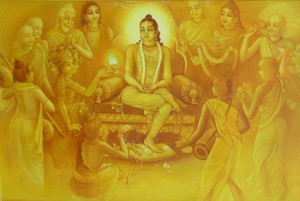
Gadadhara Pandit

Goura Arati.

   Then Prabhu closed his pastimes in Nadiya and as per his mother's request he took up his residence at Nilacala. Gadadhara also went there to live at this time. He engaged himself in the service of Sri Tota Gopinatha. Mahaprabhu would very often visit his dear friend Gadadhara and lose Himself in discussions on the topics of Sri krishna. The temple of Sri Tota Gopinathji is located near the ocean at Yameshvar.

   When Lord Caitanya traveled to Sri Vrindavana, Gadadhara, not being able to bear separation from Him, wanted to go also but Mahaprabhu reminded him of his vow of Ksetra-sannyasa (by which he was to remain constantly in Sri Ksetra in the service of Sri Gopinatha) and sent him back.

   Sri Gadadhara Pandita would regularly recite Srimad Bhagavatam. Sri Gaurasundara, along with His associates, would listen.Then one might ask a question, if Lord Chaitanya is Radha and krishna combined, where is the necessity for the appearance of Gadadhara Pandit?

   The answer to this is that it has been explained that Mahaprabhu is Krishna in search of the loving sentiment of Radha for Krishna. Sri Gadadhara Pandita represents that bhava personified, and thus he has appeared to be at the side of Mahaprabhu to assist him in his search. In this explanation, Gadadhara gives his unalloyed love to Lord Gauranga willingly.

   It has also been explained that krishna has stolen the bhava of Radha and appears as Mahaprabhu, Radha krishna combined. Gadadhara represents that which is left of Radha after Krishna steals her bhava. The mood is that seeing that neither Sri Radha nor Sri Krishna appear on the purnima tithi (full moon), but when The Divine couple combine as Sri Caitanya Mahaprabhu, this appearance in the world occurs on the Purima in Navadwipa.

   Sri Gadadhara pandit appears on the new moon and leaves the world on the same day. New moon means no moon – dark moon or Amavasya tithi. He also appeared in a land that is desert-like, dry and vacant in contrast to the lush Ganga basin of Navadwipa.

   All of this indicates the condition of the heart or nature of Sri Gadadhara. He is thus feeling empty, and lets everyone know about it too. It is said that what remains in him is the bhava of Rukmini, who is Radha's expansion in Dvaraka. Thus his surface mood in Gaura lila is like that of a dakshine (right wing) gopi rather than a vama (left wing) gopi (Vama type is little aggressive in nature, and fights with the lover). However, to prove Gadadhar's dedication as right-wing He is submissive to the extreme (daksina type tolerates everything whatever comes, only with a defensive attitude he stands. That is daksina path, that is as in Srimati Rukmini Devi. So when the spirit of Radharani of that opposing nature was drawn out by Mahaprabhu, then what remains is compared like that of Rukmini, as a passive seer, without any power to assert, only onlooker. Onlooker and bearing everything, a very pitiable condition. The idea is to awaken kindness and sympathy from everyone).

   "What is he and what is she and what is her position now. And how her lover has taken up everything from her, looted everything from her, leaving her as a beggar wandering in the street. So much looted. Radharani when looted to such a degree by Krishna, that becomes Gadadhara, the pitiable figure. The wealth of course cannot go forever. She is the proprietor, owner cannot be far off. After a long time, that must come to her again, one day. And those that are helping her in her day of distress, they will get how much remuneration at that time. When she will get back all property."

   Just as in Vraj Srimati Radharani is the Queen and proprioter of everything, so Gadadhara is master of everything, but still here He has given everything to His master, and thus in one sense He is empty. This mood of His being empty is unique, he is playing in such a way, as His part or play, as Gadadhara Pandita. His is the highest position of self-sacrifice.

   "Nimai Pandita showed His character as an aggressor, impertinent, and an extraordinary genius. Gadadhara Pandita was just the opposite. He had some natural inclination, that was in His submission and total dedication towards Nimai Pandita. And Nimai Pandita also had some special attraction for Gadadhara Pandita. But Gadadhara Pandita could not face Nimai Pandita directly. Some sort of shyness He felt about Nimai Pandita. So, this is what we know about Gadadhara Pandita. Gadadhara Pandita had very intimate relationship with Mahaprabhu, in which the acaryas, Swarupa Damodara, Rupa, Sanatana, Kaviraja Goswami, Raghunatha Dasa, all of them, could see Radharani and Rukmini both in his personality, and according to that we can try to understand him."
 
   It is true that Gauranga Mahaprabhu is Vrajendranandana Krishna, within Him, as is the case with svayam bhagavan Krishna, all of His expansions are present. Thus as Gaura-Narayana He consorts with Rukmini in Her appearance as Laksmipriya devi. Furthermore, just as Vrajendranandana Krishna never leaves Vrindavana, similarly Sacinandana Gaura Krishna never leaves Navadvipa Dhama.

   Thus the lila of Mahaprabhu in Puri, which is representative of Dvaraka, is imbued with aisvarya (opulence) not found in Nadiya (Bengal). Indeed this aisvarya is said to have weighed heavily on Gadadhara Pandita and influenced His loving sentiment of bhava. Srila krishna dasa Kaviraja Goswami says of Gadadhara in Puri Dhama that because He was influenced by aisvarya-jnana of Gauranga, He was, as Srila Prabhupada comments further, always submissive (daksina-nayiki). He could not be angered by Mahaprabhu even when Mahaprabhu tried to anger Him and see the mood of Radha (vama-nayiki) in Him.

   Krishna dasa Kaviraja pointed out that even as Krishna in the form of Mahaprabhu tried to anger Gadadhara (Radha) He could not draw out this sentiment from Him because he maintained a temperament like that of Rukmini's (daksina-nayiki) due to the fact that Mahaprabhu had already stolen the vama-nayiki aspect of Radha from him. Indeed, Svarupa Damodara Goswami asked Gadadhara why He did not reproach Mahaprabhu and instead tolerated Mahaprabhu's criticisms of Him. To this Gadadhara replied, prabhu svatantra sarvajna-siromani tanra sane 'hatha' kari,–bhala nahi mani, "The master is independent. He is the topmost omniscient person. If I speak on an equal level with Him, this will not be good for Me."

   The above opinion is one that is shared by the late Om Visnupada Bhakti Pramode Puri Goswami. In his book, 'Heart of Krishna' that contains a series of articles originally written in Bengali during the manifest presence of Srila Bhaktisiddhanta Saraswati Thakura, Puri Goswami Maharaja states, "That which is left over after the bhava and luster of Radha has been plundered by krishna is Gadadhara Pandita." It is stated that no one loves Lord Gauranga more than Sri Gadadhara. Yet even though He takes much abuse and neglect from Gauranga, still He cannot leave Him. His necessity and dependency is very great. The understanding is that without Mahaprabhu She/He is transcendentally incomplete, thus He/She wants to get His/Her bhava back from krishna to again become complete, the complete united whole Radha-krishna. To unite Gaura with Gadadhara (Radha Krishna) is the highest ideal of Gaudiya Vaisnavism.

   The worship of Gaura-Gadadhara is in madhurya-rasa so is not for the kanistha adhikari on the beginning stages of devotional service where one strives to follow the principles and avoid offences, rather this is for advanced devotees who are already steady (nistha) in krishna consciousness and getting a genuine taste (ruchi). Then in transcendental view They are worshipped like Radha and Krishna. Thus Sri Gadadhara pandit is like Sri Radha standing next to the Gaura (Krishna) who has stolen Her/His bhava (love), and She wants it back. When They are united, then the divine couple Radha-krishna/Gaura-Gadadhara are present. Sometimes the devotees will see them as Radha-krishna, and sometimes as Gaura-Gadadhara according to that pure devotee's mood. Bhaktivinoda Thakura has written an arati song for Gaura-Gadadhara describing Radha-krishna. This is the internal reality. It is all very esoteric and not to be imitated. Who can understand such wonderful and intimate pastimes, thus we use ordinary terms to try to explain them but these mellows are not ordinary.

   When Vakresvara pandita came to live at Puri, he would accompany Sri Chaitanya Mahaprabhu, Advaita Acharya and other devotees to Tota Gopinath to hear Gadadhara Pandit give discourses on the Bhagavatam One should hear the book Bhagavatam from the devotee Bhagavatam.

   One who thinks, "I understand the Bhagavatam" does not really know the Bhagavatam's central meaning. On the other hand, an ignorant person who takes shelter of the Bhagavatam will directly perceive its meaning. The Bhagavatam is pure love, it is the incarnation of Krishna himself. It recounts Krishna's most intimate activities. After recounting the Vedas and the Puranas, Vedavyasa felt unsatisfied, but as soon as the Bhagavatam manifested on his tongue, his mind was immediately satisfied.

smara gaura-gadadhara keli kalam
bhava gaura-gadadhara paksa caram
srnu gaura-gadadhara caru katham
   bhaja godruma-kanon kunja-vidhum
  

   "Remember Gaura-Gadadhara during the time of Their pastimes, Meditate on Gaura-Gadadhar, the Divine couple, the par-excellence of beauty. Hear beautiful discussions on the topics of Gaura-Gadadhara, and worship them in the forest grove of Godruma, bathed in the light of the moon." gadadhar pandit prabhu age bosi pare bhagavat – sudha dhale rasi rasi [B.R. 3/107]  After enacting His pastimes on this planet for forty-eight years, it was seen by witnesses that Sri Gaurasundara entered into the body of Sri Tota-Gopinathji, who was the Deity in Puri on the Nilachala beach served by Sri Gadadhara Pandita.By [Srila Bhaktivinoda Thakura]

nyasi siromani cesta bujhe sadya kar
akasmat prithini karila andhakar
pravesila ei gopinatha mandire
            hoila adarsan, punah na aila bahire
           

   In the diary of one Orissan devotee, Mahaprabhu is said to have first went missing inside the Gundica Mandira. Then the devotees began to comb the four directions in search of their Beloved Lord. Finally, outside of Tota Gopinatha Mandira, at Yameswar, the outer garment of Mahaprabhu was found lying on the ground. There's a story in connection with Sri Gadadhar Pandit that when He was very old and trying to render service to Tota-Gopinath that He couldn't any more reach to put the garland around the neck of the Deity. To reciprocate with His loving service the Deity knelt down to accept the flower garlands of His beloved Gadadhar, Who is none other than His beloved Srimati Radharani incarnate as mentioned previously. [B.R. 8.356-357]

   To this day the Deity of Tota-Gopinath in the temple remains in a kneeling position to accept the eternal service of His beloved Gadadhar. A slight crack which is still to be found near the right knee of Sri Gopinathji is the spot where Mahaprabhu is said to have entered the Deity. His appearance is on the amavasya (new moon) of the month of Vaisakha.

Sri Gadadharastakam by Srila Svarupa Damodara Goswami:

Text 1
sva-bhakti-yoga-lasinam sada vraje viharinam
hari-priya-ganagragam cacisuta-priyecvaram
saradha-krishna-sevana-prakacakam mahacayam bhajamy aham
gadadharam supanditam gurum prabhum

I worship the greatly learned and exalted spiritual master, Srila Gadadhara Prabhu, who appears very splendid, engaged in the Lord's devotional service. He always performs pastimes in Vraja, where he is very prominent among the gopis, who are very dear to Lord Hari. Lord Caitanya, the Son of Saci is the dear Lord of Gadadhara Prabhu, who is preaching the service of Radha and krishna.

Text 2
navojjvaladi- bhavana-vidhana-karma-paragam
vicitra-gaura-bhakti-sindhu-ragga-bhagga-lasinam
suraga-marga-darsakam vrajadi-vasa-dayakam bhajamy
aham gadadharam supanditam gurum prabhum

I worship the greatly learned spiritual master, Srila Gadadhara Prabhu. He is expertly absorbed in meditation on the nine rasas of devotional service, beginning with ujjvala-rasa (conjugal love), and he dances in the waves of the amazing ocean of devotional service to Lord Caitanya. He preaches the path of raganuga-bhakti (spontaneous devotional service), and He is a fit person to attain residence in the transcendental land of Vraja.

Text 3
sacisutagghri-sara-bhakta-vrnda-vandya-gauravam
gaura-bhava-citta-padma-madhya-krishna-vallabham
mukunda-gaura-rupinam svabhava-dharma-dayakam bhajamy
aham gadadharam supanditam gurum prabhum

I worship the greatly learned spiritual master, Srila Gadadhara Prabhu. The best of those who are devoted to the lotus feet of Lord Caitanya, the Son of Saci-devi, offer respecful obeisances to him and treat him with great importance, and he is very dear to Lord krishna, Who is seated in the middle of the lotus flower which is his heart, assuming His golden form of Caitanya Mahaprabhu. He preaches that Lord Mukunda has assumed the golden form of Lord Caitanya, and he returns the living entities to their constitutional position as servants of the Lord.

Text 4
nikunja-sevanadika-prakasanaika-karanam sada
sakhi-rati-pradam maha-rasa-svarupakam
sadacritagghri-pankajam sariri-sad-gurum varam bhajamy
aham gadadharam supanditam gurum prabhum

I worship the greatly learned and exalted spiritual master, Srila Gadadhara Prabhu. It is only because of him that the truth of the exalted devotional service performed by the intimate associates of krishna in the forests and groves of vrindavana has been revealed. He is preaching the ecstatic love attained by the gopis, and he is indeed a personification of the mellows of devotional service. The saintly devotees take shelter of his lotus feet, and he teaches the truth of spiritual life to the living entities.

Text 5
mahaprabhor maha-rasa-prakasanagkuram priyam sada
maha-rasagkura-prakacanadi-vasanam mahaprabhor
vrajagganadi-bhava-moda-karakam bhajamy aham
gadadharam supanditam gurum prabhum

I worship the greatly learned spiritual master, Srila Gadadhara Prabhu. He is very dear to Lord Caitanya Mahaprabhu, and it is as if he had sprouted from the manifestation of the Lord`s ecstatic love. He is always adorned with the garments of ecstatic love of Godhead, and He delights Lord Caitanya Mahaprabhu by arousing in the Lord the ecstatic emotional love experienced by the gopis of Vraja.

Text 6
dvijendra-vrnda-vandya-pada-yugma-bhakti-vardhakam
nijesu radhikatmata-vapuh-prakacanagraham
asesa-bhakti-sastra-siksayojjvalamrta-prabam bhajamy
aham gadadharam supanditam gurum prabhum

I worship the greatly learned spiritual master, Srila Gadadhara Prabhu, who expands the mellows of devotional service and whose lotus feet are worshipped by the kings of the brahmanas. Among his confidential associates, he reveals his actual form as Srimati Radharani. He distributes the nectar of the ecstatic mellow of the gopis conjugal love, strictly following the instructions of all the devotional scriptures.

Text 7
muda nija-priyadika-svapada-padma-sindhubhir
maha-rasarnavamrta-pradesta-gaura-bhaktidam
sadast-sattvikanvitam nijesta-bhakti-dayakam bhajamy
aham gadadharam supanditam gurum prabhum

I worship the greatly learned spiritual master, Srila Gadadhara Prabhu. With delight he is giving the devotional service of Lord Caitanya which reveals the nectarean ocean of the most exalted mellows of devotional service, along with the nectar flowing from the lotus feet of the gopis, headed by Srimati Radharani, who is most dear to krishna. Gadadhara Prabhu is decorated with the eight transcendental ecstatic symptoms of sattvika-bhava,and he is distributing devotional service to his worshippable Lord krishna.

Text 8
yadiya-riti-raga-ragga-bhagga-digdhamanaso naro `api
yati turnam eva narya-bhava-bhajanam tam
ujjvalakta-cittam etu citta-matta-catpado bhajamy aham
gadadharam supanditam guram prabhum

I worship the greatly learned spiritual master, Srila Gadadhara Prabhu. Even a conditioned soul, whose mind becomes anointed by the colorful waves of spontaneous devotional service as delineated by Srila Gadadhara Prabhu, quickly attains the highest level of devotional service. He becomes like a maddened bumble bee whose mind is anointed with the mellow of ujjvala-rasa (conjugal love).

Text 9
maha-rasamrta-pradam sada gadadhara-astakam pathet tu
yah subhaktito vrajaggana-ganotsavam
saci-tanuja-pada-padma-bhakti-ratna-yogyatam labheta
radhika-gadadharagghri-padma-sevaya

"These eight verses glorifying Srila Gadadhara Prabhu distribute the nectat of the most exalted mellow of devotional service, and they are like a festival for the gopis of Vraja. If one regularly reads these verses and serves the lotus feet of Srila Gadadhara Prabhu, who is an incarnation of Srimati Radharani, then he will become qualified to attain the jewel of pure devotional service for the lotus feet of Lord Caitanya,the son of Sacidevi."
Abhirama Gopala Thakura – Biography

Abhiram Gopala Thakur

Sridama in Krishna Lila.

   In Krsna lila, he is Sridama
   His worshippable Deity is Sri Gopinathji
   His wife's name is Sri Malini-devi
   He is also called Abhirama Gopala; Rama dasa; Bhirama dasa
 
   Abhirama Thakura was one of the most vigorous preachers among the associates of Lord Nityananda Prabhu. In the mood of a cowherd boy, Sri Abhirama Thakura carried a bamboo flute, and a bullwhip named Jaya Mangala. Whomever he struck with this whip became filled with Krishna prema, love for God. If Abhirama Thakura offered obeisances to any stone other than a sacred salagrama-sila, it would at once burst into pieces. Abhirama Thakura used his home for preaching and for serving Vaishnava pilgrims. His house constantly resounded with kirtana and topics of Krishna and he was the favorite of Nityananda Prabhu.
(Sri Caitanya-caritamrta, Adi-lila 11.13.)
 
   One day, Krishna, Balarama and their cowherd friends were playing a game of hide and seek. In the middle of Their game, Krishna decided to go to Nadia to enjoy His pastimes there, and so, taking with Him Balarama and all Their friends, He advented Himself in Navadwipa. Somehow or other, He forgot Sridama, who remained in his hiding place in a cave. After a while Krishna noticed that Sridam had been left behind and sent Balarama as Nityananda, Who found Sridam and told him: "Come on!  We've all gone to Nadia to play there!"
 
   Sridama asked, "Who are You?"
 
   "I'm your Lord Balarama. Can't you recognize me?"
 
   "You can't be my Lord Balaram. You're too small." [In Kali yuga the measurement of the body is 3.5 hands, whereas in Dwapara-yuga it is 7 hands.
 
   "If you don't believe Me, then take off running. If I can't catch you within ten paces, then you'll know I'm not Balarama."
 
   "All right! Catch me if You can!"
 
   Sridama took off running, but Nityananda Prabhu immediately caught him. But now Sridama told Him, "Now look here, You left me behind, so I'm not going to this Nuddia or whatever the place is called."
 
   Nityananda Prabhu kept coaxing him but Sridama was adamant. Finally he manifested an expansion of himself, Rama dasa, who agreed to go. But Sridam still wanted to remain behind as his feelings were greatly hurt.
 
   Rama dasa was also dissatisfied and very prone to anger. When Nityananda Prabhu's first child was born, Abhirama Thakura came to offer his obeisances to the child, who died on the spot. In this way, seven of Nityananda's children had to depart from this world just after taking birth. Finally a daughter, Ganga-devi, was born to Nityananda Prabhu and Vasudha devi. When, after offering his obeisances to the child, Abhirama Thakur saw that the baby was unaffected he exclaimed, "This time we havn't been deceived!"  Then he immediately composed one hundred verses in praise of Ganga-devi. When Viracandra Prabhu took his birth, Abhirama again came to offer his obeisances. When he saw that Viracandra was unaffected, he composed Sri Birbhadrastakam.
 
   If Abhirama Thakura would offer his obeisances to any stone other then a Shalagram-sila, that stone would crack. One time, Abhirama Thakur came to Sri Khanda, wanting to meet Raghunandana Thakura. Mukunda dasa was aware of his reputation and thus told the Thakura that Raghunandana wasn't there. Feeling disappointed, Abhirama departed. When Raghunandan heard that Abhirama Thakura had come to meet him, he ran to catch up with the Thakura. Finally he met him at Bor Danga, where they danced together in ecstasy. When Raghunandana was dancing his nupur (ankle bracelet) came off and fell down at Akaihat, where Kaliya Krishna dasa used to do his bhajan. This nupur is still being worshiped along with Kaliya Krishna Thakura's Deity at Karvi, not far from Katwa.
 
   Gopala Guru Gosvami was also similarly tested by Abhirama Thakura when he was only a small boy living with Mahaprabhu in Puri. By the mercy of Mahaprabhu, Who invested His potency in Gopala Guru, the boy emerged unscathed.
 
   Abhirama Thakura's Sripat is at Khanakhul Krishnanagar. Khanakhul Krishnanagar can be reached by bus from Tarakeshwar, which is connected by train from Bandel station. It can also be reached by bus from Atapur, the Sripat of Patameshvari dasa Thakura.
 
   His wife's name was Sri Malini-devi. His worshippable Deity Sri Gopinathji Who, after first appearing to him in a dream, manifested Himself at Khanakhul Krishnanagar. The legend is that He appeared in a dream to Abhirama Thakura and said, "I am within the earth here. Please take Me out and worship Me." Abhirama dasa excavated in that place and found within the womb of the earth the all-enchanting form of Sri Gopinathji.  That place where the Deity was found became known as Ram Kund. "In the place where Sri Gopinathji advented Himself a lake was formed, and the water contained therein was sweet as nectar. Whoever bathed in or drank that water became beside himself with ecstasy. Thereafter, this land has become famous as Ram Kund.  Having heard of these divine pastimes of Sri Gopinathji an incessant flow of people descended on that place like the waters of the Ganges River." [Bhakti-Ratnakar Taranga 4]
 
   One day while in a state of rapture in rememberance of Sri Krishna, Abhirama Thakura, in the mood of cowherd boy, desired to play the flute. In the madness of ecstatic love he began to search in all directions for one. Then he saw before him a large trunk of a tree which not even sixteen men could lift. Out of this he fashioned a flute and began to play it. "Rama dasa, one of the chief branches, was full of fraternal love of Godhead. He made a flute from a stick with sixteen knots." [C.C. Adi 11.16]
 
   Sri Abhirama Thakura had a celebrated whip, whose name was Jaya-Mangala. Whoever was touched with that whip had the symptoms of love of Krishna awakened within their person.
 
   One day, Srinivasa Acarya came to meet Abhirama Thakura. After touching him three times with his whip, his wife Malini-devi exclaimed, "Thakura, don't beat him anymore! Restrain yourself! He is just a boy. He'll become overly excited by the touch of your whip." Meanwhile, Srinivasa had become completely drowned in Krishna-prema.
 
   When Sri Gaurasundara ordered Nityananda prabhu to preach in Gaudadesa (Bengal), he sent with him Sri Rama dasa, Sri Gadadhar dasa and others. The atheists trembled in fear at the sight of Abhirama Thakura. He was a learned scholar of the scriptures. According to the desire of Nityananda Prabhu he married. His disappearance is on the seventh day of the dark fortnight of the month of Caitra.
 
   The descendants of the disciples of Abhirama Thakura are still living within the districts of Hugli and Bankura, at Krishnanagar,  Amta, Vishnupur and Kotalpur.
 
Abhiram Thakur Tests The Sons Of Lord Nityananda
BY MADHAVANANDA DAS
 
   *The following story adapted from the book "Abhiram Lilamrta" appeared in issue number 4 of Sri Krishna Kathamrita Bindu, the free fortnightly email magazine from ISKCON Gopal Jiu Publications.
 
   Abhiram Thakur is perhaps the most prominent follower of Lord Nityananda Prabhu. According to Srila Kavi Karnapur, Abhiram Thakur is the incarnation of Sridama Sakha, the chief cowherd boy in krsna-lila. His pastimes were described in simple Bengali verse by his disciple Sri Tilak Ram Das in a book called Sri Abhirama Lilamrta. In the fourth chapter the author reveals how he was able to write:
 
utha utha ore sisya sunaha vacane amara yateka lila karaha varnana eta bali mora sathe carana dharila carana parase lila svarana haila
 
   [My guru Abhiram Thakur came to me while I was resting and said “Wake up! Wake up! O disciple, hear my words! I want you to write about my pastimes.” I touched my head to my guru’s lotus feet and at that time all of his pastimes appeared to me. [Texts 5-6, 13]
 
   The following story, adapted from chapter 15, verses 141-246, describes how Abhiram Thakur tested the newborn sons of Lord Nityananda.
 
UNCOMMON POWERS
 
   Abhiram Thakur was a very powerful personality. It is said that he would sometimes test the authenticity of a salagrama-sila or a Deity by offering obeisances. If they were not genuine, they would break. He had other uncommon powers as well.
 
   On one occasion Abhiram Thakur met Nityananda Prabhu on the bank of the Ganga, near to the home of Nityananda Prabhu. Nitai offered Abhiram a seat.
 
   They embraced, and both sat down.
 
   Nitai said, "O brother Abhiram, what is your desire? Why have you come to My home?"
 
   "I want to see Your son."
 
   Hearing this, Nityananda became happy. However, when Nityananda Prabhu showed him His son, Abhiram offered obeisances to the child and immediately the child died. When Nityananda Prabhu's wives Vasudha and Jahnava heard the news, they both fainted. Nityananda then placed the body of the child in the Ganga and they all took bath.
 
   Sometime later, another child was born, and again Abhiram Thakur came. As before, when Abhiram offered his obeisances, the child died. Everyone was astonished, thinking, "What is Abhiram's purpose?" In this way, every time a child was born, Abhiram would come, offer obeisances, and the child would die.
 
NO INVITATION
 
   Although Nityananda Prabhu is the Supreme Personality of Godhead Lord Balaram, still, while acting out His human-like pastimes, He externally became very unhappy seeing all of His sons die. Therefore, when the next child was born, Nitai thought to Himself, "If Abhiram does not come My child will live."
 
   Nityananda Prabhu invited many quests for the festive occasion, but He did not invite Abhiram Thakur. Seeing that Abhiram was not there, Adwaita Acharya inquired from Nityananda, "Why have You not invited Abhiram?"
 
   Nityananda Prabhu replied, "Abhiram has made Me bereft of sons. So I will not invite him. I've told all of the boatmen not to bring him across the Ganga in their boats."
 
   During the time of the festival for the birth of Nityananda Prabhu's latest son, Abhiram and his wife Malini were staying at Krishnagar. Vakreswar Pandit came to see them. Malini offered him a seat, and Vakreswar inquired from Abhiram, "Nitai is performing a festival on the occasion of the birth of his son. You are the pradhana-gopal, the leader of the cowherd boys. Is He inviting you or not?"
 
   Abhiram laughed and said, "No. He is not inviting me."
 
   Vakreswar humbly told Abhiram, "Without your presence this ceremony cannot be performed properly. Although He is not inviting you, still you should go."
 
   "How can I go without an invitation?"
 
   Malini then said, "Abhiram is a rakhal, a cowherd boy. Such cowherders have no abhiman, false ego. He is not finding fault with Nityananda Prabhu for not inviting him."
 
   Abhiram Thakur then told Vakreswar, "O brother, I'll go there later." After Vakreswar left, Abhiram conceived a plan. He bade Malini goodbye and started off, saying, "Gaura Hari ki jaya!" He went to the bank of the Ganga and said to a boatman, "Take me across!"
 
   The boatman looked at Abhiram Thakur and inquired, "Who are you sir? Give me your name and then I will start the journey. If I take the wrong person across then Nityananda Prabhu will be very angry with me."
 
   Abhiram replied, "Why does He want to restrict this person from crossing?"
 
   The boatman said, "Nityananda Prabhu is miserable and lamenting for His lost children. He told me, 'There is one person named Abhiram Thakur. He is very powerful. If he offers obeisances to My son then the child will die.' Saying this, Nityananda Prabhu told me not to bring that person across. I think that you are that same Abhiram Thakur."
 
   Out of fear of Nityananda Prabhu, the boatman then put water in his boat and made it sink. Hearing that Abhiram Thakur had come, all of the other boatmen also filled their boats with water and sank them.
 
   Abhiram Thakur then took some cloth and threw it in the river. The cloth floated, and, sitting on it, Abhiram crossed the river.
 
   Seeing this, the people became astonished and ran to tell Nityananda Prabhu.
 
   Although Nitai became worried, He took all of the mahants who were present at the festival and went to meet Abhiram Thakur. Abhiram saw them all performing ecstatic kirtana and coming toward the bank of the Ganga to meet him. Abhiram then began playing his flute, and he lost external consciousness. Tilak Ram Das says, "Who can understand Abhiram Thakur?"
 
PRASAD AT NITAI'S HOME
 
   When they came together, Abhiram embraced all of them with ecstatic love while his hairs stood on end. Nitai brought Abhiram into His home. Abhiram told Him, "I am very hungry. Please give me some Prasad." Nitai gave him a seat in a room and Vasudha and Jahnava happily brought him nice prasad consisting of sweet rice, fancy rice and many opulent dishes. As much Prasad as they brought, Abhiram ate it until he had finished everything in the house.
 
   Seeing that he had eaten everything, Nitai said, "Dandavats to your pastimes! Who can understand You? In vraja-lila you are Sridama. Have you forgotten our loving relationship? In Vraja we all shared prasad together.
 
   But now, forgetting all of that, you are taking all of the Prasad alone. In Vraja we would always share whatever fruits we got. What sort of behavior is this that you are taking all of the Prasad alone?"
 
   Abhiram listened and said, "My nature is that of a cowherd boy. First I take, then I give to others. My behaviour is that of Vraja. Knowing my nature and activities in Vraja, how can You say I took all of the Prasad? Go and see Your pots." Then Abhiram performed acaman.
 
   Nityananda Prabhu went to see the pots and found that double the original amount of Prasad was there. Nitai then happily embraced Abhiram.
 
   Abhiram said, "O Brother, you should feed all of the mahants."
 
   The mahants then happily took Prasad and shouted, "Hari! Hari!" Finishing, they all performed acamana. Then Nitai gave them tambula and a place to take rest.
 
"SPARE OUR CHILD!"
 
   Abhiram Thakur said, "Nitai, You have celebrated a festival for the birth of Your son. What sort of son do You have? Please bring him and I will offer my obeisances to him." 
Abhiram Gopala Thakur

VIRABHADRA PRABHU-Son of Lord Nityananda.

 
   Hearing this, everyone became worried. Nityananda Prabhu's wives Vasudha and Jahnava approached Abhiram and humbly said, "This time please give protection to our child. Don't let us be criticized for not having a son. If you offer obeisances to our son then he will die. Every time this is what has happened. If you do this again, then we will also die."
 
   Abhiram said, "Why are you fearing? You don't understand. I am offering my obeisances to test the child. If he is svayam-svarupa, the Lord's personal manifestation, then he will survive my obeisances."
 
   Hearing Abhiram's words, Nityananda Prabhu became happy and brought His son before Abhiram. Abhiram Thakur offered his obeisances, and the child laughed. Abhiram become very happy and offered his obeisances a second and a third time, just to test the child. He saw that this child was jagat-priya, dear to the entire universe. Abhiram took the child on his lap and began to dance. He then told all of the mahants there:
 
ye na dekhecha gora dekha ara bar punarbar sei gora vira avatar
 
"So that those who did not see Sri Chaitanya Mahaprabhu could again have the opportunity to see Him, the Lord has reappeared in the form of Virabhadra Prabhu." 
 
THE IDENTITY OF VIRABHADRA PRABHU
 
   Lord Balaram has appeared as Lord Nityananda Prabhu. As the Supreme Lord, He is sarvajna, all-knowing. Hence He certainly understood and, in fact, inspired the behavior of Abhiram Thakur. The nature of the Lord is that He likes to see His Devotees glorified more than Himself. Therefore, to glorify His Devotee Abhiram Thakur, and also His son Virabhadra Prabhu, Lord Nityananda inspired Abhiram Thakur to act in such an unusual way. 
Abhiram Gopala Thakur

The expansion of Lord Sankarshan known as Kshirodakasayi Vishnu appeared in Sri Chaitanya Mahaprabhu's pastimes as Virachandra Prabhu. Lord Virachandra was non-different from Lord Chaitanya Himself.

 
   Virabhadra Prabhu is the incarnation of Kshirodakasayi Vishnu. Srila Kavi Karnapura has written (Sri Gaura-ganodesa-dipika text 67):
 
sankarsanasya yo vyuhah payo-visayi-namakah sa eva viracandro 'bhuc caitanyabhinna-vigrahah
 
The expansion of Lord Sankarshan known as Kshirodakasayi Vishnu appeared in Sri Chaitanya Mahaprabhu's pastimes as Virachandra Prabhu. Lord Virachandra was non-different from Lord Chaitanya Himself. 
 
   As Kshirodakasayi Vishnu, Virabhadra Prabhu is the svayam svarupa, the plenary expansion of Lord Nityananda Prabhu. Srila Krishnadas Kaviraj has described:
 
sankarsanah karana-toya-sayi garbhoda-sayi ca payobdhi-sayi sesas ca yasyamsa-kalah sa nitya- nandakhya-ramah saranam mamastu
 
May Sri Nityananda Rama be the object of my constant remembrance.
 
   Sankarshana, Sesa Naga and the Vishnus who lie on the Karana Ocean (Karanodakasayi Visnu), Garbha Ocean (Garbhodakasayi Visnu) and ocean of milk (Ksirodakasayi Visnu) are His plenary portions and the portions of His plenary portions. [Cc. adi 1.7]

Madhavendra Puri – Biography

Madhavendra Puri

“Please construct a Temple on the top of that hill,’ the boy continued, ‘and install Me in that Temple. After this, wash Me with large quantities of cold water so that My body may be cleansed. For many days I have been observing you, and I have been wondering. ‘When will Madhavendra Puri come here to serve Me?’ I have accepted your service due to your ecstatic love for Me. Thus I shall appear, and by My audience all fallen souls will be delivered..." (Chaitanya Charitamrita Madhya 4.21-43). (In the image: Madhavendra Puri worshipping Gopalji).

   Shrila Madhavendra Puri appeared in the 14th century. He was a guru of the Brahma or Madhva sampradaya, one of the four (Brahma, Shri, Rudra and Sanaka) Vaishnava lineages that purify the world in the age of Kali.

   Madhavendra Puri was the disciple of Lakshmipati-Tirtha. Madhavendra Puri's disciples included Ishvara Puri, Advaita Acharya, Paramananda Puri (a Brahmin from the Tirhu area), Brahmananda Puri, Shri Ranga Puri, Pundarika Vidyanidhi, Raghupati Upadhyaya, and others. Nityananda Prabhu is said by some to be Madhavendra Puri's disciple, others say that Lakshmipati was his guru, while the Prema-vilasa states that he was Ishvara Puri's disciple.

   At the time of his departure from this world, Madhavendra Puri was completely absorbed in separation from Krishna and constantly repeated one shloka. This verse is considered by Gaudiya Vaishnavas to be the essence of expression of the mood of separation.

 Quotes from Vaishnava Acharyas

   “Madhavendra Puri was a well known sannyasi of the Madhva sampradaya. His grand-disciple was Shri Chaitanya Mahaprabhu. Prior to his appearance, there was no evidence of prema bhakti in the Madhva line. In his verse, ayi dinia-dayardra-natha (Chaitanya Charitamrita 2.4.197), the seed of the religious doctrines of Chaitanya Mahaprabhu can be found.” – Bhaktivinoda Thakur

   “Madhavendra Puri was the fist shoot of the desire tree of divine love that came out of the Madhva lineage. Prior to his appearance, there was no sign of the conjugal mood of devotion in the Madhva line.The feeling of separation from Krishna, or transcendental vipralambha is the only practice by which the spirit soul can achieve perfection. Material feelings of separation give rise to a despondency that reveals the attachment one has for matter, whereas the despondency that results from the feelings of separation for Krishna are the best proof of one's desire to bring pleasure to His senses. The desire to bring pleasure to Krishna's senses shown by Madhavendra Puri, the great soul who is the root of this movement, is the ideal example to follow for anyone who wishes to serve the Lord. It is especially worth remarking that Mahaprabhu and His closes followers later adopted this example and made it their standard.” – Shrila Bhaktisiddhanta Saraswati Goswami

Madhavendra Puri Discovers Gopala

   “Once Shri Madhavendra Puri traveled to Vrindavana, where he came upon the hill known as Govardhana. Madhavendra Puri was almost mad in his ecstasy of love of Godhead, and he did not know whether it was day or night. Sometimes he stood up, and sometimes he fell to the ground. He could not discriminate whether he was in a proper place or not. After circumambulating the hill, Madhavendra Puri went to Govinda Kunda and took his bath. He then sat beneath a tree to take his evening rest.

   “While he was sitting beneath a tree, an unknown cowherd boy came with a pot of milk, placed it before Madhavendra Puri, and, smiling, addressed him as follows, ‘Please drink the milk I have brought. Why don’t you beg some food to eat? What kind of meditation are you undergoing?’

   “When he saw the beauty of that boy, Madhavendra Puri became very satisfied. Hearing His sweet words, he forgot all hunger and thirst.

   “Madhavendra Puri said, ‘Who are You? Where do You reside? And how did You know that I was fasting?’

   “The boy replied, ‘Sir, I am a cowherd boy, and I reside in this village. In My village, no one fasts. In this village a person can beg food from others and thus eat. Some people drink only milk, but if a person does not ask anyone for food, I supply him all his eatables. The women who come here to take water saw you, and they supplied Me with this milk and sent Me to you. I must go very soon to milk the cows, but I shall return and take back this milk pot from you.’

   “Saying this, the boy left the place. Indeed, He suddenly could be seen no more, and Madhavendra Puri’s heart was filled with wonder.

   “After drinking the milk, Madhavendra Puri washed the pot and put it aside. He looked towards the path, but the boy never returned. Madhavendra Puri could not sleep. He sat and chanted the Hare Krishna Maha-Mantra, and at the end of the night he dozed a little, and his external activities stopped. In a dream Madhavendra Puri saw the very same boy.

   “The boy came before him and holding his hand, took him to a bush in the jungle. The boy showed Madhavendra Puri the bush and said, ‘I reside in this bush, and because of this I suffer very much from severe cold, rain showers, winds, and scorching heat. Please bring the people of the village and get them to take Me out of this bush. Then have them situate Me nicely on top of the hill.’

   “Please construct a Temple on the top of that hill,’ the boy continued, ‘and install Me in that Temple. After this, wash Me with large quantities of cold water so that My body may be cleansed. For many days I have been observing you, and I have been wondering. ‘When will Madhavendra Puri come here to serve Me?’ I have accepted your service due to your ecstatic love for Me. Thus I shall appear, and by My audience all fallen souls will be delivered. My name is Gopala. I am the lifter of Govardhana Hill. I was installed by Vajranabha, and here I am the authority. When the Mohammedans attacked, the priest who was serving Me hid Me in this bush in the jungle. Then he ran away out of fear of the attack. Since the priest went away, I have been staying in this bush. It is very good that you have come here. Now just remove Me with care.’” (Chaitanya Charitamrita Madhya 4.21-43).

   Madhavendra then went to the place where this boy instructed him to go and found the Gopala Deity. A grand installation was held for Shri Gopala. What is left of the Temple that He was worshiped in can still be seen on the top of Govardhana Hill, not far from Sankarshana Kunda. 

Madhavendra Puri

"...My name is Gopala. I am the lifter of Govardhana Hill. I was installed by Vajranabha, and here I am the authority. When the Mohammedans attacked, the priest who was serving Me hid Me in this bush in the jungle. Then he ran away out of fear of the attack. Since the priest went away, I have been staying in this bush. It is very good that you have come here. Now just remove Me with care." (Chaitanya Charitamrita Madhya 4.21-43). (In the image: Gopal lifting Govardhan Hill).

Gadadhara Pandit – Biography


Gadadhara Pandit

Sri Gadadhara Pandit.

 shri-radha-prema-rupa ya pura vrindavandeshvari  
sa shri-gadadharo gaura-vallabhah panditakhyakah
nirnitah shri-Svarupair yo vraja-lakshmitaya yatha
pura vrindavane lakshmih shyamasundara-vallabha
sadya gaura-prema-lakshmih shri-gadadhara-panditah
radham anugata yat tal lalitapy anuradhika
atah pravishad esha tam gaura-candrodaye yatha 
Gadadhara Pandit

Krishna's beloved, Radharani.


 The incarnation of love who previously was the queen of Vrindavan, Radha, is now the beloved of Gaura named Srila Gadadhara Pandit.   Svarupa Damodar himself indicated that he was Vraja’s goddess of fortune, the Lakshmi who was previously the beloved of Shyamasundara in Vrindavan. She today has become the goddess of fortune of love for Gaura and is known as Srila Gadadhara Pandit. Lalita, who is also known as Anuradha, is Radha’s closest friend and confidante. She has also entered into Gadadhara, as was shown in the play Chaitanya-candrodaya.

(Gaura-ganoddesha-dipika 147-150)


Gadadhara-tattva


gadadhara panditadi prabhura nija-shakti
tan sabhara carane mora sahasra pranati

   Gadadhara Pandit and others are the lord’s own energies. I pay thousands of obeisances to their feet. (Chaitanya Charitamrita 1.1.41)

   “Chaitanya Mahaprabhu appears in six features, namely as the two types of guru, the devotees of the lord, the lord himself, his incarnation, his expansion and his energy. According to the principle of simultaneous oneness and difference, they are all identified with Chaitanya Mahaprabhu himself.”
(Anubhashya to Chaitanya Charitamrita 1.1.37-45)

   She who was Radha in Krishna’s pastimes became Srila Gadadhara Pandit Goswami in Gaura’s lila. When Gaura manifests his identity with Narayan, his shaktis are his wives Lakshmipriya and Vishnupriya. When identifying with Krishna, his shakti is Srila Gadadhara Pandit Goswami.

païcatattvatmakam krishnam
bhakta-rupa-Svarupakam
bhaktavataram bhaktakhyam
namami bhaktashaktikam

   I offer my obeisances to Krishna who appears in five features, as a devotee, as the expansion of a devotee, as an incarnation of a devotee, as the pure devotee and as the devotional energy.

   These five features all appeared with Chaitanya Mahaprabhu in his incarnation, and in their association, he joyfully performed the congregational chanting of the Holy Names. Though he appears in these five forms, there is in fact no difference between them. The distinctions arise due to his desire to relish different devotional flavors.

   Sri Gauranga, Nityananda, Advaita, Gadadhara and Srivasa, etc., make up the Pancha Tattva and there is spiritually no difference between them. The supreme truth has unlimited different pastimes in order to relish the different tastes of transcendental relationship and thus he separates into these five forms as the form of devotee, the devotional manifestation, the devotional incarnation, the devotional energy and the pure devotee.

jaya jaya nityananda-gadadharera jivana
jaya jaya advaitadi bhaktera sharana

All glories, all glories, to the life of Nityananda and Gadadhara!
All glories, all glories, to the shelter of all the devotees, headed by Advaita! 

Gadadhara Pandit

Pancha Tattva.

Srila Bhaktisiddhanta Saraswati Goswami Thakur comments on words “the life of Gadadhara” as follows: “Srila Gadadhara Pandit Goswami is chief amongst the most intimate devotees of Sri Chaitanya. He is the fountainhead of the entire shakti-tattva and is thus present equally in Mahaprabhu’s lilas in Nabadwip and in Nilachala. His childhood home was in Nabadwip; later when he took sannyas, he went to live in Jagannath Puri, in a garden or tota by the seashore. Pure devotees who wish to enter into the madhura-rasa of worship to Radha and Govinda take shelter of Gadadhara Pandit and are known as Gauranga Mahaprabhu’s intimate devotees. Those devotees who are not so inclined take shelter of Nityananda Prabhu and engage in pure devotional service in his mood. Some of Mahaprabhu’s devotees, such as Narahari, were followers of Srila Gadadhara Pandit Goswami. They took refuge in him because they knew him to be his dearest associate and thus worthy of their service. Some devotees therefore call Chaitanya ‘the life of Nityananda’ while others called him ‘the life of Gadadhara.’”

Early Life

   Gadadhara Pandit was born in the village of Beleti Gram in the Chittagong district of modern Bangladesh in a family of Varendra Brahmins in 1408 of the Shaka era (i.e., 1486 AD) on the dark moon day of the month of Vaishakh. His father was Madhava Mishra and his mother Ratnavati Devi. He also had a younger brother named Baninath. He belongs to the Kashyapa gotra. He lived in the village of Beleti until he was twelve and then moved with his family to Nabadwip.

   Srila Gadadhara Pandit Goswami was a brahmachari for his entire life. Isvara Puripada was very impressed by his indifference to the pleasures of the world and out of affection for him gave him instruction in his own work, Krishna-lilamrita.

   While Mahaprabhu was delighting in his pastimes as a student, there was no scholar in the town of Nabadwip who was not afraid of entering into debate with him. Mahaprabhu would defeat one’s position and then show how the same position could be defended. Mukunda, Srivasa and others who knew the joys of the devotional sentiment were afraid of getting involved in such useless debates with Nimai Pandit and so they would avoid him. One day, Nimai Pandit saw Gadadhara and asked him to give the definition of liberation. Gadadhara answered according to the Nyaya school, that liberation consisted in the final eradication of all miseries (atyantika duhkha-nivritti). Nimai then proceeded to show how this definition was inadequate. The other devotees who were listening thought how wonderful it would be if such a brilliant scholar became a devotee. (Chaitanya Bhagavat 1.10)

   When Mahaprabhu returned from Gaya and began to reveal the amazing transformations of love, all the devotees were astonished. Sriman Pandit was the first to see Mahaprabhu’s ecstatic symptoms and he reported this news to all the others who were overjoyed. When Mahaprabhu decided to reveal his true identity to the devotees, he told them to come to the house of Shuklambar Brahmachari. Gadadhara went to Shuklambar’s house but was discreet about his presence there, but when he saw Mahaprabhu become intoxicated with the power of the Holy Names and overcome by the sattvikas, he fainted. Mahaprabhu then said to him: “Gadadhara! You have such good fortune. From your early childhood, your mind has been fixed on Krishna’s lotus feet. Meanwhile, I have wasted my life in useless activities. Though I had obtained the great treasure of a human birth, by my misfortune, I made no use of it.” (Chaitanya Bhagavat 2.1)

   Whenever Mahaprabhu became too overcome by his ecstasies, Gadadhara would calm him. One day, as Mahaprabhu was crying out in separation, “Where is Krishna? Where is Krishna?” Gadadhara said to him, “Your lord Krishna is hidden in your heart.” As soon as he heard this, Mahaprabhu began to claw at his chest, but luckily Gadadhara was able to stop him by holding his hands and calm him by saying, “Krishna will come shortly, be patient.” When Sachi saw how Gadadhara was clever in handling her son, she asked him to always stay by his side to protect him. (Chaitanya Bhagavat 2.2.198-210)

Gadadhara Takes Initiation from Pundarika

Gadadhara Pandit

On the left: Pundariki Vidyanidhi-Spiritual Master of Gadadhara Pandit; In the right: Gadadhara Pandit.

    Once, Mahaprabhu was calling out the name of his dear associate, Pundarika Vidyanidhi, saying, “Pundarika, my father!” and crying. None of the devotees present were able to understand what Mahaprabhu meant. When they asked him, he told them about Pundarika Vidyanidhi and explained that he would shortly be coming to Nabadwip Mayapur. When Pundarika did come to Nabadwip, he played the role of a great sense enjoyer in order to dissimulate his greatness. Mukunda Datta was a former resident of Chittagong and knew Pundarika Vidyanidhi, who was formerly Radharani’s father Vrishabhanu, very well. One day, he told Srila Gadadhara Pandit Goswami that he wanted to introduce him to a very advanced Vaishnava and took him to Pundarika’s house. Mukunda introduced the two of them and Vidyanidhi happily engaged Gadadhara in conversation. Gadadhara, however, who had been indifferent to sensual pleasures since he was very young, began to have doubts about Pundarika Vidyanidhi when he saw the expensive furnishings by which he was surrounded, rich sheets as white as the foam of milk, perfumes in the air, the pan he chewed. Mukunda saw the doubt written on Gadadhara’s face and decided to reveal Pundarika’s true devotional nature to him. So he recited a verse in glorification of Krishna from the Bhagavat:

aho bakiyam stana-kala-kutam
jighamsayapayayad apy asadhvi
lebhe gatim dhatry-ucitam tato’nyam
kam va dayalum sharanam prapadye

   How truly amazing! The sister of Bakasura, the evil Putana, was sent on a mission to kill Krishna. He drank the kalakuta poison that was mixed with her breast milk, and despite her evil intentions, awarded her the position of a wet nurse (as Ambika Kilimba in Goloka). Who is more merciful than he that I should take shelter of him? (SB 3.2.23)

   The instant that Pundarika Vidyanidhi heard this couplet, he began to cry, “Ha Krishna!” and fell to the ground in a faint. Extraordinary ecstatic symptoms began to show on his body. Srila Gadadhara Pandit Goswami was amazed to see this reaction and began to regret the offensive thoughts he had been having just moments before. Later, Mahaprabhu advised Gadadhara that the best way to become free of the offense was to take initiation from Pundarika Vidyanidhi, and so he became his disciple.

The Lord's Constant Companion

   Srila Gadadhara Pandit Goswami was Mahaprabhu’s constant companion. He participated in Mahaprabhu’s water sports after the conversion of Jagai and Madhai, he acted in the play about Krishna lila in Chandrasekhara’s house, he observed the great epiphany (maha-prakasha) in Srivasa Angan; he was there when the Kazi was converted and when Mahaprabhu took sannyas; he accompanied Mahaprabhu to Puri where he joined him in cleaning the Gundicha temple, bathing in Narendra Sarovara, etc.

   At Chandrasekhara’s house, in the first act of the play about Krishna’s pastimes in Vrindavan that Mahaprabhu staged, Hari Das played the part of the village constable, Srivasa Pandit played Narada Muni and Mahaprabhu Rukmini. In the second act, Gadadhara also dressed as a woman, at which time Mahaprabhu said, “Gadadhara is a part of my Vaikuntha family.” Afterward, Mahaprabhu dressed as the primal energy and gave joy to everyone in the form of the mother of the universe; the devotees too glorified him with hymns addressed to the Divine Mother.

Gadadhara’s Kshetra-sannyas

   Srila Gadadhara Pandit Goswami went to live in Puri as a kshetra-sannyasi. Mahaprabhu gave him the service of the Tota Gopinath deity and told him to live in the Yamesvara Tota, or garden. On one occasion, when Gadadhara heard that Nityananda had come to Puri, he invited him to come and take Tota Gopinath’s prasad. Nityananda accepted his invitation and brought some fine rice from Bengal as an offering for Gopinath. Gadadhara cooked the rice along with leaves and vegetables from the Yamesvara.garden, and when he was offering the foodstuffs to the deity, Mahaprabhu also appeared there, giving him great pleasure. The three of them joyfully took prasad together. (Chaitanya Bhagavat 3.10) 

Gadadhara Pandit

Tota Gopinath Deity of Gadadhara Pandit, Puri.

   When Mahaprabhu wanted to go to Vrindavan, Ramananda Raya and Sarvabhauma Bhattacharya used all the means at their disposal to make him stay in Puri. On the third caturmasya after his departure from Nabadwip, all the Bengali devotees came to Puri with their wives to see him. After the Gundicha temple cleansing and the Rathayatra, the devotees returned home. As they were leaving, the devotees from Kulina village asked Mahaprabhu to describe the characteristics of a devotee. Mahaprabhu then described the differences between a Vaishnava, a more advanced Vaishnava and the most advanced Vaishnava.
(Chaitanya Charitamrita 2.16.69-75)

   When Mahaprabhu showed even more determination to go to Vrindavan, the devotees finally gave him permission to leave after Vijaya-dashami. King Prataparudra gave a great deal of help to smooth his journey. When he crossed the Citrotpala River, Raya Ramananda, Mardaraja, Harichandana continued on in his company. Srila Gadadhara Pandit Goswami was unable to tolerate the idea of separation from the lord and also wished to remain with him, but Mahaprabhu reminded him of his vow to remain in Jagannath Puri and forbad him to go to Vraja. Gadadhara said to him, “Jagannath Puri is wherever you are. My vows to remain in Puri can go to hell.” Mahaprabhu again told him not to abandon his service to Gopinath. Gadadhara answered, “Seeing your lotus feet is worth a million services to Gopinath.”

   When Mahaprabhu said, “If you abandon your duties to Gopinath, you will be at fault.”, Gadadhara answered that he was willing to take that responsibility, but he would not disturb Mahaprabhu by following alongside him, he would go alone to Bengal to see Sachi Mata. Other than Mahaprabhu’s intimate associates, no one is able to understand the extent of Gadadhara Prabhu’s devotion to Gauranga. Love on the path of spontaneous devotion is not easy to comprehend. Gadadhara was ready to abandon his vows, his service, everything for the sake of Mahaprabhu.

   When they all arrived at Cuttack, Mahaprabhu called Gadadhara and said, “Your decision to break your vows and leave your service has been made a reality. If you come with me, that will make you happy. But do you want your own happiness or mine? It will make me unhappy if your vows to remain in Puri and to serve Gopinath are broken. If you want my happiness, return to Puri and take up your vows again. That is all I have to say.” 

Gadadhara Pandit

Gadadhara Pandit Falls Unconscious After Hearing Chaitanya's Instructions.

   When he heard Mahaprabhu’s words, Gadadhara fell to the ground in a faint. Sarvabhauma Bhattacharya comforted him on Mahaprabhu’s order and then accompanied him back to Puri.

Gadai-Gauranga

   Due to her amiable simplicity, Krishna’s wife Rukmini was not always able to understand his joking words and would become frightened. Like her, Gadadhara was also unable to always understand Mahaprabhu’s witticisms or his feigned indifference, all of which would disturb him. Srila Gadadhara Pandit Goswami was by nature simple and affectionate. On one occasion, Vallabha Bhatta came to see Mahaprabhu and the two were engaged in jocular conversation. When Mahaprabhu saw that Vallabha Bhatta was proud of his scholarship, he became somewhat distant from him and started to find flaws in everything that he said.

   Vallabha responded to Mahaprabhu’s indifference by starting to visit Gadadhara and making a show of attachment to him. Mahaprabhu did not particularly care for Gadadhara’s relation with Vallabha and began to demonstrate a certain coolness toward him also. This behavior made Gadadhara fear that Mahaprabhu would ostracize him and so he came and fell at his feet and started to cry. Mahaprabhu laughed and embraced Gadadhara. He said,

   ”I wanted to agitate you, but you did not become agitated. You said nothing in anger, but patiently bore everything. Your mind was not disturbed by my tricks. By remaining fixed in your simple nature, you have purchased me.” No one can describe the character of Gadadhara’s ecstatic love. Thus, Mahaprabhu has been given the name Gadadhara-prananatha, “Gadadhara’s life and soul”. No one can describe the lord’s mercy toward Gadadhara; thus people sing their names together: Gadai-Gauranga.
(Chaitanya Charitamrita 3.7.157-160)

   Srila Gadadhara Pandit Goswami remained on this earth only eleven months after Mahaprabhu’s disappearance. In Bhakti-ratnakara, Narahari Chakravarti has described the terrible suffering of Gadadhara in Mahaprabhu’s separation. He remained alive only in order to be able to see Srinivas Acharya.

   Repeating the name of Gaurasundara with his eyes closed, his sighs were as hot as flames. No one but the lord can know how Gadadhara Pandit suffered in the absence of Gauranga. His motionless body remained alive only so that he could bestow his mercy on Srinivas Acharya.
(Bhakti-ratnakara 3.142-4)

   Srila Gadadhara Pandit Goswami disappeared at Puri on the dark moon day of Jyestha in 1456 of the Shaka era (1535 AD).


[Excerpted from “Sri Chaitanya: His Life & Associates” by Srila Bhakti Ballabh Tirtha Maharaj]

Purushottama Dasa Thakura – Biography

Purushottama Dasa Thakura

   “The twenty-third and twenty fourth prominent Devotees of Nityananda Prabhu were Sadashiva Kaviraja and his son Purushottama dasa, who was the tenth gopala. Since birth, Purushottama dasa Thakura was merged in the service of the lotus feet of Lord Nityananda Prabhu, and he always engaged in childish play with Lord Krishna.” – Krishnadasa Kaviraja Goswami 

Purushottama Dasa Thakura

“Sadashiva Kaviraja was greatly fortunate. His son was named Shri Purushottama dasa. Purushottama dasa Thakura had no concern for his external body; Shri Nityananda Prabhu always resided within the core of his heart.” (Chaitanya Bhagvat Antya 5.741-742) (In the wallpaper: Shri Nityananda Prabhu, ISKCON Hungary, New Vraja Dham).

   “Sadashiva Kaviraja was greatly fortunate. His son was named Shri Purushottama dasa. Purushottama dasa Thakura had no concern for his external body; Shri Nityananda Prabhu always resided within the core of his heart.” (Chaitanya Bhagvat Antya 5.741-742)

   “Sadashiva Kaviraj was a great personality. Purushottam Das was his son. From birth, Purushottam das was absorbed in the service of the lotus feet of Lord Nityananda Prabhu, and he always engaged in childish play with Lord Krishna. His son was named Shri Kanu Thakur, a very respectable gentleman. His body was saturated with the nectar of Love for Lord Krishna.” (Chaitanya Charitamrita 1.11.38-40)

   Vrindavan Das Thakur has also named Purushottam Das as one of Nityananda Prabhu's chief associates.
 
   “Sadashiva Kaviraj was very fortunate to have a son like Purushottam Das. Purushottam Das had no external consciousness of his body, for Nityananda Prabhu is constantly acting through him.” (Chaitanya Bhagavat 3.5.741-2)

Lineage

   For four generations the family of Purushottam Das consisted of eternally perfect direct associates of Mahaprabhu: Kamsari Sen, Sadashiva Kaviraj, Purushottam Thakur, and Kanu Thakur. The Gaura-ganodesha-dipika identifies Kamsari Sen as Ratnavali Sakhi and Sadashiva Kaviraj as Chandravali (156).
 
   Shri Purushottama dasa Thakura had three principle disciples: Shri Mahdvacharaya, Shri Yadavacharya, and Devakinandana dasa. They were from brahmana families. Shri Mahvacharya later became the husband of Nityananda Prabhu’s daughter Ganga Devi. Shri Devakinandana dasa was the author of an important book glorifying the lives of different Vaishnavas. Purushottama dasa Thakura’s wife name was Jahanava. She passed away just after bearing Purushottama dasa Thakura’s son Kanu. Hearing the news, Nityananda Prabhu went to the house of Purushottama dasa Thakura and took his son Kanu with him to his own village of Khadadaha.

Shrila Prabhupada says

   Sadashiva Kaviraja and Nagara Purushottama, who were father and son, are described in the Chaitanya-Bhagavata as maha-bhagyavan, greatly fortunate. They belonged to the vaidya caste of physicians. The Gaura-ganoddesha-dipika, verse 156, says that Chandravali, a most beloved gopi of Krishna, later took birth as Sadashiva Kaviraja, who was a great Devotee of Lord Chaitanya Mahaprabhu.

   Purushottama dasa Thakura sometimes lived at Sukhasagara, near the Chakadaha and Simurali railway stations.

   All the Deities installed by Purushottama Thakura were formerly situated in Beledana-grama, but when the Temple was destroyed, the Deities were brought to Sukhasagara. When that Temple merged in the bed of the Ganges, the Deities were brought with Janava-mata’s Deity to Sahebasanga Bedigrama. Since that place also has been destroyed, all the Deities are now situated in the village named Chandudegrama, which is situated one mile up from Palapada, as referred to above."

Shrila Bhaktisiddhanta Saraswati Thakur says

   Purushottam Das Thakur lived at Sukhasagara, midway between the Chakdaha and Simurali railway stations. The Deities he installed were formerly served in Beledanga village, but when the Temple fell into the river, the Deities were taken to Sukhasagara. That Temple was also swallowed by the Ganges and so the Deities were brought with Jahnava Mata's Deity to Sahebdanga Berigram. Since that place was also destroyed, all the Deities were again moved about three or four miles to the village named Chanduregram, on the banks of the Ganges about one mile up from Pal Para.” (Anubhasya 1.11.39) 

Purushottama Dasa Thakura

“I worship Sadashiva Kaviraj with great attentiveness. He was constantly intoxicated with love and had no external consciousness… I bow down to my worshipable Lord, Purushottam Thakur. Who can list his incomparable qualities? He was merciful to those who were devoid of virtue, displaying the natural power of his compassion. When only seven years old, he was so intoxicated with love for Krishna that he danced in a way that enchanted the entire world.” (In the wallpaper: Shri Gopinatha, ISKCON Belgium, Radhadesh, Devotee in Sankirtan Yagya, Europe).

Devakinandana Das, disciple of Purushottam Thakur writes

   “I worship Sadashiva Kaviraj with great attentiveness. He was constantly intoxicated with love and had no external consciousness… I bow down to my worshipable Lord, Purushottam Thakur. Who can list his incomparable qualities? He was merciful to those who were devoid of virtue, displaying the natural power of his compassion. When only seven years old, he was so intoxicated with love for Krishna that he danced in a way that enchanted the entire world.”

Gaudiya-Vaishnava Abhidhana

   “Some people say that Purushottam's surname was Nagar, while others say that the name Nagar comes from the name of the area where he lived. Since the five villages (Beledanga, Berigram, Sukhasagar, Manasapota and Pal Para) are so close together, this area is sometimes called Nagaradesh. Purushottam once ate snake poison when in a trance state without experiencing any ill effects. This was a source of great astonishment to all who witnessed it. Many of Nityananda Prabhu's associates often displayed such miraculous powers.” 

Rasikananda Prabhu – Biography 2

Rasikananda Prabhu

On the first day of the bright fortnight in the month of Phalguna, Sakabda 1574 (1652AD), Rasikananda quietly slipped out of the village Santa without anyone's notice and walked to Remuna. Arriving there, he discussed Krishna-katha with the Devotees there for a while and instructed everyone to serve Shri Krishna with devotion. Then, after requesting them to begin sankirtana, he entered the Temple of Shri Gopinatha, and after touching Kshira-chora Gopinatha's lotus feet, which bestow complete fearlessness, he entered into their ultimate shelter. Rasikananda prabhu’s samadhi is at the Temple of Kshira-chora Gopinath at Remuna just in front and to the right as you go in the main gate, with the Temple to the left, and admin’ offices straight ahead. (In the wallpaper: Samadhi of Rasikananda Prabhu, Deity of Kshira Chora and in the background the Temple of Kshira Chora in Remuna, Orissa).

   Accepting the order of his guru, Shri Shyamananda, on his head, Rasikananda preached the message of Shri Gaursundar in the world for approximately 16 years. Thereafter he entered into his eternal pastimes through the lotus feet of Gopinatha at Remuna. On the first day of the bright fortnight in the month of Phalguna, Sakabda 1574 (1652AD), Rasikananda quietly slipped out of the village Santa without anyone's notice and walked to Remuna. Arriving there, he discussed Krishna-katha with the Devotees there for a while and instructed everyone to serve Shri Krishna with devotion. Then, after requesting them to begin sankirtana, he entered the Temple of Shri Gopinatha, and after touching Kshira-chora Gopinatha's lotus feet, which bestow complete fearlessness, he entered into their ultimate shelter.

   Rasikananda prabhu’s samadhi is at the Temple of Kshira-chora Gopinath at Remuna just in front and to the right as you go in the main gate, with the Temple to the left, and admin’ offices straight ahead.

Birth

   Around 1590 AD (Sakabda 1512), on the first day of the bright fortnight of the month of Kartik, during the night of the festival Dipamalika, when the houses are decorated with rows of lamps, Shri Rasikananda Deva made his appearance in this world. His father was Shri Achyuta Deva, the king of Rohini.

   The village of Rohini or Royni was situated within the country known as Mallabhumi, encompassed on one side by the Suvarnarekha River (Suvarna meaning golden and rekha, a line). This Suvarnarekha River cleansed the sins of all the local people. Near Royni was another village of the name Barayita, by the side of which flowed the Dolanganadi River, whose banks were adorned with beautiful gardens. Raja Achyuta Deva very affectionately maintained his subjects and was famous for impeccably observing the rites attendant upon kings. In the village of Royni the son of King Achyuta appeared as the sun appears in the eastern sky and became dearly beloved by the people. He was known as Rasikananda and also Murari.

Youth

   At a very young age he became quite proficient in all of the scriptures. He was very devoted to his parents, especially his mother, whose name was Bhavani. His father married him at very young age. Murari's wife Shyamadasi was a treasure chest of good character who hailed from the village of Ghonta Shila, not far from Royni on the banks of the Suvarna Rekha, where in earlier ages the Pandavas had lived in exile.

Meeting his Guru

   One day, Murari was sitting in a lonely place, wondering when and where he might become so fortunate as to get shelter at the lotus feet of a spiritual preceptor. Just then a voice from the sky addressed him, "Don't be in anxiety, you will become the disciple of Shri Shyamananda." Having heard this proclamation, Rasik Murari became very jubilant, and began to repeatedly murmur the name Shyamananda, as though chanting japa. 

Rasikananda Prabhu

One day, Murari was sitting in a lonely place, wondering when and where he might become so fortunate as to get shelter at the lotus feet of a spiritual preceptor. Just then a voice from the sky addressed him, "Don't be in anxiety, you will become the disciple of Shri Shyamananda." Having heard this proclamation, Rasik Murari became very jubilant, and began to repeatedly murmur the name Shyamananda, as though chanting japa. (In the wallpaper: Shri Shyamananda).

   Moment to moment his eagerness increased without diminition, as tears flowed from his eyes by his chanting of the name of Shyamananda. He was in such a state that he spent most of the night sleeplessly, calling to his master Shyamananda. Finally, towards the early morning, he drifted off to the land of dreams, where he saw his spiritual master, the very figure of charm and grace. Smilingly, Shyamananda informed him, “When tomorrow the eastern sky becomes tinged with pink, you will obtain me.” Saying this, Shyamananda disappeared. Rasikananda's heart began to swell in ecstatic bliss. Then, with the first rays of morning which dispel the dense darkness of the world, the wise Murari sat silently watching the path. After some time Shyamananda approached from the distance, looking as effulgent as the sun and surrounded by his disciples like Shri Kishora dasa and others. His smiling face was like the lotus flower that opens to greet its friend- the sun, and his chest was as broad as a door. His captivating appearance was made all the more irresistable by the sweet sounds of 'Shri Krishna Chaitanya-Nityananda' emanating from his lotus mouth. Absorbed in intense love he moved along the path like the clouds move in the sky. When Rasika caught sight of this divine form, he fell down in front of him to touch his lotus feet. In great ecstasy Shyamananda embraced him and began to bathe him with his tears of ecstatic love.

Life devoted to Preaching 

   Shri Rasika Murari then felt himself to be one of the most fortunate living beings within this universe. On an auspicious day Shyamananda initiated Rasika and his wife in Radha-Krishna mantra. After that, Rasikananda began to travel with his guru, during which time he became a very intimate disciple. Shyamananda then bestowed upon him the service of Shri Radha-Govinda Deva at Shri Gopiballabhapur. Rasikananda became totally engaged in their Lordships service, and the Devotees were charmed by his excellent services. At Gopiballabhpur and other places he began to seriously take up the preaching the message of Shri Gaura-Nityananda. By his influence many atheists and non-believers were transformed into devotees of Shri Gaura-Nityananda. "By the tremendous influence of Rasikananda's preaching, many rogues, robbers and atheists were delivered from their sinful activities and received his mercy. He distributed the jewel of devotion as he travelled from village to village, in the company of his disciples.

   One day he even converted a wild elephant which was sent for his destruction into his disciple and engaged him in the service of Krishna and the Vaishnavas. That wicked miscreant who sent the elephant bowed at his feet when he realised his mistake. It is not possible to count the number of living entities that were extricated from the ocean of material existence by Rasikananda Deva's association. He was always intoxicated with the chanting of the Holy Name. Who cannot but be overwhelmed by hearing about his uncommon qualities?" [B.R. 15.86] Many virtuous kings and zamindars such as the king of Mayurbhanj named Vaidyanatha Bhanj, the king of Patashpur known as Gajapati and Chandrabhanu, the king of Moyna, took shelter at his lotus feet. What to speak of those pious and noble gentlemen, even the sinful zamindar Bhima, Shuba Ahmadbeg and the wicked atheist Shrikar also surrendered themselves at his lotus feet. Another vicious, wild elephant was tamed by Rasikananda's transcendental influence and henceforward was known as Gopala das. Later, two jungle tigers likewise gave up their ferocious nature.

Love for Lord Jagannath 

   One year, during Lord Jagannatha's Ratha-yatra festival, Rasikananda Deva was preaching somewhere in the country, but when he realised that it was time for Ratha-yatra he dropped everything and rushed like the wind in order to come to Nilachala in time for the festival.

   But in the meantime the festival had already begun. Lord Jagannath, Who felt reciprocal separation from His dear Devotee Rasikananda, caused the Rath to stop. Though the king summoned his elephants to push the Ratha, under no circumstances could they budge it, not even an inch. Then Lord Jagannatha, seeing that the king was becoming frustrated, informed him that He was waiting for His Devotee Rasika. 

   Finally Rasikananda Deva arrived, carrying with him many offerings of silk clothes and other presents. He fell down to offer his dandavats before Lord Jagannatha, and the king requested him to pull the rope at which the cart began to easily move along the road, just as the clouds move in the sky. Later the king requested Rasikananda to accept a gift of land so he might establish a Temple there. Rasikananda requested the place known as Fultota Math, which is now known as Kunja Math. There he installed the Deity of Shri Bat Krishna. The Deity is now known as Shri Shri Radha-Rasika Raya. 

Rasikananda Prabhu

Later the king requested Rasikananda to accept a gift of land so he might establish a Temple there. Rasikananda requested the place known as Fultota Math, which is now known as Kunja Math. There he installed the Deity of Shri Bat Krishna. The Deity is now known as Shri Shri Radha-Rasika Raya. (In the wallpaper: Shri Shri Radha Rasika Deities and Their Temple).

Lineage 

   Shri Rasikananda had three sons: Shri Radhananda, Shri Krishna-Govinda and Shri Radha-Krishna. The present servants of Shri Shri Radha-Govindadeva at Gopiballabhapur are their descendents. He composed Shri Shyamananda-sataka, Shrimad Bhagavatashtaka as well as other hymns and songs. His Shripat Gopiballabhpur can be reached from Calcutta by taking a train to Khavagpur, and a bus to Gopiballabhpur from there. There is also a Temple of Rasikananda at Puri.

   We observe the Disappearance of Vaishnava Acharyas by singing a bhajana in their honor."Je anilo prema dhana"

Isvara Puri – Biography

Ishvara Puri

...first sprout of the desire tree of devotion was manifested in the person of Shri Madhavendra Puri, and that that sprout developed into a sapling in the person of Shri Ishvar Puri. Then, in the person of Shri Chaitanya Mahaprabhu. (In the image: Lord Chaitanya taking initiation from Ishvara Puri).

   "Shri Krishnadasa Kaviraja Goswami has described in Shri Chaitanya Charitamrta that the first sprout of the desire tree of devotion was manifested in the person of Shri Madhavendra Puri, and that that sprout developed into a sapling in the person of Shri Ishvar Puri. Then, in the person of Shri Chaitanya Mahaprabhu. Who was also the gardener Himself, that the sapling become the trunk of an enormous tree-the desire tree of devotion." – [C. C. Adi 9.10-11]

   "Shri Ishvara Puri appeared in this world on the full moon day of the month of Jyestha. He served his guru, Shri Madhavendra Puri, very faithfully, especially during the end of Shri Puripada's life." – [C. C. Antya 8.26]

   "Shri Ishvara Puri, in his travels to various holy places, once came to Shridhama Navadwipa, where he stayed in the house of Shri Gopinatha Acharya. At that time Shri Nimai Pandita was absorbed in His pastimes of learning. Ishvara Puri entered Nadiya nagara in disguise and thus no one could understand who he really was."

   "That noble minded gentleman, was always absorbed in the mellows of devotion to Shri Krishna. He was thus extremely dear to Shri Krishna and he was an ocean of mercy. No one, however, could recognize him by his dress. By the will of fate, he came to Shri Advaita Acharya's house." [C. B. Adi 11]

   He came to where Shri Advaita Acharya was engaged in worshipping Shri Krishna and quietly sat down there. By his divine luster one Vaishnava cannot remain hidden from another. Advaita Acharya began to look in his direction again and again. Finally he asked him: "Bap! Who are you? I have a feeling you are a Vaishnava sannyasi."

   Shri Ishvara Puri very humbly replied: "I am a low class shudra, come to view your lotus feet." Mukunda Datta, who was also present could also understand that this is a Vaishnava sannyasi and thus he contrived to expose him. In his sweet voice, he began a kirtana describing Shri Krishna's pastimes. When Shri Ishvara Puri heard that kirtan he at once fell to the ground, and the earth beneath him became wet with his tears. The Devotees present were dumbstruck. "We haven't seen a Vaishnava like this before."

   Advaita Acharya very firmly embraced him. Now everyone could understand that this is Madhavendra Puri's dearmost disciple, Shri Ishvara Puri. Loud shouts of "Hari! Hari!" rose up into the air.

   Shri Ishvara Puri remained at Navadwipa for some days. One day when Nimai Pandita was returning home from the school, He happened by chance to meet Shri Ishvara Puri on the way. Shri Ishvara Puri was as though mesmerized while looking at the son of Sachi, and thought to himself, "He has all the indications of being a divine personage, and appears very grave indeed."

   Shrila Ishvara Puri inquired, "Oh Viprabori ! May I know Your name? Where do You live? What is that manuscript in Your hand?" Mahaprabhu very humbly offered His namaskar. Some of His disciples replied, "His name is Nimai Pandit." Exclaiming, "You are the famous Nimai Pandita!" Ishvara Puri felt very happy to meet Him. Mahaprabhu, coming forward and bowing His head, humbly requested, "Shripada, please come with Me to My house and be My guest for lunch."

Ishvara Puri

"Whatever a Devotee speaks is dictated by Shri Krishna Himself. If anyone sees any fault in this then he is simply a sinful wretch. Whatever poems he composes, certainly Krishna is very pleased by that. Krishna accepts the mood in which things are offered as the most substantial part of the offering." (In the image: Srila Prabhupada).

    Ishvara Puri thought to himself, "What a pleasant demeanor He has!" As though charmed by some mantra he quietly came along with the Pandit to His house. Arriving there, Mahaprabhu personally washed his feet, while in the Deity room, Sachi Mata offered the various preparations that she had prepared to the Lord. Then Mahaprabhu served that Prasadam to Shri Ishvara Puri and afterwards accepted his remnants. Thereafter they sat in the Temple (Visnu grha) and discussed Krishna-katha, by which they both became filled with ecstatic love.

   Shri Ishvara Puri thus remained at Navadwipa for a few months, staying at the house of Shri Gopinatha Acharya. Everyday Mahaprabhu would come to have darshan of his lotus feet and occasionally He would invite him for lunch. At that time Shrila Gadadhara Pandita was just a young boy and Ishvara Puri was very affectionate to him. He began to teach him from the book which he had composed "Shri Krishna Lilamrita".

   One evening when Mahaprabhu had come to offer His obeisances to Ishvara Puri, Shrila Puripada spoke to Him, "You are a great pandita. I have composed a manuscript about Shri Krishna's pastimes. If you would please hear it, then I can recite it before You, and You can correct any mistakes that there might be. I will be very pleased if You do this." 

   Mahaprabhu replied smilingly, "Whatever a Devotee speaks is dictated by Shri Krishna Himself. If anyone sees any fault in this then he is simply a sinful wretch. Whatever poems he composes, certainly Krishna is very pleased by that. Krishna accepts the mood in which things are offered as the most substantial part of the offering." To Ishvara Puri these words were like drops of nectar and he could understand that Shri Nimai Pandita was an extraordinary person. After passing some days in Nadia, Ishvara Puri continued his tour of the holy places.

Ishvara Puri

One day when Nimai Pandita was returning home from the school, He happened by chance to meet Shri Ishvara Puri on the way. Shri Ishvara Puri was as though mesmerized while looking at the son of Sachi, and thought to himself, "He has all the indications of being a divine personage, and appears very grave indeed." (In the image: Nimai Pandit).

   Meanwhile Mahaprabhu was bringing His pastimes of learning to a close and now desired to reveal His true Self and establish the religion of the age by distributing love of Godhead through the chanting of His Holy Names. Thus He came to Gaya, ostensibly to offer pinda for His departed father and fore­fathers. Shri Ishvara Puri was present at that time at Gaya. After having offered pinda at the various holy shrines, He finally came to the place where the lotus footprints of Shri Vishnu are. While taking darshan and hearing of the glories of the shrine Mahaprabhu fainted and fell to the ground. By the arrangement of Providence, Shri Ishvara Puri happened to come to that spot just then and learned from Shri Chandrashekar Acharya what had transpired. After a short time Mahaprabhu regained His consciousness, and seeing Ishvara Puri He got up to offer His obeisances. Shri Ishvara Puri embraced Him and the two of them were drenched by each others tears of love.

   Mahaprabhu addressed Ishvara Puri, "My journey to Gaya is successful just by My seeing your lotus feet. If one offers Pinda at this holy place, then his forefathers become delivered. But simply by seeing you, tens of millions of forefathers get liberation. Therefore your presence is even more auspicious than that of this holy tirtha. All of the holy tirthas pray for the dust of your lotus feet. Therefore, O Puripada, I am praying at your lotus feet to ferry me across the ocean of material existence and to cause me to drink the nectar from Krishna's lotus feet."

   Shrila Ishvara Puri replied, "Please hear me Panditji, I have understood that You are an incarnation of the Supreme Lord. This morning I saw a very auspicious dream and now that has actually materialized. From the first day I saw You at Navadwipa, I have always thought of You. I get such pleasure by seeing You, as much pleasure as I get by seeing Krishna."

   Hearing this, Mahaprabhu bowed His head and smilingly replied, "This is my great fortune."

   On another day Mahaprabhu approached Shri Ishvara Puri and requested that he initiate Him with the divine mantra. "My mind is becoming very restless in anticipation of this initiation. "Shrila Puripada very blissfully replied, "What to speak of mantras, I am prepared to offer You my very life." [C. B. Adi 17.10]

   Thereafter Shrila Ishvara Puri initiated Mahaprabhu with the divine mantra.

   One morning Shrila Ishvara Puri came to where Mahaprabhu was staying. Mahaprabhu was extremely pleased to see him and after offering His obeisances He invited him to stay for lunch. Ishvara Puri replied that, "Being able to accept foodstuffs from Your hand is a matter of great fortune for me." Mahaprabhu Himself cooked and then very carefully served His guru the Prasadam. Afterwards He smeared sandalwood paste on his body and put a garland of flowers around his neck. Thus the Supreme Lord Himself taught how one should serve his guru. Without serving the great Devotees, it is not possible to receive love of Godhead. Service to the guru is the door to devotion. 

Ishvara Puri

On His return from Gaya, Mahaprabhu came by way of Kumarhatta, the birthplace of His guru, and began to roll on the ground in ecstasy there, as the ground became wet with His tears. Finally He collected some dust from that holy place and bound it in the corner of His upper garment, saying, "This dust is as dear to me as My life." then he set out for Navadwipa. (In the image: The birthplace of Shri Ishvara Puri).

   On His return from Gaya, Mahaprabhu came by way of Kumarhatta, the birthplace of His guru, and began to roll on the ground in ecstasy there, as the ground became wet with His tears. Finally He collected some dust from that holy place and bound it in the corner of His upper garment, saying, "This dust is as dear to me as My life." then he set out for Navadwipa.

   The birthplace of Shrila Ishvara Puri is located within the present town of Halyahor, which is near the Kanchra-para rail station, which is on the Sealdah -krishnanagar line. One should get down at Kanchra-para station and then proceed by rickshaw to Chaitanya Doha. Doha means pond, which is what was created when many followers of Chaitanya Mahaprabhu, following in His footsteps, came here and collected earth from the birthplace of Shrila Ishvara Puri.

   Thereafter Mahaprabhu accepted sannyasa and by the order of His mother came to live at Jagannath Puri. By this time Ishvara Puri had already left this world. He sent two of his disciples Shri Govinda and Kashishvara brahmacharis to serve the Lord at Nilachala.

Visvanatha Cakravarti Thakura – Biography

[The following article appeared in the monthly Bengali magazine "Gaudiya", 18th volume, number 18, dated 8 Pausha, Bengali year 1329 (1922 A.D.). The magazine was founded and edited by His Divine Grace Sri Srimad Bhaktisiddhanta Sarasvati Thakura.]

The names of all the Vrajvasi Goswamis who were living during the time of Sri Mahaprabhu are very well known. Later, after their disappearance, the flow of pure devotion for the Lord took shelter of the three famous Prabhus – Srinivasa Acarya, Thakura Narottama, and Syamananda Parbhu and surged on with full force. In the disciplic succession coming from Thakura Narottama, Sri Visvanatha Cakravarti Thakura appeared in the fourth position.

The story of Sri Visvanatha Cakravarti is more or less know only among the Gaudiya Vaisnavas. They speak of the outstanding excellence of achievement demonstrated by Srila Cakravarti Thakura in his examination of the Srimad Bhagavat and the Bhagavad Gita, as well as his complete understanding of the opinions expressed by the Goswamis in their own books. Our Thakura is the protector, guardian and acarya of the middle period of Gaudiya Vaisnava dharma's historical developement.

Nowadays amongst the Vaisnavas, there is the following saying in relation to Cakravarti Thakura's three most famous books: "kirana bindu kana, e tin niye vaisnava pana"

"These three books, Ujjvala-Nilamani-Kirana, Bhakti-rasamrta-sindhu-bindhu, and Bhagavatamrta-kana, are taken and used by the Vaisnavas as their wealth." In this connection, we also hear the following verse sung everywhere:

visvasya natha-ripo 'sau
bhakti-vartma-pradarsanat
bhakta-cakre varttitatvat
cakravarty akhyaya bhavat

"Because he has shown the visva-vasis (residents of the material universe) the path of bhakti, he is called 'Visvanatha'; and because he is situated amongst the cakra (circle) of devotees, he is called 'Cakravarti'."

Srila Cakravarti Thakura Defends Sri Narottama's True Position

Previously, Srila Narottama Thakura Mahasaya had achieved fame as Rasika-raja, or The King of those devotees who know how to relish the mellows of the topmost madhura-rasa. And he certainty is that. However, certain persons who are envious of Lord Hari who are loyal servants of that energy which completely surrounds the fallen souls with strict difficulties have dared to attempt to forcibly throw such a wonderful, true rasika as Narottama into their own well of material rasa. Needless to say, they have not been successful. Being unable to understand the purely spiritual activities of Sri Narottama Thakura, many prakrta-sahajiyas had given him the title "Sahajiya-kula-bhusana" (the ornament of the family of cheap imitators). Therefore, Srila Visvanatha Cakravarti Thakura appeared in time to check the spread of this concocted sahajiya mentality, and to truly defend the factual spiritual rank of Srila Thakura Mahasaya.

Visvanatha's Family Lineage, Birth & Studies

Srila Visvanatha took birth in a family of brahmanas found in the Radha-desa area of Nadia District, West Bengal (Radha-sreniya-vipra-kula). According to some, he also used the pen name 'Hari-vallabha'. He had two older brothers named Ramabhadra and Raghunatha, and he stayed in Deva-grama during his childhood. Upon the completion of his studies in vyakarana (Sanskrit grammar), he moved to Saiyadabad-grama Murasidabad District, where he studied the bhakti-sastras (literature of devotion) in the home of his guru Sri Radha-ramana Cakravarti. This Radha-ramana was the disciple of Sri krishna-carana Cakravarti, who was in turn the disciple of Sri Ganga-narayana Cakravarti (one of the chief disciples of Thakura Narottama.) Srila Visvanatha Cakravarti Thakura later composed Sanskrit prayers describing this disciplic succession Sri Gurudevastika, Sri Parama-gurudevastika, Sri Pratapara-gurudevastika, and Sri Parama-parat-gurudevastika. All these stotrascan be found, along with many other compositions, in his book named Sri Stavamrta-lahari (Waves of Nectarean Prayers).

His Residence in Sri Vraja Mandal

By the mercy of his spiritual master, Srila Visvanatha Cakravarty Thakura lived in many different places within Vraja-dhama, and composed various transcendental literatures there. Most of these books are very difficult to find nowadays; however a few of them are well known, and are considered to be the supremely honorable wealth of the Gaudiya Vaisnavas.

Sometimes Srila Cakravarty Thakura lived at Sri Govardhana, sometimes on the bank of Sri Radha-kunda, sometimes at Sri Yavata and sometimes in Sri Vrindavana within the compound of Sri Gokulananda's temple. His movements here and there are made very clear by the statements found at the end of his books.

The Date of His Birth

In Attempting to ascertain the time of Cakravarty Thakura, we see that he states at the end of Sri krishna-Bhavanamrta that this book was completed on the full moon day of the month of Phalguna, 1607 Saka (1685 A.D.). This was the day commemorating the auspicious appearance of Sri Caitanya Mahaprabhu on the full moon in February-March. Additionally, in his commentary of the Srimad Bhagavatam named saratha-darsini, we see that this tika was written during the month of Magha, 1626 Saka (1704 A.D.). Therefore, estimating that his time of birth was approximately 1560 Saka (1638 A.D.), and determining his time of death as 1630 Saka (1708 A.D.), we can calculate that he was present in this world for 70 years.

His Disciplic Succession

Sri Ganga-narayana Cakravarti was a disciple of Srila Narottama Thakura Mahasaya, and a resident of Balucara Gambila (the place of Narottama's disappearance). By the Lords desire, he had no sons; however, he had one daughter named Visnu-priya. Srila Thakura Mahasaya also had a famous disciple known as Sri Rama-krishna Bhattacarya (a Barendra-sreniya-brahmana). The youngest son of this Bhattacarya was named Sri krishna-carana, who was accepted by Sri Ganga-narayana as his own son (since he had none of his own.) This krishna-carana is the parama-guru, or grand spiritual master of Srila Cakravarti Thakura. In Visvanatha's Bhagavatam commentary named Sarartha-darsini, at the beginning of the famous Rasa-pancadhyayi (five chapters describing Lord Sri krishna's rasa-lila dance), we find the following verse:

sri rama krishna ganga caran natva gurun uru premnah
srila narottama natha sri gauranga prabhum naumi

"Having bowed down while absorbed in the most exalted divine love at the feet of all my gurus in disciplic succession — Sri Radha-ramana Cakravarti, Sri krishna-carana Cakravarty, Sri Ganga-narayana Cakravarty, Sri Narottama Thakura and Sri Lokanath Goswami I now offer my respectful obeisances unto my Lord Sri Gauranga Mahaprabhu."

We understand from this sloka that Sri Radha-ramana's abbreviated name is 'Sri Rama', and that Sri krishna-carans's abbreviated name is 'krishna'. The word 'natha' is understood to mean Sri Lokanatha Goswami.

Refuting the Faulty Conclusions of Rupa Kaviraja

Srinivasa Acarya's famous daughter, Srimati Hamalata Thakurani, rejected an envious disciple named Sri Rupa Kaviraja from the Viasnava society. This Rupa Kaviraja is counted amongst the sub-branch of the Gaudiya Vaisnava sampradaya known as atibadi. He spread his own concocted philosophy (counter to the Gaudiya tradition) that only a person in the renounced order of life is capable of acting as acarya. He claimed that it was not possible for a householder to become a spiritual master. Fully disregarding the vidhi-marga, or path of devotional rules and regulations, he also tried to preach a philosophical path of raga-marga, or spontaneous devotion, which was completely unregulated and undisciplined. He also preached that smarana (remembrance) was possible without the help of sravana and kirtana (hearing and chanting.) Thus, this Rupa Kaviraja propogated a path which was unfavorable to the path shown by the Goswamis. Therefore, Srila Cakravarti Thakura has refuted all these false conclusions in his sarartha-darshini commentary on the 3rd canto of Srimad bhagavatam. Actually, this refutation is a rendering of the truths outlined in Srila Jiva Goswami's Bhakti Sandarbha.

Refuting the Caste Goswamis

The later descendants of Sri Rupa Kaviraja, as well as the descendants of Sri Nityananda Prabhu's son Sri Virabhadra and the descendants of Sri Advaita Acarya's rejected sons all gave the title "Goswami" to their disciples, even if they are householders. In preaching his refutation of this bogus practice, Srila Cakravarti Thakura has stated, citing scriptural evidence, that such a title of "Goswami" is not at all improper for a befitting offspring of an acarya. However, it is highly improper to simply tack the word "Goswami" onto the ends of names of offspring who are born in unfit families, even though descendants of an acarya — especially when there is a motive of greed for increasing wealth and followers. For this reason, even one conducting the activities of an acarya should never use the title "Goswami". Srila Cakravarti Thakura maintains that such foolish persons, who are bereft of proper behavior — are so ignorant that they are not even fit to be seen.

The Gaudiya Sampradaya's Conquest at Jaipur

During the time of Srila Cakravarti Thakura, the offspring of acaryas were signing the title "Goswami" next to their own names, thereby displaying their foolish ignorance. Being envious of the Lord and averse to the scriptures, they were very proud to announce the name of their vamsa-parampara (family lineage). At that time, at Sri Govindadeva's temple at Gulta-grama (just outside Jaipur), the acaryas of the Sri Ramanuja-sampradaya issued a challenge against the Gaudiya Vaisnavas. The King of Jaipur consequently invited the most prominent Gaudiya Vaisnavas of Sri Vrindavana to attend. Knowing them to be followers of Srila Rupa Goswami, he called them to council with the followers of Sri Ramanuja. This happened in 1628 Saka (1706 A.D.), when Srila Cakravarti Thakura was very old (about 68 years). So he consulted his foremost student, Gaudiya Vaishnava Vedantacarya Mahamahopadhyaya Pandit-kula-mukta Sripada Baladeva Vidys-bhusana. Thereafter, Sri Vidya-bhusana left vrindavana to join the assembly in Jaipur, accompanied by his own student (and disciple of Srila Cakravarti Thakura), Sri krishnadeva Sarvabhauma.

The caste Goswamis had completely forgotten their own loyalty to the Sri Madhva-sampradaya. Being ignorant of the true facts of the disciplic succession, and being disrespectful to Vaisnava Vedanta, they had fallen into such a degraded condition that Sri Blaldeva Vidya-bhusna was onliged to write a separate commentary on the Vedanta-sutra, according to the philosophy of the Gaudiya sampradaya. This was done just to refute their false conclusions. Srila Cakravarti Thakura gave his full sanction and approval to this task of counteracting the challenge, which simultaneously resulted in allowing the Gaudiya Vaisnava parampara to continue preaching freely.

This event marks the second illustration of Srila Cakravarty Thakura's preaching of the Vaisnava dharma. Specifically, this is a brilliant example of his endeavor to reform the Vaisnava acaryas who happened to be born in impure brahmana families.
Srila Visvanatha Cakravarti Thakura wrote many, many books. The following is a list of as many books as is possible to locate:

THE GLORIOUS BOOKS
OF
SRILA VISVANATHA CAKRAVARTIPADA

ORIGINAL BOOKS

1. Sri krishna-bhavamrta :
(Nectar-meditations on Sri krishna's Daily Sports) 1,347 Sanskrit verses in 20 chapters describing the eight periods of a day in the life of the Divine Couple and Their Friends.

2. Samkalpa Kalpa-druma :
(The Desire Tree of Resolute Determination) 104 Sanskrit verses of prayer to Sri Radhika for the attainment of specific services rendered to Her during the eight periods of the day in Goloka Vrindavana. Often published as a seperate book, this work is included in Sri Visvanatha's collection of prayers called Stavamrta-lahari.

3. Camatkara-candrika :
(A Moonbeam of Sheer Astonishment) 226 Sanskrit verses in four chapters of short stories depicting Sri krishna's mischievious pranks conducted in various disguises: 1) Meeting in the Box, 2) Meeting in the Disguise of Abhimanyu, 3) Meeting in the Disguise of a Female Doctor, 4) Meeting in the Disguise of a Female Singer.

4. Prema-samouta :
(The Jewel -box of Love) 141 Sanskrit verses narrating the story of krishna coming before Sri Radha in the disguise of a demigoddess, and Radhika's confidential confessions of the innermost core of Her selfless love for Him.

5. Vraja-riti-cintamani :
(The Touchstone of Life in Vraja) 234 Sanskrit verses in three chapters describing the holy flora, fauna, hills, lakes, groves, temples, and towns of the eternal realm of Vraja.

6. Gauranga-lilamrta :
(The Nectar of Sri Gauranga's Daily Pastimes) 11 Sanskrit verses depicting Sri Mahaprabhu's daily pastimes conducted in eight periods of the day; the descriptions of the pastimes in each verse are expanded by the extensive Bengali verses composed by Sri Visvanatha's direct disciple, the poet krishnadasa.

7. Caitanya-rasayana :
(The Necta-Tonic of Sri Caitanya) A work that was never finished; the story of it is mentioned in the 13th chapter of Sri Narottama Vilasa by Sri Narahari Cakravarti, the son of Visvanatha's disciple Jagannatha Vipra.

8. Raga-vartma-candrika :
(A Moonbeam Revealing the Path of Spontaneous Devotion) 22 Sanskrit paragraphs in two chapters of prose and verse which elaborate on the proper behavior and attitudes of one following the path of spontaneous devotional servive.

9. Madhurya-kadambini
(A Row of Clouds of Sweetness) 8 "showers of nectar" (chapters) of Sanskrit prose which scientifically analyzes the various stages of advancement that one ascends while on the devotional path.

10. Aisvarya-kadambini :
(A Row of Clouds of Majesty) A work mentioned by Visvanatha in the second chapter of his Madhurya-kadambibi. It is different from the work by Sri Baladeva Vidya-bhusana of the same name. The book by Visvanatha discusses the philosophy of "Dvaitadvaita-vada"; however no copy of this work has ever been found.

11. Ujjvala-nilamani-kirana :
(One Ray of Sri Rupa Goswami's Book, Ujjvala-nilamani) 16 paragraphs of Sanskrit prose, composed as a condensed smmary study of Srila Rupa Goswami's 1,453-verse work. It is an examination of the psychology of the Divine Couple's relationship with other and with Their girlfriends.

12. Bhakti-rasamrta-sindhu-bindhu :
(A Drop From the Nectar-Ocean of Devotion) 27 Sanskrit notes, composed as a summary of Srila Rupa Goswami's book Bhakti-rasamrta-sindhu, which outlines the process of devotional service.

13. Bhagavatamrta-kana :
(A Speck of Sri Rupa Goswami's Book, Laghu-bhagavatamrta) 15 Sanskrit notes that sum up the information presented in Sri Rupa's book, which describes Sri krishna's various incarnations and plenary portions.

14. Gaura-gana-svarupa-tattva-candrika :
(A Moonbeam Revealing the Truth of the Identity of Gaura's Associates) A book which follows the earlier work of Sri Kavi Karnapura called Gaura-ganoddesa-dipika. It similarly reveals the Vraja-lila identity of various descendants of the Gaudiya-sampradaya), but is updated to include many other personalities that appeared in the sampradaya after Kavi Karnapura's time.

15. Rupa-cintamani :
(The Touchstone of Gauranga's Bodily Beauty) Sanskrit verses describing the exact locations of the sacred marks found on Lord Caitanya's palms and soles, including those of Sri Nityananda and Sri Advaita. Visvanatha composed another work also called Rupa-cintamani that describes the head-to-toe beauty of Sri Sri Radha-krishna, as well as the marks on the soles of Their lotus feet; this work is included in his collection called Stavamrta-lahari.

16. Ksanada-gita-cintamani :
(The Touchstone of Songs to be Sung at Night) This is the first anthology of devotional songs written by Gaudiya Vaisnava poetsin the Bengali, Sanskrit and Braja-bhuli languages. Visvanatha compiled the writings of 45 authors totalling 309 songs, among which are 51 of his own songs, signed with his other pen name Hari-vallabha. The songs are divided up into groups that are to be sung each night of the month; thus there are 30 divisions — 15 for the dark fortnight and 15 for the light fortnight.

17. Mantrartha-dipika :
(A Torchlamp Illuminating the Kama-Gayatri Mantra) 18 Sanskrit notes in prose and verse which give detailed explanations of each and every syllable of kama-bija and kama-gayatri mantras. There is also a description of a doubt that Visvanatha had regarding the syllables of the mantra, and how Sri Radhika Herself appeared to him in a dream in order to solve the problem.

18. Stavamrta-lahari :
(Wave After Wave of Nectarean Prayers) A collection of 28 Sanskrit prayers, astakams, meditations and glorifications.

COMMENTARIES

1. on Srimad-bhagavatam, named Sarartha-darsisn (She Who Reveals the Inner, Essential Purports)
2. on Bhagavad-gita, named Sarartha-varsini (She Who Showers Forth the Hidden Meanings)
3. on Sri Rupa's Bhakti-rasamrta-sindhu, named Bhakti-sara-pradarsini (She Who Demonstrates the Cream-like Essence of Devotion)
4. on Sri Rupa's Ujjvala-nilamani, named Ananda-candrika (Moonbeams of Pure Bliss)
5. on Sri Rupa's Lalita-madhava-nataka
6. on Sri Rupa's Vidagha-madhava-nataka
7. on Sri Rupa's Dana-keli-kaumudi, named Mahati (She Who Is Glorious)
8. on Sri Rupa's Hamsa-duta
9. on Kavikarnapura's Alankara-kaustubha, named Subhodini (She Who Informs Very Nicely)
10. on Kavi Karnapura's Ananda-vrindavana-campu, named Sukha-varttini (She Who Establishes One in Happiness)
11. on krishnadasa Kaviraja's Sri Caitanya-caritamrta, which is said to be incomplete.
12. on Narottama dasa Thakur's Prema-bhakti-candrika
13. on Sri Brahma-samhita
14. on Gopala-tapani-upanisad, named Bhakta-harsini (She Who Gives Great Joy to the Devotees)

Gopala Bhatta Goswami – Biography

Gopala Bhatta Goswami

Gopala Bhatta Goswami.

   The all merciful Lord Shri Gaura Hari, as He travelled from village to village throughout the south of India, continued to distribute love of Godhead wherever He went. Hearing the nectarean names of Hari from His lotus mouth, thousands and thousands men and women felt relief from the blazing fire of material existence. Various wretched, miserable and fallen souls lives were completely rejuvenated and thus they became virtuous and happy. While causing rains of love of God to fall anywhere and everywhere, without consideration of time or place, Shri Gaurasundara came to the ancient holy place of Shri Rangakshetra on an island in the middle of the Kaveri river.

   The Temple of Shri Ranga Kshetra was extremely large, the crest of the Temple tower pierced the sky. Throughout the day and night hundreds and thousands of pilgrims were going and coming to take darsan of Lord Ranganath. The Temple hall resounded with the sounds of hundreds and thousand of brahmanas chanting Vedic hymns. In the midst of this scene from Vaikuntha, entered Shri Gaurasundara chanting the names of Krishna in his sweet voice that defeated the voices of 10 million gandharvas. Everyone in the Temple became dumbstruck, amazed and thrilled with wonder. What unprecedented beauty; His bodily effulgence makes molten gold appear lack-lustre. From His eyes which are like the full blown petals of a lotusflower trickled down tears of ecstatic love. Every limb, every part of His body was filled with such exquisite grace that even the mind of cupid gets stolen away. The brahmanas began to consider, "Is this a demigod? Can such symptoms and emotions be found in human beings?" Again resounding the halls with the transcendental vibrations of Shri Hari's name, when He came before the Deity and fell down as a tree is blown down by the wind, some people thought that a mountain of gold was rolling on the ground. Shri Vyenkata Bhatta seeing this divine personage became restless with ecstasy. His heart being flooded with devotion he got up and began to move the crowds away so that the Lord could engage in chanting and dancing. When the Lord had regained His external consciousness after engaging in sankirtan, Vyenkata Bhatta approached Him and took the dust of His lotus feet. Mahaprabhu gazed towards him and saying, "Krishna! Krishna!" embraced him firmly. Shri Vyenkata Bhatta invited Mahaprabhu to come to his house and having brought Him there, very reverantly washed His lotus feet and along with the other family members, he drank the water. Shri Bhattaji's house became filled with joy. 

Gopala Bhatta Goswami

His bodily effulgence makes molten gold appear lack-lustre. From His eyes which are like the full blown petals of a lotusflower trickled down tears of ecstatic love. Every limb, every part of His body was filled with such exquisite grace that even the mind of cupid gets stolen away. The brahmanas began to consider, "Is this a demigod? Can such symptoms and emotions be found in human beings?" Again resounding the halls with the transcendental vibrations of Shri Hari's name, when He came before the Deity and fell down as a tree is blown down by the wind, some people thought that a mountain of gold was rolling on the ground... (In the image: Lord Shri Chaitanya visits Shri Rangannatha Swami Temple, Shrirangam).

   Mahaprabhu came to Ranga Kshetra in the Christian year 1511. Vyenkata Bhatta had two brothers, Tirumalla Bhatta and Prabodhananda Saraswati. They all belonged to the Ramanuja sampradaya and Prabodhananda Saraswati was a tridandi sannyasi of that order. Vyenkata Bhatta had a son named Gopal, who was then just a child. When the boy came to offer his obeisances at the lotus feet of Mahaprabhu picked him up and very affectionately seated him in His lap. Mahaprabhu would call Gopal after He had finished His meal and offer His remnants to the boy. In this way He prepared him for the positon of Acharya.

   After remaining at Vyenkata Bhatta's house during the four months of the rainy season (Chaturmasya) Mahaprabhu prepared to continue His journey of the South. Vyenkata Bhatta's house began to ebb in a tide of tears in anticipation of His departure. Gopal fell at His lotusfeet in a dead faint. Therefore Mahaprabhu remained for a couple of more days in order to con-sole the boy. Being pleased with Gopala Bhatta Goswami's sincere service and devotion, Shri Chaitanya Mahaprabhu initiated him, and ordered him to move to Vrindavana after the disappearance of his parents and perform bhajan and write. He instructed him to serve his mother and father and always engage in chanting Krishna's glories and thereafter to come to Vrindavan. 

Gopala Bhatta Goswami

Vyenkata Bhatta approached Him and took the dust of His lotus feet. Mahaprabhu gazed towards him and saying, "Krishna! Krishna!" embraced him firmly. Shri Vyenkata Bhatta invited Mahaprabhu to come to his house and having brought Him there, very reverantly washed His lotus feet and along with the other family members, he drank the water. Shri Bhattaji's house became filled with joy. (In the image: Vyenkatta Bhatta's house).

   Very quickly Gopal became expert in grammar, poetry and rhetoric and then began his study of Vedanta. His uncle Prabodhananda, specifically began to instruct him from the devotional scriptures (Bhakti – shastra). Gopal Bhatta always remained thinking of the lotus feet of Mahaprabhu and when he might again be able to meet Him. At the same time however he couldn't leave his aged mother and father. Finally having reached their final days they called their son Gopal and instructed him to go to the lotus feet of Mahaprabhu in Vrindavan. Then while meditating on His lotus feet themselves they went to join Him in His eternal lila.

   At the age of thirty Gopala Bhatta Goswami came to Vrindavana, and having missed Shri Chaitanya Mahaprabhu this saddened him.Thus Gopal set out for Vrindavan and when he arrived there Rupa Goswami immediately sent word to Mahaprabhu to inform Him of Gopal's arrival there. Mahaprabhu had previously indicated to Rupa and Sanatan that Gopal Bhatta would one day come there to Vrindavan, so upon his arrival they treated him with the same care and affection they would their own brother. They immediately became life long companions.

   However, the all knowing Supreme Personality of Godhead, Shri Chaitanya Mahaprabhu received word that Gopal Bhatta had come to Vrindavan, He was very pleased and sent with that messenger with the Lord's personal wooden sitting plank (hoki) which He had used along with a pair of His undergarments and one of His upper cloths – uttara or chaddar. Having received these gifts Gopal Bhatta was in ecstasy and he worshipped them as the prasad (tadiya) of Mahaprabhu. 

   When he would worship his Deities he would sit on that wooden plank. This piri (wooden seat) and Mahaprabhus clothes are still being worshipped at Radha-Ramana Mandir. Gopala Bhatta, like Rupa and Sanatana, had no fixed residence and would spend the night in various kunjas (forest groves). He spent his time studying the scriptures and composing various literatures. After Shri Chaitanya Mahaprabhu's disappearance Gopala Bhatta Goswami felt intence separation from the Lord. To relieve his Devotee, the Lord instructed Gopala Bhatta in a dream : "If you want my darsan then make a trip to Nepal".

   In Nepal, Gopala Bhatta bathed in the famous Kali-Gandaki River. Upon dipping his waterpot in the river, he was surprised to see several Shaligrama Shilas enter his pot. He dropped the shilas back into the river, but the shilas re-entered his pot when he refilled it. After emptying and refilling his waterpot for the third time, Gopala Bhatta Goswami found twelve Shaligrama shilas sitting there. Thinking this must be the Lords mercy, he kept all the shilas and returned to Vrindavana. 

   Shri Gopala Bhatta Goswami used to worship twelve Shaligram silas. Wherever he would go he would bring them with him in a piece of cloth tied at the corner. One day a wealthy man (Seth) came to Vrindavana and offered Gopala Bhatta a variety of clothing and ornaments for his Shaligrams. Being very impressed with the Goswami he wanted his darshan and to render some service which he presented in the form of some valuable cloths and ornaments. However, Gopala Bhatta couldn't use these for his round-shaped Shaligrams, so he advised the donor to give the Deity decorations to someone else, but the Seth insisted. Gopala Bhatta kept the cloths and ornaments with his shilas. While Gopala Bhatta Goswami was absorbed in remembering how the half-man, half-lion form of the Supreme Lord had manifested from the pillar in Hiranyakashipu's palace, he prayed in transcendental lamentation to the Lord: "Oh my Lord, you are very merciful and always fulfill the desires of your Devotees. I wish to serve you in your form, having arms and legs and blissful smiling face, with lotus eyes. If I had a Deity then I would be able to decorate Him so nicely with these clothes and ornaments." 

Gopala Bhatta Goswami

"Oh my Lord, you are very merciful and always fulfill the desires of your Devotees. I wish to serve you in your form, having arms and legs and blissful smiling face, with lotus eyes. If I had a Deity then I would be able to decorate Him so nicely with these clothes and ornaments." (In the image: Shri RadhaRaman, Shri Vrindavan Dham).

   In the evening after offering some bhoga and arotika to his Shalagram shilas, Gopala Bhatta put them to rest, covering them with a wicker basket. Late in the night, Gopala Bhatta took a little rest and then, in the early morning went to take bath in the Yamuna river. Returning from his bath, he uncovered the Shalagramas in order to render the puja for Them, and saw amongst Them a Deity of Krishna playing the flute. There were now eleven shilas and this Deity. The "Damodara shila", had manifested as the beautiful three-fold bending form of tri-bhangananda-krishna. Floating in the ocean of ecstasy, he fell to the ground in order to offer his dandavats and then recited various prayers and hymns. This wonderful event of the appearance day of RadhaRaman happened on the day after Shri Nrisimha Chaturdasi, and is celebrated on that day accordingly. That day they offer 500 liters of milk for the Lord's pleasure and many other sweets and different things. The RadhaRaman Temple has the highest standard of Deity worship in all of Vraj.

   When Rupa and Sanatana Goswamis as well as many other Devotees received news of this miraculous event they came running to see the Lord. Gazing on the Lord's transcendental form, which bewildered all the living entities of the many various planets, they all bathed Him with their tears. This Deity whom the Goswamis named, "Shri Radha-raman Deva" made His appearance on the full moon day of Vaisakha in the year 1542. Except for Vrindadevi, Shri Radha-Ramanaji is the only one of the original Deities of Vrindavana who never left to go to Jaipur. Shri Shri Radha-raman-ji is still being worshipped in Vrindavana near Nidhuban kunj in the compound of the Temple.

   The Deity is called Radha-raman although physically there is no apparent Deity of Radha there. As one can see from the picture, that to the right of the picture (to Ramanji's left) is a place setting for Shrimati Radhika. In this way the pujaris worship Shri Radha and Ramanji together.

   Shri Radha-ramana Deva, unlike other Deities, has very intricate features, including fingernails and even teeth. On the back side of His body parts of the original Shalagram shila from which He manifested Himself can be seen. There is a story that the small son of one of the sevaits was playing with the Deity once and put a small stick in one ear of the Deity and pushed it through out the other ear. The stick however, had blood on it, and that boy died vomiting blood that very day.

   If you ever have the great good fortune to attend the Snan-yatra festival in Shri Vrindavan Dham, then it is a must that you visit the Radha-Raman Temple on this day. The temperatures are hot and dry in the 40+ centigrade and much anticipation of seeking out cooling water pervades the thoughts in Vrindavan's hot summer. At the Temple, the merciful Ramanji has made a provision so that first He takes His transcendental bath right at the front of the altar for all to see – But Then, after He has taken in His expanded kindness the pujaris turn on the sprinkler system that surrounds the open court-yard – the fan in the middle is even equipped with pipes to pour out cooling water as it rotates at a high speed, inundating all the Devotees taking the darshan of the Lord, with great pleasure. 

   In some discussion with the present day guardians of the Temple and Deity, they told that some scientists had come to examine the Deity and propound their doubts that He was self manifested, as the Devotees state. They examined the Deity under the supervision of the Devotees, but could find no evidence of carving.

About todays descendents:

   Once Shri Gopala Bhatta went to Haridwar. As he was returning, suddenly a downpour started and thus he took shelter in the house of one brahmana. This brahmana was very devoted and he very carefully began to serve Shri Gopala Bhatta, who thus became very pleased. As this brahmana had no children Shripad Gopal Bhatta Goswami blessed him that he might have a son who would be a devoted follower of Lord Hari. The brahman replied out of gratitude that, "My first son I will send to you in order to serve you."

   Approximately ten years later when Gopala Bhatta returned from bathing in the Yamuna one day, he saw a young boy sitting at the door of his kutir. When the boy saw the Goswamiji approaching, he got up and then fell down to offer his dandavats (obeisances like a stick on the floor before him). Shripada Gopala Bhatta Goswami enquired who the boy was, to which he replied, "My home was in Devandyagram within Saharanpur near Haridwar. My father has sent me here to serve you. My name is Gopinatha."

   Then Gopal Bhatta could remember the time when he went to Haridwar many years ago. So this boy remained with him and very carefully began to serve him. Eventually he became known as Shri Gopinatha Pujari Goswami as he served Shri Radha-Ramana Deva through his life as an unmarried brahmachari. His younger brother Shri Damodara dasa, along with his family, accepted iniation from Shri Gopinathaji and also became engaged in the service of the Deity. Shri Damodara dasa's three sons were named Harinatha, Mathuranatha and Harirama. It is from these family members of Gopinath's brother that todays guardians the Radha-Raman Gosais so nicely maintain and serve Shri Shri Radha-Ramanji.

   Shri Gopala Bhatta's devotion was so special, his devotion so profound that the Lord appeared for him in this special form – but not only that as if in confirmation of the pastimes of the Lord, and Mahaprabhu's being directly Radha Krishna (sri krishna chaitanya radha krishna nahi anya), in his worship of Shri Radha-Ramana would sometimes see that He had taken the form of Shri Gaurasundara – Shri Chaitanya Mahaprabhu, "Becoming subservient to the love of Shri Gopala Bhatta, Shri Radha-Ramana would sometimes accept the form of Shri Gausundara."

   Shri Gopala Bhatta was the initiating guru of Shrinivasa Acharya Prabhu. Shripad Gopal Bhatta Goswami was very learned, trained in pancharatra, coming in the learned family of Vyenkata Bhattar in the Shri Vaishnava line – he wrote many books including: Sat-sandarbha karika, Shri Krishna-vallabha (Krishna karnamrtatika), Sat kriya sara dipika (a brilliant work on Vaishnava samkara viddhi), and Laghu Hari-bhakti vilasa with Dig darshini tika. From this work, Shri Sanatana Goswami compiled the Hari-bhakti-vilasa now followed by all Gaudiya Vaishnavas. It is said, "Out of affection for Shrila Gopala Bhatta Goswami, Shrila Sanatana Goswami compiled the famous Vaishnava smriti titled Hari Bhakti Vilas, and published it under Gopala Bhatta Goswami's name.

   Gopala Bhatta Goswami resided for forty-five years in Shri Dham Vrindavana, but out of great humility he requested Shrila Krishna das Kaviraja not to mention his name in the classic work Shri Chaitanya Charitamrita.

   Gopala Bhatta Goswami serves as Guna Manjari. In the Gaura-ganoddesa-dipika too, it is mentioned that in the eternal pastimes of Radha and Krishna, Gopala Bhatta Goswami's name in Vraja-lila has been given as Guna manjari.

   His birth was on the day of the dark fortnight of the month Pausa in the year 1503 (Christian), 1425 (Saka).

   His disappearance was on the sixth day of the dark fortnight of the month of Sravon in the year 1578 (Christian – A.D.), 1500 (Sakabda era) Age: 75 years. 

Gopala Bhatta Goswami

Samadhi Mandir of Sripad Gopala Bhatta Goswami, Shri Vrindavan Dham.