Apani Acari Prabhu Jivere
Artha Hina Dekhi More
Ataeva Tara Nahe Nirjana Bhajana
Atmiya Sabai Bhai Atmara Sambandhe
Bara Bara Plan Kori
Batula Kahaye Setha Saba Nirakara
Bhakti Ahaituki Hoy Sva Prakasita
Boro Krpa Koile Krsna
Dehatma Buddhi Yar Sei Jada Deha
Ei Karya Dekhitechi Vrndavana Majha
Ghore Bose Cencaiya
Gurudeva Bolechilo Kanistha Ei Saba
Karma Phale Ase Saba
Kirtaner Anga Sudhu Nahe Dhaka Dhol
Krsna Tava Punya Habe Bhai
Author Archives: Sevak
Yadunandana Dasa – ebooks
Santosha Datta
On the banks of the Padmavati river, in the town of Gopalpura lived King Krishnanada Datta. His older brother was Purushottama Datta. The wealth and fame of these two brothers was beyond compare. King Krishnananda’s son was Shri Santosha Datta & Raja Krishnananda's son was Shri Narottama Dasa Thakura.
Santosha Datta took initiation from Narottama Thakura.
It appears that prior to Narottama Thakura's return from Vrindavana, his father Krishnananda and Uncle Purushottama passed away.
Krishnananda Datta appointed Santosha to the royal seat (Narottamavilasa 2). After the passing of King Krishnananda and Purushottama, he was shown much wealth and material enjoyment. From that point Santosha is referred to with the title "Raja."
Santosh was the foremost of saintly persons in the village. He was an erudite scholar as well as expert in the royal administration.
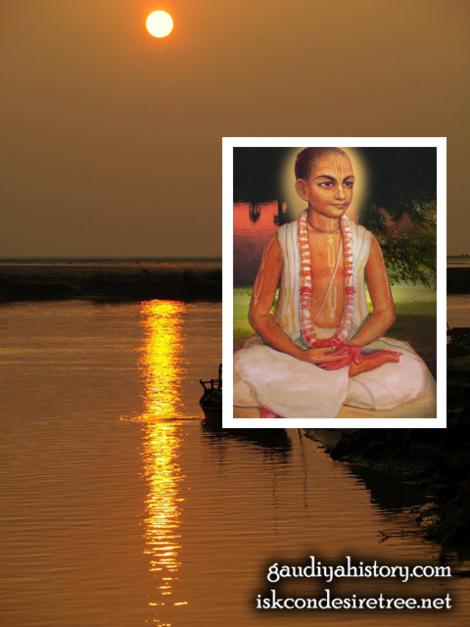
On the banks of the Padmavati river, in the town of Gopalpura lived King Krishnanada Datta. His older brother was Purushottama Datta. The wealth and fame of these two brothers was beyond compare. King Krishnananda’s son was Shri Santosha Datta & Raja Krishnananda's son was Shri Narottama Dasa Thakura. Santosha Datta took initiation from Narottama Thakura. (In the wallpaper: Shrila Narottam Das Thakur, Padma river).
When he heard that Narottama Thakura was about to bless that town with his holy footsteps after such a long time, in order to be the first one to greet Narottama, he rushed out with the rest of the Devotees to wait for him on the road outside Kheturi Gram.
After some time, Narottama could be seen in the distance. Upon seeing him, Santosh, after bowing prostrate with full obeisances, went forward with tears of ecstasy in his eyes, falling on the ground again and again to take the dust of Narottama’s lotus feet. At this, Narottama affectioantely embraced Santosh and asked how he had been faring all the time, asking him many questions about his health, happiness and well-being.
A few days later, Narottama Thakur initiated Santosh with the Radha-Kirshna mantra.
Raja Santosh Datta had previously wanted that a Temple to be built and a Deity installed. Now he begged at Narottama Thakura’s lotus feet for his permission. Narottama gladly gave his approval. Within a few months, Raja Santosh Datta had seen to it that a large Temple was built. The Temple compound included a big storehouse for food, a kirtan hall, a residence hall and ashram for Devotees, a bathing and, a beautiful flower garden, and a guest house. On the full moon day of Phalguna on the festival day of Mahaprabhu’s appearance the Temple was dedicated and the Deities were installed and a great festival, which can only be compared to the Rajasuya-yajna of Yudhishthira Maharaja in its vast expasivness began and was celebrated for miles around. Messengers were sent out for miles around Kheturi Gram, to near and distant lands, to invite kings, landowners, poets, pandits, Vaishnavas, authors, as well as many other illustrious guests. Some were sent far and wide to invite the topmost singers and orators. Preparations were made to install six Deities at one time.
When Santosha received word from Shrinivasa Acharya that the lost books of the Goswamis had been recovered, Santosha celebrated the event in his kingdom (BRK. 7.269)
Santosha bore the entire cost incurred on the occasion of the installation of Deities by Narottama. Some believe that Basanta Datta was another name of Santosha Datta. When Shyamananda prabhu arrived at Kheturi, King Santosha Datta warmly welcomed him (BRK. 7.308)
The drama Sangitamadhava was written with the consent of Santosha Datta (BRK 1.461-462).
Sachi Devi
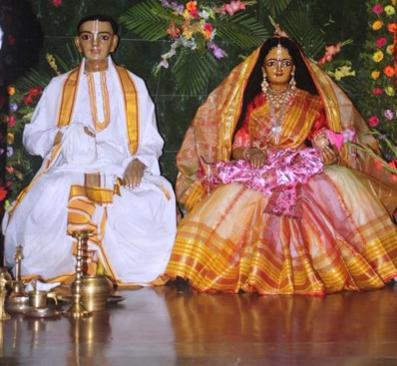
She was married to Jagannatha Mishra. After marriage she had eight daughters who died, followed by the birth of Vishvarupa and Vishvambhara. (In the image: Jagannath Mishra, Sachi Mata and little Nimai, Yoga Pitha, Mayapur).
Sachi Devi's father had formerly been the cowherd Sumukha, who was Yashoda Devi's father. Sachi Devi's mother had formerly been Patala Devi, the wife of Sumukha in Krishna lila.
She was married to Jagannatha Mishra. After marriage she had eight daughters who died, followed by the birth of Vishvarupa and Vishvambhara.
Yashoda Devi and Vraja's king Nanda, who had been like two great oceans of the nectar of love for Krishna during the Lord's pastimes in Vrindavana, appeared during Lord Chaitanya's pastimes as Sachi Devi and Jagannatha Purandara. Some Devotees say that the two demigods Aditi and Kashyapa, who incarnated as Kaushalya and Dasharatha, Prshni and Sutapa, and also as Devaki and Vasudeva, the parents of Balarama and Krishna, also entered the bodies of Sachi Devi and Jagannatha. These Devotees say that if this were not so, then it would not have been possible for Balarama to take birth as their son Vishvarupa. (Shri Gaura Ganodesha Dipika by Shrila Kavi Karnapura 37, 38, 39, 105)
In his early youth Vishvarupa accepted sannyasa and renounced home. Shortly afterwards Jagannatha Mishra passed away. During this period, Lord Gauranga was Sachi's only solace. Sachi Devi was the embodiment of unlimited patience. She never became disturbed by the Her son's mischief.
After His return from Gaya, when Lord Gauranga began to act very unusually displaying symptoms of ecstatic love, Saci thought that perhaps her beloved Nimai was suffering from a mental disorder. Thus she arranged for medical treatment.
Once Lord Gauranga used his mother as an example to demonstrate to the people in general the seriousness of committing Vaishnava aparadha.
When Lord Chaitanya visited Shantipura after taking sannyasa, Sachi went to meet Him there. She stayed in Shantipura for sometime and cooked for Her son. It was at the request of Sachi that Lord Chaitanya settled at Nilachala. From Nilachala Lord Chaitanya regularly sent Jagannatha Prasada, clothes offered to the Deity and His humble obeisances to Sachi through messengers.
One feels amazed to see the humility of Sachi Devi, who was the highest ideal of a mother and a wife, who gave birth to Vishvarupa and Vishvambhara – both of whom accepted sannyasa for the welfare of the world, whose husband was the embodiment of spiritual merit, and whose two daughters-in-law were embodiments of Lakshmi. Sachi's entire household was dedicated to the service of Vishnu and Vaishnavas. She never hesitated to listen to and carry out the spiritual instructions given by her son, and her observance of the vow of Ekadashi and the repentance for her sin at the feet of Lord Advaita bear evidence to this fact. Despite hundreds of obstacles in her life, such as the death of her eight daughters, Vishvarupa embracing sannyasa, the death of Jagannatha Mishra, the death of Lakshmipriya her beloved daughter-in-law, Nimai accepting sannyasa, undergoing a state of destitution and utter helplessness, the problems of maintaining her young daughter-in-law, etc., yet Sachi never faltered from the path of spiritual life. She did not obstruct her son from accepting the sannyasa order. She never expected anything material from her son, whilst she received spiritual sustenance.
There are innumerable pastimes of Sachi in the biographies of Lord Chaitanya:
Chaitanya Bhagavata:
CBh. 1.2.139 states that Sachi assisted Jagannatha Mishra in his service to Lord Krishna. (GVA, CC. (R.G. N. Ed)
1.2.140 Sachi conceives Vishvarupa.
1.2.195-226 Lord Gauranga is conceived.
1.4.3-85 Performance of rituals on the occasion of Nimai's birth.
1.5.5-32 The sound of ankle-bells heard and the signs of divine footprints found throughout the house.
1.5.52, 1.6.41 Nimai eats the rice offered to the Lord by a visiting brahmana.
1.6.72-134 Olahana lila (chiding by Sachi).
1.7.34 Nimai sent to the house of Advaita Prabhu to call his elder brother.
1.7.74-114 Sachi's wailing when Vishvarupa took sannyasa.
1.7.151-192 Nimai sits on the vessel left on top of the garbage.
1.8.8-24 Nimai undergoes the sacred-thread ceremony.
1.8.109-119 Bereavement at the death of Jagannatha Mishra.
1.8.127-182 Nimai's annoyance with his mother at her delay in collecting items for Gangapuja.
1.10.47-128 Preparations for Nimai's marriage
1.12.214-255 Sachi hears the sound of the flute and the Lord reveals His opulence to her.
1.14.106-188 Bereavement of Sachi at the death of Lakshmipriya.
1.15.38, 1.17.406 Nimai's marriage with Vishnupriya.
2.2.88, 2,3,103 Lord Gauranga's transcendental state is mistaken as sickness.
2.8.68-122 Lord Gauranga and Lord Nityananda reveal
2.10.91, 2.11.67 Their opulence.
2.18.161,197,201
2.22.10-483 Sachi frees herself from Vaishnava-aparadha.
2.27.18-51 Sachi's state of mind when Lord Gauranga
2.28.60-65 accepted sannyasa.
3.1.38,50,146
3.2.262,
3.3.119,205
3.4.96,104,111
3.4.239,501 Sachi's visit to Santipura.
3.5.118
3.5.421, Lord Nityananda's arrival at Navadwipa and
3.9.170,219 meeting with Sachi.
Chaitanya Charitamrita:
1.15.10,29-30 Intake of rice on Ekadashi forbidden.
1.16.22-23
2.16.210, 3.1.14 Her meeting with Lord Chaitanya at the house of Advaita in Shantipura when the Lord was on His way to Ramakeli.
3.2.34,79 Divine appearance of Lord Chaitanya.
3.19.5-15 Sachi receives clothes sent by Lord Chaitanya through Jagadananda.
Chaitanya Mangala:
1.2.283-317 Sachi prevents Nimai from playing with a puppy.
1.5.143-157 Nimai consoles Sachi after the death of Laksmipriya by narrating a story about Laksmipriya's past birth.
2.5.5-13 Nimai tells Sachi about the vision He had in a dream of Lord Krishna.
3.3.27-55 Sachi's emotions about hearing of Lord Chaitanya's arrival at Navadwipa from Nilachala.
Advaita Prakasha :
Section ten explains how Advaita Acharya offered flowers to the feet of Lord Krishna and sang the praises of Sachi's pregnancy.
Vyenkatta Bhatta – Biography
He was a resident of Shrirangam and belonged to the Shri sampradaya. It was at his earnest request that Lord Chaitanya stayed with him for four months during the Lord's pilgrimage in the South. Being a Vaishnava in the Ramanupa-sampradaya, Vyenkata Bhatta worshiped the Deity of Laksmi and Narayana. Seeing his pure devotion, Shri Chaitanya Mahaprabhu was very satisfied. Constantly associating with one another, Mahaprabhu and Vyenkata Bhatta gradually developed a friendly relationship. Indeed, sometimes they laughted and joked together. The Lord told Bhattacarya, "Your worshipable goddess of fortune, laksmi, always remains on the chest of Narayana, and she is certainly the most chaste woman in the creation. However, my Lord is Lord Shri Krishna, a cowherd boy who is engaged in tending coes. Why is it that Laksmi, being such a chaste wife, wants to associate with My Lord?"
Venkata Bhatta then said, "Lord Krishna and Lord Narayana are one and the same, but the pastimes of Krishna are more relishable due to their sportive nature. Since Krishna and Narayana are boththe same personality, Laksmi's association with Krishna does not break her vow of chastity. Rather, it was in great fun that the goddess of fortune wanted to associate with Lord Krishna. Mother Laksmi, the godess of fortune, is also an enjoyer of transcendental bliss; therefore if she wanted to enjoy herself with Krishna, what fult is there? Why are You joking so about this?"
Lord Chaitanya replied, "I know that there is no fault on the part of the goddess of fortune, but could you tell me why she could not enter into the rasa dance, whereas the authroities on Vedic knowledge could?"
Venkata Bhatta admitted, "I cannot enter into the mysteries of this behavior. I am an ordianry human being. Since my intelligence is very limited and I am easily agitated, my mind cannot enter within the deep ocean of the pastimes of the Lord. You are the Supreme Personality of Godhead Krishna Himself. You know the purpose of Your activities, and the person whom You enlighten can also understand Your pastimes."
The Lord replied, "One who worships the Lord by following in the footsteps of the inhabitants of Vrajabhumi attains the Lord and gets to know Him as He is known in the transcendental planet of Vraja. There He is known as the son of Maharaja Nanada. The authorities in Vedic literatures known as srutiA gna wroshiped Lord krishna in the ecstasy of the gopis and followed in their footsteps. The personified authorities on the Vedic hymns acquired bodies like those of the gopis and took birth in Vrajabhumi. In those bodies they were allowed to enter into the Lord's rasa-lila dance. Lord Krishna belongs to the cowherd comunity, and the gopis are the dear-most lovers of Krishna. Although the wives of the denizens of the heavenly planets are most opulent within the material world, neither they nor any other women in the material universe can acquire Krishna's assocaition. The goddess of fortune, Laksmi, wanted to enjoy Krishna and at the same time retain ehr spiritual body in the form of Laksmi. However, she did not follow in the footsteps of the gopis in her worship of Krishna."
Before this explanation was given by Shri Chaitanya Mahaprabhu, Venkata Bhatta thought that Shri Narayana was the Supreme Personality of Godhead. Thinking in this way, Venkata Bhatta believed that worship of Narayana was the supreme form of worship, superior to all other processes of devotional service, for it was followed by the Shri Vaishnava disciples of Ramanujacarya. Shri Chaitanya Mahaprabhu understood this misconception of Venkata Bhatta, and to correct it the Lord talked so much in a joking way.
The Lord then continued, "My dear Venkata Bhatta, please do not continue doubting. Lord Krishna is the Supreme Personality of Gdohead, and this is the conclusion of Vedic literatures." In this way the Lord deflated the pride of Venkata Bhatta.
Venkata Bhatta said, "I am an ordinary fallen living entity, but You are Krishna, the Supreme Personality of Godhead Himself. The transcendental pastimxes of the Lord are unfathomable, and I do not know anything about them. Whatever You say I accept as the truth. I have been engaged in the service of Laksmi-Narayana, and it is due to Their mercy that I have been able to see Your lotus feet. Out of Your causeless mercy You have told me of th glories of Lord Krishna. No one can reach the end of the opulence, qualities and forms of the Lord. I can now understand that devotional service unto Krishna is the sureme form of worship. Out of Your causeless mercy You havemade my life successful simply by explaining the facts." After saying this Venkata Bhatta fell down before the lotus feet of the Lord, and the Lord, out of His causeless mercy, embraced him.
When the period of Caturmasya was completed, Shri Chaitanya Mahaprabhu took permission to leave Venkata Bhatta. Venkata Bhatta did not want to return home but also wanted to go with the Lord. It was with great endeavor that Shri Chaitanya Mahaprabhu bade him farewell. When He did so, Venkata Bhatta fell down unconscious.
Venkata Bhatta
In the year 1510 A.D., Sri Caitanya Mahaprabhu traveled to South India, spending four months of Caturmasya Vrata, the monsoon season, at the home of a brahman known as VenkataBhatta.
Venkata Bhatta was a resident of Shrirangam and belonged to the Shri sampradaya.
Venkata Bhatta had two brothers, Tirumalla Bhatta and Prabodhananda Sarasvati. They all belonged to the Ramanuja sampradaya and Prabodhananda Sarasvati was a tridandi sannyasi of that order. Vyenkata Bhatta had a son named Gopal, who was then just a child.
During His stay, the Lord converted the entire family from Ramanuja Vaisnavism to Krsna Bhakti (Gaudiya Vaisnavism). In his paper entitled Sri Chaitanya Mahaprabhu, Srila B.V. Puri Goswami of Sri Krishna Chaitanya Mission, Ganjam, Orissa, states that Lord Caitanya's discourse on the fundamental principles of rasa in Srimad Bhagavatam converted the whole family of Venkata Bhatta from the worship of Laksmi-Narayana to the worship of Sri Sri Radha-Krishna.
Venkata Bhatta's son, Gopala, who was seven years old at the time, served Lord Chaitanya continuously during His stay and developed an intense love for Him. When Lord Chaitanya was ready to depart, Venkata Bhatta fainted, and young Gopala Bhatta's eyes filled with tears. To please the boy, Lord Chaitanya agreed to stay for a few more days. During this time, Gopala Bhatta had a vision in which Mahaprabhu revealed Himself as Lord Krsna. The Lord told Gopala that one day he would meet two jewel-like devotees in Vrindavan— Rupa Goswami and Sanatana Goswami. Waking from the dream, Gopala wanted to leave at once for Vrindavan, but Mahaprabhu told him to stay at home and serve his parents.
Being pleased with Gopala Bhatta Goswami's sincere service and devotion, Caitanya Mahaprabhu initiated him, and ordered him to move to Vrindavana after the death of his parents and perform bhajan and write. He instructed him to serve his mother and father and always engage in chanting Krishna's glories. As predicted by the vision, young Gopala later went to Vrindavan and became one of the illustrious Six Goswamis.
Prabodhananda Sarasvati, previously a Sri Sampradaya sannyasi, was converted to supreme position of Radha-Krishna being Svayam bhagavan instead of Lakshmi-Narayana. He as well apparently came to appreciate the supremacy of Radha worship from Chaitanya.
While staying in Venkata Bhatta's family asrama, Lord Caitanya became very lonely for Lord Jagannath in Puri. In this mood of separation, Mahaprabhu lovingly carved His own set of Jagannatha Deities, which reside to this day not far from the Bhatta family's original home. The family descendants of Vyenkata Bhatta also continue to live at Srirangam.
The Deities of Lord Jagannatha, Baladeva and Subhadra carved by Mahaprabhu are extremely beautiful and captivating.
In his article entitled Sri Rai Ramananda, HDG Srila Bhaktisiddhanta Saraswati Thakur wrote the following narration of Lord Caitanya's travels in South India, and His time spent at Sri Rangam:
At Sri Rangam He lived for four months in the house of a Sri vaishnava, who had migrated to that place, named Venkata Bhatta, with whom He had a comparative discussion of the principles of majesty (aishvarya) and mellow attraction (madhurya). It resulted in the conversion of his brother Prabodhananda, a tridandi sannyasin, and his son Gopala Bhatta who turned out to be one of the six principal disciples at Vrindavan.
Yadavacharya Goswami
Yadavacharya Goswami or Yadav Mishra He was the brother of Vishnupriya Devi.
He was a resident of Vrindavana & a disciple of Rupa Goswami. He was one of the improtant Vaishnavas who requested Krishnadasa Kaviraja Goswami to write Shri Chaitanya Charitamrita.
Yadavacharya gosani Shri-rupera sangi
Chaitanya-carite tenho ati bada rangi
(C.C. 1.8.67)
Shri Yadavacharya Goshani, a constant associate of Shrila Rupa Goswami, was also very enthusiastic in hearing and chanting about Lord Chaitanya's pastimes. 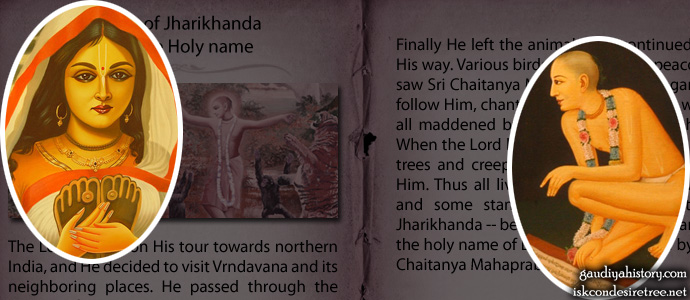
Yadavacharya Goswami or Yadav Mishra He was the brother of Vishnupriya Devi. He was a resident of Vrindavana & a disciple of Rupa Goswami. He was one of the improtant Vaishnavas who requested Krishnadasa Kaviraja Goswami to write Shri Chaitanya Charitamrita. (In the wallpaper: in the left Shrimati Vishnupriya Devi, in the right Shri Rupa Goswami, Shri Chaitanya Charitaamrita).
Before Chaitanya-Charitamrita a number of treatises pertaining to the life of Mahaprabhu were written. But none of these satisfactorily described the last days of Mahaprabhu in Nilachala. Therefore the Devotees of Mahaprabhu were left dissatisfied and disappointed. One day some prominent Devotees of Vrindavana, including Shri Bhugarbha Goswami, Kashishvara Goswami’s disciple Govinda Goswami, Rupa Goswami’s disciple Yadavacharya Goswami, Mukunda Chakravarti, Shivananda Chakravarti and Haridasa (sevait of Govinda Deva), together requested Krishnadasa to compile a biograbhy of Mahaprabhu, which described the antya-lila (last days) of Mahaprabhu in detail.
When Virabhadra Goswami arrived at Vrindavana, Yadavacharya went with other Devotees to welcome him.
The family priests of Mahaprabhu at Navadwipa claim to be descendants of Yadavacharya.
Yadunandanacharya
Yadunandanacharya was a brahmana residing in a village called Jhamatapura, near Rajabol Hatta in the district of Hugali.
He was a disciple of Virchandra Prabhu.
He had two daughters – his own daughter by birth, Shrimati, and a foster daughter named Narayani.
Both these daughters married Birchandra.
The marriage of Birchandra Prabhu has been mentioned in the Bhakti Ratnakara of Shri Narahari Chakravarti Thakura as follows:
"Near Rajabol Hatta is Jhamatpura. Shri Jahnava Mata went there to the Temple of one of her disciples. There, lived the brahmana Yadunandana Acharya. By the mercy of Shri Jahanava Mata he was endowed with great devotion. Yadunandana had a wife named Lakshmi. It was said that she was a pure and highly religous wife. They had two daughters – Shrimati and Narayani. Their bodily beauty was wonderful beyond compare. Upon the wish of Jahnava Mata that fortunate brahmana gave his two daughters to be wed to Birchandra Prabhu."
Yadunandana Dasa
Yadunandana dasa or Thakura was a Vaidya by caste and a disciple of Hemalata, the daughter of Shrinivasa Acharya.
His Shripata was at Malihati village (or Meleti) to the north of Katoa. He wrote the book which contains a biography of Shrinivasa Acharya. In his book Karnananda, Shri Yadunandana dasa mentions the name of his guru at the end of every chapter and respectfully glorifies her: "Hemalata, the daughter of Shrinivasa Acharya prabhu, is just like a creeper of divine love and is a beautiful creation of the Supreme Lord. I, Yadunandana dasa, take pleasure in writing the book Karnananda, keeping her lotus feet fixed within my heart." Upon hearing this book Hemalata Devi was deeply impressed and named it Karnananda. 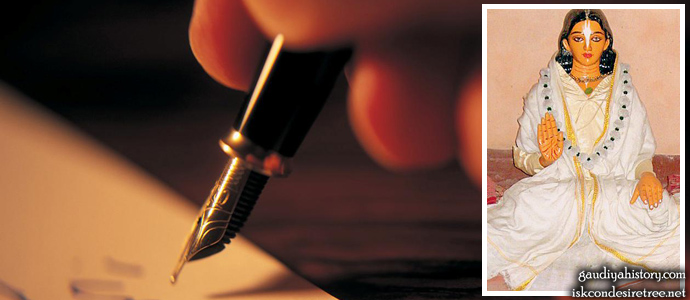
He was a versatile genius, composing numerous songs and translating many books into verse..."Worship the feet of guru which is the only abode of peace and which is the mine of all good qualities the daughter of Acharya Prabhu is Shri Hemalata, whose name can bring fulfillment of all desires finding me in utter darkness of ignorance and in utter damnation, she gave me her kind refuge and by her mercy my eyes have been opened by throwing away the darkness of ignorance." (In the wallpaper: Shrinivas Acharya).
Yadunandana acquired great fame for his lucid translations of Vidagdhamadhava, Govindalilamrta and Krishnakarnamrta. His poems have been included in Padamrtasamudra.
In 1459 Saka the great composer Shri Yadunandana dasa was born in the village of Khalihati, which was situated on the western bank of the Bhagirathi and the northern part of Kantakanagara, 13 crosa south of the district of Mursidabad.
He translated Shri Govinda-lilamrta in verse and in that book he states:
"Worship the feet of guru which is the only abode of peace and which is the mine of all good qualities the daughter of Acharya Prabhu is Shri Hemalata, whose name can bring fulfillment of all desires finding me in utter darkness of ignorance and in utter damnation, she gave me her kind refuge and by her mercy my eyes have been opened by throwing away the darkness of ignorance."
Shrimati Hemalata Thakurani was a wonderful genius amongst the Vaishnavas in Gauda. She, like her father Shrinivasa, preached the teaching of Lord Chaitanya everywhere. Through her influence even the most wicked persons became interested and attracted to the path of devotion.
Shri Yadunandana dasa was very sincere and devoted to his guru. He frequently stayed at the house of Shrimati Hemalata in the village of Budhaipara on the western bank of the Bhagirathi, where he served her with utmost care. There are no records available about Yadunandana's marriage or children. He was a versatile genius, composing numerous songs and translating many books into verse.
Pastime of Birth of Lord Virachandra
It is mentiond in Nityananda Charitamrita, Antya Khanda Chapter 11:
Lord Gauranga instructs Nityananda Prabhu to marry
One day in Nilachala Puri Dhama, Gaurachandra Mahaprabhu discussed something alone with Nityananda.
tumi yao gaudadese karaha samsara
tabe e saba lokera haibe nistara
punaha asiba ami tomara mandire
tomara grihe habe amara avatare
bhakti bilaiya punah asiba samsara
gupu avatara sastre naheta pracara
acintya amara shakti keha nahi jane
sei se janaye tumi janaha sei khane
"Dear Shripada, return to Bengal and get married, then all the people will be delivered. I'll again manifest in Your family and stay in Your home. I'll distribute krishna-bhakti and deliver the whole world. These incarnations of Mine are secret and hidden in the scriptures. No one knows My inconceivable energies. Only You know them perfectly and others know only by Your mercy."
The following story adapted from the book Abhiram Lilamrta appeared in issue number 4 of Sri Krishna Kathamrita Bindu, the free fortnightly email magazine from ISKCON Gopal Jiu Publications.
Abhiram Thakur is perhaps the most prominent follower of Lord Nityananda Prabhu. According to Srila Kavi Karnapur, Abhiram Thakur is the incarnation of Sridama Sakha, the chief cowherd boy in krsna-lila. His pastimes were described in simple Bengali verse by his disciple Sri Tilak Ram Das in a book called Sri Abhirama Lilamrta. In the fourth chapter the author reveals how he was able to write:
utha utha ore sisya sunaha vacane
amara yateka lila karaha varnana
eta bali mora sathe carana dharila
carana parase lila svarana haila
[My guru Abhiram Thakur came to me while I was resting and said] "Wake up! Wake up! O disciple, hear my words! I want you to write about my pastimes." I touched my head to my guru's lotus feet and at that time all of his pastimes appeared to me. [Texts 5-6, 13]
The following story, adapted from chapter 15, verses 141-246, describes how Abhiram Thakur tested the newborn sons of Lord Nityananda.
UNCOMMON POWERS
Abhiram Thakur was a very powerful personality. It is said that he would sometimes test the authenticity of a salagrama-sila or a deity by offering obeisances. If they were not genuine, they would break. He had other uncommon powers as well.
On one occasion Abhiram Thakur met Nityananda Prabhu on the bank of the Ganga, near to the home of Nityananda Prabhu. Nitai offered Abhiram a seat. They embraced, and both sat down.
Nitai said, "O brother Abhiram, what is your desire? Why have you come to My home?"
"I want to see Your son."
Hearing this, Nityananda became happy. However, when Nityananda Prabhu showed him His son, Abhiram offered obeisances to the child and immediately the child died. When Nityananda Prabhu's wives Vasudha and Jahnava heard the news, they both fainted. Nityananda then placed the body of the child in the Ganga and they all took bath.
Sometime later, another child was born, and again Abhiram Thakur came. As before, when Abhiram offered his obeisances, the child died. Everyone was astonished, thinking, "What is Abhiram's purpose?" In this way, every time a child was born, Abhiram would come, offer obeisances, and the child would die.
NO INVITATION
Although Nityananda Prabhu is the Supreme Personality of Godhead Lord Balaram, still, while acting out His human-like pastimes, He externally became very unhappy seeing all of His sons die. Therefore, when the next child was born, Nitai thought to Himself, "If Abhiram does not come My child will live."
Nityananda Prabhu invited many quests for the festive occasion, but He did not invite Abhiram Thakur. Seeing that Abhiram was not there, Adwaita Acharya inquired from Nityananda, "Why have You not invited Abhiram?"
Nityananda Prabhu replied, "Abhiram has made Me bereft of sons. So I will not invite him. I've told all of the boatmen not to bring him across the Ganga in their boats."
During the time of the festival for the birth of Nityananda Prabhu's latest son, Abhiram and his wife Malini were staying at Krishnagar. Vakreswar Pandit came to see them. Malini offered him a seat, and Vakreswar inquired from Abhiram, "Nitai is performing a festival on the occasion of the birth of his son. You are the pradhana-gopal, the leader of the cowherd boys. Is He inviting you or not?"
Abhiram laughed and said, "No. He is not inviting me."
Vakreswar humbly told Abhiram, "Without your presence this ceremony cannot be performed properly. Although He is not inviting you, still you should go."
"How can I go without an invitation?"
Malini then said, "Abhiram is a rakhal, a cowherd boy. Such cowherders have no abhiman, false ego. He is not finding fault with Nityananda Prabhu for not inviting him."
Abhiram Thakur then told Vakreswar, "O brother, I'll go there later." After Vakreswar left, Abhiram conceived a plan. He bade Malini goodbye and started off, saying, "Gaura Hari ki jaya!" He went to the bank of the Ganga and said to a boatman, "Take me across!"
The boatman looked at Abhiram Thakur and inquired, "Who are you sir? Give me your name and then I will start the journey. If I take the wrong person across then Nityananda Prabhu will be very angry with me."
Abhiram replied, "Why does He want to restrict this person from crossing?" The boatman said, "Nityananda Prabhu is miserable and lamenting for His lost children. He told me, 'There is one person named Abhiram Thakur. He is very powerful. If he offers obeisances to My son then the child will die.' Saying this, Nityananda Prabhu told me not to bring that person across. I think that you are that same Abhiram Thakur."
Out of fear of Nityananda Prabhu, the boatman then put water in his boat and made it sink. Hearing that Abhiram Thakur had come, all of the other boatmen also filled their boats with water and sank them.
Abhiram Thakur then took some cloth and threw it in the river. The cloth floated, and, sitting on it, Abhiram crossed the river.
Seeing this, the people became astonished and ran to tell Nityananda Prabhu. Although Nitai became worried, He took all of the mahants who were present at the festival and went to meet Abhiram Thakur. Abhiram saw them all performing ecstatic kirtana and coming toward the bank of the Ganga to meet him. Abhiram then began playing his flute, and he lost external consciousness. Tilak Ram Das says, "Who can understand Abhiram Thakur?"
PRASAD AT NITAI'S HOME
When they came together, Abhiram embraced all of them with ecstatic love while his hairs stood on end. Nitai brought Abhiram into His home. Abhiram told Him, "I am very hungry. Please give me some prasad." Nitai gave him a seat in a room and Vasudha and Jahnava happily brought him nice prasad consisting of sweet rice, fancy rice and many opulent dishes. As much prasad as they brought, Abhiram ate it until he had finished everything in the house.
Seeing that he had eaten everything, Nitai said, "Dandavats to your pastimes! Who can understand You? In vraja-lila you are Sridama. Have you forgotten our loving relationship? In Vraja we all shared prasad together. But now, forgetting all of that, you are taking all of the prasad alone. In Vraja we would always share whatever fruits we got. What sort of behavior is this that you are taking all of the prasad alone?"
Abhiram listened and said, "My nature is that of a cowherd boy. First I take, then I give to others. My behaviour is that of Vraja. Knowing my nature and activities in Vraja, how can You say I took all of the prasad? Go and see Your pots." Then Abhiram performed acaman.
Nityananda Prabhu went to see the pots and found that double the original amount of prasad was there. Nitai then happily embraced Abhiram.
Abhiram said, "O brother, you should feed all of the mahants."
The mahants then happily took prasad and shouted, "Hari! Hari!" Finishing, they all performed acamana. Then Nitai gave them tambula and a place to take rest.
"SPARE OUR CHILD!"
Abhiram Thakur said, "Nitai, You have celebrated a festival for the birth of Your son. What sort of son do You have? Please bring him and I will offer my obeisances to him."
Hearing this, everyone became worried. Nityananda Prabhu's wives Vasudha and Jahnava approached Abhiram and humbly said, "This time please give protection to our child. Don't let us be criticized for not having a son. If you offer obeisances to our son then he will die. Every time this is what has happened. If you do this again, then we will also die."
Abhiram said, "Why are you fearing? You don't understand. I am offering my obeisances to test the child. If he is svayam-svarupa, the Lord's personal manifestation, then he will survive my obeisances."
Hearing Abhiram's words, Nityananda Prabhu became happy and brought His son before Abhiram. Abhiram Thakur offered his obeisances, and the child laughed. Abhiram become very happy and offered his obeisances a second and a third time, just to test the child. He saw that this child was jagat-priya, dear to the entire universe. Abhiram took the child on his lap and began to dance. He then told all of the mahants there:
ye na dekhecha gora dekha ara bar
punarbar sei gora vira avatar
"So that those who did not see Sri Chaitanya Mahaprabhu could again have the opportunity to see Him, the Lord has reappeared in the form of Virabhadra Prabhu."
THE IDENTITY OF VIRABHADRA PRABHU
Lord Balaram has appeared as Lord Nityananda Prabhu. As the Supreme Lord, He is sarvajna, all- knowing. Hence He certainly understood and, in fact, inspired the behavior of Abhiram Thakur. The nature of the Lord is that He likes to see His devotees glorified more than Himself. Therefore, to glorify His devotee Abhiram Thakur, and also His son Virabhadra Prabhu, Lord Nityananda inspired Abhiram Thakur to act in such an unusual way.
Virabhadra Prabhu is the incarnation of Kshirodakasayi Vishnu. Srila Kavi Karnapura has written (Sri Gaura-ganodesa-dipika text 67):
sankarsanasya yo vyuhah payo-visayi-namakah
sa eva viracandro 'bhuc caitanyabhinna-vigrahah
The expansion of Lord Sankarshan known as Kshirodakasayi Vishnu appeared in Sri Chaitanya Mahaprabhu's pastimes as Virachandra Prabhu. Lord Virachandra was non-different from Lord Chaitanya Himself.
sri-virabhadra gosani — skandha-mahasakha
tanra upasakha yata, asankhya tara lekha
(C.C. Adi 11.8)
After Nityananda Prabhu, the greatest branch is Virabhadra Gosani, who also has innumerable branches and subbranches. It is not possible to describe them all.
Srila Prabhupada writes in the purport:
Srila Bhaktisiddhanta Sarasvati Thakura writes in his Anubhashya – Virabhadra Gosani was the direct son of Srila Nityananda Prabhu and a disciple of Jahnava-devi. His real mother was Vasudha. In the Gaura-ganoddesa-dipika (67) he is mentioned as an incarnation of Kshirodakasayi Vishnu. Therefore Virabhadra Gosani is nondifferent from Sri Krishna Caitanya Mahaprabhu.
In a village of the name Jhamatapura, in the district of Hugli, Virabhadra Gosani had a disciple named Yadunathacarya, who had two daughters — a real daughter named Srimati and a foster daughter named Narayani. Both these daughters married (to Virabhadra Gosani), and they are mentioned in the Bhakti-ratnakara (Thirteenth Wave).
Virabhadra Gosani had three disciples who are celebrated as his sons – Gopijana-vallabha, Ramakrishna and Ramacandra. Srila Bhaktisiddhanta Sarasvati Thakura notes that since these three disciples belonged to different gotras, or dynasties, and also had different surnames and lived in different places, it is not possible to accept them as real sons of Virabhadra Gosani.
The eldest disciple, Gopijana-vallabha, was a resident of a village known as Lata, near the Manakara railway station in the district of Burdwan.
The second, Ramakrishna, lived near Maladaha, in a village named Gayesapura. Ramacandra had four sons, of whom the eldest was Radhamadhava, whose third son was named Yadavendra. Yadavendra's son was Nandakisora, his son was Nidhikrishna, his son was Caitanyacanda, his son was Krishnamohana, his son was Jaganmohana, his son was Vrajanatha, and his son was Syamalala Gosvami. This is the genealogical table given by Bhaktisiddhanta Sarasvati Thakura for the descendants of Virabhadra Gosani.
The youngest, Ramacandra, belonged to the Sandilya dynasty and had the surname Vatavyala. He established his family at Khadadaha, and its members are known as the gosvamis of Khadadaha.