Author Archives: Sevak

Sundarananda Thakura – Biography 2

pura sudama-namasid adya sundara-thakkurah
 
   Sundarananda Thakur was previously one of the twelve Gopals known as Sudama.
   (Gaura-ganoddesha-dipika 127)
 
   Sundarananda is counted amongst the branches of Nityananda Prabhu.
 
   Sundarananda is Nityananda’s branch, a true servant. Nityananda joked with him in the Vrindavan mood.
   (Chaitanya Charitamrita 1.19.23)
 
   Sundarananda is an ocean of sacred rapture. He is chief amongst the associates of Nityananda Prabhu.
   (Chaitanya Bhagavat 3.5.728)
 
   His home was in the village of Maheshpura in Jessore district. Maheshpura stands on the Vetravati River, fourteen miles east of the Majdiya railway station. Only his place of birth remains there at present. 
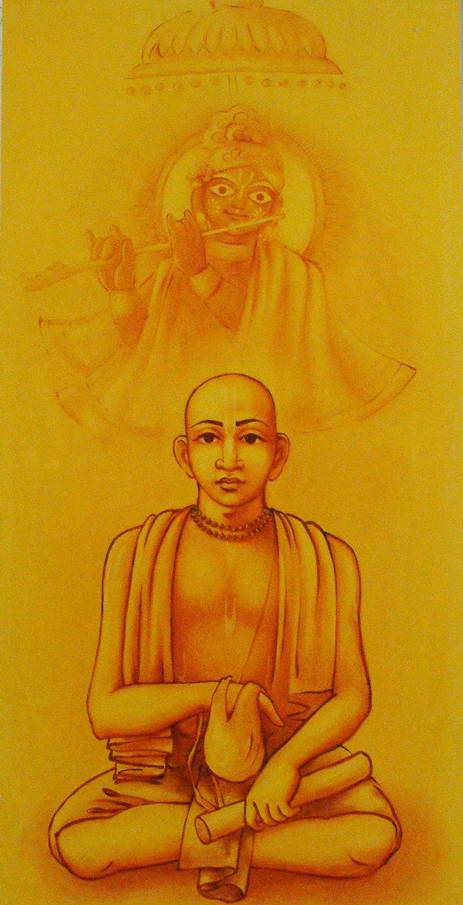
Sundarananda Thakura

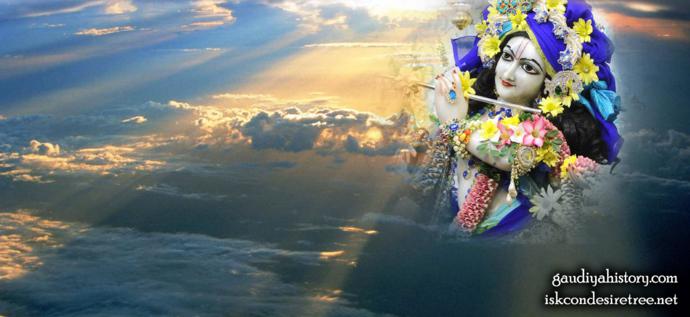
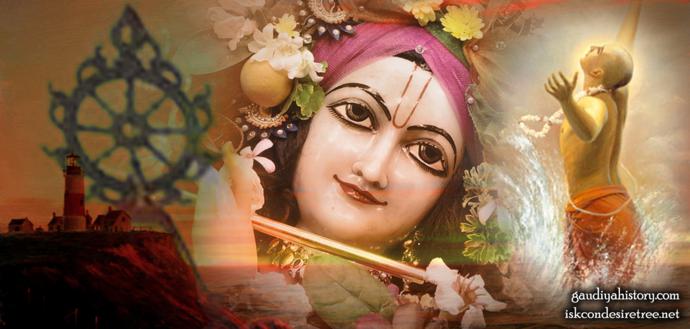
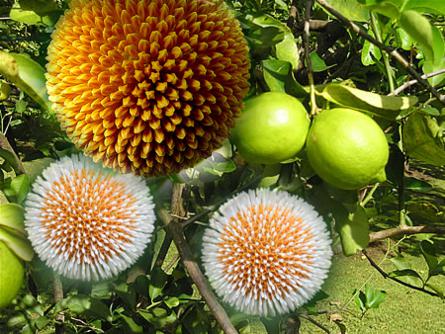
"I worship Sundarananda Thakur in great hope who made a kadamba flower bloom on a lime tree." (In the image: Kadamba flowers on the liem tree).

 
   His Deities were named Radha-Vallabha and Radha-Ramana. Their priests later moved these Deities to Saidabad and installed a wooden Deity in Maheshpura.
 
   Sundarananda never married and thus has no descendants. Descendants of his disciples continue to maintain the site in Maheshpura. Some relatives of his established a Temple in Mangaladihi in Birbhum district.
 
   Sundarananda possessed great mystic powers. He made kadamba flowers bloom on a lime tree, which he later used in the service of Radha-Ramana, as is stated in the Vaishnava-vandana:
 
   "I worship Sundarananda Thakur in great hope who made a kadamba flower bloom on a lime tree."
   On another occasion he dove into a river and pulled a crocodile out. He resembled Nityananda Prabhu in being a savior of the most fallen.
   His disappearance took place on the full moon day of Karttik month.
 
   [Excerpted from “Shri Chaitanya: His Life & Associates” by Shrila Bhakti Ballabh Tirtha Maharaj]

Svarupa Damodara Goswami

 Mahaprabhu’s Alter Ego
 
   The Lord accepted Shikhi Mahiti’s sister as one of Radha’s friends. In the entire world, there were only three and a half Devotees who were so worthy. They were Svarupa Damodar Goswami, Ramananda Raya and Shikhi Mahiti. His sister was the half person. (Chaitanya Charitamrita 3.2.105-6) 
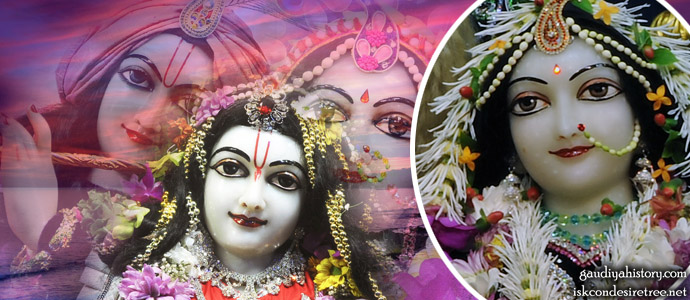
Svarupa Damodara Goswami

In His lila as the golden avatar, Mahaprabhu is Krishna Himself enveloped by the desire and bodily luster of Shrimati Radharani. Shri Svarupa Damodar Goswami was his alter ego. Because of his intimate connection to the Lord, he was able to know all the most confidential reasons for His incarnation as well as the most secret aspects of His lila. He later divulged these understandings to a larger audience of Devotees. In Vraja-lila, he was also Radharani’s alter-ego, Lalita Sakhi. In the Gaura-ganoddesha-dipika, Kavi Karnapura identifies Shri Svarupa Damodar Goswami as Radha’s other companion, Vishakha Devi. (In the wallpaper: from left to right and to backside Shri Gaurachandra, Shrimati Vishakha Devi, Shri Shri Radha Gopinath, ISKCON Chowpatty, Mumbai).

 
   Shri Svarupa Damodar Goswami was one of Mahaprabhu’s three and a half most intimate associates. Elsewhere Krishnadas Kaviraj Goswami has called him the most important of the Lord’s companions. Two persons knew the Lord best: Paramananda Puri and Svarupa Damodar. (Chaitanya Charitamrita 1.10.124-5)
 
   I have already shown that preaching the sankirtan movement was the external cause for the Lord’s descent. There is another, primary purpose for the Lord’s incarnation. This is the personal work of Krishna, the foremost enjoyer of loving exchanges. This very confidential cause is three-fold, as has been revealed by Svarupa Damodar Goswami. Shri Svarupa Damodar Goswami was extremely close to the Lord and thus was able to know all these matters. (Chaitanya Charitamrita 1.4.103-5)
 
   In His lila as the golden avatar, Mahaprabhu is Krishna Himself enveloped by the desire and bodily luster of Shrimati Radharani. Shri Svarupa Damodar Goswami was his alter ego. Because of his intimate connection to the Lord, he was able to know all the most confidential reasons for His incarnation as well as the most secret aspects of His lila. He later divulged these understandings to a larger audience of Devotees. In Vraja-lila, he was also Radharani’s alter-ego, Lalita Sakhi. In the Gaura-ganoddesha-dipika, Kavi Karnapura identifies Shri Svarupa Damodar Goswami as Radha’s other companion, Vishakha Devi.
 
kalam ashikshayad radham ya vishakha vraje pura
sadya Svarupa-gosvami tat-tad-bhava-vilasavan
 
   That same Vishakha who previously taught Radha the arts in Vraja is today Svarupa Goswami, who rejoices in the moods of Radha and Krishna.
 
   In the last twelve years of the his pastimes in Puri, the Lord remained constantly absorbed in the mood of Radharani. During this time, only Svarupa Damodar and Ramananda Raya were able to experience the depths of His emotion through relishing topics known only to them.
 
candidasa vidyapati rayera nataka giti
karnamrita shri gita-govinda
svarupa ramananda sane mahaprabhu ratri-dine
gaya, shune parama ananda
 
   Day and night, Mahaprabhu ecstatically relished the songs of Chandi Das, Vidyapati and Ramananda Raya’s plays, as well as Krishna-Karnamrita and Gita-Govinda in the company of Svarupa and Ramananda. (Chaitanya Charitamrita 2.2.77)
 
   Paramananda Puri had parental affection for Mahaprabhu; Ramananda Raya had love for Him in pure friendship; Govinda Das’s love for Him was as a servant. Gadadhara, Jagadananda and Svarupa Damodar worshiped Him in the ecstasy of the chief rasa. Mahaprabhu heart was won by these four different loving attitudes. (Chaitanya Charitamrita 2.2.78)
 
   Shrila Bhaktisiddhanta Saraswati Goswami Thakur has explained these verses in his Anubhashya as follows: Shri Paramananda Puri, who was Uddhava in Krishna-lila, loved Mahaprabhu with parental affection; Ramananda, who was either Vishakha or Arjuna, had the pure sentiment of a close friend; Govinda and others were devoted to their service to the Lord, and possessed a pure mood of service (shuddha-dasya). Gadadhara, Jagadananda and Svarupa Damodar served the Lord in the primary sentiment, i.e., that of erotic love (madhura-rasa). The Lord became obliged to these Devotees, accepting their worship, their association, their service and their joy.
 
Svarupa Damodar’s Kariacha
 
   Murari Gupta explained all of the Lord’s early pastimes in the form of an outline. Svarupa Damodar did the same for the Lord’s later pastimes. The Devotees describe the Lord’s activities by following the order given in these two outlines. (Chaitanya Charitamrita 1.13.15-17) 
Svarupa Damodara Goswami

Chaitanya-lila is like the finest of jewels which were held in Shri Svarupa Damodar Goswami’s storehouse and then placed by him around Raghunath Das’s neck. I have written down here whatever I heard from him as extensively as I was able, making a gift of it to the Devotees. (Chaitanya Charitamrita 2.2.85) (In the wallpaper: from left to right and backside Shrila Raghunatha Das Goswami Maharaja, Srila Prabhupada, Pancha Tattva members on the book).

 
   Shrila Bhaktivinoda Thakur has written his commentary on these verses: Murari Gupta’s outline of the Lord’s early pastimes are still extant, so Devotees were able to expand on the Lord’s pastimes after looking at his written text. The Vaishnavas only heard Svarupa Damodar’s kariacha through Raghunath Das Goswami.
 
   Chaitanya-lila is like the finest of jewels which were held in Shri Svarupa Damodar Goswami’s storehouse and then placed by him around Raghunath Das’s neck. I have written down here whatever I heard from him as extensively as I was able, making a gift of it to the Devotees. (Chaitanya Charitamrita 2.2.85)
 
   Shrila Bhaktivinoda Thakur comments on this verse in his Amrita-pravaha-bhashya as follows: Svarupa Damodar described the Lord’s latter pastimes in summary Sanskrit verses known as a kariacha. He made Raghunath Das memorize these verses, and later Krishnadas Kaviraj Goswami spread these accounts of the Lord’s activities throughout the world. As a result, Svarupa Damodar’s kariacha was never published in book form. The Chaitanya Charitamrita is itself the essence of Shri Svarupa Damodar Goswami’s kariacha.
 
Svarupa Damodar’s Kirtan
 
   Shri Svarupa Damodar used to used to make Mahaprabhu very happy by singing the songs of Vidyapati, Chandi Das and Gita Govinda. He was as expert a musician as the Gandharvas, and in knowledge of the scripure he was just like Brihaspati. No personality was his equal. Shri Svarupa Damodar was also very dear to Advaita acharya and Nityananda Prabhu, and he was the life and soul of all the Devotees, headed by Shrivasa Thakur. (Chaitanya Charitamrita 2.10.115-7)
 
   Krishnadas Kaviraj Goswami has described the extent to which Shri Svarupa Damodar Goswami and Ramananda Raya were dear to Mahaprabhu in the 15th chapter of the Antya-lila:
 
   After saying these things, the Lord took Svarupa Damodar and Ramananda Raya by the shoulders and said, “Listen, Svarupa and Rama Raya! Tell Me what I should do, where should I go in order to find Krishna. You can tell Me the best thing to do.” In this way, Gauranga would tell His tale of woe to Svarupa and Ramananda and they would console Him in His grief. Svarupa would sing and Ramananda would recite Sanskrit verses, giving joy to the Lord with Karnamrita, Vidyapati and Gita-Govinda. (Chaitanya Charitamrita 3.15.24-7)
 
   A similar passage is found in the 20th chapter of the Antya-lila.
 
   Mahaprabhu remained in Nilachala in this way, passing the days and nights absorbed in the anxiety of separation from Krishna. Svarupa and Ramananda were always with Him, bringing Him ecstasy with their recitation of songs and verses appropriate to His mood. (Chaitanya Charitamrita 3.20.3-4)
 
   Vrindavan Das Thakur has also named Shri Svarupa Damodar Goswami as one of Mahaprabhu’s principal associates in his Chaitanya Bhagavat. He describes there how the Lord would lose external consciousness when hearing Svarupa’s kirtan:
 
   Whenever Svarupa Damodar would sing aloud, the Lord would lose all awareness of His surroundings and fall to the ground. Of all the sannyasis who were members of the Lord’s entourage, none was the equal of Shri Svarupa Damodar Goswami. The Lord had a great deal of affection for Paramananda Puri, and an equal amount for Svarupa Damodar. Svarupa Damodar was full of the nectar of devotional songs, which would make the Lord dance as soon as He heard them. (Chaitanya Bhagavat 3.10.40-3) 
Svarupa Damodara Goswami

Whenever Svarupa Damodar would sing aloud, the Lord would lose all awareness of His surroundings and fall to the ground. Of all the sannyasis who were members of the Lord’s entourage, none was the equal of Shri Svarupa Damodar Goswami. The Lord had a great deal of affection for Paramananda Puri, and an equal amount for Svarupa Damodar. Svarupa Damodar was full of the nectar of devotional songs, which would make the Lord dance as soon as He heard them. (Chaitanya Bhagavat 3.10.40-3) (In the wallpaper: in the left Shri Gopinath, in the right Shrimati Vishakha Devi, ISKCON Chowpatty, Mumbai, Lord Shri Krishna Chaitanya).

 
   When Shrila Gadadhara Pandit Goswami was living at Tota Gopinath’s Temple, he would give discourses on the Bhagavat while in an ecstatic trance. He primarily spoke on the sections dealing with the lives of Prahlad and Dhruva. Mahaprabhu was overcome by the eight ecstatic symptoms upon hearing Gadadhara’s Bhagavat readings and Svarupa Damodar’s kirtan.
 
   Gadadhar Pandit was the main expert in the Bhagavat and Svarupa Damodar in kirtan. Svarupa Damodar would sing alone and Mahaprabhu would lose Himself in dance. Mahaprabhu would reveal all the symptoms of ecstatic love such as tears, trembling, laughing, fainting, horripilation and roaring. They all manifested on His body as He danced with the Devotees. When He heard Svarupa Damodar singing the kirtan aloud, the Lord would lose external consciousness and would fall down on the spot. There was no equal to Svarupa amongst all of the Lord’s sannyasi associates. Svarupa was as dear to Him as Paramananda Puri. Shri Svarupa Damodar Goswami was the incarnation of the delight of song, which would make Mahaprabhu dance. (Chaitanya Bhagavat 3.10.36-43)
 
Early Life and Sannyas
 
   We have the following information about Shri Svarupa Damodar Goswami in terms of his bodily identity. Before taking sannyas, he was known as Purushottam Acharya or Purushottam Bhattacharya. Gaudiya Vaishnava Abhidhana gives the following account of his antecedents: His father’s name was Padmagarbhacharya, the son of Jayarama Chakravarti. His residence was in the village of Bhitadiya on the banks of the Brahmaputra River in Bangla Desh. Jayarama Chakravarti made his home in Navadwip. After his marriage to Jayarama’s daughter, Padmagarbha also came to live there. At the birth of Purushottam, Padmagarbha left his wife and child at his father-in-law’s house and left for Mithila and Kashi in order to study the scriptures. Thus Purushottam Acharya was raised in his maternal grandparents’ home in Navadwip.
 
   Later, when Mahaprabhu took sannyas, he was unable to remain in Navadwip due to the feelings of separation from the Lord and he departed for Benares where he also took the renounced order of life. This is described as follows in the Prema-vilasa:
 
   Purushottam became a resident of Navadwip, staying with his mother’s parents. Filled with all virtues, he became Mahaprabhu’s dear Devotee. When the Lord took sannyas, he went mad with separation and left for Benares where he also took sannyas. Svarupa Damodar was given to him as his sannyas name. He was an intimate Devotee of the Lord, an ocean of rasa.
 
   Krishnadas Kaviraj Goswami has also pointed out some of the special characteristics of Shri Svarupa Damodar Goswami’s sannyas:
 
   On another day, Svarupa Damodar arrived; he was a very intimate friend of the Lord and an ocean of transcendental mellows. Before taking sannyas, he had resided at Navadwip in Mahaprabhu’s association and was known as Purushottam Acharya. When he saw Mahaprabhu accept the renounced order, he became like a madman and immediately went to Varanasi to take sannyas. His sannyas guru, Chaitanyananda Bharati, ordered him to study the Vedanta-sutra and to teach it to others. Svarupa Damodar was a great renunciate as well as a great learned scholar. With heart and soul he took shelter of Krishna’s pastimes.
 
   Due to his enthusiasm to worship Shri Krishna without any disturbance, he accepted the sannyas order almost in madness. When taking sannyas, Purushottam Acharya followed the regulative principles by giving up his tuft of hair and sacred thread, but he did not accept the saffron colored dress. Nor did he take a sannyasi title but rather kept the brahmachari name Svarupa.
 
   Svarupa Damodar then took permission from his sannyas-guru and went to Nilachala where day and night he enjoyed the ecstacies of love for Krishna. Though he had attained the peak of learning, he spoke to no one but remained incognito and in seclusion. (Chaitanya Charitamrita 2.10.102-114)
 
   Shrila Bhaktisiddhanta Saraswati Goswami Thakur has made the following comments on this section of the Chaitanya Charitamrita: In the Dashanami sect founded by Sankaracharya, the lines which take the sannyas names of Tirtha and Ashrama follow the custom of giving the title Brahmachari to anyone who desires to be initiated in the renounced order. The aspirant is then required to vow to remain celibate for the rest of his life. He is also given a brahmachari title, which in Purushottam Acharya’s case was Svarupa Damodara. Upon taking the saffron cloth known as yoga-patta, any brahmachari who has the title Svarupa takes the sannyas name of Tirtha. (Anubhashya, 2.10.102)
 
   In the Dashanami sect, certain regulative principles must be followed before taking sannyas: one must perform eight kinds of shraddha, offering oblations to one's forefathers, the Viraja sacrifice. Then one cuts off the tuft of hair called a shikha and gives up the sacred thread. Svarupa Damodar accepted these preliminary processes in the acceptance of sannyas, but not accept the gurvahvana, saffron cloth, a sannyas title or a danda, and for this reason he retained his brahmachari name.
 
   It may be pointed out here that for those who follow the formalities of tridandi sannyas, the keeping of the shikha, the sacred thread and saffron cloth are approved by the Skanda Purana, which states:
 
shikhi yajïopaviti syat tridandi sa-kamandaluh
sa pavitrash ca kashayi gayatrim ca japet sada
 
   Wearing the shikha, sacred thread and saffron cloth and carrying the kamandalu water pot, a tridandi sannyasi should constantly chant the gayatri mantra while remaining pure in his habits. Shrila Bhaktivinoda Thakur has also commented in his Amrita-pravaha-bhashya: Purushottam Acharya took Mahaprabhu’s example and took sannyas simply by renouncing his shikha and sutra. His sannyas name was Svarupa Damodar. He did not accept the formality of the yoga-patta because he wished to avoid any danger of becoming falsely proud of his status which would come with taking sannyas. He only wished to worship Krishna without any worries. (to 2.10.108)
 
   In the Anubhashya commentary to Adi-lila (4.105) of Chaitanya Charitamrita, Shrila Bhaktisiddhanta Saraswati Goswami Thakur writes, Purushottam Bhattacharya was a resident of Navadwip. Even prior to Mahaprabhu’s taking sannyas, he desired to renounce the world. He left home and went to Benares, where he accepted the position of brahmacarya in a group of Dashanami sannyasis. When he became a brahmachari, he was given the name Damodar Svarupa. He did not bother completing the sannyas rituals and came to Nilachala, Jagannath Puri, where spent the rest of his life at the Lord’s lotus feet. He became Mahaprabhu’s constant companion, enhancing the Lord’s pleasure by singing the songs requested by the Lord. Svarupa Damodar could understand Mahaprabhu’s secret mission and it was by his grace alone that all the Lord’s Devotees could know His deepest purpose.
 
Svarupa Arrives in Puri
 
   Mahaprabhu took sannyas on the full moon day of the month of Magh and left for Nilachala in the following month of Phalguna. After delivering Sarvabhauma Bhattacharya, He left for His pilgrimage to South India in the month of Vaishakh. Nityananda Prabhu gave Him a Brahmin named Kala Krishna Das as His servant to accompany Him on this trip. When Mahaprabhu returned from this journey, after having brought good fortune to the inhabitants of the South by bringing them Krishna-prema, Nityananda sent Krishna Das back to Navadwip to inform the Devotees that the Lord had arrived in Puri. The news brought great joy to Sachi Mata, Advaita Acharya, Shrivasa Pandit and the other Devotees. They immediately started making preparations to visit the Lord in Puri. Paramananda Puri had been staying at Sachi Mata’s house and he decided to leave ahead of the others with a Brahmin named Kamala Kanta. They were thus the first to come from Bengal to meet the Lord. Not long afterward, Purushottam Acharya, who had already been to Benares and taken sannyas from Chaitanyananda Bharati and received the name Svarupa Damodar, arrived and joyously entered the Lord’s entourage. When he first saw the Lord, Shri Svarupa Damodar Goswami recited the following prayer:
 
heloddhulita-khedaya vishadaya pronmilad-amodaya
shamyac-chastra-vivadaya rasa-daya cittarpitonmadaya
shashvad-bhakti-vinodaya sa-madaya madhurya-maryadaya
shri-caitanya daya-nidhe tava daya bhuyad amandodaya
 
O ocean of mercy, Shri Chaitanya Mahaprabhu!
May Your auspicious mercy arise like the dawn
driving away all kinds of material lamentation,
making everything pure and awakening transcendental bliss,
ending all quarrels and disagreements among different scriptures,
giving the taste of spiritual life
and maddening the minds of those surrendered to you,
constantly giving the intoxicating joy of devotional service,
and revealing the extent of the conjugal mood’s sweetness.
(Chaitanya Charitamrita 2.10.119, Chaitanya-candrodaya nataka 10.8) 
Svarupa Damodara Goswami

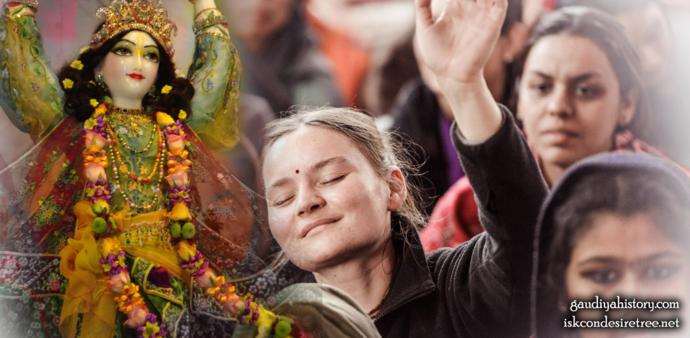
O ocean of mercy, Shri Chaitanya Mahaprabhu! May Your auspicious mercy arise like the dawn driving away all kinds of material lamentation, making everything pure and awakening transcendental bliss, ending all quarrels and disagreements among different scriptures, giving the taste of spiritual life and maddening the minds of those surrendered to you, constantly giving the intoxicating joy of devotional service, and revealing the extent of the conjugal mood’s sweetness. (In the wallpaper: Sankirtan party in Europe, Lord Shri Gaurachandra, ISKCON Chowpatty, Mumbai).

 
   Shri Svarupa Damodar Goswami first received the mercy of the Lord in the form of a heartfelt embrace. Then he paid his obeisances to Nityananda Prabhu and Paramananda Puri and then was introduced to Jagadananda and the other Devotees. He first met Raya Ramananda when the latter came to Puri with King Prataparudra and met Mahaprabhu there for the first time with the intention of persuading the Lord to meet with the king.
 
Friendship with Pundarika Vidyanidhi
 
   In Puri, Shri Svarupa Damodar Goswami participated in the water sports in Narendra Sarovara at the time of the Chandana yatra and in the Indradyumna Sarovara after the cleaning of the Gundicha Temple. He and Pundarika Vidyanidhi enjoyed splashing each other.
 
   The two friends, Vidyanidhi and Svarupa Damodar, joyously splashed each other and laughed. (Chaitanya Charitamrita 3.8.124)
 
   Jagannath has an an annual festival in Puri named Oriana Shashthi. On this occasion, Jagannath’s pujaris dress the Deity in cloth which still has the tapioca-based starch (mari) in it. Shri Pundarika Vidyanidhi did not like this behavior of the pujaris, as he considered such cloth to be unclean. He went to Svarupa Damodar and asked him for his opinion on the matter. Svarupa Damodar said to him, the Lord is completely independent. He is not dependent on the rules regulating Deity worship found in the smritis.
 
   Vidyanidhi immediately answered him, “I accept that Jagannath is completely independent. That does not mean that the pujaris are completely independent of the rules and regulations of scripture. They are not brahma, that they dress the Lord in unwashed cloth. Didn’t you know that if you even touch cloth that has mari in it, you are supposed to wash your hands?”
 
   That night Jagannath and Balaram appeared to Shri Pundarika Vidyanidhi in a dream and slapped him on his cheeks for having criticized their sevayatas. By so doing, Jagannath showed that one is not to criticize His servants for apparent lapses in behavior. The smartas are especially subject to criticizing Vaishnava behavior for failing to adhere to the obscure standards of the smriti. Shri Pundarika Vidyanidhi, though his cheeks were swollen from the slaps, was overjoyed to have been touched by their Lordships. Svarupa Damodar also congratulated Vidyanidhi for his good fortune: 
Svarupa Damodara Goswami

“Listen, brother. I have never seen or heard of a punishment like this one. The Lord came personally to chastise you in a dream. I never heard of such a thing, but now I see that it has happened to you!” The two friends floated in a feeling of satisfaction. They spent day and night talking of nothing but Krishna conscious topics. (Chaitanya Bhagavat 3.10.173-177) (In the wallpaper: Lord Shri Jagannath, laughing kids).

 
   As he looked Pundarika Vidyanidhi over, Svarupa Damodar felt an affection arising in him. Indeed he started to float in an ocean of ecstasy. A friend always feels joy at the good fortune of a friend. The two of them began to laugh spiritedly and Svarupa Damodar said, “Listen, brother. I have never seen or heard of a punishment like this one. The Lord came personally to chastise you in a dream. I never heard of such a thing, but now I see that it has happened to you!” The two friends floated in a feeling of satisfaction. They spent day and night talking of nothing but Krishna conscious topics. (Chaitanya Bhagavat 3.10.173-177)
 
Gundicha and Rathayatra Pastimes
 
   Shri Svarupa Damodar Goswami was one of the chief participants in the cleaning of the Gundicha Temple on the eve of the Rathayatra. “Other than Nityananda, Advaita, Svarupa, Brahmananda Bharati and Paramananda Puri, everyone carried buckets of water.” (Chaitanya Charitamrita 2.12.109)
 
   During the washing of the Gundicha Temple, a simple but intelligent Brahmin who was not aware of the nature of the Vaishnavas’ devotional etiquette, took some water, suddenly poured it over the Lord’s feet and drank it. In view of Mahaprabhu’s identity as the incarnation of Krishna, it was certainly no offense to drink the water which had washed Mahaprabhu’s feet even though it was done inside the Temple of the Lord, but here Mahaprabhu acted as an exemplar for the world and showed dissatisfaction at the Brahmin’s behavior in order that no other person imitate Him and become an offender to the feet of the Supreme Lord. He let His anger be known to Svarupa Damodar who caught the Bengali Brahmin and pushed him out of the Temple. The next instant, however, he returned to the Lord’s side and asked Him to forgive the Brahmin. Though a Vaishnava may externally appear to be hard-hearted, internally he or she is always filled with compassion and thinks of the welfare of every living being.
 
   Every year during Balaram, Jagannath and Subhadra’s ratha festival, the Lord would make four kirtan groups with His Devotees. Svarupa Damodar would sing in the first of these, with Advaita participating as the principal dancer. With other kirtan groups from Shantipur, Shri Khanda and Kulina Grama, there were seven sampradayas altogether. In each group, there were two drummers, meaning that there were 14sadya Svarupa-gosvami tat-tad-bhava-vilasavannbsp; altogether. When the kirtan started in each nbsp; of the seven groups, Mahaprabhu demonstrated His divine powers by appearing simultaneously in the midst of each one of them. Shrila Bhaktivinoda Thakur writes, “Just as the Lord expands into numerous forms during the rasa dance and to marry the queens in Dvaraka, Lord Chaitanya expanded in order to be present in the midst of each sampradayas’ kirtan. The members of each group were convinced that the Lord was in his group alone and in none of the others.”
 
   When Mahaprabhu wished to dance madly, He would have the seven groups come together and would dance in their midst, appointing nine singers and making Svarupa Damodar the principal singer. As the Devotees became progressively intoxicated by the kirtan, Mahaprabhu danced frenziedly for many moments. After this, Mahaprabhu’s mood changed. Svarupa Damodar was able to understand the Lord’s intention and began to sing,
 
sei to parananatha painu
jaha lagi madana-dahane jhuri genu
 
   ”I have finally found my life’s lord, for whom I had so long burned in the flames of desire.”
   Bhaktivinoda Thakur writes, “As the Lord’s frenzied dancing came to an end, He became absorbed in the mood of Radharani at Kurukshetra. This song about meeting the beloved after a long separation came naturally to Svarupa Damodar’s lips.” As He felt the mood of union strengthening, the Lord began to loudly recite the following verse:
yah kaumaraharah sa eva hi varas ta eva caitra-kshapas
te conmilita-malati-surabhayah praudhah kadambanilah
sa caivasmi tathapi tatra surata-vyapara-lila-vidhau
reva-rodhasi vetasi-taru-tale cetah samutkanthate
(Kavya-prakasha 1)
 
My husband (vara) is the same who took my maidenhead
and these the moondrenched nights we knew;
the very breeze is blowing from the Vindhya hills,
heavy with the scent of newly blossomed jasmine.
I too am still the same;
and yet with all my heart I yearn for the reedbeds by the stream
which knew our happy, graceful,
unending bouts of love.
 
   This verse was written about a mundane lover and his mistress, but Mahaprabhu recited it with great respectful feeling. No one could understand what was His hidden intention other than Svarupa Damodar.
 
   The Lord repeated this verse again and again. No one but Svarupa Damodar could understand His intention. (Chaitanya Charitamrita 2.13.122)
 
   When Rupa Goswami heard the Lord recite this verse, he himself composed a verse which revealed the deeper meaning which the Lord had envisioned. He wrote it down on a palm leaf and hid it in the roof of his cottage. The Lord somehow or other found this palm leaf and when He read it was overcome by prema.
 
   When Mahaprabhu went to the residence of Shrila Rupa Goswami, He accidentally saw the palm leaf on the roof, and thus He read the verse composed by him. After reading the verse, He went into a ecstatic mood. While He was in that state, Shrila Rupa Goswami came and immediately fell down on the floor like a stick.
 
   The Lord got up and gave him a slap. Then, He embraced him and began to speak as follows: “No one knows the purport of My verse. How could you understand My intention?” Saying this, Lord Chaitanya Mahaprabhu bestowed various blessings upon Rupa Goswami, and taking the verse, He later showed it to Svarupa Goswami. With great wonder, the Lord asked him how Rupa Goswami could have understood the intentions of His mind. Shrila Svarupa Damodar Goswami replied, “If Rupa Goswami can understand Your mind, I believe it must be the result of Your special benediction.” (Chaitanya Charitamrita 2.13.66-72)
 
   Rupa Goswami’s verse was the following:
 
priyah so’yam krishnah sahacari kurukshetra-militas
tathaham sa radha tad idam ubhayoh sangama-sukham
tathapy antah-khelan-madhura-murali-païcama-jushe
mano me kalindi-pulina-vipinaya sprihayati
(Padyavali, 383)
 
O companion! This is my beloved Krishna
meeting me here in Kurukshetra;
and I am the same Radha,
and both of us are feeling the joy of union.
Even so, my mind wishes for the forest
by the banks of the Yamuna
where the fifth note of His flute
plays sweetly within my heart. 
 
Svarupa Damodara Goswami

O companion! This is my beloved Krishna meeting me here in Kurukshetra; and I am the same Radha, and both of us are feeling the joy of union. Even so, my mind wishes for the forest by the banks of the Yamuna where the fifth note of His flute plays sweetly within my heart. (In the wallpaper: Jagannatha Ratha Yatra, Woodstock, Shri Shri Radha Krishna).

   Mahaprabhu’s vision was that the Jagannath Temple was Kurukshetra and the Gundicha Temple Vrindavan. In the mood of a gopi, He began to pull on Jagannath’s chariot, pulling Him back to Vrindavan. Shri Svarupa Damodar Goswami was able to understand all of these various moods that Mahaprabhu experienced during the Rathayatra.
 
   The Lord had relished these topics in His room with Svarupa Damodar for days and nights. When He was overcome with this mood while dancing before the Lord’s chariot, He would repeat this verse while gazing upon Jagannath’s face. No one can describe Shri Svarupa Damodar Goswami’s good fortune, for he was completely absorbed, body, mind and soul, in the Lord. His senses are the Lord’s senses, and he would sing so that the Lord could more deeply relish the sentiments of love. (Chaitanya Charitamrita 2.13.161-4)
 
   Jagannath Deva lives in Dvaraka and desires to go once a year to Vrindavan. This is symbolized by the Rathayatra festival when He travels from the Jagannath Temple (Dvaraka) to Gundicha (Vrindavana). When He goes to Vrindavan, Jagannath does not take Lakshmi with Him, because Lakshmi is not qualified to participate in the Vrindavan lila. Only the gopis have such qualifications, and Radha is the best of the gopis.
 
   Shvarupa said, “Listen, my Lord, to the reason for this. Lakshmi does not have the right to participate in the games of Vrindavan. Krishna’s companions in the Vrindavan lila are the gopis, and there are none but they who can enchant His mind.” (Chaitanya Charitamrita 2.14.122-3)
 
   Amongst the gopis, Radha is the best. She is a treasure chest of jewels of love in the bright and spotless sentiment of conjugal love. (Chaitanya Charitamrita 2.14.160)
 
   Jagannath mounted His chariot after telling Lakshmi that He would be back on the very next day. When Lakshmi saw that the Lord was late in returning, she became angry and gathering up her forces, sallied forth to attack her beloved. Her servants captured the servants of Lord Jagannath and brought them to her. Such lovers’ quarrels are not heard of anywhere in the world. Nevertheless, the mana (loving jealousy) of the gopis is superior to that of Lakshmi, and of all the gopis, that of Radha is the purest. When Mahaprabhu wished to hear about the gopis’ mana from Svarupa Damodar, Svarupa gave him great satisfaction by answering extensively. He was always able to please the Lord because he knew His wishes so intimately.
 
Bhagavan Acharya and His Brother
 
   Shri Svarupa Damodar Goswami had a close friendship with the lame Bhagavan Acharya of Halisahar.
 
   Bhagavan Acharya was a great Devotee, a scholar and and a man of refined habits. He came to Purushottam to be with the Lord. He was an incarnation of a cowherd who served Krishna in the mood of friendship. His dealings with Svarupa Damodar were also those of a close friend. He was completely surrendered to the Lord’s lotus feet, and he occasionally invited him to eat at his residence. (Chaitanya Charitamrita 3.2.84-6)
 
   Bhagavan Acharya was a generous and unpretentious Vaishnava. Even so, his father Shatananda Khan was a very materialistic person and his younger brother Gopal Bhattacharya was a mayavadi. When Gopal Bhattacharya came to Puri, the simple, straightforward Bhagavan Acharya asked Svarupa Damodar to listen to his brother speak on Shankara’s Vedanta-bhashya: “Gopal, my younger brother, has come here after finishing his study of Vedanta philosophy. Come everyone and hear the commentary upon Vedanta from him.”
 
   Svarupa Damodar Goswami, however, somewhat angry out of love for Bhagavan Acharya, answered as follows: “You have lost your intelligence in the association of Gopal, and now you are eager to hear the Mayavada philosophy. When a Vaishnava listens to the Shariraka-bhashya, the Mayavada commentary upon Vedanta-sutra, he gives up the attitude that the Lord is the master and the living entity is His servant. Instead, he considers himself to be the Supreme Lord. The Mayavada philosophy is so dangerous that even a highly elevated Devotee who has accepted Krishna as his life and soul changes his attitude when he reads the Mayavada philosophy.”
 
   Bhagavan Acharya continued, “We are all fixed at the lotus feet of Krishna with our hearts and souls. Therefore the Shariraka-bhashya cannot change our minds.”
 
   Svarupa Damodar replied, “Nevertheless, when we hear the Mayavada philosophy, we hear that Brahman is the only spiritual reality and that the universe of maya is false, but we gain no spiritual understanding. When a Devotee hears the Mayavadi say that the living entity is only imaginary and that the Supreme Lord is a manifestation of ignorance, it breaks his heart and life.” (Chaitanya Charitamrita 3.2.92-99)
 
Svarupa Watches for Rasabhasa
 
   Shvarupa Damodar was the personification of ecstatic love, fully cognizant of the transcendental mellows in relationship with Krishna. He was like a second manifestation of Mahaprabhu. If someone wrote a book or composed verses and songs and wanted to recite them before Shri Chaitanya Mahaprabhu, Svarupa Damodar would have to first examine them before the Lord would agree to listen. Mahaprabhu was never pleased to hear books or verses opposed to siddhanta, nor did He like hearing rasabhasa, an improper mixture of devotional sentiments. It was the practice of Svarupa Damodar Goswami to examine all works of literature to find out whether their conclusions were correct. Only then would he allow them to be heard by the Lord. (Chaitanya Charitamrita 2.10.110-114)
 
   One day a poet came from eastern Bengal who wrote according to his own whim. He had written a play and had read it to Bhagavan Acharya who then asked Svarupa Damodar to give an opinion on it. If Svarupa Damodar approved then it could be presented to Mahaprabhu for His enjoyment. Many of the Vaishnavas had praised the literary qualities of the play, and Svarupa Damodar finally agreed to read it after repeated requests from his friend. But after hearing only the invocation verse, Svarupa Damodar pointed out numerous faults in it, demonstrating how it contradicted Vaishnava dogma. When he saw the poet’s distress at being criticized, Svarupa Damodar became compassionate and said,
 
jaho bhagavata pario vaishnavera sthane
ekanta ashraya karo caitanya-carane
caitanyera bhakta-ganera nitya karo sanga
tabe to janiba siddhanta-samudra-taranga
(Chaitanya Charitamrita 3.5.131-2)
 
   Go and study the Bhagavat from a Vaishnava. Take exclusive shelter of Chaitanya Mahaprabhu’s lotus feet. Associate constantly with the Devotees of Chaitanya Mahaprabhu. Only then will you be able to understand all the waves of the ocean of Vaishnava philosophy.
 
   It was in Bhagavan Acharya’s house that Chota Hari Das came to beg for fine rice from Madhavi Devi and engaged in conversation with her. As a result of his conversing with a woman, Mahaprabhu ostracized Chota Hari Das. The Lord was as hard as a thunderbolt towards Hari Das, and Shri Svarupa Damodar Goswami made an attempt to intercede, persuading Hari Das to eat after he had undertaken a fast. However, Mahaprabhu remained untouched by Svarupa Damodar’s efforts and a year later, Hari Das went to Prayag and gave up his life.
 
Svarupa and the Goswamis
 
   When Sanatan Goswami came alone to Puri from Mathura, he caught scabies in the Jharikhanda jungle. In Puri, he stayed in Hari Das Thakur’s cottage where Mahaprabhu came to seem him daily, embracing him despite the pus-filled sores which covered his body. Ashamed at his condition, Sanatan decided to commit suicide, but was prevented from doing so by the all-knowing Lord. During his stay in Puri, Sanatan was introduced to all the Devotees of the Lord including Svarupa Damodar.
 
   Govardhana Majumdar’s son, Raghunath Das tricked his guru and family priest Yadunandana Acharya into giving him permission to leave his home. He walked to Puri in only twelve days where he met Mahaprabhu. Mahaprabhu was extremely merciful to Raghunath and turned him over to Shri Svarupa Damodar Goswami for tutelage. From that day on he was known as Svarupa’s Raghu.
 
   When He saw Raghunath’s thin and dirty body, the Lord felt sympathy for him. He turned to Svarupa Damodar and said, “I am turning this Raghunath over to you. I want you to take care of him as though he were your own son and personal servant. I have three Raghunaths in My entourage. From now on, we will call this one Svarupa’s Raghu.” After He had said these words, the Lord took Raghunath’s hand and placed it in that of Svarupa Damodar. (Chaitanya Charitamrita 3.3.201-4)
 
   Raghunath Das never spoke directly to Mahaprabhu. If he wished to make a submission to the Lord, he made it through either Svarupa Damodar or Govinda. He told Svarupa Damodar repeatedly that he wished to hear Mahaprabhu’s personal instructions on how to practice the spiritual life. After Svarupa passed this request on to the Lord, Mahaprabhu smiled and told Raghunath Das, “I have appointed Svarupa Damodar to be your instructor. You may learn from him about the spiritual practices and their goal. I myself do not know as much as he. Nevertheless, if you have faith in My orders, you may fix your direction from the following words: Do not listen to gossip. Don’t engage in gossip. You should not eat very palatable food, nor should you dress very nicely. Always chant the Holy Name of Lord Krishna without any expectation of honor, and offering all respect to others. Mentally render service to Radha and Krishna in Vrindavan. I have briefly given you My instructions, you will learn about them in detail from Svarupa Damodar. (Chaitanya Charitamrita 3.6.233-8) 
Svarupa Damodara Goswami

Do not listen to gossip. Don’t engage in gossip. You should not eat very palatable food, nor should you dress very nicely. Always chant the Holy Name of Lord Krishna without any expectation of honor, and offering all respect to others. Mentally render service to Radha and Krishna in Vrindavan. (In the wallpaper: Shri Shri Radha Gopinath, ISKCON Chowpatty, Mumbai, a Devotee).

 
   On the occasion of Hari Das Thakur’s disappearance, the Lord initiated the performance of sankirtan. The Devotees surrounded Hari Das Thakur’s body and Svarupa Damodar sang the Holy Names with the Devotees while Vakresvara Pandit danced. Svarupa Damodar then went to the Jagannath Temple to seek prasad for the feast which followed the burial of Hari Das and he joined Jagadananda Pandit and others to serve the Devotees.
 
   Raghunath Bhatta, the son of Tapana Mishra, left his home in Benares to come to Puri via Bengal. When he met Mahaprabhu, the Lord embraced him and introduced him to Svarupa Damodar and the other Devotees.
 
Mahaprabhu’s Intense Austerities
 
   At a certain time, Mahaprabhu went through a period of intense austerity. Constantly crying the names of Krishna, He lost a great deal of weight due to His feelings of separation. He slept on a bed of plantain bark, taking no notice of the pain which resulted when His bones rubbed against the bark. The Devotees, however, were greatly distressed to see His suffering. Jagadananda Pandit in particular was affected and he decided to do something about it. He obtained some fine cloth and dyed it saffron, and then filled it with cotton from the silk cotton tree. In this way he made both a mattress and a pillow for the Lord’s comfort. Jagadananda then asked Govinda Das to give the mattress and pillow to the Lord and Svarupa Damodar to convince Him to use them. When it was time for the Lord to go to bed, He saw the nice bed and asked angrily, “Who has made this bed?” When He heard from Govinda that Jagadananda Pandit had given it, He hesitated because Jagadananda was Satyabhama’s incarnation and given to fits of jealous anger. Even so, he had Govinda remove Jagadananda’s bedding and went to sleep on the plantain bark bed. When Svarupa Damodar reminded the Lord that Jagadananda would be distressed if he did not use his bedding, He answered,”A mattress and pillow? Why don’t you just go and get Me a bed? A sannyasi is supposed to sleep on the ground. Jagadananda wants Me to become a sense enjoyer. This is shameful.”
 
   Jagadananda was indeed upset when he heard from Svarupa Damodar that Mahaprabhu had refused the bedding. Svarupa Damodar cleverly made a mattress and pillow out of dried banana leaves torn into small pieces and stuffed into pieces of the Lord’s used clothes. Despite his reluctance, the Lord accepted this new bedding. This satisfied all the Devotees with the exception of Jagadananda, who asked the Lord permission to leave for Vrindavan. Mahaprabhu said, “Jagadananda is angry with Me, that is why he wants to go to Vrindavan.” This story gives a brilliant example of Svarupa Damodar’s expertise in serving the Lord.
 
Mahaprabhu’s Ecstasies
 
   As Mahaprabhu’s feelings of separation intensified to the point of seeming insanity, He was kept at night in the Gambhira, behind three locked doors. One day, Svarupa and Govinda noticed that even though the doors were still bolted, Mahaprabhu was missing. In great anxiety, the two of them started to look for the Lord everywhere. Finally they found Him near the Lion’s Gate of the Jagannath Temple, lying unconscious on the ground with all His joints loosened, His entire form lengthened. Svarupa Damodar started to sing the names of Krishna into the Lord’s ear until suddenly He jumped up, His body returning to its normal condition, and shouted, “Haribol!” When the Lord returned to normal consciousness, Svarupa Damodar led Him back to the Gambhira. 
Svarupa Damodara Goswami

“I was at Govardhana. I saw Krishna herding the cows and playing the flute. When they heard the flute, the gopis came running toward Him. Shrimati Radharani was there and Krishna took here into a grotto. Then suddenly you all started to call Me back here. Why did you do that? Just to bring Me pain?” (In the wallpaper: Shri Shri Radha Gopinath, ISKCON Chowpatty, Mumbai, Lord Chaitanya in the left in Govardhan).

 
   One day, the Lord saw the sand dunes and took them to be Govardhana. He ran towards them, while Svarupa Damodar and Jagadananda ran behind Him. His body was overwhelmed by the ecstatic transformations and He fell to the ground in a faint. When the Devotee’s saw the Lord in this state, they began to cry. He partially regained consciousness when the Devotees started to chant the Holy Name aloud. In this state, He started to prattle, “I was at Govardhana. I saw Krishna herding the cows and playing the flute. When they heard the flute, the gopis came running toward Him. Shrimati Radharani was there and Krishna took here into a grotto. Then suddenly you all started to call Me back here. Why did you do that? Just to bring Me pain?” The Lord began to cry and the Devotees, affected by His great distress at losing His vision, and they joined Him in shedding tears. 
 
   A few days later, Mahaprabhu was in the Gambhira in the divyonmada state, the madness of separation. Svarupa Damodar and Ramananda Raya stayed up until the middle of the night with the Lord enjoying discussions of Krishna’s pastimes. Finally, after a great deal of effort, they managed to persuade the Lord to lie down and take some rest, after which they each returned to their own quarters. Govinda also slept in the Gambhira. As he chanted the names of Krishna, Mahaprabhu suddenly heard the sound of Krishna’s flute and in the ecstasy which overcame Him, He ran out of the Gambhira, even though there were three doors bolted from the outside. This time He fell down amongst a herd of Tailangi cows to the south of the Lion’s Gate. When Govinda heard no answer from the Lord, despite calling for Him, he informed Svarupa Damodar of the situation.
 
   Svarupa Damodar organized a search party of Devotees with torches until finally they found Him lying unconscious in the midst of the cows. This time, His limbs were retracted into His body giving it the appearance of a tortoise; His mouth was covered with foam, there were eruptions on His body and His eyes were filled with tears. He looked like a pumpkin, without any limbs. Externally suffering as though poisoned, internally He was experiencing divine ecstasies. The cows had surrounded the Lord and were sniffing His body, and even when the Devotees shooed them away, they would come back, attracted by the Lord. After many attempts to arouse the Lord, when the Devotees failed to bring Him back to consciousness, they picked Him up and carried Him to the Gambhira. There they started singing the Holy Names aloud in kirtan. This continued for some time until finally the Lord returned to an external state of consciousness and His body also took on its normal appearance. 
 
   Still in a trance-like state, Mahaprabhu asked Svarupa Damodar, “Where have you brought Me? I had heard the sound of Krishna’s flute and I went to Vrindavan. I saw Krishna with the cattle, playing His flute. Radha and the gopis understood His signal and came to the bower cottage trysting place. I followed them there and felt ecstasy when hearing the sound of their tinkling ornaments and their voices and laughter. You forced Me to come back here and I can no longer hear their humorous conversations, nor the sound of their ornaments and musical instruments.”
 
   Shri Svarupa Damodar Goswami recognized the Lord’s state and sang a verse from the Bhagavat in his sweet voice:
 
ka stry-anga te kala-padayata-venu-gita-
sammohitarya-caritan na calet trilokyam
trailokya-saubhagam idam ca nirikshya rupam
yad go-dvija-druma-mrigah pulakany abibhrat
 
O dear one!
What woman within these three worlds
would not be captivated by the sweet rhythms
of your wonderful flute-song?
What woman would not abandon
her vows of chastity as a result?
For upon beholding your beauty,
the most sublime in this universe
even cows, birds, trees and animals
horripilate in jubilation.
(BhP 10.29.40)
 
Svarupa Damodara Goswami

O dear one! What woman within these three worlds would not be captivated by the sweet rhythms of your wonderful flute-song? What woman would not abandon her vows of chastity as a result? For upon beholding your beauty, the most sublime in this universe even cows, birds, trees and animals horripilate in jubilation. (BhP 10.29.40) (In the wallpaper: Shri Gopinath, ISKCON Chowpatty, Mumbai).

   As soon as the Lord heard this verse, He once again merged into the mood of the gopis and began to sing all the statements which the gopis made in separation from Krishna, known as chitra-jalpa.
 
The Lord Jumps into the Sea
 
   Krishnadas Kaviraj Goswami has described another extraordinary event of this type. Once, during a full-moon evening in autumn, the Lord was inspired to remember Krishna’s rasa-lila. Accompanied by His Devotees, He wandered through the Ai Tota garden next to the Gundicha Temple, relishing songs about the rasa dance. As they approached the seashore, Mahaprabhu took the sea to be the Yamuna River and jumped into it. His body floated south toward Konarka until a fisherman caught Him in his nets, thinking Him to be a large fish. When he dragged the Lord on board his boat, he saw that all His limbs were distended, transformed into a giant human form. Upon touching Him, the fisherman was immediately infused with prema and started crying and calling the name of Krishna.
 
   Meanwhile, Svarupa Damodar and the other Devotees were desperately seeking the Lord. Finally they saw the fisherman standing on the shore with the Lord on his shoulders. When Svarupa saw the fisherman in a state of ecstatic transformation, he came and explained who Mahaprabhu was, but still had to slap him several times before he calmed down. Then the Devotees began to sing the Holy Names aloud until the Lord jumped up with a roar. Once again, while in a state of half-absorption in trance, Mahaprabhu recounted everything that He had experienced. Mahaprabhu had been in the world of Krishna’s rasa-lila and water sports. When they heard all His ecstatic utterances, the Devotees trembled in awareness of the Lord’s divine loving madness. Then they led Him back to the Gambhira.
 
The Lord’s Final Days
 
   When Advaita Acharya sent the riddle message back from Bengal with Jagadananda Pandit, indicating that the Lord’s pastimes would soon come to an end, Svarupa Damodar became distracted, while the Lord’s divine madness became more and more intense. In His final instructions to Svarupa Damodar and Ramananda Raya, the Lord made it very clear that Harinama sankirtan is the supreme method for attaining love for Krishna.
 
   The Lord, in a wave of jubilation say, “Listen Svarupa Damodar and Ramananda Raya! In the age of Kali, Harinama sankirtan is the supreme means of deliverance. In the age of Kali, Krishna is to be worshiped by the congregational chanting of His Holy Names. This is the way that an intelligent person attains the lotus feet of Krishna. Through the chanting of the Holy Name, all of one’s sinful reactions are extinguished and all auspiciousness arises until finally one experiences the joys of love for Krishna.” (Chaitanya Charitamrita 3.20.8-11)
 
   After saying this, the Lord recited His own eight verses known as the Shikshashtaka. As He relished them, He felt more and more humble in feelings of separation from Krishna. Taking on the mood of Shrimati Radharani, He became totally absorbed in love for Krishna.
 
   Shri Svarupa Damodar Goswami and Ramananda Raya remained constantly by the Lord’s side throughout His ecstasies in divyonmada, calming Him and enriching His feelings of love. Shri Svarupa Damodar Goswami left the world on the day of Lord Jagannath’s Rathayatra, not long after the Lord’s disappearance.
 
   [Excerpted from “Shri Chaitanya: His Life & Associates” by Shrila Bhakti Ballabh Tirtha Maharaj] 
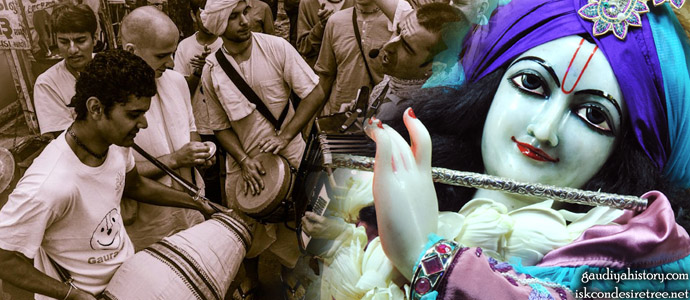
Svarupa Damodara Goswami

The Lord, in a wave of jubilation say, “Listen Svarupa Damodar and Ramananda Raya! In the age of Kali, Harinama sankirtan is the supreme means of deliverance. In the age of Kali, Krishna is to be worshiped by the congregational chanting of His Holy Names. This is the way that an intelligent person attains the lotus feet of Krishna. Through the chanting of the Holy Name, all of one’s sinful reactions are extinguished and all auspiciousness arises until finally one experiences the joys of love for Krishna.” (Chaitanya Charitamrita 3.20.8-11) (In the wallpaper: in the right Shri Gopinath, ISKCON Chowpatty, Mumbai, Harinama).
Sita Thakurani – Biography 2

Sita Thakurani

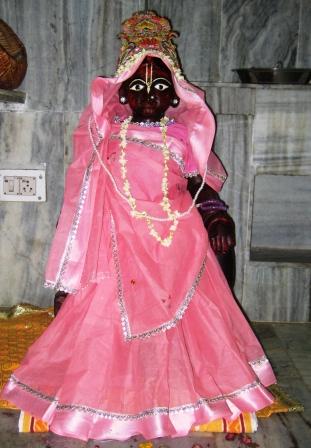
According to Gaura-Ganodesha-Dipika, Shri Sita Thakurani is Yogamaya. The Gaura-Parshada-Charitvali says that in Krishna Lila, she was Purnamasi, the mother of Sandipani Muni, grandmother of Madhumangal and Nandimukhi and a disciple of Narada Muni. (Gaura-Ganodesha-Dipika, however, says that Paurnamasi in Krishna-lila became Shri Govinda Acharya in Chaitanya lila.) (In the image: Deity of Shrimati Purnamasi, Shri Vrindavan Dham).

   Advaita Acharya’s wife was a respectable and noble woman name Sita Thakurani. Taking permission from her husband, she went to Navadwip bearing gifts to see the crown jewel of infants. (Chaitanya Charitamrita 1.13.112)
 
   Shri Sita Thakurani is to be worshiped just as much as Sachi Devi herself, as the mother of the universe. She is the eternal wife of Shri Advaita Acharya. She was the daughter of Shri Nrishinga Baduri. She was married to Shri Advaita Acharya in Phuliya Nagara. After their wedding, Advaita Acharya went to Nadiya, to live in Shantipura. Sita Thakurani was always absorbed in vatsalya prema for Shri Gaurasundara Prabhu, and, out of parental concern used to instruct Jagannatha Mishra on how to care for the boy.
 
   Shri Krishna Dasa Kaviraja Goswami has described the birth celebration at the house of Jagannatha Mishra upon the advent of the Lord, giving special attention to the position of Shri Sita Thakurani. Advaita Acharya's wife, worshipable by all the three worlds was Sita Thakurani. Taking the Acharya's orders on her head, she had come to take a look at this new child, this jewel of jewels, and to offer Him presents.
 
   On the eve of his son's advent Shri Jagannatha Mishra, seeing the imminent signs of his child's arrival, sent word to Advaita Acharya in Shantipura that the long-awaited child was being born. Hearing news of the advent of this unprecedented child, Advaita Acharya floated in the waves of ecstasy. With Shri Haridasa Thakura, he went to bathe in the river, and, after much dancing and song, he sent his wife to go quickly to Mayapura in Navadwipa.
 
   According to Gaura-Ganodesha-Dipika, Shri Sita Thakurani is Yogamaya. The Gaura-Parshada-Charitvali says that in Krishna Lila, she was Purnamasi, the mother of Sandipani Muni, grandmother of Madhumangal and Nandimukhi and a disciple of Narada Muni. (Gaura-Ganodesha-Dipika, however, says that Paurnamasi in Krishna-lila became Shri Govinda Acharya in Chaitanya lila.)
 
   In Dvapara-yuga, during the celebration of Krishna's birth ceremony, she was present in the house of Nanda, and at that time gave Nanda and Yashoda many instructions on how to care for the child. The Chaitanya-Charitamrita gives the following account of Sita Thakurani's visit to the house of Jagannatha Mishra after the birth of the Lord:
 
   "One day, shortly after Shri Chaitanya Mahaprabhu was born, Advaita Acharya's wife, Sita Devi, who is worshipable by the whole world, taking permission of her husband, went to see that topmost child with all kinds of gifts and presents. She brought different kinds of golden ornaments, including bangles for the hand, armlets, neclaces, and anklets. There were also tiger nails set in gold, waist decorations of silk and lace, ornaments for the hands and legs, nicely printed silken saris and a child's garment, also made of silk. Many other riches, including gold and silver coins, were also presented for the child.
 
   Riding in a palanquin covered with cloth and accompanied by maidservants, Sita Thakurani came to the house of Jagannatha Mishra, bringing with her many auspicious articles such as fresh grass, paddy, gorochana, turmeric, kunkuma, and sandalwood. All these presentations filled a big basket. When Sita Thakurani came to the house of Sachi Devi, bringing with her many kinds of eatables, dresses, and other gifts, she was astonished to see the newly born child, for she appreciated that except for a difference in color, the child was directly Krishna of Gokula Himself. 
Sita Thakurani 2

When Sita Thakurani came to the house of Sachi Devi, bringing with her many kinds of eatables, dresses, and other gifts, she was astonished to see the newly born child, for she appreciated that except for a difference in color, the child was directly Krishna of Gokula Himself. (In the wallpaper: in the left Shri Gopinath, ISKCON Chowpatty, Shri Gauranga Mahaprabhu in the right, ISKCON Chennai, gifts).

 
   Seeing the transcendental bodily effulgence of the child, each of His nicely constructed limbs full of auspicious signs and resembling a form of gold, Sita Thakurani was very much pleased, and because of her maternal affection, she felt as if her heart were melting. She blessed the newly born child by placing fresh grass and paddy on His head and saying, "May You be blessed with a long duration of life." But being afraid of ghosts and witches, she gave the child the name Nimai. On the day that the mother and son took bath and left the maternity room, Sita Thakurani gave them all kinds of ornaments and garments, and then also honored Jagannatha Mishra. Then Sita Thakurani, being honored by mother Sachi Devi and Jagannatha Mishra, was greatly happy within her mind, and thus she returned home."
 
   From that day on, Sita Thakurani would often come to Mayapura from Shantipura, in order to teach Sachi mata how to care for the new baby. She would give her many different instructions on how to raise children. And after helping with the child in this way, she would return to Shantipura. When it came time for the child's birthday ceremony, Jagannatha Mishra and Sachi Devi let the worshipable Sita Thakurani be the first to offer the child his new clothes.
 
   Advaita Acharya Prabhu also had a house in Navadwipa. There he would live from time to time and discuss Krishna-katha with the Devotees headed by Shrivasa, diving and surfacing in the waves of joy until the break of dawn. After Shri Gaurasundara's appearance, all the Devotees prayed together with Shri Advaita Acharya and Sita Thakurani that the child might live long in Mayapura and have good fortune.
 
   Sita Thakurani and Sachi Devi were of one mind; the baby Nimai was their life and soul. Every day Sita Thakurani would go to the house of Sachi Devi and help her with the care and nurturing of the boy. In the house of Jagannatha Mishra, the divine child increased the pleasure of the eyes and minds of all the Devotees, just as the waxing moon gradually grows more brilliant with each passing day.
 
   After several years, when Jagannatha Mishra's son Vishvarupa – Nimai's older brother – had grown up, he suddenly took sannyasa. The grief and agony of Jagannatha Mishra and Sachi Devi upon their son's leaving was great. Gaurasundara was also dismayed and unhappy at his brother's separation. At that time Advaita Acharya and Sita Thakurani consoled Jagannatha Mishra and Sachi Devi, and helped take care of Nimai.
 
   Shrivasa Pandit's wife Malini Devi also was always very affectionate towards the child, nurturing Him and caring for Him. She and Sachi Devi were of one mind in doing this.
 
   After exhibiting His childhood pastimes, Nimai gradually progressed into His Kishora-lila, or pastimes of youth. After some time, He went to Gaya and revealed His true form and real purpose. Having returned from Gaya He gathered all the Devotees at the house of Shrivasa Angan for the purpose of beginning kirtan. At that time, Advaita Acharya brought Sita Thakurani from Shantipura to Mayapura, and, having arrived there was the first to worship the lotus feet of Shri Chaitanya. 
Sita Thakurani

After exhibiting His childhood pastimes, Nimai gradually progressed into His Kishora-lila, or pastimes of youth. After some time, He went to Gaya and revealed His true form and real purpose. Having returned from Gaya He gathered all the Devotees at the house of Shrivasa Angan for the purpose of beginning kirtan. (In the wallpaper: Shri Gaura Chandra, ISKCON Chowpatty, Mumbai, Devotees in Kirtan Mela 2012, Shri Mayapur Dham, Shrivas Angan, Navadwipa).

 
   Gradually Shri Gaurasundara began, in Navadwipa, to unfold His kirtan pastimes, wishing to deliver the fallen souls. As time went by He took sannyasa and turned His face towards Vrindavana, and ran off, half mad into the jungle in search for Shri Krishna. Upon hearing this, Shri Sita Thakurani spent four days with Sachi Devi, who, plunged in the darkness of separation as if the sun had left the sky forever, lay fallen on the ground like one near death.
 
   Shri Chaitanya Mahaprabhu, being bound by the ropes of love, was unable to go to Vrindavana, but was drawn to return to Shantipura. When He arrived in Shantipura, Advaita Acharya and Sita Thakurani felt as if their life has returned. After having fasted for four days, Shri Gaurasundara accepted Prasada cooked by the hand of Sita Thakurani.
 
   Previous to taking sannyasa also, Shri Chaitanya Mahaprabhu along with Nityananda Prabhu would, from time to time go to the house of Advaita in Shantipura, where they would have a festival and perform Krishna-nama-lila-kirtan all day and all night. The beautiful nature of this subject has been described by Shri Parameshvari Dasa Thakura in his Shri Pada Kalpataru as follows:
 
   One day the Lord laughed, having arrived in the Temple of Shri Advaita and thus the son of Sachi took His seat. Along with Nityananda, Advaita sat down, and the two of them began playfully assessing the idea of having a festival. Hearing all this, Sita Thakurani entered smiling. At that time, in sweet words which made the minds of those who heard them blissful, the son of Sachi ruled that there must be a great festival. He said, "Listen Sita Thakurani: we shall extend invitations to all the different Vaishnavas who live nearby. Let whoever hears the sound of our song, resounding through the air, come and join us. We shall invite one and all."
 
   Saying this, Shri Gaurachandra gave orders to the Devotees saying,
   "You, invite the Vaishnavas."
   "You, ready the mridanga and karatalas."
   "You, prepare sandalwood and aguru for distribution."
   "Have everything ready at the ghat."
   "Carrying out these assignments expertly, and after garlanding the Devotees with flower garlands, the Devotees shall gather together in a circle for an uproarious kirtan."
 
   Hearing the words of Mahaprabhu, the Devotees followed His orders with great affection, collecting garlands, sandalwood, betel, ghee, honey, and milk, and everything else essential for worhsiping the Lord. The different gifts and fragrant articles for the Devotees and the Lord were then distributed in the proper ways. The kirtan began at midday. At that time everyone chanted "Hari! Hari!" and the mridanga made the whole kirtan auspicious. Thus swims Parameshavara Dasa in the rasik pastimes of the Lord.
 
   After Shri Chaitanya Mahaprabhu took sannyasa and went to live in Jagannatha Puri, Shri Advaita Acharya and Sita Thakurani used to go and visit Him each year, bringing their son Achyutananda with them. On one such occasion, Sita Thakurani prepared some of the Lord's favorite preparations for Him and invited Him to their home to take lunch. Simply to increase their ecstasy, the Lord, who was always absorbed in Krishna Nama, honored their invitation and took lunch in the home of Advaita and Sita.
 
   When Sachi and the people of Navadwip heard that Gaurahari was at Advaita’s they all came there to visit Him. Seeing Him in His dress as a sannyasi, they were felt joy mixed with separation. Sita Thakurani prepared an immense meal and served it on whole leaves from seed-banana trees. As Mahaprabhu and Nityananda ate, Advaita Prabhu talked and joked with them. This has been extensively described in the Chaitanya Charitamrita’s Madhya-lila, chapter 3. Mahaprabhu afterwards also ate foodstuffs prepared by Sachi Devi in order to ease the suffering He had imposed on her by His departure. The reunion of Devotees turned into a great festival, and Advaita’s house in the town of Shantipur was transformed into the city of Vaikuntha.
 
   Sita Thakurani, being always overwhelmed with vatsalya-prema treated Him as affectionately as if He were her own son. The Lord Himself also treated her with the same kind of regard and affection that He had for Sachi Devi herself. Shri Sita Thakurani bore three sons, Achyutananda, Krishna Mishra and Gopala Mishra, who were followers of Shri Chaitanya Mahaprabhu.
 
   According to Bhakti-Ratnakara, Shri Sita Thakurani's father was Shri Nrishimha Baduri. Sita Thakurani also had a sister, Shri. According to the Gaura-Ganoddesha-Dipika, Sita Thakurani, the wife of Shri Advaita Acharya, is Yogamaya, and her sister Shri is the prakasha, or manifestation, of Yogamaya. (yogamaya bhagavati, grihini tasya sampratam, sita rupenavatirna, "Shri" namni tat prakashatah)
 
   [Excerpted from the Vrinda website and “Shri Chaitanya: His Life & Associates” by Shrila Bhakti Ballabh Tirtha Maharaja] 
Sita Thakurani

Gradually Shri Gaurasundara began, in Navadwipa, to unfold His kirtan pastimes, wishing to deliver the fallen souls. As time went by He took sannyasa and turned His face towards Vrindavana, and ran off, half mad into the jungle in search for Shri Krishna. Upon hearing this, Shri Sita Thakurani spent four days with Sachi Devi, who, plunged in the darkness of separation as if the sun had left the sky forever, lay fallen on the ground like one near death. (In the wallpaper: Shri Gauranga Mahaprabhu, ISKCON Chennai, forest, crying mother).

Sarvabhauma Bhattacharya

Sarvabhauma Bhattacharya

Sarvabhauma Bhattacharya was formerly Brihaspati, the guru of the gods. (Gaura-ganoddesha-dipika 119) (In the wallpaper: from left to right Deity of Brihastpati, Sun Temple - Konark, Orissa, Sarvabhauma Bhattacharya, Lord Shri Chaitanya).

bhattacaryah sarvabhaumah purasid gishpatir divi

   Sarvabhauma Bhattacharya was formerly Brihaspati, the guru of the gods. (Gaura-ganoddesha-dipika 119)
 
Sarvabhauma’s Scholarship
 
   When Krishnadas Kaviraj Goswami lists the branches of Shri Chaitanya, after listing those Devotees like Paramananda Puri and Svarupa Damodar who came to join the Lord in Jagannath Puri, he enumerates those Bengali Devotees who were already living in Puri when the Lord arrived there and who then met him for the very first time. Sarvabhauma Bhattacharya is considered the most important of these Devotees.
 
   One of the biggest branches of the Lord was Sarvabhauma Bhattacharya. Another was his brother-in-law, Gopinath Acharya. (Chaitanya Charitamrita 1.10.130)
 
   Shrila Bhaktisiddhanta Saraswati Goswami Thakur’s has commented on this Bengali verse as follows: "Sarvabhauma Bhattacharya’s given name was Vasudeva. He was the son of Maheshvara Visharada, a celebrated resident of Vidyanagara, a village which lies about two and a half miles away from both Navadwip and Champahati. Sarvabhauma Bhattacharya was a student of Pakshadhara Mishra, the head professor of what was at that time India’s leading school of logic (nyaya) in Mithila in Bihar. Sarvabhauma Bhattacharya memorized the entire body of learning available there and then returned to Navadwip to establish his own school for the study of logic. This caused a revolution in the history of this branch of learning, as the importance of Mithila was diminished to the profit of Navadwip, which to this day still has the reputation of being the leading centre of nyaya studies. According to some, the celebrated logician Raghunath Shiromani, author of the work Didhiti, studied under Sarvabhauma Bhattacharya. Whatever the truth of such statements, it is clear that Sarvabhauma Bhattacharya had tremendous learning in both Nyaya and Vedanta. Although he was a grihastha, he took the kshetra-sannyasa, vowing never to set foot outside of Jagannath Puri, and he taught Vedanta to students there. He gave discourses on Shankaracharya’s commentary on the Vedanta to Mahaprabhu Himself until he came to understand its real meaning by His grace."
 
   Sarvabhauma Bhattacharya was an aristocratic Brahmin of the Rarha class. From the Gaudiya Vaishnava Abhidhana, we learn that he took his birth in the first half of the 14th century of the Shaka era. We also learn there that when he studied in Mithila, the nyaya scholars of that city attempted to maintain their monopoly on teaching this branch of philosophy by prohibiting their foreign students from copying the textbooks. For this reason it was impossible to either teach or study logic in Bengal at that time. Vasudeva Bhattacharya was endowed with marvelous powers of retention and he was thus able to memorize all the texts that he had studied in Mithila. When he returned to Bengal, he was thus able to transcribe these texts and make them readily available to his students. The scholar Dr. Dinesh Chandra Bhattacharya has argued that this is mere legend, however. He says that in fact Vasudeva Sarvabhauma learned the Navya-nyaya ("new logical method") from his father, Visharada, and never went to Mithila. When Maharaj Prataparudra heard of his tremendous learning, he invited him to come to Puri and to become the chief scholar of his court.
 
Sarvabhauma, the Teacher of Mayavada
 
   Even though he was a householder, Sarvabhauma Bhattacharya was so highly qualified that he became the teacher even of many sannyasis of the impersonalist school. In fact, the guru of the gods, Brihaspati, took birth as Sarvabhauma Bhattacharya in order to support Mahaprabhu’s pastime of delivering the Mayavadis. Little wonder, then, that he was an incomparable scholar! 
Sarvabhauma Bhattacharya

According to the pure and true doctrines of Vaishnavism, the Supreme Lord, who is the object of worship, possesses an eternal identity and His name, form, qualities and pastimes are all eternal and spiritual in nature. The Mayavadis who follow the path of knowledge deny the eternal spiritual character of the Lord’s essence, name, form, qualities and pastimes. They hold that these are a products of the illusory energy. This is the source of the title "mayavada", which means "illusory" (maya) , "form" (rupa), "doctrine" (vada). The Mayavadis hold that the form of the Lord is a fabrication that is only useful as a meditation aid for less advanced spiritual practitioners. They hold that Brahma, the formless, undifferentiated and potency-less form is the supreme truth. Nothing exists outside of this Brahman and thus the individual living being is identical with it. (In the wallpaper: Shri Gopinath, ISKCON Chowpatty, Mumbai).

 
   Shri Chaitanya Mahaprabhu and all the Vaishnava acharyas have accepted as dogmatic truth that the object of worship (bhajaniya), the worshiper (bhajana-kari) and the act of worship (bhajana) are all eternal principles. Pure devotional service cannot be present if the eternal existence of any one of these three principles is denied. According to the pure and true doctrines of Vaishnavism, the Supreme Lord, who is the object of worship, possesses an eternal identity and His name, form, qualities and pastimes are all eternal and spiritual in nature. The Mayavadis who follow the path of knowledge deny the eternal spiritual character of the Lord’s essence, name, form, qualities and pastimes. They hold that these are a products of the illusory energy. This is the source of the title "mayavada", which means "illusory" (maya) , "form" (rupa), "doctrine" (vada). The Mayavadis hold that the form of the Lord is a fabrication that is only useful as a meditation aid for less advanced spiritual practitioners. They hold that Brahma, the formless, undifferentiated and potency-less form is the supreme truth. Nothing exists outside of this Brahman and thus the individual living being is identical with it. 
 
   The Mayavadis hold that devotional practice has a momentary value for the less advanced spiritual practitioners which helps them to attain the state of identification with Brahman, at which time it can be discarded as it has no status in the eternal truth. It is clear, then, that such a doctrine interferes with the attainment of the fifth and ultimate goal of life, love of God. The founders of the four schools of Vaishnava thought, Madhvacharya, Ramanujacharya, Vishnuswami and Nimbarka, as well as the Supreme Lord, Shri Chaitanya Mahaprabhu Himself, have thus fought against the Mayavadi teachings of Shankaracharya characterized by the vivarta-vada or "doctrine of the apparent transformation of Brahman". Those who seek their ultimate benefit accept the teaching given by Vedavyasa himself, known as shakti-parinama-vada ("the doctrine of the transformation of the energies of Brahman").
 
   Shri Chaitanya Mahaprabhu appeared in this most fortunate age of Kali in order to bestow the most elevated service to Krishna in the conjugal mood upon everyone, whether low or high-born. He gave the supreme gift of love for God without judging the qualifications of the recipient. Furthermore, He became incarnate with intention of destroying the desires which lead the living being away from the Lord and interfere with His attainment of love; He also bestowed upon them the desire for this love and the power through which it can be established in their hearts. Even with all this mercy, the Mayavadi doctrine remains the biggest obstacle to attaining love for Krishna. 
Sarvabhauma Bhattacharya

Shri Chaitanya Mahaprabhu appeared in this most fortunate age of Kali in order to bestow the most elevated service to Krishna in the conjugal mood upon everyone, whether low or high-born. He gave the supreme gift of love for God without judging the qualifications of the recipient. Furthermore, He became incarnate with intention of destroying the desires which lead the living being away from the Lord and interfere with His attainment of love; He also bestowed upon them the desire for this love and the power through which it can be established in their hearts. Even with all this mercy, the Mayavadi doctrine remains the biggest obstacle to attaining love for Krishna. (In the wallpaper: Shri Jaya Gauranga, ISKCON Hungary, New Vraja dham, Devotees doing sankirtana yagya, Shri Vrindavan dham, Uttar Pradesh).

 
   Mahaprabhu delivered the Mayavadi Sarvabhauma Bhattacharya. Both Vrindavan Das Thakur, not different from Vedavyasa himself, and Krishnadas Kaviraj Goswami have described how this took place in their biographies of the Lord. The essence of the accounts of the Chaitanya Bhagavat and Chaitanya Charitamrita are given below.
 
Sarvabhauma Takes the Lord to His House
 
   At the age of 24, Mahaprabhu left Navadwip to take sannyasa from Keshava Bharati in Katwa. From there He went to Shantipur and then on to Puri. When He arrived at Atharo Nala, a bridge with eighteen arches which marks the entrance to the town of Jagannath Puri, the Lord saw the Temple spire and had a vision of Krishna. He ran toward the Temple in a trance of love and when He entered, ran towards the Deity of Jagannath in order to embrace Him. As He came close to the altar, He fell down in a faint. The Temple watchmen and sevayats saw Him lying unconscious in the Temple, and thinking Him to be a vagrant, prepared to beat and evict Him from the Temple.
 
   Vasudeva Sarvabhauma happened to be there and he stopped them from so doing. He had been impressed by the beauty of the Lord as well as by the manifestations of spiritual ecstasy at the sight of Lord Jagannath. He could understand that this was no ordinary person. With the help of his disciples and the Temple guards, Vasudeva Sarvabhauma had the unconscious Lord transported to his own home. He was quite anxious about the Lord’s condition and placed a tuft of cotton before His nose to see if He was still breathing. He was relieved to see saw the cotton move slightly.
 
   In the meantime, Nityananda Prabhu, Mukunda Datta, Jagadananda Pandit and Damodar Pandit arrived at the Lion’s Gate entrance to the Temple and heard from other visitors to the Temple that Mahaprabhu had been removed and taken to Sarvabhauma Bhattacharya’s house. Simultaneously, Sarvabhauma’s brother-in-law, Gopinath Acharya, passed by there. Since he too was from Navadwip, the Lord’s Devotees recognized Him. Mukunda told him everything about Mahaprabhu’s sannyasa and his coming to Puri, as well as about his being taken to Sarvabhauma’s house. Gopinath was thrilled to hear all this news and he took them to his brother-in-law’s house.
 
   The Devotees were relieved and overjoyed to see the Lord there. Sarvabhauma paid his obeisances to Nityananda Prabhu and then told them to go and take darshan of Jagannath Deva, sending his son Chandaneshvara to accompany them as their guide. When they had returned, they began to sing the Holy Names aloud and this brought Mahaprabhu back to consciousness. In his paternal affection for the Lord, he prohibited Him from going to the Temple alone. He invited the Lord and His companions for lunch and sent them to take bath in the ocean. When they returned he fed them to their full satisfaction with varieties of Jagannath’s Maha Prasada.
 
   When Sarvabhauma learned of Mahaprabhu’s family background, he was very happy, for his father Maheshvara Visharada had been a good friend of Mahaprabhu’s maternal grandfather, Nilambara Chakravarti. Sarvabhauma himself was much older than the Lord and so he felt protective toward Him. He said, "The name Krishna Chaitanya which You have been given is a very good name. But You have been initiated into the Bharati line of sannyasis, which has only a moderately good reputation. I can get You reinitiation in a more prestigious line if You wish."
 
   Gopinath and the other Devotees were disappointed to hear Sarvabhauma make this suggestion. Gopinath objected, "Shri Chaitanya Mahaprabhu is the Supreme Lord Himself. He does not depend on any external formalities." Sarvabhauma and his disciples debated these points with Gopinath at some length, and this has been described by Krishnadas Kaviraj Goswami in the sixth chapter of the Chaitanya Charitamrita’s Madhya-lila.
 
   Mahaprabhu Himself asked the Devotees not to argue with Sarvabhauma Bhattacharya because he was the Lord’s senior and was only advising him out of affection for him. How could they object to this? The Lord, setting the example of one who is free from any hankering after prestige and who is ready to give all respect to others, indicated that He was willing to hear Sarvabhauma’s advice.
 
   Sarvabhauma Bhattacharya then said to the Lord that He was a handsome young man and that if He wanted to maintain his sannyasa vows, he should study Vedanta diligently. This would awaken the required attitude of renunciation from the world in Him. The Lord accepted his invitation to learn from him and for the next seven days He took instruction from him instructing in Vedanta. When Sarvabhauma saw that Mahaprabhu was not asking any questions, but simply listening silently, he said, "The study of Vedanta is demanding. A student who wishes to understand the material properly is generally obliged to ask questions to clarify difficult areas."
 
   The Lord answered, "You told Me to listen, not to ask questions. So I have been listening. I find no difficulty understanding the meaning of the sutras for they are as self-evident as the sun. On the other hand, your explanations are confusing. I find them to hide the clear meaning of the sutras just like clouds covering the sun."
 
   Sarvabhauma Bhattacharya felt slighted by the Lord’s comments and indeed felt somewhat angry. He started to debate the meaning of the word "Brahman" with the Lord. Sarvabhauma established that Brahman was without form or qualities, having recourse to various scriptures as evidence. The Lord showed with logic and scriptural references that Brahman possessed form and qualites. The Lord cited the atmarama verse from the Bhagavat and asked Sarvabhauma to explain it.
 
atmaramash ca munayo nirgrantha apy urukrame kurvanty ahaitukim bhaktim itthambhuta-guno harih
 
   Even those silent sages who are fully self-satisfied and freed from bondage perform causeless devotional service to Lord Hari, whose pastimes are wonderful, for such is the glorious nature of His qualities. (SB 1.7.10)
 
   After Vasudeva Sarvabhauma had given nine different explanations of the verse, Mahaprabhu put on a display of superhuman scholarship by explaining the same verse in eighteen ways without even touching on those meanings given by Sarvabhauma. The scholar was astounded and speechless. He began slowly to understand that Mahaprabhu was not an ordinary human being, but the Supreme Lord Himself. He started to regret his arrogance and finally fell down at the Lord’s feet and begged Him for forgiveness.
 
Sarvabhauma Becomes the Lord’s Devotee
 
Sarvabhauma Bhattacharya

When Sarvabhauma saw the six-armed form of the Lord, as brilliant as a million suns, he fell down in a faint. (Chaitanya Bhagavat 3.3.107) (In the wallpaper: Sadbhuja form of the Lord, Shri Chaitanya Mahaprabhu, Sarvabhama Bhattacharya).

   The Lord in His kindness displayed a number of different divine forms to Sarvabhauma, starting with a four-armed Narayan form, then a two-armed Krishna form, holding a flute, and finally a six-armed form.
 
   When Sarvabhauma saw the six-armed form of the Lord, as brilliant as a million suns, he fell down in a faint. (Chaitanya Bhagavat 3.3.107)
 
   After seeing these divine manifestations, Sarvabhauma Bhattacharya wrote a panegyric of the Lord in a hundred Sanskrit verses. He wrote two of these verses down on a palm leaf and sent them to Mahaprabhu through Jagadananda Pandit. Jagadananda took the precaution of writing the verses down on the doorway before showing them to the Lord, and as a result of this foresight the verses were preserved, for Mahaprabhu tore the palm leaves up as soon as He saw them. The Devotees saw the verses written on the doorframe and memorized them:
 
vairagya-vidya-nija-bhakti-yoga-shikshartham ekah purushah puranah shri-krishna-
caitanya-sharira-dhari kripambudhir yas tam aham prapadye
 
   Let me take shelter of the Supreme Personality of Godhead, the ocean of transcendental mercy, Shri Krishna, who has descended in the form of Lord Chaitanya Mahaprabhu to teach us detachment, real knowledge and His own devotional service.
 
kalan nashtam bhakti-yogam nijam yah pradushkartum krishna-caitanya-nama avirbhutas
tasya padaravinde gadham gadham liyate citta-bhringah
 
   The Supreme Personality of Godhead, who has taken the name of Shri Krishna Chaitanya, has appeared to reveal the ancient system of devotional service to Himself which had almost been lost due to the influence of time. I pray that the honeybee of my mind will drink deeply of the nectar of His lotus feet. (Chaitanya Charitamrita 2.6.253-4; Chaitanya-chandrodaya-nataka 6.74)
 
   A Deity of Mahaprabhu’s six-armed form is still worshipped today in the Jagannath Temple at Puri. 
Sarvabhauma Bhattacharya

The Supreme Personality of Godhead, who has taken the name of Shri Krishna Chaitanya, has appeared to reveal the ancient system of devotional service to Himself which had almost been lost due to the influence of time. I pray that the honeybee of my mind will drink deeply of the nectar of His lotus feet. (Chaitanya Charitamrita 2.6.253-4; Chaitanya-chandrodaya-nataka 6.74) (In the wallpaper: in two sides Shri Krishna and Shri Gauranga Mahaprabhu, ISKCON Chennai, Sad Bhuja Deity of Sarvabhauma Bhattacharya).

 
Sarvabhauma’s Faith in Maha Prasada
 
   One day not long afterward, Mahaprabhu came to Sarvabhauma’s house with Jagannath’s Maha Prasada and offered it to him. Sarvabhauma had not yet bathed, cleaned his teeth or performed his morning rituals. Despite his ritually impure state, he joyfully honored the Prasad, quoting a verse from the Padma-purana:
 
shushkam paryushitam vapi nitam va dura-deshatah prapti-matrena bhoktavyam natra kala-vicarana
 
   One should honor Prasad as soon as one receives it, whether it is dried up, stale or brought from afar. In this, there should be no consideration of time or circumstances. (Chaitanya Charitamrita 2.6.225)
 
   Mahaprabhu was delighted to see that Sarvabhauma had developed faith in Maha Prasad and immediately started to dance in ecstasy. Sarvabhauma joined Him and the two danced madly, shedding tears and trembling in their divine joy. Mahaprabhu said,
 
   "Today I have been transported beyond the three worlds and have been taken to Vaikuntha. All My desires have been fulfilled simply because Sarvabhauma Bhattacharya has developed faith in Maha Prasad."
 
Sarvabhauma Changes the Words of the Bhagavat
 
   Sarvabhauma’s attitude was so changed as a result of his conversion that one day, he recited a verse of the Shrimad Bhagavatam, but in which he had altered a word.
 
tat te 'nukampam su-samikshamano bhunjana evatma-kritam vipakam hrid-vag-vapurbhir
vidadhan namas te jiveta yo bhakti-pade sa daya-bhak
 
   One who lives his life while joyfully seeing everything as your compassion even as he experiences the adverse conditions arising from his past deeds, and constantly pays obeisances to You with his mind, words and body, is certain to inherit a place at Your lotus feet, the object of all devotion. (SB 10.14.8)
 
   Sarvabhauma had changed the word mukti-pade found in the original verse to bhakti-pade. Mahaprabhu explained that there was no need to change the words, in as much as mukti-pada ("the source of liberation") is an epithet of Krishna. Vasudeva answered, "You are quite correct to say that the words mukti-pade refer to Krishna, but the word mukti was used customarily in its sense of impersonal liberation, and thus did not bring as great a pleasure as the word bhakti". When the other scholars in Puri heard that Sarvabhauma Bhattacharya had been converted to devotion to Krishna, they all took shelter of Chaitanya Mahaprabhu.
 
Mahaprabhu Leaves for the South
 
   Mahaprabhu took sannyas in the month of Magh and arrived in Puri in the month of Phalguna. He delivered Sarvabhauma Bhattacharya in the month of Chaitra and left for southern India in the month of Vaishakh. Nityananda Prabhu arranged for a certain Krishna Das Vipra to accompany Mahaprabhu as a servant. Before He left, Sarvabhauma gave the Lord a kaupina and bahirvasha and made a special request to the Lord to visit Ramananda Raya on the banks of the Godavari. At one time, Sarvabhauma had mocked Ramananda when he talked to him about devotional sentiment. Now, by the mercy of the Lord, he was able to recognize him for what he was, a highly advanced Devotee of Krishna. His words to the Lord were:
 
   Ramananda Raya is the governor of Vidyanagara on the bank of the Godavari. It is my request that You meet him without fail. Please do not avoid him, thinking that he is a shudra who is only interested in material activities. If anyone is fit to associate with You, it is Ramananda Raya; in this world there is no devotee equal to him in the knowledge of the divine sentiments. He is not only a most learned scholar, but very knowledgeable in the science of sacred rapture. You will learn the extent of his glories by talking with him. When I first met Ramananda Raya, I could not understand what he was talking about, nor his activities, all of which are transcendental. So, I made fun of him because he is a Vaishnava. Now, by Your mercy, I am able to understand exactly how great he is. So too will you, once you converse with him. (Chaitanya Charitamrita 2.7.63-7)
 
Kashishvara and Govinda Come to Puri
 
   After Ishvara Puripada’s disappearance, his two disciples and personal servants, Kashishvara and Govinda, came to Puri in order to serve Mahaprabhu as they had been told to do by their guru. When Sarvabhauma learned that Govinda was a shudra, he asked Mahaprabhu why his guru had taken a person of a lower caste as his personal servant. Mahaprabhu answered, "The Supreme Lord is completely autonomous and His mercy does not take anyone’s caste or creed into consideration. Service performed out of affection is thousands of times better than that which is performed out of a sense of duty or reverence. Krishna joyfully took His meal in the home of Vidura. However, as my guru’s personal servant, Govinda is an object of reverence and therefore it is improper for Me to accept service from him. On the other hand, My guru has ordered him to serve Me and I cannot ignore My spiritual master’s order. What do you think should I do?" Sarvabhauma responded to the Lord’s request for advice by saying, "One should never ignore the orders of the spiritual master. Scripture says that this is the supreme guiding principle."
 
Sarvabhauma Seeks an Audience for the King
 
   While Mahaprabhu had been traveling through the South, Maharaj Prataparudra had heard a great deal about his glories from Sarvabhauma Bhattacharya. As a result, the King developed a desire to have an audience with the Lord, but Sarvabhauma warned him that the Lord was a monk who had taken strict vows of renunciation, one of which was that He would not grant audiences to kings. Nevertheless, He promised the King that when the Lord returned, He would arrange a meeting with Him by whatever means possible. 
 
   Later, after the Lord’s return, all of Sarvabhauma’s efforts to bring the King into the Lord’s presence failed. Subsequently, Nityananda Prabhu and other Devotees glorified the King’s qualities to the Lord, which caused Him to change His attitude somewhat, despite which He continued to refuse to give the King an audience. He agreed, however, to give him an outer garment. Nityananda gave the Lord’s cloth to Sarvabhauma to bring to the King. As soon as Prataparudra touched the cloth, he experienced the symptoms of love of God.
 
The Lord Cures Sarvabhauma’s Son-in-Law
 
   When the Lord’s Bengali associates had returned home after the Chaturmasya period, Sarvabhauma Bhattacharya invited the Lord to eat at his house for an entire month. The Lord refused, saying that it was against the principles of a sannyasi to take regudiv style="text-align: center;"span style="background-color:#00ff00;"quot; Sarvabhauma and his disciples debated these points with Gopinath at some length, and this has been described by Krishnadnbsp;Shrila Bhaktisiddhanta Saraswati Goswami Thakur div style="text-align: justify;&quo t; ;as Kaviraj Goswami in the sixth chapter of the Chaitanya Charitamrita lar invitations in th strongat way. Sarvabhauma reduced his invitation to twenty days, then to fifteen days, but the Lord continued to turn him down, agreeing to go only once. Sarvabhauma Bhattacharya continued to press Him to accept more than one invitation and the Lord finally agreed to go for five days a month. Sarvabhauma then asked Paramananda Puri to also come for five days, Svarupa Damodar for four, and each of the Lord’s eight other sannyasi associates for two days each. He told the Lord that it was difficult to offer proper service when there were many guests, so he asked Him to please come alone or with Svarupa Damodar.
 
   Sarvabhauma Bhattacharya’s wife, who was known as "Nathi’s mother", was very devoted to the Lord and was very excited to hear that He was going to be coming to their house to eat. She was a very good cook and had prepared a large number of vegetable preparations as well as cakes and sweets. Sarvabhauma set the Lord a place in a quiet room, putting out an uncut banana leaf from a mature tree (which produces a giants banana cluster of thirty two hands) upon which he placed all the different preparations.
 
   Mahaprabhu saw the elaborate preparations made for offering food to Radha and Govinda and to serve Him, and praised Sarvabhauma for his efforts. When He sat down to eat, Sarvabhauma’s son-in-law, Amogha, came to watch. Sarvabhauma knew Amogha’s fault-finding character and so had kept a stick to chase him away so that he would not disturb the Lord. However, he was so absorbed in serving the Lord that Amogha managed to sneak in. He saw the lavish feast, he immediately began to criticize:
 
   "There is enough food here to satisfy a dozen people and yet this sannyasi is going to eat all this by Himself?" (Chaitanya Charitamrita 2.15.248)
 
   Sarvabhauma Bhattacharya flared up in anger, took the stick which he had at the ready and went after Amogha, who fled as fast as he could. Sarvabhauma’s wife, shocked on hearing her son-in-law insult the Lord, began to flail herself on the head and chest and repeatedly said, "May Nathi become a widow!"
 
   The Lord Himself laughed off Amogha’s trivial criticisms and tried to pacify Sarvabhauma and his wife. The next day, however, Amogha came down with cholera. Sarvabhauma thought that justice was being done, that it was a suitable punishment for the offensive words spoken by his son-in-law. When Gopinath Acharya informed Mahaprabhu that Sarvabhauma and his wife were both fasting and that Amogha was on his deathbed with cholera, the merciful Lord immediately went to Amogha’s bedside, placed His hand on his chest and said,
 
   "This Brahmin’s heart is naturally holy; it is therefore a proper place for Krishna to sit. Why have you allowed brutish enviousness a place in it, causing it to become contaminated? Fortunately, all your sins have been destroyed through your relationship with Sarvabhauma Bhattacharya. When the heart is cleansed of all contamination, one is able to chant the name of Krishna. So, get up, Amogha, and chant Krishna’s names! The Supreme Lord will bestow His mercy upon you before long." (Chaitanya Charitamrita 2.15.274-7)
 
   The Lord’s touch and His compassionate words had an immediate effect on Amogha. He rose up and started chanting, The eight symptoms of ecstatic love manifested on his body. He remembered his offensive words to the Lord and in his remorse began to slap himself repeatedly on the cheeks until his face was swollen and Gopinath Acharya stopped him. The Lord said to Amogha that he was dear to him because of his relationship with Sarvabhauma.
 
   "Everyone in Sarvabhauma’s house, even the servants, are dear. Even his household dog is dear to Me, so will I not have affection for his relatives?" (Chaitanya Charitamrita 2.15.284)
 
The Lord then went to Sarvabhauma’s house and asked him and his wife to forgive their son-in-law, whose offenses were just the result of immaturity. After bringing them around, he had them break their fast.
 
The Lord Praises Sarvabhauma
 
   Sarvabhauma participated in many other activities with the Lord in Puri, such as the water sports and the feasts of Prasad. When Vallabha Bhatta came to Puri, the Lord glorified Sarvabhauma Bhattacharya to him as follows:
 
   "Sarvabhauma Bhattacharya is a scholar in the six philosophical systems. Though professor to the world in these doctrines, he is a superlative Devotee of the Lord. He taught Me the extent of the discipline of devotion. Through him I have learned that union with Krishna is the essence of all mystical systems." (Chaitanya Charitamrita 3.7.21-2)
 
   [Excerpted from “Shri Chaitanya: His Life & Associates” by Shrila Bhakti Ballabh Tirtha Maharaj] 
Sarvabhauma Bhattacharya

At the age of 24, Mahaprabhu left Navadwip to take sannyasa from Keshava Bharati in Katwa. From there He went to Shantipur and then on to Puri. When He arrived at Atharo Nala, a bridge with eighteen arches which marks the entrance to the town of Jagannath Puri, the Lord saw the Temple spire and had a vision of Krishna. He ran toward the Temple in a trance of love and when He entered, ran towards the Deity of Jagannath in order to embrace Him. As He came close to the altar, He fell down in a faint. The Temple watchmen and sevayats saw Him lying unconscious in the Temple, and thinking Him to be a vagrant, prepared to beat and evict Him from the Temple. (In the wallpaper: Shri Gopinath, ISKCON Chowpatty, chakra of the Shri Jagannatha Temple, Puri, Lord Shri Chaitanya).

Viracandra Prabhu

Viracandra Prabhu or Virabhadra Prabhu

sankarshanasya yo vyuhah payobdhi-shayi-namakah
sa eva viracandro’bhuc caitanyabhinna-vigrahah

The expansion of Sankarshan who sleeps on the ocean of milk, Kshirodakashayi Vishnu, has become Viracandra, who is not different from Chaitanya himself.
(Gaura-ganoddesha-dipika 67)

The Supreme Personality of Godhead, Sri Krishna, is the origin of unlimited expansions and incarnations. He is the avatari. His first expansion is the root Sankarshan or Balaram. This same Balaram appeared with Lord Chaitanya as Nityananda Prabhu. Balaram’s expanison Maha-Sankarshan has his abode in the Vaikuntha planets, and he in turn expands as the purushavataras in the work of creation of the universe, first as the Karanodakashayi Vishnu, who lies in the causal ocean, then as Garbhodakashayi Vishnu, who lies in the ocean within the individual universes, and finally as the Kshirodakashayi Vishnu, who not only lies in the ocean of milk, but is the director of the individual universe and is present as the indweller of every living being within the universe. He is also known as Aniruddha and, in the course of Mahaprabhu Sri Chaitanya’s pastimes, appeared as Virabhadra Prabhu, the son of Lord Nityananda and his energy, Vasudha Devi.

Krishna Das Kaviraj Goswami has written in his Chaitanya Charitamrita that Virabhadra is the best of all the branches of Nityananda trunk of the tree of devotional service which grew with Chaitanya Mahaprabhu’s pastimes.

The best of all of Nityananda’s branches is Virabhadra Goswami. The subbranches which grew out of him are unlimited in number.
(Chaitanya Charitamrita 1.11.56)

As with all Vishnu-tattvas, in Virabhadra’s life the three energies, Shri, Bhu (or Bhakti), and Nila (or Lila) Shakti, are present. Virabhadra’s Shri-shakti was named Shrimati, who appeared in the village of Jhamatpur in Hooghly district as the daughter of Yadunatha Acharya and Vidyunmala (or Lakshmi).

Yadunandana’s wife Lakshmi was extremely chaste and devoted to her husband. Two daughters were born to her, Shrimati and Narayani, both of whom were startlingly beautiful. At Jahnava’s behest, the fortunate Brahmin gave both of his daughters in marriage to Virabhadra.
(Bhakti-ratnakara 13.251-3)

Though Virabhadra belongs to the category of Vishnu-tattva, it is his lila to behave like a devotee:

The greatest branch coming out of the trunk named Nityananda is Virabhadra Goswami, who also has innumerable branches and subbranches. It is not possible to describe them all. Although he is the Lord of the creation, Virabhadra presented himself as a great devotee. Though transcendental to all Vedic injunctions, he strictly followed the Vedic religion. Though the power of God was operating within him, out of sight to the world, he showed no pride. He is the main pillar holding up the edifice of devotional service to Sri Chaitanya Mahaprabhu. It is by the glorious mercy of Sri Virabhadra Gosaïi that people all over the world now have the chance to chant the names of Chaitanya and Nityananda. I therefore take shelter of the lotus feet of Virabhadra Goswami for by his mercy all desires are fulfilled. (Chaitanya Charitamrita 1.11.8-12)

Sri Narahari Chakravarti Thakur has written the following about Virabhadra in his Bhakti-ratnakara: Nityananda Prabhu had a single son, Virabhadra, who was an ocean of virtue and capable of purifying the world. Who can sufficiently glorify him, for their is no limit to his glories? He is famed as the branch of the Nityananda Prabhu… He is the root of all joy, is sometimes known as Virabhadra and sometimes as Viracandra. If anyone sees him even once he will give up everything and make his lotus feet his all-in-all in life.
(Bhakti-ratnakara 9.413-4, 420-1)

Virabhadra took initiation from his aunt and stepmother, Jahnava Devi. In his Anubhashya, Srila Bhaktisiddhanta Saraswati Goswami Thakur has written, “Virabhadra Goswami had three disciples who were later celebrated as his sons-Gopijana-vallabha, Ramakrishna and Ramachandra. The youngest, Ramachandra, belonged to the Shandilya dynasty and had the surname Batavyala. He established his family at Khardaha, and its members are known as the gosvamis of Khardaha. The eldest disciple, Gopijana-vallabha, was a resident of a village known as Lata, near the Manakara railway station in the district of Burdwan. The second, Ramakrishna, lived near Maladaha, in a village named Gayeshapura.”

It is described in the thirteenth chapter of the Bhakti-ratnakara that Virabhadra took permission from his mother Vasudha to go to Vrindavan. He did the Vraja Dham parikrama with the blessings of Bhugarbha and Sri Jiva Goswamis.

At Khardaha, the old Shyamasundar temple has a manuscript of the Bhagavat which is said to have been handwritten by Virabhadra Prabhu. Some hold that this was actually written by Nityananda Prabhu himself. Virabhadra personally brought a piece of stone from which the deities worshiped there were carved. Their names are Shyamasundar, Radhavallabha, and Nandadulala. The quay on the Ganges where this stone was unloaded and brought on shore is known as Shyamasundar Ghat. Virabhadra established the custom of celebrating the birth of Nityananda Prabhu at Khardaha. The current managers of the Khardaha temple have many other legends about the life of Virabhadra Goswami.

The date of Virabhadra’s appearance is given as Karttik krishna navami. The Gaudiya Vaishnava Abhidhana gives the date as Agrahayan shukla caturdashi.


[Excerpted from "Sri Chaitanya: His Life & Associates" by Srila Bhakti Ballabh Tirtha Maharaj]

Baladeva Vidyabhushana – Biography

Baladeva Vidyabhusana

Baladeva Vidyabhusana.

   The exact time and place of Sri Baladeva Vidyabhushana’s birth are unknown. Perhaps one day historians will be able to establish these facts beyond any doubt. From the little information that we do have about his life, we can conjecture that he was born in the 17th century of the modern era. Though we do not know the name of the exact village where he took birth, it was likely in the Balesore (Baleshvara) district of Orissa, somewhere near Remuna. From the date given in his commentary on Rupa Goswami’s Stavamala, it is clear that Baladeva was still living after the Battle of Plassey in 1757.

   We know that Baladeva studied in one of the villages of the Chilka Lake area in southern Orissa. There he learned grammar, poetics and logic, achieving expertise in all these subjects. He began his studies of Vedanta there, but in order to study the commentaries in greater depth, he went to Mysore. He was there particularly impressed by the logical consistency of the Madhva shuddha-dvaita commentary on the Vedanta sutras and became a disciple of that school and began living in a Tattvavadi monastery. After taking sannyas, he moved to Purushottam Kshetra where he engaged many of the local scholars in debate, demonstrating the depth of his scholarship. His fame soon spread throughout the area.

   Later, however, he met Radha Damodar Goswami, a scholar from Kanyakubja, under whose direction he studied Jiva Goswami’s Nat-sandarbha in great detail. When he was convinced of the supremacy of the Gaudiya Vaishnava philosophy, he took initiation from Radha Damodar Goswami. He was thus initiated in Nityananda Prabhu’s line. The following is his disciplic succession: (1) Gauri Das Pandit, (2) Hriday Chaitanya Prabhu, (3) Shyamananda Prabhu, (4) Rasikananda Deva Goswami, (5) Nayanananda Goswami, (6) Radha Damodar Goswami, (7) Baladeva Vidyabhushana.

   Baladeva then continued his studies of the Gaudiya literature under Pitambara Das and later studied the Bhagavata Purana under Vishvanath Chakravarti. He also took the Vaishnava vairagi’s dress, at which time he was given the name Ekanti Govinda Das. 

   He was ordered by Vishvanath Chakravarti Thakur to go to Jaipur where he prayed to Rupa Goswami’s Govindaji murti for the authorization to write a commentary on the Vedanta-sutra. He then composed the Govinda-bhashya and took it to Galta where he defeated the other sampradayas in debate, preserving the reputation of the Gaudiya school. After this episode, he was given the title Vidyabhushana. This story has been told in greater detail in this volume in the chapter on Vishvanath Chakravarti Thakur. 

Baladeva Vidyabhusana

Baladeva Vidyabhusana was ordered by Vishvanath Chakravarti Thakur to go to Jaipur where he prayed to Rupa Goswami’s Govindaji murti for the authorization to write a commentary on the Vedanta-sutra.

   The following is a list of Baladeva Vidyabhushana’s written works:

(1) A commentary on the Brahma Sutras, Govinda-bhashya;
(2) Siddhanta-ratnam,
(3) Vedanta-syamantaka,
(4) Prameya-ratnavali,
(5) Siddhanta-darpana,
(6) Sahitya-kaumudi,
(7) Kavya-kaustubha,
(8) Vyakarana-kaumudi (which appears to have been lost);
(9) Pada-kaustubha,
(10) Vaishnava-nandini, a commentary on the Tenth Canto,
(11) A commentary on Gopal-tapani Upanishad;
(12) Commentaries on the Isha and nine other upanishads;
(13) Gitabhushana-bhashya, a commentary on Bhagavad-gita;
(14) Namarthasudha, a commentary on the Vishnusahasranama;
(15) Saranga-rangada, a commentary on the Laghubhagavatamrita;
(16) Stavamala-vibhushana, a commentary on Stavamala;
(17) a commentary on Rupa Goswami’s Natika-candrika;
(18) Chandah-kaustubha-bhashya;
(20) A commentary on Rasikananda’s Shyamananda-shataka;
(21) A commentary on Candraloka (which appears to have been lost);
(22) Krishnanandini, a commentary on Sahitya-kaumudi;
(23) Govindabhashya-tika, a commentary on his own Govinda-bhashya;
(24) Sukshma, a further clarification of his own Siddhanta-ratnam;

   Other than these, it is claimed that Baladeva also wrote an Aishvarya-kadambini which is different from that written by Vishvanath Chakravarti Thakur. In the Aishvarya-kadambini by Vishvanath, there is a discussion of the dvaita and advaita doctrines, which is missing from Baladeva’s work of that name.

   It is said that Baladeva established the worship of the Vijaya Gopal Deity in Galta. His two most prominent disciples were Uddhava Das and Sri Nanda Mishra.

   In the succession of bona-fide gurus which make up the Madhva-Gaudiya-Sarasvata-Vaishnava sampradaya, Baladeva Vidyabhushana is to be remembered regularly. Simply demonstrating a connection through initiation to a family succession of initiating spiritual masters does not make one a bona-fide guru. One must demonstrate complete dedication to the supreme truth, brahma-nishtha. Only a pure Devotee can be called a bona-fide guru.

   [Excerpted from “Sri Chaitanya: His Life & Associates” by Srila Bhakti Ballabh Tirtha Maharaj]

Kali Das

 pulinda-tanaya malli kalidaso’dhunabhavat
 
Kali Das was previously the tribal girl named Malli in Vraja.
(Gaura-ganoddesha-dipika 190)
 
   Mahaprabhu’s Devotee Kali Das was born in a kayastha family. His home was in the village of Bheda or Bhaduwa in Hoogly district. This village is about three miles south of Raghunatha Das Goswami’s birthplace in Saptagram Krishnapura and one mile west of the present-day Bandel Junction train station. Jharu Thakur, who was born in a sweeper caste (bhuni-mali), lived in the same village. These places are served by the Devanandapura post office. Kali Das’s Deities used to be worshiped in Shankhanagara village, but they have since been moved to Triveni. Jharu Thakur’s Deity was named Madana Gopal and is still being worshiped in Bhaduwa.
 
   Krishnadas Kaviraj Goswami has glorified these two Devotees in his Chaitanya Charitamrita, in the sixteenth chapter of the Antya-lila. There we learn that Kali Das was related to Raghunatha Das Goswami as a distant uncle.
 
   He was related to Raghunatha Das as an uncle and he made a vow of eating the remnants of the Vaishnavas throughout his life. (Chaitanya Charitamrita 3.16.8)
 
Kali Das’s Devotion to the Remnants of the Devotees
 
   Kali Das was a great Devotee who constantly chanted the Holy Names of Krishna. He used the words “Hare Krishna” throughout all his activities. His devotion to eating the remnants of the Vaishnavas resulted in his receiving extraordinary blessings from Shri Chaitanya Mahaprabhu. The Lord gives so much mercy to anyone who has faith in the Vaishnavas and eats their remnants that he has nothing left to give. 
Kali Das

Therefore, set aside your shame and disgust and eat the Vaishnavas’ remnants, for by so doing you will be able to fulfill all your desires. The remnants of Krishna’s food are called Maha-Prasad, but the remnants of the Devotee are given the name maha-maha-prasad. The dust of a Devotee’s feet, the water that has washed his feet, and the remnants of his food are three very powerful aids to spiritual practice. All revealed scriptures loudly declare again and again that one can attain the supreme goal of ecstatic love for Krishna through the use of these three substances. So, my dear Devotees, please listen to me, for I insist on this point: keep faith in these three substances and render service to them with complete faith. Through these three substances you will taste the joy of sacred love found in the Holy Name of Krishna and you will win Krishna’s pleasure. This has been proved by the experience of Kali Das. (Chaitanya Charitamrita 3.16.58-63) (In the image: Lotus feet of Shrila Prabhupada).

 
   Therefore, set aside your shame and disgust and eat the Vaishnavas’ remnants, for by so doing you will be able to fulfill all your desires. The remnants of Krishna’s food are called Maha-Prasad, but the remnants of the Devotee are given the name maha-maha-prasad. The dust of a Devotee’s feet, the water that has washed his feet, and the remnants of his food are three very powerful aids to spiritual practice. All revealed scriptures loudly declare again and again that one can attain the supreme goal of ecstatic love for Krishna through the use of these three substances. So, my dear Devotees, please listen to me, for I insist on this point: keep faith in these three substances and render service to them with complete faith. Through these three substances you will taste the joy of sacred love found in the Holy Name of Krishna and you will win Krishna’s pleasure. This has been proved by the experience of Kali Das. Chaitanya Charitamrita 3.16.58-63)
 
   While living in Bengal, Kali Das ate the remnants of all Devotees, without taking their caste status into consideration. He would go to their houses with gifts of the finest foodstuffs. After they had finished eating, he would ask for their remnants. If any of them were unwilling to give him their remnants, he would take them without their knowledge. He would hide and wait for them to throw away the leaf-plates on which they had eaten and lick them clean.
 
Kali Das Visits Jharu Thakur
 
   All Vaishnavas are worshipable, irregardless of the caste in which they were born. A Vaishnava is beyond the material qualities and thus is not to be identified with his nationality or caste. Anyone who makes a judgment of a Devotee on the basis of the caste into which he was born is said to have a hellish mentality. Though Jharu Thakur was born into the Bhuimali, one of Bengal’s untouchable castes, he was a great Devotee.
 
Kali Das

All Vaishnavas are worshipable, irregardless of the caste in which they were born. A Vaishnava is beyond the material qualities and thus is not to be identified with his nationality or caste. Anyone who makes a judgment of a Devotee on the basis of the caste into which he was born is said to have a hellish mentality. (In the image: Harinama Sankirtana, Sidney, Australia).

   One day, Kali Das went to Jharu Thakur’s house and paid him his obeisances as he sat with his wife. He then made them a gift of some ripe, sweet mangoes. Jharu Thakur recognized Kali Das to be a guest of the highest order. He showed him the appropriate respect and said, “Dear sir, I am of a low caste. Please let me know how I can serve you. Just say the word and I will arrange for food to be cooked for you in a Brahmin’s house. If you take Prasad there, I will consider myself most fortunate.”
 
   Kali Das recognized Jharu Thakur’s humility as being appropriate to a Vaishnava and said, “I am extremely fallen. It is only as a result of great good fortune that I have been able to meet you today. If you would only be so kind as to place the dust of your feet on my head.”
 
   Jharu Thakur was embarrassed and felt uneasy. Kali Das recited a few verses that glorify the Devotees of the Lord:
 
na me’bhaktash catur-vedi
mad-bhaktah shva-pacah priyah
tasmai deyam tato grahyam
sa ca pujyo yatha hy aham
 
   A scholar learned in the four Vedas is not dear to Me if he is not My Devotee, whereas someone born as a dog-eater who is devoted to Me is very dear to Me. All respect should be given to such a person, and one should accept his gifts, for such Devotees are as worshipable as I am. (Hari-bhakti-vilasa 10.29, Chaitanya Charitamrita 3.16.25)
 
viprad dvi-shad-guna-yutad aravinda-nabha-
padaravinda-vimukhac chva-pacam varishtham
manye tad-arpita-mano-vacanehitartha-
pranam punati sa kulam na tu bhuri-manah
 
   A person born in a Brahmin family and possessing all twelve brahminical qualities, but adverse to the lotus-navelled Lord Krishna’s lotus feet, is inferior to a dog-eater who has dedicated his mind, words, activities, wealth and life to the service of the Lord. Such a person purifies not only his own life but his whole family, whereas one who is proud of his qualifications cannot. (Shrimad Bhagavatam 7.9.10, Chaitanya Charitamrita 3.16.26)
 
aho bata shva-paco’to gariyan
yaj-jihvagre vartate nama tubhyam
tepus tapas te juhuvuh sasnur arya
brahmanucur nama grinanti ye te
 
   How wonderful it is that the dog-eater who always keeps your Holy Name on his tongue is greater than a Brahmin! Despite his low caste, anyone who chant Your names is understood to have performed all kinds of austerities and the great Vedic sacrifices, to have studied all the Vedas, and to have bathed in all the holy places of pilgrimage. They are the real nobility.
(Shrimad Bhagavatam 3.33.7, Chaitanya Charitamrita 3.16.27)
 
Kali Das

When Jharu Thakur entered his house, he placed the mangoes in a banana-bark bowl and mentally offered them to Krishna. His wife then took the mango Prasad from the bowl and gave them to her husband. Jharu Thakur ate the mango, and after sucking the seed, placed it back in the bowl. She herself took his remnants and then took the mango seeds and skins and threw the bowl into the refuse pit. When she had gone, Kali Das came and sucked on the seeds and even licked the outside of the skins. As he tasted the remnants of the Vaishnavas, Kali Das was overwhelmed with ecstatic symptoms. (In the image: Mango and banana leaves).

   Though Jharu Thakur accepted the truth of these scriptural statements, he humbly stated that they were not applicable to him. Kali Das respectfully paid his obeisances and withdrew, and Jharu Thakur politely followed him a short distance before returning to his home. Kali Das took this opportunity to take the dust from the Jharu Thakur’s footprints and smeared it over his entire body. Desiring to take the Thakur’s remnants, he then hid not far from his house.
 
   When Jharu Thakur entered his house, he placed the mangoes in a banana-bark bowl and mentally offered them to Krishna. His wife then took the mango Prasad from the bowl and gave them to her husband. Jharu Thakur ate the mango, and after sucking the seed, placed it back in the bowl. She herself took his remnants and then took the mango seeds and skins and threw the bowl into the refuse pit. When she had gone, Kali Das came and sucked on the seeds and even licked the outside of the skins. As he tasted the remnants of the Vaishnavas, Kali Das was overwhelmed with ecstatic symptoms.
 
   This, then, was Kali Das’s procedure as he paid obeisances to all the Vaishnavas in Bengal and ate their food remnants.
 
Kali Das Receives Mahaprabhu’s Mercy in Puri
 
   Every year, the Bengali Devotees went to Puri to visit Mahaprabhu. Kali Das went in the second year of this institution. As the Supersoul, the Lord knew of Kali Das’s dedication to the Devotees’ remnants and so He gave him profuse blessings. Whenever Mahaprabhu went on His daily visit to the Jagannath Temple, He would be accompanied by Govinda who carried His kamandalu (water pot). Mahaprabhu would wash His feet before entering the Temple and the water would run off into a pool situated at the bottom of the twenty-two steps at the northern entrance at the Simhadvara. Mahaprabhu had given Govinda the strict order to not allow anyone to touch the water which washed His feet. For this reason, no one dared to make the attempt. Only a few intimate Devotees found ways to get some of this holy liquid.
 
   One day, as Mahaprabhu was washing His feet as usual, Kali Das came there and stretched out his hand to take some of the water. He drank not once, not twice, but three times as Mahaprabhu watched. The Lord only stopped him when he cupped his hands for the fourth time.
 
   The all-knowing Supreme Lord, Chaitanya Mahaprabhu, knew of the faith that Kali Das had in the Vaishnavas. Happy with him for this great virtue, He allowed him to win a blessing impossible for others to achieve. (Chaitanya Charitamrita 3.16.48-9)
 
   Mahaprabhu returned to Kashi Mishra’s house after visiting Jagannath to take His midday meal. Kali Das sat outside the door, hoping to receive some of the Lord’s remnants. The Lord knew of his desire and signaled Govinda to bring him His Prasad after He had finished eating.
 
   This is the wonderful result of eating Vaishnavas’ remnants: through so doing, Kali Das attained Chaitanya Mahaprabhu’s supreme mercy. Therefore, set aside your shame and disgust and eat the Vaishnavas’ remnants, for by so doing you will be able to fulfill all your desires. (Chaitanya Charitamrita 3.16.57-8)
 
   [Excerpted from “Shri Chaitanya: His Life & Associates” by Shrila Bhakti Ballabh Tirtha Maharaj] 
Kali Das

This is the wonderful result of eating Vaishnavas’ remnants: through so doing, Kali Das attained Chaitanya Mahaprabhu’s supreme mercy. Therefore, set aside your shame and disgust and eat the Vaishnavas’ remnants, for by so doing you will be able to fulfill all your desires. (Chaitanya Charitamrita 3.16.57-8) (In the image: Prasadam distribution, South Africa).

Vasudeva Vipra

Then Mahaprabhu set off for South India. In Kurmakshetra, he liberated Vasudeva Vipra.
(Chaitanya Charitamrita 2.1.103)
 
Srila Bhaktisiddhanta Saraswati Goswami Prabhupada has written the following comments on Kurmakshetra or Kurmasthana. On the BNR railroad line there is a station named Chikakola Road in the district of Gaijam. Eight miles east of this station is a place known as Kurmacala (Kurma’s mountain) or Sri Kurmam. This is the most popular pilgrimage site for those who speak the Telugu language. When Ramanuja was flung there by Jagannath Deva in the 11th century of the Shaka era, he thought that the Kurma deity was a Shiva-linga and so started a fast. Later, when he learned that it was in fact an image of the tortoise avatar of Vishnu, he arranged for it to be worshiped.
 
Ganjam is a district of Orissa. Today, the Chikakola Road station is found in the state of Andhra Pradesh and has been renamed as Sri Kakulam Road. The BNR railway line is now India’s South Eastern Railway.
 
The Lord’s Mercy to Vasudeva
 
Vasudeva Vipra was one of Mahaprabhu’s great devotees in the Deccan. It is very difficult to recognize a devotee. When a devotee is very poor and materially undistinguished, it is very hard for an ordinary mundane person to recognize him. Mahaprabhu revealed Vasudeva Vipra’s glories to the world. While wandering through South India, Mahaprabhu blessed a Brahmin named Kurma Vipra. Vasudeva Vipra was a leper, who upon learning that Mahaprabhu was at Kurma’s house, went there in the hope of getting a glance of him. He learned from Kurma, however, that the Lord had already departed. Vasudeva was so disappointed at this news that he fell down on the ground and fainted.
 
The Lord is so affectionate to his devotees that even though he had already walked a good distance from there, he returned to grant Vasudeva the opportunity to see and embrace him. Mahaprabhu’s touch immediately cured him of his leprosy and turned him into a healthy and handsome young man. The Lord is everywhere. If one is eager to have him, one can have him. The Lord can only be influenced by devotion. He takes no notice of any mundane qualification or virtue. He took no notice of Vasudeva’s advanced case of leprosy, but embraced him out of his affection for him as a devotee.
 
Vasudeva was an incredible individual. The open sores of his body were home to maggots which fed off the puss and blood which oozed from them. If one of them should fall from the wound, Vasudeva would pick it up off the ground and put it back. Krishnadas Kaviraj Goswami has written as follows:
 
There was a Brahmin named Vasudeva who had an advanced case of leprosy, and maggots lived in his open sores. If any of these maggots should happen to fall from a wound, he would pick it up and replace it.
(Chaitanya Charitamrita 2.7.137-8)
 
When Vasudeva Vipra was amazed to see the limitless mercy of the Supreme Lord and he responded with a verse spoken by Sudama Vipra from the Bhagavatam:
 
kvaham daridrah papiyan kva krishnah shri-niketanah
brahma-bandhur iti smaham bahubhyam parirambhitah
(BhP 10.89.16)
 
Just see the difference between a miserable sinner like myself and the abode of the Goddess of Fortune, Sri Krishna. Though I am an unqualified Brahmin, he has embraced me in his arms.
 
Such mercy could never be found in an ordinary human being. Ordinary people would stay far away from Vasudeva, being disgusted by the foul odor of his disease, but Mahaprabhu, the independent Lord, not only touched him, but embraced him.
 
A Vaishnava’s Body is Never Material
 
It should be remembered that a Vaishnava’s body is never material. It is transcendental and completely pure. Mahaprabhu’s affection for his devotees was displayed to Hari Das Thakur, which has been described in the Chaitanya Charitamrita as follows:
Hari Das said, "You are the merciful supreme lord; no one can understand the depths of your heart. Vasudeva had such terrible leprosy that his gaping wounds were full of maggots, you are so merciful that you embraced him in spite of it. Your embrace turned him into a young man as beautiful as Cupid. No one can understand the waves of your mercy." The Lord answered, "A devotee’s body is never material. The devotee’s transcendental body is made of divine and ecstatic spiritual substance."
 
prabhu kahe — Vaishnava deha prakrita kabhu naya
aprakrita deha bhaktera cid-ananda-maya
(Chaitanya Charitamrita 3.4.191)
 
A person who is without introspection or awareness of Krishna sees a Vaishnava’s body only externally and thus is deprived of the vision of his spiritual form.
 
The Lord’s Instruction to Vasudeva
 
When Vasudeva became a beautiful young man by the Lord’s miraculous touch, he became afraid that he would become vain and that would be his downfall. Those who are proud and vain are deprived of the Lord’s mercy and is not even qualified to chant the names of the Lord. Mahaprabhu considered Vasudeva Vipra to be most qualified and instructed him to act as an acharya:
 
The Lord said, You will never become vain if you constantly chant Krishna’s name. Deliver the fallen souls by instructing them about Krishna and Krishna will very quickly accept you.
(Chaitanya Charitamrita 2.7.147-8)
 
 
[Excerpted from "Sri Chaitanya: His Life & Associates" by Srila Bhakti Ballabh Tirtha Maharaj]

Vasudeva Datta Thakur

vraje sthitau gayakau yau
madhukantha-madhuvratau
mukunda-vasudevau tau
dattau gauranga-gayakau
 
In Vraja there were two singers named Madhukantha and Madhuvrata. They appeared in Chaitanya lila as Mukunda and Vasudeva Datta, who were singers in the society of Lord Chaitanya Mahaprabhu.
(Gaura-ganoddesha-dipika 140)
 
Sri Vasudeva Datta was born in the Chittagong district of modern Bangla Desh, in the village of Chanhara, which is under the jurisdiction of the police station named Patiya. This village is situated ten kosas, or about twenty miles, from the village of Mekhala where Pundarika Vidyanidhi made his home. Mahaprabhu’s associate Mukunda Datta was Vasudeva Datta’s brother.
 
In the book Prema-vilasa, it is said that Vasudeva was the older of the two and that they were born in an Ambashtha family:
 
In the district of Chittagong, there is a village named Cakrashala where lives a respectable family of Ambashtha physicians named Datta. Two great devotees named Mukunda Datta and Vasudeva Datta were born into this family. Both Vasudeva the older and Mukunda the younger came to Nabadwip to live.
 
Vasudeva Datta Thakur had a beautiful voice and was also well versed in the Sangita-shastra. He was one of the chief associates of Mahaprabhu, participating in sankirtan in the home of Srivasa and the streets of Nabadwip. Mahaprabhu enjoyed his association because of his Vaishnava qualities.
 
Vasudeva Datta is a respected servant of the Lord. A thousand tongues are insufficient to sing his glories.
(Chaitanya Charitamrita 1.10.41)
 
Mahaprabhu said, “Even though Mukunda has been my companion since childhood, I get even more pleasure when I see you.”
(Chaitanya Charitamrita 2.11.138)
 
Vasudeva had a particularly close friendship with Srivasa Pandit and Shivananda Sena.He lived near Kumarahatta and Kanchra Para, which were the homes of these two great associates of the Lord. Vasudeva was very generous by nature. Never thinking of himself, he spent his money liberally for others. Mahaprabhu saw this and asked Shivananda Sena to become his sarkhel and supervise his affairs.
 
Vasudeva’s Compassion
 
Vasudeva was so distressed by the suffering of the living beings that he was ready to accept their sins and suffer in hell, and he prayed emotionally to Mahaprabhu for such a boon:
 
“My Lord! You have appeared in this world to save it, so please accept my prayer. You are omnipotent and all-merciful, so if you agree to fulfill my request, it can be easily done. When I see the suffering of the world, my heart is torn apart. So I ask you, Lord, give their sins to me. I will take their sins and suffer in hell on their behalf, but please deliver them from their material disease.”
(Chaitanya Charitamrita 2.15.160-163)
 
He wished to take the sins of every single living being and suffer in hell in their place so that they could be liberated.
(Chaitanya Charitamrita 1.10.42)
 
When Mahaprabhu heard this emotional plea on behalf of the living beings of the world, he said to Vasudeva:
 
“You have desired the liberation of all the living beings in the entire universe, so it will be. They will saved without having to suffer the consequences of their sins. Krishna is not incapable of doing it, he has all powers, so why should he make you suffer for their sins? Those whose welfare you desire will all become Vaishnavas, and Krishna removes the sins of all those who are Vaishnava.”
(Chaitanya Charitamrita 2.15.167-169)
 
Srila Bhaktisiddhanta Saraswati Goswami Thakur writes in his Anubhashya to the Chaitanya Charitamrita: “In the Western world, Christians believe that only their guru, Jesus Christ, appeared in this world out of a desire to suffer on behalf of the people of the world by accepting their sins. But here we see that amongst Mahaprabhu’s associates, Vasudeva Datta Thakur, like Hari Das Thakur, showed a compassion millions of times greater and more generous, as he was willing to suffer in the place of all creatures in the universe. By so doing, he taught the world the unlimited nature of the Vaishnava’s selfless love.”
 
Raghunatha Das Goswami’s diksha guru, Yadunandana Acharya, was blessed by Vasudeva Datta. The author of Chaitanya Bhagavat, Vrindavan Das Thakur, was born in Mamgachi in Modadrumadvipa, one mile from the Purvasthali station on the Howrah-Katwa line of the Eastern Railway. Vasudeva Datta consecrated the worship of the Madana Gopal deity that is still being worshiped at this site.
 
We can see just how dear Vasudeva Datta was to Mahaprabhu by the Lord’s statements made when he was visiting Srivasa Pandit’s house in Kumarahatta :
 
Gaurachandra repeated again and again, “This body of mine belongs to Vasudeva. If he wants to sell me, I allow myself to be sold; I will not do otherwise. I announce this truth to all of you. If someone has even come into the briefest contact with Vasudeva Datta, he will be protected by Krishna. Listen all you Vaishnavas! I tell you the truth: this body of mine belongs to Vasudeva alone.”
(Chaitanya Bhagavat 3.5.27-30)
 
[Excerpted from "Sri Chaitanya: His Life & Associates" by Srila Bhakti Ballabh Tirtha Maharaj]

Vamsivadananda Thakura – Biography

vamshi krishna-priya yasit sa vamshi-dasa-thakkurah
Vamshivadanananda Thakur was Krishna’s flute in Vraja.
(Gaura-ganoddesha-dipika 179)
 
The gopis praised the good fortune of Krishna’s flute, for he was able to constantly drink the nectar of Krishna’s lips. Everything in Vraja is spiritual, i.e., conscious, and so the flute could take human form as Sri Vamshivadanananda Thakur. His life story has been recounted by his grandson, Shrivallabha Das, in the book Vamshi-vilasa. Other books which contain details of his life are Shripata-paryatana and Bhakti- ratnakara, and the Gaudiya Vaishnava Abhidhana also gives a brief biography.
 
Vamshivadanananda Thakur was known by five names in Gaudiya Vaishnava society: Vamshivadana, Vamshidas, Vamshi, Vadana, and Vadanananda. He was a well-known writer of devotional songs. His appearance took place on the day of the spring full moon (in the month of Chaitra) in either 1416 (according to Vamshi-shiksha) or 1427 of the Shaka era (1495 or 1506 AD.).
 
Vamshivadanananda’s Home in Nabadwip
 
In the Shripata-paryatana, the following information is given:
 
The two villages known as Kuliya and Pahariapura were side by side. Vamshivadana, Kavidatta and Saranga Thakur lived there. As the town grew, it was known as Kuliya Pahariapura.
 
Vamshivadanananda Thakur’s home was in Koladvipa, i.e., the present-day town of Nabadwip which was formerly known as Kuliya Pahariapura. Kuliya had four neighborhoods known as Teghari, Bneciyaria, Bedariaparia and Cinedanga. Shrikara Cattopadhyaya came from Bilvagrama to live in Bneciyaria. Amongst the descendants of Shrikara Cattopadhyaya was Yudhishthira Cattopadhyaya who had three sons: Madhava Das (nicknamed Chakarii), Hari Das (Tinakarii) and Krishnasampatti (Dukarii) Cattopadhyaya. Chakarii Cattopadhyaya was Vamshivadana’s father. His mother’s name was Candrakala Devi. When Mahaprabhu passed through Kuliya on his trip through Bengal which ultimately ended at Kanair Natashala, he stayed at Chakarii Cattopadhyaya’s house for seven days. During this time he gave his blessings to all the residents of Nabadwip and in particular to Devananda Pandit. This information comes from Kavi Karnapura’s Chaitanya-candrodaya Nataka.
 
It is said that both Mahaprabhu and Advaita Acharya were present when Vamshivadanananda was born. After Mahaprabhu took sannyas, Vamshivadanananda was engaged as Sachi Mata and Vishnupriya’s servant and protector. When Srinivas Acharya came to Nabadwip to see the Lord’s family, Vamshi embraced him emotionally. This is described in the Bhakti-ratnakara:
 
Though he had not been introduced, Vamshivadanananda guessed that this must be Srinivas. He approached him and asked him who he was. Srinivas told him everything about himself. Vamshivadanananda embraced him and washed his body with his tears. Srinivas wanted to fall to the ground and pay obeisances to Vamshi Thakur, but Vamshi would not let him. He then went and told Vishnupriya Ishvari and Sachi Ma that Srinivas had come. (Bhakti-ratnakara 4.20-24)
 
Vamshivadanananda Thakur lived as a householder. He had two sons, Chaitanya Das and Nityananda Das. His deity’s name was Pranavallabha. Later, at Vishnupriya Devi’s request, he established the worship of the Mahaprabhu deity. He also worshiped the Gopinath deity of his forefathers. He spent the last part of life in his ancestral village of Bilvagrama. The Bhattacharyas of that village are said to be his descendants.
 
Ramai Thakur
 
Vamshivadanananda Thakur’s grandson, the son of Chaitanya Das, was named Sri Ramachandra or Ramai Thakur. He found deities of Rama and Krishna deities at Praskandana Tirtha in Vrindavan [FN: Praskandana Tirtha is the Yamuna ghata which is not far from Dvadashaditya Öila. It is said that when Krishna fought with Kaliya in the middle of the Yamuna, he caught cold in the water. When he came out, all the twelve Adityas appeared simultaneously and warmed him up. Krishna became so hot that he started to sweat. His sweat flowed down and merged with the water of the Yamuna at the place known as Praskandana Tirtha.] and then brought them to Baghna Paria in Burdwan district. They are known ar Sri-Rama-Kanai.
 
Vamshivadanananda Thakur’s family received the mercy of Jahnava Thakurani. The following comment is found in the Gaudiya magazine (22.30-37):
 
A Song by Vamshivadanananda
 
The following is a song written by Vamshivadanananda Thakur:
 
ara na heriba prasara kapale alaka tilaka kaca
ara na heriba sonara kamale nayana khaïjana naca
ara na nacibe shrivasa mandire bhakata cataka laiya
ara na nacibe apanara ghare amara dekhiba caiya
ara ki du’ bhai nimai nitai nacibe ek thaïi
nimai kariya phukari sadai nimai kothao nai
nidaya keshava bharati asiya mathaya pariila baja
gauranga sundara na dekhi kemane rahiba nadiya maja
keba hena jana anibe ekhana amara gauranga raya
shashurii vadhura rodana shuniya vamshi gariagarii jaya
 
No more will I see his broad forehead, decorated with tilaka and sandalwood dots; no more will I see his eyes dance like hummingbirds in the golden lotus of his face. No longer will he dance in Srivasa’s house with his sparrow-like devotees; no more will he dance in his own home, while looking upon me.
 
Will Nimai and Nitai, those two divine brothers ever dance together again? I call out Nimai’s name, but Nimai is nowhere to be seen.
 
The heartless Keshava Bharati came and threw a thunderbolt on all of our heads. How can we now stay in Nabadwip, now that we cannot see Gauranga here?
 
Who is there here who can now bring my Gauranga back?
 
When Vamshi hears his young wife and her mother-in-law crying, he rolls on the ground in his pain.
 
 
[Excerpted from "Sri Chaitanya: His Life & Associates" by Srila Bhakti Ballabh Tirtha Maharaj]