Shining Lamp on the Associates of Gaura
By Kavi Karnapura
This is a unique work of Kavi Karnapura, describing the other-worldly identities of the prominent associates and followers of Shri Chaitanya, who are understood to have descended with Him from Goloka, the Acme of spiritual abodes.
1. Dark-complexioned Lord Krishna, whose form is eternal, blissful, and full of knowledge, formerly danced with the golden-complexioned Gopis in the land of Vrindavana. By intently embracing them He attained a golden complexion like theirs. In this golden form He has now appeared in the town of Navadwipa.
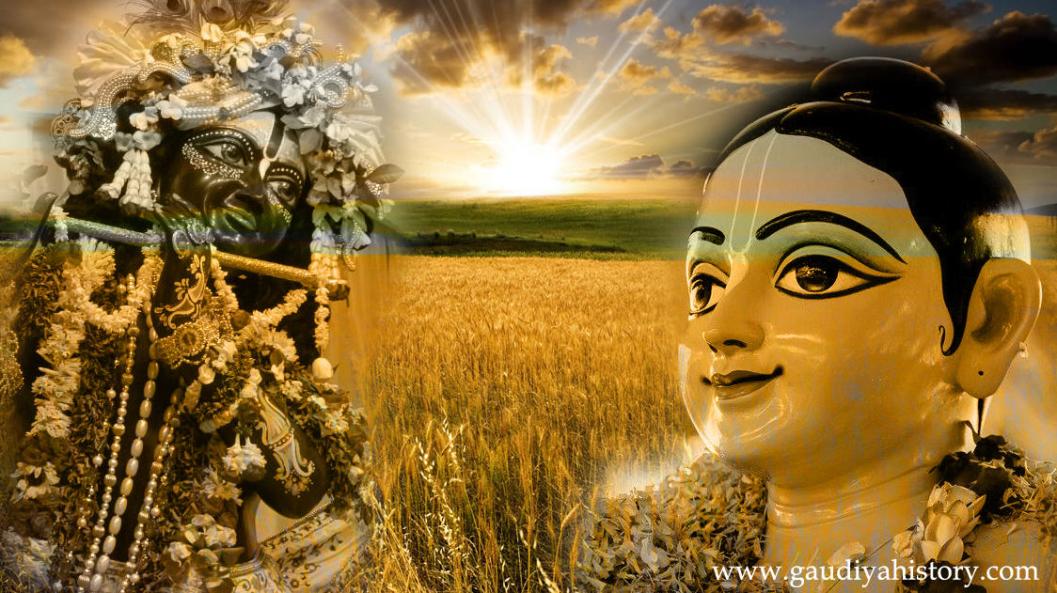
Dark-complexioned Lord Krishna, whose form is eternal, blissful, and full of knowledge, formerly danced with the golden-complexioned Gopis in the land of Vrindavana. By intently embracing them He attained a golden complexion like theirs. In this golden form He has now appeared in the town of Navadwipa. (In the wallpaper: from left to right Shri Madhav, Chandradoya Mandir, Mayapur, Shri Gauranga Mahaprabhu, Simantadwipa).
2. We offer respectful obeisances to Lord Advaita and the other dear associates of the Lord, who are all full of compassion for the fallen souls. We offer our respectful obeisances to Shrila Svarupa Damodara Goswami and the other companions of the Lord. As the Lord Himself is full of auspicious transcendental qualities, so are they. As the Lord Himself is full of mercy, so are they. These great Devotees are filled with the sweet nectar of Krishna-consciousness. These great Devotees remove the grave sins of this material world.
3. We offer our respectful obeisances to Shrinatha Chakravarti, our spiritual master, who is very dear to the all-powerful Personality of Godhead. Our spiritual master is like a jewel decorating the earth, or like a splendid moon shining in the brahminical community. Some rare elevated souls in this world are able to understand and relish his nectarean description of Lord Krishna's confidential pastimes in Vrindavana.
4. With great devotion, I offer my respectful obeisances to my father, Shri Shivanandana, who is like a brilliant lamp shining in the Sena family, and who is counted among the foremost associates of Lord Chaitanya Mahaprabhu.
5. Shrila Svarupa Damodara Goswami and other great Vaishnava authors have written in their books many descriptions of the great associates of Lord Chaitanya Mahaprabhu, Lord Nityananda, and Lord Advaita. These authors have explained that the associates of Lord Chaitanya had previously been cowherd people in Vrindavana during Lord Krishna's advent, and these authors have informed us of the former names of each of these associates of the Lord. I have carefully considered all these writings, and I have also heard the testimonies of the Devotees in Bengal, Orissa, and Mathura. Collecting all this evidence, I, Paramananda dasa, write this book describing the previous life of the associates of Lord Chaitanya Mahaprabhu.
6. Just as Lord Krishnachandra, who is non-different from the Pancha-tattva, formerly appeared in this world, so Lord Chaitanya also appeared in this world.
7. The members of the Pancha-tattva are non-different from Lord Chaitanya Mahaprabhu. Had they been different from Him, they would have been known as "catstayam tattvam (the four truths)".
8. The members of the Pancha-tattva are different from Lord Krishna, and then again they are not different from Him. By employing His internal potency, the Lord has created this condition in which the members of the Pancha-tattva are simultaneously different from Him and not different from Him.
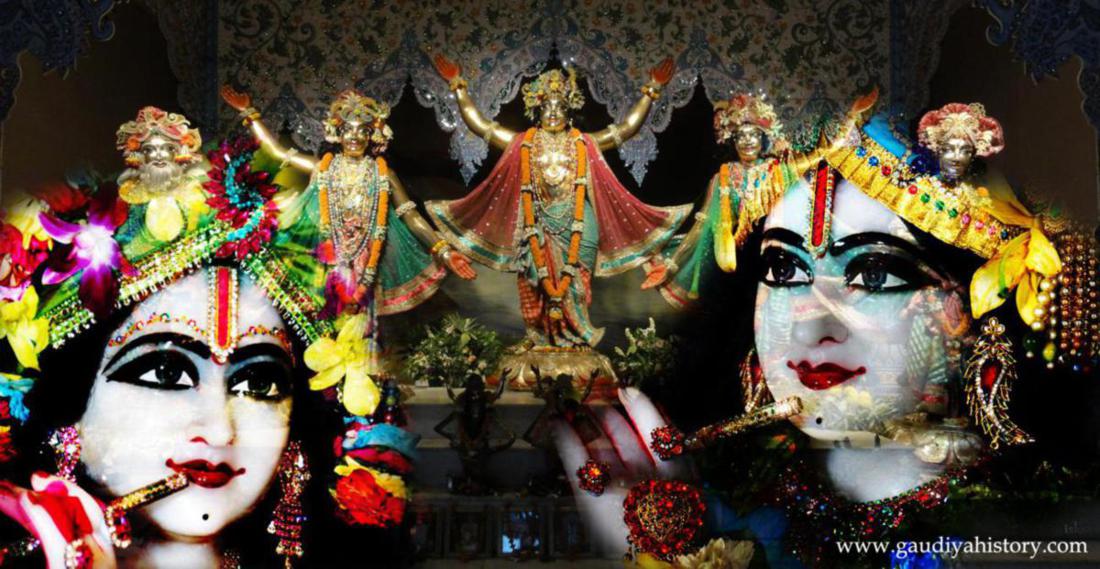
The members of the Pancha-tattva are different from Lord Krishna, and then again they are not different from Him. By employing His internal potency, the Lord has created this condition in which the members of the Pancha-tattva are simultaneously different from Him and not different from Him....the bhakta-rupa (form of a Devotee) is Lord Chaitanya Mahaprabhu, who formerly appeared as Lord Krishna, the son of Nanda Maharaja. The bhakta-svarupa (devotional incarnation) is Lord Nityananda, who formerly appeared in Vrajabhumi as Lord Balarama. The bhaktavatara (devotional manifestation) is Lord Advaita Acharya, who is not different from Lord Sadashiva. The bhaktakhya (pure Devotee) is Shrinivasa and the other great Devotees as well. The bhakta-sakti (devotional energy) is Gadadhara Pandita, the foremost of brahmanas. (In the wallpaper: in the back side Shri Pancha Tattva, ISKCON Mayapur, Shri Govinda, ISKCON Tirupati).
9. Shrila Svarupa Damodara Goswami has described the five members of the Pancha-tattva in the following words.
10. "I offer my obeisances unto the Supreme Lord Krishna, who is non-different from His features as a Devotee, devotional incarnation, devotional manifestation, pure Devotee, and devotional energy."
11. I shall now summarily explain the meaning of these words. In this Pancha-tattva, the bhakta-rupa (form of a Devotee) is Lord Chaitanya Mahaprabhu, who formerly appeared as Lord Krishna, the son of Nanda Maharaja. The bhakta-svarupa (devotional incarnation) is Lord Nityananda, who formerly appeared in Vrajabhumi as Lord Balarama. The bhaktavatara (devotional manifestation) is Lord Advaita Acharya, who is not different from Lord Sadashiva. The bhaktakhya (pure Devotee) is Shrinivasa and the other great Devotees as well. The bhakta-sakti (devotional energy) is Gadadhara Pandita, the foremost of brahmanas.
12. Lord Chaitanya, Lord Nityananda Avadhuta, and Lord Advaita, are all incarnations of the supremely exalted Personality of Godhead, and They are all known by the title Prabhu (Master). Among Them, Lord Chaitanya, who is an ocean of mercy, is known as Mahaprabhu (The Great Master), and the great personalities Lord Nityananda and Lord Advaita are known only as Prabhu (Master). All three are also known as Goswami (Master of the Senses). Gadadhara is called by the title Dvija (Brahmana), and Shrinivasa is called by the title Pandita (Learned Scholar). These are the titles of the members of the Pancha-tattva.
13. In this regard Shrila Svarupa Damodara Goswami has explained that the title Mahaprabhu should be used only for Lord Chaitanya, although the title Prabhu may be used for Lord Chaitanya, Lord Nityananda, and Lord Advaita. For this reason the Devotees address Lord Chaitanya as Mahaprabhu, and Lord Nityananda and Lord Advaita as Prabhu.
14. All the associates of Lord Chaitanya, Lord Nityananda, and Lord Advaita are very exalted personalities. The association of Lord Nityananda were all cowherd boys during Lord Krishna's advent.
15. The associates of Lord Chaitanya at Navadwipa are considered the most exalted.
16. The next most exalted are the Lord's associates at Jagannath Puri, and after them are the great souls who met Lord Chaitanya Mahaprabhu in His journeys to South India and other places.
17. In his description of Lord Chaitanya, Shrila Svarupa Damodara Goswami has explained that among the exalted associates of the Pancha-tattva are Devotees that were formerly cowherd boys who performed pastimes with Lord Krishna.
18. Some learned Devotees say that Navadwipa is identical with the land of Vrindavana. Others say that Navadwipa is actually the spiritual planet Goloka. Some say that Navadwipa is the planet Svetadwipa, and others say that Navadwipa is actually the spiritual sky of Vaikuntha. All glories to the wonderfully splendid land of Navadwipa.
19. Taking the name Vishvambhara, the Supreme Personality of Godhead accepted residence in the town of Navadwipa. He enjoyed many transcendental pastimes there with His exalted associates, and those pastimes have drowned the minds of this universe's residents in great transcendental bliss.
20. The same Supreme Personality of Godhead who appeared in Satya-yuga as the white-complexioned Lord Sukla, the same Supreme Personality of Godhead who appeared in the Treta-yuga as the red-complexioned Lord Makhamuk, the same Supreme Personality of Godhead who appeared in the Dvapara-yuga as the dark-complexioned Lord Shyamasundara, has appeared in the Kali-yuga as the golden moon of Lord Chaitanya, and engaged in the chanting of the Holy Names, the incarnation of Lord Hari.
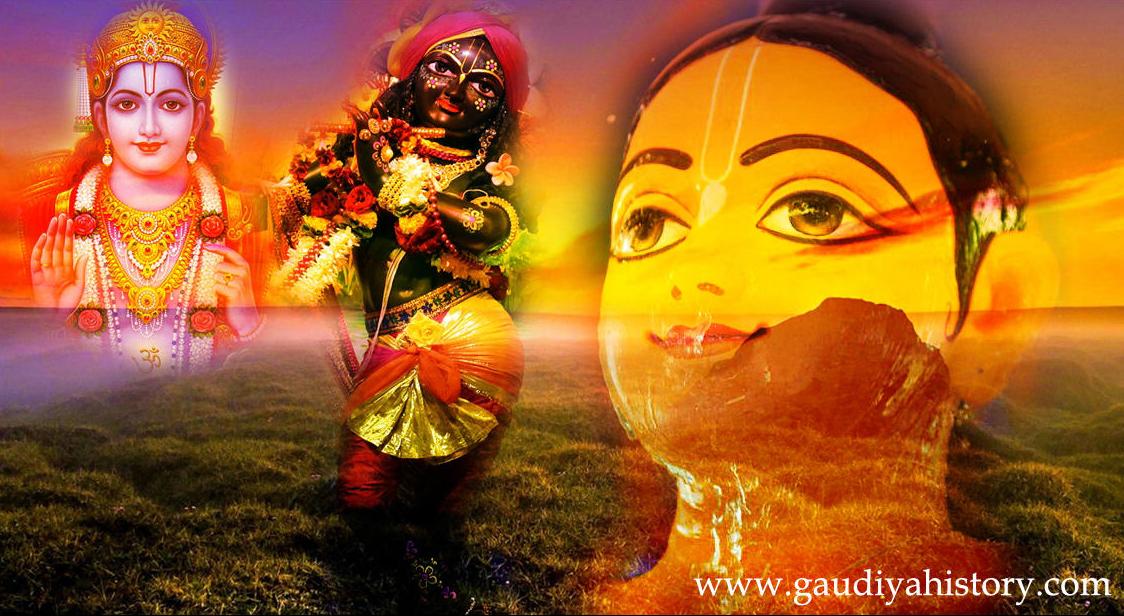
The same Supreme Personality of Godhead who appeared in Satya-yuga as the white-complexioned Lord Sukla, the same Supreme Personality of Godhead who appeared in the Treta-yuga as the red-complexioned Lord Makhamuk, the same Supreme Personality of Godhead who appeared in the Dvapara-yuga as the dark-complexioned Lord Shyamasundara, has appeared in the Kali-yuga as the golden moon of Lord Chaitanya, and engaged in the chanting of the Holy Names, the incarnation of Lord Hari. (In the wallpaper: from left to right Lord Shri Rama, Lord Shi Madan Gopal, ISKCON Nasik, Lord Shi Chaitanya Mahaprabhu, ISKCON Simantadwipa, Navadwipa).
21. In the Kali-yuga there are four Vaisnava sampradayas, known as the Sri, Brahma, Rudra, and Sanaka sampradaya. This is described in the following statement of the Padma Purana:"In the Kali-yuga four Vaisnava sampradayas, the Sri, Brahma, Rudra, and Sanaka smapradayas, will purify the earth."
22. I shall now begin this book by describing the disciplic succesion descended from Shripada Madhvacharya. Lord Brahma, the creator of the universe became the disciple of the Supreme Personality of Godhead, Lord Narayana. Brahma's disciple was Narada. Narada's disciple was Vyasa. Vyasa then transmitted transcendental knowledge to his disciple Shukadeva. Shukadeva taught the same knowledge to his many disciples and grand-disciples in this world. The famous Madhvacharya received initiation from Vyasa personally. Madhvachaya carefully studied all the Vedas from Vyasa, and later wrote his book Mayavada-sata-dusani, where he proved that the Absolute Truth is the Supreme Person, full of all transcendental qualities, and not the qualityless impersonal Brahman. Madhvacharya's disciple was the exalted Padmanabhacharya. Padmanabhacharya's disciple was Narahari. Narahari's disciple was Madhava Dvija. Madhava Dvija's disciple was Aksobhya. Aksobhya's disciple was Jayatirtha. Jayatirtha's disciple was Jnanasindhu. Jnanasindhu's disciple was Mahanidhi. Mahanidhi's disciple was Vidyanidhi. Vidyanidhi's disciple was Rajendra. Rajendra's disciple was Jayadharma Muni. Among Jayadharma Muni's disciples was Shriman Vishnupuri, the famous author of the Bhakti-ratnavali. Another disciple of Jayadharma was Brahmana Purushottama. Purushottama's disciple was Vyasatirtha, who wrote the famous book Shri Vishnu-samhita. Vyasatirtha's disciple was Shriman Lakshmipati, who was like a great reservoir of the nectar of devotional service. Lakshmipati's disciple was Madhavendra Puri, a great preacher of devotional service. Madhavendra Puri was the incarnation of a kalpa-vriksha tree in the abode of Vraja. This tree bears as its fruits the mellows of servitude to Lord Krishna, friendship with Lord Krishna, parental love for Lord Krishna, and conjugal love for Lord Krishna.
23. Madhavendra Puri's disciple was Shriman Ishvara Puri Swami. Ishvara Puri carefully understood the mellows of conjugal love for Lord Krishna, and was able to distribute that fruit to others.
24. Shri Advaita Acharya displayed the sentiments of servitorship and friendship for the Lord, and Shriman Ranga Puri manifested the sentiment of parental love for Lord Krishna.
25. Lord Chaitanya accepted Shriman Ishvara Puri as His spiritual master. The Lord proceeded to flood the entire world with spontaneous transcendental love for Krishna.
26. Lord Chaitanya accepted Shrimati Radharani's golden complexion and ecstatic love for Lord Krishna, both of which had never before been seen in this world. Lord Chaitanya was actually Lord Krishna, the son of Maharaja Nanda. He appeared like a great ocean of nectar flooding the entire world.
27. When Lord Vasudeva, the first member of the Catur-vyuha, saw the dancing of the Gandharvas at Dvaraka Puri, His mind became agitated with the desire to dance as they did. In order to fulfill this desire, Lord Vasudeva entered the transcendental body of Lord Caitanya, to participate in the Lord's pastimes of ecstatic dancing.
28. The Supreme Personality of Godhead who remains at Dvaraka also entered the body of Lord Chaitanya, the son of Sachi-devi, and various other incarnations of the Supreme Lord also entered Lord Chaitanya's body, all of them present there at the same time.
29. All these incarnations entered the body of Lord Chaitanya, just as the black incarnation Lord Shyama formerly entered the transcendental body of Lord Krishna, the Supreme Personality of Godhead.
30. Although the various incarnations of the Lord, who all manifested inconceivable transcendental qualities, were situated in various parts of the spiritual and material worlds, nevertheless, by the power of the Lord's yogamaya energy, They all assembled together within the transcendental form of Lord Chaitanya Mahaprabhu.
31. These inconceivable workings of the yogamaya potency cannot be understood by the limited conceptual power of the conditioned soul. This is confirmed by the following statement of Shrila Vyasadeva in the Prabhasa-khanda of the Mahabharata: "The activities of the Personality of Godhead are inconceivable. Ordinary material logic does not have the strength to understand them."
32. The various incarnations entered the transcendental body of Lord Chaitanya just as formerly Lord Parashurama entered the body of Lord Ramachandra. Narada and other eternal Devotees of the Lord also followed Him into this world to perform pastimes with Him in various places, just as the personified Vedas also did.
33. According to their individual sentiments of ecstatic love for Lord Krishna, the various eternal Devotees of the Lord assumed various roles in the Lord's pastimes in Vraja.
34. Just as the moon of Lord Chaitanya was about to rise in this material world, the Lord said to Advaita Acharya: "Some Devotees are attached to Me in the spirit of servitude, some are attached to Me in the spirit of friendship, and others are attached to Me with a mixture of the spirits of servitude and friendship. Some have firm faith and love for My forms as Shri Shri Radha-Madhava, and others are attached to My form as the king of Dvaraka. Some are attached to My various incarnations and thus display various kinds of love for Me. I shall show them how to love Me as the residents of Vraja did."
35. The cowherd man named Parjanya who was Krishna's paternal grandfather in Vrindavana, took birth in the town of Shri Hatta during Lord Chaitanya's pastimes. Parjanya took the name Upendra Mishra and became the father of seven sons.
36. The gopi named Variyasi-devi, who was Lord Krishna's paternal grandmother in Vraja, appeared as Kamalavati-devi during Lord Chaitanya's advent.
37. Shrimati Yasoda-devi and Vraja's king Nanda, who had been like two great oceans of the nectar of love for Krishna during the Lord's pastimes in Vrindavana, appeared during Lord Chaitanya's pastimes as Shrimati Sachi-devi and Shriman Jagannatha Purandara. Of this there is no doubt.
38/39. Some Devotees say that the two demigods Aditi and Kashyapa, who incarnated as Kaushalya and Dasharatha, Prishni and Sutapa, and also as Devaki and Vasudeva, the parents of Balarama and Krishna, also entered the bodies of Sachi-devi and Jagannatha. These Devotees say that if this were not so, then it would not have been possible for Balarama to take birth as their son Vishvarupa.
40. Rohini and Vasudeva, the parents of Balarama and Krishna, appeared during Lord Chaitanya's advent as the exalted brahmana couple Padmavati and Mukunda. Sumitra and Dasharatha were also present in the bodies of Padmavati and Mukunda.
41. The same Paurnamasi who greatly pleased Lord Govinda in Vraja appeared in Lord Chaitanya's pastimes as Shrila Govinda Acharya, the expert author of songs and poetry.
42. Ambika, the nurse who fed infant Krishna with her own breast milk in Vraja, appeared during Lord Chaitany's pastimes as Malini-devi, the wife of Shrivasa Pandita.
43. Kilambika-devi, who had been Ambika's sister in Vraja, and who had been accustomed to eating the remnants of foodstuff eaten by Lord Krishna, appeared during Lord Chaitayna's pastimes as Narayani-devi.
44. The same person who was Maharaja Janaka, the king of Mithila, appeared during Lord Chaitanya's pastimes as Vallabhacharya. Some people differ from this view, and say that Vallabhacharya was an incarnation of Maharaja Bhishmaka.
45. The same person who formerly appeared as Janaki-devi and Rukmini-devi appeared during Lord Chaitanya's pastimes as Shrimati Lakshmipriya, the daughter of Vallabhacharya.
46. Vallbhacharya's daughter, Shrimati Lakshmipriya, was an incarnation of Shrimati Lakshmi-devi, the goddess of fortune. One day, as she was walking with her friends towards the bank of the Ganges to bathe, she entered the path of Lord Chaitanya's vision. In this way the Lord saw Lakshmipriya for the first time.
47. The same person who formerly appeared as King Satrajit appeared in Lord Chaitanya's pastimes as Sanatana Mishra. Sanatana Mishra's daughter was Shrimati Vishnupriya, and she was the incarnation of the Lord's Bhu-sakti, who is the mother of the entire universe.
48. That Shrimati Vishnupriya is an incarnation of Bhu-devi is described in the Shri Chaitanya-chandrodaya-nataka, where Kali says: "Understanding that Shrimati Vishnupriya was the incarnation of Bhu-devi, Lord Chaitanya accepted her hand in marriage."
49. The same person who appeared as Vishvamitra Muni, who arranged the marriage of Lord Ramachandra, and who also appeared as the brahmana messenger sent by Shrimati Rukmini-devi to Lord Keshava, also appeared in Lord Chaitanya's pastimes as Vanamali Acharya, who was famous as a learned astrologer.
50. The brahmana named Kulaka, whom Maharaja Satrajit sent to Lord Madhava to arrange the Lord's marriage with Satyabhama, appeared in Lord Chaitanya's pastimes as Shri Kasinatha.
51. The person who appeared in Lord Chaitanya's pastimes as Jagadananda Pandita was actually an incarnation of Shrimati Satyabhama-devi. What Devotee can say otherwise?
52. The same person who appeared as Sandipani Muni, the sage who gave Lord Krishna the sacred thread in Mathura, has appeared in Lord Chaitanya's pastimes as Keshava Bharati.
53. The same person who formerly appeared as Vasishtha Muni, the spiritual master of Lord Ramachandra, appeared in Lord Chaitanya's pastimes as Gangadasa and Sudarshana.
54.The same person who was formerly known as Maharaja Vrishabhanu in the district of Vraja, appeared in Lord Chaitanya's pastimes as the great personality Pundarika Vidyanidhi.
55. When He was afflicted by the feelings of Shrimati Radharani's intense love in separation from Lord Krishna, Lord Chaitanya would address Pundarika Vidyanidhi using the word "father".
56/57. Lord Chaitanya was very pleased with Pundarika Vidyanidhi, and the Lord would address him by the name Premanidhi. Because Pundarika Vidyanidhi was a direct disciple of Madhavendra Puri, the Lord would treat him with great respect, as if he was the Lord's own spiritual master. Maharaja Vrishabhanu also appeared as Shri Madhava Mishra. Ratnavati-devi Pundarika Vidyanidhi's wife, is considered by the learned Devotees to be the incarnation of Kirtida-devi, the wife of Maharaja Vrishabhanu.
58.The original form of the Supreme Lord is considered not different from the Lord's direct expansions. For this reason it is considered that Lord Chaitanya Mahaprabhu, the son of Shrimati Sachi-devi, is non-different from His expansion Lord Vasudeva, the first member of the Chatur-vyuha. In the same way Shri Vishvarupa is considered non-different from the incarnation Lord Sankarshana, the second member of the Chatur-vyuha.
59. Lord Nityananda Avadhuta is also said to be non-different from Lord Sankarshana. That Shri Vishvarupa is identical with Lord Sankarshana is described in the Shri Chaitanya-chandrodaya-nataka, where Kali says to Dharma the following words:
60. "Lord Chaitanya's elder brother Vishvarupa is identical with the Personality of Godhead Lord Sankarshana. Vishvarupa never married, but accepted the order of parivrajakacharya-sannyasa and left home. It was the transcendental glory of Shri Vishvarupa that caused Lord Chaitanya to accept spiritual initiation from Ishvara Puri."
61. That Lord Nityananda is also non-differnent from Lord Sankarshana is described in the following statement of the Shri Chaitanya-chandradaya-nataka: "Lord Nityananda Avadhuta is non-different from Lord Sankarshana."
62. When the eternal Personality of Godhead Lord Vishvarupa disappeared from home, He entered the body of Lord Nityananda Avadhuta.
63. My father, Shivananda Sena, once said: "Lord Nityananda Avadhuta is actually the Personality of Godhead Lord Balarama. Always staying among the Devotees, He shines with the splendor of thousands of suns." Saying this, he began to dance.
64. Lord Nityananda incarnates as His plenary expansion Ananta Sesha. As Lord Sehsa He transforms His body to become the garments, bracelets, and other ornaments worn by Lord Vishnu and Lord Krishna. Expanding again as the pastime-potency, lila-sakti, Lord Sesha is aware of all the details of Lord Krishna's confidential pastimes.
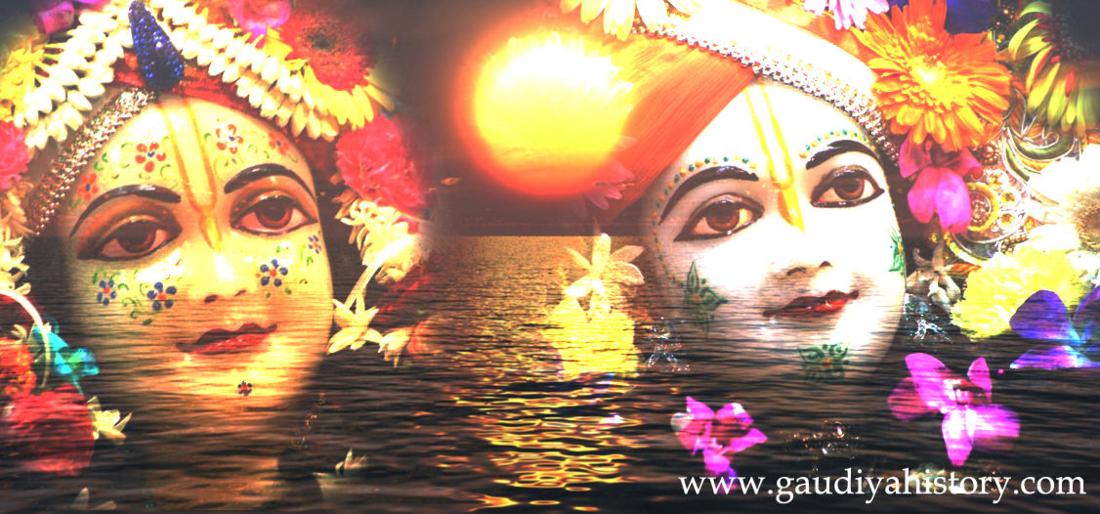
Lord Nityananda Avadhuta is actually the Personality of Godhead Lord Balarama. Always staying among the Devotees, He shines with the splendor of thousands of suns."...Lord Nityananda incarnates as His plenary expansion Ananta Sesha. As Lord Sehsa He transforms His body to become the garments, bracelets, and other ornaments worn by Lord Vishnu and Lord Krishna. Expanding again as the pastime-potency, lila-sakti, Lord Sesha is aware of all the details of Lord Krishna's confidential pastimes. (In the wallpaper: from left to right Shri Balarama, Shri Nityananda Prabhu, ISKCON Vrindavan).
65. Lord Balarama's two wives, Shrimati Varuni-devi and Shrimati Revati-devi, appeared during Lord Chaitanya's pastimes as Shrimati Vasudha-devi and Shrimati Jahnavi-devi, the two dear wives of Lord Nityananda, and the daughters of the great personality Shri Surya-dasa. Their father, Surya-dasa, had previously been Maharaja Kakudmi. His bodily luster made him as effulgent as the sun.
66. Some say that Shrimati Vasudha-devi is the incarnation of Shrimati Ananga-manjari, and others say that Shrimati Jahnavi-devi is the incarnation of Shrimati Ananga-manjari. In truth, both opinions are correct. They are both incarnations of Shrimati Ananga-manjari.
67. The expansion of Lord Sankarshana known as Lord Kshirodakashayi Vishnu appeared in Lord Chaitanya's pastimes as Virachandra Prabhu. Lord Virachandra was non-different from Lord Chaitanya Himself.
68. Lord Virachandra also entered the bodies of the two brothers Nisatha and Ulmuka, who in this way were incarnations of Lord Vishnu. Minaketana Rama dasa and others were also incarnations of Lord Sankarshana in this way.
69. The Ganges River, who was born from the lotus feet of Lord Vishnu, appeared in Lord Chaitanya's pastimes as Shrimati Ganga-devi, the daughter of Lord Nityananda. Her husband, Shri Madhava, had formerly been Maharaja Shantanu.
70. Lord Pradyumna, the third member of the Chatur-vyuha, had formerly appeared in Vrajabhumi as a close (priya-narma-sakha) friend of Shri Shri Radha-Madhava, where he helped in Their transcendental pastimes. That same Lord Pradyumna appeared in Lord Chaitanya's pastimes as Shri Raghunananda Thakura, who was non-different from both Lord Chaitanya and Lord Advaita.
71. Lord Aniruddha, the fourth member of the Chatur-vyuha, appeared in Lord Chaitanya's pastimes as Vakreshvara Pandita. Lord Krishna personally entered Vakreshvara's body and caused Him to dance in ecstasy. This ecstatic dancing of Vakreshvara Pandita delightes Lord Chaitanya Mahaprabhu.
72. One day Vakreshvara Pandita sweelty said to Lord Chaitanya: "O merciful Lord, please give me a thousand Gandharva singers to sing as I dance."
73. A particle of Lord Chaitanya entered the body of Nakula Brahmachari. In this way Nakula Brahmachari became a saktyavesha incarnation of the Lord.
74. In the same way, a particle of Lord Chaitanya also entered the body of Pradyumna Mishra. Bhagavan Acharya Khanja is said to be a partial manifestation of Lord Gaura.
75. Lord Brahma, the master of the universe, who is considered one of the members of the Navavyuha and who is the original teacher of the Vedas and Tantras, appeared in Lord Chaitanya's pastimes as Shri Gopinatha Acharya.
76. Lord Sadashiva, who formerly appeared as an avesha-incarnation in Vrajabhumi, appeared in Lord Chaitanya's pastimes as Lord Advaita Goswami, who is non-different from Lord Chaitanya Himself.
77. Assuming the form of a cowherd boy, Lord Sadashiva danced with Lord Krishna in Vrajabhumi. This is confirmed by the following statement of the Shiva-tantra, where Bhairava says:
78. "One day, during the great festival of lights in the month of Karttika, Lord Krishna enthusiastically danced with Lord Balarama and Their cowherd friends.
79. My dear Parvati, when Lord Sadashiva, my spiritual master, saw this transcendental dancing, He yearned to become a cowherd boy and be able thus to dance with Lord Krishna.
80. By Lord Krishna's mercy Lord Sadashiva was able to appear in two forms. In one form He remained as Lord Sadashiva, and in the other form He appeared as a cowherd boy in Vraja."
81. Lord Shiva's friend Kuvera, the king of the Guhyakas, appeared in Lord Chaitanya's pastimes as Kuvera Pandita, the father of Lord Advaita.
82. Formerly, on Mount Kailasha, where the Siddhas and Sadhyas reside, Kuvera, who is very dear to Lord Shiva, chanted the transcendental mantra containing the names of Lord Shiva.
83. Merciful Lord Shiva then said to Kuvera: "Please ask for some benediction. It is My desire to give you some gift." Kuvera then asked for a benediction, saying, "O my Lord, please become my son."
84. Requested in this way, Lord Sadashiva, the master of the demigods and the best of philanthropists, said to Kuvera: "During my next birth in the material world I shall accept the position of being your son."
85. In this way Kuvera attained a very difficult to attain benediction. When the appropriate time arrived, by Lord Sadashiva's mercy, Kuvera became the father of Lord Advaita Acharya.
86. The Supreme Lord's yogamaya potency appeared in Lord Chaitanya's pastimes as Shri Sita-devi, the wife of Lord Advaita Acharya.
87. Lord Advaita's son was Acyutananda, who was very dear to Lord Chaitanya. Achyutananda was the dear disciple of Shriman Pandita Goswami. This I have heard from the Devotees.
88. Some say that Achyutananda was the incarnation of Karttikeya, and others learned in transcendental mellows say that he is the incarnation of Achyuta-gopi. Both views are correct, for both Karttikeya and Achyuta-gopi were present in the body of Achyutananda. Aside from this, some Devotees say that Shri Krishna Mishra was also the incarnation of Karttikeya.
89. The Devotees Nandini and Jangali who were associates of Lord Chaitanya had previously been Jaya and Vijaya in Lord Krishna's pastimes.
90. Intelligent Shrivasa Pandita had previously been Narada Muni, the best of the sages. Shrivasa's younger brother, Shriman Rama Pandita, had previously been Narada's close friend Parvata Muni.
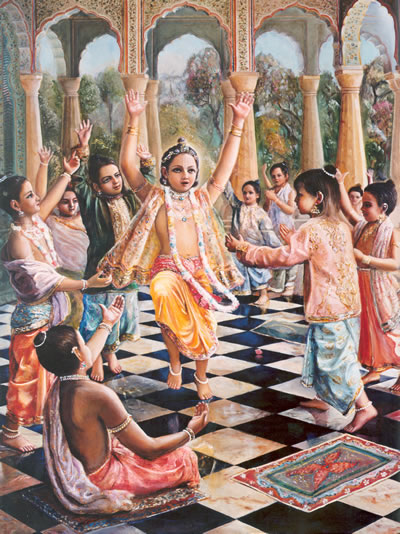
Lord Chaitanya Himself did not accept that Ramachandra Puri was the incarnation of Vibhishana, but the Lord himself said that Ramachandra Puri was the empowered incarnation of Shrimati Radharani's mother-in-law Jatila. This Ramachandra Puri restricted Lord Chaitanya in His acceptance of alms. Rchika Muni's son Brahma Mahatapah, and Prahlada Maharaja combined to appear as Haridasa Thakur in Lord Chaitanya's pastimes. (In the image: Prahlada Maharaja in the middle preaching about the glories of the Holy Names to his demon classmates).
91. The Devotee named Murari Gupta in Lord Chaitanya's pastimes had previously been Hanuman. In the same way Shri Purandara had previously been Angadam and Govindananda had been Sugriva.
92. The Devotee named Ramachandra Puri in Lord Chaitanya's pastimes had previously been Vibhishana.
93. Lord Chaitanya Himself did not accept that Ramachandra Puri was the incarnation of Vibhishana, but the Lord himself said that Ramachandra Puri was the empowered incarnation of Shrimati Radharani's mother-in-law Jatila. This Ramachandra Puri restricted Lord Chaitanya in His acceptance of alms. Rchika Muni's son Brahma Mahatapah, and Prahlada Maharaja combined to appear as Haridasa Thakur in Lord Chaitanya's pastimes.
94/95. In the book Chaitanya-charita, Murari Gupta explains that one morning Mahatapah gave an unwashed tulasi leaf to his father, who became so angry at him for this that he cursed him. Because of this Mahatapah took birth in a yavana family as the great Devotee Haridasa Thakura.
96/97. The eight mystic powers, beginning with anima-siddhi, which had formerly appeared in Vrindavana, took birth in Bengal during Lord Chaitanya's pastimes as the eight Devotees Ananta, Sukhananda, Govinda, Raghunatha, Krishnananda, Keshava, Damodara, and Raghava. All these Devotees bore the title Puri after their names.
98-101. The nine Jayanteyas, who were fixed in celibacy and equal vision, and who spoke the Shri Bhagavata-samhita to Janaka Rshi, appeared on this earth as nine sannyasis, and continually performed pastimes with Lord Chaitanya. Their names were: Shri Nrsimhananda Tirtha, Shri Satyananda Bharati, Shri Nrsimha Tirtha, Shri Chidananda Tirtha, Shri Jagannatha Tirtha, Shri Vasudeva Tirtha, Shri Rama Tirtha, Shri Purushottama Tirtha, and Shri Garuda Avadhuta, who was also known as Shri Gopendra Ashrama.
102/103 Kuvera's famous nine treasures, which include his conch and lotus, took birth during Lord Chaitanya's pastimes as the nine sons of Nidhiratna-devi. Their names were Shrinidhi, Shrigarbha, Kaviratna, Sudhanidhi, Vidyanidhi, Gunanidhi, the learned brahmana Ratnabahu, Shriman Acharyaratna, and Shri Ratnakara Pandita.
104. Before the assembled relatives and friends, Nilambara Chakravarti spoke the astrological prediction of Lord Chaitanya's future life. For this reason it is said the Nilambara Chakravarti is the incarnation of Garga Muni.
105. Shrimati Sachi-devi's father had formerly been the cowherd Sumukha, who was Yashoda-devi's father. Sachi-devi's mother had formerly been Patala-devi, the wife of Sumukha in Vrajabhumi.
106. Lord Chaitanya's associate Shri Devananda Pandita, who was very learned in the Puranas, had previously been Bhaguri Muni, the chief pandita in the court of Maharaja Nanda.
107. The four learned Devotees in Lord Chaitanya's pastimes, named Kasinatha, Lokanatha, Shrinatha, and Ramanatha, were incarnations of the four Kumaras. Of this there is no doubt.
108. The names of these four Devotees each end with the word 'natha', just as the names of the four Kumaras each end with the word 'kumara'. These four Devotees became known as the 'four Nathas'.
109. Vedavyasa appeared in Lord Chaitanya's pastimes as Vrindavana das Thakura. Lord Krishna's cowherd friend Kusumapida also entered the body of Vrindavana das Thakura.
110. Shukadeva Goswami, the son of Shrila Vyasadeva, appeared during Lord Chaitanya's pastimes as the Devotee named Vallabha Bhatta.
111. Shri Jagannatha Acharya, who was also known as Gangadasa Pandita, was very dear to Lord Chaitanya. In his previous life he had been Durvasa Muni, who delighted the gopis and was very dear to them.
112. The learned Devotees know that Chandrashekhara Acharya was an incarnation of the moon-god and Shriman Uddhava dasa was an empowered incarnation of the moon-god.
113. Lord Chaitanya personally affirmed that Chandrashekhara Acharya was an incarnation of the moon-god, and in the same way the Lord expressly said that Shriman Vishveshvara Acharya was an incarnation of the sun-god.
114. Bhaskara Thakura was an incarnation of the demigod Vishvakarma. Vanamali Tahkura was an incarnation of Sudama Brahmana, who was afflicted by great poverty and obtained great wealth from the Lord.
115. Jaya and Vijaya, the two doorkeepers of Vaikunthaloka, voluntarily appeared in Lord Chaitanya's pastimes as the two Devotees Shri Jagannatha and Shri Madhava.
116. The two liberated souls Pundarikaksha and Kumuda, who are very famous in Vaikunthaloka, appeared in Bengal as the two Devotees name Govinda and Garuda, who were both very dear to Lord Chaitanya Mahaprabhu.
117. Garuda Pandita was the incarnation of Garuda. Gopinatha Simha was the incarnation of Akrura. Some say that Keshava Bharati was the incarnation of Akrura.
118. Shri Paramananda Puri had formerly been Uddhava. Maharaja Prataparudra, who was as powerful as Lord Indra, had formerly been Maharaja Indradyumna, who began the worship of Lord Jagannatha.
119. Sarvabhauma Bhattacharya had formerly been Brihaspati, the foremost scholar in the heavenly planets.
120. The cowherd boy Arjuna who was a close friend of the Lord in Vrindavana, and the Pandava Arjuna, both joined to become Ramananda Raya, who was very dear to Lord Chaitanya.
121. This exalted personality, Ramanda Raya, for many days described to Lord Chaitanya the true nature of pure love for Shri Shri Radha-Kishna.
122-124 Some say that Ramananda Raya is the incarnation of Lalita-gopi, and others say that because Lord Chaitanya directly told Ramananda Raya's father, Bhavananda Raya, that he was the incarnation of Maharaja Pandu, Arjuna's father, therefore Ramananda Raya must be the incarnation of Pandava Arjuna. The most learned Devotees say that Ramananda Raya is the incarnation of both the Pandava Arjuna, and a gopi named Arjuniya. This explanation is also supported by the statements of the Padma Purana, Uttara-khanda. From all this we may conclude that Ramananda Raya is the incarnation of Lalita-gopi, Arjuniya-gopi, and Pandava Arjuna.
125. Now, as far as I am able, I shall describe the Devotees who had previously appeared with the Lord in His Vraja-pastimes.
126. The cowherd boy named Shridama appeared in Lord Chaitanya's pastimes as Ramadasa Abhirama dasa, who carried a flute made of a bamboo stick with sixteen knots.
127. Lord Krishna's cowherd friend Sudama appeared in Lord Chaitanya's pastimes as Sundara Thakura. Lord Krishna's cowherd friend Vasudama appeared in Lord Chaitanya's pastimes as Shri Dhananjaya Pandita.
128. Lord Krishna's dearest friend Subala appeared in Lord Chaitanya's pastimes as Gauridasa Pandita. The cowherd boy Mahabala appeared in Lord Chaitanya's pastimes as Kamalakara Pippalai.
129. The Devotee who had been the cowherd boy Subahu in Vrajabhumi appeared in Lord Chaitanya's pastimes as Uddharana Datta. Lord Krishna's cowherd friend Mahabahu appeared in Lord Chaitanya's pastimes as Shriman Mahesha Pandita.
130. Lord Krishna's cowherd friend Stoka Kirshna appeared in Lord Chaitanya's pastimes as Shri Purushottama das.
131. Dama-gopa, who had been Lord Krishna's cowherd friend in Vraja, appeared in Lord Chaitanya's pastimes as Nagara Purushottama. Nagara Purushottama was born in a family of phyisicians, and his father's name was Sadashiva.
132. Lord Krishna's cowherd friend Arjuna appeared as Shri Parameshvara dasa in Lord Chaitanya's pastimes. Lavanga, who had been Lord Krishna's cowherd friend in Vrajabhumi, appeared in Lord Chaitanya's pastimes as Shri Kala Krishna dasa.
133. The cowherd boy named Kusumasava, who joked with Lord Krishna and made Him laugh in Vrajabhumi, appeared in Lord Chaitanya's pastimes as the learned brahmana named Kholavecha Shridhara.
134. The cowherd boy Prabala, who was a close friend of Lord Balarama in Vrajabhumi, appeared in Lord Chaitanya's pastimes as Halayudha Thakura.
135. The cowherd boy Varuthapa who was close friend of Lord Krishnachandra in Vrajabhumi, appeared as Rudra Pandita, who was very dear to Lord Chaitanya.
136. The Devotee who had been the cowherd boy Gandharva in Vrajabhumi appeared in Lord Chaitanya's pastimes as Kumudananda Pandita.
137. Bhrngara and Bhangura, who had been Lord Krishna's servants in Vrindavana, later appeared as Shri Kashishvara and Shri Govinda, the servants of Lord Chaitanya Mahaprabhu.
138. Raktaka and Patraka, who had been Lord Krishna's servants in Vrindavana, later appeared as Haridasa and Brhacchishu, two servants of Lord Chaitanya.
139. The two cowherd boys Payoda and Varida, who had formerly performed the nira-samskara ceremnoy for Lord Krishna, later appeared as Ramai and Nandai, two famous servants of Lord Chaitanya.
140. Madhukantha and Madhuvrata, who were singers in Vrajabhumi, later appeared as Mukunda Datta and Vasudeva Datta, two famous singers in Lord Chaitanya's kirtana party.
141. Chandramukha, the famous dancer in Vrindavana, appeared in Lord Chaitanya's pastimes as Makaradhvajakara.
142. Shri Sudhakara, who had been an expert mrdanga player in Vrajabhumi during Lord Krishna's pastimes, appeared in Lord Chaitanya's pastimes as the expert drummer Shri Shankara Ghosha.
143. Chandrahasa, who in Vrajabhumi had been a dancer expert in transcendental mellows, appeared in Lord Chaitanya's pastimes as the dancer Jagadisha Pandita.
144. Maladhara, who had formerly carried Lord Krishna's venu and murali flutes in Vrajabhumi, later appeared as Vanamala Pandita, who was very dear to Lord Chaitanya.
145. Daksha and Vichakshana, the two famous parrots of Vrindavana, took birth during Lord Chaitanya's pastimes as Chaitanya dasa and Rama dasa, who are both my seniors.
146. As much as I have heard from authorities, and as much as I can understand, I shall now describe Lord Krishna's dear friends, the gopis, and how they descended to participate in Lord Chaitanya Mahaprabhu's pastimes.
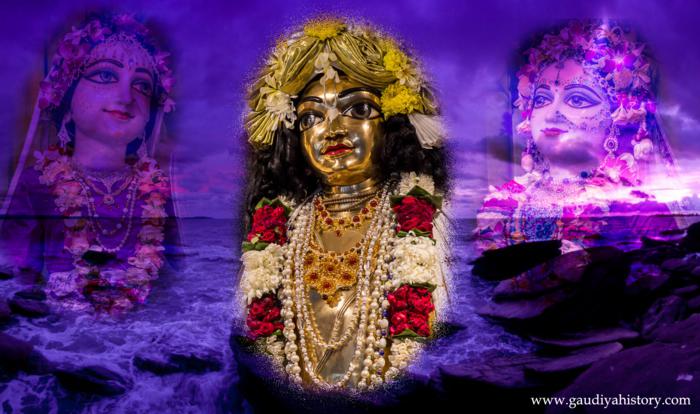
Shrila Svarupa Damodara Goswami has also confirmed that the goddess of fortune, who appeared in Vrindavana and was very dear to Lord Krishna, has now appeared as Shri Gadadhara Pandita, who is filled with love for Lord Chaitanya Mahaprabhu. Lalita-gopi always follows Shrimati Radharani, and therefore she is known as Anuradha (Radha's follower). When Shrimati Radharani appeared as Gadadhara Pandita, Lalita followed her, entering the body of Gadadhara Pandita. Therefore, Gadadhara Pandita is the incarnation of both Shrimati Radharani and Lalita-gopi. This is described in the following statement of Chaitanya-chandrodaya-nataka. (In the wallpaper: from the left to right Shrimati Lalita Sakhi, Shri Gadadhara Pandit, Shrimati Radharani, ISKCON Mayapur).
147. Shrimati Radharani, who is the personification of pure love for Lord Krishna and who is the queen of Vrindavana, appeared as Shri Gadadhara Pandita, who was very dear to Lord Chaitanya.
148-150 Shrila Svarupa Damodara Goswami has also confirmed that the goddess of fortune, who appeared in Vrindavana and was very dear to Lord Krishna, has now appeared as Shri Gadadhara Pandita, who is filled with love for Lord Chaitanya Mahaprabhu. Lalita-gopi always follows Shrimati Radharani, and therefore she is known as Anuradha (Radha's follower). When Shrimati Radharani appeared as Gadadhara Pandita, Lalita followed her, entering the body of Gadadhara Pandita. Therefore, Gadadhara Pandita is the incarnation of both Shrimati Radharani and Lalita-gopi. This is described in the following statement of Chaitanya-chandrodaya-nataka.
151. "Gadadhara, the best of the brahmanas, is the incarnation of both Shrimati Radharani and Lalita-gopi. These two are the transcendental potencies of the Lord, and since the Lord is in one sense not different from His potencies, it may be said that He is present wherever His potencies go. For this reason it may be said that Lord Hari is also present in the body of Gadadhara Pandita. Gadadhara is therefore the incarnation of three persons: Shrimati Radharani, Lalita-gopi, and Lord Hari."
152. Some say that Dhruvananda Brahmachari is the incarnation of Lalita-gopi. This opinion is also correct, for Lalita-gopi appeared as both Gadadhara Pandita and Dhruvananda Brahmachari.
153. By His own will Lord Chaitanya appeared in this world in three different forms at the same time. In the same way Shrimati Radharani appeared as Gadadhara Pandita.
154. Shrimati Radharani's expansion as Chandrakanti-devi appeared as Gadadhara dasa, a close associate of Lord Chaitanya.
155. Purnananda-gopi, the dearmost girl-friend of Lord Balarama also entered the body of Gadadhara dasa. Therefore Gadadhara dasa was the incarnation of both Chandrakanti-devi and Purnananda-gopi.
156. Chandravali-gopi, who had been very dear to Lord Krishna in Vrajabhumi, appeared in Bengal as Sadashiva Kaviraja.
157. During Lord Krishna's Vrindavana pastimes He would sometimes sleep peacefully on the chest of Shribhadra-gopi. This same Shribhadra-gopi later appeared as Shankara Pandita, who was very dear to Lord Chaitanya Mahaprabhu.
158. The vraja-gopis Taraka-devi and Pali-devi appeared as Shri Jagannatha and Shri Gopala, who were both very dear to Lord Chaitanya Mahaprabhu.
159. Hot-tempered Saibya-gopi who previously appeared in Vraja, appeared as Damodara Pandita during Lord Chaitanya's pastimes. The goddess Saraswati also entered the body of Damodara Pandita, who is thus the combined incarnation of them both.
160. Shrimati Vishakha-gopi, who formerly taught the various fine arts to Shrimati Radharani in Vrajabhumi, appeared during Lord Chaitanya's advent as Svarupa Damodara Goswami, who was filled with the various splendid manifestations of ecstatic love of Godhead.
161. Chitra-devi, who had formerly combed and decorated Shrimati Radharani's hair in Vrajabhumi, appeared as Shri Vanamali, who was very dear to Lord Chaitanya Mahaprabhu.
162. Shrimati Champakalata-gopi, who considered Shrimati Radharani as dear as her own life-breath, appeared as Raghava Goswami, who lived at Govardhana Hill and wrote the book entitled Bhakti-ratna-prakasha.
163. Tungavidya-gopi, who lived in Vrajabhumi and was learned in all the scriptures, appeared later as Prabodhananda Saraswati, the poet who eloquently glorified the transcendental qualities of Lord Chaitanya.
164. Indulekha-gopi, who was Shrimati Radharani's close friend in Vrajabhumi, appeared as Krishnadasa Brahmachari, who resided in Vrindavana-dhama.
165. The vraja-gopi Rangadevi appeared as Gadadhara Bhatta, and the vraja-gopi Sudevi appeared as Ananta Acharya Goswami.
166. The vraja-gopi Shashirekha-devi appeared as Shri Kashishvara Goswami. The vraja-gopi Dhanistha-devi, who had previously fed Lord Krishna with limitless opulent foodstuffs, appeared as Raghava Pandita, who was very dear to Lord Chaitanya.
167. The vraja-gopi Gunamala-devi appeared as Raghava Pandita's sister Damayanti-devi. Ratnarekha-gopi appeared as Krishnadasa, and Kalavati-gopi appeared as Krishnananda.
168. Gauraseni-gopi appeared as the saintly Devotee Narayana Vachaspati. Kaveri-gopi appeared as Pitambara, and Sukeshi-gopi appeared as Makaradhvaja.
169. Madhavi-gopi appeared as Madhvacharya, and Indira-gopi appeared as Jiva Pandita.
170. The charming vraja-gopi named Tungavidya appeared as Vidyavachaspati, who was dear to both Lord Chaitanya and the residents of Vrindavana.
171. Madhurekshana-gopi appeared as Balabhadra Bhattacharya, Chitrangi-gopi appeared as Shrinatha Mishra, and Manohara-gopi appeared as Kavichandra.
172. The vraja-brahmani Nandimukhi-devi appeared as Sharanga Thakura. Some people think that Sharanga Thakura was the incarnation of Prahlada Maharaja. My father (Shivananda Sena) did not agree with them.
173. Kalakantha-devi and Shukantha-devi, the two Gandharva-dancers who appeared in Vrajabhumi, also appeared as Ramananda Vasu and Satyaraja.
174. The vraja-gopi Katyayani-devi appeared as Shrikanta Sena.
175. Shrimati Vrinda-devi, the presiding Deity of Vrajabhumi, appeared as Shri Mukunda dasa, who lived in the village of Shrikhanda and was very dear to the Lord.
176. The two gopis Vira-devi and Duti-devi, who acted as messengers arranging the gopis' meetings with Lord Krishna, combined to appear as my father (Shivananda Sena). The vraja-gopi Bindumati appeared as my mother.
177. Shrimati Radharani's dear friend, the vraja-gopi named Madhumati-devi, appeared as Narahari Sarakara, who was very dear to Lord Chaitanya.
178. Shrimati Radharani's dear friend, the vraja-gopi named Ratnavali-devi appeared as Gopinatha Acharya, who was famous for his purity.
179. Lord Krishna's favorite flute appeared as Vamsidasa Thakura.
180. Shri Rupa-manjari, who had been famous in Vrindavana-dhama, appeared as Shrila Rupa Goswami.
181. Rupa-manjari's closest friend, who was known by the names Rati-manjari and Lavanga-manjari, appeared as Shrila Sanatana Goswami, who was honored by everyone, and who was considered to be like an extension of the transcendental body of Lord Chaitanya Mahaprabhu. Sanatana Kumara, the jewel among the sages, entered the body of Sanatana Goswami, which is therefore also considered to be an incarnation of Sanatana Kumara.
182. Shivananda Chakravarti, who lived in Vrindavana, is also considered to be an incarnation of Shrimati Lavanga-manjari.
184. Ananga-manjari appeared as Shrila Gopala Bhatta Goswami. Some say that Gopala Bhatta Goswami was actually the incarnation of Shri Guna-manjari.
185. Raga-manjari appeared as Shrila Raghunatha bhatta Goswami, who lived in a cottage by the shore of Radha-kunda.
186. Shrila Raghunatha dasa Goswami was the incarnation of Rasa-manjari. Some say that Raghunatha das Goswami was the incarnation of Rati-manjari, and others say he was the incarnation of Bhanumati-devi.
187. Bhugarbha Thakura was the incarnation of Prema-manjari. Lokanatha Goswami was the incarnation of Lila-manjari.
188. The vraja-gopis Kalavati-devi, Rasollasa-devi, and Gunatunga-devi, who sang the songs composed by Vishakha-devi, later appeared as Govinda, Madhavananda, and Vasudeva respectively.
189. Shrimati Radharani's maidservants, Rangalekha-devi and Kalakeli-devi, appeared as Sikhi-mahiti and his sister, Madhavi-devi respectively.
190. Malli-devi, the daughter of a Pulinda, appeared as Kalidasa.;
191. Shuklambara Brahmachari was the incarnation of one of the yajna-patnis who gave food in charity to Krishna and His friends. Lord Chaitanya was accustomed to eating food He had begged from Shuklambara Brahmachari. Some say that Shuklambara Brahmachari was not one of the yajna-patnis, but one of their husbands, the yajnika-brahmanas.
192. Two other yajna-patnis appeared as Jagadisha and Hiranya. One Ekadasi day Lord Chaitanya ate grains He had begged from them.
193. Kubja, who had been very dear to Lord Krishna in Mathura, later appeared in Jagannatha Puri as Kashi Mishra, who was very dear to Lord Chaitanya.
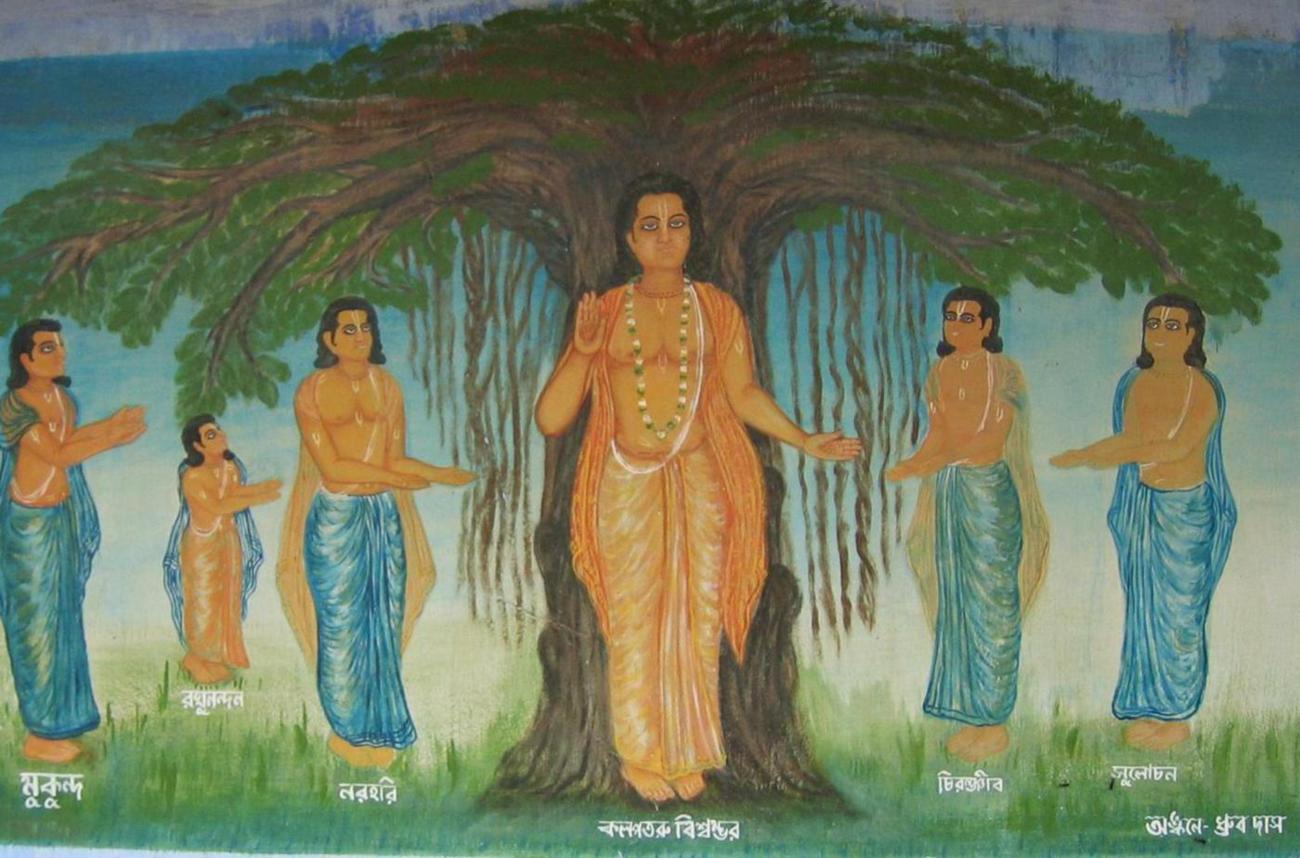
194-207 Malati, Chandralatika, Manjumedha, Varangada, Ratnavali, Kamala, Gunachuda, Sukesini, Karpura-manjari, Shyama-manjari, Shveta-manjari, Vilasa-manjari, Kamalekha, Mauna-manjari, Gandhonmada, Rasonmada, Chandrika, and Chandrashekhara, were among the maidservants of Shrimati Radharani. Assuming male forms they appeared among Lord Chaitanya's associates, and each displayed his particular kind of ecstatic love for the Lord. These gopis became Subhananda Dvija, Shridhara Brahmachari, Paramananda Gupta (who wrote the book Shri Krishna-stavavali), Raghunatha Dvija (who was an unalloyed servant of Lord Chaitanya), Kamsari Sena, Shri Jagannatha Sena Mahasaya, Subuddhi Mishra, Shriharsha, Raghu Mishra (who was the best of the brahmanas), Jitamitra (whose appropriate name, meaning 'conqueror of the enemies', was given by Lord Chaitanya because Jitamitra had completely subdued lust and the other five enemies of the conditioned soul), Shriman Bhagavatacharya (who was very dear to Lord Chaitanya, and who wrote the book Shri Krishna-prema-tarangini), Shriman Jiva Pandita (who was the saintly son of Shri Vallabha), Vaninatha Dvija (who lived in the village of Champahatta, and who was very dear to Lord Chaitanya), Ishanacharya, Kamala, Lakshminatha Pandita, Ganga-mantri, Jagannatha Mamu (who was a very elevated brahmana), Shrikanthabharana Ananta (who was born in the Chatta dynasty), Hastigopala (who lived in Rangakshetra, and who was very dear to Lord Chaitanya), Hari Acharya, Shrinayana Mishra (who was a close associate of Lord Chaitanya), Kavidatta, Ramadasa, Chiranjiva, and Sulochana respectively.
208. Someone may consider that among these Devotees some are greatly exalted and others are a little less. I will not make any such distinctions. For me all these great souls are equal.
209. Chiranjiva and Sulochana lived in the village of Shrihatta. They were completely surrendered to Lord Chaitanya, and because they were the friends and helpers of Narahari dasa they were honored and considered great souls.
210. The scriptures state: "A disciple should not address his spiritual master by name". For this reason I have not mentioned the previous name of my spiritual master, Shri Shrinatha Chakravarti.
211. All glories to Shri Krishnadeva of Kumara-hatta, the author of the commentary on Shri Bhagavata-samhita. His fame is always splendidly manifest.
212. If I have made any errors in describing the great souls mentioned in this book, I beg those great personalities to please forgive me. Neither Lord Brahma, Lord Shiva, nor Lord Ananta Shesha are able to describe completely the exalted virtues of those great souls.
213. I have written this book in such a way that the Mimamshakas, false logicians, and others who relish dry philosophical debate will not be able to understand it, even with the greatest endeavor. Only the Devotees, who are learned in the rasa-shastras, and who continually take shelter of Lord Chaitanya's lotus feet, will be able to understand this book properly. I have written this book for them.
214. I pray that this book I have written, the Shri Gaura-ganoddesha-dipika (a lamp to see the associates of Lord Chaitanya), may shine in the homes of the blissful Devotees of the Lord.
215. This book was written in the year 1498 of the Saka era (corresponding to 1576 A.D.). I pray that those great Devotees whose minds are immersed in the nectar of Lord Chaitanyachandra's pastimes may read this book critically and correct all its faults.
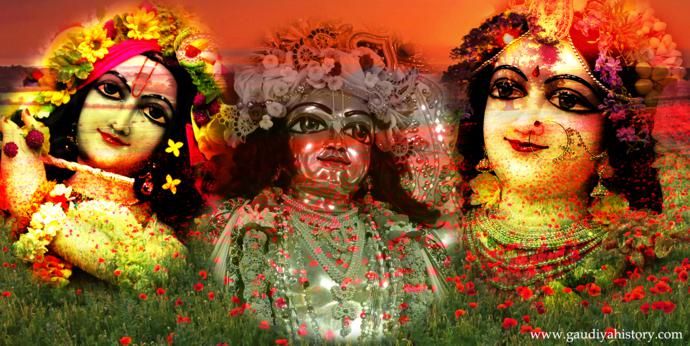
When Lord Vasudeva, the first member of the Catur-vyuha, saw the dancing of the Gandharvas at Dvaraka Puri, His mind became agitated with the desire to dance as they did. In order to fulfill this desire, Lord Vasudeva entered the transcendental body of Lord Caitanya, to participate in the Lord's pastimes of ecstatic dancing...The Supreme Personality of Godhead who remains at Dvaraka also entered the body of Lord Chaitanya, the son of Sachi-devi, and various other incarnations of the Supreme Lord also entered Lord Chaitanya's body, all of them present there at the same time... All these incarnations entered the body of Lord Chaitanya, just as the black incarnation Lord Shyama formerly entered the transcendental body of Lord Krishna, the Supreme Personality of Godhead...Although the various incarnations of the Lord, who all manifested inconceivable transcendental qualities, were situated in various parts of the spiritual and material worlds, nevertheless, by the power of the Lord's yogamaya energy, They all assembled together within the transcendental form of Lord Chaitanya Mahaprabhu. (In the wallpaper: in the middle Shri Gauranga Mahaprabhu, ISKCON Mayapur, Shri Shri Radha Gopinath, ISKCON Chowpatty, Mumbai).