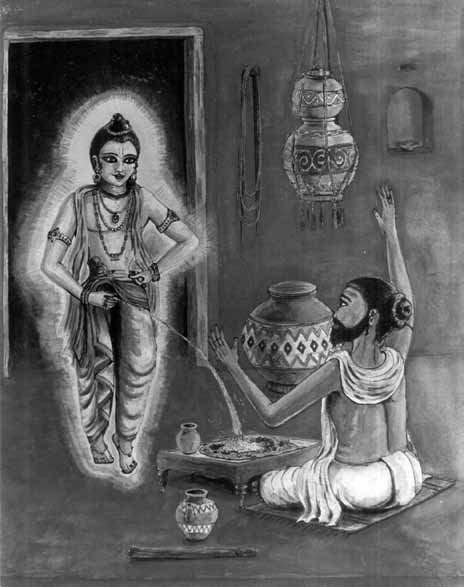
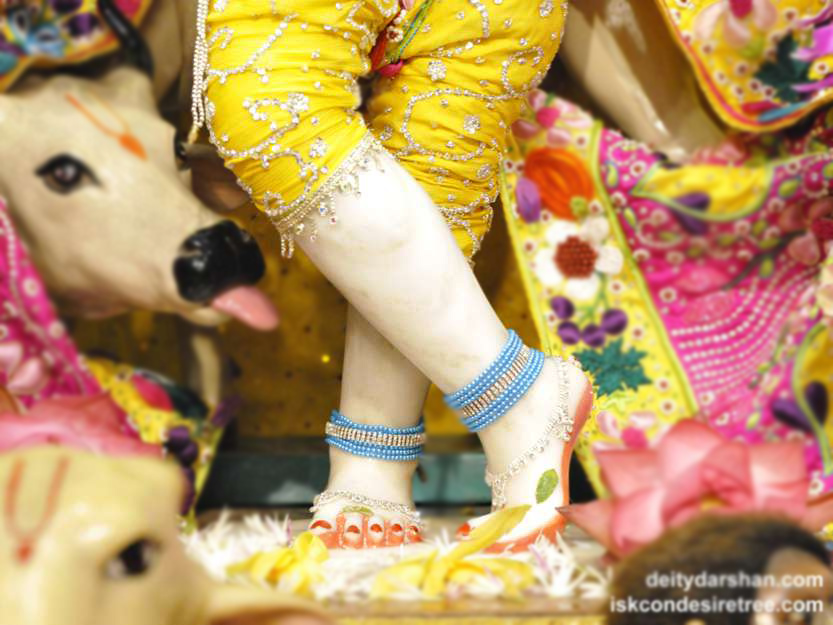
Author Archives: Sevak

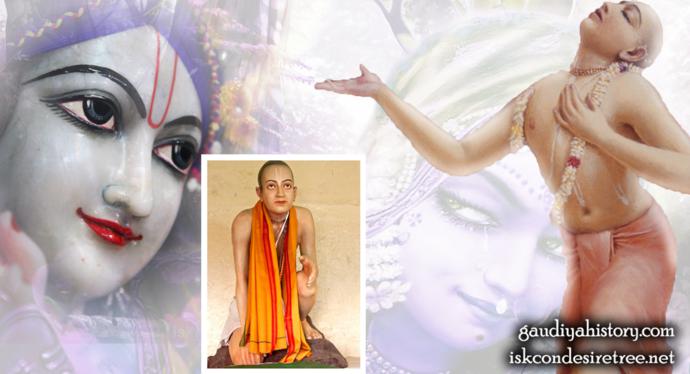
Bircandra Prabhu – Biography

Biracandra Prabhu

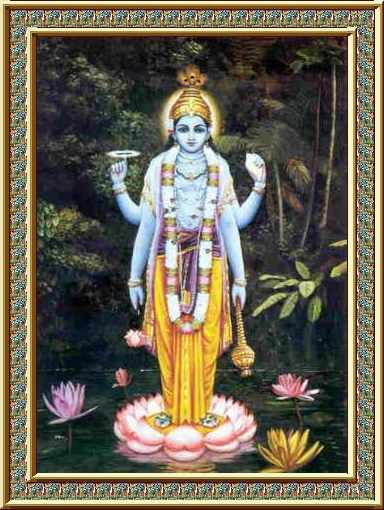
Birachandra Prabhu knew within Himself that He acted as the Supreme Lord Vishnu, but externally He was prideless.

   Srimad Birchandra or Birabhadra Prabhu took birth within this world on the ninth day of the dark moon in the month of Kartik.
 
   Sri Krishna Dasa Kaviraja Goswami writes (CC Adi 11.8-12): 
   "Sri Nityananda Prabhu is the topmost branch of the indestructible tree of eternal love of Godhead, Sri Chaitanya Mahaprabhu. From that branch grow many branches and sub-branches. After Nityananda Prabhu, the greatest branch is Birabhadra Goswami (Birchandra Prabhu) although Birabhadra Prabhu was the Supreme Personality of Godhead, He presented Himself as a great Devotee. And although the Supreme Godhead is transcendental to all Vedic injunctions, He strictly followed the Vedic rituals. He is the main pillar in the hall of devotional service erected by Sri Chaitanya Mahaprabhu. He knew within Himself that He acted as the Supreme Lord Vishnu, but externally He was prideless. It is by the glorious mercy of Sri Birchandra Prabhu that people all over the world now have the chance to chant the names of Chaitanya and Nityananda. I therefore take shelter of the lotus feet of Sri Birchandra Prabhu so that by His mercy my great desire to write Sri Chaitanya Charitamrita will be properly guided."
 
   In his Anubhashya commentary on Chaitanya Charitamrita, Sri Bhaktisiddhanta Saraswati Thakura describes the life of Birchandra Prabhu. He writes that Birchandra Prabhu, also known as Virabhadra Goswami was the son of Nityananda Prabhu and the disciple of Jahnava Mata. He was born from the womb of Sri Vasudha, Nityananda Prabhu's other wife. In the Gaura-Ganodesha-Dipika, he is mentioned as an incarnation of Kshirodakshayi Vishnu as follows:
 
sankarshanashya yo vyuha, payobdhishayi-namakah, 
sa eva virachandro'bhu-caitanya-abhinna vigraha
 
"Sri Sankarshan Deva expands Himself as Kshirodakshayi Vishnu. His avatara is Birchandra Prabhu. He is nondifferent from Sri Chaitanya Mahaprabhu, in that he is Vishnu-tattva, God Himself."
 
Biracandra Prabhu

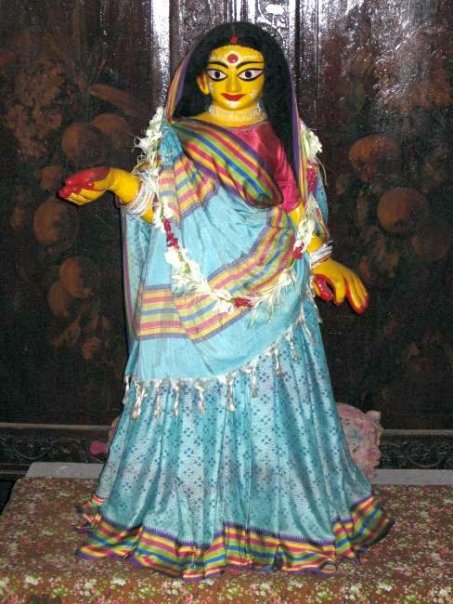
Srimati Jahnava Mata.

   In a village of the name Jhamatapura in the district of Hugali, Birchandra Prabhu had a disciple named Yadundanacharya, who had two daughters – his own daughter by birth, Srimati, and a foster daughter named Narayani. Both these daughters married Birchandra. The marriage of Birchandra Prabhu has been mentioned in the Bhakti Ratnakara of Sri Narahari Chakravarti Thakura as follows: 
 
   "Near Rajabol Hatta is Jhamatpura. Sri Jahnava Mata went there to the Temple of one of her disciples. There, lived the brahmana Yadunandana Acharya. By the mercy of Sri Jahanava Mata he was endowed with great devotion. Yadunandana had a wife named Lakshmi. It was said that she was a pure and highly religous wife. They had two daughters – Srimati and Narayani. Their bodily beauty was wonderful beyond compare. Upon the wish of Jahnava Mata that fortunate brahmana gave his two daughters to be wed to Birchandra Prabhu."
 
   Sri Yadunandana Acharya was a disciple of Birchandra Prabhu. Srimati and Narayani were given mantra initiation by Jahnava Mata. Sri Vasudha's daughter was Gangadevi. She was an avatar of Gangadevi herself. She was wed to Sri Madhava Acharya, who was an avatara of Shantanu Maharaja. The Mahabharata celebrates Shantanu Maharaja, the father of Bhishmadeva in Dwapara-yuga, as the husband of Gangadevi herself. Madhava Acharya was a great Devotee who was deep in Krishna-prema.
 
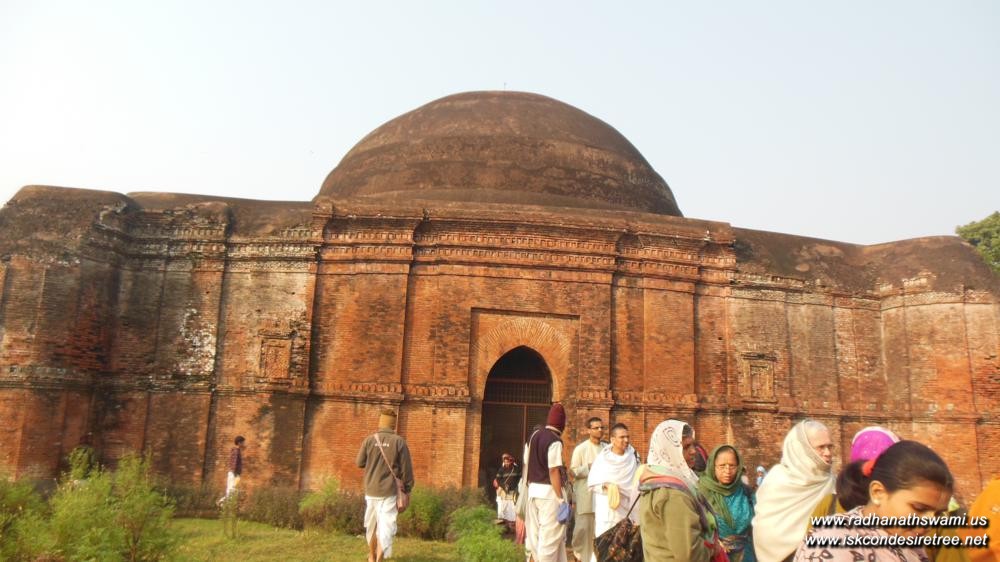
   On the order of his mother, Sri Birchandra Prabhu made a pilgrimage to Sri Vrindavana Dhama. First he visited the home of Uddharana Datta Thakura in Saptagrama. Uddharana Datta Thakura's son, Srinivasa Datta Thakura greeted Birchandra Prabhu with a respectful reception, and Birchandra Prabhu stayed there for two days. 
 
Biracandra Prabhu

...First he visited the home of Uddharana Datta Thakura in Saptagrama. (In the image: The gate to the ancient house of Uddharana Datta Thakur).

   From there, he went to Shantipura where he visited the house of Sri Advaita Acharya. Advaita Acharya's son Sri Krishna Mishra cordially welcomed Birchandra Prabhu with a full reception, and there was sankirtan, in which everyone was drowned by the sweet waves of the Holy Name. 
 
   From there, Birchandra Prabhu went to Ambika Kalna, where he visited the home of Sri Gauridasa Pandit. Sri Hridaya Chaitanya Prabhu met him there with great warmth and affection.
 
   From Ambika Kalna Birchandra Prabhu went to Navadwipa dhama to the house of Sri Jagannatha Mishra. Seeing the son of Nityananda Prabhu, all the followers of Sri Chaitanya who were present there were overjoyed, and welcomed him with great happiness. 
 
   There he stayed for two days, after which he traveled on to Sri Khanda. There he was met by Sri Raghunandana and Sri Kanai Thakura who received him affectionately and embraced him. 
 
   After staying there for some time, he continued on to Yajigrama to visit the house of Shrinivasa Acharya. With great devotion, Shrinivasa Acharya offered puja to Sri Birchandra Prabhu, knowing him to be the Supreme Personality of Godhead. There he stayed for some days, and there was a great sankirtan festival there. 
 
   After this, Birchandra Prabhu went on to Kanthak Nagara, near Katwa, where Mahaprabhu took sannyasa. 
 
   After staying there for a day, he continued on to Badhuri Gram, where he arrived at the house of Govinda Kaviraja. With great devotion, the advanced Vaishnava, Govinda Kaviraja gave him a respectful reception and worshiped him with puja. Being very please with his great devotion, Birchandra Prabhu stayed at his house for two days. 
 
   After this, he visited Kheturi Gram, the hometown of Narottama Thakura. This is all recorded in the Bhaktiratnakara: "To increase Sri Narottama Thakura's bliss beyond measure, That important branch of the Sri Chaitanya tree, Sri Birchandra Prabhu came to Kheturi Gram and danced in sankirtan. At that time, countless people came to see Sri Birchandra Prabhu, who is Vishnu Himself."
 
   After staying in Kheturi Gram for some days in a great festival of sankirtan, Birchandra Prabhu continued on his way to Vrindavana. By his influence, many sinners and atheists were delivered on the path. When he reached Vrindavana, being informed of his auspicious arrival, and wishing to welcome him as soon as he arrived, the important Devotees in Vrindavana waited for him on the road. These Devotees were all great souls, and included Sri Jiva Goswami, Srimad Krishna dasa Kaviraja Goswami, as well as Sri Ananta Acharya and Sri Hari Dasa Pandita, who were Sri Gadadhara Pandit's disciples and the pujaris of the Deity of Sri Madana-Mohan. Sri Krishna Dasa Brahmachari, Sri Gopinatha Adhikari, and Sri Madhu Pandita were also there, as was the pujari of Sri Gopinatha, Bhavananda. Kashishvara and his disciples Sri Govinda Goswami (the pujari of Sri Govinda in Vrindavana) and Sri Yadava Acharya were also there as well as many others.
 
   Bhakti Ratnakara says, "Everyone came out to see Birchandra Prabhu, and all the residents of Vrindavana were delighted to take His darshan. There was no one who was not overwhelmed by the seeing the manner of ecstatic bhakti exhibited by Birchandra Prabhu. He sang of the superlative qualities of Vrindavana and all the Vaishnavas there. After this he visited the Deities of Sri Govinda, Sri Gopinatha, and Sri Madana Mohana and took darshan of their holy forms." 
Biracandra Prabhu

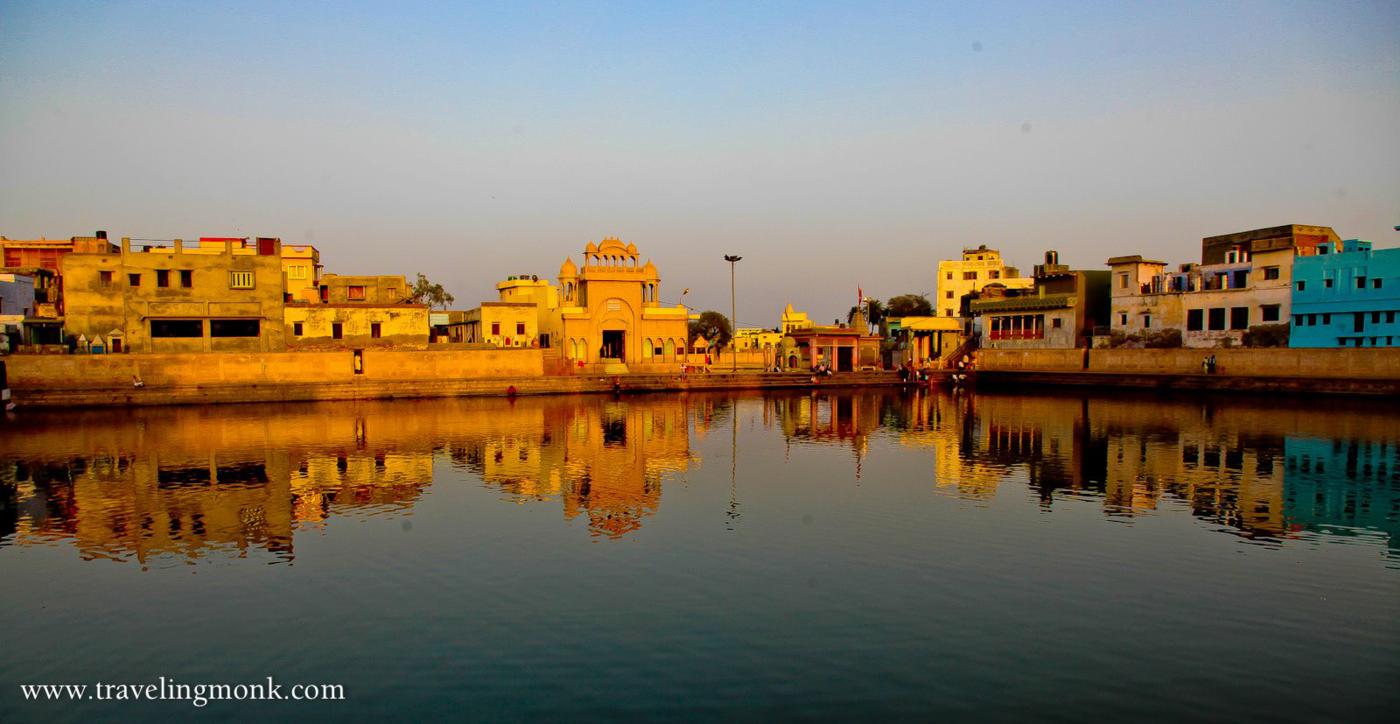
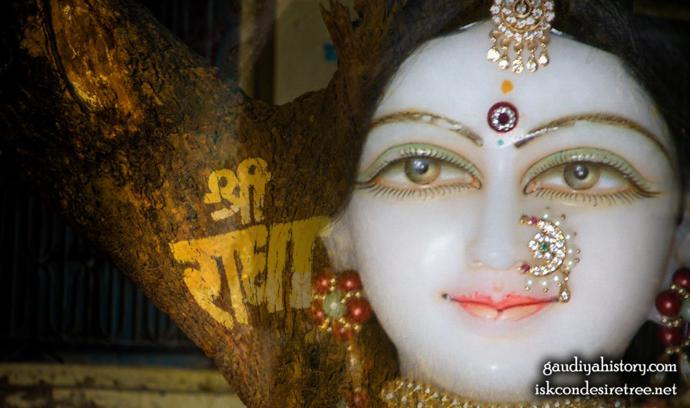
...Birchandra Prabhu wandered throughout the forests of Vrindavana on an extensive pilgrimage. He saw the twelve forests of Vrindavana, Radha Kunda, Shyama Kunda, and Govardhana Hill. (In the image: Radha Kund).

 
    After this, on the order of Sri Jiva Goswami and Sri Bhugarbha Goswami, Birchandra Prabhu wandered throughout the forests of Vrindavana on an extensive pilgrimage. He saw the twelve forests of Vrindavana, Radha Kunda, Shyama Kunda, and Govardhana Hill. And as he saw these things, he exhibited amazing and wonderful manifestations of divine love. All the residents of Vrindavana were enchanted by seeing these demonstrations of ecstasy in Krishna-bhakti. 
 
   In this way, after gradually visiting all the important holy places in Vrindavana, Sri Birchandra Prabhu returned to Gaudadesha. After these wonderful expressions of divine love by Birchandra Prabhu, his fame was preached far and wide. His divine opulences were nondifferent from those of Nityananda Prabhu.
 
   Srila Bhaktisiddhanta Saratswati Thakura, in his Anubhasya commentary, writes that Birchandra Prabhu had three disciples who are regarded as his sons – Gopijana-vallabha, Ramakrishna, and Ramachandra. The youngest, Ramachandra, belonged to the Sandilya dynasty and had the surname Varavyala. He established his family at Khoradoha, and its members are known as the goswamis of Khoradoha. His eldest disciple, Gopijana-vallabha, was a resident of a village known as Lata near the Manakara railway station in the district of Burdwan. The second, Ramakrishna, lived near Malda in a village named Gayeshpura. 
 
   Srila Bhaktisiddhanta Saraswati Thakura notes that since these three disciples belonged to different dynasties and also had different surnames and lived in different places, it is not possible to accept them as real sons of Virachandra Prabhu.
 
   Birchandra Prabhu's youngest disciple, Ramachandra had four sons, of whom the eldest was Radha-Madhava, whose third son was named Yadavendra. Yadavendra's son was Nandakirshora, his son was Nidhikrishna, his son was Chaitanyachand, his son was Krishna Mohan, his son was Jaganmohana, his son was Vrajanatha, and his son was Shyamalal Goswami. 

Bhugarbha Goswami

   Just as there is very little mentioned in the scriptures about the life of Srila Lokanatha Goswami, in the same way, there is little written about his dear friend Srila Bhugarbha Goswami. Srila Lokanatha and Sri Bhugarbha Goswami were of one heart and mind. On the order of Chaitanya Mahaprabhu they went to live in Vrindavana. Bhugarbha Goswami was a disciple of Gadadhara Pandita. Among his disciples were Sri Govindadeva's pujari Chaitanya Dasa, as well as Mukundananda Chakravarti, Premi Krishnadasa and others.
 
Sri Krishnadasa Kaviraja Goswami writes: "The eleventh branch of Gadadhara Goswami was Bhugarbha Goswami and the twelfth was Bhagavata Dasa. Both of them went to Vrindavana and resided there for life." 
 
   Sri Kavikarnapura writes in his Gaura-ganodesa-dipika that Bhugarbha Goswami was formerly the gopi named Prema Manjari in Vrindavana. While in Vrindavana, Bhugarbha Goswami passed away and entered into the unmanifest pastimes of the Lord on the fourteenth day of the full moon in the month of Kartika. 
 
   Lokanatha Goswami and Bhugarbha Goswami lived together in Vrindavana as one. Srila Narahari Cakravarti Thakura writes about them in his Bhakti-ratnakara: "Bhugarbha Goswami and Lokanatha Goswami were world-preachers; they were so close and affectionate to one another that they were like one body." 
Bhugarbha Goswami

Samadhi of Srila Bhugarbha Goswami, Vrindavan.

 
   In Vrindavana, Bhugarbha Goswami and Lokanatha Goswami were regarded as among the principle Goswamis, as they were senior by age and experience to many. The foremost among the subsequent followers of Rupa Goswami, Narottama Dasa Thakura, writes about Bhugarbha Goswami, with whom he had much affectionate association: "O Hari! Why am I addicted to this abominable path of karma? I didn't worship Radha-Krishna in Vraja even one iota, nor could I understand the position of spontaneous devotion – raga-marga. Svarupa Damodara, Sanatana Goswami, Raghunatha Bhatta, Raghunatha dasa, Gopala Bhatta Goswami, Bhugarbha Goswami, Jiva Goswami, and Lokanatha Goswami – I never offered a drop of service to their lotus feet. How then shall I attain the goal of life? 
 
   Krishnadasa Kaviraja is among the most exalted rasika-bhaktas, Devotees whose sole interest is in relishing the mellows of devotion to Radha-Govinda and Mahaprabhu. He compiled the Chaitanya-Charitamrita which describes the pastimes of Sri Chaitanya and the Govinda-lilamrita, describing the pastimes of Radha-Krishna. Hearing the pastimes of Gaura-Govinda would melt even stone, but it had no effect on my consciousness. Not only have I failed to take advantage of the association of all these great souls, but I have also neglected their associates and followers. What a sad story my life has become. My life and birth are all useless. Shame on me. Alas, alas. Thus laments Narottama Dasa."

Raghava Pandit

   Shri Raghava Pandit  was exclusively devoted to Shri Gauransundara and was very dear to Him.  Shriman Kavi Karnapura notes in his Gaura Ganodesha Dipika:  “That person who was once the dear gopi friend of Radharani and whose name was Dhanishta later appeared as Shri Raghava Pandit and later lived at Govardhan where he worshiped a Deity of Giridhari in great ecstasy. The gopi Dhanishta,  is always engaged in preparing foods for Shri Krishna.
 
   The gopi named Gunamala appeared as Raghava Pandit’s sister Damayanti. On the East Bengal railway line beginning from the Sealdah station in Calcutta, there is a station named Sodapura, which is not very far from Calcutta. Within one mile of this station, toward the western side of the Ganges, is a village known as Panihati, in which the residential quarters of Raghava Pandit still exist. On Raghava Pandit’s tomb is a creeper on a concrete platform. There is also a Madana-Mohana Deity in a broken-down Temple nearby. This Temple is managed by a local zamindar of the name Shri Shivachandra Roya Chaudhuri. – Ref CC Adi lila 10.25
 
   The foods Damayanti cooked for Lord Chaitanya when He was at Puri were carried in bags by her brother Raghava without the knowledge of others.
 
   The Lord accepted these foods throughout the entire year. Those bags are still celebrated as raghavera jhali (“the bags of Raghava Pandit”).
 
   Krishna Das Kaviraj describes the contents of the bags of Raghava Pandit in his book Chaitanya Charitamrta. Hearing this narration, Devotees generally cry, and tears glide down from their eyes. 
Raghava Pandit

The foods Damayanti cooked for Lord Chaitanya when He was at Puri were carried in bags by her brother Raghava without the knowledge of others. The Lord accepted these foods throughout the entire year. Those bags are still celebrated as raghavera jhali (“the bags of Raghava Pandit”). (In the wallpaper: Shri Vijaya Gauranga, ISKCON Hungary, New Vraja Dham).

Sita Thakurani – Biography 3

Sita Thakurani

Sita Thakurani, Shri Vrindavan dham.

   Shri Advaita Acharya, the effective cause for the appearance of Shri Chaitanya Mahaprabhu in our world, had two consorts; one was named Shri, the other Sita. Shri Sita Thakurani was the daughter of Shri Nrishinga Bhaduri. She was married to Shri Advaita Acharya in Phuliya Nagar. After their wedding, Advaita Acharya went to Nadia to live in Shantipura. He was an intimate friend of Shri Chaitanya’s father Shri Jagannatha Mishra and naturally, Sita Thakura and Sachi Mata were like sisters.
 
   On the eve of his son's advent Shri Jagannatha Mishra, seeing the imminent signs of his child's arrival, sent word to Advaita Acharya in Shantipura. Hearing news of the advent of this unprecedented child, Advaita Acharya was ecstatic. With Shri Haridasa Thakur, he went to bathe in the Ganga, and after a long session of kirtan and dancing, he sent his wife to go quickly to Mayapura in Navadwip.
 
   According to Gaura-Ganodesha-Dipika, Shri Sita Thakurani is Yogamaya. The Gaura-Parshada-Charitvali says that in Krishna Lila, she was Purnamasi, the mother of Sandipani Muni, grandmother of Madhumangal and Nandimukhi and a disciple of Narada Muni. In Dvapara-yuga, during the celebration of Krishna's birth ceremony, she was present in the house of Nanda, and at that time gave Nanda and Yashoda many instructions on how to care for the child.
 
   The Chaitanya-Charitamrita gives the following account of Sita Thakurani's visit to the house of Jagannatha Mishra after the birth of the Lord: "One day, shortly after Shri Chaitanya Mahaprabhu was born, Advaita Acharya's wife, Sita Devi, went to see that divine child with all kinds of gifts and presents. She brought different kinds of golden ornaments, including bangles for the hand, armlets, necklaces and anklets. 
 
   When Sita Thakurani came to the house of Sachi Devi, bringing with her many kinds of eatables, dresses, and other gifts, she was amazed to see the newly born child, and she could surmise that the child was directly Krishna of Gokula Himself. 
Sita Thakurani

When Sita Thakurani came to the house of Sachi Devi, bringing with her many kinds of eatables, dresses, and other gifts, she was amazed to see the newly born child, and she could surmise that the child was directly Krishna of Gokula Himself. (In the wallpaper: in the left Shri Gopinath, ISKCON Chowpatty, gifts, in the right Shri Krishna Chaitanya, ISKCON Chennai).

 
   She blessed the newly born child by placing fresh grass and paddy on His head saying, "May You be blessed with a long span of life." Being aware of Sachi Mata’s previous tragic history of miscarriages, she gave the child the name Nimai (one who was born under a Neem tree).
 
   On the day that the mother and son took the cleansing bath and left the maternity room, Sita Thakurani gave them all kinds of ornaments and garments and then also honoured Jagannatha Mishra. From that day on, Sita Thakurani would often come to Mayapura from Shantipura, in order to assist Sachi Mata in caring for the new baby. She would give her many different instructions on how to raise children. And after helping with the child in this way, she would return to Shantipura. When it came time for the child's birthday ceremony, Jagannatha Mishra and Sachi Devi let the worshipable Sita Thakurani be the first to offer the child His new clothes.
 
   Advaita Acharya Prabhu also had a house in Navadwipa. He would live from time to time and discuss spiritual topics with the Devotees headed by Shrivasa Pandit and Shri Vishvarupa, Nimai’s older brother, relishing hari katha until the early hours of dawn.
 
   Sita Thakurani and Sachi Devi were of one mind; the baby Nimai was their life and soul. Every day Sita Thakurani would go to the house of Sachi Mata and help her with the care and nurturing of the boy. After several years, when Jagannatha Mishra's son Vishvarupa suddenly took sanyasa and left home, Advaita Acharya and Sita Thakurani consoled Jagannatha Mishra and Sachi Mata and Sita Thakurani helped take care of Nimai, who was just a young boy then, and was also greatly affected by the departure of His brother and the heart-broken condition of His parents.
 
   Later on, when Nimai went to Gaya and met His Guru Shri Ishwar Puri and upon returning, gradually revealed His real mission by gathering all the Devotees at Shrivasa Angan for kirtan, at that time, Advaita Acharya and Sita Thakurani would come from Shantipura to Mayapura, and would be among the first to worship the lotus feet of Shri Chaitanya.
 
   Eventually, when Mahaprabhu also took sanyasa and left home, Sita Thakurani spent four days with a disconsolate Sachi Devi and Vishnupriya, plunged in a sea of sorrow.
 
   Shri Chaitanya Mahaprabhu, after accepting sanyas started off for Vrindavan, but was unable to go there. He was drawn to return to Shantipura. When He arrived in Shantipura, Advaita Acharya and Sita Thakurani felt as if their life has returned. After having fasted for four days, Shri Gaurasundara accepted Prasad cooked by Sita Thakurani.
 
   Before taking sanyasa also, Shri Chaitanya Mahaprabhu along with Nityananda Prabhu would, from time to time go to the house of Advaita Acharya in Shantipura, where they would have a festival and perform naam sankirtan all day and night.
 
   After Mahaprabhu took sanyasa and went to live in Jagannatha Puri, Shri Advaita Acharya and Sita Thakurani used to visit Him each year, bringing their son Achyutananda with them. On one such occasion, Sita Thakurani prepared some of the Lord's favorite preparations for Him and invited Him to their home to take lunch. Simply to increase their ecstasy, the Lord, who was always absorbed in Krishna Nama, honoured their invitation and took lunch in the home of Advaita and Sita.
 
   Sita Thakurani was always overwhelmed with vatsalya-prema and treated Shri Chaitanya as affectionately as if He were her own son. The Lord also treated her with the same kind of regard and affection that He had for Sachi Mata.
 
   Shri Sita Thakurani bore three sons, Achyutananda, Krishna Mishra and Gopala Mishra, who were all followers of Shri Chaitanya Mahaprabhu. Thus, she was an inspiration for spreading the mission of the sankirtana movement.
 
   According to the Prema-vilasa of Nityananda Das, Sita Thakurani had a woman disciple called Jangali. Nityananda-vamsa-vistara relates an account in which Virabhadra Prabhu, the son of Nityananda and Vasudha, once saught shelter of Sita Thakurani, desiring to become her disciple, but she sent him back home to take shelter of Jahnava Thakurani, his step-mother, the other wife of Prabhu Nityananda.
 
   Along with Sachi Mata, Vishnupriya Devi and Malini Thakurani, Shri Sita Thakurani forms the quartet of leading women Vaishnava Devotees of Shri Gauranga who supported and gave impetus to the mission of Mahaprabhu during His lifetime.
 
http://www.Shrigaurangashram.in 
Sita Thakurani

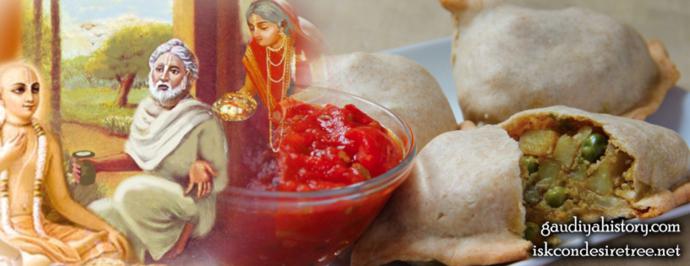
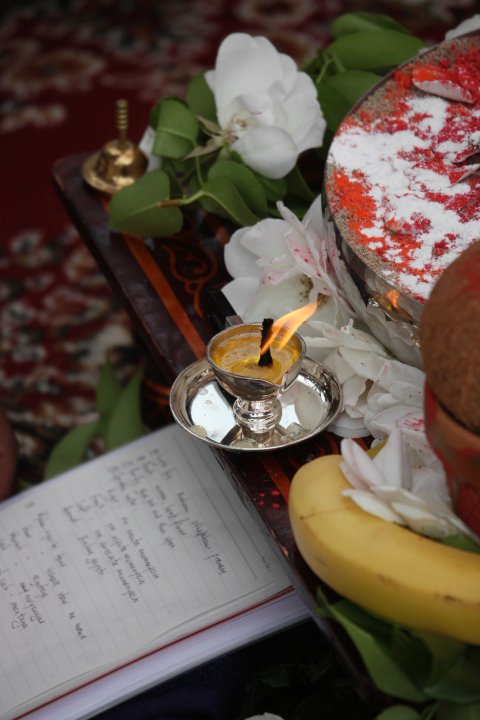
Sita Thakurani prepared some of the Lord's favorite preparations for Him and invited Him to their home to take lunch. Simply to increase their ecstasy, the Lord, who was always absorbed in Krishna Nama, honoured their invitation and took lunch in the home of Advaita and Sita. (In the wallpaper: from left to right Lord Chaitanya, Advaita Acharya, Sita Thakurani, Prasadam).

Rupa Goswami – Biography 2

   Shrila Rupa Goswami has been attributed with the honor of being the person who realized the mano-‘bhistam, the innermost heart’s desire, of Shri Krishna Chaitanya Mahaprabhu. 
Rupa Goswami

Shrila Rupa Goswami has been attributed with the honor of being the person who realized the mano-‘bhistam, the innermost heart’s desire, of Shri Krishna Chaitanya Mahaprabhu. (In the wallpaper: from left to right: Shri Gopinath, ISKCON Chowpatty, Deity of Rupa Goswami, Shri Vrindavan Dham, Shrimati Radharani and Shri Krishna Chaitanya).

 
   Shrila Rupa Goswami, the foremost of the six Goswamis of Vrindavan, was an incarnation of Rupa Manjari, the most important of the eight confidential maidservants of Shrimati Radharani in the eternal spiritual Vrindavan.
 
   It is said that without taking shelter of Shrila Rupa Goswami one cannot enter into the pastimes of Lord Chaitanya, and without taking shelter of Rupa Manjari one cannot enter into the confidential loving pastimes of Shri Shri Radha Krishna.
 
   Shrila Rupa Goswami’s lineage can be traced back to Karnataka, South India where his Saraswata brahmana descendants held influential positions. Shrila Rupa Goswami's nephew, Jiva Goswami has explained in his Laghu Toshani that Rupa's descendants were of the Bharadvaja gotra and were learned in the Yajur Veda.
 
   A brahmana called Sarvajna was seventh in the ascending geneological line of Rupa Goswami and was known by the title 'jagadguru'. He was a king as well as a learned scholar. His son, Aniruddha was also an acclaimed scholar. Aniruddha had two sons, Harihara and Rupeshvara. While Rupeshvara was knowledgable in the Vedic literatures, his brother became expert in weaponry and politics.
 
   When their father died, the kingdom was divided between the two sons. However, Harihara seized Rupeshvara's land by force and forced the family to migrate to Paurastyadesha. Rupeshvara's son, Padmanabha was spiritually and materially very successful. Padmanabha relocated his family to Nabahatta (Naihati) on the banks of the Ganges River. Padmanabha had eighteen daughters and five sons, the youngest son being Mukunda.
 
   In the course of time, Mukunda's son, Kumaradeva, moved to Jessore. His sons were Santosha (Rupa), Amara (Sanatana) and Shrivallabha (Anupama). On the demise of Kumaradeva, the three sons moved to Sakurma, near the capital of Gaudadesha (Bengal) where they continued their studies.
 
   The three brothers studied the Nyaya-shastras (treatise on rhetoric) from the famous logician Vasudeva Sarvabhauma Bhattacharya and his brother Madhusudana Vidyavachaspati. They also studied Sanskrit, Arabic and Persian.
 
   Due to their noble characters and academic proficiency, Rupa and his elder brother Sanatana were later forced into government service by the Sultan of Bengal, Alauddin Hussein Shah (1493-1519) which led to their excommunication from Hindu society by the orthodox caste brahmanas of Gauda. Rupa became the Sultan's chief secretary (dabir khas), while Sanatana became the state revenue minister (sakara mallika).
 
   Rupa and his brothers made their residence at the state capital of Ramakeli and it was here, in 1514, that they met Shri Chaitanya Mahaprabhu for the first time. At that time all three brothers were employed as important ministers in the Mohammedan government of Bengal under Hussain Shah.
 
   Approaching the Lord humbly they prayed to Him to somehow rescue them for their bonded state. Lord Chaitanya assured them that now they had surrendered to Krishna, they would soon be delivered and would be able to join His sankirtana movement. 
Rupa Goswami

Rupa and Anupama immediately decided to go and they wrote a letter to Sanatana telling him of their plans and asking him to join them in Vrindavan. They also told him that they had left 10,000 gold coins in case he was in need of financial help. Later, when Sanatana was thrown into prison by the Sultan for disobedience, he used this money to bribe the jailer and escaped to Varanasi to meet there with Chaitanya Mahaprabhu. (In the image: The jail where Sanatana Goswami was kept, Ram Keli).

 
   After some months both Rupa and Anupama were freed from service. Rupa loaded all his wealth onto two boats and left with his brother Anupama for their ancestral home at Fatiabad in Jessore, where they distributed it. They then sent two messengers to Puri in Orissa to get news of Chaitanya Mahaprabhu's plans. The messengers returned with the news that Mahaprabhu had already left Puri for Vrindavan.
 
   Rupa and Anupama immediately decided to go and they wrote a letter to Sanatana telling him of their plans and asking him to join them in Vrindavan. They also told him that they had left 10,000 gold coins in case he was in need of financial help. Later, when Sanatana was thrown into prison by the Sultan for disobedience, he used this money to bribe the jailer and escaped to Varanasi to meet there with Chaitanya Mahaprabhu.
 
   On his return trip from Vrindavan, Chaitanya stopped at the holy city of Prayaga (Allahabad). It was here that Rupa and Anupama met him for the second time. At the historic Dasasvamedha Ghat, Sri Chaitanya imparted confidential instructions to Rupa Goswami and explained in detail all the fundamental principles of the doctrine of Gaudiya Vaishnavism.
 
   Rupa Goswami was specifically commanded by Chaitanya Mahaprabhu to carry out two tasks: (1) to find and establish the lost ancient and original Deities of Lord Krishna as well as to re-discover and restore the holy places associated with His leela in Vrindavan, and (2) to write and preach Gaudiya Vaishnava theology. He then sent Rupa Goswami to Vrindavan to carry out these tasks.
 
   Rupa Goswami first arrived in Vrindavan along with his elder brother Sanatana Goswami in the year 1516, after receiving the direct order of Lord Chaitanya. Through his writings Shrila Rupa Goswami chalked out the perfect spiritual path for all the followers of Lord Chaitanya down through the ages.
 
   It was Rupa Goswami who more than anyone else, firmly established the sankirtana movement of Lord Chaitanya. He wrote a large number of important books on the science of bhakti-yoga and after the disappearance of Lord Chaitanya in 1534, Rupa became the undisputed leader of all the Gaudiya Vaishnavas in the world.
 
   Even today all Gaudiya Vaishnavas are known as Rupanugas, or followers of Shrila Rupa Goswami.
 
   After spending some time in Vrindavan, Rupa and Anupama left to visit Lord Chaitanya in Puri. It is believed that on this long and arduous journey Anupama left his body. On his way to Puri, Rupa Goswami started to write a drama about Lord Krishna's pastimes in Vrindavan and Dwaraka.
 
   On arrival at a village named Satyabhamapur in Orissa, he had a dream wherein a beautiful woman appeared before him and asked him to write a separate drama about her. When Rupa awoke the next morning he realized that she was Lord Krishna's most possessive queen, Satyabhama, and decided to write a separate drama about the Lord’s Dwaraka leela.
 
   On Rupa's arrival at Jagganatha Puri, he met Lord Chaitanya and showed the Lord the outline of his two dramas. The Lord confirmed that writing two dramas mixing the lilas of Vrindavan and Dwaraka was not proper as their was a vast difference between them. In Vrindavan the Lord enjoys the parakiya-rasa, where as in Dwaraka He enjoys the Swakiya-rasa.
 
   Lord Chaitanya as well as Ramananda Rai were delighted to read the early drafts of these two dramas, which were eventually called Vidagdha Madhava and Lalita Madhava respectively. These two works are considered by Gaudiya Vaishnavas to be the most important dramatic literatures in the Sanskrit language.
 
   Rupa Goswami stayed ten months in Puri and received further instructions on devotional service from Lord Chaitanya. The Lord then asked Rupa to return to Vrindavan and complete the task of rediscovering the lost holy places of Lord Krishna's pastimes.
 
   On returning to Vrindavan, Rupa Goswami discovered at Brahma Kunda the Deity of Vrinda Devi, from who the town of Vrindavan gets its name, this Deity was later moved to Kamyavana. Rupa Goswami then discovered the famous Govindev ji Deity and immediately established Lord Govindaji's worship on a grand scale. 
 
   On hearing the good news of Rupa's progress, Lord Chaitanya sent some of his best men to assist Rupa in serving the Deity of Govindaji and establishing the Lord's mission in Vrindavan.
 
   Shortly Rupa and Sanatana Goswamis were joined by Ragunatha dasa Goswami, Gopal Bhatta Goswami, Raghunatha Bhatta Goswami and Shrila Jiva Goswami. These great personalities become famous as the six Goswamis of Vrindavan. Jiva Goswami, who was the son of Rupa's brother Anupama, became the most important disciple of Rupa Goswami. 
 
   http://www.srigaurangashram.in 
Rupa Goswami

On returning to Vrindavan, Rupa Goswami discovered at Brahma Kunda the Deity of Vrinda Devi, from who the town of Vrindavan gets its name, this Deity was later moved to Kamyavana. (In the wallpaper: A tree in Vrindavan Dham, Shrimati Vrinda Devi, Kamyavan).

Basudev Bipra

Basudev Bipra

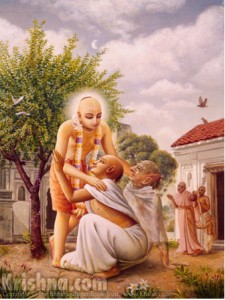
Fast as lightning, He reached that place where Basudev was lying on the ground, sobbing in disappointment. Lifting him up with both His arms, Mahaprabhu locked Basudev in a tight embrance.

   Mahaprabhu had just started on his pilgrimage to the South from Nilachal. On the way He came to a holy place called Kurmasthan. He spent a whole day there, singing and dancing in ecstasy, the entire populace joining Him in singing the Lord’s name.

   Next morning, He left the place and proceeded onward on his pada-yatra. Immediately after His departure, a Brahmin named Basudev Bipra came there to see the Lord.

   Basudev was a very devout man, but was afflicted with leprosy. But he was totally oblivious of his condition, as he used to be absorbed in his devotion to God and his faith was very strong. His body was of no concern to him although it was full of sores that were seeping and infested with maggots.

   The worms were his only companions, as the foul odour from his body kept people far away from him.

   If one of the maggots would fall off his body, he would carefully pick it up and place it back on his body.

   One night he heard that the Lord Himself had come in the guise of a sannyasi, singing the Lord’s name and roaming from place to place. Desperate to have a glimpse of the Lord, Basudev Bipra started moving towards Kurmasthan.

   Feeble and ill, his progress was slow, as he sometimes walked, sometimes sat and sometimes crawled towards his destination.

   By the time he arrived Mahaprabhu had already left that place. On finding Him gone, Basudev wept “O Lord, I could not get your darshan!” In the agony of his despair, he fainted. 

Basudev Bipra

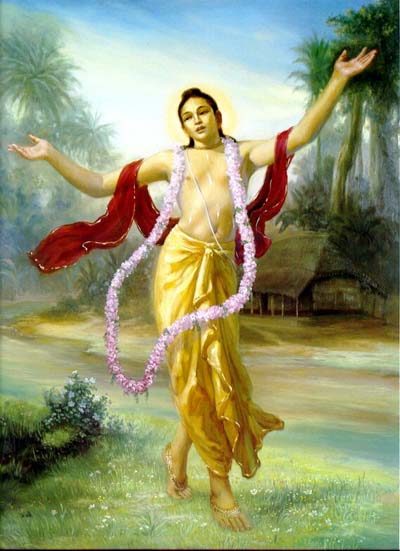
One night he heard that the Lord Himself had come in the guise of a sannyasi, singing the Lord’s name and roaming from place to place. Desperate to have a glimpse of the Lord, Basudev Bipra started moving towards Kurmasthan. (In the image: Lord Chaitanya).

   At that very moment, somewhere on the road, Mahaprabhu stopped in his tracks, as if He was carefully hearing something. “I am coming” He said and turned around and started back towards Kurmasthan.

   Fast as lightning, He reached that place where Basudev was lying on the ground, sobbing in disappointment. Lifting him up with both His arms, Mahaprabhu locked Basudev in a tight embrance.

   On the Lord’s divine touch, Basudev’s leprosy was immediately cured and he was released from all bondage. Basudev found that his body had been transformed into a lustrous golden colour, with no trace of his disease!

   Falling at the feet of Mahaprabhu, he wept, “Lord of Mercy, what have you done. No one dares to come close to me and you have held me close to your heart, which is the residence of Sri Lakshmi!! Only the Supreme God is capable of such action, as both the deserving and undeserving are both dear to You. But now, I am in anxiety. As long as I was an untouchable my mind was free of pride, which is why I could attain You. But now that I have got a beautiful body, I am afraid that I will not remain humble anymore. Once pride enters my mind, then I will lose You.”

   Hearing these words of Basudev, Mahaprabhu’s heart melted and tears streamed down his eyes. He thought, “Today Basudev has defeated me.”

   He addressed Basudev, “A Devotee like you will never be overtaken by arrogance. Your duty now is to serve the people of Utkal with devotion, bringing them close to God. Your life should be a seva yagya.” Saying this, He departed.

Basudev Bipra was a physician by profession. Thus directed by Mahaprabhu, he spent the rest of his life bringing succour to the sick and needy in Orissa.

http://www.srigaurangashram.in

p

SHYAMANANDA PRABHU – Biography

   Gouridas was born at Shaligram, about 18 kms from Shridham Navadwip in Bengal.  His father was Kansari Mishra, mother Kamala Devi.  Suryadas was his elder brother.  Suryadas had two daughters, Vasudha and Jahnavi.
 
   Suryadas was a boyhood companion of Shri Chaitanya MahaPrabhu.  He was a sadhaka in the sakhya bhava, i.e., in the mood of friendship with God.
 
   He told Gouridas, “Go and live at Ambika-Kalna and do your sadhana and worship at a lovely place near the river Ganga.”  What could have been more close to the heart of Gouridas?  Joyfully, he left for Ambika-Kalna.
 
   One day Shri Gauranga was returning from Shantipur.  He took a boat at Harinadi village. Pulling the oars with His own hands, He crossed the wide Ganga and arrived at Ambika.  But He did not leave the oar behind. Carrying it in His hands, He went to Gouridas’ house. Gouridas was astonished.  MahaPrabhu said, “This oar is for you.”
 
   “What shall I do with it?”
 
   “What shall you do? You shall take people across the samsar-river with the help of this oar” said the Lord.
 
   With profound reverence Gouridas accepted the oar with folded hands.  MahaPrabhu embraced him and said, “Come with Me to Navadwip. I shall give you something there.”
 
   Gouridas became full of bliss with the Lord’s embrace. He could not comprehend what more than this could be there. What as the thing that lay beyond imagination even?
 
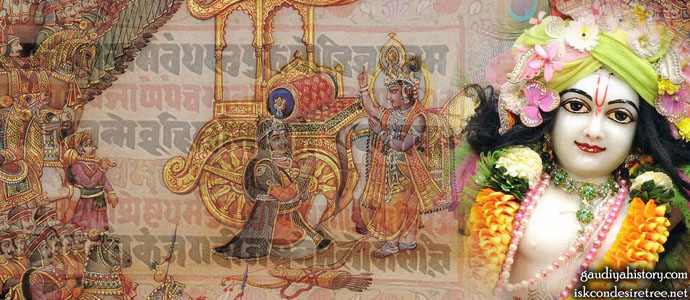
   Indeed, there was something truly beyond imagination. The Lord handed over to Gouridas the Bhagawat Gita written with His own hand. From beginning to end it was written with pearl-like letters.  The nectar of his unblinking eyes was saturated in it. It was sheer bliss just to look at the writing, to hold it in one’s hand. It was a joy flowing from the absorption of consciousness.
 
   Holding the Gita close to his heart, Gouridas returned to Ambika going over the entire transcendental experience in his mind. “How painstakingly must He (Gauranga) have written it with His own hands, and yet He gave it to me so unhesitatingly” he mused. 
Shyamananda Prabhu

Indeed, there was something truly beyond imagination. The Lord handed over to Gouridas the Bhagawat Gita written with His own hand. From beginning to end it was written with pearl-like letters. The nectar of his unblinking eyes was saturated in it. It was sheer bliss just to look at the writing, to hold it in one’s hand. It was a joy flowing from the absorption of consciousness. (In the wallpaper: Arjuna and Shri Krishna in the battle field, Lord Shri Gaurachandra, ISKCON Chowpatty, Mumbai).

 
   What meditation and worship would Gouridas do? He was absorbed in the experience and shedding tears. What divine love, what leela?  Gouridas could not fathom its vastness.
 
   When the Lord came to Shantipur after His sannyas, Gouridas did not go to see Him because of his deep sorrow on MahaPrabhu’s taking sannyas. If Prabhu renounces the world in this way, how can we live then, he thought. With what shall we continue to live?
 
   But the Lord cannot stay away from His true Devotees.  When MahaPrabhu came to Shantipur He Himself went to Gouridas’ house alongwith Nityananda Prabhu. Gouridas wept and said, “I will not let You go again. Both of You stay here as my permanent captives. I shall serve You to my heart’s content.”
 
   Gauranga smiled and said, “Do one thing.  You can serve Our images.”
   Gouridas: “Will the images be alive?”
   MahaPrabhu: “Surely”
   Gouridas: “Can they sit in a squatting position?”
   MahaPrabhu: “Yes, of course”
   Gouridas: “Will they be able to take rice with their own hands?”
   MahaPrabhu: “Yes, certainly. Now you go and bring a neem tree from Navadwip and carve out images of Us two brothers from the wood. We will surely fulfill your wish.”
 
   Gouridas wiped his tears. He sent men to Navadwip who brought a neem tree from there.  He had two wooden Deities made out of it – one of Shri Nityananda and another of Shriman Chaitanya MahaPrabhu.
 
   On the instructions of Shri Advaita Acharya, his son Achyutananda consecrated both the Deities with the ten-syllable Gopal mantra and installed them. These were the very first idols of Nitai-Gaurhari. Gouridas was the first founder of installing, serving and worshipping the dual Deities.
 
   After the Deities were established, MahaPrabhu said, “Now feed the four of Us.”
   Gouridas: “Four of You?”
   MahaPrabhu: “Yes, the four of Us.  We two brothers and the two Deities. Make places for all four.”
   Gouridas: “Will the two Deities eat?”
   MahaPrabhu: “Of course. Otherwise you wouldn’t believe in Them.”
 
   With great joy Gouridas prepared many nice food items. He placed four seats. Shri Gauranga, Nityananda and the two idols partook of the food. There was no difference between the real persons and their Deities.
 
   MahaPrabhu then said, “Now as per your wish, two of Us will stay at Ambika and two will go to Nilachal. Thus your wish will be fulfilled.”
 
   Gouridas was thus blessed. Now there was a need to find a sincere and competent Brahman who would undertake the regular worship and service of the Deities. In search of such a person Gouridas approached Gadadhar and said, “I have come to beg one thing from you.” Gadadhar looked at his face and said, “I have nothing that I cannot give to you.” Gouridas then said, “Please give your Hridayananda to me.” 
Shyamananda Prabhu

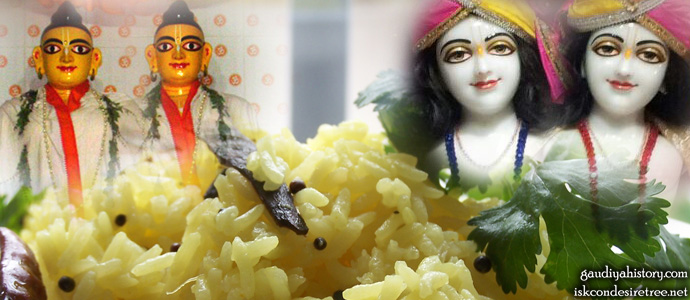
Gauranga smiled and said, “Do one thing. You can serve Our images.” Gouridas: “Will the images be alive?” Mahaprabhu: “Surely” Gouridas: “Can they sit in a squatting position?” Mahaprabhu: “Yes, of course” Gouridas: “Will they be able to take rice with their own hands?” Mahaprabhu: “Yes, certainly. Now you go and bring a neem tree from Navadwip and carve out images of Us two brothers from the wood. We will surely fulfill your wish.” (In the wallpaper: in the right Shri Shri Gaura Nitay, ISKCON Chennai, in the left Shri Shri Gaura Nitay Deities of Gauridas Pandita in Ambika Kalna).

 
   Madhav Mishra, known for his piety and virtues, lived at Bharatpur in the district of Murshidabad.  He had two sons, Gadadhar and Kashinath. Kashinath had two sons, Nayananda and Hridayananda.
 
   Gadadhar was one of the most intimate associates of Chaitanya MahaPrabhu. He was known as Gadadhar Pandit. And he had raised and nurtured Hridayananda, initiating him and educating him. In this way Hridayananda was Gadadhar’s personal attendant as well as his student.
 
   Gadadhar Pandit handed over this Hridayananda to Gouridas. Gouridas gave mantra-diksha (initiation with bija mantra) and appointed him to serve the Gaur Nitai Deities.
 
   Gouridas desired to have a great celebration on the occasion of MahaPrabhu’s birth anniversary, Dol purnima. Telling Hridayananda to worship and serve the Deities with utmost care, he set out for collecting bhiksha. “I shall return in time for the festival” he said.
 
   After Gouridas left, there was no news about him at all.  Hridayananda was in a dilemma. If invitations were not sent immediately to the mahantas and Vaishnavas, how could they be present on the fixed date?
 
   There was a great deal of related work left unfinished. Hridayananda took it upon himself to complete all the arrangements before his Guru returned.
 
   Gouridas returned to Ambika-Kalna just one day before the festival. Hridayananda told him with some satisfaction, “Seeing your delay in returning, I have myself completed all the arrangements.”
 
   Gouridas was not happy and did not bless him. Rather he came angry and asked, “What is the meaning of your independent action without my permission?”  Hridayananda was dumb-struck.
 
   Gouridas continued harshly, “Since you have gone over me and thus disregarded me, you no longer have a place here. Go somewhere else.”
 
   Heartbroken, Hridayananda bowed his head and obeyed his Guru’s order. He went to the bank of the Ganga and sat under a tree.
 
   Gouridas then started the celebrations at the ashram. Having received Hridayananda’s invitation, people started gradually assembling at the ashram for the festival. One such person, carrying huge offerings for the Lord, saw Hridayananda beside the Ganga and asked the palki-bearers to stop.
 
   Hridayananda told him, “The celebrations are taking place at the ashram, not here. Please take all these things to the ashram.”
 
   But Gouridas refused to accept the offerings.  He said, “these have come because of Hridayananda’s invitation. I shall not take them. Tell him to organize a separate festival with these offerings.”
 
   The bearers once again brought the offerings back to Hridayananda. “Has Gurudeva asked me to organize a separate celebration with these? So be it.”  Hridayananda began to organize the festival under the very tree on the bank of the Ganga. Hearing the commotion of the festivities, most of the invitees started assembling under the tree.
 
   On the other side, Gouridas also conducted the festival at the ashram as per his own arrangements. At the time of the midday bhog offering, he told the priest Gangadas to open the Temple doors and make the offering to the Deities.
 
   The door of the Temple was opened, but the Temple was empty! The Deities were missing. Gouridas started running towards the bank of the Ganga with a stick in his hand. “This is definitely the work of Hridayananda. He has removed the Deities from the Temple” he exclaimed.
 
   On reaching the river bank he saw a strange sight. Kirtan chanting was going on and in the midst of the singing and dancing, he saw the two Deities also dancing!! Seeing Gouridas with the stick in his hand, the Deities of Nitai-Gaur tried to disappear.
 
   But to his great astonishment, Gouridas saw Shri Chaitanya merging into the heart of Hridayananda. With outstretched arms, Gouridas ran and tightly embraced Hridayananda. “You are truly blessed. From today, your name should be Hriday-Chaitanya” he cried.
 
   Returning to his ashram Gouridas saw that the two Deities were back in their usual places. Their bright laughing eyes seemed to ask, “Now do you understand Hridaya’s devotion to his Guru? Have you realized Who is enshrined in whose heart?”
 
   This Hriday-Chaitanya became the diksha-guru of Shyamananda Prabhu.
 
   Shyamananda’s childhood name was Dukhi. He was born in a village called Dharenda-Bahadurpur (presently known as Kalaikunda in Midnapur) in a family of milkmen. His father’s name was Shri Krishna Mondal and his mother was Durika. His father left his native place and migrated to Dandeshwar in Orissa.
 
   Prior to Shyamananda’s birth, his parents had lost several children in childbirth and they vowed to surrender their next child to Vishnu if it survived. Having suffered so much grief in the loss of their previous children, they first named Shyamananda Dukhi,  to ward off further distress.
 
   Some called him Dukhia. After taking initiation from Hriday-Chaitanya, he was known as Krishnadas or Dukhi Krishnadas.
 
   From his early childhood itself, signs of renunciation became visible in him. Once after completing his studies, he felt the strong urge to take a bath in the Ganga. He told his father, “I am going to the Ganga for a dip.”
 
   Where? With whom, the father enquired.  
   “A group of pilgrims is going to Ambika-Kalna. I shall go with them” came the reply.
 
   There was no point in refusing. The boy could not be held back. The father only hoped that Dukhia would return home after a holy dip in the Ganga.
 
   But Dukhia never returned. He chanced to meet Hriday-Chaitanya at Ambika. Hriday-Chaitanya realized that the lotus of devotion was blooming on the stem of renunciation in the heart of the boy.
 
   He said, “Come, I will give you a mantra.”  He gave him the Krishna mantra and said, “from this day, your name is Krishnadas.” Dukhia smiled and said, “Yes. Dukhi Krishnadas.” 
Shyamananda Prabhu

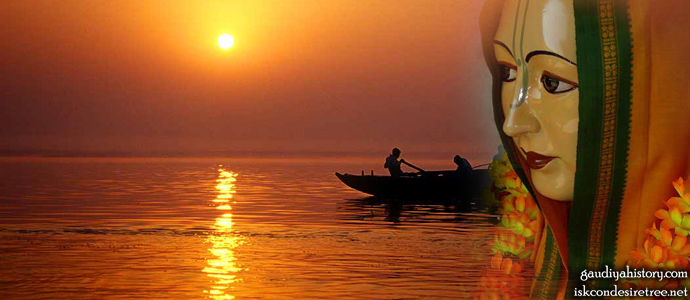
From his early childhood itself, signs of renunciation became visible in him. Once after completing his studies, he felt the strong urge to take a bath in the Ganga. He told his father, “I am going to the Ganga for a dip.”...But Dukhia never returned. He chanced to meet Hriday-Chaitanya at Ambika. Hriday-Chaitanya realized that the lotus of devotion was blooming on the stem of renunciation in the heart of the boy. (In the wallpaper: Mother Ganges, Shyamananda Prabhu's Deity, Shri Shri Radha Shyamasundar Temple, Vrindavan Dham).

 
   Krishnadas’ heart only became more agitated after the bath in the Ganga. “Now I shall see the Yamuna” he said. Hriday-Chaitanya said, “Yes, of course, you shall see it. You shall go to Braj dham.”
 
   After Krishnadas had spent some time in serving his Guru, Hriday-Chaitanya gave him permission to travel to Vrindavan.
 
   Dukhi Krishnadas first went to Navadwip and from there proceeded to Shri Vrindavan. There he took refuge at the feet of Shrila Jiva Goswami. Jiva Goswami began to teach him the scriptures and the bhakti philosophy. With the light of knowledge, the last remaining darkness of Krishnadas’ ignorance began to melt away.
 
   One morning in Vrindavan, Dukhi Krishnadas was walking down a lonely path lined with trees. His forehead was adorned with a gopichandan tilak, he had his prayer beads in his hands and he was singing the glories of Shri Gauranga as he walked along.
 
   While walking thus, he suddenly stopped on the path. A beautiful golden anklet was lying in the middle of the path. Krishnadas bent and picked up the ornament. Perceiving its ethereal beauty and elegance, he spontaneously pressed it to his forehead and then held it to his heart with both his hands. He started to horripilate and tears filled his eyes.
 
   Shortly he saw a young maiden coming up the path from the opposite direction, seemingly searching for something on the ground. “Devi, are you searching for something?” Krishnadas asked politely in a soft voice.
 
   The maiden looked up, startled.  She saw a handsome and dignified young man standing before her, and said “Yes, something is lost, that belongs to my dearest friend and I’m searching for that.”  “What?” asked Krishnadas. 
 
   “A golden anklet that was on my dear friend’s left foot.” The maiden added, “Last night while dancing, the anklet had loosened, which is why while returning home, it must have fallen off on the way.” 
Shyamananda Prabhu

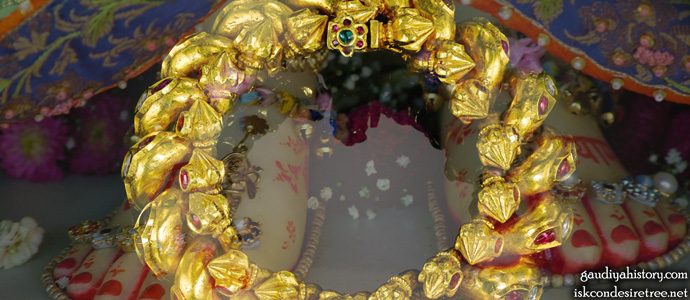
While walking thus, he suddenly stopped on the path. A beautiful golden anklet was lying in the middle of the path. Krishnadas bent and picked up the ornament. Perceiving its ethereal beauty and elegance, he spontaneously pressed it to his forehead and then held it to his heart with both his hands. He started to horripilate and tears filled his eyes. (In the wallpaper: golden ankle, Lotus Feet of Shrimati Radharani).

 
   Krishnadas held out the ornament that he held close to his heart, “Please see if this is the same anklet that you are searching for” he said.
 
   The maiden held out her hand. Even before she could say a word, the anklet dropped into her hand on its own.  Was it magic? Or a mirage?  That every instant, the girl disappeared.
 
   Krishnadas fainted and fell to the ground.
 
   When he regained consciousness, Dukhi Krishnadas found himself lying near Jiva Goswami.  Asked what had happened, Krishnadas told him the whole story.
 
   Jiva Goswami exclaimed, “What a blessed soul you are, Krishnadas. You held on your breast the golden anklet which adorns the lotus feet of Shrimati Radharani, the goddess of the rasa dance. You have also seen her dear friend Lalita. Having got her anklet back, Shrimati is definitely delighted and so is her beloved Shyamsundar.  From today, I give you the name Shyamananda.”
 
   Shyamananda sat up. “And look”, Jiva Goswami continued, “as you had pressed the anklet to your forehead, a tilak mark in the shape of the anklet has appeared on your forehead. From today, let your tilak also be in the shape of an anklet, and this will be henceforth known as the Syamannandi Tilak”.
 
   News eventually reached Hriday-Chaitanya that Krishnadas has taken a second initiation from Jiva Goswami and had also adopted a new tilak. When Shyamananda returned to Ambika-Kalna, Hriday-Chaitanya noticed the new tilak and was annoyed.
 
   “I had fixed the form of your tilak, but you’ve erased it. In its place you have adopted a new form. I hereby renounce you. Leave this ashram this very moment” he commanded.
 
   Eyes filled with tears, Shyamananda looked on silently. Feeling a bit sorry for him, Hriday-Chaitanya said, “if you wash away that tilak and put on the old one again, I can withdraw my order.”
 
   But poor Shyamananda could not wipe out the tilak mark from his forehead. As soon as he wiped it, it emerged by itself on his forehead again.
 
   Shyamananda left the ashram and went away.  He stayed on the banks of the Ganga without taking any food.
 
   The Deity in the Temple could not remain silent any longer. That night the Lord appeared in Hriday-Chaitanya’s dream and said, “What have you done, Hriday? Have you not banished my very Joy? The sign on Shyamananda’s forehead is the sign of My anklet. It is My anklet that Shrimati Radhika wears.”
 
   The whole incident was revealed in the dream. Hriday-Chaitanya realized his mistake and ran all the way to the river and gathered Shyamananda in his embrace. Placing him on his lap and shedding tears of joy, he asked, “Who is your Guru?”  Shyamananda replied “Shri Hriday-Chaitanya is my revered Guru.” 
 
   There were no more doubts. The reapproachment between the Guru and disciple was complete.
 
   It was in Vrindavan that Shyamananda Prabhu met and befriended Shrila Narottam das Thakur and Shrinivas Acharya, and thus became the famous trio of the second generation of Vaishnava acharyas after the six Goswamis.
 
   These three were empowered by Mahaprabhu to continue the work of Nityananda Prabhu, Shri Virachandra and Jahnava Thakurani and plant the victory flag of Vaishnavism in Bengal and Orissa.  They unleashed a great flood of love and devotion to God in these blessed lands.
 
   Shyamananda Prabhu was deputed to Orissa for preaching. In a village called Rohini on the banks of the river Subarnarekha, the village chieftain Achyuta and his son Rasikananda became the disciples of Shyamananda Prabhu.
 
   Gradually, a large following collected around Shyamananda and thus grew the Syamanandi sect.  The land of Utkal (Orissa) was saturated in prema-bhakti. People became mad after Shyamananda and his teachings.
 
   The whole of Orissa, Dharinda, Nrisinghapur, Balarampur, Gopiballabhpur, etc., became the centres of preaching of love and devotion by Shyamananda Prabhu and his chief and dearest disciple Rasikananda Prabhu.
 
   One day the news arrived that Hriday-Chaitanya had passed away. Shortly after that, Shyamananda Prabhu installed Shri Rasikananda as the Mahanta of the Shripat and handed over responsibility of the Shyamanandi sect to him. 
 
   Then he entered into the eternal leela. 
 
   http://www.Shrigaurangashram.in 
Shyamananda Prabhu

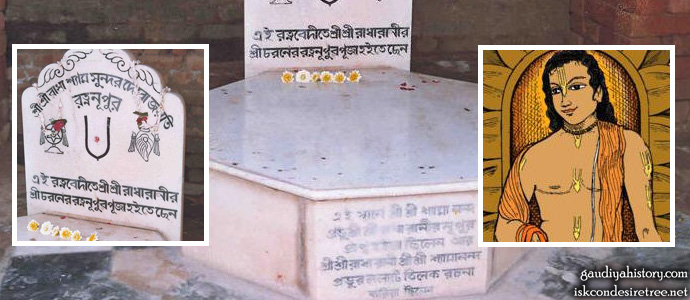
Shyamananda Prabhu and his samadhi.
Jahnava Mata – Biography

Jahnava Mata

In Gaur-Ganoddesh-Dipika it is stated that they are the expansions of Baruni and Revati the eternal consorts of Lord Balaram and Suryadas Sarkhel, was an expansion of Kakudmir, the king of Raivat. (In the image: Lord Balarama with His wives Varuni and Revati, Tota Gopinath Mandir).

   Shri Suryadas Sarkhel was a resident of Shaligram. He had five brothers –  Damodara,  Jagannatha,  Gaura  das,  Krishna  das and Nrsimha Chaitanya. He received the title “Sarkhel” because he used to  keep the accounts for the king of  Gaur desh. He had two daughters named Vasudha and Janhava, who was the youngest.
 
   In Gaur-Ganoddesh-Dipika it is stated that they are the expansions of Varuni and Revati  the eternal consorts of Lord Balaram and Suryadas Sarkhel, was an expansion of Kakudmir, the king of Raivat. 
 
   Once Mahaprabhu drew Prabhu Nityananda aside said to him, “If you also confine yourself to the austere life of a renunciate, then who will deliver the people who are immersed in maya? How will our work continue in this world? Therefore, please return to Gaudadesha and accept the householder way of life. You can continue to preach bhajan sankirtan and be the living example of love and devotion for materialistic people.” 
 
   Mahaprabhu urged Nityananda Prabhu to enter wedlock because He knew that Nityananda’s Shaktis had appeared and were waiting for him. One of them would play a critical role in keeping the movement alive in the future when They would disappear.
 
   Nityananda arrived at the home of Suryadas along with his favourite disciple, Uddharan Dutta. “I wish to marry; please give your daughter’s hand in marriage to me” he said to Suryadas. But Suryadas did not agree as Nityananda had abandoned his Varna.  Being rejected by Suryadas, Nityananda went back.
 
   But what happened to Vasudha? Knowing that the omniscient Godhead wanted to espouse her, she became lovesick. And when He was turned away by the father, she lost consciousness. The doctor was called in, but she did not revive and soon after, went into a coma and died.
 
   On getting this tragic news, Gouridas came and fell at the feet of his elder brother Suryadas. He asked Suryadas to call Prabhu Nityananda back as He alone could bring Vasudha back to life.
 
   Vasudha’s body had been taken to the banks of the Ganga for the last rites. Nityananda appeared there and Suryadas fell flat at his feet. “Please bring my daughter back to life” he sobbed.
 
   Nityananda said, “Only if you agree to give her in marriage to me, I will bring her back to life.”  Suryadas agreed.
 
   The gentle breeze from the transcendental body of Prabhu Nityananda touched the body of Vasudha. The divine fragrance of His body entered through her nostrils. Vasudha regained consciousness and gazed at Prabhu Nityananda will wide open eyes.
 
   “Now arrange the marriage,” commanded Nityananda Prabhu. Suryadas replied, “Please undergo the Vedic purificatory rites and adorn the sacred thread.” Nityananda complied saying, “As you wish. I remain uninvolved. Today the only supreme ruler is Chaitanya Goswami.”
 
   After the marriage, one day Nityananda Prabhu was taking his meal. Vasudha’s younger sister Janhava was serving the food. The veil covering Janhava’s head slipped and Nityananda saw her and realized that Janhava Devi was his complete energy – his shakti. 
Jahnava Mata

Thus the marriage ceremony was very auspiciously performed and Nityananda Prabhu remained at Shaligram with his two newly wedded wives for a few days. (In the image: Wedding of Devotees in Carpinteria).

 
   He told Suryadas, “Please give your younger daughter to me also as my wife.” Suryadas said, “I have nothing that I cannot give you. My wealth, caste, household and even my very life – everything is yours.”
 
   Thus  the  marriage  ceremony  was  very  auspiciously  performed  and Nityananda Prabhu remained at Shaligram with his two newly wedded wives for a few days.
 
   Thereafter  He  came  to  Shri Krishna das’s house at Borgachi, where He remained for a  couple of days. Next He went to Navadwip. Along with his two wives He offered His  obeisance at the feet of Sachi mata. Sachi Ma was extremely pleased to see them and showered her affection the new  brides.
 
   Then taking  leave of Sachi mata,  Nityananda  went to Advaita Acharya’s house in Shantipur.  Shri Sita Thakurani began to float in the ocean of bliss on seeing Vasudha and Janhava devi.  Taking them in her lap she blessed the new brides.  
 
   Vasudha gave birth to eight sons and one daughter. Seven sons died one after the other. Only the daughter Ganga and the youngest son Virchandra or Virbhadra survived.
 
   Soon after the birth of her two children, Vasudha passed away, and Janhava vowed to raise them as her own. Janhava did not bear any children. Virchandra was her special favourite.
 
   As time passed, Chaitanya Mahaprabhu passed away and soon thereafter Nityananda Prabhu, Advaita Acharya, Shrivas Pandit and  other associates of Mahaprabhu also disappeared.  Janhava Ma continued their work and developed a reputation as a superlative Vaishnavi, embodying the ideals of devotion in the Gaudiya sampradaya.
 
   She initiated her son Virbhadra as well as many other members of the Vaishnava community. Major figures in Mahaprabhu's lineage took shelter at her lotus feet, and personalities like Narottama Das Thakur, Shrinivas Acharya, and Shyamananda Prabhu accepted her as the most prominent Vaishnava in Bengal.  
 
   She was invited to the great festival of Kheturi and accorded the highest honour. On the first day of the Kheturi festival, the Devotees requested Janhava Ma to take charge of all the festivities. This she did, making sure that kirtan was going on with full enthusiasm that the Deities were being worshiped with elaborate splendor, and that devotional games commemorating Krishna’s pastimes were being enjoyed by the mass of participants – and there were thousands. 
Jahnava Mata

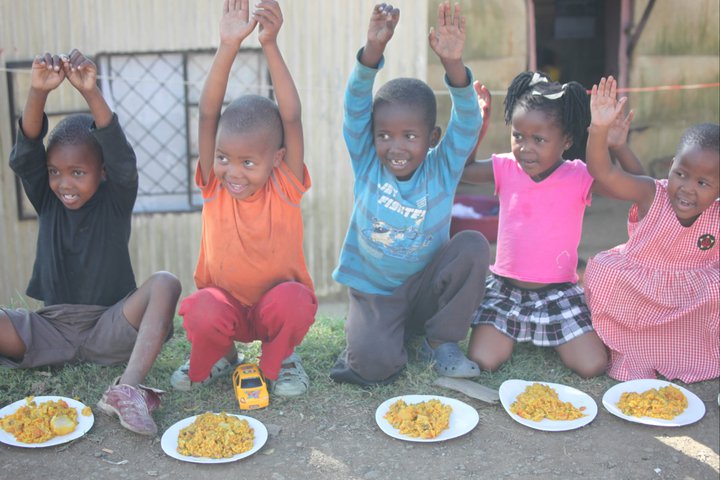
Janhava said, “This is the grace of Mahaprabhu on Narottam and Shrinivas. He has fulfilled His promise. Wherever there is naam sankirtan, there He appears. (In the image: Kids are chanting the Holy Names and honoring Prasadam, South Africa).

 
   On that grand occasion, the first recorded observance of the birth anniversary of Shri Chaitanya Mahaprabhu after His disappearance, six Deities were installed. After the installation of the Deities Janhava Ma asked Shrinivas Acharya to distribute garlands and sandalwood paste amongst the Devotees. Thereafter, she also accepted a garland and sandalwood paste. Then she directed the kirtan to begin.
 
   Kheturi was flooded with waves of divine love ! Shriman Mahaprabhu was a lover of hymns and He appeared at the scene with His associates.  For a minute, everyone beheld a lightening flash of the divine halo of Godhead. Then it disappeared.
 
   The sankirtan party was filled with grief as Mahaprabhu disappeared. Where have they all gone? Everyone was there, Advaita, Nityananda, Shrivas, Murari, Haridas, Gadadhar, Vakreshwar. Even Swarup Damodar, Ramananda, Sarvabhauma and Narahari !! Where did they go?
 
   Janhava said, “This is the grace of Mahaprabhu on Narottam and Shrinivas. He has fulfilled His promise. Wherever there is naam sankirtan, there He appears. Now start the smearing of Phagu (colour).
 
   Janhava entered the Temple and smeared the Deity of Mahaprabhu with Phagu. Everyone started throwing colour – not merely between human beings but between Devotees and God.
 
   After the evening pooja and aarti, Janhava said to Shrinivas, “now please perform the birth anniversary of Shri Gauranga.”
 
   Next morning after taking her bath and performing puja, Janhava Ma started cooking the Prasad. After offering the bhog she distributed it among all the Devotees and herself honoured the Maha Prasad only after everyone else was fed.
 
   The following day she told Narottam Das Thakur, “Now I will go to Vrindavan.” Accompanied by relatives Krishna Sarkhel, son-in-law Madhavacharya, Gopal Parmeshwari Das and others, she set off to Vrindavan.
 
   During the journey several miraculous events occurred.  En route, some envious people of one village where the group halted wanted to harm them while they were sleeping in the night.  The presiding Deity of their village Goddess Chandi appeared in their dream and chastised them severely for even thinking of harming Janhava Ma. “Janhava is a Goddess. Beg forgiveness and take refuge of her or else, I will destroy all of you” said the Goddess. The repentant men fell at Janhava’s feet and pleaded for mercy.
 
Jahnava Mata

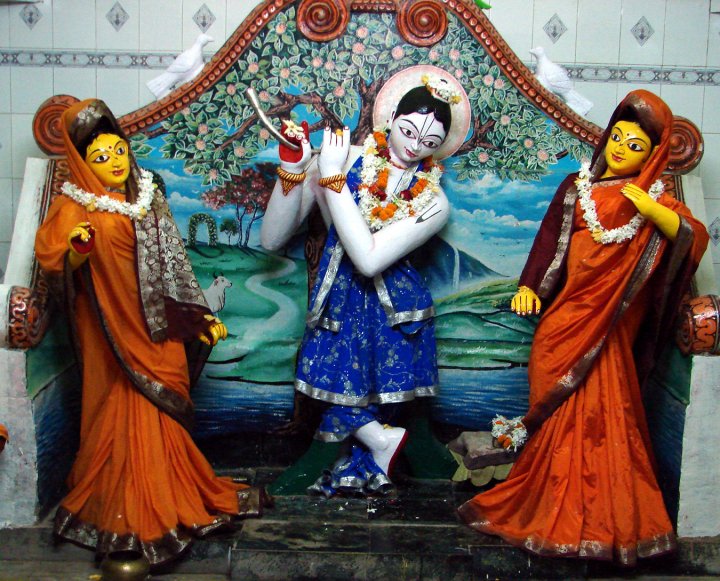
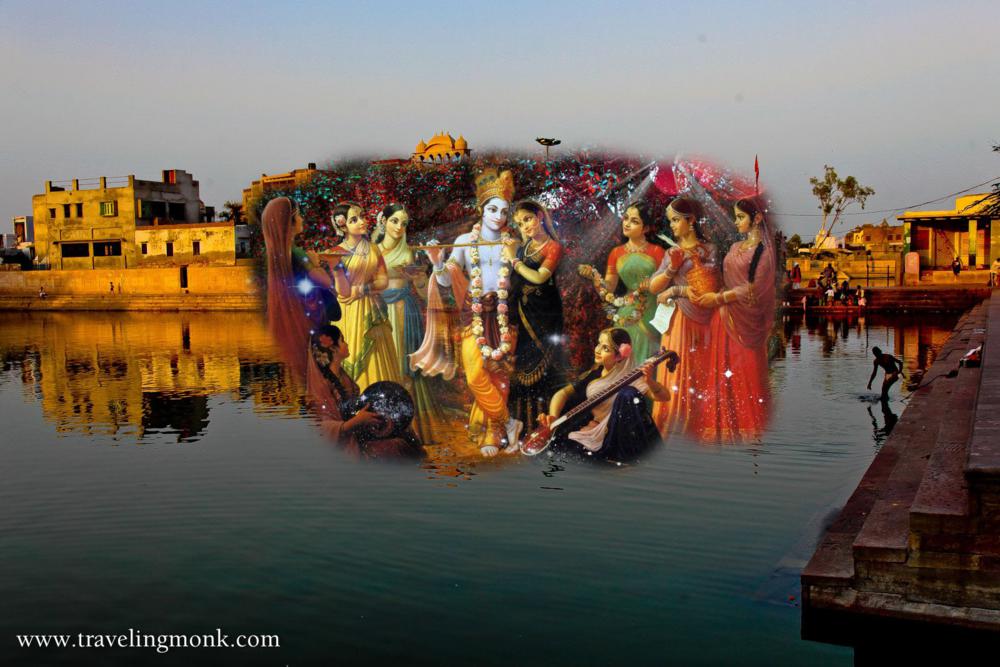
One day at noon, Janhava heard the enchanting melody of the flute on the bank of Shri Radha kunda. Thrilled, she looked around. And behold, she saw the graceful three-fold bending form of Shri Krishna beneath the Kadamba tree playing on His sweet Murali, and surrounding Him was Shrimati Radharani and the Gopis. Beholding this beatific vision, Janhava Ma fell into a trance. (In the image: Shri Shri Radha Krishna and Gopis, Radha Kund, Vrindavan).

   On another occasion during the journey some dacoits wanted to rob them. They waited till the night and started walking to the river bank where the pilgrims’ party was asleep. As they walked, the path kept stretching endlessly but they could not reach the sleeping Devotees. Finally at dawn they realized what had happened and ran and fell at Janhava Ma’s feet. These dacoits were converted into Vaishnava Devotees.
 
   Although Janhava Ma journeyed to Vraja after the Kheturi festival, she did go to Vraja one or two times before. On her first trip it is said that Rupa Goswami himself explained the literature to her at this time. Gradually, she developed a methodical plan to create solidarity between the Vaishnavas of Bengal and those of Vraja, and she accomplished this quite effectively during her few visits to the land of Krishna’s pastimes.
 
   Janhava Ma converted Muslims to Mahaprabhu's Vaishnavism and endeared herself to the Gaudiya Devotees throughout India. The Six Goswamis treated her with the utmost respect, and Raghunath Das Gosvami, in particular, was grateful for her association. He spent a good deal of time showing her the area of Radha-kunda, and the two of them took every opportunity to dance in ecstasy. 
 
Jahnava Mata

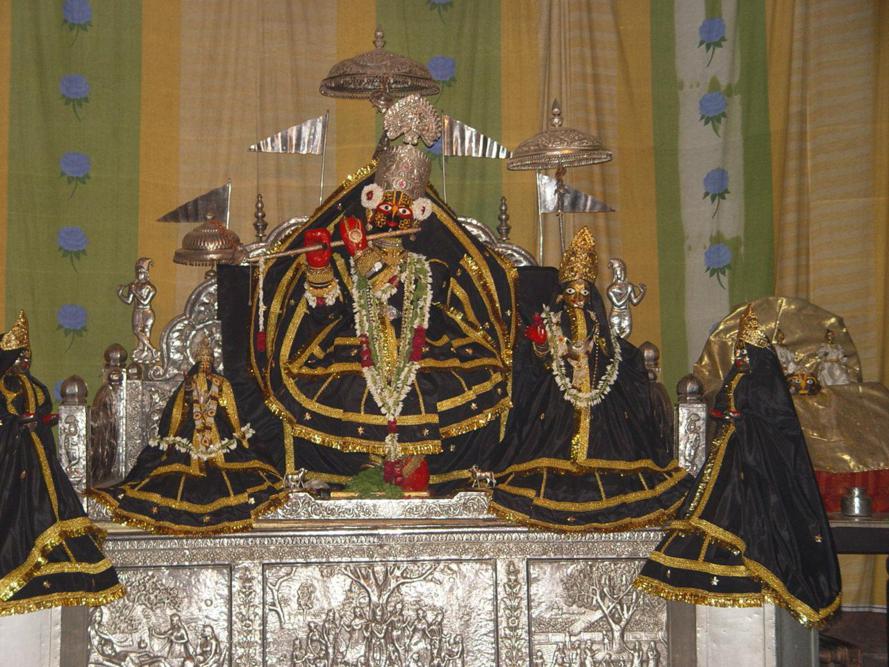
Once, in a vision, she saw the Gopinatha Deity and His little Radha companion, who told her to replace the Radha Deity with one that was larger. This mission she took back with her to Bengal and finally journeyed back to Vrindavan with the new Deity of Shri Radha. When the Deity reached Vrindavan, it had to be decided where the original smaller Deity would be placed. The king of Jaipur took charge of the original Deity. The new Deity was installed on the left of Shri Gopinatha and the new one was called “Janhava Radhika”. (In the image: Original Radhika Gopinath Ananga Manjari Deities, Jaipur).

   One day at noon, Janhava heard the enchanting melody of the flute on the bank of Shri Radha kunda. Thrilled, she looked around. And behold, she saw the graceful three-fold bending form of Shri Krishna beneath the Kadamba tree playing on His sweet Murali, and surrounding Him was Shrimati Radharani and the Gopis. Beholding this beatific vision, Janhava Ma fell into a trance.
 
   When Janhava Thakurani saw Rama Ghat, the area along the banks of the Yamuna where Balarama enjoyed a rasa dance of His own, her spiritual rapture knew no bounds.  She had mystic visions throughout her life and received divine guidance from Nityananda Prabhu long after He left this world. 
 
   Once, in a vision, she saw the Gopinatha Deity and His little Radha companion, who told her to replace the Radha Deity with one that was larger. This mission she took back with her to Bengal and finally journeyed back to Vrindavan with the new Deity of Shri Radha. When the Deity reached Vrindavan, it had to be decided where the original smaller Deity would be placed. The king of Jaipur took charge of the original Deity. The new Deity was installed on the left of Shri Gopinatha and the new one was called “Janhava Radhika”.
 
   When Janhava Ma saw the lovely form of Gopinatha with two Radhikas – one of either side of Him – it appeared as if a dark Tamal tree was being embraced by two loving creepers. She then dedicated all the offerings that she had brought from Gaud to Radha Gopinatha. She lovingly fed them preparing savoury items with her own hands.
 
   One day she entered the Temple alone and the Temple door closed behind her. Shri Gopinatha caught hold of Janhava’s garment and pulled her making her sit on His left. When the Devotees opened the door of the Temple, they found Janhava transformed in a golden Deity manifest on Gopinath’s right side!  
 
   The Vamshishiksha says that Janhava Ma left this world by merging into the Deity of Lord Gopinatha in Vrindavan.
 
   At the time of Janhava's departure from the mortal world, her beautiful manifestation as Ananga Manjari, standing in a dancing pose at Krishna’s right side, was emphasized by Nityananda Prabhu's most intimate followers. This "Ananga-Kanai-Rai," the worshipful devotion of Radha's younger sister along with Radha and Krishna together, remains the focus of Devotees coming in the line of Janhava Devi.
 
   Shri Janhava Thakurani opened Vaishnavism up to women in a way that broke all boundaries, allowing them equal footing with men in terms of service, devotion, accomplishment and the ability to rise to the highest level of perfection.  
 
http://www.srigaurangashram.in 
Jahnava Mata

Shri Janhava Thakurani opened Vaishnavism up to women in a way that broke all boundaries, allowing them equal footing with men in terms of service, devotion, accomplishment and the ability to rise to the highest level of perfection. (In the image: Harinaam Festival, Baltic Sea, Poland).

Murari Gupta – Biography

Murari Gupta 4

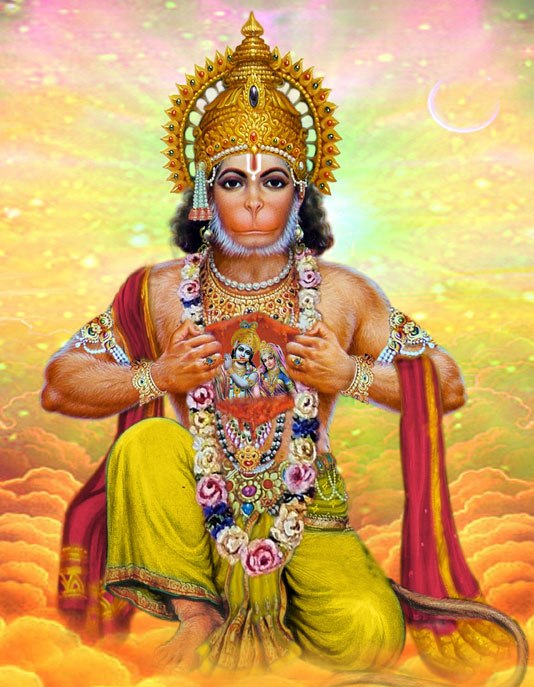
Murari Gupta, was an expansion of Hanuman, and his Ishhta Devata was Shri Sita Ram. (In the image: Hanuman).

   When the supreme Lord descends, all His associates and paraphernalia also descend to support His transcendental leela.

   One such eternal associate was Shri Murari Gupta, a disciple of Shri Chandrashekhara Acharya. Murari Gupta was Chaitanya Mahaprabhu’s senior at Ganga Das Pandit’s school in Navadwip.

   Shrivas Pandit, Chandrashekhara Acharya and Shri Murari Gupta Thakur were all from Shrihatta. Murari Gupta came from there to live in Navadwip, near the home of Jagannath Mishra.

   Murari Gupta, was an expansion of Hanuman, and his Ishhta Devata was Shri Sita Ram.

   He had an intimate lifelong relationship with Mahaprabhu. At the nightly kirtans in Shrivasa Angan, Murari Gupta served Lord Gaurahari with melodious chanting of the Bhagavata. He would also sing and dance expertly. Murari Gupta served Shri Chaitanya in all His Nadia lilas.

   During Mahaprabhu's 21 hours of 'Great Revelation' or the Mahaprakash when Mahaprabhu disclosed His transcendental identity as the Supreme Personality of Godhead to his closest associates, He called on His various Devotees and bestowed blessings to them.

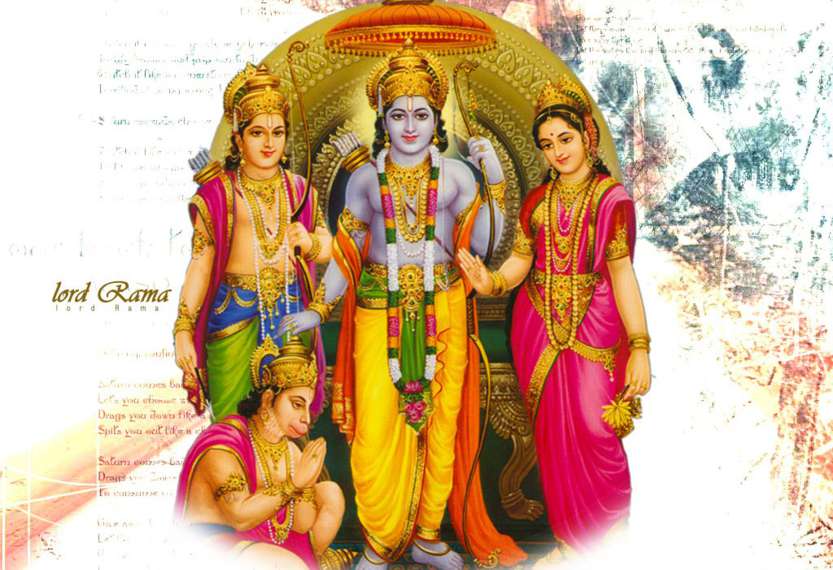
   He addressed Murari: "Murari! For so many days couldn't you recognize who I really am? Just see My divine form." Then Murari saw Mahaprabhu as his adored Lord, Shri Raghunatha, sitting in the virasana, his legs folded beneath His body, and holding a great bow in His hand, with Lakshman and Janaki seated on either side of Him.

   Then when he saw himself amongst those monkeys in his original form and he fainted. Mahaprabhu called him: "Murari! Get up! Just see My divine form. Have you forgotten who set Ravana's Lanka on fire? It was you, Hanuman! Get up and gaze on the form of Lakshmana, who is the very embodiment of your life. Offer your obeisances to that one for whose sadness you cried so much (Sita Devi)." 

Murari Gupta

"Murari! Get up! Just see My divine form. Have you forgotten who set Ravana's Lanka on fire? It was you, Hanuman! Get up and gaze on the form of Lakshmana, who is the very embodiment of your life. Offer your obeisances to that one for whose sadness you cried so much (Sita Devi)." (In the image: Shri Shri Sita Rama, Lakshman and Hanuman).

   Mahaprabhu once tested Murari Gupta's attachment to his worshipful Lord Shri Ramachandra. Shri Gaurasundara preached to Murari about the supreme sweetness and position of Vrajendra-nandana (Krishna): "Murari, worship Krishna and take shelter of Him. Nothing but His service can satisfy the mind and the heart."

   Although Murari Gupta became somewhat inclined toward Shri Krishna, the thought of giving up Lord Ramachandra's bhakti devastated him. That night he prayed to Lord Rama to take his life. He asked for this because he couldn't stop serving Rama, nor could he defy Shri Chaitanya's request.

   After crying all night Murari approached Lord Chaitanya and said: "What should I do? I've sold my heart to the lotus feet of Lord Ramachandra. But if I disobey Your order to worship Lord Shri Krishna, then also I am in offence. What can I do?"

   Smiling, Shri Gaura Raya replied, "All glories to you, Murari! You're so fixed in your worship that even My request couldn't change your mind. This is exactly the type of single-minded love and devotion the bhakta must have for the lotus feet of their chosen Ishta. Even if the Lord wants separation, a Devotee cannot abandon the shelter of His lotus feet. Just to test your firm faith in your Lord I repeatedly asked you to change your worship from Lord Rama to Lord Krishna."

   Showering His mercy on Murari Gupta, the Lord continued, "You are the incarnation of Hanuman, the eternal servant of Lord Rama. Therefore, you cannot give up your worship of Lord Rama."

   In Katwa, when Lord Chaitanya took sannyasa Murari stood by weeping like a child. And when Shriman Mahaprabhu moved to Jagannatha Puri, Murari and his wife would visit Him every year to relish the Lord's company, taking with them many of the favourite eatables of Mahaprabhu.

   Since he was born in a dynasty of ayurvedic physicians, Murari Gupta practiced medicine. But his practice was unique in that he cured his patient's physical ailments and also freed them from the disease of material existence. He wrote the first biography of Shri Chaitanya Mahaprabhu, an important Sanskrit work entitled Shri Chaitanya Charita Mahakavya.

   An amusing story is told of how Lord Gauranga gave his mercy to Shri Murari Gupta in His childhood itself by playing a transcendental prank on him. One morning Shri Sachinandan Vishwambhar was playing in the street with the other children. He was covered with dust from the head to toe—e dhuli dhusar, hemgiri kolebar, anugata bayasya sohite—and the only way He could be recognised was by His golden complexion.

   The children were having a fight and enjoying themselves immensely. They did not care for their clothes which had fallen off long ago. Bathed with perspiration and dirt, they were totally engrossed in their boyish play.

   Just at that time Murari Gupta, the scholarly boy of Navadwip passed by. He was a very serious student and was surrounded by his admiring friends and class-mates who were in awe of him as he was such a bright student. They looked up to him in all respects and today Murari was engrossed in enlightening his companions on the merits of Jnana yoga.

   In an animated way, shaking his head and gesticulating with his hands, he was explaining the philosophy of Knowledge to them. When little Nimai saw this, He quietly followed Murari. Murari saw Nimai from the corner of his eyes but he ignored Him.

   Murari knew this was the best way to treat the precocious son of Jagannath Mishra who was notorious all over Navadwip. He calmly continued his elucidation on the finer points of Jnana yoga.

   Seeing this, Vishwambhar told his friends with a snicker, “There goes the great future doctor of Nadia. Come on, let’s have some fun.” He started mimicking Murari Gupta.

   Whenever Murari waved his arm to stress a point, Nimai would do the same. He tossed His head in exactly the same manner Murari did. Nimai’s friends were as naughty as He was; they held their sides as they laughed. Not only Nimai’s friends, but even Murari Gupta’s followers had a hard time suppressing their laughter.

   Lochan das Thakur described what happened next:

dekhi baidya Murari katâksha tileko heri
puno kore joger bâkhân,
sei moto bishwambhare jogger bakhan kore
teno nâre hât teno mukho khan.

   Murari could not ignore Nimai any more. Although he was generally of a peaceful temperament, the son of his Aunt Sachi had crossed all the limits of decency. Murari lost his temper and blurted out:

echchâre ke bole bhâlo dekhiyâ to châowâl
mishra Purandar suta ei,
sarbatra shuniye kathâ ihâr sei guna-gâthâ
bhâle nâm ihâr Nimai.

   “This son of Purandar Mishra is a trouble to everyone! Who has ever spoken nicely about Him? Wherever you go, you hear His ‘glory’ (sic). Moreover, what a name they have kept for Him! Nimai! Bah!” 

Murari Gupta

"...The Lord then commanded Murari, “Abandon all the paths of Jnana and Karma Yoga and simply immerse yourself in Shri Krishna-Bhajan. Krishna is the supreme connoisseur of ras. He is expert in all the arts, the fountainhead of all charm and eternally blissful.” (In the image: Lord Nimai passed urine to Murari Gupta's food).

   Gaursundara became angry when He heard Murari speak in this way. Of course, whenever the Supreme Lord becomes angry with His Devotee, it is part of His lila and He is in fact showering His mercy.

   Nimai scowled at Murari, knitted His eyebrows and said, “I will show you for all of your so-called oratory skills! Just you wait until lunchtime Murari. I will teach you such a lesson, you won’t forget!”

   Murari felt uneasy in mind. Jagannatha Mishra’s son was well known all over Navadwip for His mischievous and naughty pranks. God alone knows what He would get up to now! However, Murari soon forgot about this incident once he reached home and became busy with his afternoon duties.

   Meanwhile, Vishwambhar, who was none other than the Supreme Personality of Godhead, dressed Himself up very nicely and arrived at Murari Gupta’s house. He had a beautiful belt around His waist, He wore two strings of pearls round His neck and His hair was tied in a high chudâ (topknot) on His head. His large and beautiful eyes were lined with kohl and golden ornaments shone on His body. He wore stylish sandals on His rosy feet and held laddoos of condensed milk in His hands.

   Murari was eating his lunch in the inner rooms of his house when he suddenly heard someone calling out his name with a voice as deep as rumbling clouds. “MURARI! MURARI!” Murari Gupta sat upright as if a thunderbolt had struck him. He immediately remembered what had happened in the morning. Had Nimai really come to teach him a lesson? Had he been serious when he made that threat?

   Murari could not believe it. Gaurchandra was at Murari’s doorstep; His beautiful golden form shone as He stood in the threshold. He said with a smile:

tobe se gourhari ki koro ki koro boli
seikhâne hoilo uponito
torosto nâhoio tumi eikhâne âchhi âmi
bhojan koroho b&ˆni boilo

   “Murari, what are doing? It’s all right, don’t worry. I am standing here. You eat peacefully.” Murari heaved a sigh of relief and continued to eat quietly.

Then, can you imagine Nimai did? Calmly He walked right up to Murari Gupta and ………….

thâl bhoriye moot mutilo

…………………..urinated all over his plate!

   Murari Gupta was totally dumbfounded. He immediately stood up—ki ki boli chhee chhee kori, uthilâ se Murari—“What is this?” and he cried in disbelief, “Chhee! Chhhee!”

   Nimai, however, clapped His hands in glee—kara tâli diyâ bole gorâ. He said to Murari:

bhakti path chhadia koru shirr nadiâ
jog bolo lei abhipârâ
jnana karma upekhiyâ krishna-bhajo mon diyâ
rasik bidagdha chidânanda

   “You dare to discard the path of bhakti and propound the glories of Jnana Yoga? And look at you, how you move your head and hands—as if you are a great pandit when actually you are the biggest fool!”

   The Lord then commanded Murari, “Abandon all the paths of Jnana and Karma Yoga and simply immerse yourself in Shri Krishna-Bhajan. Krishna is the supreme connoisseur of ras. He is expert in all the arts, the fountainhead of all charm and eternally blissful.”

   Nimai then calmly left and returned home after revealing this essence of prem-bhakti to His eternal associate. Murari Gupta's hair stood on end. He was astounded. He thought, “Who is this boy who speaks with such commanding authority? Is Sachi Mata’s son none other than Lord Krishna Himself? Otherwise, how could He speak such profound philosophy at such a young age?”

   Murari rushed to Nimai’s house filled with ecstasy. There he was further amazed to see Sachi Mata and Jagannatha Mishra having a tug-of-war over who would have Nimai on their lap. They were both tugging at Nimai and kissing His cheeks.

   Murari then ran to Advaita Prabhu and narrated everything to him. Lord Advaita was ecstatic &‐ihâ shuni dwijamoni, huhunkâra kore dhwani, puloke purilo sob anga—His eyes brimmed with tears and he roared in joy. He called out, “Has the Supreme Being finally answer my fervent prayers? Has the day of deliverance arrived?” He held Murari in a tight embrace.

   http://www.srigaurangashram.in 

Murari Gupta

"All glories to you, Murari! You're so fixed in your worship that even My request couldn't change your mind. This is exactly the type of single-minded love and devotion the bhakta must have for the lotus feet of their chosen Ishta. Even if the Lord wants separation, a Devotee cannot abandon the shelter of His lotus feet. Just to test your firm faith in your Lord I repeatedly asked you to change your worship from Lord Rama to Lord Krishna." (In the image: Lotus feet of Shri Gopinath, ISKCON Chowpatty, Mumbai).

Vishnupriya Devi – Biography

Basant Panchami or Saraswati Puja marks the appearance day of Sri Raghunath Das Goswami, Sri Pundarik Vidyanidhi and Sri Vishnupriya Devi, the consort of Sri Chaitanya Mahaprabhu.
 
All manifestations of Vishnu tattva have three shaktis, known as Sri, Bhu and Nila (or Lila). Lakshmipriya Devi is the sri-shakti of Mahaprabhu in his majestic Gaura-Narayan form; Vishnupriya is the manifestation of His bhu-shakti and Nabadwip Dham is His lila-shakti.
 
Srila Gadadhara Pandit represents the shakti of Gaura-Krishna or Mahaprabhu in the mood of Krishna.
 
After the untimely demise of her daughter-in-law Sri Lakshmipriya Devi, Sachi Mata started looking for another wife for her young son then around 17 or 18, and consulted Kashinatha Pandit for that purpose. Kashinatha was a well-known matchmaker who is described in Gaura-ganoddesa-dipika as having been the Brahmin in Krishna lila named Kulaka who was sent by Maharaj Satrajit to arrange the marriage between his daughter Satyabhama and Krishna. So some regard Vishnupriya ji is the expansion of Sri Satyabhama devi.
 
Kashinath pandit  then went to the home of Pandit Sanatan Mishra to arrange the marriage between Nimai and his daughter, the devotionally minded Vishnupriya.
 
From her early childhood, Vishnupriya Devi was devoted to her parents and to Lord Vishnu, taking her bath in the Ganges three times daily. She regularly saw mother Sachi there, paid obeisance to her and received her blessings.
 
In this way, Sachi already knew Vishnupriya's good qualities, and was happy to agree to accept her as a wife for her son.
 
Once it was decided that Vishnupriya and Vishvambhara would be married, an auspicious day and time were fixed for the ceremony. With great pomp, the adhivaasa rituals were carried out on the eve of the marriage.
 
The Lord arrived at Sanatan Mishra's house in a palanquin at dusk and Gaurasundar and Vishnupriya's wedding ceremony was performed according to both scriptural and popular traditions. On the following day, Vishnupriya joined her new husband on the palanquin and returned with Him to His house.
 
On the threshold of her married home, Vishnupriya accidentally hurt her foot on the doorway. Her toe was injured and she bit down on her lip to tolerate the sharp pain.  In her heart, fearing that this may be a bad omen, she trembled with fear and almost fainted.  Just then Mahaprabhu who was standing beside her, pressed His own toe on her injured toe and gazed intently into her eyes. Upon the divine touch of the Lord's lotus feet Vishnupriya devi at once steadied herself and entered the house.
 
If one hears the eternal pastime of the wedding of Sri Lakshmi and Narayan, they gradually lose their desire for the material relationship of enjoyer and enjoyed, for one comes to understand that Sri Hari alone is the Supreme Enjoyer of the entire universe.
 
After the marriage
 
It was after his marriage to Vishnupriya that Mahaprabhu went to Gaya and met Sri Ishwar Puri and received initiation from him. When He returned to Navadvipa, He was a changed man. He cried out for Krishna and wept.
 
Both mother Sachi and Vishnupriya anxiously witnessed Mahaprabhu's increasing intensity and self-forgetful absorption in ecstatic bhakti. As time passed, the rumours that Nimai Pandit might take sanyas reached their ears.
 
Mother Sachi felt that her life would end. She fell unconscious to the ground when she first heard the rumour. Later with great trepidation, when she broached the subject with her son, her worst fears were confirmed. She cried, pleaded and reasoned with Nimai. "After the death of your father and your elder brother's sanyas, I have survived only by looking at your face. If you also leave me now, I will certainly die." she wept.
 
As mother Sachi implored Him in many ways, Nimai listened quietly, with His head bowed. Realising that his mother would not survive, He took her aside and revealed to her His real identity and hers too. He told her that long ago in ancient times, her name had been Aditi and He had incarnated as her son Vaman. Then when she was known as Devahuti, He came as her son Kapila. As Kaushalya, He was born of her as Ramachandra, and again He was born as her son Krishna when she was Devaki in the Dwapara yuga.
 
Mahaprabhu then told His mother that He had disclosed the most confidential secret to her was so that she could fulfil her role in His great mission. In My form as the deity, you are My mother as the earth. In My form as the holy names, you are My mother as the tongue. In this way, birth after birth, you have always been My mother. We are really never separated, he told her.
 
Nevertheless, mother Sachi was plunged in a sea of sorrow.
 
Parting from Vishnupriya
 
Vishnupriya Devi was 8 or 9 at the time of her marriage. As was the custom, she remained in her parents' home until she came of age and possibly came to her husband's house at around 12 or 13. Her separation from Lord Gaurhari took place hardly a year later, when she was 14 and Mahaprabhu 24.
 
Although Visnupriya devi was his wife, Mahaprabhu hardly ever spoke with her, especially when He returned from Gaya where He took harinama and diksa initiation from Sri Isvarapuri.
 
His personality underwent a sea change at that time. He was no longer known as Nimai Pandita. Now He became known as Bhavuka Nimai, Nimai who is always absorbed in His ecstatic moods of Krishna prema.
 
At this time, however, some of the inhabitants of Navadvipa, especially the students and His former teachers in the schools were somewhat unfavorable towards Him. Mahaprabhu thought, "I came to give the supreme medicine for everyone's material disease, but these persons do not listen to Me. I should take sannyasa, for then they will respect Me.” This is one of the reasons why Chaitanya Mahaprabhu took sanyasa.
 
On the day He decided to take sannyasa, Visnupriya devi went to bathe in the Ganges. While She was on the way there, she accidentally stubbed her toe on a stone, and it was injured and started bleeding. Then, while she was in the midst of bathing there, the nose-ring she had received on her marriage day and which is very auspicious for a wife, fell in the Ganges.
 
Although she searched for it with great endeavor, She could not find it. She began to weep bitterly, "Why are all these things happening today?" Later, when She returned home, Sachi Mata asked her, "O my daughter, why you are weeping so?" She replied, "Today I went to bathe in the Ganges. My foot was injured, and I lost my nose-ring. I don’t know what is to be my fate." Sachi Ma tried to console her.
 
Although Chaitanya Mahaprabhu had previously paid practically no attention to her, that night, after taking some prasadam, He decorated her hair and placed betel nuts in her mouth. That morning He had gone to visit and meet with all His associates. He had procured some milk, He had also gotten a loki vegetable from Sridhara, with whom He would always jokingly quarrel. When he returned home in the evening He told Saci Ma, "Mother, please make a preparation from these, adding sugar, ghee, camphor and other ingredients, and offer it to Krsna."
 
He later honoured that prasada, after which He entered the room of Vishnupriya devi. Then, with love and affection He decorated her, gave her a beautiful garland, placed betel nuts in her mouth and engaged in loving conversation with her.
 
Vishnupriya was greatly perplexed "What is this? A hurricane light burns brightly when it is just about to be extinguished. I see now that my fate may be like this.
 
Thinking like this, she gently sat and massaged His lotus feet, tears pouring from her eyes. Sri Gauranga opened his eyes when He felt her tears on His feet. Pulling her to Him and gently wiping her tears, He asked, O Goddess. You are most dear to Me. Why are you weeping? 
 
Unable to utter a word Vishnupriya wept uncontrollably. A flood of tears rained from her eyes.  Sri Gauranga asked her again and again, but she wouldn't say a word. Holding His feet with both her arms, she wept.
 
Then, the Lord who is the In-dweller in everyone's heart, gently placed her on His lap and spoke sweet words to her and calmed her down. In a voice choked with emotion, Vishnupriya finally spoke, My life, my beauty, youth, my service, my dress and adornment is only meant to please You. If You leave me, what will I, a worthless pile of ashes, do with my life? she cried.
 
The most munificent and merciful Lord was neither unaware nor indifferent to His dearest devotees' pain and grief.  He also wept with her. Finally, to her also, He revealed the secret of His birth and mission.
 
Wiping her tears with his garment, He embraced her and told her that Lord Sri Krishna is the supreme Husband of all. "Your name is Vishnupriya, she who is dear to Lord Vishnu. Please make your name true to yourself. Please do not needlessly torment yourself with worries of the world or what they will say. Dedicate your mind and body to serving Sri Hari." 
 
Lord Gauranga then manifested His four-armed Narayan form. He displayed His maya shakti and made Vishnupriya temporarily forget her pain. He joked and teased her and satisfied her. Thus they spent their last night together.
 
Mahaprabhu then gave her His special kripa, "O Goddess Vishnupriya, now hear my words. Whenever you think of Me, I will come to you. I solemnly promise you this. It is the truth."
 
Then Yogamaya entered Vishnupriya's eyes in the form of sleepiness. She did not want to fall asleep, but by the power of Yogamaya she was forced to do so. Caitanya Mahaprabhu glanced at her once, and then stood up to leave home and take sannyasa.
 
Just before dawn, rising from his bed where Vishnupriya lay, Lord Gauranga finished his morning rituals. Touching the feet of mother Sachi who sat like a statue at the doorway, eyes wide open but unable to move, the Lord left Navadvipa and crossed the Ganga.
 
Union in Separation
 
Vishnupriya lived her life in the slow burning agony of separation from Sri Gauranga after His departure. Every morning, with the exception of taking bath daily in the Ganga alongwith mother Sachi, she always remained in the house.
 
She led a very strict spiritual life and would look after Sachi Devi who was heart-broken and devastated after her son's departure.
 
Not even the devotees could see anything more than her feet, nor would anyone ever hear her voice. Constantly shedding tears and eating only Mother Sachi's remnants, she became pale and thin.
 
She immersed herself in the Holy Name, chanting all day long in solitude before a portrait of Gauranga, serving it as though He were present in it and surrendering herself to His lotus feet.
 
For every 16-syllable Naam she uttered during her japa, she would place a grain of rice aside. When she had completed her rounds, in the early afternoon, she would cook whatever rice was collected in this manner, offer it to the Lord, serve Sachi Mata and eat only the remnants thereafter.
 
Sri Vamsivadana Thakur and Ishan Thakur were blessed by the service of taking care of Vishnupriya Devi and Sachi Devi after Mahaprabhu took sanyas.
 
It is said that Vishnupriya Devi abandoned food and drink until He appeared to her in a dream, telling her to have a deity of Himself carved from the wood of the margosa tree under which Sachi mata had sat to suckle Him.
 
When the deity was finished, Vishnupriya sang the verse of Chandi Das: Here is the Lord of my life. I am finally able to see Him for whom the arrows of desire have caused me to burn and come to the point of dying. She was thus the first to establish worship of a deity of Gauranga Mahaprabhu.
 
Just as Bhagawan Ramachandra, who had taken the vow of monogamy, had a golden statue of Sita devi made after Her exile to the forest, rather than marry a second time, so Vishnupriya repaid her debt to her Lord in the pastimes of Gaura-Narayan by having an image of Mahaprabhu created so she could perform the sacrifice of the Holy Name to Him. The image of the deity she installed and worshipped is given here.  This deity is still worshipped to this day in Navadvipa.
 
Srila Bhaktivinoda Thakura relates the following pastime in his Sri Navadvipa-Dhama-Mahatmya: During his exile in the forest for 14 years, Lord Rama visited Ramkeli, Gangasagar and Navadvip areas of Gaud desa.
 
Once as Lord Rama was observing the extraordinary beauty of the forest, He began to smile. Sita asked Him why He was smiling, and Sri Rama replied, "In this forthcoming Kali-yuga, I will take birth from the womb of Mother Sachi in Sri Jagannatha Mishra's house in this same Navadvipa-dhama. People will know Me as Gauranga, and I will charm everyone by performing a variety of enchanting pastimes. I will manifest the glory of the Holy Name and thus madden the common people with the chanting of these names. I will change the hearts of even hardened sinners and give them love of God, which even the demigods rarely attain. In My youth I will accept sanyas, after which I will reside in Sri Jagannatha Puri. At that time My mother Sachi-devi, who is none other than Kausalya, will weep holding her daughter-in-law Visnupriya in her arms. You will be that Visnupriya. I will thereafter remain in Puri and will also weep for you day and night.
 
By her devotion and austerity, Sri Visnupriya Devi, played a very important role in the preaching of Gaudiya Vaishnavism. Through her acceptance of the mood of separation, her surrender to her Lord's mission, her showing of the pangs of separation, she helped in establishing the ideal of union in separation, the cornerstone of Gaudiya Vaishnava philosophy.
 
She melted the hearts of many and did away with the envy or antagonistic feeling toward Mahaprabhu that many people harboured at the time. And thereby in Bengal she facilitated the preaching of Nityananda Prabhu and the glorification of Sri Chaitanya Mahaprabhu.


http://www.srigaurangashram.in