Author Archives: Sevak

Bhugarbha Goswami – Biography

   As there is not much mention of Sri Lokanatha Goswami in Vaishnava literatures, similarly there is not much mention either of Sri Bhugarbha Goswami, who was his very close friend. Following Mahaprabhu's order, they both came to live at Vraja dham. Their hearts were inseparable. Bhugarbha Goswami was Lokanatha’s closest friend and constant companion. He was Prema Manjari in Vraja (Gaura-ganoddesha-dipika 187).

bhugarbha-thakkurasyasit purvakhya prema-manjari.

   According to the Sadhana-dipika, Bhugarbha was Lokanatha’s paternal uncle. The Shakha-nirnayamrita adds the following comments on Bhugarbha Goswami:

gosvaminam ca bhugarbham bhugarbhottham suvishrutam
sada mahashayam vande krishna-prema-pradam prabhum
shrila-govinda-devasya seva-sukha-vilasinam
dayalum premadam svaccham nityam ananda-vigraham

   I offer my reverence to the illustrious Bhugarbha Prabhu, who is said to have been born from the bowels of the earth. He bestows love of Krishna; he takes pleasure in the service of Govinda Deva, is compassionate, simple and always joyful. 

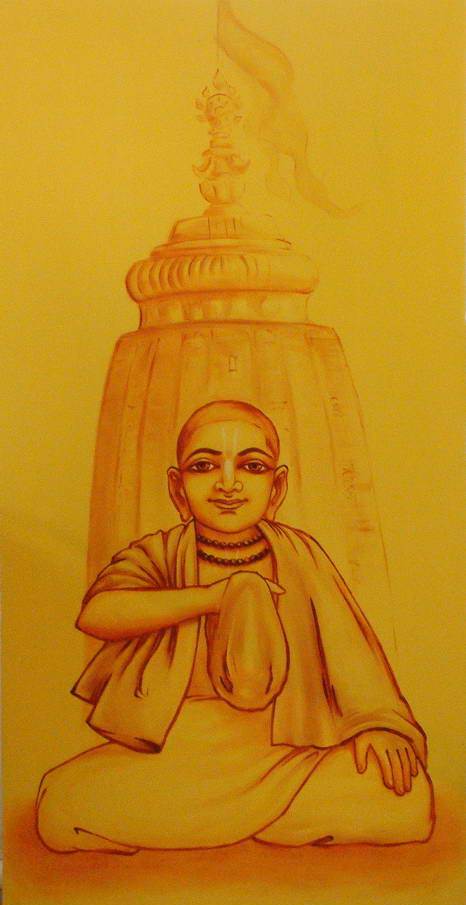
Bhugarbha Goswami

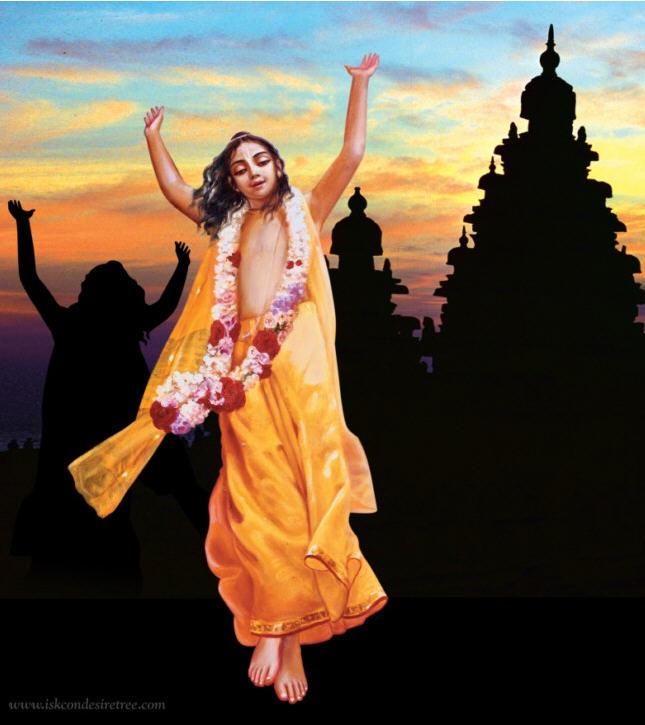
Lokanatha started to cry when he imagined the Lord with his beautiful curls shorn and the distress the Devotees would feel at his departure. (In the image: Lord Chaitaniya is going to take a sannyasa).

   Bhugarbha Goswami’s initiating guru was Gadadhara Pandit Goswami. He is therefore considered to be Gadadhara’s branch. Shri Bhagavata Das, a fellow disciple of Shrila Gadadhara Pandit Goswami, was also a close friend.

   Bhugarbha and Bhagavata Das are branches of Gadadhara Pandit, both of whom went to live in Vrindavan. (Chaitanya Charitamrita Adi, 12.81)

   Lokanatha Goswami renounced the householder ashrama in 1431 of the Shaka era (1510) and came to meet Mahaprabhu in Navadwip. Mahaprabhu immediately told him to go and live in Vrindavan, telling him that it was his own intention to take sannyas very shortly and go there himself. Lokanatha started to cry when he imagined the Lord with his beautiful curls shorn and the distress the Devotees would feel at his departure. When the Lord saw Lokanatha’s anxiety, he embraced him and consoled him with various spiritual instructions and Lokanatha surrendered completely to him. When Bhugarbha saw how unhappy Lokanatha was, he decided to accompany him to Vrindavan. The two companions walked through Rajmahal, Tajpur, Purniya, Lukhnow and many holy places before finally arriving in Braj. 

Dhananjaya Pandit – Biography

Dhananjaya Pandit

"Dhananjaya Pandit was a very rare soul. Nityananda Prabhu was always present in his heart." (C.B. Antya 5.733) (In the image: Sri Nityananda Prabhu).

   "Dhananjaya Pandit was a very rare soul. Nityananda Prabhu was always present in his heart." [C.B. Antya 5.733] 

   His Shripat is at Sitalgram, Mangal Kota Khana, Barddhaman district. There is a railway station at Kaichor on the metre gauge line from Katwa to Barddhaman. If one gets down at Kaichor, then it is about a twenty minute walk to the village of Sitalgram. 

   Dhananjaya Pandita also stayed at Sanchra Panchra for some time. According to the opinion of some he was born in the village of Jargram, within the district of Chattagram. He was present during Mahaprabhu's sankirtana pastimes in Navadwipa. After returning from Vrindavana, he also worshipped the Deities at Jalandigram.

   At present the Deities of Sri Gopinatha, Sri Sri Nitai-Gaura and Sri Damodara Salagram-sila are being worshipped there. He has no descendants, but he had a brother by the name Sri Sanjaya, whose son was Sri Rama Kanai Thakura. His Sripat is located at Mulukgrama (near Bolpur). Sanjaya was perhaps the disciple of Dhananjaya Pandita. The present sevakas at Sitalgram are the descendants of Dhananjaya Pandit's disciple.

   His disappearance is on the eighth day of the bright fortnight, in the month of Kartik. 


Gadadhara Dasa Gosawami – Biography

   Shri Gadadhara dasa Thakura previously lived at Navadwip. When the Lord went to live at Nilachala Shri Dasa Gadadhara also went there to be with Him. Later on Mahaprabhu sent him back with Nityananda Prabhu to preach in Bengal. He first stayed at Eriyadahagram, which is situated on the banks of the Ganges. Then he spent some time in Navadwipa, taking care of Sachi Mata and Vishnupriya, but after their disappearance he came to live at Katwa, where Mahaprabhu had accepted sannyasa from Keshava Bharati.

   He was a very confidential associate of Sri Sri Gaura-Nityananda. In Gaura-ganoddesa-dipika it is stated that he is an incarnation of the effulgence of Shrimati Radharani's body, as well as an expansion of Purnananda gopi. Though he was one of the associates of Nityananda Prabhu, the majority of whom were cowherd boys and thus situated in the mellow of friendship, he was always absorbed in the mood of a gopi. 

Gadadhara Dasa Goswami

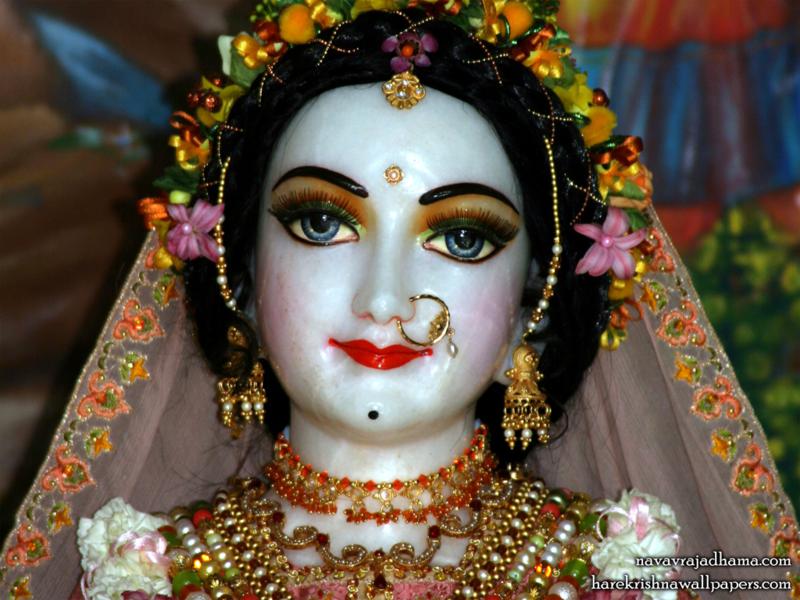
In Gaura-ganoddesa-dipika it is stated that he is an incarnation of the effulgence of Shrimati Radharani's body, as well as an expansion of Purnananda gopi. Though he was one of the associates of Nityananda Prabhu, the majority of whom were cowherd boys and thus situated in the mellow of friendship, he was always absorbed in the mood of a gopi. (In the image: Shrimati Radharani, Krishna-Valley, ISKCON Hungary).

   Once, as he was carrying a pot of Ganges water on his head, he called loudly, "Who wants to buy some milk?" Sometimes he would say, "Here is some first class yogurt. Whoever wants to buy some, come here." Calling out like this, he would then laugh very loudly.

   When Mahaprabhu instructed Nityananda Prabhu to preach in Bengal, He sent Shri Rama dasa and Shri Gadadhara dasa along with Him. [C.C. Adi 11.13,14]

   One day Nityananda Prabhu came to Dasa Gadadhar's Temple at Eriyadahagram. In the Temple was a very beautiful Deity of Sri Bala Gopala, which Nityananda Prabhu carefully picked up from the altar. While holding Him against His chest, He began to dance in ecstasy. When all of the Devotees saw that Gopala had taken shelter of the heart of Shri Anantadeva, they made the heavens resound with the vibrations of "Hari! Hari!" Nityananda Prabhu, who was very robust and heroic, then began to roar very loudly while engaging in His ecstatic dance with Gopalaji. 

   Then Madhavananda Ghosa began to sing some songs describing Krishna's dan-lila (from Dan-keli-Kaumadi). Hearing his sweet voice and the poetic descriptions of Krishna's dan-lila, Nityananda exhibited all of the ecstatic symptoms within His body simultanously as He danced like one intoxicated. The gestures He exhibited while dancing were like slashes of lightning; His limbs moved with unparalleled grace. His expressive eye movements, His sweet smiling and eruptive laughter, and the shivering and quaking of His head, provided a feast for the Devotees' eyes and ears. Bringing His two beautiful lotus feet together, He would then jump in such a way as to completely captivate ones mind. Whomever He would look at would find themselves floating in an ocean of the mellows of love of Krishna, and by His merciful glance they forgot about the existence of their physical body. The level of devotion that is sought by great yogis and munis was attained that day by the ordinary men and women of that place, as they relished the remnants of Lord Nityananda's love for Krishna. 

Gadadhara Dasa Goswami

Hearing his sweet voice and the poetic descriptions of Krishna's dan-lila, Nityananda exhibited all of the ecstatic symptoms within His body simultanously as He danced like one intoxicated. The gestures He exhibited while dancing were like slashes of lightning; His limbs moved with unparalleled grace. His expressive eye movements, His sweet smiling and eruptive laughter, and the shivering and quaking of His head, provided a feast for the Devotees' eyes and ears. Bringing His two beautiful lotus feet together, He would then jump in such a way as to completely captivate ones mind. Whomever He would look at would find themselves floating in an ocean of the mellows of love of Krishna, and by His merciful glance they forgot about the existence of their physical body. The level of devotion that is sought by great yogis and munis was attained that day by the ordinary men and women of that place, as they relished the remnants of Lord Nityananda's love for Krishna. (In the image: Lord Nityananda).

   Someone as fat as an elephant becomes so thin and weak if he fasts for three days that he can barely walk. However, by the mercy of Nityananda Prabhu, one small child of that village didn't eat anything for one month, yet his movements and behavior were like those of a lion. Such was the mysterious influence of Nityananda Prabhu, though no one could understand His activities due to the Lord's yogamaya potency. Nityananda Prabhu thus enjoyed various pastimes at the Temple of Gadadhar dasa Thakura.

   In Shri Chaitanya-bhagavata, Shri Vrindavana dasa Thakura has described the glories of Dasa Gadadhara in this way: "Nityananda Prabhu was personally present within the body of Shri Gadadhara das; such are his glories."

   Amongst Chaitanya Mahaprabhu's associates, no one wanted to go near the Mohammedan Kazi for fear that he might lose his caste. Simply by looking at the face of a Mohammedan, a Hindu would lose his name in society. It was Dasa Gadadhara who had the power to influence the notorious Kazi, and so he bestowed his merciful glance upon him. Even at their first meeting, he was able to lift that Kazi beyond the limits of his caste and creed, and thus those limitations completely fell away.

   One day Shri Gadadhara dasa Thakura, intoxicated in ecstatic love while chanting the Holy Names of Hari, came to the house of the Kazi at Eriyadahagram and began to call him. The Kazi, in a fit of anger, came storming out of his internal apartment, but upon seeing the transcendentally serene appearance and mood of Dasa Gadadhara Prabhu, he became stunned. His anger softened and his expression became friendly. The Kazi inquired, "Thakur, why have you come just now?"

   Dasa Gadadhara Thakura answered, "I should like to have a few words with you." "Yes, whatever you have to say, just speak up."

   "Shri Shri Gaura-Nityananda have appeared on this earth to distribute the nectar of the Holy Names to all classes of men, from the highest to the lowest, even to the most sinful, despicable persons. Why haven't you accepted this sweet treat? Why haven't you taken up the chanting of these nectarean Holy Names?"
   "We'll accept it tomorrow."

   "Why tomorrow?! Today you should accept. I have come here today to deliver you from the depths of ignorance and sin by the power of these Holy Names. So you please take this supremely auspicious Harinama. I will deliver you from all your sinful activities this very day."

   Having listened to Gadahara dasa Thakura's sweet speech, the Kazi became a little bewildered. He began to laugh and said, "Tomorrow I'll say Hari."

   When he heard the two syllables 'ha' and 'ri' emanate from the Kazi's mouth, Dasa Gadadhara Thakura became overwhelmed in the happiness of ecstatic love and exclaimed, "Tomorrow?! Sir, you said Hari just now! All of your sins have fled far away. You have become supremely pure." Saying this he began to dance in ecstasy. 

Gadadhara Dasa Goswami

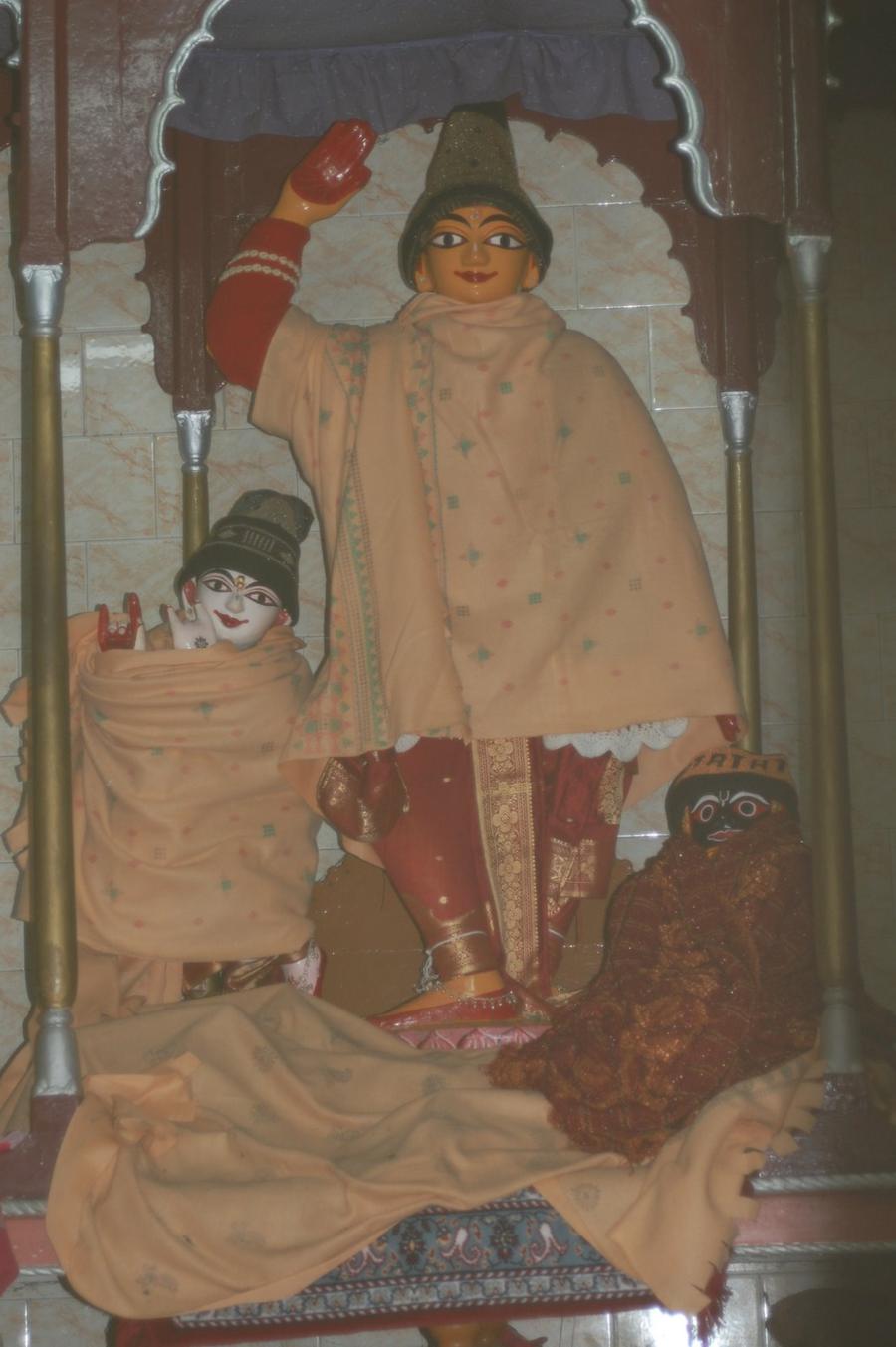
Lord Shri Shri Nitay Gauranga and Lord Shri Jagannath, Kattwa.

   The Kazi, having been purified by the transcendental vibration of Hari, took shelter at das Gadadhara Thakura's lotus feet. In this way, das Gadadhara Thakura delivered many sinful, wicked yavanas and other such people.

   He disappeared on the eighth day of the bright fortnight in the month of Kartik.

   Eriyadaha gram is reached from Calcutta by bus from Esplanade. Gadadhara dasa Thakura's samadhi-mandir and the samadhi of the hair of Lord Chaitanya shaved off by the barber Madhi Sil when He accepted sannyasa are united within the same tomb at Keshava Bharati's ashrama at Katwa.

   Sri Dasa Gadadhara Thakura established a Temple at the place where Mahaprabhu accepted sannyasa, and the Deity of Lord Gauranga was personally installed by him. This Deity is one of three Deities which were carved from one Nimba tree as per the order of Shriman Mahaprabhu, which he communicated to Narahari Sarkar Thakura and the bhakar (Deity-maker) on the same night through the medium of their dreams. The next day, when the two met and learned that they had both had the same dream, they could understand that they should carry out the Lord's instruction immediately. The other two Deities are at Sri Khanda. There is also a Deity of Balarama (Nityananda) who is about half the size of Mahaprabhu and who came later on. Thus the Deities here are known as Shri Shri Nitai-Gauranga.

   There is a local anecdote concerning this Deity of Balarama. He is said to have once been worshiped by Mineketana Rama dasa, who used to carry this Deity of Balarama with him wherever he went. Mineketana Rama's body was very strongly built, so he would carry Balarama upon a simhasana mounted on his back. The simhasana itself weighed perhaps twenty kilos. When he became somewhat advanced in years and it was difficult to carry the simhasana, he entrusted the worship of his Balarama to the pujari of Lord Gauranga here.

   There is another story that claims that as Mineketana was a non-Bengali, his native tongue was a non-Bengali dialect. In his language, the word for hair was awa. Thus the name of the place where Mahaprabhu accepted sannyasa became Katwa, literally meaning 'cutting hair' or 'the place where Prabhu's head was shorn of its beautiful locks.' The previous name of this place was Kantak Nagar, supposedly given by Sachi Mata. Kantak means thorn. The disciple of Dasa Gadadhara was Yadunandana Chakravarti. The present sevakas of this Temple are his descendents. This is a very nice Temple where many of the local people attend the arati ceremonies and classes on the devotional scriptures. There is a railway station at Katwa. From there one should go by ricksaw to Gauranga Bari.

Gadadhara Dasa Goswami

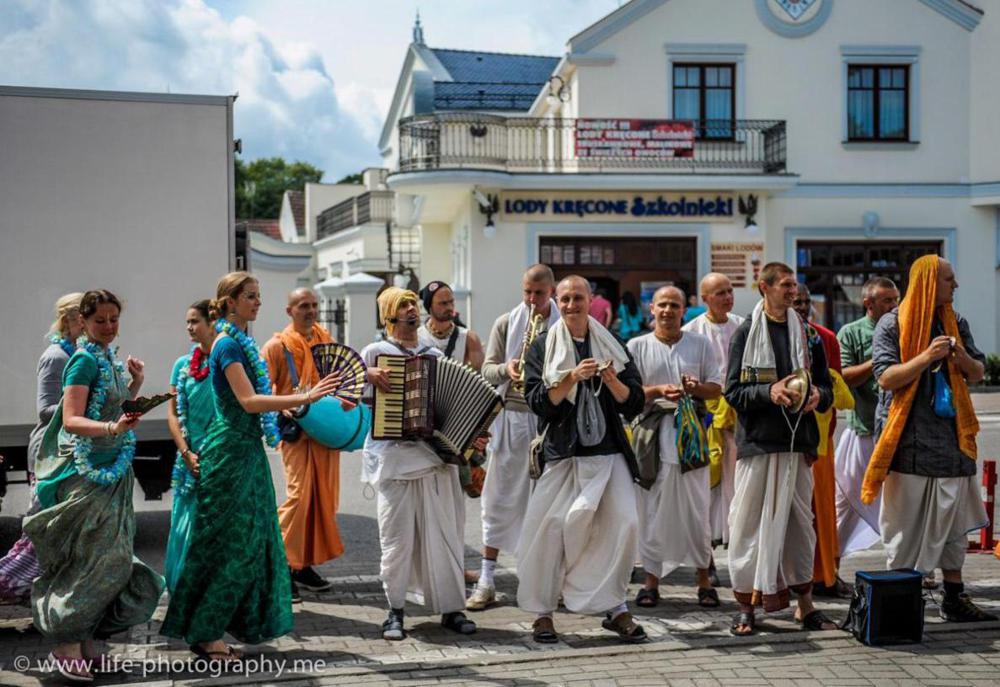
"Why tomorrow?! Today you should accept. I have come here today to deliver you from the depths of ignorance and sin by the power of these Holy Names. So you please take this supremely auspicious Harinama. I will deliver you from all your sinful activities this very day." (In the image: Harinaam Sankirtan party, Woodstock, Poland).

Haridasa Thakura – Biography

Haridasa Thakura

Shrila Haridas Thakur.

   Shri Haridas Thakur appeared in this world in the village of Buron, in the present district of Sat-kira, which was previously a sub-division of Khulna, Bangladesh. By this great fortune that land has been blessed, in that the chanting of the Holy Names of Hari-Naam Sankirtan, became revealed there. After remaining there for some time, he came to the banks of Ganga at Fulia, near Shantipur. Advaita Acharya was overjoyed to get his association and roared very loudly. The two of them thus began to float in the waves of the mellows of pastimes of Shri Krishna – Govinda. [C. B. Adi 16.18]

   Shri Haridas Thakur is an eternally liberated associate of the Lord. The associates of the Lord are worshipable wherever they make their appearance. Just as Garuda appeared as a bird, and Hanuman as a monkey, Haridas Thakur appeared in a family of Yavanas (Mohammedans). From his very birth he was very deeply devoted to the Holy Names of Shri Krishna.

   When he came to live by the banks of the Ganges, Advaita Acharya was very happy to get his association. The brahmana residents of Fulia were very pleased to see how he worshipped the Holy Name, and they used to come everyday to have his darshan. Gradually word began to spread of his glories. When the Mohammedan administrator came to know of all this he began to burn with malice and went to the local Mohammedan king to inform him, "Though he is Mohammedan, he behaves as a Hindu, are therefore he should be brought here for trial." Hearing the words of that sinful man, the local king who was also very sinful, had Hari das Thakur brought there immediately. [C. B. Adi 16.37].

   The Mohammedan King told Haridas, "Just give up this chanting and say the Kalma (prayer of the Mohammedans)."

   Haridasa Thakura replied, "The Supreme Lord is one, though His names might be different. The Hindu shastras are the Puranas and the Muslim sastra is the Koran. Everyone acts as he is inspired by the Lord, as also do I. Some yavanas become Hindus and some Hindus become yavanas, to worship the Lord. Oh Maharaja, you can now judge me." 

   Hearing these words the Kazi replied that it would be necessary to punish him. Hearing the decree of the Kazi, the Muluk pati addressed Haridasa, "My brother, just follow your own religion. Then you will have nothing to worry about. Otherwise you will have to be punished."

   In reply to this Haridasa Thakura exclaimed, "Even if you cut my body into pieces, I will never give up the chanting of Hari nama." [C. B. Adi 6.94]

   After hearing these words of Haridasa spoken with great determination, the Kazi declared, "He should be beaten in twenty two market places. If he doesn't die after this, then I will know that the learned gentleman speaks the truth."

   Thus having heard the words of the Kazi, the sinful Muluk pati then ordered that Haridasa Thakura be beaten in twenty two market places. Haridasa remembered the Lord by chanting "Krishna Krishna", and in the happiness of that remembrance, he didn't feel any bodily inconvenience. [C. B. Adi 16.102]. 

Haridasa Thakura

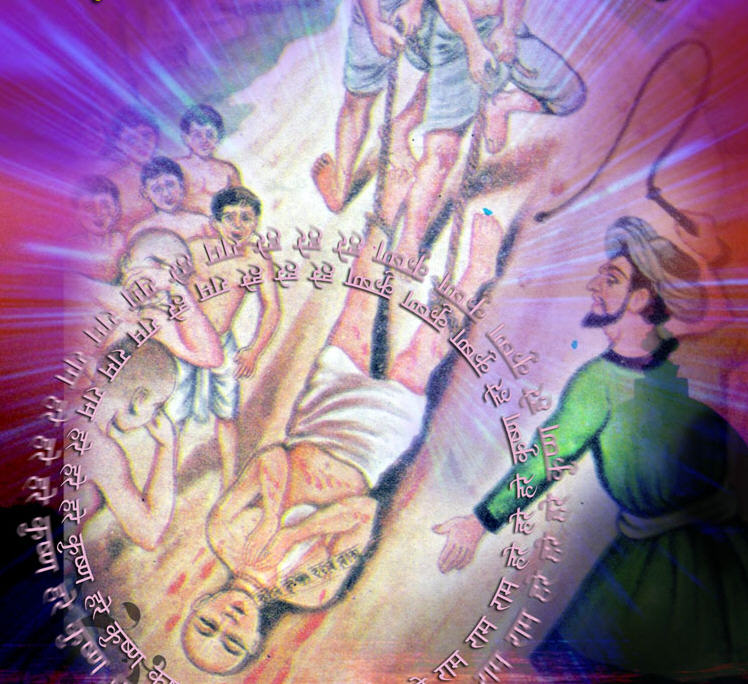
Thus having heard the words of the Kazi, the sinful Muluk pati then ordered that Haridasa Thakura be beaten in twenty two market places. Haridasa remembered the Lord by chanting "Krishna Krishna", and in the happiness of that remembrance, he didn't feel any bodily inconvenience. (C. B. Adi 16.102) (In the image: Haridas Thakur was beaten in 22 market places).

   As the demoniac associates of Hiranyakashipu tried in so many ways to kill Shri Prahlada Maharaja, but were unsuccessful, similarly the demoniac Mohammedans, though they tried to harm Haridasa Thakura, were unable to do so. Haridasa Thakur was immersed in the nectar of the Name and thus gradually the Mohammedans could understand that he wasn't an ordinary person.

   Thus they humbly submitted to the Thakura, "Haridasa! We can understand that you are a genuine saintly person. No one can do anything to you. But the Mulukpati won't understand any of this. Rather he will have our heads." Hearing their frightened please Haridasa's external consciousness ceased and he entered into deep meditation on the Lord's Holy Name.

   Then the Mohammedans carried his body on their shoulders to the Mulukpati, who surmised that he was dead. Thinking as such he ordered that his body be thrown in the Ganga. Haridasa's body floated down the Ganga until he reached Fulia ghat, where he got out of the water and began to loudly chant Hari Nama. Seeing the greatness of Haridasa Thakura, the Mulukpati became fearful. Along with the other Mohammedans he came there and begged Haridas Thakur to forgive him for his offence.

   Considering him to be a holy man, they all offered their salutations and thus were delivered from their offences. Having witnessed the pastimes of the Thakura the Devotees were in ecstasy.

   Haridasa Thakur used to chant Hari Nama in a hollowed out cave like hole at the base of a tree. This "cave" still exists near Fulia, on the banks of the Ganga. One can get there by train from Shantipura. Within the roots of this tree also lived a poisonous snake. Being fearful of this snake the Devotees couldn't remain there for very long and one day they mentioned to the Thakura about this snake which was worrying them. Seeing the distress of the Devotees Haridasa Thakur called to that snake and spoke to him, "My dear sir, if in fact you are residing here, then I am requesting that you please leave by tomorrow, otherwise I myself will definitely leave here."

Haridasa Thakura

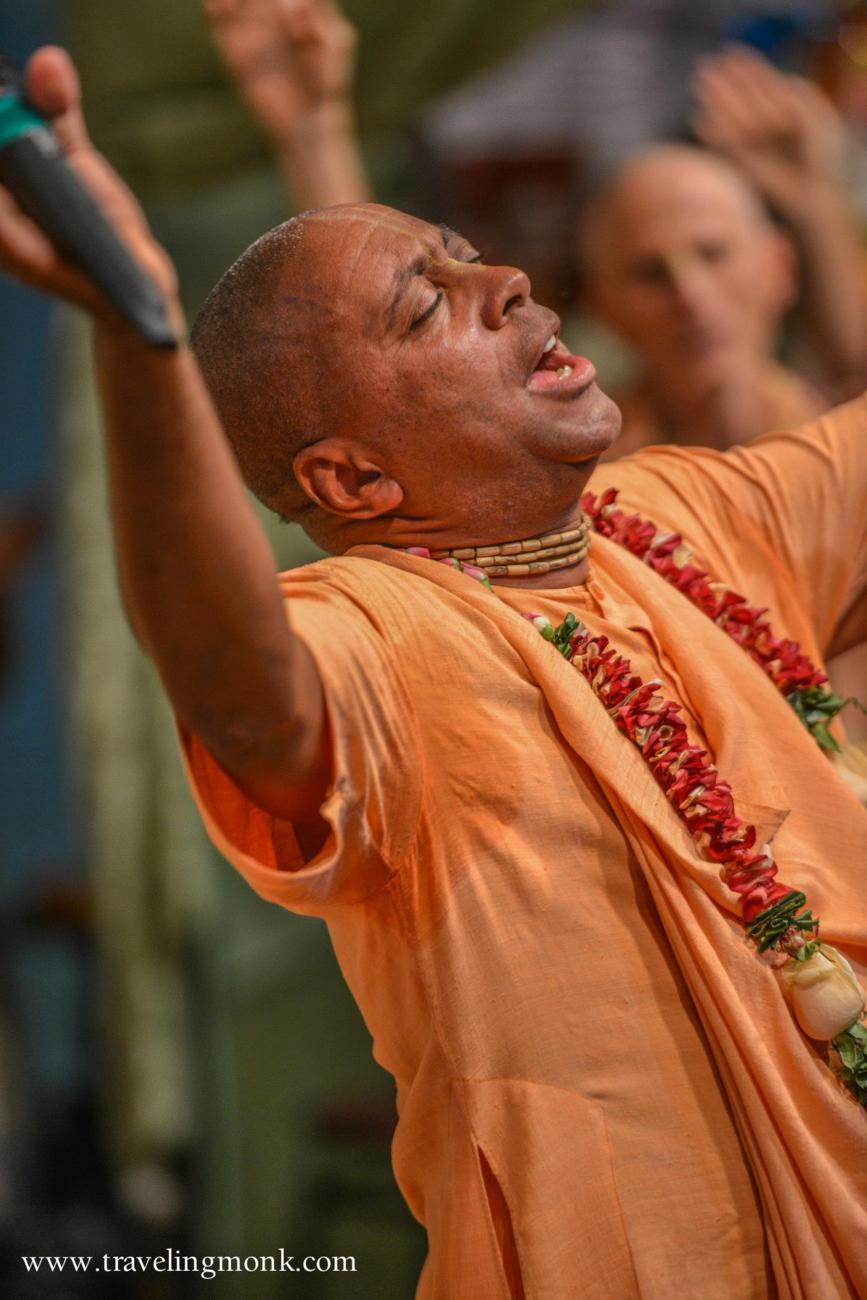
One time Haridasa Thakura came to a village within Jessore district named Harinodegram, which was predominantly inhabited by brahmanas. One day during a religious discussion one puffed brahmana approached Haridasa Thakura and remarked, "Oh Haridasa! Why do you chant the Holy Name loudly? In the scriptures it is recommended to chant within the mind." In reply Haridasa Thakura told him, "The birds, beasts and insects cannot chant themselves, but if they get to hear Hari Nama then they also become delivered. If one chants only to himself then he delivers only himself, but if one chants loudly, the benefit is a hundred times greater. This is the conclusion of the scriptures." (C. B. Adi 16.180) (In the image: Bhakti Sangam Festival, Ukraine).

   Hearing these words of the Thakura, that snake immediately came out of its hole and after offering namaskar to the Thakura, it went elsewhere. Seeing this pastime, the Devotees were struck with wonder and they developed profound and deep devotion for Haridasa Thakura.

   One time Haridasa Thakura came to a village within Jessore district named Harinodegram, which was predominantly inhabited by brahmanas. One day during a religious discussion one puffed brahmana approached Haridasa Thakura and remarked, "Oh Haridasa! Why do you chant the Holy Name loudly? In the scriptures it is recommended to chant within the mind." In reply Haridasa Thakura told him, "The birds, beasts and insects cannot chant themselves, but if they get to hear Hari Nama then they also become delivered. If one chants only to himself then he delivers only himself, but if one chants loudly, the benefit is a hundred times greater. This is the conclusion of the scriptures." [C. B. Adi 16.180]

   Hearing this objective statement of Haridasa Thakura that sinful brahmana couldn't tolerate it and exclaimed, "In Kali yuga sudras will recite the shastras, now I am seeing this with my own eyes." In answer to this personal insult delivered by that miscreant brahmana, Haridasa Thakura simply silently walked out of that assembly. Within a few days that brahmana contracted ulcerous leprosy. The result of Vaishnava aparadha became immediately manifest. In Kali yuga, Rakshasas take birth in brahmana families in order to give trouble to the honest, virtuous people. [C.B. Adi 16.300]

   Another time, Haridasa desired to have darshan of the Vaishnavas of Navadwipa. Everyone there became overwhelmed with ecstasy, to see Haridasa. Advaita Acharya loved Haridasa as much as His own life and he would offer the first Prasadam to Haridasa Thakura (which is to be offered only to high class brahmanas) after performing Pitr-shraddha (worship of his forefathers).

   Haridasa Thakura lived for some time at Benapol, which was within Jessore district. Every day and night he would chant three hundred thousand Holy Names. At the time, when Shri Chaitanya Mahaprabhu displayed His divine opulences by manifesting Himself as the Supreme Personality of Godhead in the courtyard at Shrivasa Pandita's house, He was calling His dear Devotees: "Haridasa! when those Mohammedans were beating you I was ready to destroy them with My Sudarshana Chakra, but as you were praying for their welfare I was unable to do anything." [C. B. Madhya 10.42]

   Therefore I accepted their blows on My own body. Just see, the scars are still here on My body." Seeing those marks Haridasa fainted in ecstatic love. Regaining his consciousness he began to praise the Lord of his life, "O Lord Vishwambhara, master of the universe, please have mercy on this sinner, who has fallen at Your feet. I have no good qualities and am a vile wretch, rejected by all classes of men. How can I describe Your divine character?" [C. B. Mad 20.58]

   Thakura Haridasa was present during most of the Lord's pastimes in Nadia, and when the Lord went to Jagannatha Puri, Haridasa also went and took up residence there. Everyday, after attending Lord Jagannath's mangal arati, Lord Chaitanya would come to see Haridasa Thakura and would bring him some of Lord Jagannath's Prasadam. When Shri Sanatana Goswami and Shri Rupa Goswami would come from Vrindavana to Puri they used to stay with Haridasa Thakura. Haridasa, in order to maintain the etiquette, would not go near Lord Jagannatha's Temple but would offer his obeisances to the Chakra on top of the Temple, from a distance. As he was considered to be a Mohammedan by birth, his presence in the Temple would be objectionable to those who were caste conscious.

   Mahamaya devi took initiation in the maha-mantra from Haridasa Thakura and Chaitanya Mahaprabhu appointed him as the acharya of the Holy Name. His departure from this world, in the presence of Chaitanya Mahaprabhu, is fully described by Shri Krishna dasa Kaviraja Goswami in the Antya-lila of Shri Chaitanya Charitamrta. 

Haridasa Thakura

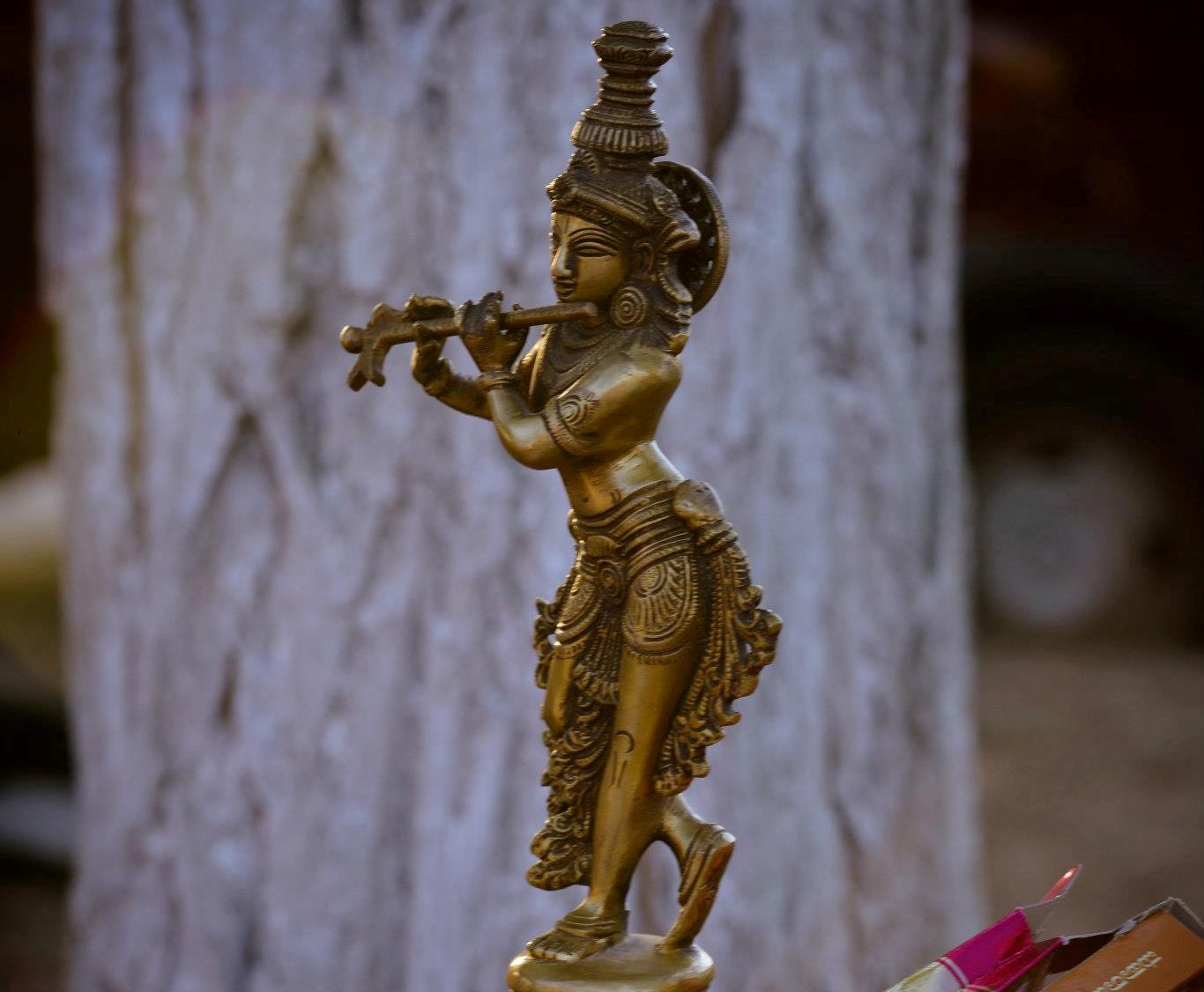
Haridasa Thakura replied, "The Supreme Lord is one, though His names might be different. The Hindu shastras are the Puranas and the Muslim sastra is the Koran. Everyone acts as he is inspired by the Lord, as also do I. Some yavanas become Hindus and some Hindus become yavanas, to worship the Lord. Oh Maharaja, you can now judge me." (In the image: Murti of Supreme Personality of Godhead Shri Krishna).

Sita Thakurani – Biography 4

   Shrimati Sita Thakurani is to be worshiped just as much as Sachi Devi herself, as the mother of the universe. She is the eternal wife of Shri Advaita Acharya. She was the daughter of Shri Nrishinga Baduri. She was married to Shri Advaita Acharya in Phuliya Nagara. 

Sita Thakurani

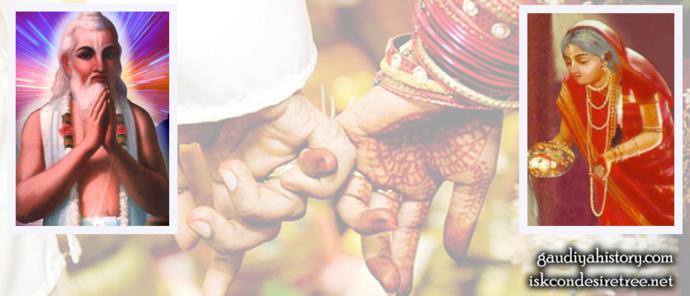
Shrimati Sita Thakurani is to be worshiped just as much as Sachi Devi herself, as the mother of the universe. She is the eternal wife of Shri Advaita Acharya. She was the daughter of Shri Nrishinga Baduri. She was married to Shri Advaita Acharya in Phuliya Nagara. (In the wallpaper: in the left Shri Advaita Acharya, in the right Shrimati Sita Thakurani, wedding ceremony).

   After their wedding, Advaita Acharya went to Nadiya, to live in Shantipura. Sita Thakurani was always absorbed in vatsalya prema for Shri Gaurasundara Prabhu, and, out of parental concern used to instruct Jagannatha Mishra on how to care for the boy. Shri Krishna Dasa Kaviraja Goswami has described the birth celebration at the house of Jagannatha Mishra upon the advent of the Lord, giving special attention to the position of Shri Sita Thakurani. Advaita Acharya's wife, worshipable by all the three worlds was Sita Thakurani. Taking the Acharya's orders on her head, she had come to take a look at this new child, this jewel of jewels, and to offer him presents.

   On the eve of his son's advent Shri Jagannatha Mishra, seeing the imminent signs of his child's arrival, sent word to Advaita Acharya in Shantipura that the long-awaited child was being born. Hearing news of the advent of this unprecedented child, Advaita Acharya floated in the waves of ecstasy. With Shri Haridasa Thakura, he went to bathe in the river, and, after much dancing and song, he sent his wife to go quickly to Mayapura in Navadwipa.

   According to Gaura-Ganodesha-Dipika, Shri Sita Thakurani is Yogamaya. The Gaura-Parshada-Charitvali says that in Krishna Lila, she was Purnamasi, the mother of Sandipani Muni, grandmother of Madhumangal and Nandimukhi and a disciple of Narada Muni. (Gaura-Ganodesha-Dipika, however, says that Paurnamasi in Krishna-lila became Shri Govinda Acharya in Chaitanya lila.)

   In Dvapara-yuga, during the celebration of Krishna's birth ceremony, she was present in the house of Nanda, and at that time gave Nanda and Yashoda many instructions on how to care for the child. The Chaitanya-Charitamrita gives the following account of Sita Thakurani's visit to the house of Jagannatha Mishra after the birth of the Lord: "One day, shortly after Shri Chaitanya Mahaprabhu was born, Advaita Acharya's wife, Sita Devi, who is worshipable by the whole world, taking permission of her husband, went to see that topmost child with all kinds of gifts and presents. She brought different kinds of golden ornaments, including bangles for the hand, armlets, neclaces, and anklets. There were also tiger nails set in gold, waist decorations of silk and lace, ornaments for the hands and legs, nicely printed silken saris and a child's garment, also made of silk.
 
   Many other riches, including gold and silver coinds, were also presented for the child. Riding in a palanquin covered with cloth and accompanied by maidservants, Sita Thakurani came to the house of Jagannatha Mishra, bringing with her many auspicious articles such as fresh grass, paddy, gorochana, turmeric, kunkuma, and sandalwood. All these presentations filled a big basket. When Sita Thakurani came to the house of Sachi Devi, bringing with her many kinds of eatables, dresses, and other gifts, she was astonished to see the newly born child, for she appreciated that except for a difference in color, the child was directly Krishna of Gokula Himself. 
 
   Seeing the transcendental bodily effulgence of the child, each of His nicely constructed limbs full of auspicious signs and resembling a form of gold, Sita Thakurani was very much pleased, and because of her maternal affection, she felt as if her heart were melting. She blessed the newly born child by placing fresh grass and paddy on His head and saying, "May You be blessed with a long duration of life." But being afraid of ghosts and witches, she gave the child the name Nimai. On the day that the mother and son took bath and left the maternity room, Sita Thakurani gave them all kinds of ornaments and garments, and then also honored Jagannatha Mishra. Then Sita Thakurani, being honored by mother Sachi Devi and Jagannatha Mishra, was greatly happy within her mind, and thus she returned home." 

Sita Thakurani

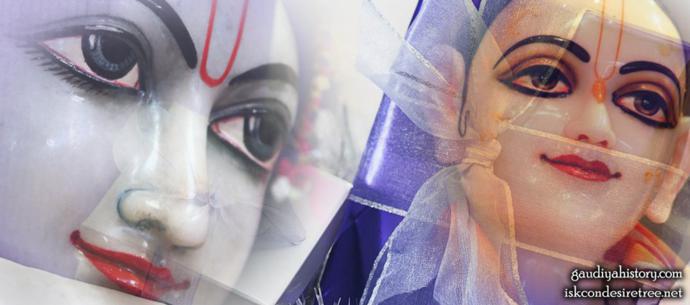
...Sita Thakurani came to the house of Jagannatha Mishra, bringing with her many auspicious articles such as fresh grass, paddy, gorochana, turmeric, kunkuma, and sandalwood. All these presentations filled a big basket. When Sita Thakurani came to the house of Sachi Devi, bringing with her many kinds of eatables, dresses, and other gifts, she was astonished to see the newly born child, for she appreciated that except for a difference in color, the child was directly Krishna of Gokula Himself. (In the wallpaper: Shri Gopinath in the left, ISKCON Chowpatty, Mumbai, gifts, Shri Krishna Chaitanya, ISKCON Chennai).

   From that day on, Sita Thakurani would often come to Mayapura from Shantipura, in order to teach Sachi mata how to care for the new baby. She would give her many different instructions on how to raise children. And after helping with the child in this way, she would return to Shantipura. When it came time for the child's birthday ceremony, Jagannatha Mishra and Sachi Devi let the worshipable Sita Thakurani be the first to offer the child His new clothes.

   Advaita Acharya Prabhu also had a house in Navadwipa. There he would live from time to time and discuss Krishna-katha with the Devotees headed by Shrivasa, diving and surfacing in the waves of joy until the break of dawn. After Shri Gaurasundara's appearance, all the Devotees prayed together with Shri Advaita Acharya and Sita Thakurani that the child might live long in Mayapura and have good fortune.

   Sita Thakurani and Sachi Devi were of one mind; the baby Nimai was their life and soul. Every day Sita Thakurani would go to the house of Sachi Devi and help her with the care and nurturing of the boy. In the house of Jagannatha Mishra, the divine child increased the pleasure of the eyes and minds of all the Devotees, just as the waxing moon gradually grows more brilliant with each passing day.

   After several years, when Jagannatha Mishra's son Vishvarupa Nimai's older brother had grown up, he suddenly took sannyasa. The grief and agony of Jagannatha Mishra and Sachi Devi upon their son's leaving was great. Gaurasundara was also dismayed and unhappy at His brother's separation. At that time Advaita Acharya and Sita Thakurani consoled Jagannatha Mishra and Sita Thakurani, and helped take care of Nimai.

   Shrivasa Pandit's wife Malini Devi also was always very affectionate towards the child, nurturing Him and caring for Him. She and Sachi Devi were of one mind in doing this.

   After exhibiting His childhood pastimes, Nimai gradually progressed into His Kishora-lila, or pastimes of youth. After some time, He went to Gaya and revealed His true form and real purpose. Having returned from Gaya He gathered all the Devotees at the house of Shrivasa Angan for the purpose of beginning kirtan.
 
   At that time, Advaita Acharya brought Sita Thakurani from Shantipura to Mayapura, and, having arrived there was the first to worship the lotus feet of Shri Chaitanya.

   Gradually Shri Gaurasundara began, in Navadwipa, to unfold His kirtan pastimes, wishing to deliver the fallen souls. As time went by He took sannyasa and turned His face towards Vrindavana, and ran off, half mad into the jungle in search for Shri Krishna. Upon hearing this, Shri Sita Thakurani spent four days with Sachi Devi, who, plunged in the darkness of separation as if the sun had left the sky forever, lay fallen on the ground like one near death.

   Shri Chaitanya Mahaprabhu, being bound by the ropes of love, was unable to go to Vrindavana, but was drawn to return to Shantipura. When he arrived in Shantipura, Advaita Acharya and Sita Thakurani felt as if their life has returned. After having fasted for four days, Shri Gaurasundara accepted Prasada cooked by the hand of Sita Thakurani.

   Previous to taking sannyasa also, Shri Chaitanya Mahaprabhu along with Nityananda Prabhu would, from time to time go to the house of Advaita in Shantipura, where they would have a festival and perform Krishna-nama-lila-kirtan all day and all night. The beautiful nature of this subject has been described by Shri Parameshvari Dasa Thakura in his Shri Pada Kalpataru as follows: One day the Lord laughed, having arrived in the Temple of Shri Advaita and thus the son of Sachi took His seat. Along with Nityananda, Advaita sat down, and the two of them began playfully assessing the idea of having a festival. Hearing all this, Sita Thakurani entered smiling. At that time, in sweet words which made the minds of those who heard them blissful, the son of Sachi ruled that there must be a great festival. He said, "Listen Sita Thakurani: we shall extend invitations to all the different Vaishnavas who live nearby. Let whoever hears the sound of our song, resounding through the air, come and join us. We shall invite one and all."

   Saying this, Shri Gaurachandra gave orders to the Devotees saying,
   "You, invite the Vaishnavas."
   "You, ready the mridanga and karatalas."
   "You, prepare sandalwood and aguru for distribution."
   "Have everything ready at the ghat."
   "Carrying out these assignments expertly, and after garlanding the Devotees with flower garlands, the Devotees shall gather together in a circle for an uproarious kirtan."

   Hearing the words of Mahaprabhu, the Devotees followed His orders with great affection, collecting garlands, sandalwood, betel, ghee, honey, and milk, and everything else essential for worhsiping the Lord. The different gifts and fragrant articles for the Devotees and the Lord were then distributed in the proper ways. The kirtan began at midday. At that time everyone chanted "Hari! Hari!" and the mridanga made the whole kirtan auspicious. Thus swims Parameshavara Dasa in the rasik pastimes of the Lord.

   After Shri Chaitanya Mahaprabhu took sannyasa and went to live in Jagannatha Puri, Shri Advaita Acharya and Sita Thakurani used to go and visit Him each year, bringing their son Achyutananda with them. On one such occasion, Sita Thakurani prepared some of the Lord's favorite preparations for Him and invited Him to their home to take lunch. Simply to increase their ecstasy, the Lord, who was always absorbed in Krishna Nama, honored their invitation and took lunch in the home of Advaita and Sita. Sita Thakurani, being always overwhelmed with vatsalya-prema treated Him as affectionately as if He was her own son. The Lord Himself also treated her with the same kind of regard and affection that He had for Sachi Devi herself. Shri Sita Thakurani bore three sons, Achyutananda, Krishna Mishra and Gopala Mishra, who were followers of Shri Chaitanya Mahaprabhu.

   According to Bhakti-Ratnakara, Shri Sita Thakurani's father was Shri Nrishimha Baduri. Sita Thakurani also had a sister, Shri. According to the Gaura-Ganoddesha-Dipika, Sita Thakurani, the wife of Shri Advaita Acharya, is Yogamaya, and her sister Shri is the prakasha or manifestation of Yogamaya.

yogamaya bhagavati, grihini tasya sampratam,
sita rupenavatirna, "Shri" namni tat prakashatah 

Sita Thakurani

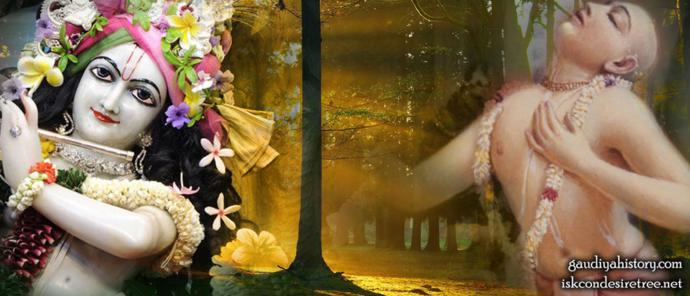
As time went by He took sannyasa and turned His face towards Vrindavana, and ran off, half mad into the jungle in search for Shri Krishna. Upon hearing this, Shri Sita Thakurani spent four days with Sachi Devi, who, plunged in the darkness of separation as if the sun had left the sky forever, lay fallen on the ground like one near death. (In the wallpaper: In the left Shri Gopinath, ISKCON Chowpatty, Mumbai, forest, Lord Shri Chaitanya).

Gauridasa Pandit – Biography

Gauridasa Pandit

Gauridasa Pandit in Krishna lila was a Gopa Subal.

   Across the Ganges from Shantipur, in a small town called Ambika Kalna, which is within the present district of Barddhama, is where Gauri dasa Pandita's Temple is located.

   His worshippable Deities Shri Shri Gaura-Nityananda are still residing in all their splendor there. There is a railway station at Ambika Kalna on the Howrah-Navadwipa line. From there one can proceed by rickshaw to Mahaprabhu Mandira. In the Temple is an old copy of the Bhagavad-Gita on palm leaves which is supposed to have been written by the hand of Mahaprabhu Himself. There is also an oar from a boat which has an interesting story behind it.

   One day, the two Lords Chaitanya and Nityananda came to Kalna from Santipur by boat, paddling it themselves. Lord Chaitanya kept the oar in His hand, and when He entered Gauri dasa's house He gave it to him, saying, "With this you should cross over the ocean of material existence, taking all the living entities with you."

   Gauri dasa Pandita's older brother, Surya dasa Sarakkali, had two daughters, Shri Vasudha and Jahnava Devi. He gave them in marriage to Nityananda Prabhu.

   Near the conclusion of His Navadwipa pastimes, when Mahaprabhu desired to accept sannyasa, He came to Kalna to bid farewell to Gauri dasa. At that time Gauri dasa became extremely afflicted by separation. Hereafter is a nice song which describes what occured at that time:

   "In the Thakur Pandit's house, Lord Gauranga was dancing ecstatically, revolving around and around, while Lord Nityananda chanted 'Hari! Hari!'

   Gauri dasa, however,was crying very piteously and incessantly. He fell at the Lord's feet and begged Him, 'Please don't ever go away from here!

   Just honor this one request: stay here in Ambikanagar – this is my last submission at your lotus feet. If You go away, surely I'll die. Don't try to trick me like You did the gopis, giving some high philosophy about Your 'Bhava-murti' (or anything like that). I must keep You here in such a way that I can see You. You two brothers just stay here with me, thus everyone will become liberated. Again I am petitioning You, don't leave me 'Gaura Hari'. Then I'll know that You are the deliverers of the fallen."

   "Shri Gauranga Mahaprabhu replied, 'Gauri dasa! Give up this idea. You can just serve My Deity form, for I am personally present in that form also. You should know this to be a fact. Just accept what I am telling you as the truth." 

Gauridasa Pandit 3

Across the Ganges from Shantipur, in a small town called Ambika Kalna, which is within the present district of Barddhama, is where Gauri dasa Pandita's Temple is located.

   "Hearing this, Gauri dasa simply let out a deep sigh and continued to cry piteously.
   Again the two brothers tried to console him but his heart refused to be pacified.

   "Dina Krishna dasa is praying at the lotus feet of Lord Chaitanya, that these two brothers might remain there. Thus the two of them were bound by the love of Gauri dasa and therefore the Lord is known as bhakta-vatsala or one who is affectionate to His Devotees.

   "Seeing that Gauri dasa was extremely distraught, Mahaprabhu spoke to him very gently:
   'All right, We'll stay with you. Know in all certainty that We two brothers will stay in your house.'

   "Consoling him in this way the two Lords came before him in the company of two Deities. Seeing the four of them standing before him, Panditji was astonished, and though tears continued to flow from his eyes, now it was not out of sadness. 

   The Lord again spoke to him, 'Whichever two you choose, you can keep in your room. Whichever two you can recognise as Us will stay with you and depend on you to feed Us. Know this to be the truth of truths within your heart.

   "Having heard Mahaprabhu speak these words, Gauri dasa immediately began to cook. He fed all four of them sumptuously and then offered Them nice cloths and garlanded Them with garlands of lotus flowers. Then he offered pan and betel nuts for chewing and smeared sandalwood paste on Their bodies. By serving them in various ways, he gradually regained his former composure and at the same time decided which two he would keep in his house.

   Due to the Pandita's pure love, two Lords remained with him and asked him to feed Them when they were hungry, while the other two went to Nilachala Puri. Gauri dasa Pandita served his two Lords according to Their whims and enjoyed many pastimes with Them.

   "Praying at the lotus feet of such a rare Devotee as Pandita Gauri das, Dina Krishna dasa concludes his song.
   Becoming subservient to Gauri dasa' love, Shri Shri Gaura-Nityananda accepted the archa vigraha form and remained with him to enjoy sporting pastimes."

Gauridasa Pandit

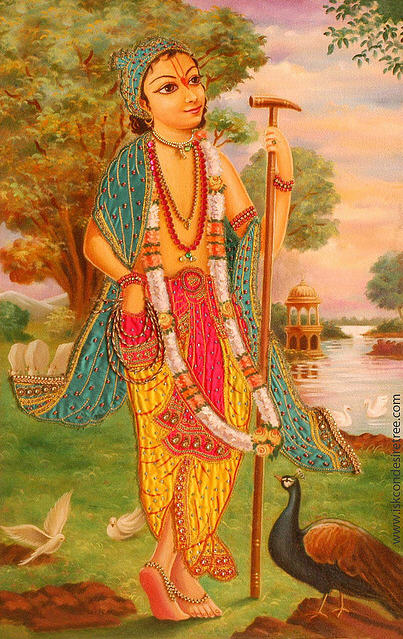
Speaking in this sweet way, suddenly they took the form of Krishna and Balarama. Dressed like cowherd boys, They held buffalo horn, cane and flute in Their hands. Their heads were decorated with peacock feathers and around their necks were garlands of forest flowers, and their lotus feet were decorated with ankle bells... (In the image: Shri Shri Krishna Balaram and Their associates).

   One day the two Lords smilingly spoke to Panditji "Gauri dasa! Previously you were our friend, Subal. Don't you remember how we used to play and frolic, enjoying different pastimes on the banks of the Yamuna?"

   Speaking in this sweet way, suddenly they took the form of Krishna and Balarama. Dressed like cowherd boys, They held buffalo horn, cane and flute in Their hands. Their heads were decorated with peacock feathers and around their necks were garlands of forest flowers, and their lotus feet were decorated with ankle bells. Gauri dasa also assumed his previous appearance and in this way they enjoyed some fun together. After some time, Gauri dasa calmed himself, and the two Lords again sat down on the simhasana.

   Every day, Gauri dasa used to cook many varieties of vegetables and offer them to Their Lordships. He was always absorbed in their service and never perceived his own bodily discomfort. As the years went by, gradually he attained a ripe old age. Nevertheless he continued to serve his Lordships as before, cooking many various preparations for Them. Seeing that he was having to exert himself so much to do so much cooking, one day Shri Shri Gaura-Nityananda feigned anger and refused to eat. Panditji was in turn hurt by this and said, "If You get happiness by not eating, then why do You have me cook in the first place?" After saying this he became silent.

   Lord Gauranga smiled and replied softly, "Your cooking is no small accomplishment. You prepare rice and so many varieties of vegetables. You won't listen if We request you not to make so much but We can't bear to see your hard labor. Whatever you can prepare easily that would be best."

   Hearing Their statement, Gauri dasa replied, "Anyway, whatever I have prepared today, please accept that. From tomorrow I won't feed You with so many preparations. I'll just put some sak on Your plate." Having heard the reply of Gauri dasa, the two Lords laughed and began to eat.

   Sometimes Gauri dasa desired to decorate Their Lordships with ornaments. Coming to know of this, Shri Gaura-Nityananda put on various ornaments and exhibited Themselves in Their full opulence. When Panditji entered the Temple, he smiled with wonder. "Where did so many ornaments come from?" He was simply astonished in ecstasy. In this way Shri Shri Gaura-Nityananda began to manifest Their opulences through various sporting pastimes in Gauri das's house.

   Gauri dasa's dearmost disciple was Shri Hrdayananda. One time, on the occasion of Lord Gaurasundara's birth anniversary, Gauri dasa went to visit some of his disciples. At the time of going he left Hrdayananda in charge of worshiping the Deities, which Hrdayananda began to do in full love. Gradually the appearance day of Mahaprabhu drew very near. When there were only three days remaining, still Gauri dasa hadn't returned home yet. Hrdayananda deliberated for some time about what should be done and finally, being prompted on his own, sent out invitations to all the Devotees and disciples to attend the festival.

   Just after that, Gauri dasa returned. Hrdayananda informed his gurudeva that he had written out invitations and had then sent them to the Devotees. Within himself, Gauri dasa was very pleased by Hrdayananda's service, but externally he feigned great anger and said, "Even in my presence you show so much independence, sending out invitations hither and thither.
Anyway, whatever this upstart has done is done, but he won't be able to remain here."

   Hearing this, Hrdayananda offered his obeisances and went to sit underneath a tree on the banks of the Ganga. Shortly thereafter, a rich man passing by in a boat hailed Hrdayananda, wishing to make a donation. But instead of accepting the donation himself, Hrdayananda sent him to his guru. However, Gauri dasa sent the man back to Hrdayananda and told him to accept the donation and with it to hold a festival on the banks of the Ganga.

   As per the order of his guru, Hrdayananda began to make the necessary preparations. Gradually, the people that he had sent invitations to began to arrive, but upon hearing that a festival was being held on the Ganges riverbank, they proceeded there first. In the company of the many Devotees, Hrdayananda chanted and dance ecstatically. The sankirtan was so blissful and attractive that Their Lordships Themselves, Shri Shri Gaura-Nityananda, came to take part in the dancing and singing. Hrdayananda was very fortunate to see all of this.

   Meanwhile, Gauri dasa was also holding a festival in his house. When the time came for making an offering, the pujari, Boro Ganga dasa Pandita entered the Deity room only to find that there were no Deities. He immediately informed Gauri dasa. Gauri dasa could understand the matter very well and, smiling, he picked up a stick and proceeded towards the kirtana festival on the banks of the Ganges. Arriving there, he saw the two transcendental brothers engaged in ecstatic dancing. Shri Shri Gaura-Nityananda also saw Gauri dasa approaching in an angry mood with a stick in his hand, and They quickly and silently entered the Temple of Hrdayananda's heart. Seeing this Gauri das couldn't restrain his tears of ecstasy. He forgot his anger and ran towards Hrdayananda with his arms outstretched. Firmly embracing him he said, "You are so fortunate! From today your name is Hrdaychaitanya."

   Gauri dasa began to bathe him with his tears as Hrdaychaitanya fell at his lotus feet. Then Gauri dasa took Hrdaychaitanya and all of the Devotees to his courtyard where intense chanting and dancing continued. The assembled Vaishnavas filled the day with the vibrations of "Hari! Hari!" In this way the birth anniversary celebration of Gaurasundara was observed. Thereafter Gauri dasa appointed Hrdaychaitanya as the sevaka of the Deities. 

Gauridasa Pandit

"Shri Gauranga Mahaprabhu replied, 'Gauri dasa! Give up this idea. You can just serve My Deity form, for I am personally present in that form also. You should know this to be a fact. Just accept what I am telling you as the truth." (In the image: Shri Shri Gaura Nitay Deities, ISKCON Chennai).

Raghunandana Thakura – Biography

Raghunandana Thakura

Shri Uddhav das sings the glories of Raghunandan, who is non different from Madan (Cupid).

   Shri Mukunda Das, Madhava Das and Shri Narahari Sarakar Thakur were three brothers who lived in the village of Shri Khanda. Raghunandan was the son of Shri Mukunda Das. [C. C. Mad 15]

   In the house of Shri Mukunda Das, who lives at Shri Khanda, Lord Shri Gopinath is served with great devotion. One day Mukunda was called out to do some work, and then he instructed his son Raghunandan to worship the Deity and asked him to serve the Lord Gopinath that day. He explained to him that this Deity is in our family for many generations and thus He has been worshipped by my father and his father and his father on and on, in this way for many years. Just as your mother feeds you and I everyday, so also He has to be fed everyday. Having explained to Raghunandan that this is a very big responsibility and he should be very careful to give his full attention to this service, Mukunda went out. Raghunandan meanwhile having been instructed by his father, collected the items for offering to Shri Gopinathji and entered into the Deity room. Raghunandan was at that time barely 5 years old and therefore, when he saw that Gopinath hadn't eaten the offering after he had imitated how his father offered the bhoga, he became very worried. Ultimately he simply requested Gopinath with tears in his eyes: "Please eat! Eat!" Gopinath became completely subjected by Raghunandan's simple request, which was made entirely in love, and thus He stealthily ate up everything without leaving any remnants.

   After some time Raghu-nandan's father, Mukunda, returned and asked his son if he had done as he was told? When his son replied "Yes", then Mukunda asked him to bring some of the Prasadam. Raghunandan replied, "Prasadam? I offered everything just like you told me, and Gopinath ate everything; so what should I bring you now?" Mukunda was completely taken aback. "This boy is not naughty and is always accustomed to speak the truth. I doubt if he could have eaten everything. I wonder what actually happened?"

   Musing on this matter in this way for some time, on another day his curiosity was so stirred that he again requested Raghunandan to offer the bhoga to Gopinath on that day. On this day however, having gone out of the house, he again came in by another way and remained hiding in one place. Raghunandan was very happy to be able to serve Shri Gopinathji again and brought everything into the Deity room. As before, he again very insistently persuaded Gopinath to take his meal. As Gopinath had eaten half of a laddu, He espied Mukunda peering out from his hiding spot. He didn't try to cover up the fact that He had eaten what He had, but neither did He eat anymore. Seeing all this Mukunda was completely immersed in ecstatic love and picked up his son and put him on his lap. He extolled his virtues in a voice trembling with ecstasy, all the while torrents of tears of joy falling from his eyes. Even today, those who are greatly fortunate can still see that half-eaten laddu in Gopinatha's lotus hand. Thus Shri Uddhav das sings the glories of Raghunandan, who is non different from Madan (Cupid).

   Raghunandan was present at the khetori utsob. In Krishna lila he was Kandarpa manjari & in Dwaraka lila he was Shri Krishna's son Kandarpa. Raghunandan's son is Kanai Thakur. His descendants are still residing at Shri Khanda. Shri Khanda can be easily reached from Katwa by bus or train. He was born in the year 1432 Sakabda. 

Raghunandana Thakura

Raghunandan was at that time barely 5 years old and therefore, when he saw that Gopinath hadn't eaten the offering after he had imitated how his father offered the bhoga, he became very worried. Ultimately he simply requested Gopinath with tears in his eyes: "Please eat! Eat!" Gopinath became completely subjected by Raghunandan's simple request, which was made entirely in love, and thus He stealthily ate up everything without leaving any remnants. (In the wallpaper: a small Deity on the right corner Shri Gopinatha Deity of Raghunandana Thakur, Shrikand, Shri Govinda, ISKCON Tirupati, a boy).

Shrinivasa Acharya – Biography 2

Shrinivasa Acharya

“Chaitanya Das desires to have a son. Indeed his wife will give birth to a jewel of a son, who will be named Shrinivasa. He will be the manifest form of My love and will be non-different from Me. He will increase everyone’s enthusiasm for devotion. Through Rupa and others I will bring scriptures into the world, and through Shrinivasa, shall distribute them.” (In the wallpaper: In the left Shri Vijaya Gauranga, ISKCON Budapesht, in the right Shrinivas Acharya, Gaudiya books with the purports of Shrila Prabhupada, book distribution in Santa Monica).

   Shrinivas’s Birth
 
   Shrinivasa Acharya was born in 1530 AD, on the full moon day of the month of Vaishakh, in the village of Chakhandi, which lies just north of Agradwipa in the district of Nadiya. His father, Gangadhara Bhattacharya, was a Brahmin of the Rarha class. The Bhakti-ratnakara describes the event as follows:
 
   When Mahaprabhu took sannyas in Katwa, Gangadhara was overcome with grief and began to cry constantly while calling out the names “Ha Chaitanya! Ha Chaitanya!” When other Devotees saw him intoxicated in divine love for Mahaprabhu, they nicknamed him Chaitanya Das, a name which stuck with him for the rest of his life.
 
   Chaitanya Das had no desire for the things of this world, but one day he suddenly felt a strong wish to have a son and told this to his wife, Lakshmipriya. She responded by telling him to immediately go to Puri to ask Mahaprabhu for His blessings. The couple left for Puri, stopping for a few days at the house of Balaram Vipra, Lakshmipriya’s father, in Jajigrama. When they arrived in Puri, Chaitanya Das and his wife paid their obeisances to Mahaprabhu, but before they could speak, the Lord Himself said, understanding their desire, “Jagannath Deva will surely fulfill all your desires.”
 
   The other Devotees were curious about what desire Mahaprabhu was talking about and they asked His servant Govinda. But before he could say anything, Mahaprabhu called Govinda and gave him the answer: “Chaitanya Das desires to have a son. Indeed his wife will give birth to a jewel of a son, who will be named Shrinivasa. He will be the manifest form of My love and will be non-different from Me. He will increase everyone’s enthusiasm for devotion. Through Rupa and others I will bring scriptures into the world, and through Shrinivasa, shall distribute them.” 
 
   At that time, the Lord called Govinda and said in a deep voice, from a trance state, “The Brahmin has come here, desiring a son. He will soon have one, whom he will name Shrinivasa. I will bring scriptures into the world through Shri Rupa and others and these jewel-like books will be distributed by Shrinivasa. Shrinivasa is the embodiment of pure love for Me. All minds will be enthused upon seeing him.” (Bhakti-ratnakara 2.120-3)
 
   Once they had received Mahaprabhu’s blessing, Chaitanya Das and his wife returned to his home and when the auspicious moment came, a son was born to them. Chaitanya Das immediately offered the child to Mahaprabhu.
 
   The child went through the usual rituals of the first feeding of solid food, name-giving, hair-cutting, etc. All the local associates of Mahaprabhu, such as Govinda Ghosh and the residents of Shrikhanda, Narahari and Raghunandan, poured down affectionate blessings on the child.
 
Early Education and Travels
 
   Shrinivasa Acharya was devoted to his parents. He was fortunate to hear both Mahaprabhu’s divine glories as well as Radha and Krishna’s Vrindavan pastimes from his father. The two of them would go into an ecstatic state as they discussed these transcendental topics. Shrinivasa’s mother trained him in kirtan.
 
   He studied grammar, literature and poetic theory from Dhananjaya Vidyavachaspati, and quickly acquired mastery of these subjects. Not long afterward, Shrinivasa’s father died. The loss of his Devotee father’s association greatly affected Shrinivasa, but the other Devotees made a concerted effort to console him and his mother in their grief.
 
   Shrinivasa took his mother and moved from Chakhandi to his maternal grandfather’s house in Jajigrama, where the villagers were overjoyed to see him. Shortly thereafter, he went to visit Narahari Sarkara in nearby Shrikhanda. From Narahari he learned that Mahaprabhu would shortly be ending His earthly pastimes. This news made Shrinivasa determined to see the Lord before it happened. He quickly returned to Jajigrama and took permission from his mother to make the trip to Puri. He then joined the Devotees on the annual pilgrimage. It was the fifth day of the waxing moon. 
Shrinivasa Acharya

Before arriving in Puri, however, the news arrived that Mahaprabhu had indeed ended His lila. Shrinivasa Acharya fainted at the news, and when he came back to consciousness, he decided to commit suicide. However, the Lord Himself appeared to him in a dream and told him to complete his journey to Puri. Once in Puri, he again had a dream in which he saw Jagannath, Subhadra and Balaram, as well as Chaitanya Mahaprabhu with His associates. (In the wallpaper: Jagannath, Baladeva and Subhadra Mayi in the right ISKCON New Jersey-Laurence Harbor, USA, Lord Chaitanya and His associates in the left).

 
   Before arriving in Puri, however, the news arrived that Mahaprabhu had indeed ended His lila. Shrinivasa Acharya fainted at the news, and when he came back to consciousness, he decided to commit suicide. However, the Lord Himself appeared to him in a dream and told him to complete his journey to Puri. Once in Puri, he again had a dream in which he saw Jagannath, Subhadra and Balaram, as well as Chaitanya Mahaprabhu with His associates. The incarnation of Mahaprabhu’s pleasure potency, Shrila Gadadhara Pandit Goswami met him and both of them were immersed in an ocean of ecstasy. Shrinivasa also met Raya Ramananda, Paramananda Puri, Shikhi Mahiti, Sarvabhauma Pandit, Vakreshvara Pandit, Govinda, Shankara Pandit, Gopinath Acharya and received blessings from them all.
 
   Shrinivasa Acharya stayed for some time in Puri, hearing Shrimad Bhagavatam from Gadadhara Pandit Goswami. Gadadhara then told him to return to Gauda. When Shrinivasa returned, he heard that Advaita Acharya and Nityananda Prabhu had also disappeared. Once again he determined to end his life, but the two Prabhus appeared to him in a dream to assuage his grief and had him give up his intention.
 
   When he arrived in Navadwip, Shrinivasa was once again plunged into a morass of sorrow at the loss of Chaitanya Mahaprabhu. Vamshivadanananda Thakur saw him in this condition and approached Vishnupriya Devi and asked her to grant an audience to Shrinivasa and bless him. Shrinivasa Acharya was amazed to see the intense renunciation and deep faith of Mahaprabhu’s widow. While in Navadwip, he had a dream of Sachi Devi and received blessings from her, too. Shrinivasa then wandered throughout Bengal, going to all the Shripatas of the associates of Mahaprabhu and Nityananda Prabhu, seeking their blessings. He visited Shantipur, Khardaha, Khanakula Krishnanagara, Shrikhanda, etc., and met Murari Gupta, Shrivasa Pandit, Damodar Pandit, Shuklambar Brahmachari, Gadadhara Das, Parameshvari Das, Jahnava Devi, Vasudha Devi, Virabhadra, Abhiram Thakur, Narahari Sarakara Thakur, Raghunandan Thakur. All these great personalities witnesses Shrinivasa’s intense devotion and told him to go to Vrindavan. Shrinivasa then went to his mother and asked her repeatedly for permission to make the trip which she could not refuse when she saw his great eagerness.
 
Shrinivasa Arrived in Vraja
 
   Shrinivasa then travelled through Agradwipa, Katwa, Maureshvara, Ekachakra to Kashi, Ayodhya, and Prayag. He spent a long time travelling and visiting all these holy places before finally arriving in Vraja. There he heard that Rupa Goswami, Sanatan Goswami, Kashishvara Pandit and Raghunath Bhatta Goswami had all disappeared. Raghunath Das Goswami, Gopal Bhatta Goswami and Jiva Goswami were still living, however. Shrinivasa met all three of them and received their blessings. He was initiated by Gopal Bhatta and took instruction in the Vaishnava scriptures from Jiva. In great affection for Shrinivasa, Jiva commended him to his Deities, Radha Damodar. Shrinivasa met Raghunath Das and Krishna Das Kaviraj in Radha Kund and received their blessings. One day Shri Jiva heard Shrinivasa explain a verse from Ujjvala-nilamani and was so impressed by his erudition that he bestowed the title “Acharya” upon him. Jiva also gave the titles “Thakur” to Narottama and “Shyamananda” to Duhkhi Krishna Das. Jiva ordered Shrinivasa to tour the sites of pilgrimage in the Vraja area with Raghava Goswami. 
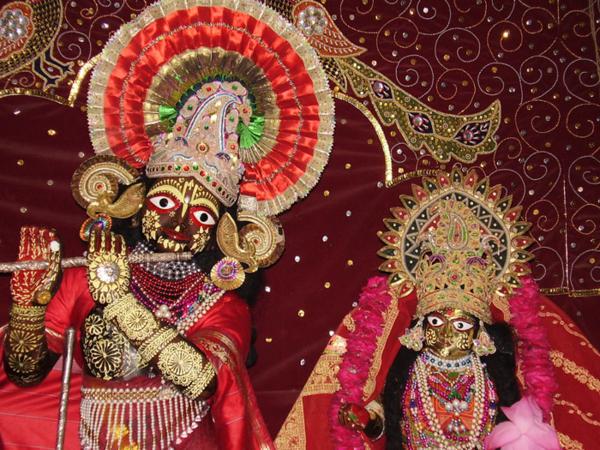
Shrinivasa Acharya

He was initiated by Gopal Bhatta and took instruction in the Vaishnava scriptures from Jiva. In great affection for Shrinivasa, Jiva commended him to his Deities, Radha Damodar. (In the image: Shri Shri Radha Damodara, Shri Vrindavan Dham).

 
The Return to Bengal
 
   After Shrinivasa had attained mastery of the Gaudiya Vaishnava scriptures, Shri Jiva and the other Vaishnavas in Vraja ordered him, Narottama and Shyamananda to take manuscripts of these invaluable books back to Bengal in an ox-cart. They set off on the Shukla Panchami of Agrahayan month. It was a long and dangerous trip, but they were able to cover the greater part of the distance without any trouble. Upon arriving in the Hindu kingdom of Bana Vishnupura, they felt that the danger was over. However, the rumor had reached the capital of Vishnupura that a rich merchant was travelling to Puri with a valuable cargo of merchandise. The ruler of the kingdom led a gang of highwaymen and when he heard that a cargo of great value was passing through his territory, he asked an astrologer to divine the truth of the rumors. The astrologer confirmed that this was indeed a cargo of great value. The king immediately sent a group of robbers to steal it, specifying that they should kill no one. The robbers first worshiped the goddess Chandi, then sent out a spy who returned to tell them that everyone in the group accompanying the oxcart was sleeping in exhaustion after eating their night meal. The robbers thought that this was surely Chandi’s mercy that a golden opportunity like this had come their way. They seized the oxcart and the books, thinking that they were gold and jewels, and turned them over to the king.
 
   When Vishnupura’s king saw the large chest, he was delighted at the prospect of finding large amounts of valuables inside. How disappointed he must have been to see nothing but books inside! He turned to the astrologer and asked him how he could have made such a mistake. The astrologer answered, “I can’t understand it. Every time I made my calculations I came up with the same conclusion: this chest is full of priceless jewels! It is incredible, I don’t know why my calculations have gone wrong!”
 
   The mere sight of the holy books had a purifying effect on the king, however, and he regretted having stolen them. Indeed, he desired to meet with the acharya of the books. That night he had a dream in which the Granthacharya appeared to him and this pacified him somewhat.
 
   The next morning, Shrinivasa, Narottama and Shyamananda awoke to find the chest of books missing. They searched everywhere, but when they failed to find any clue of the books’ whereabouts, they felt so depressed that they considered killing themselves. Some local villagers saw the distressed condition of the three Vaishnavas and immediately suspected the robber king, Vira Hambira. Shrinivasa made some further investigations and was assured that he would be able to find more information from the king himself. The three Vaishnavas felt some hope and abandoned their suicidal intentions. Shrinivasa Acharya decided to remain in Vishnupura in the hope of finding the books, but he sent Narottama to Kheturi and Shyamananda to Orissa.
 
The Conversion of Vira Hambira
 
   While staying in Vishnupura, Shrinivasa heard from a Brahmin named Krishnavallabha that Vira Hambira liked to listen to Shrimad Bhagavatam and daily attended classes. On the next day, Shrinivasa went with this Brahmin to the hall where the Bhagavat classes were held. The Brahmin introduced Shrinivasa to the king as a great Vaishnava, and the king indeed observed the characteristics of a great person in him and was attracted to him. The King expressed a desire to hear Shrinivasa speak on the Bhagavat and Shrinivasa agreed, thinking that this might be a good opportunity to recover the books. So he started to give lectures on the Bhagavat on a daily basis. The King was enchanted by Shrinivasa’s unprecedented explanations of the Bhagavat in his sweet voice. Shrinivasa Acharya primarily preached Mahaprabhu’s dharma through speaking on the Bhagavat and kirtan, while Narottama and Shyamananda primarily used the medium of kirtan. The style of kirtan that these three acharyas used were named manohara-sahi, garanahati, and reneti.
 
   Vira Hambira arranged for a secluded dwelling to be given to Shrinivasa Acharya. One day, when he had the opportunity to find the king alone in his apartments, Shrinivasa recounted the entire story of the journey from Vraja and the theft of the manuscripts. The King immediately confessed, showing great sorrow for his misdeed, and had the chest of books returned to its owner. In great relief, Shrinivasa immediately sent messengers to Vrindavan, to Narottama and Shyamananda with the good news. In the course of time, Vira Hambira and his entire entourage all took initiation from Shrinivasa and dedicated their entire lives and wealth to him. Vira Hambira’s initiated name was Chaitanya Das.
 
Shrinivasa’s Marriage
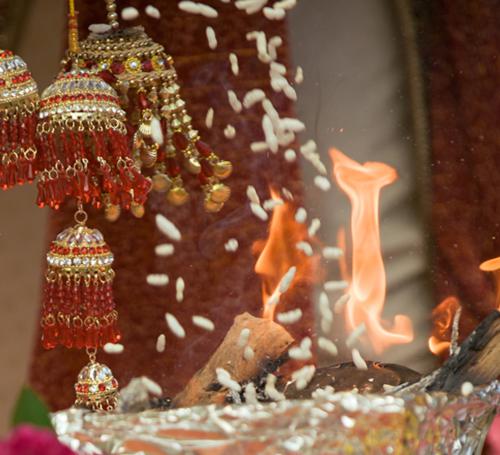
 
Shrinivasa Acharya

Though he felt somewhat ashamed, he realized that he could not ignore the wishes of Narahari, his mother and Advaita Prabhu. He thus agreed to get married and was wed to Ishvari, the devoted daughter of Gopal Chakravarti of Jajigrama. (In the image: grains thrown to the sacrificial fire).

   After staying in Vana Vishnupura for some time, Shrinivasa Acharya returned to his maternal grandfather’s house in Jajigrama. Then he set off on another tour of Katwa, Navadwip and other important towns in Bengal. Shrinivasa respected Narahari Sarakara of Shrikhanda greatly and was also very devoted to his saintly mother. When Narahari heard Shrinivasa’s mother express her desire to see her son married, he gave him the order to do so. Even prior to receiving this order, Shrinivasa had received the same command from Advaita Acharya in a dream. Though he felt somewhat ashamed, he realized that he could not ignore the wishes of Narahari, his mother and Advaita Prabhu. He thus agreed to get married and was wed to Ishvari, the devoted daughter of Gopal Chakravarti of Jajigrama.
 
   It is not always easy to understand the divine activities of Mahaprabhu’s Devotees. Only someone who is totally surrendered to the Lord and His Devotees can have access to their glories.
 
Shrinivasa’s Preaching Activities
 
   Shrinivasa Acharya started to teach the Goswamis’ books to his disciples in Jajigrama. One of his most important disciples was Ramachandra Kaviraj, the son of Shrikhanda resident Chiranjiva Sena. Shrinivasa gave Ramachandra the title kaviraja after hearing his poems. Narottama Thakur had a close friendship with Ramachandra Kaviraj and even wrote about it in one of his songs:
 
   Please be merciful, Prabhu Shrinivasa Acharya! Narottama Das begs for the association of Ramachandra.
 
   When Shuklambar Brahmachari, Gadadhara Das, Narahari Sarkara and Dvija Hari Das all ended their earthly activities, Shrinivasa Acharya once again felt overcome by grief and made another trip to Vrindavan. Once again he met with Gopal Bhatta and Shri Jiva Goswamis, as well as with Bhugarbha and Lokanatha Goswamis, and these great Devotees spoke to him encouragingly, reducing his feelings of loss. Ramachandra Kaviraj and Shyamananda Prabhu also joined Shrinivasa in Vraja on this occasion.
 
   When he returned to Gauda, Shrinivasa joined in the festivities occasioning the anniversaries of the departure of Gadadhara Das in Katwa, Narahari in Shrikhanda and Dvija Hari Das in Kanchanagariiya. From there he went to Budhari village, where Ramachandra Kaviraj and Govinda Kaviraj hosted him with great opulence.
 
   Narottama Das Thakur had also left Vrindavan on Lokanatha Goswami’s orders, returning to his home in Kheturi. On the full moon day of Phalguna, he established the worship of six sets of Deities in the Temple there: Gauranga, Vallabhikanta, Vrajamohana, Shri Krishna, Radhakanta, and Radharamana. Shrinivasa Acharya performed the installation ceremony and the first puja.
 
   Jahnava Devi was also present at this great event. After the festival, she went on to Vraja with her entourage. Upon her return, she met with Shrinivasa Acharya at Katwa and then went with him to spend some time in Jajigrama.
 
   Shrinivasa Acharya made another trip to Navadwip with Narottama and Ramachandra Kaviraj, performing the parikrama of the nine islands, each of which represents one of the limbs of devotional service.
 
   When Raghunandan Thakur entered the nitya-lila, Shrinivasa Acharya went to Shrikhanda to help conduct the funeral festival in his honor. He returned with a heavy heart to Jajigrama, and from there went to see his disciples in Vana Vishnupura. He was received by the excited King and the other residents of the town. There, he received an order from Mahaprabhu Himself in a dream to accept the hand of Gaurangapriya, the daughter of a certain Raghava Chakravarti. Raghava and his wife Madhavi had been searching for a suitable husband for their daughter with no success. They also received the order in a dream to give their daughter in marriage to Shrinivasa. As a result, Shrinivasa married for a second time.
 
   The pure Devotee has no other objective in life than to fulfill the desires of the Supreme Lord. They are thus ready to do anything if it pleases the Lord. None of their activities has the slightest hint of material desire in it. Shrinivasa Acharya is the avesha incarnation of Mahaprabhu Himself and His transcendental activities can only be described by someone who has received His special blessings.
 
   [Excerpted from the book “Shri Chaitanya: His Life and Associates” by Shrila Bhakti Ballabh Tirtha Goswami Maharaj.]
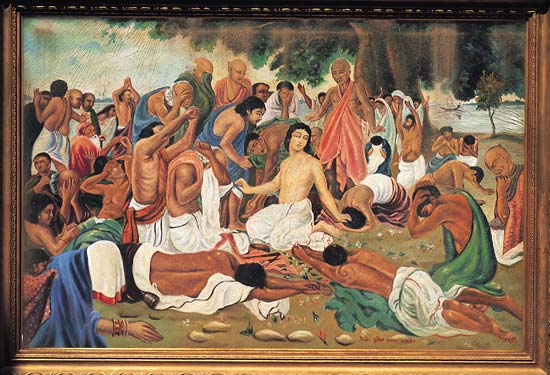
Shivananda Sena – Biography 3

   He was a Vaidya by caste. In his past incarnation he was Vira Duti (GGD. 176). His Shripata was located at Kumarahatta at Halisahara (Pata Paryatana).

   Shivananda had three sons named Chaitanyadasa, Ramadasa, and Paramanandadasa (Kavi Karnapura).

   Shivananda was one of Shri Chaitanya Mahaprabhu's intimate associates. As directed by the Lord, he escorted the Gaudiya Devotees to Nilachala every year, providing them with food and lodging along the way. 

Shivananda Sena

Shivananda was one of Shri Chaitanya Mahaprabhu's intimate associates. As directed by the Lord, he escorted the Gaudiya Devotees to Nilachala every year, providing them with food and lodging along the way. (In the wallpaper: food, road and a house).

   During one pilgrimage to Nilachala a dog joined their party and Shivananda took personal care of him, even paying extra fare to allow the dog to across the river along with them. One night Shivananda was detained for sometime and arrived at the camp late in the evening, only to find that the dog had not been given Prasada and, despite a thorough search, the dog was nowhere to be found.

   Thus Shivananda did not accept any food that night. When their party arrived in Nilachala, they found the dog in the presence of the Lord. The dog was eating some coconut given by the Lord and was chanting, "Krishna, Krishna." Shivananda offered his humble obeisances at the feet of the dog and apologized.

   On another occasion Shivananda was detained and thus accommodations for the party had not been made. It was quite late at night and Lord Nityananda appeared to be restless and hungry, thus He said, "I am so hungry yet still there is no sign of Shivananda, therefore I curse his three sons to die." Hearing this Shivananda's wife began to cry. When Shivananda returned and his wife informed him what had happened, he consoled her saying, "Why are you crying? Let my three sons die if it is the desire of Lord Nityananda."

   Shivananda then went before Lord Nityananda, who kicked him.

   Shivananda, however, was extremely happy and said, "Lord, at last I know that you have accepted this wretched soul as Your servant.

   Vasudeva Datta was an extraordinarily generous man, thus he never saved any money. Lord Chaitanya therefore directed Shivananda as follows:

   "You should become the accountant of Vasudeva and take charge of his expenses."

   Once Lord Chaitanya appeared within the body of Nakula Brahmachari at Ambika. Upon hearing this Shivananda went to Ambika but instead of meeting Nakula, he remained hidden.

   Hoping to test the authenticity of Nakula brahmachari, Shivananda thought "If that brahmachari calls me by name and speaks out my Ishtamantra, then I will be convinced that the omniscient Lord Gauranga has truly entered his body. It happened as Shivananda desired; the brahmachari called him and spoke out his Ishtamantra.

   Once Lord Chaitanya, without manifesting Himself physically, partook of food presented by Nrsimhananda in the house of Shivananda. Not having personally seen the Lord, Shivananda was uncertain of this incident. However, the next year when visiting the Lord in Puri, Lord Chaitanya mentioned the time which He had come to accept Prasada at Shivananda's house, thus clearing up Shivananda's doubts. Before writing his books Kavi Karnapura collected considerable information about Lord Chaitanya's life from Shivananda.

   The following are references to Shivananda given in CC:

   1.20.52 A close Devotee of Lord Gauranga.
   1.10.52-53 Responsible caretaker of the Gaudiya Devotees in their pilgrimage to Nilachala.
   2.1.129, 2.16.18-19;25-26, 3.2.160;3.10.11,
   2.15.98 Directed by Lord Chaitanya to guide all Gaudiya Devotees to Nilachala.
   2.1.130;3.1.12-28 Paid equal attention to a stray dog along the journey.
   2.15.94-97 Directed by Lord Chaitanya to take charge of Vasudeva Datta's accounts.
   2.16.203 Lord Chaitanya visits Shivananda's house on his way from Nilachala to Gauda.
   3.2.21-31 Test of Nakula brahmachari.
   3.2.41-42;3.2.44-77 Lord Chaitanya partaking of food in a subtle form.
   3.6.178-180 Letter from Govardhana dasa to Shivananda after the former's son, Raghunatha dasa, renounced home.
   3.6.242-244 At Nilachala Raghunatha dasa was informed about his father's letter.
   3.6.245-253 On return from Nilachala the messenger of Govardhana is informed about Raghunatha dasa's condition.
   3.6.255-258 Govardhana sends money through messenger to Shivananda after learning about his son; Shivananda's advice to the messenger.
   3.6.139-148 Shivananda's eldest son, Chaitanyadasa, meets Lord Chaitanya; the Lord invites Chaitanyadasa and the latter also invites the Lord.
   3.12.17-31 Receives grace showered by Lord Nityananda on the pretext of chastisement.
   3.12.43-48 Lord Chaitanya meets the three sons of Shivananda; mystery associated with the name of Puridasa, the youngest son.
   3.12.52 Lord Chaitanya directs Govinda to pass on the remnants of the Lord's food to the wife and sons of Shivananda as long as they stay at Nilachala.
   3.12.101-102 Arrival of Jagadananda at Shivananda's house and preparation of herbal oil.
   3.16.60-70 Grace showered by Lord Chaitanya on Puridasa.

Further information from GPC :

   Shivananda Sena utilized his entire property and wealth in the service of Hari-guru-Vaisnavas. All his family members, including his friends, servants and three sons (Shri Chaitanya dasa, Shri Rama dasa and Shri Karnapura), even his nephew Shri Vallabha Sena were great Devotees of Shri Chaitanya Mahaprabhu. Shri Shivananda lived in Kumarahatta, which is known as Halisahara. The Deity Gaura-Gopala which was worshiped by him, is now at Kanchrapada, one and a half miles away from Halisahara.

   In GGD, Kavi Karnapura writes that Shivananda Sena was the associate of Shri Radha in Dvapara yuga and was known as Vira. Every year Shivananda took full responsibility for bringing the Gaudiya Devotees to Puri on foot. Once the Devotees started their journey on an auspicious day and on their way came to the house of Advaita Acharya at Shantipura. After spending one day there performing sankirtana, they went to the house of Shri Sachi Devi in Navadwipa, along with Advaita Acharya, his wife and his son. Mother Sachi was living in distress due to separation from her son. She offered her respects to the Devotees, and after serving Shri Advaita Acharya and Sita Devi, she began to weep in remembrance of Shri Gauranga. After consoling her the Devotees continued on their journey.

   Though Mahaprabhu had advised Shri Nityananda Prabhu to preach and spread love of God, Nityananda set off with the Devotees to meet Mahaprabhu. Amongst the Devotees were Shri Acharyaratna, Pundarika Vidyanidhi, Shrivasa Pandita and his wife and brothers , Vasudeva Ghosh, Govinda Ghosh, Madhava Ghosh, Murari Gupta Ojha, Shri Raghava Pandita, Narahari from Shrikhanda, Gunaraja Khan and many others. Shivananda Sena's wife and three sons also accompanied the party. Many of the Devotees brought along their wives, who eagerly collected many varieties of food for the pleasure of Mahaprabhu. Shivananda took charge of paying the fares and food of the Devotees. Wherever they spent the night, they engaged in sankirtana.

   One year Shri Shivananda, along with his first son Shri Chaitanya dasa, came to Puri.

   When Mahaprabhu asked Shivananda why he named the boy as such, Shivananda replied that he had been inspired from within. One day, by his father's instruction, Chaitanya dasa invited Mahaprabhu to their house for Prasada. Mahaprabhu accepted the invitation and when He came to their house, Shivananda and his wife showed Him great respect and offered Him various types of food. Being very pleased the Lord said, "Today Chaitanya dasa invited Me." Chaitanya dasa then placed various items such as curd, lemon, ginger, fry, salt, etc. in front of Mahaprabhu, who happily said, "This boy knows Ny mind, therefore I am very satisfied with his service."

   With those words Mahaprabhu began eating with great pleasure and after finishing He gave the food left on His plate to Chaitanya dasa. After spending four months in the Lord's association, the Devotees from Bengal were preparing to leave when Mahaprabhu told Shivananda that he should name his next son Puri dasa. Shivananda became very happy and with the blessings of Mahaprabhu, returned to Gauda.

   After a few months a son was born and the astrologer gave him the name Paramananda. The next year Shivananda and the Devotees visited Puri. As usual Shivananda arranged for their boarding and food and the Devotees eventually arrived in the presence of the Lord. Along with the Devotees, Shivananda happily participated in singing and dancing before the Ratha of Shri Jagannatha Deva.

   One day Shivananda and his wife came to Mahaprabhu and the little child fell down at the lotus feet of Mahaprabhu and fixed his eyes on the reddish feet of the Lord. A bit amused, Mahaprabhu gently placed His toe in front of the little boy, who began to suck the toe with great pleasure.The Devotees present were filled with joy and began chanting the Holy nName. This child later became the poet Kavi Karnapura Goswami. 

Shivananda Sena

One day Shivananda and his wife came to Mahaprabhu and the little child fell down at the lotus feet of Mahaprabhu and fixed his eyes on the reddish feet of the Lord. A bit amused, Mahaprabhu gently placed His toe in front of the little boy, who began to suck the toe with great pleasure.The Devotees present were filled with joy and began chanting the Holy nName. This child later became the poet Kavi Karnapura Goswami. (In the wallpaper: Lotus feet of Shri Vijaya Gauranga, ISKCON Hungary, Budapesht, a baby).

Svarupa Damodara Goswami – Biography

Shri Svarupa Damodara is an eternal associate and friend of Shri Chaitanya Mahaprabhu Previously his name was Shri Purushottama Acharya.He lived in Nabadwipa. He always stayed with Mahaprabhu.

When Shriman Mahaprabhu took sannyasa, he became half-mad. He went to Varanasi and took sannyasa from a sannyasi named Chaitanyananda, who ordered him to study Vedanta and teach it to the people in general. Shri Purushottama Acharya did not accept the dress of a sannyasi, but only gave up the shikha and sacred thread. His name became Svarupa. After this, taking up the order of his sannyasa-guru, Shri Purushottama Acharya went to Jagannatha Puri. At that time, he again met with Shri Chaitanya.

The Chaitanya Charitamrita (ML 10:102-104) records this meeting as follows:

"One day, Svarupa Damodara arrived. His mystic awareness of the Lord's inner purpose was deep and unfathomable. He was an ocean of rasa. In his previous ashrama, his name had been Purushottama Acharya. When he was in Nabadwipa, he had attained the Lord's lotus feet. But when he saw the sannyasa of Shri Chaitanya, he went half mad. And so, he went straight to Varanasi to take sannyasa.

In connection with Svarupa Damodara, Shri Krishnadasa Kaviraja Goswami has written further, as follows:

"Shri Svarupa Damodara was the limit of scholarship; still, he did not generally converse with anyone.
He kept to himself.
He liked to remain alone, and did not see others.
He was the very embodiment of Krishna-prem.
He was like a second Mahaprabhu, in the sense that he fully understood the Lord's conclusions on Krishna-tattva and Krishna-bhakti, and could fully represent them.
As such, whoever wanted to bring before the Lord a book, poem, or song would first bring it to Svarupa Damodara, who would examine it before the Lord would hear it.
The Lord did not delight in hearing literature and song which was opposed to the conclusions of bhakti (bhaktisiddhanta-viruddha), or which contained rasabhasa, conflicting devotional mellows. Therefore, Svarupa Damodara would examine these things, and if he decided that they were pure, then he would arrange for the Lord to hear them.

Svarupa Damodara would sing for Shri Chaitanya the songs of Vidyapati, Chandidasa, and Gita Govinda, and this gave the Lord much pleasure. Svarupa Damodara could sing like a Gandharva, and he knew the scriptures like Brihaspati, the guru of the gods. No one was a greater soul than he. He was most dear to Advaita and Nityananda and the life and soul of the devotees headed by Shrivasa Thakura."

In this way, it is said that Svarupa Damodara was like a second form of Mahaprabhu, in song he was like a Gandharva, and in scripture, he was like Brihaspati. Svarupa Damodara was very expert in music as well as Vedic scriptures. Shri Chaintaya used to call him Damodara, becasue of his expert singing and musical skills. The name Damodara was given by Shri Chaitanya and added to the name given by his sannyasa guru. He was therefore known as Svarupa Damodara. He compiled a book of music called Sangita-Damodara.

When anyone wanted to submit a song, a verse, or a book to Shriman Mahaprabhu, they first had to submit it to the examination of Svarupa Damodara, before it would be heard by the Lord. When Svarupa Damodara came from Kashi, he submitted a verse before the Lord, glorifying Him.

This verse has been recorded by Kavi Karnapura in his Chaitanya Chandrodaya Nataka as follows:

heloddhunita khedaya vishadaya pronmila-damodarau
shamyacchastra vivadaya rasadaya cittarpitonmadaya
shashvad-bhaktivinodaya sa-madaya madhurya-maryadaya
shri chaitanya dayanidhe tava daya bhuyadamandodaya

"O Ocean of Mercy, Shri Chaitanya! Let that which easily drives away whatever pain we have been experiencing in this material world; that which is all purifying, that which manifests the greatest transcendental bliss; that which by its sunrise casts away all the doubtful conclusions of the shastra; that which rains rasa on our hearts and minds, rules our consciousness and thus causes jubilation; that all-liberating, all-auspiciousness-giving, the limit of madhurya-rasa mercy of yours-let it arise within our hearts. "

Shri Svarupa Damodara made his dandavats before the Lord, and the Lord embraced him, saying, "Today I saw in a dream that you were arriving here. Everything was just right. Just as one who is blind becomes happy getting eyes, so I have become happy upon getting you." Shri Svarupa Goswami said, "O Lord! Please forgive me. Forgetting you, I deserted your lotus feet. Not having a trace of prema within me, I left your service, and being sinful, I went to a foreign land. But, although I abandoned you, you didn't abandon me. By the ropes of your mercy, you have bound me by the neck and dragged me back to your lotus feet." Hearing Svarupa Damodara saying these words in great humility, the Lord again embraced him and said, "Shri Krishna is very kind. By his mercy we have met once again."

Svarupa Damodara always stayed near the Lord. Whatever mood the Lord was in, Svarupa Damodara would perform kirtan to augment the Lord's internal sentiments. Around the same time that Svarupa Damodara came to Puri, Shri Ramananda Raya arrived from Vidyanagara. Shri Ramananda Raya was a great poet and could explain everything in a very elegant style. Shri Chaitanya Mahaprabhu heard rasatattva from Ramananda's mouth.

In the daytime, Shri Chaitanya Mahaprabhu used to perform kirtan with his devotees. At night, in the company of Ramananda Raya and Svarupa Damodara, he would relish the truths about the pastimes and mellows of Radha and Krishna. In the same way that Lalita and Vishakha are the internal confidantes of Shri Radha, Svarupa Damodara and Ramananda Raya are the internal confidantes of Shri Chaitanya Mahaprabhu.

At the time of Shri Gaurasundara's final pastimes, Shri Svarupa Damodara was constantly with the Lord. Shri Svarupa Damodara's right hand was Raghunatha Dasa Goswami.
On the second day of the day of full moon in the month of Asharh, Shri Svarupa Damodara Goswami passed away from this earth and entered into the Lord's unmanifest pastimes.