Category Archives: More About Gaudiya Saints

Jiva Goswami – Biography

Jiva Goswami

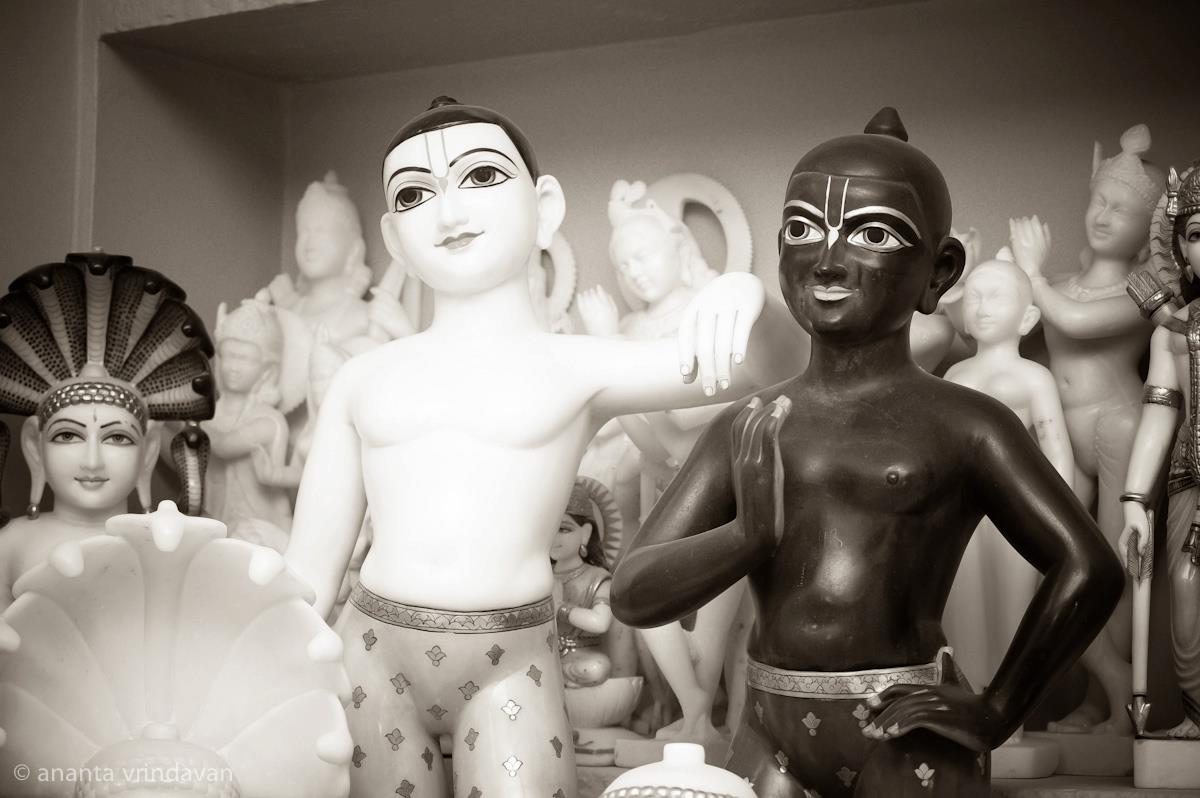
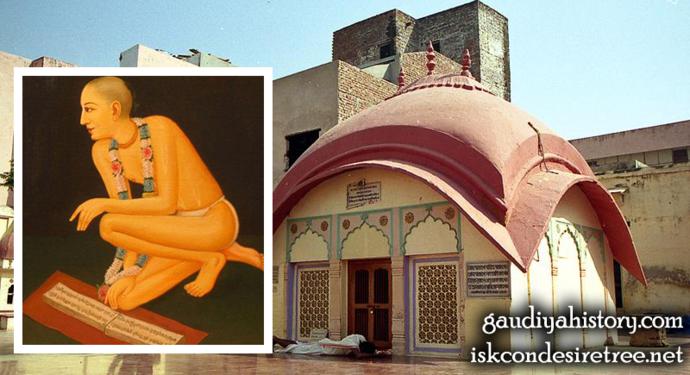
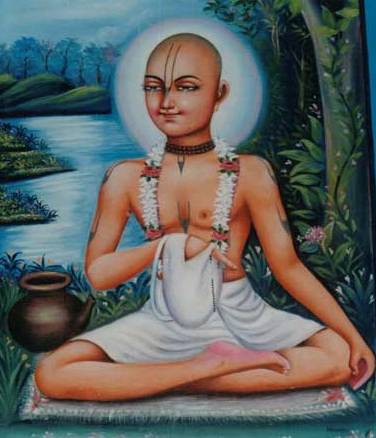
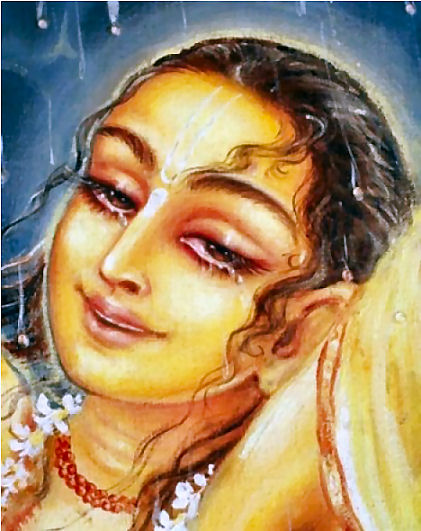
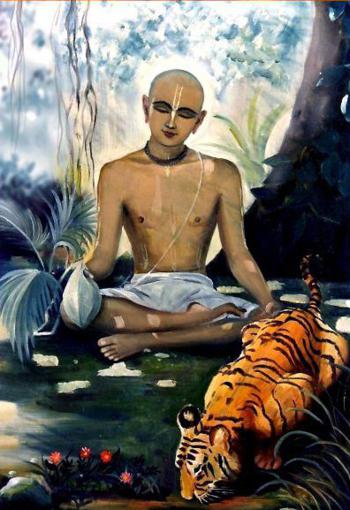
When Shri Gaurasundara came to Ramakeli, Shri Jiva was blessed by having darshana of His worshipable Lord, though he was just a baby at the time. Placing the dust of His lotus feet on the child's head, Mahaprabhu indicated him to be the future sovereign preceptor of the Gaudiya sampradaya. Though he was only a child, Shri Jiva kept the form of the Lord, which fascinates all the world, within his heart. As he grew up, while eating, lying down, in his dreams, while he was awake, at all times, he would meditate on that form. (In the image: Shrila Jiva Goswami).

   Shri Sanatana, Shri Rupa and Shri Vallabha were three brothers, all employed in the service of the Badsha Hussain Shah. Amongst the three, there was only one descendent, Shri Jiva. Having been rewarded richly by the Badsha for their sevices, their household life was very opulent. There was nothing lacking in whatever was necessary for the upbringing of the only son. The house was illuminated by the effulgence of the child's golden complexion; his eyes were like the expanded petals of the lotus; every part of his body was graced with a lusterous, radiant splendor.

   When Shri Gaurasundara came to Ramakeli, Shri Jiva was blessed by having darshana of His worshipable Lord, though he was just a baby at the time. Placing the dust of His lotus feet on the child's head, Mahaprabhu indicated him to be the future sovereign preceptor of the Gaudiya sampradaya. Though he was only a child, Shri Jiva kept the form of the Lord, which fascinates all the world, within his heart. As he grew up, while eating, lying down, in his dreams, while he was awake, at all times, he would meditate on that form.

   Later on, when his father and uncles renounced their family life in order to be with Mahaprabhu, the only child, Shri Jiva, was left with his mother in the family palace at Fateyabad. Lying in her lap, which was wet with tears of separation, he gradually began to grow as the waxing moon. Seeing that the mother and the child's face were always wet with tears, their friends also fell under the shadow of sadness and only with great difficulty managed to assuage their grief. Whenever Shri Jiva would remember his father and uncles, or the lotus feet of Shri Gaura Hari, he would lose consiousness and fall to the ground.

   As he got a little older, Shri Jiva took up the worship of the Deities of Shri-Shri Rama-Krishna. He would carefully decorate Them and offer bhoga and arati, serving Them with his full attention. Even in his play, whatever games he played were connected with Shri Krishna's pastimes.

   While studying under the local panditas he became proficent in grammar, poetry and rhetoric. Noting his great intellect, his teachers commented, "Such brilliance is not often found in a child so young as this. No doubt he will be a very high-souled, saintly person."

   Even while engaged in his studies Jiva always thought of Shri Shri Nitai-Gauranga. Once he saw in a dream that Shri Rama-Krishna had taken the forms of Nitai-Gauranga and were dancing. [B.R.1.732] Giving him the dust of Their lotus feet, the Two Lords then disappeared. Having seen such a wonderful dream, Shri Jiva was consoled somewhat. Then he began to think, "When will I be able to crawl out of this well of family life and devote my full time and energy, my very self, to serving these two most magnanimous Lords?" But he was the only son of the family. Only in his company could his mother forget somewhat the pangs of separation in her heart. When Shri Jiva learned that his father had given up his life on the banks of the Ganga, he was compeletely unsettled. After that his eyes were never dry. The family members and friends tried to console him but to little avail. Family life had become the source of his utter sadness.

   Someone suggested to Jiva to go to Navadwipa and bathe himself in the coolness emanating from the lotus feet of Lord Nityananda Prabhu so that his mind and body, burning with grief, could be refreshed. Thus Shri Jiva set our for Navadwipa with a group of pilgrims. [B.R.1/741]

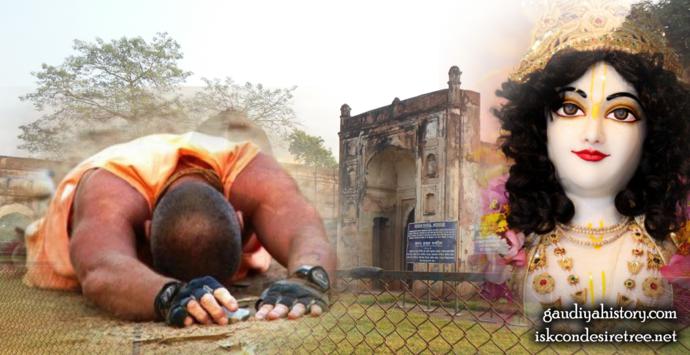
   Nityananda Prabhu, the omniscient Lord, could understand that Shri Jiva was on his way to Navadwipa. Therefore He also left for there from Khardaha. After a few days, Jiva arrived at Navadwipa. Seeing the beauty of that place he was charmed. Falling down on the ground, he offered his dandavats to Mother Ganges. Inquiring from the villagers the directions to Mayapura, he learned that Nityananda Prabhu was residing at Shrivasa  Pandita's house. At last arriving there, he fell down at the door to offer his dandavats. Nityananda Prabhu came out with Shrivasa Pandita and picked him up and embraced him, asking, "Are you the nephew of Shri Rupa and Shri Sanatana?"

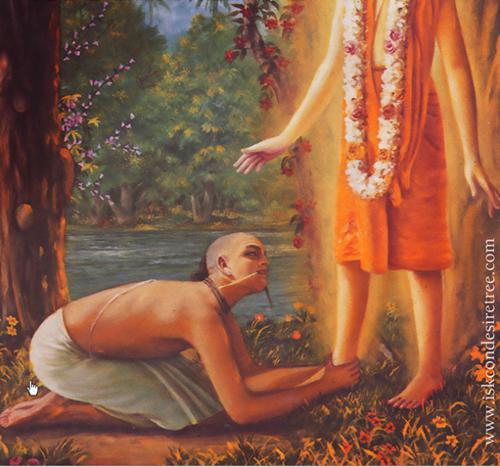
   As an answer, Jiva again fell down on the ground at the lotus feet of Nityananda Prabhu. This time Nityananda Prabhu brought him in the house and began to inquire after the welfare of his family at Fateyabad. Then Shri Jiva was introduced to the Devotees present in Navadwipa; he offered his salutations at their lotusfeet. Everyone was very happy to meet the nephew of Shri Rupa and Sanatana. That day Shri Jiva received the remnants of Nityananda Prabhu's Prasadam.

   The next day, the two of them came to Sachi Mata'a house. Seeing the birthplace of Shri Gaurasundara, which was filled with such splendor, Shri Jiva was greatly pacified and fell down on the ground to roll in the dust. In the large courtyard the Devotees were singing songs praising the glories of Shri Krishna Chaitanya Mahaprabhu. Seeing Nityananda Prabhu, everyone stood up and then fell down, offering their dandavats at His lotus feet. Then Jiva saw Sachi Mata sitting on the veranda. 

Jiva Goswami

After initiating him with the divine mantra, Rupa engaged him in the service of Shri Shri Radha-Damodara. According to Sadhana dipika, this Deity of Damodara was fashioned by Rupa Goswami's own hand for his dear disciple Shri Jiva. Shri Shri Radha-Damodara are presently being worshipped in Jaipur, Rajasthan. (In the image: Shri Shri Radha Damodar, Jaipur).

   Dressed in white with silk chadder around her shoulders she looked radiant, the white of her hair blending with her white sari. Though her body trembled with old age and was very thin, still the courtyard was illuminated by her divine effulgence. Forgetting herself in rememberance of Shri Gaursundara, she was sitting with her eyes closed. Becoming aware that Nityananda Prabhu had arrived, she covered her head with her sari and called her servant.  "Ishana!  Shripada has arrived.  Please wash His feet."

   After this was done, Nityananda offered namaskar to the mother of the Supreme Lord and took His seat. He then introduced Shri Jiva to her. Sachi Mata placed her hand on his head to bless him, and Shri Jiva floated in the ocean of happiness. Sachi Mata then requested the two of them to honor the Lord's Prasada."Take Prasada here at your mother's house today, my child. I offered there preparations in secret to Shri Gaurachandra."

   Shri Jiva spent some days with Nityananda Prabhu, touring the nine islands of Navadwipa, in order to have darshana of the holy places of the Lord's pastimes there. Then, as ordered by Nitya­nanda Prabhu, he set out for Kashi (Varanasi) . At Kashi he studied Vedanta under Shri Madhusudana Vachaspati, a disciple of Sarvabhauma Bhattacharya. The conclusions of Vedanta contained in Shrimad-Bhagavatam that were expounded by Shri Chaitanya Mahaprabhu to Sarvabhauma Bhattacharya in Puri had been in turn taught by the Bhattacharya to Madhusudana Vachaspati, who established a toll at Kashi. From him, Shri Jiva mastered the same conclusions.

   From here Shri Jiva set out for Shri Vrindavana where he received shelter at the lotus feet of his two uncles. Shri Rupa and Sanatana. They were very pleased to see him and received from him all the news. Jiva stayed with Shri Rupa, who began to teach him Shrimad Bhagavatam. After initiating him with the divine mantra, Rupa engaged him in the service of Shri Shri Radha-Damodara. According to Sadhana dipika, this Deity of Damodara was fashioned by Rupa Goswami's own hand for his dear disciple Shri Jiva. Shri Shri Radha-Damodara are presently being worshipped in Jaipur, Rajasthan.

   Seeing that Jiva had quickly become conversant with the conclusion of the Shrimad Bhagavatam, Shri Rupa engaged him in proof-reading his Bhakti-rasamrta-sindhu. At this time Shri Jiva compiled a commentary on Bhakti-rasamrta-sindhu called Durgama sangamani. In the year 1476 (Sakabda) Shri Sanatana Goswami compiled Shri Vaishnava tosani, a commentary on the tenth canto of Shrimad-Bhagavatam, which he gave to Shri Jiva for proof reading. Under the order of Shri Sanatana, Shri Jiva compiled a commentary on that named Laghu Vaishnava tosani in the year 1500 (Sakabda). His writings, along with those of Shri Rupa and Shri Sanatana, Shri Gopal Bhatta, Shri Raghunatha Bhatta, Shri Raghunath das, Shri Krishna das, Shri Kashishvar Pandit, and Shri Madhu Pandit, completely captivated the learned men of that time. It was the beginning of a golden age at Shri Vraja dhama.

   Shri Jiva regurlarly brought water for Shri Rupa and Sanatana's bath. He massaged their heads with oil, cleaned their ashram, worshiped the Deity, cooked and corrected manuscripts.

   After the disappearance of Shri Rupa and Sanatana, Shri Jiva continued the tradition that they had inaugerated. Once Shri Jiva travelled to Agra to debate with the Rajputs concerning the glories of Jamuna and Ganga rivers. He established that the Jamuna is more glorious than the Ganga as the Ganga emanates from Krishna's lotus feet whereas the Jamuna is His own consort. At this the Moghul emperor was very much satisfied and wanted to present him something. Shri Jiva replied that he would accept some blank papers. So the emperor presented Jiva some stained paper. (At that time paper was very rare and most manuscripts were usually composed on leaves.)

   There is also a legend that once, when a moghul emperor (possibly Akbar) wanted to confer something on the Goswamis of Vrindavana, they requested a farman (emperor's order) that no living beings would be killed within Vraja. As a result of this no king would come to hunt there anymore.

   The disciple of Lokanatha Goswami, Narottama dasa Thakura Maha­shaya, Shri Gopala Bhatta Goswami's disciple Shrinivasa Acharya Prabhu, and the disciple of Hridaya Chaitanya Prabhu, Shri Shyamananda Prabhu, were greatly favored by Shrila Jiva Goswami. Under his tutelage they studied all the literatures of the Goswamis. Later he sent them to preach this knowledge in Bengal.

   Shrila Jiva Goswami composed many literatures, amongst them:

Harinamamrta-vyakarana
Sutra-malika
Rasamrta-sesa
Gopala-virudavali
Sri-Madhava-mahotsava
Sri-Sankalpa-kalpavrksa
Brahma-Samhita-tika
Bhakti-rasamrta-sindhu-tika (Durgama-sangamani)
Ujjvala-nilamani-tika (Locana-rocani)
Gopala-campu
Sat-sandharbha (Tattva-sandarbha, Bhagavata-sandarbha, Paramatma sandarbha, krishna-sandarbha, Bhakti-sandharbha, Priti-sandarbha)
Srimad-Bhagavata-tika (Krama-sandarbha)
Laghu-vaisnava-tosani (Tenth Canto Bhagavatam commentary)
Sarva-sambadina (commentary on Sat-sandarbha)
Gopala-tapani-tika (Sri-Suhkha-bodhini)
Padma-puranastha-yogasara-stotra-tika
Gayatri-vyakhya-vivrti (A commentary on the Gayatri mantra as described in the Agni Purana, chapters 216-217)
Radha-krishnarcana-candrika
Dhatu-sangraha
Bhavartha-sucaka-campu

   Birth: 1533 (Christian calendar), 1455 (Sakabdha), 12th day of the bright fortnight in the month of Bhadra.
   Disappearance : 1540 (Sakabdha), 3rd day of bright fortnight, Pausa 

Jiva Goswami

As he got a little older, Shri Jiva took up the worship of the Deities of Shri-Shri Rama-Krishna. He would carefully decorate Them and offer bhoga and arati, serving Them with his full attention. Even in his play, whatever games he played were connected with Shri Krishna's pastimes. (In the image: Shri Shri Krishna-Balarama, at Deity vala, Jaipur).

Rupa Goswami – Biography 3

Rupa Goswami

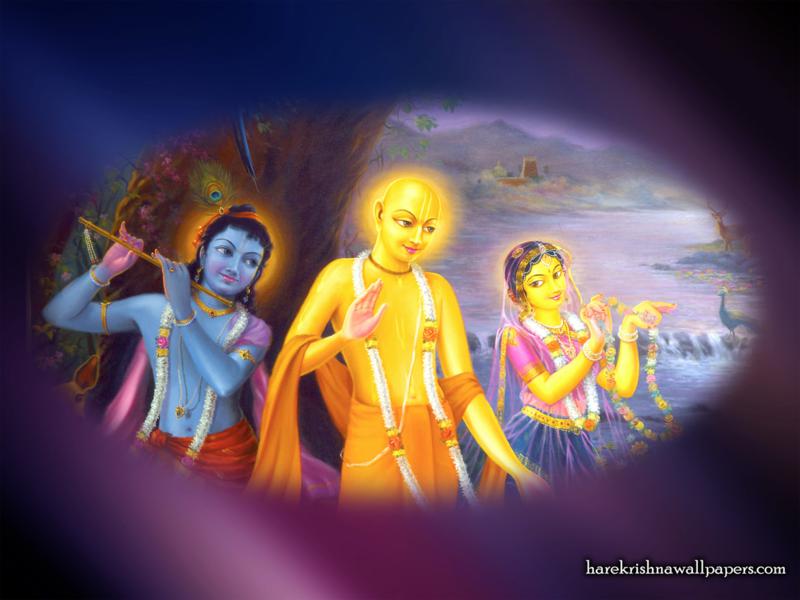
Shrila Rupa Goswami was extremely dear to Shri Chaitanya Mahaprabhu. (In the image: from left to right Shrila Rupa Goswami, Lord Shri Krishna Chaitanya).

   Shrila Rupa Goswami was extremely dear to Shri Chaitanya Mahaprabhu. Through him and his elder brother, Shri Sanatan, Mahaprabhu disseminated His own teachings, the essential conclusions of all the scriptures. Amongst the Devotees of Mahaprabhu these two were known as His generals. In the Gaura-ganoddesha-dipika, Kavi Karnapura has written that Shri Rupa Goswami was known as Shri Rupa Manjari during Krishna lila. There is an anecdote as to how they came to be the ministers of the king of Gaudadesha, Hussain Shah Badsha. Even at a very young age they had become quite learned in all of the scriptures. The guru (moulabi) of Hussain Shah was supposedly capable of seeing into the future. Hussain Shah inquired him about the prosperity of his kingdom. The moulabi replied, "There are two extremely learned brahmana boys who are endowed with all good qualities. If you appoint them as your ministers then you will attain a very opulent kingdom." Having heard of the glories of Shri Chaitanya Mahaprabhu, Shri Rupa had written a letter to Him praying for His darshan. In His reply Mahaprabhu explained to him, "As a woman who is attached to another man makes a show of being devoted to her husband, so you should, while being internally attached to the lotus feet of Shri Krishna, externally make a show of being engaged in your worldly duties. Krishna will bestow His mercy on you very soon." While residing at Ramakeli, Shri Rupa and Shri Sanatana were visited by many brahmanas and panditas from Navadwipa, Karnataka and various other parts of India. They were always careful to receive these guests and serve them in a befitting manner. 

Rupa Goswami

"As a woman who is attached to another man makes a show of being devoted to her husband, so you should, while being internally attached to the lotus feet of Shri Krishna, externally make a show of being engaged in your worldly duties. Krishna will bestow His mercy on you very soon."

   They lived in a very opulent surroundings at Ramakeli. Their court, which rivalled that of Lord Indra, was always attended by brahmanas, pandits from many lands as well as poets, singers, musicians and dancers. At great expense they maintained these guests and were always very careful that no one was disrespected in any way. They were always engaged in studying the shastras and could establish and defeat the same philosophical arguments alternatively. Near their house were solitary gardens of Kadamba and other trees in the middle of which were Radha-kunda and Shyama-kunda. There they would meditate on the Vrindavana pastimes of Shri Shri Radha-Shyama and thus, losing their patience, a constant stream of tears would flow from their eyes. They were always absorbed in the service of Shri Madana Mohana and constantly assuaged their grief by praying for His mercy. Hearing of the pastimes of Sri Gaurasundara at Nadia they were always meditating when they might get His darshan. [B.R. 1/585].

   Rupa Goswami's worshipable Deity in Vrindavana was Shri Govinda Deva.  Shri Chaitanya Mahaprabhu had instructed the Goswamis to re-discover the holy places of Krishna's pastimes in Braja and to establish worship of His Shri vigraha. One day Shri Rupa was sitting on the banks of the Jamuna, lamenting that they hadn't been able to properly carry out His instructions. It was known to them that Shri Krishna's grandson Vajranabha had installed a number of Deities in Braja, among them Hari Deva, Madana Mohana Deva, Gopinath Deva and Shri Govinda Deva. Shri Rupa had tried to locate these Deities, but to no avail. As he was sitting and thinking in this way a very beautiful cowherd boy came along and asked him, "He Swamin! Why do you look so sad?" Hearing the boy's cheerful voice, Shri Rupa's melancholy reverie was broken and his heart felt engladdened. He replied that he was feeling sad because he hadn't been able to follow Mahaprabhu's instructions properly. The cowherd boy told him, "Swamin! Please come with Me. I know where what you are looking for is." Then the boy brought him to Gomatila and explained, "Everyday a cow comes on top of this hill and pours down her milk here. There is a good chance you will find what you are looking for inside.

   Now I have to go." Shri Rupa turned to see the cowherd boy off, but found no one present. He began to reflect, "Who was that cowherd boy and where did he run off so suddenly?" His body thrilled with ecstatic symptoms as he intently gazed at the Mahayoga Pith (Gomatila), and then went back to his kutir. The next morning he again came to Gomatila and quietly waited. After a little while an exquisitely beautiful Surabhi cow came there and poured milk down on top of the hill which immediately disappeared inside the earth. Then she sauntered on into the woods.

   Now Shri Rupa was positive that Shri Govinda Deva must be within the earth here. He came very quickly to the village of cowherds nearby and excitedly told them everything that had happened. The cowherd men hurriedly gathered up some spades and hatchets and came running to Gomatila. Digging where Shri Rupa indicated they saw, after removing a small amount of earth, the all enchanting form of Shri Govinda. They all erupted in shouts of ecstasy, "Hari! Hari! Shri Govinda has again manifested Himself." Shri Rupa with tears flowing from his eyes fell down at the lotus feet of Shri Govinda deva to offer his obeisances, all the while reciting prayers and hymns. Very quickly the news spread and the other Goswamis, floating in an ocean of joy, came there also. Soon an incessant flow of people from all quarters began to arrive, carried by waves of joy. Lord Brahma and the other demigods, having assumed mortal appearances, mixed in with the other people and gazed upon the body of Shri Govinda. There was not a lull in the crowd for even a moment as people continued to pour in from places unknown. Shri Rupa Goswami immediately sent word to Mahaprabhu in Puri concerning this auspicious event. Shri Gaurasundara along with His associates couldn't contain their ecstasy on receiving this happy news. Meanwhile the brahmanas performed the abhisheka of the Deity and began to prepare offerings of bhoga from the milk, yogurt, rice, flour and vegetables which the villagers were bringing. Mahaprabhu sent Kashishvar Pandit from Puri to assist in worshiping the Deity. 

Rupa Goswami

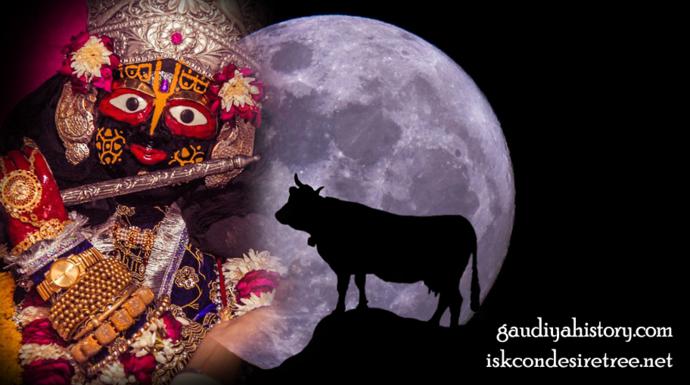
"Hari! Hari! Shri Govinda has again manifested Himself." Shri Rupa with tears flowing from his eyes fell down at the lotus feet of Shri Govinda deva to offer his obeisances, all the while reciting prayers and hymns. Very quickly the news spread and the other Goswamis, floating in an ocean of joy, came there also. (In the wallpaper: Shri Govindaji, Jaipur, a cow).

   Shri Govinda Deva is presently being worshiped in Jaipur, Rajasthan, which is easily reached by bus from Vrindavana. One has to proceed by rickshaw to Shri Shri Radha-Govinda Mandir from the bus stand. Overjoyed that Shri Govindaji and Madan Mohan had reappeared and thus the responsibilities which Mahaprabhu had given them were gradually being carried out, Shri Rupa and Sanatan began to compose the Bhakti-shastras, in compliance with Mahaprabhu's further instructions. After completing Vidagdha – madhava, Lalita-madhava, and various other books, Shri Rupa began to work on Bhakti-rasamrta-sindhu. One day Shri Vallabhacharya (of the Visnuswami sampradaya) came to visit Rupa Goswami. After offering him a seat the two of them began to discuss krishna-katha. In the house of their conversation, Sri Rupa presented the opening verse of Bhakti-Rasamrta-Sindhu to Vallabhacharya to read. After studying this verse for some time Vallabha commented that there were a few mistakes. At this time Sri Jiva, who had arrived from Bengal a few days before, was fanning his uncle Sri Rupa. He was extremely learned in all the sastras and was unsatisfied with Vallabha's remark. When Vallabhacharya went to the Jamuna to take his bath, Shri Jiva also came there on the pretext of fetching some water. He inquired from the acharya as to what actually were the mistakes in that verse. Vallabhacharya, after discussing some points with him, was amazed at the boy's scholarship. After a few days Vallabha again came to Shri Rupa. After inquiring about the boy scholar, he greatly praised his learning. After Vallabha had gone to his residence, Shri Rupa called Jiva and spoke to him, "Those whom we respect as our Guru and to whom we offer our obeisances you are ready to debate with on an equal level. This is not at all polite. What he spoke was for my benefit but you couldn't tolerate that. You should return home and when you can control your mind then you can come back to Vrindavana." [B.R. 5.1643] Hearing this decision of his uncle Shri Jiva left that place and decided to proceed eastwards. When he came to an old dilapidated Temple at Nanda-ghat, he sat down and began to cry. Soon the villagers began to worry: "Such a handsome young man, but he sits there crying for so long without taking food." After a while, Shri Sanatana Goswami came by and the villagers informed Sanatana of the boy's presence at the old Temple.

   Sanatana went there and saw his nephew, who looked very pale from not eating. Sanatana picked him up from the ground and affectionately asked him what was the matter. Shri Jiva explained everything that had happened. Sanatana Goswami pacified him and, taking his nephew with him, went to see his brother. At first Sanatana spoke with Rupa alone.  When Shri Rupa happened to mention Jiva, Sanatana explained everything. Shri Rupa immediately called Jiva. Seeing his forlorn and pale appearance, he gradually nursed him back to health and a happy state of mind.

   Then he entrusted him with proof reading and various litratures which he had composed. Just as he was very strict with his young nephew, so also he was very affectionate and loving. Their relationship was an ideal example of how the guru and shishya behave together. When Shri Rupa had finished writing Lalita-madhava, he gave it to Raghunatha dasa Goswami to read. Lalita-madhava is a description of Krishna's pastimes after He left Vrindavana and is thus full with sentiments in the mood of separation. By reading this book Dasa Goswami began to cry day and night, having become completely absorbed in love in separation to the point of being ready to leave his body. [B.R.5.768] He became as though deranged in mind from sadness, and he compeletely lost all patience. When Shri Rupa requested Shri Dasa Goswami to return the manuscript so that he could correct it, Raghunatha dasa held on to it very tightly, not saying anything, refusing to part with it. After considering what to do, Shri Rupa composed Dana-keli-kau­mudi. He managed to exhange this manuscript with Lalita-madhava.

   By reading Dana-keli-kaumudi, full of narrations of Krishna's Vrindavana pastimes, Raghunatha dasa Goswami now became totally absorbed in the ecstacy of happiness. On another occasion the Goswamis were having a discussion about the ecstatic feelings of separation of Radha-Krishna and Their associates. Some of the Vaishnavas were fainting to the ground, while Shri Rupa Goswami began to breath very heavily. His heart felt as though it was burning. At one point as he sighed his breath happened to fall on the body of one Devotee present there.

   Shortly thereafter a boil developed on that Devotee's body where Shri Rupa's breath had touched it. [B.R. 5.1326] After the re-appearance of Shri Govinda, Madana Mohana and the Yoga Pith, Shri Rupa began to contemplate where Vrindadevi might be. One night she came to him in a dream and said, “I am on the banks of Brahma-kunda. You can have my darsan there.” The next morning, after finishing his bath and puja, he came to Brahma-kunda and began to look everywhere. Suddenly he saw a heavenly damsel whose bodily effulgence defeated the luster of gold. All the directions were illuminated by this glow and the atmosphere created by her presence was very sweet and cooling. Shri Rupa offered his dandavats and various prayers and hymns. In this way, Vrinda Devi reappeared in Vrajabhumi. Shri Gaurasundara established the glories of Shri Vrajadhama through His two generals Shri Rupa and Shri Sanatan Goswamis. Within their hearts He awakened, through oral transmission, the knowledge of what was in His own heart. “Shri Rupa Goswami has established in this world the mission to fullfill the desire of Lord Chaitanya. When will he give me the shelter at his lotus feet?” [Shrila Narottama dasa Thakura in his Shri Rupa Pranama].

   Shri Rupa Goswami completed many literatures, among them: Shri Hamsaduta Kavya, Sgri Uddhava-sandesh, Sgri Krishna-janma-tithi-vidhi, Brhat Radha-Krishna-ganoddesha-dipika, Laghu Radha-Krishna ganoddesah-dipika, Stavamala, Vidagha-madhava, Lalita-madhava, Dana-keli-kaumudi, Bhakti-rasamrta-sindhu, Ujjvala-nilamani, Prayuktakhyata-manjari, Mathura-mahima, Padyavali, Nataka chandrika, Laghu-Bhagavatamrta, among others.

   Birth: 1493 (Christian calendar), 1415 (Sakabda) Disapearance: 1564 (Christian calendar), 1486 (Sakabda) Appearance day? Disappearance day: 12th day of the bright fortnight of Shravan. 

Rupa Goswami

Shri Rupa Goswami completed many literatures, among them: Shri Hamsaduta Kavya, Sgri Uddhava-sandesh, Sgri Krishna-janma-tithi-vidhi, Brhat Radha-Krishna-ganoddesha-dipika, Laghu Radha-Krishna ganoddesah-dipika, Stavamala, Vidagha-madhava, Lalita-madhava, Dana-keli-kaumudi, Bhakti-rasamrta-sindhu, Ujjvala-nilamani, Prayuktakhyata-manjari, Mathura-mahima, Padyavali, Nataka chandrika, Laghu-Bhagavatamrta, among others. Disappearance day: 12th day of the bright fortnight of Shravan. (In the wallpaper: Shrila Rupa Goswami, and his samadhi, Shri Vrindavan Dham).

Sanatana Goswami – Biography 2

Sanatana Goswami

Shri Kumaradeva had many sons, amongst whom Shri Amar (Sanatana), Shri Santosh (Shri Rupa) and Shri Vallabha (Anupama) were great Devotees. (In the image: Shrila Sanatana Goswami).

   In his Laghu-Vaishnava-Toshani, Shri Jiva Goswami has mentioned their family lineage beginning with Shri Sarva, who was a yajur vedi brahmana, Bharadvaja gotriya, from Karnataka. His son was Shri Aniruddha deva who had two sons Shri Rupeshvara and Shri Harihar-deva. There was apparently some altercation between the two brothers, who had different mothers (Aniruddha deva had two wives) as a result of which Shri Rupeshvara along with his wife and eight horses, came to Paulastya desha, where he was befriended by the ruler of that land, Shri Sekareshvar. Shri Padmanabha deva, the son of Shri Rupeshvar was extremely learned in all the Vedas. He came with his family to live at Naihati, on the banks of the Ganga. He had eight daughters and five sons. His five sons, following in the footsteps of their predecessors, were very expert in the study of Vedas. Their names were Purushottama, Jagannatha, Narayana, Murari and Mukundadeva. Mukundadeva's son, Shri Kumara deva, being oppressed by some of the other family members, came to live at Bakla Chandradwip. Shri Kumaradeva had many sons, amongst whom Shri Amar (Sanatana), Shri Santosh (Shri Rupa) and Shri Vallabha (Anupama) were great  Devotees.

   Shri Sanatana was born in the Christian year 1488 (Sakabda 1410). He, along with his brothers, began his studies from their maternal uncle's house, in a small village, Sakurma, near the capital of Gaura-desha.

   The Badsha Hassain Shah, having heard of their profound scholarship and intelligence, decided to engage the two brothers as his ministers. Though they were unwilling, the order of the Badsha could not be entirely neglected. Thus they came to live at Ramakeli, the capital of Gaura-desha at that time, and were presented much wealth by the Badsha. Many brahmanas and pandits from distant lands would stay with Rupa and Sanatana whenever they would come to Ramkeli,  specially, those from Karnataka and Navadwipa. There is still a house near the Ganga, called  Bhattabati, which is said to have been their residence.

   They had many instructors and professors. In rhetoric their teacher was Shri Vidyabhushanapada. They were trained in philosophy by the brother of Sarvabhauma Bhattacharya, Shri Vidyavachaspati, as well as Shri Paramananda Bhattacharya, Shri Rampada Bhadrapada. Their names have been mentioned in the commentary of the tenth canto of Shrimad Bhagavatam.

   These three brothers were from childhood endowed with great devotion to the Lord. In memory of Shri Vrindavana, near their residence they planted many auspicious trees such as Tamal, Kadamba, Juthika and Tulasi. In the midst of these gardens constructed Shyama-kunda and  Radha-kunda. In these auspicious surroundings they always remained absorbed in service to Shri Madana Mohana. Having heard something about the famous Nimai Pandita they became very anxious to have His darshana, and always meditated on when they might get such a chance. 

Sanatana Goswami

These three brothers were from childhood endowed with great devotion to the Lord. In memory of Shri Vrindavana, near their residence they planted many auspicious trees such as Tamal, Kadamba, Juthika and Tulasi. In the midst of these gardens constructed Shyama-kunda and Radha-kunda. In these auspicious surroundings they always remained absorbed in service to Shri Madana Mohana. (In the wallpaper: Shri Shri Radha Madan Mohan, Shri Shri Nitay Gaura Sitanath, Shri Shri Radha and Shyama kunds, Ramkeli).

   One morning, Sanatana Goswami, saw a dream in which one brahmana was presenting the Shrimad Bhagavatam to him. Suddenly he woke up, but seeing that no one was there, he felt sad. Later on, in the morning after he had finished his bath and performance of puja, one brahmana came to his house and presented him with the Bhagavata, instructing him to study it very thoroughly. Having received it in this way, he was beside himself with bliss, and from that day, considering the Bhagavata to be the essence of all scriptures, he began its thorough study.

   "My only constant companion, my only friend, guru, wealth, that which has delivered me, my great fortune and the source of my good luck, the form through which I taste pleasure, my obeisances to you, Shrimad Bhagavatam." [Shri Krishna-lila stava].

   When the brothers learned that Nimai Pandita, the life and soul of Nadia, had accepted sannyasa and gone to stay at Puri, they fainted dead away, having lost hope of getting His darshana. They were a little pacified only after a celestial voice informed them that they would be able to see the Lord, here in Ramakeli itself.

   After five years had passed, Mahaprabhu decided to come to Bengal to have darshana of His mother and mother Ganga. All of the Devotees were in ecstasy and Sachi mata was so overjoyed that she was not even aware of her own body. After spending a few days with Advaita Acharya in Shantipur, He came to Ramakeli. [C. C. Mad 1.166]

   Sakara Mallik (Sanatan) and Dabir Khas (Rupa), along with their brother Shri Ballabha (Anupama), who had a son who was just a small child (Shri Jiva), they offered salutations at the lotus feet of Mahaprabhu.

   After Mahaprabhu had left Ramakeli to return to Puri, the brothers began to observe some vows and rituals in order to obtain shelter at His lotus feet. After sending the family members to their residences at Chandradwip and Fateyabad, Shri Rupa and Anupama loaded a boat with their accumulated wealth and left Ramakeli. Sanatan remained there alone. Thereafter, Rupa and  Anupama, having received news of Mahaprabhu's journey to Vrindavana, set out to meet Him. Arriving at Prayaga, their desire was fulfilled. At that time they informed Mahaprabhu that their brother had been incarcerated at Ramakeli. Mahaprabhu simply smiled and replied that he would get his freedom very soon. 

Sanatana Goswami

Sakara Mallik (Sanatan) and Dabir Khas (Rupa), along with their brother Shri Ballabha (Anupama), who had a son who was just a small child (Shri Jiva), they offered salutations at the lotus feet of Mahaprabhu. (In the wallpaper: The place where Rupa and Sanatana Goswamis worked, Ramkeli, Shri Maha Gauranga, ISKCON Brazil, a Devotee).

   Meanwhile, after the successful departure of Rupa and Anupama, Sanatan was planning how he also could make his getaway. The Badsha had entrusted Dabir Khas and Sakar Mallik with the main responsibility of managing the affairs of his kingdom. When Sanatana stopped attending his darbar on the plea of being ill, he sent his personal doctor to examine him. The doctor  informed him that there was nothing wrong with Sakara Mallik, and so the Badsha personally came there to find out what was the matter. The Badsha addressed Sanatana Goswami, "My doctor says that you are perfectly healthy. All my affairs depend on you, but you are simply sitting in your house, in the company of these pandits. Your brother has also left.  In this way my kingdom will topple. I don't know what you are trying to do to me."

   Sanatana Goswami said, "We will no longer be able to assist you in the affairs of your government.  You had better find someone else to do it."

   The Badsha got up in great anger and declared, "You brothers have ruined all my plans."

   Sanatan replied, "You are the independent ruler of Gauda.  If you feel anyone has committed any misdeed, then you can punish him as you see fit."

   The Badsha had Sanatan imprisoned.  During this time the Badsha was preparing to go to Orissa to engage in warfare with the king of that country, so he requested Sanatana to accompany him.  Sanatana refused, telling him, "As you will naturally try to give pain to the Deities in the Temples and the sadhus, I will not be able to accompany you."

   Therefore the Badsha set out for Orissa leaving Sanatana   imprisoned.  At this time Sanatana received a letter from Shri Rupa, stating that he had depositied eight hundred gold coins with one grocer.  With the help of this money, Sanatana should immediately arrange his release.  The account of his escape and journey to meet Shri Chaitanya Mahaprabhu in Varanasi is found in C.C., Madhya-lila ch. 20.  After that he went to Vrindavana.

   In a kutir cottage made from leaves, Sanatana Goswami lived for some time at Mahabon, the birth place of Shri Krishna. One day, he was walking along the banks of the Yamuna, going to beg some foodstuffs in a nearby village. Madana Gopaladeva was playing with some cowherd boys there, and when he saw Sanatana Goswami he came running towards him, "Baba! Baba!". Catching hold of Sanatana's hand he told him, "I want to go with you!"

   "Lala!"  replied Sanatana, "Why do You want to go with me?"

   "I want to stay where you live."

   "If You stay with me, what will You eat?"

   "Baba! Whatever you eat."

   "But I only eat some dry chapatis and chick peas."

   "Then that is what I will eat."

   "No that won't be enough for You. You should stay with Your mother and father."

   "Na. baba. na. I want to stay with you."

   Sanatan Goswami patiently explained that the boy might feel difficulty if he stayed with him, and sent him home. Then he went to beg some chapatis in the village.

   That night, in a dream, he saw that boy again come to him. Smiling very sweetly, He caught hold of Sanatana's hand and said, "Baba! I am coming tomorrow to stay with you. My name is Madana Gopal". His dream ended and he woke up. Losing himself in great ecstasy, he said to himself, "What did I see? Such a beautiful boy!" Thinking of Lord Krishna he opened the door to his hut and saw standing outside a beautiful Deity of Gopal.  His effulgence shone in all  directions. For a few seconds Sanatana was completely stunned as he gazed upon Gopal's radiant smile. He expected that the Deity might say something or come towards him. Finally, tears of love gliding down his cheeks, Sanatana fell to the ground, offering his dandavats. 

Sanatana Goswami

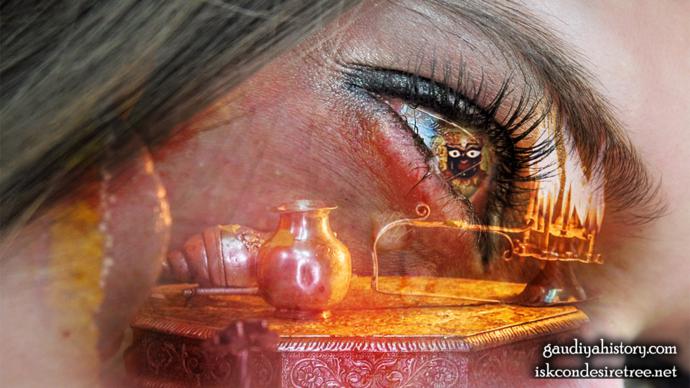
...tears of love gliding down his cheeks, Sanatana fell to the ground, offering his dandavats...Gradually, he performed Gopala's abhisheka (bathed the Deity) and offered worship to Him. (In the wallpaper: Shri Madan Mohan in the eyes of a girl, worshiping items).

   Gradually, he performed Gopala's abhisheka (bathed the Deity) and offered worship to Him. Sanatana's brother Rupa came there and, seeing the Deity, was deeply moved in ecstatic love. Sanatana kept the Deity with him in his leaf hut and began to worship Him in great happiness. Shrila Rupa Goswami immediately sent word of this auspicious event to Mahaprabhu, at Puri.

   According to the different perspectives of vision of various Devotees, Krishna's pastimes might sometimes be described in different ways, putting more or less emphasis on the external events that surround the internal moods and sentiments felt by Krishna and His Devotees. In light of this, it has been described in the Prema-vilas that the Madana Mohana Deity resided at the home of one Mathura brahmana, Damodar Chaube by name. Subsequent to the period of time during which He was worshipped by Shri Advaita Acharya Damodar Chaube, his wife Ballabha and their son, Madan Mohan, used to worship the Deity in the mood of parental affection and friendship. Damodar Chaube's son used to play together with Lord Madana Gopala. Sometimes, like naughty brothers, they would slight one another and then complain to the parents. Their parents would feed them together at the same time and lay them down to rest together.

   Sanatana Goswami used to sometimes beg chapatis from Chaube's house. When he saw how the Deity was being worshipped he would instruct Damodara's wife Ballabhadevi in the rules and regulations of proper Deity worship. However, she found all of these rules very difficult to follow. One day when Sanatana saw the Deity Madana Gopala and the boy Madan Mohan eating their lunch together, he became moved by the transcendental mood there and the symptoms of ecstatic love appeared in his body. Then he told Ballabhadevi that she should worship Madana Gopala according to the dictates of her heart. 

   One night Sanatana Goswami and Damodar Chaube's wife both had a dream simultaneously in which Madana Gopala requested to be able to come and live with Sanatana Goswami. In great happiness Sanatana received Madana Gopala from the family and Him to a small hillock near Surja ghat, where he constructed a small hut made of branches and leaves. Then he began to serve Madana Gopala, preparing offerings for Him from whatever he obtained by begging. 

Sanatana Goswami

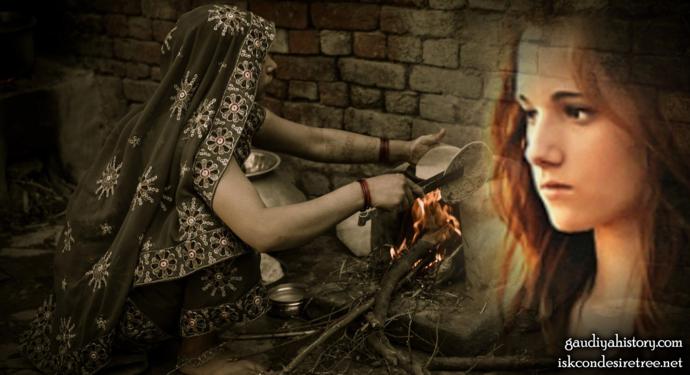
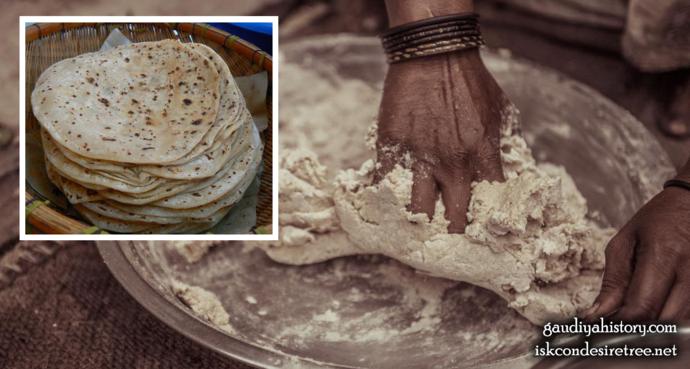
Sanatana Goswami would beg some flour from the village and then with that prepare chapatis for Madana Gopala. Sometimes he would collect some forest vegetables, roots or spinach and also prepare some vegetables. If sometimes there was no ghee or oil, or salt, then he would just cook dry chapatis. But he felt very bad about this. On the other hand, he could not see an alternative. Mahaprabhu had ordered him to compile Bhakti-shastras (devotional scriptures) and the major portion of his time was devoted to that. Sometimes it simply wasn't possible to find time to beg some money with which to purchase salt and oil. (In the wallpaper: Chapati making process and chapatis out of wheat floor).

   One day Madana Gopala refused to eat, complaining that there wasn't even any salt in the chapatis. Sanatana replied, "Today it's salt and tomorrow it will be ghee. But I am sorry. I don't have the time or the inclination to chase around after rich men requesting special items from them". Having silently listened to this reply Madana Mohana didn't say anything further, but rather arranged that Krishna dasa Kapoor would come that way, as will subsequently be described.

   Sanatana Goswami would beg some flour from the village and then with that prepare chapatis for Madana Gopala. Sometimes he would collect some forest vegetables, roots or spinach and also prepare some vegetables. If sometimes there was no ghee or oil, or salt, then he would just cook dry chapatis. But he felt very bad about this. On the other hand, he could not see an alternative. Mahaprabhu had ordered him to compile Bhakti-shastras (devotional scriptures) and the major portion of his time was devoted to that. Sometimes it simply wasn't possible to find time to beg some money with which to purchase salt and oil. 

   "Madana Mohana is the son of a Maharaj. Seeing that He is simply eating dry chapatis Sanatana felt very sad; Madana Mohana, who is within the heart of everyone could understand, 'Sanatana wants to render greater service to Me.' Then Madana Mohana Himself desired that His service might be increased."

   Within a few days a wealthy Kshatriya named Shri Krishna dasa Kapoor came to Mathura to engage in trade and business. By chance, however, his boat became stuck on a sand bar in the Yamuna and by no means could he manage to free it. By the way, he came to learn that a sadhu by the name of Shri Sanatan Goswami was living nearby. In order to seek the blessings of the sadhu, Krishna dasa Kapoor came to his hermitage and found Sanatana Goswami engaged in writing.

   Sanatana Goswami's body was very lean and thin from the practice of great austerities and he was wearing only a kaupin. Krishna das offered his dandavats and Sanatana Goswami in turn offered him a grass mat to sit on. Krishna dasa touched the mat with his hand and sat on the ground. He appealed to the Goswami, "Baba! Please bestow your mercy on me."

   Sanatana replied, "I am a beggar. What mercy can I bestow upon you?"

   "I simply want your blessings. My boat is stuck on a sand bar in the Yamuna, and we can't free it by any means."

   "I am completely ignorant about all these matters You can speak to Madana Gopala about it."

   Krisina das offered his dandavats to Madana Mohanji and spoke to Him, "O Madana Gopala Deva! If, by Your mercy my boat is freed, then whatever profit is realized from the sale of its cargo, I will give to this Goswami to be engaged in Your service."

   Praying this way, Kapoor Seth took leave from Sanatan Goswami. That afternoon there was such a downpour of rain that the boat very easily floated off the sand bar and on to Mathura. Krishna dasa could understand that this was the mercy of Lord Madana Gopala Deva. His goods were sold at a very handsome profit and with this money he constructed a Temple and kitchen and made all the necessary arrangements for the royal execution of Shri Madana Gopala's worship. Seeing this arrangement, Sanatana Goswami was very happy and after some period initiated Krishna dasa Kapoor as his disciple. 

Sanatana Goswami

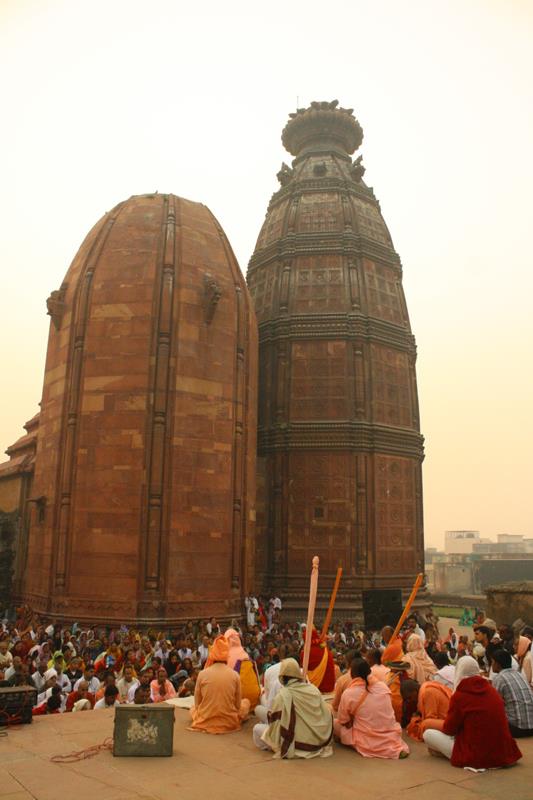
His goods were sold at a very handsome profit and with this money he constructed a Temple and kitchen and made all the necessary arrangements for the royal execution of Shri Madana Gopala's worship. Seeing this arrangement, Sanatana Goswami was very happy and after some period initiated Krishna dasa Kapoor as his disciple. (In the image: Shri Madan Mohan Temple, ISKCON Devotees at the time of parikrama, Shri Vrindavan Dham).

   Shri Madana Mohana Deva is presently worshiped at Karauli, Rajasthan. When the daugher of the king of Jaipur was offered in marriage to the king of Karauli, she very insistently requested that her father send Lord Madana Mohana with her as a dowry, as she was very attached to Him. Her father was very reluctant and agreed only after stipulating one condition: "Madana Mohana would be placed in a room with many other Deities.  Whoever she chose while blindfolded could go with her to Karauli."

   Madana Mohana reassured her by telling her that she would be able to recognize Him by the soft touch of His arm. By this stratagem, she easily recognized Madana Mohana who still resides in Kaurali till this day. There is a direct bus to Karauli from Jaipur. Otherwise, one can go by train from Mathura to Hindaun and then from there to Karauli by bus.

   One day Sanatana Goswami came to Radha-kunda to meet Shri Rupa and Shri Raghunatha dasa Goswami. Upon his arrival they both got up to greet him and after respectfully seating him, they immersed themselves in discussion of the nectarean pastimes of Shri Shri Radha-Krishna. At that time Shrila Rupa Goswami was composing some hymns in praise of Shrimati Radharani, collectively known as "Chatu Pushpanjali". Sanatan Goswami, while reading these, came across one verse:

anava gorocana gauri praba rendi barambaram
amani stavak vidyoti veni byalangana fanam

   Here "byalangana fanam" means that the braids of Radharani's hair appeared very beautiful like the hoods of a snake. Sanatana Goswami reflected, "Is that a proper comparison 'like the hood of a poisonous snake'?"

   At noon Sanatan came to the banks of Radha-kunda, and after offering prayers there, he began to take his bath. Then, on the opposite bank of the kunda, he noticed some cowherd girls playing under the shade of a large tree. As he watched them from the distance, it appeared that a black snake, hanging from the tree, was about to wrap itself around the neck and shoulders of one of those cowherd girls. Sensing some danger he called out to her, "Ohe Lali! Look out! There is a snake just behind You!" But the girls were absorbed in their play and didn't take notice of him. So he immediately took off running to save them from the impending danger. Seeing him approaching them, Shrimati Radharani and Her friends began to laugh. Then they disappeared. Sanatana was completely stunned but then gradually the understanding came to him that Shri Rupa's comparison was appropriate.

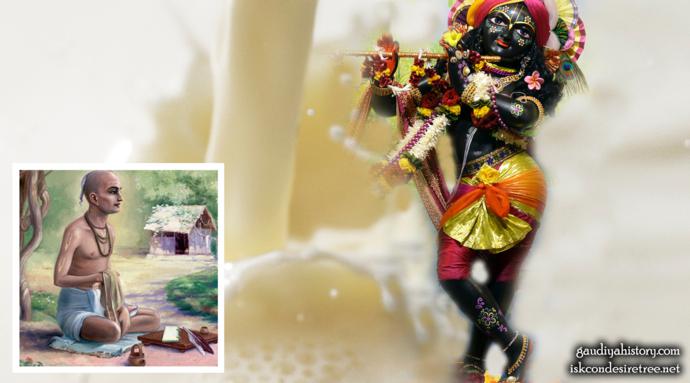
   Coming to the banks of Pavan Sarovar, Sanatana Goswami entered into some woods there, and giving up food and water, he became absorbed in intense meditation on the lotus feet of Shri Shri Radha-Govinda. Shri Krishna, who is within the heart of everyone, could understand that His Devotee was going without food, so He came there in the dress of a cowherd boy, with a pot of milk in His hand, and stood smiling before Sanatana Goswami.  [B.R. 5/1303]

   "Baba! I brought some milk for you."

   "Oh Lala! Why have You gone to such trouble for me?"

   "I saw you are sitting here for so long without any food."

   "How do You know that I am not eating anything?"

   "I come here to pasture My cows and I watch you to see what you are doing. But you never take any food."

   "You should have sent someone else, You are just a small boy. You have suffered some difficulty in bringing this milk here for me."

   "Na, na, Baba. It was no trouble. At home everyone else was busy, so I was happy to be able to come Myself."

   Sanatan Goswami requested the boy to sit down while he transferred the milk into another  container.

   "Na Baba! I can't sit down now. It is almost sunset. I have to milk My cows now. I will come to get the pot tomorrow."

   When when Sanatana looked up there was no one there. He could understand Shri Krishna Himself had brought him this milk. With tears of love streaming down his cheek, he drank the milk. From that day he gave up fasting and would go to beg some food-stuffs from the Brijabasis. The Brijabasis also built him a small hut. 

Sanatana Goswami

When when Sanatana looked up there was no one there. He could understand Shri Krishna Himself had brought him this milk. With tears of love streaming down his cheek, he drank the milk. From that day he gave up fasting and would go to beg some food-stuffs from the Brijabasis. The Brijabasis also built him a small hut. (In the wallpaper: Shri Madan Gopal, ISKCON Nasik, Maharashtra, Shrila Sanatana Goswami, milk).

   One day Rupa Goswami had a desire to cook some sweet rice for his elder brother, Sanatana, but he had none of the necessary ingredients, Shri Radha Thakurani, who fulfills the desires of her Devotees, could understand everything. Dressing Herself as a cowherd girl, she came there carrying a basket containing rice and sugar with a pot of milk in her other hand. "swamin! swamin! Please accept this offering which I have brought".

   Hearing someone calling in such a sweet voice, he opened the door of the kutir and saw an extremely beautiful cowherd girl standing there with a present of rice, sugar and milk in her hands.

   "Lali! What brings You here so early this morning?"

   "swamin, I came to bring you this present."

   "Oh! But You have gone to so much trouble."

   "What trouble? I have come to serve the sadhus."

   Shri Rupa requested her to sit down, but she replied that there was much work at home, so She couldn't sit down just now. And then She was gone. Shri Rupa looked up and saw that there was no one there and was a little startled. "Now where did She run off to so quickly?"

   He prepared the sweet rice and after offering to Shri Giri-dhari, he gave the Prasadam to Shri Sanatana. Sanatana was in total ecstasy while accepting this Prasadam and inquired, "From where did you get the rice and milk?"

   Shri Rupa replied, "One cowherd girl brought everything."

   Sanatana asked, "Just like that? Suddenly She brought every thing?"

   "Yes. This morning I was thinking to make some sweet rice for you. Just after that I saw one cowherd girl standing before our kutir with all the ingredients in Her hands."

   As Sanatana heard this, tears began to glide down his cheeks. "The taste of this sweet rice is from another world. Who else could have brought such ingredients but Shrimati Radha Thakurani Herself. Don't desire like this again." [B.R. 5.1322]

   Everyday Shri Sanatana Goswami would circumambulate the fourteen mile circumference of Govardhan hill. As he became advanced in years this became somewhat difficult, but he was not inclined to give up his vow. Krishna, however could understand that it was difficult for him, so He came to him one day dressed as a cowherd boy.

   "Baba! You have become old now, so I think it isn't necessary for you to circumambulate Govardhan hill anymore."

   "No. Lala! This is my regular vow, my worship."

   "You can renounce this vow in your old age."

   "No Lala. One should never renounce his vows."

   "Baba. I have a very good idea, if you will accept it."

   "If it is acceptable surely I will accept it."

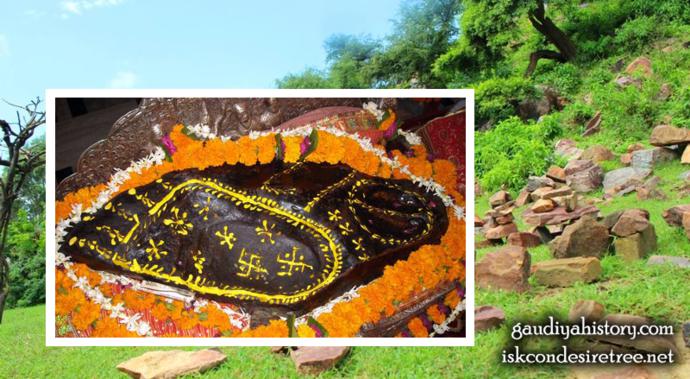
   Then Shri Krishna presented him a stone from Govardhan hill with the imprint of His foot, a calf's foot print and the impressions of a stick and flute in it.

   "Baba! This is a Govardhan shila."

   "What will I do with this?"

   "You can circumambulate this shila, and that will be the same as circumambulating Giri Govardhan." Saying this much the cow herd boy disappeared. Then Sanatana could understand that Giriraja Himself had presented His worshippable form to him and from that day he would circumambulate this shila. 

Sanatana Goswami

"You can circumambulate this shila, and that will be the same as circumambulating Giri Govardhan.&quo#39;s pastimes might sometimes be described in different ways, putting more or less emphasis on the external events that surround the internal moods and sentiments felt by Krishna and His Devotees. In light of this, it has been described in the Prema-vilas that the Madana Mohana Deity resided at the home of one Mathura brahmana, Damodar Chaube by name. Subsequent to the period of time during which He was worshipped by Shri Advaita Acharya Damodar Chaube, his wife Ballabha and their son, Madan Mohan, used to worship the Deity in the mood of parental affection and friendship. Damodar Chaube t; Saying this much the cow herd boy disappeared. Then Sanatana could understand that Giriraja Himself had presented His worshippable form to him and from that day he would circumambulate this shila. (In the wallpaper: Shri Govardhan Hill and Shila which was given to Sanatana Goswami by Krishna Himself).

   Sometimes Shri Sanatana used to stay at Mahavan. One day he saw some cowherd boys playing on the banks of the Yamuna, and amongst them was one boy whom he thought was Madana Gopala. 

   "Is that my Madana Gopala playing there? No it must be one of the local village boys."

   Then on another day as he was passing by the Yamuna, there again he saw that same boy and thought, "This time let me wait and see where Damodar Chaubee goes." Finally as the evening approached the boys finished playing and set out for their respective homes.

   Following behind that particular boy, sure enough, Sanatana saw him enter the Temple. Then he could understand that Madana Gopala goes every day to the banks of the Jamuna to play with the other boys.

   Wherever Shri Sanatana and Shri Rupa would go throughout Vraja, in all the various villages the two brothers were much adored by the Brajabasis, who would feed them milk and yogurt. They in turn would see the Vrajavasis as Krishna's own family members and respect them in that way. Though it was not their business to engage in ordinary gossip, with the Brajavasis they would inquire about their well-being, e.g. how many sons and daughters they had and who had been married where, what everyone's various names were, how their cows were giving milk, how the bulls were working in the fields, how the harvest was going on, who had fallen ill and if they were getting better or not.

   In this way Rupa and Sanatana became the life of the villagers and the Brijabasis also became the life of Rupa and Sanatana.

   Shri Sanatana would sometimes stay at Chakleshwar, near Govardhan. At that place there were many mosquitos, which was a great disturbance. When he was one day being harassed by these insects, Sanatan remarked, "I won't stay here anymore. It is impossible to concentrate on anything. Neither can I write, nor chant."

   That night, Lord Shiva came to Sanatan and told him, "Sanatan! Please continue your service here in a happy frame of mind. From tomorrow there will be no more disturbance from mosquitos."

   After that there were no more mosquitos and Sanatana continued his bhajan free from disturbance.

   Shri Sanatana Goswami compiled many scriptures.  These include: Shri Brhat-bhagavatmrta, Shri Hari-bhakti-vilas and its Dig-darshani-tika, Shri Krishna-lilastava (dasham charit), Shri Bhagavata- tipani, (commentary on Shrimad Bhagavatam) and Brihat-vaishnava-toshani.

   Shri Sanatan Goswami was born – 1488 (Christian) 1410 (Sakabda). At the age of 27 he came to live at Braja where he remained for 43 years. He thus lived to be 70 years old. His disappearance was on the full moon day of Asar in the year 1558 (Christian calendar). His name in Braja-lila is Rati-manjari.

Sri Svarupa Damodar Goswami – Biography

Sri Svarupa Damodar is the eternal associate of Sri Caitanya Mahaprabhu. His previous name was Sri Purusottam acarya and he resided at Navadwip. He was always present with Mahaprabhu. When Sri Caitanya Mahaprabhu exhibited His pastimes of accepting sannyasa, Svarupa Damodara became like a madman and, journeying to Baranasi he also accepted sannyasa from one sannyasi named Caitanyananda.
 
His sannyasa guru ordered him that, "You should yourself study the Vedanta and also teach it to others." Sri Purusottama acarya didn't accept the garments of sannyasa, but simply gave up his sikha and brahmana thread. Therefore his name became Svarupa (a brahmacari name). Thereafter, by the order of his guru, he came to Sri Nilacal, where he again met Mahaprabhu. Then one day, Svarupa Damodar, who was very intimate with Mahaprabhu, and an ocean of the mellows of devotion, came to Sri Jagannath Puri. His previous name was Purusottam acarya and he resided at Navadwip, at the lotus feet of Mahaprabhu.
 
Seeing that Mahaprabhu had accepted sannyasa, he became like a madman and also accepted sannyasa at Varanasi. [C. C. Mad. 10.102]. Though his scholarship was practically unlimited, he spoke very little with others and preferred to remain alone. Thus very few were aware of his actual position. He was completely conversant with the understanding of the mellows of devotion to Sri Krsna and his body was fully imbued with love for Him. He was as though a second Mahaprabhu.
 
Whenever anyone wanted to present to Mahaprabhu some book, verse or song that they had composed, Svarupa Damodar would first hear what they had written before it could be presented to Mahaprabhu. If these compositions contained any points which were in contradiction to the superior position of bhakti, as concluded in scriptures, then hearing these writings would not be a source of transcendental pleasure for Mahaprabhu. Therefore Svarupa Gosai would first examine what had been composed and if it was untainted then it could be presented to Mahaprabhu. Usually he would recite Sri Gita Govinda, and the writings of Candidas and Vidyapati, for the transcendental happiness of Mahaprabhu. In music and singing he was like a Gandharva and in knowledge of the shastras he was like Brhaspati.

There was no one to compare with him in talent and intelligence. He was extremely dear to Sri Advaita and Nityananda Prabhu and was the life and soul of devotees like Srivas and others. When Sri Svarupa Damodar arrived in Puri from Kasi (Baranasi) he recited this sloka in praise of Mahaprabhu: "Oh You, who are the personification of mercy – Sri Caitanya. That which very easily causes grief to retreat far away, and which is spotlessly pure; which causes the appearance of the highest happiness, and by whose appearance disputation over the intricacies of scriptural statements ceases; that which causes the spirit to become extremely agitated in ecstatic love, by a shower of grace and beauty; may that extremely expansive and auspicious mercy by its sweetness and dignity shine its rays upon me." (Sri Caitanya Candrodoy Natak.) Seeing that Svarupa Damodar was offering his dandavats to Him, Mahaprabhu picked him up and as He embraced him he said, "I saw in a dream this morning that you had come. Just as a blind man finds unlimited happiness by regaining his eyesight, so I am feeling by regaining your association." Svarupa Damodar replied: "Prabhu, please forgive me. By leaving You and running off to Baranasi, I made a great mistake. I don't have even a hint of attachment to your lotus feet, and I have actually become a great sinner by leaving you and going to a distant country.

I gave up your association, but You didn't give me up. Binding the rope of mercy around my neck You brought me again to Your lotus feet." [C. C. Mad 10] Hearing these words of Svarupa Damodar, spoken in such humility, Mahaprabhu again embraced him and said: "Krsna is very kind. He has very mercifully brought us together again." Mahaprabhu kept Svarupa Damodar close to Him. Whenever Mahaprabhu became immersed in a particular ecstatic emotion, Svarupa Damodar would perform a kirtan in that particular mood. During this period Sri Ray Ramananda also arrived from Vidyanagar in South India. Thus the two of them, Svarupa Damodar and Ramananda Ray would enhance the ecstatic moods of Mahaprabhu by singing different songs and reciting various poetic verses.

During the day, Mahaprabhu would engage in his pastimes of sankirtan with His devotees, and at night He would taste the mellows of the ecstatic love of Sri Sri Radha-Krsna in the company of these two. As Lalita and Visakha were very intimate with Srimati Radharani, Ray Ramananda and Svarupa Damodar were similarly intimate with Caitanya Mahaprabhu. Svarupa Damodar's place of residence in Puri was the "Satasan Math". This is located near Bhaktivinode Thakur's "bhakti kutir", near the ocean at Svarga Dwar. Mahaprabhu entrusted him to look after and instruct Raghunath Das Goswami. Svarupa Damodar Goswami disappeared on the second day of the bright fortnight in the month of Asar.
 

Mahaprabhu’s Pastime And Mission, The Condensed Version.

Caitanya Mahaprabhu

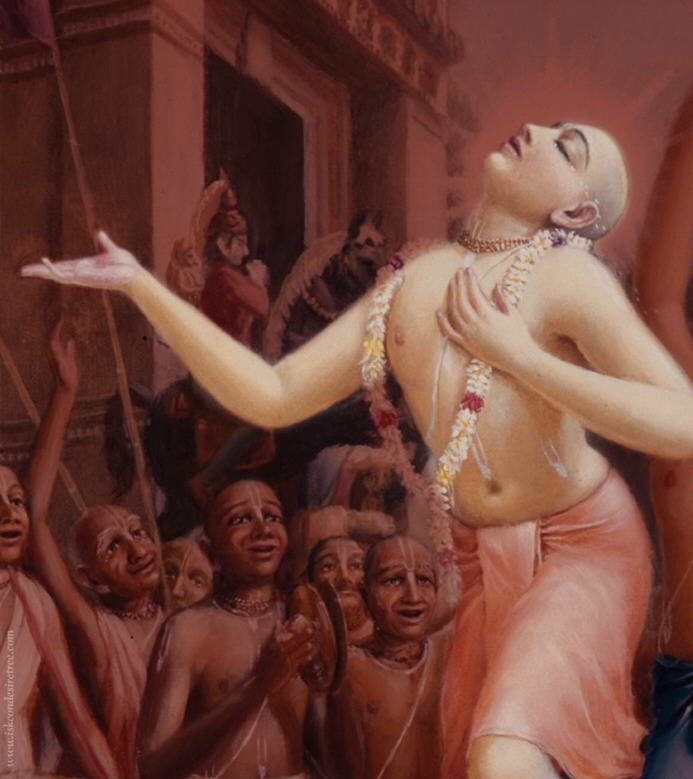
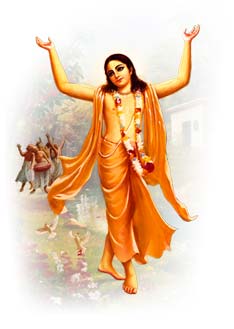
Lord Krishna thought in Goloka, "I shall personally inaugurate the religion of the age; nama-sankirtana, the congregational chanting of the Holy Name of the Lord in the form of Lord Gauranga. By accepting the role of a Devotee, I shall make the whole world dance in ecstasy, and thus realize the four mellows of loving devotional service. In this way, I shall teach devotional service to others by personally practicing it, for whatever a great personality does, common people will follow. Of course, My plenary portions can establish the religious principles for each age, but only I can bestow the kind of loving devotional service which is performed by the residents of Vraja." (In the image: Lord Sri Krishna Chaitanya dancing in ecstacy).

   Lord Krishna thought in Goloka, "I shall personally inaugurate the religion of the age; nama-sankirtana, the congregational chanting of the Holy Name of the Lord in the form of Lord Gauranga. By accepting the role of a Devotee, I shall make the whole world dance in ecstasy, and thus realize the four mellows of loving devotional service. In this way, I shall teach devotional service to others by personally practicing it, for whatever a great personality does, common people will follow. Of course, My plenary portions can establish the religious principles for each age, but only I can bestow the kind of loving devotional service which is performed by the residents of Vraja."

   Besides this secondary reason for Lord Krishna to appear once more, taking the form of a Devotee, there is another confidential purpose of a very personal nature. Even though Lord Krishna had tasted the essence of loving mellows by performing His conjugal pastimes in the company of the gopis, He was not able to fulfill three desires.

   Therefore, after His disappearance, the Lord thought, "Although I am the Absolute Truth, and the reservoir of all rasas, I cannot understand the strength of Radharani's love, with which She always overwhelms Me. Indeed, the love of Radharani is My teacher, and I am Her dancing pupil, for Her love makes Me dance in various novel ways. Whatever pleasure I get from tasting My love for Srimati Radharani, She relishes ten million times more, by Her love. Although there is nothing greater than Radha's love, since it is all pervading, it nonetheless expands constantly and is completely devoid of pride. There is nothing purer than Radha's love, and yet its behavior is always perverse and crooked."

   "Sri Radhika is the highest abode of love, and I am its only object. I taste the bliss to which the object is entitled, but Radha's pleasure is ten million times greater than Mine. Therefore, My mind becomes mad to taste the pleasure that is experienced by the abode of love, although I cannot do so. Only if I can somehow become the abode of that love, will I be able to experience its joy." 

Caitanya Mahaprabhu

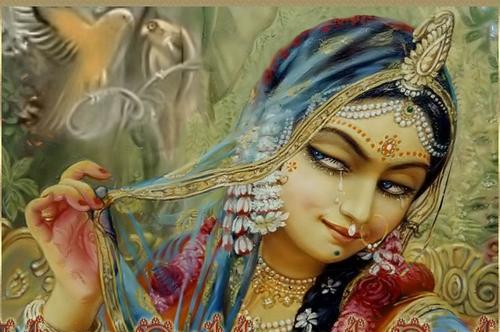
"Sri Radhika is the highest abode of love, and I am its only object..." (In the image: Eternal Consort of Sri Krishna Srimati Radharani).

   This was one desire that increasingly blazed in Lord Krishna's heart. Then, upon seeing His own beauty, Lord Krishna began to consider as follows: "My sweetness is unlimitedly wonderful. Only Radhika can taste the complete nectar of My sweetness, by the strength of Her love, which acts just like a mirror whose clarity increases at every moment. Although My sweetness, being without limit, seemingly has no room for expansion, it shines forth with newer and newer beauty, and thus constantly competes with the mirror of Radharani's love, as they both go on increasing without admitting defeat." "Devotees taste My sweetness according to their respective love, and if I see that sweetness reflected in a mirror, I also become tempted to taste it, although I cannot. Upon deliberation, I find that the only way I can relish My sweetness is to take the position of Srimati Radharani."

   This was Lord Krishna's second desire, and His third desire was expressed while thinking as follows: "Everyone says that I am the reservoir of all transcendental bliss, and indeed, all the world derives pleasure from Me alone. Who then could give Me pleasure? I think that only someone having a hundred times more qualities than Myself could give pleasure to My mind, but such a person is impossible to find."

   "And yet, in spite of the fact that My beauty is unsurpassed, and gives pleasure to all who perceive it, the sight of Srimati Radharani gives pleasure to My eyes. Although the vibration of My flute attracts everyone within the three worlds, My ears become enchanted by the sweet words spoken by Radharani. Although My body lends its fragrance to the entire creation, the scent of Radharani's limbs captivates My mind and heart. Although there are various tastes due to Me alone, I become charmed by the nectarean taste of Radharani's lips. Although My touch is cooler than ten million moons, I become refreshed by the touch of Srimati Radharani. Thus, in spite of the fact that I am the source of happiness for the entire world, the beauty and attributes of Sri Radhika are My very life and soul." 

Caitanya Mahaprabhu

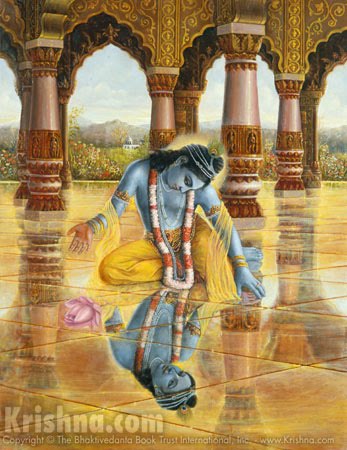
"Everyone says that I am the reservoir of all transcendental bliss, and indeed, all the world derives pleasure from Me alone. Who then could give Me pleasure? I think that only someone having a hundred times more qualities than Myself could give pleasure to My mind, but such a person is impossible to find." (In the image: Lord Sri Krishna seeing His own complextion on the marble floor became attracted to Himself).

   "My eyes become fully satisfied by looking at Srimati Radharani, and yet, when She gazes at Me, She feels even greater satisfaction. The whispering murmur of the bamboo trees that rub against one another steals away Radharani's mind, for She thinks it to be the sound of My flute. She embraces a tamala tree, mistaking it for Me, and thus She considers, 'I have gotten the embrace of Krishna, and so now My life has become fulfilled.' When the fragrance of My body is carried to Her by the wind, Radharani becomes blinded by love and tries to fly into that breeze. When She tastes the betel nut that has been chewed by Me, She merges into an ocean of joy, and forgets everything else."

   "Thus, even with hundreds of mouths, I could not express the pleasure which Radharani derives from My association. Indeed, upon seeing the luster of Her complexion after Our pastimes together, I consider My own happiness to be negligent. Expert sexologists say that the happiness of the lover and the beloved are equal, but they do not know the nature of transcendental love in Vrindavana. Because of the indescribable pleasure which Radharani experiences, I can understand that there is some unknown mellow within Me that controls Her entire existence."

   "I am always very eager to taste the joy that Srimati Radharani derives from Me, and yet, in spite of endeavoring, I have been unable to do so. Therefore, in order to fulfill My three desires, I shall assume Sri Radhika's bodily complexion and ecstatic loving sentiment, and then descend as an incarnation."

   Desiring to understand the glory of Radharani's love, the wonderful qualities in Him that She alone relishes through Her love, and the happiness that She feels upon realizing the sweetness of His love, the Supreme Lord, Gauranga-Krishna, decided to appear in a form that was richly endowed with Her emotions. First of all, the Lord had His respectable superiors incarnate on the earth, such as His mother and father, Sri Sachidevi and Jagannath Mishra. In addition, there was Madhavendra Puri, Keshava Bharati, Ishvara Puri, Advaita Acharya, Shrivas Pandita, Thakur Haridas, Acharyaratna and Vidyanidhi.

   Before the appearance of Lord Sri Gauranga Mahaprabhu, all of the Devotees in the Navadwip area used to gather at the house of Advaita Acharya. In these meetings, Advaita Acharya preached on the basis of Bhagavad-Gita and Srimad-Bhagavatam, decrying the paths of philosophical speculation and fruitive activity, and firmly establishing the super excellence of devotional service. In the house of Advaita Acharya, the Devotees took pleasure in always talking about Krishna, worshipping Krishna, and chanting the Hare Krishna maha-mantra.

   However, Advaita Acharya felt very pained to see how practically all the people of the world were devoid of Krishna consciousness and completely merged into material sense enjoyment. Knowing that no one can gain relief from the cycle of repeated birth and death without taking an interest in the devotional service of the Lord, Advaita Acharya compassionately pondered over the means whereby people could become delivered from the clutches of maya. 

Caitanya Mahaprabhu

"...Indeed, my name Advaita will be fitting only if I am able to induce Lord Krishna to inaugurate the sankirtan movement of chanting the Holy Name, which is the only religion for this age." (In the image: Sri Advaita Acharya is calling out for Krishna to descend to this world).

   Advaita Acharya thought, "Only if Lord Krishna personally appears and preaches the path of devotional service by His own example, will liberation become possible for all people. Therefore, I shall worship the Lord in a purified state of mind and constantly petition Him with all humility. Indeed, my name Advaita will be fitting only if I am able to induce Lord Krishna to inaugurate the sankirtan movement of chanting the Holy Name, which is the only religion for this age."

   While Advaita Acharya thought about how to satisfy Krishna by His worship, the following verse came to mind: "Sri Krishna, who is very affectionate toward His Devotees, sells Himself to one who offers Him merely a tulasi leaf and a palmful of water." (Gautamiya-tantra)

   Advaita Acharya considered the meaning of this verse in the following way: "Lord Krishna cannot find any way to repay the debt which He owes to one who offers Him a tulasi leaf and water. Therefore, the Lord concludes, 'Since there is nothing in My possession which is equal to a tulasi leaf and water, I will liquidate the debt by offering Myself to the Devotee.' " Thereafter, while meditating upon the lotus feet of Sri Krishna, Advaita Acharya constantly offered tulasi buds in water from the Ganga. While thus engaged in worship, Advaita Acharya petitioned Krishna to appear by His loud cries, and this repeated invitation attracted the attention of the Lord, causing Him to descend. 

   Sri Upendra Mishra, a brahmana who was formerly the gopala named Parjanya, the grandfather of Lord Krishna, was a great Devotee and scholar. One of Upendra's seven sons, Jagannath Mishra, moved from Srihatta to the banks of the Ganga at Nadia, and then married Srimati Sachidevi, the daughter of Nilambar Chakravarti, who was formerly Gargamuni.

   Before the appearance of Sri Gauranga Mahaprabhu, Jagannath Mishra (who was formerly Nanda Maharaja) begot eight daughters in the womb of Sachidevi (who was formerly Yashoda), but just after birth, they all died. Being very aggrieved at the loss of his children, one after another, Jagannath Mishra worshiped Lord Vishnu, while desiring a son. Thereafter, Sachimata gave birth to a baby boy named Vishvarup, who was an incarnation of Lord Baladev. Being very pleased, the mother and father began to serve the lotus feet of Lord Govinda even more devotedly, because they realized that their happiness was by His mercy.

   Then, in the month of Maagh (18th February 1486) of the year 1406, Shaka era, Lord Krishna entered the bodies of both Jagannath Mishra and Sachidevi. Thereafter, Jagannath informed his wife, "I see many wonderful things! Your body seems to be effulgent, and it appears as if the goddess of fortune is personally residing in our house. Wherever I go, everyone offers me respect, and even without asking, they give me money, cloth and grains." Sachimata replied, "I also see wonderfully brilliant beings, appearing in the sky, as if offering prayers."

   Jagannath Mishra then said, "In a dream I saw the effulgent abode of the Supreme Lord enter into my heart. Then, from my heart it entered your heart, and thus I can understand that a great personality will soon take birth."

   After this conversation, both husband and wife felt very jubilant, and with great care and attention they rendered service unto the household Shalagrama-shila.

   However, when Sachimata's pregnancy approached the thirteenth month, and still there was no sign of delivery, Jagannath Mishra became very apprehensive. At that time, Nilambara Chakravarti made an astrological calculation and predicted that the child would be born that very month, taking advantage of an auspicious moment.

   Thus it so happened that on the evening of the Phalguni purnima, in the year 1407 Shaka era, corresponding to the modern year 1486, Sri Chaitanya Mahaprabhu made His appearance at Navadwip. At this time, Rahu considered, "When the spotless moon of Chaitanya Mahaprabhu is about to become visible, what need is there for a moon which is full of black marks?" Thinking in this way, Rahu covered the full moon, and so all of the Hindus went to the banks of the Ganga in order to bathe and chant the names "Krishna" and "Hari". While the Hindus were thus vibrating the Holy Names of the Lord, the Mohammedans jokingly imitated them. In this way, at the time of Lord Chaitanya's appearance, everyone was engaged in chanting the Hare Krishna maha-mantra.

   In all directions and within everyone's mind there was peacefulness and joy. In Shantipur, Advaita Acharya and Haridas Thakur began chanting and dancing in a very pleasing mood, although no one could understand why they did so. While laughing again and again, they also went to the Ganga, and at that time, Advaita Acharya took advantage of the lunar eclipse to distribute all kinds of charity to the brahmanas. Upon seeing how the whole world had become jubilant, Haridas Thakur addressed Advaita Acharya in great astonishment, "Since Your dancing and distribution of charity appears very pleasing to me, I can understand that You have some very special purpose."

   In Navadwip, Shrivas Thakur and Acharyaratna, who was also called Chandrashekhar, immediately went to bathe in the Ganga, and while chanting the Holy Name of the Lord in great jubilation, they also gave charity by dint of mental strength. Indeed, wherever they were situated, all of the Devotees danced, chanted and gave charity on the plea of the lunar eclipse, their minds overwhelmed with joy. Even in the heavenly planets, chanting and dancing was going on, for the demigods were very eager to witness the transcendental appearance of the Lord.

   The Supreme Proprietor of the entire creation remained in the womb of Srimati Sachidevi, and on the full moon night in the month of Phalguna He appeared. That full moon night was the summum bonum of all the auspicious holy occasions of the cosmic manifestation combined. The Supreme Personality descended, accompanied by the process of congregational chanting of the Holy Name. He propagated this process by practicing it Himself.

   Who is able to know the wonderful pastimes of the Supreme Lord? He arranged a lunar eclipse at the time of His birth. Upon seeing the lunar eclipse the residents of Nabadwip began to loudly chant the Lord's holy name and make other auspicious sounds. Endless teeming millions convulsed on the Ganges for holy ablutions and rent the air with loud chanting of the Lord's name. The tumultuous sound of their chanting penetrated the coverings of this material universe and travelled beyond Brahmaloka.

   All the saintly persons marvelled at this wonderful chanting and prayed for a perennial eclipse. All the Devotees experienced deep exhilaration and exclaimed, "Such great joy! Maybe the Supreme Lord Krishna is making His appearance. The Devotees went to the Ganges for their ablutions followed by the roar of chanting from all directions. Women, children, aged, pious, and impious – everyone loudly chanted Lord Hari's Holy Name during the lunar eclipse. The only sound within the universe was the all-prevailing chanting of "Hari! Hari!"

   The demigods showered flower confetti everywhere and pro-claimed victory as they beat clamorously on their dundubhi drums. Amidst the resounding adulations, the Lord and the very soul of the universe appeared as the son of Srimati Sachidevi. 

Caitanya Mahaprabhu

"The Supreme Proprietor of the entire creation remained in the womb of Srimati Sachidevi, and on the full moon night in the month of Phalguna He appeared. That full moon night was the summum bonum of all the auspicious holy occasions of the cosmic manifestation combined. The Supreme Personality descended, accompanied by the process of congregational chanting of the Holy Name. He propagated this process by practicing it Himself." (Chaitanya Bhagavat). (In the image: Lord Sri Krishna Chaitanya).

Gaudiya Kanthahara On Sri Chaitanya Mahaprabhu’s Divine Appearance And Mission:

Caitanya Mahaprabhu

The Personality of Godhead (Sri Chaitanya Mahaprabhu) is brilliantly effulgence (like molten gold), and he is imperishable.

   4.1

mahan-prabhur vai purusam sattvasyesu pravarttakam
surnimalam imam santisano jyotiravyam

   The Personality of Godhead [Sri Chaitanya Mahaprabhu] is brilliantly effulgence [like molten gold], and he is imperishable. He is the Supreme Controller. He controls the mode of goodness and [through the performance of sankirtana] he bestows upon the living beings [the] spiritual intelligence [by which they can understand devotional service]. [In his acarya-lila, as a sannyasi] He is the source of spiritual purity and of liberation. He is therefore known as "Mahaprabhu." (Shvetasvatara Upanishad 2.12)

   The Sruti establishes that The Supreme Lord will appear in a golden form as Sri Gauranga

4.2
yada pasyam pasyate rukma-varnam kartaram isam purusam brahma-yonim
tada vidyan punya-pape vidhuya nira-janam pramam samyam upaiti

   When one realizes the golden form of that Lord [Sri Gauranga] who is the ultimate actor and the source of the Supreme Brahman, he attains the highest knowledge, transcends both pious and impious activities, becomes free from wordly bondage and gains entrance into the divine abode of the Lord. (Mundaka Upanisad 3.3)

   The evidence of Srimad-Bhagavatam.

4.3
krishna-varnam tvisa-'krishnam sangopangastra-parsadam
yajnaim sankirtana-prayair-yajanti hi sumedhasam

   In the age of Kali, Krishna appears in a golden form, [as Sri Gauranga] chanting the two syllables “Krish” “na”. He descends along with his weapons [The Holy Name of Krishna, Srimad-Bhagavatam, kirtana, and mahaprasada ], His limbs [His expansions and avataras such as Nityananda, Advaita, and His divine energies (saktis) such as Gadadhara, Svarupa Damodara, and Ramananda Raya], and eternal confidential associates [like Shrivasa Thakura, Haridasa Thakura, and other Devotees]. Those who are advanced in transcendental intelligence worship Him by performing sankirtana. (Srimad-Bhagavatam 11.5.32) 
Caitanya Mahaprabhu

His limbs (His expansions and avataras such as Nityananda, Advaita, and His divine energies (saktis) such as Gadadhara, Svarupa Damodara, and Ramananda Raya), and eternal confidential associates (like Shrivasa Thakura, Haridasa Thakura, and other Devotees). Those who are advanced in transcendental intelligence worship Him by performing sankirtana. (Srimad-Bhagavatam 11.5.32) (In the image: Pancha Tattva).

4.4
"krishna" – ei dui varna sada ya-'ra mukhe
athava krishnake ti-ho varne nija sukhe
dehakantye haya ti-ho akrishna-varana
"akrishna" – varane kahe pita-varana

   The two syllables "Krishna" are always in His mouth, or He always describes Krishna with great pleasure. These are two meanings of the words "Krishna-varna." Indeed, nothing but Krishna issues from His mouth. If someone tries to describe Him as being of blackish complexion, the next adjective, "tvisakrishnam" immediately restricts him. His complexion is certainly not blackish. Indeed, His not being blackish indicates that his complexion is golden. (Chaitanya Charitamrta-Adi 3.53,56)

4.5
asan varnastrayo'hyasya grhnato'nuyugam tanum
suklo-raktas-tatha-pita idanim krishnatam gatam

   This boy, Krishna, has three other colors: white, red, and yellow, as he appears in different ages. Now, in this Dvapara-yuga, he has appeared in a transcendental blackish color. (Srimad-Bhagavatam 10.8.13)

4.6
sukla, rakta, krishna, pita – krame cari varna
cari varna dhari' "krishna" karena yugadharma

   In the four ages, (yugas) Satya, Treta, Dvapara, and Kali, Krishna accepts four different colors: white, red, black, and yellow respectively. These are the colors of the different incarnations of Krishna in different milleniums. (Chaitanya Charitamrta Madhya 20.330)

4.7
itham nr-tiryag-rsi-deva-jhasavataraair
lokan vibhavayasi hamsi jagat-pratipan
dharmam mahapurusa pasi yuganuvrttam
channam kalau yad-abhavas tri-yugo 'tha sa tvam

   [Prahlada said] O Krishna! In this way you appear in various incarnations: as a human being, an animal, a great saint, a demigod, a fish, or a tortoise. Thus maintaining the entire creation in different planetary systems. In this way, according to the age,You protect the principles of religion. But O, Mahaprabhu! In the age of Kali, [when you come to preach the Holy Name of Krishna, you do so as a Devotee and therefore] You do not assert Yourself as the Supreme Personality of Godhead. Because your Godhood is hidden in the age of Kali You therefore known as Triyuga, or the Lord who manifests his Supremacy in only three ages. [And for this reason many sastras have also kept your appearance in Kaliyuga a secret.] (Srimad-Bhagavatam 7.9.38)

   The evidence of Mahabharata.

4.8
suvarna-varna hemango varangas-candanangadi
sannyasa-krcchamam santo nistha-santi-parayanam

   [The following explanation of this verse is given by Srila Bhaktisiddhanta Saraswat and is based on the commentary by Baladeva Vidyabhushana on the Vishnu-sahasra-nama-stotram found in Mahabharata. These remarks are mentioned by A.C. Bhaktivedanta Swami in his translation of Srila Bhaktisiddhanta Saraswati Thakura’s anubhasya commentary on Chaitanya Charitamrta Adi 3.49.52)] When the Supreme Personality of Godhead Krishna appears as Sri Gauranga, in his early pastimes His complexion is gold (suvarna-varna ), his limbs are the color of molten white gold (hemanga), his body is extremely beautiful (varangas), and he is decorated with sandalwood pulp (candanangadi). [These four are the symptoms of His grhastha-lila.] Another meaning of the description of the Lord as having a golden hue is that Lord Chaitanya's personality is as fascinating as gold is attractive.

   Sri Chaitanya accepts the sannyasa order of life (sannyasa-krt), and shows equanimity (sama) in different ways: by describing the mysteries of devotion to Sri Krishna, and by satisfying everyone by knowledge and attachment to Krishna. (santa). He is peaceful because He renounces all topics not related to the service of Krishna. His mind is always fixed on Krishna, and thus He is fixed (nistha ) in performing the great sacrifice of the Holy Name of Krishna. He silences the nondevotees and impersonalists who are opposed to the service of the Lord, by promoting the cause of devotion. Thus he distributes real peace. He is therefore an abode of the highest spiritual peace and devotion (mahabhava-parayana).(Mahabharata, Tadanadharma 149).

   The evidence of the Puranas.

4.9
aham eva kvacid brahman sannyasnasramamnasritam
hari-bhaktim grahayami kalau papa-hatan-naran

   [The Supreme Lord said to Sri Vyasadeva] O learned brahmanas, sometimes I accept the renounced order of life to induce the fallen people of the age of Kali to accept devotional service to the Lord. (Chaitanya Charitamrta Adi 3.81)

4.10
aham eva dvija-srestha nityam pracchana-vigraham
bhagavad-bhakta-rupena lokan raksami sarvada

   O best of the brahmanas! My disguised form is eternal. In this way, with my own form hidden from ordinary sight, I take the form of a Devotee and appear among the people in general in order to establish and protect religious principles. (Adi Purana )

   The version of the Goswamis.

4.11
antam krishnam bahir-gauram darsitangadi-vaibhavam
kalau sankirtanadyaim smam krishna-caitanyamnasritam

   I take shelter of Sri Krishna Chaitanya Mahaprabhu, who is Krishna Himself, thinking of Himself. He is internally Krishna – blackish – but externally, he appears with the golden complexion [of Sri Radha]. In this age of Kali, Krishna appears as Krishna Chaitanya, simultaneously manifesting His eternal associates, opulences, expansions, and incarnations. In this way, he preaches the process of Krishna consciousness by performing sankirtana. (Tattva-Sandarbha 2)

   Sri Gauranga is the fountainhead of all avataras.

4.12
sutiya acchinu ksira-sagara-bhitare
mora nidra bhanileka nadara hunkare

   [While sitting on the altar of Vishnu in the house of Shrivasa, Sri Chaitanya Maharabhu said] Lying within ocean of milk, My transcendental slumber broke, as I awoke to hear the loud cries of my Devotees. Thus I [Lord Vishnu] have come [as Sri Cahitanya]. (Chaitanya Bhagavata Madhya 22.16).

4.13
sei krishna avatari vrajendra-kumara
apane caitanya-rupe kaila avatara
ata eva caitanya gosa-i paratattva sima
ta-re ksirodasayi kahi ki ta-ra mahima
sei ta bhaktera vakya nahe vyabhicari
sakala sambhave ta-'te ya-'te avatari
avatarira dehe saba avatarera sthiti
keho kona mata kahe yemama ya'ra mati
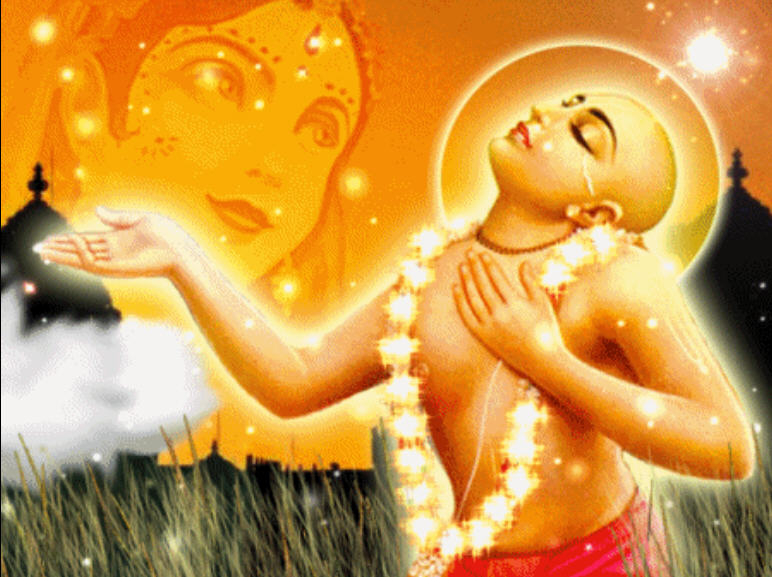
Caitanya Mahaprabhu

That same Lord Sri Krishna who is the fountainhead of all avataras is the son of the king of Vraja. He has descended personally as Sri Chaitanya Mahaprabhu. Therefore Sri Chaitanya Maharabhu is the supreme absolute truth.

   That same Lord Sri Krishna who is the fountainhead of all avataras is the son of the king of Vraja. He has descended personally as Sri Chaitanya Mahaprabhu. Therefore Sri Chaitanya Maharabhu is the supreme absolute truth. To call Him Kshirodakshayi Vishnu does not add to His glory. But such words from the lips of a sincere Devotee cannot be false. All possibilities abide in Him because He is the primeval Lord. All other incarnations are potentially situated in the original body of the primeval Lord. Thus according to one's opinion one may address Him as any one of the avataras. (Chaitanya Charitamrta-Adi 2.109-112)

   He is transcendental truth: He cannot be attained by wordly knowledge.

4.14
bhagavata-bharata-sastra agama purana
caitanya krishna-avatara prakata pramana
pratyakse dekhaha nana prakata prabhava
alaukika karma, alaukika anubhava
dekhiya na dekhe yata abhaktera gana
uluke na dekhe yena suryera kirana

   Srimad-Bhagavatam, Mahabharata, the Puranas, and other Vedic literatures all give evidence to prove that Sri Chaitanya is the avatara or descent of Krishna Himself. One can also directly see Sri Chaitanya's manifest influence in His uncommon deeds and uncommon Krishna conscious realization. But faithless unbelievers do not see what is clearly evident, just as owls do not see the rays of the sun. (Chaitanya Charitamrta-Adi 3.83 – 85)

   Sri Krishna Chaitanya Tattva: the Lord's sixfold nature.

4.15
sakala vaisnava suna kari' ekamana
caitanya-krsnera sastre yemata nirupana
krishna, gurudvaya, bhakta, avatara prakasa
sakti – ei chayarupe karena vilasa

   I advise all my Vaishnava readers to read and hear with rapt attention this narration of the pastimes of Sri Krishna Chaitanya as inculcated in the revealed scriptures. Lord Krishna enjoys His pastimes by manifesting Himself (Krishna) as the spiritual masters (guru), His Devotees (bhakta), His diverse energies (sakti), His incarnations (avatara), and His full expansions (prakasa). (Chaitanya Charitamrta-Adi 1.31 – 32)

   Sri Gauranga is the supreme truth.

4.16
yad advaitam brahmopanisadi tad-apy-asya tanubha
ya atmantaryami purusa iti so'syamsa-vibhavam
sad-aisvaryaim purno ya iha bhagavan sa svayam-ayam
na caitayanyat krishnaj-jagati paratattvam param iha

   What the Upanisads describe as the impersonal absolute (brahman) is but the effulgence of His (Sri Chaitanya's) body. The Lord who is known as the Supersoul (paramatma) is but his localized expansion. He is the Supreme Personality of Godhead, Krishna Himself, (bhagavan), full in six opulences. He is the Absolute Truth, one without a second. There is no truth superior to Sri Krishna Chaitanya Mahaprabhu. (Chaitanya Charitamrta-Adi 1.3)

   Sri Chaitanya Mahaprabhu is the jagad-guru.

4.17
caudda-bhuvanera guru caitanya gosa-i
ta-'ra guru anya, ei kona sastre nai

   Sri Chaitanya Mahaprabhu is the jagad-guru, the spiritual master of the fourteen worlds. No other guru can compare with Him. (Chaitanya Charitamrta-Adi 12.16)

   Sri Gauranga is the best of all.

4.18
saundarye kama-kotim sakala-jana samahladane candrakotir
vatsalye matrkotis tridasavitapinam kotir audarya-sare
gambhirye 'mbodhi-kotir madhurimani sudha-ksira-madvhika-kotir
gaurodevam sa jiyat pranaya-rasapade darsitascarya-kotim
Caitanya Mahaprabhu

Sri Chaitanya Mahaprabhu is lovelier than millions of cupids, mellower than millions of moons, dearer than millions of mothers, kinder than millions of wish-fulfilling trees, deeper than millions of oceans, and sweeter than millions of nectarine drinks. All glories to Sri Chaitanya Mahaprabhu, the Supreme Lord who displays millions of amazing sentiments of madhurya-bhakti, the most exalted mellow of pure love of Godhead. (Chaitanya-Chandamrta 101)

   Sri Chaitanya Mahaprabhu is lovelier than millions of cupids, mellower than millions of moons, dearer than millions of mothers, kinder than millions of wish-fulfilling trees, deeper than millions of oceans, and sweeter than millions of nectarine drinks. All glories to Sri Chaitanya Mahaprabhu, the Supreme Lord who displays millions of amazing sentiments of madhurya-bhakti, the most exalted mellow of pure love of Godhead. (Chaitanya-Chandamrta 101)

   Sri Gauranga's principle, name, form, qualities and pastimes: (tattva,nama,rupa,guna,lila)

4.19
namo maha-vadanyaya krishna-prema-pradaya te
krishnaya krishna-caitanya-namne gaura-tvise namam

   His nature (tattva) is that He is Krishna Himself. His name (nama) is "Krishna Chaitanya." His form (rupa) is golden. His quality (guna) is that He is the most magnanimous of all Personalities of Godhead. His pastime (lila) is to distribute the highest love of Godhead: Krishna-prema. I offer my obeisances unto that most generous Lord, Sri Krishna Chaitanya Mahaprabhu. (Chaitanya Charitamrta-Madhya 19.53)

   Sri Gauranga delivers everyone by distributing the Holy Name of Krishna.

4.20
sankirtana-pravartaka sri krishna caitanya
sanirtana-yaj-e ta-'re bhaje sei dhanya
sei ta' sumedha ara kubuddhi samsara
sarva-yajna haite krishna-nama sara

   Sri Chaitanya Mahaprabhu inaugurated the sankirtana movement. One who worships Him through sankirtana is fortunate indeed. Such a person is truly intelligent, whereas others, who have but a poor fund of knowledge, must endure the cycle of repeated birth and death. Of all sacrificial performances, the chanting of the Lord's Holy Name is the most sublime. (Chaitanya Charitamrta-Adi 3.76 – 77)

   Sri Gauranga is the giver of Krishna-prema.

4.21
uchalila premavanya caudike vedaya
stri-vrddha-balaka-yuva sakali dubaya
sajjana, durjana, pangu, jata andhagana
premavanyaya dubaila jagatera jana

   The flood of love of Godhead distributed by Sri Chaitanya Mahaprabhu swelled in all directions and thus, young men, old men, women, and children were all immersed in that inundation. The Krishna consciousness movement begun by Sri Chaitanya Mahaprabhu will inundate the entire world and drown everyone, whether one be a gentleman or rogue, or even lame, invalid, or blind. (Chaitanya Charitamrta-Adi 7.25,26)

4.22
patrapatra-vicara nahi, nahi sthanasthana
yei ya-ha paya, ta-ha kare prema dana
lutiya khaiya diya bandara prema sataguna vade

   In distributing love of Godhead, Sri Chaitanya Mahaprabhu and his associates did not consider who was fit and who was unfit; nor where such distribution should or should not take place. They may no such conditions. Rather, wherever they got the opportunity, the members of the pancha-tattva distributed love of Godhead. Although the members of the pancha-tattva plundered the storehouse of love of Godhead and ate and distributed its contents, there was no scarcity, for this wonderful storehouse is so complete that as the love is distributed, the supply increases hundreds of times. (Chaitanya Charitamrta-Adi 7.23,24)

   Who would cheat themselves out of love of godhead?

4.23
mayavadi karma-nistha kutarkikagana
nindaka pasandi yata paduya adhama
sei saba mahadaksa dhaina palaila
sei vanya ta' sabare chuite narila

   The impersonalists, fruitive workers, false logicians, blasphemers, nondevotees, and lowest among the student community are very expert in avoiding the Krishna consciousness movement. Therefore the mercy of Sri Chaitanya Mahaprabhu, in the form of this Krishna consciousness movement, cannot reach them. (Chaitanya Charitamrta-Adi 7.29,30)

   By the mercy of Sri Gauranga one can know the proper conclusions of scripture.

4.24
sri caitanya prabhum vande balo'pi yad-anugrahat
taren-nanamata-grahavyaptam siddhanta-sagaram

   I offer my obeisances unto Sri Chaitanya Mahaprabhu, by whose mercy even an ignorant child can swim across the ocean of conclusive truth which is filled with the crocodiles of various theories. (Chaitanya Charitamrta-Adi 2.1)

4.25
hrdaye dharaye ye caitanya nityananda
ei saba siddhante sei pai be ananda
ei saba siddhanta haya amrera pallava
bhaktagana usthrera ithe nahaya pravesa
tabe citte haya mora ananda visesa

   (Krishna Dasa Kaviraja Goswami says) Anyone who has captured Sri Chaitanya Mahaprabhu and Nityananda Prabhu within his heart will become blissful by hearing all these transcendental conclusions. All these conclusions are like the newly grown twigs of a mango tree: they are always pleasing to the Devotees, who in this way resemble cuckoo birds. The camel-like nondevotees, however, cannot enter into these topics, and therefore there is special jubilation within my heart. (Chaitanya Charitamrta-Adi 4.233,235)

   Sri Gauranga's preaching pastimes.

4.26
sannyasi panditaganera karite garvanasa
nica-sudra-dvara kare dharmera prakasa
bhakti-tattva prema kahe raye kari vakta
apani pradyumna-misra saha haya srota
haridasa-dvara nama-mahatmya-prakasa
sanatana-dvara bhaktisiddhanta-vilasa
sri rupa-dvara vrajer rasa-prema-lila
ke kahite pare gambhira caitanyera khela

   To vanquish the false pride of so-called sannyasis and learned scholars, he spread real religious principles, even through a sudra, or lowborn person. Sri Chaitanya Mahaprabhu preached about devotional service, ecstatic love, and the absolute truth by making Ramananda Raya, a grhastha born in a low family the speaker. Then Mahaprabhu Himself, the exalted brahmana sannyasi, and Pradyumna Mishra, the purified brahmana, both became the hearers of Ramananda Raya. Sri Chaitanya Mahaprabhu exhibited the glories of the Holy Name of the Lord through Haridasa Thakura, who was born in a Muslim family, and similarly He exhibited the essence of devotional service through Sanatana Goswami, who had almost been converted into a Muslim. The Lord also fully exhibited the ecstatic love and transcendental pastimes of Vrindavana through Srila Rupa Goswami. Considering all this, who can understand the deep plans of Sri Chaitanya Mahaprabhu? (Chaitanya Charitamrta-Antya 5.84 – 87)

4.27
vraje ye vihare purve krishna-balarama
koti candra-surya jini' do-hara nija dhama
sei dui jagatere haiya sadaya
gaudades purva saile karila udaya
sri krishna caitanya ara prabhu nityananda
ya-hara prakase sarva jagata ananda
surya-candra hare yaicche saba andhakara
bastu prakasiya kare dharmera pracara
ei mata dui bhai jivera ajnana
tamonasa kari' kare vastu-tattva dana
suryacandra bahirera tamo se vinase
bahirvastu ghatapata adi se prakase
dui bhai hrdayera ksali' andhakara
dui bhagavata-sane karan saksatkara
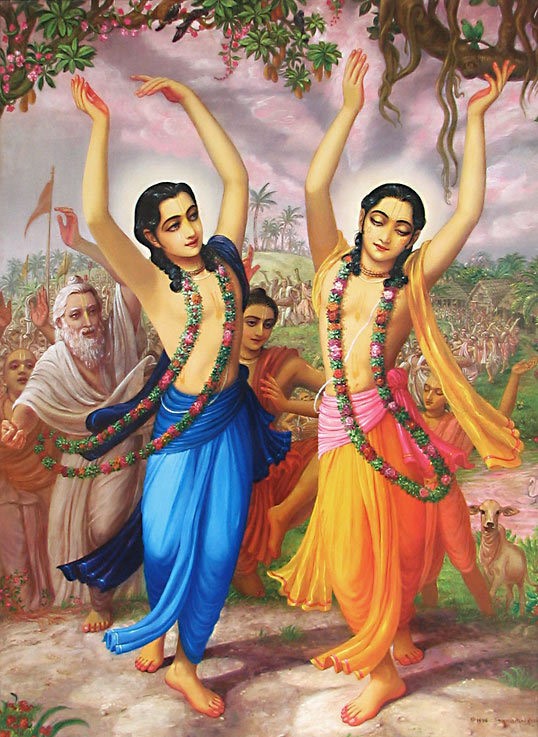
Caitanya Mahaprabhu

...The appearance of Sri Chaitanya and Nityananda has surcharged the world with happiness. As the sun and moon drive away darkness by their apperance and reveal the nature of everything, these two brothers dissipate the darkness of the living beings' ignorance and enlighten them with knowledge of the Absolute Truth. (In the image: Lord Sri Nityananda in the left and Lord Sri Krishna Chaitanya in the right).

   Sri Krishna and Balarama, the Personalities of Godhead who formerly appeared in Vrindavana and who were millions of times more effulgent than the sun and moon have arisen over the eastern horizon of Gauda-desa, being compassionate for the fallen state of the world. The appearance of Sri Chaitanya and Nityananda has surcharged the world with happiness. As the sun and moon drive away darkness by their apperance and reveal the nature of everything, these two brothers dissipate the darkness of the living beings' ignorance and enlighten them with knowledge of the Absolute Truth. By the grace of Sri Chaitanya and Nityananda, all darkness is removed, and the truth is brought to light. The sun and moon dissipate the darkness of the external world and thus reveal material reality. But these two brothers dissipate the darkness of the inner core of the heart, and thus help one to meet the two kinds of bhagavatas, [Srimad-Bhagavatam and the pure Devotee.] (Chaitanya Charitamrta-Adi 1.85 – 99)

Sri Gauranga's example and precept.

4.28
hare-krsnetucchaim sphurita-rasano namaganana-
krta-granthi-sreni-subhaga-kati-sutrojjvala-karam
visalakso dirghargala-yugala-khela-cita-bhujam
sa caitanyam kim me punarapi drsoryasati padam

   Sri Chaitanya Mahaprabhu chants the Hare Krishna mantra in a loud voice. The Holy Name dances on his tongue as he counts his number of recitations with His effulgent hands. His eyes are large, and His long arms, which bend as He performs his pastimes, reach down to His knees. When will he again become visible before me? (Stava-mala verse 5 – Sri Rupa Goswami)

   Sri Gauranga's principle and ultimate goals.

4.29
ei mata caitanya-krishna purna bhagavan
yuga-dharma-pravartana nahe ta-'ra kama
kona karane yabe haila avatare mana
yugadharma kala haila se kale milana
dui hetu avatari' laina bhaktagana
apane asvade prema-nama-sankirtana
sei dvare acandale kirtana-sa-care
ei mata bhakta-bhava kari' angikara
apani acari' bhakti karila pracara

   [Just as Sri Krishna really appeared in order to manifest His Vrindavana pastimes whereas his supression of demons was incidental,] in the same way, for Sri Chaitanya Mahaprabhu, promulgating the dharma for the age is an incidental reason for his appearance. When the Lord desired to appear for another reason, the time for promulgating the religion of the age also arose. Thus with two intentions, the Lord appeared with His Devotees and tasted the nectar of prema with the congregational chanting of the Holy Name. Thus he spread kirtana even among untouchables. He wove a wreath of the Holy Name and prema with which he garlanded the entire world. In this way, assuming the sentiment of a Devotee, He preached devotional service while practicing it Himself. (Chaitanya Charitamrta-Adi 4.37 – 41)

   Sri Gauranga is like a lion.

4.30
caitanya-simhera nabadipe avatara
simha-griva simhaviraya simhera hunkara
sei simha vasuk jivera hrdaya-kandare
kalmasa-dviradanasa ya-jara hunkare
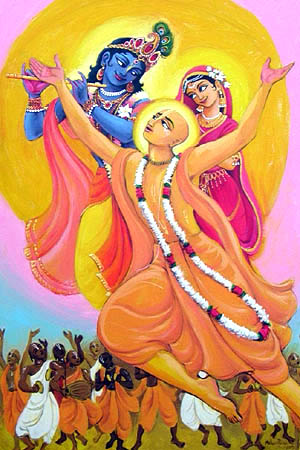
Caitanya Mahaprabhu

Thus the lionlike Sri Chaitanya Mahaprabhu has appeared in Navadwipa-dhama. He has the shoulders of a lion, the powers of a lion, and the loud voice of a lion. May that lion be seated in the core of the heart of every living being. Thus with His resounding roar, may he drive away one's elephantine vices. (Chaitanya Charitamrta-Adi 3.30 - 31)

   Thus the lionlike Sri Chaitanya Mahaprabhu has appeared in Navadwipa-dhama. He has the shoulders of a lion, the powers of a lion, and the loud voice of a lion. May that lion be seated in the core of the heart of every living being. Thus with His resounding roar, may he drive away one's elephantine vices. (Chaitanya Charitamrta-Adi 3.30 – 31)

   Sri Gauranga's external reasons for appearing.

4.31
anarpitacarim cirat karunayavatirnam kalau
samarpayitum-unnatojjvala-rasam sva-bhakti-sriyam
harim purata-sundara-dyuti-kadamba-sandipitam
sada hrdaya-kandare sphuratu vam sacinandanam

   May that Lord who is known as the son of Srimati Sachidevi be transcendentally situated in the inner-most chambers of your heart. Resplendent with the radiance of molten gold, he has appeared in the age of Kali by His causeless mercy to bestow what no incarnation ever offered before: the most sublime and radiant spiritual knowledge of the mellow taste of his service. (Chaitanya Charitamrta-Adi 1.4, Vidagdha-Madhava 1.2)

   Sri Gauranga's ultimate and confidential reason for appearing

4.32
sri radhayam pranaya-mahima kidrso vanayaiva-
svadyo yenadbhuta-madhurima kidrso va madiyam
saukhya-casya madanubhavatam kidrsam veti lobhat-
tad-bhavadyam samajani saci-garbha-sindhau harindum

   Desiring to understand the glory of Srimati Raharani's love, the wonderful qualities in Him that She alone relishes through Her love, and the happiness She feels when She realizes the sweetness of His love, The Supreme Lord Hari, richly endowed with Her emotions, appears from the womb of Srimati Sachidevi as the moon appears from the ocean. (Chaitanya Charitamrta-Adi 1.6)

   Internally he has the mood of Sri Radha, externally he preaches the Holy Name.

4.33
sei radha-bhava laina caitanya-avatara
yuga-dharma nama-prema kaila paracara

   Sri Chaitanya Mahaprabhu appeared with the sentiments of Sri Radha. He preached the dharma of this age, the chanting of the Holy Name of Sri Krishna, and pure love of Godhead (Krishna-prema). (Chaitanya Charitamrta-Adi 4.220)

   The pastimes of Sri Gauranga are eternal.

4.34
adyapiha caitanya ei saba lila kare
ya'ra bhagye thake se dekhaye nirantare

   As yet, no one can completely see the opulences of all the pastimes performed by Sri Chaitanya Mahaprabhu, because they are without limit in time and space. They are unlimited and eternal. (Chaitanya Bhagavata Madhya 23.513)

   Materialistic and demonic persons are envious of Sri Gauranga.

4.35
purve yena jarasandha adi rajagana
veda-dharma kari' kare visnura pujana
krishna nahi mane ta'te daitya kari' mannbsp/strongnbsp; ;Sri G/strongaurangai caitanya/strong na manile taiche daitya ta're jani
hena krpamaya caitanya na bhaje yei jana
sarvottama haile ta're asure ganana

   Formerly, even kings like Jarasandha strictly followed the Vedic rituals, thus worshiping Lord Vishnu. One who does not accept Krishna as the Supreme Personality of Godhead is certainly a demon. Similarly, one who does not accept Sri Chaitanya Mahaprabhu as Krishna, the same Supreme Lord, is also to be considered a demon. One who does not show respect unto this merciful Lord Sri Chaitanya Mahaprabhu or does not worship Him should be considered a demon, even if that person is very "exalted" in human society. (Chaitanya Charitamrta-Adi 8.8,9,12)

   Sri Gauranga in his acarya-lila is not the enjoyer of the rasa dance ("Gauranga-nagari")

4.36
ei mata capalya karena saba sane
sabe strimara nadekhena drsthikone
"stri" hena naa prabhu ei avatare
sravane o na karila – vidita samsare
ata eva yata maha-mahima sakale
"gauranga nagara" hena staqva nahi bale

   The Lord was apt to indulge in such indiscrimate merciful behavior towards all, except that he never looked at a women, even by a sidelong glance. During this avatara, it is known to all the world that the Lord did not even allow the name of a women to enter his ear. Therefore, those who are His real Devotees never address Sri Gauranga as "Gauranga-nagari" or the enjoyer of women. Although all forms of praise are applicable to the Lord, the wise sing only what is in accordance with His nature. (Chaitanya Bhagavata Adi 15. 28 – 31)

   The glories of the mercy of Sri Gauranga and Nityananda.

4.37
caitanya nityanande nahi ei' saba vicara
nama laite prema dena, bahe asrudhara
svatantra-isvara prabhu atyanta udara
ta-'re na bhajile kabhu nahaya nistara
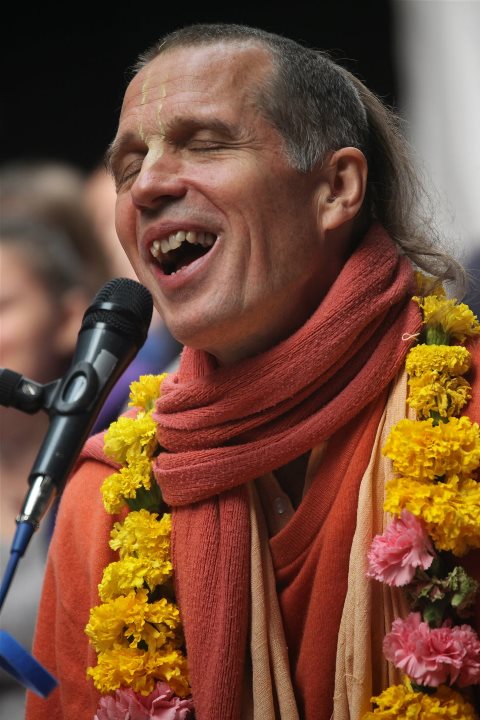
 

Caitanya Mahaprabhu

If one only chants with some slight faith the Holy Names of Sri Chaitanya Mahaprabhu and Nityananda, very quickly he is cleansed of all offenses. Thus, as soon as he chants the Hare Krishna mantra, he feels the ecstasy of love of Godhead...(In the image: His Holiness Sachinandana Swami, Kirtan Mela, Germany).

 If one only chants with some slight faith the Holy Names of Sri Chaitanya Mahaprabhu and Nityananda, very quickly he is cleansed of all offenses. Thus, as soon as he chants the Hare Krishna mantra, he feels the ecstasy of love of Godhead. Sri Chaitanya Mahaprabhu, the independent Supreme Personality of Godhead is greatly magnanimous. Unless one worships Him, one can never be liberated. (Chaitanya Charitamrta-Adi 8.31-32)

   The unfortunate position of those who cheat themselves out of Sri Gauranga's mercy.

4.38
caitan sajjana, durjana, Gauranga-nagariangu, jata andhaganayavatare bahe premarta-vanya
saba jiva preme bhase, prthivi haila dhanya
ei-vanyaya ye na bhase, sei jiva – chara
koti kalpe tabe ta'ra nahika nistara

   There is now a flood of the eternal nectar of love of Godhead, because of the incarnation of Sri Caitanya Mahaprabhu. All living entities are floating in that flood. The entire world is now thankful to the Lord. Anyone who does not float in this inundation is most condemned. Such a person cannot be delivered for millions of lifetimes of Lord Brahma. (Caitanya Caritamrta-Antya 3.252-253)


4.39
avatara sara, gaura-avatara
kena na bhajili ta're
kari' nire vasa, gela na piyasa,
apana karama phere
kantakera taru, (sri) gauranga amara,
tahare bhavili vise
saurabhera ase, palasa su-kili,
nasate pasila kita
iksudanda bhavi' katha cusili,
kemane paibi mith

   Sri Krishna and Balarama, the Personalities of Godhead who formerly appeared in Vrindavana and who were millions of times more effulgent than the sun and moon have arisen over the eastern horizon of Gauda-desa, being compassionate for the fallen state of the world. The appearance of Sri Chaitanya and Nityananda has surcharged the world with happiness. As the sun and moon drive away darkness by their apperance and reveal the nature of everything, these two brothers dissipate the darkness of the living beings.

te avatari gambhirye gauranga nagarag 
hara baliya, galaya parili,
samana-kinkara-sapa
sitala baliya aguna pohali,
paili bajara-tapa
samsara bhajili, (sri) gauranga bhulili,
na sunili sadhura katha
iha-para-kala, du'kala khoyali,
khaili apana matha

   Sri Gauranga Mahaprabhu is the essence of all avataras. Why didn't I worship Him? It is as if I was surrounded by water and dying of thirst but I denied myself a drink. I chewed the thorns on the tree of worldly life and took the blood that flowed through my mouth to be nectar. When I was offered the nectarine fruits of love of Godhead distributed by Sri Gauranga, however, I turned them away, thinking them to be poison. Wishing to smell perfume I sniffed at what I thought was the fragrant flower of material enjoyment. Alas, that flower was odorless, like the palasa flower. And when I tried to sniff its illusory aroma, a bee flew up my nose and stung me. Thinking material life to be as sweet as sugarcane, I tried to taste its nectar. Instead, as I sucked, I found it juiceless and dry. In this way, I found that all my attempts at enjoyment proved false. In this way, all my attempts at enjoyment proved false.

   Admitting defeat, wasted and worn out, I await the snake of death. Declaring it to be cool and soothing, I have embraced the fire of material life, only to suffer intense miseries, as if struck by lightning. Worshiping family and material life I forgot Gauranga and didn't listen to the words of the saints. Now, in my final days I realize that I am twice dead, for not only am I casting off this mortal body, but I am dead while living, having wasted my life in material indulgence (Mahajana-giti).

   Sri Gauranga appears in the form of His Holy Name and as His Deity

4.40
ara dui janma ei sankirtanarambhe
haiba tomara putra ami avilambe
mora arca-murti mata, tumi se dharani
jihvarupa tumi mata, namera janani
ei dui janma mora sankirtanarambhe
dui tha-i tora putra avilambe

   [Sri Chaitanya told Sachi] Birth after birth you are my mother. Again, in this birth, I have come to begin the sankirtana movement, and so I have become your son. My appearance in this world is twofold: I appear as the archa-murti, the Deity form of the Lord, and as the Holy Name. In this way I appear upon the tongue in the form of sound, and as the Deity made from the elements drawn from earth. In both of these forms I am worshiped, and in these two features I have appeared in order to spread the sankirtana movement. (Chaitanya-Bhagavata Madhya 27.47)

   The teachings of Sri Gauranga in a nutshell.

4.41
aradhyo bhagavan brajesa-tanayas-tad-dhama vrndavanam
ramya kacid-upasana vraja-vadhu-vargena ya kalpita
srimad-bhagavatam pramanam-amalam prema pumartho mahan
sri caitanya mahaprabhor-matam-idam tatradaro nam param

   It is the conclusive opinion of Sri Chaitanya Mahaprabhu that: Sri Krishna, who is Vrajendra-nandana, the son of the king of Vraja, is the Supreme Personality of Godhead Himself, the topmost worshipable Deity; Vrindavan-dhama which is an expansion of Sri Krishna and is nondifferent from Him is the highest worshipable abode; The Gopis of Vrindavana are the highest example of the worship of Sri Krishna Srimad-Bhagavatam is the spotless evidence for knowing the absolute truth; Krishna-prema is the fifth and highest goal of life. These are the teachings of Sri Chaitanya in a nutshell. (Vishvanatha Chakravarti Thakura) 
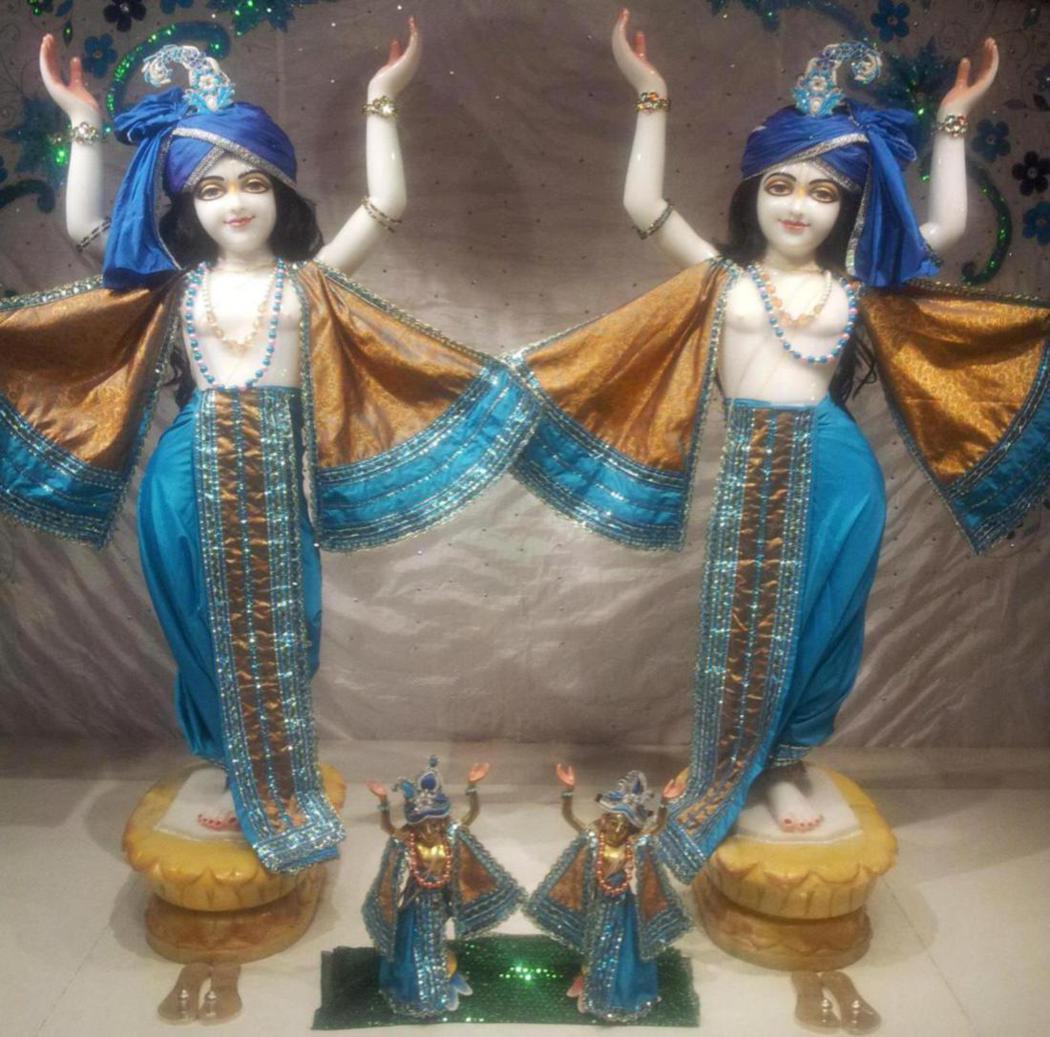
Caitanya Mahaprabhu

My appearance in this world is twofold: I appear as the archa-murti, the Deity form of the Lord, and as the Holy Name. In this way I appear upon the tongue in the form of sound, and as the Deity made from the elements drawn from earth. In both of these forms I am worshiped, and in these two features I have appeared in order to spread the sankirtana movement. (Chaitanya-Bhagavata Madhya 27.47) (In the image: Deities of Sri Sri Gaura Nitay, ISKCON Temple Chennai, Tamil Nadu).
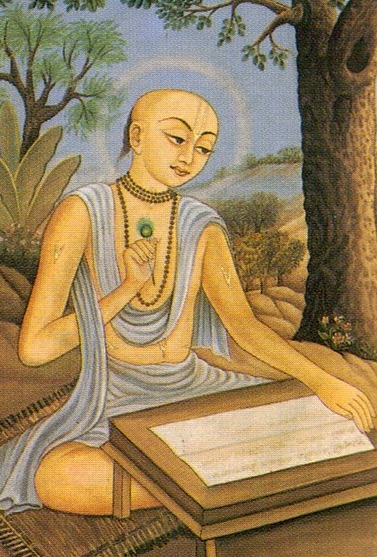
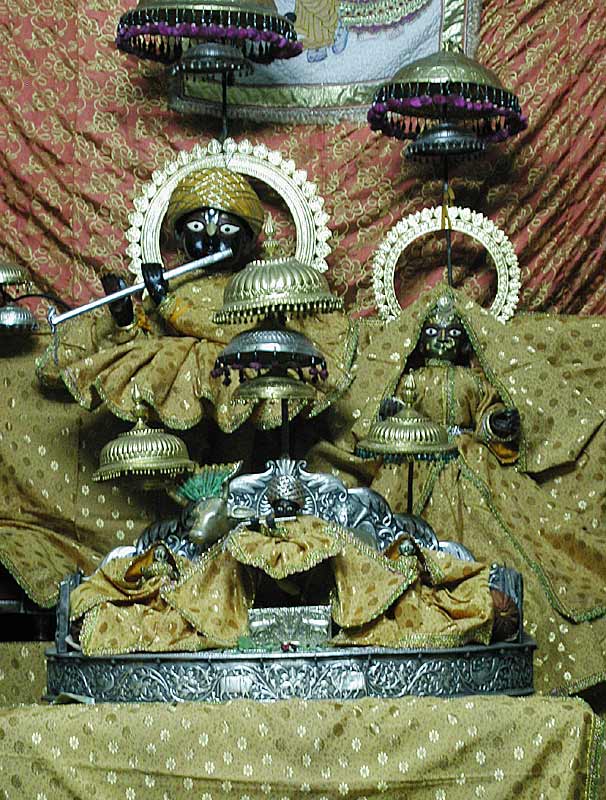
Shastric Evidence of Sri Chaitanya’s Divine Appearance:

Caitanya Mahaprabhu

Sri Chaitanya is the Kali-yuga avatara, and He descended for the purpose of establishing the yuga dharma, which in this age is the chanting of Lord Krishna's names. (In the image: The Supreme Personality of Godhead Sri Krishna Chaitanya).

   Sri Chaitanya is the Kali-yuga avatara, and He descended for the purpose of establishing the yuga dharma, which in this age is the chanting of Lord Krishna's names. He appeared in the guise of a Devotee to perfectly show how the process of devotion should be followed and applied. It is something like a teacher drawing on the black board "A B C". We should not think the teacher is himself learning the alphabets, but he is doing it to show us how to write properly.

   The inner purpose of Sri Chaitanya's incarnation was to experience the devotional love that Radharani has for Krishna. He wanted to experience the process of bhakti from the side of the Devotee.

   In other ages the Lord incarnates along with His weapons for destroying the demons, but in Kali yuga He shows special mercy to the demons by delivering them with nama-sankirtana. In the Kali-yuga there are practically only demons on this earth, so if the Lord were to kill the demons there would be nobody left. Instead He chose to kill the demoniac tendency within the heart of the demons by giving them Krishna bhakti.

   Sri Chaitanya is described in the following verse composed by Sri Rupa Goswami:

namo maha-vadanyaya
krishna-prema-pradaya te
krishnaya krishna-caitanya-
namne gaura-tvishe namah

   "I offer my respectful obeisances unto Sri Chaitanya, who is the most merciful incarnation. He has appeared in a golden color for the purpose of freely distributing pure love of Krishna."

   In other incarnations, Lord Krishna would require the Devotee to first surrender to Him: sarva dharman parityajya mam ekam sharanam vraja. But in the incarnation as Sri Chaitanya, He would go to the non-devotees and freely distribute Krishna-prema to all. This is the unique blessing of this age of Kali. Despite it being the most sinful age, the process of self-realization is the simplest and most accessible to all classes of men.

   Lord Chaitanya's incarnation is mentioned and predicted in numerous scriptures. The following are some of the important references.

   In the Atharva Veda (Purusha-bodini Upanishad) it is said:

saptame gaura-varna-vishnor ity anena sva-shaktya
caikyam etya prante pratar avatirya saha svaih sva-manum shikshayati

   "In the seventh manvantara, the Supreme Lord will, accompanied by His own associates, descend in a golden form. He will teach the chanting of His own Holy Names."

   It is further stated in the Atharva Veda:

itotham krta sannyaso'vatarisyami sa-guno nirvedo
niskamo bhu-girvanas tira-atho' lakanandayah kalau
catuh-sahasrabdhopari panca-sahasrabhyantare
gaura-varno dirghangah sarva-laksana-yukta isvara-
prarthito nija-rasasvado bhakta-rupo misrakhyo vidita-yogah syam

   "The Supreme Lord Himself says: When between four thousand and five thousand years of Kali-yuga have passed, I will descend to the earth in a place by the Ganges' shore. I will be a tall, saintly brahmana Devotee of the Lord, and have a golden complexion. I will be renounced and free from all desire. I will accept the order of renunciation (sannyasa). I will be a Devotee advanced in bhakti-yoga. I will chant the Holy Names of the Lord. I will taste the sweet mellows of My own devotional service. Only the great Devotees will understand Me."

   In the Sama Veda the Lord states:

tathaham krta sannyaso bhu-girvano 'vatarisye
tire'lakanandayah punah punah isvara-prarthitah sa-
parivaro niralambo nirdhuteh kali-kalmasa-kavalita-
janavalambanaya

   "To deliver the people devoured by the sins of Kali-yuga, I will, accompanied by My associates, descend to the earth in a place by the Ganges shore. I will be a brahmana avadhuta sannyasi. Again and again I will chant the Holy Names of the Lord." 

Caitanya Mahaprabhu

"To deliver the people devoured by the sins of Kali-yuga, I will, accompanied by My associates, descend to the earth in a place by the Ganges shore. I will be a brahmana avadhuta sannyasi. Again and again I will chant the Holy Names of the Lord." (In the image: Pancha Tattva dancing before Lord Jagannath, Baladev and Subhadra Mayi).

  In the Krishna Upanishad it is stated:

sa eva bhagavan yuge turiye 'pi brahma-kule jayamanah sarva upanishadah uddidirshuh sarvani dharma-shastrani vistarayishnuh sarvan api janan santarayishnuh sarvan api vaishnavan dharman vijrimbhayan sarvan api pashandan nicakhana


    "In the Kali-yuga, Lord Krishna will appear in a brahmana's family. He will teach the message of the Upanishads and the dharma-shastras. He will defeat the atheists and offenders and He will establish the truth of Vaishnava dharma."

   In the eleventh canto of Srimad Bhagavatam the following verse is found:

krishna-varnam tvishakrishnam
sangopangastra-parshadam
yajnaih sankirtana-prayair
yajanti hi su-medhasah

   "In the age of Kali, intelligent persons perform congregational chanting to worship the incarnation of Godhead, who constantly sings the name of Krishna. Although His complexion is not blackish, He is Krishna Himself. He is accompanied by His associates, servants, weapons, and confidential companions."

   In the seventh canto of Srimad Bhagavatam is the following verse describing the Lord's incarnations:

channah kalau yad abhava tri-yugo 'tha sa tvam

   "Because in Kali-yuga You appear in a covered incarnation, you are therefore known as Tri-yuga (one who appears in only three yugas)."

   The incarnation of Sri Chaitanya is a hidden incarnation because He appears in the guise of His Devotee. This covered incarnation is confirmed in both the Adi Purana and the Narada Purana in the following verse:

aham eva dvija-shreshtho
nityam pracchanna-vigrahah
bhagavad-bhakta-rupena
lokam rakshami sarvada

   "My true identity always concealed, I will assume the form of a brahmana Devotee of the Lord. In this form I will deliver the worlds."

   In the Kurma Purana the following statement is found:

kalina dahyamananam
uddharaya tanu-bhritam
janma prathama-sandhyayam
bhavishyati dvi jalaye

   "To deliver the conditioned souls burning in the troubles of Kali-yuga, in the first sandhya of that age the Lord will take birth in a brahmana's home."

   In the Garuda Purana the Lord Himself states:
 

kalina dahyamananam
paritranaya tanu-bhritam
janma prathama-sandhyayam
karishyami dvi jatishu

   "To deliver the conditioned souls burning in the troubles of Kali-yuga, in the first sandhya of that age I will take birth among the brahmanas."

aham purno bhavishyami
yuga-sandhau visheshatah
mayapure navadvipe
bhavishyami shaci-sutah

   "In My original spiritual form, perfect and complete, I will become the son of Shachi-devi in Navadwipa Mayapura at the begining of Kali-yuga.

   Sri Chaitanya was born in Mayapura, a subsection of the holy town of Navadwipa, to Shachi-devi in 1486 AD, aproximately 4,500 years after the beginning of the Kali-yuga.

   Elsewhere in the Garuda Purana it is said:

kaleh prathama-sandhyayam
lakshmi-kanto bhavishyati
daru-brahma-samipa-sthah
sannyasi gaura-vigrahah

   "In the first sandhya of Kali-yuga, the Lord will assume a golden form. First He will be the husband of Lakshmi, and then He will be a sannyasi who stays near Lord Jagannatha at Puri."

Caitanya Mahaprabhu

After taking sannyasa He left Navadwipa in Bengal, and resided in the holy city of Puri in Orissa. Lord Jagannatha, the presiding Deity of Puri is known in the Puranas by the name daru-brahma or "the Lord who is wood". This is because the Jagannatha Deities in Puri are made from Neem wood.

   Sri Chaitanya first married His eternal consort Sri Lakshmi-priya Devi before taking sannyasa at the age of twenty-four. After taking sannyasa He left Navadwipa in Bengal, and resided in the holy city of Puri in Orissa. Lord Jagannatha, the presiding Deity of Puri is known in the Puranas by the name daru-brahma or "the Lord who is wood". This is because the Jagannatha Deities in Puri are made from Neem wood.

   Also in the Garuda Purana:

yo reme saha-ballavi ramayate vrindavane 'har-nisham
yah kamsam ni jaghana kaurava-rane yah pandavanam sakha
so 'yam vainava-danda-mandita-bhujah sannyasa-veshah svayam
nihsandeham upagatah kshiti-tale caitanya-rupah prabhuh

   "The Supreme Lord who enjoyed pastimes with the gopis, who day and night filled the people of Vrindavana with happiness, who killed kamsa, and who in the war between the Kauravas made friendship with the Pandavas, will come again to the earth. Of this there is no doubt. His arm will be decorated with a bamboo danda (stick), He will be a sannyasi and His name will be Chaitanya."

   The custom is that one begins carrying a bamboo rod (danda) after one takes sannyasa. Sri Chaitanya was an eka-danda sannyasi, thus He carried a single bamboo rod.

   In the Devi Purana we find the following statement:

nama-siddhanta-sampatti
prakashana-parayanah
kvacit sri-krishna-chaitanya-
nama loke bhavishyati

   "The Lord will again appear in this world. His name will be Sri Krishna Chaitanya and He will spread the chanting of the Lord's Holy Names.

   Sri Chaitanya perfectly illuminated the glories of the nama-siddhanta as predicted in this verse.

   In the Nrisimha Purana it is mentioned:

satye daitya-kuladhi-nasha-samaye simhordhva-martyakritis
tretayam dasa-kandharam paribhavan rameti namakritih
gopalan paripalayan vraja-pure bharam haran dvapare
gaurangah priya-kirtanah kali-yuge caitanya-nama prabhuh

   "The Supreme Lord, who in the Satya-yuga appeared as a half-man half-lion to cure a terrible disease that had ravaged the daityas, and who in Treta-yuga appeared as Rama, a person who defeated the ten-headed Ravana , and who in Dvapara-yuga removed the earth's burden and protected the gopa people of Vraja-pura, will appear again in the Kali-yuga. His form will be golden, He will delight in chanting the Lord's Holy Names, and His name will be Chaitanya."

   In the Padma Purana we find the following statement from the Lord:

kaleh prathama-sandhyayam
gaurango 'ham mahi-tale
bhagirathi-tate ramye
bhavishyami shaci-sutah

   "In the first sandhya of Kali-yuga I will appear on the earth in a beautiful place by the Gange's shore. I will be the son of Shachi-devi and My complexion will be golden."

   In the Narada Purana the Lord says:

aham eva kalau vipra
nityam pracchanna-vigrahah
bhagavad-bhakta-rupena
lokan rakshami sarvada

   "O brahmana, in the age of Kali I will appear disguised as a Devotee of the Lord and I will deliver all the worlds."

divija bhuvi jayadhvam
jayadhvam bhakta-rupinah
kalau sankirtanarambhe
bhavishyami shaci-sutah

   "O demigods, in the Kali-yuga take birth as Devotees on the earth. I will appear as the son of Shachi in Kali-yuga to start the sankirtana movement."

   Nama-sankirtana, or the chanting of the Lord's names is the yuga dharma for the age of Kali. Establishing this was Sri Chaitanya's primary purpose for incarnating.

   In the Bhavishya Purana we find:

anandashru-kala-roma-
harsha-purnam tapo-dhana
sarve mam eva drakshyanti
kalau sannyasa-rupinam

Caitanya Mahaprabhu

"O Govinda! Feeling Your separation, I am considering a moment to be like many years. Tears are flowing from my eyes like torents of rain, and I am feeling all vacant in the world in your absence." (In the image: Lord Sri Krishna Chaitanya with tears in His eyes).

   "O sage whose wealth is austerity, in the Kali-yuga everyone will see My form as a sannyasi, a form filled with tears of bliss and bodily hairs standing erect in ecstacy."

   Sri Chaitanya would always display such symptoms of pure love of Krishna. When chanting the names of the Lord tears would flow from His eyes, and the hair on His body would stand erect. In his life Sri Chaitanya personally only composed eight verses known as Shikshashtakam. In the sixth verse He states:

nayanam galad-ashru-dharaya
vadanam gadgada-ruddhaya gira
pulakair nicitam vapuh kada
tava nama-grahane bhavishyati

   "O my Lord, when will my eyes be decorated with tears of love flowing constantly when I chant Your Holy Name? When will my voice choke up, and when will the hairs of my body stand on end at the recitation of Your name?"

   Then in the seventh verse He says:

yugayitam nimeshena
cakshusha pravrishayitam
shunyayitam jagat sarvam
govinda-virahena me

   "O Govinda! Feeling Your separation, I am considering a moment to be like many years. Tears are flowing from my eyes like torents of rain, and I am feeling all vacant in the world in your absence."

   These emotional symptoms of devotion were constantly being displayed by Sri Chaitanya.

In the Matsya Purana the following statement is made by the Lord:

mundo gaurah su-dirghangas
tri-srotas-tira-sambhavah
dayaluh kirtana-grahi
bhavishyami kalau yuge

   "In the Kali-yuga I will take birth in a place where three rivers meet. I will be golden color and tall. I will have a shaven head. I will be very merciful, and I will eagerly chant the Holy Names."

   The place where three rivers meet is Navadwipa. It is the custom that eka-danda sannyasis completely shave their head when they take sannyasa, and Sri Chaitanya followed this principle.

   This same verse is also found in the Vayu Purana with just two words appearing differently. The Vayu Purana verse mentions the Ganges river instead of 'three rivers'.

   In the Vamana Purana the Lord says:
 

kali-ghora-tamas-channat
sarvan acara-var jitan
shaci-garbhe ca sambhuya
tarayishyami narada

   "O Narada, taking birth in Shachi-devi's womb, I will deliver the sinful people from the terrible darkness of Kali-yuga."

   In the Vayu Purana the Lord states:

 paurnamasyam phalgunasya
phalguni-riksha-yogatah
bhavishye gaura-rupena
shaci-garbhe purandarat

   "In the month of Phalguna, when the star phalguni is conjoined with the full moon, I will appear in a golden form begotten by Purandara in Shachi-devi's womb."

   Sri Chaitanya's father was known by the names Purandara Mishra and Jagannatha Mishra. Sri Chaitanya was born on the full moon day of the month of Phalguna.

svarnadi-tiram asthaya
navadvipe janashraye
tatra dvi ja-kulam prapto
bhavishyami janalaye

   "I will take birth in a brahmana family in the city of Navadwipa, by the Ganges shore."

bhakti-yoga-pradanaya
lokasyanugrahaya ca
sannyasa-rupam asthaya
krishna-chaitanya-nama-dhrik

   "In order to show mercy to the people and engage them in devotional service, I will accept sannyasa. Then My name will be Sri Krishna Chaitanya."

   In the Ananta Samhita we find:

svarnadi-tiram ashritya
navadvipe dvijalaye
sampradatum bhakti-yogam
laksyanugrahaya ca

   "To show mercy to the people and give them devotional service, the Supreme Personality of Godhead will appear in a brahmana's home in Navadwipa by the Gange's shore."

   Then the Lord states:

avatirno bhavishyami
kalau nija-ganaih saha
shaci-garbhe navadvipe
svardhuni-parivarite

   "In Kali-yuga I will descend to the earth with My associates. In Navadvipa, which is surrounded by the Ganges, I will take birth in Shachi-devi's womb."

   In the Urdhvamnaya Tantra it is mentioned:

kalau purandarat shacyam
gaura-rupo vibhu smritah

   "In Kali-yuga I will appear in a golden form as the son of Purandara and Shachi-devi."

   In the Krishna-yamala it is stated:

aham purno bhavishyami
yuga-sandhau visheshatah
mayapure navadvipe
varam ekam shaci-sutah

   "During the first sandhya of Kali-yuga I will descend, with all My powers and glories, to Mayapura in Navadwipa and become the son of Shachi-devi."

   In the Brahma-yamala:

athavaham dhara-dhamni
bhutva mad-bhakta-rupa-dhrik
mayayam ca bhavishyami
kalau sankirtanagame

   "I will appear on the earth in the garb of My Devotee. In the Kali-yuga I will appear in Mayapura to start the sankirtana movement."

kalau prathama-sandhyayam
hari-nama-pradayakah
bhavishyati navadvipe
shaci-garbhe janardanah

   "In the first sandhya of Kali-yuga, Lord Krishna will appear in Navadwipa, in Shachi-devi's womb. In that incarnation He will teach the chanting of Lord Hari's Holy Names."

   In the Ananta Samhita we find:

gauri shri-radhika devi
harih krishna prakirtitah
ekatvac ca tayoh sakshad
iti gaura-harim viduh

   "The golden Goddess Radha is known by the name Gauri and the dark Lord Krishna is known by the name Hari. Aware that both of them have combined, the wise call Him as Gaurahari."

navadvipe tu tah sakhyo
bhakta-rupa-dharah priye
ekangam shri-gaura-harim
sevante satatam muda


Caitanya Mahaprabhu

"The golden Goddess Radha is known by the name Gauri and the dark Lord Krishna is known by the name Hari. Aware that both of them have combined, the wise call Him as Gaurahari." (In the image: in the middle Lord Sri Krishna Chaitanya, in His right Sri Krishna and in His left Srimati Radharani).

 "O beloved, assuming the forms of Devotees the Gopis will also take birth in Navadwipa. With great happiness they will again and again serve Lord Gaurahari, who is Radha and Krishna combined in a single form."

   In the Krishna-yamala we further find: 

iti matva kripa-sindhur
amshena kripaya harih
prasanno bhakta-rupena
kalav avatarishyati

   "Thinking in this way, Lord Krishna, who is an ocean of mercy, mercifully decided to appear as a Devotee in Kali-yuga."

gaurango nada-gambhirah
sva-namamrita-lalasah
dayaluh kirtana-grahi
bhavishyati shaci-sutah

   "His limbs will be golden and His voice deep. He will be very merciful. He will yearn to taste the nectar of His own Holy Name. He will be attached to chanting His own Holy Name. He will be the son of Shachi-devi."

   In the Jaimini-bharata it is said:

anyavatara bahavah
sarve sadharana matah
kalau krishnavataras tu
gudhah sannyasa-vesha-dhrik

   "Lord Krishna descends to the world in many different forms. However in Kali-yuga, His incarnation is hidden. At that time He appears disguised as a sannyasi."

   In the Yoga-vashishtha we find:

kaleh prathama-sandhyayam
gaurango 'sau mahi-tale
bhagirathi-tate ramye
bhavishyati sanatanah

   "In the first sandhya of Kali-yuga, on the earth, by the beautiful shore of the Ganges, the Lord will appear in His eternal golden form."

   In the Skanda Purana:

antah krishna bahir gaurah
sangopangastra-parshadah
shaci-garbhe samapnuyam
maya-manusha-karma-krit

   "Outwardly of golden complexion, but inwardly Krishna, I will take My birth in the womb of Shachi-devi. Accompanied by My associates, servants, weapons, and confidential companions, I will assume the role of a human being."

   In the Kapila Tantra we find the following statements:

kvacit sapi krishnam aha
shrinu mad-vacanam priya
bhavata ca sahaikatmyam
icchami bhavitum prabho

mama bhavanvitam rupam
hridayahlada-karanam
parasparanga-madhya-stham
krida-kautuka-mangalam

paraspara-svabhavadhyam
rupam ekam pradarshaya
shrutva tu preyasi-vakyam
parama-priti-suchakam

svecchayasid yatha purvam
utsahena jagad-guruh
premalingana-yogena
hy acintya-shakti-yogatah

radha-bhava-kanti-yuktam
murtim ekam prakasayan
svapne tu darshayam asa
radhikayai svayam prabhuh

   "Then Sri Radha said to Lord Krishna: O beloved, please hear My words. I yearn to become one with you. Please show a form where You and I embrace and Our two bodies become one, a form filled with the love I bear for You, a form filled with auspicious and blissful pastimes, a form that brings bliss to the heart, a form that unites Our two natures.'

   "Hearing His beloved's words, which were filled with joy and love, Lord Krishna passionately embraced Her. Then by the touch of His inconceivable potency Their two forms joined and became one, a single form endowed with Sri Radha's divine love and glorious splendour. In a dream Lord Krishna showed all this to Sri Radha."

   Other direct references are found in the Vishvasara Tantra, Kularnava Tantra, Brahma-rahasya, and Vishnu-yamala. Besides these there are complete chapters about Sri Chaitanya's incarnation in the Vayu Purana and Bhavishya Purana, which are too long to quote here. Also there is a text by the name Chaitanya Upanishad within the Atharva Veda, which explains the Lord's incarnation in Kali-yuga. I have not cited it here, as it was rediscovered in recent times, so most people will reject it's authenticity, or at least its value as evidence.

   Sri Chaitanya's incarnation was a hidden incarnation, thus He burried references to His appearance deep within the ocean of vedic texts. His desire was that His disguise would not be betrayed, so He made sure these references would remain hidden until after His incarnation was complete. These text's were always present, but by the inconceivable yoga-maya of the Lord, He covered His true identity even from the Vedic scholars and panditas. Only the pure devotees understood His actual identity.

   In the Ananta Samhita we find this very relevant statement regarding Sri Chaitanya's incarnation:

 
aprakashyam idam guhyam
na prakashyam bahir mukhe
bhaktavataram bhaktakhyam
bhaktam bhakti-pradam svayam
 
man-maya-mohitah kecin
na jnasyanti bahir-mukhah
jnasyanti mad-bhakti-yuktah
sadhavo nyasino 'malah

   "Those who are bewildered by My illusory potency will not understand the great secret of My appearance in this world in My personal form, in My form as the incarnation of a Devotee, in My form bearing the name of a Devotee, in My form as a Devotee, and in My form as the giver of devotional service. This secret is not to be revealed to them. Only the saintly, pure, renounced Devotees, diligently engaged in My devotional service, will be able to understand Me in these forms."

Advaita Acharya – Biography

 
Advaita Acharya

Combined Form of Mahavishnu and Sadashiva - Advaita Acharya.

 vraje avesha-rupatvad vyuho yo’pi sadashivah
sa evadvaita-gosvami caitanyabhinna-vigrahah
 
   Sadashiva, an expansion of the supreme lord in Vraja, is here known as Advaita Acharya. He is non-different from Chaitanya.
(Gaura-ganoddesha- dipika 76)
 
yash ca gopala-dehah san vraje krishnasya sannidhau
nanarta shri-shiva-tantre bhairavasya vaco yatha
ekada karttike masi dipa-yatra-mahotsave
sa-ramah saha-gopalah krishno nrityati yatnavan
nirikshya mad-gurur devo gopa-bhavabhilashavan
priyena nartitum arabdhash cakra-bhramana-lilaya
shri-krishnasya prasadena dvi-vidho’bhut sadashivah
ekas tatra shivah sakshad anyo gopala-vigrahah
 
   In Vraja, he took the form of a cowherd boy and danced alongside Krishna. This is stated by Bhairava in the Shivatantra: “Once, during the Divali festival in the month of Karttik, my guru Shankaradeva saw Krishna dancing with Balaram and the cowherd boys. He became desirous of becoming a cowherd boy himself and he began to dance, spinning like a whirling wheel for Krishna’s pleasure.” Thus, by Krishna’s mercy, Sadashiva plays two different roles in Vraja, in one he is Shiva himself, in the other, he is a cowherd boy.
(Gaura-ganoddesha-dipika 77-80)
 
Advaita-tattva
 
   In Chaitanya Charitamrita, Krishnadas Kaviraj quotes the following evidence from the diary of Svarupa Damodar to describe the ontological principle of Advaita Acharya:
 
maha-vishnur jagat-karta mayaya yah srijaty adah
tasyavatara evayam advaitacarya ishvarah
advaitam harinadvaitad acaryam bhakti-shasanat
bhaktavataram isham tam advaitacaryam ashraye
 
   Mahavishnu is the master of the universe, which he creates through his power of Maya. Advaita Acharya is the incarnation of this form of the Supreme Lord. He is known as Advaita because he is none other than Hari, as Acharya because he is the preceptor of devotion. I take shelter of the supreme Lord Advaita Acharya who is the incarnation of a Devotee.
(Chaitanya Charitamrita 1.1.12-13)
 
   Srila Bhaktivinoda Thakur has written, “Maya has two functions, and Maha Vishnu appears in two ways according to those functions. When he is within the material world as creator, he is the universe’s effective cause (nimitta-karana) in his form as Vishnu. In the unmanifest material energy (pradhana), appearing in the form of Rudra, he has a second identity as Advaita.”
 
   Bhaktisiddhanta Saraswati Goswami Thakur has also written about Advaita Acharya in his Anubhashya to Chaitanya Charitamrita 1.6.12: “Lord Advaita Acharya is Maha Vishnu. He is the supreme preceptor. Vishnu’s activities are auspicious because of his existence as the owner or master of the universe. He is the root source of all auspiciousness…. Anyone who cannot understand that the complications which are ever present in the material universe are beneficial in a way which is pure, eternal, complete and free is deprived of his true spiritual activity, devotion to Krishna.” 
Advaita Acharya

Maha Vishnu who is lying on the Causal Ocean.

 
   Advaita Acharya was also known as Kamalaksha:
 
   The well-being of the universe is in Advaita. He is the abode of all auspicious qualities. His activities are the eternal source of welfare for the world, so he was given the name Mangala…. Advaita, the abode of virtue, is a portion (amsha) of Mahavishnu; his full name is thus Advaita because he is not different from him…. He is the most noble personality in the universe, the spiritual master of the Vaishnavas; he thus has two names which come together as Advaita Acharya. Because in appearance he has eyes like lotus flowers, he also has the name Kamalaksha.
(Chaitanya Charitamrita 1.6.12, 26. 30-31)
 
   Vrindavan Das Thakur has also described Advaita as both the foremost of the Vaishnavas and as Shankara:
 
   Residing in Nabadwip is the foremost of the Vaishnava, the most fortunate of all people, Advaita Acharya. He is the chief amongst the gurus in knowledge, devotion and renunciation. He especially teaches devotion to Krishna in the same way that Shankara did.
(Chaitanya Bhagavat 1.2.78-9)
 
Advaita’s Appearance
 
   Advaita Acharya appeared in the village of Navagrama near the city of Sylhet as the son of the Varendra Brahmin Kubera Pandit and his wife Nabha Devi, on the seventh day of the waxing moon in the month of Magh. Kubera Pandit is identified in the Gaura-ganoddesha-dipika (v. 91) with the original god Kubera, who was Mahadeva’s friend and leader of the Guhyakas.
 
   Kubera Pandit, a devotee of Nrisingha, resided in the village of Navagrama near Sylhet in Bangladesh. He was a greatly fortunate follower of the path of devotion; he knew nothing other than the lotus feet of Krishna. His devoted and faithful wife was named Nabha Devi. She is worshipable to the whole world for she is the mother of Advaita Prabhu.
(Bhakti-ratnakara 5.2041-3)
 
   On the seventh day of the waxing moon in the month of Magh, the great ocean of joy overflowed. In that auspicious moment, the moon of Advaita descended in the blessed womb of Nabha Devi. In his ecstasy, Kubera Pandit gave in charity to the Brahmins and the poor. He tiptoed to the birthing room and his heart was filled with gladness upon seeing his son’s face. All the villagers came running to his house and said to each other, “What pious works did this Brahmin do that in his old age he has been blessed with such a jewel of a son?” The gods rained down flowers without being seen. There is nothing with which this scene can compare. Ghanashyama sings of this great auspicious occasion when a joyous uproar rang around the earth. (Bhakti-ratnakara 12.1759-62)
 
   In the Gaudiya Vaishnava Abhidhana, Advaita’s birthplace is given as Laura Gram. It is also said there that Advaita Prabhu left Laura to go to live in Sylhet and then from there moved to Shantipur. He also had a home in Nabadwip. His full name was Sri Kamalaksha or Kamala Kanta Vedapanchanana. His birth took place in 1434 AD and he disappeared in the year 1559, at the age of 125 years. 
Advaita Acharya

Home of Advaita Acharya, Shantipur.

 
   Jahnava Mata’s diksha disciple Nityananda Das wrote in his Prema-vilasa that Advaita’s birthplace is to be found in Shantipur. He writes that Advaita studied the Veda and other scriptures with the scholar Shantacharya, who lived in the Phullabati section of Shantipur and earned from him the title acharya. Advaita’s life has been described in several Bengali books, including Advaita-mangala, Advaita-vilasa and Sitacaritra. In the Advaita-vilasa it is written, “The lord remained on this earth for a century and a quarter, performing unlimited pastimes.”
 
Advaita Prabhu’s Travels
 
    When Kubera Pandit and Nabha Devi disappeared, Advaita went to Gaya on the pretext of performing the appropriate rituals of mourning, and thence continued on a pilgrimage tour of all of India’s holy places. When he came to Vrindavan, he became absorbed in the worship of Krishna, but through his meditation he was able to understand that Krishna was about to appear in Nabadwip. While on this pilgrimage tour, he came to Mithila where he met the poet Vidyapati. This encounter is beautifully described in the Advaitavilasa. Advaita Prabhu finally returned from Vrindavan to Shantipur after spending several days in Nabadwip. The people of Shantipur had been suffering from his separation for a long time and were very happy to see him back.
 
   Advaita had two wives; one was named Sri, the other Sita. In the Gaura-ganoddesha-dipika, it is written that the divine Yogamaya took the form of Advaita’s wife Sita, and that Sri is her prakasha expansion.
(Gaura-ganoddesha-dipika 86)
 
   Advaita Acharya also had two residences, one in Shantipur, the other not far from Srivasa’s home in Nabadwip-Mayapur. His heart was greatly pained at seeing that the people of the world were devoid of any devotion to Vishnu and were as a consequence greatly suffering the pains of material life. Overwhelmed with compassion, he began to teach the Bhagavad-gita and Bhagavat, explaining that the purport of the scriptures was to engage in devotional service to Krishna. At about the same time, Madhavendra Puri had a dream in which Govardhanadhari Gopal commanded him to find sandalwood paste for the Deity service. Madhavendra then started out for Puri, taking the road through western Bengal. While there, he stopped at Advaita’s house in Shantipur. Advaita became convinced to accept Madhavendra Puri as his guru when he saw his devotional ecstasies, even though he himself is an expansion of the supreme lord. He underwent this ritual in order to demonstrate to the conditioned souls the necessity of accepting a spiritual master. 
Advaita Acharya

Madhavendra Puri with Gopal.

 
   Madhavendra Puri arrived in the house of Advaita Acharya. When Advaita saw Puripada’s prema, he felt a deep inner joy. So, he took care to receive the mantra from him, after which Madhavendra left to continue his voyage to the south.
(Chaitanya Charitamrita 2.4.110-1)
 
   It is said that Mahaprabhu is the main trunk of the wish-fulfilling tree of devotion, as well as the gardener who enjoys and distributes the tree’s fruits. Though the tree was planted in Nabadwip, it grew in Purushottam Dham (Puri) and Vrindavan, expanding into an entire orchard producing many, many fruits of love. Madhavendra Puri is said to be the first seedling, which eventually grew into this tree. Isvara Puri was the nourished form of this seedling. Mahaprabhu, though himself the gardener, also became the tree’s main trunk through his inconceivable energies. Advaita and Nityananda were the two secondary trunks into which the main trunk divided.
(Chaitanya Charitamrita 1.9.21)
 
The Cause of the Lord’s Incarnation
 
   Sri Krishna Chaitanya Mahaprabhu is the main body of the devotional movement, and Advaita and Nityananda are the limbs. All three of them became incarnate, along with Srivasa and other devotees, in order to preach devotion to Hari. All those who were senior to Gauranga appeared on this earth prior to him. Advaita appeared along with the other elderly members of Chaitanya’s retinue and when he did so, he observed that the sinfulness of the age of Kali had reached a disturbing limit and that the world was entirely devoid of devotion to Krishna. He thought that a partial incarnation of the lord would not be sufficient to completely bring about the welfare of the earth in this state. He thought, “The world will only benefit if the Supreme Personality of Godhead himself descends to the earth.” So he began to worship Krishna’s lotus feet with Ganges water and tulasi leaves, shouting and pleading to the lord to become incarnate. With roars of love (prema-hunkara) Advaita showed his desire for the lord of Goloka to descend to the earth.
 
   He constantly offered water from the Ganges and tulasi manjaris while meditating on Krishna’s lotus feet, at the same time calling to Krishna with loud roars. This is the way that he caused Krishna to descend. This, then, is the chief reason that Krishna Chaitanya became incarnate on this earth. He who is the bridge of justice descends at the wish of the devotee.
(Chaitanya Charitamrita 1.3.107-9)
 
   Advaita Acharya dwelt in Shantipur. His body is the reservoir of devotional nectar and is not different from that of Chaitanya. Chaitanya, whose spotless fame has filled the earth, was brought down to this earth by him. My Advaita is not different from Gauranga, and his wife Sita is the mother of the universe. His roars brought Gauranga into this world and then he glorified him everywhere.
(Bhakti-ratnakara 12.3753-6)
 
    All glories to Advaita Acharya, the most merciful, whose roars brought about Gauranga’s incarnation. Whoever takes shelter of his lotus feet will obtain the great prize of love for Gaura.
(Bhakti-ratnakara 12.3761, 3764)
 
   He constantly served Krishna with great enthusiasm, offering Ganges water and tulasi manjaris. Absorbed in thoughts of Krishna, he worshiped him by roaring his name, the sound of which filled the entire universe, reaching up to Vaikuntha. Lord Krishna heard the sound of these roars of love and made himself visible to humanity, for he is controlled by his devotee.
(Chaitanya Bhagavat 1.2.81-3) 
Advaita Acharya

Nityananda Prabhu.

 
   Prior to Mahaprabhu’s appearance, Nityananda Prabhu also descended on the thirteenth day of the waxing moon in the month of Magh, into the family of Hariai Pandit and Padmavati in the village of Ekachakra in Rarha, bestowing upon them the opportunity to serve him in the vatsalya-rasa. Meanwhile, eight daughters were born to Jagannath Mishra and Sachi Devi, all of whom died before their son, Vishvarupa, Nityananda Prabhu’s other self, took birth. Subsequently, on the full moon evening of the month of Phalgun, the source of all avatars, Gauracandra, made his appearance. After the appearance of Sri Chaitanya, Sita Devi took Advaita’s permission to come with gifts to Nabadwip from Shantipur to see the most wonderful child. When she saw him, she blessed him by placing unhusked rice and durva grass on his head.
 
   Advaita Acharya’s wife was a respectable and noble woman name Sita Thakurani. Taking permission from her husband, she went to Nabadwip bearing gifts to see the crown jewel of infants.
(Chaitanya Charitamrita 1.13.112) 
Advaita Acharya

Appearance Day of Lord Gouranga.

 
   Advaita Acharya established a tol for teaching Sanskrit in Nabadwip-Mayapur and started to engage in a deep study of the scriptures. Every day, Mahaprabhu’s older brother Vishvarupa used to go to Advaita’s house after bathing in the Ganges to listen to him lecture. On certain occasions, when Advaita was engaged in performing his puja, Vishvarupa would explain to everyone present there that devotion to Krishna was the ultimate purport of all the scriptures. When Advaita heard him speaking in this way, he got up from worshiping his deity and embraced him. Sachi regularly sent little Nimai at lunchtime with something for Vishvarupa to eat. When Advaita Prabhu saw Nimai’s beautiful face he became enchanted, but was unable to recognize him as his worshipable lord, the Supreme Truth.
 
   In the meantime, Vishvarupa had secretly decided that he would renounce family life out of a realization that the material world is temporary and that a human being’s only real duty is to worship the lord. When he saw that his parents were starting to make wedding plans for him, he quickly left home and took sannyasa, after which he was known by the name Shankararanya. Sachi, Jagannath and other devotees all lamented his loss. Advaita too was pained by Vishvarupa’s departure, but pacified everyone by saying that Krishna himself would appear soon to eradicate everyone’s distress.
 
   After Vishvarupa’s abandonment of the hearth, Sachi and Jagannath became afraid that Nimai would follow his example and so they put a stop to his education. Later, however, when they heard Nimai speaking sweetly in the mood of Dattatreya, they decided it would be better to send him back to school. Jagannath Mishra left this world not long after Nimai was given the sacred thread and had become fully absorbed in his studies.
 
   While Mahaprabhu was still fully devoted to his pastimes as a scholar, his marriage to Ballabha’s daughter Lakshmipriya was arranged. In those days, Advaita was holding Bhagavat lectures and kirtan at his house in Nabadwip. All the devotees including Advaita were very enthused about the singer Mukunda Datta’s voice. On one occasion Isvara Puri came to Advaita’s house while on a visit to Nabadwip. From his vigorous appearance, Advaita was able to recognize that he was a Vaishnava sannyasi. Later, Gauranga also met him.
 
   At that time, Isvara Puri arrived in Nabadwip in a most discrete manner. Constantly preoccupied with the taste of Krishna devotion, he was single-minded, dear to Krishna and compassionate. No one was able to recognize him because he was not dressed as a sannyasi, until one day, by chance, he arrived at Advaita’s house.
(Chaitanya Bhagavat 1.11.70-72)
 
Advaita Tests Mahaprabhu
 
   When Gauranga returned from Gaya in a changed mood, Advaita, Srivasa and the other devotees were overjoyed. In due course, Nityananda Prabhu arrived in Nabadwip after having toured the sacred pilgrimage sites and there he met Nimai. One day at Srivasa’s house, Mahaprabhu indicated that he wanted to perform the Vyasa Puja to Nityananda. On the eve of this puja, Mahaprabhu showed everyone that Nityananda was Baladeva and then, repeating the words, “Naria, Naria”, revealed that Advaita had caused him to descend to the earth by calling him.
 
   It is due to Advaita that I have become incarnate, for Naria’s roars rang in my ears. I was lying in the Milk Ocean, but Naria’s roar woke me up and brought me down here.
(Chaitanya Bhagavat 3.9.297-8)
 
   After the Vyasa Puja had come to an end, Mahaprabhu took on the mood of the supreme lord and sent Ramai Pandit, Srivasa Pandit’s brother, to fetch Advaita from his house in Shantipur by telling him of the Lord’s divine manifestation: “Advaita Prabhu has brought Hari, the Lord of Goloka, to this earth by his cries and by worshiping him with Ganges water and tulasi. Nityananda Prabhu has also made his auspicious appearance in Nabadwip. So Advaita Acharya and his wife should come immediately to Srivasa Angan, bringing all the paraphernalia for worship with him.” Ramai immediately carried out Mahaprabhu’s order and took his message to Advaita Prabhu.
 
   As soon as Advaita heard that Mahaprabhu had publicly revealed his divine identity, he and Sita Devi immediately set off, bringing their son Achyutananda and some other associates. But rather than going directly to Srivasa’s house, Advaita decided to test Mahaprabhu by hiding in Nandanacharya’s house. He told Ramai not to tell Mahaprabhu, but the lord, who knows the heart of all, was able to see through Advaita’s plan. As Mahaprabhu sat on the altar and revealed his own Deity to everyone, Nityananda held the royal parasol while Gadadhara and the other devotees engaged in a variety of services. This time, when Mahaprabhu sent Ramai to Nandanacharya’s house to fetch Advaita, Advaita realized that Mahaprabhu was omniscient and hesitated no longer. 
 
   In the company of his wife, he joyfully prostrated himself before the lord, speechless before the manifestation of the lord’s divine power. He washed the lord’s lotus feet and then worshiped him with the five ingredients (pancopacara), using the following mantra to do so:
 
   namo brahmanyadevaya go-brahmana-hitaya ca I pay my obeisances to Krishna Govinda, the lord of the brahminical society, to him who is the source of the cows’ and the Brahmins’ welfare, and who is the source of the entire universe’s well-being.
 
   Mahaprabhu then commanded Advaita Prabhu to get up and dance. Advaita started to dance madly until he was completely intoxicated in a way that astonished all the watching devotees.
 
   Krishnadas Kaviraj has written:
 
   There is one Mahaprabhu or Supreme Lord, and two other prabhus, or lords. The two other prabhus serve the lotus feet of Mahaprabhu. These three personalities belong to the category of the all-worshipable; the fourth category is the devotee who is the worshiper. Srivasa and the millions of other devotees belong to the category of the pure devotees. Gadadhara Pandit and others are considered to be incarnations of the Lord’s energies or shaktis. They are counted as his intimate devotees. (Chaitanya Charitamrita 1.7.94-7) 
Advaita Acharya

Pancha Tattva.

 
   These are the Pancha Tattva, who include Gauranga Mahaprabhu, the form of a devotee; Nityananda Prabhu, who is the bhakta-Svarupa; and Advaita Acharya, the incarnation of the devotee. These three are considered to be prabhu-tattva or Vishnu-tattva, the category of the lord. Advaita is an incarnation of Mahavishnu, he belongs to the category of Vishnu-tattva, but because he took on the mood of a devotee so he is called bhaktavatara, the incarnation of a devotee.” Because Gauranga, Nityananda and Advaita all belong to the category of Vishnu-tattva, tulasi leaves are offered to their feet. Without Advaita’s mercy, one can never attain the service of Chaitanya and Nityananda. 
 
daya koro sitapati advaita gosani
 
   Be merciful, Advaita Prabhu, husband of Sita! On the strength of your mercy, I will attain Chaitanya and Nitai.
(Narottama Das Thakur)
 
   Advaita Acharya’s glories and his activities have been described extensively in Krishnadas Kaviraj’s Chaitanya Charitamrita, Vrindavan Das’s Chaitanya Bhagavat, Narahari Chakravarti’s Bhakti-ratnakara, as well as in works such as Advaita-vilasa, etc. Those who wish to have a deeper knowledge of his life should consult these books. We can only give an abbreviated biography in this book and such an extensive account cannot be given here. We have only set out to remember the main pastimes Advaita engaged in.
 
Advaita and Hari Das Thakur
 
   By his pastimes, Advaita Prabhu revealed that a Vaishnava is praiseworthy and worthy of worship, no matter what his family background. Namacharya Hari Das Thakur was born in a Muslim family in Burihan village in the district of Jessore, but later came to live in the village of Phuliya near Shantipur where he would come to associate with Advaita Prabhu. He was staying in a grotto where he was engaged in solitary devotional practices. This was after he had spent time preaching the glories of the Holy Names at the Chandpur house of Raghunatha Das Goswami’s father and uncle, Govardhana and Hiranya Majumdar. Advaita used to invite Hari Das to come to his house in Shantipur to take prasad. This made Hari Das Thakur feel somewhat uneasy. However, Advaita Prabhu, the teacher of the people, claimed that his behavior was in conformity with all the scriptures, for to feed a great devotee like Hari Das is equal to the feeding of millions of Brahmins. In order to demonstrate this, he honored Hari Das by giving him the plate offered in the shraddha ceremony. On the annual date set aside for offering oblations to the forefathers, a householder Vaishnava offers all kinds of foodstuffs to the Lord and then invites Brahmins and Vaishnavas to take prasad. The mahaprasad is given to the guest of honor and Advaita Prabhu chose Hari Das for this special treatment.
 
   Advaita said, “Please don’t be afraid. I shall only do what is accepted in scripture. If you eat, it is as though ten million Brahmins had eaten.” After saying these words, he gave him the shraddha plate to eat.
(Chaitanya Charitamrita 3.3.219-20) 
Advaita Acharya

Haridas Thakur - Nama Acharya.

 
   One of the branches of the Chaitanya tree is Hari Das Thakur, whose activities are amazing. He would unfailingly chant 300,000 names of the lord every day. I only give an indication here of his unlimited virtues; Advaita Acharya honored him by giving him the shraddha plate.
(Chaitanya Charitamrita 1.10.43-4)
 
The Sons of Advaita
 
   Although six sons were born to Advaita Acharya, the incarnation of Maha Vishnu, he indicated that some of them had understood the essence of spiritual life and some had not. Those who simply claimed to be his followers but showed no affection for Gauranga were the latter; those who were attached to Mahaprabhu in ever-increasing affection were the former. These included Achyutananda, Sri Krishna Mishra and Gopal Mishra, while Balaram, Svarupa and Jagadisa belonged to the category of those who did not recognized Chaitanya. Achyutananda was the oldest brother and Sri Krishna Mishra and Gopal Mishra followed his lead. The Chaitanya Charitamrita (Cf. 1.12.12) compares the two groups to the wheat and chaff.
 
   Bhaktisiddhanta Saraswati also writes in his Gaudiya-bhashya to the Chaitanya Bhagavat (2.10.162), “If someone takes Advaita Acharya to be the best of all the Vaishnavas, then he can be called a Vaishnava. On the other hand, if someone considers him to be the object of all religious life, the vishaya Krishna, and Sri Krishna Chaitanya Mahaprabhu to be his devotee, or ashraya, then he will never be able to attain Krishna’s lotus feet.”
 
The Lord Punishes Advaita
 
   It is also said that Mahaprabhu taught Advaita the real meaning of the Bhagavad-gita.
 
   Vishvambhara explained the true understanding of the Gita to Advaita, he hid the gates which held back the understanding of bhakti.
(Chaitanya Bhagavat 2.10.166)
 
   Another wonderful pastime was prepared by Advaita in order to show the fallen jivas how auspicious it is to receive punishment from the lord, or from the guru or a Vaishnava. How fortunate is a devotee who is chastised by his guru! This is described in the seventeenth chapter of the Chaitanya Charitamrita, about which Bhaktivinoda Thakur has made the following comments in his Amrita-pravaha-bhashya: “Advaita Acharya is the godbrother of Mahaprabhu’s guru, Isvara Puri. For this reason, Mahaprabhu treated Advaita as his elder and spiritual master, even though Advaita considered himself to be Mahaprabhu’s servant. Advaita was pained to see Mahaprabhu treat him with such respect and so, in order to seek out the merciful punishment of the lord returned to Shantipur and began to explain the path of knowledge to a few unfortunate individuals. When the Lord caught wind of this, he became extremely angry and went to Shantipur to give him a good thrashing. When he was thrashed in this way, Advaita danced for joy, saying, “Look. My desires have been fulfilled today! Mahaprabhu was previously miserly with me, treating me as his respectful elder. Now he has acted toward me as though I were his servant or disciple, by trying to save me from the heresy of mayavada.” When the lord understood that this had all been a ruse on Advaita’s part, he was embarrassed but pleased with Lord's mercy, Sadashiva plays two different roles in Vraja, in/div/div on/div e he is Shiva himself, in the other, he is a cowherd boy.
 
   The Lord treated Advaita with the respect deserved by a guru. This caused the Acharya great distress, so he adopted a ruse of teaching the path of knowledge. Mahaprabhu became angry and scorned Advaita, causing him great bliss. When he saw his satisfaction with the turn of events, the Lord became ashamed and was merciful to him.
(Chaitanya Charitamrita 1.17.66-8)
 
"Previously Mahaprabhu would honor me. This (Chaitanya Charitamrita 1.1.12-13) made me unhappy, so I thought that if I start giving lectures on the Yoga-vashishtha, explaining mukti as the supreme goal of life, the lord would become angry and insult me.
 
Sachidevi and Advaita
 

   Because Advaita Prabhu was very emotional about the condition of the fallen souls, Mahaprabhu could not forgive even his mother when she looked askance at him. On one occasion, through chastising her, he warned all Devotees of the danger of offences to the Vaishnavas. If Sachi, who is the essence of motherly affection, the incarnation of Yashoda Devi, cannot be forgiven an offence to the Vaishnava, then what chance do others have? By the same lila, Chaitanya also showed that in order to become free of Vaishnavaparadha, one should beg for forgiveness from the Vaishnava one has offended. 

   When Vishvarupa came to the conclusion, after studying with Advaita Prabhu, that the world is a temporary place and the only real duty of humankind is to worship the Supreme Lord, he left  his home and took sannyasa. Subsequently, on the full moon evening of the month of Phalgun, the source of all avatars, Gauracandra, made his appearance. Lord Chaitania also used to visit Sita Devi and Advaita Acharya. Sachi Mata, though troubled by his departure, was wary of insulting Advaita for the role he had played in it, knowing him to be a Vaishnava, and took consolation in Nimai’s presence at home. But when she saw that Nimai too was going constantly to associate with Advaita, leaving his wife Lakshmipriya alone at home, she began to think that Advaita’s name was really unsuitable, that rather than unifying people as it would indicate, he split them apart. Advaita” would thus be a more appropriate name. “This old gosai goes by the name Advaita, but he should be called Dvaita. One son of mine, as beautiful as the moon, has left home because of him, and he hasn’t let me keep the other one settled. No one has mercy on me who am now without anyone in this world. He may be one (advaita) with the world, but I see him as maya (dvaita).”

(Chaitanya Bhagavat 2.22.114-6)
 
   Because of her affection for her son, Sachi mentally criticized Advaita in this way and no one knew except for her son, Gaura Hari, who is the indweller of all beings. On the day of the mahaprakasha in the house of Srivasa, when Mahaprabhu was fulfilling the desires of every one of his devotees by allowing them to see his divine form for twenty-one hours, Srivasa asked him whether Sachi Mata see His form at the house while on a visit to Nabadwip. From his vigorous appearance, Advaita was able to recognize that he was a Vaishnava sannyasi. Later, Gauranga also met him. Devi could also be blessed with this divine vision. Mahaprabhu answered, “My mother has committed an offense against Advaita Prabhu, so I will not show her this form.”
 
   When the devotees told Sachi what her son had said, she immediately went to Advaita and begged him for forgiveness. After Advaita had heard Sachi’s confession , he began to glorify her as the one who had carried the Supreme Lord of all creation in her womb. He continued to do so until he became unconscious from the overwhelming love that he felt. Only when he fell unconscious could Sachi finally take the dust of his lotus feet and thus be free from her offense. Mahaprabhu was satisfied with his mother and showed her his glorious, divine form. Another important lesson we can draw from this story is that Vaishnavas are never proud. Even though she had given birth to Lord Gaurahari, Sachi had no inflated pride as a result. As soon as she became aware of having committed an offense, she immediately went without any hesitation to Advaita and prayed to be pardoned.
 
The Lord Comes to Shantipur
 
   Advaita Acharya was Mahaprabhu’s associate in sankirtan, both in Srivasa’s house and in the streets of Nabadwip and along the shores of the Ganges.
 
   Everyone sang together in great joy, “Krishna Rama Mukunda, Murari, Vanamali!” Holding on to Nityananda and Gadadhara, Advaita, like a lion ran in every direction.
(Chaitanya Bhagavat 2.23.29-30)
 
   The lord danced along the banks of the Bhagirathi while all around him all the people sang the names of Hari. Advaita Acharya preceded him, dancing ecstatically with a small group of devotees.
(Chaitanya Bhagavat 2.23.202-3) 
Advaita Acharya

Harinaam Sankirtan Yagya - Congregationally chanting of the Holy Names.

 
   After Mahaprabhu had taken sannyasa from Keshava Bharati in Katwa, he became overwhelmed with love for Krishna and started to run toward Vrindavan. With the help of some cowherd boys, Nityananda Prabhu tricked him into coming to the banks of the Ganges. Nityananda wanted to show him to the people of Navadwip and wanted to bring him to Shantipur. When Mahaprabhu saw the Ganges, he thought that it was the Yamuna and became ecstatic. Meanwhile, Advaita had heard that Nityananda had brought Mahaprabhu there and came by boat across the river with new clothes for him. Mahaprabhu was astonished to see Advaita, wondering how he could have known that he was in Vrindavan. Advaita answered by saying that Vrindavan was there wherever Mahaprabhu went and that the western flow of the Ganges was the Yamuna. When he heard these words, Mahaprabhu realized that he had been tricked to coming to the western bank of the Ganges across from the town of Shantipur. Advaita had him take a bath and dressed him in the new cloth and then took him to his house where he stayed for several days.
 
   When Sachi and the people of Navadwip heard that Gaurahari was at Advaita’s they all came there to visit him. Seeing him in his dress as a sannyasi, they were felt joy mixed with separation. Sita Thakurani prepared an immense meal and served it on whole leaves from seed-banana trees. As Mahaprabhu and Nityananda ate, Advaita Prabhu talked and joked with them. This has been extensively described in the Chaitanya Charitamrita’s Madhya-lila, chapter 3. Mahaprabhu afterwards also ate foodstuffs prepared by Sachidevi in order to ease the suffering he had imposed on her by his departure. The reunion of Devotees turned into a great festival, and Advaita’s house in the town of Shantipur was transformed into the city of Vaikuntha.
 
   Everyone was dancing and singing the names of Hari. Advaita’s house became the city of Vaikuntha.
(Chaitanya Charitamrita 2.3.156)
 
Advaita Goes to Puri on the Annual Pilgrimage
 
   When Mahaprabhu was saying his goodbyes to the Devotees, he set off to Puri or Nilachala to live there at the behest of his mother. Advaita and the residents of Navadwip were once again hurled into the ocean of separation from their Lord. These events took place in the year 1510. It was probably three more years before the Devotees went to Puri during the caturmasya period to visit him there at the time of the Rathayatra.
 
   The first year, Advaita and the other Devotees went to Nilachala to see Mahaprabhu’s lotus feet. They witnessed the Rathayatra and then stayed for four months, passing the time in kirtan and dancing in great joy. When the time came for them to depart, the Lord told everyone to return every year to see the Rathayatra festival. And so the yearly trips to Puri to see the Lord became an institution.
(Chaitanya Charitamrita 2.1.46-49)
 
   Of the last 24 years of Mahaprabhu’s life, six were spent in traveling to and from Puri, while He spent the last eighteen there without ever leaving. During the six years that He was traveling, the Bengali Devotees would first find out whether He was present in Puri before going. During the eighteen years of Mahaprabhu’s permanent stay in Puri, the annual trips became a matter of course.
 
   After Mahaprabhu arrived in Puri, returning from Vrindavan, He never again left in the eighteen remaining years of his life. The Devotees came from Bengali every year, meeting with the Lord and staying for the four months of the rainy season.
(Chaitanya Charitamrita 2.1.249-50)
 
   All of Mahaprabhu’s servants, Advaita, Nityananda, Mukunda, Srivasa, Vidyanidhi, Vasudeva and Murari, went every year to meet with the lord, staying in Puri for four months. The Lord enjoyed a multitude of pastimes with these Devotees during this time.
(Chaitanya Charitamrita 2.1.255-6)
 
   The time for Rathayatra came around again and the devotees started off on the annual pilgrimage to Nilachala. They were following the Lord’s order to come every year to see the Rathayatra festival. With Advaita Acharya at their head, all the Devotees set off toward Nilachala.
(Chaitanya Charitamrita 3.8.4-6)
 
   Advaita Acharya would go every year to Puri and stay for the full four months, participating with Mahaprabhu in lilas such as the cleaning of the Gundicha temple, the water sports in Narendrasarovara, Jagannath’s Rathayatra, etc. The best of Advaita’s three orthodox sons, Achyutananda, who was totally devoted to Gauranga, was also present there, as is attested by the fact that his name is mentioned as the leader of the sixth kirtan group at the Rathayatra, which was from Shantipur. Another of Advaita’s sons, Gopal Mishra, is also named in this list. Advaita himself was the principal dancer in the first kirtan group led by Svarupa Damodar.
 
   In the third year, the wives of the Bengal Devotees accompanied them, bringing various gifts for Mahaprabhu’s service.
 
   Advaita went first to Sachi Mata’s house to take her leave. Then he departed with the assembly of Devotees. They brought with them all the edibles they knew formerly brought pleasure to the Lord. They performed sankirtan the entire length of the route, purifying everything on their way. All the people of the three worlds were sanctified by the Devotees’ joyful calls of Hari! Hari! In a mood of ecstasy they all went to see Chaitanya, accompanied by their wives and sons, their male and female servants.
(Chaitanya Charitamrita 3.8.39-43)
 
   In the third year, all the Devotees from Bengal decided to go to Nilachala. They went in a group to Advaita Acharya’s house, and he happily agreed to go with them to see the Lord. That year, all the wives of these saints went also, the mother of Achyuta accompanying Advaita Acharya.
(Chaitanya Charitamrita 2.13.12-13, 21)
 
   Krishnadas Kaviraj has written about a wonderful pastime with Advaita’s son Gopal Mishra in the twelfth chapter of Chaitanya Charitamrita’s Adi-lila. During the cleaning of the Gundicha temple, Advaita and Mahaprabhu were satisfied to see the deep absorption of Gopal in dancing and singing before them. When Gopal Mishra suddenly fell unconscious, Advaita became very anxious and took his inert body in his lap, chanting the Nrisingha mantra. Despite the various mantras that Advaita uttered, Gopal did not return to consciousness. All the devotees began to cry for him, but Mahaprabhu, who takes away the distress of his devotees, touched Gopal over the heart and said, “Get up, Gopal and chant Hari Hari!” Gopal immediately returned to consciousness and stood up. The devotees shouted the names of the Lord in relief and joy.
 
Kamala Kanta Vishvasa
 
   Advaita Acharya had a disciple name Kamala Kanta Vishvasa who wrote to King Prataparudra establishing that Advaita was the Supreme Lord, but then asked him for money for him. When Chaitanya heard about this, he punished Kamala Kanta by refusing him access to the Gambhira. Kamala Kanta was disturbed by this punishment, but Advaita explained to him that to be punished by Mahaprabhu was a cause for rejoicing and that he was most fortunate.
 
   Bhaktivinoda Thakur has made the following comment on this story, which is found in the twelfth chapter of the Adi-lila: “Kamala Kanta first proved that Advaita was the Supreme Lord, but then begged for money from the king on Advaita’s behalf. This action was very displeasing to Chaitanya. Even though the Advaita Acharya is God himself, he is in this world playing the part of a man in order to teach. For an acharya to beg from a king to free himself from debt is considered to be shameless behavior. One should entirely abandon the desire for material and if the desire for material well-being is taken to the point of begging from a foreign king in order to become free of a debt, then one’s spiritual life will certainly go to ruin. Kings are by nature materialistic. If one eats the food of a materialistic person, his mind becomes clouded over. When one’s mind is clouded over, then he can no longer remember Krishna and his life is wasted. Such begging is therefore a prohibited action for everyone, but is especially so for those who are in the position of acharya. It is the acharya’s duty to instruct people in the Holy Names, but he should not take money in return for such instruction. If he does so, he becomes an offender to the Holy Name rather than an initiator in the Name. If an instructor of the Holy Names becomes a money collector, then it is a matter of shame and his religious reputation will be ruined.”
 
   In the third year when the Bengal Devotees came with their wives and gifts of various food preparations that were dear to the Lord, He mercifully ate all these offerings out of his affection for them. One day, Mahaprabhu was invited to eat at Advaita’s residence. This time, Advaita himself did the cooking and his wife assisted him by cutting the vegetables and gathering the ingredients. It was Advaita’s secret wish to be able to feed Mahaprabhu alone. It so happened that on that day the weather turned bad and due to a storm, all the sannyasis who normally came with Mahaprabhu on such occasions were unable to accompany Him. Mahaprabhu thus arrived by Himself, to Advaita’s great satisfaction, for he was thus able to serve Him the meal in complete privacy. He praised the god Indra as a servant of Krishna who fulfilled the wishes of his devotees. Mahaprabhu was aware of the Advaita’s mood and praised him by saying, Krishna himself fulfills your desires, so what is unusual about Indra carrying out your orders?” 
Advaita Acharya

Lord Chaitania is honoring offered food.

(Chaitanya Bhagavat 3.9.60-72)
 
   Mahaprabhu himself glorified Advaita and described the underlying truth of his nature in the following way:
 
   Advaita Acharya is God Himself. As a result of his association, I have become purified. Because there is no one equal to him in devotion to Krishna, nor in knowledge of the scriptures, he is called Advaita Acharya. By his mercy, even the mlecchas become Devotees of Krishna, who can describe the extent of his powers or his devotion?
(Chaitanya Charitamrita 3.7.17-9)
 
   Mahaprabhu had Rupa and Sanatan Goswamis meet with Advaita and Nityananda in Puri and asked the two prabhus to bless the brothers. Raghunatha Das Goswami received Mahaprabhu’s leftovers by the grace of Advaita Prabhu. He was the object of Advaita’s affection because his father, Govardhana Mishra, had served him honestly.
 
   His father always rendered service to Advaita Acharya, therefore the acharya was pleased with him. By the grace of the acharya, Raghunatha obtained the Lord’s leftover plate and was able to have darshan of the lord for five or six days.
(Chaitanya Charitamrita 2.16.225-6)
 
   The words that Mahaprabhu spoke to Advaita when he was about to leave Puri show just how much affection he had for him:
 
   Acharya Gosai came here to show his mercy for Me. I am bound in debt to his love and there is no way that I can repay him. He has abandoned his wife, children and home for my sake, traveling a long and difficult way to come here. I am living here in Nilachala without moving. I make no effort on your behalf. I am a monk and I have no wealth–what could I give you to make good my debt? My only possession is my body, which I give you. I will sell it to whomever you wish.
(Chaitanya Charitamrita 3.12.70-74)
 
Advaita’s Riddle
 
   When he returned to Nabadwip from Puri, Advaita Acharya met Jagadananda Pandit who had previously been sent there by Mahaprabhu. Advaita was very happy to have his association. When Jagadananda finally asked permission of Advaita Prabhu to return to Nilachala, Advaita gave him a message in the form of a riddle to take back to Mahaprabhu. The riddle was comprehensible to no one but Mahaprabhu Himself. The message was as follows:
   Tell the Lord that I pay him a million obeisances and that I humbly submit to him the following: Tell the madman that everyone has gone mad. Tell the madman that they are no longer selling rice in the market. Tell the madman that the crazies are no longer good for anything. Tell the madman that this is what the madman said.
(Chaitanya Charitamrita 3.19.19-21)
 
   Bhaktivinoda Thakur explains this riddle in this way: “Tell Mahaprabhu that everyone has become intoxicated with love for Krishna and so in the marketplace of love, no one is buying the rice of Krishna prema any longer. Tell Mahaprabhu that the crazies (aul) are so intoxicated with love that they are no longer involved in their material duties. Tell Mahaprabhu that Advaita said this in a state of complete intoxication of prema. In short, the message was that the purpose for which Mahaprabhu had been called to earth by Advaita had been completed. Now the Lord may do as He wills.”
 
   Sarvabhauma Bhattacharya has also written several poems glorifying Advaita: Advaita-dvadasha-nama-stotra, Advaitashtakam and Advaitashtottara-shata-nama-stotra.
 
   Advaita, the avatar of Mahavishnu, appeared in this world on the seventh day of the waxing moon in the month of Magh. This tithi is also known as Advaita-saptami.
 
 
[Excerpted from “Sri Chaitanya: His Life & Associates” by Srila Bhakti Ballabh Tirtha Maharaj]


Nama Acharya Shrila Hari Das Thakur

Haridasa Thakura   ricikasya muneh putro namna brahma mahatapah
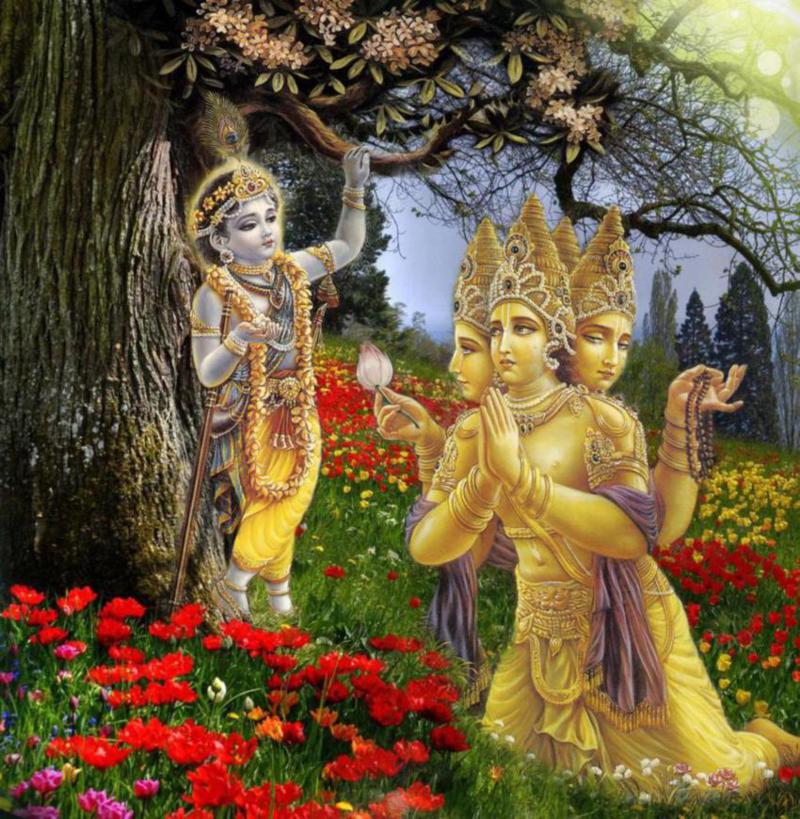
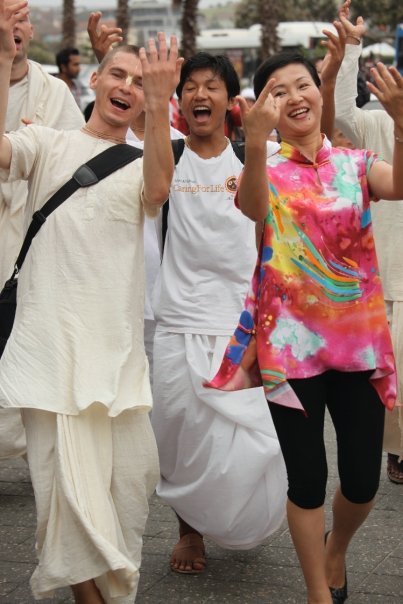
prahladena samam jato haridasakhyako’pi san
murari-gupta-caranaish caitanya-caritamrite
ukto muni-sutah pratas tulasi-patram aharan
adhautam abhishaptas tam pitra yavanatam gatah
sa eva haridasa san jatah parama-bhaktiman
 
   Hari Das Thakur is a combined incarnation of Brahma Mahatapa, the son of Richika Muni and Prahlad. The respected Murari Gupta has written in his Chaitanya Charitamrita that this muni’s son picked a Tulasi leaf and offered it to Krishna without having washed it first. His father then cursed him to become a mleccha in his next life. He was thus born as Hari Das, a great Devotee.
   (Gaura-ganoddesha-dipika 93-95)
 
Hari Das’s Birth as a Muslim
 
   In his book Navadwip-dhama-mahatmya, Bhaktivinoda Thakur has written the following account of how Brahma became Hari Das Thakur:
 
   In the Dvapara Yuga, Nandanandana Shri Krishna was herding the cows through Vraja Dham in the company of his cowherd boyfriends when Brahma decided to test the Lord out of a desire to see His majestic form and opulences. He stole both Krishna’s cows and calves, as well as His friends and hid them for a year in the caves of Sumeru Mountain. But a year later, when Brahma returned to Vraja, he was astonished to see that Krishna was still there with both His friends and cattle. Brahma immediately understood his error and began to regret his rash action. He fell down at Krishna’s feet and begged Him for forgiveness; Krishna responded by mercifully revealing His divine opulence. He who appears in the Dvapara Yuga as Nandanandana Shri Krishna, descends again in the Kali Yuga as Gauranga, taking on the mood and bodily luster of Radharani in order to display the most magnanimous pastimes. Brahma was afraid that he might commit the same offense during Gaura’s incarnation so he went to Antardwipa, the central island of Navadwip, and began to meditate. The Lord was able to understand his mind and so came to him in the form of Gauranga and said, “During my incarnation as Gaura, you will be born in a family of mlecchas and will preach the glories of the Holy Name and bring auspiciousness to all the living beings.” Haridasa Thakura
 
   From this above description, it is understood that Hari Das Thakur was an incarnation of the creator god Brahma. It is said that in order to avoid coming under the influence of ahamkara, in Gauranga lila, he prayed to Krishna to take birth in a lowly family. The same idea is found in the Advaita-vilasa.
 
   A Vaishnava may appear in any family in any class of society. Mahaprabhu wished to show that even though he may be born in a lowly family, a Vaishnava is the best of all human society. In order to do so, He had His associates be born in a variety of castes. Vrindavan Das Thakur has written the following in Chaitanya Bhagavat:
 
   Hari Das Thakur was born in a low-caste family on the Lord’s order in order to show that caste and class have no importance at all. All the scriptures say that a Devotee of Vishnu, though born in a lowly family, is still worshipable by all. What will one’s caste do for one is born in a high caste but does not worship Krishna? He will go to hell in spite of his high birth. Hari Das took a low birth just to bear witness to these scriptural statements. He is comparable to Prahlad who was born in a family of demons, or Hanuman, who was born a monkey. They belong only superficially to low castes.
   (Chaitanya Bhagavata 1.16.237-240)
 
   Namacharya Hari Das Thakur appeared in Burihana village. Burihana is currently an administrative region containing 65 blocks (groups of villages) in the Satkhira subdivision of Khulna in Bangla Desh. It is not clear exactly where Burihana village itself lies. Some people hold that Burihana is in West Bengali in the district known as 24 Paraganas, while others think that it is in Jessore district in Bangla Desh. Benapole is the station after Bongaon on the railroad line to Khulna on the Bangla Desh side of the border, so both Benapole and Burihana are currently in Bangla Desh.
 
   According to some people, Hari Das Thakur was born in a Brahmin family. His father’s name was Sumati and his mother Gauri. His parents died when he was young, so he went to live with a Muslim couple named Khan in the village of Halimpur about five miles from his birthplace on the other bank of the Salai River. He was thus brought up in an Islamic environment. According to the Advaita-vilasa, however, Hari Das Thakur was born in 1372 of the Shaka era (1451 AD) in the month of Agrahayan and his father’s name was Khanaulla Kazi. According to this version also, Hari Das was orphaned young.
 
Hari Das’s Participation in the Sankirtan Movement
 
   Since Mahaprabhu was born in 1407 Shaka, if we accept the Advaita-vilasa’s version, Hari Das was 35 years older than Mahaprabhu. It is known that Nityananda was 12 years older than Mahaprabhu, so there was a difference of 23 years between Hari Das and Nityananda also. Hari Das entered into Mahaprabhu’s association when the Lord returned to Navadwip after having been initiated by Ishvara Puri in Gaya. This was when the Lord started preaching the sankirtan movement.
 
Haridasa Thakura   Mahaprabhu engaged in His sankirtan pastimes in Navadwip while in His kaishora age (i.e., when he was between 10 and 15 years old). From this we can estimate that Hari Das was about 50 years old when he first met Mahaprabhu. By the Lord’s wish, Hari Das appeared long before He did. Even before meeting the Lord, Hari Das had already started to reveal the glories of the Holy Names in many wondrous ways. One of the Lord’s most important associates in His role as the initiator of the yuga dharma, which is Harinama sankirtan. Vrindavan Das Thakur has described Hari Das’s spotless and glorious pastimes extensively in his Chaitanya Bhagavat. Krishnadas Kaviraj Goswami has added some extra information about his life and character.
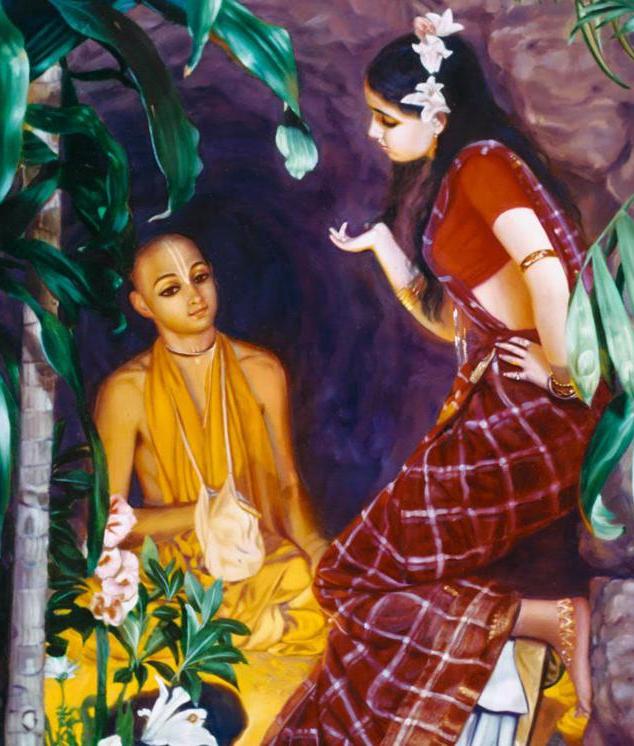
 
   Hari Das Thakur is a major branch of the desire tree of devotion. His character is extraordinary. He would unfailingly chant 300,000 names of the Lord each day. His virtues are unlimited and I can only give a brief summary here. Advaita Acharya gave him the place of honor at his father’s shraddha ceremony. Hari Das Thakur possessed the same qualities as Prahlad, being undisturbed even when being beaten by the Muslims. When he entered the Lord’s eternal pastimes, Mahaprabhu took his mortal remains in His arms and danced ecstatically. Vrindavan Das Thakur has described his pastimes extensively, I will simply take up what he has left undescribed. 
   (Chaitanya Charitamrita 1.10.43-47)
 
   It is not known exactly when Hari Das Thakur performed the various lilas which have been described, nevertheless we will try to follow a chronological order as far as possible. In the Adikhanda of the Chaitanya Bhagavat, Vrindavan Das Thakur writes about Mahaprabhu’s life from His birth until His return from Gaya. The Madhya-khanda describes the Lord after His return from Gaya, His ecstatic transformations in separation from Krishna, His Krishna conscious instructions to His students, His beginning the sankirtan movement with His students, His kirtan pastimes in the houses of Chandrashekhara and Shrivasa Pandit, etc., up until He took sannyas. Hari Das Thakur is mentioned in the Madhya-khanda in connection with the Lord’s sankirtan pastimes:
 
   In the Madhya-khanda, the Lord falls in to the Ganges in great distress; Nityananda and Hari Das pull Him out of the water.
   (Chaitanya Bhagavat 1.1.149)
 
   Hari Das Thakur was also a participant in the sankirtan festivities in the houses of Chandrashekhara and Shrivasa Pandit.
 
   When the Vaishnavas heard that the Lord had begun His sankirtan pastimes, they all were overjoyed. Every night He would hold kirtan in the house of Shrivasa Pandit, sometimes at the house of Chandrashekhara Acharya. Nityananda, Gadadhara, Advaita, Shrivasa, Vidyanidhi, Murari, Hiranya and Hari Das were all there.
   (Chaitanya Bhagavat 2.8.110-112)
 
   Hari Das was an eternal associate of the Lord and he incarnated in a Muslim household in order to serve Him; from a very early age he showed a proclivity for the chanting of the Holy Names. His life gives a brilliant example of how a Devotee who chants constantly without ulterior motivation and without offenses, cannot be swayed from his goal of attaining pure devotional service by any kind of worldly temptation, not even if Maya Devi herself comes to lure him. We summarize what Krishnadas Kaviraj Goswami has written in the third chapter of the Antya-lila of Chaitanya Charitamrita.
 
Temptation by the Prostitute Lakshahira
 
Haridasa Thakura    After Hari Das Thakur had left his home in Burihana, he came to the Benapole jungle, which after the pastime about to be described was given the name Hira Veshya’s Jungle. Hari Das would have been in his early youth at this time, as it does not seem that Mahaprabhu had yet appeared when these events took place. He was chanting the Holy Name in a secluded part of the jungle, worshiping Tulasi Devi and chanting his three lakhs of Names. He would beg for food at a Brahmin’s house. All the people in the area observed his spotless character and his staunch devotion to the Holy Name and gave him their respect.
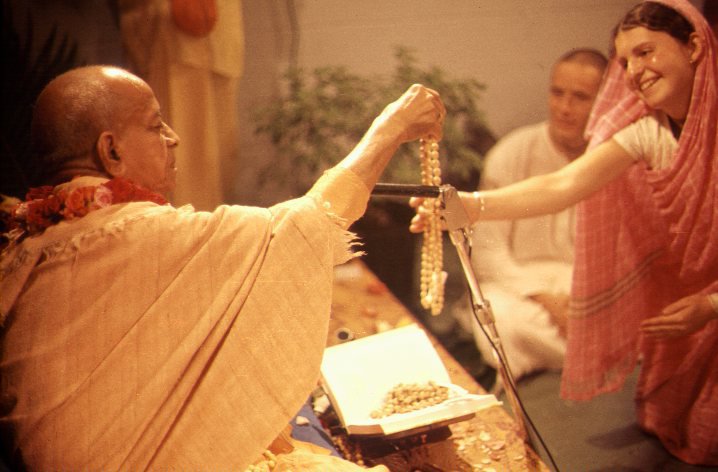
 
   At that time, an atheistic Vaishnava hater name Ramachandra Khan was a large landowner in the area. He became jealous of Hari Das Thakur’s increasing reputation and decided to ruin it by showing a flaw in his character. To this end he devised numerous tactics, none of which were successful. Finally, he called some prostitutes together and asked them to seduce Hari Das. One of these prostitutes, a very beautiful young girl named Lakshahira, promised that she would be able to accomplish the task within three days. Hence, Ramachandra engaged her for this mission.
 
   Ramachandra proposed sending an armed guard with Lakshahira to take Hari Das Thakur prisoner as soon as he had been brought down, but she refused, saying that it would be better to wait until she was sure that Hari Das was ready to fall. That night, she dressed and decorated herself in a most beautiful fashion and went to Hari Das’s hut. The first thing she did when she got there was to pay obeisances to the Tulasi plant, showing that she was still influenced by her pious Hindu upbringing.
 
   She then went and stood beside Hari Das. She began to use all the wiles at her command, flirting with him by saying, “You are a very handsome man, Thakur. You are in the full bloom of youth; what woman would be able to resist you? I have come here because I am filled with desire for you. If I don’t get your touch, I will kill myself.”
 
   In answer to this, Hari Das Thakur said, “I have just begun chanting my regular number of Holy Names. As soon as I am finished I will do as you wish. While waiting, please sit down and listen to the sound of the Holy Name.” He kept chanting and chanting until morning, when the prostitute became impatient and left. She returned to Ramachandra Khan and told him the whole story.
 
   She returned again that night to Hari Das’s hut, and he expressed his regret at having been unable to fulfill her desires due to his inability to complete his quota of Holy Names. Once again, however, he assured her that as soon as he was finished, he would do whatever she wished. Once again, Lakshahira paid her obeisances to Tulasi Devi and sat down and spent the night waiting for Hari Das to finish his chanting. When morning came, she again grew restless. Hari Das said to her, “I have taken a vow that I will chant 10,000,000 Holy Names before the end of the month. I am now almost finished. As a matter of fact, it should be completed this very night. As soon as it is over, I can sleep with you. Do not worry.”
 
   On the third night, Lakshahira returned, again paying obeisances to the Tulasi bush and sitting down beside Hari Das Thakur to listen to him chant. As she continued to listen to him chanting, the contaminations in her mind began to melt away and she began to regret her mission. She finally fell down at his feet and begged him forgiveness. She told him all about Ramachandra Khan’s evil intentions. Hari Das answered her, “I know all about Ramachandra Khan’s wicked plans. I would have left on the very first day, but I wanted to show you my mercy so I stayed for three days.”
 
   Lakshahira then asked him to instruct her so that she might be saved. He told her that whatever money she had earned by sinful means should be given in charity to the Brahmins and that then she should come and take up residence in his hut where she should chant the Holy Names constantly and worship Tulasi Devi.
 
   Lakshahira did exactly as her guru instructed her, giving all her riches to the Brahmins and shaving her head before returning to the hut dressed in a single cloth. She then started to chant three lakhs of names as Hari Das did. By virtue of her service to Tulasi and her chanting of the Holy Name, she became very renounced, all her senses were conquered and she attained pure love for Krishna. Through Hari Das Thakur’s mercy, the prostitute had become a great Vaishnavi.
 
   The prostitute became a celebrated Devotee and very advanced in spiritual life. Many stalwart Vaishnavas would come to see her.
   (C 3.3.141)
Haridasa Thakura   Shrila Bhaktisiddhanta Saraswati Goswami Thakur has commented on Hari Das Thakur’s instructions to Lakshahira in the following way: “Even though the guru has a legitimate claim on all of his disciple’s worldly possessions, he does not ask for them for his own use. Those who take dakshina, or alms, are opening the door to the house of Yamaraja. A Vaishnava guru is not such a person bound for the house of Yama; he is a traveler on a higher road. For this reason, there is an arrangement for giving donations of material wealth, etc., to Brahmins on the karma-marga. By not accepting his disciple’s possessions, which are after all intended for sense gratification, the Vaishnava guru remains independent of his disciple and does not compromise his integrity. He renounces them because he knows that they will awaken in him a disinterest in the service of the Lord. Hari Das Thakur’s teaching here is that the guru’s duty is to rid his disciple of his mundane pride and not to himself accept the material possessions which the disciple has renounced.”
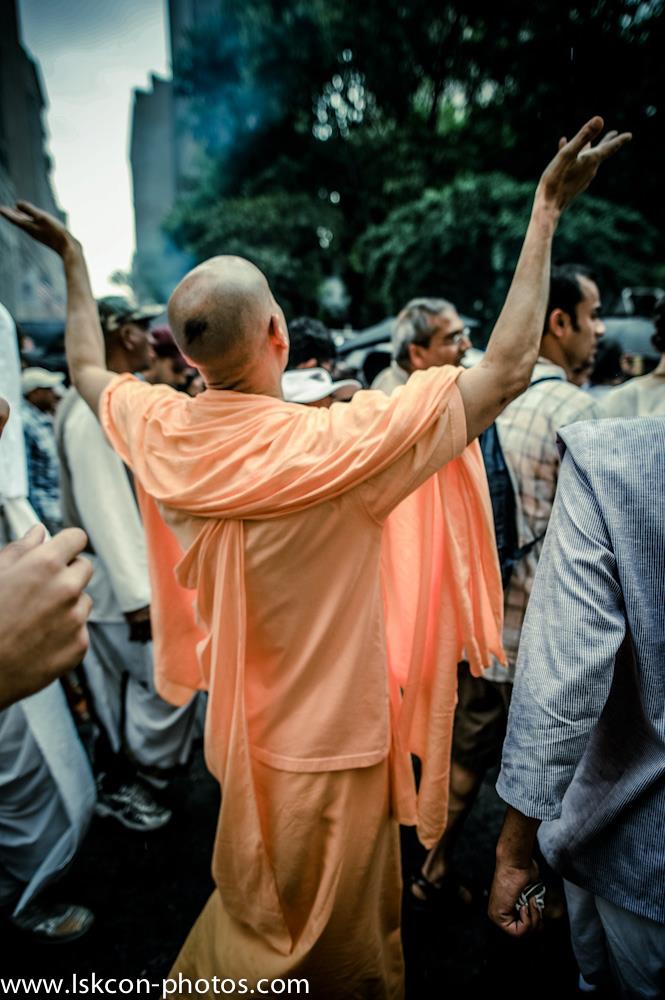
   (Anubhashya to Chaitanya Charitamrita 3.3.139)
 
The Fate of Ramachandra Khan
 
   A Vaishnava does not take offense from anyone for he does not even consider himself to be a Vaishnava. He accepts all suffering that he undergoes to be the result of his own sinful past and thus does not blame anyone for such suffering. Nevertheless, he is so dear to Krishna that the Lord never tolerates offenses to his feet. The Lord never forgives offenses to the feet of a Devotee who is constantly engaged in acts for the benefit of all living beings. As a result, there is no other source of self-destruction and misfortune more powerful than offense to a Vaishnava. The results of such offenses may come immediately or they may be delayed, but they are inevitable.
 
   In the case of Ramachandra Khan, the seeds he had sown in committing these offenses to Hari Das Thakur grew into a great tree, which bore fruit when Nityananda Prabhu came to his house with his associates in his pastimes of saving the fallen souls. As the indwelling soul of all beings, Nityananda was perfectly aware of Ramachandra’s record and had in fact come to his house because he was angry and intended to punish him. Though Nityananda Prabhu is known to be the most compassionate, merciful to even the lowliest people, saving sinners like Jagai and Madhai and giving them love of God, he too becomes angry at the offender to the feet of a Vaishnava.
 
   As a result of his offenses to Hari Das Thakur, Ramachandra Khan had become a complete demon and thus was unable to give Nityananda and his companions the proper respect, arranging for living quarters for them in a milkman’s cowshed. Nityananda became even more displeased with Ramachandra Khan and left the place. He said, this place is not fit for me, but for a cow-killing meat-eater. Not long after Nityananda Prabhu had left the place, the Muslim tax collector came with his police to collect Khan’s overdue taxes. He and his men stayed in the Durga Mandapa at Ramachandra Khan’s house and killed a cow there. They took him and his family prisoner and looted the house and village, destroying his caste, his wealth and his family in one fell swoop.
 
   Any town or country in which a great soul is insulted, even if by only one of its inhabitants, is destroyed on account of that offense.
   (Chaitanya Charitamrita 3.3.163)
 
The Offenses of Gopal Chakravarti
 
   Hari Das Thakur left the district of Jessore and came to Hooghly district. He stayed in the village of Chandpur, near Saptagrama-Triveni, at the house of Hiranya and Govardhana Majumdar’s family priest, Balaram Acharya. There he stayed in a straw hut and chanted the Holy Names all day long, taking food at Balaram Acharya’s house. Raghunatha Das Goswami was a young boy then and he would come to visit Hari Das whose merciful glance made it possible for Raghunatha to later come into Mahaprabhu’s direct company.
 
Haridasa Thakura   Hiranya and Govardhana Majumdar would regularly arrange for discussions of the Bhagavat and other scriptures at their house. One day Balaram Acharya brought Hari Das Thakur to this assembly. When he heard about Hari Das Thakur’s various qualities and that he chanted three lakhs of names every day, Raghunatha’s father Govardhana was very impressed.
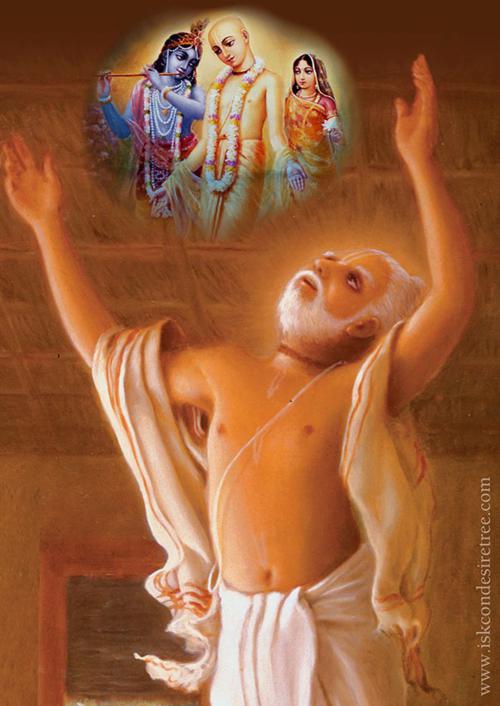
 
   While discussing the scriptures, the scholars present brought up the subject of the glories of the Holy Names. One pandit said that the Holy Name destroyed sins, another said that it gave liberation. Hari Das said that the primary fruit of chanting the Holy Name was that it gave love for the lotus feet of Shri Krishna, and the destruction of accumulated sinful karmas and liberation from the material condition were secondary results. He gave the following example: with the first dawn’s light, darkness is dissipated and along with it the fear of thieves, ghosts and demons. With the full rising of the sun, one can set about doing one’s daily duties. Similarly, even before one has experienced the full manifestation of the Holy Name, one’s sins are destroyed and one becomes liberated. With its full manifestation, one attains Krishna prema. The reflection of the Holy Name (namabhasa) brings liberation, but even if the Lord wants to give liberation to His Devotee, the Devotee does not accept it.
 
   One of the people who heard Hari Das speak was a Brahmin named Gopal Chakravarti, a handsome and learned young scholar who worked as a tax collector for the Muslim government. When he heard that simply the shadow of the Holy Name could bring liberation, he got angry and said, “Fellow scholars! These are the statements of a sentimentalist. After millions of births of practicing knowledge one may still not attain liberation, but this fellows says that just a glimpse of the Holy Name will bring that result.”
 
   Hari Das Thakur answered, “The pleasure of liberation is insignificant when compared to the ecstasy of devotion. Just a shadow of devotion, just a shadow of the Holy Name, will easily give one liberation.”
 
   The Brahmin became even angrier and said, “Hari Das must swear that if one is not liberated by namabhasa, then he shall cut off his nose.”
 
   Hari Das Thakur had no trouble agreeing to this, but the rest of the people in the assembly were shocked by Gopal’s breach of the proper etiquette toward a great spiritual personality. Hiranya and Govardhana rebuked the tax collector. Balaram Acharya also chastised him, saying, “You are a foolish logician. What do you know of devotion? You have insulted Hari Das Thakur. Nothing positive will come of that, you will be ruined on account of it.” All the other members of the assembly fell at Hari Das’s feet and asked for forgiveness for Gopal’s behavior, but he only said, “Neither he nor you are at fault. The Brahmin is ignorant and addicted to arguing. One cannot understand the glories of the Holy Name through logic. May the Lord bless you all. Don’t worry about me.” The Majumdars ostracized Gopal Chakravarti, refusing him entry to their house.
 
   Though Hari Das Thakur personally took no offense at Gopal Chakravarti’s words, and even forgave him, Krishna does not take the blasphemy of a Devotee lightly and so he punished the Brahmin. Three days later he contracted leprosy and his very prominent nose melted and fell off. Everyone was terrified by the Brahmin’s misfortune and glorified Hari Das Thakur’s spiritual power, but it was a source of distress to Hari Das himself.
 
Hari Das and Advaita Acharya
 
   Hari Das thus quit the region and moved to Phuliya, near Shantipur, where he came into contact with Advaita Acharya. Advaita was born in 1434, 52 years before the appearance of Chaitanya Mahaprabhu, so he was 17 years senior to Hari Das.
 
Haridasa Thakura   Advaita Prabhu gave Hari Das the shraddha plate that was normally given only to Brahmins. When Hari Das objected to the honor, “If you eat, it is the equivalent of thousands of Brahmins.” Hari Das daily took his midday meal at Advaita Acharya’s house at his invitation. From Krishnadas Kaviraj Goswami’s account, it is apparent that these events took place before Mahaprabhu’s appearance. The primary reason for Mahaprabhu’s incarnation was the devotion and the emotional prayers of both Advaita Acharya and Hari Das Thakur.
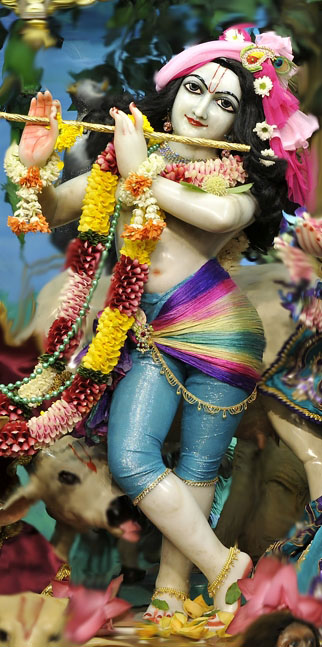
 
   Advaita began to wonder how the world could be saved. How can this world without devotion for the Supreme Lord ever achieve liberation. He became determined to make Krishna descend and so he began to worship Krishna with Ganges water and Tulasi leaves. Meanwhile, Hari Das Thakur was in his grotto chanting the Holy Names and praying for Krishna’s incarnation. Chaitanya Mahaprabhu’s avatar was the result of both these persons’ devotion, by which he saved the world through preaching the chanting of the Holy Names and love of Krishna.
   (Chaitanya Charitamrita 3.3.221-4)
 
   A Devotee who chants the Holy Name without artifice cannot be swayed from the path of pure devotion, not even by the personification of Maya herself. Once again, Hari Das Thakur is an outstanding example. There was no object of enjoyment in this entire world that could tempt him. If one sees someone who is apparently taking shelter of the Holy Name, but at the same time succumbs to the temptations of women, wealth and power, it can be understood that he is not truly surrendered to the Name. Phalena phalakaranam anumiyate: one can guess the cause by examining the results. Although one sees the Holy Names being chanted in many places, but one does not often see the desired results. The reason is that those who are doing the chanting are not doing it in a fashion that is sincere, single-minded and offenseless.
 
Maya Devi Tries to Tempt Hari Das
 
   While Hari Das Thakur was sitting in his grotto near Shantipur and chanting the Holy Names with single-minded devotion, Maya Devi herself came to test him. She took on the form of a beautiful woman and called out to him in a sweet voice that wnbsp; nbsp;Any town or country in which a great soul is insulted, even if by only one of its inhabitants, is destroyed on account of that offense. nbsp;Any town or country in which a great soul is insulted, even if by only one of its inhabitants, is destroyed on account of thnbsp; nbsp; at offnbsp; ense. nbsp;Any town or country in which a great soul is insulted, even if by only one of its inhabitants, is destroyed on account of that offense . nbsp;Any town or country in which a great soul is insulted, even if by only one of its inhabitants, is destroyed orsquo;s Birth as a Muslim n account of that offense. ould hnbsp;Any town or country in which a great soul is insulted,/divrsquo;s account, it is apparent that these events took placenbnbsp; /divnbs div p; sp; nbsp; /div before Mahapra bhu even if by only one of its inhabitants, is destroyed on account /divdiv/divnbsp; of that ostro ng ffense . ave toppled even great sages, imploring him to embrace her. Once again, Hari Das told her that he would complete hinbsp; nbsp; nbsp; /divs vow of chanting a fixed number of Harinama, and only then he would satisfy her desires. Although she came three nights in a row in this way, Maya Devi was astonished to see that there was not the slightest wavering in his resolve to chant the Holy Name. She admitted defeat and prayed to him for his mercy. Hari Das Thakur gave her initiation in the Maha Mantra and thus Maya Devi disappeared, feeling that she had been fulfilled.
 
   Previously I received the name of Rama from Shiva; but I had the desire to hear the name of Krishna from you. Rama’s name is the taraka-nama that gives liberation, whereas Krishna’s name is called the paraka-nama because it gives prema. You have made me fortunate by giving me the name of Krishna and I feel a flood of love for him washing over me.
   (Chaitanya Charitamrita 3.3.254-6)
 
Hari Das is Imprisoned and Tortured
 
Haridasa Thakura    From Shrila Vrindavan Das Thakur’s Chaitanya Bhagavat, it is known that prior to Hari Das’s coming to meet Advaita Prabhu in Shantipur, he lived in Phuliya. Phuliya is on the Eastern Railway line in Nadia district between Ranaghat and Shantipur, about five miles north of Ranaghat. When the Brahmins of the village saw his dedication to the chanting of the Holy Names as well as his ecstatic symptoms of love, they concluded that he was a Vaishnava of the highest order.
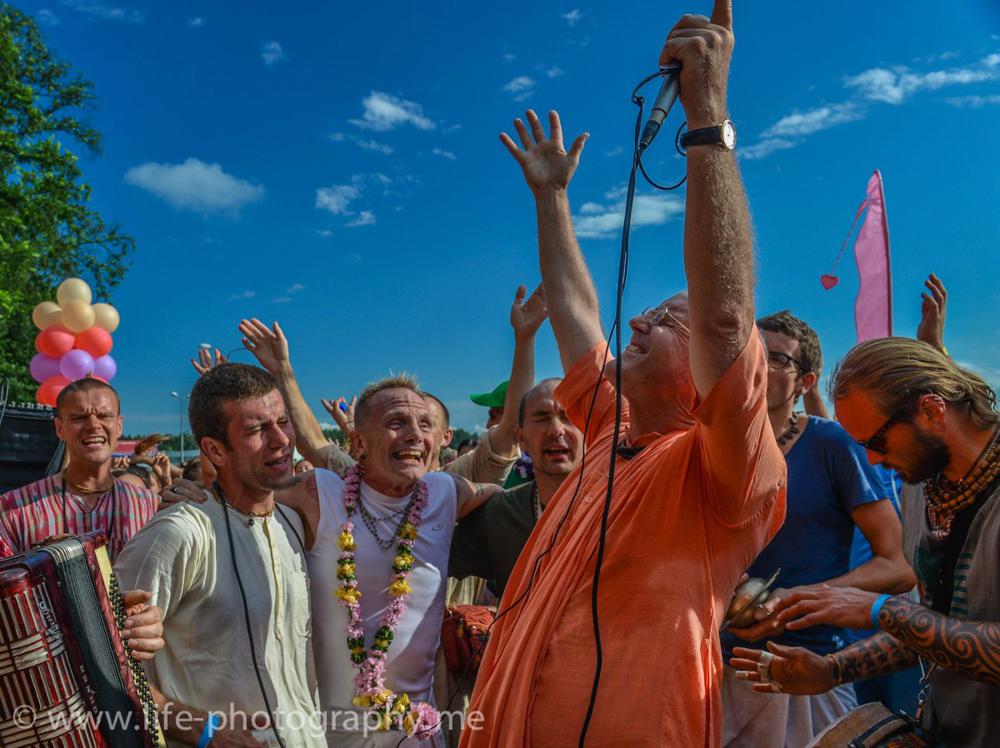
 
   The local magistrate (Kazi), however, knowing that Hari Das had been born in a Muslim household, and now was showing such a taste for chanting the Holy Names of Krishna, began to fear that he might convert others to Vaishnavism. He took his complaint to the governor (Nawab), suggesting that Hari Das be punished as soon as possible. The governor ordered his officers to place Hari Das under arrest. The other prisoners already knew Hari Das’s glories and thought that the sight and blessings of such a great spiritual personality would surely bring them merit to insure their early release from jail. But Hari Das told them that they were better off in jail and he blessed them that they stay. The prisoners were naturally unhappy to hear such a statement, but then Hari Das explained his strange blessing:
 
   I don’t mean to say that you should remain prisoners, but that you forget sense gratification and that you chant Hare Krishna. This was the meaning of my blessing; please don’t be sad for a moment on that account.
   (Chaitanya Bhagavat 1.16.63-64)
 
   While in jail, the prisoners could forget the entanglements of material life and simply concentrate on chanting the Holy Name.
 
   One day, the Nawab asked Hari Das why he had abandoned the pure religion of Islam to embrace Hinduism. Hari Das Thakur answered, “God is one. The same God is present in every religion; He is the non-dual absolute truth. In the different religions, it is simply the name that differs, but on the absolute plane, there is no distinction to be made. The same God sits in the heart of every single living being and he engages each one of them in His service in different ways. One worships in the way one is made to worship by Him. There are Hindu Brahmins who convert to Islam. In the same way, though I was born in a Muslim family, I have been engaged by the Lord in chanting the Holy Names of Krishna. The living being has no independence in such matters. If this is a fault, then please punish me.” 
 

   The Nawab rebuked Hari Das, saying, “Chant the names of God as they are found in your own religion and stop practicing other peoples’ religion. If you don’t, you will have to face a very severe punishment.” Hari Das Thakur answered with conviction: 

khanda khanda haï deha jay jadi prana

tabu ami vadane na charii hari-nama
 
   ”You may cut my body to pieces, and the life may leave it. But I will never abandon the Holy Name which my tongue will ever continue to chant.”
   (Chaitanya Bhagavat 16.91)
 
   This statement demonstrated Hari Das’s unswerving determination in his worship of the Name. The ordinary living entity is bound up in Maya and so considers the well-being of the body to be more important than worshiping the Lord. Those who are transcendentalists recognize that the body and its interests are fleeting, and so they put them aside and concentrate on their real self interest, that of the soul, and worship the Lord.
 
   When the Nawab saw that Hari Das Thakur’s determination to continue chanting the names of Krishna was unbreakable, he asked the Kazi what should be done. The Kazi answered, “He should be given such a severe punishment that other Muslims will be afraid to convert. He should be flogged publicly in 22 market places until he is dead. If after being beaten in 22 market places he is still alive, then we will know that he really has some kind of spiritual power and that he has been telling the truth!”
 
   The Nawab gave the order and several infantry men took Hari Das Thakur from marketplace to marketplace, giving him a cruel flogging with a cane in each one. Even so, he did not die. Just like Prahlad, Krishna’s mercy protected his body and kept him conscious only of the joys of the Holy Name, and so he did not feel the slightest discomfiture. The pious people of the area who witnessed the merciless beating of Hari Das were greatly distressed. He himself, though being ruthlessly flogged by these sinful people, did not stop praying to the Lord for the well being of his torturers.
 
   ”Be merciful to all these poor souls, O Lord! Though they treat me like an enemy, do not consider this to be an offense.”
   (Chaitanya Bhagavat 16.110)
 
   Normally, the type of beating that was being given to Hari Das would have killed an ordinary man after only two or three marketplaces. When his torturers saw that he was still alive after 22 marketplaces, they began to worry. The Kazi would not believe that they had really flogged him if Hari Das remained alive, and he would surely punish them by ordering them to be killed. When Hari Das saw that they were inconvenienced by his remaining alive, he went into a deep trance of meditation on Krishna, appearing to everyone as though dead.
 
   The infantry men took the body to the Nawab and he ordered it to be buried. But the Kazi objected, saying that because Hari Das had engaged in such reprehensible activities, he should not be buried but thrown in the water. So on the Kazi’s order, Hari Das’s body was flung into the Ganges. To everyone’s surprise, Hari Das floated to the other shore where he climbed onto dry land and started chanting the Holy Names in a loud voice, walking in the direction of Phuliya. Both the Nawab and the Kazi realized that he was a real saint or pir and they fell to the ground in obeisances and begged him for forgiveness. By his grace, they were able to become free of their evil misdeeds. The Nawab gave Hari Das official permission to go wherever he pleased and to chant the Holy Names.
 
   In the tenth chapter of the Madhya-khanda, Vrindavan Das Thakur writes that while Hari Das was being cruelly beaten, Mahaprabhu descended with his discus, intending to destroy the demons, but was unable to do so on account of Hari Das’s prayers. So he shielded Hari Das’s body with his own. Then he revealed to Hari Das the cane marks on his back. The main reason for the Lord’s appearance is his Devotee. When such an outrage was being perpetrated on His Devotee Hari Das, He immediately appeared to protect him.
 
   When Hari Das heard the Lord recount this story, he immediately fainted. The Lord then showed him His divine form. He glorified Hari Das himself: “Anyone who even sees Hari Das becomes free from all bondage. Even great gods like Brahma and Shiva desire Hari Das’s company. Even the Ganges desires his touch.”
 
   The Brahmins of Phuliya were overjoyed to see Hari Das again. They had been paralyzed by the news that Hari Das was being flogged in all the marketplaces of the district. Hari Das told them that these events had been the result of hearing the blasphemy of Vaishnavas, which in itself is a great offense. Indeed, the punishment that he had received could be considered minimal.
 
Hari Das, the Snake and the Snake-charmer
 
   In the grotto at Phuliya where Hari Das did his bhajan lived a poisonous snake. Visitors to Hari Das’s place of residence were placed in some discomfort because of the poisonous fumes emanating from this beast. Some local doctors, who were particularly expert in dealing with snakebite, warned Hari Das and advised him to leave his place of worship. At the consistent pleadings of all the people, Hari Das finally agreed to move. However, just before sunset, as he was about to leave, the great serpent left the grotto of its own accord.
 
   Another lesson that can be taken from Hari Das’s life is that making a public display of love of Krishna in order to gain public prestige is very detrimental to one’s devotional life. One day, a snake charmer from Phuliya village went to a rich man’s house to sing Krishna’s pastime of taming the serpent Kaliya. Hari Das was present, and when he heard the lilas of Krishna became so affected by love that he fainted in the assembly and the various manifestations of ecstatic love became present on his body. All the people present took the dust of Hari Das’s feet and smeared it on their bodies.
 
   A certain Brahmin who was present there saw the respect that the people were showing to Hari Das and became jealous. The shameless fellow had such a strong desire for prestige that when the snake charmer continued his song, he too fell to the ground and began to make a show of all kinds of false ecstasies. The snake charmer could recognize the faker for what he was and started to hit him with a cane. The Brahmin began to scream, “Father! Mother!” and ran away. This particular pastime shows that even a humble snake charmer can possess the simplicity to distinguish between real and faked ecstatic symptoms. He explained to everyone present the naturalness of Hari Das’s love and the falseness of the Brahmins pretense.
 
The Loud Chanting of the Holy Names
 
   Hari Das Thakur constantly chanted the Holy Name and called to the Lord in a loud voice. At that time, not many people were able to understand the value of this practice. Prior to Gauranga-sundara’s appearance, most people were simply interested in sense gratification and were inimical to devotion for Krishna and the chanting of His Holy Names. Advaita Acharya and Hari Das Thakur were saddened by this terrible situation. When the non-devotees heard them chanting loudly, they would say, “The Lord sleeps during the four months of the rainy season. If you call Him out loud in this way, you will wake Him up and that will be a grave offense. There will be famine in the country if you keep on with it. Some Brahmins have taken up this chanting business as a way of worshiping their own bellies, no doubt.” They would criticize Hari Das and Advaita by joking in this way. Even though such criticism pained Hari Das, he never stopped chanting Hare Krishna in a loud voice.
 
Haridasa Thakura    One day, a Brahmin from a village named Harinadi (in Jessore district) started a debate with Hari Das on this subject. He argued that the names of the Lord should be meditated upon and that there was no reason to chant them aloud. He wanted to know in which scripture it was stated that one should chant aloud. In answer to these questions, Hari Das Thakur gave a detailed account of the glories of the Holy Name. He said that loud chanting of the Holy Names was a hundred times more powerful than japa. Through the loud chanting of the Names, even the birds, animals and other creatures are also saved.
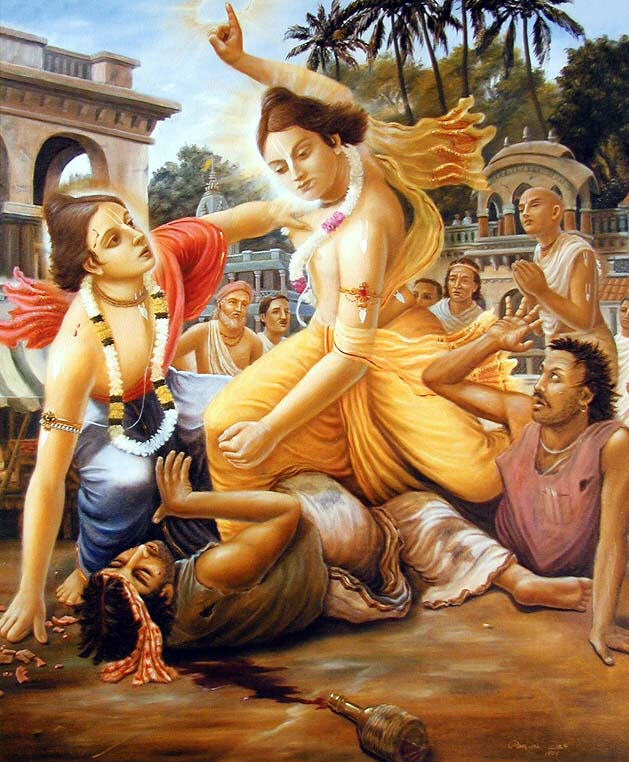
 
   Animals, birds, insects and other creatures are unable to speak, but if they just hear the Holy Name, they can all cross over. If you chant the Holy Names silently, then you yourself will be saved, but if you chant aloud, then you will benefit others. Therefore, all the scriptures state that by the loud chanting of the Name, a hundred times greater result can be obtained.
   (Chaitanya Bhagavat 1.16.280-2)
 
japato harinamani sthane shata-gunadhikah
atmanam ca punaty uccair japan shrotnn punati ca
(Naradiya Purana)
 
   Someone who chants the Holy Names aloud is a hundred times better than one who performs japa, because the one who chanting japa simply benefits himself, while the person who chants japa aloud not only does good for himself, but for all those who hear him as well.
 
   Who is better, the person who earns money and spends it all on himself, or the one who uses his money to support a thousand others? Through japa, one takes care of his own spiritual life, while through ucca-sankirtan, all living beings are benefited. This is the reason for its being considered superior.
 
   Even though he heard Hari Das quote scripture in support of his idea, the Brahmin from Harinadi village was unconvinced. Indeed, he became angry and began to verbally abuse Hari Das by bringing up his low birth. He said, "If everything that you say about the Holy Name is not found in scripture, then I will publicly cut off your nose and ear as a punishment." As a result of this offensive behavior, the Brahmin contracted smallpox not long afterward and his own nose and ear fell off.
 
Hari Das Comes to Navadwip
 
   After this, Hari Das Thakur then went to live in Navadwip out of a desire to be with pure Devotees like Advaita Acharya. There he was a participant in the Lord’s sankirtan pastimes in the houses of Shrivasa Pandit and Chandrashekhara Acharya. Mahaprabhu sent Hari Das and Nityananda Prabhu to go from door to door to beg people to chant the names of Krishna, to worship Him and to study the Vaishnava scriptures.
 
   One day, the Lord suddenly had an idea and he called Nityananda and Hari Das to tell them: “Listen, listen, Nityananda. Listen, Hari Das. I wish you to go and communicate my order to everyone. Go to every house and beg people to chant the names of Krishna, worship Krishna, study about Krishna. Other than this, say nothing and make others say nothing. At the end of the day, come here and tell me the results of your preaching. You will beg people in this way, and I will come and destroy those who do not comply with my discus in my hand.”
   (Chaitanya Bhagavat 2.13.7-11)
 
Haridasa Thakura    Nityananda Prabhu and Hari Das Thakur followed the Lord’s order and began preaching everywhere in Navadwip. One day they went up to two feared drunken bandits named Jagai and Madhai, and asked them to chant the Holy Name as the Lord had instructed them. Seeing their fallen condition, Nityananda became merciful toward them, but Jagai and Madhai were in such a state of intoxication that they simply became angry when they heard his appeal, and came forward to beat him and Hari Das up. Nityananda started to run away, but Hari Das being already quite advanced in age (58) was unable to keep up with him. Nevertheless, he somehow managed to escape with his life. Hari Das told Advaita Acharya about the day’s events, saying that he would not go out preaching with Nityananda any more, since his behavior was rash and unpredictable. The all-powerful Lord Nityananda’s running away is certainly a mysterious pastime, but it is to be remembered that he later went out on his own and managed to deliver the two rascals, Jagai and Madhai.
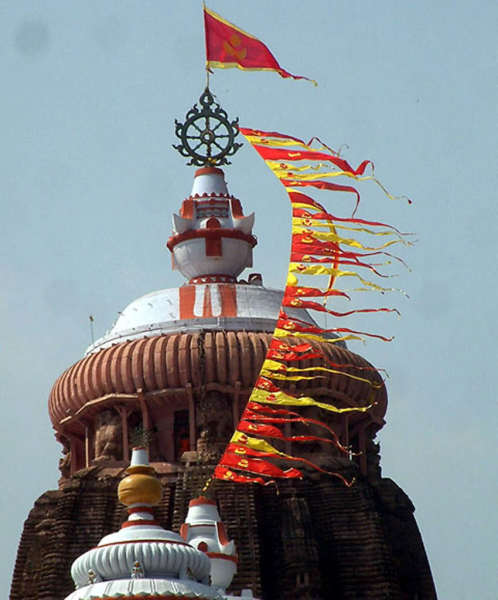
 
   Hari Das Thakur also engaged in water sports with the Lord in Navadwip. One day, overcome by a mood of love, the Lord tried to drown himself in the Ganges, and Hari Das and Nityananda jumped in to save Him. They hid Mahaprabhu in the house of Nandana Acharya because of His wish for seclusion. When Advaita Acharya and the other Devotees were feeling the distress of separation, they went and brought Shrivasa there and reunited the Devotees with the Lord.
 
   When Mahaprabhu put on a play about Krishna’s Vrindavan pastimes in the house of Chandrashekhara Acharya, Hari Das played the part of the town constable. He came onto the scene, dressed as a policeman, carrying a stick in his hand. The other actors in the play were Mahaprabhu as Adya shakti, Nityananda as an old cowherd woman, Advaita as the clown, Gadadhara Pandit as a cowherd girl, and Shrivasa Pandit as Narada Muni. Hari Das’s duty in the play was to awaken everyone to the service of Krishna. He cried out, “Wake up! Wake up! Wake up! Shrivasa will dance dressed as Narada Muni.” (Chaitanya Bhagavat 2.18.100)
 
   When the Lord took his sankirtan party along the banks of the Bhagirathi, Hari Das joined Him. Then Hari Das, the ocean of Krishna-rasa, on Mahaprabhu’s order, danced beautifully.
   (Chaitanya Bhagavat 2.23.204)
 
   The night before Mahaprabhu left to take sannyas, Hari Das was staying at his house. He and all the other Devotees were desolated by the Lord’s intention to take the renounced order. When the Lord went to Puri. Hari Das went there not long afterwards to see the Rathayatra and never left.
 
Hari Das Thakur in Puri
 
   When in Puri, though Hari Das was not officially banned from going into the Jagannath Temple or the house of Kashi Mishra (where Mahaprabhu was staying), out of humility at his lowly birth, never went there. Rupa and Sanatan Goswamis also demonstrated a similar humility, even though they were born in a very high-caste Brahmin family. They considered themselves to be no better than mlecchas because of their long association with the Muslim court. They would stay with Hari Das when in Puri and not go for darshan of Jagannath or Mahaprabhu. Mahaprabhu himself would go to meet them.
 
   Neither Hari Das, Rupa, nor Sanatan would go to the Jagannath Temple. Mahaprabhu would go there to see the Upala-bhoga in the morning. He would then go to the place where they were staying and would visit them there. It was thus the Lord’s regular practice to meet whichever one of these three was staying in Puri at the time.
   (Chaitanya Charitamrita 2.1.63-65)
 
   During Lord Jagannath’s absence from the Temple (anavasara-kala), Mahaprabhu would feel separation so intensely that He would go to stay in Alalanath. When He heard that more than 200 Devotees had come from Bengal, He returned to Puri to meet them. When He did not see Hari Das Thakur, He inquired after him. Hari Das was there, but paying his obeisances at the side of the highway. The Devotees went to Hari Das and told him that Mahaprabhu wanted to see him. Hari Das said, ”I am a low-born person who has no good qualities. I have no right to go near the Temple. If I can find a solitary place to stay in some garden somewhere, then I will pass my time there alone. That way there is no danger that the servants of Jagannath will accidentally touch me. This is my wish.”
   (Chaitanya Charitamrita 2.11.165-7)
 
   The Devotees came back to Mahaprabhu to report what Hari Das had said, and his wish pleased Him. He arranged for a house in a solitary garden not far from His own place of worship at Kashi Mishra’s house. Kashi Mishra was happy to have the chance to serve the Lord by making these arrangements according to His order. The Lord went to talk to Hari Das and when He saw him paying his dandavats, lifted him from the ground and embraced him. When Hari Das said, “I am an untouchable. Lord, you should not touch me”, the Lord answered:
 
 Haridasa Thakura  ”I touch you just to become purified, for your standard of purification is non-existent in Me. At every moment you are bathing in the water of every holy place; at every moment you are performing all sacrifices, penances and charity. You constantly are performing the pious activity of studying the Veda. You are more purifying than any Brahmin or sannyasi.”
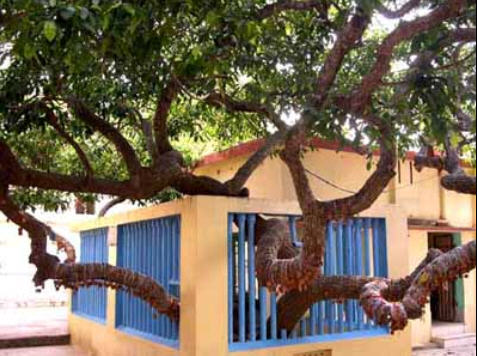

 
   After saying this, the Lord took him to the flower garden and gave him the solitary room there as a place to stay. “Stay here and chant the Holy Names. I will come every day to visit you here. You can see the discus on the pinnacle of the Temple tower from here. When you see it, pay your obeisances to it. I will arrange for Jagannath’s Prasad to be brought to you here.”
   (Chaitanya Charitamrita 2.11.189-95)
 
   This flower garden is now known by the name, Siddha Bakula. Previously it was named Mudra Math. There is a legend connected with the Siddha Bakula tree. The local pandas have a tradition of giving the twig that is used to clean Jagannath’s teeth as Prasad to some special person. One day they gave a twig from a bakula tree that had so been used as a gift to Mahaprabhu. The Lord planted this twig in the ground at Hari Das’s place of bhajan. This twig eventually grew into a large tree. It is said that the Lord planted the twig on the first day of the month of Chaitra also known as Mahavishuva Sankranti, i.e. the day when the sun enters into the sign of Aries. For this reason, a festival named the Danta-kashtha-ropana Mahotsava is held on that day ever year to celebrate the occasion. Haridasa Thakura
 
   Shrila Hari Das Thakur participated in the kirtan during the Rathayatra festival as the main dancer in one of the seven kirtan sampradayas. He was in the third group, which had Mukunda Datta as its lead singer.
 
Hari Das’s Teachings on the Holy Name
 
   Mahaprabhu taught the glories of the Holy Name through Hari Das Thakur. One day, the Lord was feeling particularly unhappy about the lot of the conditioned souls. He came to Siddha Bakula and said to the Thakur: “Hari Das, in the age of Kali, the non-Hindus kill the cow and are inimical to the Brahmins. How will these Muslims ever be saved?” Hari Das answered, “Don’t be distressed at seeing the pitiable condition of the Muslims. They will be liberated by the namabhasa, the shadow of the Holy Name, whenever they say haram. In the Nrisingha-purana it is said, [1]
 
damshtri-dantahato mleccho harameti punah punah
uktvapi muktim apnoti kim punah shraddhaya grinan
 
   When wounded by the tusks of a boar, the Muslim cries out “Harama, Harama!” again and again. If he attains liberation by so doing, then just think what will be the result if one chants the name of Rama with faith.
 
Haridasa Thakura   Bhaktivinoda Thakur says that if any Muslim dies while saying this word (haram), he is immediately liberated. This is namabhasa or nama-sanketa because the speaker makes the correct sound but does not intend the Lord Rama. Therefore, it is impossible to say just what fruits await the sincere and faithful chanter. The example is given of Ajamila who called the name of his son Narayan as he was dying, and through this namabhasa he attained liberation.
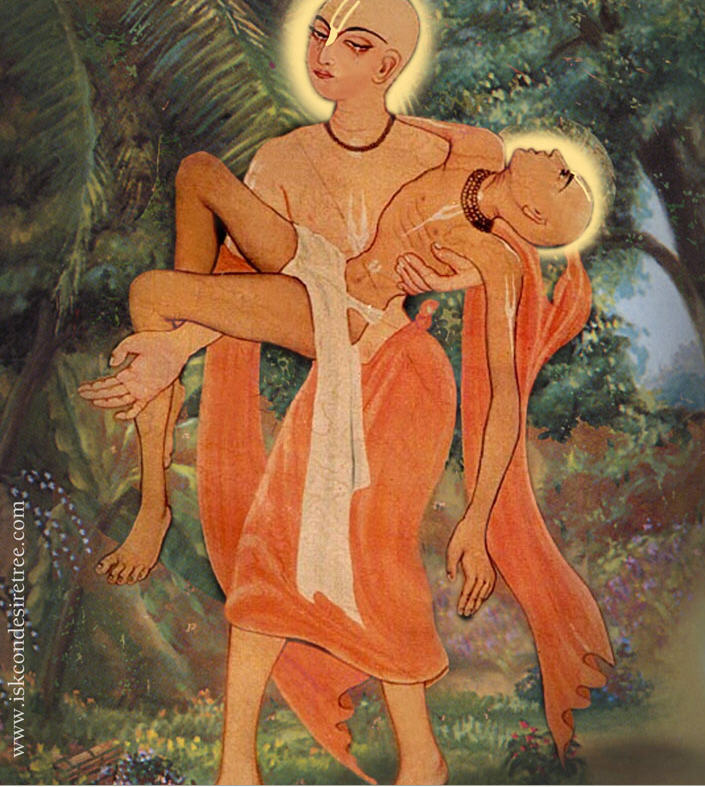
 
   When he heard this explanation, Mahaprabhu was very pleased, but again He asked Hari Das, “How will the dumb animals and the trees, etc., be delivered?” Hari Das answered:
 
   ”You Yourself have instituted the loud chanting of the Holy Names which both the moving and non-moving creatures can hear. The mobile creatures are freed from their bondage to repeated birth and death by hearing the names. As for the immobile, they perform kirtan themselves by echoing the sounds. By your indescribable mercy, the entire universe is engaged in kirtan and the mobile and immobile beings dance when they hear it… You preached the loud chanting of the Holy Names by which the repeated births and deaths of all living beings come to an end.”
   (Chaitanya Charitamrita 3.3.68-71, 75)
 
The Disappearance of Hari Das Thakur
   In the eleventh chapter of the Chaitanya Charitamrita’s Antya-lila, Krishnadas Kaviraj Goswami describes the disappearance of Hari Das Thakur in a most captivating way. It should be read in its entirety on the occasion of Hari Das’s disappearance day. A brief summary is given here:
 
namami hari dasam tam caitanyam tam ca tat-prabhum
samsthitam api yan-murtim skandhe kritva nanarta yah
 
   I offer my obeisances to Hari Das as well as to his worshipable lord, Chaitanya Mahaprabhu, who placed his body on His shoulders and danced.
 
   As Hari Das Thakur grew old, it became more and more difficult for him to maintain his vow of chanting three lakhs of names every day. Thus, he had no appetite when Govinda would come with Jagannath’s Prasad and only to avoid disrespecting the holy food would he eat a single grain of rice. Out of his affection for Hari Das, Mahaprabhu told him that he was a perfected being and that there was no need for him to show such attachment for devotional service in practice; he could thus reduce the number of Holy Names that he chanted every day. Hari Das then revealed what was really bothering him.
 
Haridasa Thakura   He knew that Mahaprabhu would soon be ending His pastimes in this world and he wished to leave before Him. The affectionate Lord granted him his wish, even though He felt desolate at the prospect of losing his company.
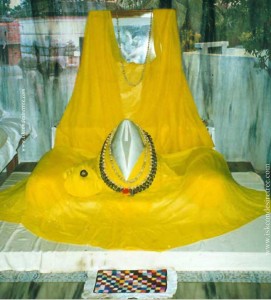
 
   Hari Das Thakur sat in front of Mahaprabhu who was standing in front of Him. Then, as the tears flowed from his eyes, he gazed at the Lord’s lotus face and took His lotus feet on his chest and, while chanting the names “Krishna Chaitanya”, voluntarily left his body like Bhishma.
 
   The Devotees became intoxicated by the kirtan which grew louder and louder, and the Lord lifted Hari Das’s body and started to dance around the courtyard. In the accompaniment of the loud singing of the Holy Names, He and the Devotees took Hari Das’s remains to the beach. There they washed the body in the sea and then dug a hole in the sand where they placed it. Mahaprabhu was the first to throw sand into the samadhi. This is how the samadhi ritual of Hari Das Thakur was performed. By virtue of his presence, the seashore became a great place of pilgrimage.
 
Haridasa Thakura   Mahaprabhu circumambulated the burial place and then went personally to the Jagannath Temple to beg for Prasad for a feast in honor of Hari Das. Svarupa Damodar Goswami would not let Mahaprabhu carry the Prasad Himself, but took care of making all the arrangements himself. At the feast, all the Devotees were given enough food to eat to their fill. In a mood of absorption in divine love, Mahaprabhu said to all the Devotees:
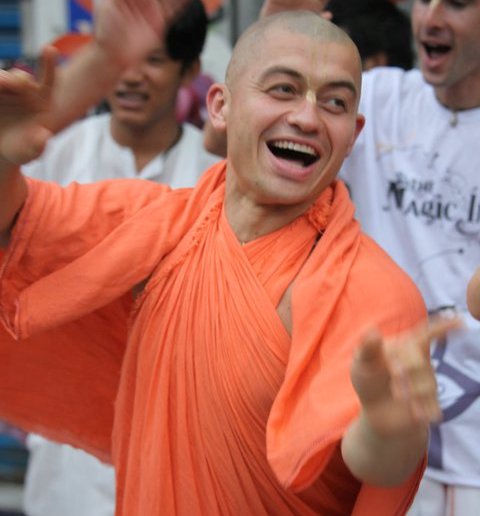
 
   ”All those who witnessed the disappearance festival of Hari Das Thakur, who danced or sang the Holy Names there, who came to throw sand on his samadhi or took Maha Prasad on this occasion, will quickly attain Krishna. This is the fruit of seeing a great personality like Hari Das Thakur. The Supreme Lord was so merciful that he gave Me his association, and now the independent Lord has wished to deprive Me of it. When Hari Das decided that he wanted to leave, there was nothing I could do to keep him back. He left his body at the very moment that he desired to do so, just as we have heard that Bhishma did. Hari Das was the exemplar of humanity in this world, and now that he is gone, the world has lost a jewel. All glories to Hari Das Thakur! Chant the Lord’s names!” And having finished his eulogy, the Lord began once again to dance.
   (Chaitanya Charitamrita 3.11.91-98)
 
   Hari Das Thakur’s tirodhana-lila took place on the fourteenth day of the waxing moon in the month of Bhadra.
 
   FOOTNOTES:
 
[1] The Arabic word haram (haram in Bengal) means anything which is impure according to the Islamic religion. For Bengali Muslims, it particularly refers to the pig or boar which is an untouchable animal in Islam.
 
[Excerpted from "Sri Chaitanya: His Life & Associates" by Shrila Bhakti Ballabh Tirtha Maharaj] Haridasa Thakura

Ishvara Puri – Biography

Disappearance Day of Shri Ishvara Puri

   Ishvara Puri was born in the town of Kumara Hatta on the full moon day of the month of Jyestha to a family of Brahmins hailing from Rarha. Kumara Hatta is in the 24 Paraganas district about two miles from the Halisahar train station. The town is also important for Gaudiya Vaishnavas because Shrivas Pandit and his brothers moved here after Mahaprabhu took sanyassa because they were unable to tolerate all the painful reminders of Him in Navadwip. Their home is not far from the place in the Mukhopadhyaya Para neighborhood where Ishvara Puri was born.
 
Ishvara Puri

Ishvara Puri's birthplace is popularly known by the name "Chaitanya Doba." The word doba means "a pool of water". When Chaitanya Mahaprabhu passed through Kuymara Hatta on His way to Puri, He showed respect for His spiritual master by picking up some earth from the place of his birth, wrapping it in His cloth and taking it with Him. Thousands of pilgrims have since followed His example, thus forming a pit that has since filled with water. (In the image: Chaitanya Doba-birthplace of Shrila Ishvara Puri).

   Ishvara Puri's birthplace is popularly known by the name "Chaitanya Doba." The word doba means "a pool of water". When Chaitanya Mahaprabhu passed through Kuymara Hatta on His way to Puri, He showed respect for His spiritual master by picking up some earth from the place of his birth, wrapping it in His cloth and taking it with Him. Thousands of pilgrims have since followed His example, thus forming a pit that has since filled with water.
 
The Mercy of the Spiritual Master
 
   Ishvara Puri is a sannyas name. Though his name prior to taking sannyas is unknown, we do know that his father's name was Shyamasundara Acharya. Ishvara Puri took initiation from Madhavendra Puri, the embodiment of nectarean devotional love. Madhavendra Puri was pleased with Ishvara Puri's guileless, sincere and affectionate service and thus showered him with blessings, so that he too became immersed in the ocean of love for Krishna. If a disciple can satisfy his spiritual master, then he will be fortunate and attain all auspiciousness and the fulfillment of all his desires. On the other hand, if the guru is unhappy with his disciple, then he will only know inauspiciousness.
 
Mahaprabhu Takes Initiation From Ishvara Puri
 
   Mahaprabhu is the Supreme Personality of Godhead and has no need of any teacher. Even so, He wishes to teach the world that it is absolutely necessary to take shelter of a bonafide spiritual master. For this reason, He played the role of a disciple by taking initiation from Ishvara Puri when He met him at Gaya. This in itself shows beyond a doubt Ishvara Puri's greatness and importance.
 
   Then the Lord went to Gaya where he met Ishvara Puri. After taking initiation from him, He started to display the signs of love of God, and when He returned to His homeland He began to engage in the pastimes of divine love.
   (Chaitanya Charitamrita 1.17.8-9)
 
Ishvara Puri

"My pilgrimage to Gaya is successful for today I have seen your lotus feet. When one makes the pinda (offerings to the ancestors at a holy place), then that ancestor is delivered. But simply by seeing you, ten million ancestors are delivered from all forms of bondage in a single moment. Therefore no holy place is your equal, and you are the primary source of auspiciousness for even the holy places. Please lift Me up from the ocean of material suffering: I offer this body up to your service. The only gift I ask of you is that you give Me the nectar of Krishna's lotus feet to drink." (In the wallpaper: Shrila Prabhupada, backside image is Gaya).

   When they met, Mahaprabhu and Ishvara Puri were overcome by the ecstasy of love and drenched each other in tears of prema that fell from their eyes. The Lord said, "My pilgrimage to Gaya is successful for today I have seen your lotus feet. When one makes the pinda (offerings to the ancestors at a holy place), then that ancestor is delivered. But simply by seeing you, ten million ancestors are delivered from all forms of bondage in a single moment. Therefore no holy place is your equal, and you are the primary source of auspiciousness for even the holy places. Please lift Me up from the ocean of material suffering: I offer this body up to your service. The only gift I ask of you is that you give Me the nectar of Krishna's lotus feet to drink."
   (Chaitanya Bhagavata 1.17.49-55)
 
   Mahaprabhu was acting the role of an ordinary mortal, a pilgrim who had come to Gaya to offer the shraddha oblations for His deceased father. On the day that He performed these rituals, He returned to His room and began to cook. When Ishava Puri came and placed his holy feet in Mahaprabhu's room, Mahaprabhu personally served him the rice and vegetables that He Himself had cooked with great satisfaction. In so doing, Mahaprabhu demonstrated most perfectly how to serve the guru.
 
Ishvara Puri in Navadwip
 
   Ishava Puri had met Mahaprabhu in Navadwip even prior to giving Him the ten-syllable mantra in Gaya. He also met with Advaita Acharya, who had similarly played the role of Madhavendra Puri's disciple. Vrindavan Das Thakur has described this meeting in the Chaitanya Bhagavata.
 
   Once, Ishava Puri passed through Navadwip when Nimai was still engaged in His pastimes as a student. He stayed there for a few months in the house of Gopinath Acharya as his guest. One day he saw Nimai and was most impressed and attracted by His bodily beauty. Nimai invited Ishava Puri to His house to eat and had His mother Sachi cook and serve him Krishna Prasad. Then He and Ishvara Puri began talking about Krishna.
 
   Ishava Puri also met Gadadhar Pandit and was pleased when he saw the depth of his renunciation. He started to affectionately give him lessons from Shri-Krishna-lilamrta, a book of his own composition. Nimai would also come daily to Gopinath Acharya's house to visit Ishava Puri while he was teaching Gadadhar and offer him His obeisances. One day, Ishvara Puripada asked Nimai to correct any mistakes that were in his book. Nimai answered:
 
   "Anyone who finds any fault with a Devotee's description of Krishna is a sinner. If a Devotee writes a poem, no matter how poorly he does it, it will certainly contain his love for Krishna. A fool says 'visnaya' while a scholar knows the correct form is 'visnave', but Krishna accepts the sentiment in either case. If anyone sees a fault in this, the fault is his, for Krishna is pleased with anything the pure Devotee says. You too describe the Lord with words of love, so what arrogant person would dare criticize anything that you have written?"
   (Chaitanya Bhagavata 1.11.105-110)
 
   The same incident is described in the Bhakti-ratnakara in the following way:
 
   Look here, this is the house of Gopinath Acharya where Vishvambhara would visit from time to time. Ishava Puri stayed here for a while and composed his book Shri Krishna-lilamrta. He had great affection for Gadadhara Pandit and when he saw the symptoms of love for Krishna in him, he taught him that book.
   (Bhakti-ratnakara 12.2205-07)
 
   When Nityananda Prabhu as traveling in the west of India, he incidentally met Madhavendra Puri there. When the two met, they fainted. Nityananda was overcome by love and started to describe Madhavendra Puri's glories while Madhavendra Puri himself embraced Nityananda and wet him with his tears. Ishvara Puripada understood that Nityananda was extremely dear to his spiritual master and so, like his guru's other disciples, held him in great affection and felt a deep love for him.
 
   All glories to Madhava Puri, the ocean of love for Krishna! He was the first shoot of the desire tree of devotion. That first shoot was nourished and grew in the form of Ishvara Puri and from him the thick trunk of Chaitanya lila took shape.
   (Chaitanya Charitamrita 1.9.10-11)
 
   Before he left this world, Ishvara Puri sent two of his disciples, Kashishvara and Govinda, to serve Mahaprabhu. Even though they were His godbrothers, Mahaprabhu still obeyed the order of His spiritual master and accepted them as His servants. 
Ishvara Puri

If a disciple can satisfy his spiritual master, then he will be fortunate and attain all auspiciousness and the fulfillment of all his desires. On the other hand, if the guru is unhappy with his disciple, then he will only know inauspiciousness. (In the wallpaper: Shrila Prabhupada and his disciples).