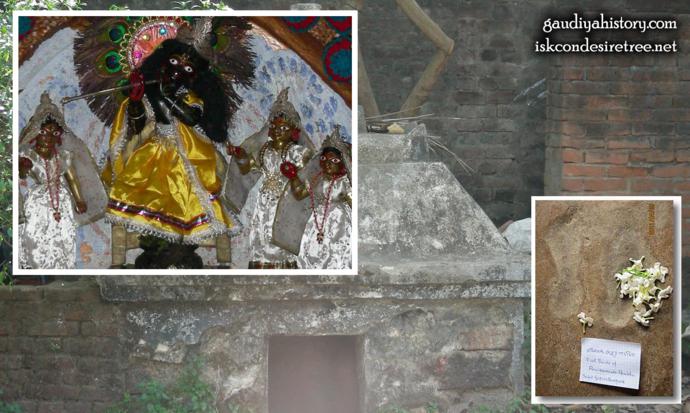
Category Archives: More About Gaudiya Saints

Narottama dasa Thakura – Biography

Narottama Dasa Thakura

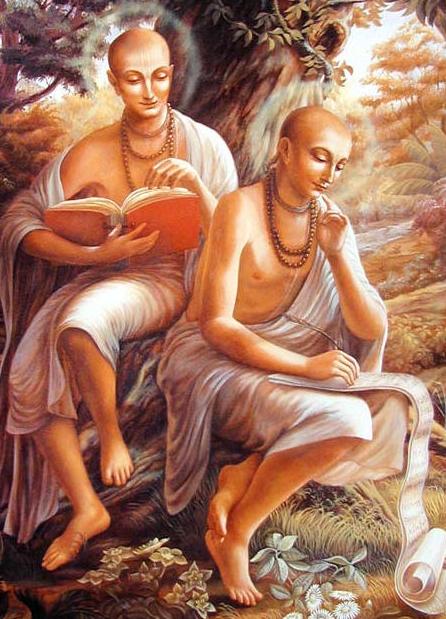
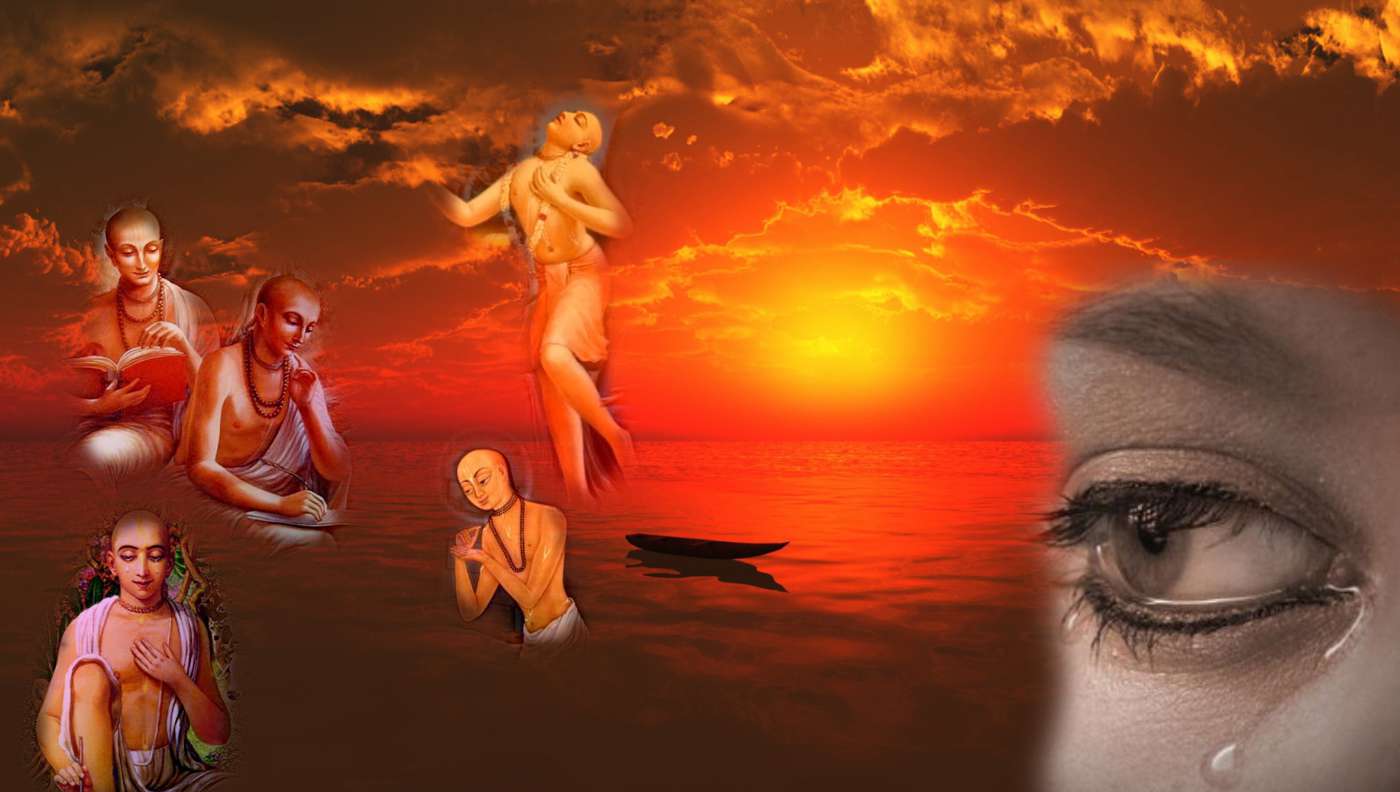
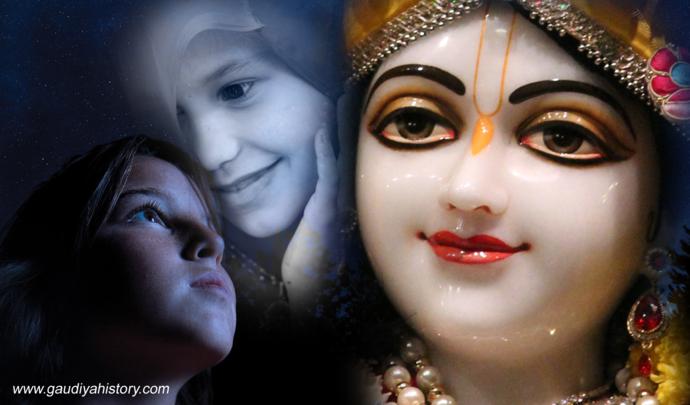
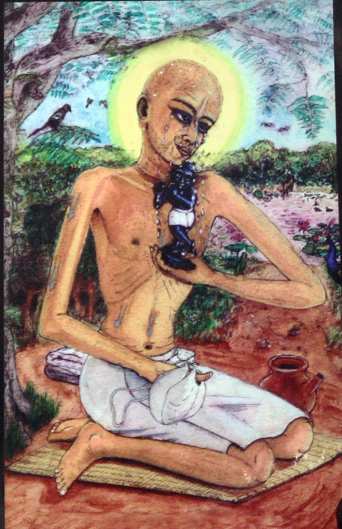
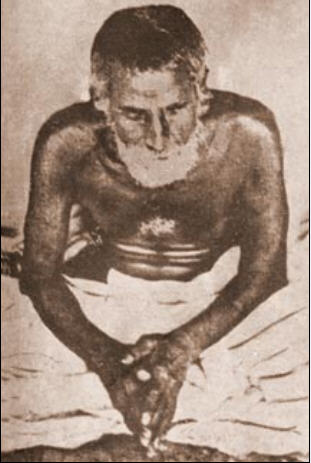
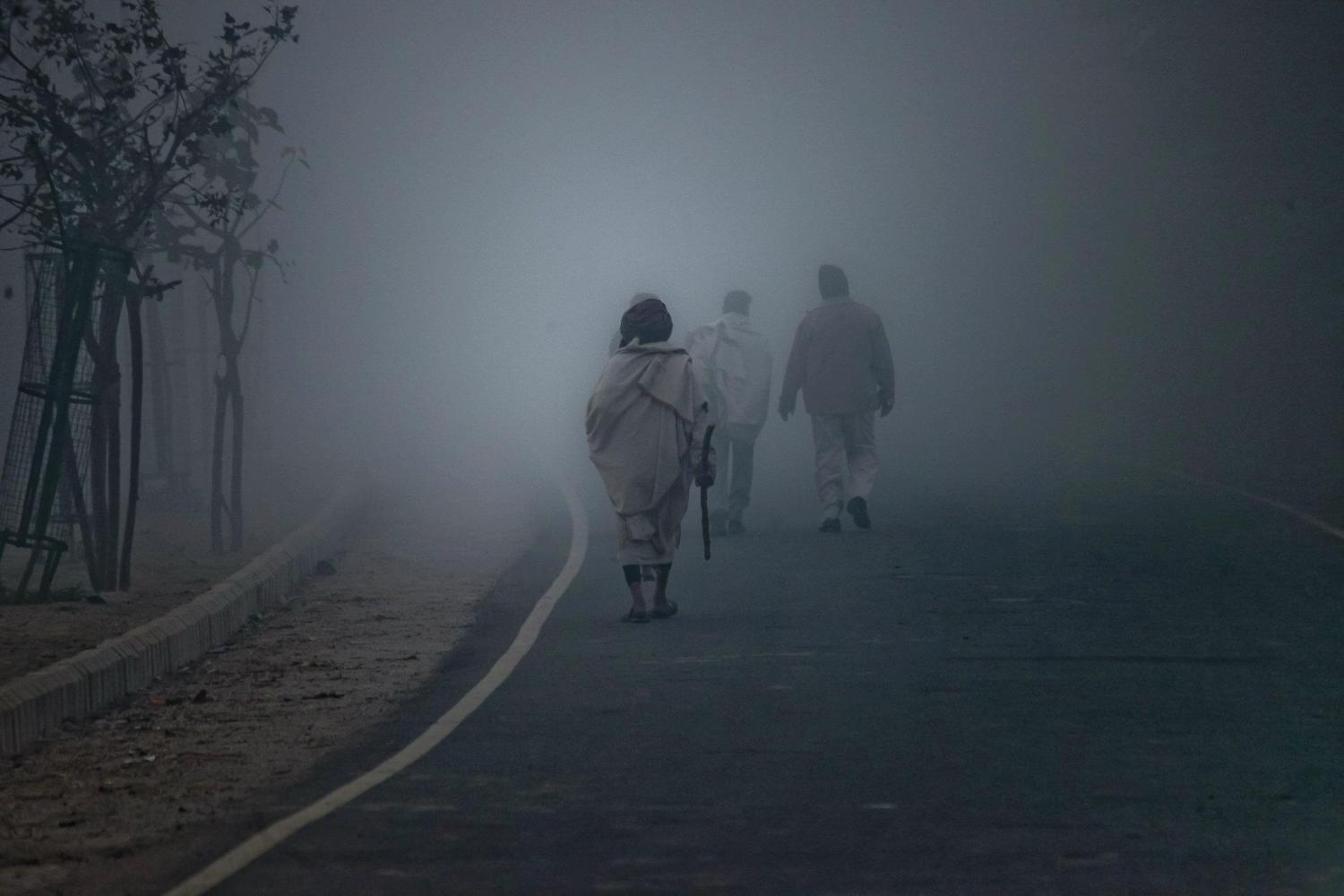
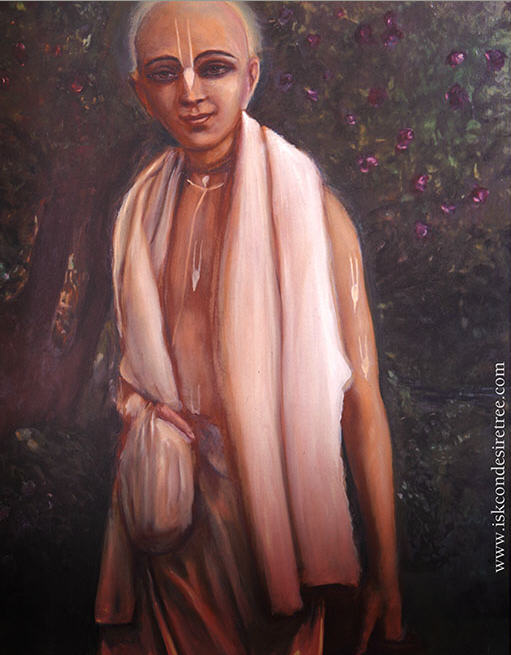
From his early childhood, Narottama began to display symptoms of his future greatness. Everyone was amazed to see his great intelligence and his devotional demeanor. (In the image: Shrila Narottana Dasa Thakura).

   akumara-brahmacari sarva-tirtha-darshi
parama-bhagavatottamah shrila-narottama-dasa
 
   A brahmachari for his entire life, Narottama Das visited all the places of pilgrimage. He was on the highest platform of devotional achievement. (Bhakti-ratnakara 1.256)
 
   Narottama Thakur was Champaka Manjari in Krishna-lila. Eternally assisting Rupa Manjari in her service to Radha and Krishna, Champaka Manjari had mercy on the conditioned souls of this earth and appeared as Narottama in the village of Kheturi, about twelve miles from Rampur Bowaliya in the Gopalpur subdivision of Rajshahi district. This took place on the full moon day of the month of Magh sometime around the middle of the 15th century of the Shaka era.
 
   Narottama was born on the Maghi Purnima. From that day on he thrived and grew like the waxing moon. (Bhakti-ratnakara 1.281)
 
   Narottama’s father was Raja Krishnananda Datta, the zamindar of the Gopalpur area. His mother’s name was Narayani Devi. Raja Krishnananda had a younger brother named Purushottam Datta, who had a son named Santosha. In order to show that His associates can take birth in any caste, Krishna had Narottama take birth in a kayastha family.
 
   From his early childhood, Narottama began to display symptoms of his future greatness. Everyone was amazed to see his great intelligence and his devotional demeanor. He was constantly absorbed in meditation on the wonderful qualities of Shri Chaitanya Mahaprabhu and Nityananda Prabhu. The Lord and His associates appeared to him in his dreams.
 
   As tears poured from his eyes, Narottama would offer prayers of surrender to Shri Krishna Chaitanya, Nityananda, Advaita and the other associates of the Lord. Finally, the Lord and His associates appeared to him in a dream and consoled him with kind words. (Bhakti-ratnakara 1.285-6)
 
Mahaprabhu Leaves Prema Behind for Narottama
 
   According to the Premavilasa, when Mahaprabhu passed through Kanair Natashala, as He was dancing ecstatically in kirtan, He began to call out the name Narottama. When Nityananda asked Him why He was calling out this name, Mahaprabhu answered, “My Lord. You do not know your own glories. When we went to Jagannath Puri, you shed tears out of divine love, day after day. I managed to capture your divine love and save it. Now I wish to keep it here by the Padmavati River for Narottama Das.” 
Narottama Dasa Thakura

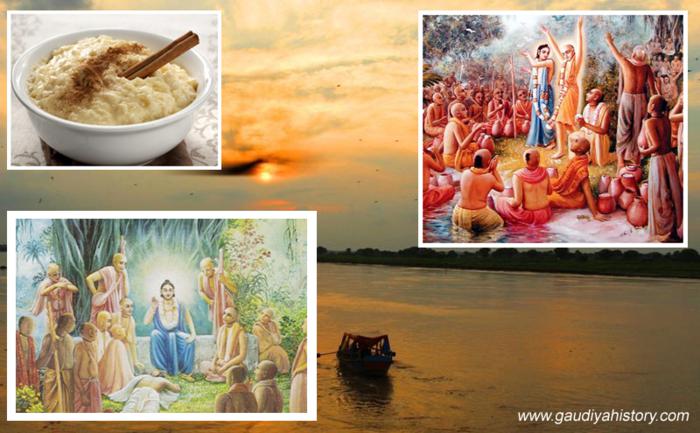
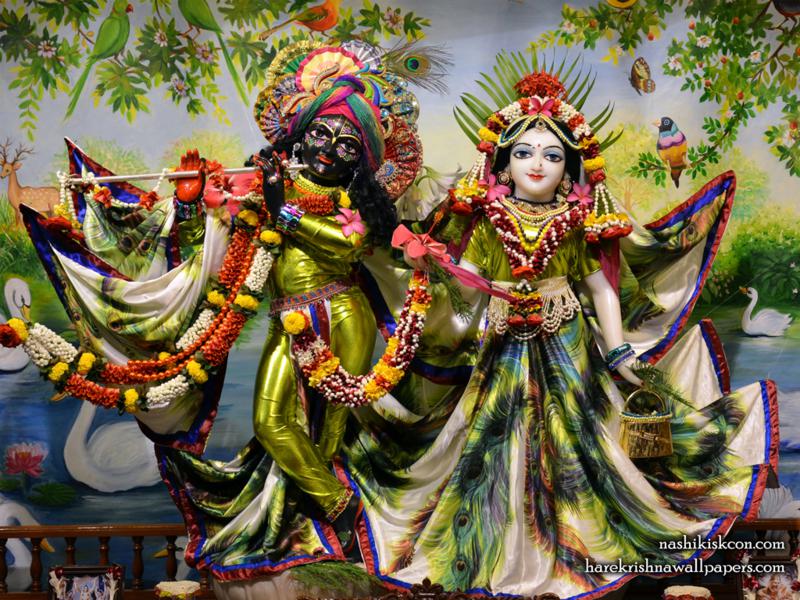
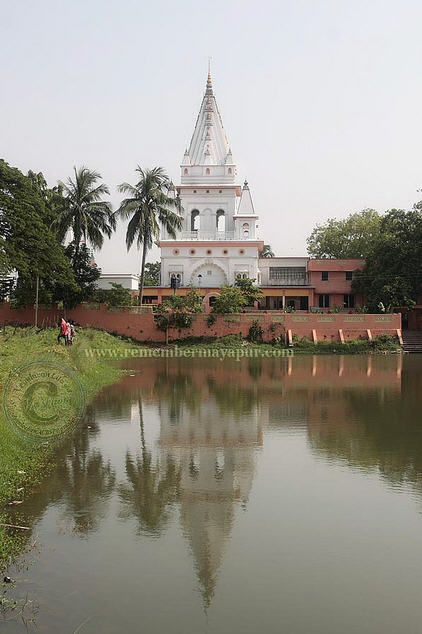
“O Padmavati! Take my love and keep it here. When Narottama comes and bathes here, give it to him.” (In the wallpaper: The Padmavati River, Lord Shri Chaitanya Mahaprabhu).

 
   Mahaprabhu then went on to the Padmavati River to the place known as Kutubpur, where He bathed and sang and danced in ecstasy. He then called out to the river, “O Padmavati! Take my love and keep it here. When Narottama comes and bathes here, give it to him.”
 
   The Padmavati inquired, “How will I recognize him?”
 
   Mahaprabhu answered, “You will know it is Narottama, for when he enters your waters, you will overflow.”
 
   The place where Mahaprabhu placed prema for Narottama’s sake was later given the name Prematali. When Narottama was twelve years old, he had a dream in which Nityananda Prabhu told him to bathe in the Padmavati and take the prema which had been stored there for him. He went the next day to the Padma and as soon as he put his foot in the water, the river started to overflow. The Padmavati then remembered Mahaprabhu’s words and gave Narottama the prema which she had been safeguarding for him.
 
Narottama Leaves Home
 
   As soon as he experienced the ecstasies of prema, Narottama’s character, his appearance, everything about him changed. His parents noticed the transformation and did everything they could to bring him back to his normal state, but failed. Having drunk the wine of divine ecstasy, Narottama had become intoxicated and the bonds of family life could no longer hold him back. 
Narottama Dasa Thakura

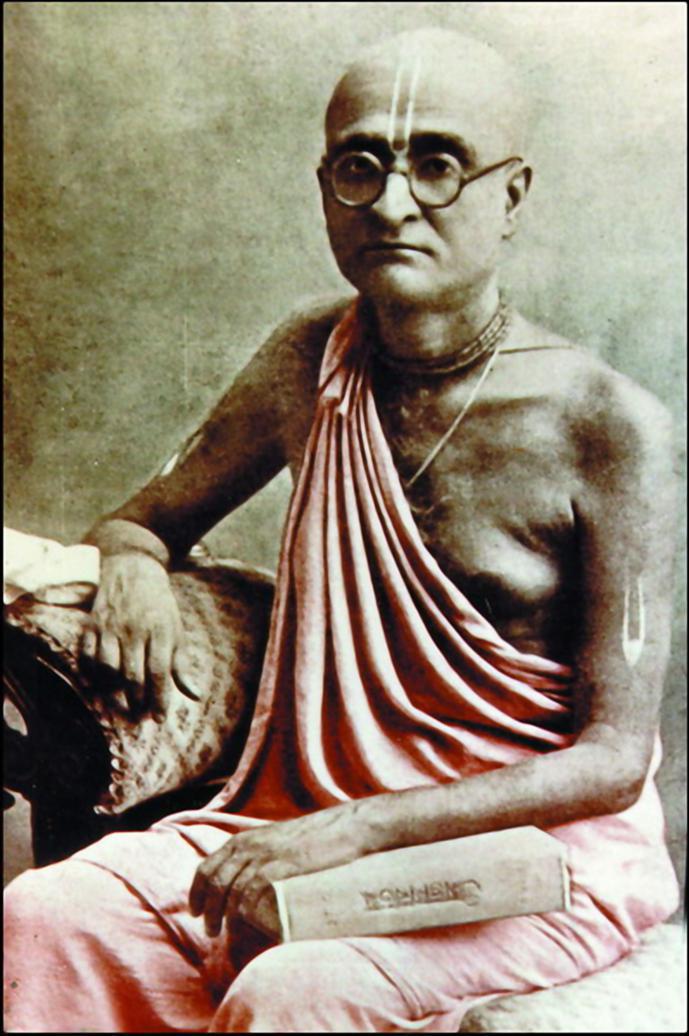
After saying this, the Brahmin vanished and the exhausted Narottama finally fell asleep. That night, he dreamt of Rupa and Sanatan Goswami. The two Goswamis placed their hands on his chest and fed him the milk that Mahaprabhu Himself had brought him. All of Narottama’s fatigue disappeared. (In the image: Rupa and Sanatana Goswamis).

 
   Narottama began to wonder how he could escape from his material entanglements. Finally, one day when his father and uncle were away on official business, he practiced some deception on his mother and tricked his bodyguards so that he could leave his family for Vrindavan. It was the full-moon day of Karttik when this event took place.
 
   According to others, Narottama waited to go to Vrindavan until after the death of his father when his cousin Santosha was given the responsibility for the zamindari. Even though he was the son of a rich zamindar, in his desire to unite with the Lord, he was ready to abandon the pleasures of the body in a moment. Day and night, he cried, walking barefoot, forgetting to eat and to drink until finally he would fall unconscious under a tree. One golden-skinned Brahmin came and offered him a cup of milk and said to him in a sweet voice, “O Narottama, drink this milk. Your cuts and bruises will go away. Take it easy.”
 
   After saying this, the Brahmin vanished and the exhausted Narottama finally fell asleep. That night, he dreamt of Rupa and Sanatan Goswami. The two Goswamis placed their hands on his chest and fed him the milk that Mahaprabhu Himself had brought him. All of Narottama’s fatigue disappeared.
 
Narottama is Initiated by Lokanatha Goswami
 
   The Prema-vilasa also describes how Narottama took initiation from Lokanatha Goswami. Narottama was born on Maghi purnima, his renunciation took place on the Karttik purnima, and he was initiated by Lokanatha on the Shravan purnima.
 
   Lokanatha Goswami is considered to be a personal associate of Shri Chaitanya Mahaprabhu. Indeed, he was the first Gaudiya Vaishnava to be instructed by the Lord to go to Vrindavan, along with Bhugarbha Goswami. Lokanatha set the standard for worship in a spirit of renunciation while in the dham. He was a viviktanandi Vaishnava, i.e., he took pleasure in worshiping the Lord in solitude. In this spirit, he had vowed not to take any disciples. Narottama Das too made a vow — to take initiation from no one other than Lokanatha. Though he was the son of a raja, Narottama’s desire to receive Lokanatha’s mercy was so great that he went in the middle of every night to clean the place he used as a toilet. He would also leave fine earth and water for him to clean himself afterward. This is described as follows in the Prema-vilasa:
 
   He went to the place where the Goswami performed his bodily functions and did a special job of cleaning it. He sifted the earth to make fine, clean earth with which Lokanatha could clean his hands. He did this as a regular service. He would hide the broom of coconut leaves in the earth and each night take them out to sweep the place, his heart filled with joy. He considered himself fortunate and his body worthwhile. He would hold the broom to his chest, repeating, “This is the power that will help me attain my Lord’s lotus feet.” As he said these words, he cried and torrents of tears washed over his chest. 
Narottama Dasa Thakura

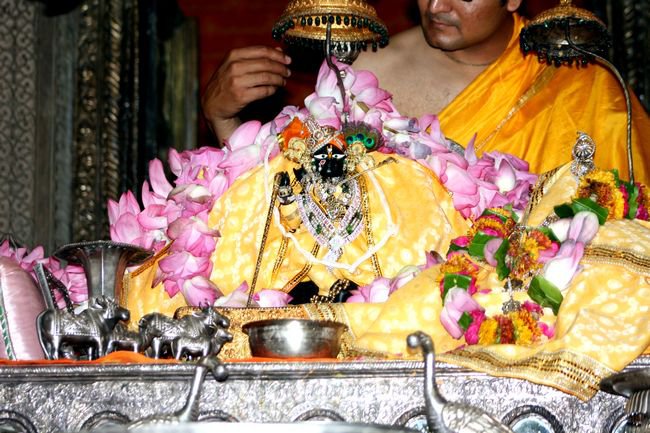
He went to the place where the Goswami performed his bodily functions and did a special job of cleaning it. He sifted the earth to make fine, clean earth with which Lokanatha could clean his hands. He did this as a regular service. He would hide the broom of coconut leaves in the earth and each night take them out to sweep the place, his heart filled with joy. He considered himself fortunate and his body worthwhile. He would hold the broom to his chest, repeating, “This is the power that will help me attain my Lord’s lotus feet.” As he said these words, he cried and torrents of tears washed over his chest. (In the wallpaper: A statue).

 
   Lokanatha was astonished to see that the place was daily being kept clean. He became curious to find out who it was and so, one evening, he went and hid in the jungle, chanting japa the entire night in wait for the anonymous benefactor. At midnight, he saw someone engaged in cleaning the place and asked him who he was. When he found out that Narottama, the son of a raja, was doing such a filthy task, he felt embarrassed and told him to desist. Narottama, however, immediately fell at Lokanatha’s feet began to cry. When Lokanatha saw Narottama’s humility and pain, his resolve softened and gave him initiation. Thus Narottama gave an outstanding example to the world of how one should behave in the service of one’s spiritual master.
 
   At that moment, Narottama went there and with great enthusiasm, engaged in the necessary service to his guru. Lokanatha was pleased with his service and initiated him in the mantra, demonstrating the greatest mercy on Narottama. (Bhakti-ratnakara 1.345-6)
 
   Without caring for his youth or his physical beauty, he left home on the full moon day of the month of Karttik. After wandering through many pilgrimage places, he finally came to Vrindavan where he became Lokanatha Goswami’s disciple. On the auspicious day of Shravani purnima, Lokanatha initiated Narottama.
 
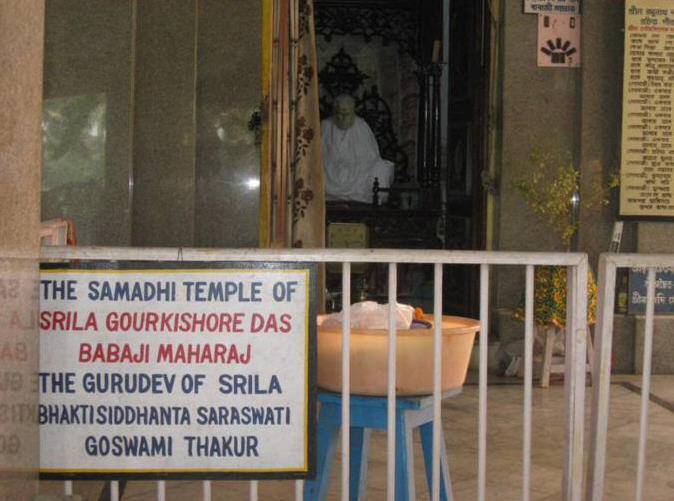
   Thus Narottama Das was Lokanatha’s one and only disciple. The founder of the world-wide Gaudiya Maths and the flagship monastery in Mayapur, the Chaitanya Math, Srila Bhaktisiddhanta Saraswati Goswami Thakur, similarly demonstrated a determination and patience in service to his spiritual master in order to convince him to accept him as a disciple. Gaura Kishora Das Babaji, like Lokanatha, had vowed to take no disciples. He refused Shrila Prabhupada three times, but this did not break Prabhupada’s will. When Gaura Kishora saw his humility and intense desire, he finally relented and gave him mantra diksha. Shrila Prabhupada was Gaura Kishora Das’s only disciple.
 
   After the disappearance of Rupa and Sanatan Goswamis, Shri Jiva Goswami became the undisputed intellectual leader of all Gaudiya Vaishnavas throughout Mathura, Bengal and Orissa and the chief-minister of the universal court of Vaishnavas at Vrindavan — the Vishva-vaishnava-raja-sabha. Shrinivas Acharya, Narottama Das, and Duhkhi Krishna Das all studied the scriptures under Jiva, receiving detailed personal instruction from him. When their studies were completed, Jiva gave them the titles of Acharya, Thakur and Shyamananda, respectively.
 
Narottama Returns to Bengal
 
   After their studies were complete, Jiva sent his three students to Bengal with the Vaishnava scriptures. Shri Jiva heard the news that the books had been stolen in Bana Vishnupura and then later that they had been recovered. This story has been told in this book on pages 165 to 166 in the chapter on Shrinivas.
 
   Lokanatha Goswami considered Narottama’s previous life as a wealthy zamindar to be particularly suitable for preaching in his home area of northern Bengal and thought that with his status he would be able to teach the standards of renounced devotional behavior. Out of compassion for that country’s people, he ordererd Narottama to return to his home town of Kheturi. Shrinivas was aware of Lokanatha’s intention, so when the books were stolen, he told Narottama to continue on his way to Kheturi. Shrinivas Acharya said, “Go quickly to Kheturi and carry out Lokanatha’s orders.” (Bhakti-ratnakara 7.119)
 
   Anchorite Devotees (viviktanandis), being absorbed in the intimate service of the Lord on the transcendental platform, normally have no taste for engaging in any welfare activity which brings only temporary succor to materialistic persons, bound by Maya and absorbed in their bodily identification. Materialistic welfare activities are considered to be of great value only when there is a misunderstanding about the real goal of life–service to Krishna. Lokanatha taught the world through his disciple, on the principle that  “a housewife teaches the daughter-in-law by instructing the daughter.” Though Narottama himself was distraught with separation from his spiritual master, he nevertheless took his order seriously and returned to Kheturi where he began preaching the doctrines of pure devotional service to the people of northern Bengal. Narottama revealed his emotional state somewhat in his Prarthana, 
Narottama Dasa Thakura

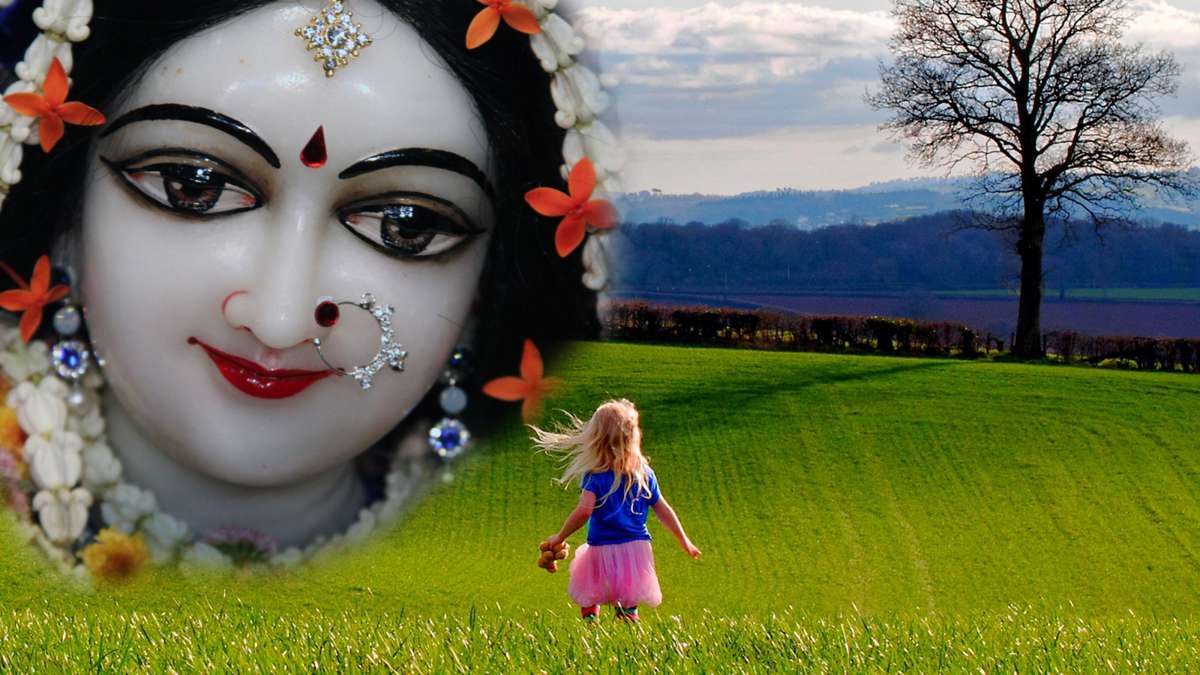
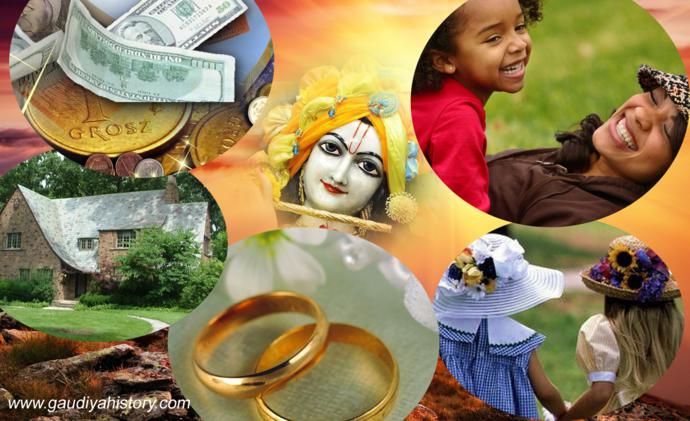
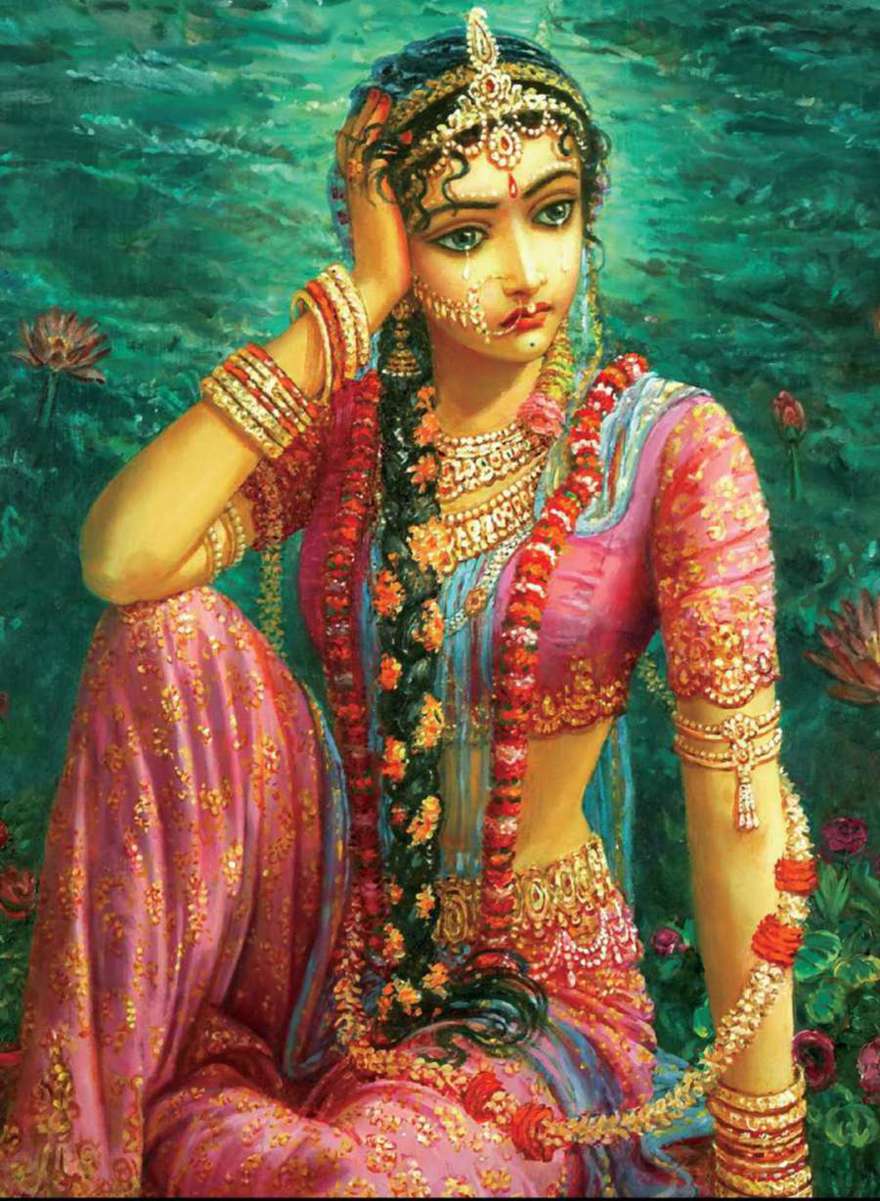
If you would only be merciful to me and grab me by the hair, pulling me back into Vraja-dham. Then everything will seem right once more, otherwise, Narottama says, his life is over. (In the wallpaper: Shrimati Radharani, ISKCON Chowpatty, Mumbai).

 
aneka duhkhera pare, layechile vraja-pure
kripa-dora galaya bandhiya
daiva-maya balatkare, khasaiya sei dore
bhavakupe dileka dariya
punah yadi kripa kari, e janare keshe dhari
taniya tulaha vraja-dhame
tabe se dekhiye bhala, natuba parana gela
kahe dina dasa narottame
 
   After a great deal of suffering, you finally dragged me to Vraja-dham, tying the rope of mercy around my neck. But now, the forces of fate and illusion have loosened that rope and thrown me back down the well of material existence.
 
   If you would only be merciful to me and grab me by the hair, pulling me back into Vraja-dham. Then everything will seem right once more, otherwise, Narottama says, his life is over.
 
   On Lokanatha Goswami’s orders, Narottama installed six sets of Deities in his Temple in Kheturi: Gauranga, Vallabhikanta, Vrajamohana, Shri Krishna, Radhakanta, and Radharamana. The great festival which he held on that occasion is still remembered in the Vaishnava world.
 
   Narottama arrived in Gauda-desha. He had been ordered by Lokanatha to establish the Deity service of both Gauranga and Krishna, to serve the Vaishnavas and to preach the congregational chanting of the Holy Names. He immediately dedicated himself to carrying out these orders. First he set about establishing the service of six sets of beautiful Deities, whose names, taken together, bring joy to the heart of the Devotees:
 
gauranga vallabhi-kanta shri-krishna vraja-mohana
radha-ramana he radhe radha-kanta namo’stu te
(Bhakti-ratnakara 1.422-6)
 
The Great Festival at Kheturi
 
   Prior to the Kheturi-mahotsava, Narottama Das Thakur traveled throughout Bengal and Orissa, visiting various places where Mahaprabhu had performed His pastimes, meeting the Lord’s associates and receiving their blessings. Amongst the places he visited were Uddharan Datta’s home in Saptagram; Khardaha, where he met Parameshvari Das, and Nityananda’s shaktis, Jahnava and Vasudha; Khanakula Krishnanagara, the home of Abhiram Thakur; Shyamananda’s home in Nrisinghapura; the Shripatas of Narahari and Raghunandan in Shrikhanda; and the birthplace of Nityananda Prabhu in Ekachakra-dham; Gopinath Acharya’s home, Hari Das Thakur’s samadhi tomb, Gadadhara Pandit’s place of worship, the Jagannath Temple and Gundicha, the Jagannath-vallabha gardens, Narendra-sarovara, etc. in Jagannath Puri.
 
   Most of the living associates of Mahaprabhu and other leaders of the sampradaya came to Kheturi on the occasion of the festival organized by Narottama Das. A list of these has been given by Narahari Chakravarti in his books, Bhakti-ratnakara and Narottama-vilasa: Shyamananda Prabhu, Jahnava Devi, Parameshvari Das, Krishna Das Sarkhela (Jahnava’s uncle), Madhava Acharya (Nityananda’s son-in-law), Raghupati Vaidya, Minaketan Rama Das, Murari Chaitanya Das, Jnana Das, Mahidhara, Shri Shankara, Kamalakara Pippalai, Gauranga Das, Nakarii, Krishna Das, Damodar, Balaram Das, Shri Mukunda, Vrindavan Das Thakur; Raghunandan Thakur and other Devotees from Shrikhanda; Shripati and Shrinidhi (Shrivasa’s brothers) came from Navadwip; Advaita’s sons, Achyutananda, Gopal Mishra and Krishna Mishra came from Shantipur; Hriday Chaitanya and other Devotees from Ambika Kalna, etc.
 
   Shrinivas Acharya acted as the officiating priest at the festival and performed the rituals installing the Deities. In the kirtan led by Narottama which followed, Mahaprabhu and His associates themselves appeared.
 
   Who can describe the joy of that kirtan? Mahaprabhu Himself and His associates all became incarnate just like lightning in a conglomeration of rainclouds. (Bhakti-ratnakara 10.571-2)
 
   The kirtan was amazing: you could see Nityananda Prabhu and Advaita Acharya overcome with ecstasy and Gauranga, encircled by the Devotees. What wonderful compassion the Lord displayed on that day! Who can understand these wonderful pastimes? What blessings He poured on Narottama and Shrinivas, for they and their companions found the fulfillment of all their desires. (Bhakti-ratnakara 10.605-7)
 
   After the Kheturi festival, Narottama’s fame spread throughout the Vaishnava world. Prominent Brahmins like Ramakrishna Acharya and Ganga-Narayan Chakravarti became his disciples.
 
Narottama’s Preaching Adventures
 
Narottama Dasa Thakura

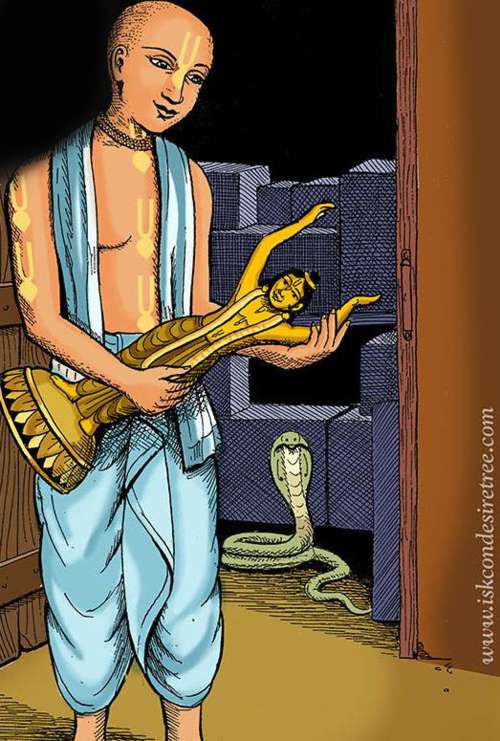
In Gopalpura village, there was a Brahmin named Vipra Das. He had a poisonous snake living in his wicker grain-storage bin (gola). When Narottama visited Vipra Das’s house, the snake vanished, and in its place appeared Deities of Gaura and Vishnupriya. Gaurasundara and His beloved Vishnupriya came out of the gola and climbed into Narottama’s lap in plain view of everyone. (Bhakti-ratnakara 10.202) (In the image: Shrila Narottam Das Thakur).

   Narahari Chakravarti has described Narottama’s activities extensively in his Narottama-vilasa. One can understand his outstanding feats by reading this book.
 
   In Gopalpura village, there was a Brahmin named Vipra Das. He had a poisonous snake living in his wicker grain-storage bin (gola). When Narottama visited Vipra Das’s house, the snake vanished, and in its place appeared Deities of Gaura and Vishnupriya.
 
   Gaurasundara and His beloved Vishnupriya came out of the gola and climbed into Narottama’s lap in plain view of everyone. (Bhakti-ratnakara 10.202)
 
   Everyone was quite amazed. These same Deities are today being served in Gambhila.
 
   A certain smarta Brahmin scholar blasphemed Narottama, calling him a shudra. As a result he was attacked by leprosy. He later had a vision of the Goddess in a dream. He went and fell at Narottama Das’s feet and begged him for forgiveness, as she had told him to, and was thus freed from the terrible disease.
 
   Harirama and Ramakrishna, the sons of Shivananda Acharya, were taking a goat and a buffalo to be offered as a sacrifice to the Goddess on the order of their father. They met Narottama and Ramachandra Kaviraj on the way and were attracted by their effulgent beauty. Narottama Thakur advised the two young Brahmins to abandon worship in the modes of passion and ignorance which entailed violence to animals and to worship the Supreme Lord without any desire. The brothers immediately let the goat and buffalo go and bathed in the Padma. They then took initiation from Narottama and dedicated their lives to the service of Lord Krishna and His Devotees.
 
   When Shivananda Acharya heard about this, he became angry and called a Smarta scholar from Mithila named Murari to come and defeat Narottama’s Vaishnava philosophy. However, Harirama and Ramakrishna were given divine blessings by their guru and were able to defeat every one of the Smarta’s arguments with scriptural evidence. Defeated, Shivananda Acharya went to pray to the Goddess. She appeared to him that night in a dream and rebuked him for his enmity to the Vaishnavas and told him to cease all such behavior.
 
   In the course of time, Ganga Narayan Chakravarti, Jagannath Acharya and other well-known Brahmins started to become Narottama’s disciples. This caused a stir in the Smarta community and they went to complain to Raja Narasimha: “Narottama is a shudra who makes disciples of Brahmins. He is using some kind of mystic powers or hypnotism to convert them. He should be stopped.”
 
   After discussions with Raja Narasimha, it was decided that a scholar named Rupa Narayan should be summoned to debate Narottama. This Brahmin had won numerous debates of this sort and was known as a digvijayi. The Raja himself set off with Rupa Narayan and a number of other Brahmins toward Kheturi.
 
   Ramachandra Kaviraj and Ganga Narayan Chakravarti were upset to see the wicked intentions of the Raja and his pandita. When they heard that the Raja and his entourage were resting overnight in Kumarapura village, they went in disguise as a potter and a pan-seller and set up stalls in the village market. When the Brahmins came through the market, Ramachandra and Ganga Narayan spoke with them in Sanskrit. The Brahmins were astounded that even ordinary stall-keepers in the village were able to speak in Sanskrit. Ramachandra and Ganga Narayan began a debate with the Brahmins, defeating every Smarta argument that they put forward and establishing the pure doctrine of devotional service.
 
   The Raja and his Digvijayi Pandit were rendered speechless by the scholarship of the two ordinary stall-keepers. When they learned that the two men were disciples of Narottama Das, the Raja said to his pandita, “If Narottama’s ordinary disciples can defeat you in debate, there is no need of going to see him.” But once again, the Goddess appeared to Narasimha and Rupa Narayan and ordered them to go to Narottama and pray for forgiveness for their offenses. The two of them did so and became Devotees of Radha and Krishna.
 
Two Songs by Narottama
 
   In the Gaudiya Vaishnava Abhidhana, the following comments are found: “Narottama’s ashrama was in a place called Bhajanatuli, about two miles from his capital city, Kheturi. Narottama did his preaching through kirtan. He created the style of kirtan known as Garanahati. He wrote two books, Prarthana and Prema-bhakti-chandrika, which are like the very life of the Devotees. He has written songs which are appropriate for every devotional mood, and this is what touches the Devotees’ hearts. These two books are so popular that they have been published countless times. Narottama’s influence can be appreciated even in distant Manipura. Everyone agrees that the Vaishnava religion spread through Manipura through Narottama’s potency. His devotional songs are sung in every home throughout Manipura state.
 
   Shrinivas Acharya’s disciple Ramachandra Kaviraj was Narottama’s dearest companion. Narottama received news of Ramachandra’s disappearance first; not long afterward he heard of Shrinivas’s disappearance, he wrote the following song in the mood of separation which is capable of melting even a stone-like heart.
 
je anila prema-dhana karuna pracura
hena prabhu kotha gela acarya thakura
kahan mora Svarupa rupa, kahan sanatana?
kahan dasa raghunatha patita-pavana?
kahan mora bhatta-yuga, kahan kaviraja?
eka-kale kotha gela gora nataraja?
pashane kutiba matha anale pashiba
gauranga gunera nidhi kotha gele paba
se saba sangira sange je kaila vilasa
se sanga na païa kande narottama-dasa
 
Narottama Dasa Thakura

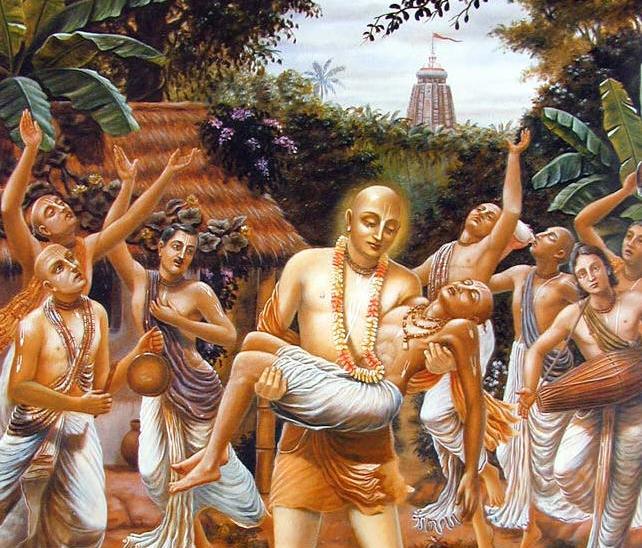
Where has Acharya Thakur gone, he who out of great mercy brought the wealth of love as a gift to the world. Where are my Svarupa and Rupa, where is Sanatan? Where has Raghunath Das, the deliverer of the most fallen, gone? Where are Raghunath Bhatta and Gopal Bhatta? Where is Krishnadas Kaviraj? Where has the king of the dance, Gauranga, suddenly disappeared to? I will beat my head against the rocks or enter the flames--but where can I go to find that ocean of virtue, Gauranga? Narottama Das is crying because he is deprived of the association of all those companions of the Lord. (In the wallpaper: Lord Chaitanya and His associates).

   Where has Acharya Thakur gone, he who out of great mercy brought the wealth of love as a gift to the world. Where are my Svarupa and Rupa, where is Sanatan? Where has Raghunath Das, the deliverer of the most fallen, gone? Where are Raghunath Bhatta and Gopal Bhatta? Where is Krishnadas Kaviraj? Where has the king of the dance, Gauranga, suddenly disappeared to? I will beat my head against the rocks or enter the flames–but where can I go to find that ocean of virtue, Gauranga? Narottama Das is crying because he is deprived of the association of all those companions of the Lord.
 
   Narottama Das Thakur was the topmost of the followers of Rupa Goswami, Mahaprabhu’s close associate. His devotion to Rupa Goswami can be recognized from the following song:
 
shri rupa manjari pada sei mora sampada
sei mora bhajana pujana
sei mora prana-dhana sei more abharana
sei mora jivanera jivana
 
sei mora rasa-nidhi sei mora vancha-siddhi
sei mora vedera dharama
sei vrata, sei tapa sei mora mantra japa
sei mora dharama karama
 
anukula habe vidhi se pade haibe siddhi
nirakhiba ei dui nayane
se rupa madhuri-rashi prana-kuvalaya-shashi
praphullita habe nishi-dine
 
adarsha /strongnbsp; na ahi garale jarala dehi
cira-dina tapita jivana
ha ha prabhu kara daya deha morekahan mora bhatta-yuga,
kahan kavira ja pada-chaya
narottama laila sharana
 
   Rupa Manjari’s feet are my wealth; they are my worship, they are my ritual. They are what keep me alive, they are my ornament, they are the life of my life.
 
   They are my ocean of nectar, they are the perfection of my desire, they are my Vedic religion. They are my vow, they are my austerity, they are the mantra that I chant on my beads. They are my religious duty.
 
   Fate will be kind to me, and I will find my perfection by attaining her feet and will be able to see with my own eyes the beauty of Radha and Krishna’s form, the moon of the lily of my life. 
 
   The snake of your absence has burned up my body with its poison; I have suffered this pain for so long. O my lord, be merciful to me, give me the shade of your feet. Narottama has taken shelter.
 
Narottamashtaka by Vishvanath Chakravarti
 
shri-krishna-namamrita-varshi-vaktra-
candra-pr abha-dhvasta-tamo-bharaya
gauranga-devanucaraya tasmai
namo namah shrila-narottamaya
 
   I offer my repeated obeisances to Shrila Narottama Das Thakur, who destroys the darkness of ignorance with the nectarean rays of Krishna’s Holy Name which emanate from his moon-like face; to him who is the glorious follower of the divine Gauranga.
 
sankirtananandaja-manda-hasya-
danta-dyuti-dyotita-din-mukhaya
svedashru-dhara-snapitaya tasmai
namo namah shrila-narottamaya
 
   I offer my repeated obeisances to Shrila Narottama Das Thakur, who lights up every direction with the effulgence of his teeth, revealed as he laughs out of the joy of Harinama-sankirtan; to him who is bathed in torrents of tears and perspiration.
 
mridanga-nada-shruti-matra-caicat-
padambujamanda-manoharaya
sadyah samudyat-pulakaya tasmai
namo namah shrila-narottamaya
 
Narottama Dasa Thakura 12

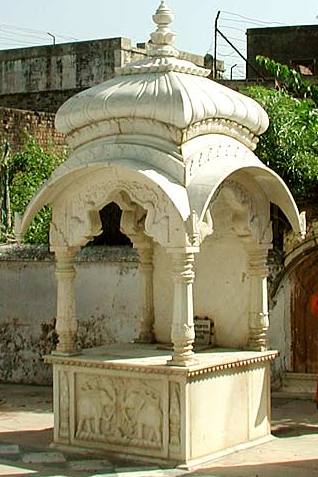
I offer my repeated obeisances to Shrila Narottama Das Thakur, who lights up every direction with the effulgence of his teeth, revealed as he laughs out of the joy of Harinama-sankirtan; to him who is bathed in torrents of tears and perspiration. (In the image: Samadhi of Shrila Narottama Das Thakura, court yard if Shri Shri Radha Gokulananda Temple, Shri Vrindavan Dham).

   I offer my repeated obeisances to Srila Narottama Das Thakur, whose lotus feet dance enchantingly, being set into motion as soon as he hears the sound of the mridanga; whose body is covered with horripilation.
 
gandharva-garva-kshapana-svalasya-
vismapitashesha-kriti-vrajaya
sva-srishta-gana-prathitaya tasmai
namo namah shrila-narottamaya
 
   I offer my repeated obeisances to Shrila Narottama Das Thakur, whose dance and song, indeed, every action in kirtan brings shame to the Gandharvas; whose fame has spread through the songs he has written.
 
ananda-murcchavanipat-bhata-
dhuli-bharalankrita-vigrahaya
yad-darshanam bhagya-bharena tasmai
namo namah shrila-narottamaya
 
   I offer my repeated obeisances to Shrila Narottama Das Thakur, whose figure is decorated with the dust which covers it as he falls to the ground in an ecstatic faint; who can be seen only by one who has unlimited good fortune.
 
sthale vhale yasya kripa-prapabhih
krishnanya-trishna jana-samhatinam
nirmulita eva bhavanti tasmai
namo namah shrila-narottamaya
 
   I offer my repeated obeisances to Shrila Narottama Das Thakur, who rains down mercy wherever he goes, causing every person’s desires, other than those for service to Krishna, to be uprooted.
 
yad-bhakti-nishtha pala-rekhikeva
sparshah punah sparsha-maniva yasya
pramanyam evam shrutivad yadiyam
tasmai namah shrila-narottamaya
 
   I offer my repeated obeisances to Shrila Narottama Das Thakur, whose firm devotion is like a line scratched in a stone, whose touch is like that of the philosopher’s stone and whose every word is as authoritative as that of the Veda.
 
bhaktih kim ayam kim esha
vairagya-saras tanuman nriloke
sambhavyate yah kritibhih sadaiva
tasmai namah shrila-narottamaya
 
   I offer my repeated obeisances to Shrila Narottama Das Thakur, who appears to some as devotion itself incarnate, or as the essence of renunciation in human form — this is forever the opinion of the wise.
 

rajan-mridanga-karatala-kalabhiramam

gauranga-gana-madhu-pana-bharabhiramam

shriman-narottama-padambuja-maïju-nrityam
bhrityam kritarthayatu mam phaliteshta-krityam
 
   May the dancing of Shrila Narottama Das Thakur’s lotus feet, which follows every beat of the drum and hand cymbals and which incarnates the beauty of his intoxication in the songs glorifying Gauranga bring fulfillment to me, his servant, by bringing to fruition all his sacrifices.
 
   Shri Jiva gave both Shrinivas Acharya’s disciple Ramachandra Sena and his brother Govinda the Kaviraj title.
 
 
   [Excerpted from “Shri Chaitanya: His Life & Associates” by Shrila Bhakti Ballabh Tirtha Maharaj] 
Narottama Dasa Thakura

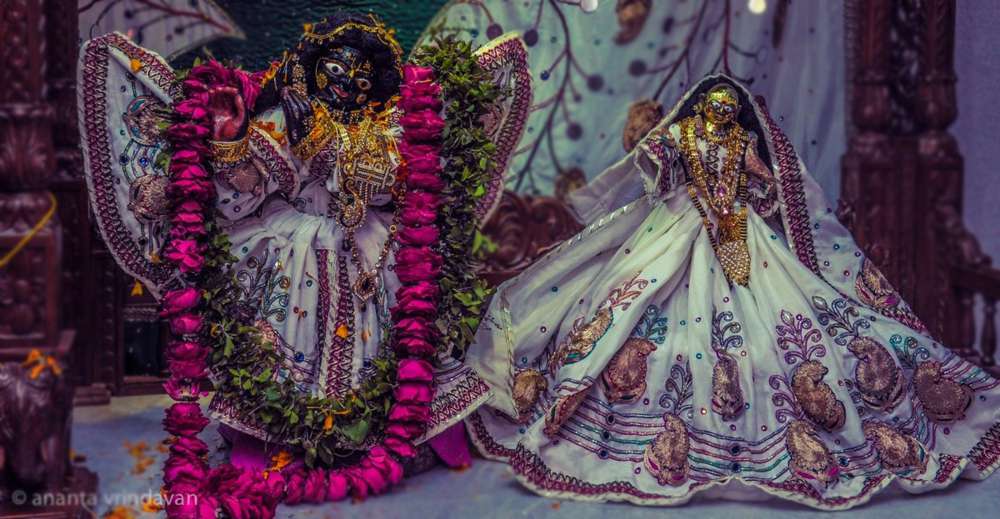
After a great deal of suffering, you finally dragged me to Vraja-dham, tying the rope of mercy around my neck. But now, the forces of fate and illusion have loosened that rope and thrown me back down the well of material existence. (In the image: Deities of Shrila Narottam Das Thakur Shri Shri Radha Vraja Mohan, Shri Vrindavan Dham).

Raghunatha Dasa Goswami – Biography 5

dasa-raghunathasya purvakhya rasa-maïjari
amum kecit prabhashante shrimatim rati-maïjarim
bhanumaty-akhya kecit ahus tam nama-bhedatah
 
   Raghnatha Das is ascribed three different names from his previous identity as a manjari in Krishna-lila: Rasa Manjari, Rati Manjari, and Bhanumati. (Gaura-ganoddesha-dipika 186)
 
Raghunath’s Childhood
 
   Raghunath Das was born in around 1416 Shaka (1494 AD) in the town of Saptagram in Hooghly district. His actual birthplace was in the village of Krishnapura which is not far south of the current railway station name Adi Saptagram on the eastern bank of the ancient Saraswati River. Krishnapura is about a mile from Adi Saptagram station and approximately 1 miles from Trish Bigha station. 
 
   Shrila Raghunatha Das Goswami was the son of Govardhana Majumdar. His mother’s name is not known. Govardhana’s older brother Hiranya had no male offspring. The two brothers belonged to the kayastha caste and were the primary landholders in Saptagram. In those days, the borders of Saptagram stretched from the Yashohara Bhairava creek almost up to the Rupa Narayan River. Raghunath lived in Saptagram Krishnapura, his uncle Kali Das, who was also Chaitanya Mahaprabhu’s Devotee, lived in Shankhanagara. Raghunath’s family priest, Balaram Acharya and his guru, Yadunandana Acharya, lived in the town of Chandpura. Yadunandana was a intimate disciple of Advaita Acharya and a dedicated Devotee of Lord Chaitanya Mahaprabhu who had also received the special blessings of Vasudeva Datta Thakur. 
Raghunatha Dasa Goswami

Raghunath Das was just a little boy engaged in studies he had the darshan of Hari Das Thakur. Hari Das was merciful to him and this mercy was the reason that he later was able to attain the company of Lord Chaitanya. (Chaitanya Charitamrita 3.3.168-9) (In the image: Shrila Haridas Thakur, a child).

 
   After delivering the prostitute sent to tempt him by Ramachandra Khan, Hari Das Thakur left Benapole and came to Chandpura where he stayed with Balaram Acharya. Shrila Raghunath Das Goswami was just a young boy at this time, but he had the opportunity to see Hari Das Thakur and receive his blessings. Krishnadas Kaviraj Goswami says that these blessings were the cause of Raghunath’s later being able to attain the association of Mahaprabhu in the last years of his life.
 
   Raghunath Das was just a little boy engaged in studies he had the darshan of Hari Das Thakur. Hari Das was merciful to him and this mercy was the reason that he later was able to attain the company of Lord Chaitanya. (Chaitanya Charitamrita 3.3.168-9)
 
Raghunath’s Desire to Join the Lord
 
   Hiranya and Govardhana Majumdar had an annual income of 800,000 rupees. At that time, a rupee could buy about 650 lbs of rice, which means several hundred times the value of a rupee today. Even though Raghunath was the only heir to this great fortune, he was indifferent to riches from his childhood. He had his first opportunity to see Mahaprabhu when the Lord came to Shantipur after taking sannyas. As soon as he saw the Lord, Raghunath fell to His feet in a transport of divine love. Raghunath’s father, Govardhana Majumdar, always served Advaita Acharya with faith and devotion, and thus Advaita Prabhu was predisposed to show kindness to the young Raghunath. He thus made sure that Raghunath received the Lord’s remnants for as long as he remained in Shantipur.
 
   When the Lord departed for Puri, Raghunath returned to his home in Saptagram, but he had been transformed and was constantly feeling intense separation from the Lord. Seeing him in this condition, his father surrounded Raghunath by a guard of eleven men, including two Brahmins, four servants and five guards. Even so, Raghunath tried on several occasions to run away in order to join the Lord, but each time was caught and brought back before realizing his objectives. Raghunath became progressively depressed as a result of this situation.
 
   In 1513, when the Lord made His attempt to visit Vrindavan, but only managed to get as far as Kanair Natashala, he returned to Shantipur and again stayed there for a short period of time. Raghunath wanted to see the Lord and this time begged his father to give him permission to go to Advaita’s house. Govardhana was worried about the state of his son’s mind and finally decided to let him go on condition that he return quickly. He also sent a large entourage of guards to accompany him.
 
   When Raghunath saw the Lord, it was as though he regained a new lease on life. He told the Lord of the intolerable situation he was living and prayed to him to tell him how he could break free from the bondage of his material existence. The all-knowing Lord could understand the depth of Raghunath’s feeling and yet He tried to pacify him with the following instruction:
 
   “Calm yourself and return home. Don’t be foolish. It takes time to cross the ocean of material suffering. Don’t make a show of “monkey renunciation” (markata-vairagya) simply for other people’s benefit. Enjoy the worldly life in a moderate way without attachment. Be fixed on Krishna internally while externally dealing with the world in the appropriate fashion. It will not be long before Krishna delivers you.” (Chaitanya Charitamrita 2.16.237-9)
 
   Shrila Bhaktisiddhanta Saraswati Goswami Thakur has made the following comments on the word markata-vairagya: “To a superficial eye, monkeys are engaged in renunciation because they live naked in the forest without any fixed home. In fact, they are only interested in their own sensual enjoyment and have never given it up. Such show-bottle renunciation is called markata- vairagya, ‘monkey-renunciation’. Real renunciation comes as a side-effect of pure devotion, and other types of renunciation which arise out of frustration with material pleasures or desires cannot last throughout one’s life. Because of its temporary character, such renunciation is therefore called phalgu, or false. Such temporary renunciation, or monkey renunciation, is also known as shmashana-vairagya, ‘the renunciation of the cremation ground.’ 
Raghunatha Dasa Goswami

Shri hari-sevaya jâha anukula, vishaya boliya tyage haya bhula-- “It is a mistake to renounce something which is favorable to the service of Lord Krishna, thinking it to be an ordinary material sense object.” (In the wallpaper: Shri Gopinath, ISKCON Chowpatty, Mumbai).

 
   “One may accept things which are absolutely necessary in order to serve Krishna without becoming absorbed by them or attached to them. If one lives in this way, he will not be under the influence of the karmic reactions resulting from the involvement with sense objects. In the Bhakti-rasamrita-sindhu (1.2.108), it is said:
 
yavata syat sva-nirvahah
svikuryat tavad arthavit
adhikye nyunatayam ca
cyavate paramarthatah
 
   One who knows his purpose should accept only as much as he needs to maintain his existence. If he accepts more or less than that, he will fall from the supreme objective.
 
   Shri Jiva Goswami glosses the word sva-nirvahah in his Durgama-sangamani commentary with the words sva-sva-bhakti-nirvahah, i.e., a Devotee should accept only those material things that will help him render service to the Lord, according to his own individual needs. In the Bhakti-rasamrita-sindhu (1.2.256), markata-vairagya, or phalgu-vairagya, has been more clearly explained as follows:
 
prapaïcikataya buddhya
hari-sambandhi-vastunah
mumukshubhih parityago
vairagyam phalgu kathyate
 
   Phalgu-vairagya is defined as the rejection by one desiring liberation of something which is related to the Lord in the understanding that it is something material.
 
   Shri hari-sevaya jâha anukula, vishaya boliya tyage haya bhula– “It is a mistake to renounce something which is favorable to the service of Lord Krishna, thinking it to be an ordinary material sense object.”
 
anasaktasya vishayan
yatharham upayuïjatah
nirbandhah krishna-sambandhe
yuktam vairagyam ucyate
 
   Yukta-vairagya is defined as the attitude of one who is detached from the objects of the sense, but uses them only in as much as they have utility in the service of Lord Krishna.
 
   [From Vaishnava ke?] asakti-rahita sambandha sahita vishaya-samuha sakali madhava — ”All sense objects which are used without personal attachment and in relation to Krishna are identical to Krishna.” Taking Mahaprabhu’s instruction to heart, Raghunath returned home and gave up his feverish desire to renounce material life and instead engaged in his various duties with a sense of detachment. When his parents saw Raghunath abandon all the external signs of renunciation, they were delighted and they began to think that there was no necessity for such a tight guard around their son.
 
Hiranya Majumdar’s Tax Problems
 
   In those days, there was an officer of the Shah with the title chaudhuri or nayeb who acted as an intermediary between the Shah and the zamindars. He collected taxes from the landowners and received a commission of 25% on them. Hiranya Majumdar, however, paid his taxes directly to the Shah, with whom he had a special agreement and thus cut out the middle man. Thus, on an income of 2,000,000 rupees, Hiranya was paying only 1,200,000 rather than 1,500,000, the difference which would normally have been paid to the chaudhuri. Since he was losing a large amount of commission, the Turkish Muslim chaudhuri became an enemy of the Majumdars. Ever since returning from his meeting with Mahaprabhu, Raghunath was practicing yukta-vairagya in accordance with the Lord’s instructions. However, when he heard that Mahaprabhu had returned from Vrindavan, he started making preparations to join Him in Puri. At that time, the chaudhuri had started making complaints to the Shah about Hiranya and Govardhana out of anger at being cheated of his percentage of the tax revenue. Fearful of arrest, the two brothers had gone into hiding.
 
   When the minister came to investigate the chaudhuri’s complaints, he arrested Raghunath, since his father and uncle were not present. The chaudhuri came daily to rebuke and threaten Raghunath, asking him to reveal their whereabouts. Finally he decided to have Raghunath beaten, but when he saw his calm, lotus-like face, he was unable to continue. In fact, though he verbally chastized him, the chaudhuri was afraid to cause him any real harm because Raghunath belonged to an influential family of the kayastha class. He knew that the kayasthas are intelligent and could plot against him, causing him worse problems.
 
   Raghunath himself was looking for a way to extricate himself from the situation, and spoke to the chaudhuri in a sweet voice: “My father and uncle are like your brothers. The behavior of brothers is difficult to understand–sometimes they fight amongst themselves, sometimes they are loving to each other. Today you are arguing, but tomorrow, I am sure that you will be reconciled with each other. I am your son as much as I am my father’s and therefore you are my protector. It is not right for one such as yourself to punish his dependent. I need say no more, for you know the scriptures and are practically a living saint, a pir.”
 
   The chaudhuri was affected by Raghunath’s sweet words and began to cry as he was overcome by affection for him. He said, “From now on, I consider you to be my son. I will find an excuse to have you freed today. Have your uncle meet with me and make arrangements so that I can get my share of the revenues.”
 
   Thus Raghunath was able to mollify the chaudhuri by his sweet and diplomatic behavior and bring the dispute between him and his uncle to an end. In the meantime, Raghunath’s father was making arrangements for his son’s marriage to an extremely beautiful girl in order to insure his commitment to the family.
 
The Danda-mahotsava
 
   A year later, Raghunath once again became anxious to see Mahaprabhu and repeatedly ran away from home in an effort to go to Puri. Each time, he was caught by his father and returned home. Raghunath’s mother thought that her son was going mad and told her husband to place him under guard again. Govardhana responded in defeated tones, 
Raghunatha Dasa Goswami

“He has as much wealth as Indra, the king of the gods, and his wife is as beautiful as the heavenly courtesans. If these things have not been able to capture his spirit, then how will mere ropes be able to do so? The father who gives life to a child cannot interfere with the effects of his previous lives’ actions. Shri Chaitanya Chandra has given His blessings to this boy. Who can keep prisoner one who was been made mad by Lord Chaitanya Mahaprabhu?” (Chaitanya Charitamrita 3.6.39-41) (In the wallpaper: Shri Gauranga Mahaprabhu, ISKCON Chennai, a boy, a girl).

 
   “He has as much wealth as Indra, the king of the gods, and his wife is as beautiful as the heavenly courtesans. If these things have not been able to capture his spirit, then how will mere ropes be able to do so? The father who gives life to a child cannot interfere with the effects of his previous lives’ actions. Shri Chaitanya Chandra has given His blessings to this boy. Who can keep prisoner one who was been made mad by Lord Chaitanya Mahaprabhu?” (Chaitanya Charitamrita 3.6.39-41)
 
   While Raghunath Das was devising a plan for how he would be delivered from his entanglements, he heard that Nityananda Prabhu had made an auspicious appearance in the town of Panihati. Thinking that Nityananda was the deliverer of the most fallen and that by his mercy he would surely be able to find his freedom, he went across the Ganges to Panihati where he found the Lord sitting under a tree on a wooden seat, surrounded by his associates. As soon as Raghunath saw him from a distance, he fell down like a rod. The merciful Lord Nityananda immediately had him brought close to him and, understanding the deep-rooted desires of Raghunath’s heart, arranged for him to perform a service to the Vaishnavas so that he could realize them.
 
   “Like a thief, you don’t come near me, but simply try to run away. Now that I have caught you, I shall punish you. I want you to feed all my followers chipped rice and yogurt.” When he heard Nityananda’s command, Raghunath’s mind was filled with joy. (Chaitanya Charitamrita 3.6.50-1) 
 
   The festival which Nityananda ordered Raghunath to put on is still celebrated as the Panihati Chiriadadhi Mahotsava. Nityananda Prabhu and a manifestation of Shri Chaitanya Mahaprabhu Himself celebrated the festival, eating on the banks of the Ganges just as though they were cowherd boys on the banks of the Yamuna River. Shri Chaitanya Mahaprabhu, Nityananda Prabhu, their associates, numerous Brahmins and countless men and women from the area enjoyed a feast of milk and chipped rice and yogurt and chipped rice. The opportunity to serve the Lord and His Devotees in this way was something that could not come about except for some great fortune. 
Raghunatha Dasa Goswami

“Like a thief, you don’t come near me, but simply try to run away. Now that I have caught you, I shall punish you. I want you to feed all my followers chipped rice and yogurt.” When he heard Nityananda’s command, Raghunath’s mind was filled with joy. (Chaitanya Charitamrita 3.6.50-1) (In the wallpaper: Yamuna, in the image left below Raghunatha Das Goswami, Lord Nityananda and other Devotees, image right top Gaura Nitay and Devotees, chipped rice cooked in milk).

 
   On the following day, Raghunath Das Goswami emotionally asked Nityananda through Raghava Pandit how he could possibly gain freedom from his material entanglements and find the association of Mahaprabhu. Like an ocean of mercy, Nityananda Prabhu placed his feet on Raghunath’s head and said,
 
   “You arranged this feast on the banks of the river and Mahaprabhu was merciful to you and came here Himself to enjoy it. He blessed you by accepting the offering of chipped rice and yogurt. Then, after watching the Devotees’ dancing, He took Prasad in the evening. Lord Gauranga came here just to deliver you and now He has removed any impediments which remained. He will turn you over to Svarupa Damodar and making you His confidential servant, He will keep you by His side. Go home now and forget your worries. You will soon be able to go to the Lord without any difficulties.” (Chaitanya Charitamrita 3.6.139-143)
 
   After discussing with Raghava Pandit, Raghunath gave a large sum of money as dakshina to be paid to Nityananda and his associates. He himself felt as though his life had been fulfilled after receiving Nityananda Prabhu’s blessings. Upon returning to his house, he never again entered the inner quarters, but remained outside where he slept in the Durga Mandapa. Nevertheless, there was always a guard posted near him to prevent him running away.
 
Raghunath Escapes
 
   Though Raghunath knew that the Devotees from Bengal were preparing their annual trip to Puri, he was afraid of joining them because he knew that he would easily be caught. One day, about an hour before dawn, Yadunandana Acharya came by the house while Raghunath was sleeping on the Durga-mandapa. He told Raghunath that a disciple who performed the puja had abandoned his service and needed to be persuaded to take it up again as there was no replacement.
 
   Raghunath accompanied his guru while all the guards were still sleeping. After walking a way with Yadunandana Acharya, however, Raghunath told him to return to his home, saying that he would go alone to the disciple’s house and convince him to come and perform his duties. He told him not to worry and bid him goodbye. With no guards or servants around him, Raghunath realized that he had a golden opportunity to make his escape.
 
   Meditating on Mahaprabhu’s lotus feet, he started to walk toward the east. He avoided the main roads for fear of being caught and even the smaller roads through the villages. Despite the difficult route through the jungle, he walked thirty miles on the very first day, finally taking rest in a milkman’s cowshed that evening. The milkman saw that he had not eaten for the entire day and gave him some milk.
 
   When Govardhana heard that his son had run away, he immediately sent a group of ten servants with a letter for Shivananda Sena who was already on his way to Puri with the Devotees, telling him to send Raghunath back. They caught up with the group of pilgrims at a place called Jhankara, but were disappointed to find that Raghunath was not with them. Meanwhile, Raghunath was walking at great speed towards Puri, completely oblivious to his own fatigue and hunger.
 
   Raghunath arrived in Puri after only twelve days, having stopped to eat only three times along the way and resting only infrequently. He came upon Mahaprabhu, who was sitting with Svarupa Damodar, and paid his obeisances to the Lord from a certain distance. Mukunda Datta informed the Lord that Raghunath had arrived and was paying his obeisances. The Lord told him to approach and Raghunath fell at His feet. The Lord embraced him, His heart melting with compassion for the exhausted young man. He said, “Nothing is more powerful than Krishna’s mercy. It has dragged you out of the deep latrine hole of sense gratification.” (Chaitanya Charitamrita 3.6.193) Raghunath answered the Lord mentally, thinking, “I know nothing about Krishna. I believe that it was You who pulled me out of that hole.” Mahaprabhu’s maternal grandfather, Nilambara Chakravarti knew Raghunath’s father and uncle and used to call them bhaya because they were younger than he. They too called him dada (“older brother”) because he was their elder and a Brahmin. Knowing that this relationship existed between them, Mahaprabhu joked with Raghunath, saying:
 
   “Your father and uncle are like worms in the latrine pit of sense gratification. They think that the suffering which comes from sense gratification is happiness. Even though they believe in brahminical culture and contribute to it, they are not pure Vaishnavas, only imitation Vaishnavas. The nature of the sense objects is that they make one blind; they make one engage in activities which result in material bondage. It is not possible to properly describe Krishna’s mercy which has delivered you from such bondage.” (Chaitanya Charitamrita 3.6.197-200) 
Raghunatha Dasa Goswami

“Nothing is more powerful than Krishna’s mercy. It has dragged you out of the deep latrine hole of sense gratification.” (Chaitanya Charitamrita 3.6.193) Raghunath answered the Lord mentally, thinking, “I know nothing about Krishna. I believe that it was You who pulled me out of that hole.” (In the wallpaper: Shri Govinda, ISKCON Tirupati, a girl).

 
   Shrila Bhaktisiddhanta Saraswati Goswami Thakur has written the following about Krishna’s mercy and the suffering caused by the poison of sense gratification: “Krishna’s mercy is more powerful than the results of one’s previous activities. It was this powerful compassion of the Lord which pulled Raghunath out of the latrine hole of sensual existence. A living entity who is attached to sense gratification does not have the strength to give it up. For the living being who has become a pure Devotee of Krishna, however, sense enjoyments are like a ditch of stool. Mahaprabhu knew that Raghunath was completely free from any attachment to sense gratification. Nevertheless, He said this to him as a teaching to the conditioned souls.” (Anubhashya 6.9.193)
 
   “Sense objects (vishaya) bring great distress to their so-called enjoyer (vishayi). Even so, those whose brains are completely immersed in the objects of sense gratification and are entangled in the whirlpool of material existence consider these sources of distress to be happiness. The objects of material sense gratification should be discarded in the same way that one abandons an outhouse, and one whose mind is possessed by the desire for these objects of gratification is like a maggot who feeds off the stools in the latrine. This is how the transcendentalist sees the materialistic person who is trying to extract pleasure from inert matter. He has nothing but disdain for materialistic pleasures which he sees being exactly like the pleasure a maggot extracts from the taste of rotting excrement.” (Anubhashya 6.9.197)
 
Raghunath’s Renunciation
 
   Mahaprabhu noticed that Raghunath was dirty and weak after his journey and so, after accepting him as His own son and servant, entrusted him to Svarupa Damodar, telling him take responsibility for him and to see to his well-being. He was thenceforth to be known as Svarupa’s Raghunath to distinguish him from Raghunath Vaidya and Raghunath Bhatta, who were also living in Mahaprabhu’s association in Puri at that time. The Lord also told Govinda to take care of Raghunath with great affection. He then told him to go and take his bath in the ocean and go to see Lord Jagannath, after which He was to join him for lunch. When Govinda gave Raghunath the remnants of the Lord’s plate to eat, Raghunath was overjoyed.
 
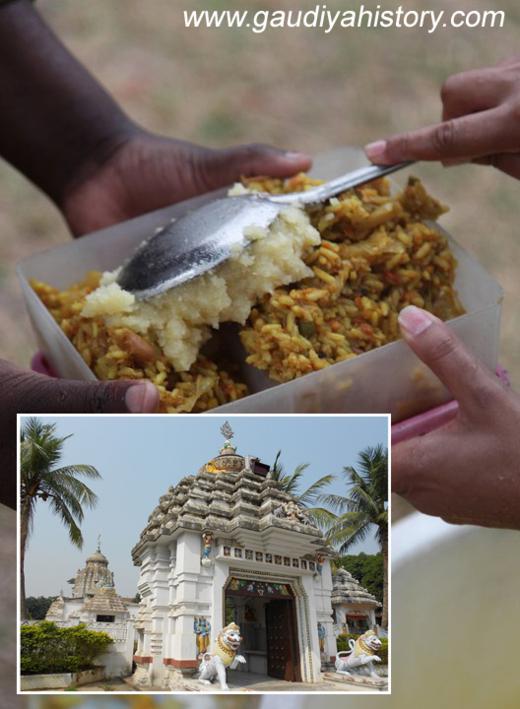
   Things went on like this for five days, Raghunath taking the Lord’s remnants each day, but on the sixth day, he stopped taking the Lord’s Maha Prasada. From that day on, he went to the Jagannath Temple and took darshan of the Lord’s flower offering, after which he would stand at the Lion’s Gate and beg Maha Prasad. At night, after they had finished their duties, Jagannath’s servants would pass by on their way home and would customarily give Prasad to any hungry Vaishnavas who waited there. In this way, renounced Vaishnavas could keep body and soul together. This type of renounced attitude was particularly noticeable amongst Mahaprabhu’s Devotees.
 
   When the Lord asked after Raghunath and learned that he was no longer taking Prasad in the same way as before, but begging by the Simha-dvara, He was satisfied to see that he was taking the renounced way of life so seriously. He said, Raghunatha Dasa Goswami
 
   “That’s very good. He is taking the life of a renunciate seriously. A renunciate should always be engaged in repeating the names of the Lord and should keep his body and soul together through begging. Anyone who takes the renounced order and then becomes dependent on others cannot achieve his ends and Krishna will ignore him. One who becomes a renunciate and then lusts for tasty foods will never attain his spiritual goal, and will simply become the slave of his tastebuds. A vairagi’s duty is to always chant the names of Lord Krishna and fill his belly with spinach leaves, fruits and roots. One who runs here and there looking for good things tyatharham upayuo eat becomes attached to his sex organs and his belly and will never attain Krishna.” (Chaitanya Charitamrita 3.6.222-7)
 
   Shrila Bhaktisiddhanta Saraswati Goswami Thakur has underscored Krishnadas Kaviraj Goswami’s statement that the vairagi’s only duty is to chant the names of the Lord. He has written the following: “Examining them impartially, both materialistic non-devotees and pure Vaishnavas can see that Mahaprabhu’s associates are not attached to the gratification of their material senses. They are indifferent to anything which cannot be used in the service of Krishna. The reasons for such renunciation are incomprehensible to the ordinary materialistic person, for their service is without any external motive and it cannot be interrupted by any mundane impediment. When Lord Gaurasundara sees a Devotee engaged in this kind of devotional service, completely indifferent to sense objects which are outside the scope of his service needs, He is greatly pleased with his clever attitude.
 
   “The various rituals which are described in the Hari-bhakti-vilasa are meant for the wealthy householder and not for the vairagi who has renounced everything to take exclusive shelter of the Holy Name. One who chants the Holy Names in the morning, in the middle of the night, in the midday and at sunset, in other words throughout the day and night is certain to cross over the ocean of material existence. Those pure Devotees who are fixed exclusively on the devotional service of the Lord and chant His names and remember Him with love have no duty to perform other than kirtan and smarana.” (Anubhashya 3.6.223, translation of Hbv 20.366, 379, 382).
 
   Shrila Raghunath Das Goswami would never speak to the Lord directly, but asked Govinda or Svarupa Damodar to submit any question or request to the Lord on his behalf. One day he asked the Lord through Svarupa Damodar to instruct him personally on his duties. When the Lord heard this, He told Raghunath that Svarupa Damodar knew far more than He did and that he should take instruction from him about the goal of life and how to attain it. When Raghunath’s eagerness to hear from him directly did not abate, the Lord said, “If he has faith in My words, then let him follow these instructions:
 
   “Do not listen to gossip nor engage in gossip yourself. You should not eat very palatable food, nor should you dress very nicely. Always chant the Holy Name of Lord Krishna without any expectation of honor, offering all respect to others. Mentally render service to Radha and Krishna in Vrindavan.” (Chaitanya Charitamrita 3.6.236-7)
 
   The Bengali Devotees arrived in Puri for Rathayatra and met Raghunath, who was particularly fortunate to receive Advaita Prabhu’s blessings. Shivananda Sena told him that his father had been looking for him. After staying four months in Puri, the Devotees returned to Bengal and Shivananda gave news of Raghunath to Govardhana Majumdar, telling him of his determined ascetic spiritual practices. Raghunath’s parents were distressed to hear of his lifestyle and sent a Brahmin, two servants and four hundred rupees to Shivananda for Raghunath. The following year, Shivananda took these servants and the money to Puri with him and informed Raghunath that his father had sent them. Raghunath would not accept them, but thinking of his father’s benefit, he took some of the money and used it to pay for Mahaprabhu’s meals twice a month. After doing this for two years, Raghunath abandoned this practice also. In response to Mahaprabhu’s question about why Raghunath had stopped inviting Him, Svarupa Damodar said that Raghunath had decided that since his father was a materialistic man, Mahaprabhu was not really pleased to eat the food purchased with his money. By accepting such money his own mind was becoming contaminated and his only gain was some fame and status. Furthermore, he thought that Mahaprabhu was only accepting his invitations out of kindness because Raghunath was so foolish that he would be unhappy if he refused, but that in fact he was secretly not very pleased by it. Mahaprabhu was greatly satisfied to hear this conclusion and said,
 
Raghunatha Dasa Goswami

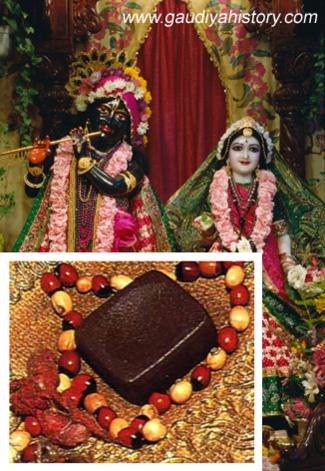
...Mahaprabhu cherished the two objects, taking the necklace of gunja beads to be identical to Radharani and the stone from Govardhana to be identical to Krishna...After worshiping the necklace and the stone for three years, He decided one day to give them to Raghunath as a sign of His satisfaction with his devotion...Raghunath felt honored and delighted by the Lord’s gift, and taking them to be the direct representations of Shri-Shri-Gandharvika-Giridhari, he worshiped them with water and tulasi leaves...(In the wallpaper: Govardham Shila of Raghunatha Dasa Goswami, Shri Shri Gandharvika Giridhari, ISKCON Sweden, New Radhakund).

   “When one eats food offered by a materialistic person, one’s mind becomes contaminated. If the mind is contaminated, one is unable to remember Krishna. The food of a materialistic person is infected by the mode of passion and both the person who offers it and the one who accepts it are mentally contaminated. I accepted Raghunath’s invitation for many days because of his enthusiasm. I am glad that he has realized all this and given up this practice on his own initiative.” (Chaitanya Charitamrita 3.6.278-80)
 
   Shrila Bhaktisiddhanta Saraswati Goswami Thakur has commented on the above events as follows: “People who are egotistical and possessive are generally materialistic persons who try to enjoy the world for their own sense gratification. Such persons see their money as a tool for achieving such sense gratification. If they attempt to serve the Lord, the guru or the Vaishnavas, who are beyond the material energy, their only gain will be an increase in material prestige and not the true benefits of such service. One who seeks true auspiciousness should therefore try to serve the Supreme Personality of Godhead by full surrender to His lotus feet and then engaging whatever money one has honestly earned in the spiritual service of Krishna, the spiritual master and the Vaishnavas, using his body, mind, words and heart.” (Anubhashya 3.6.275)
 
   “Certain materialistic persons who are intoxicated by high birth, riches, learning or physical beauty, may make a show of Deity worship, offer the Prasad from that worship to Vaishnavas. Due to their ignorance, they are not aware that because they lack devotion, the Lord does not accept their offerings. Because of the taint of the sense enjoyer’s false pride which contaminates such offerings, it is often seen that the pure Vaishnava is indifferent to such apparent service to the Deity. In other words, a pure Vaishnava who has renounced the life of sense enjoyment does not accept such service. Rich materialistic sense gratifiers are so foolish because of their sense of identification with the body and mind that they become angry with the Vaishnavas and offended by their behavior. (Anubhashya 3.6.276)
 
   “Non-devotees and Prakrita-sahajiyas are considered to be materialistic, or vishayis. Because they offer food without devotion, an aspiring Devotee will be contaminated by their association through eating their food. The result of such flaws in association (sanga-dosha), one will develop the same mentality as they. If one engages in even minimal association with materialists or Sahajiyas, who are materialists in the guise of Vaishnavas, through any of the six kinds of association (exchanging gifts, food or confidences), with even a drop of hidden affection, the result will be that the transcendental devotional service of Lord Krishna is transformed into sense gratification, and this will cause the aspiring Devotee’s falldown. The conclusion is that one whose mind is fixed on the pleasures of the bodily senses and contaminated by the sense objects is too impure to be able to serve Krishna through the process of transcendental remembrance or smarana.” (Anubhashya 3.6.278)
 
   Shrila Bhaktivinoda Thakur has also written about the rajasika character of a materialistic person’s dinner invitations. He says, “Invitations to dinner are of three kinds, sattvika, rajasika and tamasika. The invitation of a pure Devotee is in the mode of goodness, that of a pious materialistic person is in the mode of passion, while the invitation of a very sinful person is in the mode of darkness.” (Amrita-pravaha-bhashya, 3.6.279)
 
   Raghunath Goswami’s asceticism grew stronger with each passing day. He stopped begging at the Lion’s Gate and started going instead to an almshouse. When Mahaprabhu heard this news from Govinda, He asked Svarupa Damodar what the cause was for the change. Svarupa Damodar answered that Raghunath was finding that a lot of time was being wasted standing in front of the Simha-dvara and was going to the almshouse every day at noon instead. Mahaprabhu praised Raghunath’s decision, saying, “Begging by the Simha-dvara resembles the behavior of a prostitute.” A prostitute stands around and waits for some man to come and give her some business, a beggar cannot remain indifferent as he waits for someone to be kind to him. Going for handouts at the almshouse does not present the same kind of problem. One simply has to go at the proper time and one receives enough to keep his body alive. This is useful if one wishes to use one’s time in chanting the Holy Names.
 
   The sannyasi Shankarananda Saraswati sent Mahaprabhu a gunja-mala and a Govardhana-shila from Vrindavan. Mahaprabhu cherished the two objects, taking the necklace of gunja beads to be identical to Radharani and the stone from Govardhana to be identical to Krishna. Mahaprabhu would hold the Govardhana-shila to His head, to His eyes and to His heart, and this would bring Him great pleasure. After worshiping the necklace and the stone for three years, He decided one day to give them to Raghunath as a sign of His satisfaction with his devotion. Raghunath felt honored and delighted by the Lord’s gift, and taking them to be the direct representations of Shri-Shri-Gandharvika-Giridhari, he worshiped them with water and tulasi leaves. When engaged in such loving service, he would go into a devotional trance. After his disappearance, the Govardhana-shila was placed in the Gokulananda Temple where it is still being served. 
 
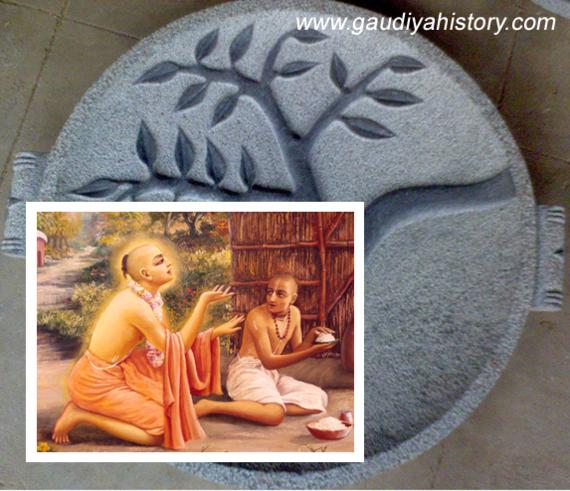
   It is said of Raghunath Das Goswami’s ascetic vows that they were like lines drawn in stone. He spent 21 hours a day engaged in chanting Krishna’s names and in smarana, only one and a half hours for sleep and food. He only ate enough to keep body and soul together. He allowed no delicious foods to ever touch his tongue, and he wore only a piece of torn cloth and a quilt. Finally, he started going at night to gather the Prasad which the vendors outside the Temple threw away near the Simha-dvara after it started to go so bad that even the Tailangi cows would not eat it. He would wash it to take out the dirt with which it had become mixed until he reached the hard core of the grains which had not cooked. This is what he would eat, only adding a little salt. One day, Shri Svarupa Damodar Goswami saw Raghunath doing this and came and asked him for some of this Prasad, comparing it to the nectar of the gods. Even Mahaprabhu, when He heard about it from Govinda, came and took a handful of Raghunath’s Prasad, though Svarupa Damodar prevented Him from taking a second.
 
   “What is this all about? You are eating such nice things and not giving any to Me?” Saying this, the Lord snatched a morsel from Raghunath and ate it. As He was about to take another Svarupa Damodar caught Him by the hand and said, “It is not fit for You,” and took it away from Him. (3.6.322-3) 
Raghunatha Dasa Goswami

Raghunath Das Goswami’s ascetic vows that they were like lines drawn in stone. He spent 21 hours a day engaged in chanting Krishna’s names...He allowed no delicious foods to ever touch his tongue... Finally, he started going at night to gather the Prasad which the vendors outside the Temple threw away near the Simha-dvara after it started to go so bad that even the Tailangi cows would not eat it...“What is this all about? You are eating such nice things and not giving any to Me?” Saying this, the Lord snatched a morsel from Raghunath and ate it. As He was about to take another Svarupa Damodar caught Him by the hand and said, “It is not fit for You,” and took it away from Him. (3.6.322-3) (In the wallpaper: Shri Gauranga Mahaprabhu and Raghunatha Dasa Goswami, in the background a lines on the stone).

 
   Shrila Raghunath Das Goswami has himself summarized these experiences in his verses called Chaitanya-stava-kalpa-vriksha (“The desire tree of Chaitanya Mahaprabhu’s glories”) which can be found in the collection called Stavavali.
 
maha-sampad-davad api patitam uddhritya kripaya
svarupe yah sviye kujanam api mam nyasya muditah
uro-guïja-haram priyam api ca govardhana-shilam
dadau me gaurango hridaya udayan mam madayati
 
   By His mercy, Shri Gauranga took pleasure in delivering me even though I am a fallen soul, the lowest of men, from the blazing forest fire of great material opulence and entrusted me to His personal associate, Svarupa Damodar. He gave me the cherished gunja garland that He wore on His chest as well as His Govardhana Shila. And now He awakens within my heart and makes me mad after Him. (verse 11)
 
Raghunath Goes to Vrindavan
 
   Raghunath remained under Svarupa Damodar’s tutelage as long as he stayed in Puri, thus gaining direct access to Mahaprabhu’s confidential service and association. In all, he remained there for sixteen years until the Lord and His chief confidant disappeared to the eyes of this world.
 
   When this event took place, Raghunath felt that he could no longer live in their absence and decided to go to Vrindavan to commit suicide by jumping from Govardhana Hill. When he arrived in Vraja, he met Rupa and Sanatan Goswamis. They spoke to him for a long time and finally persuaded him not to put an end to his life. They adopted him as their third brother and kept him with them. Rupa and Sanatan were enriched by hearing the nectarean pastimes of Lord Shri Chaitanya Mahaprabhu from Raghunath.
 
   Raghunath Das Goswami’s separation from Mahaprabhu and Radha-Krishna became so intense that he gave up eating solid food altogether, only drinking whey to sustain himself. He would pay a thousand prostrated obeisances, chant 100,000 Holy Names, serve Radha and Krishna mentally both day and night, recount the glorious pastimes of Lord Chaitanya Mahaprabhu and bathe three times a day without fail in Radha Kund. This was the exemplary standard of bhajana set by Raghunath in which he served their Lordships for more than 22 hours a day, sleeping only an hour and a half, if at all.
 
   Raghunath’s renunciation may superficially be compared to that of the Buddha, but when examined more closely it will be observed that there are some unique characteristics in Raghunath’s asceticism. The external meaning of renunciation is detachment from sense gratification, but its true meaning is attachment to the supreme person. Raghunath’s strong attachment to the lotus feet of Radha and Krishna meant that he was completely and naturally detached from anything which was not connected to his worshipable Lord's.
 
Radha Kund
 
   Shri Raghunath Das Goswami lived a long life. Shrinivas Acharya had the chance to receive Raghunath’s blessings before leaving Vrindavan to return to the East with the Goswamis’ books. Shrinivas was astounded by the powerful asceticism and deep absorption in love. Raghunath Das Goswami wrote three books: Stavavali, Shri Dana-charita (Dana-keli-chintamani) and Mukta-charita.
 
   He lived in Radha Kund which was where he engaged in his most intense devotional practices. He was blessed there by Nityananda Prabhu’s widow, Jahnava Devi, when she visited Radha Kund.
 
   When Mahaprabhu Himself visited the village of Arit and displayed His pastime of bathing in a rice field, by which He indicated the presence of Radha Kund and Shyama Kund. At that time the two tanks had not been excavated and finished with steps, etc. Raghunath himself thought it would be a good idea to have this work done, but had some reservations about getting involved in this kind of work. However, one day, a rich merchant who was on pilgrimage to Badari Narayan with the intention of donating a large sum of money to the Temple there. But Badari Narayan appeared to him in a dream and told him to fund Raghunath’s vision of a developed Radha Kund and Shyama Kund. The merchant came back to Vraja and found Raghunath in the village of Arit and recounted the story of the dream to him. Raghunath thus supervised the excavation of the ponds and the subsequent building of stone steps walkways.
 
   Five trees stood on the banks of Shyama Kund which are said to be the five Pandavas. Raghunath had the intention of cutting down these trees so that Shyama Kund could be made perfectly rectangular. Before this could happen, however, Raghunath had a dream in which Yudhishthira appeared to him and told him that the five Pandavas were present in Radha Kund in the form of these trees. Raghunath immediately stopped the workers from cutting them down. This is why Shyama Kund was not built as a perfect rectangle.
 
Other Legends About Raghunath in Vraja
 
   Another story is told about Raghunath Das Goswami. It is said that when he read Rupa Goswami’s play, Lalita Madhava, he was submerged in an ocean of separation. Though he was permanently in Radha’s association at Radha Kund, he was unable to tolerate even a momentary threat of separation, what to speak of intense feelings of Krishna’s absence. When he read the Lalita-madhava, which has separation from Krishna as its primary subject matter, this mood became so strong that it became doubtful that he would be able to survive. When Rupa saw Raghunath’s response to his play, he wrote another, short work named Dana-keli-kaumudi which is full of humor and amusing banter. He gave this book to Raghunath and took back his copy of Lalita-Madhava. When Raghunath read Dana-keli-kaumudi, he forgot his feelings of separation.
 
   At first, when staying by Radha Kund Raghunath had no fixed shelter. He occasionally stayed with Gopal Bhatta Goswami, whose cottage was situated on the banks of the Manasa-Ganga in Govardhana. One day he took bath in the Manasa-Ganga and then went to sit under a tree surrounded by unkept thickets and began to worship the Lord in a devotional trance. While he was meditating, a tiger came there to drink water. Sanatan Goswami was also present there at the time and observed Raghunath as he remained unmoved even though exposed to such danger. He instructed Raghunath to build a cottage in which to live and engage in his devotional activities.
 
   Shrila Raghunath Das Goswami had special affection for a certain Vrajavasi whose name was Das. Raghunath’s daily nourishment consisted of only a leaf bowl of whey. This Vrajavasi was distressed to learn that Raghunath ate so little, thinking that it was impossible for him to keep alive on such a small amount. One day when in the village known as Sakhisthali, he was overjoyed to see a silk cotton tree with huge leaves. He had a bigger sized bowl made with these leaves in which he put whey for Raghunath and then brought it to him. Raghunath was quite astonished to see such a large leaf-bowl and asked him where he got it. When he heard the name of Sakhisthali, he immediately threw down the bowl and the whey. Sakhisthali is the home of Chandravali, Radharani’s primary rival for Krishna’s love. Chandravali’s sakhis like Shaivya and Padma are constantly looking for ways to take Krishna away from Radha’s bower and bring him to that of their girlfriend. Just as Radharani is distressed by these actions, so are her girlfriends. Raghunath was a member of Radharani’s entourage and so it was his role to constantly think of how to bring happiness to her and her girlfriends. As soon as he heard the name of Sakhisthali mentioned, he was transported by anger. This mood is the ultimate stage of love which envious people who are burdened by material lust could never understand. In the Bhakti-ratnakara, it is written,
 
   After calming down, Raghunath said to Das, “That is Chandravali’s place. You shouldn’t ever go there.” Das Vrajavasi calmed down and recognized that these were the symptoms of spiritual perfection in what was apparently a spiritual aspirant. All these Devotees are eternally perfected souls. Anyone who doubts it must be considered fallen. (Bhakti-ratnakara 5.572-4)
 
   There is one other extraordinary legend about Raghunath Das Goswami recounted in the Bhakti-ratnakara. One day he was suffering from indigestion. Vitthalanatha came with two doctors from Vallabhapura to cure Raghunath Das. After examining him, the doctors said that the indigestion had been caused by eating rice and milk. Vitthalanatha was astonished to hear this diagnosis and said, “This is impossible. This man never eats anything but whey.” Raghunath then spoke up, saying that he had indeed eaten milk and rice in the course of his meditation on the pastimes of Radha and Krishna.
 
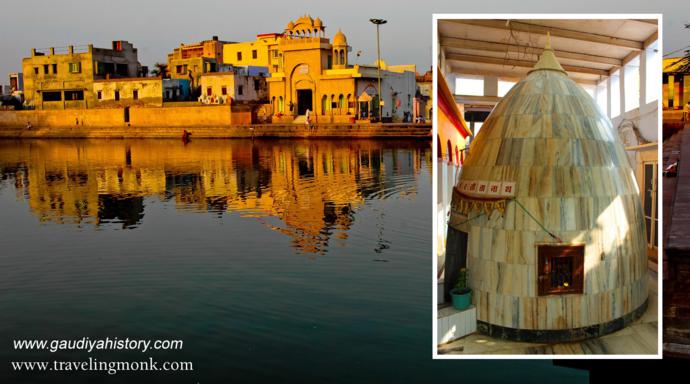
   Shri Raghunath Das Goswami left his body on the banks of Radha Kund where his samadhi tomb stands. This took place on th Shukla Dvadashi tithi of the month of Ashwina, in the year 1586.
 
   [Excerpted from “Shri Chaitanya: His Life & Associates” by Shrila Bhakti Ballabh Tirtha Maharaj] 
Raghunatha Dasa Goswami

Shri Raghunath Das Goswami left his body on the banks of Radha Kund where his samadhi tomb stands. This took place on th Shukla Dvadashi tithi of the month of Ashwina, in the year 1586. (In the wallpaper: Samadhi of Shrila Raghunatha Dasa Goswami, in the background Shri Radha Kund).

Sanatana Goswami – Biography 3

Sanatana Goswami

Rati Manjari, who was previously very dear to Rupa Manjari and was also known by some wise persons as Lavanga Manjari, has become the worshipable Sanatana, who is non-different from Gaura Himself. The jewel amongst sages, Sanatana Kumara, has also entered into him to fulfill a certain mission. (Gaura-ganoddesha-dipika 181) (In the image: Shrila Sanatana Goswami).

   ya rupa-manjari-preshtha purasiad rati-manjari
socyate nama-bhedena lavanga-maïjari budhaih
sadya gaurabhinna-tanuh sarvaradhyah sanatanah
tam eva pravishat karyan muni-ratnah sanatanah
 
   Rati Manjari, who was previously very dear to Rupa Manjari and was also known by some wise persons as Lavanga Manjari, has become the worshipable Sanatana, who is non-different from Gaura Himself. The jewel amongst sages, Sanatana Kumara, has also entered into him to fulfill a certain mission. (Gaura-ganoddesha-dipika 181)
 
Sanatana’s Life Before Meeting Mahaprabhu
 
   According to the Gaudiya Vaishnava Abhidhana, Sanatana was born in around 1410 of the Shaka era (1488 AD). Narahari Chakravarti Thakur has described his ancestors in Bhakti-ratnakara (1.541ff) and Shrila Bhaktisiddhanta Saraswati Goswami Thakur has given a summary of this information in his Anubhashya to Chaitanya Charitamrita (1.10.84), which we have quoted in this book on page 12 in our discussion of the life of Rupa Goswami. Other than this, no reliable information about their antecedents has been found. Perhaps researchers in Indian history will be able to shed more light on this.
 
   According to the Gaudiya Vaishnava Abhidhana, the following brief account is given of how Sanatana’s grandfather came to be engaged in the Muslim Shah’s service: “During the reign of Barbak Shah (1460-1470 AD), Sanatana’s grandfather Mukunda entered the court at the capital city of Gauda. Barbak Shah engaged many Abyssinian slaves and eunuchs in both his court and harem; they were known as habshi [which is now the common Bengali word for any black African]. After the death of Barbak Shah, his son Yusuf became king, and he was followed by his son Fateh Shah. During the reign of Fateh Shah, the Abyssinians led a coup in which Fateh Shah himself was assassinated. They ruled for five or six years. Hussein Shah was the wazir or prime minister of the last of the Abyssinian rulers and he later became himself ruler of Bengal. Mukunda left this world during the rule of Fateh Shah and Mukunda was engaged in his place. Sanatana managed to survive the Abyssinian period and during Hussein Shah’s reign managed to take a higher position on the strength of his personal talents, eventually becoming prime minister. Rupa Goswami held another ministerial post, possibly as finance minister.” Sanatana’s title was Sakara Mallik and Rupa’s was Dabir Khas.
 
   While Shri Sanatana Goswami was still young, he studied under the country’s leading scholar named Vidyavachaspati, learning many scriptures from him. He was especially attached to the study of the Shrimad Bhagavatam. Although he had taken birth in a high class Brahmin family, because he had worked for the Muslim government, he considered himself to be fallen and always behaved in a most humble manner, as is appropriate for a Vaishnava.
 
   Sanatana’s teacher was Vidyavachaspati who would come to stay in Ramakeli from time to time. Sanatana studied all the scriptures from him. No one can achieve the depth of devotion that he had for his guru. (Bhakti-ratnakara 1.598-9)
 
   Sanatana’s father would perform atonement rituals after even seeing a Muslim, yet Sanatana himself would associate constantly with Muslims. Being dependent on them for his livelihood, he would even go into their homes. For this reason, he considered himself to be on the same level as the Muslims and behaved very humbly. Sometimes, when he had fallen into the ocean of humility, he would think of himself as even lower than a mleccha. Because he had associated with Muslims and behaved in a lowly manner like them, he would speak of himself in that way. Though born in the highest class family of Brahmins, he never thought of himself as a Brahmin. (Bhakti-ratnakara 1.609-14)
 
   Through Ramananda [the Lord] destroyed Cupid’s pride; through Svarupa Damodar he demonstrated detachment. Through Hari Das Thakur, he demonstrated forbearance and through Rupa and Sanatana Goswami, he taught humility. (Bhakti-ratnakara 1.630-1)
 
   All the participants in Krishna’s lila also made their appearance in Gaura’s incarnation in order to enrich His pastimes. Through them, the Lord gives various teachings to the people of this world.
 
   Through Hari Das, he revealed the glories of the Holy Name; through Sanatana, the articles of faith in devotional service. Through Rupa he taught Radha and Krishna’s pastimes of love. Who can understand the mysterious workings of the Lord? (Chaitanya Charitamrita 3.5.86-7)
 
   Through Sanatana’s mercy, I learned the points of devotional doctrine, while through Rupa’s mercy, I learned about the divine devotional sentiments. (Chaitanya Charitamrita 1.5.203) 
Sanatana Goswami

Through Hari Das, he revealed the glories of the Holy Name; through Sanatana, the articles of faith in devotional service. Through Rupa he taught Radha and Krishna’s pastimes of love. Who can understand the mysterious workings of the Lord? (Chaitanya Charitamrita 3.5.86-7) (In the wallpaper: Shri Shri Radha Madan Gopal, ISKCON Nasik, Maharashtra, His Holiness Indradyumna Swami along with Devotees in Shri Vrindavan Dham, a book).

 
   Thus Sanatana has been called the bhakti-siddhantacharya, or the teacher of devotional doctrine, by which is meant the teacher of sambandha-jnana, or of the basic relations between God, man and the world. The founder of the Chaitanya Math, Shrila Bhaktisiddhanta Saraswati Goswami Thakur, whose various branches have spread throughout the world, mercifully gave his disciples a poem entitled “Who is a Vaishnava?” The nectarean instructions which are found in this poem mention the teachings of Mahaprabhu to Sanatana Goswami from the Chaitanya Charitamrita.
 
tai dushta mana nirjana bhajana
pracaricha chale kuyogi-vaibhava
prabhu sanatane parama yatane
shiksha dila yaha, cinta sei saba
 
   So, wicked mind, you have deceptively been preaching nirjana-bhajana, the practice of the eremitic life, which is nothing more than a display, like that of a misleading yoga practitioner interested in the mystic powers. Study the teachings of the Lord to Sanatana very carefully and meditate upon them.
 
   Shrila Bhaktisiddhanta Saraswati Goswami Thakur thus instructs us all to give great attention to the Lord’s teachings to Sanatana, or those teachings which He gave to the world through Sanatana Goswami.
 
First Meeting in Ramakeli
 
   After Mahaprabhu took sannyas, He first went to Shantipur and then on to Puri and then on pilgrimage to South India. After completing His pilgrimage and returning to Puri, Mahaprabhu decided to go to Vrindavan via the route which follows the Ganges through Bengal. Great crowds of people accompanied Him and He eventually decided to turn back from Kanair Natshala. He met Rupa and Sanatana for the first time while passing through the village of Ramakeli on this voyage.
 
   Ramakeli is in the district of Maldah in West Bengal, about eight miles south of English Bazar, which was the district headquarters, and about five or six miles from the Maldah train station. It is also known as Gupta (“hidden”) Vrindavan. There are a number of sites which are worth seeing as reminders of Rupa and Sanatana:
 
   (1) A tamala and a kadamba tree under which Mahaprabhu is said to have been sitting when He met Rupa and Sanatana; a shrine containing the footprints of the Lord has been constructed there as a memorial of that meeting. The Lord distributed love of Krishna to all the Devotees in this location. 
   
   (2) The Temple of Madana-Mohana. This Madana-Mohana Deity was personally worshiped by Sanatana Goswami. There are also Deities of Nitai-Gauranga and Advaita Prabhus. 
 
   (3) There are several tanks, which are named Radha Kund, Shyama Kund, Surabhi Kund, Lalita Kund and Vishakha Kund.
 
   (4) A large man-made lake named Rupa Sagara, which is said to have been excavated by Rupa Goswami, and
 
   (5) another named Sanatana Sagara. Rupa and Sanatana had large mansions built both in Ramakeli and Fateyabad. 
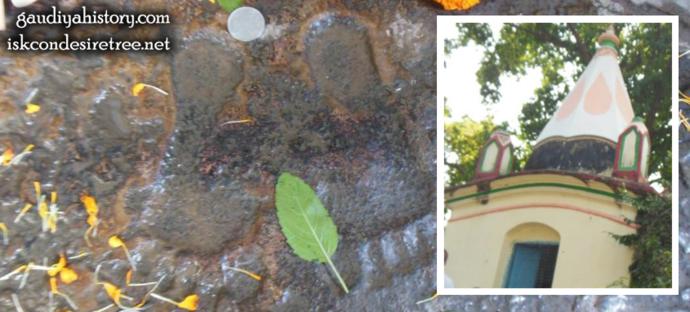
Sanatana Goswami

(1) A tamala and a kadamba tree under which Mahaprabhu is said to have been sitting when He met Rupa and Sanatana; a shrine containing the footprints of the Lord has been constructed there as a memorial of that meeting. The Lord distributed love of Krishna to all the Devotees in this location. (In the wallpaper: Foor prints of Lord Chaitanya, Ramkeli, Malda town).

 
   At first, when the Muslim king heard that such great crowds of Hindus had assembled in the nearby village, he was worried. One of the Hindu members of the Shah’s court was Keshava Khattri, who explained to him that there was no reason to fear Mahaprabhu. Rupa Goswami (Dabir Khas) also glorified Mahaprabhu to the king, telling him of his fortune in having the Lord bless the country by His presence. Keshava Kshatriya, meanwhile, sent a secret message to the Lord telling Him to go elsewhere because the King could not be trusted.
 
   The King said, “Listen, I am also beginning to think that this person must be God Himself. There is no doubt about it.” After having this conversation, the king entered his private quarters and Dabir Khas also returned to his residence. After returning there, however, he and his brother decided after much consideration to go incognito to see the Lord. Thus, in the dead of night the two brothers, Dabir Khas and Sakara Mallik, went to see Mahaprabhu. First they met Nityananda Prabhu and Hari Das Thakur. Nityananda Prabhu and Hari Das then went and told the Lord that Rupa and Sakara Mallik had come to see Him. (Chaitanya Charitamrita 2.1.180-4)
 
   When Rupa and Sanatana met the Lord, they spoke to Him with extreme humility:
 
   “We two are millions of times more degraded, fallen and sinful than Jagai and Madhai. We are of wicked birth because we are the servants of Muslims and our activities are exactly like those of the Muslims. We constantly associate with people who are inimical toward the cows and Brahmins. Due to our abominable activities we are now bound by the neck and hands and have been thrown into the ditch filled with the excrement of evil sense enjoyment.” (Chaitanya Charitamrita 2.1.196-199)
 
   It is very distressful to us that we are so unworthy, yet when we see Your merciful qualities, we become desirous of attaining Your blessings. This powerful desire rises up in us as that of a dwarf who wants to touch the moon. (Chaitanya Charitamrita 2.1.204-5)
 
   When the Lord heard the extreme humility of the two brothers, He became compassionate and said to them, “You are My eternal servants. From now on you shall be known as Rupa and Sanatana. I came to Bengal just so that I could meet you here in Ramakeli village. Krishna will deliver you from your entanglements very shortly.”
 
   Shrila Bhaktisiddhanta Saraswati Goswami Thakur has written the following comment in his Anubhashya (Chaitanya Charitamrita 2.1.208): “Mahaprabhu showed His mercy to Dabir Khas and Sakar Mallik by giving them the spiritual names of Rupa and Sanatana, respectively. Nama-karana is a type of samskara on the lowest level of qualification. However, those who ignore the mercy that is manifest in the spiritual name have no chance of attaining devotion to Krishna, but remain intoxicated with material prestige. The prakrita-sahajiyas pay no heed to the injunctions of the scripture which state that the minimum characteristics of a Vaishnava are that he wears the symbols of the discus and conchshell and urdhva-pundra (tilaka) and takes one of the names of Krishna. As such, they cannot be qualified as Gaudiya Vaishnavas. Non-Vaishnavas have not been given a name by the Vaishnava guru and so they continue in the bodily conception of life without any awareness of their relationship with the Lord. They continue to identify themselves with their previous caste according to the name which ties them to their body.” 
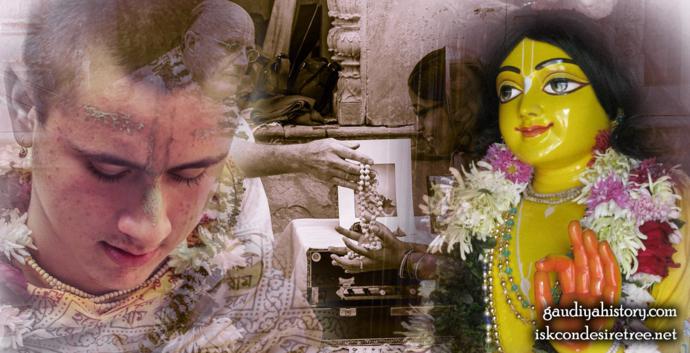
Sanatana Goswami

“Mahaprabhu showed His mercy to Dabir Khas and Sakar Mallik by giving them the spiritual names of Rupa and Sanatana, respectively. Nama-karana is a type of samskara on the lowest level of qualification. However, those who ignore the mercy that is manifest in the spiritual name have no chance of attaining devotion to Krishna, but remain intoxicated with material prestige. The prakrita-sahajiyas pay no heed to the injunctions of the scripture which state that the minimum characteristics of a Vaishnava are that he wears the symbols of the discus and conchshell and urdhva-pundra (tilaka) and takes one of the names of Krishna. As such, they cannot be qualified as Gaudiya Vaishnavas. Non-Vaishnavas have not been given a name by the Vaishnava guru and so they continue in the bodily conception of life without any awareness of their relationship with the Lord. They continue to identify themselves with their previous caste according to the name which ties them to their body.” (In the wallpaper: in the background His Hoilenss Indradyumna Swami is giving initiation to his disciple, in the left one more initiated Devotee, and Lord Shri Krishna Chaitanya in ISKCON Simantadwipa, Shri Navadwipa Dham).

 
   Amongst the Lord’s companions present on this occasion were Nityananda Prabhu, Hari Das Thakur, Shrivasa Pandit, Shrila Gadadhara Pandit Goswami, Mukunda Datta, Jagadananda Pandit, Murari Gupta, Vakreshvara Pandit and many others. The Lord had them all give their blessings to Rupa and Sanatana. As the Lord was departing, the worldly-wise Sanatana said to him, You should leave this place, Lord. You have no business here. Even though the Shah has faith in You, he is a Muslim and cannot be trusted. To go on pilgrimage with such a large company of Devotees is not recommended. You are going to Vrindavan with an entourage of hundreds and thousands of people, and this is not a fitting way to go on a pilgrimage.” (Chaitanya Charitamrita 2.1.222-4)
 
   Mahaprabhu continued on as far as Kanair Natashala, but as He considered the wisdom of Sanatana’s advice, He decided to turn back, first going to Shantipur and then to Puri.
 
   After He and His entourage had given their mercy to Rupa and Sanatana, they left Ramakeli village. (Bhakti-ratnakara 1.635)
 
Sanatana Escapes from Prison
 
   Rupa and Sanatana are the eternal associates of Krishna in Vrindavan. They appeared in this world in order to enrich Lord Gauranga’s lila by playing the role of aspirants for spiritual perfection (sadhakas). After meeting Mahaprabhu, they began to feel very impatient to change their lifestyle. They became very renounced and austere. In order to quickly be united with Mahaprabhu, they engaged two Brahmins in the performance of a purashcharana.
 
   Shrila Rupa Goswami finally resigned from his government service and he deposited 10,000 coins on behalf of his older brother with a grocer in the capital Gauda. Then he took the rest of their accumulated wealth with him to Bakla Chandradwipa where he divided it up amongst the Vaishnavas, Brahmins and his family, while keeping a quarter of it with a trustworthy Brahmin against future necessity. He then sent two people to Puri to find out when Mahaprabhu intended to travel to Vrindavan.
 
   Hussein Shah used to treat Sanatana Goswami as his younger brother and had great affection for him. Sanatana thought that the affection of the king, or indeed of any materialistic person, was a source of material bondage. If the king became angry with him, it would make it easier for him to break away from his entanglements. For this reason, he stopped performing his duties in the Shah’s court, pretending to be ill. Though he claimed to be seriously ill, he was in fact engaged in an intense study of the Bhagavat with a group of Sanskrit scholars.
 
   The Shah was disquieted by Sanatana’s illness and he sent a doctor to examine him. The doctor came back and reported to the king that Sanatana was in good health and that he was studying the Bhagavat with a group of panditas. When he heard this, the Shah went to Sanatana himself and spoke to him very affectionately, trying to convince him to come back to work. Sanatana refused, however, to return to his ministerial duties and furthermore refused to accompany the Shah in the war he was preparing with Orissa. The Shah became suspicious of Sanatana and had him put in prison.
 
   In the meantime, Rupa had received the news that Mahaprabhu had taken the jungle route through Jharikhanda for Vrindavan. He himself immediately departed for Vraja with his younger brother Anupama Mallik. He sent Sanatana a letter telling him know of his intentions, telling him to take any necessary action to free himself and then to come and join them. The letter consisted of the following Sanskrit verse:
 
yadupateh kva gata mathura Pur
raghupateh kva gatottara-koshala
iti vicintya kurushva manah sthiram
na sad idam jagad ity avadharaya
 
   Where has the Mathura of the Lord of the Yadus gone? And where is the kingdom of Koshala of the Lord of the Raghus? Contemplate this and make your mind steady: beware, this world will not last forever. (Amrita-pravaha-bhashya, 2.20.3)
 
   Sanatana was able to understand the secret meaning of the verse, which indicated that the Lord had gone to Mathura, and was overjoyed. He began to consider how he could escape from prison. 
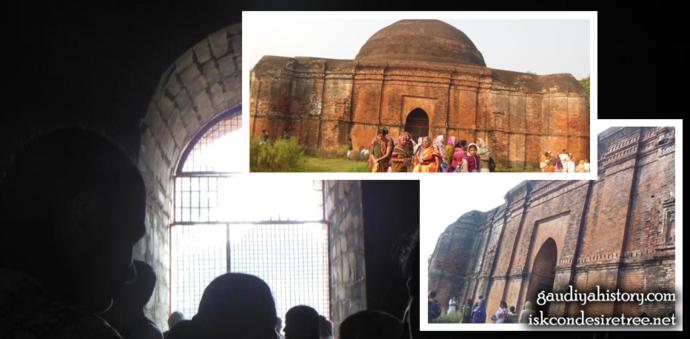
Sanatana Goswami

The Shah was disquieted by Sanatana’s illness and he sent a doctor to examine him. The doctor came back and reported to the king that Sanatana was in good health and that he was studying the Bhagavat with a group of panditas. When he heard this, the Shah went to Sanatana himself and spoke to him very affectionately, trying to convince him to come back to work. Sanatana refused, however, to return to his ministerial duties and furthermore refused to accompany the Shah in the war he was preparing with Orissa. The Shah became suspicious of Sanatana and had him put in prison. (In the wallpaper: The prison where Sanatana Goswami was put for 9 months, Ramkeli, Malda town).

 
   Sanatana knew the Muslim jailkeeper, for he was the one who had hired him. He began trying to persuade him to let him go, saying that the Almighty would surely bless and give him salvation for setting free someone who had been unjustly imprisoned. The jailor remained unconvinced, so Sanatana tried to win him over by reminding him that he owed him a favor for having given him the job.
 
   When the jail keeper still refused to let him go, Sanatana offered him a bribe of 5,000 rupees. At this, the jailkeeper’s resolve began to waver, but he was still afraid of being caught by the Badshah. Sanatana told him, “The Shah has gone to war. When he comes back, just tell him that I went to the toilet. Then when I went to the Ganges to wash myself, I jumped into the water and disappeared. Say that you looked everywhere but couldn’t find me.”
 
   Sanatana further assured him that he would not remain in the area, as it was his intention to become a Sufi and go on the Haj to Mecca. Therefore, he need not worry on that account. The jailor remained reticent, however, and finally Sanatana had the grocer bring 7,000 rupees of the money which Rupa had left in his safekeeping and placed it directly in front of him. When he saw the money before him, the jailor became greedy and capitulated. He cut Sanatana’s chains and helped him to cross the Ganges.
 
    In general, we consider flattery, asking return for a favor, putting temptation before someone, telling someone to lie, and bribery all to be unethical acts. Sanatana, however, used all the means at his disposal to escape bondage so that he could join the Lord and engage in His service. To achieve an auspicious end, any means may be permissible. The purity or impurity of a particular means depends on the purity or impurity of the objectives to be achieved. In order to serve his master Rama, the Supreme Brahman, Hanuman burned down Lanka, killing many living beings. Because he was acting for the pleasure of the all-auspicious Supreme Lord, however, everyone was ultimately benefited by his action, and Hanuman is still considered worshipable to this very day. On the other hand, one could bathe in a holy river three times a day and worship the Deity of the Lord, and be completely in the mode of ignorance if his objective is to do harm to other beings.
 
   Even from the worldly point of view we see that one who commits murder is considered a criminal and is punished by the death penalty, but if one fights on the battlefield to save the nation and kills many members of an enemy army, he is not punished but rather decorated with medals. This is because he is not acting for personal ends, but for those of the collectivity. This is easy to understand, but when one acts, not for the limited purposes of serving the country, or even the entire world, but for the supremely auspicious owner of unlimited millions of universes, then that is the most justifiable of purposes and the highest benefits are attained by everyone through such actions. In the Padma-purana, it is written:
 
man-nimittam kritam papam api dharmaya kalpate
mam anadritya dharmo ‘pi papam syan mat-prabhavatah
 
   Even sinful activities done for My sake are to be considered religious acts. On the other hand, pious activities done while disdaining Me are considered to be sin. This is the extent of My power.
 
   Those who chant the Holy Names or make a show of devotion, but in fact are seeking to achieve mundane, egoistic goals, are factually engaged in sin and are destined for a hellish fate. Krishna also states in the Bhagavad-gita,
 
yasya nahamkrito bhava buddhir yasya na lipyate
hatvapi sa imal lokan na hanti na nibadhyate
 
   He who is free from egotism (arising from aversion to the Absolute), and whose intelligence is not implicated (in worldly activities)–even if he kills every living being in the whole world–does not kill at all, nor does he suffer a murderer’s consequences. (Bhagavad-gita 18.17)
 
   When causeless devotion is manifest in the soul and one’s heart has an honest eagerness to find service to the Lord, then one gives up all consideration for happiness in this world, for renunciation is a side effect of unmotivated devotion.
 
Ishana Nearly Gets Sanatana Killed
 
   Sanatana had been prime minister, yet he escaped from jail with practically not a penny to his name. He did not take the main highway, but travelled as quickly as possible through fields and villages until he reached Pataria Mountain, which is part of the Raj Mahal Hills in the Chota Nagpur area in the state of Bihar. He did not know how to get across this mountain, and so requested the aid of a landowner who was also a robber chieftain. Accompanying Sanatana was a longtime personal servant named Ishana. Through the help of a palmist, the landowner was able to know that Ishana had eight gold coins in his possession, so he welcomed Sanatana into his home and treated him with great hospitality.
 
   Sanatana was sufficiently experienced from his years in politics to become suspicious of the warm treatment he was getting from his host, and so he asked Ishana whether he was carrying anything of value. Ishana answered that he had seven gold coins, keeping his other coin a secret from him. Sanatana said, “Why have you brought this ruination upon us?” After gently chastising his servant in this way, he took the coins from him and gave them to his host, asking him to help him get across the mountain.
 
   The landowner then revealed to Sanatana that he had known all along about the eight gold coins and that it had been his intention to murder them both that night somewhere on the mountain in order to take the money. He was very pleased that Sanatana had given him the gold and was even ready to return it to him, but Sanatana refused. He was intelligent enough to understand the adage: avyvasthita-cittasya prasado’pi bhayankarah, “even the kindness of an undependable person is dangerous.”  
Sanatana Goswami

How can one have faith in the n/div bsp; words of a rascal? He sometimes tells the truth and sometimes falsehoods. Just as with the clouds of Shravan--sometimes there is sunshine and sometimes rain. (In the wallpaper: Mountain and gold coins).

dhurtasya vacane kvastha kvacit satyam kvacin mrisha
kvacid raudram kvacid vrishtih shrastrong vanasya ghano yatha
 
   How can one have faith in the words of a rascal? He sometimes tells the truth and sometimes falsehoods. Just as with the clouds of Shravan–sometimes there is sunshine and sometimes rain.
 
   After they had crossed the mountain, Sanatana told Ishana to take the remaining gold coin and return home. Ishana had shown by his attachment to this gold coin that he was not yet ready to accept a life of renunciation, that he was too dependent on material conditions. When unqualified people take the renounced orders, then these orders themselves become contaminated. This is the lesson that Sanatana gave through his servant Ishana.
 
Sanatana Meets the Lord in Benares
   After bidding good bye to Ishana, Sanatana continued on his way until he arrived at Hajipur on the northern bank of the Ganges near Patna. Sanatana’s brother-in-law, Shrikanta, made his home there. Though Shrikanta invited him to stay there for a few days to recuperate from the voyage, Sanatana declined his invitation because of his desire to see the Lord. Shrikanta gave him a valuable blanket of Bhutanese wool.
 
   Sanatana then continued on to Benares where he was overjoyed to learn that Mahaprabhu was staying at the house of the physician, Chandrashekhara. Sanatana did not go straight into Chandrashekhara’s house but waited on his front porch. The Lord, the indweller of all souls, knew of His Devotee’s arrival and sent Chandrashekhara to the door to invite him in. As soon as Sanatana entered, Mahaprabhu immediately rushed to embrace him. The meeting of the Lord with His Devotee affected them both so intensely that they were overcome by the transformations of ecstatic love. In His affection for Sanatana, the Lord started to brush off the dust accumulated on his body from his travels, but this caused Sanatana to feel uncomfortable. He told the Lord not to touch him, but the Lord answered,
 
   “I touch you in order to purify Myself. Your devotional force is so great that you can purify the entire universe. I look at you, I touch you and I sing your glories. By so doing, all My senses attain their most perfect use.” (Chaitanya Charitamrita 2.20.56,60)
 
   The Lord repeated again and again that He was touching Sanatana for His own purification and for the purification of the entire universe. Then He immediately added, “Listen Sanatana. Krishna is the ocean of mercy, He saves the most fallen. He has delivered you from the hell known as Raurava.” Sanatana is, of course, an eternal associate, so there is no question of his being truly fallen, but Mahaprabhu wished to make a point for the benefit of the people of the world. He wanted to teach that worldly honor measured in terms of one’s fortune and accumulation of sense objects is in truth misfortune, since the accumulation of material possessions for the sake of gross or subtle sense gratification ultimately leads to a hellish existence. Conditioned souls who are bewildered by the illusory energy are constantly busy working hard in order to accumulate wealth, position and influence, whether by fair means or foul. Seldom does one come across an exemplary householder who knows that Krishna is the only true enjoyer and engages all his worldly possessions in the Lord’s service rather than considering them to be the objects of his own enjoyment. 
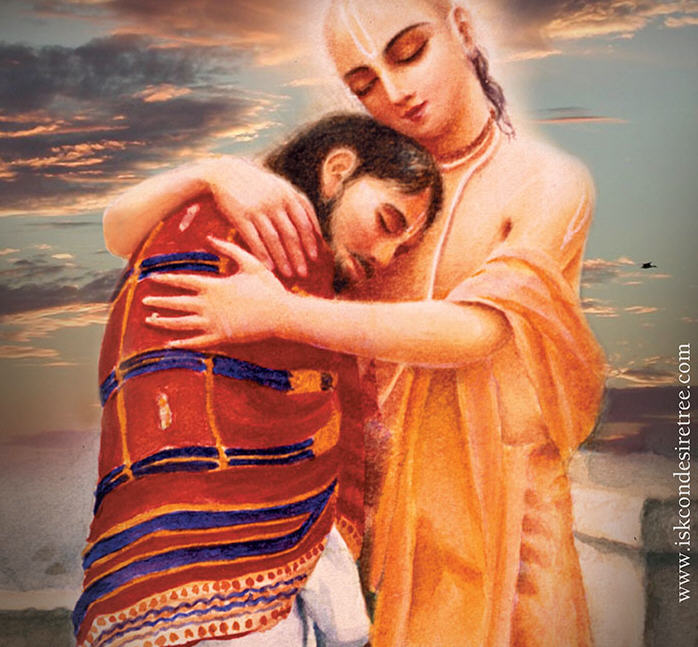
Sanatana Goswami

“I touch you in order to purify Myself. Your devotional force is so great that you can purify the entire universe. I look at you, I touch you and I sing your glories. By so doing, all My senses attain their most perfect use.” (Chaitanya Charitamrita 2.20.56,60) (In the image: from right to left Shri Krishna Chaitanya, Sanatana Goswami).

 
   While Mahaprabhu was in Benares, He stayed with Chandrashekhara and took His meals at the house of Tapana Mishra. Mahaprabhu introduced Sanatana to these two Devotees, and Tapana Mishra invited Sanatana to come to his house and take Mahaprabhu’s Prasad remnants. After many days in prison and travelling, Sanatana’s hair and beard had grown long. The Lord told him to get shaved, so that he would look “respectable”. Vaishnavas in general are clean shaven, growing neither beard nor moustache. With the exception of the chaturmasya period when one does not shave nor cut the fingernails, this is the accepted practice for Vaishnava men. Vaishnava sannyasis, however, usually shave only once a month on the full moon day, as for them to shave daily would be considered unnecessary preoccupation with the body.
 
   After being shaved, Sanatana took his bath in the Ganges. When he came back to the house, Chandrashekhara wanted to give him a new cloth, but Sanatana refused it, taking back his old one. Though he had been rich enough to give clothes to thousands of mendicants, on this day he was reluctant to accept a new cloth for himself. When one’s desire to worship the Lord is real, one becomes indifferent to nice clothes or good food. Accepting gifts from Vaishnavas or taking their remnants is an exception to this rule, however, as these do not have the poisonous character that other sense objects have. Every single one of Sanatana’s actions contains a lesson for the conscientious sadhaka.
 
   Mahaprabhu was extremely pleased to see Sanatana’s renunciation. Thus it is said,
 
mahaprabhura bhakta jata vairagya pradhana
yaha dekhi’ tushta han gaura bhagavan
 
   Renunciation is the predominating characteristic of every one of Mahaprabhu’s Devotees. When Lord Gauranga sees their renunciation, He is very pleased. (Chaitanya Charitamrita 2.6.220) 
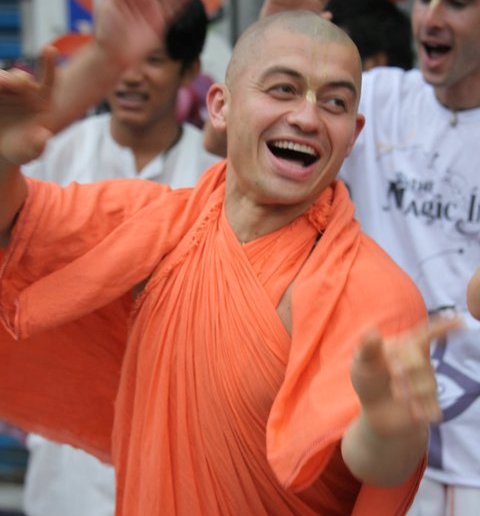
Sanatana Goswami

Vaishnavas in general are clean shaven, growing neither beard nor moustache. With the exception of the chaturmasya period when one does not shave nor cut the fingernails, this is the accepted practice for Vaishnava men. Vaishnava sannyasis, however, usually shave only once a month on the full moon day, as for them to shave daily would be considered unnecessary preoccupation with the body. (In the image: Harinama Sankirtana somewhere in Europe).

 
   When one is intoxicated by material sensuality and enjoyments and engaged in competition to attain them, one is destined for a falldown from any spiritual attainment.
 
   There was a Maharashtrian Brahmin who invited Sanatana to come daily to his house to eat for as long as he stayed in Benares. Sanatana refused, however, saying that he prefered to keep body and soul together by eating only madhukari, that is to say, by begging a handful of food from several houses each day. A pure Devotee has no desire for bodily comfort.
 
   Sanatana Goswami had torn his old cloth into two to make a loincloth (bahirvasa) and a shawl (uttariya), but even so, he continued to wrap himself in the Bhutanese wool blanket. Mahaprabhu looked repeatedly at this blanket, and Sanatana realized that Mahaprabhu did not approve of it. That day, when he went to the Ganges ghat, he saw a Bengali mendicant washing a quilt in the river. He offered him his expensive blanket in exchange for the quilt. When Sanatana came back wearing the threadbare quilt, the Lord was pleased.
 
   The Lord said, “I had been thinking about this. It seems that since Lord Krishna is very merciful, He has cured you of your disease of attachment to sense enjoyment. Why then would He allow you to hold fast to a last bit of material attachment? After restoring someone to health, a good physician does not allow any trace of the disease to remain. It is contradictory to practice madhukari while wearing a blanket worth three gold coins. By so doing, you would have lost your spiritual strength and become a laughing stock.” (Chaitanya Charitamrita 2.20.90-2)
 
   Shri Chaitanya Mahaprabhu is the Supreme Personality of Godhead Himself. Even so, He played the role of the supreme teacher. He insisted that His personal associates maintain the standards of behavior that he Sanatana was sufficiently experienced from his years in politics to become suspicious of the warm treatment he was getting from his host, and so he asked Ishana whether he was carrying anything of value. Ishana answered that he had seven gold coins, keeping his other coin a secret from him. Sanatana said, set and himself followed.
 
   I shall accept the role of a Devotee and shall teach devotional service by practicing it Myself. It is explained in the Bhagavat and the Bhagavad-gita that if one does not oneself practice a religious principle, it cannot be taught. (Chaitanya Charitamrita 1.3.20-1)
 
yad yad acarati shreshthas tat tad evetaro janah
sa yat pramanam kurute lokas tad anuvartate
 
   The general masses imitate the ways of great men. They follow whatever the great personality accepts as the right conclusion. (Bhagavad-gita 3.21)
 
The Lord’s Teachings to Sanatana
 
   Being pleased with Sanatana, Mahaprabhu infused him with spiritual power, giving him the capacity to ask appropriate questions about the practice of true spiritual life. Without the mercy of the Supreme Lord, genuine, honest questions on such matters cannot arise in someone’s mind. Most people ask questions thinking that they already know the right answer, simply as a sort of debating technique. No spiritual benefit arises from such types of questions. Honest questions meant to find out doctrinal truths leading to surrender are called pariprashna (“relevant inquiry”) in the Bhagavad-gita:
 
Tad viddhi pranipatena pariprashnena sevaya
upadekshyanti te jïanam jïaninas tattva-darshinah
 
   You will be able to attain all this knowledge by satisfying the enlightened spiritual master with prostrate obeisances, relevant inquiry, and sincere service. Great souls who are most expert in scriptural knowledge and endowed with direct realization of the Supreme Absolute Truth will teach you that divine knowledge. (Bhagavad-gita 4.34)
 
   On the day a person undertakes his journey on the road to liberation, when his material entanglement is about to start the process of termination, he meets a spiritual master. Sanatana Goswami was himself an ever-liberated soul and a permanent companion of the Lord, but he showed what questions the aspiring practitioner of devotional service should ask his spiritual master on that day. He said to the Lord:
 
   “I was born in a low family and have always associated with low-class men. I am fallen and the lowest of men. Indeed, I have fallen into the well of sinful materialism and passed my whole life there. I have no idea of what is beneficial for me and what is not. In ordinary dealings, people consider me wise, and I have also come to think of myself as such. You have mercifully delivered me from the materialistic path. Now, by the same causeless mercy, please explain to me my duty. I don’t know who I am or why the threefold miseries constantly wear me down, so how can I attain the highest good? Actually, I do not even know how to inquire about the goal of life and the process for obtaining it. Please be merciful upon me and explain all these things to me.” (Chaitanya Charitamrita 2.20.99-103)
 
   Sanatana’s first question was ami ke? “Who am I?” This is the first question which arises in the heart of a person seeking the highest good. If one makes a mistake in assessing his true identity, then he will make errors when it comes to determining the ultimate goal of life. If one makes an error in determining the ultimate goal of life, then everything he does, every effort he makes, will be wasted. All of one’s duties, religious observations and self-interest rest upon the proper knowledge of oneself. If one takes the body to be the self, then he considers the maintenance of the body itself to be the goal of life or prayojana-tattva, and one’s self-interest will be the fulfilment of goals related to the body; duties will also be considered in terms of these ends, and morality, or the determination of good and bad, will all be determined on the basis of what is good or bad for the body. On the other hand, if someone takes the subtle body to be the self, then one will consider his personal interests in terms of its development and he will consider his religious duty to help others to develop in this way. Those who consider the self to be a soul which exists beyond the gross and subtle bodies will consider its development to be their self-interest and will consider it their religious duty to help other people to develop spiritually. Those whose vision is sufficiently clear to recognize their identity as spirit soul, but find themselves in the undesirable situation of bondage to the gross and subtle material bodies, still make favorable use of these coverings in an understanding of their true self-interest, which is that of the soul. They avoid the unfavorable use of the gross and subtle bodies.
 
   In his teachings to Sanatana Goswami, Shri Chaitanya Mahaprabhu taught that the living being’s true identity is to be Krishna’s eternal servant. The jiva is the Lord’s tatastha-shakti, or marginal energy, His separated expansion, who is simultaneously one and different from Him. The Lord taught him the sadhya and the sadhana, the goal of the seeker, and the methods by which the seeker achieves his goal. Mahaprabhu summarized the three elements of His teaching as the sambandha, saying that it was Krishna, the abhidheya, the practice which leads to perfection or devotion to Krishna, and the prayojana, the supreme goal of spiritual life or love for Krishna or prema. 
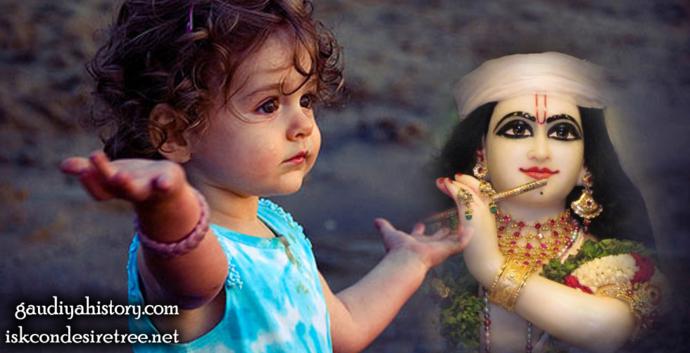
Sanatana Goswami

The sum total of the Vedic literatures explains three things: sambandha, abhidheya and prayojana. The living entity’s eternal relationship with Krishna is called sambandha. Devotional service is the process by which one attains the supreme objective, Krishna. Devotional service, or sense activity for the satisfaction of the Lord, is called abhidheya because it can develop one's original love of Godhead, which is the goal of life, the prayojana. This goal is the living entity's topmost interest and greatest treasure. (Chaitanya Charitamrita 2.20.124-5) (In the wallpaper: Shri Govinda, ISKCON Tirupati, a girl).

 
   The sum total of the Vedic literatures explains three things: sambandha, abhidheya and prayojana. The living entity’s eternal relationship with Krishna is called sambandha. Devotional service is the process by which one attains the supreme objective, Krishna. Devotional service, or sense activity for the satisfaction of the Lord, is called abhidheya because it can develop one's original love of Godhead, which is the goal of life, the prayojana. This goal is the living entity's topmost interest and greatest treasure. (Chaitanya Charitamrita 2.20.124-5)
 
   All these matters have been explained at great length, with copious quotations from scripture, by Krishnadas Kaviraj Goswami in his Chaitanya Charitamrita, from the 20th to the 23rd chapters of the Madhya-lila. Rather than repeat these teachings in detail here, which would lead to this account of Sanatana Goswami’s life becoming over long, we will limit ourselves to a brief summary.
 
   Mahaprabhu told Sanatana that the various scriptures, in particular, the Shruti, contain statements which indicate that the living being is both one with and different from the Supreme Lord. Different acharyas have put forth a variety of doctrines explaining the relation between this oneness and distinction, named advaita-vada, dvaita-vada, vishishtadvaita-vada, shuddhadvaita-vada, dvaitadvaita-vada, etc.. If one accepts the scripture, one must accept it in its entirety, including both types of affirmation, and try to find a way to harmonize the apparent contradictions. Shri Chaitanya Mahaprabhu’s solution to the problem was to establish the doctrine named achintya-bhedabheda, “inconceivable oneness and difference”. This doctrine has been looked upon favorably around the world and created a revolution in thinking.
 
   Mahaprabhu concluded His teachings with a discourse on the atmarama verse:
 
atmaramash ca munayo
nirgrantha apy urukrame
kurvanty ahaitukim bhaktim
ittham-bhuta-guno harih
 
   Self-satisfied sages who are freed from any bondage also engage in the unmotivated service of Shri Krishna, whose activities are all wonderful. Such are the transcendentally attractive features of Hari!
 
   Mahaprabhu gave eighteen different explanations of this verse from the Shrimad Bhagavat to Sarvabhauma Bhattacharya. When Sanatana asked the Lord to allow him to hear them, Mahaprabhu treated him to 61 different interpretations.
 
Sanatana Goes to Vraja
 
   After this, Mahaprabhu converted Prakashananda Saraswati and the other sannyasis of Benares to Vaishnavism. When He had completed instructing Sanatana in a most thorough fashion, He sent him to Vrindavan while He Himself took the less frequented road to Puri. Sanatana took the main highway to Vrindavan where he met Subuddhi Raya who was following Mahaprabhu’s instructions to atone for his past sins by chanting Hare Krishna. Though he was barely able to make a living selling dry wood, Subuddhi would provide for the Vaishnavas who came to Vraja from Bengal.
 
   Sanatana took the pilgrimage circuit through the twelve forests of Vraja in the company of Subuddhi and the Sanoriya Brahmin. From them he learned that Rupa and Anupama had also completed the circuit not long before and had then taken the road along the banks of the Ganges to return to Bengal. 
 
   When Mahaprabhu Himself did the Vraja parikrama, He discovered Radha Kund and Shyama Kund near Arit village. Then He went to see the Deity of Harideva at Govardhana after which He desired to see Giridhari Gopal. The Gopal Deity of Madhavendra Puri had His Temple on top of the hill. Mahaprabhu had vowed not to walk on Govardhana, but nevertheless wished to take darshan of Gopal. While He was wondering how to solve this problem, there was a panic in the area that the Muslims were planning to destroy images throughout Vraja and so Gopal’s pujaris took Him out of His Temple and hid Him in the village of Gatholi. Mahaprabhu then could go there and take His darshan. From time to time, Gopal would perform this pastime of being moved to Gatholi in this way. Sanatana also had the good fortune to be able to visit Gopal while He was there. 
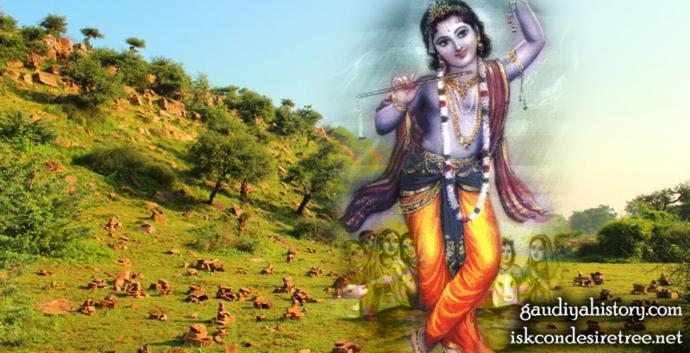
Sanatana Goswami

The Gopal Deity of Madhavendra Puri had His Temple on top of the hill. Mahaprabhu had vowed not to walk on Govardhana, but nevertheless wished to take darshan of Gopal. While He was wondering how to solve this problem, there was a panic in the area that the Muslims were planning to destroy images throughout Vraja and so Gopal’s pujaris took Him out of His Temple and hid Him in the village of Gatholi. Mahaprabhu then could go there and take His darshan. (In the wallpaper: Giri Govardhan, Shri Giridhari, Shri Vrindavan Dham, Uttar Pradesh).

 
Sanatana Visits the Lord in Puri
 
   It took Rupa Goswami longer to get to Bengal than he had expected and so he was unable to join the other Devotees on their annual trip to Puri to see the Lord. He therefore arrived some time after the main group and went to stay with Hari Das Thakur. When Mahaprabhu met Rupa, he inquired after Sanatana and heard from him that the brothers had taken different roads and thus missed each other.
 
   After touring Vrindavan, Sanatana Goswami took the Jharikhanda route to Puri. As a result of drinking bad water in the jungle, Sanatana came down with scabies. He became depressed as a result of the running sores on his body and in his despondency began to plan a suicide, thinking that due to his low birth and his now disgusting physical condition, he would not only be unable to go near the Temple and see Jagannath, but would also be deprived of Mahaprabhu’s darshan. He would not even be able to stay close enough to theTemple to see it, and if Lord Jagannath’s servants should accidentally touch him, he would commit a great offense. All in all, he thought it would be better to throw himself under the wheels of Jagannath’s chariot and be crushed to death while watching Mahaprabhu dance.
 
   When he finally arrived in Puri, he went directly to see Hari Das Thakur and paid his respectful obeisances to him and Hari Das affectionately embraced him. Sanatana then began to stay with him. Thus when Mahaprabhu came to see Hari Das, as he was wont to do, Sanatana had the opportunity to see him. The Lord was so overcome by divine love when He saw Sanatana that He approached with the intention of embracing him. Sanatana retreated, however, thinking himself too impure to be touched by the Lord. Nevertheless, Mahaprabhu would not let him escape and took him in his arms by force, holding him tightly enough that the fluid oozing from Sanatana’s sores was smeared on His body, the sight of which broke Sanatana’s heart. Mahaprabhu then gave Sanatana the news of Rupa’s visit and Anupama’s devotion to Rama and his departure for Rama’s eternal abode.
 
   On another day, the all-knowing Mahaprabhu came to Siddha Bakula where Hari Das and Sanatana stayed and suddenly confronted Sanatana with his intention to commit suicide during the Rathayatra festival. He said,
 
   “My dear Sanatana, if I could attain Krishna by committing suicide, then I would give up millions of bodies without a moment's hesitation. But I cannot attain Krishna simply by giving up the body, but only through bhajana. There is no means other than devotional service by which to attain Him.” (Chaitanya Charitamrita 3.4.55-6)
 
   In this way, Mahaprabhu taught the world through Sanatana that suicide is an act of the mode of ignorance which cannot be used to attain Krishna. It is only through the cultivation of pure devotion in practice that one can attain the Supreme Lord. The best forms of bhajana, or worship, are known as the nine kinds of devotional service, or nava-vidha bhakti. The best of these is the congregational chanting of the Holy Names of Krishna, Harinama-sankirtana. Finally, Mahaprabhu revealed how dear Sanatana was to him when He said,
 
   “You have already surrendered yourself to Me, so your body is now My personal property. Why do you want to destroy another’s property? Are you unable to distinguish right from wrong? Your body is an important instrument of Mine through which I shall accomplish many things.” (Chaitanya Charitamrita 3.4.76-8)
 
   During the Chaturmasya period, many Bengali and Orissan Devotees would come to Puri to be with the Lord, and that year they also met Sanatana. Sanatana was struck with wonder by the Lord’s dancing before Jagannath’s chariot. When the Bengali Vaishnavas returned to their homes after the four month period, Sanatana remained in Puri.
 
   During the hot season, in the month of Jyestha, the Lord stayed with Gadadhara Pandit at Yameshvara Oota. One day, He called Sanatana to come and see Him at noontime. Rather than taking the main road leading from the Simha Dvara to the seashore, Sanatana took another path which led across the hot sands of the beach. Though Sanatana had no consciousness of the burning heat of the sand, his feet were covered in blisters when he arrived.
 
    The Lord asked Sanatana why he had not taken the path which led from the Simha Dvara. Sanatana replied,
 
   “I have no right to pass by the Simha-dvara, for the servants of Jagannath are always coming and going there. Since they are always using that road, I would not be able to pass withordquo; Sanatana is, of course, an eternal associate, so there is no question of his being truly fallen, but Mahaprabhu wished to make a point for the benefit of the people of the world. He wanted to teach that worldly honor measured in terms of onbsp; nenbsp; ut touching them. If that should happen, I would be ruined.” (Chaitanya Charitamrita 2.4.126-7)
 
   Mahaprabhu was very pleased by Sanatana’s respect for Jagannath’s pujari/divs and by his humility. He answered him as follows:
 
   “My dear Sanatana, you can save the entire universe and even the demigods and great saints are purified by touching you. Nevertheless, it is the characteristic of a Devotee to observe Vaishnava etiquette. Maintenance of Vaishnava etiquette is the ornament of a Devotee. One who transgresses these rules of behavior becomes a laughing stock and is lost both in this world and the next. By observing the etiquette, you have brought Me great satisfaction. Who else but you will set this standard?” (Chaitanya Charitamrita 3.4.126-7) 
Sanatana Goswami

“My dear Sanatana, if I could attain Krishna by committing suicide, then I would give up millions of bodies without a moment's hesitation. But I cannot attain Krishna simply by giving up the body, but only through bhajana. There is no means other than devotional service by which to attain Him.” (Chaitanya Charitamrita 3.4.55-6)... “You have already surrendered yourself to Me, so your body is now My personal property. Why do you want to destroy another’s property? Are you unable to distinguish right from wrong? Your body is an important instrument of Mine through which I shall accomplish many things.” (Chaitanya Charitamrita 3.4.76-8) (In the wallpaper: Lotus Feet of Shri Gopinath, ISKCON Chowpatty, Mumbai, Rath, Puri, a child).

 
   Mahaprabhu embraced Sanatana again and again, and once again, the oozing fluids from Sanatana’s blisters were smeared all over the Lord’s body.
 
   Finally, Sanatana became so troubled by the situation that he went to discuss the matter with Jagadananda Pandit, asking him for advice on how to free himself from the offenses that he was unwillingly committing. Jagadananda suggested that Sanatana leave Puri and return to Vrindavan.
 
   The next time that Mahaprabhu came to Siddha Bakula and embraced him, Sanatana blurted out his distress, saying that he should never have come to Puri as his coming had only resulted in his committing countless offenses. The contaminating impurities from his scabies daily touched the Lord’s body, plunging him deeper and deeper into misery. He begged Mahaprabhu for permission to leave for Vrindavan, letting Him know that it was Jagadananda who had thus advised him.
 
   When Mahaprabhu heard this, He became angry and said,
 
   “Jagadananda is just a newcomer, a boy. Yet, he has become so proud that he thinks he can give even you advice. You are his guru in every respect, both in material and spiritual terms and yet he gives you advice? Doesn’t he know his own worth? You are My teacher; you are an authority. And yet, like an impudent child, he is giving instructions even to someone as qualified as you.” (Chaitanya Charitamrita 3.4.158-60)
 
   When Sanatana heard Mahaprabhu criticize Jagadananda in this way, He took it as another sign of the Pandit’s great fortune on the one hand and His own misfortune on the other.
 
   “You accept Jagadananda into Your inner circle while venerating me. It is as though You were giving him ambrosia to drink and me the bitter juice of neem and tobacco leaves.” (Chaitanya Charitamrita 3.4.163)
 
   Even after hearing these words, Mahaprabhu continued to take Jagadananda’s actions as a sign of impudence. Shrila Bhaktisiddhanta Saraswati Goswami Thakur has written in this connection, “Everyone has a certain status. If someone thinks that he is more important than he really is, he transgresses the lines of etiquette which are prescribed by seniority, etc., and gives advice to someone to whom he should rather offer respect. Mahaprabhu did not encourage such transgressions, but rather sought to discourage a younger Devotee like Jagadananda from behaving in this way.”
 
   The Lord further prohibited anyone from looking upon Sanatana’s body as material.
 
   “You take your body to be disgusting, whereas I think that your body is like nectar. Your body is transcendental, never material, but you conceive of it in material terms.” (Chaitanya Charitamrita 3.4.172-3)
 
   When Hari Das Thakur objected that the Lord was exaggerating out of His own mercy, the Lord laughed and explained to him and Sanatana as follows:
 
   “My dear Hari Das and Sanatana, I think of you as My adopted children and of Myself as your maintainer. The maintainer never takes seriously any faults of the maintained. I never think of Myself as deserving of respect, but because of affection I always consider you to be like My little boys. Even when a child passes stool and urine that touch her body, a mother never hates the child. On the contrary, she takes much pleasure in cleansing him and takes his filth to be like sandalwood pulp. Similarly, I felt no disgust at being touched by the fluids oozing from Sanatana’s itches.” (Chaitanya Charitamrita 3.4.184-7)
 
   Shri Chaitanya Mahaprabhu went on to say,
 
   “The body of a Devotee is never material. It is considered to be transcendental, full of spiritual bliss. At the time of initiation, when a Devotee fully surrenders unto the service of the Lord, Krishna accepts him to be as good as Himself. When the Devotee's body is thus transformed into ecstatic spiritual existence, he is able to render service to the lotus feet of the Lord… Krishna produced scabies on Sanatana’s body and sent him here to test Me. Had I refused to embrace him out of disgust, I would certainly have committed an offense to Krishna Himself. This is the body of an associate of Krishna. It has no foul odor coming from it. On the first day that I embraced him, I smelled the aroma of chatuhsama [a mixture of sandalwood pulp, camphor, aguru and musk].” (Chaitanya Charitamrita 3.4.191-7)
 
   This time, when the Lord embraced Sanatana, the foul itches which covered his body immediately disappeared and his skin took on an effulgent golden glow.
 

Jagadananda and Sanatana in Vraja

 
   Sanatana stayed a full year in Puri, after which Mahaprabhu told him to return to Vrindavan. He bid the Lord goodbye after the Òolayatra and took the jungle path to Vrindavan. Rupa Goswami joined him there not long afterward. When Raghunath Bhatta Goswami came to Vrindavan on Mahaprabhu’s order, he stayed with Rupa and Sanatana and daily recited the Bhagavat for them in a sweet voice.
 
   Some time later, Jagadananda Pandit took permission from Mahaprabhu to come to Vrindavan. When he came there, he met Sanatana who was overjoyed to see him. The two of them went together on a tour of the twelve forests of Vraja. Sanatana encouraged Jagadananda to stay with him in Gokula where he was settled at that time. Even though they dwelt together, they ate separately. Shrila Bhaktivinoda Thakur writes in his Amrita-pravaha-bhashya, “Sanatana had become habituated to the madhukari system and lived on a few pieces of bread each day. Jagadananda, however, could not live without eating rice, and so he went every day to a nearby Temple to cook. In those days, even in the Temples of Vraja, rice and dahl were not regularly offered to the Deities.”
 
   One day, Jagadananda invited Sanatana to eat with him. Sanatana desired to show the world the extent of Jagadananda’s devotion to Mahaprabhu. So when he came to eat Jagadananda’s offering, he wore around his head a saffron cloth which had been given to him by a certain Mukunda Saraswati. When Jagadananda learned that the cloth was not a gift from Mahaprabhu, he was so angry with Sanatana that he took the pot in which the rice had been cooking and threatened to hit him with it. He said,
 
   “You are Mahaprabhu’s most important associate. No one is dearer to Him than you. How could anyone tolorate you wearing another sannyasi’s cloth around your head?” (Chaitanya Charitamrita 3.13.56-7)
 
Sanatana Goswami

Sanatana gave Him sand from the place where Krishna held the rasa dance, a stone from Govardhana, a garland of gunja berries and some dried ripe pilu fruits. Jagadananda gave all these gifts to Mahaprabhu upon his arrival in Puri; He and His Devotees especially enjoyed the pilu fruits. (In the images: Pilu fruits).

   Sanatana answered by praising Jagadananda’s exclusive dedication to Gauranga Mahaprabhu:
 
   “Well said! It is clear, Pandit Mahashaya, that you are unequalled in your love for the Lord. Only from you could I have learned this lesson, for you alone have such solid faith in the Lord.. My purpose in binding the cloth around my head has been realized, for as soon as you saw it, I was able to witness the manifestations of your love for the Lord. A Vaishnava should not wear a red-colored cloth. I will give it to someone else, for I have no further need for it.” (Chaitanya Charitamrita 3.13.56-61)
 
   Jagadananda stayed in Vraja for two months, after which he was no longer able to tolerate being separated from Mahaprabhu. He took leave of Sanatana and headed in the direction of Jagannath Puri. As they bid each other goodbye, as gifts for Mahaprabhu, Sanatana gave Him sand from the place where Krishna held the rasa dance, a stone from Govardhana, a garland of gunja berries and some dried ripe pilu fruits. Jagadananda gave all these gifts to Mahaprabhu upon his arrival in Puri; He and His Devotees especially enjoyed the pilu fruits.
 
Sanatana’s Service to the Lord
 
   Mahaprabhu gave Sanatana four responsibilities:
 
   (1) to preach pure devotional service by establishing the doctrines of pure devotion;
 
   (2) to discover and make known the various places where Krishna had His pastimes;
 
   (3) to establish the service of the Deity of Krishna in Vrindavan; and
 
   (4), to establish proper Vaishnava behavior through compiling a Vaishnava rule book or smriti, and in this way make the foundations of a Vaishnava society.
 
   “O Sanatana, you should broadcast the revealed scriptures on devotional service and excavate the lost places of pilgrimage in the district of Mathura. Establish the Deity service of Lord Krishna in Vrindavan. You should also compile a scripture containing the rules of devotional practice and preach these practices.” (Chaitanya Charitamrita 2.23.97-8)
 
   In following the instructions to broadcast the revealed scriptures on pure devotional service and to establish the foundations of proper Vaishnava practice and etiquette, Sanatana wrote four books, all of which are considered to be jewels by the Devotees. He wrote (1) a commentary on the Haribhakti-vilasa known as Digdarshani, (2) a commentary on the tenth canto of the Shrimad Bhagavatam known as the Brihad-Vaishnava-Toshani, (3) Lila-stava or Dashama-charita, and (4) Brihad-Bhagavatamrita, to which he added a commentary. Mahaprabhu Himself gave directions to Sanatana about the contents of the Hari-bhakti-vilasa, which is the smriti scripture, or rule book for the external practices to be followed by the Devotees.
 
   Sanatana spent a great deal of time searching out the various holy spots in the land of Vraja. He also established the service of the Madana Mohana Deity. Shrila Sanatana Goswami founded a math in Vrindavan at the place known as Dvadashaditya Öila. He first had a Temple built there for Radha-Madana Mohana. It is said that a rich officer in the Sultan’s army named Krishna Das Kapura built the Temple and a kitchen and financed an opulent standard of worship for the Deity. He later became Sanatana Goswami’s disciple.
 
   When Sanatana Goswami was staying in Gokula Mahavana, he saw Madana Gopal playing with a group of cowherd boys at Ramanareti. Narahari Chakravarti has given a beautiful description of this vision in his Bhakti-ratnakara:
 
   O Shrinivas, just look at this place. Sanatana Goswami used to live here. All the fortunate residents of Mahavana would be revitalized by seeing him. He joyfully lived in Mahavana looking upon his Madana Gopal Deity. Madana Gopal enjoyed playing on the sandy beaches which line the Yamuna, known as Ramana Reti. One day He came to that divine riverbank with the children of Mahavana, Himself taking the form of a cowherd boy. Sanatana watched him as He played various childhood games with the other children and thought, “This is no ordinary child.” When the children had finished playing and were leaving, Sanatana followed them. The child entered into the Temple and when Sanatana followed him inside, he saw no one but the Deity of Madana Mohana. He paid his obeisances to the Deity and then returned to his own dwelling without saying anything to anyone. So this is how Madana Mohan showed Himself to be under the control of Sanatana’s love. Sanatana’s wondrous character has thus filled the three worlds. (Bhakti-ratnakara 5.177-186) 
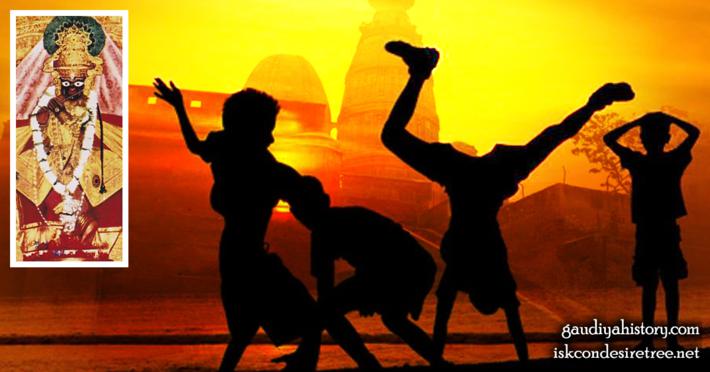
Sanatana Goswami

Sanatana watched him as He played various childhood games with the other children and thought, “This is no ordinary child.” When the children had finished playing and were leaving, Sanatana followed them. The child entered into the Temple and when Sanatana followed him inside, he saw no one but the Deity of Madana Mohana. He paid his obeisances to the Deity and then returned to his own dwelling without saying anything to anyone. So this is how Madana Mohan showed Himself to be under the control of Sanatana’s love. (In the wallpaper: backside image is of Madan Mohan Temple, Shri Vrindavan Dham, Shri Madan Mohan, Karoli, Rajastan, and kids).

 
Sanatana’s Glorious Pastimes in Vraja
 
   Krishnadas Kaviraj Goswami has described in his Chaitanya Charitamrita how Rupa and Sanatana Goswami worshiped Krishna in the land of Vraja:
 
   These brothers have no fixed residence. They spend each night beneath a different tree in the forest, one night under one tree and the next under another. Sometimes, they begged dry food from a Brahmin’s house and sometimes cooked food like dry bread and fried chick-peas. This is how they have given up all kinds of material enjoyments. They wrap themselves in a quilt and wear noting but a piece of torn cloth, claiming nothing but a waterpot as a possession. They engage almost twenty-four hours daily in rendering service to the Lord by chanting the Holy Names of Krishna and discussing His pastimes or dancing in great jubilation. They spend only an hour and a half in sleep, and some days, when overcome by the love of chanting the Lord's Holy Name, they do not sleep at all. Sometimes they write transcendental works about divine aesthetics, and sometimes they listen to talks about Shri Chaitanya Mahaprabhu or spend their time thinking about the Lord. (Chaitanya Charitamrita 2.19.127-31)
 
   While staying at Chakratirtha near Govardhana, Sanatana would regularly circumambulate the mountain. As he grew older, he became too weak to walk these 14 miles on a daily basis without becoming excessively fatigued. One day, Gopinath Himself came in the form of a cowherd boy to fan him when he became too tired from walking. After refreshing Sanatana in this way, the boy climbed onto the hill and brought down a stone marked with Krishna’s footprint. He gave the stone to Sanatana and said, “You have grown old. There is no need for you to trouble yourself to this extent any longer. I am giving you this stone from Govardhana. If you circumambulate this stone, you can consider yourself to have circumambulated Govardhana itself.” Then He disappeared. No longer able to see the charming form of the cowherd boy, Sanatana was overwhelmed with pain and began to cry. This story has also been told in the (Bhakti-ratnakara 5.728-741).
 
   Chakratirtha is on the northern shore of Manasi Ganga. There is a Temple dedicated to Chakreshvara Shiva, or as he is popularly known, Chakreshvara Mahadeva. Sanatana’s bhajana-kutira was under a neem tree which stood in front of this Temple. Just north of this place is a Temple which houses Gaura-Nityananda. Sanatana Prabhu’s Govardhana-Shila is currently kept in the Radha-Damodar Temple at Radha Kund.
 
   There are more stories about the glories of Chakratirtha. When Sanatana first came to this place, there were so many mosquitos that he was unable to concentrate while meditating on the Holy Name or writing transcendental literature, so much so that he decided to move. That night, Chakreshvara appeared to Sanatana in a dream and told him not to worry about the problem. He would be able to engage in his worship without disturbance. From that night on, there were no more mosquitos at Chakratirtha. 
Sanatana Goswami

That night, Chakreshvara appeared to Sanatana in a dream and told him not to worry about the problem. He would be able to engage in his worship without disturbance. From that night on, there were no more mosquitos at Chakratirtha. (In the wallpaper: Manasi Ganga, Shri Vrindavan Dham, Lord Shiva, mosquito).

 
   Shrila Sanatana Goswami also spent some time living in a cottage on the banks of Pavana Sarovara near Nandagrama. Here also he was granted a vision of Krishna as a cowherd boy, who gave him milk and told him to build a hut and engage in His worship there. One day, Rupa invited Sanatana to come and eat with him. For this occasion, he wished to prepare sweet rice, but he did not have the necessary ingredients. Shrimati Radharani took the form of a young cowherd girl and came to Rupa with milk, sugar, rice and ghee, in short, giving him everything he needed to make the preparation for Sanatana’s pleasure. Rupa Goswami cooked the sweet rice and after offering it to the Deity, gave the Prasad to Sanatana. Sanatana found that after relishing the delicious sweet rice, he was overcome by uncontrollable waves of ecstasy. Suspecting that something unusual had taken place, he asked Rupa where the ingredients had come from. When Rupa told him about the little cowherd girl, Sanatana immediately realized that it had been Radha. Because Radha was their goddess and they were her servants, the proper relation of served and servant had been reversed. He therefore strictly forbad Rupa from accepting such gifts in the future. (Bhakti-ratnakara 5.1311-30) 
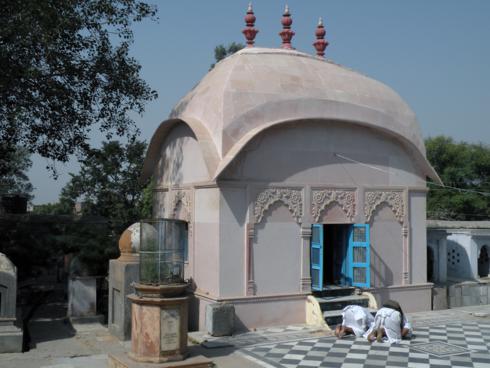
Sanatana Goswami

Sanatana Goswami’s samadhi tomb is found next to the old Radha-Madana Mohana Temple in Vrindavan. He left this world on the full moon day of Asharh in the Shaka year 1480 (1558 AD). (In the image: Samadhi of Shrila Sanatana Goswami).

 
   Another legend told about Sanatana is the following. Once there was a very poor Devotee of Shiva, whose name, according to the Bhaktamala and Gaudiya Vaishnava Abhidhana, was Shri Jivana Chakravarti. Originally from the village of Manakara in Burdwan district in Bengal, he had spent many years worshiping Shiva in Benares, praying to him for wealth. Finally, one night Shiva appeared to him in a dream and told him to go to Sanatana in Vrindavan, for he was in possession of a great wealth which he would share with him.
 
   The poor Brahmin immediately set off for Vrindavan where he found Sanatana deep in meditation. However, when he saw the Goswami, thin and dressed in a dirty loincloth, he began to doubt that he could give him the desired riches. Even so, he told Sanatana about the dream. Sanatana heard the Brahmin and came back to external consciousness. He answered saying that he lived by begging a few crumbs from a number of different houses, how could he possibly give him the riches he desired?
 
   The poor Brahmin was disappointed and turned away, thinking that perhaps the message Shiva had given him in the dream had just been an illusion. Meanwhile, Sanatana pondered why Shiva had sent the Brahmin to him. As he ruminated, he remembered a philosopher’s stone that was lying in a pile of rubbish and had long since been covered in dust. As soon as he remembered the existence of this valuable jewel, he sent someone to fetch the Brahmin and told him to take the jewel from the rubbish heap.
 
   When the Brahmin saw the touchstone, he was overjoyed and thought, now there will be no one as rich as I in the entire world! After walking some distance away, however, he began to wonder why Sanatana had completely forgotten about such a valuable possession. Indeed, if he cared so little for the philosopher’s stone, he must have something even more valuable. Perhaps he had been cheated! He wanted to know what riches Sanatana possessed that he cared so little for the touchstone.
 
   The Brahmin quickly ran back to Sanatana and expressed his doubts, asking him if he had anything more valuable in his possession. Then Sanatana told him that there was no greater wealth than love for Krishna and that material goods were insignificant and simply a cause of greater distress. The Brahmin then bowed his head and prayed to Sanatana to please give him the wealth which made him consider even a touchstone insignificant. Sanatana was moved by his prayer and mercifully bestowed upon him the riches of Krishna-prema.
 
   Sanatana Goswami’s samadhi tomb is found next to the old Radha-Madana Mohana Temple in Vrindavan. He left this world on the full moon day of Asharh in the Shaka year 1480 (1558 AD).
 
   [Excerpted from “Shri Chaitanya: His Life & Associates” by Shrila Bhakti Ballabh Tirtha Maharaj] 
Sanatana Goswami

The Brahmin then bowed his head and prayed to Sanatana to please give him the wealth which made him consider even a touchstone insignificant. Sanatana was moved by his prayer and mercifully bestowed upon him the riches of Krishna-prema. (In the wallpaper: Sankirtana Yagya somewhere in Europe).
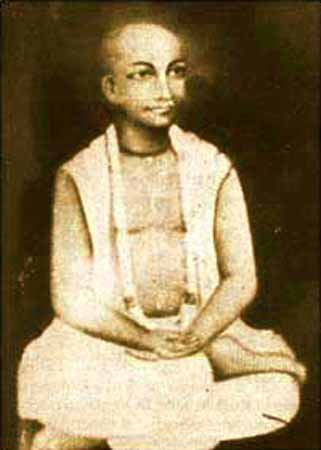
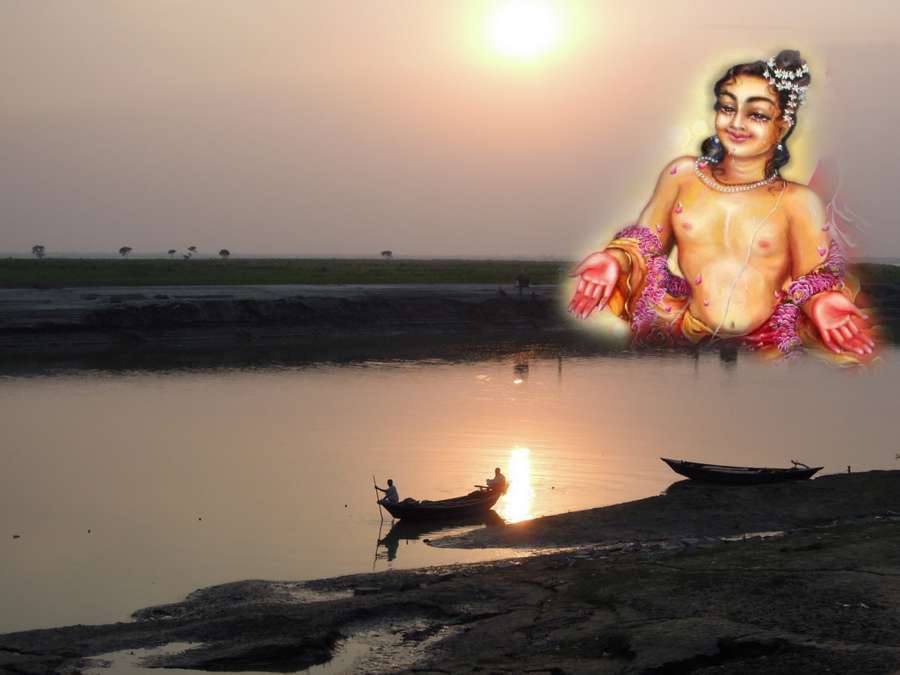
Madhavendra Puri – Biography

Madhavendra Puri

Brahma, the master of this universe, was the disciple of the Lord of the spiritual world. His disciple was Narada and Vyasa became the disciple of Narada. Suka became the disciple of Vyasa through the endowment of spiritual knowledge. Madhvacharya took initiation in the Krishna mantra from Vyasa. His disciple was Padmanabh acharya, ... Lakshmipati Tirtha, a reservoir of devotion, was Vyasa Tirtha's disciple. Madhavendra Puri was the disciple of Lakshmipati, and it is by him that the religion was founded. His disciple, the sannyasi Ishvara Puri, took up the mood of conjugal devotion, while Advaita Acharya (also the disciple of Madhavendra) took up the moods of servitude and friendship. Gaura accepted Ishvara Puri as His guru, and then flooded the material and spiritual worlds (with love). (In the image: Lord Shri Krishna is giving spiritual knowledge to Lord Brahma).
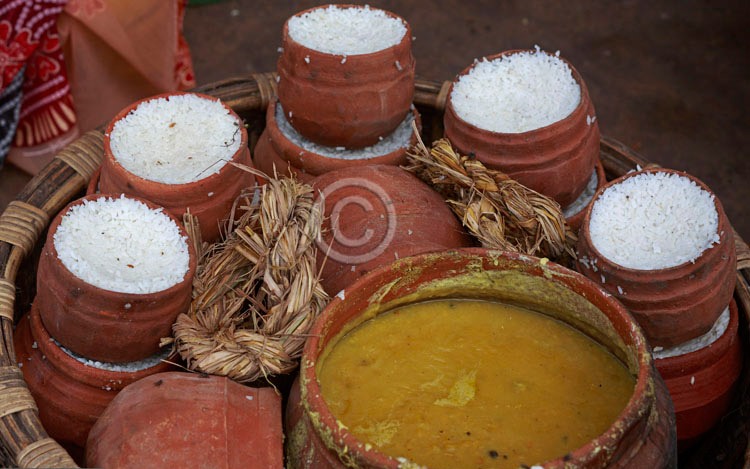
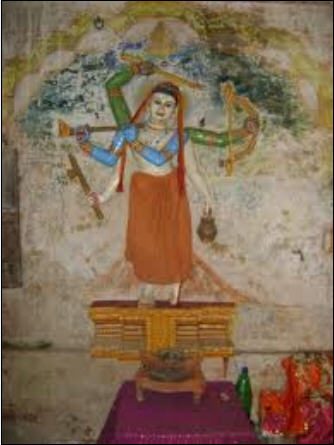
   Mahaprabhu's seniors, His parents and gurus, are all His servants and eternal associates and they take their birth prior to His appearance in order to serve Him in their own way.
 
   Whenever Krishna descends to the earth, He first sends down His elders. These include His father, mother, guru and all the other persons He considers to be the objects of His respect. He arranges that these persons should accept birth before He does. Madhavendra Puri, Ishvara Puri, Sachi, Jagannath, and Advaita Acharya are amongst those who appeared in this way. (Chaitanya-Charitamrita 1.3.92-4)
 
   Later in the Chaitanya Charitamrita (1.13.52-55), the same thing is stated in the following way:
 
   Whenever the son of the king of Vraja decides to appear on earth in order to fulfill a particular desire, He first sends down His seniors. I will briefly name some of them as it is not possible to mention everyone: Sachi Devi, Jagannath Mishra, Madhava Puri, Keshava Bharati, Ishvara Puri, Advaita Acharya, Shrivas Pandit, Acharyaratna, Pundarika Vidyanidhi, Hari Das Thakur.
 
The Disciplic Succession
 
   Shrila Madhavendra Puri appeared in the 14th century. He was a guru of the Brahma or Madhva sampradaya, one of the four (Brahma, Shri, Rudra and Sanaka) Vaishnava lineages that purify the world in the age of Kali. The Madhva lineage has been transcribed in books like Gaura-ganoddesha-dipika, Prameya-ratnavali and the writings of Gopal Guru Goswami. The same set of verses is found with some slight differences in the Bhakti-ratnakara (5.2549-2162). The following is the version as found in the Gaura-ganoddesha-dipika:
 
paravyomesvarasyasic chisyo brahma jagat-patih
tasya sisyo narado 'bhut vyasas tasyapa sisyatam
suko vyasasya sisyatvam prapto jnanavabodhanat
vyasal labdha-krsna-dikso madhvacaryo mahayasah
tasya sisyo naraharis tacchisyo madhava-dvijah
aksobhyas tasya sisyo 'bhut tac-chisyo jayatirthakah
tasya sisyo jnana-sindhus tasya sisyo mahanidhih
vidyanidhis tasya sisyo rajendras tasya sevakah
jayadharma munis tasya sisyo yad-gana-madhyatah
srimad-visnu-puri yas tu bhaktiratnavali-krtih
jayadharmasya sisyo 'bhud brahmanyah purusottahmah
vyasatirthas tasya sisyo yas cakre visnusamhitam
sriman laksmipatis tasya sisyo bhaktirasasrayah
tasya sisyo madhavendro yad-dharmo 'yam pravartitah
tasya sisyo 'bhavat sriman isvarakhya-puri-yatih
kalayamasa srngaram yah srngara-phalatmakah
advaitam kalayamasa dasya-sakhye phale ubhe
isvarakhya-purim-gaura urarikrtya gaurave
jagad aplavayamasa prakrtaprakrtatmakam
 
   Brahma, the master of this universe, was the disciple of the Lord of the spiritual world. His disciple was Narada and Vyasa became the disciple of Narada. Suka became the disciple of Vyasa through the endowment of spiritual knowledge. Madhvacharya took initiation in the Krishna mantra from Vyasa. His disciple was Padmanabh acharya, whose disciple was Narahari, who was followed by Madhva Dvija. Akshobhya was his disciple, then Jayatirtha, Jnanasindhu, Mahanidhi, Vidyanidhi and Rajendra followed. Jayadharma Muni was one of Rajendra's many disciples and Vishnu Puri, the author of Bhakti-ratnavali and Purushottam, the lover of Brahmin culture became his disciples. Vyasa Tirtha, the author of Vishnu-samhita, was the disciple of Purushottam. Lakshmipati Tirtha, a reservoir of devotion, was Vyasa Tirtha's disciple. Madhavendra Puri was the disciple of Lakshmipati, and it is by him that the religion was founded. His disciple, the sannyasi Ishvara Puri, took up the mood of conjugal devotion, while Advaita Acharya (also the disciple of Madhavendra) took up the moods of servitude and friendship. Gaura accepted Ishvara Puri as His guru, and then flooded the material and spiritual worlds (with love).
 
   Thus, Madhavendra Puri was the disciple of Lakshmipati-Tirtha. Madhavendra Puri's disciples included Ishvara Puri, Advaita Acharya, Paramananda Puri (a Brahmin from the Tirhu area), Brahmananda Puri, Shri Ranga Puri, Pundarika Vidyanidhi, Raghupati Upadhyaya, and others. Nityananda Prabhu is said by some to be Madhavendra Puri's disciple, others say that Lakshmipati was his guru, while the Prema-vilasa states that he was Ishvara Puri's disciple.
Madhavendra Puri

"The feeling of separation from Krishna, or transcendental vipralambha is the only practice by which the spirit soul can achieve perfection. Material feelings of separation give rise to a despondency that reveals the attachment one has for matter, whereas the despondency that results from the feelings of separation for Krishna are the best proof of one's desire to bring pleasure to His senses. The desire to bring pleasure to Krishna's senses shown by Madhavendra Puri, the great soul who is the root of this movement, is the ideal example to follow for anyone who wishes to serve the Lord. It is especially worth remarking that Mahaprabhu and His closes followers later adopted this example and made it their standard." (In the image: Shrimati Radharani).

   Bhaktivinoda Thakur writes: "Madhavendra Puri was a well known sannyasi of the Madhva sampradaya. His grand-disciple was Shri Chaitanya Mahaprabhu. Prior to his appearance, there was no evidence of prema bhakti in the Madhva line. In His verse, ayi dinia-dayardra-natha (Chaitanya Charitamrita 2.4.197), the seed of the religious doctrines of Chaitanya Mahaprabhu can be found."
 
   To this, Bhaktisiddhanta Saraswati Goswami Prabhupada adds, "Madhavendra Puri was the fist shoot of the desire tree of divine love that came out of the Madhva lineage. Prior to his appearance, there was no sign of the conjugal mood of devotion in the Madhva line." …
 
   Prabhupada Bhaktisiddhanta Saraswati writes: "The feeling of separation from Krishna, or transcendental vipralambha is the only practice by which the spirit soul can achieve perfection. Material feelings of separation give rise to a despondency that reveals the attachment one has for matter, whereas the despondency that results from the feelings of separation for Krishna are the best proof of one's desire to bring pleasure to His senses. The desire to bring pleasure to Krishna's senses shown by Madhavendra Puri, the great soul who is the root of this movement, is the ideal example to follow for anyone who wishes to serve the Lord. It is especially worth remarking that Mahaprabhu and His closes followers later adopted this example and made it their standard."
 
   Madhavendra Puri's disappearance day is the shukla dvadashi of the month of Phalgun.
 
   [Excerpted from “Shri Chaitanya: His Life & Associates” by Shrila Bhakti Ballabh Tirtha Maharaj] 

Gopala Bhatta Goswami – Biography

Gopala Bhatta Goswami

Shrila Gopala Bhatta Goswami.

   ananga-manjari yasit sadya gopala-bhattakah

bhatta-gosvaminam kecit ahuh sri-guna-manjari
 
   She who was formerly Ananga Manjari has appeared to enrich Mahaprabhu's pastimes as Shrila Gopal Bhatta Goswami. Some say that Gopal Bhatta is actually Guna Manjari. (Gaura-ganoddesha-dipika 184)
 
   Shrila Gopal Bhatta Goswami appeared in 1500 AD (though, according to some authorities, he was born in 1503) as the son of Venkata Bhatta in the town of Shrirangam in South India. Their residence was in a village not far from Shrirangam called Belagundi.
 
   According to Narahari in the Bhakti-ratnakara, Shrila Gopal Bhatta Goswami was given a vision in a dream by Mahaprabhu in which he was fortunate enough to witness all the Lord's Navadwip pastimes. An eternal associate of Krishna, he appeared in a faraway place in order to participate in Lord Gauranga's pastimes. Even so, he was able to know long before he even saw him that the Lord had appeared and taken sannyas. Gopal Bhatta did not particularly like the Lord's appearance as a sannyasi. He was distressed and crying alone when the Lord appeared to him and gave him the dream vision of his Navadwip lila. In this vision, the Lord was overwhelmed by ecstatic love, embraced him and drenched him in his tears.
 
   Having said this to Gopal, the Lord embraced him and drenched him in his tears. He then told him to keep all these experiences secret, and Gopal felt great joy in his mind. (Bhakti-ratnakara 1.123-4) 
 
   Through the power of Shri Krishna Chaitanya Mahaprabhu's merciful association, Venkata Bhatta, his brother Prabodhananda Saraswati, his son Gopal Bhatta Goswami, and all the other members of his family, were inspired to give up the worship of Lakshmi-Narayan and became engaged in the exclusive devotional service of Radha and Krishna. Shrila Gopal Bhatta Goswami took initiation from his uncle, Tridandi Yati Shrimat Prabodhananda Saraswati. Proof of this is found in the Hari-bhakti-vilasa:
 
bhakter vilasams cinute prabodha-
nandasya sisyo bhagavat-priyasya
gopala-bhatto raghunatha-dasam
santosayan rupa-sanatanau ca
 
   Gopal Bhatta, the disciple of Prabodhananda who is dear to the Lord, has collected these devotional activities to satisfy Raghunath Das, Rupa and Sanatan Goswamis. (Hbv 1.2) 
Gopala Bhatta Goswami

Through the power of Shri Krishna Chaitanya Mahaprabhu's merciful association, Venkata Bhatta, his brother Prabodhananda Saraswati, his son Gopal Bhatta Goswami, and all the other members of his family, were inspired to give up the worship of Lakshmi-Narayan and became engaged in the exclusive devotional service of Radha and Krishna. (In the image: Shri Shri Radha Madan Gopal, ISKCON Nashik, Maharashtra).

 
   Gopal's parents were very fortunate, for they surrendered themselves, life and soul, to the feet of Lord Chaitanya. They ordered their son to go to Vrindavan before they left this world, absorbed in meditating on the Lord. Gopal travelled directly to Vrindavan where he met with Rupa and Sanatan. (Bhakti-ratnakara 1.163-5)
 
Gopal Bhatta comes to Vrindavan
 
   When Gopal arrived in Vrindavan, Rupa and Sanatan wrote to Mahaprabhu to tell Him. The Lord was overjoyed and immediately wrote back telling them to affectionately take care of him as though he were their own younger brother. Shrila Sanatan Goswami compiled the Hari-bhakti-vilasa and published it in Shrila Gopal Bhatta Goswami's name. Rupa Goswami considered Gopal to be as dear to him as his own life and engaged him in the Deity worship of Radha Ramana. 
Gopala Bhatta Goswami

Shrila Rupa and Shrila Sanatana Goswamis.

 
   Shrila Gopal Bhatta Goswami became one of the Six Goswamis, but he always kept an attitude of meekness and humility. Thus, when Krishnadas Kaviraj approached him for permission to write the Chaitanya Charitamrita, he granted it, but under the condition that he not write about him. Krishnadas Kaviraj Goswami could not go against the order of Gopal Bhatta and thus did nothing more than mention his name. Shri Jiva Goswami writes in the introduction to the Sat-sandarbha that he wrote it on the basis of an earlier text by Gopal Bhatta. Shrila Gopal Bhatta Goswami also wrote a book called the Sat-kriya-sara-dipika ("Light on the essential sacraments for the Vaishnavas"). Thus his contribution to Gaudiya Vaishnava literature was in editing the Hari-bhakti-vilasa, preparing the notes for Jiva's Sat-sandarbha and in compiling the Sat-kriya-sara-dipika. He also gave great joy to the community of Devotees by writing a commentary on Bilvamangala's Krishna-karnamrta.
 
   Amongst his disciples were Shrinivas Acharya and Shri Gopinath Pujari. It is said that Mahaprabhu had such affection for Gopal Bhatta that he sent him His own belt and kaupina as well as a wooden seat which He had used. These items are still worshiped in the Radha Ramana Temple by the current sevaits.
 
Shri Shri Radha Ramana
 
   When Shrila Gopal Bhatta Goswami was visiting the pilgrimage centres of northern India, he found a Shalagrama Shila on the banks of the Gandaki River. He took the worshipable stone and carried it with him wherever he went, treating it as Vrajendranandana Krishna Himself. One day he thought that he would like to worship the Lord in a Deity form so that he could expand his service. On the very next day, he found that the Shalagrama Shila had transformed itself into Radha Ramana to fulfill the wish of His Devotee. This Deity stands alone without any form of Radha standing by His side. Instead, as a symbol of Radharani, a silver crown is placed on His left side. 
Gopala Bhatta Goswami

One day he thought that he would like to worship the Lord in a Deity form so that he could expand his service. On the very next day, he found that the Shalagrama Shila had transformed itself into Radha Ramana to fulfill the wish of His Devotee. This Deity stands alone without any form of Radha standing by His side. Instead, as a symbol of Radharani, a silver crown is placed on His left side. (In the image: Shri Shri Radha Raman, Shri Vrindavan Dham).

 
   The story is also told in the following way. It is said that Shrila Gopal Bhatta Goswami used to daily worship twelve Shalagramas. He developed a desire to serve the Lord in the form of a Deity, thinking that in this way he would be able to worship Him in a much better way. The Lord within his heart knew his feelings and through a rich merchant had many beautiful items used in the worship of the Deity, such as ornaments and clothes, sent to him. Gopal began to worry that all these beautiful objects would be wasted because there was no way that he could use them unless he had a Deity in human form. That night, he put the Shalagramas to rest and in the morning he saw that one of Them had been transformed into the Radha Ramana Deity. When Rupa and Sanatan heard that Krishna had so mercifully appeared to Gopal Bhatta, they immediately came with the other Devotees for darshan, and when they saw him, they were ecstatic with love. The annual festival commemorating Radha Ramana's appearance, when he is bathed publicly, takes place on the full moon day of Vaishakh. The Radha Ramana Temple is considered one of the most important in Vrindavan.
 
   Shrila Gopal Bhatta Goswami ended his earthly pastimes on the Krishna Panchami of Asarh of 1507 of the Saka era (1585 AD). His samadhi Temple is behind the current Radha Ramana Temple. By reading Shrinivas Acharya's hymn to the Six Goswamis, Sad-gosvamy-astaka, we can understand their glories.
 
[Excerpted from “Sri Chaitanya: His Life & Associates” by Srila Bhakti Ballabh Tirtha Maharaj]

Gaura Kishora Dasa Babaji Maharaja – Biography

Gaura Kishora Dasa Babaji Maharaja

Gaura Kishora Dasa Babaji Maharaja.

namo gaura-kishoraya sakshad vairagya-murtaye
vipralambha-rasambhodhe padambujaya te namah
 
   I bow to your lotus feet, Shrila Gaura Kishora Das Babaji, the embodiment of renunciation and the ocean of sacred rapture in separation.
 
Early Life
 
   Paramahamsa Shrila Gaura Kishora Das Babaji Maharaj was born into a Vaishya family on the banks of the Padma River in Bagayana village in Faridpur district in what is now Bangla Desh. The names of his parents are unknown. His given name was Vamshi Das. He was born sometime in the middle of the nineteenth century. He is important to us because he was the diksha guru of Shrila Bhaktisiddhanta Saraswati Goswami Prabhupada, founder of the Chaitanya Math and the world-wide Gaudiya Maths.
 
   Vamshi Das’s parents had him married at an early age according to the custom of the time, but always remained detached from householder life. His main interest was always worshiping the Lord. When his wife died, he left home and went to Vrindavan where he took the paramahamsa-vesha from Bhagavata Das Babaji (a disciple of Shrila Jagannath Das Babaji Maharaj) and took the name Gaura Kishora Das Babaji.
 
Gaura Kishora Comes to Navadwip
 
   After being initiated into the Babaji order, Gaura Kishora Das spent thirty years in Vraja engaged in intense religious practice. He also traveled outside of the Vraja area, visiting northern India and Bengal. While in the East, he met many of the leading Vaishnavas of Bengal and Orissa, such as Svarupa Das Babaji of Puri, Bhagavan Das Babaji of Kalna and Chaitanya Das Babaji of Kuliya. 
Gaura Kishora Dasa Babaji Maharaja

In 1893, when the birthplace of Chaitanya Mahaprabhu was inaugurated at the Shri Mayapur Yoga Pith, Jagannath Das Babaji Maharaj ordered him to stay in Navadwip. This is where Gaura Kishora remained for the rest of his life. (In the image: Yoga Pitha-birth place of Lord Chaitanya, Mayapur).

 
   In 1893, when the birthplace of Chaitanya Mahaprabhu was inaugurated at the Shri Mayapur Yoga Pith, Jagannath Das Babaji Maharaj ordered him to stay in Navadwip. This is where Gaura Kishora remained for the rest of his life. He saw all the residents of Navadwip with transcendental eyes, considering them to be divine beings. He thus accepted madhukari from them, cooking everything in a rejected clay bowl. It is said that sometimes he would subsist on nothing but Ganges water and mud. Sometimes he would go for long periods without eating, chanting the Holy Names constantly. He set the standard for those in the renounced order who live the life of solitary worship, remaining completely independent of others. Mahaprabhu’s personal envoy, Shrila Bhaktivinoda Thakur was extremely impressed by Gaura Kishora’s extraordinary renunciation, his pure devotion and his attachment to the Lord. Gaura Kishora would often go to Bhaktivinoda’s home in Godrumadwipa, Svananda-sukhada-kunja, where he would listen to him give readings of the Bhagavat and discuss Vaishnava theology with him. 
 
Saraswati Thakura Meets Babaji Maharaj
 
   Babaji Maharaj never accepted service from anyone. He constantly chanted the Holy Name, sometimes counting the names on a Tulasi mala, at other times by making knots on long strips of an old cloth. His favorite texts were Narottama Thakur’s Prarthana and Prema-bhakti-chandrika, which he considered to be his all-in-all. His renunciation resembled that of Raghunath Das Goswami and he possessed the same attachment to Krishna.
 
   In 1898 AD, Gaura Kishora Das Babaji Maharaj met Shrila Bhaktisiddhanta Saraswati Goswami Thakur for the first time at Svananda-sukhad-kunja in Godrumadwipa. Saraswati Thakur was enchanted by Babaji Maharaj’s heartfelt emotional kirtan. He wrote the kirtan down and later taught it to his own disciples. The song describes Raghunath Das Goswami’s ecstatic separation from Radha.
 
kothay go premamayi radhe radhe
radhe radhe go, jaya radhe radhe
dekha diye prana rakha radhe radhe
tomara kangala tomaya dake radhe radhe
radhe vrindavana-vilasini radhe radhe
radhe kanu-mano-mohini radhe radhe
radhe ashta-sakhira shiromani radhe radhe
radhe vrishabhanu-nandini radhe radhe
(gosaïi) niyama kare sadai dake radhe radhe
(gosaïi) ekabara dake keshi-ghate radhe radhe
abara dake vamshi-bate radhe radhe
(gosaïi) ekabara dake nidhuvane radhe radhe
abara dake kuïja-vane radhe radhe
(gosaïi) ekabara dake radhakunde radhe radhe
abara dake shyama-kunde radhe radhe
(gosaïi) ekabara dake kusuma-vane radhe radhe
abara dake govardhane radhe radhe
(gosaïi) ekabara dake tala-vane radhe radhe
abara dake tamala-vane radhe radhe
(gosaïi) maline vasana diye gaya,
vrajera dhulaya gariagarii jaya, radhe radhe
(gosaïi) mukhe radha radha bale
bhese nayanera jale, radhe radhe
(gosaïi) vrindavane kulakuli
kende beriaya radha bali, radhe radhe
(gosaïi) chapanna danda ratri dine, jane na
radha-govinda bine, radhe radhe
tara para cari danda shuti thake svapne
radha-govinda dekhe, radhe radhe
 
   Where is the incarnation of love, Radhe Radhe! Glories to Radha! Show yourself to me, Radha, give me back my life. I have become a beggar for you, Radha, and I am calling you. O Radha, you cavort in Vrindavan, you enchant Krishna’s mind, you are chief amongst the eight sakhis, and are the daughter of Vrishabhanu.
 
   Raghunath Das Goswami regularly, constantly calls out to you, Radha. He calls for you in Keshi Ghat, in Vamshi Bata, Nidhuvana, Kunjavana, in Radha Kund and Shyama Kund, in Kusumavana and Govardhana, in Talavana and Tamalavana. He calls out wearing only a worn and dirty cloth and rolling in the Vrindavan dust. The names of Radha on his lips, his eyes are filled with tears. He wanders through every part of Vraja, calling Radha’s name. Night or day, for twenty-three hours he thinks of nothing but Radha and Govinda, and when he sleeps, he dreams of Radha and Govinda.
 
Gaura Kishora Initiates Shrila Prabhupada
 
Gaura Kishora Dasa Babaji Maharaja

“In order to complete the gaping needs that I felt, I was busily trying to get my hands on everything under the sun. I thought that possessions would fulfill my needs. Over time, I had indeed accumulated a great number of rare possessions, but I was not able to rid myself of the sense of being unfulfilled...Fortunately, the supremely merciful Shri Gauranga Mahaprabhu allowed two of his dearest companions to show their kindness to me...From the time that I first met my Prabhu, my stubborn egoism started to diminish..." Bhaktisiddhanta Saraswati Thakur.

   In January 1900, Shrila Bhaktisiddhanta Saraswati Goswami Thakur took initiation from Gaura Kishora Das Babaji on the instructions of Shrila Bhaktivinoda Thakur. Bhaktisiddhanta Saraswati was Babaji Maharaj’s only disciple. Babaji Maharaj was an anchorite who had sworn not to take any disciples, but he was forced to change his decision when he saw Saraswati Thakur’s determination and devotion.
 
   The story is told that Shrila Prabhupada asked Gaura Kishora Das Babaji Maharaj several times to give him initiation. The first time he asked, Babaji Maharaj told him, “If Mahaprabhu tells me to, I will.”
 
   The second time Babaji Maharaj told him that he had forgotten to ask Mahaprabhu. Shrila Prabhupada did not give up and came a third time, Babaji Maharaj said, “Virtuousness, scholarship and other qualities are not the means to attain the Lord. They do not give you any right to initiation.”
 
   Though he had been turned back by Gaura Kishora Das Babaji repeatedly, Shrila Prabhupada did not abandon his resolution. Ramanujacharya was turned back eighteen times before receiving the mercy of Goshthipurna. Shrila Prabhupada showed his qualities of patience and determination continued to come to Babaji Maharaj, humbly entreating him to give him initiation until finally his heart melted and out of great affection mercifully initiated Shrila Prabhupada by sprinkling the dust of his lotus feet on his head.
 
   Gaura Kishora Das Babaji would never allow any materialistic persons to touch his feet. If they did so, he would make a show of anger, saying, “You are doomed!” Most people were thus afraid to attempt it. On this occasion, however, he himself offered the dust of his feet to his dear disciple and smeared it on his body. From Shrila Prabhupada’s disciples, it is heard that he was turned back twelve times before Babaji Maharaj became compassionate and initiated him at his thirteenth request. Others say that it happened on the fourth time. This story reminds one of Narottama’s initiation by Lokanatha Goswami. Unswerving dedication to the guru is the sign of a disciple. Afterward, Babaji Maharaj, judging Shrila Prabhupada to be eminently qualified for the task, blessed him and ordered him to preach Mahaprabhu’s message all around the world.
 
Shrila Prabhupada Describes His Guru
 
   Shrila Prabhupada wrote the following words about his guru, with exemplary humility, in order to show the world definitively the path of auspiciousness: “In order to complete the gaping needs that I felt, I was busily trying to get my hands on everything under the sun. I thought that possessions would fulfill my needs. Over time, I had indeed accumulated a great number of rare possessions, but I was not able to rid myself of the sense of being unfulfilled. I had encountered many personalities who were reputed to be great saints, but saw various lacunae in every one of them and so was unable to give them my respect. Fortunately, the supremely merciful Shri Gauranga Mahaprabhu allowed two of his dearest companions to show their kindness to me. I was egotistically so self-absorbed that I had completely lost any sense of where my well-being could be found. Even so, due to past pious activities, I was able to get the association of Shrila Bhaktivinoda Thakur who was my ever well-wisher. My Prabhu often came to visit him and sometimes stayed overnight at his house. Out of mercy to me, Shrila Bhaktivinoda Thakur introduced me to him. From the time that I first met my Prabhu, my stubborn egoism started to diminish. Previously, I used to think that everyone who took birth in a human body was filled with the same faults that I had, but upon seeing my Prabhu’s divine character I realized that there truly were flawless Vaishnavas in this world who matched the ideal.”
 
   Shrila Prabhupada further wrote, “Many people who saw Gaura Kishora Das Babaji, whether innocent or experienced, young or old, learned or ignorant, or proud of their being advanced Devotees, were not able to truly see him. This is the divine power of Krishna’s Devotees. Hundreds of people came to him seeking help in fulfilling their material desires and he would give them advice, but this was a kind of deception. There are countless persons who take on the dress of a saintly person and make a show of acting like a saintly person, but on closer analysis are far from the standard. My Prabhu was not a cheater like them. It is clear from his spiritual activities that he identified complete honesty with the truth. His sincere affection was incomparable; it proved that the attainment of spiritual powers is a deception. He showed no enmity for those who opposed him or disagreed with him; similarly, he made no particular external show of affection for those who were objects of his compassion. He used to say, ‘I neither love nor hate anyone in this world; everyone is the object of my respect.’
 
   “Amazingly, Prabhu would be surrounded by people with no understanding, fakers and materialists inimical to the path of pure devotion who thought themselves to be recipients of such a saintly person’s mercy, but continued to engage in sensual activities. Prabhu never openly rejected any of these people, but he never openly accepted any of them, either.”
 
Babaji Maharaj’s Disappearance
 
   Babaji Maharaj was an expert judge of character and had highly-developed foresight and clairvoyance, often foretelling events in the distant future.
 
   On the 30th of Karttik in 1322 (Bengali ’ 1915 AD), Paramahamsa Shrila Gaura Kishora Das Babaji entered the eternal pastimes of the Lord. At the time, he was residing at Ranira Dharma-shala in Kuliya. When Shrila Bhaktisiddhanta Saraswati Goswami Thakur received the news of his disappearance, he was overcome with feelings of separation from his guru and immediately hurried to the site of his departure. He was heart-broken to see that mahantas (abbots) of various akharias (ashramas) were busily arguing about where and how to bury his body. The idea of the Babajis was to lay claim to any future samadhi Temple as such a Temple would be an attractive pilgrimage site and a possible source of money-making. Shrila Prabhupada alone stood up and spoke out against this rascaldom. As things heated up, Navadwip’s chief of police, Jatindranath Singh Ray Bahadur, came to maintain the peace.
 
   At that time, Shrila Prabhupada had not yet taken tridandi sannyas. The Babajis argued that as they had taken the renounced order, they had the right to perform the last rites for one of their order. As this was not the case for Shrila Prabhupada, he had no rights. Shrila Prabhupada displayed his spiritual strength and stated that he was Babaji Maharaj’s one and only disciple. He then asked them if there was any amongst them who had not had illicit sexual relations in the previous six months, or even in the previous three months, or one month, or even in the previous three days. He who had so done would be doomed if he touched Babaji Maharaj’s divine remains.
 
   When he heard Shrila Prabhupada make this challenge, Jatindra Babu asked how anyone could prove whether or not he had had illicit sexual relations. Shrila Prabhupada answered that he would take anyone who came forward at his word. When the Babajis looked at the effulgence of pure spiritual practice emanating from Shrila Prabhupada, they slowly slunk away, one by one. The chief of police was embarrassed at this sight and he paid his obeisances to Shrila Prabhupada and then left himself. 
Gaura Kishora Dasa Babaji Maharaja

"...When Hari Das Thakur entered his eternal pastimes, Lord Gauranga took his body to his chest and danced with it. What a precedent he set for honoring the perfected soul’s departure! We would rather follow Mahaprabhu’s example and carry Siddha Baba’s divine remains on our head.” (In the image: Lord Chaitanya danced and cried lifting the body of Haridas Thakur).

 
   Some residents of Kuliya told Shrila Prabhupada what Babaji Maharaj had said about his last desires. Apparently, he had stated that he wished his body to be dragged through the streets of Navadwip so that it would be covered by the dust of the Holy dham. Shrila Prabhupada replied, “This is my gurudeva. Even Krishna is honored to carry him on his shoulders and carries him like a crown upon his head. He said these things to confound the pride of the materialists with his humility. We may be inexperienced fools and offenders, but we should still make an effort to understand his intention. When Hari Das Thakur entered his eternal pastimes, Lord Gauranga took his body to his chest and danced with it. What a precedent he set for honoring the perfected soul’s departure! We would rather follow Mahaprabhu’s example and carry Siddha Baba’s divine remains on our head.” 
 
   On the first day of Agrahayan in Kuliya’s Nutana Caria, Shrila Prabhupada performed the samadhi rites for Shrila Gaura Kishora Das Babaji according to Vaishnava Smriti injunctions. A certain Poddar Mahashaya of Lohagaria in Jessore district gave the land for the samadhi, renouncing any claims on the property. Later, however, he reneged on his promise and came to live there himself and engaged in various illicit activities on the site. During the Ganges floods one season, the samadhi Temple was washed into the river. On the 5th of Bhadra, 1339 Bengali (1932 AD) Shrila Bhaktisiddhanta Saraswati Goswami Thakur retrieved some of his remains from the Ganges bed and took them to the Chaitanya Math where he established a samadhi Temple on the banks of Radha Kund. The site was consecrated on the 2nd of Ashvina, 1339 and in the course of time, a small Temple housing a murti of Gaura Kishora Das Babaji was constructed there. The murti’s nitya-seva has continued ever since. 
Gaura Kishora Dasa Babaji Maharaja

On the 5th of Bhadra, 1339 Bengali (1932 AD) Shrila Bhaktisiddhanta Saraswati Goswami Thakur retrieved some of his remains from the Ganges bed and took them to the Chaitanya Math where he established a samadhi Temple on the banks of Radha Kund. The site was consecrated on the 2nd of Ashvina, 1339 and in the course of time, a small Temple housing a murti of Gaura Kishora Das Babaji was constructed there. The murti’s nitya-seva has continued ever since.

 
Babaji Maharaj’s Teachings
 
   Shrila Bhaktisiddhanta Saraswati Goswami Thakur told of a few events from Gaura Kishora Das Babaji’s life which are full of import for the practitioner of devotional life.
 
   (1) On one occasion, a certain babaji came to visit Shrila Gaura Kishora Das Babaji with some of his followers in tow. These acolytes began glorifying their guru to Babaji Maharaj, “Our Prabhu is so merciful. He takes so much trouble to travel from place to place to deliver the poor, fallen souls. If he did not travel, what would be the destiny of these forsaken places?” Babaji Maharaj immediately became cross and answered, “If someone makes a pretense of delivering the world when in fact he is only interested in making money and garnering prestige, he not only does no one any good, but falls down for having cheated others.”
 
   (2) One day, a few Devotees were describing the expertise of a particular lecturer on the Bhagavat. Babaji Mahashaya knew that this individual received money for his services. He said, “This fellow does not explain the Bhagavat or the scriptures of the Goswamis. He is simply speaking on the sense-gratification scriptures. He isn’t chanting ‘Gaura, Gaura!’ or ‘Krishna, Krishna!’, but ‘Money! Money!’. It has nothing to do with bhajana. The end result is that the true Vaishnava religion is obscured. Nothing good can come from it; indeed, the world will be harmed by such preaching.”
 
   (3) One day Babaji Mahashaya was chanting japa late at night when he suddenly jumped up and exclaimed, “Did you see that? Did you see? A professional speaker on the Bhagavat has gone to Pabna district and has just made a chaste widow break her vows! What a shame! These rascals are giving Mahaprabhu’s religion a bad name.” He spoke as if he were personally witnessing the event. 
Gaura Kishora Dasa Babaji Maharaja

“If you want my association, leave all your riches and come and live under a bamboo shelter like mine. You won’t have to worry about food. I will beg for enough to feed both of us. If I go to stay in your palace, it won’t be long before I start desiring to enjoy sense gratification. I will start thinking about how I can accumulate a property for myself. Then before you know it, I will become your enemy. If you want to preserve our friendship and if you wish to be kind to me as your Vaishnava friend, then you will come to the Dhama and join me in worshiping the Lord and eating madhukari.” (In the image: Brajabasi, Radha Kund, Vrindavan).

 
   (4) The owner of the Navadwip Dharmashala was a certain Girisha Babu. One day, his wife offered to build a cottage for Babaji Maharaj. He answered, “I have no problem sleeping under the straw shelter on a boat. The only problem I have is that so many rascals are constantly coming to me asking me to bless them. They disturb my chanting. They don’t really want my blessings because they don’t really want what is best for them, but still they come to disrupt my chanting the Holy Name. If you give me your brick outhouse, I will be able to chant in peace. No one will come to bother me there.” When he realized that Babaji Mahashaya was serious, Girisha Babu immediately had the outhouse purified with cowdung and brought in a mason to completely redo the building.
 
   (5) One day during the cold season, a Devotee made a gift of a quilt to Babaji Mahashaya, but rather than wrapping himself in it, he simply draped it over the tiny bamboo shelter under which he slept. When asked why he did that, he answered that the cold would go away simply upon seeing the quilt.
 
   (6) One day the Raja of Cossim Bazar, Sir Manindra Chandra Nandi Bahadur, invited Babaji Maharaj to his palatial residence for a Vaishnava assembly. Babaji Mahashaya answered, “If you want my association, leave all your riches and come and live under a bamboo shelter like mine. You won’t have to worry about food. I will beg for enough to feed both of us. If I go to stay in your palace, it won’t be long before I start desiring to enjoy sense gratification. I will start thinking about how I can accumulate a property for myself. Then before you know it, I will become your enemy. If you want to preserve our friendship and if you wish to be kind to me as your Vaishnava friend, then you will come to the Dhama and join me in worshiping the Lord and eating madhukari.”
 
Gaura Kishora Das Babaji’s Favorite Song
 
   Narottama Das Thakur’s songs were much beloved of Babaji Maharaj. He was often heard to sing one of them in particular. All the Vaishnava teachings can be found in this one song:
 
gaura pahu na bhajiya goinu
prema-ratana-dhana helaya harainu
 
   I have invited my spiritual death by not worshiping Lord Chaitanya. Due to my neglect, I have lost the invaluable jewel of love for Krishna.
 
adhane yatana kari dhana teyaginu.
apana karama-doshe apani dubinu
 
   I have rejected the real purpose of my life and given my attention to worthless things. I am drowning because of my own misdeeds.
 
sat-sanga charii kainu asate vilasa
te-karane lagila je karma-bandha-phansa
 
   I have given up the association of Devotees, but I am associating with common nonsense men. And that is why the noose of karmic entanglement has been placed around my neck.
 
vishaya vishama visha satata khainu
gaura-kirtana-rase magana na painu
 
   I have constantly drunk the most dangerous poison of sense gratification and so I could not merge myself into the sankirtan movement started by Lord Chaitanya.
 
keno va achaye prana ki sukha lagiya
narottama dasa kena na gela mariya
 
   Why am I living? What pleasure is life bringing me? Narottama asks, “Why did I not die long, long ago?”
 
   [Excerpted from “Sri Chaitanya: His Life & Associates” by Srila Bhakti Ballabh Tirtha Maharaj] 
Gaura Kishora Dasa Babaji Maharaja

I have invited my spiritual death by not worshiping Lord Chaitanya. Due to my neglect, I have lost the invaluable jewel of love for Krishna. (In the wallpaper: Shri Gopinath, ISKCON Chowpatty, Mumbai).

Visvanatha Cakravarti Thakura – Biography

vishvasya natha-rupo’sau bhakti-vartma-pradarshanat
bhakta-cakre vartitatvat cakravarty-akhyayabhavat

Because he revealed the path of devotion, he is considered to be identical with the Lord of the Universe, Vishvanath; and because he was predominant in the circle of Vaishnavas, he held the title Chakravarti.

Vishvanath’s Birth and Disciplic Succession

Vishvanath took birth in a family of Rarihiya Brahmins in the village of Devagrama in Nadia district in about 1560 of the Shaka era (1638 AD). Some others suggest 1576 (1656) as his year of birth. The Gaudiya Vaishnava Abhidhana identifies his father as Rama Narayan Chakravarti. His mother’s name is unknown. He had two older brothers, Ramabhadra and Raghunath. His spiritual master was Radharamana Chakravarti, disciple of Krishnacarana Chakravarti. Krishnacarana Chakravarti was a disciple and, according to some, adopted son of Ganga Narayan Chakravarti. Vishvanath has summarized his guru-parampara at the beginning of the Rasa-païcadhyaya section of his Sarartha-darshini commentary on the Srimad Bhagavatam.

shri-rama-krishna-ganga-caranan natva gurun uru-premnah
shrila-narottama-natha-shrigauranga-prabhum naumi


In this verse, Radharamana Chakravarti’s name is abbreviated as Rama, Krishnacarana’s name as Krishna, and Ganga Narayan’s name as Ganga. The word natha refers to Lokanatha Goswami, whose guru was Gauranga Mahaprabhu. Thus the entire disciplic succession of Vishvanath has been given in this one single verse.

Vishvanath’s Studies and Writings

After completing his studies of grammar in Devagrama, Vishvanath went to Saiyadabad in the Murshidabad district to study devotional scriptures from his guru. According to the Gaudiya Vaishnava Abhidhana, Vishvanath was married. Although he was married according to the rites, he never showed the slightest attachment for family life. It is said that he taught his wife the Bhagavat, giving her a taste for its nectar, and instructed her to devote herself to the worship of the Lord before he left home.

Srila Vishvanath Chakravarti Thakur followed the example of Sri Rupa and went to live in Vrindavan where he could dedicate himself to the devotional life. As a result of his commitment to following the orders of his spiritual master, he received many blessings from him. These blessings took shape in his good fortune to be able to live in various spots in Vraja-dham and write a great number of books on Gaudiya Vaishnava subjects, which are considered to be a great treasure by those in the sampradaya. All his books and his commentaries on the Bhagavad-gita and Bhagavat are written in a Sanskrit which is clear and simple, but at the same time full of the nectar of devotion.

In the edition of the Bhagavad-gita published by the Sri Chaitanya Gaudiya Math, the following points are raised under the heading, “A description of the commentary”: “In Gaudiya Vaishnava history, Vishvanath was the guardian and chief teacher of the middle period. Amongst Vaishnavas of our day, a saying has been preserved about three of his works: kirana-bindu-kana, ei tin niye vaishnava-pana — Vishvanath’s resumes of Rupa Goswami’s Ujjvala-nilamani (Ujjvala-nilamani-kirana), Bhakti-rasamrita-sindhu (Bhakti-rasamrita-sindhu-bindu), and Laghu-bhagavatamrita (Bhagavatamrita-kana) are the source of transcendental joy for the Vaishnavas; studying them makes one a Vaishnava. After the disappearance of Mahaprabhu’s Vrindavan associates, Srinivas, Narottama and Shyamananda preserved the traditions and expanded the movement in Bengal. Vishvanath is the fourth descendant in the disciplic line from Narottama Das. Few acharyas of the Gaudiya Vaishnava school have been as productive as Vishvanath. Besides writing this large corpus of books, Vishvanath also made two other major contributions, both of which are related to preaching and kirtan.”

Rupa Kaviraj was excommunicated from Vaishnava society. He was the founder of an apasampradaya which taught that only renunciates were eligible to act as acharya, all householders are disqualified. He preached a distorted doctrine of raganuga bhakti which completely negates the value of vidhi-marga, minimizing the importance of hearing and chanting. To the benefit of the general public, Vishvanath has argued against this doctrine in the Sarartha-darshini commentary on the Third Canto of the Bhagavat. Rupa Kaviraj holds that no householder can take the Goswami title. Vishvanath counters this proposition by stating, on the basis of scripture, that any member of a dynasty of gurus who has the proper qualifications is entitled to be called a Goswami, i.e., he can do the work of a guru or acharya. However, to call one’s unworthy children Goswamis simply for the purpose of accumulating wealth and disciples is opposed to the scriptural conclusions and is to be considered unlawful, even if born in a family with a tradition of acting as gurus.

Vishvanath Chakravarti Thakur wrote Bengali songs under the pen-name of Harivallabha Das. Some people say that this name was given to him when he took the vairagi vesha. In all respects, Vishvanath is worthy of superlatives, whether in his expertise in philosophical discourse, his knowledge of the Vaishnava scriptures, or his poetic talent.

The following is a list of the books written by Vishvanath:

(1) Vraja-riti-cintamani

(2) Camatkara-candrika

(3) Prema-samputa

(4) Gitavali

(5) Subodhini commentary to Alankara-kaustubha

(6) Ananda-candrika commentary to Ujjvala-nilamani

(7) a commentary on Gopal-tapani Upanishad

(8) Shri-Krishna-bhavanamrita a maha-kavya

(9) Shri-Bhagavatamrita-kana

(10) Ujjvala-nilamani-kirana-lesha

(11) Bhakti-rasamrita-sindhu-bindu

(12) Ragavartma-candrika

(13) Aishvarya-kadambini which appears to have been lost

(14) Madhurya-kadambini

(15) Bhakti-sara-pradarshini a commentary on Bhaktirasamrita-sindhu

(16) Ananda-candrika a commentary on the Ujjvala-nilamani

(17) a commentary on the Danakeli-kaumudi

(18) a commentary on the Lalita-madhava

(19) an incomplete commentary on Chaitanya Charitamrita

(20) a commentary on the Brahma-samhita

(21) Sararthavarshini a commentary on the Bhagavad-gita

(22) Sarartha-darshini a commentary on the Srimad Bhagavatam

He also wrote a number of small works which have been collected as Stavamrita-lahari:

(1) Guru-tattvashtaka

(2) Mantra-datri-gurvashtaka

(3) Paramaguror ashtaka

(4) Paratparaguror ashtaka

(5) Parama-paratparaguror ashtaka

(6) Shri-Lokanathashtaka

(7) Shri-Narottamashtaka

(8) Shri-Sacinandanashtaka

(9) Shri-Svarupa-caritamrita

(10) Svapna-vilasamritam

(11) Shri-Gopaladevashtaka

(12) Shri-Madanamohanashtaka

(13) Shri-Govindashtaka

(14) Shri-Gopinathashtaka

(15) Shri-Gokulanandashtaka

(16) Svayam Bhagavadashtaka

(17) Shri-Radhakundashtaka

(18) Jaganmohanashtaka

(19) Anuragavalli

(20) Shri-Vrindadevyashtaka

(21) Shri-Vrindavanashtaka

(22) Shri-Radhika-dhyanamrita

(23) Shri-Rupacintamani

(24) Shri-Nandishvarashtaka

(25) Shri-Govardhanashtaka

(26) Shri-Sankalpa-kalpadruma

(27) Shri-Nikuïja-virudavali

(28) Shri-Surata-kathamrita

(29) Shri-Shyamakundashtaka

His Student Baladeva

When Vishvanath Chakravarti Thakur was old and hampered in his ability to travel, the acharyas of the Ramanuja sampradaya in the Galta village of Jaipur attempted to convert the King of Jaipur to their school by denying that the Gaudiya school had any historical basis. They accused the Gaudiyas of not having a tie to any one of the four Vaishnava disciplic successions. They advised the King of Jaipur to take initiation from someone in the Ramanuja line. The King was confused by their arguments and asked Vishvanath, who was the most prominent acharya of the Gaudiya school at that time, to come to Jaipur and answer the questions posed by the Ramanuja group. Due to his advanced age, Vishvanath was unable to go, but in his stead he sent his dear student, Baladeva Vidyabhushana to defend the line.

One of the arguments of the Ramanujis was that the Gaudiya school had no commentary of its own on the Vedanta. Baladeva asked the accusers for some time — seven days according to some, three months according to others — to write a Gaudiya commentary on Vedanta. He was given the time and then he went to the Govinda temple and prayed to his guru and to the Lord to give him the power to write such a commentary. Govindaji’s garland fell from around his neck and the pujaris placed it on Baladeva chest. Baladeva took this a sign that the Lord had given him authorization.

With the Lord’s blessings, even the impossible becomes possible, and Baladeva undertook the writing of comments to the 500 sutras of the Brahmasutra, completing it in the limited time given him but without neglecting the aesthetic qualities of the Gaudiya tradition in any way. When he went to Galta, the scholars of the other sampradayas were astonished by the quality of Baladeva’s commentary. Because Govindaji himself had ordered its writing, the commentary became known as the Govinda-bhashya. It was after completing this commentary that Baladeva received the Vidyabhushana title.

It is said of Vishvanath that when he wrote the Bhagavat, when it rained, water fell everywhere except the place where he was sitting. Thus, the ink did not run and the text remained intact.

Vishvanath established the service of Gokulananda, and the Gokulanandaji temple stands in Vrindavan. Vishvanath left this world in Radhakunda in ca. 1630 of the Shaka era (1708 AD). The tithi was either the Shukla or Krishna Païcami of the month of Magh.


[Excerpted from "Sri Chaitanya: His Life & Associates" by Srila Bhakti Ballabh Tirtha Maharaj]

Gangamata Goswamini – Biography

   Ganga Mata Goswamini was initiated in the line of Gauranga's shakti, Srila Gadadhara Pandit Goswami, by Hari Das Pandit Goswami. Krishnadas Kaviraj Goswami himself has described this Hari Das’s character in his Chaitanya Charitamrita:

   The chief servitor of the Govinda Temple was Shri Hari Das Pandit. His qualities and fame are known all over the world; he was gentle, tolerant, peaceful, magnanimous, grave, sweet in his words, and very sober in his endeavors. He was respectful to everyone and worked for the benefit of all. Diplomacy, envy and jealousy were unknown to his heart.The fifty general qualities of Lord Krishna were all present in his body… Ananta Acharya, a disciple of Gadadhara Pandit, was always absorbed in love of Godhead, magnanimous and advanced in all respects. He was a reservoir of all good qualities. No one can estimate how great he was. Pandit Hari Das was his beloved disciple.
(Chaitanya Charitamrita 1.8.54-7, 59-60)

Gangamata Goswamini

‘Ananta Acharya Goswami was formerly Sudevi-gopi in Vraja (Vrindavan).’ (In the image: Sudevi one of 8 main Gopis).

   Srila Bhaktisiddhanta Saraswati Goswami Thakur writes in his Anubhashya: “During the advent of Lord Sri Krishna, Ananta Acharya was Sudevi, one of the eight gopis. This is stated in the Gaura-ganoddesha-dipika, verse 165, as follows: ‘Ananta Acharya Goswami was formerly Sudevi-gopi in Vraja [Vrindavan].’ According to the disciplic succession descending from him at the famous Ganga-mata monastery, he is known as Vinoda manjari. One of his disciples was Hari Das Pandit Goswami, who is also known as Shri Raghu Gopal and as Shri Rasa manjari. He had two important disciples: Lakshmipriya and her niece, Ganga-mata, daughter of the Raja of Puntiya.”

   More is learned about Ganga-mata's holy life from Hari Das Das's Gaudiya Vaishnava Abhidhana and, in more detail, from Sundarananda Vidyavinoda's Shrikshetra, where an elaborate account is given.

Sachi Devi Goes to Live in Vraja

   Ganga Mata Goswamini's original name was Sachi Devi. She was born in Puntiya which is in the Rajashahi district of present-day Bangla Desh. Her father was an important zamindar or raja, whose name was Naresha Narayan. From her early childhood, Sachi Devi was indifferent to family life and devoted to Krishna. Her parents saw this and wanted to see her married as soon as possible, but Sachi told them that she refused to accept any mortal as her husband. When she announced her determination to remain unmarried in this way, her parents were troubled but could do nothing to change her mind. When her mother died, Sachi Devi left home and set out on a pilgrimage which led her first to Puri and then to Vrindavan. 

Gangamata Goswamini

When her mother died, Sachi Devi left home and set out on a pilgrimage which led her first to Puri and then to Vrindavan. (In the image: Brajabasis, Vrindavan).

   Upon her arrival in Vrindavan Dhama, she met Hari Das Pandit Goswami and felt as though making contact with him had made her entire pilgrimage worthwhile. She became anxious to take initiation from him, but he hesitated at first because of her wealthy family background. Later, however, when he saw her asceticism and her unswerving determination to engage in pure devotional activity, he gave her initiation in the eighteen-syllabled mantra. This event took place in the Govindaji temple on the Chaitra Shukla Ekadashi.

   After having received these blessings from her guru, she began to engage in intense bhajana, subsisting through madhukari, i.e., by begging from door to door for morsels of bread. After a year of this intense devotional activity, she was told by her spiritual master to live in Radha Kund with her spiritually advanced aunt and god-sister, Lakshmipriya, who regularly chanted three lakhs of Names every day. As a part of their regular spiritual practice, the two of them daily circumambulated Govardhana.

Gangamata Goswamini

After several years of such practice at Radha Kund, when Sachi had become very advanced in her devotional life, her guru sent her to Purushottam Kshetra... (In the wallpaper: Lord Shri Jagannath's Temple, Puri).

   After several years of such practice at Radha Kund, when Sachi had become very advanced in her devotional life, her guru sent her to Purushottam Kshetra to recover the home of Sarvabhauma Bhattacharya, which had fallen into disrepair. Taking the command of her spiritual master as her all in all, Sachi Devi came to Jagannath Puri and took the kshetra-sannyasa vow. At that time, all that remained of Sarvabhauma's house was a single run-down building which housed his Damodar Shalagrama-shila. 

   Even while she had lived at home in Puntiya, Sachi Devi had studied the scriptures. In Vrindavan, furthermore, she had thoroughly studied the Bhagavata Purana. In order to salvage Sarvabhauma's residence, she set out to preach. Her explanations of the Bhagavat and her transcendental qualities made such an impression on the public that her discourses soon attracted large audiences. It did not take long before her fame had spread so widely that the king of Orissa himself, Mukunda Deva, came to listen to her Bhagavat lectures. He too became a devoted follower after being impressed by her learning and her devotional qualities.

The Shvetaganga

   According to the Utkala-khanda, there was a King Shweta in the Treta Yuga who was a Devotee of Jagannath. He made arrangements for Jagannath's bhoga just as Indradyumna had done. One morning he came to the Temple and saw the offerings which were made by the gods–thousands and thousands of wonderful gifts which were beyond the power of any mortal to present to the Lord. Shweta became disturbed at the insignificance of his own offerings and stood at the Temple door, his head hung in shame. As he was meditating on his own insignificance, he had a vision in which he saw Lakshmi Devi herself taking his food offerings and feeding them to both sets of Jagannath Deities [FN: Besides the main Deities, there is a second set, known as the vijaya-vigraha.] who were eating them with great enthusiasm. The King immediately thought himself consummated by this vision and he continued to serve Jagannath with unflagging enthusiasm. Jagannath eventually granted him the boon of being liberated in a spot which faces Matsya Madhava, halfway between Akshaya Bata and the ocean, which was subsequently named Shweta Madhava in his honor. The tank excavated here was also named Shwetaganga. On the banks of this tank, Deities of Shweta Madhava, Matsya Madhava and the nine planets are still worshiped. 

Gangamata Goswamini

Sweta Ganga.

   One night, the king of Orissa, Mukunda Deva, had a dream in which Jagannath Deva appeared to him and told him to give Sachi Devi a tract of land which bordered this Shveta-ganga. The next morning, the King joyfully came to see Sachi Devi and told her about the dream. Though she had no interest in increasing her worldly possessions, Sachi Devi decided to accept the King's gift for the sake of her guru-given mission to improve the condition of Sarvabhauma's house. Prior to that she had had to beg for the wherewithal to serve the deities. Wherever there is true devotion to the Lord, the trouble which one has to take to serve him is not seen as trouble, but rather as an opportunity and a source of joy.

How Sachi Came to be Known as Gangamata

   Not long afterward, a miraculous occurrence took place. One Krishna Trayodashi, an opportune moment came for the Maha Varuni Ganges bath. Many people who seek to accumulate pious credits make the trip to the Ganges for this auspicious occasion. Indeed, many of Sachi Devi's friends asked her to accompany them, but she could not abandon her kshetra-sannyasa vows nor her service to the Deities, so she was obliged to plead that it was impossible for her to go.

   Even though she did not really want to go, Jagannath Deva Himself made arrangements for her to bathe in the Ganges. That night He appeared to her in a dream and told her to take bath in the Shwetaganga in the middle of the night. Sachi Devi followed His instructions, but as soon as she entered the water, she had a vision of Ganga Devi herself. She was carried away in a strong river current which came from nowhere and suddenly found herself inside the Jagannath Temple. But she continued to see herself bathing in the midst of her friends from Puri. She not only saw the Ganges and all those who were immersed in its waters, but she could hear the joyful noise of the bathing crowds. 

Gangamata Goswamini

Sachi Devi followed His instructions, but as soon as she entered the water, she had a vision of Ganga Devi herself. (In the image: Deity of Shrimati Ganga Devi).

   And she was not the only one. The Temple gatekeepers awakened on hearing this hubbub and called Lord Jagannath's pujaris. They in turn gave a report to the King himself who ordered them to open the Temple doors. When they finally flung the doors open, they saw no one but Sachi Devi standing there alone. Jagannath's pujaris were confused and at first did not know what to do. They assumed that Sachi Devi had broken into the Temple with the intention of robbing the Deities' valuables and that they had caught her red-handed. But by their suspicions they committed an offense to a great Devotee. As a result, they were attacked by various diseases and distresses–so much so that the service to Jagannath was affected.

   Jagannath Deva finally appeared to the King again and told him what had really happened. Being influenced by Sachi Devi's pure devotional attitude, Jagannath Himself had made the Ganges flow from His feet to bathe Sachi Devi directly in the currents of His charanamrita. The King and the other servants of the Lord could only be freed from their offenses if they apologized to Sachi Devi and took initiation from her.

   King Mukunda Deva went to Sachi Devi with his entourage, the Temple guards and servants. They paid her their prostrated obeisances and begged for her forgiveness. Though the King and all the pujaris, etc., asked her for initiation, she only gave the mantra to the King in obedience to Jagannath's order. The King wanted to give a large amount of land as guru-dakshina, but Sachi Devi refused it. When the King continued to beg for an opportunity to render service, she finally said that every midday he could send two containers of Mahaprasad rice and one of vegetables, a cloth and 160 paisa for the service of the Vaishnavas. From that day onward, Sachi was known as Ganga-mata and Sarvabhauma Bhattacharya's house as Ganga-mata Math and to this day, after the midday offering at the Jagannath Temple, these same items are sent to the Ganga-mata Math. 

Gangamata Goswamini

When the King continued to beg for an opportunity to render service, she finally said that every midday he could send two containers of Mahaprasad rice and one of vegetables, a cloth and 160 paisa for the service of the Vaishnavas. (In the image: Maha Prasadam of Lord Shri Jagannath, Puri).

   Another of those who were blessed by initiation from Ganga Mata Goswamini was a certain Smarta Brahmin named Mahiratha Sharma from Dhanaïjayapura.

Rasika Raya

   There was a Deity of Krishna named Rasika Raya in the house of Chandra Sharma, a resident of Jaipur in Rajasthan. As a result of sevaparadha, offenses in the performance of service to this Deity, this Brahmin had no descendants to continue the family line. Jagannath Deva appeared to him in a dream and told him to bring the Deity to Puri and to give it to Ganga-mata if he wished to be rid of the effects of his offenses. The Brahmin did as he was told and appeared at Ganga-mata's door to offer her the service of Rasika Raya. At first she was not ready to accept, as it was impossible for her to give the kind of royal service which was due such a Deity. Finally, the Brahmin simply hid the Deity amongst the Tulasi bushes and went away. Rasika Raya appeared to Ganga-mata in a dream and told her that He wanted her to accept and serve Him. Having been so ordered, Ganga-mata joyfully took the Deity in and organized a festival in His honor.

Gangamata Goswamini

At present there are five pairs of Deities in the Ganga-mata Math: Shri Shri Radha Rasika Raya, Shri Shri Radha Shyamasundar, Shri Shri Radha Madanamohana, Shri Shri Radhavinoda and Shri Shri Radharamana. Other than these, the Damodar Shalagrama-shila of Sarvabhauma Bhattacharya, a dancing figures of Gauranga and a Gopal Deity are also present on the altar there.

   At present there are five pairs of Deities in the Ganga-mata Math: Shri Shri Radha Rasika Raya, Shri Shri Radha Shyamasundar, Shri Shri Radha Madanamohana, Shri Shri Radhavinoda and Shri Shri Radharamana. Other than these, the Damodar Shalagrama-shila of Sarvabhauma Bhattacharya, a dancing figures of Gauranga and a Gopal Deity are also present on the altar there. 

   According to the information given by the Math, Gangamata was born on the Shukla-dashami of Jyestha in AD 1601 and entered the eternal pastimes in AD 1721. Branches of her Math are found in Jagannath Puri at the Haveli Math and Gopal Math, as well as the Gopal Math in Cuttack district's Tangi village.

   Devotees of Krishna may be born in any race, in any caste, or indeed in either sex. They are still to be considered the best of human beings and worshipable by all. There are many examples of women who attained the supreme achievement of pure devotional service to the Lord, such as the wives of the Vedic Brahmins who due to the demands of bhakti ignored the orders of their less-advanced husbands to serve Krishna. In the Kaliyuga, also, as a result of the blessings of Hari Das Thakur, a prostitute was transformed into a renowned Vaishnavi and many great Devotees went to seek audiences from her in order to receive her saintly association.


[Excerpted from “Sri Chaitanya: His Life & Associates” by Srila Bhakti Ballabh Tirtha Maharaj] 

Gangamata Goswamini

Devotees of Krishna may be born in any race, in any caste, or indeed in either sex. They are still to be considered the best of human beings and worshipable by all. There are many examples of women who attained the supreme achievement of pure devotional service to the Lord, such as the wives of the Vedic Brahmins who due to the demands of bhakti ignored the orders of their less-advanced husbands to serve Krishna. In the Kaliyuga, also, as a result of the blessings of Hari Das Thakur, a prostitute was transformed into a renowned Vaishnavi and many great Devotees went to seek audiences from her in order to receive her saintly association. (In the image: Festival, Poland)

Abhirama Gopala Thakura – Biography

Abhiram Gopala Thakur

He who was previously known as Sridama is today Abhirama Thakur. He picked up a piece of wood that it took 32 men to lift. (Gaura-ganoddesha-dipika 126)

pura shridama-namasid abhiramo’dhuna mahan
dvatrimshata janair eva vahyam kashtham uvaha sah

He who was previously known as Sridama is today Abhirama Thakur. He picked up a piece of wood that it took 32 men to lift.
(Gaura-ganoddesha-dipika 126)

   Abhirama Thakur lived with his wife Malini in the village of Khanakul Krishnanagara in the Hooghly district. Khana refers to the Dvarakesvara River, kula means banks; thus, the village of Krishnanagara on the banks of the Dvarakesvara River is also known as Khanakula Krishnanagara. At the doors of his Temple stands a large Bakula tree which is known as the Siddha-bakula, and the place is popularly called Siddha-bakula Kunja. This is the place where Abhirama Thakur first sat down when he arrived in the village. The Gopinath Deity was found when digging for a tank first began. This tank goes by the name of Sri Abhirama Kund. The Temple also houses the Deities of Vrajavallabha, Gopal and a Salagram Sila.

   Sri Abhirama Thakur was a very vigorous and powerful acharya. He engaged in preaching on the orders of Lord Nityananda and saved many atheists and people opposed to the Vaishnava religion.

   Abhirama Goswami possessed a fiery temper and great spiritual power. The atheists trembled whenever they saw him. He was intoxicated as though he had been possessed by Nityananda, and his enchanting mercies are famed throughout the world.
(Bhakti-ratnakara 4.103-4)

   Rama Das Abhirama was fully absorbed in the mood of friendship. He lifted a flute which contained sixteen knots.
(Chaitanya Charitamrita 1.10.116)

   This reference in the Chaitanya Charitamrita is also that found in the Gaura-ganoddesha-dipika which says that Abhirama Thakur lifted a log which would normally have taken 32 people to lift. The Bhakti-ratnakara states that it would have taken hundreds of people. After lifting it, he held it like a flute.

   He held in his hands a piece of wood that a hundred men could not move, in the way one holds a flute.
(Bhakti-ratnakara 4.123) 

   The Devotees were greatly astonished when they saw him perform such superhuman feats. According to one legend, whenever Abhirama Thakur paid his obeisances to a stone or statue, if it was not a Vishnu-shila or a consecrated Deity, it would crack or be reduced to powder. Non-devotees were also unable to tolerate his pranamas. Nityananda’s son Virachandra Goswami and daughter Ganga Devi survived his obeisances, which confirmed their divinity. These things are written in ashtakas composed by Abhirama Thakur in their name. 

Abhiram Gopala Thakur

Bali Math in Puri was established by Abhirama Thakur.

   Srila Abhirama Thakur possessed an amazing whip which he named Jaya-mangala. Anyone who was touched by this whip would immediately experience the transcendental ecstasies of prema. One day Srinivas Acharya visited Abhirama Thakur who gave him three lashes with that whip. Abhirama’s wife Malini stopped her husband from hitting him again, saying that Srinivas was just a young lad who wouldn’t be able to tolerate the effects of divine love. Nevertheless, Srinivas Acharya was very dear to Abhirama and received many blessings from him. Though not his initiated disciple, he was like a disciple to him. The Jaya-mangala whip is still held in the Krishnanagara Temple.

   In the Bhakti-ratnakara, the following statement is also made:

   O Srinivas! How much more can I say? Abhirama descended into this world in order to deliver it. Taking birth in a Brahmin family, he became a scholar in all the scriptures and was an unequalled musician, not only in song and playing musical instruments, but in dance also. He married at Nityananda Balaram’s request. His wife Malini is also indescribably powerful.
(Bhakti-ratnakara 4.105-8)

   Many people say that the Bali Math in Puri was established by Abhirama Thakur. An annual festival is held in Khanakula Krishnanagara on his disappearance day, i.e., the Chaitra Krishna saptami.

   Our parama-guru, Jagad-guru Srila Bhaktisiddhanta Saraswati Goswami Thakur visited this site when travelling on the parikrama of Sri Gaura Mandala. At that time, the Devotees charged with the Temple greeted him with great hospitality and honored him and his followers with special treatment.

[Excerpted from “Sri Chaitanya: His Life & Associates” by Srila Bhakti Ballabh Tirtha Maharaj]

Rasikananda Prabhu – Biography 3

Rasikananda Prabhu

Achyutananda and Rasikananda were born in the Karana caste in order to bless it. (In the images: Rasikananda Prabhu and his house).

   Rasikananda's Birth
 
   Rasikananda Deva Goswami was born in 1512 of the Saka era (1590 AD) in the village of Rohini or Rayni in the Midnapore district. This village is situated at the confluence of the Subarnarekha and Dolanga rivers. His father's name was Raja Achyutananda and his mother, Bhavani Devi. The Subarnarekha River crosses back and forth across the present-day Bengal-Orissa border. Midnapore district used to be a part of the Orissan kingdom. Raja Achyutananda was an Orissan of the Karana caste, the equivalent of the Kayasthas in Bengal. A Vaishnava is beyond the material qualities and should not be judged in terms of his caste origins. Achyutananda and Rasikananda were born in the Karana caste in order to bless it.
 
   We can assume that Rasikananda was a manjari in Krishna lila. Though his spiritual master Shyamananda had himself been initiated by Hriday Chaitanya Goswami, who worshipped the Lord in the mood of friendship, he later took shelter of the conjugal mood due to the association of the Vraja Devotees led by Jiva Goswami. Shyamananda thus initiated Rasikananda into the worship of Radha and Krishna.
 
   Rasikananda was also known by the name Rasika Murari. Mother Jahnava's disciple Nityananda Das wrote in his Prema-vilasa that Shyamananda had two principle disciples, one named Rasikananda, the other Murari, both of whom lived in Rayni. But Narahari Chakravarti indicates clearly in Bhakti-ratnakara that both names refer to the same individual.
 
   In the village of Rayni lived the famous son of Achyutananda. He had two names: Rasikananda and Murari. Thus he was also known as Rasika-Murari. He became learned in the scriptures in his childhood. (Bhakti-ratnakara 15.27-8)
 
Rasika Murari Meets Shyamananda Prabhu
 
   Rasika Murari was anxious to find a spiritual master who could give him guidance on the mystical path. One day while in Ghantashila, he went to a solitary place to meditate. He had just entered into a very deep trance when he heard a voice from an unseen source say, "Murari! You need be anxious no longer. Your guru is Shyamananda and you will meet him here very shortly. Take shelter of him and your life will be successful."
 
   Upon hearing the divine message, Murari began chanting the name of Shyamananda on his beads with joyful enthusiasm. He spent the entire night crying out of eager expectation to meet his guru, until finally at the end of the night, he had a dream vision of Shyamananda Prabhu who said to him, "Don't worry any longer, for you will meet me on this very day."
 
   At dawn, Rasika Murari was on the lookout for his guru, when he saw the tall figure of Shyamananda approaching him, as effulgent as the sun. Surrounded by disciples like Kishor Das, he was dancing in a state of absorption in divine love while chanting the names of Nityananda and Chaitanya. Rasika Murari had been waiting anxiously for so long to encounter his guru that he immediately fell down at his feet. Shyamananda affectionately lifted him up and embraced him. Then, after giving him the Radha-Krishna mantra, he offered him up to Chaitanya and Nityananda Prabhus. This whole story demonstrates how we can find a guru through sincere prayers. 
Rasikananda Prabhu

At dawn, Rasika Murari was on the lookout for his guru, when he saw the tall figure of Shyamananda approaching him, as effulgent as the sun. Surrounded by disciples like Kishor Das, he was dancing in a state of absorption in divine love while chanting the names of Nityananda and Chaitanya. Rasika Murari had been waiting anxiously for so long to encounter his guru that he immediately fell down at his feet. Shyamananda affectionately lifted him up and embraced him. Then, after giving him the Radha-Krishna mantra, he offered him up to Chaitanya and Nityananda Prabhus. This whole story demonstrates how we can find a guru through sincere prayers. (In the wallpaper: Brajabasi offering prayers, a Devotee chanting japa on beads).

 
Rasikananda Becomes a Potent Preacher
 
   Rasikananda Deva Goswami fully committed himself in body, mind and soul to the service of his guru. Indeed, he served him so well that in a short time he was recognized as Shyamananda's chief disciple, a very powerful preacher and initiating guru himself. In fact, it is a truism that a good disciple becomes a good teacher. A spiritual master may have innumerable followers who call him their guru, but are disciples in name only. Only a true disciple who has dedicated himself completely to his spiritual mater is imbued with all the powers of the guru. Shyamananda invested Rasikananda with such spiritual power that he was able to convert many criminals, atheists, Muslims, and other fallen spirit souls to the path of devotion, bestowing the jewel of prema upon them all.
 
   On one occasion, a wicked Muslim tried to silence Rasika Murari by having him attacked by an intoxicated elephant, but Rasikananda was able to transform even the elephant into a disciple and engage him in the service of Vishnu and the Vaishnavas. All who witnessed this amazing event were overwhelmed with astonishment at Rasika Murari's spiritual power and the evil Muslim zamindar himself came and surrendered to him.
 
   Shyamananda turned the service of his personal Govinda Deity in Gopiballabhpur over to Rasikananda. He delivered unlimited living beings without any consideration of their caste or religious background. Rasikananda remained constantly intoxicated in Harinam sankirtana. Who will not be overcome with emotion on reciting his virtues? (Bhakti-ratnakara 15.81-6)
 
   The Prema-vilasa corroborates this account in the 19th chapter, "He delivered many criminals and Muslims."
 
   The Raja of Mayurbhanj in Orissan, Vaidyanath Bhanj, was also attracted to the transcendental power of Rasikananda and became his disciple. Other important disciples were Ganapati, the zamindar of Patashpur in Midnapore, Shri Bhima and Shrikara, zamindars of Dharenda, and Ahmed Beg, the son-in-law of Ibrahim Khan, the governor of Orissa.
 
   Rasikananda Deva Goswami wrote a number of works, including Shyamananda-staka, Bhakta-Bhagavatashtaka, and Kunjakeli-dvadashaka.
 
Rasikananda's Disappearance
 
   It is said that just prior to Rasikananda's disappearance in AD 1652, he went with seven of his disciples to a village named Bansdaha near Jaleshwar. Mahaprabhu passed through the village when traveling to Puri with Nityananda. (Chaitanya Bhagavata 3.2.263-4)
 
   Rasikananda and his party walked from there to Remuna, chanting kirtan the whole way. When they arrived in the courtyard of the famous Khirchora Gopinath Temple, Rasikananda suddenly merged into the body of the Gopinath Deity. His disciples also left their bodies in the same place. Rasika Murari's flower samadhi and those of his seven associates are still maintained in the courtyard of the Khirchora Gopinath Temple. An annual festival lasting twelve days is held in Remuna to celebrate his disappearance. This takes place on Shiva-chaturdasi in the month of Magh.
 
   Vishvambharananda Deva Goswami, the author of the celebrated Ashtikya-darshana, was Rasikananda's descendant.
 
   [Excerpted from “Shri Chaitanya: His Life & Associates” by Shrila Bhakti Ballabh Tirtha Maharaj] 
Rasikananda Prabhu

Rasikananda and his party walked from there to Remuna, chanting kirtan the whole way. When they arrived in the courtyard of the famous Khirchora Gopinath Temple, Rasikananda suddenly merged into the body of the Gopinath Deity. His disciples also left their bodies in the same place. Rasika Murari's flower samadhi and those of his seven associates are still maintained in the courtyard of the Khirchora Gopinath Temple. (In the wallpaper: in the background Samadhi of Rasikananda Prabhu, Deities of Shri Shri Radha Rasikananda and footprints of Rasikananda Prabhu).