Author Archives: Sevak

Raghunatha Dasa Goswami – Biography 4

Raghunatha Dasa Goswami

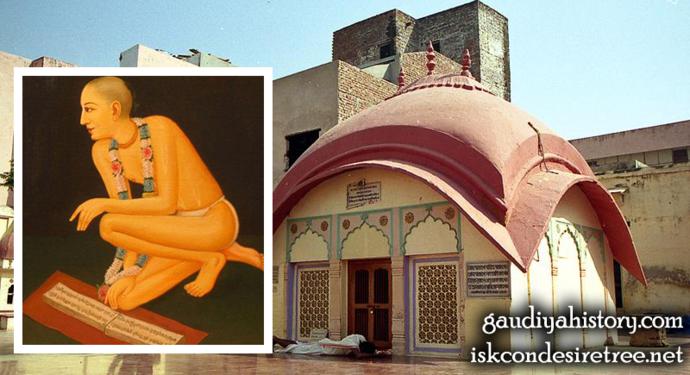
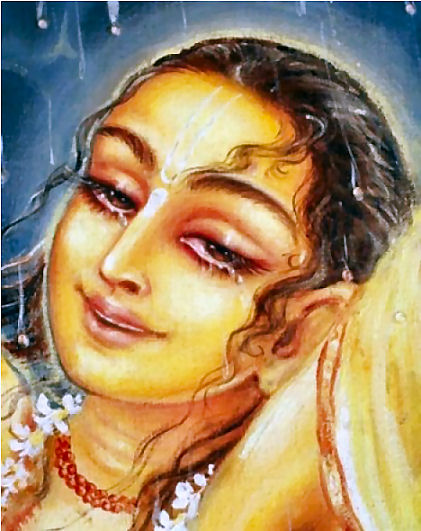
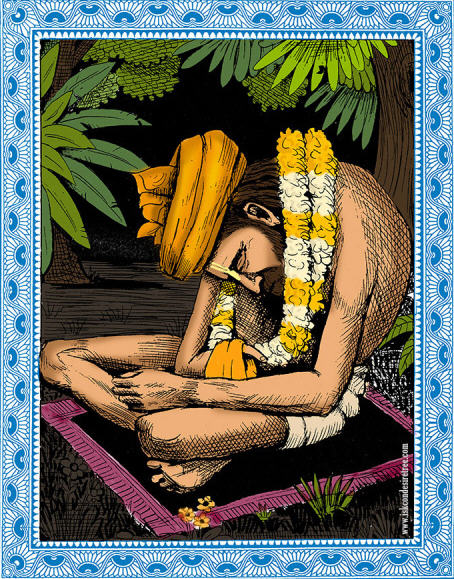
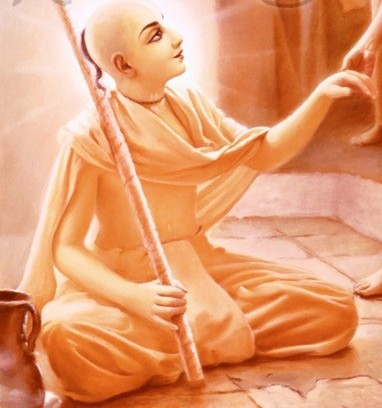
Raghunatha dasa Goswami used to reside on the bank of Shri Radha-kunda. At the time Radha-kunda was just a small pond of water, and therefore sometimes Raghunatha would meditate on enlarging the kund. Then he would chastise himself for desiring something which would require a large amount of money. (In the image: Shri Radha kund in nowadays, Vrindavan Dham, Shrila Raghunatha Dasa Goswami).

   Raghunatha dasa Goswami used to reside on the bank of Shri Radha-kunda. At the time Radha-kunda was just a small pond of water, and therefore sometimes Raghunatha would meditate on enlarging the kund. Then he would chastise himself for desiring something which would require a large amount of money.

   Around this time one very wealthy Seth underwent great austerity by walking to Badarikashrama in the Himalayas. Arriving there he very reverently worshiped Shri Badrinarayana and offered much wealth at His lotus feet. That night as he slept there, he had a dream in which Shri Badarinarayana instructed him to proceed to Vraja, where he should present all his wealth to Shri Raghunatha Dasa Goswami, who was residing at Aritgram. "If he declines to accept it, then you can mention My name and remind him about renovating Radha-kunda and Shyama-kunda."

   That Seth was very happy to have seen such a wonderful dream and after returning to his home he very joyfully set out for Vraja. There he met Raghunatha dasa Goswami and related all of these events to him. Dasa Goswami was somewhat taken aback to hear this news, but then immediately gave his consent. Thus Sethji began to work of re-digging the two kunds.

   On the banks of Radha-kunda, the five Pandavas were residing in the form of trees. As the work was proceeding it was decided that on the following day these trees would have to be cut down, but that night the five Pandavas appeared in a dream of Raghunatha dasa and forbade the cutting of those dreams. Today they are still residing there. When the work of beautifying the kundas was complete, the Devotees' bliss knew no bounds. Nearby the kundas, the kunjas of the eight gopies were also constructed. Seeing all these, Raghunatha dasa forgot himself in ecstasy.

   Raghunatha dasa Goswami lived on the banks of Radha-kunda without any fixed residence, staying under a different tree every night. Sometimes he would stay on the banks of the Manasa Ganga. At that time these areas were jungles filled with ferocious animals. One day Sanatana Goswami came to the banks of Manasa Ganga to meet Gopala Bhatta Goswami. Before accepting his noon meal at Gopal Bhatta's bhajan kutir, he went to take bath at the Pavan ghat of Manasa Ganga. From there he saw two tigers come to the kund and after drinking some water saunter off. Just near that spot Raghunatha das Goswami was sitting under a tree absorbed in his bhajana. Sanatana Goswami was startled to see this but even more so when he saw Shri Krishna standing at some distance observing everything. He then requested Raghunatha to do his bhajana within a hut. 

Raghunatha Dasa Goswami

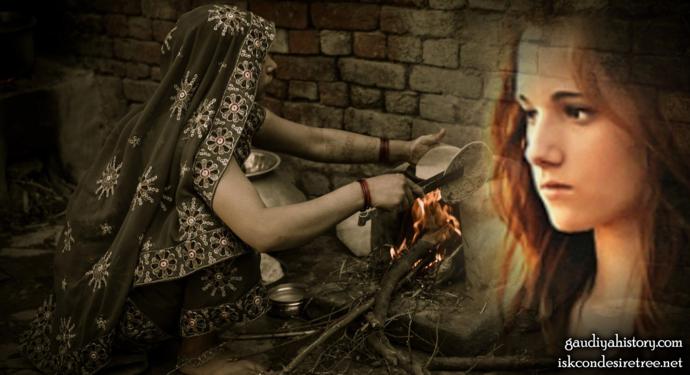
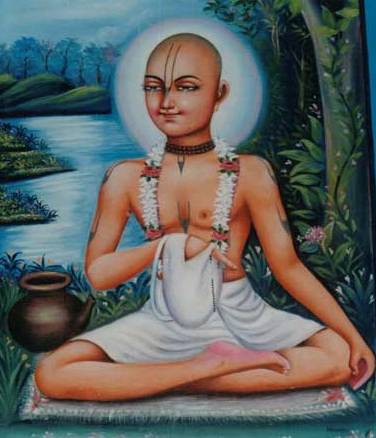
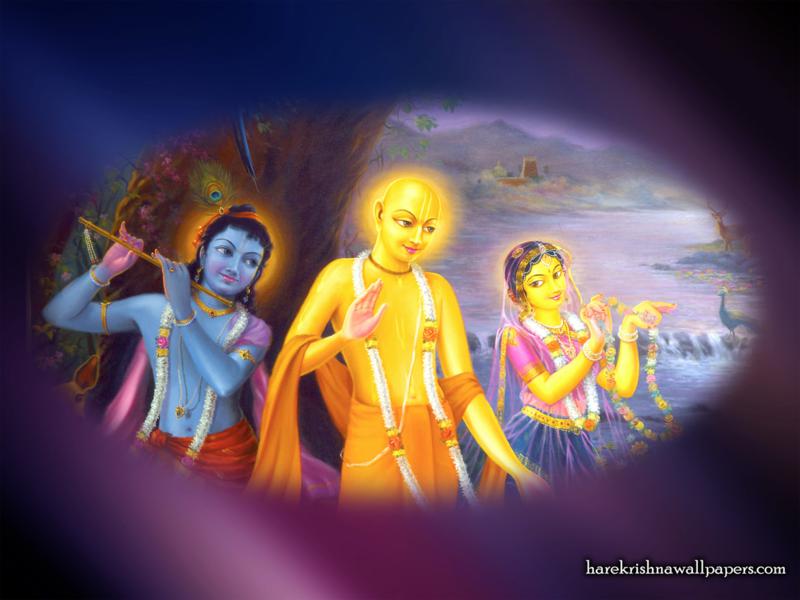
Raghunatha dasa, who still hadn't bothered to have a kutir constructed, was sitting in the noon day sun absorbed in his bhajana. Shrimati Radharani happened to pass that way at this time and, seeing that the sun was beating down on Raghunatha's head, she stood behind him and held the end of her sari to shield him from the suns rays. Then one of the Goswamis came along and saw this heart rending scene, while profuse perspiration continued to flow from Shrimati Radharani's transcendental body. This time when he was again requested to do his bhajan in a kutir, he immediately agreed to comply. (In the wallpaper: Shrimati Radharani, ISKCON Chowpatty, Mumbai, Shrila Raghunatha Dasa Goswami).

  On another occasion, Raghunatha dasa, who still hadn't bothered to have a kutir constructed, was sitting in the noon day sun absorbed in his bhajana. Shrimati Radharani happened to pass that way at this time and, seeing that the sun was beating down on Raghunatha's head, she stood behind him and held the end of her sari to shield him from the suns rays. Then one of the Goswamis came along and saw this heart rending scene, while profuse perspiration continued to flow from Shrimati Radharani's transcendental body. This time when he was again requested to do his bhajan in a kutir, he immediately agreed to comply.

   In Vraja, Krishna is served by Radharani and Chandravali, who each have unlimited maid servants. According to the mellows of paramour love, Shri Raghunatha dasa Goswami counted himself as a maidservant of the friends of Shrimati Radharani. As Chandravali is the chief comperitor of Radharani, Shri dasa Goswami would never go to her kunja or talk with any of the sakhis. Thus he served the servants of Radharani within his mind in this way.

   One Brajabasi known as Shri dasa Brijabasi used to bring Shri das Goswami a leafcup of buttermilk every day. Drinking this much only Raghunath dasa would engage in bhajana throughout the day. One day Shri Das Brijabasi went to Chandravali's kunda, known as Sakhi-sthali, to herd his cows. There he saw a palash tree with very large leaves, so he collected some leaves to make leafcups. The next day, in one of the new leafcups he brought some buttermilk to das Goswami. Raghunatha dasa accepted the leafcup of buttermilk and inquired, "Shri dasji, where did you get these nice palash leaves?" Shri dasji replied, "While I was pasturing the cows I came to Sakhi-sthali and found them there."

   Simply hearing  the word 'Sakhi-sthali' Raghunatha dasa flew into a rage and threw the leafcup of buttermilk away saying, "The followers of Shrimati Radharani never accept anything from that place." Seeing the loyal devotion of Raghunatha dasa for Shrimati Radharani Shridasji was amazed.

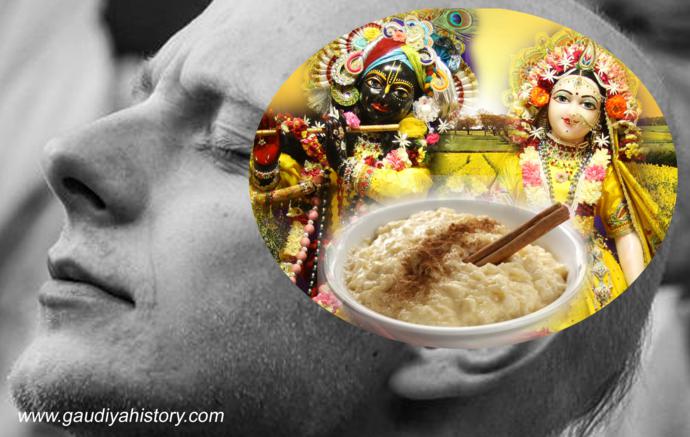
   Raghunatha dasa Goswami used to always serve Shri Shri Radha-Govinda in his mind. One day in his meditation he cooked sweet rice and offered it to Shri Shri Radha and Krishna. In great pleasure they accepted the offering and the other sakhis also relished this Prasadam. Then Raghunatha himself honored the remnants of their Prasadam and in great ecstasy, due to the pleasure of having been able to satisfy Shri Shri Radha-Govinda and Their loving attendants, he ate a little more than was his custom.

   In the afternoon Raghunatha dasa used to speak about Shri Chaitanya Mahaprabhu. However, this day when the Devotees came in the afternoon to hear him speak, they found that the door to his kutir was closed. They waited for some time but when it appeared that there was no movement inside they became a little anxious and called out, "Goswamiji, are you all right?" Shri dasa Goswami answered, "My body is not well." 

Raghunatha Dasa Goswami

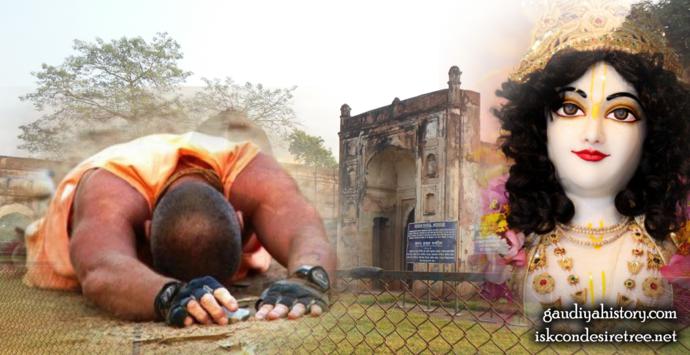
Raghunatha dasa Goswami used to always serve Shri Shri Radha-Govinda in his mind. One day in his meditation he cooked sweet rice and offered it to Shri Shri Radha and Krishna. In great pleasure they accepted the offering and the other sakhis also relished this Prasadam. Then Raghunatha himself honored the remnants of their Prasadam and in great ecstasy, due to the pleasure of having been able to satisfy Shri Shri Radha-Govinda and Their loving attendants, he ate a little more than was his custom. (In the wallpaper: Shri Shri Radha Govinda, ISKCON Nigdi, Maharashtra, a Devotee, and sweet rice).

   The Devotees became concerned and immediately sent word to Sanatana Goswami in Mathura. At that time Shri Sanatana Goswami was staying with Shri Vallabhacharya's son Shri Vithalnathji, who immediately sent two physicians to Radha-kunda to examine Shri Raghunatha dasa Goswami. After checking his pulse, the doctors concluded that, "due to eating a combination of rice and milk his body is feeling very heavy."

   Hearing this diagnosis everyone was struck eith wonder. That Raghunatha dasa Goswami, who subsisted on only a little buttermilk each day, should fall ill from eating too much sweet rice was astonsihing, especially because it was eaten only in meditation.

   There are various opinions on Shri Raghunatha das Goswami's identity in Krishna-lila. Some have ascertained that he was Rasa Manjari, some that he was Rati Manjari, while still others that he was Bhanumoti.

   The Govardhana-Shila given by Shriman Mahaprabhu to Raghunatha dasa to worship is still worshiped at Shri Gokulananda Mandira, in Vrindavana.

   Shrila Bhaktisiddhanta Saraswati Thakura writes in his Anubhashya that in the opinion of Shri Chaitanya Mahaprabhu, the Govardhana-Shila, the stone from Govardhana Hill, was directly the form of Krishna, the son of Maharaja Nanda. The Lord used the stone for three years, and then in the heart of Raghunatha dasa the Lord awakened devotional service to the stone. The Lord then gave the stone to Raghunatha dasa, accepting him as one of His most confidential servants. However, some envious people conclude that because Raghunatha dasa had not taken birth in the family of a brahmana, Shri Chaitanya Mahaprabhu did not give him the right to worship the Deity directly, but instead gave him a stone from Govardhana. This kind of thought is naraki, or hellish. As stated in the Padma Purana, arcye vishnau siladhir gurushu nara-matir vaishnave jati-buddhih. ..yasya va naraki sah: “One who considers the archa-murti (the worshipable Deity of Lord Vishnu) to be stone, the spiritual master to be an ordinary human being, or a Vaishnava to belong to a particular creed is possessed of hellish intelligence.” If one thinks that the worshipable Shalagrama-Shila is a mere stone, that the spiritual master is an ordinary human being or that a pure Vaishnava preaching the bhakti cult all over the world is a member of a particular caste or material division of society, he is considered a naraki, a candidate for hellish life. When Shri Chaitanya Mahaprabhu instructed that the Govardhana-Shila, the stone taken from Govardhana, is nondifferent from the body of Shri Krishna, the Supreme Personality of Godhead, He indirectly advised such foolish persons that one should not be envious of a Vaishnava who belongs to a different caste or sect. One should accept a Vaishnava as transcendental. In this way one can be saved; otherwise, one is surely awaiting a hellish life. (A.C. Bhaktivedanta Swami Prabhupada. Shri Chaitanya Charitamrta Antya lila 6:294. purport.)

ei silare kara tumi sattvika pujana
acirat pabe tumi krishna-prema-dhana


   TRANSLATION :
   Shri Chaitanya Mahaprabhu continued, “Worship this stone in the mode of goodness like a perfect brahmana, for by such worship you will surely attain ecstatic love of Krishna without delay. (Shri Chaitanya Charitamrta Antya-lila 6:295.)

   Shrila Raghunatha dasa Goswami compiled following books: Stavavali, Dana charita, and Mukta charita, among others.

   Birth: 1428 (Sakabda) Disappearence: 1504 on the 12th day of the bright fortnight of the month of Ashwin. 

Raghunatha Dasa Goswami

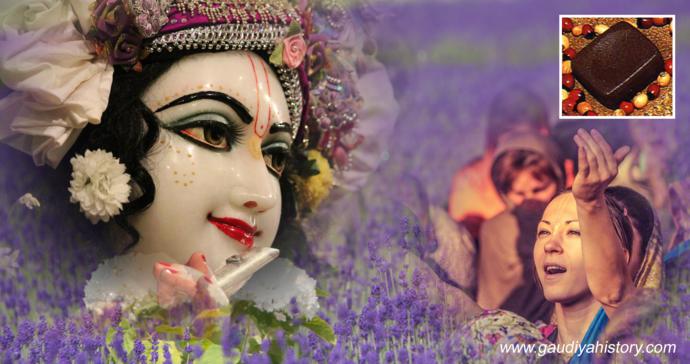
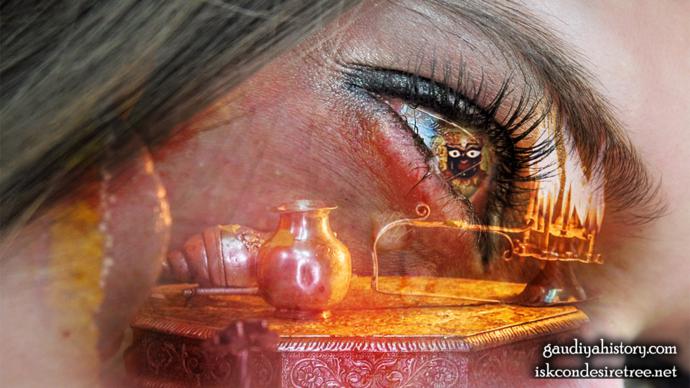
Shrila Bhaktisiddhanta Saraswati Thakura writes in his Anubhashya that in the opinion of Shri Chaitanya Mahaprabhu, the Govardhana-Shila, the stone from Govardhana Hill, was directly the form of Krishna, the son of Maharaja Nanda. The Lord used the stone for three years, and then in the heart of Raghunatha dasa the Lord awakened devotional service to the stone...“One who considers the archa-murti (the worshipable Deity of Lord Vishnu) to be stone, the spiritual master to be an ordinary human being, or a Vaishnava to belong to a particular creed is possessed of hellish intelligence.” If one thinks that the worshipable Shalagrama-Shila is a mere stone, that the spiritual master is an ordinary human being or that a pure Vaishnava preaching the bhakti cult all over the world is a member of a particular caste or material division of society, he is considered a naraki, a candidate for hellish life...One should accept a Vaishnava as transcendental. In this way one can be saved; otherwise, one is surely awaiting a hellish life. (In the wallpaper: Shri Krishna, ISKCON Chennai, Shaligram Shila of Raghunatha Dasa Goswami, Devotees in Vrindavan parikrama).

Jiva Goswami – Biography

Jiva Goswami

When Shri Gaurasundara came to Ramakeli, Shri Jiva was blessed by having darshana of His worshipable Lord, though he was just a baby at the time. Placing the dust of His lotus feet on the child's head, Mahaprabhu indicated him to be the future sovereign preceptor of the Gaudiya sampradaya. Though he was only a child, Shri Jiva kept the form of the Lord, which fascinates all the world, within his heart. As he grew up, while eating, lying down, in his dreams, while he was awake, at all times, he would meditate on that form. (In the image: Shrila Jiva Goswami).

   Shri Sanatana, Shri Rupa and Shri Vallabha were three brothers, all employed in the service of the Badsha Hussain Shah. Amongst the three, there was only one descendent, Shri Jiva. Having been rewarded richly by the Badsha for their sevices, their household life was very opulent. There was nothing lacking in whatever was necessary for the upbringing of the only son. The house was illuminated by the effulgence of the child's golden complexion; his eyes were like the expanded petals of the lotus; every part of his body was graced with a lusterous, radiant splendor.

   When Shri Gaurasundara came to Ramakeli, Shri Jiva was blessed by having darshana of His worshipable Lord, though he was just a baby at the time. Placing the dust of His lotus feet on the child's head, Mahaprabhu indicated him to be the future sovereign preceptor of the Gaudiya sampradaya. Though he was only a child, Shri Jiva kept the form of the Lord, which fascinates all the world, within his heart. As he grew up, while eating, lying down, in his dreams, while he was awake, at all times, he would meditate on that form.

   Later on, when his father and uncles renounced their family life in order to be with Mahaprabhu, the only child, Shri Jiva, was left with his mother in the family palace at Fateyabad. Lying in her lap, which was wet with tears of separation, he gradually began to grow as the waxing moon. Seeing that the mother and the child's face were always wet with tears, their friends also fell under the shadow of sadness and only with great difficulty managed to assuage their grief. Whenever Shri Jiva would remember his father and uncles, or the lotus feet of Shri Gaura Hari, he would lose consiousness and fall to the ground.

   As he got a little older, Shri Jiva took up the worship of the Deities of Shri-Shri Rama-Krishna. He would carefully decorate Them and offer bhoga and arati, serving Them with his full attention. Even in his play, whatever games he played were connected with Shri Krishna's pastimes.

   While studying under the local panditas he became proficent in grammar, poetry and rhetoric. Noting his great intellect, his teachers commented, "Such brilliance is not often found in a child so young as this. No doubt he will be a very high-souled, saintly person."

   Even while engaged in his studies Jiva always thought of Shri Shri Nitai-Gauranga. Once he saw in a dream that Shri Rama-Krishna had taken the forms of Nitai-Gauranga and were dancing. [B.R.1.732] Giving him the dust of Their lotus feet, the Two Lords then disappeared. Having seen such a wonderful dream, Shri Jiva was consoled somewhat. Then he began to think, "When will I be able to crawl out of this well of family life and devote my full time and energy, my very self, to serving these two most magnanimous Lords?" But he was the only son of the family. Only in his company could his mother forget somewhat the pangs of separation in her heart. When Shri Jiva learned that his father had given up his life on the banks of the Ganga, he was compeletely unsettled. After that his eyes were never dry. The family members and friends tried to console him but to little avail. Family life had become the source of his utter sadness.

   Someone suggested to Jiva to go to Navadwipa and bathe himself in the coolness emanating from the lotus feet of Lord Nityananda Prabhu so that his mind and body, burning with grief, could be refreshed. Thus Shri Jiva set our for Navadwipa with a group of pilgrims. [B.R.1/741]

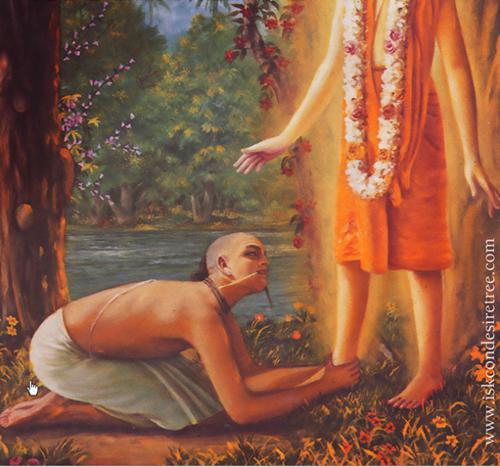
   Nityananda Prabhu, the omniscient Lord, could understand that Shri Jiva was on his way to Navadwipa. Therefore He also left for there from Khardaha. After a few days, Jiva arrived at Navadwipa. Seeing the beauty of that place he was charmed. Falling down on the ground, he offered his dandavats to Mother Ganges. Inquiring from the villagers the directions to Mayapura, he learned that Nityananda Prabhu was residing at Shrivasa  Pandita's house. At last arriving there, he fell down at the door to offer his dandavats. Nityananda Prabhu came out with Shrivasa Pandita and picked him up and embraced him, asking, "Are you the nephew of Shri Rupa and Shri Sanatana?"

   As an answer, Jiva again fell down on the ground at the lotus feet of Nityananda Prabhu. This time Nityananda Prabhu brought him in the house and began to inquire after the welfare of his family at Fateyabad. Then Shri Jiva was introduced to the Devotees present in Navadwipa; he offered his salutations at their lotusfeet. Everyone was very happy to meet the nephew of Shri Rupa and Sanatana. That day Shri Jiva received the remnants of Nityananda Prabhu's Prasadam.

   The next day, the two of them came to Sachi Mata'a house. Seeing the birthplace of Shri Gaurasundara, which was filled with such splendor, Shri Jiva was greatly pacified and fell down on the ground to roll in the dust. In the large courtyard the Devotees were singing songs praising the glories of Shri Krishna Chaitanya Mahaprabhu. Seeing Nityananda Prabhu, everyone stood up and then fell down, offering their dandavats at His lotus feet. Then Jiva saw Sachi Mata sitting on the veranda. 

Jiva Goswami

After initiating him with the divine mantra, Rupa engaged him in the service of Shri Shri Radha-Damodara. According to Sadhana dipika, this Deity of Damodara was fashioned by Rupa Goswami's own hand for his dear disciple Shri Jiva. Shri Shri Radha-Damodara are presently being worshipped in Jaipur, Rajasthan. (In the image: Shri Shri Radha Damodar, Jaipur).

   Dressed in white with silk chadder around her shoulders she looked radiant, the white of her hair blending with her white sari. Though her body trembled with old age and was very thin, still the courtyard was illuminated by her divine effulgence. Forgetting herself in rememberance of Shri Gaursundara, she was sitting with her eyes closed. Becoming aware that Nityananda Prabhu had arrived, she covered her head with her sari and called her servant.  "Ishana!  Shripada has arrived.  Please wash His feet."

   After this was done, Nityananda offered namaskar to the mother of the Supreme Lord and took His seat. He then introduced Shri Jiva to her. Sachi Mata placed her hand on his head to bless him, and Shri Jiva floated in the ocean of happiness. Sachi Mata then requested the two of them to honor the Lord's Prasada."Take Prasada here at your mother's house today, my child. I offered there preparations in secret to Shri Gaurachandra."

   Shri Jiva spent some days with Nityananda Prabhu, touring the nine islands of Navadwipa, in order to have darshana of the holy places of the Lord's pastimes there. Then, as ordered by Nitya­nanda Prabhu, he set out for Kashi (Varanasi) . At Kashi he studied Vedanta under Shri Madhusudana Vachaspati, a disciple of Sarvabhauma Bhattacharya. The conclusions of Vedanta contained in Shrimad-Bhagavatam that were expounded by Shri Chaitanya Mahaprabhu to Sarvabhauma Bhattacharya in Puri had been in turn taught by the Bhattacharya to Madhusudana Vachaspati, who established a toll at Kashi. From him, Shri Jiva mastered the same conclusions.

   From here Shri Jiva set out for Shri Vrindavana where he received shelter at the lotus feet of his two uncles. Shri Rupa and Sanatana. They were very pleased to see him and received from him all the news. Jiva stayed with Shri Rupa, who began to teach him Shrimad Bhagavatam. After initiating him with the divine mantra, Rupa engaged him in the service of Shri Shri Radha-Damodara. According to Sadhana dipika, this Deity of Damodara was fashioned by Rupa Goswami's own hand for his dear disciple Shri Jiva. Shri Shri Radha-Damodara are presently being worshipped in Jaipur, Rajasthan.

   Seeing that Jiva had quickly become conversant with the conclusion of the Shrimad Bhagavatam, Shri Rupa engaged him in proof-reading his Bhakti-rasamrta-sindhu. At this time Shri Jiva compiled a commentary on Bhakti-rasamrta-sindhu called Durgama sangamani. In the year 1476 (Sakabda) Shri Sanatana Goswami compiled Shri Vaishnava tosani, a commentary on the tenth canto of Shrimad-Bhagavatam, which he gave to Shri Jiva for proof reading. Under the order of Shri Sanatana, Shri Jiva compiled a commentary on that named Laghu Vaishnava tosani in the year 1500 (Sakabda). His writings, along with those of Shri Rupa and Shri Sanatana, Shri Gopal Bhatta, Shri Raghunatha Bhatta, Shri Raghunath das, Shri Krishna das, Shri Kashishvar Pandit, and Shri Madhu Pandit, completely captivated the learned men of that time. It was the beginning of a golden age at Shri Vraja dhama.

   Shri Jiva regurlarly brought water for Shri Rupa and Sanatana's bath. He massaged their heads with oil, cleaned their ashram, worshiped the Deity, cooked and corrected manuscripts.

   After the disappearance of Shri Rupa and Sanatana, Shri Jiva continued the tradition that they had inaugerated. Once Shri Jiva travelled to Agra to debate with the Rajputs concerning the glories of Jamuna and Ganga rivers. He established that the Jamuna is more glorious than the Ganga as the Ganga emanates from Krishna's lotus feet whereas the Jamuna is His own consort. At this the Moghul emperor was very much satisfied and wanted to present him something. Shri Jiva replied that he would accept some blank papers. So the emperor presented Jiva some stained paper. (At that time paper was very rare and most manuscripts were usually composed on leaves.)

   There is also a legend that once, when a moghul emperor (possibly Akbar) wanted to confer something on the Goswamis of Vrindavana, they requested a farman (emperor's order) that no living beings would be killed within Vraja. As a result of this no king would come to hunt there anymore.

   The disciple of Lokanatha Goswami, Narottama dasa Thakura Maha­shaya, Shri Gopala Bhatta Goswami's disciple Shrinivasa Acharya Prabhu, and the disciple of Hridaya Chaitanya Prabhu, Shri Shyamananda Prabhu, were greatly favored by Shrila Jiva Goswami. Under his tutelage they studied all the literatures of the Goswamis. Later he sent them to preach this knowledge in Bengal.

   Shrila Jiva Goswami composed many literatures, amongst them:

Harinamamrta-vyakarana
Sutra-malika
Rasamrta-sesa
Gopala-virudavali
Sri-Madhava-mahotsava
Sri-Sankalpa-kalpavrksa
Brahma-Samhita-tika
Bhakti-rasamrta-sindhu-tika (Durgama-sangamani)
Ujjvala-nilamani-tika (Locana-rocani)
Gopala-campu
Sat-sandharbha (Tattva-sandarbha, Bhagavata-sandarbha, Paramatma sandarbha, krishna-sandarbha, Bhakti-sandharbha, Priti-sandarbha)
Srimad-Bhagavata-tika (Krama-sandarbha)
Laghu-vaisnava-tosani (Tenth Canto Bhagavatam commentary)
Sarva-sambadina (commentary on Sat-sandarbha)
Gopala-tapani-tika (Sri-Suhkha-bodhini)
Padma-puranastha-yogasara-stotra-tika
Gayatri-vyakhya-vivrti (A commentary on the Gayatri mantra as described in the Agni Purana, chapters 216-217)
Radha-krishnarcana-candrika
Dhatu-sangraha
Bhavartha-sucaka-campu

   Birth: 1533 (Christian calendar), 1455 (Sakabdha), 12th day of the bright fortnight in the month of Bhadra.
   Disappearance : 1540 (Sakabdha), 3rd day of bright fortnight, Pausa 

Jiva Goswami

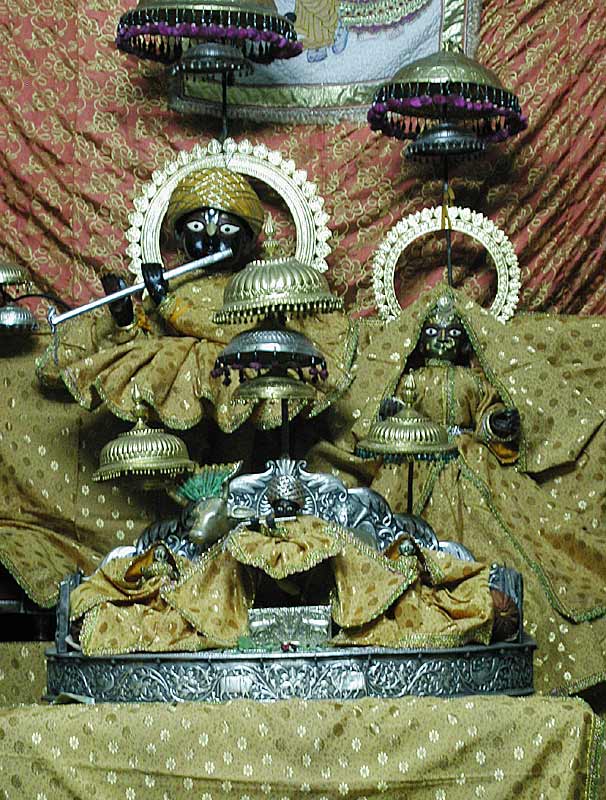
As he got a little older, Shri Jiva took up the worship of the Deities of Shri-Shri Rama-Krishna. He would carefully decorate Them and offer bhoga and arati, serving Them with his full attention. Even in his play, whatever games he played were connected with Shri Krishna's pastimes. (In the image: Shri Shri Krishna-Balarama, at Deity vala, Jaipur).

Rupa Goswami – Biography 3

Rupa Goswami

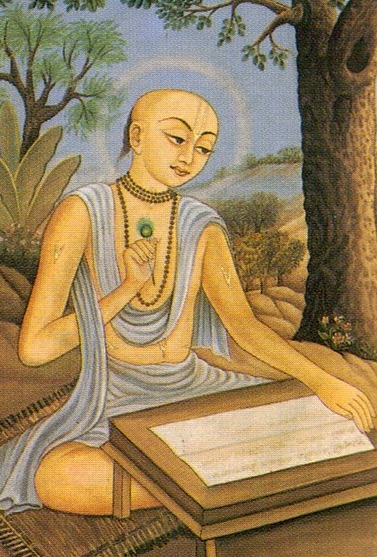
Shrila Rupa Goswami was extremely dear to Shri Chaitanya Mahaprabhu. (In the image: from left to right Shrila Rupa Goswami, Lord Shri Krishna Chaitanya).

   Shrila Rupa Goswami was extremely dear to Shri Chaitanya Mahaprabhu. Through him and his elder brother, Shri Sanatan, Mahaprabhu disseminated His own teachings, the essential conclusions of all the scriptures. Amongst the Devotees of Mahaprabhu these two were known as His generals. In the Gaura-ganoddesha-dipika, Kavi Karnapura has written that Shri Rupa Goswami was known as Shri Rupa Manjari during Krishna lila. There is an anecdote as to how they came to be the ministers of the king of Gaudadesha, Hussain Shah Badsha. Even at a very young age they had become quite learned in all of the scriptures. The guru (moulabi) of Hussain Shah was supposedly capable of seeing into the future. Hussain Shah inquired him about the prosperity of his kingdom. The moulabi replied, "There are two extremely learned brahmana boys who are endowed with all good qualities. If you appoint them as your ministers then you will attain a very opulent kingdom." Having heard of the glories of Shri Chaitanya Mahaprabhu, Shri Rupa had written a letter to Him praying for His darshan. In His reply Mahaprabhu explained to him, "As a woman who is attached to another man makes a show of being devoted to her husband, so you should, while being internally attached to the lotus feet of Shri Krishna, externally make a show of being engaged in your worldly duties. Krishna will bestow His mercy on you very soon." While residing at Ramakeli, Shri Rupa and Shri Sanatana were visited by many brahmanas and panditas from Navadwipa, Karnataka and various other parts of India. They were always careful to receive these guests and serve them in a befitting manner. 

Rupa Goswami

"As a woman who is attached to another man makes a show of being devoted to her husband, so you should, while being internally attached to the lotus feet of Shri Krishna, externally make a show of being engaged in your worldly duties. Krishna will bestow His mercy on you very soon."

   They lived in a very opulent surroundings at Ramakeli. Their court, which rivalled that of Lord Indra, was always attended by brahmanas, pandits from many lands as well as poets, singers, musicians and dancers. At great expense they maintained these guests and were always very careful that no one was disrespected in any way. They were always engaged in studying the shastras and could establish and defeat the same philosophical arguments alternatively. Near their house were solitary gardens of Kadamba and other trees in the middle of which were Radha-kunda and Shyama-kunda. There they would meditate on the Vrindavana pastimes of Shri Shri Radha-Shyama and thus, losing their patience, a constant stream of tears would flow from their eyes. They were always absorbed in the service of Shri Madana Mohana and constantly assuaged their grief by praying for His mercy. Hearing of the pastimes of Sri Gaurasundara at Nadia they were always meditating when they might get His darshan. [B.R. 1/585].

   Rupa Goswami's worshipable Deity in Vrindavana was Shri Govinda Deva.  Shri Chaitanya Mahaprabhu had instructed the Goswamis to re-discover the holy places of Krishna's pastimes in Braja and to establish worship of His Shri vigraha. One day Shri Rupa was sitting on the banks of the Jamuna, lamenting that they hadn't been able to properly carry out His instructions. It was known to them that Shri Krishna's grandson Vajranabha had installed a number of Deities in Braja, among them Hari Deva, Madana Mohana Deva, Gopinath Deva and Shri Govinda Deva. Shri Rupa had tried to locate these Deities, but to no avail. As he was sitting and thinking in this way a very beautiful cowherd boy came along and asked him, "He Swamin! Why do you look so sad?" Hearing the boy's cheerful voice, Shri Rupa's melancholy reverie was broken and his heart felt engladdened. He replied that he was feeling sad because he hadn't been able to follow Mahaprabhu's instructions properly. The cowherd boy told him, "Swamin! Please come with Me. I know where what you are looking for is." Then the boy brought him to Gomatila and explained, "Everyday a cow comes on top of this hill and pours down her milk here. There is a good chance you will find what you are looking for inside.

   Now I have to go." Shri Rupa turned to see the cowherd boy off, but found no one present. He began to reflect, "Who was that cowherd boy and where did he run off so suddenly?" His body thrilled with ecstatic symptoms as he intently gazed at the Mahayoga Pith (Gomatila), and then went back to his kutir. The next morning he again came to Gomatila and quietly waited. After a little while an exquisitely beautiful Surabhi cow came there and poured milk down on top of the hill which immediately disappeared inside the earth. Then she sauntered on into the woods.

   Now Shri Rupa was positive that Shri Govinda Deva must be within the earth here. He came very quickly to the village of cowherds nearby and excitedly told them everything that had happened. The cowherd men hurriedly gathered up some spades and hatchets and came running to Gomatila. Digging where Shri Rupa indicated they saw, after removing a small amount of earth, the all enchanting form of Shri Govinda. They all erupted in shouts of ecstasy, "Hari! Hari! Shri Govinda has again manifested Himself." Shri Rupa with tears flowing from his eyes fell down at the lotus feet of Shri Govinda deva to offer his obeisances, all the while reciting prayers and hymns. Very quickly the news spread and the other Goswamis, floating in an ocean of joy, came there also. Soon an incessant flow of people from all quarters began to arrive, carried by waves of joy. Lord Brahma and the other demigods, having assumed mortal appearances, mixed in with the other people and gazed upon the body of Shri Govinda. There was not a lull in the crowd for even a moment as people continued to pour in from places unknown. Shri Rupa Goswami immediately sent word to Mahaprabhu in Puri concerning this auspicious event. Shri Gaurasundara along with His associates couldn't contain their ecstasy on receiving this happy news. Meanwhile the brahmanas performed the abhisheka of the Deity and began to prepare offerings of bhoga from the milk, yogurt, rice, flour and vegetables which the villagers were bringing. Mahaprabhu sent Kashishvar Pandit from Puri to assist in worshiping the Deity. 

Rupa Goswami

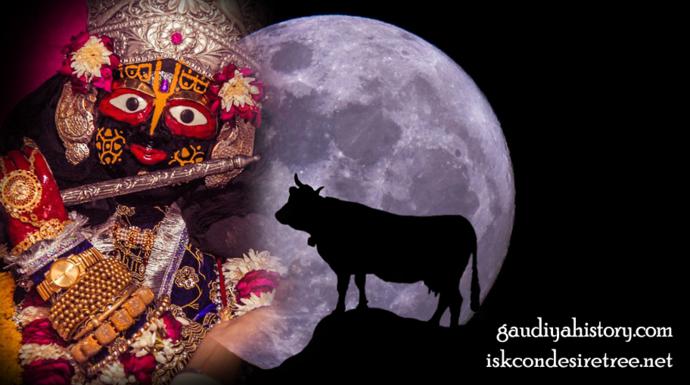
"Hari! Hari! Shri Govinda has again manifested Himself." Shri Rupa with tears flowing from his eyes fell down at the lotus feet of Shri Govinda deva to offer his obeisances, all the while reciting prayers and hymns. Very quickly the news spread and the other Goswamis, floating in an ocean of joy, came there also. (In the wallpaper: Shri Govindaji, Jaipur, a cow).

   Shri Govinda Deva is presently being worshiped in Jaipur, Rajasthan, which is easily reached by bus from Vrindavana. One has to proceed by rickshaw to Shri Shri Radha-Govinda Mandir from the bus stand. Overjoyed that Shri Govindaji and Madan Mohan had reappeared and thus the responsibilities which Mahaprabhu had given them were gradually being carried out, Shri Rupa and Sanatan began to compose the Bhakti-shastras, in compliance with Mahaprabhu's further instructions. After completing Vidagdha – madhava, Lalita-madhava, and various other books, Shri Rupa began to work on Bhakti-rasamrta-sindhu. One day Shri Vallabhacharya (of the Visnuswami sampradaya) came to visit Rupa Goswami. After offering him a seat the two of them began to discuss krishna-katha. In the house of their conversation, Sri Rupa presented the opening verse of Bhakti-Rasamrta-Sindhu to Vallabhacharya to read. After studying this verse for some time Vallabha commented that there were a few mistakes. At this time Sri Jiva, who had arrived from Bengal a few days before, was fanning his uncle Sri Rupa. He was extremely learned in all the sastras and was unsatisfied with Vallabha's remark. When Vallabhacharya went to the Jamuna to take his bath, Shri Jiva also came there on the pretext of fetching some water. He inquired from the acharya as to what actually were the mistakes in that verse. Vallabhacharya, after discussing some points with him, was amazed at the boy's scholarship. After a few days Vallabha again came to Shri Rupa. After inquiring about the boy scholar, he greatly praised his learning. After Vallabha had gone to his residence, Shri Rupa called Jiva and spoke to him, "Those whom we respect as our Guru and to whom we offer our obeisances you are ready to debate with on an equal level. This is not at all polite. What he spoke was for my benefit but you couldn't tolerate that. You should return home and when you can control your mind then you can come back to Vrindavana." [B.R. 5.1643] Hearing this decision of his uncle Shri Jiva left that place and decided to proceed eastwards. When he came to an old dilapidated Temple at Nanda-ghat, he sat down and began to cry. Soon the villagers began to worry: "Such a handsome young man, but he sits there crying for so long without taking food." After a while, Shri Sanatana Goswami came by and the villagers informed Sanatana of the boy's presence at the old Temple.

   Sanatana went there and saw his nephew, who looked very pale from not eating. Sanatana picked him up from the ground and affectionately asked him what was the matter. Shri Jiva explained everything that had happened. Sanatana Goswami pacified him and, taking his nephew with him, went to see his brother. At first Sanatana spoke with Rupa alone.  When Shri Rupa happened to mention Jiva, Sanatana explained everything. Shri Rupa immediately called Jiva. Seeing his forlorn and pale appearance, he gradually nursed him back to health and a happy state of mind.

   Then he entrusted him with proof reading and various litratures which he had composed. Just as he was very strict with his young nephew, so also he was very affectionate and loving. Their relationship was an ideal example of how the guru and shishya behave together. When Shri Rupa had finished writing Lalita-madhava, he gave it to Raghunatha dasa Goswami to read. Lalita-madhava is a description of Krishna's pastimes after He left Vrindavana and is thus full with sentiments in the mood of separation. By reading this book Dasa Goswami began to cry day and night, having become completely absorbed in love in separation to the point of being ready to leave his body. [B.R.5.768] He became as though deranged in mind from sadness, and he compeletely lost all patience. When Shri Rupa requested Shri Dasa Goswami to return the manuscript so that he could correct it, Raghunatha dasa held on to it very tightly, not saying anything, refusing to part with it. After considering what to do, Shri Rupa composed Dana-keli-kau­mudi. He managed to exhange this manuscript with Lalita-madhava.

   By reading Dana-keli-kaumudi, full of narrations of Krishna's Vrindavana pastimes, Raghunatha dasa Goswami now became totally absorbed in the ecstacy of happiness. On another occasion the Goswamis were having a discussion about the ecstatic feelings of separation of Radha-Krishna and Their associates. Some of the Vaishnavas were fainting to the ground, while Shri Rupa Goswami began to breath very heavily. His heart felt as though it was burning. At one point as he sighed his breath happened to fall on the body of one Devotee present there.

   Shortly thereafter a boil developed on that Devotee's body where Shri Rupa's breath had touched it. [B.R. 5.1326] After the re-appearance of Shri Govinda, Madana Mohana and the Yoga Pith, Shri Rupa began to contemplate where Vrindadevi might be. One night she came to him in a dream and said, “I am on the banks of Brahma-kunda. You can have my darsan there.” The next morning, after finishing his bath and puja, he came to Brahma-kunda and began to look everywhere. Suddenly he saw a heavenly damsel whose bodily effulgence defeated the luster of gold. All the directions were illuminated by this glow and the atmosphere created by her presence was very sweet and cooling. Shri Rupa offered his dandavats and various prayers and hymns. In this way, Vrinda Devi reappeared in Vrajabhumi. Shri Gaurasundara established the glories of Shri Vrajadhama through His two generals Shri Rupa and Shri Sanatan Goswamis. Within their hearts He awakened, through oral transmission, the knowledge of what was in His own heart. “Shri Rupa Goswami has established in this world the mission to fullfill the desire of Lord Chaitanya. When will he give me the shelter at his lotus feet?” [Shrila Narottama dasa Thakura in his Shri Rupa Pranama].

   Shri Rupa Goswami completed many literatures, among them: Shri Hamsaduta Kavya, Sgri Uddhava-sandesh, Sgri Krishna-janma-tithi-vidhi, Brhat Radha-Krishna-ganoddesha-dipika, Laghu Radha-Krishna ganoddesah-dipika, Stavamala, Vidagha-madhava, Lalita-madhava, Dana-keli-kaumudi, Bhakti-rasamrta-sindhu, Ujjvala-nilamani, Prayuktakhyata-manjari, Mathura-mahima, Padyavali, Nataka chandrika, Laghu-Bhagavatamrta, among others.

   Birth: 1493 (Christian calendar), 1415 (Sakabda) Disapearance: 1564 (Christian calendar), 1486 (Sakabda) Appearance day? Disappearance day: 12th day of the bright fortnight of Shravan. 

Rupa Goswami

Shri Rupa Goswami completed many literatures, among them: Shri Hamsaduta Kavya, Sgri Uddhava-sandesh, Sgri Krishna-janma-tithi-vidhi, Brhat Radha-Krishna-ganoddesha-dipika, Laghu Radha-Krishna ganoddesah-dipika, Stavamala, Vidagha-madhava, Lalita-madhava, Dana-keli-kaumudi, Bhakti-rasamrta-sindhu, Ujjvala-nilamani, Prayuktakhyata-manjari, Mathura-mahima, Padyavali, Nataka chandrika, Laghu-Bhagavatamrta, among others. Disappearance day: 12th day of the bright fortnight of Shravan. (In the wallpaper: Shrila Rupa Goswami, and his samadhi, Shri Vrindavan Dham).

Sanatana Goswami – Biography 2

Sanatana Goswami

Shri Kumaradeva had many sons, amongst whom Shri Amar (Sanatana), Shri Santosh (Shri Rupa) and Shri Vallabha (Anupama) were great Devotees. (In the image: Shrila Sanatana Goswami).

   In his Laghu-Vaishnava-Toshani, Shri Jiva Goswami has mentioned their family lineage beginning with Shri Sarva, who was a yajur vedi brahmana, Bharadvaja gotriya, from Karnataka. His son was Shri Aniruddha deva who had two sons Shri Rupeshvara and Shri Harihar-deva. There was apparently some altercation between the two brothers, who had different mothers (Aniruddha deva had two wives) as a result of which Shri Rupeshvara along with his wife and eight horses, came to Paulastya desha, where he was befriended by the ruler of that land, Shri Sekareshvar. Shri Padmanabha deva, the son of Shri Rupeshvar was extremely learned in all the Vedas. He came with his family to live at Naihati, on the banks of the Ganga. He had eight daughters and five sons. His five sons, following in the footsteps of their predecessors, were very expert in the study of Vedas. Their names were Purushottama, Jagannatha, Narayana, Murari and Mukundadeva. Mukundadeva's son, Shri Kumara deva, being oppressed by some of the other family members, came to live at Bakla Chandradwip. Shri Kumaradeva had many sons, amongst whom Shri Amar (Sanatana), Shri Santosh (Shri Rupa) and Shri Vallabha (Anupama) were great  Devotees.

   Shri Sanatana was born in the Christian year 1488 (Sakabda 1410). He, along with his brothers, began his studies from their maternal uncle's house, in a small village, Sakurma, near the capital of Gaura-desha.

   The Badsha Hassain Shah, having heard of their profound scholarship and intelligence, decided to engage the two brothers as his ministers. Though they were unwilling, the order of the Badsha could not be entirely neglected. Thus they came to live at Ramakeli, the capital of Gaura-desha at that time, and were presented much wealth by the Badsha. Many brahmanas and pandits from distant lands would stay with Rupa and Sanatana whenever they would come to Ramkeli,  specially, those from Karnataka and Navadwipa. There is still a house near the Ganga, called  Bhattabati, which is said to have been their residence.

   They had many instructors and professors. In rhetoric their teacher was Shri Vidyabhushanapada. They were trained in philosophy by the brother of Sarvabhauma Bhattacharya, Shri Vidyavachaspati, as well as Shri Paramananda Bhattacharya, Shri Rampada Bhadrapada. Their names have been mentioned in the commentary of the tenth canto of Shrimad Bhagavatam.

   These three brothers were from childhood endowed with great devotion to the Lord. In memory of Shri Vrindavana, near their residence they planted many auspicious trees such as Tamal, Kadamba, Juthika and Tulasi. In the midst of these gardens constructed Shyama-kunda and  Radha-kunda. In these auspicious surroundings they always remained absorbed in service to Shri Madana Mohana. Having heard something about the famous Nimai Pandita they became very anxious to have His darshana, and always meditated on when they might get such a chance. 

Sanatana Goswami

These three brothers were from childhood endowed with great devotion to the Lord. In memory of Shri Vrindavana, near their residence they planted many auspicious trees such as Tamal, Kadamba, Juthika and Tulasi. In the midst of these gardens constructed Shyama-kunda and Radha-kunda. In these auspicious surroundings they always remained absorbed in service to Shri Madana Mohana. (In the wallpaper: Shri Shri Radha Madan Mohan, Shri Shri Nitay Gaura Sitanath, Shri Shri Radha and Shyama kunds, Ramkeli).

   One morning, Sanatana Goswami, saw a dream in which one brahmana was presenting the Shrimad Bhagavatam to him. Suddenly he woke up, but seeing that no one was there, he felt sad. Later on, in the morning after he had finished his bath and performance of puja, one brahmana came to his house and presented him with the Bhagavata, instructing him to study it very thoroughly. Having received it in this way, he was beside himself with bliss, and from that day, considering the Bhagavata to be the essence of all scriptures, he began its thorough study.

   "My only constant companion, my only friend, guru, wealth, that which has delivered me, my great fortune and the source of my good luck, the form through which I taste pleasure, my obeisances to you, Shrimad Bhagavatam." [Shri Krishna-lila stava].

   When the brothers learned that Nimai Pandita, the life and soul of Nadia, had accepted sannyasa and gone to stay at Puri, they fainted dead away, having lost hope of getting His darshana. They were a little pacified only after a celestial voice informed them that they would be able to see the Lord, here in Ramakeli itself.

   After five years had passed, Mahaprabhu decided to come to Bengal to have darshana of His mother and mother Ganga. All of the Devotees were in ecstasy and Sachi mata was so overjoyed that she was not even aware of her own body. After spending a few days with Advaita Acharya in Shantipur, He came to Ramakeli. [C. C. Mad 1.166]

   Sakara Mallik (Sanatan) and Dabir Khas (Rupa), along with their brother Shri Ballabha (Anupama), who had a son who was just a small child (Shri Jiva), they offered salutations at the lotus feet of Mahaprabhu.

   After Mahaprabhu had left Ramakeli to return to Puri, the brothers began to observe some vows and rituals in order to obtain shelter at His lotus feet. After sending the family members to their residences at Chandradwip and Fateyabad, Shri Rupa and Anupama loaded a boat with their accumulated wealth and left Ramakeli. Sanatan remained there alone. Thereafter, Rupa and  Anupama, having received news of Mahaprabhu's journey to Vrindavana, set out to meet Him. Arriving at Prayaga, their desire was fulfilled. At that time they informed Mahaprabhu that their brother had been incarcerated at Ramakeli. Mahaprabhu simply smiled and replied that he would get his freedom very soon. 

Sanatana Goswami

Sakara Mallik (Sanatan) and Dabir Khas (Rupa), along with their brother Shri Ballabha (Anupama), who had a son who was just a small child (Shri Jiva), they offered salutations at the lotus feet of Mahaprabhu. (In the wallpaper: The place where Rupa and Sanatana Goswamis worked, Ramkeli, Shri Maha Gauranga, ISKCON Brazil, a Devotee).

   Meanwhile, after the successful departure of Rupa and Anupama, Sanatan was planning how he also could make his getaway. The Badsha had entrusted Dabir Khas and Sakar Mallik with the main responsibility of managing the affairs of his kingdom. When Sanatana stopped attending his darbar on the plea of being ill, he sent his personal doctor to examine him. The doctor  informed him that there was nothing wrong with Sakara Mallik, and so the Badsha personally came there to find out what was the matter. The Badsha addressed Sanatana Goswami, "My doctor says that you are perfectly healthy. All my affairs depend on you, but you are simply sitting in your house, in the company of these pandits. Your brother has also left.  In this way my kingdom will topple. I don't know what you are trying to do to me."

   Sanatana Goswami said, "We will no longer be able to assist you in the affairs of your government.  You had better find someone else to do it."

   The Badsha got up in great anger and declared, "You brothers have ruined all my plans."

   Sanatan replied, "You are the independent ruler of Gauda.  If you feel anyone has committed any misdeed, then you can punish him as you see fit."

   The Badsha had Sanatan imprisoned.  During this time the Badsha was preparing to go to Orissa to engage in warfare with the king of that country, so he requested Sanatana to accompany him.  Sanatana refused, telling him, "As you will naturally try to give pain to the Deities in the Temples and the sadhus, I will not be able to accompany you."

   Therefore the Badsha set out for Orissa leaving Sanatana   imprisoned.  At this time Sanatana received a letter from Shri Rupa, stating that he had depositied eight hundred gold coins with one grocer.  With the help of this money, Sanatana should immediately arrange his release.  The account of his escape and journey to meet Shri Chaitanya Mahaprabhu in Varanasi is found in C.C., Madhya-lila ch. 20.  After that he went to Vrindavana.

   In a kutir cottage made from leaves, Sanatana Goswami lived for some time at Mahabon, the birth place of Shri Krishna. One day, he was walking along the banks of the Yamuna, going to beg some foodstuffs in a nearby village. Madana Gopaladeva was playing with some cowherd boys there, and when he saw Sanatana Goswami he came running towards him, "Baba! Baba!". Catching hold of Sanatana's hand he told him, "I want to go with you!"

   "Lala!"  replied Sanatana, "Why do You want to go with me?"

   "I want to stay where you live."

   "If You stay with me, what will You eat?"

   "Baba! Whatever you eat."

   "But I only eat some dry chapatis and chick peas."

   "Then that is what I will eat."

   "No that won't be enough for You. You should stay with Your mother and father."

   "Na. baba. na. I want to stay with you."

   Sanatan Goswami patiently explained that the boy might feel difficulty if he stayed with him, and sent him home. Then he went to beg some chapatis in the village.

   That night, in a dream, he saw that boy again come to him. Smiling very sweetly, He caught hold of Sanatana's hand and said, "Baba! I am coming tomorrow to stay with you. My name is Madana Gopal". His dream ended and he woke up. Losing himself in great ecstasy, he said to himself, "What did I see? Such a beautiful boy!" Thinking of Lord Krishna he opened the door to his hut and saw standing outside a beautiful Deity of Gopal.  His effulgence shone in all  directions. For a few seconds Sanatana was completely stunned as he gazed upon Gopal's radiant smile. He expected that the Deity might say something or come towards him. Finally, tears of love gliding down his cheeks, Sanatana fell to the ground, offering his dandavats. 

Sanatana Goswami

...tears of love gliding down his cheeks, Sanatana fell to the ground, offering his dandavats...Gradually, he performed Gopala's abhisheka (bathed the Deity) and offered worship to Him. (In the wallpaper: Shri Madan Mohan in the eyes of a girl, worshiping items).

   Gradually, he performed Gopala's abhisheka (bathed the Deity) and offered worship to Him. Sanatana's brother Rupa came there and, seeing the Deity, was deeply moved in ecstatic love. Sanatana kept the Deity with him in his leaf hut and began to worship Him in great happiness. Shrila Rupa Goswami immediately sent word of this auspicious event to Mahaprabhu, at Puri.

   According to the different perspectives of vision of various Devotees, Krishna's pastimes might sometimes be described in different ways, putting more or less emphasis on the external events that surround the internal moods and sentiments felt by Krishna and His Devotees. In light of this, it has been described in the Prema-vilas that the Madana Mohana Deity resided at the home of one Mathura brahmana, Damodar Chaube by name. Subsequent to the period of time during which He was worshipped by Shri Advaita Acharya Damodar Chaube, his wife Ballabha and their son, Madan Mohan, used to worship the Deity in the mood of parental affection and friendship. Damodar Chaube's son used to play together with Lord Madana Gopala. Sometimes, like naughty brothers, they would slight one another and then complain to the parents. Their parents would feed them together at the same time and lay them down to rest together.

   Sanatana Goswami used to sometimes beg chapatis from Chaube's house. When he saw how the Deity was being worshipped he would instruct Damodara's wife Ballabhadevi in the rules and regulations of proper Deity worship. However, she found all of these rules very difficult to follow. One day when Sanatana saw the Deity Madana Gopala and the boy Madan Mohan eating their lunch together, he became moved by the transcendental mood there and the symptoms of ecstatic love appeared in his body. Then he told Ballabhadevi that she should worship Madana Gopala according to the dictates of her heart. 

   One night Sanatana Goswami and Damodar Chaube's wife both had a dream simultaneously in which Madana Gopala requested to be able to come and live with Sanatana Goswami. In great happiness Sanatana received Madana Gopala from the family and Him to a small hillock near Surja ghat, where he constructed a small hut made of branches and leaves. Then he began to serve Madana Gopala, preparing offerings for Him from whatever he obtained by begging. 

Sanatana Goswami

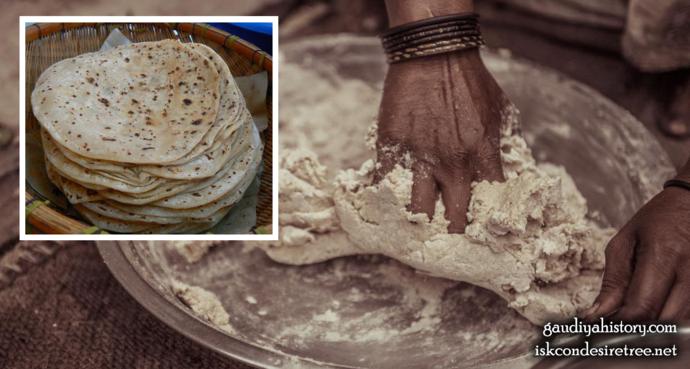
Sanatana Goswami would beg some flour from the village and then with that prepare chapatis for Madana Gopala. Sometimes he would collect some forest vegetables, roots or spinach and also prepare some vegetables. If sometimes there was no ghee or oil, or salt, then he would just cook dry chapatis. But he felt very bad about this. On the other hand, he could not see an alternative. Mahaprabhu had ordered him to compile Bhakti-shastras (devotional scriptures) and the major portion of his time was devoted to that. Sometimes it simply wasn't possible to find time to beg some money with which to purchase salt and oil. (In the wallpaper: Chapati making process and chapatis out of wheat floor).

   One day Madana Gopala refused to eat, complaining that there wasn't even any salt in the chapatis. Sanatana replied, "Today it's salt and tomorrow it will be ghee. But I am sorry. I don't have the time or the inclination to chase around after rich men requesting special items from them". Having silently listened to this reply Madana Mohana didn't say anything further, but rather arranged that Krishna dasa Kapoor would come that way, as will subsequently be described.

   Sanatana Goswami would beg some flour from the village and then with that prepare chapatis for Madana Gopala. Sometimes he would collect some forest vegetables, roots or spinach and also prepare some vegetables. If sometimes there was no ghee or oil, or salt, then he would just cook dry chapatis. But he felt very bad about this. On the other hand, he could not see an alternative. Mahaprabhu had ordered him to compile Bhakti-shastras (devotional scriptures) and the major portion of his time was devoted to that. Sometimes it simply wasn't possible to find time to beg some money with which to purchase salt and oil. 

   "Madana Mohana is the son of a Maharaj. Seeing that He is simply eating dry chapatis Sanatana felt very sad; Madana Mohana, who is within the heart of everyone could understand, 'Sanatana wants to render greater service to Me.' Then Madana Mohana Himself desired that His service might be increased."

   Within a few days a wealthy Kshatriya named Shri Krishna dasa Kapoor came to Mathura to engage in trade and business. By chance, however, his boat became stuck on a sand bar in the Yamuna and by no means could he manage to free it. By the way, he came to learn that a sadhu by the name of Shri Sanatan Goswami was living nearby. In order to seek the blessings of the sadhu, Krishna dasa Kapoor came to his hermitage and found Sanatana Goswami engaged in writing.

   Sanatana Goswami's body was very lean and thin from the practice of great austerities and he was wearing only a kaupin. Krishna das offered his dandavats and Sanatana Goswami in turn offered him a grass mat to sit on. Krishna dasa touched the mat with his hand and sat on the ground. He appealed to the Goswami, "Baba! Please bestow your mercy on me."

   Sanatana replied, "I am a beggar. What mercy can I bestow upon you?"

   "I simply want your blessings. My boat is stuck on a sand bar in the Yamuna, and we can't free it by any means."

   "I am completely ignorant about all these matters You can speak to Madana Gopala about it."

   Krisina das offered his dandavats to Madana Mohanji and spoke to Him, "O Madana Gopala Deva! If, by Your mercy my boat is freed, then whatever profit is realized from the sale of its cargo, I will give to this Goswami to be engaged in Your service."

   Praying this way, Kapoor Seth took leave from Sanatan Goswami. That afternoon there was such a downpour of rain that the boat very easily floated off the sand bar and on to Mathura. Krishna dasa could understand that this was the mercy of Lord Madana Gopala Deva. His goods were sold at a very handsome profit and with this money he constructed a Temple and kitchen and made all the necessary arrangements for the royal execution of Shri Madana Gopala's worship. Seeing this arrangement, Sanatana Goswami was very happy and after some period initiated Krishna dasa Kapoor as his disciple. 

Sanatana Goswami

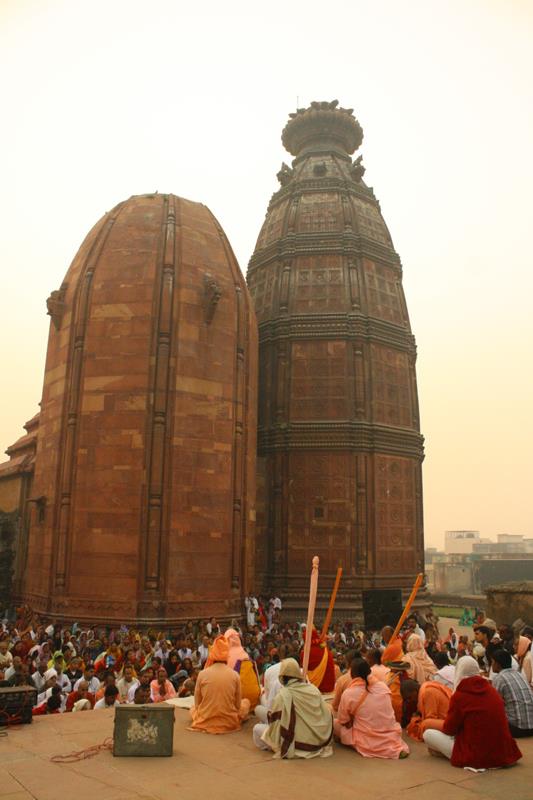
His goods were sold at a very handsome profit and with this money he constructed a Temple and kitchen and made all the necessary arrangements for the royal execution of Shri Madana Gopala's worship. Seeing this arrangement, Sanatana Goswami was very happy and after some period initiated Krishna dasa Kapoor as his disciple. (In the image: Shri Madan Mohan Temple, ISKCON Devotees at the time of parikrama, Shri Vrindavan Dham).

   Shri Madana Mohana Deva is presently worshiped at Karauli, Rajasthan. When the daugher of the king of Jaipur was offered in marriage to the king of Karauli, she very insistently requested that her father send Lord Madana Mohana with her as a dowry, as she was very attached to Him. Her father was very reluctant and agreed only after stipulating one condition: "Madana Mohana would be placed in a room with many other Deities.  Whoever she chose while blindfolded could go with her to Karauli."

   Madana Mohana reassured her by telling her that she would be able to recognize Him by the soft touch of His arm. By this stratagem, she easily recognized Madana Mohana who still resides in Kaurali till this day. There is a direct bus to Karauli from Jaipur. Otherwise, one can go by train from Mathura to Hindaun and then from there to Karauli by bus.

   One day Sanatana Goswami came to Radha-kunda to meet Shri Rupa and Shri Raghunatha dasa Goswami. Upon his arrival they both got up to greet him and after respectfully seating him, they immersed themselves in discussion of the nectarean pastimes of Shri Shri Radha-Krishna. At that time Shrila Rupa Goswami was composing some hymns in praise of Shrimati Radharani, collectively known as "Chatu Pushpanjali". Sanatan Goswami, while reading these, came across one verse:

anava gorocana gauri praba rendi barambaram
amani stavak vidyoti veni byalangana fanam

   Here "byalangana fanam" means that the braids of Radharani's hair appeared very beautiful like the hoods of a snake. Sanatana Goswami reflected, "Is that a proper comparison 'like the hood of a poisonous snake'?"

   At noon Sanatan came to the banks of Radha-kunda, and after offering prayers there, he began to take his bath. Then, on the opposite bank of the kunda, he noticed some cowherd girls playing under the shade of a large tree. As he watched them from the distance, it appeared that a black snake, hanging from the tree, was about to wrap itself around the neck and shoulders of one of those cowherd girls. Sensing some danger he called out to her, "Ohe Lali! Look out! There is a snake just behind You!" But the girls were absorbed in their play and didn't take notice of him. So he immediately took off running to save them from the impending danger. Seeing him approaching them, Shrimati Radharani and Her friends began to laugh. Then they disappeared. Sanatana was completely stunned but then gradually the understanding came to him that Shri Rupa's comparison was appropriate.

   Coming to the banks of Pavan Sarovar, Sanatana Goswami entered into some woods there, and giving up food and water, he became absorbed in intense meditation on the lotus feet of Shri Shri Radha-Govinda. Shri Krishna, who is within the heart of everyone, could understand that His Devotee was going without food, so He came there in the dress of a cowherd boy, with a pot of milk in His hand, and stood smiling before Sanatana Goswami.  [B.R. 5/1303]

   "Baba! I brought some milk for you."

   "Oh Lala! Why have You gone to such trouble for me?"

   "I saw you are sitting here for so long without any food."

   "How do You know that I am not eating anything?"

   "I come here to pasture My cows and I watch you to see what you are doing. But you never take any food."

   "You should have sent someone else, You are just a small boy. You have suffered some difficulty in bringing this milk here for me."

   "Na, na, Baba. It was no trouble. At home everyone else was busy, so I was happy to be able to come Myself."

   Sanatan Goswami requested the boy to sit down while he transferred the milk into another  container.

   "Na Baba! I can't sit down now. It is almost sunset. I have to milk My cows now. I will come to get the pot tomorrow."

   When when Sanatana looked up there was no one there. He could understand Shri Krishna Himself had brought him this milk. With tears of love streaming down his cheek, he drank the milk. From that day he gave up fasting and would go to beg some food-stuffs from the Brijabasis. The Brijabasis also built him a small hut. 

Sanatana Goswami

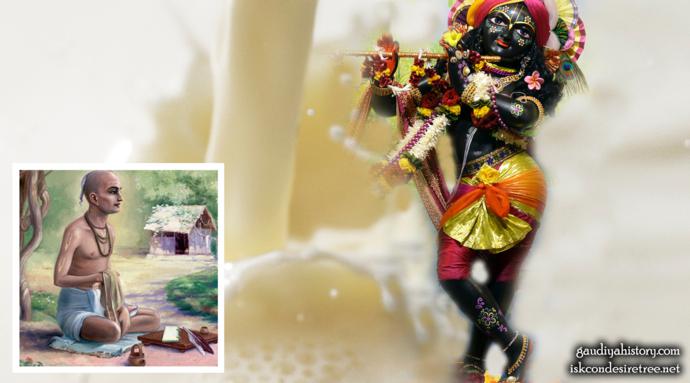
When when Sanatana looked up there was no one there. He could understand Shri Krishna Himself had brought him this milk. With tears of love streaming down his cheek, he drank the milk. From that day he gave up fasting and would go to beg some food-stuffs from the Brijabasis. The Brijabasis also built him a small hut. (In the wallpaper: Shri Madan Gopal, ISKCON Nasik, Maharashtra, Shrila Sanatana Goswami, milk).

   One day Rupa Goswami had a desire to cook some sweet rice for his elder brother, Sanatana, but he had none of the necessary ingredients, Shri Radha Thakurani, who fulfills the desires of her Devotees, could understand everything. Dressing Herself as a cowherd girl, she came there carrying a basket containing rice and sugar with a pot of milk in her other hand. "swamin! swamin! Please accept this offering which I have brought".

   Hearing someone calling in such a sweet voice, he opened the door of the kutir and saw an extremely beautiful cowherd girl standing there with a present of rice, sugar and milk in her hands.

   "Lali! What brings You here so early this morning?"

   "swamin, I came to bring you this present."

   "Oh! But You have gone to so much trouble."

   "What trouble? I have come to serve the sadhus."

   Shri Rupa requested her to sit down, but she replied that there was much work at home, so She couldn't sit down just now. And then She was gone. Shri Rupa looked up and saw that there was no one there and was a little startled. "Now where did She run off to so quickly?"

   He prepared the sweet rice and after offering to Shri Giri-dhari, he gave the Prasadam to Shri Sanatana. Sanatana was in total ecstasy while accepting this Prasadam and inquired, "From where did you get the rice and milk?"

   Shri Rupa replied, "One cowherd girl brought everything."

   Sanatana asked, "Just like that? Suddenly She brought every thing?"

   "Yes. This morning I was thinking to make some sweet rice for you. Just after that I saw one cowherd girl standing before our kutir with all the ingredients in Her hands."

   As Sanatana heard this, tears began to glide down his cheeks. "The taste of this sweet rice is from another world. Who else could have brought such ingredients but Shrimati Radha Thakurani Herself. Don't desire like this again." [B.R. 5.1322]

   Everyday Shri Sanatana Goswami would circumambulate the fourteen mile circumference of Govardhan hill. As he became advanced in years this became somewhat difficult, but he was not inclined to give up his vow. Krishna, however could understand that it was difficult for him, so He came to him one day dressed as a cowherd boy.

   "Baba! You have become old now, so I think it isn't necessary for you to circumambulate Govardhan hill anymore."

   "No. Lala! This is my regular vow, my worship."

   "You can renounce this vow in your old age."

   "No Lala. One should never renounce his vows."

   "Baba. I have a very good idea, if you will accept it."

   "If it is acceptable surely I will accept it."

   Then Shri Krishna presented him a stone from Govardhan hill with the imprint of His foot, a calf's foot print and the impressions of a stick and flute in it.

   "Baba! This is a Govardhan shila."

   "What will I do with this?"

   "You can circumambulate this shila, and that will be the same as circumambulating Giri Govardhan." Saying this much the cow herd boy disappeared. Then Sanatana could understand that Giriraja Himself had presented His worshippable form to him and from that day he would circumambulate this shila. 

Sanatana Goswami

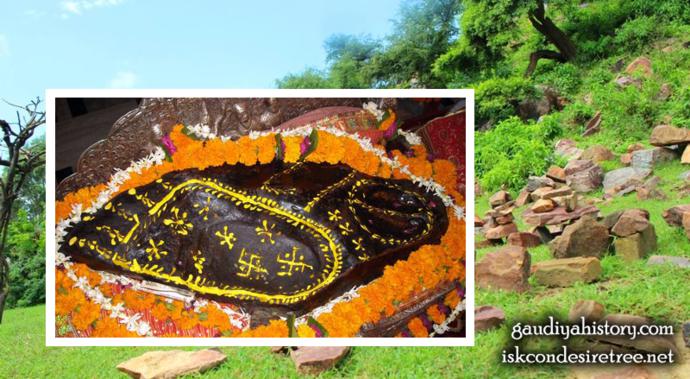
"You can circumambulate this shila, and that will be the same as circumambulating Giri Govardhan.&quo#39;s pastimes might sometimes be described in different ways, putting more or less emphasis on the external events that surround the internal moods and sentiments felt by Krishna and His Devotees. In light of this, it has been described in the Prema-vilas that the Madana Mohana Deity resided at the home of one Mathura brahmana, Damodar Chaube by name. Subsequent to the period of time during which He was worshipped by Shri Advaita Acharya Damodar Chaube, his wife Ballabha and their son, Madan Mohan, used to worship the Deity in the mood of parental affection and friendship. Damodar Chaube t; Saying this much the cow herd boy disappeared. Then Sanatana could understand that Giriraja Himself had presented His worshippable form to him and from that day he would circumambulate this shila. (In the wallpaper: Shri Govardhan Hill and Shila which was given to Sanatana Goswami by Krishna Himself).

   Sometimes Shri Sanatana used to stay at Mahavan. One day he saw some cowherd boys playing on the banks of the Yamuna, and amongst them was one boy whom he thought was Madana Gopala. 

   "Is that my Madana Gopala playing there? No it must be one of the local village boys."

   Then on another day as he was passing by the Yamuna, there again he saw that same boy and thought, "This time let me wait and see where Damodar Chaubee goes." Finally as the evening approached the boys finished playing and set out for their respective homes.

   Following behind that particular boy, sure enough, Sanatana saw him enter the Temple. Then he could understand that Madana Gopala goes every day to the banks of the Jamuna to play with the other boys.

   Wherever Shri Sanatana and Shri Rupa would go throughout Vraja, in all the various villages the two brothers were much adored by the Brajabasis, who would feed them milk and yogurt. They in turn would see the Vrajavasis as Krishna's own family members and respect them in that way. Though it was not their business to engage in ordinary gossip, with the Brajavasis they would inquire about their well-being, e.g. how many sons and daughters they had and who had been married where, what everyone's various names were, how their cows were giving milk, how the bulls were working in the fields, how the harvest was going on, who had fallen ill and if they were getting better or not.

   In this way Rupa and Sanatana became the life of the villagers and the Brijabasis also became the life of Rupa and Sanatana.

   Shri Sanatana would sometimes stay at Chakleshwar, near Govardhan. At that place there were many mosquitos, which was a great disturbance. When he was one day being harassed by these insects, Sanatan remarked, "I won't stay here anymore. It is impossible to concentrate on anything. Neither can I write, nor chant."

   That night, Lord Shiva came to Sanatan and told him, "Sanatan! Please continue your service here in a happy frame of mind. From tomorrow there will be no more disturbance from mosquitos."

   After that there were no more mosquitos and Sanatana continued his bhajan free from disturbance.

   Shri Sanatana Goswami compiled many scriptures.  These include: Shri Brhat-bhagavatmrta, Shri Hari-bhakti-vilas and its Dig-darshani-tika, Shri Krishna-lilastava (dasham charit), Shri Bhagavata- tipani, (commentary on Shrimad Bhagavatam) and Brihat-vaishnava-toshani.

   Shri Sanatan Goswami was born – 1488 (Christian) 1410 (Sakabda). At the age of 27 he came to live at Braja where he remained for 43 years. He thus lived to be 70 years old. His disappearance was on the full moon day of Asar in the year 1558 (Christian calendar). His name in Braja-lila is Rati-manjari.

Sri Svarupa Damodar Goswami – Biography

Sri Svarupa Damodar is the eternal associate of Sri Caitanya Mahaprabhu. His previous name was Sri Purusottam acarya and he resided at Navadwip. He was always present with Mahaprabhu. When Sri Caitanya Mahaprabhu exhibited His pastimes of accepting sannyasa, Svarupa Damodara became like a madman and, journeying to Baranasi he also accepted sannyasa from one sannyasi named Caitanyananda.
 
His sannyasa guru ordered him that, "You should yourself study the Vedanta and also teach it to others." Sri Purusottama acarya didn't accept the garments of sannyasa, but simply gave up his sikha and brahmana thread. Therefore his name became Svarupa (a brahmacari name). Thereafter, by the order of his guru, he came to Sri Nilacal, where he again met Mahaprabhu. Then one day, Svarupa Damodar, who was very intimate with Mahaprabhu, and an ocean of the mellows of devotion, came to Sri Jagannath Puri. His previous name was Purusottam acarya and he resided at Navadwip, at the lotus feet of Mahaprabhu.
 
Seeing that Mahaprabhu had accepted sannyasa, he became like a madman and also accepted sannyasa at Varanasi. [C. C. Mad. 10.102]. Though his scholarship was practically unlimited, he spoke very little with others and preferred to remain alone. Thus very few were aware of his actual position. He was completely conversant with the understanding of the mellows of devotion to Sri Krsna and his body was fully imbued with love for Him. He was as though a second Mahaprabhu.
 
Whenever anyone wanted to present to Mahaprabhu some book, verse or song that they had composed, Svarupa Damodar would first hear what they had written before it could be presented to Mahaprabhu. If these compositions contained any points which were in contradiction to the superior position of bhakti, as concluded in scriptures, then hearing these writings would not be a source of transcendental pleasure for Mahaprabhu. Therefore Svarupa Gosai would first examine what had been composed and if it was untainted then it could be presented to Mahaprabhu. Usually he would recite Sri Gita Govinda, and the writings of Candidas and Vidyapati, for the transcendental happiness of Mahaprabhu. In music and singing he was like a Gandharva and in knowledge of the shastras he was like Brhaspati.

There was no one to compare with him in talent and intelligence. He was extremely dear to Sri Advaita and Nityananda Prabhu and was the life and soul of devotees like Srivas and others. When Sri Svarupa Damodar arrived in Puri from Kasi (Baranasi) he recited this sloka in praise of Mahaprabhu: "Oh You, who are the personification of mercy – Sri Caitanya. That which very easily causes grief to retreat far away, and which is spotlessly pure; which causes the appearance of the highest happiness, and by whose appearance disputation over the intricacies of scriptural statements ceases; that which causes the spirit to become extremely agitated in ecstatic love, by a shower of grace and beauty; may that extremely expansive and auspicious mercy by its sweetness and dignity shine its rays upon me." (Sri Caitanya Candrodoy Natak.) Seeing that Svarupa Damodar was offering his dandavats to Him, Mahaprabhu picked him up and as He embraced him he said, "I saw in a dream this morning that you had come. Just as a blind man finds unlimited happiness by regaining his eyesight, so I am feeling by regaining your association." Svarupa Damodar replied: "Prabhu, please forgive me. By leaving You and running off to Baranasi, I made a great mistake. I don't have even a hint of attachment to your lotus feet, and I have actually become a great sinner by leaving you and going to a distant country.

I gave up your association, but You didn't give me up. Binding the rope of mercy around my neck You brought me again to Your lotus feet." [C. C. Mad 10] Hearing these words of Svarupa Damodar, spoken in such humility, Mahaprabhu again embraced him and said: "Krsna is very kind. He has very mercifully brought us together again." Mahaprabhu kept Svarupa Damodar close to Him. Whenever Mahaprabhu became immersed in a particular ecstatic emotion, Svarupa Damodar would perform a kirtan in that particular mood. During this period Sri Ray Ramananda also arrived from Vidyanagar in South India. Thus the two of them, Svarupa Damodar and Ramananda Ray would enhance the ecstatic moods of Mahaprabhu by singing different songs and reciting various poetic verses.

During the day, Mahaprabhu would engage in his pastimes of sankirtan with His devotees, and at night He would taste the mellows of the ecstatic love of Sri Sri Radha-Krsna in the company of these two. As Lalita and Visakha were very intimate with Srimati Radharani, Ray Ramananda and Svarupa Damodar were similarly intimate with Caitanya Mahaprabhu. Svarupa Damodar's place of residence in Puri was the "Satasan Math". This is located near Bhaktivinode Thakur's "bhakti kutir", near the ocean at Svarga Dwar. Mahaprabhu entrusted him to look after and instruct Raghunath Das Goswami. Svarupa Damodar Goswami disappeared on the second day of the bright fortnight in the month of Asar.
 

Mahaprabhu’s Pastime And Mission, The Condensed Version.

Caitanya Mahaprabhu

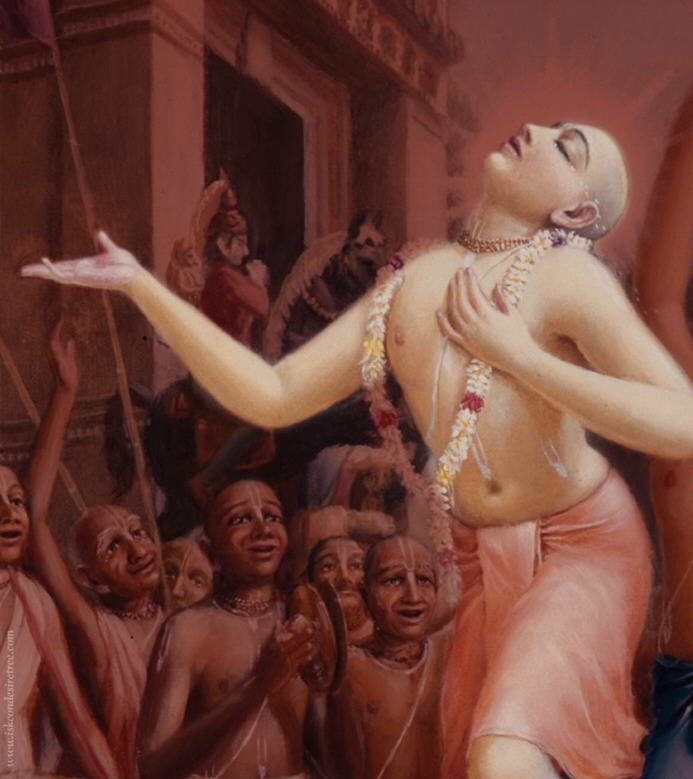
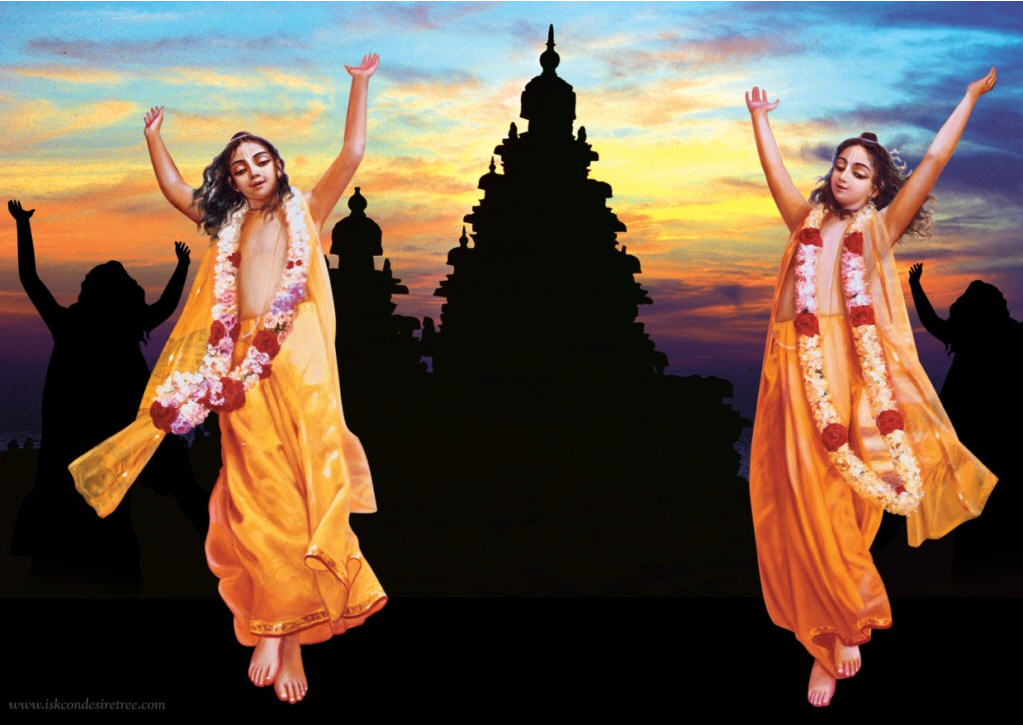
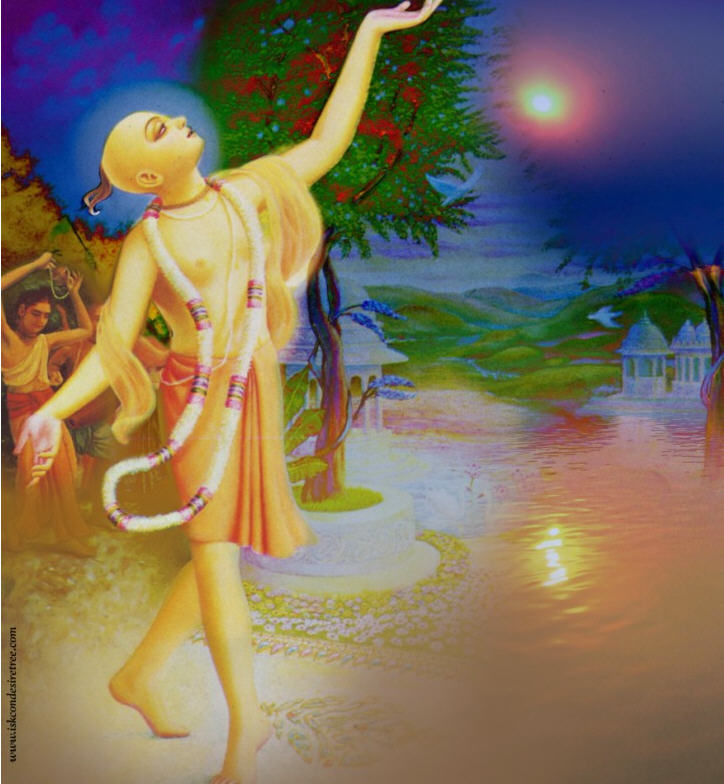
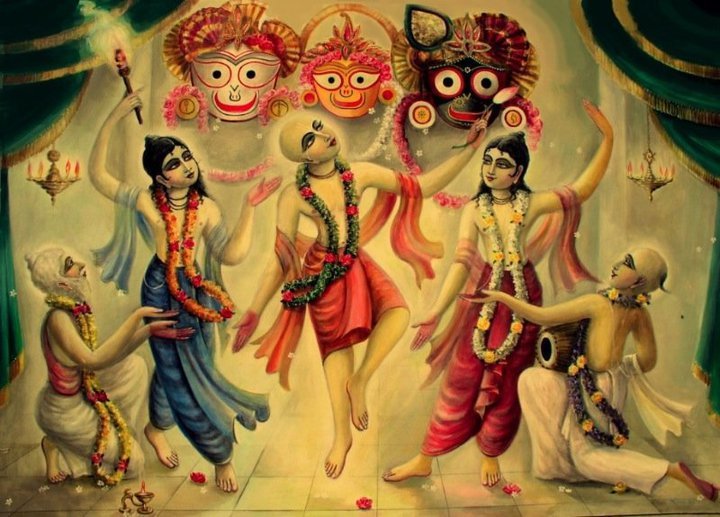
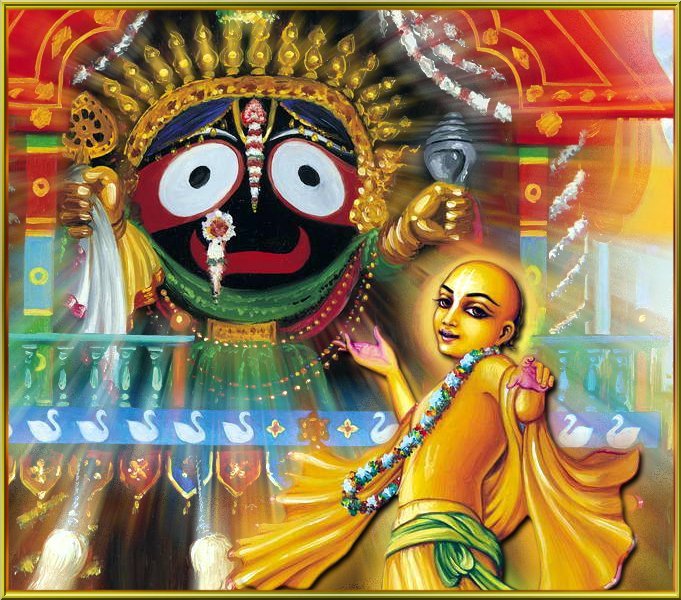
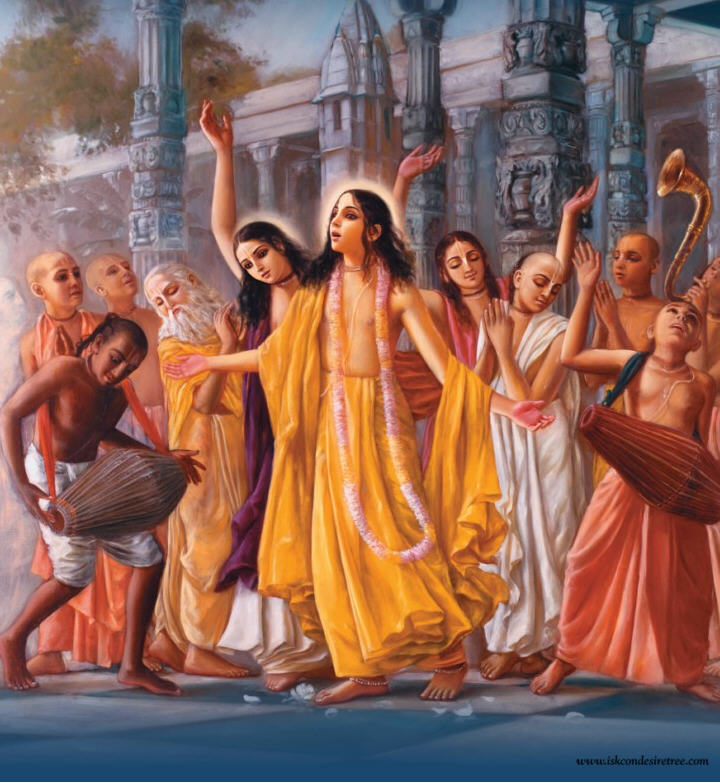
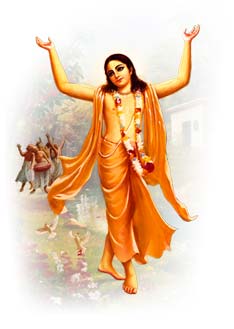
Lord Krishna thought in Goloka, "I shall personally inaugurate the religion of the age; nama-sankirtana, the congregational chanting of the Holy Name of the Lord in the form of Lord Gauranga. By accepting the role of a Devotee, I shall make the whole world dance in ecstasy, and thus realize the four mellows of loving devotional service. In this way, I shall teach devotional service to others by personally practicing it, for whatever a great personality does, common people will follow. Of course, My plenary portions can establish the religious principles for each age, but only I can bestow the kind of loving devotional service which is performed by the residents of Vraja." (In the image: Lord Sri Krishna Chaitanya dancing in ecstacy).

   Lord Krishna thought in Goloka, "I shall personally inaugurate the religion of the age; nama-sankirtana, the congregational chanting of the Holy Name of the Lord in the form of Lord Gauranga. By accepting the role of a Devotee, I shall make the whole world dance in ecstasy, and thus realize the four mellows of loving devotional service. In this way, I shall teach devotional service to others by personally practicing it, for whatever a great personality does, common people will follow. Of course, My plenary portions can establish the religious principles for each age, but only I can bestow the kind of loving devotional service which is performed by the residents of Vraja."

   Besides this secondary reason for Lord Krishna to appear once more, taking the form of a Devotee, there is another confidential purpose of a very personal nature. Even though Lord Krishna had tasted the essence of loving mellows by performing His conjugal pastimes in the company of the gopis, He was not able to fulfill three desires.

   Therefore, after His disappearance, the Lord thought, "Although I am the Absolute Truth, and the reservoir of all rasas, I cannot understand the strength of Radharani's love, with which She always overwhelms Me. Indeed, the love of Radharani is My teacher, and I am Her dancing pupil, for Her love makes Me dance in various novel ways. Whatever pleasure I get from tasting My love for Srimati Radharani, She relishes ten million times more, by Her love. Although there is nothing greater than Radha's love, since it is all pervading, it nonetheless expands constantly and is completely devoid of pride. There is nothing purer than Radha's love, and yet its behavior is always perverse and crooked."

   "Sri Radhika is the highest abode of love, and I am its only object. I taste the bliss to which the object is entitled, but Radha's pleasure is ten million times greater than Mine. Therefore, My mind becomes mad to taste the pleasure that is experienced by the abode of love, although I cannot do so. Only if I can somehow become the abode of that love, will I be able to experience its joy." 

Caitanya Mahaprabhu

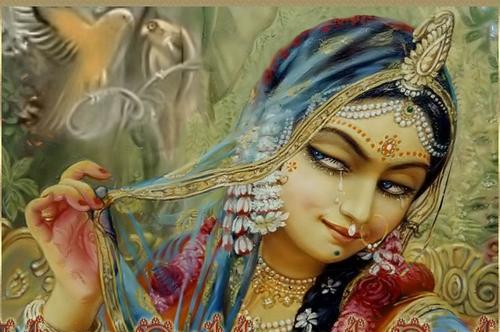
"Sri Radhika is the highest abode of love, and I am its only object..." (In the image: Eternal Consort of Sri Krishna Srimati Radharani).

   This was one desire that increasingly blazed in Lord Krishna's heart. Then, upon seeing His own beauty, Lord Krishna began to consider as follows: "My sweetness is unlimitedly wonderful. Only Radhika can taste the complete nectar of My sweetness, by the strength of Her love, which acts just like a mirror whose clarity increases at every moment. Although My sweetness, being without limit, seemingly has no room for expansion, it shines forth with newer and newer beauty, and thus constantly competes with the mirror of Radharani's love, as they both go on increasing without admitting defeat." "Devotees taste My sweetness according to their respective love, and if I see that sweetness reflected in a mirror, I also become tempted to taste it, although I cannot. Upon deliberation, I find that the only way I can relish My sweetness is to take the position of Srimati Radharani."

   This was Lord Krishna's second desire, and His third desire was expressed while thinking as follows: "Everyone says that I am the reservoir of all transcendental bliss, and indeed, all the world derives pleasure from Me alone. Who then could give Me pleasure? I think that only someone having a hundred times more qualities than Myself could give pleasure to My mind, but such a person is impossible to find."

   "And yet, in spite of the fact that My beauty is unsurpassed, and gives pleasure to all who perceive it, the sight of Srimati Radharani gives pleasure to My eyes. Although the vibration of My flute attracts everyone within the three worlds, My ears become enchanted by the sweet words spoken by Radharani. Although My body lends its fragrance to the entire creation, the scent of Radharani's limbs captivates My mind and heart. Although there are various tastes due to Me alone, I become charmed by the nectarean taste of Radharani's lips. Although My touch is cooler than ten million moons, I become refreshed by the touch of Srimati Radharani. Thus, in spite of the fact that I am the source of happiness for the entire world, the beauty and attributes of Sri Radhika are My very life and soul." 

Caitanya Mahaprabhu

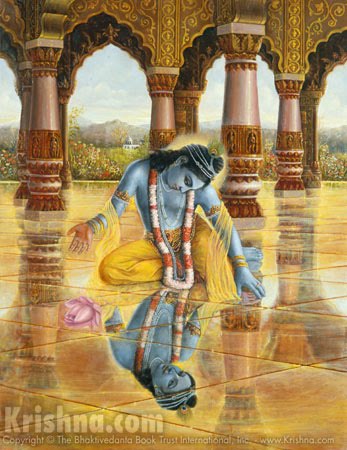
"Everyone says that I am the reservoir of all transcendental bliss, and indeed, all the world derives pleasure from Me alone. Who then could give Me pleasure? I think that only someone having a hundred times more qualities than Myself could give pleasure to My mind, but such a person is impossible to find." (In the image: Lord Sri Krishna seeing His own complextion on the marble floor became attracted to Himself).

   "My eyes become fully satisfied by looking at Srimati Radharani, and yet, when She gazes at Me, She feels even greater satisfaction. The whispering murmur of the bamboo trees that rub against one another steals away Radharani's mind, for She thinks it to be the sound of My flute. She embraces a tamala tree, mistaking it for Me, and thus She considers, 'I have gotten the embrace of Krishna, and so now My life has become fulfilled.' When the fragrance of My body is carried to Her by the wind, Radharani becomes blinded by love and tries to fly into that breeze. When She tastes the betel nut that has been chewed by Me, She merges into an ocean of joy, and forgets everything else."

   "Thus, even with hundreds of mouths, I could not express the pleasure which Radharani derives from My association. Indeed, upon seeing the luster of Her complexion after Our pastimes together, I consider My own happiness to be negligent. Expert sexologists say that the happiness of the lover and the beloved are equal, but they do not know the nature of transcendental love in Vrindavana. Because of the indescribable pleasure which Radharani experiences, I can understand that there is some unknown mellow within Me that controls Her entire existence."

   "I am always very eager to taste the joy that Srimati Radharani derives from Me, and yet, in spite of endeavoring, I have been unable to do so. Therefore, in order to fulfill My three desires, I shall assume Sri Radhika's bodily complexion and ecstatic loving sentiment, and then descend as an incarnation."

   Desiring to understand the glory of Radharani's love, the wonderful qualities in Him that She alone relishes through Her love, and the happiness that She feels upon realizing the sweetness of His love, the Supreme Lord, Gauranga-Krishna, decided to appear in a form that was richly endowed with Her emotions. First of all, the Lord had His respectable superiors incarnate on the earth, such as His mother and father, Sri Sachidevi and Jagannath Mishra. In addition, there was Madhavendra Puri, Keshava Bharati, Ishvara Puri, Advaita Acharya, Shrivas Pandita, Thakur Haridas, Acharyaratna and Vidyanidhi.

   Before the appearance of Lord Sri Gauranga Mahaprabhu, all of the Devotees in the Navadwip area used to gather at the house of Advaita Acharya. In these meetings, Advaita Acharya preached on the basis of Bhagavad-Gita and Srimad-Bhagavatam, decrying the paths of philosophical speculation and fruitive activity, and firmly establishing the super excellence of devotional service. In the house of Advaita Acharya, the Devotees took pleasure in always talking about Krishna, worshipping Krishna, and chanting the Hare Krishna maha-mantra.

   However, Advaita Acharya felt very pained to see how practically all the people of the world were devoid of Krishna consciousness and completely merged into material sense enjoyment. Knowing that no one can gain relief from the cycle of repeated birth and death without taking an interest in the devotional service of the Lord, Advaita Acharya compassionately pondered over the means whereby people could become delivered from the clutches of maya. 

Caitanya Mahaprabhu

"...Indeed, my name Advaita will be fitting only if I am able to induce Lord Krishna to inaugurate the sankirtan movement of chanting the Holy Name, which is the only religion for this age." (In the image: Sri Advaita Acharya is calling out for Krishna to descend to this world).

   Advaita Acharya thought, "Only if Lord Krishna personally appears and preaches the path of devotional service by His own example, will liberation become possible for all people. Therefore, I shall worship the Lord in a purified state of mind and constantly petition Him with all humility. Indeed, my name Advaita will be fitting only if I am able to induce Lord Krishna to inaugurate the sankirtan movement of chanting the Holy Name, which is the only religion for this age."

   While Advaita Acharya thought about how to satisfy Krishna by His worship, the following verse came to mind: "Sri Krishna, who is very affectionate toward His Devotees, sells Himself to one who offers Him merely a tulasi leaf and a palmful of water." (Gautamiya-tantra)

   Advaita Acharya considered the meaning of this verse in the following way: "Lord Krishna cannot find any way to repay the debt which He owes to one who offers Him a tulasi leaf and water. Therefore, the Lord concludes, 'Since there is nothing in My possession which is equal to a tulasi leaf and water, I will liquidate the debt by offering Myself to the Devotee.' " Thereafter, while meditating upon the lotus feet of Sri Krishna, Advaita Acharya constantly offered tulasi buds in water from the Ganga. While thus engaged in worship, Advaita Acharya petitioned Krishna to appear by His loud cries, and this repeated invitation attracted the attention of the Lord, causing Him to descend. 

   Sri Upendra Mishra, a brahmana who was formerly the gopala named Parjanya, the grandfather of Lord Krishna, was a great Devotee and scholar. One of Upendra's seven sons, Jagannath Mishra, moved from Srihatta to the banks of the Ganga at Nadia, and then married Srimati Sachidevi, the daughter of Nilambar Chakravarti, who was formerly Gargamuni.

   Before the appearance of Sri Gauranga Mahaprabhu, Jagannath Mishra (who was formerly Nanda Maharaja) begot eight daughters in the womb of Sachidevi (who was formerly Yashoda), but just after birth, they all died. Being very aggrieved at the loss of his children, one after another, Jagannath Mishra worshiped Lord Vishnu, while desiring a son. Thereafter, Sachimata gave birth to a baby boy named Vishvarup, who was an incarnation of Lord Baladev. Being very pleased, the mother and father began to serve the lotus feet of Lord Govinda even more devotedly, because they realized that their happiness was by His mercy.

   Then, in the month of Maagh (18th February 1486) of the year 1406, Shaka era, Lord Krishna entered the bodies of both Jagannath Mishra and Sachidevi. Thereafter, Jagannath informed his wife, "I see many wonderful things! Your body seems to be effulgent, and it appears as if the goddess of fortune is personally residing in our house. Wherever I go, everyone offers me respect, and even without asking, they give me money, cloth and grains." Sachimata replied, "I also see wonderfully brilliant beings, appearing in the sky, as if offering prayers."

   Jagannath Mishra then said, "In a dream I saw the effulgent abode of the Supreme Lord enter into my heart. Then, from my heart it entered your heart, and thus I can understand that a great personality will soon take birth."

   After this conversation, both husband and wife felt very jubilant, and with great care and attention they rendered service unto the household Shalagrama-shila.

   However, when Sachimata's pregnancy approached the thirteenth month, and still there was no sign of delivery, Jagannath Mishra became very apprehensive. At that time, Nilambara Chakravarti made an astrological calculation and predicted that the child would be born that very month, taking advantage of an auspicious moment.

   Thus it so happened that on the evening of the Phalguni purnima, in the year 1407 Shaka era, corresponding to the modern year 1486, Sri Chaitanya Mahaprabhu made His appearance at Navadwip. At this time, Rahu considered, "When the spotless moon of Chaitanya Mahaprabhu is about to become visible, what need is there for a moon which is full of black marks?" Thinking in this way, Rahu covered the full moon, and so all of the Hindus went to the banks of the Ganga in order to bathe and chant the names "Krishna" and "Hari". While the Hindus were thus vibrating the Holy Names of the Lord, the Mohammedans jokingly imitated them. In this way, at the time of Lord Chaitanya's appearance, everyone was engaged in chanting the Hare Krishna maha-mantra.

   In all directions and within everyone's mind there was peacefulness and joy. In Shantipur, Advaita Acharya and Haridas Thakur began chanting and dancing in a very pleasing mood, although no one could understand why they did so. While laughing again and again, they also went to the Ganga, and at that time, Advaita Acharya took advantage of the lunar eclipse to distribute all kinds of charity to the brahmanas. Upon seeing how the whole world had become jubilant, Haridas Thakur addressed Advaita Acharya in great astonishment, "Since Your dancing and distribution of charity appears very pleasing to me, I can understand that You have some very special purpose."

   In Navadwip, Shrivas Thakur and Acharyaratna, who was also called Chandrashekhar, immediately went to bathe in the Ganga, and while chanting the Holy Name of the Lord in great jubilation, they also gave charity by dint of mental strength. Indeed, wherever they were situated, all of the Devotees danced, chanted and gave charity on the plea of the lunar eclipse, their minds overwhelmed with joy. Even in the heavenly planets, chanting and dancing was going on, for the demigods were very eager to witness the transcendental appearance of the Lord.

   The Supreme Proprietor of the entire creation remained in the womb of Srimati Sachidevi, and on the full moon night in the month of Phalguna He appeared. That full moon night was the summum bonum of all the auspicious holy occasions of the cosmic manifestation combined. The Supreme Personality descended, accompanied by the process of congregational chanting of the Holy Name. He propagated this process by practicing it Himself.

   Who is able to know the wonderful pastimes of the Supreme Lord? He arranged a lunar eclipse at the time of His birth. Upon seeing the lunar eclipse the residents of Nabadwip began to loudly chant the Lord's holy name and make other auspicious sounds. Endless teeming millions convulsed on the Ganges for holy ablutions and rent the air with loud chanting of the Lord's name. The tumultuous sound of their chanting penetrated the coverings of this material universe and travelled beyond Brahmaloka.

   All the saintly persons marvelled at this wonderful chanting and prayed for a perennial eclipse. All the Devotees experienced deep exhilaration and exclaimed, "Such great joy! Maybe the Supreme Lord Krishna is making His appearance. The Devotees went to the Ganges for their ablutions followed by the roar of chanting from all directions. Women, children, aged, pious, and impious – everyone loudly chanted Lord Hari's Holy Name during the lunar eclipse. The only sound within the universe was the all-prevailing chanting of "Hari! Hari!"

   The demigods showered flower confetti everywhere and pro-claimed victory as they beat clamorously on their dundubhi drums. Amidst the resounding adulations, the Lord and the very soul of the universe appeared as the son of Srimati Sachidevi. 

Caitanya Mahaprabhu

"The Supreme Proprietor of the entire creation remained in the womb of Srimati Sachidevi, and on the full moon night in the month of Phalguna He appeared. That full moon night was the summum bonum of all the auspicious holy occasions of the cosmic manifestation combined. The Supreme Personality descended, accompanied by the process of congregational chanting of the Holy Name. He propagated this process by practicing it Himself." (Chaitanya Bhagavat). (In the image: Lord Sri Krishna Chaitanya).

Gaudiya Kanthahara On Sri Chaitanya Mahaprabhu’s Divine Appearance And Mission:

Caitanya Mahaprabhu

The Personality of Godhead (Sri Chaitanya Mahaprabhu) is brilliantly effulgence (like molten gold), and he is imperishable.

   4.1

mahan-prabhur vai purusam sattvasyesu pravarttakam
surnimalam imam santisano jyotiravyam

   The Personality of Godhead [Sri Chaitanya Mahaprabhu] is brilliantly effulgence [like molten gold], and he is imperishable. He is the Supreme Controller. He controls the mode of goodness and [through the performance of sankirtana] he bestows upon the living beings [the] spiritual intelligence [by which they can understand devotional service]. [In his acarya-lila, as a sannyasi] He is the source of spiritual purity and of liberation. He is therefore known as "Mahaprabhu." (Shvetasvatara Upanishad 2.12)

   The Sruti establishes that The Supreme Lord will appear in a golden form as Sri Gauranga

4.2
yada pasyam pasyate rukma-varnam kartaram isam purusam brahma-yonim
tada vidyan punya-pape vidhuya nira-janam pramam samyam upaiti

   When one realizes the golden form of that Lord [Sri Gauranga] who is the ultimate actor and the source of the Supreme Brahman, he attains the highest knowledge, transcends both pious and impious activities, becomes free from wordly bondage and gains entrance into the divine abode of the Lord. (Mundaka Upanisad 3.3)

   The evidence of Srimad-Bhagavatam.

4.3
krishna-varnam tvisa-'krishnam sangopangastra-parsadam
yajnaim sankirtana-prayair-yajanti hi sumedhasam

   In the age of Kali, Krishna appears in a golden form, [as Sri Gauranga] chanting the two syllables “Krish” “na”. He descends along with his weapons [The Holy Name of Krishna, Srimad-Bhagavatam, kirtana, and mahaprasada ], His limbs [His expansions and avataras such as Nityananda, Advaita, and His divine energies (saktis) such as Gadadhara, Svarupa Damodara, and Ramananda Raya], and eternal confidential associates [like Shrivasa Thakura, Haridasa Thakura, and other Devotees]. Those who are advanced in transcendental intelligence worship Him by performing sankirtana. (Srimad-Bhagavatam 11.5.32) 
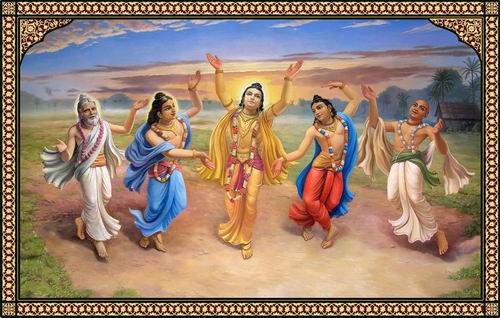
Caitanya Mahaprabhu

His limbs (His expansions and avataras such as Nityananda, Advaita, and His divine energies (saktis) such as Gadadhara, Svarupa Damodara, and Ramananda Raya), and eternal confidential associates (like Shrivasa Thakura, Haridasa Thakura, and other Devotees). Those who are advanced in transcendental intelligence worship Him by performing sankirtana. (Srimad-Bhagavatam 11.5.32) (In the image: Pancha Tattva).

4.4
"krishna" – ei dui varna sada ya-'ra mukhe
athava krishnake ti-ho varne nija sukhe
dehakantye haya ti-ho akrishna-varana
"akrishna" – varane kahe pita-varana

   The two syllables "Krishna" are always in His mouth, or He always describes Krishna with great pleasure. These are two meanings of the words "Krishna-varna." Indeed, nothing but Krishna issues from His mouth. If someone tries to describe Him as being of blackish complexion, the next adjective, "tvisakrishnam" immediately restricts him. His complexion is certainly not blackish. Indeed, His not being blackish indicates that his complexion is golden. (Chaitanya Charitamrta-Adi 3.53,56)

4.5
asan varnastrayo'hyasya grhnato'nuyugam tanum
suklo-raktas-tatha-pita idanim krishnatam gatam

   This boy, Krishna, has three other colors: white, red, and yellow, as he appears in different ages. Now, in this Dvapara-yuga, he has appeared in a transcendental blackish color. (Srimad-Bhagavatam 10.8.13)

4.6
sukla, rakta, krishna, pita – krame cari varna
cari varna dhari' "krishna" karena yugadharma

   In the four ages, (yugas) Satya, Treta, Dvapara, and Kali, Krishna accepts four different colors: white, red, black, and yellow respectively. These are the colors of the different incarnations of Krishna in different milleniums. (Chaitanya Charitamrta Madhya 20.330)

4.7
itham nr-tiryag-rsi-deva-jhasavataraair
lokan vibhavayasi hamsi jagat-pratipan
dharmam mahapurusa pasi yuganuvrttam
channam kalau yad-abhavas tri-yugo 'tha sa tvam

   [Prahlada said] O Krishna! In this way you appear in various incarnations: as a human being, an animal, a great saint, a demigod, a fish, or a tortoise. Thus maintaining the entire creation in different planetary systems. In this way, according to the age,You protect the principles of religion. But O, Mahaprabhu! In the age of Kali, [when you come to preach the Holy Name of Krishna, you do so as a Devotee and therefore] You do not assert Yourself as the Supreme Personality of Godhead. Because your Godhood is hidden in the age of Kali You therefore known as Triyuga, or the Lord who manifests his Supremacy in only three ages. [And for this reason many sastras have also kept your appearance in Kaliyuga a secret.] (Srimad-Bhagavatam 7.9.38)

   The evidence of Mahabharata.

4.8
suvarna-varna hemango varangas-candanangadi
sannyasa-krcchamam santo nistha-santi-parayanam

   [The following explanation of this verse is given by Srila Bhaktisiddhanta Saraswat and is based on the commentary by Baladeva Vidyabhushana on the Vishnu-sahasra-nama-stotram found in Mahabharata. These remarks are mentioned by A.C. Bhaktivedanta Swami in his translation of Srila Bhaktisiddhanta Saraswati Thakura’s anubhasya commentary on Chaitanya Charitamrta Adi 3.49.52)] When the Supreme Personality of Godhead Krishna appears as Sri Gauranga, in his early pastimes His complexion is gold (suvarna-varna ), his limbs are the color of molten white gold (hemanga), his body is extremely beautiful (varangas), and he is decorated with sandalwood pulp (candanangadi). [These four are the symptoms of His grhastha-lila.] Another meaning of the description of the Lord as having a golden hue is that Lord Chaitanya's personality is as fascinating as gold is attractive.

   Sri Chaitanya accepts the sannyasa order of life (sannyasa-krt), and shows equanimity (sama) in different ways: by describing the mysteries of devotion to Sri Krishna, and by satisfying everyone by knowledge and attachment to Krishna. (santa). He is peaceful because He renounces all topics not related to the service of Krishna. His mind is always fixed on Krishna, and thus He is fixed (nistha ) in performing the great sacrifice of the Holy Name of Krishna. He silences the nondevotees and impersonalists who are opposed to the service of the Lord, by promoting the cause of devotion. Thus he distributes real peace. He is therefore an abode of the highest spiritual peace and devotion (mahabhava-parayana).(Mahabharata, Tadanadharma 149).

   The evidence of the Puranas.

4.9
aham eva kvacid brahman sannyasnasramamnasritam
hari-bhaktim grahayami kalau papa-hatan-naran

   [The Supreme Lord said to Sri Vyasadeva] O learned brahmanas, sometimes I accept the renounced order of life to induce the fallen people of the age of Kali to accept devotional service to the Lord. (Chaitanya Charitamrta Adi 3.81)

4.10
aham eva dvija-srestha nityam pracchana-vigraham
bhagavad-bhakta-rupena lokan raksami sarvada

   O best of the brahmanas! My disguised form is eternal. In this way, with my own form hidden from ordinary sight, I take the form of a Devotee and appear among the people in general in order to establish and protect religious principles. (Adi Purana )

   The version of the Goswamis.

4.11
antam krishnam bahir-gauram darsitangadi-vaibhavam
kalau sankirtanadyaim smam krishna-caitanyamnasritam

   I take shelter of Sri Krishna Chaitanya Mahaprabhu, who is Krishna Himself, thinking of Himself. He is internally Krishna – blackish – but externally, he appears with the golden complexion [of Sri Radha]. In this age of Kali, Krishna appears as Krishna Chaitanya, simultaneously manifesting His eternal associates, opulences, expansions, and incarnations. In this way, he preaches the process of Krishna consciousness by performing sankirtana. (Tattva-Sandarbha 2)

   Sri Gauranga is the fountainhead of all avataras.

4.12
sutiya acchinu ksira-sagara-bhitare
mora nidra bhanileka nadara hunkare

   [While sitting on the altar of Vishnu in the house of Shrivasa, Sri Chaitanya Maharabhu said] Lying within ocean of milk, My transcendental slumber broke, as I awoke to hear the loud cries of my Devotees. Thus I [Lord Vishnu] have come [as Sri Cahitanya]. (Chaitanya Bhagavata Madhya 22.16).

4.13
sei krishna avatari vrajendra-kumara
apane caitanya-rupe kaila avatara
ata eva caitanya gosa-i paratattva sima
ta-re ksirodasayi kahi ki ta-ra mahima
sei ta bhaktera vakya nahe vyabhicari
sakala sambhave ta-'te ya-'te avatari
avatarira dehe saba avatarera sthiti
keho kona mata kahe yemama ya'ra mati
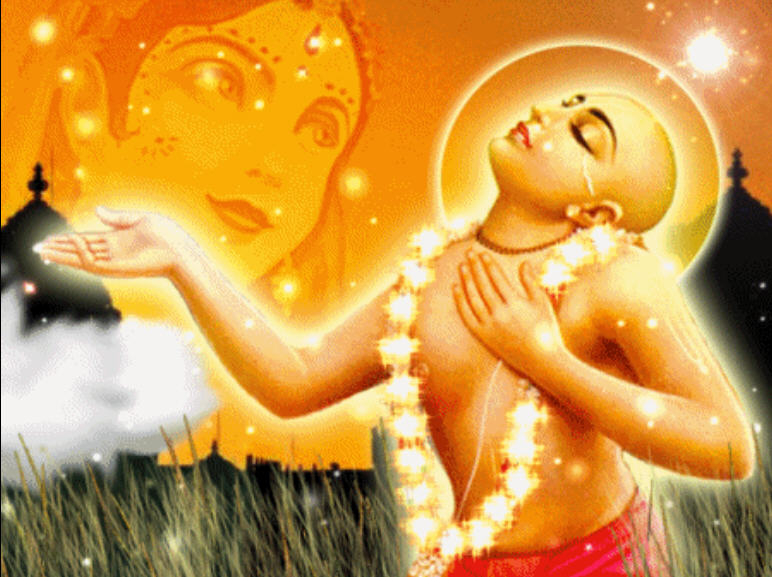
Caitanya Mahaprabhu

That same Lord Sri Krishna who is the fountainhead of all avataras is the son of the king of Vraja. He has descended personally as Sri Chaitanya Mahaprabhu. Therefore Sri Chaitanya Maharabhu is the supreme absolute truth.

   That same Lord Sri Krishna who is the fountainhead of all avataras is the son of the king of Vraja. He has descended personally as Sri Chaitanya Mahaprabhu. Therefore Sri Chaitanya Maharabhu is the supreme absolute truth. To call Him Kshirodakshayi Vishnu does not add to His glory. But such words from the lips of a sincere Devotee cannot be false. All possibilities abide in Him because He is the primeval Lord. All other incarnations are potentially situated in the original body of the primeval Lord. Thus according to one's opinion one may address Him as any one of the avataras. (Chaitanya Charitamrta-Adi 2.109-112)

   He is transcendental truth: He cannot be attained by wordly knowledge.

4.14
bhagavata-bharata-sastra agama purana
caitanya krishna-avatara prakata pramana
pratyakse dekhaha nana prakata prabhava
alaukika karma, alaukika anubhava
dekhiya na dekhe yata abhaktera gana
uluke na dekhe yena suryera kirana

   Srimad-Bhagavatam, Mahabharata, the Puranas, and other Vedic literatures all give evidence to prove that Sri Chaitanya is the avatara or descent of Krishna Himself. One can also directly see Sri Chaitanya's manifest influence in His uncommon deeds and uncommon Krishna conscious realization. But faithless unbelievers do not see what is clearly evident, just as owls do not see the rays of the sun. (Chaitanya Charitamrta-Adi 3.83 – 85)

   Sri Krishna Chaitanya Tattva: the Lord's sixfold nature.

4.15
sakala vaisnava suna kari' ekamana
caitanya-krsnera sastre yemata nirupana
krishna, gurudvaya, bhakta, avatara prakasa
sakti – ei chayarupe karena vilasa

   I advise all my Vaishnava readers to read and hear with rapt attention this narration of the pastimes of Sri Krishna Chaitanya as inculcated in the revealed scriptures. Lord Krishna enjoys His pastimes by manifesting Himself (Krishna) as the spiritual masters (guru), His Devotees (bhakta), His diverse energies (sakti), His incarnations (avatara), and His full expansions (prakasa). (Chaitanya Charitamrta-Adi 1.31 – 32)

   Sri Gauranga is the supreme truth.

4.16
yad advaitam brahmopanisadi tad-apy-asya tanubha
ya atmantaryami purusa iti so'syamsa-vibhavam
sad-aisvaryaim purno ya iha bhagavan sa svayam-ayam
na caitayanyat krishnaj-jagati paratattvam param iha

   What the Upanisads describe as the impersonal absolute (brahman) is but the effulgence of His (Sri Chaitanya's) body. The Lord who is known as the Supersoul (paramatma) is but his localized expansion. He is the Supreme Personality of Godhead, Krishna Himself, (bhagavan), full in six opulences. He is the Absolute Truth, one without a second. There is no truth superior to Sri Krishna Chaitanya Mahaprabhu. (Chaitanya Charitamrta-Adi 1.3)

   Sri Chaitanya Mahaprabhu is the jagad-guru.

4.17
caudda-bhuvanera guru caitanya gosa-i
ta-'ra guru anya, ei kona sastre nai

   Sri Chaitanya Mahaprabhu is the jagad-guru, the spiritual master of the fourteen worlds. No other guru can compare with Him. (Chaitanya Charitamrta-Adi 12.16)

   Sri Gauranga is the best of all.

4.18
saundarye kama-kotim sakala-jana samahladane candrakotir
vatsalye matrkotis tridasavitapinam kotir audarya-sare
gambhirye 'mbodhi-kotir madhurimani sudha-ksira-madvhika-kotir
gaurodevam sa jiyat pranaya-rasapade darsitascarya-kotim
Caitanya Mahaprabhu

Sri Chaitanya Mahaprabhu is lovelier than millions of cupids, mellower than millions of moons, dearer than millions of mothers, kinder than millions of wish-fulfilling trees, deeper than millions of oceans, and sweeter than millions of nectarine drinks. All glories to Sri Chaitanya Mahaprabhu, the Supreme Lord who displays millions of amazing sentiments of madhurya-bhakti, the most exalted mellow of pure love of Godhead. (Chaitanya-Chandamrta 101)

   Sri Chaitanya Mahaprabhu is lovelier than millions of cupids, mellower than millions of moons, dearer than millions of mothers, kinder than millions of wish-fulfilling trees, deeper than millions of oceans, and sweeter than millions of nectarine drinks. All glories to Sri Chaitanya Mahaprabhu, the Supreme Lord who displays millions of amazing sentiments of madhurya-bhakti, the most exalted mellow of pure love of Godhead. (Chaitanya-Chandamrta 101)

   Sri Gauranga's principle, name, form, qualities and pastimes: (tattva,nama,rupa,guna,lila)

4.19
namo maha-vadanyaya krishna-prema-pradaya te
krishnaya krishna-caitanya-namne gaura-tvise namam

   His nature (tattva) is that He is Krishna Himself. His name (nama) is "Krishna Chaitanya." His form (rupa) is golden. His quality (guna) is that He is the most magnanimous of all Personalities of Godhead. His pastime (lila) is to distribute the highest love of Godhead: Krishna-prema. I offer my obeisances unto that most generous Lord, Sri Krishna Chaitanya Mahaprabhu. (Chaitanya Charitamrta-Madhya 19.53)

   Sri Gauranga delivers everyone by distributing the Holy Name of Krishna.

4.20
sankirtana-pravartaka sri krishna caitanya
sanirtana-yaj-e ta-'re bhaje sei dhanya
sei ta' sumedha ara kubuddhi samsara
sarva-yajna haite krishna-nama sara

   Sri Chaitanya Mahaprabhu inaugurated the sankirtana movement. One who worships Him through sankirtana is fortunate indeed. Such a person is truly intelligent, whereas others, who have but a poor fund of knowledge, must endure the cycle of repeated birth and death. Of all sacrificial performances, the chanting of the Lord's Holy Name is the most sublime. (Chaitanya Charitamrta-Adi 3.76 – 77)

   Sri Gauranga is the giver of Krishna-prema.

4.21
uchalila premavanya caudike vedaya
stri-vrddha-balaka-yuva sakali dubaya
sajjana, durjana, pangu, jata andhagana
premavanyaya dubaila jagatera jana

   The flood of love of Godhead distributed by Sri Chaitanya Mahaprabhu swelled in all directions and thus, young men, old men, women, and children were all immersed in that inundation. The Krishna consciousness movement begun by Sri Chaitanya Mahaprabhu will inundate the entire world and drown everyone, whether one be a gentleman or rogue, or even lame, invalid, or blind. (Chaitanya Charitamrta-Adi 7.25,26)

4.22
patrapatra-vicara nahi, nahi sthanasthana
yei ya-ha paya, ta-ha kare prema dana
lutiya khaiya diya bandara prema sataguna vade

   In distributing love of Godhead, Sri Chaitanya Mahaprabhu and his associates did not consider who was fit and who was unfit; nor where such distribution should or should not take place. They may no such conditions. Rather, wherever they got the opportunity, the members of the pancha-tattva distributed love of Godhead. Although the members of the pancha-tattva plundered the storehouse of love of Godhead and ate and distributed its contents, there was no scarcity, for this wonderful storehouse is so complete that as the love is distributed, the supply increases hundreds of times. (Chaitanya Charitamrta-Adi 7.23,24)

   Who would cheat themselves out of love of godhead?

4.23
mayavadi karma-nistha kutarkikagana
nindaka pasandi yata paduya adhama
sei saba mahadaksa dhaina palaila
sei vanya ta' sabare chuite narila

   The impersonalists, fruitive workers, false logicians, blasphemers, nondevotees, and lowest among the student community are very expert in avoiding the Krishna consciousness movement. Therefore the mercy of Sri Chaitanya Mahaprabhu, in the form of this Krishna consciousness movement, cannot reach them. (Chaitanya Charitamrta-Adi 7.29,30)

   By the mercy of Sri Gauranga one can know the proper conclusions of scripture.

4.24
sri caitanya prabhum vande balo'pi yad-anugrahat
taren-nanamata-grahavyaptam siddhanta-sagaram

   I offer my obeisances unto Sri Chaitanya Mahaprabhu, by whose mercy even an ignorant child can swim across the ocean of conclusive truth which is filled with the crocodiles of various theories. (Chaitanya Charitamrta-Adi 2.1)

4.25
hrdaye dharaye ye caitanya nityananda
ei saba siddhante sei pai be ananda
ei saba siddhanta haya amrera pallava
bhaktagana usthrera ithe nahaya pravesa
tabe citte haya mora ananda visesa

   (Krishna Dasa Kaviraja Goswami says) Anyone who has captured Sri Chaitanya Mahaprabhu and Nityananda Prabhu within his heart will become blissful by hearing all these transcendental conclusions. All these conclusions are like the newly grown twigs of a mango tree: they are always pleasing to the Devotees, who in this way resemble cuckoo birds. The camel-like nondevotees, however, cannot enter into these topics, and therefore there is special jubilation within my heart. (Chaitanya Charitamrta-Adi 4.233,235)

   Sri Gauranga's preaching pastimes.

4.26
sannyasi panditaganera karite garvanasa
nica-sudra-dvara kare dharmera prakasa
bhakti-tattva prema kahe raye kari vakta
apani pradyumna-misra saha haya srota
haridasa-dvara nama-mahatmya-prakasa
sanatana-dvara bhaktisiddhanta-vilasa
sri rupa-dvara vrajer rasa-prema-lila
ke kahite pare gambhira caitanyera khela

   To vanquish the false pride of so-called sannyasis and learned scholars, he spread real religious principles, even through a sudra, or lowborn person. Sri Chaitanya Mahaprabhu preached about devotional service, ecstatic love, and the absolute truth by making Ramananda Raya, a grhastha born in a low family the speaker. Then Mahaprabhu Himself, the exalted brahmana sannyasi, and Pradyumna Mishra, the purified brahmana, both became the hearers of Ramananda Raya. Sri Chaitanya Mahaprabhu exhibited the glories of the Holy Name of the Lord through Haridasa Thakura, who was born in a Muslim family, and similarly He exhibited the essence of devotional service through Sanatana Goswami, who had almost been converted into a Muslim. The Lord also fully exhibited the ecstatic love and transcendental pastimes of Vrindavana through Srila Rupa Goswami. Considering all this, who can understand the deep plans of Sri Chaitanya Mahaprabhu? (Chaitanya Charitamrta-Antya 5.84 – 87)

4.27
vraje ye vihare purve krishna-balarama
koti candra-surya jini' do-hara nija dhama
sei dui jagatere haiya sadaya
gaudades purva saile karila udaya
sri krishna caitanya ara prabhu nityananda
ya-hara prakase sarva jagata ananda
surya-candra hare yaicche saba andhakara
bastu prakasiya kare dharmera pracara
ei mata dui bhai jivera ajnana
tamonasa kari' kare vastu-tattva dana
suryacandra bahirera tamo se vinase
bahirvastu ghatapata adi se prakase
dui bhai hrdayera ksali' andhakara
dui bhagavata-sane karan saksatkara
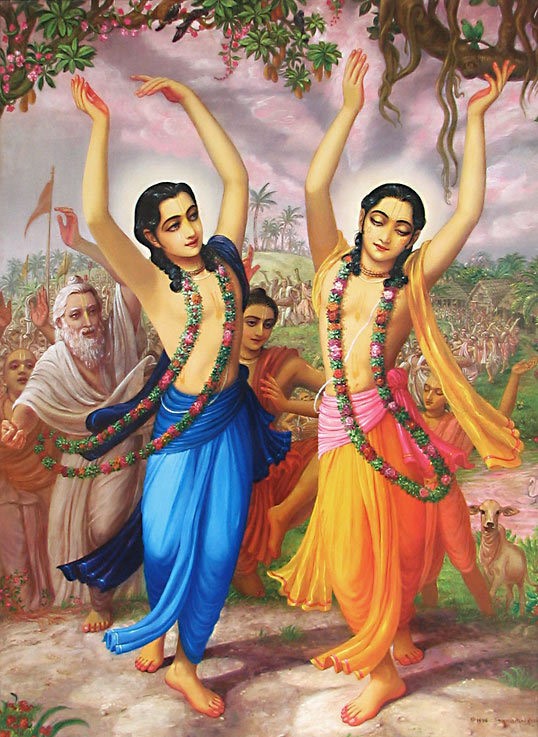
Caitanya Mahaprabhu

...The appearance of Sri Chaitanya and Nityananda has surcharged the world with happiness. As the sun and moon drive away darkness by their apperance and reveal the nature of everything, these two brothers dissipate the darkness of the living beings' ignorance and enlighten them with knowledge of the Absolute Truth. (In the image: Lord Sri Nityananda in the left and Lord Sri Krishna Chaitanya in the right).

   Sri Krishna and Balarama, the Personalities of Godhead who formerly appeared in Vrindavana and who were millions of times more effulgent than the sun and moon have arisen over the eastern horizon of Gauda-desa, being compassionate for the fallen state of the world. The appearance of Sri Chaitanya and Nityananda has surcharged the world with happiness. As the sun and moon drive away darkness by their apperance and reveal the nature of everything, these two brothers dissipate the darkness of the living beings' ignorance and enlighten them with knowledge of the Absolute Truth. By the grace of Sri Chaitanya and Nityananda, all darkness is removed, and the truth is brought to light. The sun and moon dissipate the darkness of the external world and thus reveal material reality. But these two brothers dissipate the darkness of the inner core of the heart, and thus help one to meet the two kinds of bhagavatas, [Srimad-Bhagavatam and the pure Devotee.] (Chaitanya Charitamrta-Adi 1.85 – 99)

Sri Gauranga's example and precept.

4.28
hare-krsnetucchaim sphurita-rasano namaganana-
krta-granthi-sreni-subhaga-kati-sutrojjvala-karam
visalakso dirghargala-yugala-khela-cita-bhujam
sa caitanyam kim me punarapi drsoryasati padam

   Sri Chaitanya Mahaprabhu chants the Hare Krishna mantra in a loud voice. The Holy Name dances on his tongue as he counts his number of recitations with His effulgent hands. His eyes are large, and His long arms, which bend as He performs his pastimes, reach down to His knees. When will he again become visible before me? (Stava-mala verse 5 – Sri Rupa Goswami)

   Sri Gauranga's principle and ultimate goals.

4.29
ei mata caitanya-krishna purna bhagavan
yuga-dharma-pravartana nahe ta-'ra kama
kona karane yabe haila avatare mana
yugadharma kala haila se kale milana
dui hetu avatari' laina bhaktagana
apane asvade prema-nama-sankirtana
sei dvare acandale kirtana-sa-care
ei mata bhakta-bhava kari' angikara
apani acari' bhakti karila pracara

   [Just as Sri Krishna really appeared in order to manifest His Vrindavana pastimes whereas his supression of demons was incidental,] in the same way, for Sri Chaitanya Mahaprabhu, promulgating the dharma for the age is an incidental reason for his appearance. When the Lord desired to appear for another reason, the time for promulgating the religion of the age also arose. Thus with two intentions, the Lord appeared with His Devotees and tasted the nectar of prema with the congregational chanting of the Holy Name. Thus he spread kirtana even among untouchables. He wove a wreath of the Holy Name and prema with which he garlanded the entire world. In this way, assuming the sentiment of a Devotee, He preached devotional service while practicing it Himself. (Chaitanya Charitamrta-Adi 4.37 – 41)

   Sri Gauranga is like a lion.

4.30
caitanya-simhera nabadipe avatara
simha-griva simhaviraya simhera hunkara
sei simha vasuk jivera hrdaya-kandare
kalmasa-dviradanasa ya-jara hunkare
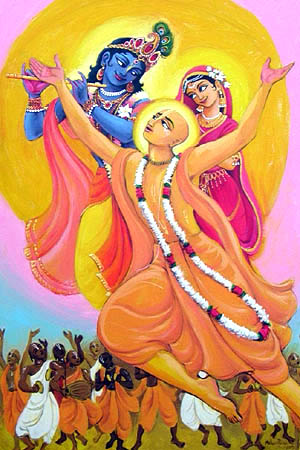
Caitanya Mahaprabhu

Thus the lionlike Sri Chaitanya Mahaprabhu has appeared in Navadwipa-dhama. He has the shoulders of a lion, the powers of a lion, and the loud voice of a lion. May that lion be seated in the core of the heart of every living being. Thus with His resounding roar, may he drive away one's elephantine vices. (Chaitanya Charitamrta-Adi 3.30 - 31)

   Thus the lionlike Sri Chaitanya Mahaprabhu has appeared in Navadwipa-dhama. He has the shoulders of a lion, the powers of a lion, and the loud voice of a lion. May that lion be seated in the core of the heart of every living being. Thus with His resounding roar, may he drive away one's elephantine vices. (Chaitanya Charitamrta-Adi 3.30 – 31)

   Sri Gauranga's external reasons for appearing.

4.31
anarpitacarim cirat karunayavatirnam kalau
samarpayitum-unnatojjvala-rasam sva-bhakti-sriyam
harim purata-sundara-dyuti-kadamba-sandipitam
sada hrdaya-kandare sphuratu vam sacinandanam

   May that Lord who is known as the son of Srimati Sachidevi be transcendentally situated in the inner-most chambers of your heart. Resplendent with the radiance of molten gold, he has appeared in the age of Kali by His causeless mercy to bestow what no incarnation ever offered before: the most sublime and radiant spiritual knowledge of the mellow taste of his service. (Chaitanya Charitamrta-Adi 1.4, Vidagdha-Madhava 1.2)

   Sri Gauranga's ultimate and confidential reason for appearing

4.32
sri radhayam pranaya-mahima kidrso vanayaiva-
svadyo yenadbhuta-madhurima kidrso va madiyam
saukhya-casya madanubhavatam kidrsam veti lobhat-
tad-bhavadyam samajani saci-garbha-sindhau harindum

   Desiring to understand the glory of Srimati Raharani's love, the wonderful qualities in Him that She alone relishes through Her love, and the happiness She feels when She realizes the sweetness of His love, The Supreme Lord Hari, richly endowed with Her emotions, appears from the womb of Srimati Sachidevi as the moon appears from the ocean. (Chaitanya Charitamrta-Adi 1.6)

   Internally he has the mood of Sri Radha, externally he preaches the Holy Name.

4.33
sei radha-bhava laina caitanya-avatara
yuga-dharma nama-prema kaila paracara

   Sri Chaitanya Mahaprabhu appeared with the sentiments of Sri Radha. He preached the dharma of this age, the chanting of the Holy Name of Sri Krishna, and pure love of Godhead (Krishna-prema). (Chaitanya Charitamrta-Adi 4.220)

   The pastimes of Sri Gauranga are eternal.

4.34
adyapiha caitanya ei saba lila kare
ya'ra bhagye thake se dekhaye nirantare

   As yet, no one can completely see the opulences of all the pastimes performed by Sri Chaitanya Mahaprabhu, because they are without limit in time and space. They are unlimited and eternal. (Chaitanya Bhagavata Madhya 23.513)

   Materialistic and demonic persons are envious of Sri Gauranga.

4.35
purve yena jarasandha adi rajagana
veda-dharma kari' kare visnura pujana
krishna nahi mane ta'te daitya kari' mannbsp/strongnbsp; ;Sri G/strongaurangai caitanya/strong na manile taiche daitya ta're jani
hena krpamaya caitanya na bhaje yei jana
sarvottama haile ta're asure ganana

   Formerly, even kings like Jarasandha strictly followed the Vedic rituals, thus worshiping Lord Vishnu. One who does not accept Krishna as the Supreme Personality of Godhead is certainly a demon. Similarly, one who does not accept Sri Chaitanya Mahaprabhu as Krishna, the same Supreme Lord, is also to be considered a demon. One who does not show respect unto this merciful Lord Sri Chaitanya Mahaprabhu or does not worship Him should be considered a demon, even if that person is very "exalted" in human society. (Chaitanya Charitamrta-Adi 8.8,9,12)

   Sri Gauranga in his acarya-lila is not the enjoyer of the rasa dance ("Gauranga-nagari")

4.36
ei mata capalya karena saba sane
sabe strimara nadekhena drsthikone
"stri" hena naa prabhu ei avatare
sravane o na karila – vidita samsare
ata eva yata maha-mahima sakale
"gauranga nagara" hena staqva nahi bale

   The Lord was apt to indulge in such indiscrimate merciful behavior towards all, except that he never looked at a women, even by a sidelong glance. During this avatara, it is known to all the world that the Lord did not even allow the name of a women to enter his ear. Therefore, those who are His real Devotees never address Sri Gauranga as "Gauranga-nagari" or the enjoyer of women. Although all forms of praise are applicable to the Lord, the wise sing only what is in accordance with His nature. (Chaitanya Bhagavata Adi 15. 28 – 31)

   The glories of the mercy of Sri Gauranga and Nityananda.

4.37
caitanya nityanande nahi ei' saba vicara
nama laite prema dena, bahe asrudhara
svatantra-isvara prabhu atyanta udara
ta-'re na bhajile kabhu nahaya nistara
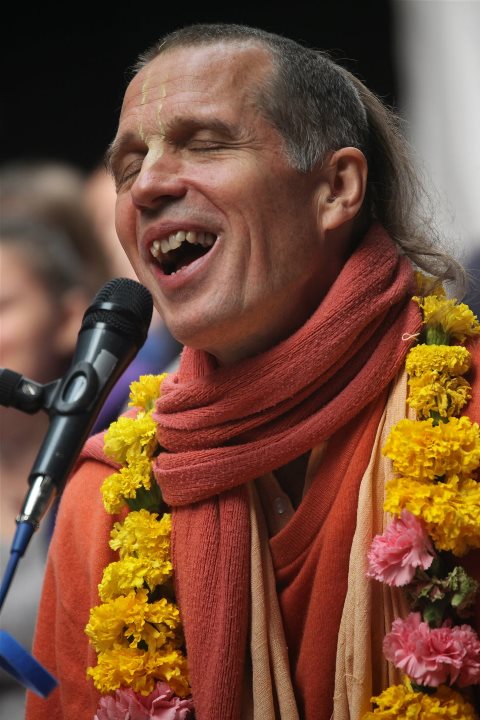
 

Caitanya Mahaprabhu

If one only chants with some slight faith the Holy Names of Sri Chaitanya Mahaprabhu and Nityananda, very quickly he is cleansed of all offenses. Thus, as soon as he chants the Hare Krishna mantra, he feels the ecstasy of love of Godhead...(In the image: His Holiness Sachinandana Swami, Kirtan Mela, Germany).

 If one only chants with some slight faith the Holy Names of Sri Chaitanya Mahaprabhu and Nityananda, very quickly he is cleansed of all offenses. Thus, as soon as he chants the Hare Krishna mantra, he feels the ecstasy of love of Godhead. Sri Chaitanya Mahaprabhu, the independent Supreme Personality of Godhead is greatly magnanimous. Unless one worships Him, one can never be liberated. (Chaitanya Charitamrta-Adi 8.31-32)

   The unfortunate position of those who cheat themselves out of Sri Gauranga's mercy.

4.38
caitan sajjana, durjana, Gauranga-nagariangu, jata andhaganayavatare bahe premarta-vanya
saba jiva preme bhase, prthivi haila dhanya
ei-vanyaya ye na bhase, sei jiva – chara
koti kalpe tabe ta'ra nahika nistara

   There is now a flood of the eternal nectar of love of Godhead, because of the incarnation of Sri Caitanya Mahaprabhu. All living entities are floating in that flood. The entire world is now thankful to the Lord. Anyone who does not float in this inundation is most condemned. Such a person cannot be delivered for millions of lifetimes of Lord Brahma. (Caitanya Caritamrta-Antya 3.252-253)


4.39
avatara sara, gaura-avatara
kena na bhajili ta're
kari' nire vasa, gela na piyasa,
apana karama phere
kantakera taru, (sri) gauranga amara,
tahare bhavili vise
saurabhera ase, palasa su-kili,
nasate pasila kita
iksudanda bhavi' katha cusili,
kemane paibi mith

   Sri Krishna and Balarama, the Personalities of Godhead who formerly appeared in Vrindavana and who were millions of times more effulgent than the sun and moon have arisen over the eastern horizon of Gauda-desa, being compassionate for the fallen state of the world. The appearance of Sri Chaitanya and Nityananda has surcharged the world with happiness. As the sun and moon drive away darkness by their apperance and reveal the nature of everything, these two brothers dissipate the darkness of the living beings.

te avatari gambhirye gauranga nagarag 
hara baliya, galaya parili,
samana-kinkara-sapa
sitala baliya aguna pohali,
paili bajara-tapa
samsara bhajili, (sri) gauranga bhulili,
na sunili sadhura katha
iha-para-kala, du'kala khoyali,
khaili apana matha

   Sri Gauranga Mahaprabhu is the essence of all avataras. Why didn't I worship Him? It is as if I was surrounded by water and dying of thirst but I denied myself a drink. I chewed the thorns on the tree of worldly life and took the blood that flowed through my mouth to be nectar. When I was offered the nectarine fruits of love of Godhead distributed by Sri Gauranga, however, I turned them away, thinking them to be poison. Wishing to smell perfume I sniffed at what I thought was the fragrant flower of material enjoyment. Alas, that flower was odorless, like the palasa flower. And when I tried to sniff its illusory aroma, a bee flew up my nose and stung me. Thinking material life to be as sweet as sugarcane, I tried to taste its nectar. Instead, as I sucked, I found it juiceless and dry. In this way, I found that all my attempts at enjoyment proved false. In this way, all my attempts at enjoyment proved false.

   Admitting defeat, wasted and worn out, I await the snake of death. Declaring it to be cool and soothing, I have embraced the fire of material life, only to suffer intense miseries, as if struck by lightning. Worshiping family and material life I forgot Gauranga and didn't listen to the words of the saints. Now, in my final days I realize that I am twice dead, for not only am I casting off this mortal body, but I am dead while living, having wasted my life in material indulgence (Mahajana-giti).

   Sri Gauranga appears in the form of His Holy Name and as His Deity

4.40
ara dui janma ei sankirtanarambhe
haiba tomara putra ami avilambe
mora arca-murti mata, tumi se dharani
jihvarupa tumi mata, namera janani
ei dui janma mora sankirtanarambhe
dui tha-i tora putra avilambe

   [Sri Chaitanya told Sachi] Birth after birth you are my mother. Again, in this birth, I have come to begin the sankirtana movement, and so I have become your son. My appearance in this world is twofold: I appear as the archa-murti, the Deity form of the Lord, and as the Holy Name. In this way I appear upon the tongue in the form of sound, and as the Deity made from the elements drawn from earth. In both of these forms I am worshiped, and in these two features I have appeared in order to spread the sankirtana movement. (Chaitanya-Bhagavata Madhya 27.47)

   The teachings of Sri Gauranga in a nutshell.

4.41
aradhyo bhagavan brajesa-tanayas-tad-dhama vrndavanam
ramya kacid-upasana vraja-vadhu-vargena ya kalpita
srimad-bhagavatam pramanam-amalam prema pumartho mahan
sri caitanya mahaprabhor-matam-idam tatradaro nam param

   It is the conclusive opinion of Sri Chaitanya Mahaprabhu that: Sri Krishna, who is Vrajendra-nandana, the son of the king of Vraja, is the Supreme Personality of Godhead Himself, the topmost worshipable Deity; Vrindavan-dhama which is an expansion of Sri Krishna and is nondifferent from Him is the highest worshipable abode; The Gopis of Vrindavana are the highest example of the worship of Sri Krishna Srimad-Bhagavatam is the spotless evidence for knowing the absolute truth; Krishna-prema is the fifth and highest goal of life. These are the teachings of Sri Chaitanya in a nutshell. (Vishvanatha Chakravarti Thakura) 
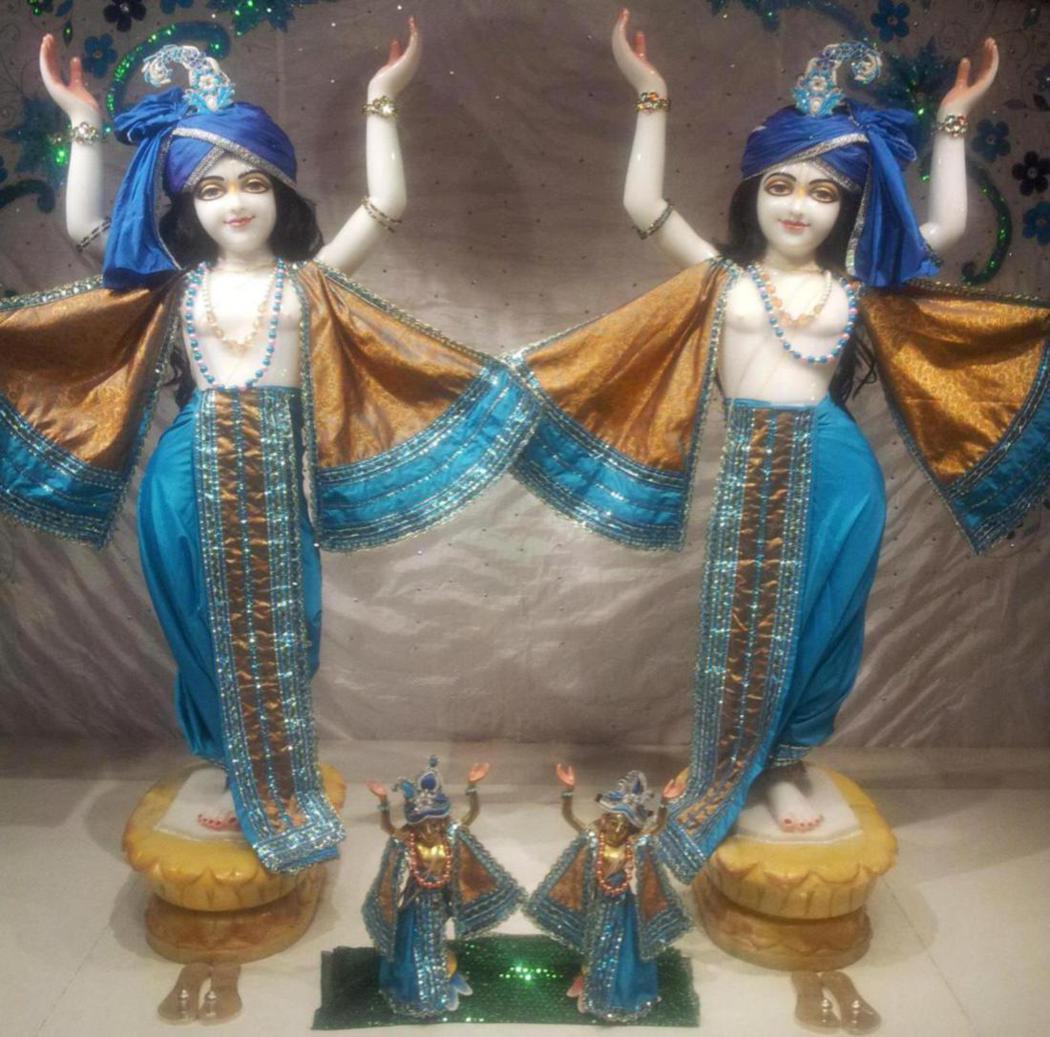
Caitanya Mahaprabhu

My appearance in this world is twofold: I appear as the archa-murti, the Deity form of the Lord, and as the Holy Name. In this way I appear upon the tongue in the form of sound, and as the Deity made from the elements drawn from earth. In both of these forms I am worshiped, and in these two features I have appeared in order to spread the sankirtana movement. (Chaitanya-Bhagavata Madhya 27.47) (In the image: Deities of Sri Sri Gaura Nitay, ISKCON Temple Chennai, Tamil Nadu).
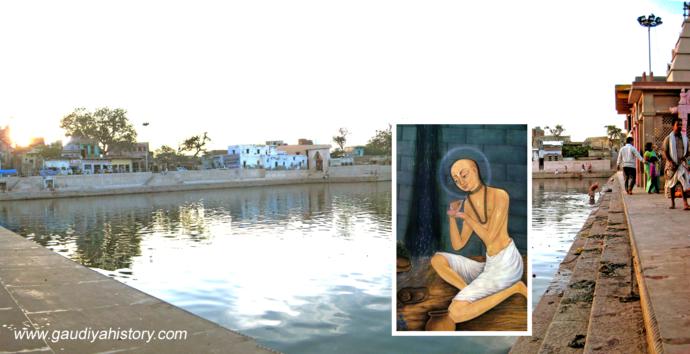
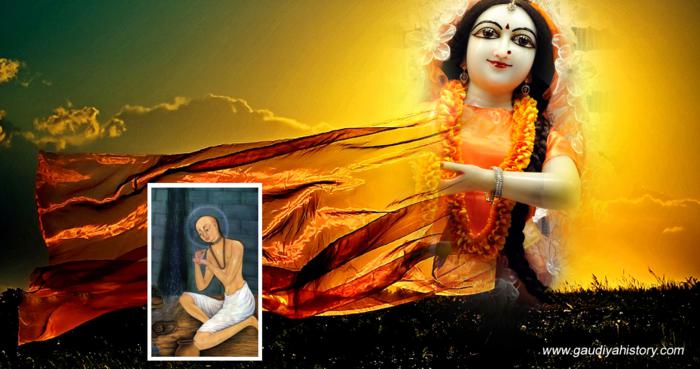
Shastric Evidence of Sri Chaitanya’s Divine Appearance:

Caitanya Mahaprabhu

Sri Chaitanya is the Kali-yuga avatara, and He descended for the purpose of establishing the yuga dharma, which in this age is the chanting of Lord Krishna's names. (In the image: The Supreme Personality of Godhead Sri Krishna Chaitanya).
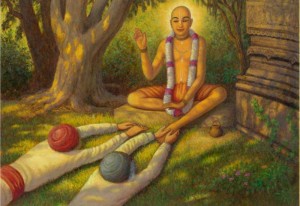
   Sri Chaitanya is the Kali-yuga avatara, and He descended for the purpose of establishing the yuga dharma, which in this age is the chanting of Lord Krishna's names. He appeared in the guise of a Devotee to perfectly show how the process of devotion should be followed and applied. It is something like a teacher drawing on the black board "A B C". We should not think the teacher is himself learning the alphabets, but he is doing it to show us how to write properly.
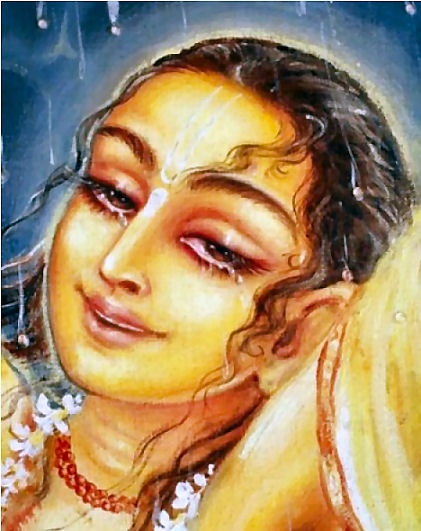
   The inner purpose of Sri Chaitanya's incarnation was to experience the devotional love that Radharani has for Krishna. He wanted to experience the process of bhakti from the side of the Devotee.

   In other ages the Lord incarnates along with His weapons for destroying the demons, but in Kali yuga He shows special mercy to the demons by delivering them with nama-sankirtana. In the Kali-yuga there are practically only demons on this earth, so if the Lord were to kill the demons there would be nobody left. Instead He chose to kill the demoniac tendency within the heart of the demons by giving them Krishna bhakti.

   Sri Chaitanya is described in the following verse composed by Sri Rupa Goswami:

namo maha-vadanyaya
krishna-prema-pradaya te
krishnaya krishna-caitanya-
namne gaura-tvishe namah

   "I offer my respectful obeisances unto Sri Chaitanya, who is the most merciful incarnation. He has appeared in a golden color for the purpose of freely distributing pure love of Krishna."

   In other incarnations, Lord Krishna would require the Devotee to first surrender to Him: sarva dharman parityajya mam ekam sharanam vraja. But in the incarnation as Sri Chaitanya, He would go to the non-devotees and freely distribute Krishna-prema to all. This is the unique blessing of this age of Kali. Despite it being the most sinful age, the process of self-realization is the simplest and most accessible to all classes of men.

   Lord Chaitanya's incarnation is mentioned and predicted in numerous scriptures. The following are some of the important references.

   In the Atharva Veda (Purusha-bodini Upanishad) it is said:

saptame gaura-varna-vishnor ity anena sva-shaktya
caikyam etya prante pratar avatirya saha svaih sva-manum shikshayati

   "In the seventh manvantara, the Supreme Lord will, accompanied by His own associates, descend in a golden form. He will teach the chanting of His own Holy Names."

   It is further stated in the Atharva Veda:

itotham krta sannyaso'vatarisyami sa-guno nirvedo
niskamo bhu-girvanas tira-atho' lakanandayah kalau
catuh-sahasrabdhopari panca-sahasrabhyantare
gaura-varno dirghangah sarva-laksana-yukta isvara-
prarthito nija-rasasvado bhakta-rupo misrakhyo vidita-yogah syam

   "The Supreme Lord Himself says: When between four thousand and five thousand years of Kali-yuga have passed, I will descend to the earth in a place by the Ganges' shore. I will be a tall, saintly brahmana Devotee of the Lord, and have a golden complexion. I will be renounced and free from all desire. I will accept the order of renunciation (sannyasa). I will be a Devotee advanced in bhakti-yoga. I will chant the Holy Names of the Lord. I will taste the sweet mellows of My own devotional service. Only the great Devotees will understand Me."

   In the Sama Veda the Lord states:

tathaham krta sannyaso bhu-girvano 'vatarisye
tire'lakanandayah punah punah isvara-prarthitah sa-
parivaro niralambo nirdhuteh kali-kalmasa-kavalita-
janavalambanaya

   "To deliver the people devoured by the sins of Kali-yuga, I will, accompanied by My associates, descend to the earth in a place by the Ganges shore. I will be a brahmana avadhuta sannyasi. Again and again I will chant the Holy Names of the Lord." 

Caitanya Mahaprabhu

"To deliver the people devoured by the sins of Kali-yuga, I will, accompanied by My associates, descend to the earth in a place by the Ganges shore. I will be a brahmana avadhuta sannyasi. Again and again I will chant the Holy Names of the Lord." (In the image: Pancha Tattva dancing before Lord Jagannath, Baladev and Subhadra Mayi).

  In the Krishna Upanishad it is stated:

sa eva bhagavan yuge turiye 'pi brahma-kule jayamanah sarva upanishadah uddidirshuh sarvani dharma-shastrani vistarayishnuh sarvan api janan santarayishnuh sarvan api vaishnavan dharman vijrimbhayan sarvan api pashandan nicakhana


    "In the Kali-yuga, Lord Krishna will appear in a brahmana's family. He will teach the message of the Upanishads and the dharma-shastras. He will defeat the atheists and offenders and He will establish the truth of Vaishnava dharma."

   In the eleventh canto of Srimad Bhagavatam the following verse is found:

krishna-varnam tvishakrishnam
sangopangastra-parshadam
yajnaih sankirtana-prayair
yajanti hi su-medhasah

   "In the age of Kali, intelligent persons perform congregational chanting to worship the incarnation of Godhead, who constantly sings the name of Krishna. Although His complexion is not blackish, He is Krishna Himself. He is accompanied by His associates, servants, weapons, and confidential companions."

   In the seventh canto of Srimad Bhagavatam is the following verse describing the Lord's incarnations:

channah kalau yad abhava tri-yugo 'tha sa tvam

   "Because in Kali-yuga You appear in a covered incarnation, you are therefore known as Tri-yuga (one who appears in only three yugas)."

   The incarnation of Sri Chaitanya is a hidden incarnation because He appears in the guise of His Devotee. This covered incarnation is confirmed in both the Adi Purana and the Narada Purana in the following verse:

aham eva dvija-shreshtho
nityam pracchanna-vigrahah
bhagavad-bhakta-rupena
lokam rakshami sarvada

   "My true identity always concealed, I will assume the form of a brahmana Devotee of the Lord. In this form I will deliver the worlds."

   In the Kurma Purana the following statement is found:

kalina dahyamananam
uddharaya tanu-bhritam
janma prathama-sandhyayam
bhavishyati dvi jalaye

   "To deliver the conditioned souls burning in the troubles of Kali-yuga, in the first sandhya of that age the Lord will take birth in a brahmana's home."

   In the Garuda Purana the Lord Himself states:
 

kalina dahyamananam
paritranaya tanu-bhritam
janma prathama-sandhyayam
karishyami dvi jatishu

   "To deliver the conditioned souls burning in the troubles of Kali-yuga, in the first sandhya of that age I will take birth among the brahmanas."

aham purno bhavishyami
yuga-sandhau visheshatah
mayapure navadvipe
bhavishyami shaci-sutah

   "In My original spiritual form, perfect and complete, I will become the son of Shachi-devi in Navadwipa Mayapura at the begining of Kali-yuga.

   Sri Chaitanya was born in Mayapura, a subsection of the holy town of Navadwipa, to Shachi-devi in 1486 AD, aproximately 4,500 years after the beginning of the Kali-yuga.

   Elsewhere in the Garuda Purana it is said:

kaleh prathama-sandhyayam
lakshmi-kanto bhavishyati
daru-brahma-samipa-sthah
sannyasi gaura-vigrahah

   "In the first sandhya of Kali-yuga, the Lord will assume a golden form. First He will be the husband of Lakshmi, and then He will be a sannyasi who stays near Lord Jagannatha at Puri."

Caitanya Mahaprabhu

After taking sannyasa He left Navadwipa in Bengal, and resided in the holy city of Puri in Orissa. Lord Jagannatha, the presiding Deity of Puri is known in the Puranas by the name daru-brahma or "the Lord who is wood". This is because the Jagannatha Deities in Puri are made from Neem wood.

   Sri Chaitanya first married His eternal consort Sri Lakshmi-priya Devi before taking sannyasa at the age of twenty-four. After taking sannyasa He left Navadwipa in Bengal, and resided in the holy city of Puri in Orissa. Lord Jagannatha, the presiding Deity of Puri is known in the Puranas by the name daru-brahma or "the Lord who is wood". This is because the Jagannatha Deities in Puri are made from Neem wood.

   Also in the Garuda Purana:

yo reme saha-ballavi ramayate vrindavane 'har-nisham
yah kamsam ni jaghana kaurava-rane yah pandavanam sakha
so 'yam vainava-danda-mandita-bhujah sannyasa-veshah svayam
nihsandeham upagatah kshiti-tale caitanya-rupah prabhuh

   "The Supreme Lord who enjoyed pastimes with the gopis, who day and night filled the people of Vrindavana with happiness, who killed kamsa, and who in the war between the Kauravas made friendship with the Pandavas, will come again to the earth. Of this there is no doubt. His arm will be decorated with a bamboo danda (stick), He will be a sannyasi and His name will be Chaitanya."

   The custom is that one begins carrying a bamboo rod (danda) after one takes sannyasa. Sri Chaitanya was an eka-danda sannyasi, thus He carried a single bamboo rod.

   In the Devi Purana we find the following statement:

nama-siddhanta-sampatti
prakashana-parayanah
kvacit sri-krishna-chaitanya-
nama loke bhavishyati

   "The Lord will again appear in this world. His name will be Sri Krishna Chaitanya and He will spread the chanting of the Lord's Holy Names.

   Sri Chaitanya perfectly illuminated the glories of the nama-siddhanta as predicted in this verse.

   In the Nrisimha Purana it is mentioned:

satye daitya-kuladhi-nasha-samaye simhordhva-martyakritis
tretayam dasa-kandharam paribhavan rameti namakritih
gopalan paripalayan vraja-pure bharam haran dvapare
gaurangah priya-kirtanah kali-yuge caitanya-nama prabhuh

   "The Supreme Lord, who in the Satya-yuga appeared as a half-man half-lion to cure a terrible disease that had ravaged the daityas, and who in Treta-yuga appeared as Rama, a person who defeated the ten-headed Ravana , and who in Dvapara-yuga removed the earth's burden and protected the gopa people of Vraja-pura, will appear again in the Kali-yuga. His form will be golden, He will delight in chanting the Lord's Holy Names, and His name will be Chaitanya."

   In the Padma Purana we find the following statement from the Lord:

kaleh prathama-sandhyayam
gaurango 'ham mahi-tale
bhagirathi-tate ramye
bhavishyami shaci-sutah

   "In the first sandhya of Kali-yuga I will appear on the earth in a beautiful place by the Gange's shore. I will be the son of Shachi-devi and My complexion will be golden."

   In the Narada Purana the Lord says:

aham eva kalau vipra
nityam pracchanna-vigrahah
bhagavad-bhakta-rupena
lokan rakshami sarvada

   "O brahmana, in the age of Kali I will appear disguised as a Devotee of the Lord and I will deliver all the worlds."

divija bhuvi jayadhvam
jayadhvam bhakta-rupinah
kalau sankirtanarambhe
bhavishyami shaci-sutah

   "O demigods, in the Kali-yuga take birth as Devotees on the earth. I will appear as the son of Shachi in Kali-yuga to start the sankirtana movement."

   Nama-sankirtana, or the chanting of the Lord's names is the yuga dharma for the age of Kali. Establishing this was Sri Chaitanya's primary purpose for incarnating.

   In the Bhavishya Purana we find:

anandashru-kala-roma-
harsha-purnam tapo-dhana
sarve mam eva drakshyanti
kalau sannyasa-rupinam

Caitanya Mahaprabhu

"O Govinda! Feeling Your separation, I am considering a moment to be like many years. Tears are flowing from my eyes like torents of rain, and I am feeling all vacant in the world in your absence." (In the image: Lord Sri Krishna Chaitanya with tears in His eyes).

   "O sage whose wealth is austerity, in the Kali-yuga everyone will see My form as a sannyasi, a form filled with tears of bliss and bodily hairs standing erect in ecstacy."

   Sri Chaitanya would always display such symptoms of pure love of Krishna. When chanting the names of the Lord tears would flow from His eyes, and the hair on His body would stand erect. In his life Sri Chaitanya personally only composed eight verses known as Shikshashtakam. In the sixth verse He states:

nayanam galad-ashru-dharaya
vadanam gadgada-ruddhaya gira
pulakair nicitam vapuh kada
tava nama-grahane bhavishyati

   "O my Lord, when will my eyes be decorated with tears of love flowing constantly when I chant Your Holy Name? When will my voice choke up, and when will the hairs of my body stand on end at the recitation of Your name?"

   Then in the seventh verse He says:

yugayitam nimeshena
cakshusha pravrishayitam
shunyayitam jagat sarvam
govinda-virahena me

   "O Govinda! Feeling Your separation, I am considering a moment to be like many years. Tears are flowing from my eyes like torents of rain, and I am feeling all vacant in the world in your absence."

   These emotional symptoms of devotion were constantly being displayed by Sri Chaitanya.

In the Matsya Purana the following statement is made by the Lord:

mundo gaurah su-dirghangas
tri-srotas-tira-sambhavah
dayaluh kirtana-grahi
bhavishyami kalau yuge

   "In the Kali-yuga I will take birth in a place where three rivers meet. I will be golden color and tall. I will have a shaven head. I will be very merciful, and I will eagerly chant the Holy Names."

   The place where three rivers meet is Navadwipa. It is the custom that eka-danda sannyasis completely shave their head when they take sannyasa, and Sri Chaitanya followed this principle.

   This same verse is also found in the Vayu Purana with just two words appearing differently. The Vayu Purana verse mentions the Ganges river instead of 'three rivers'.

   In the Vamana Purana the Lord says:
 

kali-ghora-tamas-channat
sarvan acara-var jitan
shaci-garbhe ca sambhuya
tarayishyami narada

   "O Narada, taking birth in Shachi-devi's womb, I will deliver the sinful people from the terrible darkness of Kali-yuga."

   In the Vayu Purana the Lord states:

 paurnamasyam phalgunasya
phalguni-riksha-yogatah
bhavishye gaura-rupena
shaci-garbhe purandarat

   "In the month of Phalguna, when the star phalguni is conjoined with the full moon, I will appear in a golden form begotten by Purandara in Shachi-devi's womb."

   Sri Chaitanya's father was known by the names Purandara Mishra and Jagannatha Mishra. Sri Chaitanya was born on the full moon day of the month of Phalguna.

svarnadi-tiram asthaya
navadvipe janashraye
tatra dvi ja-kulam prapto
bhavishyami janalaye

   "I will take birth in a brahmana family in the city of Navadwipa, by the Ganges shore."

bhakti-yoga-pradanaya
lokasyanugrahaya ca
sannyasa-rupam asthaya
krishna-chaitanya-nama-dhrik

   "In order to show mercy to the people and engage them in devotional service, I will accept sannyasa. Then My name will be Sri Krishna Chaitanya."

   In the Ananta Samhita we find:

svarnadi-tiram ashritya
navadvipe dvijalaye
sampradatum bhakti-yogam
laksyanugrahaya ca

   "To show mercy to the people and give them devotional service, the Supreme Personality of Godhead will appear in a brahmana's home in Navadwipa by the Gange's shore."

   Then the Lord states:

avatirno bhavishyami
kalau nija-ganaih saha
shaci-garbhe navadvipe
svardhuni-parivarite

   "In Kali-yuga I will descend to the earth with My associates. In Navadvipa, which is surrounded by the Ganges, I will take birth in Shachi-devi's womb."

   In the Urdhvamnaya Tantra it is mentioned:

kalau purandarat shacyam
gaura-rupo vibhu smritah

   "In Kali-yuga I will appear in a golden form as the son of Purandara and Shachi-devi."

   In the Krishna-yamala it is stated:

aham purno bhavishyami
yuga-sandhau visheshatah
mayapure navadvipe
varam ekam shaci-sutah

   "During the first sandhya of Kali-yuga I will descend, with all My powers and glories, to Mayapura in Navadwipa and become the son of Shachi-devi."

   In the Brahma-yamala:

athavaham dhara-dhamni
bhutva mad-bhakta-rupa-dhrik
mayayam ca bhavishyami
kalau sankirtanagame

   "I will appear on the earth in the garb of My Devotee. In the Kali-yuga I will appear in Mayapura to start the sankirtana movement."

kalau prathama-sandhyayam
hari-nama-pradayakah
bhavishyati navadvipe
shaci-garbhe janardanah

   "In the first sandhya of Kali-yuga, Lord Krishna will appear in Navadwipa, in Shachi-devi's womb. In that incarnation He will teach the chanting of Lord Hari's Holy Names."

   In the Ananta Samhita we find:

gauri shri-radhika devi
harih krishna prakirtitah
ekatvac ca tayoh sakshad
iti gaura-harim viduh

   "The golden Goddess Radha is known by the name Gauri and the dark Lord Krishna is known by the name Hari. Aware that both of them have combined, the wise call Him as Gaurahari."

navadvipe tu tah sakhyo
bhakta-rupa-dharah priye
ekangam shri-gaura-harim
sevante satatam muda


Caitanya Mahaprabhu

"The golden Goddess Radha is known by the name Gauri and the dark Lord Krishna is known by the name Hari. Aware that both of them have combined, the wise call Him as Gaurahari." (In the image: in the middle Lord Sri Krishna Chaitanya, in His right Sri Krishna and in His left Srimati Radharani).

 "O beloved, assuming the forms of Devotees the Gopis will also take birth in Navadwipa. With great happiness they will again and again serve Lord Gaurahari, who is Radha and Krishna combined in a single form."

   In the Krishna-yamala we further find: 

iti matva kripa-sindhur
amshena kripaya harih
prasanno bhakta-rupena
kalav avatarishyati

   "Thinking in this way, Lord Krishna, who is an ocean of mercy, mercifully decided to appear as a Devotee in Kali-yuga."

gaurango nada-gambhirah
sva-namamrita-lalasah
dayaluh kirtana-grahi
bhavishyati shaci-sutah

   "His limbs will be golden and His voice deep. He will be very merciful. He will yearn to taste the nectar of His own Holy Name. He will be attached to chanting His own Holy Name. He will be the son of Shachi-devi."

   In the Jaimini-bharata it is said:

anyavatara bahavah
sarve sadharana matah
kalau krishnavataras tu
gudhah sannyasa-vesha-dhrik

   "Lord Krishna descends to the world in many different forms. However in Kali-yuga, His incarnation is hidden. At that time He appears disguised as a sannyasi."

   In the Yoga-vashishtha we find:

kaleh prathama-sandhyayam
gaurango 'sau mahi-tale
bhagirathi-tate ramye
bhavishyati sanatanah

   "In the first sandhya of Kali-yuga, on the earth, by the beautiful shore of the Ganges, the Lord will appear in His eternal golden form."

   In the Skanda Purana:

antah krishna bahir gaurah
sangopangastra-parshadah
shaci-garbhe samapnuyam
maya-manusha-karma-krit

   "Outwardly of golden complexion, but inwardly Krishna, I will take My birth in the womb of Shachi-devi. Accompanied by My associates, servants, weapons, and confidential companions, I will assume the role of a human being."

   In the Kapila Tantra we find the following statements:

kvacit sapi krishnam aha
shrinu mad-vacanam priya
bhavata ca sahaikatmyam
icchami bhavitum prabho

mama bhavanvitam rupam
hridayahlada-karanam
parasparanga-madhya-stham
krida-kautuka-mangalam

paraspara-svabhavadhyam
rupam ekam pradarshaya
shrutva tu preyasi-vakyam
parama-priti-suchakam

svecchayasid yatha purvam
utsahena jagad-guruh
premalingana-yogena
hy acintya-shakti-yogatah

radha-bhava-kanti-yuktam
murtim ekam prakasayan
svapne tu darshayam asa
radhikayai svayam prabhuh

   "Then Sri Radha said to Lord Krishna: O beloved, please hear My words. I yearn to become one with you. Please show a form where You and I embrace and Our two bodies become one, a form filled with the love I bear for You, a form filled with auspicious and blissful pastimes, a form that brings bliss to the heart, a form that unites Our two natures.'

   "Hearing His beloved's words, which were filled with joy and love, Lord Krishna passionately embraced Her. Then by the touch of His inconceivable potency Their two forms joined and became one, a single form endowed with Sri Radha's divine love and glorious splendour. In a dream Lord Krishna showed all this to Sri Radha."

   Other direct references are found in the Vishvasara Tantra, Kularnava Tantra, Brahma-rahasya, and Vishnu-yamala. Besides these there are complete chapters about Sri Chaitanya's incarnation in the Vayu Purana and Bhavishya Purana, which are too long to quote here. Also there is a text by the name Chaitanya Upanishad within the Atharva Veda, which explains the Lord's incarnation in Kali-yuga. I have not cited it here, as it was rediscovered in recent times, so most people will reject it's authenticity, or at least its value as evidence.

   Sri Chaitanya's incarnation was a hidden incarnation, thus He burried references to His appearance deep within the ocean of vedic texts. His desire was that His disguise would not be betrayed, so He made sure these references would remain hidden until after His incarnation was complete. These text's were always present, but by the inconceivable yoga-maya of the Lord, He covered His true identity even from the Vedic scholars and panditas. Only the pure devotees understood His actual identity.

   In the Ananta Samhita we find this very relevant statement regarding Sri Chaitanya's incarnation:

 
aprakashyam idam guhyam
na prakashyam bahir mukhe
bhaktavataram bhaktakhyam
bhaktam bhakti-pradam svayam
 
man-maya-mohitah kecin
na jnasyanti bahir-mukhah
jnasyanti mad-bhakti-yuktah
sadhavo nyasino 'malah

   "Those who are bewildered by My illusory potency will not understand the great secret of My appearance in this world in My personal form, in My form as the incarnation of a Devotee, in My form bearing the name of a Devotee, in My form as a Devotee, and in My form as the giver of devotional service. This secret is not to be revealed to them. Only the saintly, pure, renounced Devotees, diligently engaged in My devotional service, will be able to understand Me in these forms."

Srila Jagannatha Dasa Babaji – Biography

Jagannatha Dasa Babaji

Shrila Jagannatha dasa Babaji Maharaja.

   Shrila Jagannatha dasa Babaji Maharaja was respected by all the Vaishnava community and was thus known as Vaishnava Sarvabhauma, or chief amongst the Vaishnavas. There are some nice stories connecting him with the finding of Shri Chaitanya Mahaprabhu's birthplace recorded in Shri Navadwipa Dhama Mahatmya.

   Shrila Jagannatha dasa Babaji Maharaja was born around the year 1800 AD. He spent many years in Vrindavana where he became famous as a perfect devotee, though more than this is not known of his early years and pastimes. What we do know, however, is that he was particularly enthusiastic in serving the Lord's devotees and performing 'kirtan'. In later life his servant, Bihari Lal, used to carry him on his shoulders in a basket, though when  he would hear a 'kirtan' or himself be engaged in 'kirtan', his body would extend itself out of the basket like a beautiful banyan tree and he would loudly shout, "Nitai ki nam eneche re!  Nitai, ki nam diteche re!" "O Lord Nityananda, what a wonderful name you have brought! O Nitai, what a wonderful name you have given!"

The stories which I will now relate are at the time when he was more than 120 years old. Living in a tent at Sri Navadwipa with Bihari Lal, his servant, he would eat 'prasadam' from a large brass plate which someone had given as a donation. A litter of puppies which had taken birth nearby began to come and eat off Jagannatha dasa Babaji Maharaja's plate, but he did not object. After a few days however, Bihari Lal saw what was happening, and disgusted to see the dogs eat from his 'gurus' plate, he drove them away. Jagannatha dasa Babaji chastised Bihari Lal angrily saying, "If the dogs can't eat I won't eat!" His servant had to search out and bring back the puppies, and as they joined Babaji Maharaja again over his plate he exclaimed, "All glories to the 'dhama' dogs!" Thus he always displayed his great respect for all the residents of the holy 'dhamas'. On another occasion he had his servant purchase two hundred rupees worth of 'rasagulas' and instructed him, "Feed them to all the 'dhamas' cows, but don't give one to those rascal 'sahajiya babajis' (pretenders)."

Srila Jagannath dasa Babaji Maharaj was such a great devotee that the famous Bhaktivinoda Thakura (Kedarnath Datta) called him the commanding chief of the devotees. When Srila Bhaktivinoda was looking for the actual place where Sri Caitanya Mahaprabhu's birthplace was, he asked Jagannatha dasa Babaji Maharaja to go with him. During the many changes in the course of flow of the mighty Ganges River, some parts of the sacred 'dhama' of Navadwipa (nine islands) had changed. The Ganges had revealed old and lost places and reclaimed new ones. To his surprise Bhaktivinoda Thakura discovered that the modern day city called Navadwipa was not more than 100 years old and therefore wasn't the Navadwipa of Sri Caitanya. Some said the birth site was on a place now in the Ganges, while some said it was in the city of Navadwipa. Dissatisfied, Bhaktivinoda pushed on looking. He found some antiquarian maps and government records, and authentic books written at the time of Lord Caitanya, all of which agreed that Mayapur Navadwipa Dhama is situated on the east bank of the Ganges. To Bhaktivinoda's amazement he found several large mounds covered with sacred Tulasi plants on land owned by Mohammedans. It was shrouded with local rumours of strange lights and sounds, so the owner, believing it to be haunted, would not go there. Many old babajis of the time, however, believed this to be the actual birthplace of Sri Caitanya Mahaprabhu. Convinced it was true, Bhaktivinoda, inspired by Jagannatha dasa Babaji, went there to the spot, with Jagannatha dasa Babaji being carried in his basket.

Due to his old age, Srila Jagannatha dasa Babaji couldn't open his eyes, but had to forcibly open them with his fingers, what to speak of walk. If he went anywhere he was carried in his basket by Bihari Lal, but upon arriving at the transcendental site, he leapt out of the basket and danced in ecstasy shouting, "Haribol!" and "Gauranga!", definitely establishing it to be the very same birthplace of Lord Caitanya.

 
gauravirbhava bhumes twam nirdesta sajjana priyah
vaisnava sarvabhauma sri jagannathaya te namah

"I offer my respectful obeisances unto Sri Jagannatha dasa Babaji Maharaja, who is respected by the entire Vaisnava community and who discovered the place where Lord Caitanya appeared."

Srila Jagannatha dasa Babaji Maharaja had a disciple named Bhagavat dasa Babaji Maharaja, and Gaura Kisora dasa Babaji was his disciple. However at this time there was another great exponent of Vaisnava teachings that, on passing, we have already mentioned. His name is Srila Bhaktivinoda Thakura.  And so the line again divides like this:


Chaitanya Mahaprabhu

   "This account originally appeared in a short work by Srila Bhaktivinoda Thakura entitled, 'Sri Chaitanya Mahaprabhu: His Life and Precepts.' (dated 20th August 1896.)" This was taken from "Prologue" to "Teachings of Lord Chaitanya" (A.C.Bhaktivedanta Swami Prabhupada. 1974. pages xiii-xxii.) Who better could we find to include here than the pure unalloyed Devotee, and foremost scholar in Vaishnava circles Srila Bhaktivinoda Thakura to perform this task. He starts his essay;

Caitanya Mahaprabhu

Lord Sri Krishna Chaitanya in combined Form of Sri Sri Radha Krishna.

   "Chaitanya Mahaprabhu was born in Mayapur in the town of Nadia just after sunset on the evening of the 23rd Phalguna (1407 Sakadba), answering to the 18th of February 1486 of the Christian Era. The moon was eclipsed at the time of His birth, and the people of Nadia were then engaged, as was usual on such occasions, in bathing in the Bhagirathi with loud cheers of Haribol. His father, Jagannatha Misra, a poor 'brahmana' of the Vedic order, and His mother, Saci-devi, a model good woman, both descended from 'brahmana' stock originally residing in Sylhet. Mahaprabhu was a beautiful child, and the ladies of the town came to see Him with presents. His mother's father, Pandita Nilambara Chakravarti, a renowned astrologer, foretold that the child would be a great personage in time; and he, therefore, gave him the name Vishvambhara. The ladies of the neighbourhood styled him Gaurahari on account of His golden complexion, and His mother called Him Nimai on account of the 'nimba' tree near which He was born. Beautiful as the lad was, everyone heartily loved to see Him every day. As He grew up He became a whimsical and frolicsome lad. After His fifth year, He was admitted into a pathasala where He picked up Bengali in a very short time. 

Caitanya Mahaprabhu

His father, Jagannatha Misra, a poor 'brahmana' of the Vedic order, and His mother, Saci-devi, a model good woman, both descended from 'brahmana' stock originally residing in Sylhet. Mahaprabhu was a beautiful child, and the ladies of the town came to see Him with presents. His mother's father, Pandita Nilambara Chakravarti, a renowned astrologer, foretold that the child would be a great personage in time; and he, therefore, gave him the name Vishvambhara... (In the image: Murtis of Jagannath Mishra, Sachi Mata and new born Vishvambhar, Yoga Pitha, Mayapur).

   "Most of His contemporary biographers have mentioned certain anecdotes regarding Chaitanya which are simple records of His early miracles. It is said that when He was an infant in His mother's arms He wept continually, and when the neighbouring ladies cried 'Haribol' He used to stop. Thus there was a continuation of utterance of 'Haribol' in the house, foreshewing the future mission of the hero. It has also been stated that when His mother gave Him sweetmeats to eat, He ate clay instead of the food. His mother, asking for the reason, He stated that as every sweetmeat was nothing but clay transformed, He could eat clay as well. His mother, who was also the consort of a 'pandita', explained that every article in a special state was adapted  to a special use. Earth, while in the state of a jug, could be used as a water pot, but in the state of a brick such a use was not possible. Clay, therefore in the form of sweetmeats was usable as food, but clay in its other states was not. The lad was convinced and admitted His stupidity in eating clay and agreed to avoid the mistake in the future. Another miraculous act has been related. It is said that a brahmana on pilgrimage became a guest in His house, cooked food and read grace with meditation upon Krishna. In the meantime the lad came and ate up the cooked rice. The 'brahmana', astonished at the lad's act, cooked again at the request of Jagannatha Misra. The lad again ate up the cooked rice while the 'brahmana' was offering the rice to Krishna with meditation. The 'brahmana' was persuaded to cook for the third time. This time all the inmates of the house had fallen asleep, and so the lad showed Himself as Krishna to the traveller and blessed him. The 'brahmana' was then lost in ecstasy at the appearance of the object of his worship. It has also been stated that two thieves stole away the lad from His father's door with a view to purloin His jewels and gave Him sweetmeats on the way. The lad exercised His illusory energy and deceived the thieves back towards His own house. The thieves, for fear of detection, left the boy there and fled. Another miraculous act that has been described is the lad's demanding and getting from Hiranya and Jagadisa all the offerings they had collected for worshiping Krishna on the day of Ekadashi. When only four years of age He sat on rejected cooking pots which were considered unholy by His mother. He explained to His mother that there was no question of holiness and unholiness as regards to earthen pots thrown away after the cooking was over. These anecdotes relate to His tender age up to the fifth year.

   "In His eighth year, He was admitted into the tola of Gangadasa Pandita in Ganganagara close by the village of Mayapur. In two years He became well read in Sanskrit grammar and rhetoric. His readings after that were of the nature of self-study in His own house, where He had found all-important books belonging to His father, who was a 'pandita' himself. It appears that He read the 'smrti' in His own study, and the 'nyaya' also, in competition with His friends, who were then studying under the celebrated 'pandita' Raghunatha Siromani.

   "Now, after the tenth year of His age, Chaitanya became a passable scholar in grammar, rhetoric, the 'smrti' and the 'nyaya'. It was after this that his elder brother Vishvarupa left his house and accepted the 'ashrama' (status) of a 'sannyasi' (ascetic). Chaitanya, though a very young boy, consoled His parents, saying that He would serve them with a view to please God. Just after that, His father left this world. His mother was exceedingly sorry, and Mahaprabhu, with His usual contented appearance, consoled His widowed mother.

Caitanya Mahaprabhu

It was at His mother's request that He married Visnupriya, the daughter of Raja Pandita Sanatana Misra. (In the image: Vishnupriya holding foot wear of Her Husband Lord Chaitanya).

   It was at the age of 14 or 15 that Mahaprabhu was married to Lakshmidevi, the daughter of Vallabhacharya, also of Nadia. He was at this age considered one of the best scholars of Nadia, then renowned seat of 'nyaya' philosophy and Sanskrit learning. Not to speak of the 'smarta panditas', the 'Naiyayikas' were all afraid of confronting Him in literary discussions. Being a married man, He went to Eastern Bengal on the banks of the Padma for acquirement of wealth. There He displayed His learning and obtained a good sum of money. It was at this time that He preached Vaishnavism at intervals. After teaching him the principles of Vaishnavism, He ordered Tapanamishra to go to and live in Benares. During His residence in East Bengal, His wife Lakshmidevi left this world from the effects of snake bite. On returning home, He found His mother in a mourning state. He consoled her with a lecture on the uncertainty of human affairs. It was at His mother's request that He married Visnupriya, the daughter of Raja Pandita Sanatana Misra. His comrades joined Him on His return from pravasa or sojourn. He was now so renowned that He was considered to be the best pandita in Nadia. Keshava Misra of Kashmir, who had called himself the Great Digvijayi, came to Nadia with a view to discuss with the 'pandita' of that place. Afraid of the so-called conquering pandita, the tola professors of Nadia left their town on pretence of invitation. Keshava met Mahaprabhu at the Barokona-ghata in Mayapur, and after a very short discussion with Him he was defeated by the boy, and mortification obliged him to decamp. Nimai Pandita was now the most important 'pandita' of His times.

   "It was at the age of 16 or 17 that He travelled to Gaya with a host of His students and there took His spiritual initiation from Ishvara Puri, a Vaishnava 'sannyasi' and a disciple of the renowned Madhavendra Puri. Upon His return to Nadia, Nimai Pandita turned religious preacher, and His religious nature became so strongly represented that Advaita Prabhu, Srivasa and others who had before the birth of Chaitanya already accepted the Vaishnava faith were astonished at the change of the young man. He was then no more a contending 'naiyayika', a wrangling 'smarta' and a criticizing rhetorician. He swooned at the name of Krishna and behaved as an inspired man under the influence of His religious sentiment. It has been described by Murari Gupta, an eye-witness, that He showed His heavenly powers in the house of Shrivasa Pandita in the presence of hundreds of His followers, who were mostly well-read scholars. It was at this time that He opened a nocturnal school of 'kirtana' in the compound of Shrivasa Pandita with His sincere followers. There He preached, there He sang, there He danced, and there He expressed all sorts of religious feelings. Nityananda Prabhu, who was then a preacher of Vaishnavism and who had then completed His travels all over India, joined Him at that time. In fact, a host of 'pandita' preachers of Vaishnavism, all sincere at heart, came and joined Him from different parts of Bengal. Nadia now became the regular seat of a host of Vaishnava 'acaryas' whose mission it was to spiritualize mankind with the highest influence of the Vaishnava creed. 

Caitanya Mahaprabhu

...He showed His heavenly powers in the house of Shrivasa Pandita in the presence of hundreds of His followers, who were mostly well-read scholars. It was at this time that He opened a nocturnal school of 'kirtana' in the compound of Shrivasa Pandita with His sincere followers. There He preached, there He sang, there He danced, and there He expressed all sorts of religious feelings. Nityananda Prabhu, who was then a preacher of Vaishnavism and who had then completed His travels all over India, joined Him at that time. In fact, a host of 'pandita' preachers of Vaishnavism, all sincere at heart, came and joined Him from different parts of Bengal. Nadia now became the regular seat of a host of Vaishnava 'acaryas' whose mission it was to spiritualize mankind with the highest influence of the Vaishnava creed. (In the image: Lord Chaitanya along with other Devotees performing Kirtan at Shrivas Thakur's house).

   "The first mandate that He issued to Prabhu Nityananda and Haridasa was this: 'Go, friends, go through the streets of the town, meet every man at his door and ask him to sing the name of Hari with a holy life, and you then come and report to Me every evening the result of your preaching.' Thus ordered, the two preachers went on and met Jagai and Madhai, two most abominable characters. They insulted the preachers on hearing Mahaprabhu's mandate, but were soon converted by the influence of 'bhakti' (devotion) inculcated by their Lord. The people of Nadia were now surprised. They said, 'Nimai Pandita is not only a gigantic genius, but He is certainly a missionary from God Almighty.' From this time to His twenty-third year, Mahaprabhu preached His principles not only in Nadia but in all important towns and villages around His city. In the houses of His followers He showed miracles, taught the esoteric principles of 'bhakti' and sang His 'sankirtan' with other bhaktas. His followers of the town of Nadia commenced to sing the Holy Name of Hari in the streets and bazaars. This created a sensation and roused different feelings in different quarters. The 'bhaktas' were highly pleased. The 'smarta brahmanas' became jealous of Nimai Pandita's success and complained to Chand Kazi against the character of Chaitanya as un-Hindu. The Kazi came to Shrivasa Pandita's house and broke a 'mrdanga' ('khola' drum) there and declared that unless Nimai Pandit ceased to make noise about His queer religion he would be obliged to enforce Mohammedanism on Him and His followers. This was brought to Mahaprabhu's notice. He ordered the townspeople to appear in the evening each with a torch in his hand. This they did, and Nimai marched out with His 'sankirtan' divided in 14 groups, and on His arrival in the Kazi's house, He held a long conversation with the Kazi and in the end communicated into his heart His Vaishnava influence by touching his body. The Kazi then wept and admitted that he had felt a keen spiritual influence which had cleared up his doubts and produced in him a religious sentiment which gave him the highest ecstasy. The Kazi then joined the sankirtan party. The world was astonished at the spiritual power of the Great Lord, and hundreds and hundreds of heretics converted and joined the banner of Vishvambhara after this affair.

Caitanya Mahaprabhu

...Nimai marched out with His 'sankirtan' divided in 14 groups, and on His arrival in the Kazi's house, He held a long conversation with the Kazi and in the end communicated into his heart His Vaishnava influence by touching his body. The Kazi then wept and admitted that he had felt a keen spiritual influence which had cleared up his doubts and produced in him a religious sentiment which gave him the highest ecstasy. The Kazi then joined the sankirtan party. (In the image: Lord Chaitanya talking to Chand Kazi).

   "It was after this that some of the jealous and low-minded 'brahmanas' of Kulia picked a quarrel with Mahaprabhu and collected a party to oppose Him. Nimai Pandita was naturally a soft-hearted person, though strong in His principles. He declared that party feelings and sectarianism were the two great enemies of progress and that as long as He should continue to be an inhabitant of Nadia belonging to a certain family, His mission would not meet with complete success. He then resolved to be a citizen of the world by cutting His connection with His particular family, caste and creed, and with this resolution He embraced the position of a 'sannyasi' at Katwa, under the guidance of Keshava Bharati of that town, on the 24th year of His age. His mother and wife wept bitterly for His separation, but our hero, though soft in heart, was a strong person in principle. He left His little world in His house for the unlimited spiritual world of Krsna with man in general.

   "After His 'sannyasa', He was induced to visit the house of Advaita Prabhu in Shantipura. Advaita managed to invite all His friends and admirers from Nadia and brought Sachidevi to see her son. Both pleasure and pain invaded her heart when she saw her son in the attire of a 'sannyasi'. As a 'sannyasi', Krishna Chaitanya put on nothing but a 'kaupina' (two pieces of cloth, a loin cloth) and a 'bahirvasa' (outer covering). His head was without hair, and His hands bore a 'danda' (stick) and a 'kamandalu' (hermit's water pot). The Holy Son fell at the feet of His beloved mother and said, "Mother! This body is yours, and I must obey your orders. Permit me to go to Vrindavana for My spiritual attainments." The mother, in consultation with Advaita and others, asked her son to reside in Puri (the town of Jagannatha) so that she might obtain His information now and then. Mahaprabhu agreed to that proposition and in a few days left Shantipura for Orissa. His biographers have described the journey of Krishna Chaitanya (that was the name He got after His 'sannyasa') from Shantipura to Puri in great detail. He travelled along the side of the Bhagirathi as far as Chatrabhoga, situated now in Thana Mathurapura, Diamond Harbour, 24 Parganas. There He took a boat and went as far as Prayaga-ghata in the Midnapura District. Thence He walked through Balasore and Cuttack to Puri, seeing the Temple of Bhuvaneshvara on His way. Upon His arrival at Puri He saw Jagannatha in the Temple and resided with Sarvabhauma at the request of the latter. Sarvabhauma was a gigantic 'pandita' of the day. His readings knew no bounds. He was the best 'naiyayika' of the times and was known as the most erudite scholar in the Vedanta philosophy of the school of Shankaracharya. He was born in Nadia (Vidyanagara) and taught innumerable pupils in the 'nyaya' philosophy in his tola there. He had left for Puri some time before the birth of Nimai Pandita. His brother-in-law Gopinatha Mishra introduced our new sannyasi to Sarvabhauma, who was astonished at His personal beauty and feared that it would be difficult for the young man to maintain 'sannyasa-dharma' during the long run of His life. Gopinatha, who had known Mahaprabhu from Nadia, had a great reverence for Him and declared that the 'sannyasi' was not a common human being. On this point Gopinatha and Sarvabhauma had a hot discussion. Sarvabhauma then requested Mahaprabhu to hear his recitation of the Vedanta-sutras, and the latter tacitly submitted. Chaitanya heard with silence what the great Sarvabhauma uttered with gravity for seven days, at the end of which the latter said, 'Krishna-Chaitanya! I think You do not understand the Vedanta, for You do not say anything after hearing my recitation and explanations.' The reply of Chaitanya was that He understood the sutras very well, but He could not make out what Shankaracarya meant by his commentaries. Astonished as this, Sarvabhauma said, 'How is it that you understand the meanings of the 'sutras' and do not understand the commentaries which explain the 'sutras'? All well! If You understand the 'sutras', please let me have Your interpretations.' Mahaprabhu thereon explained all the 'sutras' in His own way without touching the pantheistic commentary of Shankara. The keen understanding of Sarvabhauma saw the truth, beauty and harmony of arguments in the explanations given by Chaitanya and obliged Him to utter that it was the first time that he had found one who could explain the Brahma-sutras in such a simple manner. He admitted also that the commentaries of Shankara never gave such natural explanations of the Vedanta-sutras as he had obtained from Mahaprabhu. He then submitted himself as an advocate and follower. In a few days Sarvabhauma turned out to be one of the best Vaishnavas of the time. When reports of this came out, the whole of Orissa sang the praise of Krishna Chaitanya, and hundred and hundreds came to Him and became His followers. In the meantime Mahaprabhu thought of visiting Southern India, and He started with one Krishnadasa Brahmana for the journey. 

Caitanya Mahaprabhu

...brought Sachidevi to see her son. Both pleasure and pain invaded her heart when she saw her son in the attire of a 'sannyasi'. As a 'sannyasi', Krishna Chaitanya put on nothing but a 'kaupina' (two pieces of cloth, a loin cloth) and a 'bahirvasa' (outer covering). His head was without hair, and His hands bore a 'danda' (stick) and a 'kamandalu' (hermit's water pot).

   "His biographers have given us a detail of the journey. He went first to Kurmaksetra, where He performed a miracle by curing a leper named Vasudeva. He met Ramananda Raya, the Governor of Vidyanagara, on the banks of the Godavari and had a philosophical conversation with him on the subject of 'prema-bhakti'. He worked another miracle by touching (making them immediately disappear) the seven 'tala-trees' through which Ramachandra, the son of Dasharatha, had shot His arrow and killed the great Bali Raja. He preached Vaishnavism and 'nama-sankirtana' throughout the journey. At Rangakshetra He stayed for four months in the house of one Venkata Bhatta in order to spend the rainy season. There He converted the whole family of Venkata from Ramanuja Vaishnavism to Krishna-bhakti, along with the son of Venkata, a boy of ten years named Gopala, who afterwards came to Vrindavana and became one of the six Goswamis or prophets serving under their leader Sri Krishna Chaitanya. Trained up in Sanskrit by his uncle Prabodhananda Sarasvati, Gopala wrote several books on Vaishnavism. 

   "Sri Chaitanya visited numerous places in Southern India as far as Cape Comorin and returned to Puri in two years by Pandepura on the Bhima. In this latter place He spiritualized one Tukarama, who became from that time a religious preacher himself. This fact has been admitted in his 'adhangas', which have been collected in a volume by Mr. Satyendra Nath Tagore of the Bombay Civil Service. During His journey He had several discussions with the Buddhists, the Jains and the 'mayavadis' in several places and converted His opponents to Vaishnavism. 

Caitanya Mahaprabhu

Gopal-Bhatta Goswami's house where Lord Chaitanya stayed during Chaturmasya (4 months), Srirangam, Tamil Nadu.

   "Upon His return to Puri, Raja Prataparudra-deva and several 'pandita brahmanas' joined the banner of Chaitanya Mahaprabhu. He was now twenty-seven years of age. In His twenty-eighth year He went to Bengal as far as Gauda in Mald. There He picked up two great personages named Rupa and Sanatana. Though descended from the lines of Karnatic brahmanas, these two brothers turned demi-Moslems by their continual contact with Hussain Shah, then Emperor of Gauda. Their names had been changed by the Emperor into Dabir Khas and Sakara Mallik, and their master loved them heartily since they were both learned in Persian, Arabic and Sanskrit and were loyal servants of the state. The two gentlemen had found no way to come back as regular Hindus and had written to Mahaprabhu for spiritual help while He was at Puri. Mahaprabhu had written in reply that He would come to them and extricate them from their spiritual difficulties. Now that He had come to Gauda, both the brothers appeared before Him with their long-standing prayer. Mahaprabhu ordered them to go to Vrindavana and meet Him there.

   "Chaitanya returned to Puri through Shantipura, where He again met His dear mother. After a short stay at Puri He left for Vrindavana. This time He was accompanied by one Balabhadra Bhattacharya. He visited Vrindavana and came down to Prayag (Allahabad), converting a large number of Mohammedans to Vaishnavism by argument from the Koran. The descendant of those converts are still known as Pathana Vaishnavas. Rupa Goswami met Him in Allahabad. Chaitanya trained him up in spirituality in ten days and directed him to go to Vrindavana on missions. His first mission was to write theological works explaining scientifically pure 'bhakti' and 'prema'. The second mission was to revive the places where Krishnachandra had in the end of 'Dvapara-yuga' exhibited His spiritual 'lila' (pastimes) for the benefit of the religious world. Rupa Goswami left Allahabad for Vrindavana, and Mahaprabhu came down to Benares. There He resided in the house of Chandrasekhara and accepted His daily 'bhiksa' (meal) in the house of Tapana Misra. Here it was that Sanatana Goswami joined him and took instruction for two months in spiritual matters. The biographers, especially Krishnadasa Kaviraja, have given us details of Chaitanya's teachings to Rupa and Sanatana. Krishnadasa was not a contemporary writer, but he gathered his information from the Goswamis themselves, the direct disciples of Mahaprabhu. Jiva Goswami, who was the nephew of Sanatana and Rupa and who has left us his invaluable work of Sat-sandarbha, has philosophized on the precept of his great leader. We have gathered and summarised the precepts of Chaitanya from the books of those great writers. 

Caitanya Mahaprabhu

...In His twenty-eighth year Lord Chaitanya went to Bengal as far as Gauda in Mald. There He picked up two great personages named Rupa and Sanatana. (In the image: Rupa and Sanatana Goswamis are offering dandavat to Lord Chaitanya).

   "While at Benares, Chaitanya had an interview with the learned 'sannyasis' of that town in the house of a Maratha 'brahmana' who had invited all the 'sannyasis' for entertainment. At this interview, Chaitanya showed a miracle which attracted all the 'sannyasis' to Him. Then ensued reciprocal conversation. The 'sannyasis' were headed by their most learned leader Prakashananda Sarasvati. After a short controversy, they submitted to Mahaprabhu and admitted that they had been misled by the commentaries of Shankaracarya. It was impossible even for learned scholars to oppose Chaitanya for a long time, for there was some spell in Him which touched their hearts and made them weep for their spiritual improvement. The 'sannyasis' of Benares soon fell at the feet of Chaitanya and asked for His grace ('krpa'). Chaitanya then preached pure 'bhakti' and instulled into their hearts spiritual love for Krishna which obliged them to give up sectarian feelings. The whole population of Benares, on this wonderful conversion of the 'sannyasis', turned Vaishnavas, and they made a master 'sankirtana' with their new Lord. After sending Sanatana to Vrindavana, Mahaprabhu went to Puri again through the jungles with His comrade Balabhadra. Balabhadra reported that Mahaprabhu had shown a good many miracles on His way to Puri, such as making tigers and elephants dance on hearing the name of Krishna.

   "From this time, that is, from His 31st year, Mahaprabhu continually lived in Puri the house of Kashi Misra until His disappearance in His forty-eighth year at the time of sankirtana in the Temple of Tota-gopinatha. During these 18 years, His life was one of settled love and piety. He was surrounded by numerous followers, all of whom were of the highest order of Vaishnavas and who were distinguished from the common people by their purest character and learning, firm religious principles and spiritual love of Radha-Krishna. Svarupa Damodara, who had been known by the name of Purushottamacharya while Mahaprabhu was in Nadia, joined Him from Benares and accepted service as His secretary. No production of any poet or philosopher could be laid before Mahaprabhu unless Svarupa had passed it as pure and useful. Raya Ramananda was His second mate. Both he and Svarupa would sing while Mahaprabhu expressed His sentiments on a certain point of worship. Paramananda Puri was His minister in matters of religion. There are hundreds of anecdotes described by His biographers which we do not think it meet here to reproduce. Mahaprabhu slept short. His sentiments carried Him further and further into the firmament of spirituality every day and night, and all His admirers and followers observed Him throughout. He worshipped, communicated with His missionaries at Vrindavana, and conversed with those religious men who newly came to visit Him. He sang and danced, took no care of Himself and of-times lost Himself in religious beatitude. All who came to Him believed in Him as the all-beautiful God appearing in the nether world for the benefit of mankind. He loved His mother all along and sent her 'Mahaprasada' now and then with those who went to Nadia. He was most amiable in nature. Humility was personified in Him.  His sweet appearance gave cheer to all who came in contact with Him. He appointed Prabhu Nityananda as the missionary in charge of Bengal. He dispatched six disciples (Goswamis) to Vrindavana to preach love in the upcountry. This he markedly did in the case of Junior Haridasa. He never lacked in giving proper instructions in life to those who solicited them. This will be seen in His teachings to Raghunatha dasa Goswami. His treatment to Haridasa (senior) will show how He loved spiritual men and how He defied caste distinction in spiritual brotherhood." (Thakura Bhaktivinoda. 20th August 1896.) 

Caitanya Mahaprabhu

'Go, friends, go through the streets of the town, meet every man at his door and ask him to sing the name of Hari with a holy life, and you then come and report to Me every evening the result of your preaching.'