Category Archives: Gaudiya Vaishnav Biographies

Kaliya Krishna Dasa

   "One will surely attain Shri Chaitanya and Shri Nityananda simply by remembering Kaliya Krishna Dasa." (Chaitanya Bhagavata) Completely devoted to Lord Nityananda, Kaliya Krishna Dasa knew nothing but the lotus feet of Nitai. 
 
   His birthplace is in the Bardhaman (Burdwan) district of West Bengal within a short distance from the Railway station at Katwa, at the village called Akai Hatta. This village is situated on the old king's road between Navadwipa and Katwa. Akai Hatta is a very small village.
 
   On the twelfth day of the dark moon in the month of Chaitra, Shri Kaliya Krishna Dasa Thakura disappeared. He left his body while doing bhajana in Vrindavana. 
 
   This is not the same Kaliya Krishna dasa who accompanied Shri Chaitanya Mahaprabhu to South India.
 
   At present, Kaliya Krishnadas's descendents live in different holy places in Bengal.

   In Vraja lila he is Labanga, a cowherd boyfriend of Krishna-Balarama. 

Kaliya Krishna Dasa

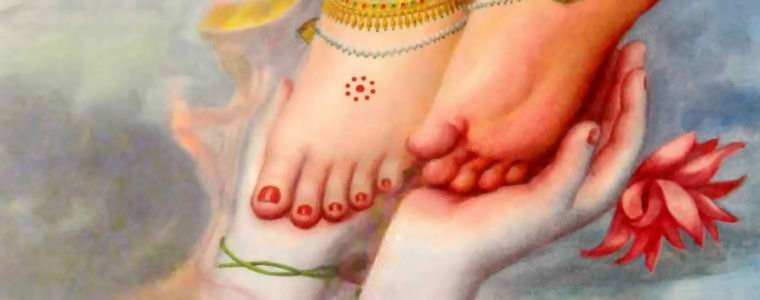
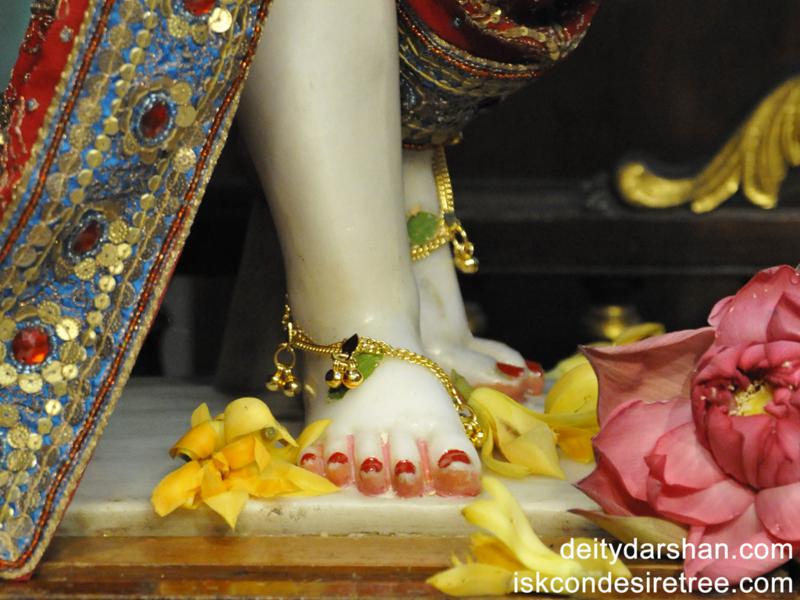
"One will surely attain Shri Chaitanya and Shri Nityananda simply by remembering Kaliya Krishna Dasa." (Chaitanya Bhagavata) Completely devoted to Lord Nityananda, Kaliya Krishna Dasa knew nothing but the lotus feet of Nitai. (In the image: Lotus Feet of Shri Nityananda Prabhu. ISKCON Chowpatty, Mumbai).

Jiva Goswami

Jiva Goswami

Appearing as the nephew of Shri Rupa and Sanatana Goswamis, Shri Jiva Goswami displayed all the charming features of a mahapurusa (divine person). He had lotus eyes, a high nose and forehead, broad chest, long arms, and a radiant golden body. (In the image: Shrila Jiva Goswami).

   Appearing as the nephew of Shri Rupa and Sanatana Goswamis, Shri Jiva Goswami displayed all the charming features of a mahapurusa (divine person). He had lotus eyes, a high nose and forehead, broad chest, long arms, and a radiant golden body. 

   In his boyhood he made a Deity of Krishna-Balarama. Expressing his pure devotion, he would often cry while worshiping Them. After offering clothes, chandana, flowers, ornaments, and tasty sweets to Krishna-Balarama he would take some and give Maha-Prasadam to his playmates. From the beginning Jiva showed his kindness to other jivas (living entities). Jiva was so much attached to Krishna-Balarama that at bed time he would embrace his Deities and fall asleep. His parents thought he was only playing. But the villagers rejoiced to see Jiva's love for Krishna-Balarama.

   In school he quickly mastered Sanskrit grammar, poetry, logic, philosophy. Shrimad Bhagavatam gave life to his life. Krishna-katha filled him with happiness. No one dared to speak to him about anything but Krishna. He toured Navadwipa-dhama with Shri Nityananda Prabhu, studied Sanskrit in Benares, and then resided in Vrindavana. After humbly serving Shri Rupa Goswami by washing his feet, preparing his manuscripts, and editing his books he received diksha.

   Once the aging Vaishnava, Vallabhacharya, gave critical advice to Shri Rupa Goswami on his writing. Although much younger than the venerable Vallabha, Shri Jiva brazenly spoke in defense of his guru. Shri Rupa Goswami scolded Shri Jiva telling him to leave Vrindavana. Living in an abandoned crocodile hole in Nanda Ghat (45 minutes from Shri Rupa's bhajana kutir) , Shri Jiva Goswami began fasting. He subsisted on wheat flour, which he begged, mixed with Yamuna water. Seeing his strict self-denial, Sanatana Goswami brought him back to the service of Shri Rupa Goswami. 

Jiva Goswami

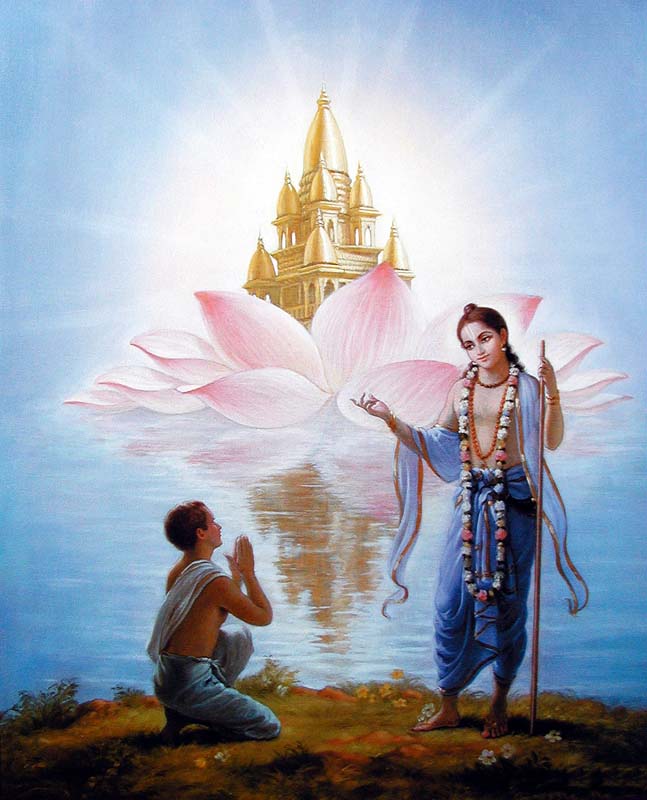
In school he quickly mastered Sanskrit grammar, poetry, logic, philosophy. Shrimad Bhagavatam gave life to his life. Krishna-katha filled him with happiness. No one dared to speak to him about anything but Krishna. He toured Navadwipa-dhama with Shri Nityananda Prabhu, studied Sanskrit in Benares, and then resided in Vrindavana. After humbly serving Shri Rupa Goswami by washing his feet, preparing his manuscripts, and editing his books he received diksha. (In the image: Shri Nityananda Prabhu showing Shri Navadwipa Dham to Jiva Goswami).

   Shrila Prabhupada once commented on this "guru-disciple pastime." "Shri Rupa Goswami cast out Jiva Goswami to teach us, the Devotees of today, a lesson. It was not done to teach or punish Shri Jiva Goswami, who is a perfectly liberated, eternal associate of Lord Krishna. Rupa Goswami sent Jiva Goswami out of Vrindavana to teach all jivas what he wrote in Upadesamrta: vaco vegam mansah krodah vegam, jihva vegam… At all times, a Devotee should control his tongue, his speech, and always remain humble, trnad api sunicena:"
 
   After the disappearance of Shri Rupa and Shri Sanatana Goswamis, Shri Jiva Goswami became the Gaudiya Sampradayacharya to guide all Vaishnavas in Navadwipa, Vrindavana, Jagannatha Puri. Although he was the undisputed leader, he always acted as a humble servant of all the jivas. Whenever Bengali Vaishnavas visited Vrindavana he would lovingly receive them, arrange for Prasadam and comfortable rooms, an even guide them on Vraja mandala parikrama.
 
   A superexcellent Sanskrit scholar, Shri Jiva Goswami would compose Sanskrit verses in his mind and write them down without changing anything. Write them down means he used a metal stylus to permanently etch them in palm leaves. This inscription method left no room for erasing, editing, rewriting, or running a spellcheck. Yet, each verse was a priceless gem of perfect meter, rhythm, poetry, and meaning. He was the greatest philosopher in all of Indian history. Contemporary Sankritists call him the greatest scholar who ever lived.
 
   Shri Jiva Goswami was the youngest but most prolific writer among the Goswamis. He wrote an astounding half million Sanskrit verses (about 25 books). His books prove that Shri Chaitanya's philosophy gives the essence of Vedic wisdom and the perfection of religion. Gopala Champu, Sat Sandarbhas, and Hari Nama-vyakarana are three of his most famous works. The Sandarbhas firmly establish the transcendental truths of Shrimad Bhagavatam. They also confirm that Lord Shri Krishna is the Supreme Absolute Truth (svayam bhagavan), the cause of everything and the source of all avataras. Anyone who faithfully reads these books will become a Devotee of Krishna.
 

Jiva Goswami

Shri Jiva Goswami wrote an astounding half million Sanskrit verses (about 25 books). His books prove that Shri Chaitanya's philosophy gives the essence of Vedic wisdom and the perfection of religion...They also confirm that Lord Shri Krishna is the Supreme Absolute Truth (svayam bhagavan), the cause of everything and the source of all avataras... (In the image: Shri Gopinath, ISKCON Chowpatty, Mumbai).

  Satyanarayana Dasa, a Gaudiya Vaisnava Sanskrit scholar who is presently translating the Sandarbhas into English for ISKCON BBT (Bhaktivedanta Book Trust) gives this explanation of Jiva Goswami's name: "Actually, Shri Jiva Goswami's name jiva is very interesting when considered in light of the Bhagavata verse: ahastani sahastanam apadani catus padam … jivo jivasya jivanam, "Animals without hands are food for those with hands, those without feet are food for Ihe four-Iegged … everywhere one jiva (living entity) is food for another." Another meaning of jiva is,"one who gives life to others." So the spiritual knowledge given by Jiva Goswami in his twenty-five books gives life to all the Devotees.

   "Another name of Jiva is jivakah, "one who makes the jivas (living beings) emit ecstatic sounds." Shri Jiva Goswami did this by supplying the esoteric meaning of the Shrimad Bhagavatam through his Bhagavata commentaries and the Sat Sandarbhas. One who expands the nature of the jiva, his relationship with the Lord, the process to achieve the goal, and the ultimate purpose of life is jivakan or jiva."

   The following quote comes from Shri Jiva Goswami's nectarean Gopala Champu, which describes the playful Vrindavana pastimes of Radha Damodara. "From Govardhana Hill a large form of Govardhana manifested. All the Vrajavasis along with Krishna Himself then offered obeisances to that towering form. As Shri Krishna stood by with folded hands, that great personality Govardhana bellowed, 'I shall eat all your offerings.' He ate and drank water by emptying all the kundas around the hill. While eating all the preparations made by the Vrajavasis with his right hand, he snapped the fingers on his left hand. The cowherd men ran out of the way when Govardhana stretched out His hands to take more and 'called out, Aniyor! Aniyor! Aniyor! 'bring more, bring more, bring more.' " At the request of Acharyarani Jahnava Devi Thakurani, Shri Jiva Goswami had Shrinivasa Acharya, Narottama Dasa Thakura, Shyamananda Prabhu take the Goswami's writings from Vrindavana to Bengal. They translated them into Bengali and distributed them throughout Bengal and Orissa. They also preached extensively and initiated hundreds of Devotees. In 1542, Shri Jiva Goswami established the worship Shri-Shri Radha-Damodara in Seva Kunja, Vrindavana. His samadhi stands in the Temple compound. Shri Jiva Goswami is Vilasa-manjari in Radha-Damodara's nitya Vrindavana lila. 

Jiva Goswami

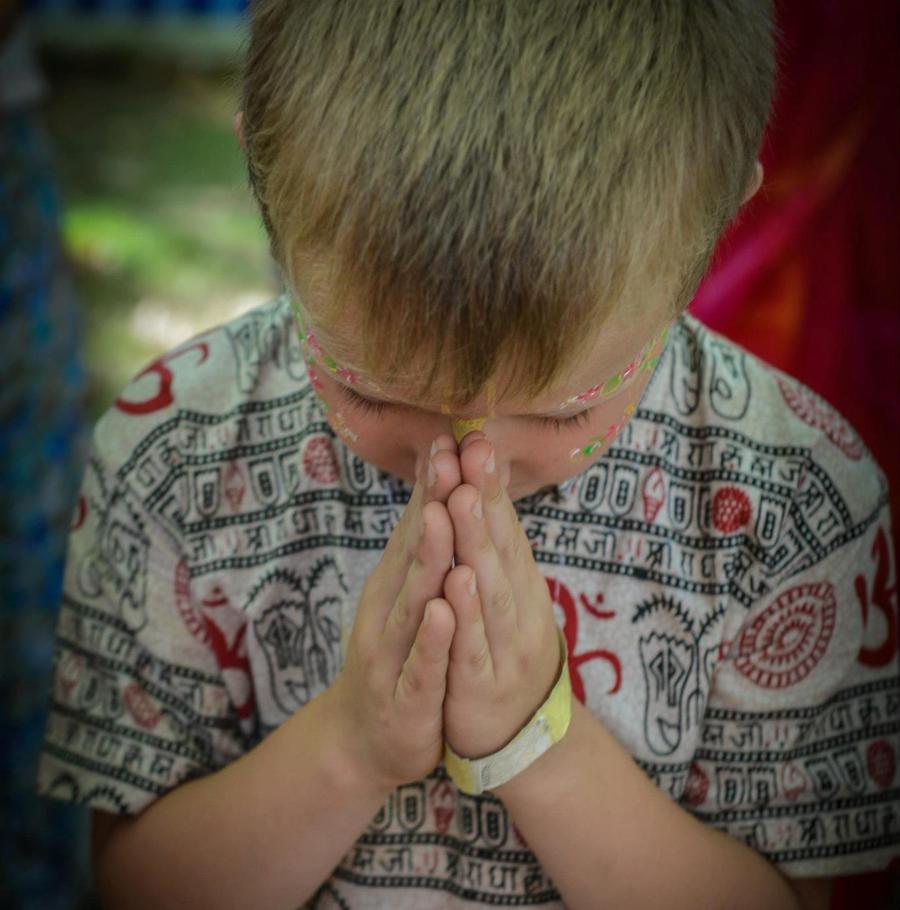
"Shri Rupa Goswami cast out Jiva Goswami to teach us, the Devotees of today, a lesson. It was not done to teach or punish Shri Jiva Goswami, who is a perfectly liberated, eternal associate of Lord Krishna. Rupa Goswami sent Jiva Goswami out of Vrindavana to teach all jivas what he wrote in Upadesamrta: vaco vegam mansah krodah vegam, jihva vegam... At all times, a Devotee should control his tongue, his speech, and always remain humble, trnad api sunicena:" (In the image: Bhakti Sangam Festival, Russia).

Jayadeva Goswami

Jayadeva Goswami

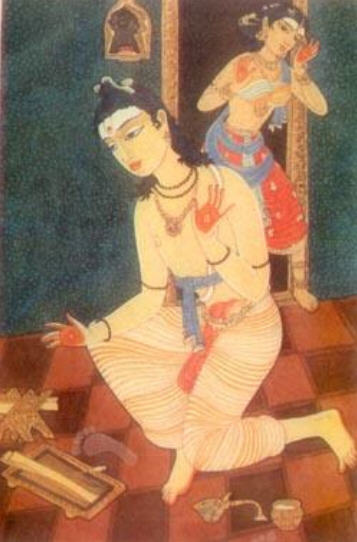
Three hundred years before the appearance of Shri Chaitanya Mahaprabhu, Shri Jayadeva Goswami served as the court pandita of Shri Lakshmana Sena, King of Bengal. Jayadeva and Padmavati (his wife and an expert dancer) used to worship Lord Shri Krishna with single-minded devotion. (In the image: Jayadeva Goswami and his wife Padmavati).

   Three hundred years before the appearance of Shri Chaitanya Mahaprabhu, Shri Jayadeva Goswami served as the court pandita of Shri Lakshmana Sena, King of Bengal. Jayadeva and Padmavati (his wife and an expert dancer) used to worship Lord Shri Krishna with single-minded devotion. After some time, he left the opulent royal life to live peacefully in a grass hut in Champahatti, Navadwipa. Here Jayadeva wrote Gita Govinda.

   One day while working on Gita Govinda Jayadeva felt inspired to write, "Krishna bows down to touch the lotus feet of Shrimati Radharani." Jayadeva was hesitant to say something which might diminish Lord Krishna's position as the Supreme Personality of Godhead.

   He went to refresh himself with a Ganges bath before honoring Radha-Madhava's Maha-Prasadam. In his absence, Krishna Himself, disguised as Jayadeva, wrote a line in the Gita Govinda: dehi pada pallavam udaram. The Lord also accepted Prasadam from Padmavati. Opon returning, Jayadeva was astonished to see the line. Understanding the mystery, Jayadeva cried in spiritual joy and said, "Padmavati, we are most fortunate. Shri Krishna Himself has written the line, dehi pada pallavam udaram, and taken Prasadam from your hand."

   Gita Govinda expresses the intense feelings of separation that Shri Radhika felt before the rasa dance. It also describes the most intimate pastimes of Radha-Shyamasundara. During Lord Chaitanya's Gambhira lila in Jagannatha Puri, He would thoroughly relish hearing the Gita Govinda sung daily by Svarupa Damodara and Mukunda.

   The author Jayadeva Goswami describes Gita Govinda:"Whatever is delightful in varieties of music, whatever is graceful in fine strains of poetry, and whatever is exquisite in the sweet art of Iove-Iet the happy and wise learn from the songs of Jayadeva."

   After finishing Gita Govinda Jayadeva visited Vrindavana and then lived his last in Jagannatha Puri. He introduced daily reading of Gita Govinda in the Temple for the pleasure of Lord Jagannatha. His samadhi is in the 64 Samadhis Area. 

Jayadeva Goswami

One day while working on Gita Govinda Jayadeva felt inspired to write, "Krishna bows down to touch the lotus feet of Shrimati Radharani." Jayadeva was hesitant to say something which might diminish Lord Krishna's position as the Supreme Personality of Godhead. (In the image: Krishna is holding the Lotus feet of Shrimati Radharani).

Hemalata Thakurani

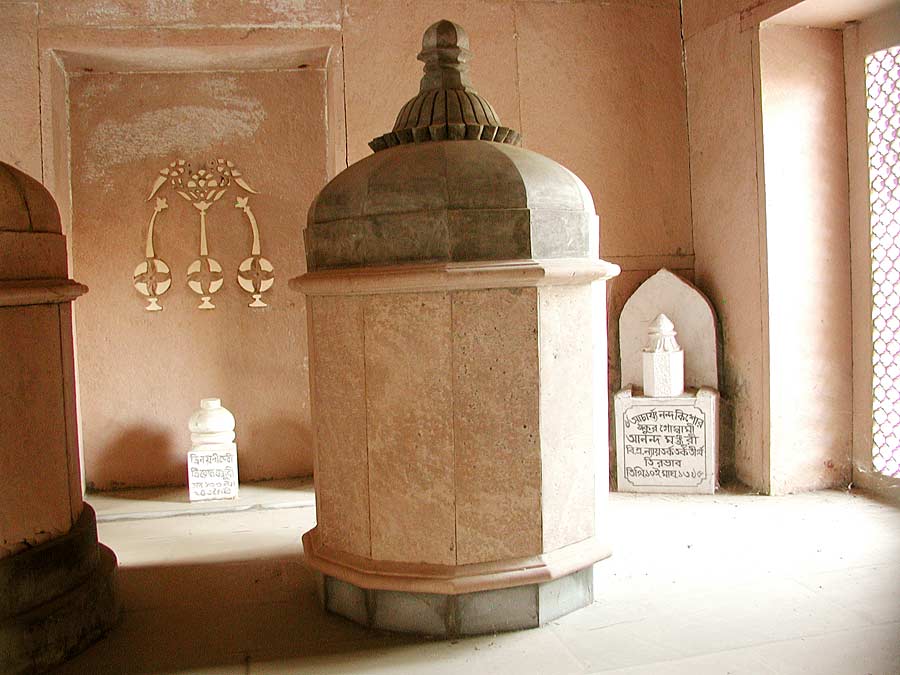
   Shri Hemalata Thakurani, the daughter of Shrinivasa Acharya, was a pure Devotee of Lord Krishna and Lord Chaitanya. She lived in Gaura mandala and initiated many disciples. Yadunandana Dasa, her disciple, wrote Shri Karnanandana and other Vaishnava books. Her samadhi is in Dhira Samira Kunja, next to her father's. 
Hemalata Thakurani

Samadhi of Hemalata Thakurani.

Gopala Guru Goswami

Gopala Guru Goswami

Gopala Guru Goswami.

   As a young boy, Gopala came to the lotus feet of Shri Chaitanya Mahaprabhu. Shri Vakreshvara Pandit trained and initiated him. Lord Chaitanya loved Golpala and often joked with him. Once Mahaprabhu humorously called the boy "guru." The name stuck and he became known as Gopala Guru Goswami.
 
   By studying under Shri Svarupa Damodara Goswami and Shri Raghunatha Dasa Goswami he became expert in rasa tattva (the science of Radha-Govinda's loving mellows). He enlightened Shri Dhyan Chandra Goswami, his disciple, in the same. Dhyana Chandra's books explain in detail how to worship Gauranga and Radha-Govinda in raganuga bhakti.

   Gopala Guru lived with and served his guru, Shri Vakreshvara Pandit, in Jagannatha Puri in Kashi Mishra's house, where Lord Chaitanya previously stayed. Beside the Gambhira, he established a Temple for worshiping Shri-Shri Radha-Kanta. His unusual samadhi in Vrindavana is in the Dhira Samira area.


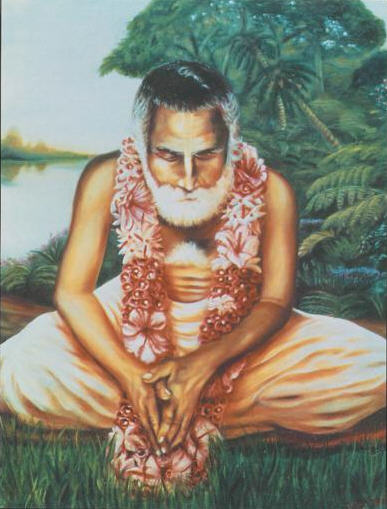
Gaura Kishora Dasa Babaji Maharaja

Gaura Kishora Dasa Babaji Maharaja

Shrila Gaura Kishora Dasa Babaji.

   In 1849, Shrila Gaura Kishora Dasa Babaji left grihasta life after the death of his wife. He moved to Vrindavana and took initiation from Shri Bhagavata Dasa Babaji, a disciple of Shri Jagannatha Dasa, Babaji. For over thirty years Gaura Kishora Dasa stayed in Vrindavana performing bhajana under the trees at Giri Govardhana, Nandagrama, Varshana, Radha-Kunda, Surya-kunda, Raval, Gokula.

   Sitting in seclusion, he chanted 200,000 names of Krishna every day (128 rounds of japa). He felt painful separation from Radha-Govinda and cried profusely. As he wandered through the dvadasa vana (12 forests) of Vraja, he would loudly chant the Holy Names in a deep voice full of lamentation. He would also relish the following bhajan:

kothay go prema-mayi radhe radhe!
radhe radhe go jaya radhe radhe!
dekha diya prana rakho radhe radhe!
tomar kangal tomay dake radhe radhe!
radhe vrindavana-vilasini radhe radhe!
radhe kanu-mano-mohini radhe radhe!
radhe astha-sakhir siromani radhe radhe!
radhe vrsabhanu-nandini radhe radhe!


   "0h Radhe Radhe! Where are You, 0h Goddess of ecstatic love? Oh Radhe Radhe! All glories to You, 0h Radhe Radhe!

   Oh Radhe Radhe! Please show Yourself to me and thereby maintain my life. Your most despicable fallen servant calls out to You, 0h Radhe Radhe! Oh Radhe! Oh artful enjoyer of Vrindavana. 0h Radhe Radhe! Oh Radhe! Oh enchantress of Kanu's (Krishna) mind. 0h Radhe Radhe!

   Oh Radhe! Oh crest jewel of Your eight main girlfriends. 0h Radhe Radhe! 0h Radhe! Oh delightful daughter of Maharaja Vrishabhanu. 0h Radhe Radhe!" 
Gaura Kishora Dasa Babaji Maharaja

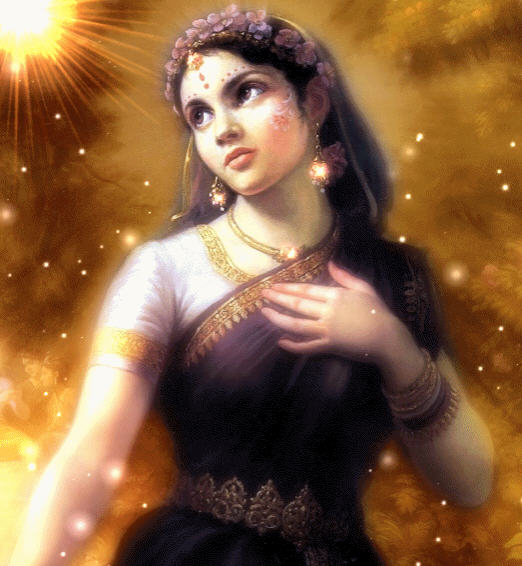
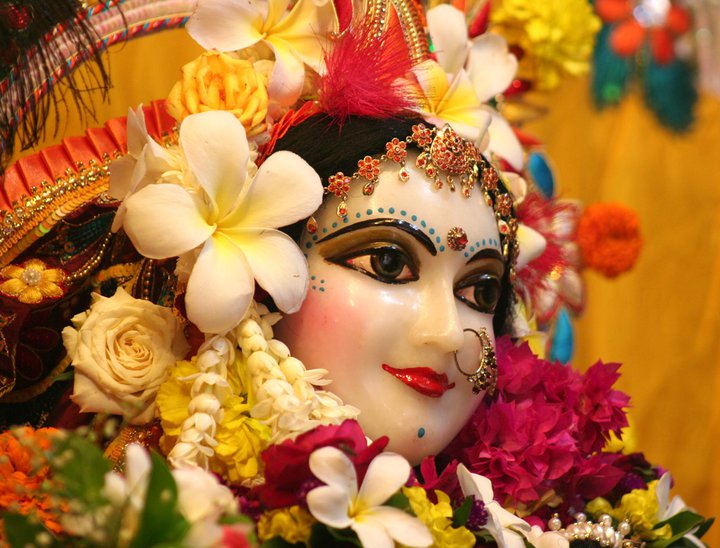
Oh Radhe Radhe! Please show Yourself to me and thereby maintain my life. Your most despicable fallen servant calls out to You, 0h Radhe Radhe! Oh Radhe! Oh artful enjoyer of Vrindavana. 0h Radhe Radhe! Oh Radhe! Oh enchantress of Kanu's (Krishna) mind. 0h Radhe Radhe! (In the image: Shrimati Radharani, Krishna - Balaram Mandir, ISKCON Vrindavan).


   Shrila Babaji Maharaja's mood of renunciation was unparalleled. Sometimes he ate mud from the banks of Radha-Kunda or the Yamuna. Other times he took madhukari from the Vrajavasis. Madhukari is a babaji's daily practice of begging a little food from one to seven houses, just as a bee collects a drop of honey from each flower. He saw all the Vrajavasis (residents of Vrindavana) as being the direct personal associates of Radha and Krishna. As a result of this vision, he would pay respects to every person, cow, animal, bird, tree, creeper, insect, ant in the holy dhama.

   While staying in Varshana he made a flower garland everyday for Rai and Kanu (Radha-Krishna). After thirty years of rendering intimate services to Radha and Krishna in Vrindavana, Babaji felt inspired by the Divine Couple to see Shri Navadwipa Dhama. He visited all the lila sthanas of Lord Gauranga in Gaura Mandala. In Navadwipa, he used to sing one bhajana which means, "By receiveing Nitai's mercy one gets Gauranga's mercy, which makes one eligible for Krishna prema. With Krishna prema one can attain the service of Shrimati Radharani and the gopis."
Gaura Kishora Dasa Babaji Maharaja

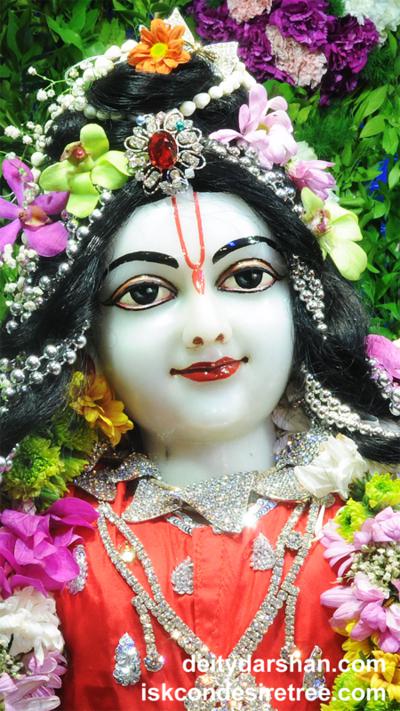
"By receiveing Nitai's mercy one gets Gauranga's mercy, which makes one eligible for Krishna prema. With Krishna prema one can attain the service of Shrimati Radharani and the gopis." (In the image: Shri Nityananda Prabhu, ISKCON Chowpatty, Mumbai).

   Gaura Kishora Dasa Babaji was the embodied form of Shri Rupa-Raghunatha's renunciation. Completely detached, he would wash discarded cloth to cover his body. He drank from a rejected clay pot. Parched rice mixed with Ganges water or simply some mud from Ganga's bank sustained his life.

   He carried two books written by Shri Narottama Dasa Thakura; Prarthana, Prema-bhakti-candrika. On Ekadashi he didn't eat or drink a drop of water. Recognizing him to be a mahabhagavata, many tried to serve, but he never accepted.

   Regularly, he associated with and heard Shrimad Bhagavatam from Shrila Thakura Bhaktivinoda in Svananda sukhada kunja in Godrumadwipa. Constantly absorbed in bhajana, Shrila Babaji Maharaja had no desire to make disciples. On the request of Bhaktivinoda Thakura, however, he reconsidered. Upon seeing the true humility and deep attachment of Thakura Bhaktivinoda's son for bhajana, Shrila Gaurakishora Dasa Babaji accepted one disciple–Shri Varshabhanavi-dayita Dasa (Shrila Bhaktisiddhanta Saraswati Thakura).

   To keep mundane people from approaching him for material boons he once resided in the lavatories at the Kuliya Dharmashalla (in Koladwipa) for six months. When public officials came offering to build him a proper bhajana kutir, Babaji Maharaja locked himself inside and said he already had one. He believed that associating with materialistic people was much worse than the smell of stool in the latrine.

   Gaura Kishora Dasa Babaji advised a Calcutta doctor who wanted to open a free health clinic in Navadwipa Dhama: "If you really want to live in Navadwipa Dhama, then give up your desire to run a free clinic for healing sense enjoyers. If you want to render substantial service, then renounce everything except what promotes Hari bhajana. All other kinds of duties and services simply bind one to the ghastly cycle of karmic reactions."

   Babaji Maharaja spoke gravely to a newly married man: "A Vaishnava wife is extremely rare and difficult to find in this world. If one has the good fortune of having one, he should see it as a benediction from Krishna. The wife worships the husband as her lord and master. Similarly, the husband should worship the wife because she is Krishna dasi, a servant of Krishna. In this way, the husband can protect his devotional enthusiasm by not considering his wife to be his maidservant, but she is always the maidservant of Krishna."

   "One who wants bhojana (eating palatably) will spoil his bhajana," was a favorite quote of Shrila Babaji Maharaja. In other words, eating here and there simply to gratify the tongue (bhojana) destroys any attempts to worship Krishna (bhajana). Once a Devotee ate some festival Prasadam in his bhajana kutir. Babaji Maharaja would not speak to him for three days. On the fourth day he said, "You accepted "festival Prasadam" given by low class harlots and beautiful women. Because you took food without considering its origin your bhajana is useless." 
Gaura Kishora Dasa Babaji Maharaja

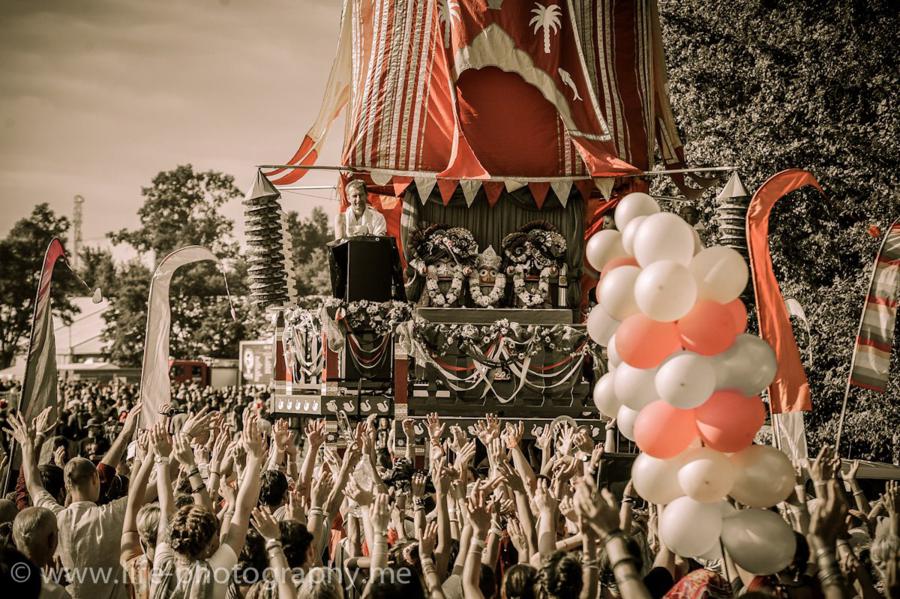
"The Divine Name of Krishna offers the one and only shelter. One should never try to remember Radha-Damodara's transcendental pastimes by artificial methods. Constant chanting of the Divine Names will purify the heart. By chanting Hari Nama the syllables of the Maha-mantra (Hare Krishna Hare Krishna Krishna Krishna Hare Hare, Hare Rama Hare Rama Rama Rama Hare Hare) will gradually reveal the spiritual form, qualities, pastimes of Shri Krishna. Then you will realize your own eternal spiritual form, service, and the eleven particulars of your spiritual identity." (In the image: Ratha Yatra, Poland).


   The essence of Shrila Gaura Kishora Dasa Babaji's instructions: "The Divine Name of Krishna offers the one and only shelter. One should never try to remember Radha-Damodara's transcendental pastimes by artificial methods. Constant chanting of the Divine Names will purify the heart. By chanting Hari Nama the syllables of the Maha-mantra (Hare Krishna Hare Krishna Krishna Krishna Hare Hare, Hare Rama Hare Rama Rama Rama Hare Hare) will gradually reveal the spiritual form, qualities, pastimes of Shri Krishna. Then you will realize your own eternal spiritual form, service, and the eleven particulars of your spiritual identity." 

   In pursuance of Babaji Maharaja's statement, "drag my dead body through the streets of Navadwipa," a group of so-called advanced Devotees proposed to commit the said sacrilege. Shrila Bhaktisiddhanta Saraswati Thakura, however, challenged them: "According to shastra, one who has had carnal association with a loose woman within the last twenty-four hours is contaminated, and therefore not qualified to touch my Guru Maharaja." Hearing this bold statement, the black-hearted brahmanas made a hasty retreat.

   On 19 November 1915, Shrila Gaura Kishora Dasa Babaji Maharaja joined the eternal blissful Pastime of Gandharvika Giridhari. His beloved disciple, Shrila Bhaktisiddhanta Saraswati Thakura, established his samadhi on the banks of Shri Chaitanya Matha's Radha-Kunda, near Lord Chaitanya's Yogapitha in Shridhama Mayapur.

   In Vraja lila he serves Shrimati Radharani as Guna-manjari. His pushpa samadhi stands besides the Radha-Kunja Bihari Gaudiya Matha near Radha-kunda. 
Gaura Kishora Dasa Babaji Maharaja

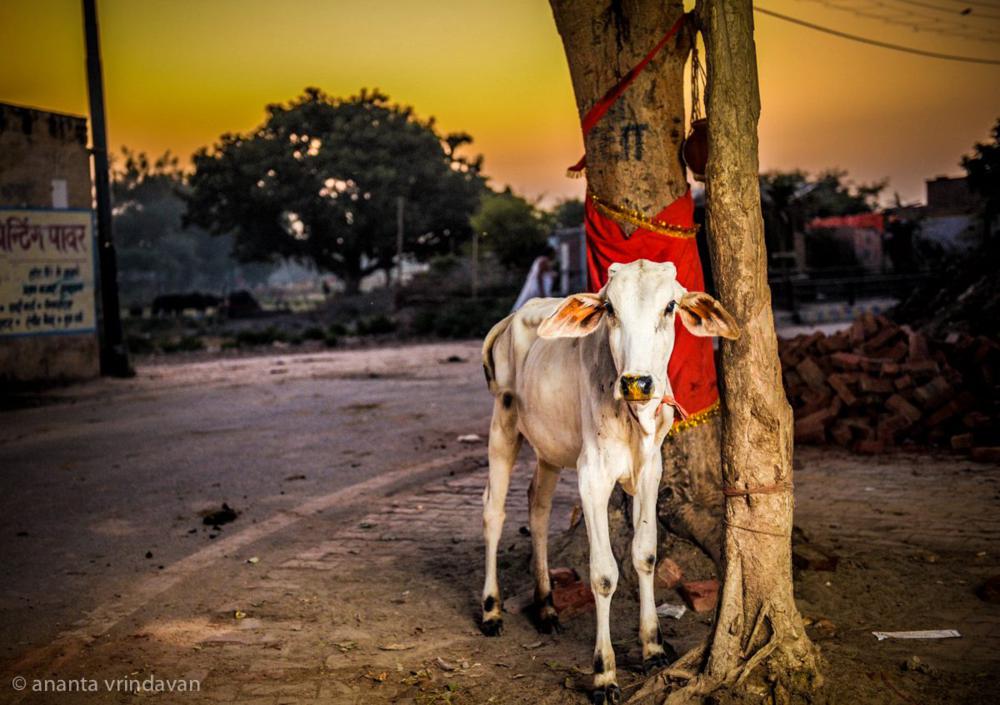
Shrila Babaji Maharaja's mood of renunciation was unparalleled. Sometimes he ate mud from the banks of Radha-Kunda or the Yamuna. Other times he took madhukari from the Vrajavasis. Madhukari is a babaji's daily practice of begging a little food from one to seven houses, just as a bee collects a drop of honey from each flower. He saw all the Vrajavasis (residents of Vrindavana) as being the direct personal associates of Radha and Krishna. As a result of this vision, he would pay respects to every person, cow, animal, bird, tree, creeper, insect, ant in the holy dhama. (In the image: Kamadhenu cow, Shri Vrindavan Dham).
Gangamata Goswamini

Gangamata Goswamini

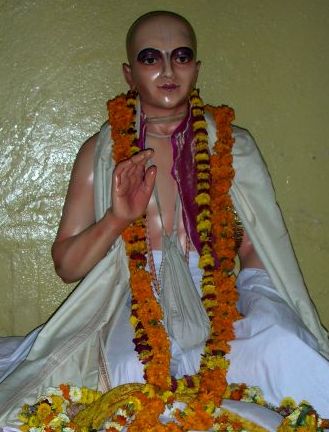
Gangamata Goswamini.

   From her childhood Princess Sachi devi, the daughter of King Naresh Narayana of Bengal, showed unalloyed devotion to Lord Sri Krishna. She even refused to marry on account of her genuine attachment to Krishna. After her father's demise she ruled the kingdom. But she soon renounced it to find a bona fide spiritual master. Princess Sachi devi met Shri Haridasa Pandit, a leading guru in Vrindavana, and began performing devout bhajana to Govindaji. Although she became frail from undereating, she would always sleep on the Yamuna's sandy bank, and rise before sunrise to clean Govindaji's Temple. Daily she would hear Bhagavata-katha, see Govindaji's arotika, circumambulate Radha-Shyamasundara's lila sthanas (pastime places) such as Vamishivata, Seva Kunja, Nidhu vana, Rasa Sthali.Receiving encouragement from Shri Haridasa Pandit, Sachi devi completely dropped her false ego, put on rags, and went house-to-house in Vraja begging alms. The Vrajavasis were astonished by her severe renunciation. Taking her guru's suggestion, she went to Radha-Kunda to associate with Shri Lakshmipriya devi dasi, a dear disciple of Shri Haridasa.

   Following Thakura Haridasa's perfect example, Lakshmipriya devi daily chanted 3,00,000 names (192 rounds) of Krishna. Everyday the two ladies would circumambulate Govardhana Hill and worship Krishna.

   On her guru's order, Sachi devi went to the home of Sarvabhauma Bhattacharya in Jagannatha Puri. Sarvabhauma Bhattacharya and most of Lord Gauranga-sundara's eternal associates had already returned to Goloka Vrindavana. Sachi devi restored Sarvabhauma's house, and established first-class worship of Shri Shyama Raya, a Deity given to her by a Jaipur brahmana. Everyday she lectured on Shrimad Bhagavatam. Her classes became popular attracting eager listeners from miles around. Many people, including brahmanas and King Mukunda Deva, took initiation from Sachi devi.

   In Sri Navadwipa Dhama Parikrama, Sripad B.V. Narayana Maharaja explains how Sachi devi got the name "Gangamata."

   "On the day of Ganga Sagara Mela, Sachi devi, who was residing in Jagannatha Puri, desired to bathe in the Ganges. That night the Ganges flowed from the lotus feet of Lord Jagannatha and came to Sachi's ashrama. Entering Ganga Devi's waters, Sachi floated to the lotus feet of Jagannatha Swami inside the Temple. After unlocking the doors the next morning the pujaris were surprised to find her inside the Temple. Thinking she was a thief, they immeditately put Sachi devi in jail. Seeing this mistake, Lord Jagannatha appeared simultaneously in a dream to both the Puri King and the head pujari. The Lord ordered them to release Sachi devi dasi and take initiation from her. From then on she became famous as Gangamata Gosvamini:" 

Gangamata Goswamini

"On the day of Ganga Sagara Mela, Sachi devi, who was residing in Jagannatha Puri, desired to bathe in the Ganges. That night the Ganges flowed from the lotus feet of Lord Jagannatha and came to Sachi's ashrama. Entering Ganga Devi's waters, Sachi floated to the lotus feet of Jagannatha Swami inside the Temple..." (In the inamge: Sachi Devi).

Ganga Narayana Cakravarti

Ganga Narayana Cakravarti

Srila Narottama Dasa.

   When Shri Ganga Narayana Chakravarti, a renowned brahmana, took initiation from Shri Narottama Dasa Thakura the smarta brahmanas became outraged. They complained to King Narasimha that the "audacious sudra," Narottama Dasa, had brazenly initiated a brahmana into the fold of Gaudiya Vaishnavism. The king, the smartas, and the dig vijaya pandit (world class scholar) went to challenge and conquer the "upstart" Narottama Dasa.
 
   Krishna's Devotees peacefully tolerate all insults and abuses to themselves. But they strike like fire against offenders to their beloved guru or worshipable Lord Krishna.
 
   Ganga Narayana Chakravarti and Ramachandra Kaviraja felt disturbed upon hearing of the imminent attack against their gurudeva.
 
   Disguising themselves as a potter and a pan walla (betel nut vendor), they opened shops in a neighboring village. Upon arriving there, the smartas sent their students to buy pan and clay pots for cooking. Both the potter (Ramachandra Kaviraja) and the pan walla (Ganga Narayana) spoke pure Sanskrit with the students. Soon an argument stirred the ethers. The smartas, King Narasimha and Shri Rupa Narayana (the dig vijaya pandit) joined the furious debate. The two "wallas" quickly silenced the opposition. When he understood they were Narottama Dasa's disciples, the King told the smarta pandits, "If you can't even defeat these two common ordinary disciples of Narottama Dasa Thakura, how will you even defeat Narottama Dasa himself?"


   Humiliated, the pandits headed home. That night in a dream Durga Devi told King Narasimha and the Dig Vijaya pandit, "Take initiation from Narottama Dasa Thakura, or else I'll cut off your heads." The next day they surrendered and received Radha-Krishna mantra diksha from Narottama Dasa Thakura.
 
   The samadhi of Ganga Narayana Chakravarti is next to Narottama Dasa Thakura's samadhi in the Radha-Gokulananda Temple courtyard. 

Ganga Narayana Cakravarti

The samadhi of Ganga Narayana Chakravarti is next to Narottama Dasa Thakura's samadhi in the Radha-Gokulananda Temple courtyard.

Gadadhara Pandit

Gadadhara Pandit

Sri Gadadhara Pandit. He was a member of the Panca Tattva and is described as the effulgence of Srimate Radharani.

    Sri Gaurahari had so much affection for Sri Gadadhara Pandit that He couldn't be without him for a moment. He appeared a year after Lord Caitanya. Gadai and Nimai were inseparable as childhood playmates. Peaceful, renounced, serious, self-composed, fond of solitude Gadadhara proved quite a contrast to his bosom friend Gaura Raya, who was fickle, unsteady, and whimsical. In Ganga Dasa Pandit's tol (school) Nimai Pandit regularly teased Gadadhara by challenging him with illogical questions.
 
   Sri Kavi Karnapura states that in Vraja lila Gadadhara Pandit is the daughter of King Vrsabhanu–Srimati Radharani. Gadadhara Pandit served as Lord Gaura's chief assistant during His Navadvipa-lila. Sri-Sri Radha Krishna in Vrindavana appear as Gaura-Gadadhara to perform pastimes in Navadvipa in the forest groves beside the Ganges. 

  Gadadhara Pandit"No one call describe the characteristics and ecstatic love of Gadadhara Pandit. Therefore another name for Sri Caitanya Mahaprabhu is Gadadhara Prananatha, "the life and soul of Gadahara Pandit." (Caitanya-caritamrta).

   One day while wandering along the bank of the Ganges, Gaurasundara entered a forest grove and sat in a meditative mood. Soon he became enraptured remembering His Vrindavana pastimes. To enhance the Lord's mood, Mukunda Datta began singing Sweet songs inpurva raga. Sri 

   Gadadhara made a garland of fragrant forest flowers and lovingly placed it around the Lord's beautiful neck. As Sri Radha used to dress Damodara in Vrindavana, similarly, Gadadhara would adorn the radiant form of Lord Gauranga. He would also decorate Lord Caitanya's bed and bedroom with sweet smelling flowers. Everyday he would make sandalwood paste to rub on Sri Caitanya's transcendental body. 

Gadadhara Pandit

Lord Chaitania is sitting, on His left is Gadadhara Pandit in red Vaishnava cloth during Nadia Lila.

   Gaura-Gadadhara sat on the root of a tree, serving as a raised dais. Sri Nityananda Prabhu sat on Lord Caitanya's right, Srivasa Pandit decorated them with flowers. Sri Advaita Acarya offered arotika. Narahari waved a camara. Suklambhara offered candana and Murari Gupta sang the Lord's glories. Vijay, Mukunda, Purusottama, Madhava and Vasudeva Ghosh sang a variety of songs in different ragas. In this way, Sri Caitanya Mahaprabhu performed His Nadia lila. 
 
   Gadadhara Pandit also took the renounced order of life and went to Jagannatha Puri to be with Lord Caitanya. Accepting ksetra sannyasa (a renunciate who never leaves the dhama), he served the Deity of Tota-Gopinatha with full love and devotion. Regularly, Sri Krishna Caitanya carne to relish Sri Gadadhara's rasika reading of Srimad Bhagavatam. Lord Caitanya concluded His manifest pastimes by entering the Deity of Tota-Gopinatha.

Tota Gopinath

Tota Gopinath Deity which was worshipped by Gadadhara Pandit;

    Although Gadadhara Pandit was barely forty-eight when the Lord departed, he quickly became old because of the intense anguish he felt in separation from his beloved Lord Gaurasundara. He couldn't stretch his arms to offer a garland to his Deity. Understanding His servant's difficulty, Sri Tota-Gopinatha sat down to facilitate Gadadhara's loving service. To this day, Sri Tota-Gopinatha is the only sitting Deity of Krishna.  

Gadhara Pandit

This is the Deity he wore around his neck. The deity is called, Sri Meyo Krishna.There is Krishna ... and Lalita and Visakha;

    According to some authorities, a short time after Lord Caitanya's disappearance Sri Gadadhara Pandit joined His eternal pastimes by entering his beloved Deity of Tota-Gopinatha. His danta (tooth) samadhi stands near the Vamsi Gopala temple in Vrindavana.


Gadadhara Dasa Goswami

Gadadhara Dasa Goswami

...Krishna Dasa Kaviraja describe Lord Chaitanya as radha-bahva-dyuti suvalita, "characterized by the emotions and bodily luster of Shrimati Radharani." Gadadhara Dasa is this dyuti, luster. Gadadhara Dasa is sometimes called "the personification of Sri Radhika's divine effulgence." (In the image: Shrimati Radharani).

   Sri Chaitanya Mahaprabhu has basically two groups of associated. One group such as the dvadasa gopalas (Abhirama Gopalas, Gauridasa Pandit, Dhananjaya and others) serve Sri Nityananda Prabhu in the mood of sakhya rasa (Friendship). The second group always stay merged in the mellow of madhurya rasa (conjugal love).

   Sri Gadadhara Goswami is a united form of Chandrakanti gopi (an expansion of Radharani's effulgence) and Purnanada (an expansion of Lord Balarama's dear girlfriend). Thus, Gadadhara Dasa was an associate of both Sri Chaitanya Mahaprabhu and Sri Nityananda Prabhu. Krishna Dasa Kaviraja describe Lord Chaitanya as radha-bahva-dyuti suvalita, "characterized by the emotions and bodily luster of Shrimati Radharani." Gadadhara Dasa is this dyuti, luster. Gadadhara Dasa is sometimes called "the personification of Sri Radhika's divine effulgence." 

   While traveling with Lord Nityananda Gadadhara would sometimes become absorbed in madhurya prema and begin acting  and speaking like a Vraja gopi. Putting a clay pot of Ganges water on his head, as if he were a gopi, he would call out, "Who wants to buy milk? Who wants to buy yogurt?"

   As one of Lord Nityananda's chief preachers in Bengal Gadadhara Dasa delivered countless sinner, and yavanas once while tasting Krishna prema he began dancing madly and chanting Krishna's Holy Names outside the Kazi's mansion. The irate Muslim magistrate stormed out of his house to chastize him for "disturbing the peace." But beholding the dazzingly attractive form of Gadadhara Dasa, the Kazi became stunned and dropped his anger. 
 
   Gadadhara affectionately embraced the Kazi and said, "Gaura-Nityananda have appeared to deliver everyone with divine love by distributing the sweet nectar of the Holy Name of Hari. Why don't you chant this sweet name of Hari?"

   "Tomorrow I shall chant the name of Hari," replied the Kazi. Hearing the Kazi inadvertanly chant the Holy Name filled Gadadhara with happiness. He said, "Why tomorrow? You have already chanted today. And this powerful name of Hari will destroy your sins and purify your existence." From that day on the Kazi took shelter of Sri Gadadhara Dasa Goswami. His samadhi is in the 64 Samadhis Area. 

Gadadhara Dasa Goswami

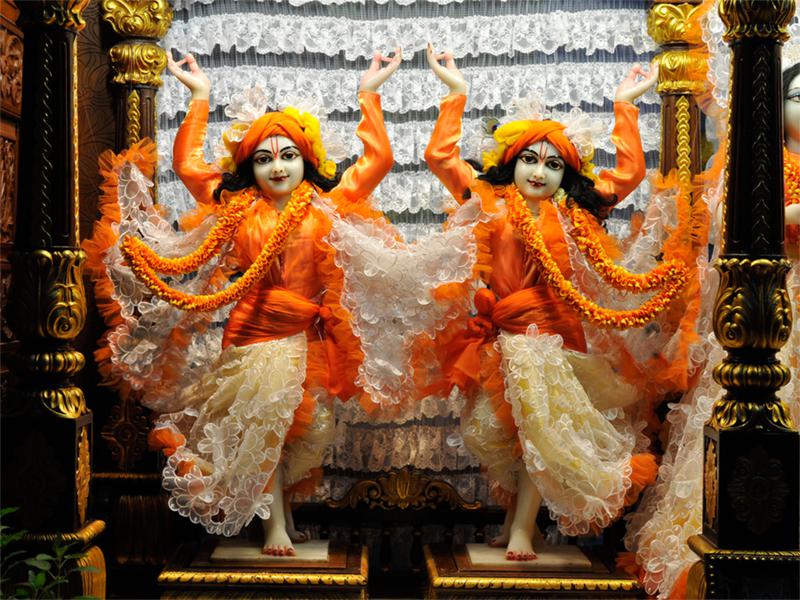
"Gaura-Nityananda have appeared to deliver everyone with divine love by distributing the sweet nectar of the Holy Name of Hari. Why don't you chant this sweet name of Hari?" (In the image: Sri Sri Nitai Gaurachandra, ISKCON Chowpatty, Mumbai).