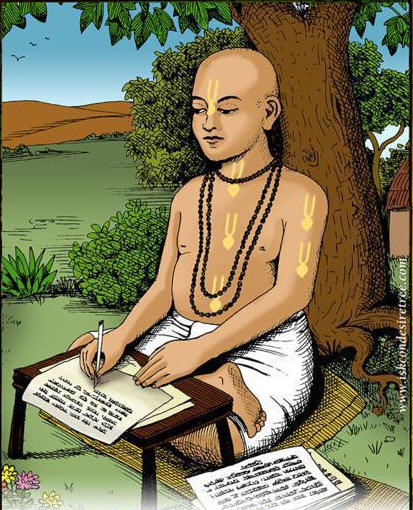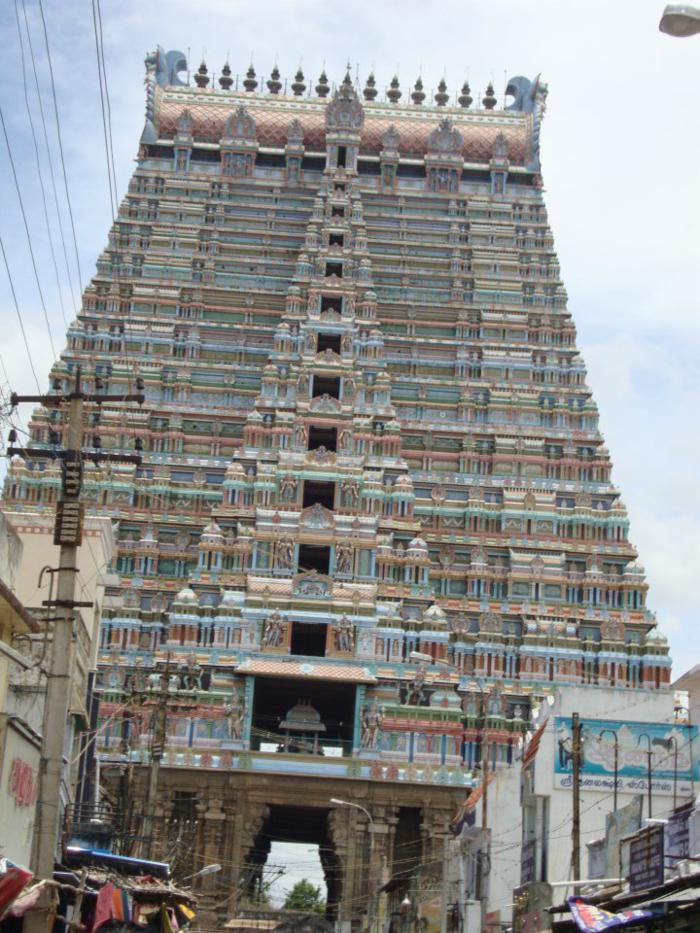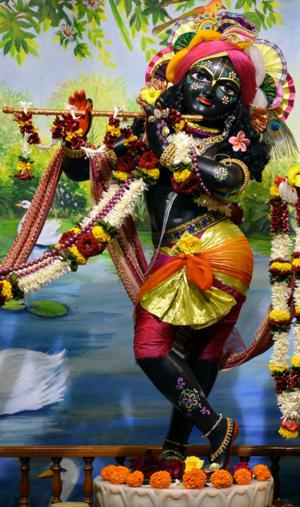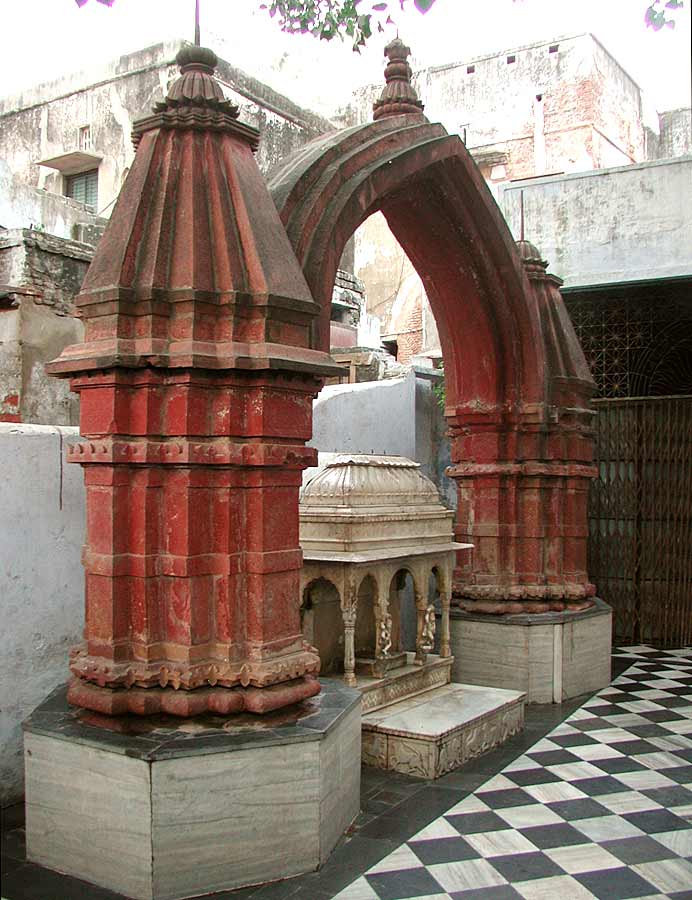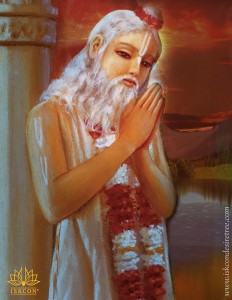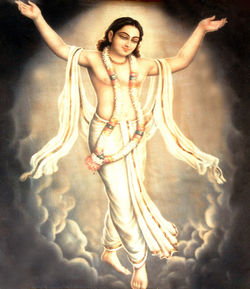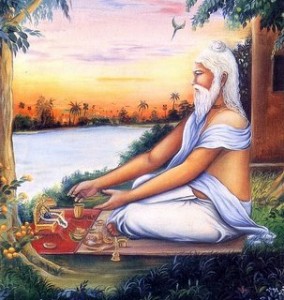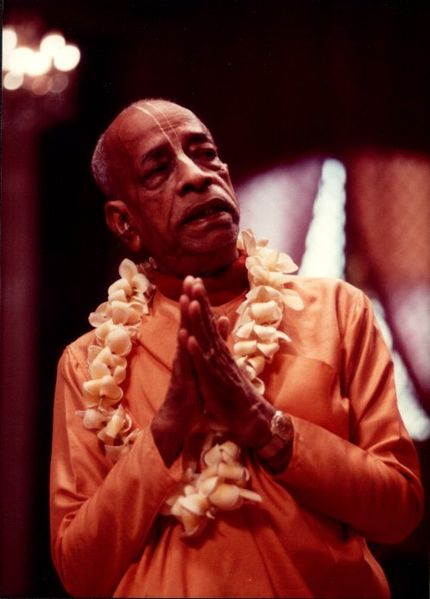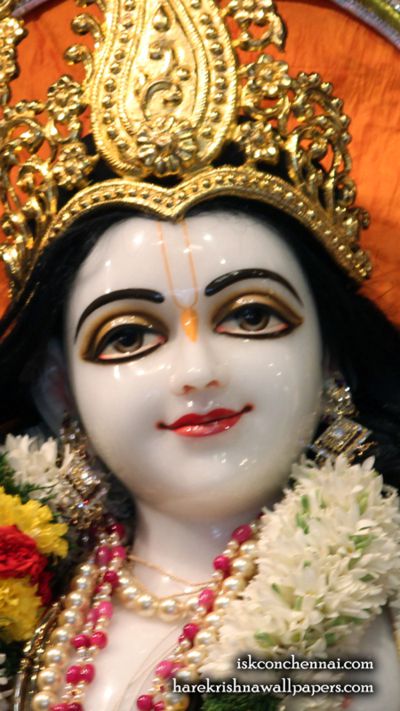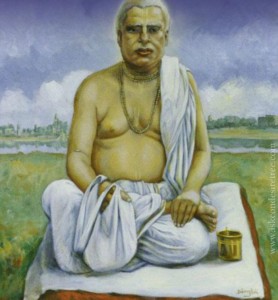
Srila Bhaktivinoda Thakur.
namo bhaktivinodaya saccidananda-murtaye
gaura-shakti-svarupaya rupanuga-varaya te
I offer my obeisances to you, O Bhaktivinoda, the form of eternity, knowledge and bliss, the incarnation of Gaura’s potency and the best of the followers of Rupa Goswami.
Srila Bhaktivinoda Thakur’s transcendental identity is revealed to the members of his spiritual family. He is the best of the followers of Rupa Manjari who is the leader of Lalita Sakhi’s entourage. Lalita Sakhi is the foremost of Radharani’s eight girlfriends. In various places in his own writings, Srila Bhaktivinoda Thakur has indicated this divine identity:
yugala-sevaya, shri-rasa-mandale, niyukta kara amay
lalita-sakhira, ayogya-kinkari, vinoda dhariche pay
Bhaktivinoda holds your feet and asks you to engage this unworthy servant of Lalita Sakhi in the service of the Divine Couple while they are performing the rasa-lila.
(Kalyana-kalpataru)
In the song Siddhi-lalasa in his Gita-mala, also, Bhaktivinoda Thakur gives his eternal spiritual identity as Kamala Manjari, the servant of Sri Rupa Manjari. Her kunja is in the bower of Lalita, Vrajananda-sukhada-kuïja, where she sets the standard of worship to the Divine Couple.
varane tariit, vasa taravali, kamala-maïjari nama
sarie baro varsha, vayas satata, svananda-sukhada dhama
My bodily hue is like that of lightning and I wear a sari the colour of a clear night sky sprinkled with stars. I am twelve and a half years old and I live in Svananda-sukhada-kuïja.
The need for Bhaktivinoda’s appearance
After the disappearance of Sri Krishna Chaitanya Mahaprabhu, Svarupa Damodar, Ramananda Raya and the Six Goswamis, Srinivas Acharya, Narottama Das and Shyamananda Prabhu, a dark age descended on the world of Gaudiya Vaishnavism. Those unable to understand the transcendental purity of Mahaprabhu’s religion of love started numerous heretical sects or apasampradayas. Totarama Das Babaji named thirteen such heretical sects:
aul, baul, kartabhaja, neria, daravesha, sain
sahajiya, sakhibheki, smarta, jata-gosaïi
atibarii, curiadhari, gauranga-nagari
tota kahe ei teror sanga nahi kari
Educated upper class Bengali society was shocked and disgusted by the practices of these heretical sects and came to identify Mahaprabhu’s religion with the lower classes, the uneducated and immoral. People of the gentle classes thus had no understanding or faith in Mahaprabhu’s true religion. The most munificent incarnation Sri Chaitanya Mahaprabhu took pity on these bewildered persons and in order to reclaim them for his path of divine love sent his eternal associate Srila Bhaktivinoda Thakur into this world. Possessed of superhuman prowess, the Thakur wrote more than a hundred books in several different languages with the goal of defeating all the unorthodox views opposed to the true doctrines of Mahaprabhu’s religion. The result was that many members of discerning society and others from all over the world came to recognize the unequalled value of Mahaprabhu’s teachings. The founder of the Chaitanya Math and the worldwide Gaudiya Maths, Srila Bhaktisiddhanta Saraswati Goswami Thakur, based his mission on the books and teachings given by Srila Bhaktivinoda Thakur and set into motion the fulfillment of Mahaprabhu’s message, found in the Chaitanya Bhagavat:
prithivite paryanta ache jata desha-grama
sarvatra saïcara ha+ibeka mora nama
My name will pervade every village and country in the world. (Chaitanya Bhagavat 3.4.126)
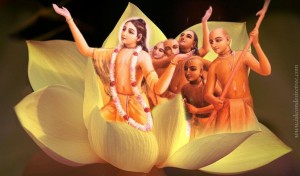
My name will pervade every village and country in the world. (Chaitanya Bhagavat 3.4.126)
Srila Bhaktivinoda Thakur thus made an unequalled contribution to the ultimate, spiritual welfare of humankind. Srila Bhaktisiddhanta Saraswati Goswami Thakur wrote in his preface to the Jaiva-dharma: “Srila Bhaktivinoda Thakur is an extremely dear associate of Sri Chaitanya Chandra. In the course of time, when those who preached the desires of Chaitanya Deva had left this world to enter the Lord’s eternal pastimes, the sky over Bengal slowly darkened, covered by the thick clouds of sensual enjoyment and false renunciation. The sky was covered and the world was bereft of the rays of light coming from the sankirtan propagated by Sri Chaitanya Mahaprabhu. One by one, the sun, the moon and the unlimited stars of that sky faded from view, leaving only the occasional flash of lightning to disrupt the unending darkness of ignorance. Almost 350 years after the appearance of Chaitanya Mahaprabhu, Srila Bhaktivinoda Thakur came to illuminate the Gaudiya sky.
All the great virtues are present in the body of a Vaishnava. The good qualities of Krishna gradually develop in his Devotees. All these transcendental qualities are the characteristics of pure Vaishnavas, and they cannot be fully explained, but I shall try to point out some of the most important. Devotees are always merciful; they are not bellicose. They are truthful, equal to all, faultless, generous, mild and clean. They are without material possessions, and they work for the welfare of all. They are peaceful, surrendered to Krishna and desireless. They are meek, resolute, and completely control the six character flaws of lust, anger, greed and so forth. They eat only as much as required and are prudent, respectful, and free from false prestige. They are grave, sympathetic, friendly, poetic, expert and silent.
(Chaitanya-caritamrita 2.22.75-80)
“All these Devotee qualities were perfectly displayed by Srila Bhaktivinoda Thakur throughout his life of pure devotion. The ocean of compassion, Sri Gaurahari, displayed this merciful nature to the conditioned souls in nine different ways. The same kind of distribution of mercy is seen in the life and work of Srila Bhaktivinoda Thakur.”
The Sampradaya’s debt to Bhaktivinoda Thakur
Srila Bhaktivinoda Thakur is the root of the daily activities in the Chaitanya Math, the Gaudiya Math, the Chaitanya Gaudiya Math, the Gaudiya Missions, etc. The Gaudiya Math institutions cannot be separated from Srila Bhaktivinoda Thakur. These institutions are entirely indebted to his sublime contributions.
Srila Bhaktisiddhanta Saraswati Goswami Thakur has written, “Devotees in the line of Srila Rupa Goswami do not preach faith in their own powers, but rather direct attention to the source of their spiritual strength. We also do everything for the sake of Sri Krishna Chaitanya, Sri Rupa, Srila Bhaktivinoda Thakur and our divine spiritual master.”
(From Patravali, Srila Prabhupada’s letters, vol. 3, p. 89.)
Devotees of the Brahma-Madhva-Sarasvata-Gaudiya sampradaya pay their respects daily to Srila Bhaktivinoda Thakur as follows:
shuddha-bhakti-pracarasya mulibhuta ihottamah
shri-bhaktivinodo devas tat-priyatvena vishrutah
Srila Bhaktivinoda Thakur is a transcendental personality who is the root of the preaching movement of pure devotion. He is renowned as one who is dear to Sri Chaitanya Mahaprabhu.
Hymns to Srila Bhaktivinoda Thakur
Two of Srila Bhaktisiddhanta Saraswati Goswami Thakur’s most prominent disciples, His Grace Bhaktirakshaka Shridhara Deva Goswami and His Grace Bhaktivicara Yayabara Maharaj wrote hymns in praise of Srila Bhaktivinoda Thakur, the former in Sanskrit, the latter in Bengali. These have been given below:
vande bhaktivinodam shri-gaurashakti-Svarupakam
bhakti-shastra-jïa-samrajam radha-rasa-sudhanidhim
I bow to Sri Thakur Bhaktivinoda, Mahaprabhu’s divine energies personified. He is the emperor of Vaishnava scholars and possesses the ambrosial treasure of Sri Radha’s sacred rapture.
Bhakativinoda prabhu, daya koro more
tava kripa bale pai shri-prabhupadere
bhakati-siddhanta sarasvati prabhupada
jagate aniya dile kariya prasada
sarasvati krishna-priya, krishna-bhakti tanra hiya
vinodera sei se vaibhava
ei gitera bhavartha, prabhupada para-artha
ebe mora kari anubhava
O Bhaktivinoda Prabhu, be merciful to me, for by your blessings I can attain Srila Prabhupada, Bhaktisiddhanta Saraswati. Out of compassion for the world, you brought him whose heart is filled with devotion to Krishna and who is dear to Krishna. This is the glory of Bhaktivinoda Thakur. The purpose of this song is to find complete dedication to Srila Prabhupada and this is what we now experience.
shri-caitanya-janma-sthana shri-mayapura
tomara pracare ebe janila samsara
shikshamrita, jaiva-dharma, adi grantha shata
sajjana-toshani-patri sarva-samadrita
ei saba grantha-patri kariya pracara
lupta-praya shuddha-bhakti karile uddhara
jivere janale tumi hao krishna-dasa
krishna bhajo krishna cinto charii anya asha
krishna-dasye jiva saba parananda pay
sakala vipad ha’te mukta haye jay
The whole world has learned that Chaitanya’s birthplace is in Mayapur thanks to your preaching efforts. Your hundred books such as Sri-Chaitanya-Shikshamrita, Jaiva Dharma, etc., and your magazine, Sajjana-toshani are valued by all. You preached these books and magazines and by so doing were able to restore the religion of pure devotion which had almost been lost. You told the fallen souls that they were in truth servants of Krishna and you told them to worship Krishna, to think of Krishna and to give up all other ambition. Through service to Krishna, the living being finds full happiness in life and freedom from all danger.
apani acari dharma shikhale sabare
grihe kimba dhame thaki bhajaha krishnere
gadadhara-gaurahari-seva prakashile
shri-radha-madhava-rupe tandera dekhile
gosvami-ganera grantha vicara kariya
susiddhanta shikhayeche pramanadi diya
taha parii shuni loka akrishta haila
jaga-bhari tava nama gahite lagila
vyasera abhinna tumi purana prakasha
shuk_bhinna prabhupada shri-dayita-dasa
You taught everyone by your own example that they should worship Krishna whether they are living as a householder or residing in the dham. You consecrated Deities of Gadadhara-Gauranga, seeing Radha and Madhava in them. You studied the scriptures of the Goswamis and preached the pure doctrines that you found there with the appropriate evidence. Those who heard and read these doctrines were attracted and began to sing your glories throughout the world. You are like Vyasadeva who published the Puranas, and Srila Prabhupada, Dayita Das, your son, is like Sukadeva.
vaishnavera jata guna achaye granthete
sakala prakasha haila tomara dehete
shri-gaura-mandala majhe shri-biranagar
tava avirbhava sthana sarva-shubhankara
vandi ami nata-shire sei punya-kshetra
mastake dharana kari se dhuli pavitra
tomara kripaya ishodyane sthana pai
bhagavata-mathe basi tava nama gai
tomara dasanudasa yati yayabara
prarthana karaye dhama-vasa nirantara
All the Vaishnava qualities described in the books are manifest in your body. You appeared in Gaura-mandala-bhumi, in the village of Birnagar, a place which is auspicious for all. I worship that holy spot with my head bowed low, taking its holy dust on my head. By your mercy, I have found a place in Ishodyan, the divine garden of Mayapur, and here in the Bhagavata Math, I glorify your name. The servant of your servants, the sannyasi Yayabara, prays to you to grant him eternal life in the Holy Dhama.
Srila Bhaktivinoda Thakur’s family history
Just as the Supreme Lord Sri Krishna’s highest perfection is in his human activities in a human form, so similarly his eternal associates also act in human-like ways when they descend to the worldly platform for the benefit of the fallen living entities. Even though they appear to be ordinary human beings, they are in fact never touched by the illusory nature and always remain transcendental to it. They may be situated in householder life, but they are never entangled in material sensual desires like an ordinary conditioned soul because of their deep attachment and love for the Lord. They are simply engaged in a pastime whereby they imitate the activities of the rest of mankind for the sake of exchanging with them for the purposes of benefitting them. Those who have surrendered with sincerity to Vishnu and the Vaishnavas are able to recognize the non-material character of these personalities.
The King Adishura invited Brahmins and other upper class Hindus to Bengal, amongst whom was the kayastha Purushottam. His seventh and eighth generation descendants were Sri Vinayaka and Narayan who became government ministers. The fifteenth generation descendant was Mahaprabhu’s contemporary, Raja Krishnananda Datta. He was a devotee of Krishna and Nityananda Prabhu came to stay in his home with his entourage and bestowed profuse blessings on him. Descendents of Krishnananda Datta include Govindasharana Datta who founded the village of Govindapura. Kalighata, Sutanuti and Govindapura are the three villages which later became Calcutta.
Govindasharana Datta’s grandson was Ramachandra. His grandson was Madana Mohana Datta, who donated Calcutta’s Heduwa Pukur to the municipality for public use. He also spent a great deal of his personal wealth in 1774 to build steps at Gaya’s Pretashila Tirtha and the Candranatha mountain. Madana Mohana Datta’s grandson was Rajavallabha Datta, whose son Anandacandra Datta was very religious and detached from material life. Anandacandra married Jaganmohini Devi, the daughter of the celebrated zamindar of Ula village in Nadia district, Ishvaracandra Mustaufi.
Srila Bhaktivinoda Thakur accepted Anandacandra Datta and Jaganmohini Devi as his parents and appeared in Ula-Birnagar in the home of his maternal grandfather. It was the 352nd year after the birth of Chaitanya Mahaprabhu, Sunday, Sept. 2, 1838; the tithi was Shukla Trayodashi of Bhadra. His parents gave him the name Kedaranatha.
Bhaktivinoda Thakur’s childhood
Bhaktivinoda composed his first poem when he was only two years old. This extraordinary display of talent gave an indication of his future vocation and the transcendental devotional songs he would write later in his life. Songs full of devotion for the Lord and sacred sentiment like his are not the result of any worldly scholarship or creativity, but are self-manifested in the eternally perfect associate of the Lord. The words of the residents of Vaikuntha are all not different from the object of their speech, the Supreme Lord. They can in no way be compared to any mundane sound vibration. Every word used by the Thakur is divine ambrosia which awakens the mood of love for the Lord and is full of the flavors of devotional sentiment.
At only six, had learned all the details of the historical epics, Mahabharata and Ramayana. Is an ordinary six-year old capable of such a feat? Without divine mercy, it is impossible to understand the basis of all the devotional scriptures. They are not accessible to mere scholarship. The meaning of the scriptures was revealed in the heart of the Thakur on its own. Thus, there is a basic difference between the explanations of scripture given by him and those derived from a mundane scholarly analysis.
Srila Bhaktivinoda Thakur began researching astrological texts when he was nine years old, but according to his autobiography, he began inquiring into spiritual truth at the age of ten. Though he was naturally fixed in spiritual truth at every moment, he displayed this pastimes in order to demonstrate the special character of human life. He began to mix with people in order to find out what preoccupied people and what they thought about. With his sweet words and respectful attitude, he won over all those whom he encountered. Whenever he pointed out the flaws of anyone’s argument, they would not feel angry or disappointed but rather joy. This was not within the capacity of an ordinary restless boy of ten years.
The following is Srila Bhaktivinoda Thakur’s account of several childhood events from his autobiography: “I would go whenever a festival was held at someone’s house. There were often such religious festivals at the Brahmachari’s house. There was a nice temple on the outside, and inside a flower garden and a fire-sacrifice altar. The Brahmachari worshiped according to the Tantrik cult. He kept a human skull in a small, hidden room. Some people said that if you gave water and milk to a human skull, it will smile. I took the skull down and gave it water, but I saw no smile.
“Nearby there was also an astrologer’s house where I would listen to singing performances. One old carpenter was engaged to paint backdrops for the image during the Durga puja. I sat near him while he worked and asked him many questions, which he always answered. I asked, ‘When does the spirit of the god enter into the image?’ The carpenter answered, ‘When I paint its eyes, the god will come and take up residence in the image.’ The day that he was actually going to paint the deity’s eyes, I eagerly came but I never saw the god actually appear. I said, ‘Goloka Pal made this image. He first tied bundles of straw and then covered it with clay. You covered it with chalk and then painted it. There is no god anywhere in this statue at all, is there?’ The old carpenter then said, ‘When the Brahmins consecrate the Deity then the god incarnates and enters the form.’ I observed this consecration ceremony carefully, but I was never able to see any divine manifestation. I thought that the carpenter was a fairly wise fellow and so I went to his house and asked him to explain again. He then said to me, ‘I have no faith in this worship of idols. My belief is that the Brahmins simply use this as a means of deception for taking money from gullible people.’ The carpenter’s words brought me great pleasure and I asked him to tell me something about the Supreme Lord. He said, ‘Say what you will, I believe in nothing other than the one Supreme Lord, Parameshvara. The gods and goddesses are all imaginary. I worship the one God every day.’ These words of the old man gave me faith.
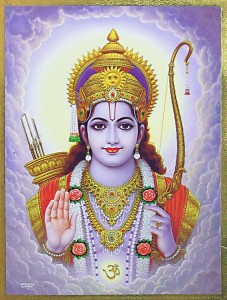
...‘Rama and Rahim are one...
“I became even more inquisitive. The Muslim footman Golam Khan used to guard the treasury. Once in response to my questions, he said, ‘God’s name is Khoda. At one time he was alone and there was no one and nothing but him. Then he took the dirt from his body and made a pancake out of it which he threw into the single ocean. The upper part of the pancake became the sky and the lower part became the earth. He then created humankind, starting with Adam and Eve. We are all the descendants of Adam and Eve.’ After hearing this myth, I asked him, ‘Who do you think Rama is?’ He said, ‘Rama and Rahim are one. That is Khoda.’ Then I learned from him about a spell which chases ghosts. Golam Khan said, ‘Ghosts are the descendants of Satan. They are afraid of the name of Rahim.’ These teachings gave me great pleasure.
“My maternal uncle Parashurama Mustaufi was studying law at that time. At first, he had some faith in God, but later dismissed the idea. While he was a believer, my other uncles Raghu and Nashu were his followers. When he stopped believing in the personal god, he started calling Rama Mohana Raya his guru. I was very troubled because, being just an ignorant child, I was uncomfortable having a difference of opinion with him. Uncle Parashurama said, ‘Everything in the world is a product of natural forces. There is no such thing as a God outside of nature.’ When I heard this, I went to see some Bhattacharya in his school and asked him to respond to it. His answers caused me to become more confused. Though I was confused, I never gave up chanting the name of Rama.”
From all these stories, we can draw the lesson that rather than entering into the confusing business of establishing exact doctrines of the relation of the divine and the creation, one should chant the Holy Name with faith. At one point, Mahaprabhu also bound his books in their cloth wrappers and told his students to simply chant the Holy Name. Dogmatic truths will all be revealed through the Holy Name. Dogmatic spiritual truth is not arrived at through mental speculation; one is bound to arrive at a mistaken conception of God.
Kedaranatha’s marriage
When Srila Bhaktivinoda Thakur was only eleven years old, his father died. According to the custom prevalent at that time, Kedaranatha’s mother arranged for her twelve-year-old son to be married to a five-year-old from nearby Ranaghat. Srila Bhaktivinoda Thakur has the following to say about his marriage: “It was just like a doll’s play-marriage. Because I would not be able to stay alone at my in-laws’ house, my parents sent my nanny to accompany me.” Though the Thakur had direct perception of human entanglement, he did nothing to protest the defects of the marriage system of the period.
Studies
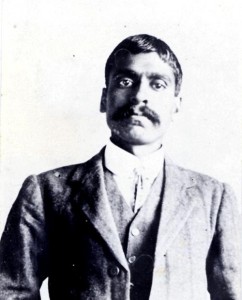
Bhaktivinoda Thakur - student years.
At six years of age, Kedaranatha went to study Sanskrit at the Tola of Vidyavacaspati. Then at the age of seven, his grandfather sent him to study at Krishnagar College. At that time, the college principal’s name was Captain D. L. Richardson and the principle native professor was Ramtanu Lahiri. The next year, an English-language school was established in Ula in which Kedaranatha was enrolled. While studying at Krishnagar College, one of his fellow students was the King of Koochbihar, who was still a child.
When his maternal grandfather died, he and his mother came to live in Calcutta at the family home at the corner of Beadon Street and Hedua in Bhawanipur. He recommenced his studies at the Hindu Charitable Trust School. After four years there, he was admitted to the Hindu School in 1856.
Srila Bhaktivinoda Thakur was one of Ishvaracandra Vidyasagara’s first students, whom he held in great affection. One day, Bhaktivinoda visited the great scholar in his house in Calcutta. Vidyasagara Mahashaya said to him, “Since none of us has ever seen God, it is best that we not talk about him.” Though he was his student, Bhaktivinoda Thakur did not refrain from speaking the truth to the venerated teacher. He asked, “Pandit Mahashaya, why then did you write in your [children’s] book Bodhodaya that God is formless and pure consciousness. If you haven’t seen God, then why have you written this about him? God is omnipotent. Don’t you think that if he can do anything, that he has the power to maintain a form? The Supreme Lord is my eternal master, and I am his eternal servant. The natural affection that we have for the Supreme Lord is called bhakti, brahma-vidya or para-vidya in the Veda. This is real knowledge, the realization of which means that there is no shortage of any knowledge.”
Those who are always engaged in a direct relationship with the absolute truth, the Supreme Lord, are immediately able to recognize any statement which goes contrary to the spiritual truth. There is a complete difference between knowledge which has been garnered from the reading of books and the knowledge which arises from the epiphany of the self-effulgent truth.
Calcutta University was founded in 1856 and entrance exams held for the first time. Amongst Srila Bhaktivinoda Thakur’s fellow students were Satyendranath and Ganendranath Tagore, Tarak Nath Palit and Naragopal Mitra. Principal Clint, Reverend Duff, George Thompson, and Keshab Chandra Sen were attracted by the young man’s mastery of the English language and literature. Toward the end of 1856, Kedaranatha published an English poem, The Poriade, which was well-received in educated circles in Calcutta. All the Thakur’s English poems were published in the paper, Library (Literary) Gazette. He delivered a lecture to the British Indian Society in 1856 on the evolution of matter which was much applauded.
He considered Christianity superior to the Brahma religion because of its acceptance of God’s eternal personality.
During this time, the Thakur also studied the Brahma Dharma, Christianity, the Bible and Qur’an and many other religious traditions and books. He considered Christianity superior to the Brahma religion because of its acceptance of God’s eternal personality. In 1857, the Sepoy Mutiny broke out. Kedaranatha spent some of this time traveling and lecturing.
The prediction of grandfather Krishnavallabha
In 1858, Kedaranatha went to Nilachala. On the way back to Calcutta, he stopped at Chutigram, where his grandfather Krishnavallabha Datta was living. His grandfather said prophetically that Kedaranatha would be a great Vaishnava. Immediately upon making this prediction, his life airs passed out through the top of his head. Kedaranatha remained there for a few more days before continuing through Cuttack, Bhadrak, and Midnapor to Calcutta.
The title 'Bhaktivinoda'
On Ishvara Candra Vidyasagara’s recommendation, Kedaranatha Datta took a job teaching at the Cuttack Government Secondary School and shortly thereafter, the headmaster’s position at a school in Bhadrak in 1860. During this time, he wrote a book on the various religious institutions of Orissa, Maths of Orissa, which Sir William Hunter made much use of as a reference work in his Orissa. He also wrote a work named Shri-Caitanya-Gita under the pen name Saccidananda Premalankara. He was given the title Bhaktivinoda by the Sri Gaudiya Goswami Sangha on the 400th anniversary of Mahaprabhu’s appearance (1885). From this time on, Kedaranatha Datta was known in Vaishnava society as Sri Saccidananda Bhaktivinoda Thakur.
Travels and Preaching
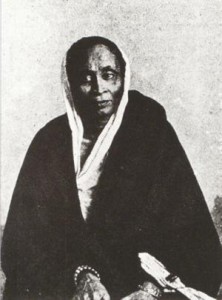
Bhagavati Devi - second wife of Bhaktivinoda Thakur.
The Thakur also taught at a school in Midnapore. One day a follower of the Brahmo religion, Rama Narayan Basu, heard him speak at literary society meeting on the truth of religion and was deeply affected. During his time in Midnapor, the Thakur’s first wife died and he married for a second time, to Bhagavati Devi. From Midnapore, he went to Burdwan to preach. While there, he published an English book, Our Wants, in 1863. He was involved in the arguments between the Brahmo Samaj and Christians and tried to mediate between the two religions. In two lectures he showed the problems with both groups’ positions. While in Burdwan, he started a group called the Bhratri-samaja. At one of the meetings of this group, he gave a learned speech on the soul which attracted the attention of a certain Mr. Heiley.
From Burdwan, the Thakur went to Chuadanga and Ranaghat before going to live temporarily in Chapra in Bihar. While living there, he made his first visit to Vrindavan, traveling by train through Kashi, Mirzapur, Prayag, Agra, etc. While in Chapra, the Thakur studied Urdu and Persian and mastered these languages. He also gave a speech on Gautama while there.
From Chapra, he went to Purniya and then, in 1868, to Dinajpur where he was engaged as Deputy Magistrate. In Dinajpur, he found that there was a dispute between Hindus and Brahmos in which he intervened, giving a speech on the Bhagavat: Its Philosophy, Its Ethics and Its Theology.
In June of 1868, he visited Rupa and Sanatan’s home in Ramakeli as well as Rajmahal, etc. Thereafter he returned to Calcutta, where he undertook research to find copies of Chaitanya-charitamrita and Srimad Bhagavatam. After much work, he finally found copies at the Bata Tala publishing house. With these valuable editions, he went to Purushottam Dhama. He was engaged as a director of the temple to oversee its management. He lived in Puri continuously for over five years, from 1869-1874.
Punishing Bishikishana for deception
In Srila Bhaktivinoda Thakur’s life we find that he personified the description of a Vaishnava as one who is more gentle than a rose, yet more terrible than the thunderbolt. Although he was generally kind and sympathetic, he gave no quarter to dishonesty in the name of religion. One event in his life which took place while he was in Orissa is an indication of this. In 1871, a member of the Khandait caste and the Atibarii sect named Bishakishana who had gained some mystic powers through yogic practices proclaimed himself to be an incarnation of Mahavishnu.
He was staying with his acolyt saj/p/pnbsp;In Srila Bhaktivinoda Thak urjana-toshani-patri sarva-samadritape sajjana-toshani-patri sarva-samadritap s at the edge of the jungle near the tow sajjana-toshani-patri sarva-samadritapn of Bhuvaneshvara. He announced that on the 14th of Chaitra, he would reveal a four-armed form and destroy all the foreigners, restoring the true religion. His announcement was written in Orissan verse:
banere achi bishakishana
guptare achi na janani ana
tera minare arambhiba rana,
caturbhuja hoi nashiba mleccha-gana
In the forest am I hiding and no one else knows me. But on the 13th of Mina I will begin the war. Taking on a four-armed form, I will destroy the Mlecchas.
Through his mystic powers, he had been able to cure incurable diseases and these powers had won for him a large following. One day he announced that on the f ull-moon day he would perform the rasa-lila and invited the girls of a nearby village to come and join him. The Chaudhuris of the Bhringara clan found that he had polluted their womenfolk and went to complain en masse to the district commissioner, Ravenshaw. The Commissioner gave the task of investigating the matter to Bhaktivinoda Thakur, who went personally into the jungle to meet with Bishakishana. Bishakishana told Bhaktivinoda that he was the living Mahavishnu and that Jagannath Deva was nothing but a lifeless wooden statue. He tried in various ways to flatter the Thakur and to win him over. When he saw that Bishakishana had no intention of stopping his efforts to deceive the people, Bhaktivinoda had him arrested and brought back to Puri.
The Thakur proceeded to investigate the background of Bishakishana by going to many villages and Buddhist viharas in the Khandagiri area of Puri district. After accumulating a mass of evidence showing the extent to which this yogi was cheating people, he had him brought to court. While the case was being heard, the yogi used his mystic power to cause Bhaktivinoda and his family to be attacked by various illnesses, in an effort to intimidate him, but without success. The Thakur was determined to see Bishakishana punished for conspiracy to rebellion and gave him a sentence of one and a half years. Bishakishana went for 21 days without food or drink and then left his body.
In the months which followed, another rascal in Jajpur proclaimed himself to be the incarnation of Brahma, while someone else in Khurda said that he was a manifestation of Balaram. Bhaktivinoda Thakur quickly thwarted their efforts to cheat the populace.
Other activities of the Thakur in Puri
While living in Puri, Srila Bhaktivinoda Thakur took the opportunity to study the Bhagavat, the Six Sandarbhas of Jiva Goswami, the Govinda-bhashya, Siddhanta-ratnam, Prameya-ratnavali, etc., of Baladeva Vidyabhushana. He also studied Rupa Goswami’s Bhakti-rasamrita-sindhu in great detail. By making a display of intense study, he demonstrated the necessity of cultivating an understanding of the scriptures in order to learn the truths about pure devotion contained therein. Mahaprabhu indicated that one of the five principle limbs of devotional service is hearing the Bhagavat. Jiva Goswami indicated that this is the best of all devotional activities. In order to proclaim this same truth, Srila Bhaktivinoda Thakur founded a regular group for discussion of the Bhagavat, Bhagavata Samsat which was held in the Jagannath-vallabha gardens in Puri.
Many of the leading Vaishnavas in Puri such as Nityananda Das, Paramananda Das, Narayan Das Mahanta, Harihara Das Mahanta of Uttara Parshva were attracted to hearing the Bhagavat from his lips. Just as Mahaprabhu performed the pastime of hearing Bhagavat from Srila Gadadhara Pandit Goswami, Srila Bhaktivinoda Thakur also listened to discourses given by Sri Gopinath Pandit. A certain renounced Vaishnava, Raghunath Das Babaji of Hati Akharia, objected to the Thakur’s speaking on Bhagavat and was attacked by disease. After Jagannath appeared to him in a dream and ordered him, he went and begged Srila Bhaktivinoda Thakur for forgiveness, after which he was cured.
When the Thakur went to the Jagannath Temple, he did not sit in the so-called Mukti-mandapa, where Mayavadi scholars discussed their philosophy. He would sit by the Lakshmi temple where Mahaprabhu’s footprints are enshrined and discussed devotional doctrines there. Many of the Mayavadis were attracted by his discourses and soon the place became known as the Bhakti-mandapa or the Bhakti-prangana.
During this time, Srila Bhaktivinoda Thakur studied Krishnadas Kaviraj Goswami’s Chaitanya Charitamrita, Narahari Chakravarti’s Bhakti-ratnakara, but he did not accept Jayananda’s Chaitanya-mangala as being authoritative. He associated with a siddha Vaishnava named Svarupa Das Babaji, discussing scripture with him. He also wrote the Sanskrit work, Datta-kaustubha and began writing the Sanskrit verses of Shri-Krishna-samhita.
The birth of Bhaktisiddhanta Saraswati
A wealthy family in Puri had leased land along the Grand Road from the Dakshina Parshva Math and build a house on it. Srila Bhaktivinoda Thakur and his family resided in this building, which is not far from the Jagannath temple, next to the Narayan Chata. This house was reclaimed in 1974 by His Grace Bhakti Dayita Madhava Goswami Maharaj and now houses a Chaitanya Gaudiya Math with a beautiful temple building.
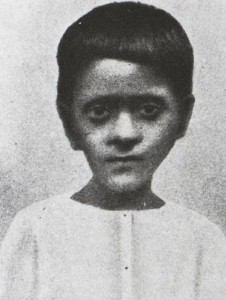
Bimal Prasad.
At 3:30 on Friday, February 6, 1874, on the Krishna-païcami of Magh month, an effulgent and beautiful child was born to Bhagavati Devi in this home, while the Thakur and other family members sang the names of the Lord. Everyone was amazed to see that the child’s umbilical cord was wrapped around his body like a sacred thread. He was named after the divine energy of Jagannath Deva, Vimala Devi, as Bimala Prasad (Vimala-prasada). His first solid food was Jagannath’s maha prasad. When he grew up, this child became the founder of the Chaitanya Math and the worldwide Gaudiya Maths, Srila Bhaktisiddhanta Saraswati Goswami Thakur Prabhupada.
Srila Bhaktivinoda Thakur was Jagannath Deva’s own man. It was by his arrangement that he was brought to Puri and put in charge of the Temple’s management. After the birth of Srila Bhaktisiddhanta Saraswati Goswami Thakur, the preaching of Mahaprabhu’s message spread over the entire planet. This gave meaning to the words written by Vyasadeva in the Padma-Purana, hy utkale purushottamat, “out of Purushottam in Orissa.” Ten months after the child’s birth, Bhaktivinoda Thakur returned to Bengal with his family, this time going to Ranaghat. They traveled overland by palanquin.
Bhaktivinoda’s unequalled contribution
Vedavyasa and the scriptures he wrote are the foundation of all those who claim to follow the Sanatan Dharma. He himself practiced and preached the means by which humankind can attain the supreme peace. Vedavyasa compiled and divided the Veda, wrote the eighteen Puranas and the Mahabharata including the Bhagavad-gita, but remained unsatisfied. Finally, while at Badarikashrama, Narada Muni instructed him to glorify the activities of Sri Krishna in order to attain his pleasure. After writing the twelve cantos of the Srimad Bhagavatam, Vedavyasa finally found the peace he had been looking for. Mahaprabhu Sri Chaitanya preached the Bhagavat religion which is found in this text. After the disappearance of Mahaprabhu and his associates, however, the path of pure devotion became covered with thorns until Bhaktivinoda Thakur appeared to write many books and to preach the pure doctrine of devotional service to Krishna. Through his tireless efforts, all the heretical doctrines were shown to be empty, the path of supreme auspiciousness and compassion was shown to all the world. These efforts can only be said to constitute an unequalled and certainly unsurpassed contribution. Without being empowered by Krishna himself, the message of pure devotion cannot be spread. Such a display of empowerment could not be possible were he not a direct associate of Gauranga Mahaprabhu, Sri Krishna.
Externally he was a householder with family obligations, a government servant engaged in the administrative service, but despite these responsibilities he was still able to write over a hundred books in several different languages. One cannot fail to be impressed by this monumental achievement. Every word of his writing is scripture; every word awakens the spirit of devotion to him who is beyond the grasp of the material senses and mind. Mundane scholars would never be able to achieve the kind of synthesis that he did. His every thought was perfectly reasonable and never far-fetched. His writings are a permanent display of compassion to the fallen souls. His Grace Bhakti Dayita Madhava Maharaj used to say to his disciples, “You need do nothing else other than translate Bhaktivinoda Thakur’s books into the world’s various languages and you will have done the greatest act of welfare for the people of the world.” In fact, everything that is done in the Gaudiya Maths throughout the world has come from Srila Bhaktivinoda Thakur.
Bhaktivinoda’s travels and preaching activities
After the birth of Srila Bhaktisiddhanta Saraswati Goswami Thakur, Srila Bhaktivinoda Thakur returned to Bengal. From then on he engaged in preaching the doctrine of pure devotional service, traveling throughout India. We will give a brief summary here of all the places he visited during the period between 1877 and 1910, whether for the sake of pilgrimage or for preaching. He went to Amta in the Uluberiiya subdivision, to Abhiram Thakur’s Shripata in Khanakula Krishnanagara, Shyamapura, Bhadrak in Orissa, Nariail in Jessore district, Calcutta, Prayag, Vrindavan (where he met Jagannath Das Babaji for the first time), Sri Radha Kund, Sri Govardhana (where he broke up the Kaijhara gang of dacoits who were harassing pilgrims to the Dhama), Mathura, Lucknow, Faiyedabad, Goptara Ghat, Ayodhya and Benares.
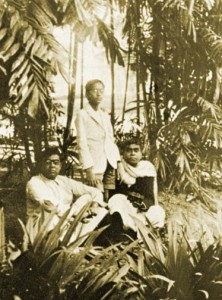
Srila Bhaktivinod Thakur in Mayapur.
He then returned to Calcutta where in 1882 he started construction on Bhakti Bhavana at 181 Maniktola Street. While digging the foundations for the building, a murti of Kurmadeva was found. Srila Bhaktivinoda Thakur gave this deity to Srila Bhaktisiddhanta Saraswati Goswami Thakur and taught him how to worship it. He also visited Mayapur for the first time.
He was engaged as Deputy Collector in the Barasat subdivision. Then he was transferred to Shriramapura (1884) Vaidyanatha, Bakipura, and Gaya, where he saw the steps on Pretashila constructed by his great-grandfather, Madana Mohana Datta. He returned to Nariail, Barasat, Memari, Kulinagrama, Byandel, and Saptagram. In Kulinagrama he lectured on the Holy Name, distinguishing between the pure name, namabhasa and namaparadha. There he also gave Srila Bhaktisiddhanta Saraswati Goswami Thakur initiation in the Holy Name and the Nrisingha mantra.
In Calcutta in 1885, he established the Chaitanya-yantra printing press. In 1886, he helped establish the Vishva-Vaishnava-sabha at the Durga Mandapa of Rama Gopal Basu in Krishnasimhera Gali off Bethune Road. There he gave lectures on Chaitanya Charitamrita and Bhakti-rasamrita-sindhu. He met Ramakrishna Paramahamsa at this time and countered his impersonal philosophy and described the truth of pure devotion to him.
Discovery of Mahaprabhu’s birthplace
In 1887, he visited the most important Shiva-linga in Bengal at Tarakeshvara where Shiva appeared to him in a dream and said, “You want to go to Vrindavan, but there is much work left to do in Nabadwip Dhama nearby. What have you done there?” Later that year, he was transferred to Krishnanagara. Then, while visiting Kuliya, the modern city of Nabadwip, he was standing on the roof of the Ranira Dharmashala overlooking the Ganges. At about ten o’clock at night, he saw an illuminated building on the other side of the river. His son Kamala Prasada who was there with him also saw this light. On inquiry, they learned that this place was Ballaladighi. When he made inquiries from the elderly residents of Ballaladighi, they told him that this was the birthplace of Chaitanya Mahaprabhu.
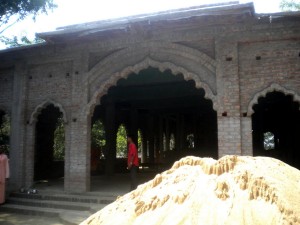
Surabhi Kunj, Navadwipa Dham.
Srila Bhaktivinoda Thakur continued to research old maps and documents and was able to establish conclusively that Mahaprabhu’s birthplace was indeed there.
He continued to maintain his Calcutta home where he installed a Giradhari Shila given him by Jagannath Das Babaji, but in 1888 purchased the property in Godrumadvipa known as Surabhi Kunja. While working at Krishnanagara he was also able to visit his birthplace at Ula.
In 1889, he was transferred to East Bengal in the Netrakona subdivision in Mymensingh District, whence he visited Narayan Gaij, Mymensingh city, the Garo Hills where he blessed the people of the Hajong tribe, and Gowalanda. Though he was able to visit Calcutta during this period, he was soon transferred to Tangail and then to Burdwan. He visited Shantipur, Kalna, Baghna Para, Kaigram, and Denur, the site of Vrindavan Das Thakur’s Shripata. During this time he visited Kuliya again where he met Jagannath Das Babaji at his bhajana-kutira. He had a concrete veranda built on this occasion (May, 1890). While in Burdwan, he also performed kirtan with the devotees of Amlajora village and visited Gopalpura, Raniganj and Barakara.
In 1890, Srila Bhaktivinoda Thakur was again transferred to Raniganj in East Bengal and then back to Dinajpur in 1891. When he visited Calcutta, he met Shishira Kumara Ghosh who considered him a guru, even calling him “the seventh Goswami”. Shishira Kumara Ghosh would come regularly to visit him at Bhakti Bhavan and at the Thakur’s direction, started chanting japa and wearing a tulasi mala around his neck. He was not able to accept the principles of Vaishnava behavior in their entirety, however.
During this period Bhaktivinoda also visited Midnapore (Medinipura), where he preached to Sitanatha Mahapatra and other devotees, Ghatal in Midnapore district and Kayapata Badana Gaij in Hooghly district. From there he returned to Krishnanagar, staying once again in Surabhi Kunja. He arranged for some large assemblies to be called in Krishnanagara at which he spoke. Messrs, Mulrow, Revelshaw, and Butler were regular attendants.
At Amaljora on March 9, 1892, he participated in a Harivasara program at which Jagannath Das Babaji was present. From there he traveled to Vrindavan, stopping at Baksar (Bihar) and Prayag. He was in Vraja from March 21 to 29, during which time he managed to visit Bilvavana, Bhandiravana, Mathavana, Manasarovara, Mathura, Gokula, Madhuvana, Talavana, Kumudavana, Bahulavana, Radhakunda, Govardhana, etc. He then returned to Calcutta via Kanpur and Allahabad.
In Calcutta, he once again engaged in preaching the message of Sri Chaitanya Mahaprabhu at Bhakti Bhavana, as well as continuing to hold assemblies at Krishnanagara. In Magh 1399 (February, 1893), he held a kirtan festival at Godrumadvipa at which Jagannath Das Babaji was the guest of honor. Later that spring, on the 20th of Phalguna (March, 1893), Jagannath Das indicated the exact spot where Mahaprabhu had first appeared in this world.
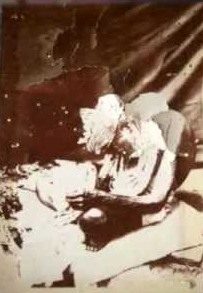
Jagannath Das Babaji Maharaj.
At this time, the Thakur had an argument with a certain member of a Goswami family who held that one of Mahaprabhu’s closest associates was a Shudra. Srila Bhaktivinoda Thakur was very displeased when he heard this and warned him with the words:
aishnava-caritra, sarvada pavitra, jei ninde himsa kari
bhakativinoda, na sambhashe tare, thake sada mauna dhari
The character of a Vaishnava is always spotless. Bhaktivinoda will not talk to anyone who criticizes a Vaishnava out of spite, but always remains silent. Also at about this time, Srila Bhaktivinoda Thakur wrote down his guru-parampara and hung it on the outside of Bhakti Bhavan.
In January of 1894, Srila Bhaktivinoda Thakur held another large meeting at the A.V. School in Krishnanagara. At this meeting it was decided that Deities should be installed at Mahaprabhu’s birthplace. At the same time, the Nabadwip Pracarini Sabha was formed to preach the newly discovered birthsite. Nafar Chandra Pal Bhaktibhushana, the zamindar of Natudaha in Nadia district, was elected executive secretary of the of the Sabha. Dvarika Babu, Nafar Babu, and other members of the Sabha decided that a thatched cottage would be constructed on the site would house Deities of Gaura and Vishnupriya. These Deities were consecrated on Friday, March 21, 1894 (Chaitra 9, 1300 Bengali), on the Phalguni Purnima, in the midst of a rousing kirtan during a lunar eclipse. For the maintenance of the Deities, a committee was formed (Sri Mayapur Seva Samiti) which had many distinguished Vaishnavas as its members, including Shyamalal Goswami, Shashibhushana Goswami, Radhikanatha Goswami, Vipina Vihari Goswami, Mahamahopadhyaya Pandit Ajitanatha Nyayaratna, Mahendranatha Bhattacharya Vidyaranya, Satyajivana Lahirii, Raja Vanamali Raya Bahadura or Tariasa in Pabna district, Shishira Kumara Ghosh, Matilal a Ghosh, Yatindranatha Chaudhuri, Mahendranatha Majumdara, the advocate Kishorilala Sarkara, Nalinaksha Datta, Kanailala De Bahadura, Deputy Magistrate Navina Candra Sena, and Jagaccandra Raya.
Bhaktivinoda spends some time in Puri
On October 4, 1894, Srila Bhaktivinoda Thakur retired from government service and came to live permanently in Surabhi Kuija in Godrumadvipa where he once again gave discourses on the Vaishnava scriptures. Some time after the disappearance of Jagannath Das Babaji in February of 1896, he accepted the invitation of the independent Raja of Tiperrah (Tripura), Birchandra Devavarma Manikya Bahadura, to go to Agartola. He went there with Bhaktisiddhanta Saraswati in July 1896 and gave discourses on pure devotional service which enchanted the Raja. Later in the same year, he took Bhaktisiddhanta Saraswati to Kashiyang, then in 1898 to Benares and Prayag.
In 1899, Srila Bhaktivinoda Thakur purchased the property on which Svananda Sukhada Kuija would be built. When the building was finished, he came to perform his bhajana there. Gaura Kishora Das Babaji would come there to hear the Thakur’s Bhagavat lectures and it was here that Srila Bhaktisiddhanta Saraswati Goswami Thakur first met him. In 1900, Bhaktivinoda Thakur traveled with Bhaktisiddhanta through Baleshvara, Remuna, Bhuvaneshvara, and Sakshi Gopal to Puri. Srila Bhaktisiddhanta Saraswati Goswami Thakur displayed a deep desire to engage in bhajana by the beach near Hari Das Thakur’s samadhi and his father arranged with Puri’s sub-registrar, Jagabandhu Pattanayaka, for him to be given the service of the Giridhari asana at the Satasana Math. In March of 1901, they came to Puri again and in 1902 the construction of Bhakti-Kuti was begun. At this time the Raja of Cossimbazar, Manindra Candra Nandi took instruction in devotional service from the Thakur.
In 1903, Bhaktisiddhanta Saraswati regularly read and gave discourses on Chaitanya Charitamrita to the Thakur at Bhakti Kuti. The famous Radha ramana Carana Das Babaji came to visit Bhaktivinoda Thakur during this time and they discussed devotional doctrines. Srila Bhaktisiddhanta Saraswati Goswami Thakur found Carana Das’s activities and dogmas to be heterodox and showed how by reference to the scriptures. Later, after Srila Bhaktivinoda Thakur had returned to Nabadwip, Carana Das indicated his desire to participate in the Nabadwip-parikrama that the Thakur had inaugurated, but unfortunately left his body before he was able to do so.
The Thakur returns to Godrumadvipa
In 1906, Srila Bhaktivinoda Thakur gave a lengthy discourse on Mahaprabhu’s teachings at the house of zamindar Yatindranatha Raya Chaudhuri in Taki. On February 26, 1906, the Thakur came to Calcutta again and from there to Svarupa Gaij in Godrumadvipa where he engaged in his devotional activities at Svananda-sukhada-kuïja. While there, a certain Tarakabrahma Goswami of Jessore came to him and asked him to accept the service of his Radha Madhava deities for Mahaprabhu’s birthplace. Tarakabrahma Goswami also began to live there with his wife and family, but after a short time it became clear that his behavior was at odds with the standards expected of them and they were obliged to leave. On April 29, 1906, however, the Shri Dhama Pracarini Sabha decided to award an annual stipend of 500 rupees to the temple for the service of Sri Sri Radha Madhava.
In 1908, Srila Bhaktivinoda Thakur took the dress of a renounced Vaishnava, that of a Bhagavata-paramahamsa, in order to dedicate his life to the full relishing the sacred nectar of Radha and Govinda’s intimate pastimes.
On March 25, 1910, which was Phalguni Purnima, Bhakti Pradipa Tirtha, at that time still a householder, visited Bhaktivinoda Thakur at Mayapur and five days later was given initiation by him at Godrumadvipa. Another disciple, Krishna Das Babaji, was living at Svananda-sukhada-kuïja at that time.
Srila Bhaktivinoda Thakur preached that the rules of the Daiva-varnashrama dharma should always be followed. Thus, he upheld the directives of the Sat-kriya-sara-dipika in giving the sacred thread to Jagadisa Bhaktipradipa (who after taking sannyasa from Srila Bhaktisiddhanta Saraswati Goswami Thakur became Bhaktipradipa Tirtha Maharaj), Sitanatha Mahapatra, Vasanta Kumara Ghosh, and Manmathanatha Raya.
In this connection, it is worth examining the Thakur’s following words: “The Varnashrama dharma which is current in society is distinct from the transcendental religion of exclusive devotion to Krishna. The practice of Varnashrama dharma on its own does not result in full surrender to the Lord. The ultimate instruction of the Bhagavad-gita is to discard all the principles related to the varnas and ashramas, in short, all activities based on bodily identification, and to engage in a cultivation of devotional activities based on the natural emotional constitution of the soul, which is pure and without ulterior motive. Dedicated scholars such as Raghavacari have no understanding of this glorious characteristic of Gaudiya Vaishnavism’s concept of pure devotion.”
Bhaktivinoda sends Bhaktisiddhanta to Balighai
In 1910, while still at Svananda-sukhada Kunja, Srila Bhaktivinoda Thakur was engaged in writing his Svaniyama-dvadashaka when suddenly he became extremely ill. Srila Bhaktisiddhanta Saraswati Goswami Thakur and other dear disciples and followers gathered there, afraid that he was about to enter the nitya-lila. Even in a state of extreme physical discomfort, however, his enthusiasm for preaching Lord Chaitanya’s message was unabated. Though unable to walk, he indicated a desire to be taken from place to place on horseback so that he could continue to spread the teachings of Mahaprabhu.
Three years before the Thakur’s disappearance, Srila Bhaktisiddhanta Saraswati Goswami Thakur approached his father and indicated to him that though he felt himself to be an unworthy servant, he vowed to take up the ultimate welfare work of defeating all the heterodox doctrines which went against pure devotional service. Bhaktivinoda Thakur’s was delighted to hear his son’s determination and when Gopivallabhapura’s Sri Vishvambharananda Deva Goswami invited him to participate in a conference in Balighai, Midnapore, he sent Srila Bhaktisiddhanta Saraswati Goswami Thakur and Sureshacandra Mukhopadhyaya in his place. The conference, the theme of which was to establish orthodox doctrines in certain areas of theology, took place from Sept. 8-11, 1911. Many respected and well-reputed scholars of the sampradaya were present, including Madhusudana Goswami Sarvabhauma of the Radharamana Ghera in Vrindavan.
Srila Bhaktisiddhanta Saraswati Goswami Thakur gave a talk on the distinctions between a Vaishnava and a Brahmin, demonstrating clearly a great amount of research, which left the assembly of scholars enchanted and speechless. A year later, when Madhusudana Goswami visited Srila Bhaktivinoda Thakur at the Bhakti Bhavan he enthusiastically proclaimed that Srila Bhaktisiddhanta Saraswati Goswami Thakur was his capable successor in protecting the Gaudiya sampradaya.
In 1913, Bhaktisiddhanta Saraswati wrote a commentary on the Chaitanya-caritamrita meant to accompany the Amrita-pravaha-bhashya written by Srila Bhaktivinoda Thakur. He read several passages of this Anubhashya to the Thakur, giving him indescribable pleasure.
Bhaktivinoda Thakur’s entry into the eternal pastimes
A few days before his disappearance, Srila Bhaktivinoda Thakur left Godrumadvipa to come to Bhakti Bhavan. On June 23, 1914, on the disappearance day of Gaura-shakti, Srila Gadadhara Pandit Goswami, in his Calcutta home, Srila Bhaktivinoda Thakur entered the midday pastimes of Sri Sri Radha and Govinda at Radha Kund. Six years later, the worshipable Mata Thakurani, his wife Sri Bhagavati Devi, went to join him.
Srimad-Bhaktivinoda-viraha-dashakam
(Ten verses describing the feelings of separation from Srila Bhaktivinoda Thakur written for the occasion of his disappearance day by His Grace Bhakti-rakshaka Shridhara Deva Goswami in 1936)
ha ha bhaktivinoda thakkura guro dvavimshatis te sama
dirghad-duhkha-bharad ashesha-virahad duhkhikrita bhur iyam
jivanam bahu-janma-punya-nivahakrishto mahimandale
avirbhava-kripam cakara ca bhavan shri-gaura-shaktih svayam 1
Alas! Alas! My guru Bhaktivinoda Thakur! It is now twenty-two long years that the world has been burdened with the grief of your separation. You are the personification of Sri Gauranga’s energy and you mercifully appeared in this world being attracted by many lifetimes of the living beings’ pious activities.
dino’ham cira-dushkritir na hi bhavat-padabja-dhuli-kana-
snanananda-nidhim prapanna-shubhadam labdhum samartho’bhavam
kintv audarya-gunat tavati-yashasah karunya-shaktih svayam
shri-shri-gaura-mahaprabhoh prakatita vishvam samanvagrahit 2
Being most fallen and possessing nothing but sinful activity in my past, I have not been able to attain the joyful treasure of being bathed in the dust of your lotus feet, which brings all auspiciousness to the surrendered. Even so, you are deservedly renowned for your magnanimity. You are the personification of Lord Sri Chaitanya Mahaprabhu’s compassionate powers who have appeared in this world in order to bestow upon it his divine blessings.
he deva! stavane tavakhila-gunanam te viriïcadayo
deva vyartha-manorathah kim u vayam martyadhamah kurmahe
etan no vibudhaih kadapy atishayalankara ity ucyatam
shastreshv eva na paraye’ham iti yad gitam mukundena ca 3
O Lord! The gods led by Brahma are frustrated when they endeavor to glorify your unlimited virtues. What then can low-born humans such as we accomplish? This is no rhetorical exaggeration, as some scholars may claim, for even Mukunda himself has said the same to the gopis in the Bhagavat (10.32.22).
dharmash carmagato’jïataiva satata yogash ca bhogatmako
jïane shunya-gatir japena tapasa khyati-jighamsaiva ca
dane dambhikatanuraga-bhajane dushtapacaro yada
buddhim buddhimatam bibheda hi tada dhatra bhavan preshitah 4
You were sent by the Lord when even the most intelligent people’s wisdom was ruined through religious activities which only sought bodily pleasures, through a constant state of ignorance, in yoga which had sensual enjoyment as its goal, in the idea that the goal of knowledge is the void, in the desire to destroy individual consciousness through prayer and austerity, in arrogant pride in giving charity, and from evil practices spread in the name of raganuga-bhajana.
vishve’smin kiranair yatha himakarah saïjivayan naushadhir
nakshatrani ca raïjayan nija-sudham vistarayan rajate
sac-chastrani ca toshayan budha-ganam sammodayams te tatha
nunam bhumi-tale shubhodaya iti hlado bahuh satvatam 5
Just as in this universe, the moon gives life to the world’s vegetation, revitalizes the constellations and spreads its own nectar with its rays, so too, your auspicious appearance on Earth brought satisfaction to the holy scriptures, joy to the intelligent and a great amounts of ecstasy to the Vaishnavas.
lokanam hita-kamyaya bhagavato bhakti-pracaras tvaya
granthanam racanaih satam abhimatair nanavidhair darshitah
acaryaih krita-purvam eva kila yad ramanujadyair budhaih
premambhodhi-vigrahasya bhavato mahatmya-sima na tat 6
Desiring the welfare of everyone in the world, you displayed the method of preaching devotion to the Supreme Lord through writing a variety of books which were appreciated by the saintly. The glorious achievements of all the previous acharyas such as Ramanuja, etc., cannot match yours, for you are the embodiment of the ocean of prema.
yad-dhamnah khalu dhama caiva nigame brahmeti samjïayate
yasyamshasya kalaiva duhkha-nikarair yogeshvarair mrigyate
vaikunthe para-mukta-bhringa-carano narayano yah svayam
tasyamshi bhagavan svayam rasa-vapuh krishno bhavan tat-pradah 7
You came to give the Supreme Person Krishna himself, whose body is the form of sacred rapture, the effulgence of whose abode is known in the Veda as Brahman, whose mere partial expansion is the goal of the great yogis’ austere practices, who is the source of Narayan himself, whose lotus feet are surrounded by the most advanced, bee-like liberated souls in Vaikuntha.
sarvacintya-maye paratpara-pure goloka-vrindavane
cil-lila-rasa-rangini parivrita sa radhika shri-hareh
vatsalyadirasaish ca sevita-tanor madhurya-seva-sukham
nityam yatra mada tanoti hi bhavan tad-dhama-seva-pradpah 8
You bestowed service to the completely inconceivable divine abode of Goloka Vrindavan, which lies beyond the other spiritual worlds, where Radha, surrounded by hernbsp;In the forest am I hiding and no one else knows me. But on the 13th of Mina I will begin the war. Taking on a four-armed form, I will destroy the Mlecchas. rsquo;s concept of pure devotion. sakhis, whose pleasure is in the transcendental nectar of the spiritual pastimes, joyfully constantly serves in the erotic mood Sri Hari who is worshiped in the moods of parenthood, etc.
shri-gauranumatam Svarupa-viditam rupagrajenadritam
rupadyaih pariveshitam raghu-ganair asvaditam sevitam
jivadyair abhirakshitam shuka-shiva-brahmadi-sammanitam
shri-radha-pada-sevanamritam aho tad datum isho bhavan 9
You are perfectly competent to give the nectar of service to Sri Radha’s feet, which was approved by Gauranga Mahaprabhu, which was understood by Svarupa Damodar, adorped by Sanatan Goswami, distributed by Sri Rupa Goswami, relished and enjoyed by Raghunath and the rest of Sri Rupa’s followers, and which is respected by Suka, Shiva and Brahma, etc.,
kvaham manda-matis tv ativa patitah kva tvam jagat-pavanah
bho svamin kripayaparadha-nicayo nunam tvaya kshamyatam
yace’ham karuna-nidhe varam imam padabja-mule bhavat-
sarvasvavadhi-radhika-dayita-dasanam gane ganyatam 10
I am a wicked-minded fallen soul, so far from you who purify the entire universe. O Master! Please forgive me all my offenses out of your great compassion. I beg you, O ocean of mercy, to grant me this boon thatp In 1889, he was transferred to East Bengal in the Netrakona subdivision in Mymensingh District, whence he visited Narayan Gaij, Mymensingh city, the Garo Hills where he blessed the people of the Hajong tribe, and Gowalanda. Though he rsquo;s birthplacewas able to visit Calcutta during this period, he was soopn transferred to Tangail and then to Burdwan. He visited Shantipur, Kalna, Baghna Para, Kaigram, and Denur, the site of Vrindavan Das Thakur I be included amongst the followers of Srila Bhaktisiddhanta Saraswati Goswami Thakur, for whom your lotus feet are everything.
Srimad-Bhaktivinoda-dashakam
(This poem appeared in the Gaudiya magazine, July 1939, 7.47)
amanda-karunya-gunakara shri-
caitanya-devasya dayavatarah
sa gaura-shaktir bhavita punah kim
padam drishor bhakti-vinoda-devah 1 dharmash carmagato sarvacintya-maye paratpara-pure goloka-vrindavane
O ocean of unlimited compassion, you are the incarnation of Chaitanya Deva’s mercy. You are the energy of Gauranga. O Lord Bhaktivinoda, when will you again be visible to me? 1
shrimaj-Jagannath-prabhu-priyo ya
ekatmako gaura-kishorakena
shri-gaura-karunya-mayo bhavet kim
nityam smritau bhakti-vinoda-devah 2
When will Bhaktivinoda Prabhu, the embodiment of Mahaprabhu’s ble nakshatrani ca rassings, remain fixed in my memory? He is dear to Jagannath Prabhu and is not different from Gaura Kishora Das Babaji.
shri-nama-cintamani-sampracarair
adarsham acaravidhau dadhau yah
sa jagarukah smriti- mandire kim
nityam bhaved bhakti-vinoda-devah 3
When will Bhaktivinoda Prabhu, who gave the example how to act by preaching the jewel of the Holy Name, remain alive in the temple of my memory?
namaparadhai rahitasya n/p lokanam hita-kamyaya bhagavato bhakti-pracaras tvaya amno
mahatmya-jatam prakatam vidhaya
jive dayalur bhavita smritau kim
kritasano bhakti-vinoda-devah 4
When will Bhaktivinoda Prabhu, most merciful to all living beings, take his place in my mind after revealing the glories of the Holy Name, void of any offenses?
gaurasya gudha-prakatalayasya
sato’sato harsha-kunatyayosh ca
prakashako gaurajano bhavet kim
smrityaspadam
bhakti-vinoda-devah 5
When will Irsquo;s determination and when Gopivallabhapura/strong remember Bhaktivinoda Prabhpu, the member of Gauranga’s entourage who revealed his hidden birthplace, to the joy of the saintly and the envious reaction of the wicked?
nirasya vighnan iha bhakti-ganga-
pravahanenoddhrita-sarvalokah
bhagiratho nitya-dhiyam padam kim
bhaved asau bhakti-vinoda-devah 6
Like King Bhagiratha, he saved the entire world by destroying all impediments and allowing the Ganga of pure devotion to flow. When will Bhaktivinoda Prabhu be the permanent object of my meditation?
vishveshu caitanya-katha-pracari
mahatmya-shamsi guru-vaishnavanam
nama-grahadarsha iha smritah kim
citte bhaved bhakti-vinoda-devah 7
When will I remember Bhaktivinoda Prabhu, who preached the message of Chaitanya Mahaprabhu throughout the world, who glorified the guru and the Vaishnavas and who set the example for chanting the Holy Name.
prayojanam sann abhidheya-bhakti-
siddhanta-vanya samam atra gaura-
kishora-sambandha-yuto bhavet kim
cittam gato bhakti-vinoda-devah 8
When will Bhaktivinoda Prabhu, himself the representative of the proyojana-tattva, appear in my mind, accompanied by Gaura Kishora Das Babaji, the personification of the sambandha-tattva, and by Bhaktisiddhanta Saraswati, the incarnation of the abhidheya-tattva. [bhakti-vinoda or taking delight in devotional service is the ultimate goal of prema, sambandha is the relationship with Mahaprabhu (Gaura-kishora) and the devotional processes established by the doctrine, or bhakti-siddhanta are the abhidheya-tattva.]
shikshamritam sajjana-toshanim ca
cintamanim catra sajaiva-dharmam
prakashya caitanya-prado bhavet kim
citte dhrito bhakti-vinoda-devah 9
When will Bhaktivino/p/pda Prabhu, who made people conscious of Sri Chaitanya Mahaprabhu through his publications Chaitanya-shikshamrita, Sajjana-toshani, Harinama-cintamani, and Jaiva Dharma, be held constantly in my mind.
ashadha-darshe’hani gaura-shakti-
gadadharabhinna-tanur jahau yah
prapaïca-lilam iha no bhavet kim
drishyah punar bhakti-vinoda-devah 10
When will Bhaktivinoda Prabhu appear to us again? Being non-different from Gaura-shakti Gadadhara Pandit, he left the material world on the same day as he, the dark-moon-day of Asharha month.
Sri Godrumacandra-bhajanopadesha
(“Instructions to worship the Moon of Godruma”. These verses were published posthumously for the first time in 1950 in Gaudiya magazine, 18.47-8 (pp. 757-8)
yadi te hari-pada-saroja-sudha-
rasa-pana-param hridayam satatam
parihritya griham kali-bhava-mayam
bhaja godruma-kanana-kuïja-vidhum 1
If your heart wishes to always drink the nectar of Hari’s lotus feet, then abandon your home which is filled with the spirit of Kali and worship the moon of Godruma’s forest bowers.
dhana-yauvana-jivana-rajya-sukham
Nahi nityam anukshana-nasha-param
tyaja gramya-katha-sakalam viphalam
bhaja godruma-kanana-kuïja-vidhum 2
All your joys from wealth, youth, life and power are all temporary and susceptible to destruction at any moment. Give up all your useless mundane discourses and worship the moon of Godruma’s forest bowers.
ramani-jana-sanga-sukham ca sakhe
carame bhayadam purushartha-haram
hari-nama-sudha-rasa-matta-matir
bhaja godruma-kanana-kuïja-vidhum 3
O friend! The joys of intercourse with beautiful women are ultimately a source of fear, for they prevent the achievement of life’s goals. Become intoxicated with the nectar of the Holy Names and worship the moon of Godruma’s forest bowers.
jada-kavya-raso nahi kavya-rasah
kali-pavana-gaura-raso hi rasah
alam any-kathady-anushilanaya
bhaja godruma-kanana-kuïja-vidhum 4
The relishing of poetic sentiments is not the sacred rapture of devotional poetry. Real sacred rapture is found in the sentiments connected to the purifier of the age of Kali, Gaura. Give up the study of all other subjects and worship the moon of Godruma’s forest bowers.
vrishabhanu-sutanvita-vama-tanum
yamuna-tata-nagara-nanda-sutam
murali-kala-gita-vinoda-param
bhaja godruma-kanana-kuïja-vidhum 5
Worship the moon of Godruma’s forest bowers, the son of Nanda, the playboy who sports on the Yamuna’s banks with the daughter of Vrishabhanu at his left side, joyfully playing wonderful songs on his flute.
hari-kirtana-madhyagatam svajanaih
pariveshtita-jambunadabha-harim
nija-gauda-janaika-kripa-jaladhim
bhaja godruma-kanana-kuïja-vidhum 6
Worship the moon of Godruma’s forest bowers, the ocean of mercy for his own associates from the land of Gauda, whose effulgent form, surrounded by these associates as he dances in the midst of the kirtan, has been stolen from refined gold.
giriraja-suta-parivita-griham
nava-khanda-patim yati-citta-haram
sura-sangha-nutam priyaya sahitam
bhaja godruma-kanana-kuïja-vidhum 7
Worship the moon of Godruma’s forest bowers, whose house is surrounded by the daughters of the king of mountains, who is the Lord of the abode of nine islands, who steals the minds of the sannyasis and who, in the company of his beloved, is praised by the heavenly hosts.
kali-kukkura-mudgara-bhava-dharam
hari-nama-mahaushadha-dana-param
patitarta-dayardra-sumurti-dharam
bhaja godruma-kanana-kuïja-vidhum 8
Worship the moon of Godruma’s forest bowers, who has taken the mood of the hammer-wielding chastiser of the Kali-dog, who brings the gift of the Holy Name medicine, and whose form is soaked in tearful compassion for the fallen.
ripu-bandhava-bheda-vihina-daya
yad abhikshnam udeti mukhabja-tatau
tam akrishnam iha vraja-raja-sutam
bhaja godruma-kanana-kuïja-vidhum 9
His mercy makes no distinction between friend and foe. Though his bodily hue is not black, he is the son of the King of Vraja. Worship the moon of Godruma’s forest bowers.
iha copanishat-parigita-vibhur
dvija-raja-sutah puratabha-harih
nija-dhamani khelati bandhu-yuto
bhaja godruma-kanana-kuïja-vidhum 10
Worship the moon of Godruma’s forest bowers–he whose glories are sung in the Upanishads and is now a son of the best of Brahmins with a golden bodily hue, playing in his own dham with his eternal associates.
avatar-varam paripurna-phalam
para-tattvam ihatma-vilasa-mayam
vraja-dhama-rasambudhi-gupta-rasam
bhaja godruma-kanana-kuïja-vidhum 11
Worship the moon of Godruma’s forest bowers, who is the best of the incarnations of the Supreme, who brings the ultimate fruit of spiritual life, who is the Supreme Truth come into this world out of his own pleasure and who relish a taste hidden in the ocean of rapture that is Vraja Dhama.
shruti-varna-dhanadi na yasya kripa-
janane balavad-bhajanena vina
tam ahaituka-bhava-patha hi sakhe
bhaja godruma-kanana-kuïja-vidhum 12
Learning or high birth are useless in bringing about his mercy without intense bhajana. O friend, worship the moon of Godruma’s forest bowers without any desire for any fruits.
api nakra-gatau hrada-madhya-gatam
kam amocayad arta-janam tam ajam
avicintya-balam shiva-kalpa-tarum
bhaja godruma-kanana-kuïja-vidhum 13
This same Lord also once liberated a distressed demigod from a crocodile body within the lake known as Goradaha. He is the unborn one, possessing inconceivable power, and is truly a desire tree of pure auspiciousness. Just worship the beautiful Moon of Godruma's forest bowers. [FN: This incident is recounted in Jagadananda’s Prema-vilasa, chapter 15.]
surabhindra-tapah-paritushta-mano
vara-varna-dharo harir avirabhut
tam ajasra-sukham muni-dhairya-haram
bhaja godruma-kanana-kuïja-vidhum 14
When his mind was pleased by the austerities of Indra and Surabhi, he appeared in a golden form before them. Worship the moon of Godruma’s forest bowers, who brings unlimited pleasure and who disturbs the calm minds of the silent sages. [This incident is described in Bhaktivinoda’s Nabadwip-dhama-mahâtmya.]
abhilasha-cayam tad abheda-dhiyam
ashubham ca shubham ca tyaja sarvam idam
anukulataya priya-sevanaya
bhaja godruma-kanana-kuïja-vidhum 15
Give up all your desires for sense enjoyment. Give up the idea that you are identical with the Lord. Abandon both auspicious and inauspicious works. Only worship the moon of Godruma’s forest bowers with acts compatible with his pleasure and by serving those dear to him.
hari-sevaka-sevana-dharma-paro
hari-nama-rasamrita-pana-ratah
nati-dainya-daya-paramana-yuto
bhaja godruma-kanana-kuïja-vidhum 16
Become fixed in the religion of serving the servants of Hari. Be fixed in drinking the nectar of the Holy Names. Always be fixed in respect, humility and compassion. Worship the moon of Godruma’s forest bowers.
vada yadava madhava krishna hare
vada rama janardana keshava he
vrishabhanu-suta-priyanatha sada
bhaja godruma-kanana-kuïja-vidhum 17
Sing the names of Yadava, Madhava, Krishna and Hari. Sing the names of Rama, Janardana and Keshava. Always sing the name of the dearest lord of the daughter of Vrishabhanu. Worship the moon of Godruma’s forest bowers.
vada yamuna-tira-vanadri-pate
vada gokula-kanana-puïja-rave
vada rasa-rasayana gaura-hare
bhaja godruma-kanana-kuïja-vidhum 18
Sing the name of the Lord of the forests by the Yamuna banks. Sing the name of the sun which lights up the gardens of Gokula. Sing the name of Gaurahari, the alchemist of sacred rapture. Worship the moon of Godruma’s forest bowers.
cala gaura-vanam nava-khandamayam
patha gauraharesh caritani muda
lutha gaura-padankita-ganga-tatam
bhaja godruma-kanana-kuïja-vidhum 19
Go live in Gauranga’s forest with its nine divisions. Study the lives of Gaurahari. Roll about in the dust by the banks of the Ganges marked with Gauranga’s footprints. And worship the moon of Godruma’s forest bowers.
smara gaura-gadadhara-keli-kalam
bhava gaura-gadadhara-paksha-carah
shrnu gaura-gadadhara-caru-katham
bhaja godruma-kanana-kuïja-vidhum 20
Remember always the enchanting pastimes of Gaura-Gadadhara. Become a follower of Gaura-Gadadhara. Always listen to the enchanting topics of Gaura-Gadadhara. Worship the moon of Godruma’s forest bowers.
A list of Bhaktivinoda Thakur’s written works
Other than the titles already mentioned, Srila Bhaktivinoda Thakur wrote numerous works from 1866 to 1907 which are listed here as far as possible.
(1) Balid-e-registry (Urdu), 1856.
(2) Speech on Gautam (English), 1856.
(3) Speech on the Bhagavatam (English), 1869.
(4) Garbha-stotra-vyakhya (Bengali), 1870.
(5) Reflections (English), 1871.
(6) Slokas of Haridas Thakur’s Samadhi (English), 1871.
(7) Jagannatha Mandir of Puri (English), 1871.
(8) Akhras of Puri (English), 1871.
(9) Vedantadhikarana-mala (Sanskrit), 1872.
(10) Datta-kaustubham (Sanskrit), 1874.
(11) Datta-vamsha-mala (Sanskrit), 1876.
(12) Bauddha-vijaya-kavyam (Sanskrit), 1878.
(13) Shri-Krishna-samhita (Sanskrit and Bengali), 1880.
(14) Kalyana-kalpa-taru (Bengali songs), 1881.
(15) Shri-sajjana-toshani (Bengali monthly magazine) from 1881-1898.
(16) Review of Nitya-Svarupa-samsthapana (English), 1883.
(17) Srimad-Bhagavad-gita, with Vishvanath Chakravarti’s commentary, and Rasika-raïjana translation (Bengali), 1886.
(18) Shri-Caitanya-shikshamrita (Bengali), 1886.
(19) Sammodana commentary to Shikshashtaka (Sanskrit), 1886.
(20) Manah-shiksha padyanuvada (Bengali), 1886.
(21) Dashopanishac-curnika (Sanskrit), 1886.
(22) Bhavavali, verses and commentary (Sanskrit), 1886.
(23) Prema-pradipa (Bengali novel), 1886.
(24) Vishnu-sahasra-nama with Baladeva’s commentary (Sanskrit), 1886.
(25) Published Satyaraja Khan’s Shri-Krishna-vijaya, 1886.
(26) Caitanyopanishat with Chaitanya-caranamrita commentary (Sanskrit), 1887.
(27) Vaishnava-siddhanta-mala (Bengali), 1888.
(28) Shri-Amnaya-sutra (Sanskrit sutras, Bengali explanation), 1890.
(29) Shridhama-Nabadwip-mahatmya (Bengali), 1890.
(30) Siddhanta-darpana translation (Bengali), 1890.
(31) Srimad-Bhagavad-gita, Bengali translation (Vidvad-raïjana-bhashya) and Baladeva’s Sanskrit commentary (Bengali), 1891.
(32) Shri-Harinama (Bengali), 1892.
(33) Shri-Nama (Bengali), 1892.
(34) Shri-Nama-tattva (Bengali), 1892.
(35) Shri-Nama-mahima (Bengali), 1892.
(36) Shri-Nama-pracara (Bengali), 1892.
(37) Shriman-Mahaprabhura Shiksha (Bengali), 1892.
(38) Tatta-viveka (Sanskrit verses and Bengali comment), 1893.
(39) Sharanagati (Bengali songs), 1893.
(40) Shoka-shatana (Bengali song), 1893.
(41) Jaiva-dharma (Bengali), 1893.
(42) Tattva-sutra (Sanskrit and Bengali), 1894.
(43) Ishopanishat Vedarka-didhiti-vyakhya (Bengali), 1894.
(44) Tattva-muktavali or Mayavada-shata-dushani (Sanskrit and Bengali), 1894.
(45) Amrita-pravaha-bhashya on Chaitanya-caritamrita (Bengali), 1895.
(46) Shri-Gauranga-smarana-mangala-stotra (Sanskrit), 1896.
(47) Life and Precepts of Sree Chaitanya Mahaprabhu (English), 1896.
(48) Shri-Ramanuja-Upedesha (Bengali), 1896.
(49) Artha-paicaka (Bengali), 1896.
(50) Bengali translation of Brahma-samhita, 1897.
(51) Kalyana-kalpa-taru (Revised), 1897.
(52) Translation and comment on Krishnakarnamrita (Bengali), 1898.
(53) Translation and commentary on Upadeshamritam (Bengali), 1898.
(54) Bhagavad-gita with Madhva’s commentary (Bengali), 1898.
(55-56) Sanatan Goswami’s Brihad-Bhagavatamrita in two volumes (Bengali translation), 1898.
(57) Narahari Thakur’s Bhajanamrita (Bengali translation), 1899.
(58) Nabadwip-bhava-tarangini (Bengali verse), 1899.
(59) Shri-Harinama-cintamani (Bengali verse), 1900.
(60) Tattva-vamsha-mala (Bengali)
(61) Bhagavatarka-marici-mala (compilation and Bengali translation), 1900.
(62) Shri-sankalpa-kalpadruma (Bengali translation), 1900.
(63) Padma-purana (edited), 1901.
(64) Bhajana-rahasya (collection of verses and Bengali verse translation), 1902.
(65) Vijana-grama o sannyasai (Bengali verse, revised edition), 1902.
(66) Shri-Krishna-samhita (Sanskrit and Bengali, revised), 1903.
(67) Sat-kriya-sara-dipika (edited), 1903.
(68) Shri-Caitanya-shikshamrita (revised and expanded), 1905.
(69) Prema-vivarta (Bengali), 1905.
(70) Sva-niyama-dvadashakam (Sanskrit verse), 1906.
(71) Shri-Nimbarka-Dasha-shloki (Bengali trans. and comment), 1907.
(72) Shri-Gitimala (Bengali songs), 1907.
(73) Shri-Gitavali (Bengail songs), 1907.
(74) Harikatha (Bengali verse), 1850.
From 1878 to 1881, while Srila Bhaktivinoda Thakur was living at Nariala in Jessore district, he wrote Shri-Krishna-samhita and Kalyana-kalpa-taru and started publishing the monthly magazine, Sajjana-toshani. While in Barasat in 1883, he published Sajjana-toshani in English. Then while in Serampore (Shriramapura) in 1886 he published his translation-commentary Rasika-raijana with Vishvanath’s commentary Sarartha-darshini to Bhagavad-gita, Chaitanya-shikshamrita, Sanmodana-bhashya to Shikshamrita and Bhaktivinoda. In 1887 while in Sambalpur, he received an old manuscript of Caitanyopanishat from a disciple named Madhusudana Das. Later in the same year, while living in Krishnanagara, he started work on Amnaya-sutra and published his Nabadwip-mahatmya. In 1896, after returning to Calcutta from Tripura he wrote his English Life and Precepts of Sree Chaitanya Mahaprabhu and the Sanskrit Gauranga-smarana-mangala-stotra.
[Excerpted from "Sri Chaitanya: His Life & Associates" by Srila Bhakti Ballabh Tirtha Maharaj
If your heart wishes to always drink the nectar of Hari
dhana-yauvana-jivana-rajya-sukham (74) Harikatha (Bengali verse), 1850.
His mercy makes no distinction between friend and foe. Though his bodily hue is not black, he is the son of the King of Vraja. Worship the moon of Godruma forest bowers, the son of Nanda, the playboy who sports on the Yamuna
(69) Prema-vivarta (Bengali), 1905.
(53) Translation and commentary on Upadeshamritam (Bengali), 1898.
Sing the name of the Lord of the forests by the Yamuna banks. Sing the name of the sun which lights up the gardens of Gokula. Sing the name of Gaurahari, the alchemist of sacred rapture. Worship the moon of Godruma
vishveshu caitanya-katha-pracari