Author Archives: Sevak

Gangamata Goswamini – Biography

   Ganga Mata Goswamini was initiated in the line of Gauranga's shakti, Srila Gadadhara Pandit Goswami, by Hari Das Pandit Goswami. Krishnadas Kaviraj Goswami himself has described this Hari Das’s character in his Chaitanya Charitamrita:

   The chief servitor of the Govinda Temple was Shri Hari Das Pandit. His qualities and fame are known all over the world; he was gentle, tolerant, peaceful, magnanimous, grave, sweet in his words, and very sober in his endeavors. He was respectful to everyone and worked for the benefit of all. Diplomacy, envy and jealousy were unknown to his heart.The fifty general qualities of Lord Krishna were all present in his body… Ananta Acharya, a disciple of Gadadhara Pandit, was always absorbed in love of Godhead, magnanimous and advanced in all respects. He was a reservoir of all good qualities. No one can estimate how great he was. Pandit Hari Das was his beloved disciple.
(Chaitanya Charitamrita 1.8.54-7, 59-60)
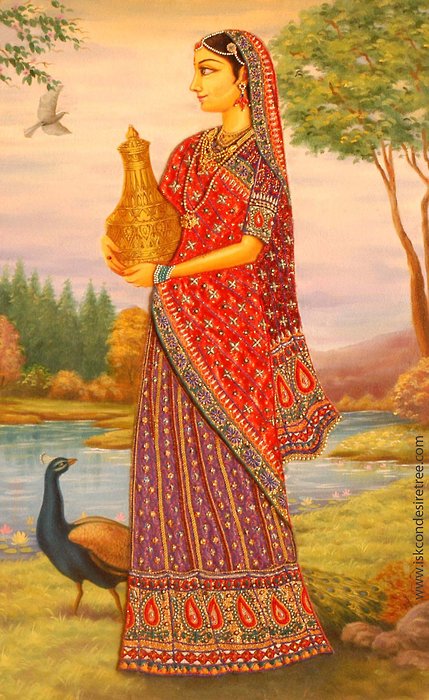
Gangamata Goswamini

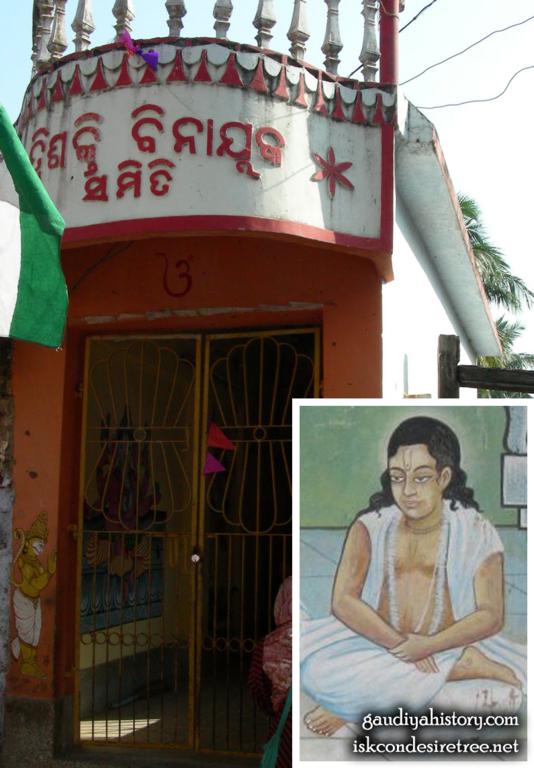
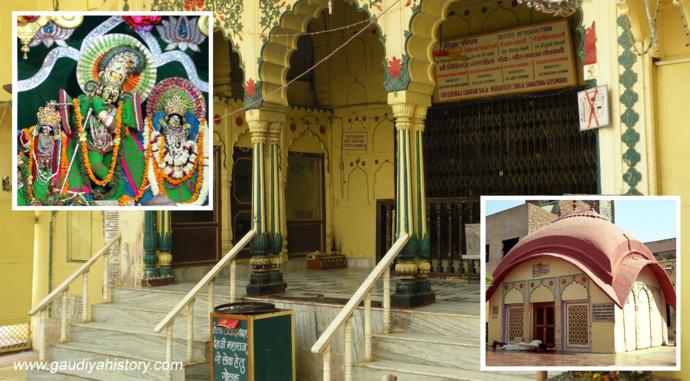
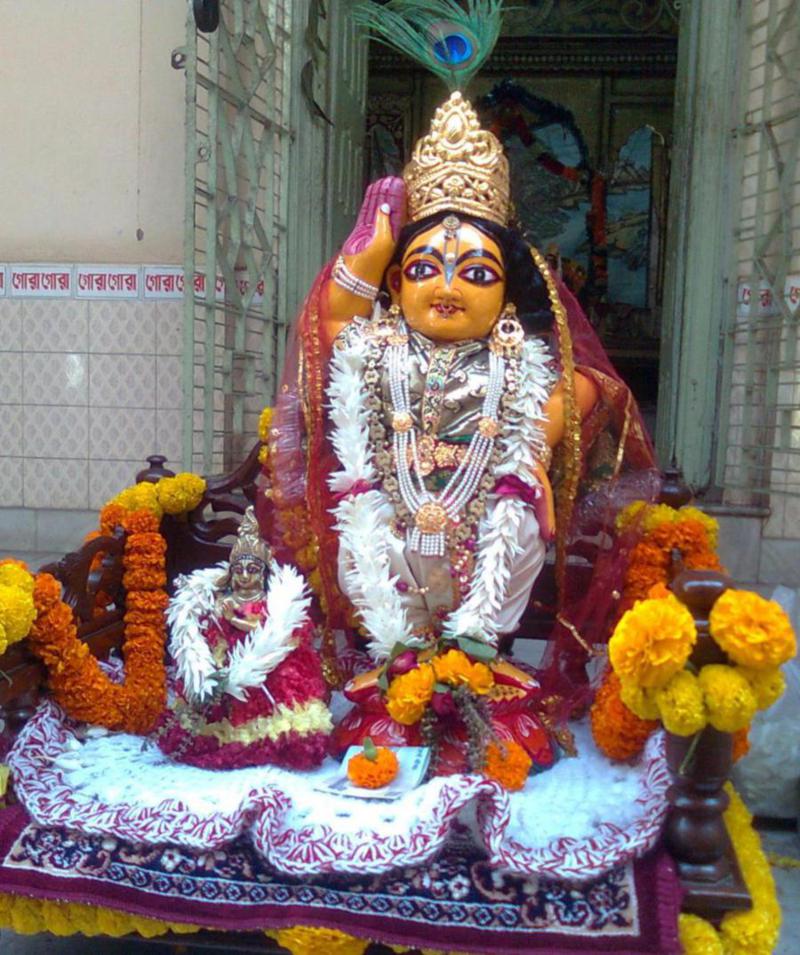
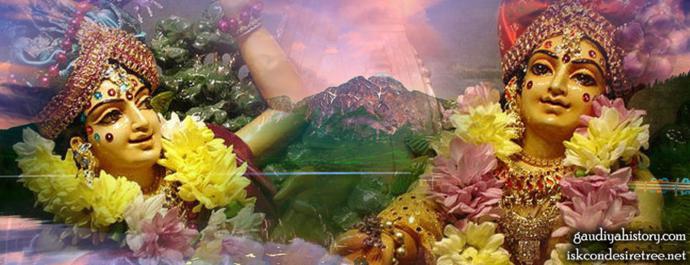
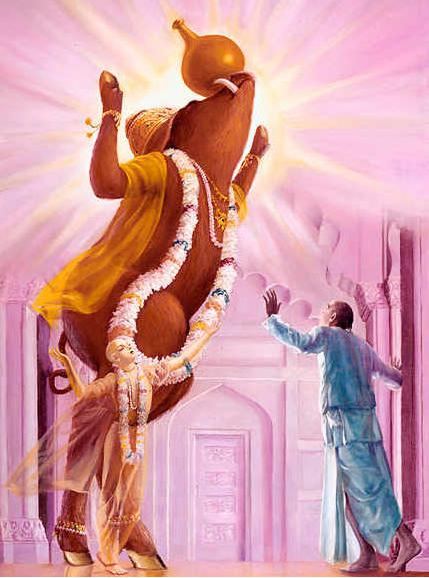
‘Ananta Acharya Goswami was formerly Sudevi-gopi in Vraja (Vrindavan).’ (In the image: Sudevi one of 8 main Gopis).

   Srila Bhaktisiddhanta Saraswati Goswami Thakur writes in his Anubhashya: “During the advent of Lord Sri Krishna, Ananta Acharya was Sudevi, one of the eight gopis. This is stated in the Gaura-ganoddesha-dipika, verse 165, as follows: ‘Ananta Acharya Goswami was formerly Sudevi-gopi in Vraja [Vrindavan].’ According to the disciplic succession descending from him at the famous Ganga-mata monastery, he is known as Vinoda manjari. One of his disciples was Hari Das Pandit Goswami, who is also known as Shri Raghu Gopal and as Shri Rasa manjari. He had two important disciples: Lakshmipriya and her niece, Ganga-mata, daughter of the Raja of Puntiya.”

   More is learned about Ganga-mata's holy life from Hari Das Das's Gaudiya Vaishnava Abhidhana and, in more detail, from Sundarananda Vidyavinoda's Shrikshetra, where an elaborate account is given.

Sachi Devi Goes to Live in Vraja

   Ganga Mata Goswamini's original name was Sachi Devi. She was born in Puntiya which is in the Rajashahi district of present-day Bangla Desh. Her father was an important zamindar or raja, whose name was Naresha Narayan. From her early childhood, Sachi Devi was indifferent to family life and devoted to Krishna. Her parents saw this and wanted to see her married as soon as possible, but Sachi told them that she refused to accept any mortal as her husband. When she announced her determination to remain unmarried in this way, her parents were troubled but could do nothing to change her mind. When her mother died, Sachi Devi left home and set out on a pilgrimage which led her first to Puri and then to Vrindavan. 
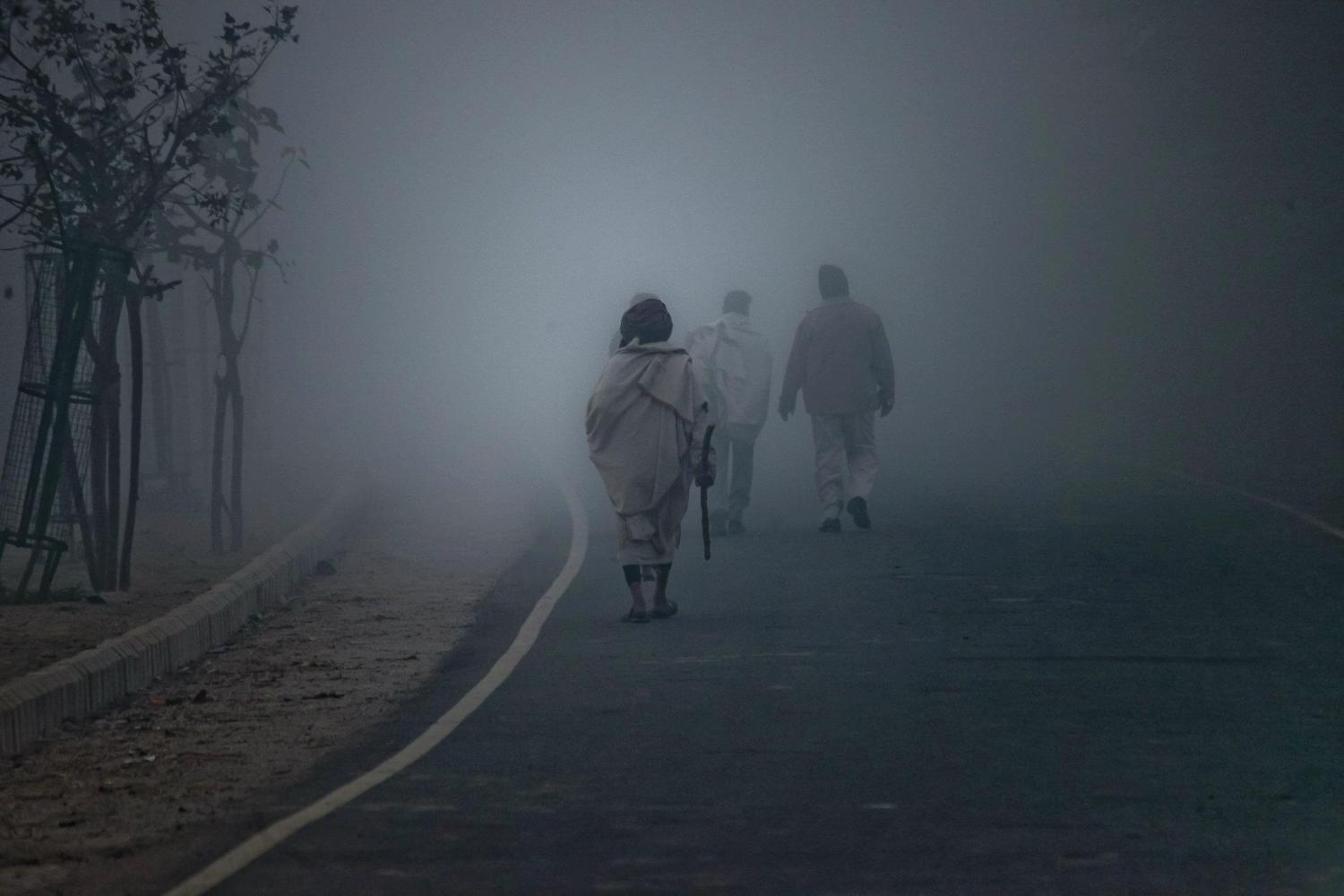
Gangamata Goswamini

When her mother died, Sachi Devi left home and set out on a pilgrimage which led her first to Puri and then to Vrindavan. (In the image: Brajabasis, Vrindavan).

   Upon her arrival in Vrindavan Dhama, she met Hari Das Pandit Goswami and felt as though making contact with him had made her entire pilgrimage worthwhile. She became anxious to take initiation from him, but he hesitated at first because of her wealthy family background. Later, however, when he saw her asceticism and her unswerving determination to engage in pure devotional activity, he gave her initiation in the eighteen-syllabled mantra. This event took place in the Govindaji temple on the Chaitra Shukla Ekadashi.

   After having received these blessings from her guru, she began to engage in intense bhajana, subsisting through madhukari, i.e., by begging from door to door for morsels of bread. After a year of this intense devotional activity, she was told by her spiritual master to live in Radha Kund with her spiritually advanced aunt and god-sister, Lakshmipriya, who regularly chanted three lakhs of Names every day. As a part of their regular spiritual practice, the two of them daily circumambulated Govardhana.
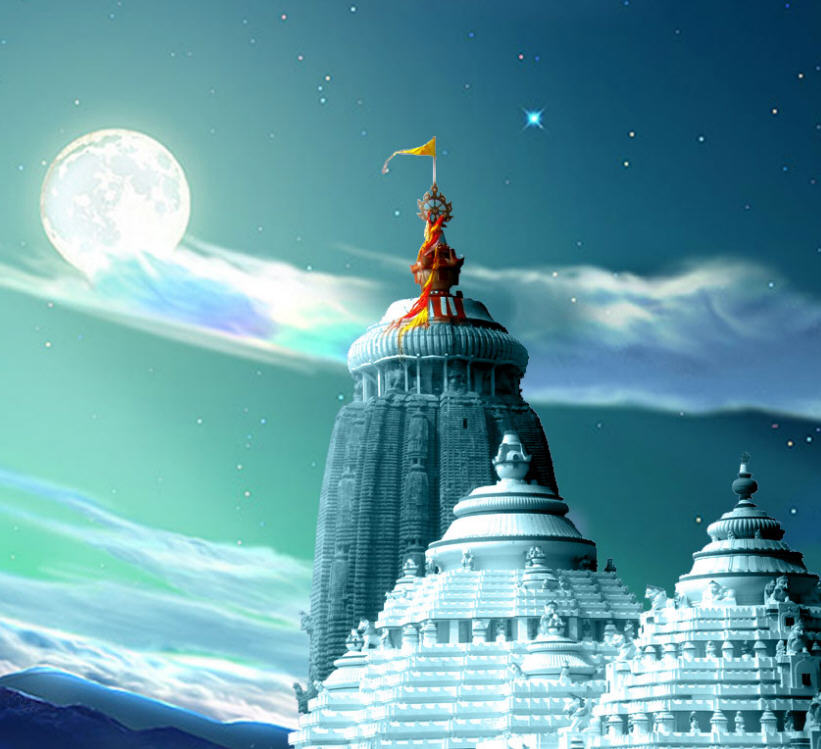
Gangamata Goswamini

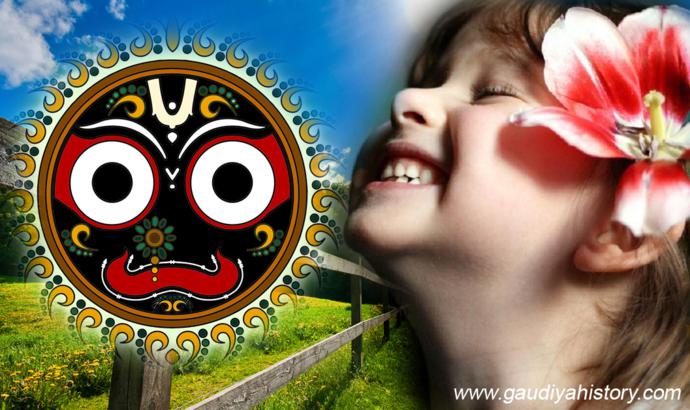
After several years of such practice at Radha Kund, when Sachi had become very advanced in her devotional life, her guru sent her to Purushottam Kshetra... (In the wallpaper: Lord Shri Jagannath's Temple, Puri).

   After several years of such practice at Radha Kund, when Sachi had become very advanced in her devotional life, her guru sent her to Purushottam Kshetra to recover the home of Sarvabhauma Bhattacharya, which had fallen into disrepair. Taking the command of her spiritual master as her all in all, Sachi Devi came to Jagannath Puri and took the kshetra-sannyasa vow. At that time, all that remained of Sarvabhauma's house was a single run-down building which housed his Damodar Shalagrama-shila. 

   Even while she had lived at home in Puntiya, Sachi Devi had studied the scriptures. In Vrindavan, furthermore, she had thoroughly studied the Bhagavata Purana. In order to salvage Sarvabhauma's residence, she set out to preach. Her explanations of the Bhagavat and her transcendental qualities made such an impression on the public that her discourses soon attracted large audiences. It did not take long before her fame had spread so widely that the king of Orissa himself, Mukunda Deva, came to listen to her Bhagavat lectures. He too became a devoted follower after being impressed by her learning and her devotional qualities.

The Shvetaganga

   According to the Utkala-khanda, there was a King Shweta in the Treta Yuga who was a Devotee of Jagannath. He made arrangements for Jagannath's bhoga just as Indradyumna had done. One morning he came to the Temple and saw the offerings which were made by the gods–thousands and thousands of wonderful gifts which were beyond the power of any mortal to present to the Lord. Shweta became disturbed at the insignificance of his own offerings and stood at the Temple door, his head hung in shame. As he was meditating on his own insignificance, he had a vision in which he saw Lakshmi Devi herself taking his food offerings and feeding them to both sets of Jagannath Deities [FN: Besides the main Deities, there is a second set, known as the vijaya-vigraha.] who were eating them with great enthusiasm. The King immediately thought himself consummated by this vision and he continued to serve Jagannath with unflagging enthusiasm. Jagannath eventually granted him the boon of being liberated in a spot which faces Matsya Madhava, halfway between Akshaya Bata and the ocean, which was subsequently named Shweta Madhava in his honor. The tank excavated here was also named Shwetaganga. On the banks of this tank, Deities of Shweta Madhava, Matsya Madhava and the nine planets are still worshiped. 
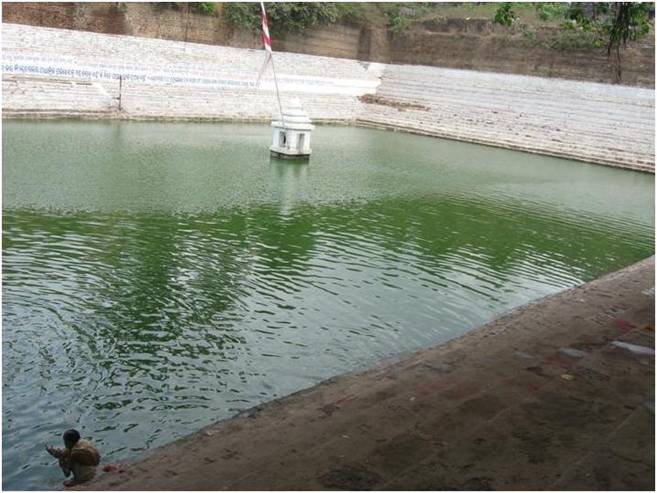
Gangamata Goswamini

Sweta Ganga.

   One night, the king of Orissa, Mukunda Deva, had a dream in which Jagannath Deva appeared to him and told him to give Sachi Devi a tract of land which bordered this Shveta-ganga. The next morning, the King joyfully came to see Sachi Devi and told her about the dream. Though she had no interest in increasing her worldly possessions, Sachi Devi decided to accept the King's gift for the sake of her guru-given mission to improve the condition of Sarvabhauma's house. Prior to that she had had to beg for the wherewithal to serve the deities. Wherever there is true devotion to the Lord, the trouble which one has to take to serve him is not seen as trouble, but rather as an opportunity and a source of joy.

How Sachi Came to be Known as Gangamata

   Not long afterward, a miraculous occurrence took place. One Krishna Trayodashi, an opportune moment came for the Maha Varuni Ganges bath. Many people who seek to accumulate pious credits make the trip to the Ganges for this auspicious occasion. Indeed, many of Sachi Devi's friends asked her to accompany them, but she could not abandon her kshetra-sannyasa vows nor her service to the Deities, so she was obliged to plead that it was impossible for her to go.

   Even though she did not really want to go, Jagannath Deva Himself made arrangements for her to bathe in the Ganges. That night He appeared to her in a dream and told her to take bath in the Shwetaganga in the middle of the night. Sachi Devi followed His instructions, but as soon as she entered the water, she had a vision of Ganga Devi herself. She was carried away in a strong river current which came from nowhere and suddenly found herself inside the Jagannath Temple. But she continued to see herself bathing in the midst of her friends from Puri. She not only saw the Ganges and all those who were immersed in its waters, but she could hear the joyful noise of the bathing crowds. 
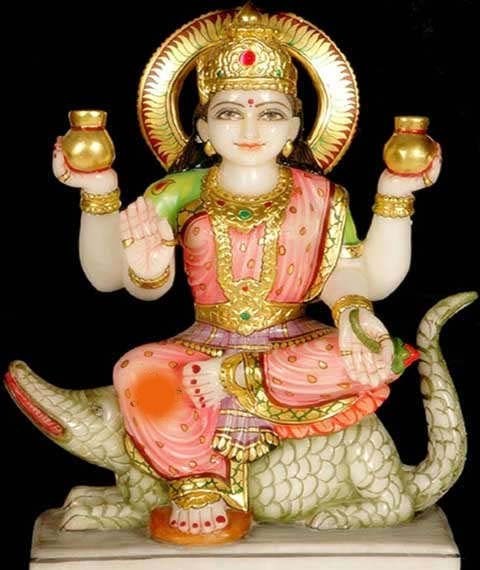
Gangamata Goswamini

Sachi Devi followed His instructions, but as soon as she entered the water, she had a vision of Ganga Devi herself. (In the image: Deity of Shrimati Ganga Devi).

   And she was not the only one. The Temple gatekeepers awakened on hearing this hubbub and called Lord Jagannath's pujaris. They in turn gave a report to the King himself who ordered them to open the Temple doors. When they finally flung the doors open, they saw no one but Sachi Devi standing there alone. Jagannath's pujaris were confused and at first did not know what to do. They assumed that Sachi Devi had broken into the Temple with the intention of robbing the Deities' valuables and that they had caught her red-handed. But by their suspicions they committed an offense to a great Devotee. As a result, they were attacked by various diseases and distresses–so much so that the service to Jagannath was affected.

   Jagannath Deva finally appeared to the King again and told him what had really happened. Being influenced by Sachi Devi's pure devotional attitude, Jagannath Himself had made the Ganges flow from His feet to bathe Sachi Devi directly in the currents of His charanamrita. The King and the other servants of the Lord could only be freed from their offenses if they apologized to Sachi Devi and took initiation from her.

   King Mukunda Deva went to Sachi Devi with his entourage, the Temple guards and servants. They paid her their prostrated obeisances and begged for her forgiveness. Though the King and all the pujaris, etc., asked her for initiation, she only gave the mantra to the King in obedience to Jagannath's order. The King wanted to give a large amount of land as guru-dakshina, but Sachi Devi refused it. When the King continued to beg for an opportunity to render service, she finally said that every midday he could send two containers of Mahaprasad rice and one of vegetables, a cloth and 160 paisa for the service of the Vaishnavas. From that day onward, Sachi was known as Ganga-mata and Sarvabhauma Bhattacharya's house as Ganga-mata Math and to this day, after the midday offering at the Jagannath Temple, these same items are sent to the Ganga-mata Math. 
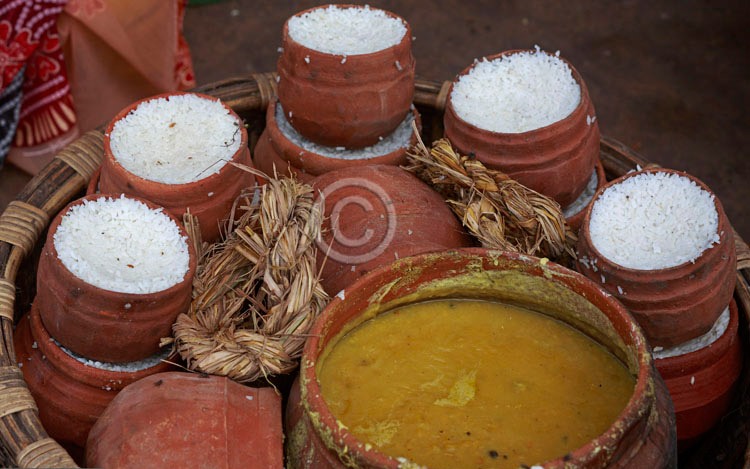
Gangamata Goswamini

When the King continued to beg for an opportunity to render service, she finally said that every midday he could send two containers of Mahaprasad rice and one of vegetables, a cloth and 160 paisa for the service of the Vaishnavas. (In the image: Maha Prasadam of Lord Shri Jagannath, Puri).

   Another of those who were blessed by initiation from Ganga Mata Goswamini was a certain Smarta Brahmin named Mahiratha Sharma from Dhanaïjayapura.

Rasika Raya

   There was a Deity of Krishna named Rasika Raya in the house of Chandra Sharma, a resident of Jaipur in Rajasthan. As a result of sevaparadha, offenses in the performance of service to this Deity, this Brahmin had no descendants to continue the family line. Jagannath Deva appeared to him in a dream and told him to bring the Deity to Puri and to give it to Ganga-mata if he wished to be rid of the effects of his offenses. The Brahmin did as he was told and appeared at Ganga-mata's door to offer her the service of Rasika Raya. At first she was not ready to accept, as it was impossible for her to give the kind of royal service which was due such a Deity. Finally, the Brahmin simply hid the Deity amongst the Tulasi bushes and went away. Rasika Raya appeared to Ganga-mata in a dream and told her that He wanted her to accept and serve Him. Having been so ordered, Ganga-mata joyfully took the Deity in and organized a festival in His honor.
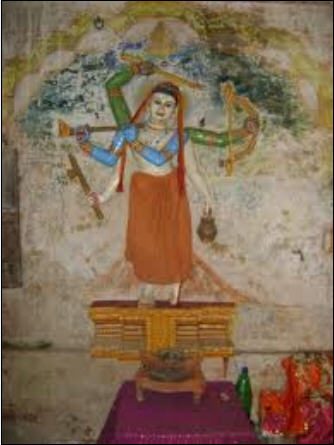
Gangamata Goswamini

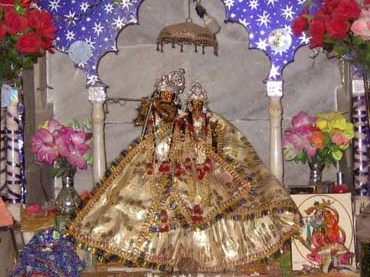
At present there are five pairs of Deities in the Ganga-mata Math: Shri Shri Radha Rasika Raya, Shri Shri Radha Shyamasundar, Shri Shri Radha Madanamohana, Shri Shri Radhavinoda and Shri Shri Radharamana. Other than these, the Damodar Shalagrama-shila of Sarvabhauma Bhattacharya, a dancing figures of Gauranga and a Gopal Deity are also present on the altar there.

   At present there are five pairs of Deities in the Ganga-mata Math: Shri Shri Radha Rasika Raya, Shri Shri Radha Shyamasundar, Shri Shri Radha Madanamohana, Shri Shri Radhavinoda and Shri Shri Radharamana. Other than these, the Damodar Shalagrama-shila of Sarvabhauma Bhattacharya, a dancing figures of Gauranga and a Gopal Deity are also present on the altar there. 

   According to the information given by the Math, Gangamata was born on the Shukla-dashami of Jyestha in AD 1601 and entered the eternal pastimes in AD 1721. Branches of her Math are found in Jagannath Puri at the Haveli Math and Gopal Math, as well as the Gopal Math in Cuttack district's Tangi village.

   Devotees of Krishna may be born in any race, in any caste, or indeed in either sex. They are still to be considered the best of human beings and worshipable by all. There are many examples of women who attained the supreme achievement of pure devotional service to the Lord, such as the wives of the Vedic Brahmins who due to the demands of bhakti ignored the orders of their less-advanced husbands to serve Krishna. In the Kaliyuga, also, as a result of the blessings of Hari Das Thakur, a prostitute was transformed into a renowned Vaishnavi and many great Devotees went to seek audiences from her in order to receive her saintly association.


[Excerpted from “Sri Chaitanya: His Life & Associates” by Srila Bhakti Ballabh Tirtha Maharaj] 
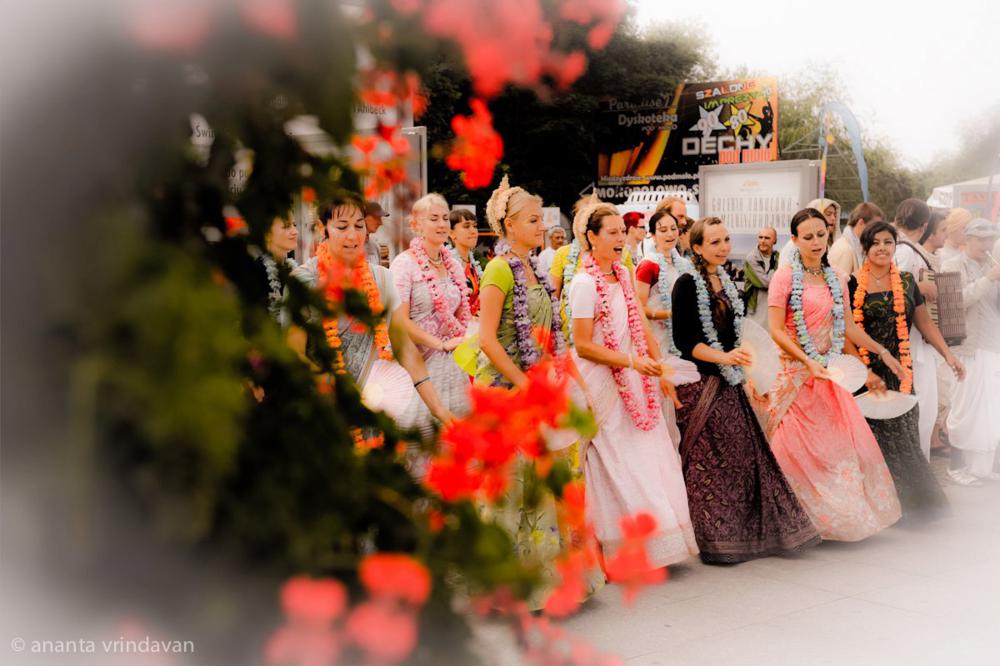
Gangamata Goswamini

Devotees of Krishna may be born in any race, in any caste, or indeed in either sex. They are still to be considered the best of human beings and worshipable by all. There are many examples of women who attained the supreme achievement of pure devotional service to the Lord, such as the wives of the Vedic Brahmins who due to the demands of bhakti ignored the orders of their less-advanced husbands to serve Krishna. In the Kaliyuga, also, as a result of the blessings of Hari Das Thakur, a prostitute was transformed into a renowned Vaishnavi and many great Devotees went to seek audiences from her in order to receive her saintly association. (In the image: Festival, Poland)
Abhirama Gopala Thakura – Biography

Abhiram Gopala Thakur

He who was previously known as Sridama is today Abhirama Thakur. He picked up a piece of wood that it took 32 men to lift. (Gaura-ganoddesha-dipika 126)

pura shridama-namasid abhiramo’dhuna mahan
dvatrimshata janair eva vahyam kashtham uvaha sah

He who was previously known as Sridama is today Abhirama Thakur. He picked up a piece of wood that it took 32 men to lift.
(Gaura-ganoddesha-dipika 126)

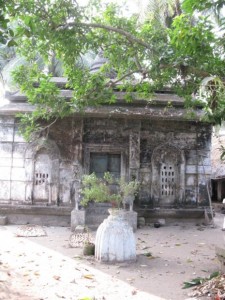
   Abhirama Thakur lived with his wife Malini in the village of Khanakul Krishnanagara in the Hooghly district. Khana refers to the Dvarakesvara River, kula means banks; thus, the village of Krishnanagara on the banks of the Dvarakesvara River is also known as Khanakula Krishnanagara. At the doors of his Temple stands a large Bakula tree which is known as the Siddha-bakula, and the place is popularly called Siddha-bakula Kunja. This is the place where Abhirama Thakur first sat down when he arrived in the village. The Gopinath Deity was found when digging for a tank first began. This tank goes by the name of Sri Abhirama Kund. The Temple also houses the Deities of Vrajavallabha, Gopal and a Salagram Sila.

   Sri Abhirama Thakur was a very vigorous and powerful acharya. He engaged in preaching on the orders of Lord Nityananda and saved many atheists and people opposed to the Vaishnava religion.

   Abhirama Goswami possessed a fiery temper and great spiritual power. The atheists trembled whenever they saw him. He was intoxicated as though he had been possessed by Nityananda, and his enchanting mercies are famed throughout the world.
(Bhakti-ratnakara 4.103-4)

   Rama Das Abhirama was fully absorbed in the mood of friendship. He lifted a flute which contained sixteen knots.
(Chaitanya Charitamrita 1.10.116)

   This reference in the Chaitanya Charitamrita is also that found in the Gaura-ganoddesha-dipika which says that Abhirama Thakur lifted a log which would normally have taken 32 people to lift. The Bhakti-ratnakara states that it would have taken hundreds of people. After lifting it, he held it like a flute.

   He held in his hands a piece of wood that a hundred men could not move, in the way one holds a flute.
(Bhakti-ratnakara 4.123) 

   The Devotees were greatly astonished when they saw him perform such superhuman feats. According to one legend, whenever Abhirama Thakur paid his obeisances to a stone or statue, if it was not a Vishnu-shila or a consecrated Deity, it would crack or be reduced to powder. Non-devotees were also unable to tolerate his pranamas. Nityananda’s son Virachandra Goswami and daughter Ganga Devi survived his obeisances, which confirmed their divinity. These things are written in ashtakas composed by Abhirama Thakur in their name. 

Abhiram Gopala Thakur

Bali Math in Puri was established by Abhirama Thakur.

   Srila Abhirama Thakur possessed an amazing whip which he named Jaya-mangala. Anyone who was touched by this whip would immediately experience the transcendental ecstasies of prema. One day Srinivas Acharya visited Abhirama Thakur who gave him three lashes with that whip. Abhirama’s wife Malini stopped her husband from hitting him again, saying that Srinivas was just a young lad who wouldn’t be able to tolerate the effects of divine love. Nevertheless, Srinivas Acharya was very dear to Abhirama and received many blessings from him. Though not his initiated disciple, he was like a disciple to him. The Jaya-mangala whip is still held in the Krishnanagara Temple.

   In the Bhakti-ratnakara, the following statement is also made:

   O Srinivas! How much more can I say? Abhirama descended into this world in order to deliver it. Taking birth in a Brahmin family, he became a scholar in all the scriptures and was an unequalled musician, not only in song and playing musical instruments, but in dance also. He married at Nityananda Balaram’s request. His wife Malini is also indescribably powerful.
(Bhakti-ratnakara 4.105-8)

   Many people say that the Bali Math in Puri was established by Abhirama Thakur. An annual festival is held in Khanakula Krishnanagara on his disappearance day, i.e., the Chaitra Krishna saptami.

   Our parama-guru, Jagad-guru Srila Bhaktisiddhanta Saraswati Goswami Thakur visited this site when travelling on the parikrama of Sri Gaura Mandala. At that time, the Devotees charged with the Temple greeted him with great hospitality and honored him and his followers with special treatment.

[Excerpted from “Sri Chaitanya: His Life & Associates” by Srila Bhakti Ballabh Tirtha Maharaj]

Rasikananda Prabhu – Biography 3

Rasikananda Prabhu

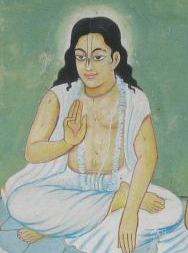
Achyutananda and Rasikananda were born in the Karana caste in order to bless it. (In the images: Rasikananda Prabhu and his house).

   Rasikananda's Birth
 
   Rasikananda Deva Goswami was born in 1512 of the Saka era (1590 AD) in the village of Rohini or Rayni in the Midnapore district. This village is situated at the confluence of the Subarnarekha and Dolanga rivers. His father's name was Raja Achyutananda and his mother, Bhavani Devi. The Subarnarekha River crosses back and forth across the present-day Bengal-Orissa border. Midnapore district used to be a part of the Orissan kingdom. Raja Achyutananda was an Orissan of the Karana caste, the equivalent of the Kayasthas in Bengal. A Vaishnava is beyond the material qualities and should not be judged in terms of his caste origins. Achyutananda and Rasikananda were born in the Karana caste in order to bless it.
 
   We can assume that Rasikananda was a manjari in Krishna lila. Though his spiritual master Shyamananda had himself been initiated by Hriday Chaitanya Goswami, who worshipped the Lord in the mood of friendship, he later took shelter of the conjugal mood due to the association of the Vraja Devotees led by Jiva Goswami. Shyamananda thus initiated Rasikananda into the worship of Radha and Krishna.
 
   Rasikananda was also known by the name Rasika Murari. Mother Jahnava's disciple Nityananda Das wrote in his Prema-vilasa that Shyamananda had two principle disciples, one named Rasikananda, the other Murari, both of whom lived in Rayni. But Narahari Chakravarti indicates clearly in Bhakti-ratnakara that both names refer to the same individual.
 
   In the village of Rayni lived the famous son of Achyutananda. He had two names: Rasikananda and Murari. Thus he was also known as Rasika-Murari. He became learned in the scriptures in his childhood. (Bhakti-ratnakara 15.27-8)
 
Rasika Murari Meets Shyamananda Prabhu
 
   Rasika Murari was anxious to find a spiritual master who could give him guidance on the mystical path. One day while in Ghantashila, he went to a solitary place to meditate. He had just entered into a very deep trance when he heard a voice from an unseen source say, "Murari! You need be anxious no longer. Your guru is Shyamananda and you will meet him here very shortly. Take shelter of him and your life will be successful."
 
   Upon hearing the divine message, Murari began chanting the name of Shyamananda on his beads with joyful enthusiasm. He spent the entire night crying out of eager expectation to meet his guru, until finally at the end of the night, he had a dream vision of Shyamananda Prabhu who said to him, "Don't worry any longer, for you will meet me on this very day."
 
   At dawn, Rasika Murari was on the lookout for his guru, when he saw the tall figure of Shyamananda approaching him, as effulgent as the sun. Surrounded by disciples like Kishor Das, he was dancing in a state of absorption in divine love while chanting the names of Nityananda and Chaitanya. Rasika Murari had been waiting anxiously for so long to encounter his guru that he immediately fell down at his feet. Shyamananda affectionately lifted him up and embraced him. Then, after giving him the Radha-Krishna mantra, he offered him up to Chaitanya and Nityananda Prabhus. This whole story demonstrates how we can find a guru through sincere prayers. 
Rasikananda Prabhu

At dawn, Rasika Murari was on the lookout for his guru, when he saw the tall figure of Shyamananda approaching him, as effulgent as the sun. Surrounded by disciples like Kishor Das, he was dancing in a state of absorption in divine love while chanting the names of Nityananda and Chaitanya. Rasika Murari had been waiting anxiously for so long to encounter his guru that he immediately fell down at his feet. Shyamananda affectionately lifted him up and embraced him. Then, after giving him the Radha-Krishna mantra, he offered him up to Chaitanya and Nityananda Prabhus. This whole story demonstrates how we can find a guru through sincere prayers. (In the wallpaper: Brajabasi offering prayers, a Devotee chanting japa on beads).

 
Rasikananda Becomes a Potent Preacher
 
   Rasikananda Deva Goswami fully committed himself in body, mind and soul to the service of his guru. Indeed, he served him so well that in a short time he was recognized as Shyamananda's chief disciple, a very powerful preacher and initiating guru himself. In fact, it is a truism that a good disciple becomes a good teacher. A spiritual master may have innumerable followers who call him their guru, but are disciples in name only. Only a true disciple who has dedicated himself completely to his spiritual mater is imbued with all the powers of the guru. Shyamananda invested Rasikananda with such spiritual power that he was able to convert many criminals, atheists, Muslims, and other fallen spirit souls to the path of devotion, bestowing the jewel of prema upon them all.
 
   On one occasion, a wicked Muslim tried to silence Rasika Murari by having him attacked by an intoxicated elephant, but Rasikananda was able to transform even the elephant into a disciple and engage him in the service of Vishnu and the Vaishnavas. All who witnessed this amazing event were overwhelmed with astonishment at Rasika Murari's spiritual power and the evil Muslim zamindar himself came and surrendered to him.
 
   Shyamananda turned the service of his personal Govinda Deity in Gopiballabhpur over to Rasikananda. He delivered unlimited living beings without any consideration of their caste or religious background. Rasikananda remained constantly intoxicated in Harinam sankirtana. Who will not be overcome with emotion on reciting his virtues? (Bhakti-ratnakara 15.81-6)
 
   The Prema-vilasa corroborates this account in the 19th chapter, "He delivered many criminals and Muslims."
 
   The Raja of Mayurbhanj in Orissan, Vaidyanath Bhanj, was also attracted to the transcendental power of Rasikananda and became his disciple. Other important disciples were Ganapati, the zamindar of Patashpur in Midnapore, Shri Bhima and Shrikara, zamindars of Dharenda, and Ahmed Beg, the son-in-law of Ibrahim Khan, the governor of Orissa.
 
   Rasikananda Deva Goswami wrote a number of works, including Shyamananda-staka, Bhakta-Bhagavatashtaka, and Kunjakeli-dvadashaka.
 
Rasikananda's Disappearance
 
   It is said that just prior to Rasikananda's disappearance in AD 1652, he went with seven of his disciples to a village named Bansdaha near Jaleshwar. Mahaprabhu passed through the village when traveling to Puri with Nityananda. (Chaitanya Bhagavata 3.2.263-4)
 
   Rasikananda and his party walked from there to Remuna, chanting kirtan the whole way. When they arrived in the courtyard of the famous Khirchora Gopinath Temple, Rasikananda suddenly merged into the body of the Gopinath Deity. His disciples also left their bodies in the same place. Rasika Murari's flower samadhi and those of his seven associates are still maintained in the courtyard of the Khirchora Gopinath Temple. An annual festival lasting twelve days is held in Remuna to celebrate his disappearance. This takes place on Shiva-chaturdasi in the month of Magh.
 
   Vishvambharananda Deva Goswami, the author of the celebrated Ashtikya-darshana, was Rasikananda's descendant.
 
   [Excerpted from “Shri Chaitanya: His Life & Associates” by Shrila Bhakti Ballabh Tirtha Maharaj] 
Rasikananda Prabhu

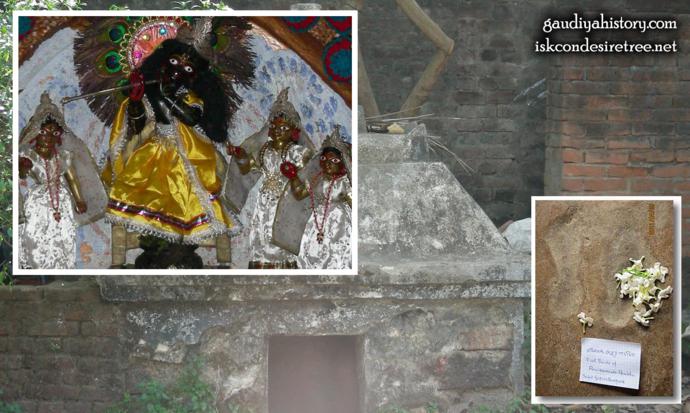
Rasikananda and his party walked from there to Remuna, chanting kirtan the whole way. When they arrived in the courtyard of the famous Khirchora Gopinath Temple, Rasikananda suddenly merged into the body of the Gopinath Deity. His disciples also left their bodies in the same place. Rasika Murari's flower samadhi and those of his seven associates are still maintained in the courtyard of the Khirchora Gopinath Temple. (In the wallpaper: in the background Samadhi of Rasikananda Prabhu, Deities of Shri Shri Radha Rasikananda and footprints of Rasikananda Prabhu).

Ramacandra Kaviraja – Biography 3

Radha Damodara Mandir

Ramachandra, a king amongst poets, was born in the town of Sarajani on the banks of the Ganges as the son of Sunanda and Chiranjiva Sen, a well-known minister of the king of Gauda, a Devotee of the Brahmins and Vishnu. Ramachandra was not in any way different from Narottam Das Thakur. (Sangita-madhava-nataka, quoted at Bhakti-ratnakara 1.270) (In the image: Ramachandra Kaviraja).

   svardhunyas-tira-bhumau
sarajani-nagare gauda-bhupadi-patrad
brahmanyad visnu-bhaktad
api suparicitat sri-ciranjiva-senat
 
yah sri-ramendu-nama samajani paramah
sri-sunandabhidhayam
so-yam sriman narakhye sa hi kavi-nrpatih
samyag asid abhinnah
 
   Ramachandra, a king amongst poets, was born in the town of Sarajani on the banks of the Ganges as the son of Sunanda and Chiranjiva Sen, a well-known minister of the king of Gauda, a Devotee of the Brahmins and Vishnu. Ramachandra was not in any way different from Narottam Das Thakur. (Sangita-madhava-nataka, quoted at Bhakti-ratnakara 1.270)
 
   Chiranjiva Sen was a resident of Shrikhanda, whose wife's name was Sunanda. They had two sons, the older was Ramachandra, the younger Govinda. Ramachandra was a disciple of Shrinivas Acharya who took the title Kaviraj. His siddha name was Karuna Manjari. (Verses quoted in Gaudiya Vaishnava Abhidhana)
 
   After the death of his father, Ramachandra went to live in Kumar Nagar with his maternal grandfather, Damodar Kaviraj, who was a disciple of Narahari Sarkar. Later he went with his younger brother Govinda to live in the village of Telia Budhari in Murshidabad district. This place has the distinction of being his Shripat.
 
The Kaviraj Title
 
   Shrinivas Acharya was so overcome with affection for Ramachandra that he gave him the diksha mantra and engaged him as his personal servant. Though Bir Hambir became Shrinivas Acharya's disciple, Ramachandra acted as his shiksha guru. Ramachandra also visited Vrindavan where he associated with Jiva Goswami and the other Vaishnavas, receiving their blessings. They were very pleased to hear his poetry, so much so that Jiva Goswami gave him the Kaviraj title. He thus became one of the eight Kavirajs (asta-kaviraja). He was Narottama Thakur's favored companion for preaching activities and spiritual association. 
 
   Paramananda Bhattacharya, an ocean of love, Jiva Goswami and the other residents of Vraja, listened to Ramachandra recite his own poetic compositions and they joyfully awarded him the title of kaviraja. Ramachandra Kaviraj was full of all virtues and Narottam Das' second self. (Bhakti-ratnakara 1.267-9)
 
   Kamsari Sen, Rama Sen, Ramachandra Kaviraj, and the three Kavirajs, Govinda, Shriranga and Mukunda, are Nityananda's branches. (Chaitanya Charitamrita 1.11.51)
 
   Ramachandra wrote several books, including Smarana-chamatkara, Smarana-darpana, Siddhanta-chandrika, and Shrinivasa Acharyera Jivana-charita.
 
Ramachandra in Vrindavan
 
   Narahari Chakravarti has written an extensive description of Ramachandra and his visit to Vrindavan in the ninth wave of Bhakti-ratnakara. All the residents of Vraja who saw him were attracted by his physical beauty. When Ramachandra visited the Radha-Damodar Temple with Jiva Goswami and saw Rupa Goswami's samadhi, he experienced ecstatic transformations that were a source of amazement to all. Gopal Bhatta Goswami, Lokanatha Goswami and Bhugarbha Goswami gave him their blessings. He went to bathe in Radha Kund and Shyama Kund and met Raghunath Das Goswami there. When he paid obeisances to Raghunath, the venerable saint affectionately embraced him. 
Radha Damodara Mandir

When Ramachandra visited the Radha-Damodar Temple with Jiva Goswami and saw Rupa Goswami's samadhi, he experienced ecstatic transformations that were a source of amazement to all. Gopal Bhatta Goswami, Lokanatha Goswami and Bhugarbha Goswami gave him their blessings. He went to bathe in Radha Kund and Shyama Kund and met Raghunath Das Goswami there. When he paid obeisances to Raghunath, the venerable saint affectionately embraced him. (In the image: Shri Shri Radha Damodar Deities and Temple, Samadhi of Sanatana Goswami).

 
   Ramachandra's friendship with Narottam Das Thakur has been immortalized by Narottam Das' prayer to Shrinivas Acharya for his association:
 
daya kara shri-acharya prabhu shrinivasa ramachandra sanga mage narottama dasa
 
   "Please be merciful, Prabhu Shrinivas Acharya! Narottam Das begs for Ramachandra's association." (Prarthana)
 
hau sasvad-bhagavat-parayana-parau-samsara-parayanau
samyak satvata-tantra-vada-paramau nihsesa-siddhantagau
sasvad-bhakti-rasa pradana-rasikau pusanda-hrn-mandalav
anyonya-priyatabharena yugali-bhutav imau tau numah
 
   "I pay my obeisances to Narottam and Ramachandra, who are devoted to all those who have dedicated their lives to the Supreme Lord, who help people cross over the ocean of material life, who know all the scriptures completely and have understood all the transcendental doctrines, who most generously distributed bhakti-rasa and won the hearts of the atheists, who are deeply attached to each others' affectionate company."
(Sangita-madhava-nataka, quoted at Bhakti-ratnakara 1.277)
 
   Ramachandra's disappearance day is the Krishna triya in the month of Magh. He passed away in Vrindavan after the disappearance of Shrinivas Acharya.
 
   [Excerpted from “Shri Chaitanya: His Life & Associates” by Shrila Bhakti Ballabh Tirtha Maharaj]

Raghunandana Thakura – Biography

vyuhas tritiyah pradyumnah priya-narma-sakho’bhavat
cakre lila-sahayam yo radha-madhavayor vraje
shri-caitanyadvaita-tanuh sa eva raghunandanah
 
   The third member of the chatur-vyuha, Pradyumna, took part in Radha Madhava’s lila in Vraja as Krishna’s intimate friend or priya-narma-sakha. He has now appeared as Raghunandan, whose body is not different from that of Chaitanya. (Gaura-ganoddesha-dipika 70)
 
Raghunandan’s Father: Mukunda Das
 
   Raghunandan was born into a family of physicians in the Shaka year 1432 (1510 AD). His father’s name was Mukunda Das, his mother’s name is unknown. Mukunda Das was Narahari Sarkar Thakur’s older brother. In the fifteenth chapter of the Madhya-lila of Chaitanya Charitamrita, it is clearly said that Mukunda Das was physician to the king.
 
   Externally, he appears to be a physician to the king who is engaged in government service. But internally, he is filled with divine love. Who would be able to know his love? (Chaitanya Charitamrita 2.15.120) 
Raghunandana Thakura

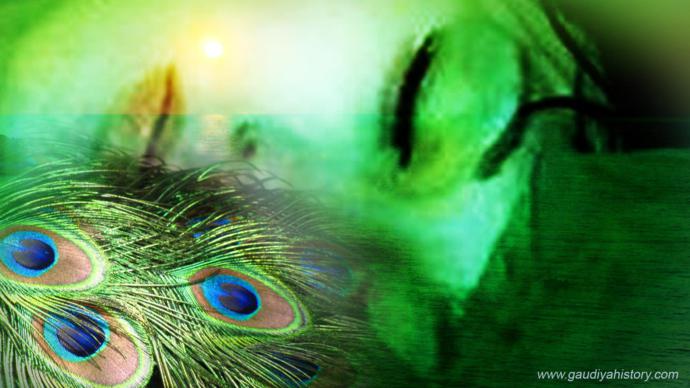
Once when Mukunda Das was engaged in treating the king, he saw a peacock feather and fainted. (In the wallpaper: Peacock feather , fainted person).

 
   Once when Mukunda Das was engaged in treating the king, he saw a peacock feather and fainted. This incident is also described in the Chaitanya Charitamrita (2.15.121ff). His home was in Shrikhanda, a village in Burdwan district. On the Katwa-Burdwan rail line, the first station west of Katwa is Shripat Shrikhanda, and the second Shrikhanda. Mukunda Das’s home is about one mile from the Shrikhanda station. Raghunandan Thakur took birth on the Vasanta Panchami day. His uncle Narahari took a great deal of interest in raising Raghunandan, for whom he had much affection.
 
   Chaitanya Mahaprabhu indicated that one’s importance increases with the depth of devotion by telling Mukunda Das that his son was really his father.
 
   The three most important Devotees from Shrikhanda were Mukunda Das, Raghunandan and Narahari. Mahaprabhu asked Mukunda Das, “Are you Raghunandan’s father and he is your son? Or, is he your father and you his son? Tell me so that I can put My doubts to rest.” Mukunda answered, “Raghunandan is my father and I am his son, rest assured. Whatever devotion we have comes from him, therefore I see him as my father.” When He heard Mukunda Das’s answer, Mahaprabhu was thrilled and He said, “He from whom we imbibe devotion is certainly our guru.” (Chaitanya Charitamrita 2.15.112-117)
 
Mahaprabhu Gave Raghunandan the Service of Deity Worship
 
   Raghunandan’s work is to serve Krishna. He has no interest in anything other than serving Krishna. (Chaitanya Charitamrita 2.15.131)
 
   From his early childhood, Raghunandan Thakur would feed the family’s Gopinath Deity laddus. Uddhava Das has written a song in which this lila is described:
 
   Mukunda Das lived in the village of Shrikhanda, where his household Deity was named Gopinath. One day he had to go somewhere for work and he called Raghunandan to do the service.
 
   He said, “In this house we worship Krishna, so I want you to be sure to give Him something to eat.” and then he left. Raghunandan did as his father had ordered and made the offering to the Deity.
 
   Raghunandan was just a child and in his simplicity, he said to Gopinath, “Eat! Eat!” Krishna is controlled by love, and so He did as the child told Him and ate everything on the plate without leaving a grain of rice. 
Raghunandana Thakura

Raghunandan was just a child and in his simplicity, he said to Gopinath, “Eat! Eat!” Krishna is controlled by love, and so He did as the child told Him and ate everything on the plate without leaving a grain of rice. (In the wallpaper: Shri Gopinatha, ISKCON Belgium, Radhadesh, a kid).

 
   When Mukunda Das returned, he asked the boy to bring him the Prasad from the offering he had made. The child answered, “Father, He ate everything and left no remnants.”
 
   Mukunda was astonished at his child’s wonderful words that he asked him again on another occasion to make an offering. This time after he left the house, he returned and hid to watch what his son would do.
 
   Raghunandan joyfully placed a laddu in Krishna’s hand and said in a commanding voice, “Eat! Eat!”. When Krishna had eaten half of the laddu, Raghunandan saw Mukunda Das in the doorway.
 
   Mukunda saw that Krishna did not take another bite and that the half-eaten laddu remained in His hand. This caused him to be filled with love. He embraced his child and, as tears of joy rained from his eyes, spoke to him in a broken voice.
 
   To this day, fortunate people come to Shrikhanda to see the half-eaten laddu in Gopinath’s hand. Raghunandan is not different from Cupid himself, says Uddhava Das with great feeling.
 
   [All the mahantas] felt fascinated to see the Gopinath Deity whom Raghunandan had fed laddus. (Bhakti-ratnakara 9.525)
 
Other Miraculous Events
 
   Narahari Sarkar Thakur gave mead to Nityananda Prabhu and Mahaprabhu from a pond which was right next to the their home. This pond became known as Madhu Pushkarini. The legend is told that a kadamba tree which grew right next to the pond always had two flowers blooming regardless of the season by Raghunandan’s miraculous powers. 
Raghunandana Thakura

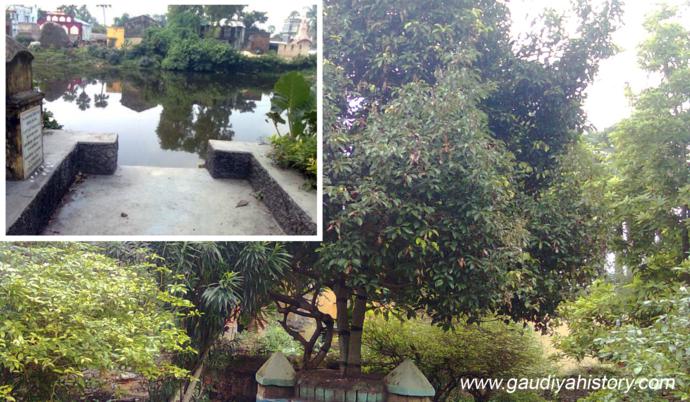
Narahari Sarkar Thakur gave mead to Nityananda Prabhu and Mahaprabhu from a pond which was right next to the their home. This pond became known as Madhu Pushkarini. The legend is told that a kadamba tree which grew right next to the pond always had two flowers blooming regardless of the season by Raghunandan’s miraculous powers. (In the wallpaper: Madhu Pushkarini pond and Kadamba tree, Shrikhand).

 
   According to the Gaudiya Vaishnava Abhidhana, another miraculous event took place in Raghunandan’s life: One day Abhirama Thakur came to Shrikhanda and paid his obeisances to Raghunandan. Then he embraced him and melted with feelings of prema. Raghunandan started to dance and sing kirtan, and while doing so, one of his ankle bells slipped from his foot and went flying off, landing four miles away in Akai Hat near his disciple Krishna Das’s house. Later, in order to commemorate the event, a tank was excavated there which was given the name Nupur Kund.
 
   Mahaprabhu, the father of sankirtan, gave his adopted son Raghunandan Thakur the authority to offer the garland on the day before the sankirtan yajna (the adhivasa) and to make the final offering at the yajna’s end.
 
   Raghunandan Thakur accompanied the Bengali Devotees to Puri ever year at chaturmasya. He would dance with his uncle Narahari at the Rathayatra festival in the group formed by the residents of Shrikhanda.
 
   He participated in the Kheturi festival organized by Narottama Das Thakur, at Gadadhara Das’s festival in Katwa and at the commemorative festival for Narahari Sarkar Thakur in Shrikhanda.
 
   Some people said, “Anyone who is dear to Raghunandan will win Mahaprabhu’s mercy for life after life.” Others said, “Raghunandan is so merciful that he gives life to the most humble and fallen.” Some said, “What humility! There is no one who is his equal.” And others, “He is as beautiful as Kandarpa himself!”, etc. (Bhakti-ratnakara 9.660 ff.) 
Raghunandana Thakura

Raghunandan Thakur bequeathed the service of his Gaura-Gopal Deity to his son Kanai Thakur and then left this world on the fourth day of the waxing moon in the month of Shravan. (In the image: Gaura Goapl and Gopinath of Raghunandana Thakur, Shrikhand).

 
   Shrila Raghunandan Thakur had great affection for Shrinivas Acharya. Prior to his disappearance he consoled Shrinivas that despite the difficult times, he would be able to spread Vaishnavism in the future:
 
   “A difficult time is coming in which people will succumb to various doubts. Narahari Prabhu wrote in his Shri-Krishna-bhajanamrita:
 
krishna-caitanya-candrena nityanandena samhrite
avatare kalav asmin vaishnavah sarva eva hi
bhavishyanti sadodvignah kale kale dine dine
prayah sandigdha-hridaya uttametara-madhyamah
(verses 3-4)
 
   Once our Lord Krishna Chaitanya and his companion Nityananda Prabhu have ended their incarnation, the Vaishnavas in this age of Kali will be anxious with every passing day. Whether very advanced, somewhat advanced or neophyte, their hearts will nearly always be filled with doubt.
 
   But don’t let this worry you. Lord Gauranga will accomplish many great works through you. I bless you that you remain long on this earth and that you and your followers protect our Lord’s religion. Those who are opposed to devotion to Krishna will become Devotees by your influence and they will take shelter of you. (Bhakti-ratnakara 13.174-179)
 
   Raghunandan Thakur bequeathed the service of his Gaura-Gopal Deity to his son Kanai Thakur and then left this world on the fourth day of the waxing moon in the month of Shravan. Kanai Thakur gave a feast as a part of his father’s last rites:
 
   Raghunandan slowly became hidden to mortal eyes while repeating again and again the names of Shri Krishna Chaitanya. How glorious is that day of Shravan shukla chaturthi! Who will not sing the glories of Raghunandan Thakur? (Bhakti-ratnakara 13.183-4)
 
   [Excerpted from “Shri Chaitanya: His Life & Associates” by Shrila Bhakti Ballabh Tirtha Maharaj] 

Purushottama Dasa Thakura – Biography

Disappearance Day of Shri Purushottama Das Thakura
 
sadasivasuto namna nagarah purusottamah
vaidya-vamsodbhavo namna dama yo vallavo vraje
 
   Nagar Purushottam was previously the cowherd named Daman in Vraja. He is now born in a Vaidya family as the son of Sadashiva. (Gaura-ganoddesha-dipika 131)
 
   Daman was one of the twelve Gopals and a companion of Krishna in his childhood pastimes in Vraja. In the eleventh chapter of the Adi-lila of Chaitanya Charitamrita, Krishna Das Kaviraj Goswami has listed Purushottam Das amongst the Devotees of Lord Nityananda.
 
   Sadashiva Kaviraj was a great personality. Purushottam Das was his son. From birth, Purushottam das was absorbed in the service of the lotus feet of Lord Nityananda Prabhu, and he always engaged in childish play with Lord Krishna. His son was named Shri Kanu Thakur, a very respectable gentleman. His body was saturated with the nectar of Love for Lord Krishna. (Chaitanya Charitamrita 1.11.38-40)
 
   Vrindavan Das Thakur has also named Purushottam Das as one of Nityananda Prabhu's chief associates.
 
   Sadashiva Kaviraj was very fortunate to have a son like Purushottam Das. Purushottam Das had no external consciousness of his body, for Nityananda Prabhu is constantly acting through him. (Chaitanya Bhagavata 3.5.741-2) 
Purushottama Dasa Thakura 4.jpg

For four generations the family of Purushottam Das consisted of eternally perfect direct associates of Mahaprabhu: Kamsari Sen, Sadashiva Kaviraj, Purushottam Thakur, and Kanu Thakur. The Gaura-ganodesha-dipika identifies Kamsari Sen as Ratnavali Sakhi and Sadashiva Kaviraj as Chandravali (156). (In the image: Krishna Chandravali, Rithora).

 
   For four generations the family of Purushottam Das consisted of eternally perfect direct associates of Mahaprabhu: Kamsari Sen, Sadashiva Kaviraj, Purushottam Thakur, and Kanu Thakur. The Gaura-ganodesha-dipika identifies Kamsari Sen as Ratnavali Sakhi and Sadashiva Kaviraj as Chandravali (156).
 
   Purushottam Thakur's wife was named Jahnava Devi. She died while her son, Kanu Thakur, was just a young child. Nityananda Prabhu named the boy Shishu Krishna Das. It is said that Nityananda Prabhu's wife Jahnava Devi adopted Kanu and took him with her to Vrindavan. Some say that he was also one of the twelve Gopals. One legend about Kanu Thakur holds that when in Vrindavan, while he was dancing in kirtan, his ankle bell flew off. He vowed that he would make his residence wherever the ankle bell was recovered. When it was found in the town of Bodhkhana in Jessore district, he established his Shripat there. In the opinion of some, Madhavacharya (Madhava Chattopadhyaya) of Jirat in Hooghly district, the husband of Nityananda Prabhu's daughter Ganga Devi, was Purushottam Thakur's disciple.
 
   Shrila Bhaktisiddhanta Saraswati Goswami Thakur has the following to say about Purushottam Thakur's Shripat: "Purushottam Das Thakur lived at Sukhasagara, midway between the Chakdaha and Simurali railway stations. The Deities he installed were formerly served in Beledanga village, but when the Temple fell into the river, the Deities were taken to Sukhasagara. That Temple was also swallowed by the Ganges and so the Deities were brought with Jahnava Mata's Deity to Sahebdanga Berigram. Since that place was also destroyed, all the Deities were again moved about three or four miles to the village named Chanduregram, on the banks of the Ganges about one mile up from Pal Para." (Anubhasya 1.11.39)
 
   Devakinandana Das, the author of the Vaishnava-vandana, was Purushottam Thakur's disciple. There he writes,
 
   "I worship Sadashiva Kaviraj with great attentiveness. He was constantly intoxicated with love and had no external consciousness… I bow down to my worshipable Lord, Purushottam Thakur. Who can list his incomparable qualities? He was merciful to those who were devoid of virtue, displaying the natural power of his compassion. When only seven years old, he was so intoxicated with love for Krishna that he danced in a way that enchanted the entire world."
 
   The following supplementary information is given in the Gaudiya-Vaishnava Abhidhana:
 
   "Some people say that Purushottam's surname was Nagar, while others say that the name Nagar comes from the name of the area where he lived. Since the five villages (Beledanga, Berigram, Sukhasagar, Manasapota and Pal Para) are so close together, this area is sometimes called Nagaradesh. Purushottam once ate snake poison when in a trance state without experiencing any ill effects. This was a source of great astonishment to all who witnessed it. Many of Nityananda Prabhu's associates often displayed such miraculous powers."
 
   [Excerpted from “Shri Chaitanya: His Life & Associates” by Shrila Bhakti Ballabh Tirtha Maharaj]

Pundarika Vidyanidhi – Biography

 vrishabhanutaya khyatah pura yo vraja-mandale
adhuna pundarikaksho vidyanidhi-mahashayah
svakiya-bhavam asvadya radha-viraha-katarah
caitanyah pundarikaksham aye tatavadat svayam
 
prema-nidhitaya khyatim gauro yasmai dadau sukhi
madhavendrasya shishyatvat gauravam ca sadakarot
tat-prakasha-vishesho’pi mishrah shri-madhavo matah
ratnavati tu tat-patni kirtida kirtita budhaih
 
   He who was previously known in Vraja as Vrishabhanu, is known here as Shri Pundarikaksha Vidyanidhi. When Mahaprabhu was in His own mood as Krishna and felt the pain of separation from Radha, He would call him “father!”. Gaurachandra was happy with Pundarika and named him Premanidhi, or “the treasure house of love”. Mahaprabhu always treated him with respect because he was the disciple of Madhavendra Puri. Madhava Mishra is said to be his expansion and his wife Ratnavati was Kirtida in Vraja. (Gaura-ganoddesha-dipika 54)
 
   Pundarika Vidyanidhi’s father was named Baneshvara and his mother, Ganga Devi. He was born on Vasanta-panchami, the fifth day of the waxing moon in the month of Magh in Chakrashala in Chittagong. His home, or Shripat, used to stand in the village of Mekhala which is two miles east of the Hat Hajari police station, about twelve miles north of the city of Chittagong. Vidyanidhi’s father was a Varendra Brahmin who hailed from the town of Baghiya in the district of Dhaka. Pundarika Vidyanidhi himself was a wealthy zamindar of Chakrashala.
 
   He is a zamindar from Chakrashala, extremely rich and very pure in his actions. He is a Varendra Brahmin, whose lineage is extremely respectable. His name is Shri Pundarika Vidyanidhi. Sometimes he stays in Chittagong, and sometimes in Navadwip. He is a disciple of Madhavendra Puri. (Prema-vilasa, 22)
 
The Lord Glorifies Pundarika
 
   Shri Pundarika Vidyanidhi came to Navadwip because he wished to live by the banks of the Ganges. Mahaprabhu, the indweller of all beings, knew prior to his coming that he had such a desire, and one day in the assembly of Devotees started calling out, “Pundarika, My friend, My father!” and crying. 
Pundarika Vidyanidhi

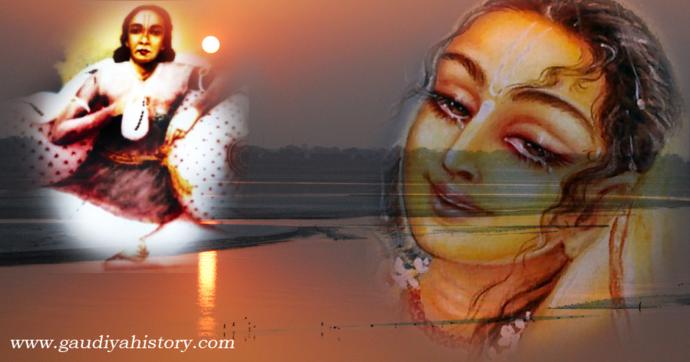
Shri Pundarika Vidyanidhi came to Navadwip because he wished to live by the banks of the Ganges. Mahaprabhu, the indweller of all beings, knew prior to his coming that he had such a desire, and one day in the assembly of Devotees started calling out, “Pundarika, My friend, My father!” and crying. (In the wallpaper: in the backgraund Ganges River, in the left Pundarika Vidyanidhi, in the right Shri Gauranga Mahaprabhu).

 
   When His associates asked Him why He was crying in this way, the Lord described Pundarika Vidyanidhi to them in the following way: “His character is quite extraordinary. Just by hearing his name, the whole world is purified, but he dresses and looks just like a materialistic person in the midst of the accouterments of the life of pleasure. No one is able to recognize him as a Vaishnava, yet he remains constantly merged in the deep ocean of devotion for Krishna. He never bathes in the Ganges because he is afraid to touch the holy waters with his feet, which would show disrespect. He only goes to take darshan of the Ganges at night and from a distance. He cannot bear to see people engaged in offensive behavior to the Ganges by gargling, cleaning their teeth, washing their hair in her waters, so he never goes there during the daytime. He never engages in worship of the Deity without having taken a drink of Ganges water. He has homes in both Chittagong and in Navadwip and will soon be arriving here. Because of his apparently materialistic behavior, you will not be able to recognize him, but I feel unwell because I am not able to see him.”
 
   The Supreme Lord has appeared in Navadwip, but He heaves long sighs because He doesn’t see Pundarika Vidyanidhi. Lord Gauranga stands up and starts to dance, calling out loudly, “Pundarika, My father! Pundarika, My friend, My father! When will I see you?” (Chaitanya Bhagavat 2.7.11-3)
 
   It is thought that Pundarika Vidyanidhi took initiation from Madhavendra Puripada at the same time that Advaita Acharya did. Mahaprabhu always showed him the respect that was due the godbrother of His own guru. In the Chaitanya Charitamrita, Krishnadas Kaviraj Goswami writes:
 
   I know Shri Pundarika Vidyanidhi to be a major branch, for the Lord Himself cried while spontaneously calling out his name. (Chaitanya Charitamrita 1.10.14)
 
Gadadhara Becomes Pundarika’s Disciple
 
   Shrila Gadadhara Pandit Goswami, Mukunda Datta and Vasudeva Datta were also originally from Chittagong and so they were acquainted with Pundarika Vidyanidhi. Indeed Gadadhar Pandit’s father Madhava Mishra was his good friend. Mukunda Datta knew his transcendental personality and that he was a Vaishnava, but Gadadhara did not, even though he was from the same town. This was, of course, a pretense for the sake of the lila.
 
   When Pundarika was living in Navadwip, Mukunda Datta told Gadadhar one day that he wanted to introduce him to a great Vaishnava. Shrila Gadadhara Pandit Goswami was a brahmachari from childhood and extremely detached from the senses and ascetic in his lifestyle. When he saw Pundarika sitting on comfortable cushions covered in sheets as white as the foam of milk, and wearing very expensive clothes and perfumes, smoking from a hookah, and generally surrounded by all the trappings of a sensual lifestyle, he was unable to recognize him as a Vaishnava. Indeed, he felt let down.
 
   Mukunda could see from Gadadhara’s face what was going through his head, and in order to bring out Pundarika’s inner mood, recited two verses from the Bhagavatam that enkindle the flames of love for Krishna.
 
aho bakiyam stana-kala-kutam
jighamsayapayayad apy asadhvi
lebhe gatim dhatry-ucitam tato’nyam
kam va dayalum sharanam prapadye
(Srimad Bhagavatam 3.2.23)
 
putana lokabalaghni rakshasi rudhirashana
jighamsayapi haraye stanam dattvapa sad-gatim
(Shrimad Bhagavatam 10.6.35)
 
   How truly amazing! The sister of Bakasura, the evil Putana, was sent on a mission to kill Krishna. He drank the kalakuta poison mixed with her breast milk, and despite her evil intentions, awarded her the position of a wet nurse (as Ambika Killimba in Goloka). Who is more merciful than He that I should take shelter of Him?
 
   That Rakshasi Putana was a blood-drinking killer of infants. Even though she wanted to kill Krishna, because she gave Him her breast, she attained the auspicious goal of a nurse in Goloka.
 
   As soon as he heard these two verses in glorification of Krishna’s mercy, Shri Pundarika Vidyanidhi cried out “Ha Krishna!” and fell to the floor in a swoon. He began to roll on the floor in ecstasy, knocking over the hookah and tearing his clothes. 
Pundarika Vidyanidhi

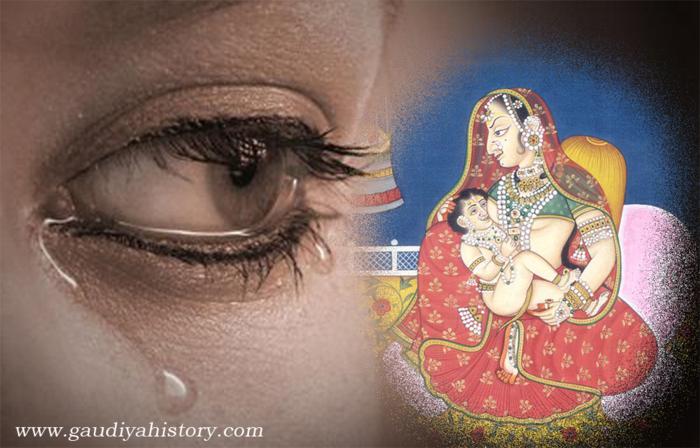
That Rakshasi Putana was a blood-drinking killer of infants. Even though she wanted to kill Krishna, because she gave Him her breast, she attained the auspicious goal of a nurse in Goloka. As soon as he heard these two verses in glorification of Krishna’s mercy, Shri Pundarika Vidyanidhi cried out “Ha Krishna!” and fell to the floor in a swoon. He began to roll on the floor in ecstasy, knocking over the hookah and tearing his clothes. (In the wallpaper: Putana feeding Krishna her milk).

 
   When he saw these transcendental symptoms of love on Pundarika’s body, Gadadhara realized that he had committed an offense, which he began to regret. He decided that the only way to rid himself of this offense would be to take initiation from Pundarika, and he related this idea to Mukunda. Mukunda then communicated his desire to Pundarika who happily set a date for the auspicious act. Mahaprabhu also gave His approval and so Gadadhara took mantra initiation from Pundarika Vidyanidhi. 
 
   In Krishna lila, Shri Pundarika Vidyanidhi is Vrishabhanu and Shrila Gadadhara Pandit Goswami is Radha. Because of his identity as Vrishabhanu, Mahaprabhu would call out to him as “father!” when He was Himself in the mood of Shrimati Radharani. The deep affection from their previous life’s relation became apparent between Pundarika and Gadadhara. No one can understand the pastimes of the Vaishnavas without their mercy.
 
vaishnava cinite nare devera shakati
mui kon chara shishu alpamati
 
   Even the gods are unable to recognize a Vaishnava, so how can a foolish, fallen child like Myself do so?
 
   Even though Pundarika Vidyanidhi was a great Vaishnava, he kept it a secret and appeared just like a materialistic person. One cannot recognize a Vaishnava through any superficial examination. Shrila Bhaktisiddhanta Saraswati Goswami Thakur writes in his Gaudiya-bhashya to the Chaitanya Bhagavat: “Krishna lila is not accessible to pure sensual understanding. Krishna’s servants occasionally go unrecognized due to their apparently materialistic surroundings. In this way they deceive the conditioned souls. Most scholars take Krishna’s activities to be those of a material lover because of their own obsession with sensuality, and thus they have no faith in Him. Others consider Krishna to be an ordinary man who is born and dies and is transformed and thus they have no idea of who He really is. Krishna’s Devotees are also sometimes reluctant to reveal their real selves to those who are unworthy and thus make a pretense of being ordinary materialistic persons. Gauranga Mahaprabhu is also sometimes called the pracchanna-avatar or hidden incarnation. In the same spirit, Pundarika put on the show of being sensualist for those who were capable of being deceived by someone’s external appearance.”
 
   One day Pundarika Vidyanidhi came to see Mahaprabhu when it was already quite late at night. As soon as he saw the Lord, he was so overcome by love that he could not even pay his obeisances. Mahaprabhu was similarly anxious to see His most dear Devotee, Pundarika and He immediately took him to his breast and washed Him with his tears of love. When the other Devotees heard Mahaprabhu cry and call Pundarika “father” and “treasure of love”, they knew that he was most dear to Him. Pundarika Vidyanidhi was also known to Mahaprabhu’s associates as Acharyanidhi.
 
   The Supreme Lord cried and called out “Pundarika! Father! Today I have seen My own father! Today I rose from My sleep at an auspicious moment, and I saw Premanidhi standing before me. (Chaitanya Bhagavat 2.7.131, 143)
 
Pundarika in Puri
 
   Shri Pundarika Vidyanidhi participated in the nightly sankirtan festival in Shrivasa Pandit’s house along with Mahaprabhu and His other associates. On Mahaprabhu’s order, Nityananda and Hari Das went door to door to spread the chanting of the Holy Names and thus to liberate the conditioned souls, succeeding in converting Jagai and Madhai. Later, when Jagai and Madhai were sitting amongst the Devotees before Mahaprabhu, they also displayed the ecstatic symptoms of prema. Shri Pundarika Vidyanidhi was also present there and he became completely submerged in loving ecstasy to see their fortune. On Mahaprabhu’s order, the Devotees led by Advaita Acharya went each year to see the Rathayatra. Krishnadas Kaviraj Goswami describes him as being one of the leaders of Gauranga’s associates as they made the annual trip:
 
   All of Mahaprabhu’s servants such as Advaita, Nityananda, Mukunda, Shrivasa, Vidyanidhi, Vasudeva and Murari came together each year to meet with Him and they would stay four months. The Lord enjoyed many pastimes in their company. (Chaitanya Charitamrita 2.1.255-6)
 
   Shri Pundarika Vidyanidhi was also present at Jagannath’s Chandana yatra festival when Mahaprabhu and all His Devotees would play in the water of Narendra Sarovara, also known as Chandan Pukur. Pundarika and Svarupa Damodar were close friends and they joyfully splashed each other as a part of these pastimes.
 
   Vidyanidhi and Svarupa Damodar were friends. Laughing, they splashed water on each other. (Chaitanya Bhagavat 3.8.124)
 
   Pundarika Vidyanidhi also participated with Mahaprabhu and His associates in the cleaning of the Gundicha Temple, afterwards relishing Mahaprasad with them.
 
Gadadhara Wants to be Reinitiated
 
   One day, Shrila Gadadhara Pandit Goswami asked Mahaprabhu if he could retake again. He said,
 
   “Ever since I repeated my ishta-mantra to someone, I have been unable to concentrate when I chant. Please repeat the mantra to me, then my mind will be calmed.”
 
   Mahaprabhu answered, “You already have a mantropadeshaka guru. Be careful, otherwise you will be an offender to him. Everything I have is yours, even My life, what to speak of the mantra. But as long as your guru is alive it is improper for Me to repeat it to you.” (Chaitanya Bhagavat 3.10.23-6)
 
   Gadadhara answered, saying, “He isn’t here. Please do it in his place.”
 
   Mahaprabhu replied: “Destiny will bring your guru Vidyanidhi to you.” The omniscient Mahaprabhu continued, “Shri Pundarika Vidyanidhi will be here in Puri to see Me in ten days.” And that is what came to pass. Mahaprabhu became ecstatic, crying, “Father has come! Father has come!” Upon Vidyanidhi’s arrival, Gadadhara went to him and asked him to repeat the mantra to him.
 
   Gadadhara Deva asked Premanidhi to again initiate him in the ishta-mantra, which he lovingly did. How can I sufficiently glorify Shri Pundarika Vidyanidhi, who has a loving disciple like Gadadhara Pandit! (Chaitanya Bhagavat 3.10.79-80)
 
   Our most worshipable Shrila Prabhupada commented on the above verse (3.10.24) in the following way: “The mantra is that divine sound or shabda brahma which destroys the mental aptitude for sense gratification. If one instructs a faithless person in the divine sound, the mind becomes contaminated. If one’s divine understanding (divya-jïana) is destroyed, then one must seek the same again. Gadadhara Pandit understood this and so he asked Gaurasundara Mahaprabhu to reinitiate him. Mahaprabhu’s judgment, however, was that he should go to his own guru to hear the mantra again.”
 
   The lesson to be learned here is this: Shrila Gadadhara Pandit Goswami is Mahaprabhu’s eternal associate; it is thus impossible that any contamination could have entered his mind. It was only through Gadadhara that He was instructing those who would be guru that if one instructs an unqualified person in the mantra, it loses its potency and no longer brings the same joy to the heart of the practitioner. When this happens, it is necessary to go to the guru again and hear the mantra from him again. It is against custom to hear the mantra again from someone who is not one’s guru, because one cannot change initiating spiritual masters in this way. Gadadhara was only saying “I cannot concentrate like before” (na sphure bhalo mati), i.e., “The ecstatic feelings no longer come when I chant”, out of an exemplary humility designed to teach humanity how to act.
 
Jagannath Slaps Pundarika
 
   On the Oriana Shashthi festival, Jagannath’s servants dress Him in a cloth which still has starch in it. Shri Pundarika Vidyanidhi was a pure sad-achari, i.e., attached to the proper etiquette of Vaishnavism. When he observed this custom, he did not feel happy about it and said to his friend, Svarupa Damodar, “Why do they give this unwashed cloth to the Lord? The people of this country know the rules in the Smritis and the Shrutis, so why do they give this mariuwa cloth to Jagannath?”
 
   Svarupa Damodar answered that the Supreme Lord is beyond the rules and regulations that have become general custom and that therefore there was no fault. Vidyanidhi did not find this conclusion satisfying and he countered by saying, “That may be true for the Lord Himself. But His servants should follow the rules of the scripture. The shri-vigraha of the Lord is beyond the material qualities, so you can say this of Him, but His servants are not of the same nature as He. So we have to judge whether their behavior is proper or improper.”
 
   Vidyanidhi is Mahaprabhu’s dear associate and beyond any fault, but once again we see that the Lord teaches particular lessons through His Devotees. Here He wished to show that we have no right to make judgments or to find fault with the behavior of Jagannath’s Devotees. That night an angry Jagannath came to Pundarika Vidyanidhi and gave him a dream vision. Vidyanidhi was frightened when he saw the anger of the Lord. He saw both Jagannath and Balaram slap him on each of his cheeks and he started to cry out, “Krishna save me! Krishna, save me! Forgive me my offense!” Jagannath said to him:
 
   “There is no end to your offensiveness. Just as there is no question of pure and impure in My case, the same holds true for My servants. You are staying here; you should know all this. If you thought that it was impure, then why did you stay at all? Go home then, if you want to maintain your purity.” (Chaitanya Bhagavat 3.10.131-2) 
Pundarika Vidyanidhi

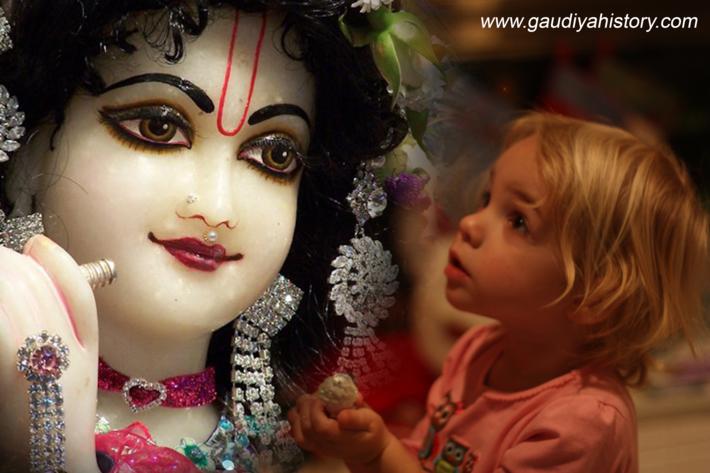
Jagannath said to him: “There is no end to your offensiveness. Just as there is no question of pure and impure in My case, the same holds true for My servants. You are staying here; you should know all this. If you thought that it was impure, then why did you stay at all? Go home then, if you want to maintain your purity.” (Chaitanya Bhagavat 3.10.131-2) When he woke up in the morning, the Devotees saw the marks of the Lords’ slaps on his cheeks, which had swollen as a result and they started to laugh. This pastime shows just how dear Shri Pundarika Vidyanidhi was to Jagannath and to Mahaprabhu, for the Lord only comes to His dearest Devotees to personally punish them in this way. (In the wallpaper: Lord Jagannath, a girl).

 
   When he woke up in the morning, the Devotees saw the marks of the Lords’ slaps on his cheeks, which had swollen as a result and they started to laugh. This pastime shows just how dear Shri Pundarika Vidyanidhi was to Jagannath and to Mahaprabhu, for the Lord only comes to His dearest Devotees to personally punish them in this way.
 
   That night Jagannath and Balaram came to him and, laughing all the while, slapped him on the cheeks. Pundarika Vidyanidhi felt a secret joy at his swollen cheeks, as has been described by Vrindavan Das in detail. (Chaitanya Charitamrita 2.16.80-1)
 
   It is stated in the Bhakti-ratnakara that Mahaprabhu celebrated the birth of Radharani at Sri Pundarika Vidyanidhi’s house. (Bhakti-ratnakara 12.3177).
 
   Vrindavan Das Thakur concludes the Chaitanya Bhagavat with the following glorification of Shri Pundarika Vidyanidhi:
 
   The Supreme Lord Gauranga called out the name of this Devotee, crying “Pundarika, My father. Anyone who hears about his life and activities will undoubtedly attain Krishna’s lotus feet.” (Chaitanya Bhagavat 3.10.183-4)
 
   [Excerpted from “Shri Chaitanya: His Life & Associates” by Shrila Bhakti Ballabh Tirtha Maharaj]

Shrivasa Pandit – Biography 3

Shrivasa Pandit

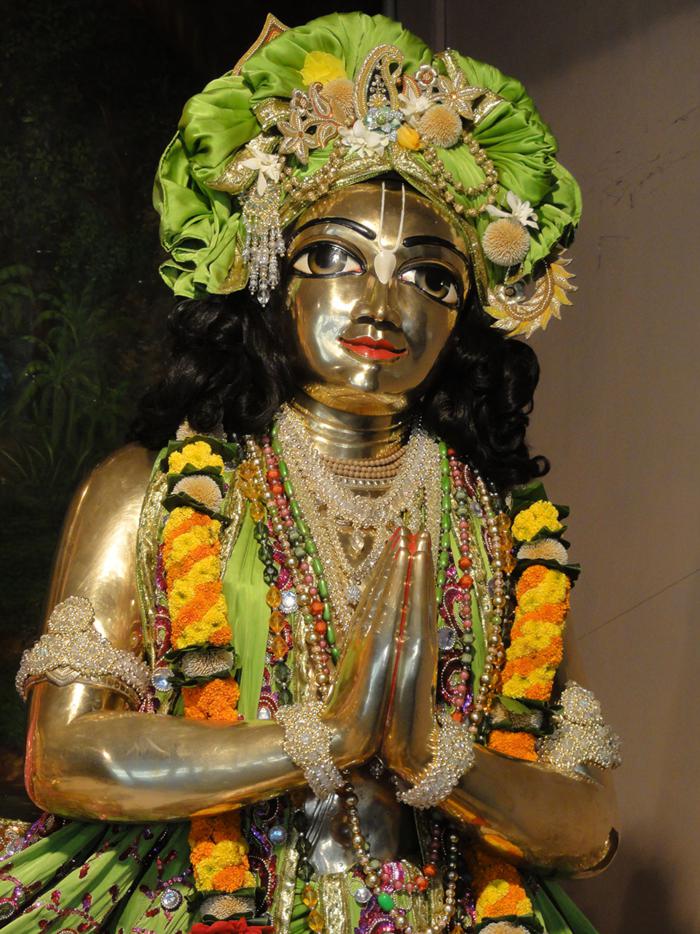
Shrivasa Pandit, ISKCON Mayapur.

   The Pancha Tattva
 
   "There is no difference between the energy and the energetic in regard to the Lord's appearance as Shri Chaitanya Mahaprabhu and His four associates — Nityananda Prabhu, Advaita Prabhu, Gadadhara, and Shrivasa. Amongst these five diverse manifestations of the Supreme Lord (as the Lord Himself and His incarnation, expansion and energies) there is no spiritual difference. They are five in one Absolute Truth. For the sake of relishing transcendental flavors in the Absolute Truth, there are five diverse manifestations. These are called the form of a Devotee, the identity of a Devotee, the incarnation of a Devotee, the pure Devotee and devotional energy.
 
   Out of the five diversities in the Absolute Truth, the form of Lord Chaitanya is that of the original Personality of Godhead, Krishna. Lord Nityananda is the manifestation of the first expansion of the Supreme Lord. Similarly, Advaita Prabhu is an incarnation of the Supreme Lord. These three–Chaitanya, Nityananda and Advaita–belong to the category of Vishnu-tattva, or the Supreme Absolute Truth. Shrivasa represents the pure Devotee, and Gadadhara represents the internal energy of the Lord for the advancement of pure devotion. Therefore Gadadhara and Shrivasa, although included in Vishnu-tattva, are dependent, diverse energies of the Supreme Lord. In other words, they are not different from the energetic, but they are manifest diversely for the sake of relishing transcendental relationships. The whole process of devotional service involves a transcendental reciprocation in the relationship between the worshiper and the worshiped. Without such a diverse exchange of transcendental flavors, devotional service has no meaning." [Teachings of Lord Chaitanya, Chapter 17 by HDG A.C. Bhaktivedanta Swami Shrila Prabhupada]
 
Shrivas Pandit's Origins
 
shrivasa-pandita dhiman yah pura narado munih
parvatakhyo muni-varo ya asin narada-priyah
shri-rama-panditah shriman tat-kanistha-sahodarah
namnambika vraje dhatri stanya-datri sthita pura
saiveyam Malini namni shrivassa-grhini mata
 
   Shrivas is Narada, who plays such an important part in Krishna's lila. Narada Muni's friend Parvata Muni appeared as Shrivas' younger brother Ramai. Shrivas' wife Malini Devi was Krishna's wet nurse in Vraja, Ambika. (Gaura-ganoddesha-dipika 90)
 
   Shrivas Pandit hailed from Sylhet. He later came to live in Navadwip where he made an immense contribution to Gauranga lila. From the Chaitanya Bhagavata and Chaitanya Charitamrita we learn that Shrivas had three brothers living with him in Navadwipa: Shrirama Pandit, Shripati Pandit and Shrikanta or Shrinidhi Pandit. All four were participants in Mahaprabhu's lila.
 
   Gaudiya Vaishnava Abhidhana cites Prema-vilasa in saying that Shrivas' father was a Vedic Brahmin of the name Shri Jaladhar Pandit. Shrivas Pandit was the second of five sons. The eldest son, Shri Nalina Pandit, had a daughter named Narayani, the mother of the author of the Chaitanya Bhagavata, Vrindavan Das. Narayani's husband Vaikuntha Das Vipra died while she was pregnant with Vrindavan Das, so she left her husband's house in Kumarahatta (Halisahar) and came to live with Shrivas in Navadwip.
 
Kirtan Pastimes at Shrivas Angan
 
   After a night of kirtan at Shrivas' house, when Mahaprabhu returned to external awareness, He would go with all the Devotees to bathe in the Ganges. Sometimes the Devotees would ceremonially bathe the Lord at Shrivas Angan. One of Shrivas' servant girls named Dukhi would watch Mahaprabhu's ecstatic dancing with tears in her eyes. She also performed the service of filling jugs of water from the Ganges for Mahaprabhu's morning bath. One day, Mahaprabhu observed her devotion and was pleased; He changed her name from Dukhi ("unhappy") to Sukhi ("happy").
 
   Another day, Shrivas' only son died while sankirtana was being performed in his house. Shrivas was afraid that the sounds of mourning from the women's quarters would disturb Mahaprabhu while He was engaged in singing the Holy Names. So he went directly into the house and tried to quiet the women by explaining spiritual truths to them. When they still didn't stop their loud lamentations, Shrivas threatened to throw himself into the river and drown if they did not stop making noise. This had the desired result.
 
   Later on that night, however, the kirtan came to a stop and Mahaprabhu said, "Something doesn't seem right. Has some tragedy taken place in the pandit's house?" Shrivas answered, "How can anything be wrong, when I have Your smiling face in my home?"
 
   However, some of the other Devotees said, "Prabhu, Shrivas' only son died in the evening about an hour after sunset."
 
   Mahaprabhu asked, "Why did no one say anything before now?"
 
   The Devotees answered, "Lord, Shrivas told us not to, because he was afraid that it would interfere with Your pleasure in kirtana."
 
   Mahaprabhu said, "How could I ever abandon Devotees who love Me to this extent!" and started to cry. After this, He went inside and sat down beside the child's dead body and brought him back to consciousness. He asked, "Child! Why do you want to leave the house of such a great Devotee as Shrivas?"
 
   The dead child answered, "The few days that I was to spend in Shrivas' house are over, and now I am following Your wishes in going elsewhere. I am a living being without any independence; I cannot go against Your wishes. Please be merciful to me that I never forget Your lotus feet, wherever I go."
 
   When Shrivas' family members heard the child speak such wisdom, they immediately forgot their distress and stopped mourning. Mahaprabhu said to Shrivas, "From this day on, Nityananda and I will be your sons. We will never leave you."
 
   [Excerpted from “Shri Chaitanya: His Life & Associates” by Shrila Bhakti Ballabh Tirtha Maharaj] 
Shrivasa Pandit

Mahaprabhu said, "How could I ever abandon Devotees who love Me to this extent!" and started to cry..."From this day on, Nityananda and I will be your sons. We will never leave you." (In the wallpaper: Shri Gaura Nitay, ISKCON Leicester, UK).

Narahari Sarakara Thakura – Biography

Narahari Sarakara Thakura

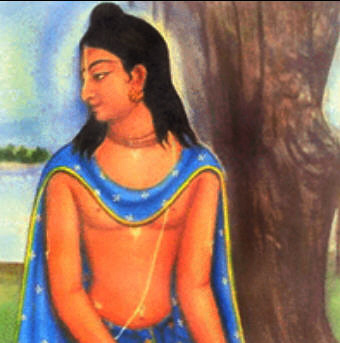
Shrila Narahari Sarkar Thakur is counted as one of Chaitanya’s branches on the desire tree of pure devotional service. By Mahaprabhu’s desire, he took birth in a physician (vaidya) family, blessing his family by so doing. He was the Lord’s chief associate amongst the residents of the village of Shrikhanda. (In the image: Shrila Narahari Sarakara Thakura).

   pura madhumati prana-sakhi vrindavane sthita
adhuna narahary-akhyah sarakarah prabhoh priyah
 
   She who was previously Radha’s intimate girlfriend named Madhumati is today Narahari Sarkar, the Lord’s dear associate. (Gaura-ganoddesha-dipika 117)
 
   Shrila Narahari Sarkar Thakur is counted as one of Chaitanya’s branches on the desire tree of pure devotional service. By Mahaprabhu’s desire, he took birth in a physician (vaidya) family, blessing his family by so doing. He was the Lord’s chief associate amongst the residents of the village of Shrikhanda. The Shrikhanda railway station is in Burdwan district four miles west of Katwa. Narahari’s home is about one mile from the station.
 
   Some of the other residents of Shrikhanda who were Devotees of Lord Chaitanya were: Shri Mukunda, Shri Raghunandan, Shri Chiranjiva, Shri Sulochana, Shri Damodar Kaviraj, Shri Ramachandra Kaviraj, Shri Govinda Kaviraj, Shri Balaram Das, Shri Ratikanta, Shri Ramagopala Das, Shri Pitambara Das, Shri Sachinandana, Shri Jagadananda, etc. Krishnadas Kaviraj Goswami mentions many of these names as Chaitanya’s branches that generously distributed the fruits of love of God. (Chaitanya Charitamrita 1.10.78-9)
 
   The scholar Bharat Mallik has written the following Sanskrit verses about Narahari’s appearance in a vaidya family in his book Chandra-prabha:
 
shrikhanda-nama-nagari radhe bangeshu vishruta
sarvesham eva vaidyanam ashrayo yatra vidyate
yatra goshthi-bhuta vaidya yah khando’bhud bhishak-priyah
visheshatah kulinanam sarvesham eva vasa-bhuh
 
   In Bengal, in the area known as Rarha (Burdwan, Birbhum), there is a famous town known as Shrikhanda that gave shelter to all the physician clans. Since vaidyas gathered there, it became a favored residence for them, especially those who were of the most noble birth.
 
   In the Gaudiya Vaishnava Abhidhana, it is stated that Narahari Sarkar Thakur appeared in either the Shaka year 1401 or 1402 (1479-80 AD). His father’s name was Shri Narayan Das, his mother Shri Goyi. Shri Goyi was the daughter of Murari Sena. Narayan Das had three sons, Mukunda, Madhava and Narahari. Raghunandan Thakur was Mukunda’s son. (Bhakti-ratnakara 11.730-1).
 
   The author of Chaitanya Mangala, Lochana Das, who came from the village of Kogram, near Jhamatpur, was Narahari’s disciple. For this reason, Lochana Das writes that Shrila Gadadhara Pandit Goswami and Narahari Sarkar Thakur were Mahaprabhu’s dearest associates. On the other hand, in Chaitanya Bhagavat, Vrindavan Das Thakur has not spoken at any length about the Devotees of Shrikhanda.
 
   Shrila Lochana Das Thakur has written the following about his guru in Chaitanya Mangala:
 
   Narahari Das Thakur is my worshipable master. He possessed the power of the pure lineage of a family of physicians. His body was permeated by love for Krishna, and other than Krishna-prema, he taught nothing to those who were his disciples. He was previously known as Madhumati, one of Radha’s dearest sakhis in Vrindavan, a storehouse of sweetness. Now in the Age of Kali, with the appearance of Gauranga, he has become the keeper of the storehouse of love for Radha and Krishna. 
Narahari Sarakara Thakura

Even before becoming Mahaprabhu’s associate, he composed songs glorifying Radha and Govinda’s pastimes. When Shrila Gadadhara Pandit Goswami was constantly by the Lord’s side, engaged in His service, Narahari had the good fortune to enter into His association. (In the wallpaper: Shri Shri Radha Gopinath, ISKCON Chowpatty, Mumbai).

 
   After the death of his father Narayan, Narahari’s older brother Mukunda arranged for him to study in Navadwip. It is said that Mukunda sometimes worked as the Shah’s family physician. Narahari quickly became very learned as well as a connoisseur of the flavors of devotional. Even before becoming Mahaprabhu’s associate, he composed songs glorifying Radha and Govinda’s pastimes. When Shrila Gadadhara Pandit Goswami was constantly by the Lord’s side, engaged in His service, Narahari had the good fortune to enter into His association. Narahari Sarkar Thakur’s personal service was to fan the Lord with the yaktail whisk. Shrila Bhaktivinoda Thakur, Mahaprabhu’s personal representative, confirmed this in his Gaura-arati:
 
narahari adi kare camara dhulay
saïjaya, mukunda, vasu ghosha adi gay
 
   Narahari and the other residents of Shrikhanda fanned with the camara, while Sanjaya, Mukunda and Vasu Ghosh sang.
 
   Narahari wrote several books, including Bhakti-chandrika-patala, Shri-Krishna-bhajanamrita, Shri-chaitanya-sahasranama, Shri-Sachinandanashtaka, Shri-Radhashtaka, etc. All of these are well known and thought of highly by the Devotees.
 
Narahari Sarakara Thakura

Shri Shri Gaura Gadadhara Deities of Sarakara Thakura, Vishakha Math, Puri).

   The following story is told about Narahari: Once when Mahaprabhu and Nityananda Prabhu came to his house in Shrikhanda, they suddenly expressed a desire for honey. Narahari demonstrated his miraculous powers by transforming the water in a pond near his house into honey. He quenched the Lords’ desire for honey with water from this pond, which has ever since been called Madhu-pushkarini. The Lord gave Narahari the order in a dream to install three Deities of Himself, which are currently worshipped in Shrikhanda, Katwa and Ganganagara. 
 
   Narahari Sarakar Thakur also participated in the Lord’s activities in Puri. He and the other residents of Shrikhanda would come every year with Shivananda Sena (Chaitanya Charitamrita 2.1.132). After His pilgrimage to South India, when He had saved so many people by giving them love for Krishna, Mahaprabhu returned to Puri when Nityananda sent his servant Kala Krishna Das back to Bengal to tell everyone of the Lord’s arrival. All the Devotees immediately made arrangements to go to Jagannath Puri to see the Lord. The Khanda-vasis were amongst their number.
 
   Mukunda, Narahari, and Raghunandan from Shrikhanda arrived at Advaita Acharya’s house to go to Nilachala. (Chaitanya Charitamrita 2.10.90)
 
   After Jagannath’s Snana Yatra, Jagannath would be unavailable for darshan. Mahaprabhu would go to Alalanath during this time in search of relief from the feelings of separation do to not being able to see Jagannath. When Sarvabhauma Bhattacharya asked Gopinath Acharya to identify the Lord’s Devotees, he mentioned the names of Narahari, Mukunda Das, Raghunandan, Chiranjiva and Sulochan. (Chaitanya Charitamrita 2.11.92)
 
   During the Rathayatra festival, the Lord formed seven kirtan groups with the Devotees from Bengal. One of these was composed uniquely of the Devotees from Shrikhanda. Krishnadas Kaviraj Goswami writes that Narahari and Raghunandan were the dancers for this group, which sang separately from the others. (Chaitanya Charitamrita 2.13.46)
 
   When the Lord gave all the Devotees directions for service, He told Narahari to remain in the association of Devotees. (Chaitanya Charitamrita 2.15.132)
 
   Many people confuse the author of Bhakti-ratnakara, Narahari Chakravarti, with Narahari Sarakar Thakur. The former, who is also known as Ghanashyama Das, is a different person who was born in the district of Murshidabad. His father’s name was Jagannath Chakravarti and he was a disciple of Vishvanath Chakravarti. On Govindaji’s order, he was engaged as the cook for the Govinda Temple and was known as the “cooking pujari” (rasuiya pujari) in Braj.
 
   The following song was written by Narahari Sarakar Thakur:
 
aola gaura puna hi nadiya pura
hoyata manahi ullasa
aiche ananda kanda kiye heraba
karabahi kirtana vilasa
 
hari hari,
kaba hama heraba so mukha-cada
viraha payodhi kabahu dina pan raba
tutaba hridayaka bandha
 
kundana kanaka panti keba heraba
yajïa ki sutra viraja
bahu-jugala tuli hari hari bolaba
natana bhakata-gana majha
 
eta kahi nayana mudi bahu saba jana
gaura prema bhela bhora
narahari dasa asha kaba puraba
heraba gaura-kishora
 
   If Gaura came back to Nadia town, my mind would be filled with joy. Then I would see Him, the source of all joy, performing His kirtan pastimes.
 
   Hari Hari! When will I again gaze upon that moon-like face? When will that day come when the dam holding the ocean of separation in my heart breaks?
 
   When will I see the golden form of the Lord, wrapped in His yajna-sutra? Lifting my arms in the air, I will shout “Hari! Hari!” and dance in the midst of the Devotees.
 
   Saying such things, many of Gaura’s Devotees close their eyes and merge into love for Him. When will Narahari’s desires be filled? When will he gaze again upon the form of the young Gaura?
 
   Narahari disappeared in around 1540 AÒ. [Not according to his descendants, who say that he lived 100 years until 1578 or so.] in the month of Agrahayan on the Krishna Ekadashi day. Shrinivas Acharya officiated at his funeral ceremony. Nityananda Prabhu’s son Virachandra Goswami and many other important Vaishnavas were in Shrikhanda to celebrate Narahari’s disappearance feast, which is described in Bhakti-ratnakara:
 
   Some people said, “Brothers! Do not leave right away. An ocean of prema will flood over in Shrikhanda in a few days. On the thirteenth day of the waning moon of Agrahayan, when Narahari Thakur disappeared, a great festival will be held here.” (Bhakti-ratnakara 9.512-4)
 
   [Excerpted from “Shri Chaitanya: His Life & Associates” by Shrila Bhakti Ballabh Tirtha Maharaj] 
Narahari Sarakara Thakura 8

If Gaura came back to Nadia town, my mind would be filled with joy. Then I would see Him, the source of all joy, performing His kirtan pastimes. Hari Hari! When will I again gaze upon that moon-like face? When will that day come when the dam holding the ocean of separation in my heart breaks? When will I see the golden form of the Lord, wrapped in His yajna-sutra? Lifting my arms in the air, I will shout “Hari! Hari!” and dance in the midst of the Devotees. (In the wallpaper: Harinaam Sankirtan, ISKCON Ashgabat, Turkmenistan, Shri Gaurachandra, ISKCON Chowpatty, Mumbai).

Murari Gupta – Biography

 
Murari Gupta

The word gupta means “hidden”, so the name Murari Gupta indicates that Murari (Shri Chaitanya Deva) had secretly taken up permanent residence in his heart. (Chaitanya Bhagavat 2.10.31) (In the image: Lord Rama embracing Hanuman (Murari Gupta in Chaitanya lila)).

  murari-gupto hanuman
angadah shri-purandarah
yah shri-sugriva-namasid
govindananda eva sah
 
   Murari Gupta was Hanuman in Ramachandra’s lila; Purandara was Angada and Govindananda Sugriva. (Gaura-ganoddesha-dipika 91)
 
   The word gupta means “hidden”, so the name Murari Gupta indicates that Murari (Shri Chaitanya Deva) had secretly taken up permanent residence in his heart. (Chaitanya Bhagavat 2.10.31)
 
   Murari Gupta took birth in a family of Ayurvedic physicians in the district of Sylhet.
 
   Murari Gupta is a physician for the material disease. He was amongst the many associates of Mahaprabhu who appeared in Sylhet. (Chaitanya Bhagavat 1.2.35)
 
   The names of his parents are unknown. He was somewhat older than Mahaprabhu. When his family moved from Sylhet to take up residence in Navadwip, they lived in the same neighborhood as Shri Chaitanya, so Murari was Nimai’s companion in many of his childhood pastimes. It is also written in the Chaitanya Charitamrita that Murari observed Mahaprabhu’s childhood pastimes. His name is included in the Chaitanya Bhagavat’s list of associates who appeared prior to Mahaprabhu’s incarnation.
 
   Hidden in Navadwip, there were many who had previously taken birth at the Lord’s command. They included Shri Chandrashekhara, Jagadisha, Gopinath, Shriman, Murari, Shri Garuda and Ganga Das. (Chaitanya Bhagavat 1.2.98-99)
 
Murari’s Student Life in Navadwip
 
   Along with Mahaprabhu, he was also a student at Ganga Das Pandit’s Tol. When the Lord was engaged in His pastimes of learning and study, He would often engage Murari in joking and mock debate. Murari Gupta was amazed at Mahaprabhu’s wonderful intelligence and just the touch of His hand would so immerse him in ecstasy that he was early convinced that He was no ordinary human being. 
Murari Gupta

The Vaishnava’s ornament is humility. Mahaprabhu would melt when he saw the humility of Murari Gupta. (In the image: Devotees are in Vrindavan Dham).

 
   One day, the Lord was pleased with the explanation which Murari Gupta gave Him, one which he was able to give through the Lord’s grace. He touched Murari with His hand and his entire body was filled with ecstasy. Murari Gupta thought that this person can in no way be an ordinary human being. Can an ordinary human attain such scholarship so quickly? And His touch brings such ecstatic pleasure!  (Chaitanya Bhagavat 1.10.49)
 
   The Vaishnava’s ornament is humility. Mahaprabhu would melt when he saw the humility of Murari Gupta.
 
   Murari Gupta, the twenty-first branch of the Chaitanya tree, was a storehouse of love. The Lord’s heart would melt when He saw Murari’s meekness and humility. (Chaitanya Charitamrita 1.10.49)
 
Mahaprabhu’s Special Mercy to Murari
 
   When Mahaprabhu returned from Gaya, He saw Murari at the house of Shuklambar Brahmachari. Murari had heard of Mahaprabhu’s transformations from Shriman Pandit. Mahaprabhu was pleased with Murari and one day He gave him a vision of His form as the Varaha avatar; the Lord lifted Murari’s water jug on His nose as He gave a loud roar. Murari considered his life to have been fulfilled by this vision and he composed a hymn in glorification of the Lord. This event has been beautifully described by Vrindavan Das Thakur in the Chaitanya Bhagavat, Madhya-khanda, chapter 3.
 
   The Lord took on the mood of Varaha in the house of Murari. The Lord climbed on His shoulders and danced in the courtyard. (Chaitanya Charitamrita 1.17.19)
 
   Lord Gaurahari had the same kind of affection for Murari Gupta that Lord Ramachandra had for His servant, Hanuman. (Chaitanya Bhagavat 2.3.11) On the occasion of the 21-hour great manifestation (maha-prakasha) at Shrivasa Angana, the Lord gave Murari a vision of Himself as Ramachandra. When he saw his worshipable Deity before him, Murari fainted. Then he glorified the Lord in a way which so pleased Him that He gave a benediction to Murari which fulfilled all his desires. 
Murari Gupta

Mahaprabhu was pleased with Murari and one day He gave him a vision of His form as the Varaha avatar; the Lord lifted Murari’s water jug on His nose as He gave a loud roar. Murari considered his life to have been fulfilled by this vision and he composed a hymn in glorification of the Lord. (In the image: Lord Chaitanya is showing His Varaha form to Muraru Gupta).

 
   He ordered Murari, “Look at my form”, and lo! Murari saw the form of Raghunatha directly before him. He saw the Lord of the Universe in the swarthy color of durba grass, sitting in the virasana, in the posture of a great bowman. He saw Sita and Lakshman standing on either side of Him, and His army of monkeys surrounding Him singing hymns of praise. It seemed to him that he was himself one of the monkeys, and as soon as he saw this, he fell down in a faint. The best of the physicians, Murari, lay unconscious on the ground, completely under Mahaprabhu’s spell. (Chaitanya Bhagavat 2.10.7-11) 
 
   On one occasion, when Mahaprabhu heard Murari Gupta recite the glories of Ramachandra, He wrote “the servant of Rama” on his forehead. (Chaitanya Charitamrita 1.17.61) On another occasion, Mahaprabhu displayed a four-armed Narayan form in the house of Shrivasa, and began calling the name of Garuda. Murari Gupta heard the call, and giving a loud roar took the form of the king of birds. Mahaprabhu then climbed on his shoulders. This lila is described in the 20th chapter of the Madhya-khanda of Chaitanya Bhagavat, and in the 12th wave of Bhakti-ratnakara.
 
Murari and Nityananda Prabhu
 
   At Shrivasa’s house, Mahaprabhu taught the spiritual truths about Himself, Nityananda Prabhu and matters of etiquette through Murari. One day, Murari Gupta came to Shrivasa’s house. Upon arriving, he first paid obeisances to Mahaprabhu and then to Nityananda. Mahaprabhu said, “This is not correct.” Murari could not understand what He meant. That night when he returned home, he had a dream in which he saw Nityananda as Balaram, fanning Mahaprabhu-Krishna with a fly whisk. Murari then understood what Mahaprabhu had been telling him and from then on first paid obeisances to Nityananda and afterwards to Mahaprabhu. Shrila Bhaktisiddhanta Saraswati Goswami Thakur writes in his Gaudiya-bhashya, “Shri Murari was a worshiper of Balaram. Therefore to worship the Supreme Lord without first worshiping the guru and the jagad-guru is a mistake in sequence.” 
Murari Gupta

“Shri Murari was a worshiper of Balaram. Therefore to worship the Supreme Lord without first worshiping the guru and the jagad-guru is a mistake in sequence.” (In the image: Obeisances before Shrila Prabhupada).

 
   The lotus-eyed Mahaprabhu was sitting down with the smiling Nityananda at his right hand side. Murari paid obeisances first to Nityananda and then to the feet of Vishvambhara. (Chaitanya Bhagavat 2.20.22-3)
 
The Lord Gives Murari His Pan
 
   Mahaprabhu had great affection for Murari Gupta and so would give him His own pan, which Murari would eat with relish. When Mahaprabhu told Murari to wash his hands, Murari would simply wipe his hands on his head. It was at this time that Mahaprabhu suddenly began to criticize the false views of the Smarta Brahmins and Prakashananda’s mayavada.
 
   The Lord said, “O foolish one, you will lose your caste status. My remnants are all over your body.” As he spoke, the Lord went into a trance in which He took on His identity as the Supreme Person. He ground His teeth and started to say something special, “There is a sannyasi named Prakashananda in Kashi who is cutting me into little bits. He teaches the Vedanta, but does not accept My form. I have caused him to become leprous, but still he does not understand. The fool does not realize that the unlimited universes are contained within My body, what arrogance that he should deny it! I tell you the truth Murari, for you are My servant: anyone who does not accept My form is bound for ruin.” (Chaitanya Bhagavat 2.20.31-36)
 
Murari Cures the Lord’s Indigestion
 
   The Lord is very happy to accept a Devotee’s offering, no matter how it is made. When Murari returned home, he told his wife that he wished to eat. His devoted wife carefully prepared rice with ghee and gave it to her husband. But Murari, absorbed in contemplation on Krishna, took handful after handful of the food and threw it on the ground, offering it to the Lord in this way. The amazing thing is that even though Mahaprabhu was not physically present there at that time, He accepted the offering. The next day He came to Murari’s house and said to him, “I have come to you for medicine. You made Me eat so much, insisting that I take and eat. Now I have indigestion. You must give Me some water, that will be the remedy for My stomach problem.” Mahaprabhu took water from a jug in Murari’s house, drinking down its entire contents. Seeing this, Murari fainted and all the Devotees began to cry. (Chaitanya Bhagavat 2.20.69-71)
 
   Murari would cure anyone who came to him, whether their disease was of the body or the soul. (Chaitanya Charitamrita 1.10.51)
 
Murari’s Fear of the Lord’s Departure
 
   Murari Gupta analyzed the multiple incarnations of the Lord and came to the conclusion that in each one of the Lord’s appearances, before Himself leaving, He arranged for His associates to leave also. Thus, Ramachandra destroyed Ravana to save Sita, but then He abandoned her. Krishna arranged for the destruction of the Yadus. Thus, Mahaprabhu too would inevitably be disappearing at a certain moment. He thought that it would be better for him to depart before that day arrived, for it would be too painful for him. For this reason, Murari purchased a sharp knife and kept it hidden in his home. The Lord knew of his intention and immediately came to his house and asked Murari to hand over the knife. Both the above mentioned lilas are found described in the Bhakti-ratnakara’s twelfth wave.
 
   Murari Gupta would also go on the annual pilgrimage to see Mahaprabhu in Puri. Accompanied by his wife, he would feed Mahaprabhu many preparations. He would participate in the Rathayatra festival as a member of the third sankirtan group in which Mukunda Datta sang and Hari Das Thakur danced.
 
Murari’s Exclusive Devotion to Rama
 
   Mahaprabhu taught the principle of devotion to one’s worshipable Deity through Murari Gupta. One cannot advance in devotional service without a particular devotion to a worshipable Deity, or ishta-devata. Murari was an incarnation of Hanuman, and he saw Chaitanya Mahaprabhu as Ramachandra. On one occasion, Mahaprabhu desired to test his loyalty to his worshipable Deity Rama by telling him to worship Krishna. He explained to Murari that Krishna was the Supreme Personality of Godhead, the fountainhead of all the other incarnations. Because He was the ocean of all the devotional flavors, the joy to be had in worshiping Krishna could not be had in the service of any other form of the Lord. Murari promised Mahaprabhu that he would do as He advised and worship Krishna, but when he returned to his home, he could not give up the lotus feet of Ramachandra. Just the thought of it made him upset and he stayed awake the entire night. In the morning, he went to Mahaprabhu and fell at His feet with tears in his eyes. He humbly submitted to the Lord:
 
   I have sold my head to Ramachandra. I cannot remove it from His feet, for as soon as I try, it causes me great pain. I cannot give up the lotus feet of Raghunatha, even though this means disobeying You. What can I do? O merciful one, please allow me to give up my life here before You rather than suffer this fate. (Chaitanya Charitamrita 2.15.149-151)
 
shrinathe janaki-nathe
cabhede paramatmani
tathapi mama sarvasvo
ramah kamala-locanah
 
   Both Narayan, the husband of Lakshmi, and Ramachandra, the husband of Sita are equally the Supreme Personality of Godhead. Even so, the lotus-eyed Rama alone is everything to me.
 
   Mahaprabhu was greatly satisfied to hear this exclusive devotional attitude to the worshipable Deity. He said, “You are Hanuman himself, the eternal servant of Ramachandra. Indeed, why should you give up worshiping His feet?” Shri Jiva Goswami’s father Anupama was similarly devoted to Rama. Mahaprabhu compared him to Murari when Sanatan told him that Anupama was not able to give up worshiping Rama despite his brothers’ exhortations.
 
   Mahaprabhu said, “Previously, I tested Murari Gupta and found him also to be devoted to Rama in the same way. That Devotee who does not abandon his worshipable Deity’s lotus feet is truly glorious. Glorious too is that Lord who does not abandon His Devotee.” (Chaitanya Charitamrita 3.4.45-46)
 
   Murari Gupta disappeared on the same full-moon day as the autumn rasa-lila festival.
 
   [Excerpted from “Shri Chaitanya: His Life & Associates” by Shrila Bhakti Ballabh Tirtha Maharaj] 
Murari Gupta

The Lord said, “O foolish one, you will lose your caste status. My remnants are all over your body.” As he spoke, the Lord went into a trance in which He took on His identity as the Supreme Person. He ground His teeth and started to say something special, “There is a sannyasi named Prakashananda in Kashi who is cutting me into little bits. He teaches the Vedanta, but does not accept My form. I have caused him to become leprous, but still he does not understand. The fool does not realize that the unlimited universes are contained within My body, what arrogance that he should deny it! I tell you the truth Murari, for you are My servant: anyone who does not accept My form is bound for ruin.” (Chaitanya Bhagavat 2.20.31-36) (In the wallpaper: Shri Krishna, ISKCON Chennai, Tamil Nadu).